Article

Transforming “Ritual Cultural Features” into “Modern Product Forms”: A Case Study of Ancient Chinese Ritual Vessels


1
College of Art & Design, Nanjing Forestry University, Nanjing 210037, China
2
Graduate School of Creative Industry Design, National Taiwan University of Arts, New Taipei City 22058, Taiwan
*
Author to whom correspondence should be addressed.
Religions 2022, 13(6), 517; https://doi.org/10.3390/rel13060517
Submission received: 6 May 2022 / Revised: 29 May 2022 / Accepted: 3 June 2022 / Published: 6 June 2022
(This article belongs to the Special Issue Innovations in Religious Material Culture Studies)

Abstract

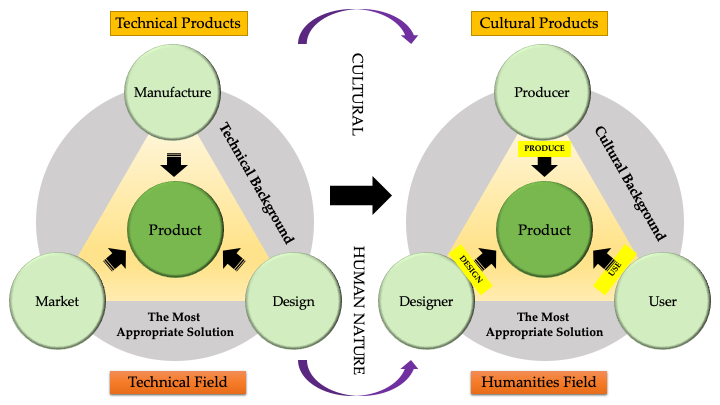
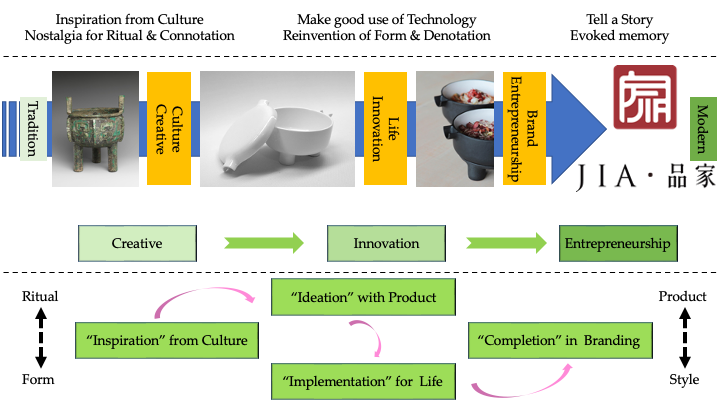
Antique relics represent a part of the rich history and cultural heritage of a nation, region, or country, and serve as great inspiration for the creation of unique cultural and artistic products. This article explores the meaning of the transition from “ritual cultural features” to “modern product forms”. By elucidating the rituals (connotation) and forms (denotation) of these cultural characteristics, this article attempts to illustrate how to transform these characteristics into modern products that are tailored to meet the needs of contemporary consumer markets. The specific objects chosen for this study are the “ritual vessels” used in various ceremonial activities in ancient China. Specifically, this study discusses the form of the “ritual vessels”, the meaning of their cultural significance, and their use scenarios. Lastly, this article introduces a cultural product design model based on the relationship between “form” and “ritual”, which seeks to offer a valuable reference for designers of cultural and creative products in the design of modern products that adhere to the continuation of cultural attributes. Moreover, we hope this article will also serve as an inspiration for how designers can use their creative thinking to discover traditional cultures’ advantages.
Keywords: form and ritual; Chinese ritual vessels; cultural creative product; cultural heritage and sustainability form and ritual; Chinese ritual vessels; cultural creative product; cultural heritage and sustainability