Article

Religious Affiliation’s Association with Suicidality across Sexual Orientations and Gender Identities

Religious Education, Brigham Young University, Provo, UT 84602, USA
*
Author to whom correspondence should be addressed.
Religions 2022, 13(10), 932; https://doi.org/10.3390/rel13100932
Submission received: 29 August 2022 / Revised: 28 September 2022 / Accepted: 3 October 2022 / Published: 9 October 2022
(This article belongs to the Special Issue The Relevance of Religion and Spirituality for Suicide Prevention)

Abstract

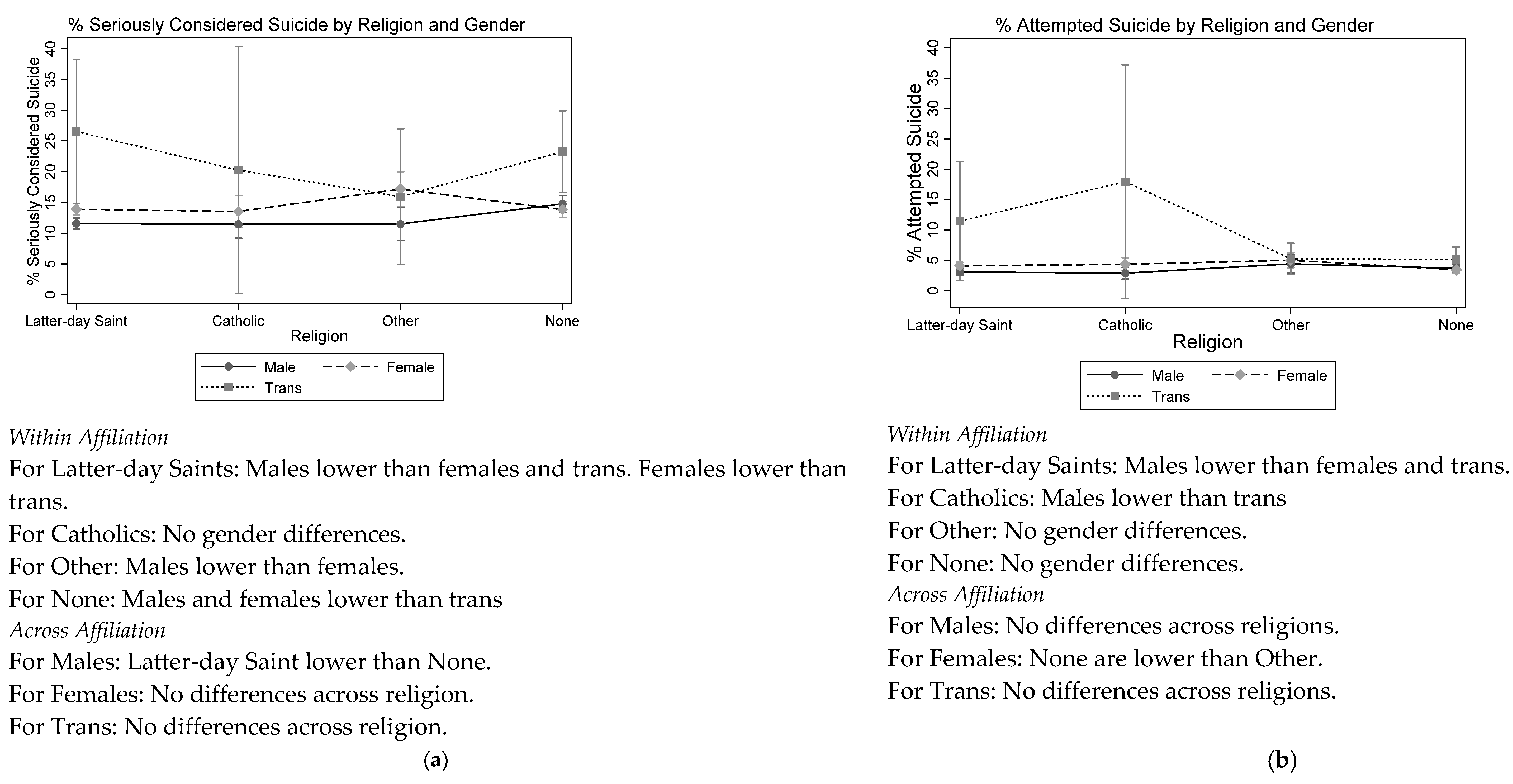
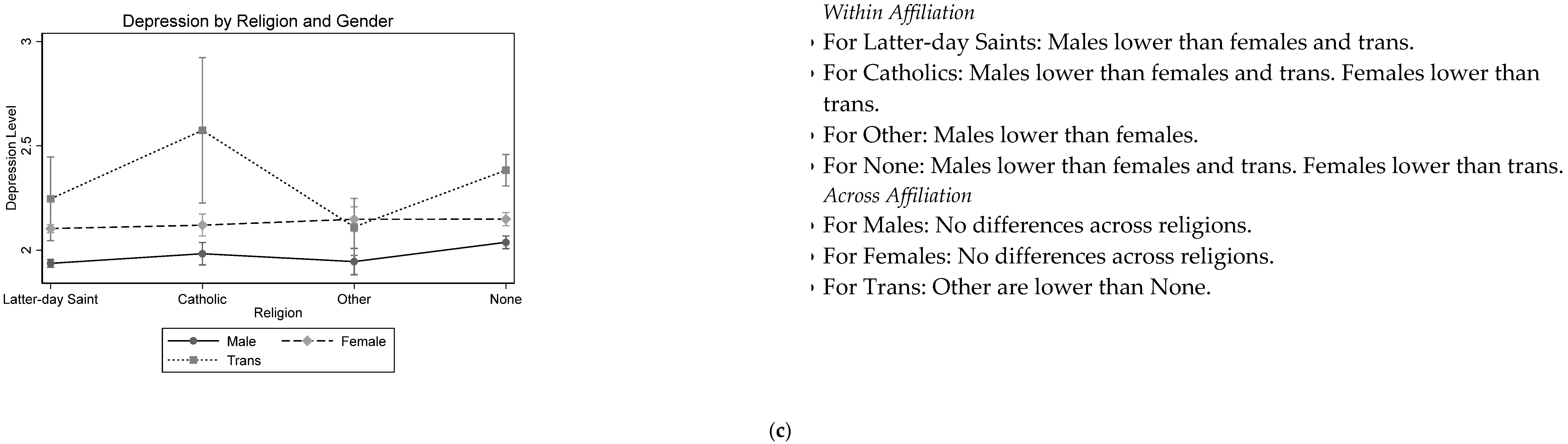
The objective was to replicate and extend earlier findings examining the intersection of sexual orientation and religious affiliation predicting suicidality. Current analyses used updated data and extended prior work by examining how affiliation relates to suicidality for transgender individuals. Data were collected in 2021 from 46,562 adolescents and were representative of Utah adolescents in grades 8, 10, and 12. In regressions, affiliation predicted suicidality and subsequent models added demographics, family functioning, drug use, feeling socially integrated, and interaction terms between sexual orientation, gender identity, and affiliation. In baseline models, affiliation was related to fewer mental health difficulties. When including drug use and family functioning, most differences became non-significant. This did not differ for sexual minorities. Interactions between affiliation and gender identity were significant. Cisgender males had the fewest mental health difficulties. When other differences were significant, transgender individuals had the highest mental health difficulties. There were no differences for transgender individuals across affiliation except those affiliated with “Other” religions had less depression than those “not affiliated.” However, “Other affiliated” females were higher in suicide attempts than the “not affiliated” and Latter-day Saint males were lower in ideation than the “not affiliated.” Findings largely replicate prior work. In final models, religious affiliation was unrelated to mental health for sexual or gender minorities; though “Other affiliation” related to protection for transgender individuals. The proposition that religious affiliation is negative for sexual or gender minorities was not supported. Longitudinal research is required to determine how affiliation may impact mental health.
Keywords: suicide; sexual orientation; transgender; religious affiliation suicide; sexual orientation; transgender; religious affiliation