Early Warning Method for Thermal Runaway High-Risk Cells Based on Nonlinear Mapping and Multidimensional Features


Abstract
1. Introduction
- (1)
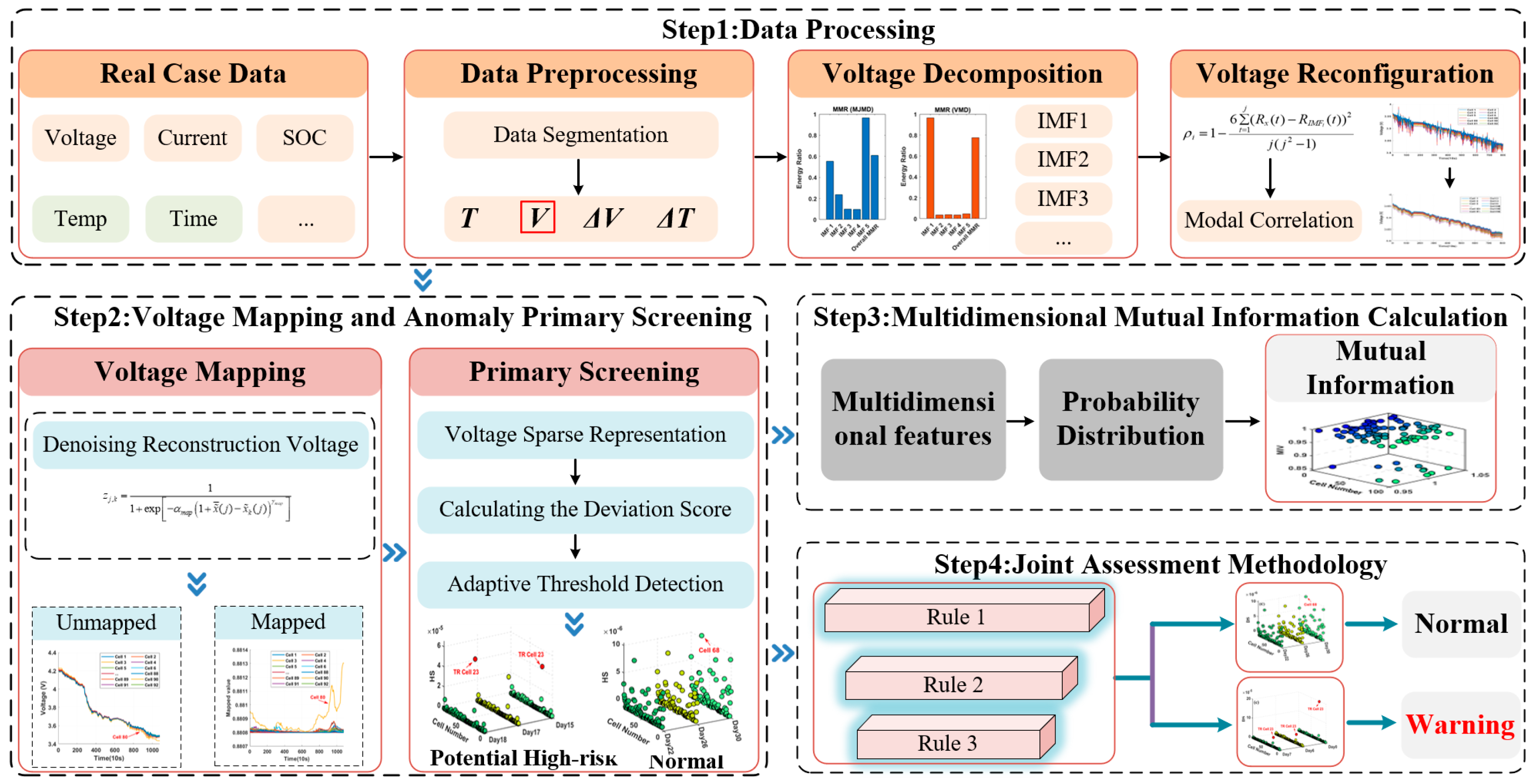
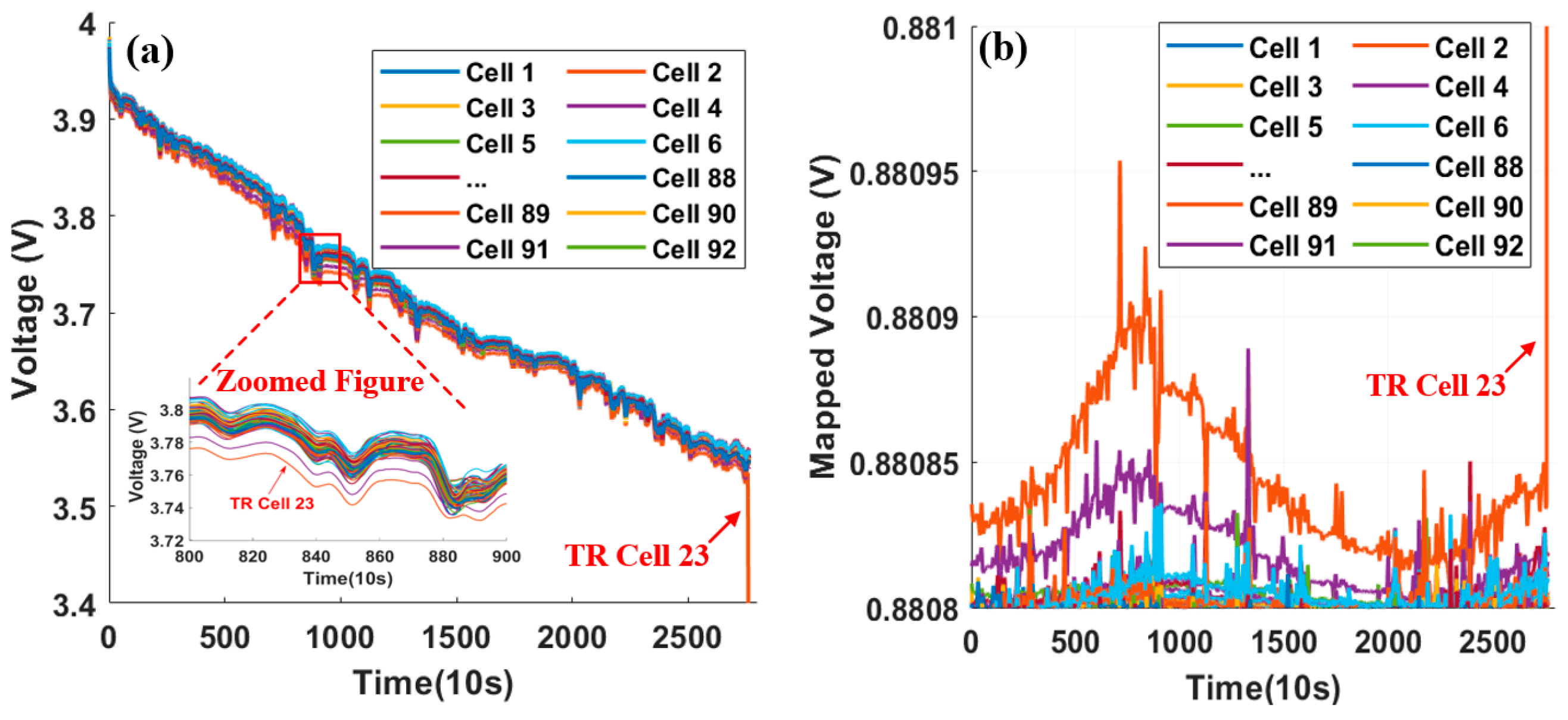
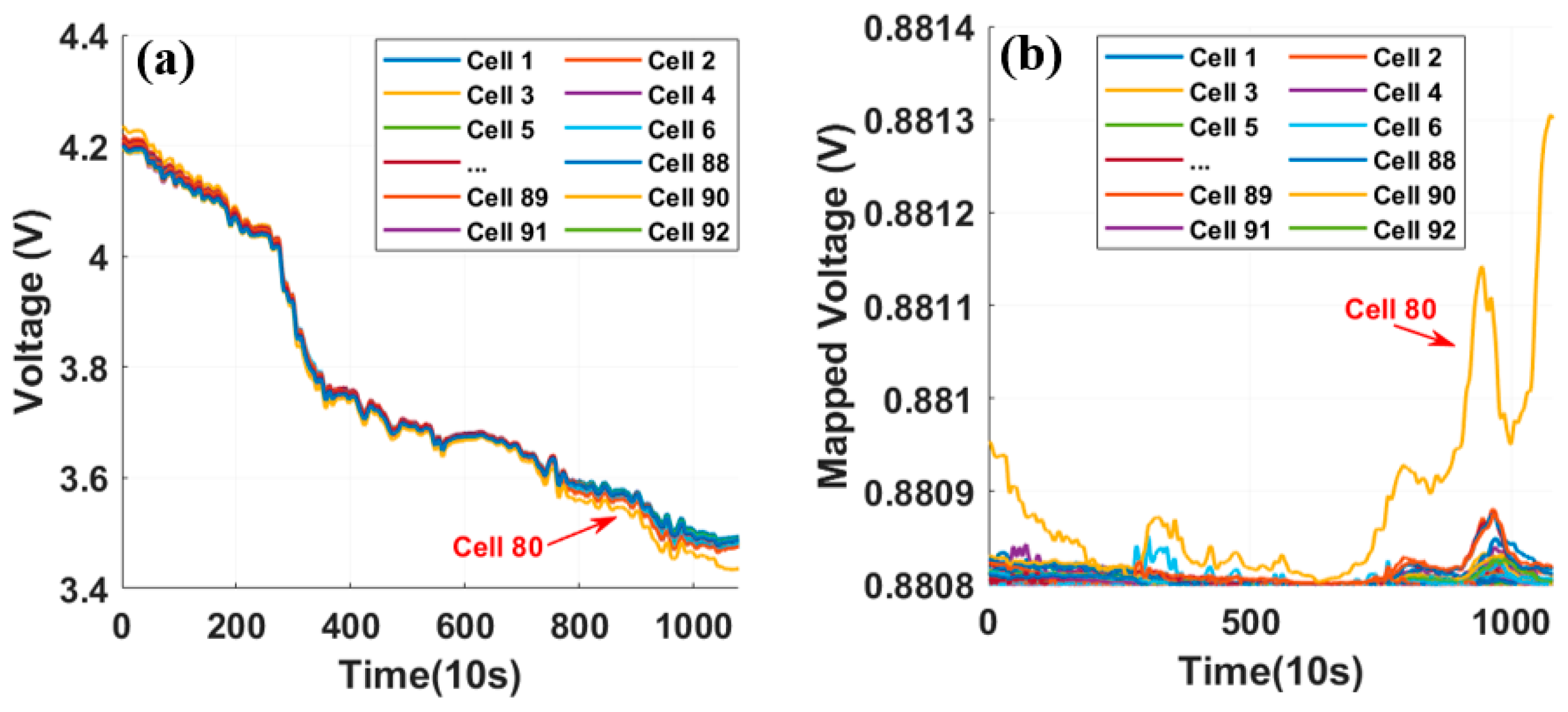
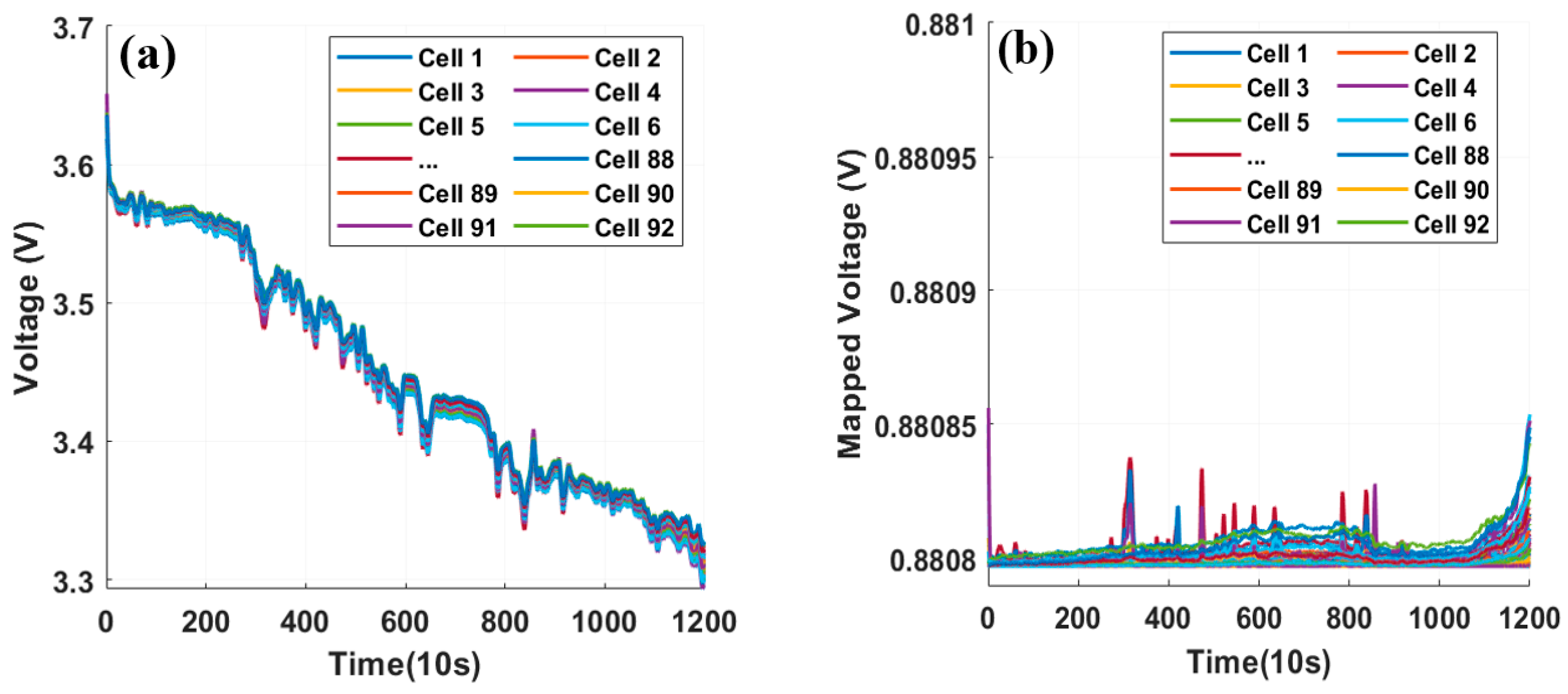
- In the early stage of abnormal evolution, the voltage responses of TR high-risk cells and normal cells are often highly similar, which limits the effectiveness of direct warning based only on denoised voltage signals. To improve early separability, an improved Sigmoid nonlinear mapping method is introduced to amplify subtle inter-cell voltage deviations and enhance the sensitivity of voltage features to incipient abnormalities.
- (2)
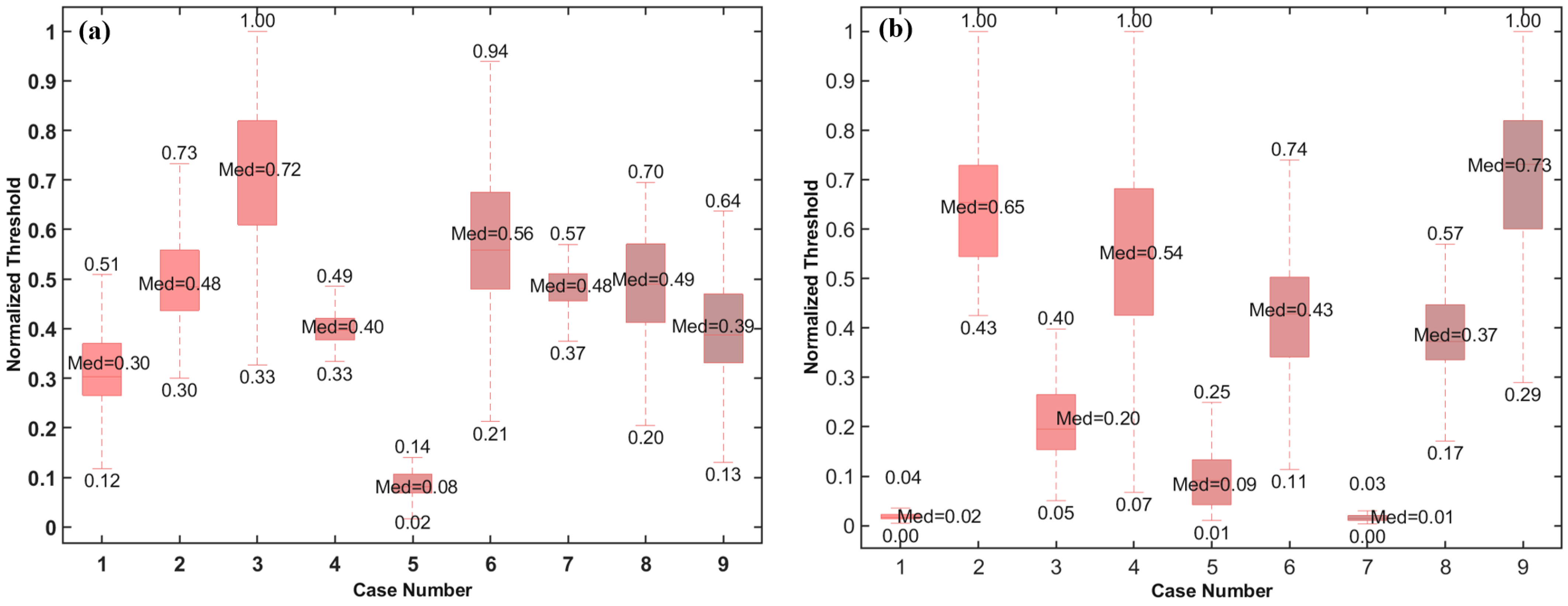
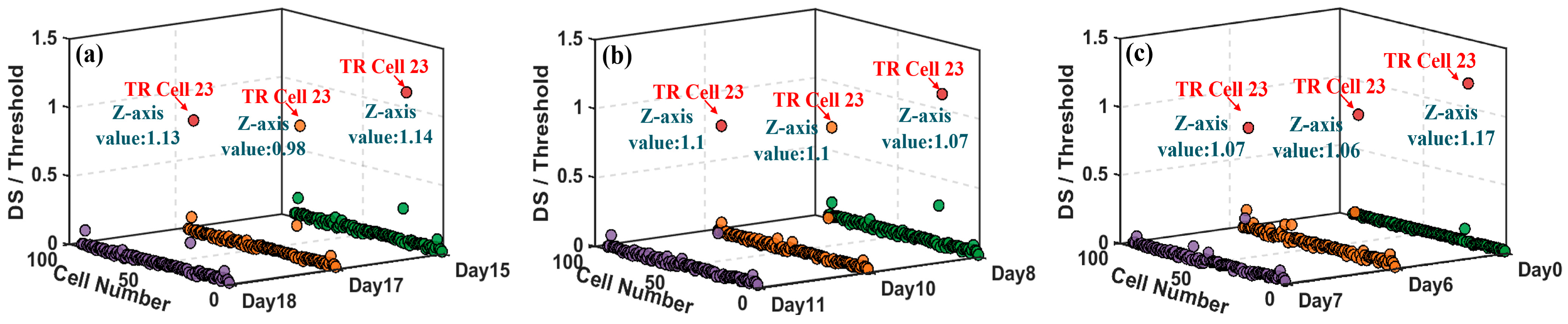
- Because abnormal cell evolution is case-dependent and the corresponding screening boundary varies across segments and operating states, a cell abnormality screening method combining sparse representation with adaptive thresholding is developed. Sparse representation is used to construct the cell deviation score (DS) from reconstruction error, while the adaptive threshold is used to determine a segment-dependent screening boundary, thereby improving the adaptability of abnormal cell identification under real operating conditions.
- (3)
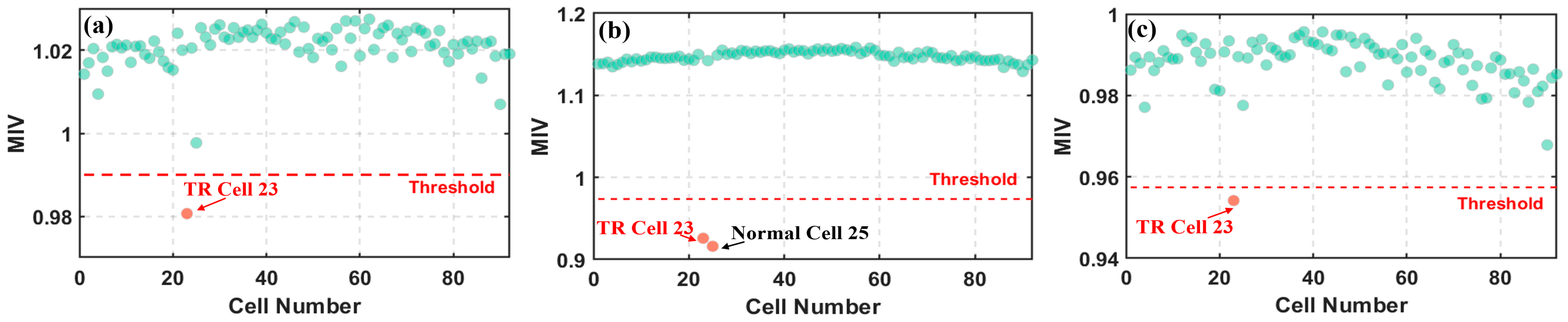
- Since voltage feature alone is insufficient to fully characterize the abnormal state of cells under complex operating conditions, a joint assessment methodology based on multidimensional mutual information value (MIV) is further established. By incorporating voltage, temperature, and their rates of change into multidimensional feature vectors, this methodology provides consistency confirmation for the cells identified in the primary screening stage, thereby reducing single-feature-induced false warnings and improving the credibility of the final warning decision.
2. Data Processing and Proposed Early Warning Method
- (1)
- Data processing: Only voltage, temperature, and their corresponding rates of change are retained as downstream analysis variables, while current and SOC are treated as information on partitioning data segments and are not included in the subsequent analysis. The original voltages are then decomposed using multiscale jump plus mode decomposition (MJMD), with a genetic algorithm used for parameter optimization. Denoised voltages are obtained by reconstructing the decomposed modes according to the Spearman-correlation criterion.
- (2)
- Voltage mapping and abnormal cell screening: An improved Sigmoid nonlinear mapping method is applied to the denoised voltages to enhance inter-cell differentiation. A sparse representation scheme is then used to construct a representative voltage basis, and each mapped voltage is reconstructed through a sparse linear combination. Based on the reconstruction error, a cell DS is calculated and combined with the adaptive threshold to screen abnormal cells.
- (3)
- Calculation of MIV: To capture both static and dynamic cell characteristics, four-dimensional feature vectors are constructed from voltage, temperature, and their corresponding rates of change. The MIV of each cell’s four-dimensional vector is then calculated, providing the basis for the subsequent joint assessment.
- (4)
- Joint assessment methodology: Based on the abnormal screening results and the MIV of each cell, a joint assessment method with three decision rules is established to further improve early warning accuracy.
2.1. Voltage Processing
2.2. Voltage Mapping and Screening of Abnormal Cells
2.2.1. Voltage Mapping
2.2.2. Abnormal Cell Screening Based on Sparse Representation
2.3. Evaluation of Cell State Based on MIV
2.4. Joint Assessment Methodology
3. Data Description and Primary Analysis
3.1. Initial Analysis of TR Case
3.2. Initial Analysis of Non-TR Cases
4. Analysis and Discussion of the Warning Results
4.1. Threshold Analysis
4.2. Warning Results of TR Cases
4.3. Warning Results of Non-TR Cases
4.4. Comparative Analysis
4.4.1. Effectiveness Analysis of Voltage Signal Processing
4.4.2. Comparison of Anomaly Screening Results of Three Mapping Methods
4.4.3. Sensitivity Analysis of Key Parameters
4.4.4. Validity Analysis of Multidimensional Features
4.4.5. Comparison of Early Warning Results with Other Methods
5. Conclusions
- (1)
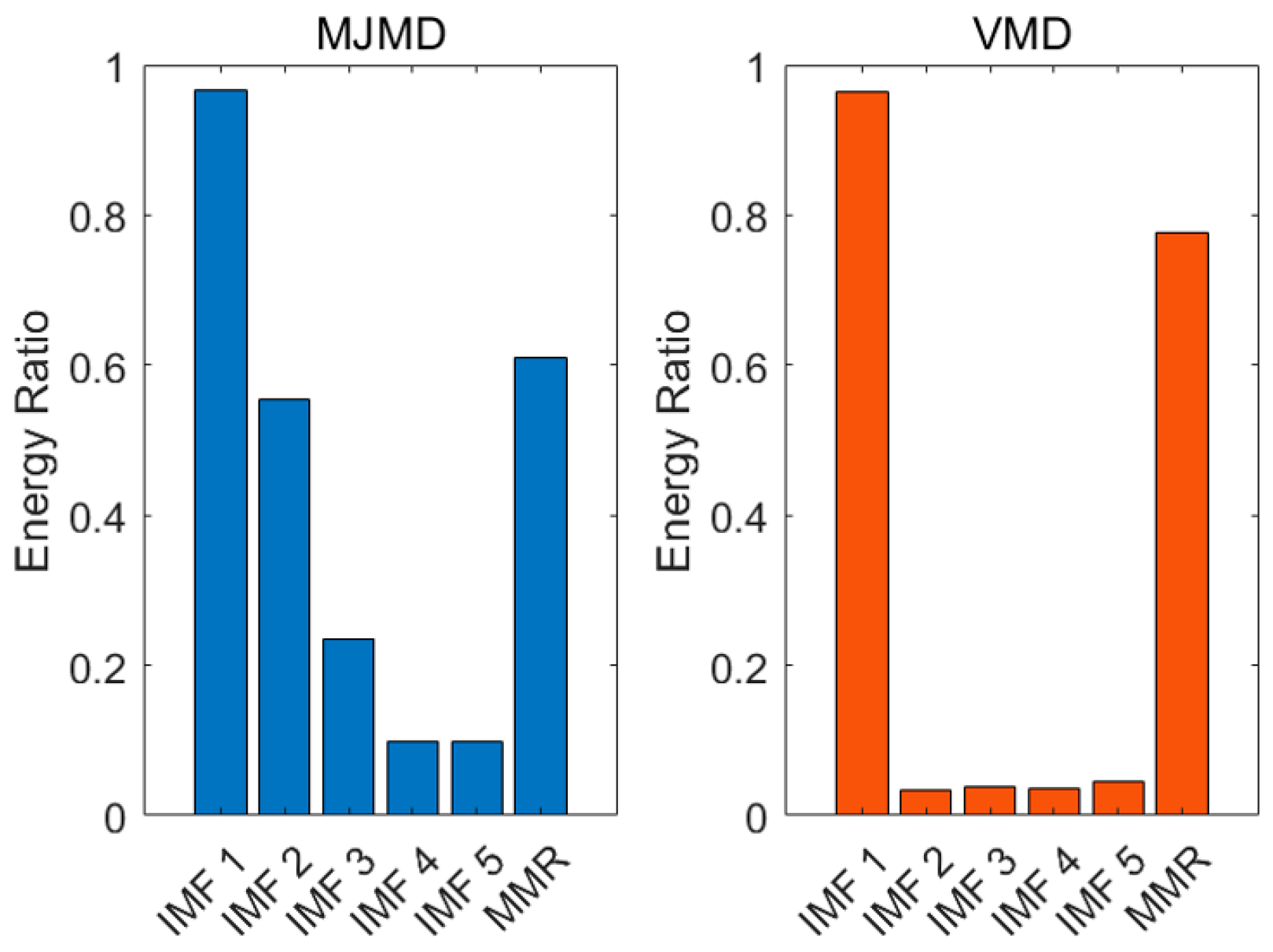
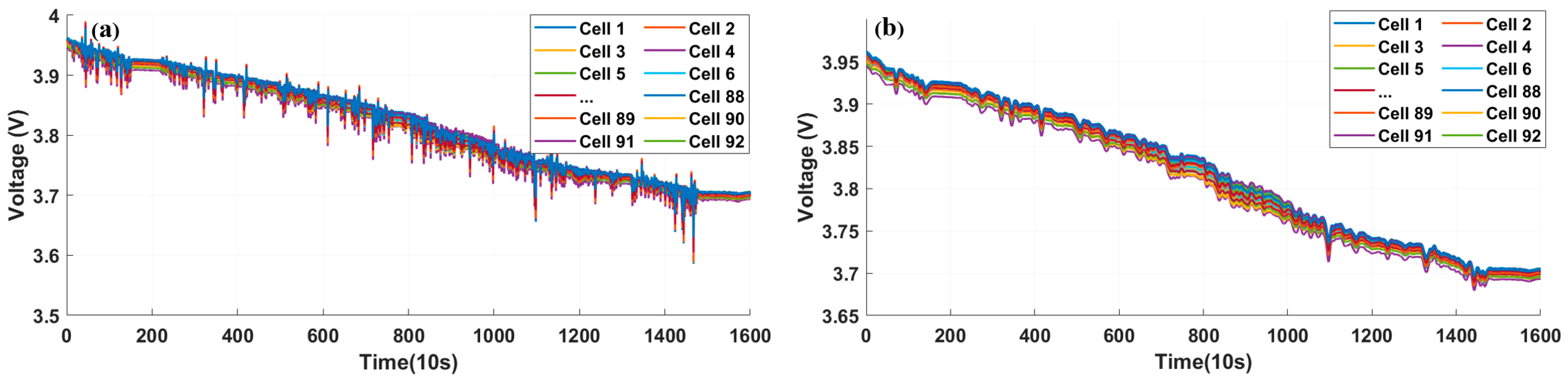
- The MJMD denoising scheme, together with Spearman correlation selection, effectively suppresses irrelevant voltage interference while preserving useful signal information. This provides a more reliable basis for the subsequent warning process.
- (2)
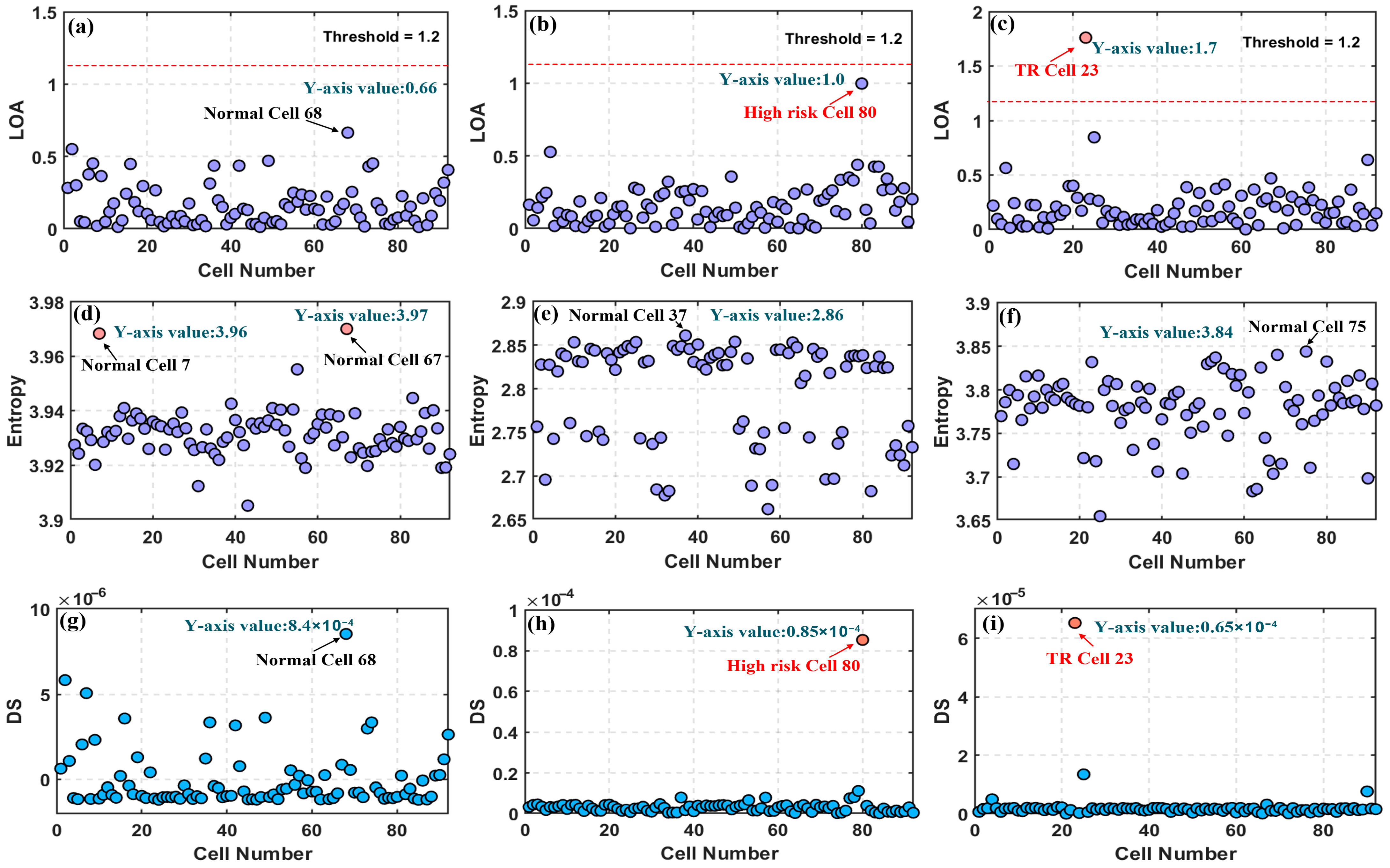
- The improved Sigmoid nonlinear mapping makes subtle early-stage differences between TR high-risk cells and normal cells more visible. In doing so, it addresses the limited local sensitivity of linear mappings and helps reduce false warnings when the original voltage differences are extremely small.
- (3)
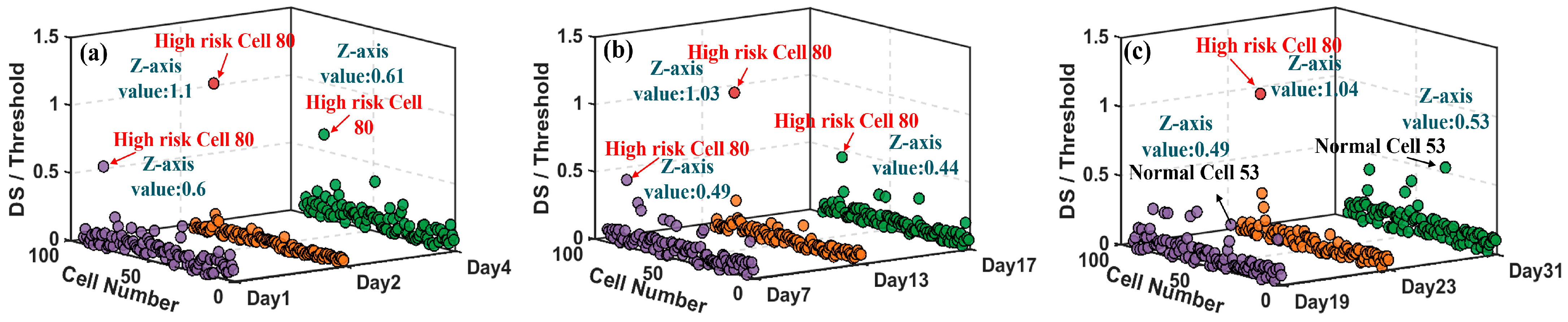
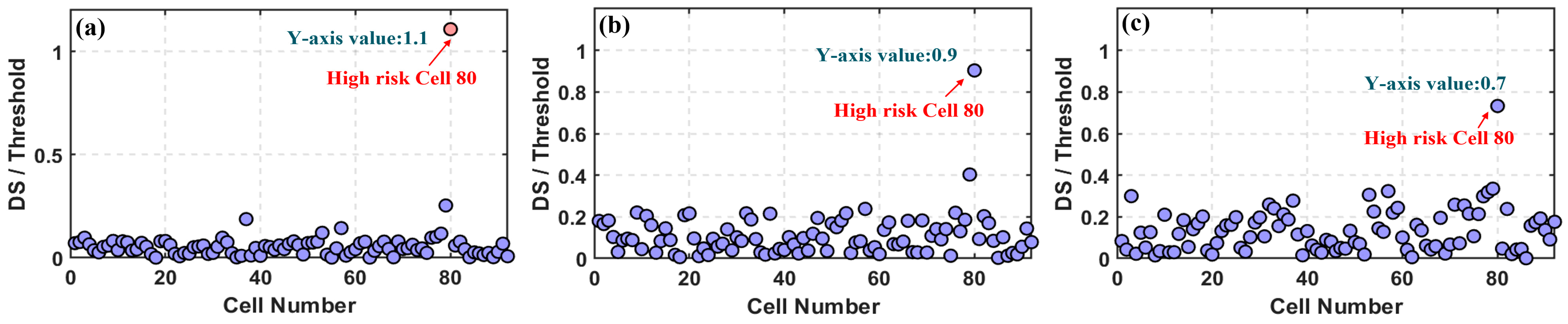
- Sparse representation combined with adaptive thresholding improves adaptability across degradation stages and operating conditions. Compared with fixed-threshold approaches, it better controls both false warnings and missed warnings, which in turn strengthens the strategy’s generalizability.
- (4)
- By incorporating both static and dynamic cell characteristics, the MIV-based joint assessment provides an additional check beyond voltage alone. This improves the reliability of high-risk cell identification and helps suppress false warnings that can arise from single-feature screening.
Author Contributions
Funding
Data Availability Statement
Conflicts of Interest
References
- Guo, S.; Wang, Y.; Dai, L.; Hu, H. All-Electric Ship Operations and Management: Overview and Future Research Directions. eTransportation 2023, 17, 100251. [Google Scholar] [CrossRef]
- Abu Bakar, N.N.; Bazmohammadi, N.; Vasquez, J.C.; Guerrero, J.M. Electrification of Onshore Power Systems in Maritime Transportation towards Decarbonization of Ports: A Review of the Cold Ironing Technology. Renew. Sustain. Energy Rev. 2023, 178, 113243. [Google Scholar] [CrossRef]
- Tummakuri, V.; Chelliah, T.R.; Ramesh, U.S. Energy Management and Charging Portfolio Analysis for Future Battery Powered Harbor Vessels. IEEE Trans. Ind. Appl. 2023, 59, 6522–6531. [Google Scholar] [CrossRef]
- Chen, J.; Li, B.; Li, J.; Gao, Y.; Hao, Z.; Wang, L. Exploring the Electrochemical and Mechanical Properties of Lithium-Ion Batteries in Salt Spray Environments. eTransportation 2024, 20, 100324. [Google Scholar] [CrossRef]
- Berg, P.; Spielbauer, M.; Tillinger, M.; Merkel, M.; Schoenfuss, M.; Bohlen, O.; Jossen, A. Durability of Lithium-Ion 18650 Cells under Random Vibration Load with Respect to the Inner Cell Design. J. Energy Storage 2020, 31, 101499. [Google Scholar] [CrossRef]
- Yin, R.; Du, M.; Shi, F.; Cao, Z.; Wu, W.; Shi, H.; Zheng, Q. Risk Analysis for Marine Transport and Power Applications of Lithium Ion Batteries: A Review. Process Saf. Environ. Prot. 2024, 181, 266–293. [Google Scholar] [CrossRef]
- Liu, S.; Wang, Y.; Liu, Q.; Panchal, S.; Zhao, J.; Fowler, M.; Fraser, R.; Yuan, J. Thermal Equalization Design for the Battery Energy Storage System (BESS) of a Fully Electric Ship. Energy 2024, 312, 133611. [Google Scholar] [CrossRef]
- Wang, Y.; Lu, X.; Zhang, Y.; Liu, L. Hazard Comparison of Thermal Runaway of Electric Marine Battery Cabinet under Different Trigger Modes. Int. J. Heat Mass Transf. 2024, 228, 125689. [Google Scholar] [CrossRef]
- Yan, Y.; Wang, L.; Wu, Z.; Dong, J.; Yuan, Z.; Han, J.; Li, J. Thermal Runaway and Combustion of Lithium-Ion Batteries in Engine Room Fires on Oil/Electric-Powered Ships. Appl. Therm. Eng. 2024, 254, 123838. [Google Scholar] [CrossRef]
- Bugryniec, P.; Khanna, S.; Wootton, M.; Williams, D.; Brown, S. Assessment of the Risks Posed by Thermal Runaway within Marine Li-Ion Battery Energy Storage Systems—Considering Past Incidents, Current Guidelines and Future Mitigation Measures. J. Energy Storage 2024, 128, 117070. [Google Scholar] [CrossRef]
- Hong, J.; Zhang, H.; Xu, X. Thermal Fault Prognosis of Lithium-Ion Batteries in Real-World Electric Vehicles Using Self-Attention Mechanism Networks. Appl. Therm. Eng. 2023, 226, 120304. [Google Scholar] [CrossRef]
- Zhang, Y.; Li, S.; Mao, B.; Shi, J.; Zhang, X.; Zhou, L. A Multi-Level Early Warning Strategy for the LiFePO4 Battery Thermal Runaway Induced by Overcharge. Appl. Energy 2023, 347, 121375. [Google Scholar] [CrossRef]
- Cao, X.; Du, J.; Qu, C.; Wang, J.; Tu, R. An Early Diagnosis Method for Overcharging Thermal Runaway of Energy Storage Lithium Batteries. J. Energy Storage 2024, 75, 109661. [Google Scholar] [CrossRef]
- Zhang, W.; Ouyang, N.; Yin, X.; Li, X.; Wu, W.; Huang, L. Data-Driven Early Warning Strategy for Thermal Runaway Propagation in Lithium-Ion Battery Modules with Variable State of Charge. Appl. Energy 2022, 323, 119614. [Google Scholar] [CrossRef]
- Lyu, N.; Jin, Y.; Miao, S.; Xiong, R.; Xu, H.; Gao, J.; Liu, H.; Li, Y.; Han, X. Fault Warning and Location in Battery Energy Storage Systems via Venting Acoustic Signal. IEEE J. Emerg. Sel. Top. Power Electron. 2023, 11, 100–108. [Google Scholar] [CrossRef]
- Jia, T.; Zhang, Y.; Ma, C.; Yu, H.; Hu, S. The Early Warning for Thermal Runaway of Lithium-Ion Batteries Based on Internal and External Temperature Model. J. Energy Storage 2024, 83, 110690. [Google Scholar] [CrossRef]
- Jianhui, Y.; Yu, W.; Yan, W.; Hongxu, L.; Ruiguang, Y.; Yalun, L.; Hewu, W.; Languang, L.; Xuning, F.; Chengshan, X.; et al. The Experimental Research for a Thermal Failure LiFePO4 Battery: Venting Behavior, Multi-Information Monitoring and Early Warning Strategy. J. Energy Storage 2024, 87, 111456. [Google Scholar] [CrossRef]
- Yu, Q.; Wang, C.; Li, J.; Xiong, R.; Pecht, M. Challenges and Outlook for Lithium-Ion Battery Fault Diagnosis Methods from the Laboratory to Real World Applications. eTransportation 2023, 17, 100254. [Google Scholar] [CrossRef]
- Song, Y.; Yu, J.; Zhou, J.; Zhang, J.; Tang, D.; Yu, Z. Detection of Voltage Fault in Lithium-Ion Battery Based on Equivalent Circuit Model-Informed Neural Network. IEEE Trans. Instrum. Meas. 2024, 73, 3508010. [Google Scholar] [CrossRef]
- Yang, Q.; Xu, C.; Geng, M.; Meng, H. A Review on Models to Prevent and Control Lithium-Ion Battery Failures: From Diagnostic and Prognostic Modeling to Systematic Risk Analysis. J. Energy Storage 2023, 74, 109230. [Google Scholar] [CrossRef]
- Machlev, R. EV Battery Fault Diagnostics and Prognostics Using Deep Learning: Review, Challenges & Opportunities. J. Energy Storage 2024, 83, 110614. [Google Scholar] [CrossRef]
- Fan, Y.; Huang, Z.; Li, H.; Yuan, W.; Yan, L.; Liu, Y.; Chen, Z. Fault Detection for Li-Ion Batteries of Electric Vehicles with Feature-Augmented Attentional Autoencoder. Sci. Rep. 2025, 15, 18534. [Google Scholar] [CrossRef]
- Zhao, J.; Feng, X.; Pang, Q.; Fowler, M.; Lian, Y.; Ouyang, M.; Burke, A.F. Battery Safety: Machine Learning-Based Prognostics. Prog. Energy Combust. Sci. 2024, 102, 101142. [Google Scholar] [CrossRef]
- Kumar, R.; Das, K. Lithium Battery Prognostics and Health Management for Electric Vehicle Application—A Perspective Review. Sustain. Energy Technol. Assess. 2024, 65, 103766. [Google Scholar] [CrossRef]
- Yao, L.; Xiao, Y.; Gong, X.; Hou, J.; Chen, X. A Novel Intelligent Method for Fault Diagnosis of Electric Vehicle Battery System Based on Wavelet Neural Network. J. Power Sources 2020, 453, 227870. [Google Scholar] [CrossRef]
- Li, X.; Dai, K.; Wang, Z.; Han, W. Lithium-Ion Batteries Fault Diagnostic for Electric Vehicles Using Sample Entropy Analysis Method. J. Energy Storage 2020, 27, 101121. [Google Scholar] [CrossRef]
- Jiang, J.; Cong, X.; Li, S.; Zhang, C.; Zhang, W.; Jiang, Y. A Hybrid Signal-Based Fault Diagnosis Method for Lithium-Ion Batteries in Electric Vehicles. IEEE Access 2021, 9, 19175–19186. [Google Scholar] [CrossRef]
- Stallone, A.; Cicone, A.; Materassi, M. New Insights and Best Practices for the Successful Use of Empirical Mode Decomposition, Iterative Filtering and Derived Algorithms. Sci. Rep. 2020, 10, 15161. [Google Scholar] [CrossRef]
- Li, S.; Zhang, C.; Du, J.; Cong, X.; Zhang, L.; Jiang, Y.; Wang, L. Fault Diagnosis for Lithium-Ion Batteries in Electric Vehicles Based on Signal Decomposition and Two-Dimensional Feature Clustering. Green Energy Intell. Transp. 2022, 1, 100009. [Google Scholar] [CrossRef]
- Tang, A.; Wu, Z.; Xu, T.; Wu, X.; Hu, Y.; Yu, Q. Week-Level Early Warning Strategy for Thermal Runaway Risk Based on Real-Scenario Operating Data of Electric Vehicles. eTransportation 2024, 19, 100308. [Google Scholar] [CrossRef]
- Sun, J.; Qiu, Y.; Shang, Y.; Lu, G. A Multi-Fault Advanced Diagnosis Method Based on Sparse Data Observers for Lithium-Ion Batteries. J. Energy Storage 2022, 50, 104694. [Google Scholar] [CrossRef]
- Jiang, J.; Li, T.; Chang, C.; Yang, C.; Liao, L. Fault Diagnosis Method for Lithium-Ion Batteries in Electric Vehicles Based on Isolated Forest Algorithm. J. Energy Storage 2022, 50, 104177. [Google Scholar] [CrossRef]
- Jiang, J.; Zhang, R.; Wu, Y.; Chang, C.; Jiang, Y. A Fault Diagnosis Method for Electric Vehicle Power Lithium Battery Based on Wavelet Packet Decomposition. J. Energy Storage 2022, 56, 105909. [Google Scholar] [CrossRef]
- Yu, P.; Li, Y.; Geng, X.; Li, S.; Zong, B.; Liu, H. An Energy Entropy-Based Diagnostic Method for Voltage Abnormality in Real-World Battery Systems. J. Energy Storage 2025, 125, 116958. [Google Scholar] [CrossRef]
- Hong, J.; Wang, Z.; Zhang, X.; Wang, W.; Chen, Y.; Shan, T. Collision-Caused Thermal Runaway Investigation of Li-Ion Battery in Real-World Electric Vehicles. Appl. Therm. Eng. 2024, 236, 121901. [Google Scholar] [CrossRef]
- Nazari, M.; Korshøj, A.R.; Rehman, N.U. Jump Plus AM-FM Mode Decomposition. IEEE Trans. Signal Process. 2025, 73, 1081–1093. [Google Scholar] [CrossRef]
- Duan, Y.; Song, C. Relevant Modes Selection Method Based on Spearman Correlation Coefficient for Laser Signal Denoising Using Empirical Mode Decomposition. Opt. Rev. 2016, 23, 936–949. [Google Scholar] [CrossRef]
- Yang, H.; Cheng, Y.; Li, G. A Denoising Method for Ship Radiated Noise Based on Spearman Variational Mode Decomposition, Spatial-Dependence Recurrence Sample Entropy, Improved Wavelet Threshold Denoising, and Savitzky-Golay Filter. Alex. Eng. J. 2021, 60, 3379–3400. [Google Scholar] [CrossRef]
- Chen, F.; Chen, X.; Jin, J.; Qin, Y.; Chen, Y. A Data-Driven Early Warning Method for Thermal Runaway of Energy Storage Batteries and Its Application in Retired Lithium Batteries. Front. Energy Res. 2024, 11, 1334558. [Google Scholar] [CrossRef]
- Akhavan, S.; Baghestani, F.; Kazemi, P.; Karami, A.; Soltanian-Zadeh, H. Dictionary Learning for Sparse Representation of Signals with Hidden Markov Model Dependency. Digit. Signal Process. 2022, 123, 103420. [Google Scholar] [CrossRef]
- Li, X.; Li, Q.; Zhang, J.; Sun, J.; Li, R.; Li, J. Based on Principal Component Analysis Method for Identification of Thermal Runaway Stages in LiFePO4 Batteries under Thermal Abuse Conditions. J. Energy Storage 2025, 137, 118684. [Google Scholar] [CrossRef]
- Yin, X.; Pan, T.; Tian, J.; Ni, L.; Lao, L. Voltage-Fault Diagnosis for Battery Pack in Electric Vehicles Using Mutual Information. J. Power Sources 2024, 608, 234636. [Google Scholar] [CrossRef]
- Xu, K. Electrolytes and Interphases in Li-Ion Batteries and Beyond. Chem. Rev. 2014, 114, 11503–11618. [Google Scholar] [CrossRef]
- Lain, M.J.; Kendrick, E. Understanding the Limitations of Lithium Ion Batteries at High Rates. J. Power Sources 2021, 493, 229690. [Google Scholar] [CrossRef]
- Johnson, H.; Styhre, L. Increased Energy Efficiency in Short Sea Shipping through Decreased Time in Port. Transp. Res. Part A Policy Pract. 2015, 71, 167–178. [Google Scholar] [CrossRef]
- Zheng, X.-B.; Kim, Y.-S.; Shin, Y.-R. Cost Effectiveness Analysis in Short Sea Shipping: Evidence from Northeast Asian Routes. J. Mar. Sci. Eng. 2021, 9, 1340. [Google Scholar] [CrossRef]
- Ni, J.; Tian, H.; Zhang, K.; Xue, Y.; Xiong, Y. Data-Driven Multi-Scale Channel-Aligned Transformer for Low-Carbon Autonomous Vessel Operations: Enhancing CO2 Emission Prediction and Green Autonomous Shipping Efficiency. J. Mar. Sci. Eng. 2025, 13, 1143. [Google Scholar] [CrossRef]
- Mäkelä, M.; Niemi, S.; Nuortila, C.; Nyystilä, L. Applicability of Hydrogen Fuel for a Cruise Ship. Clean Technol. 2025, 7, 6. [Google Scholar] [CrossRef]
- Kim, J.-Y.; Oh, J.-S. Multiple Feature Extraction Long Short-Term Memory Using Skip Connections for Ship Electricity Forecasting. J. Mar. Sci. Eng. 2023, 11, 1690. [Google Scholar] [CrossRef]
- Zhang, J.; Wang, Y.; Jiang, B.; He, H.; Huang, S.; Wang, C.; Zhang, Y.; Han, X.; Guo, D.; He, G.; et al. Realistic Fault Detection of Li-Ion Battery via Dynamical Deep Learning. Nat. Commun. 2023, 14, 5940. [Google Scholar] [CrossRef]









| Parameters | Value |
|---|---|
| Bandwidth penalty | 5000 |
| jump weights | 0.05 |
| Scaling factor | 50 |
| Minimum jump amplitude threshold | 0.45 |
| Number of modes | 4 |
| Date | Abnormal ID | Minimum MIV | Threshold |
|---|---|---|---|
| Day 18 | None | 0.6955 | 0.6908 |
| Day 17 | 23 | 0.9806 | 0.99 |
| Day 15 | 25/23 | 0.916 | 0.9736 |
| Day 11 | 23 | 0.9541 | 0.9574 |
| Day 10 | None | 0.7731 | 0.6174 |
| Day 8 | None | 0.6931 | 0.6892 |
| Day 7 | None | 0.6931 | 0.6895 |
| Day 6 | None | 0.9805 | 0.9773 |
| Day 0 | 23 | 0.9217 | 0.9233 |
| Date | Abnormal ID | Minimum MIV | Threshold |
|---|---|---|---|
| Day 1 | None | 0.9159 | 0.9149 |
| Day 2 | None | 0.8769 | 0.8207 |
| Day 4 | None | 0.6686 | 0.6672 |
| Day 7 | None | 0.8769 | 0.8207 |
| Day 13 | None | 0.845 | 0.7757 |
| Day 17 | None | 0.6093 | 0.609 |
| Day 19 | None | 0.6658 | 0.6657 |
| Day 23 | 80 | 0.8745 | 0.9155 |
| Day 31 | None | 0.6368 | 0.6367 |
| Date | Abnormal ID | Minimum MIV | Threshold |
|---|---|---|---|
| Day 1 | None | 0.8876 | 0.8845 |
| Day 6 | None | 1.003 | 0.9927 |
| Day 10 | None | 0.6960 | 0.6957 |
| Day 13 | 31/43 | 1.0456 | 1.0641 |
| Day 17 | None | 1.0687 | 1.0513 |
| Day 19 | None | 1.0249 | 1.0168 |
| Day 22 | None | 1.0104 | 1.001 |
| Day 26 | None | 1.0061 | 1.0047 |
| Day 30 | 67 | 0.7148 | 0.7418 |
| Number | Route | Type | Day |
|---|---|---|---|
| [45] | Sweden-Finland | Bulk | ≤5 |
| [46] | Korea-Japan | Container | ≤5 |
| [47] | Rotterdam-New York | Container | 7 |
| [48] | Around the Mediterranean Sea | Cruise ship | ≤10 |
| Case#1: Earliest Warning Time Within One Month | Case#1: Number of Cells with Missed Warning | Case#1: The Number of Days Within a Month with Detected DS Abnormalities | Case#2: Earliest Warning Time Within One Month | Case#2: Number of Cells with Missed Warning | Case#2: The Number of Days Within a Month with Detected DS Abnormalities | |
|---|---|---|---|---|---|---|
| 2 | Day 4 | 0 | 8 | Day 23 | 0 | 3 |
| 5 | None | 1 | None | None | 1 | 2 |
| 7 | None | 1 | None | None | 1 | 0 |
| Case#1: Earliest Warning Time Within One Month | Case#1: Number of Cells with Missed Warning | Case#1: The Number of Days Within a Month with Detected DS Abnormalities | Case#2: Earliest Warning Time Within One Month | Case#2: Number of Cells with Missed Warning | Case#2: The Number of Days Within a Month with Detected DS Abnormalities | |
|---|---|---|---|---|---|---|
| 10 | Day 16 | 0 | 9 | Day 23 | 0 | 4 |
| 12 | Day 20 | 0 | 8 | Day 23 | 0 | 3 |
| 14 | None | 1 | 2 | None | 1 | 2 |
| Method | Total Number of Cells | Number of True TR High-Risk Cells | Number of Cells Ever Identified as High-Risk | Cumulative Number of False Warnings |
|---|---|---|---|---|
| Proposed | 276 | 2 | 2 | 2 |
| LOA | 276 | 2 | 10 | 34 |
| Entropy-based | 276 | 2 | 40 | 141 |
| Variational Autoencoder | 276 | 2 | 32 | 74 |
| Isolated Forest | 276 | 2 | 48 | 225 |
| Support Vector Machine | 276 | 2 | 45 | 337 |
Disclaimer/Publisher’s Note: The statements, opinions and data contained in all publications are solely those of the individual author(s) and contributor(s) and not of MDPI and/or the editor(s). MDPI and/or the editor(s) disclaim responsibility for any injury to people or property resulting from any ideas, methods, instructions or products referred to in the content. |
© 2026 by the authors. Licensee MDPI, Basel, Switzerland. This article is an open access article distributed under the terms and conditions of the Creative Commons Attribution (CC BY) license.
Share and Cite
Liu, Z.; Liu, H.; Lu, F.; Liu, Y.; Xiao, Y. Early Warning Method for Thermal Runaway High-Risk Cells Based on Nonlinear Mapping and Multidimensional Features. J. Mar. Sci. Eng. 2026, 14, 684. https://doi.org/10.3390/jmse14070684
Liu Z, Liu H, Lu F, Liu Y, Xiao Y. Early Warning Method for Thermal Runaway High-Risk Cells Based on Nonlinear Mapping and Multidimensional Features. Journal of Marine Science and Engineering. 2026; 14(7):684. https://doi.org/10.3390/jmse14070684
Chicago/Turabian StyleLiu, Zhengxin, Hongda Liu, Fang Lu, Yuxi Liu, and Yangting Xiao. 2026. "Early Warning Method for Thermal Runaway High-Risk Cells Based on Nonlinear Mapping and Multidimensional Features" Journal of Marine Science and Engineering 14, no. 7: 684. https://doi.org/10.3390/jmse14070684
APA StyleLiu, Z., Liu, H., Lu, F., Liu, Y., & Xiao, Y. (2026). Early Warning Method for Thermal Runaway High-Risk Cells Based on Nonlinear Mapping and Multidimensional Features. Journal of Marine Science and Engineering, 14(7), 684. https://doi.org/10.3390/jmse14070684