Hydrodynamic Performance Assessment of a Hybrid Wave Energy Converter Array–Floating Breakwater System Under Irregular Waves



 and
and
Abstract
1. Introduction
2. Numerical Models
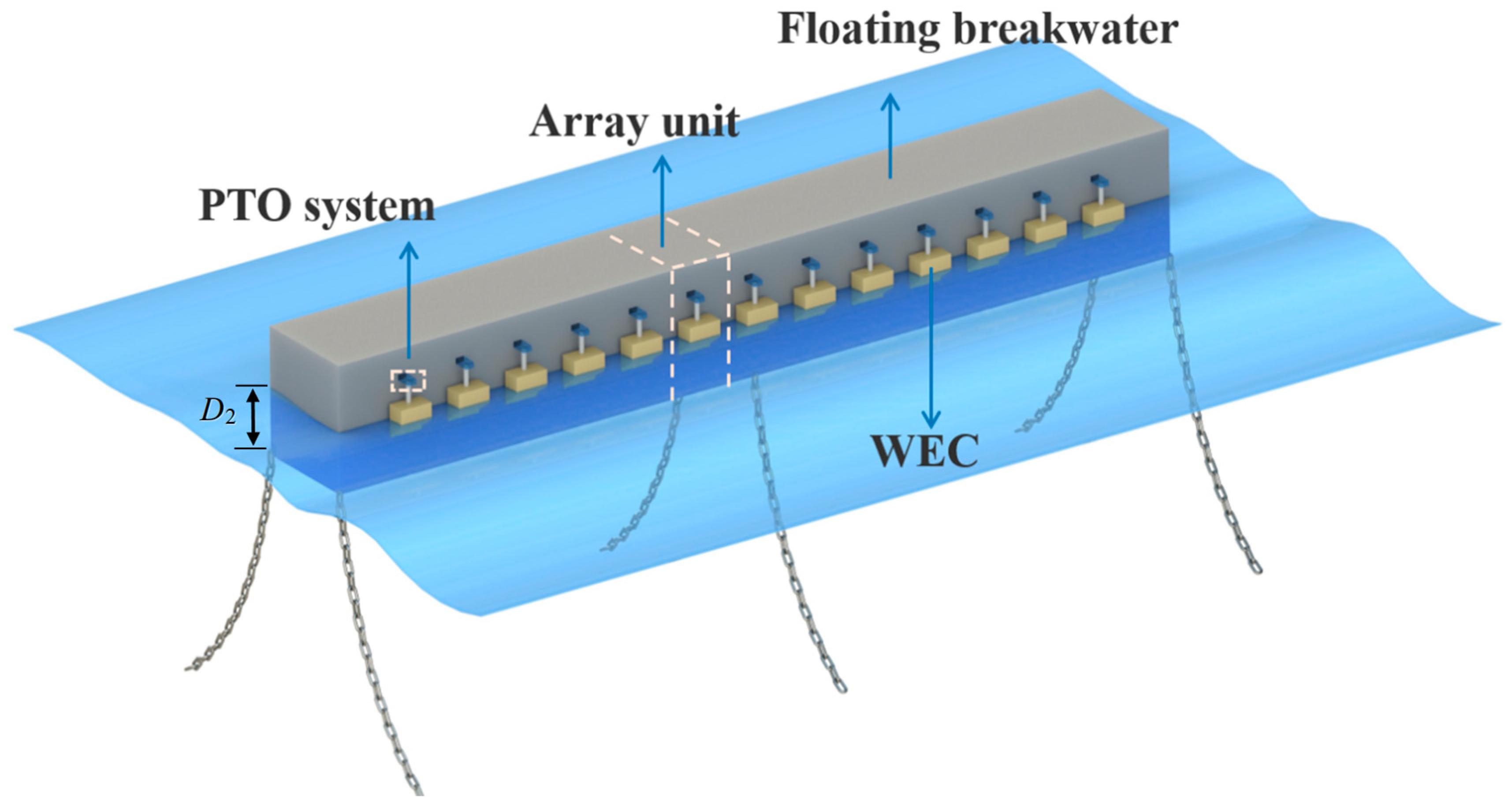
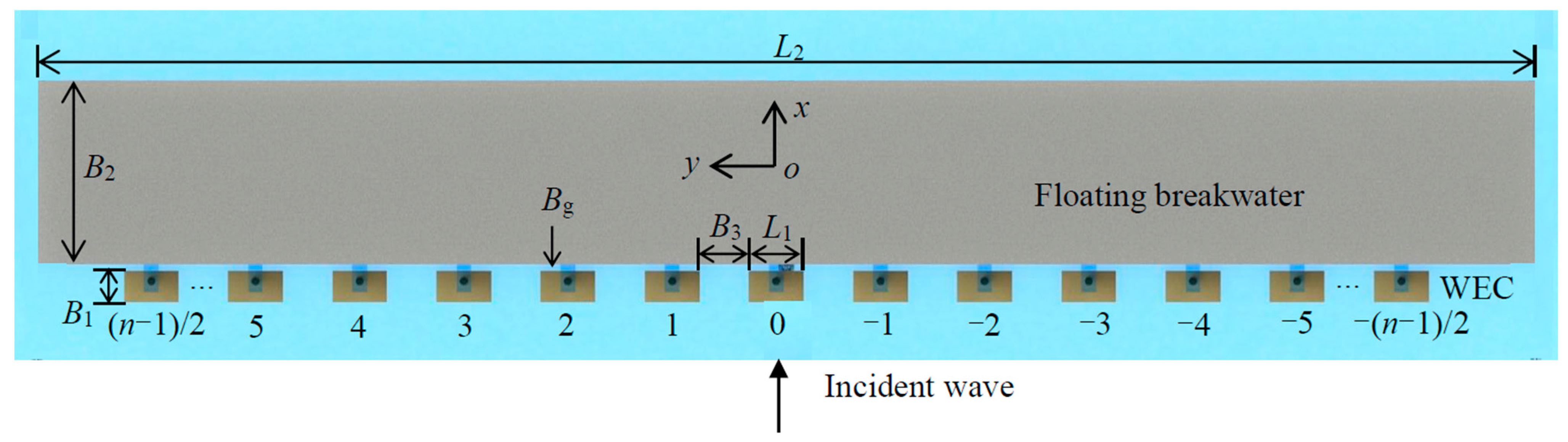
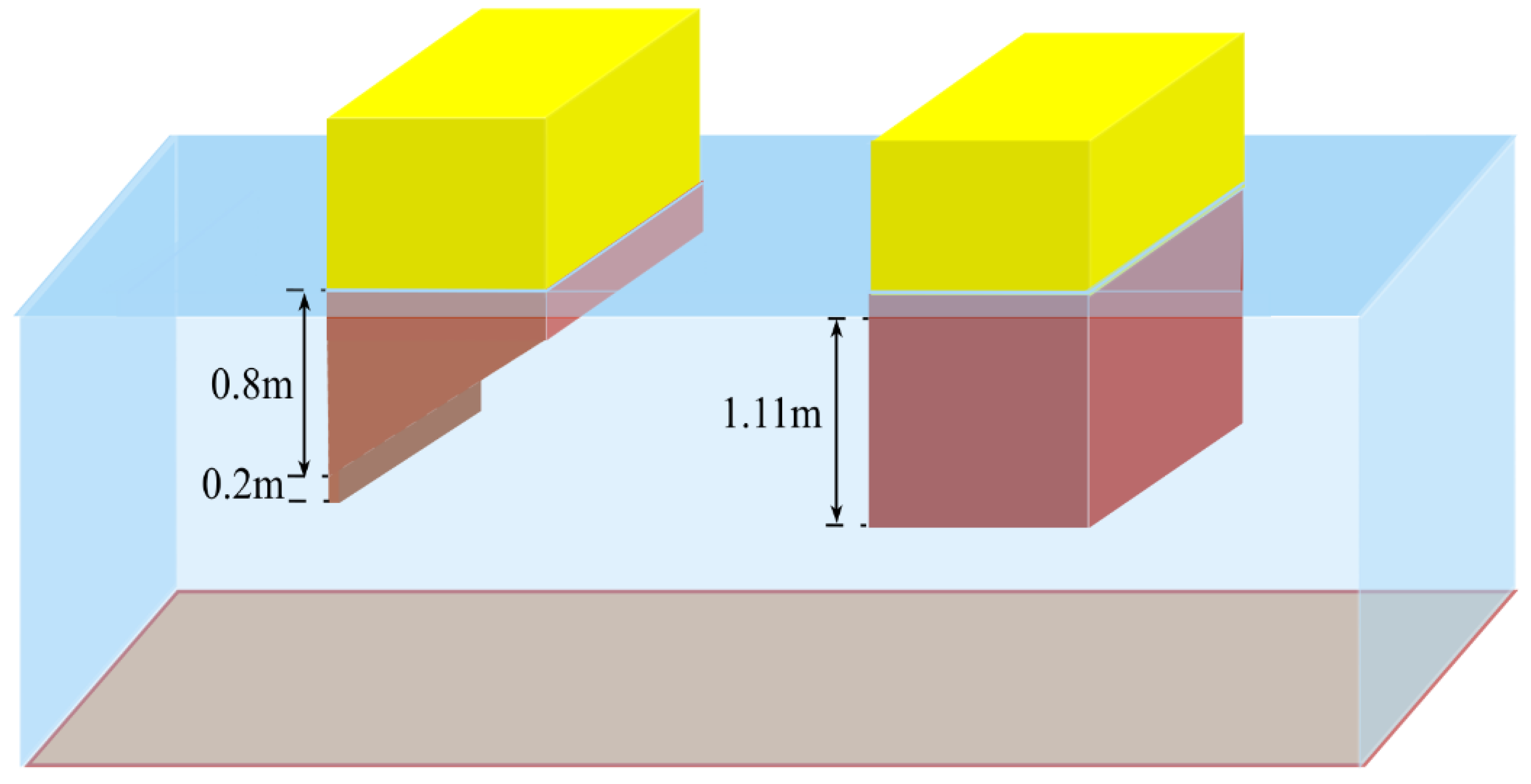
2.1. Hybrid WEC–Breakwater System
2.2. Motion Equation of Floaters
2.3. Wave Power of WECs
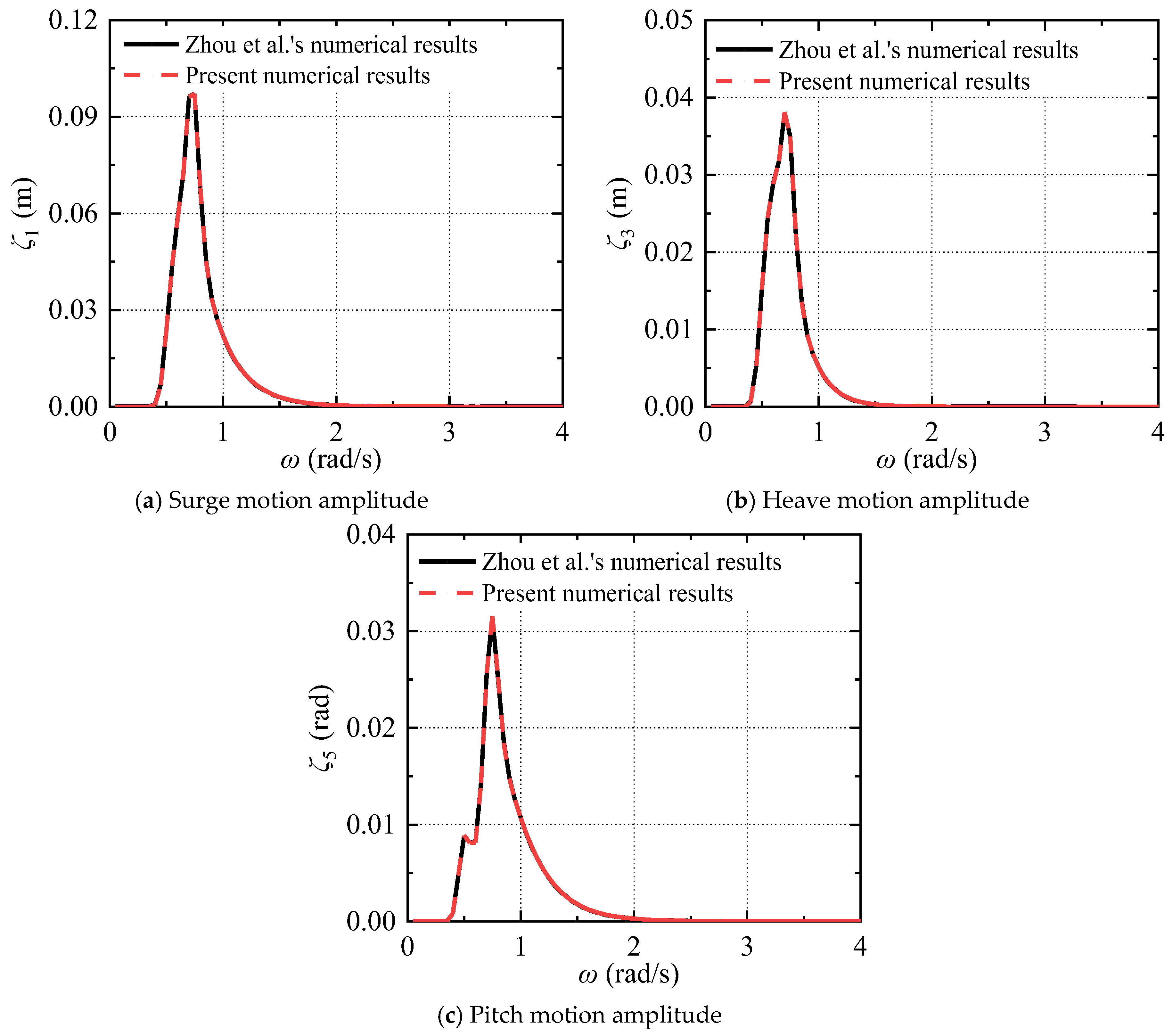
3. Validation
4. Numerical Results and Discussion
4.1. Evaluation of Wave Power for WEC
4.2. Evaluation of Motion Response for Breakwater
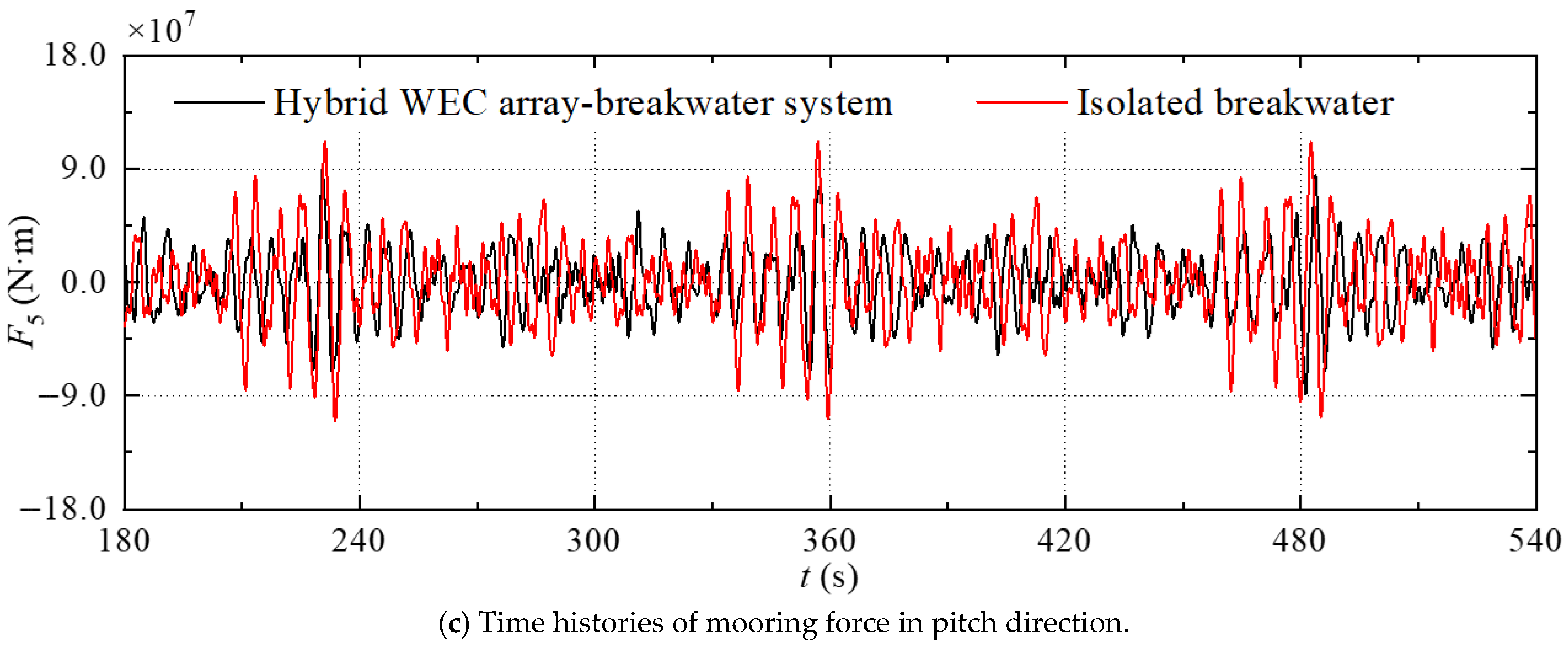
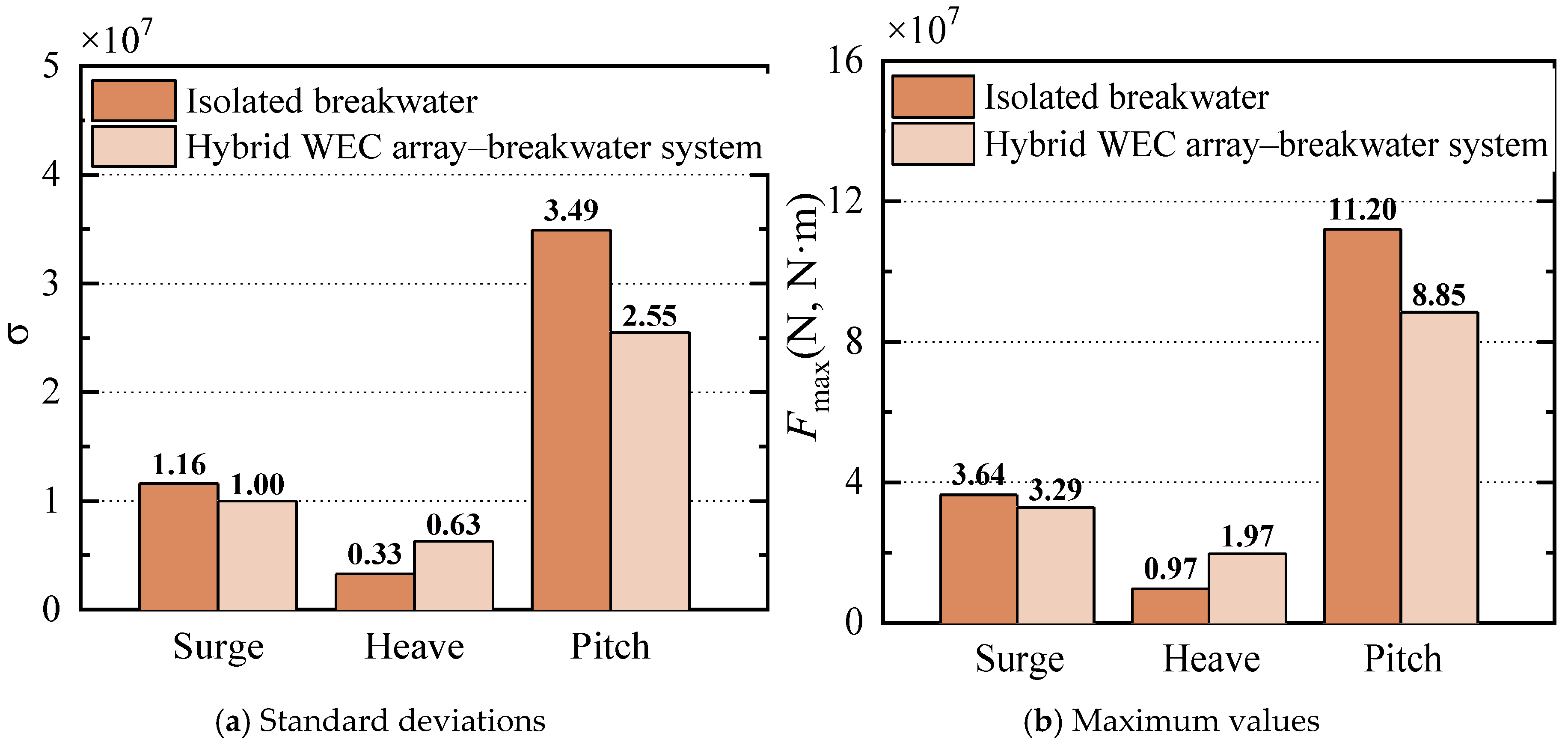
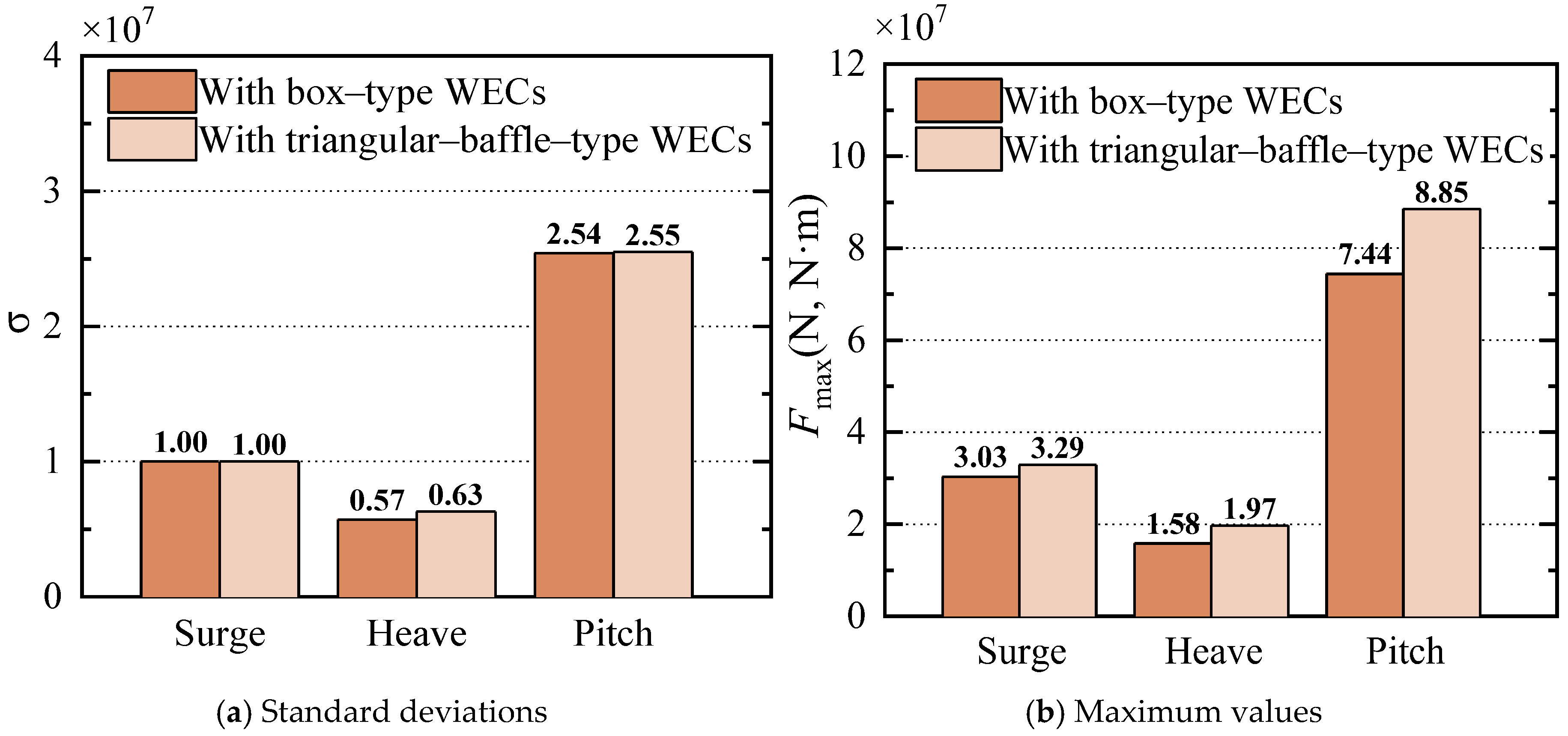
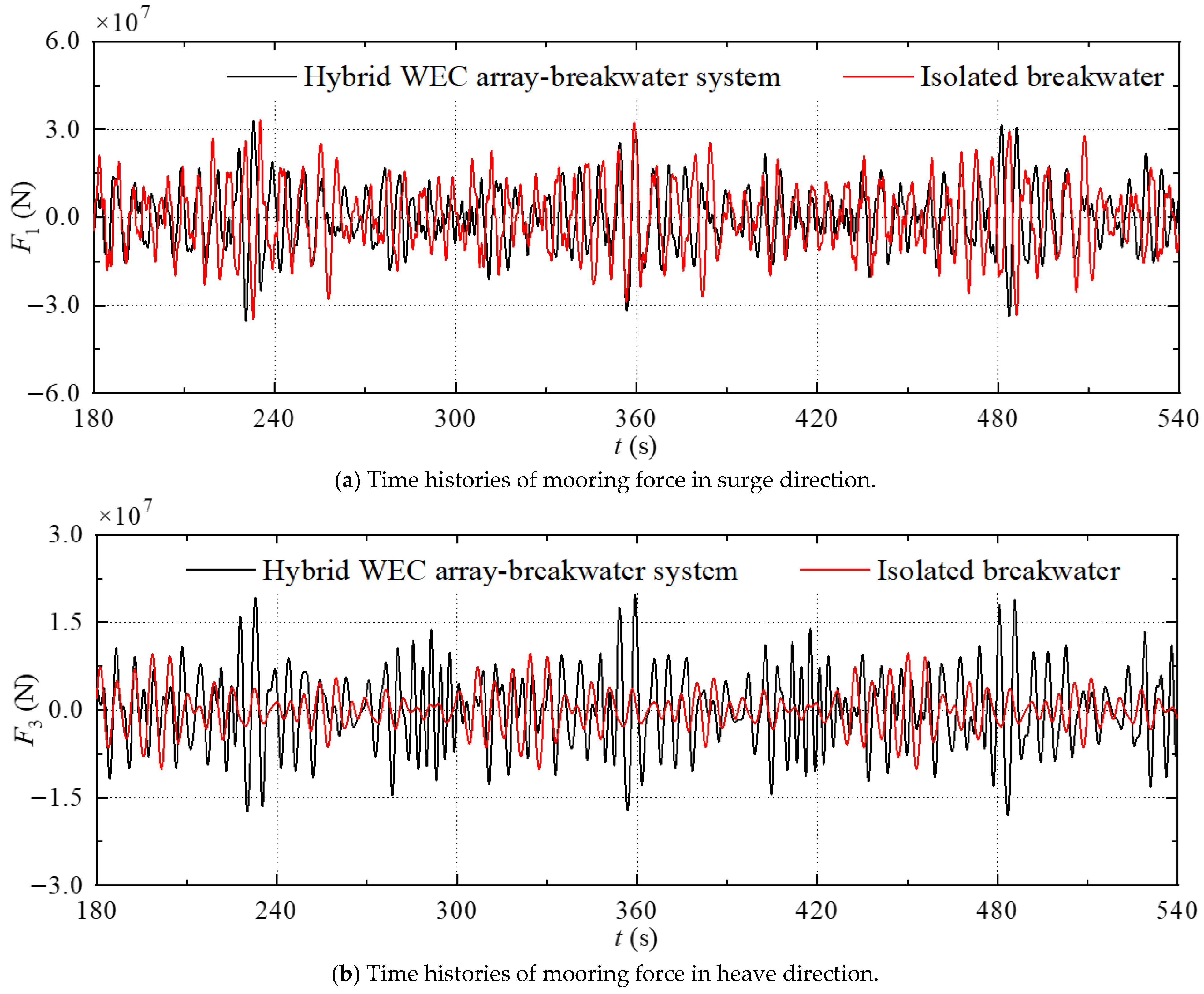
4.3. Evaluation of Mooring Forces
5. Conclusions
- (1)
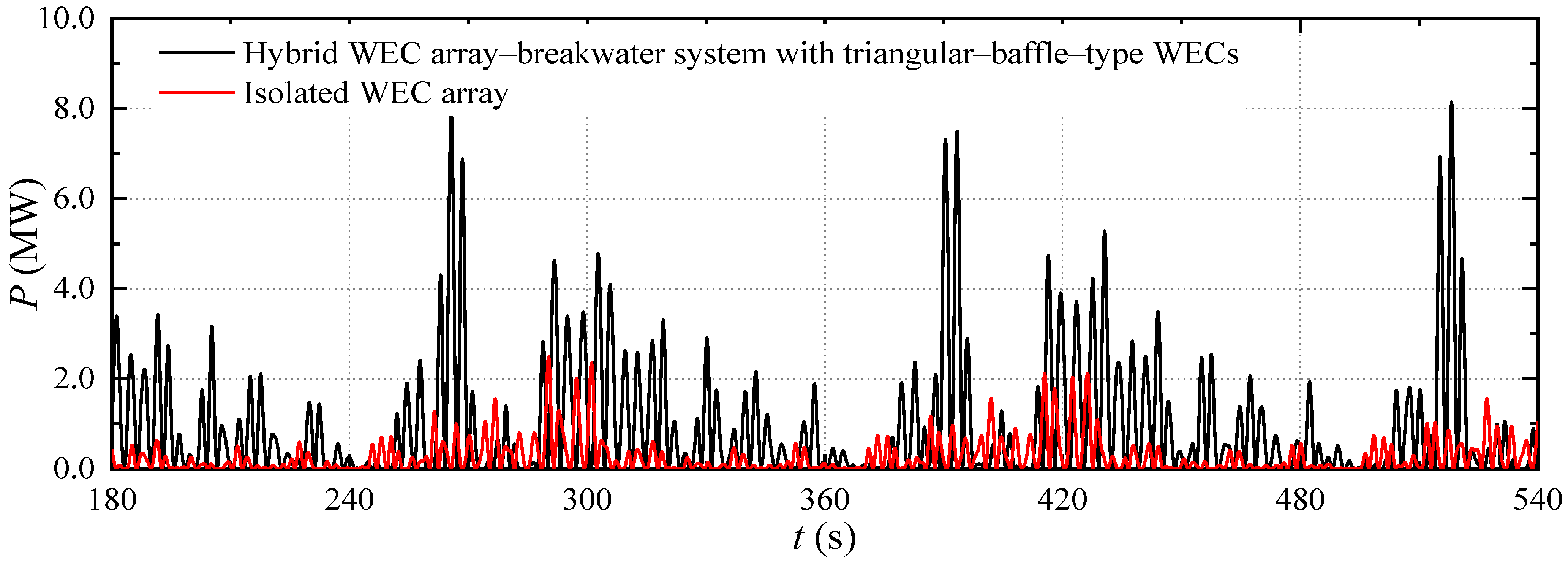
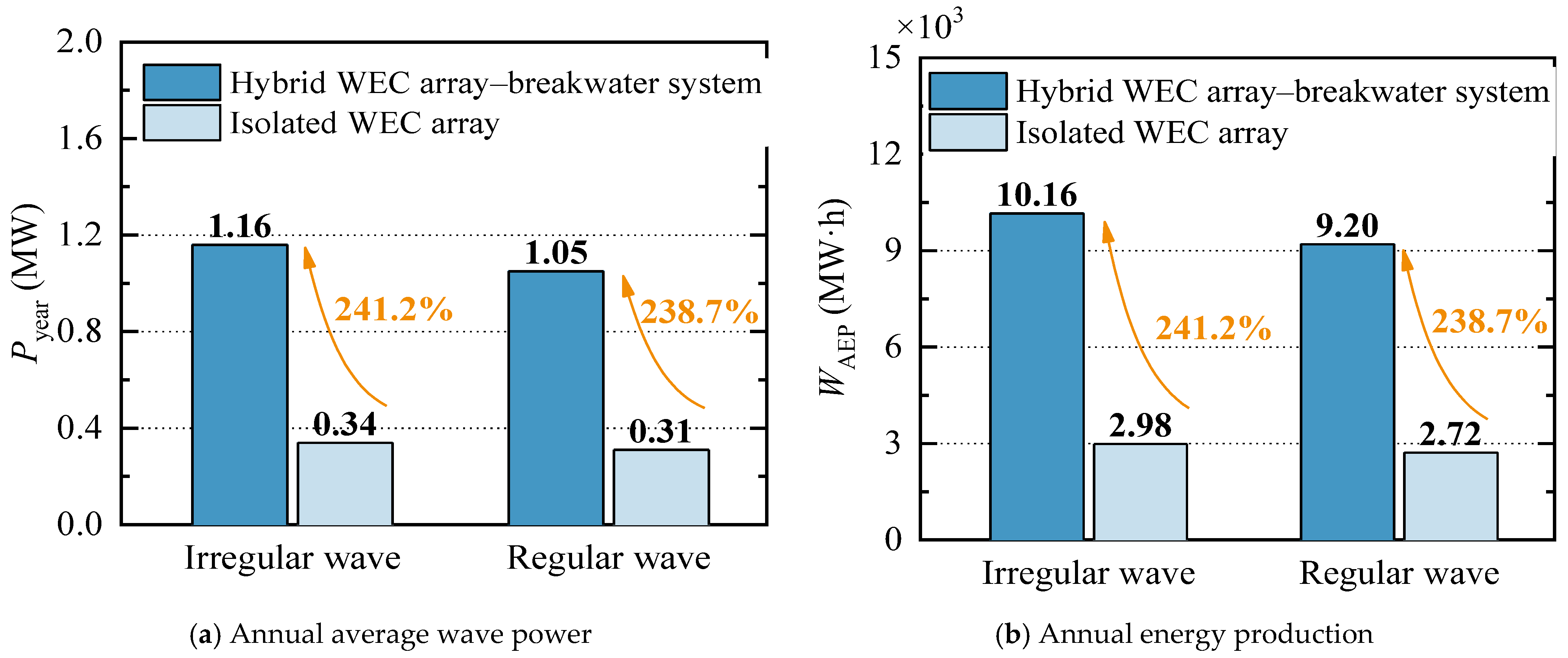
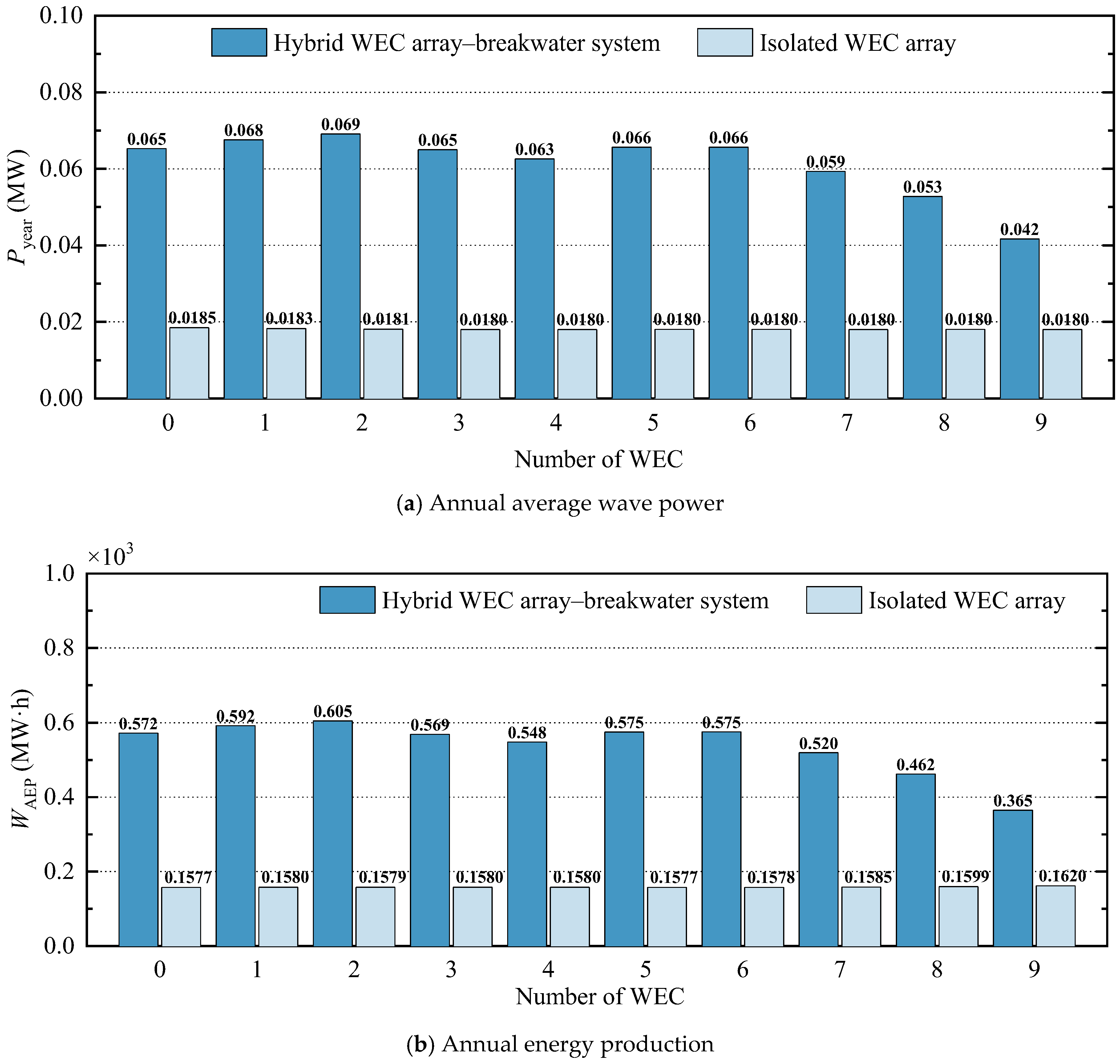
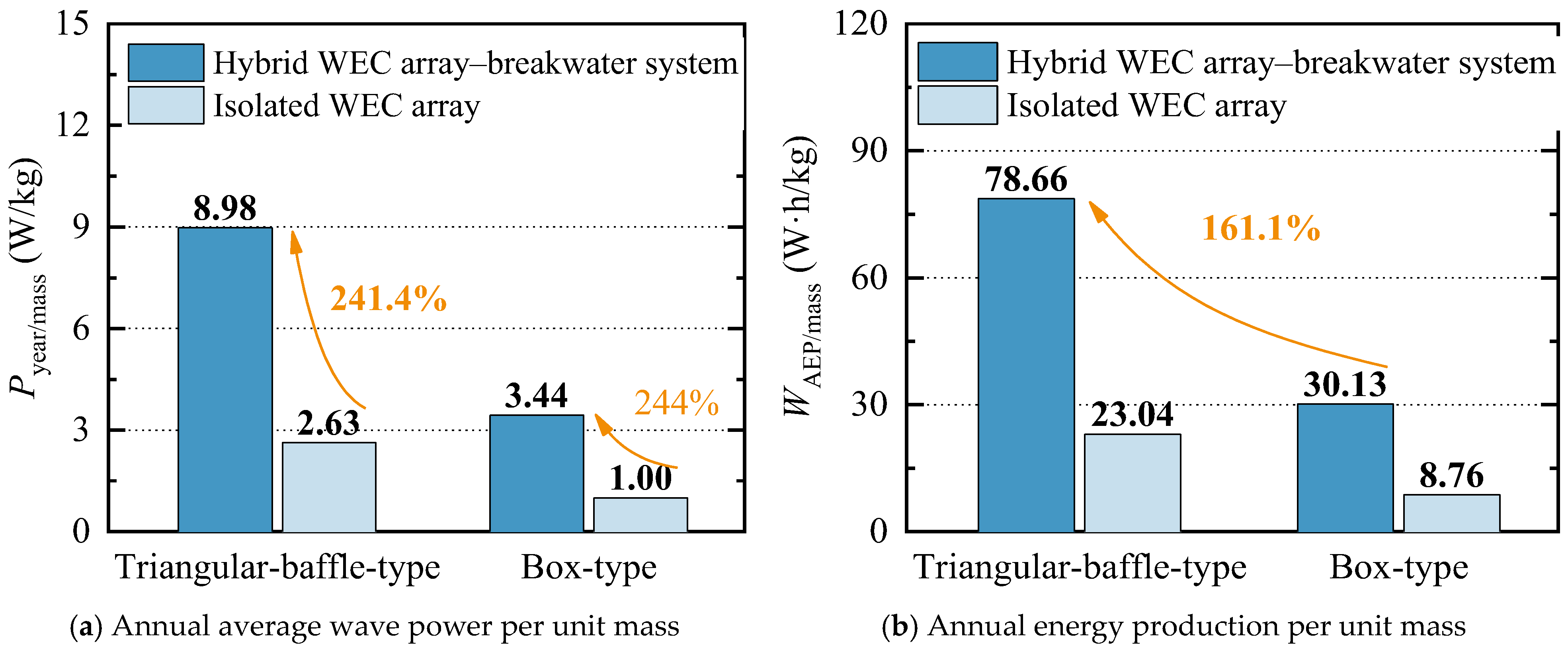
- In irregular waves, the annual average wave power and the annual energy production of the hybrid system with a triangular-baffle-type WEC array are 1.16 MW and 10.16 × 10³ MW·h, respectively, which is a 241.2% improvement compared to those of the isolated WEC array. This configuration is highly recommended for irregular wave conditions to maximize annual energy production and reduce the levelized cost of energy.
- (2)
- Annual average wave power and annual energy production of the hybrid system under regular wave conditions are smaller than those under irregular wave conditions. Design evaluations must rely on irregular wave inputs rather than regular-wave tests to avoid underestimating actual energy yield.
- (3)
- Compared to the isolated WEC array, the standard deviations of the mooring forces for the hybrid system with a triangular-baffle-type WEC array in the surge and pitch directions reduce by 13.8% and 26.9%, respectively, while increasing by 90.0% in the heave direction. This indicates that the vertical mooring design must be reinforced.
- (4)
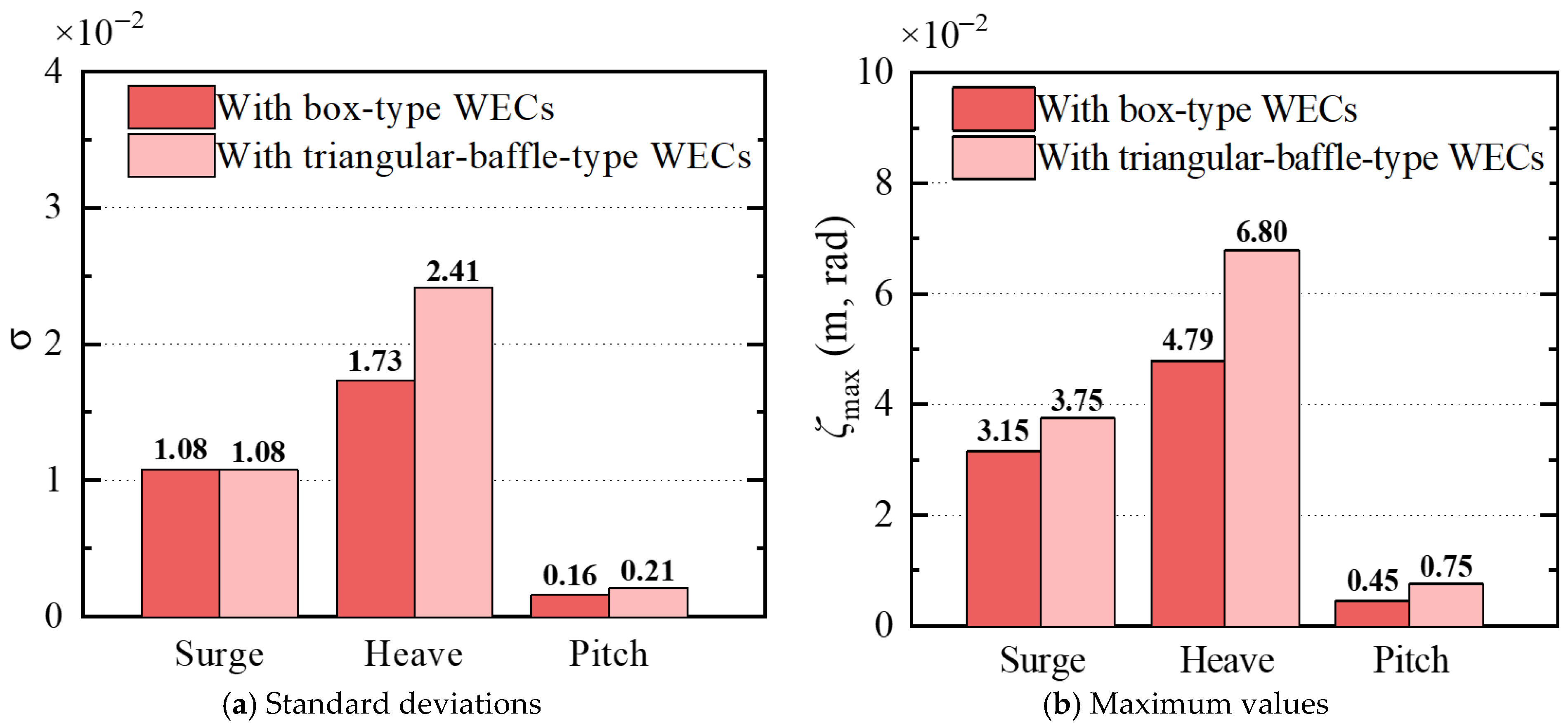
- The wave energy harvesting characteristics and maximum mooring forces of the hybrid system with triangular-baffle-type WECs are both superior to those of the hybrid system with box-type WECs under the same cost. It means that under equivalent budget constraints, the triangular-baffle-type WEC is the preferred choice for better energy capture, lower peak mooring forces, and higher cost-effectiveness.
Author Contributions
Funding
Data Availability Statement
Conflicts of Interest
Nomenclature
| WEC | Wave energy converter |
| OWC | Oscillating water column |
| OB | Oscillating buoy |
| DoF | Degrees of freedom |
| PTO | Power take-off |
| L2 | Length of the breakwater |
| B2 | Breadth of the breakwater |
| n | Number of WECS |
| Bg | Distance between WEC and breakwater |
| L1 | Length of the WEC |
| B1 | Breadth of the WEC |
| B3 | Distance between WECs |
| M | Rigid body mass matrix |
| C | Restoring force matrix |
| a∞ | Additional mass matrix when the incident wave frequency is infinite |
| , , | Displacement, velocity, and acceleration vector |
| D | Constraint matrix |
| FL,5n×1 | Force and moment generated by the connection between the bodies |
| F(t) | Total force matrix |
| κ(t − τ) | Radiation pulse response function matrix |
| ω and Ai | Incident wave frequency and amplitude |
| aij | Added mass |
| bij | Radiation damping |
| Fwave(t) | Wave force |
| FPTO(t) | PTO force |
| Fvis(t) | Viscous force |
| Fstiff(t) | Mooring force |
| θwave(ωi) and θrand,i | Initial phase and random phase of the i-th cosine wave |
| R | Buffer function |
| tbf | Blocking time |
| S(ωi) | Spectral density function of the Joint North Sea Wave Project |
| Tp and ωp | Peak period and frequency |
| γ | Peak shape parameter |
| H1/3 | Characteristic wave height |
| and | Average wave height and wave period |
| δ | Scale parameters |
| (xi, yi, zi) | Global coordinates of the connection point between WEC and breakwater |
| (xci, yci, zci) | Global coordinates of the rotation center of each floater |
| Ptotal (Tp) | Total wave power of the WEC array at peak period Tp |
| Pave (Tp) | Total wave power per unit mass of the WEC array at peak period Tp |
| mtotal | Total mass of the WEC array |
| Pi (Tp) | Wave power produced by the i-th WEC at peak period Tp |
| v3i(t) | Heave motion velocity of the i-th WEC |
| bopt | Optimal PTO damping |
| Pyear | Annual average wave power |
| WAEP | Annual energy production |
| Tj, Hj, Sj | Wave period, wave height, and probability of occurrence for the j-th component in the joint probability distribution table |
| tyear | Total seconds of one year |
References
- Pelc, R.; Fujita, R.M. Renewable energy from the ocean. Mar. Pol. 2002, 26, 471–479. [Google Scholar] [CrossRef]
- Falnes, J. A review of wave energy extraction. Mar. Struct. 2007, 4, 185–201. [Google Scholar] [CrossRef]
- Mustapa, M.A.; Yaakob, O.B.; Ahmed, Y.M. Wave energy device and breakwater integration: A review. Renew. Sustain. Energy Rev. 2017, 77, 43–58. [Google Scholar] [CrossRef]
- Zhao, X.L.; Ning, D.Z.; Zou, Q.P.; Qiao, D.S.; Cai, S.Q. Hybrid floating breakwater-WEC system: A review. Ocean Eng. 2019, 186, 106126. [Google Scholar] [CrossRef]
- Giri, R.; Mohd, R.S.; Mohd, A.M.N.; Noh, Z.A.; Yasutaka, I.; Muhammad, Z.R.; Mohd, R.A.R. Numerical study on the balance of energy of a floating oscillating water column wave energy converter and breakwater hybrid system. Ocean Coast. Manag. 2025, 266, 107666. [Google Scholar] [CrossRef]
- Zheng, S.M.; Zhang, Y.L.; Iglesias, G. Coast/breakwater-integrated OWC: A theoretical model. Mar. Struct. 2019, 66, 121–135. [Google Scholar] [CrossRef]
- Ning, D.Z.; Zhou, Y.; Mayon, R.; Johanning, L. Experimental investigation on the hydrodynamic performance of a cylindrical dual-chamber Oscillating Water Column device. Appl. Energy 2020, 260, 114252. [Google Scholar] [CrossRef]
- Xu, C.H.; Huang, Z.H. A dual-functional wave-power plant for wave-energy extraction and shore protection: A wave-flume study. Appl. Energy 2018, 229, 963–976. [Google Scholar] [CrossRef]
- Ruzzo, C.; Arena, F.; Malara, G. Theoretical modelling of U-Oscillating Water Column energy harvesters integrated in floating platforms. Ocean Eng. 2026, 343, 123276. [Google Scholar] [CrossRef]
- Sahel, S.; Mohammad, A.L.Y.; Alireza, M.; Mohammad, H.A.; Mehran, D. Experimental and numerical investigation of a hybrid floating breakwater-WEC system. Ocean Eng. 2024, 303, 117613. [Google Scholar] [CrossRef]
- Ning, D.Z.; Zhao, X.L. Hydrodynamic performance of a pile-restrained WEC-type floating breakwater: An experimental study. Renew. Energy 2016, 95, 531–541. [Google Scholar] [CrossRef]
- Jeong, H.J.; Koo, W. Analysis of various algorithms for optimizing the wave energy converters associated with a sloped wall-type breakwater. Ocean Eng. 2023, 276, 114199. [Google Scholar] [CrossRef]
- Zhou, B.Z.; Lin, C.S.; Huang, X.; Zhang, Q.; Yuan, Y.M.; Zhang, H.M.; Jin, P.; Yang, Y.F. Hydrodynamic performance and narrow gap resonance of WEC-floating breakwater hybrid system: An experimental study. Ocean Eng. 2025, 328, 121040. [Google Scholar] [CrossRef]
- Cheng, Y.; Fu, L.; Dai, S.S.; Collu, M.; Cui, L.; Yuan, Z.M.; Incecik, A. Experimental and numerical analysis of a hybrid WEC-breakwater system combining an oscillating water column and an oscillating buoy. Renew. Sustain. Energy Rev. 2022, 169, 112909. [Google Scholar] [CrossRef]
- Zhang, H.M.; Zhou, B.Z.; Vogel, C.; Willden, R.; Zang, J.; Geng, J. Hydrodynamic performance of a dual-floater hybrid system combining a floating breakwater and an oscillating-buoy type wave energy converter. Appl. Energy 2020, 259, 114212. [Google Scholar] [CrossRef]
- Zhao, X.L.; Ning, D.Z.; Zhang, C.W.; Kang, H.G. Hydrodynamic Investigation of an Oscillating Buoy Wave Energy Converter Integrated into a Pile-Restrained Floating Breakwater. Energies 2017, 10, 712. [Google Scholar] [CrossRef]
- Chen, Q.; Zang, J. On the hydrodynamic performance of a vertical pile-restrained WEC-type floating breakwater. Renew. Energy 2018, 146, 414–425. [Google Scholar] [CrossRef]
- Madhi, F.; Sinclair, M.E.; Yeung, R.W. The Berkeley Wedge: An asymmetrical Energy-Capturing floating breakwater of high performance. Mar. Syst. Ocean Technol. 2014, 9, 5–16. [Google Scholar] [CrossRef]
- Zhang, H.M.; Zhou, B.Z.; Vogel, C.; Willden, R.; Zang, J.; Zhang, L. Hydrodynamic performance of a floating breakwater as an oscillating-buoy type wave energy converter. Appl. Energy 2020, 257, 113996. [Google Scholar] [CrossRef]
- Zhou, B.Z.; Lin, C.S.; Huang, X.; Zhang, H.M.; Zhao, W.H.; Zhu, S.Y.; Jin, P. Experimental study on the hydrodynamic performance of a multi-DOF WEC-type floating breakwater. Renew. Sustain. Energy Rev. 2024, 202, 114694. [Google Scholar] [CrossRef]
- Zhao, X.L.; Ning, D.Z. Experimental investigation of breakwater-type WEC composed of both stationary and floating pontoons. Energy 2018, 155, 226–233. [Google Scholar] [CrossRef]
- Ning, D.Z.; Zhao, X.L.; Zhao, M.; Hann, M.; Kang, H.G. Analytical investigation of hydrodynamic performance of a dual pontoon WEC-type breakwater. Appl. Ocean Res. 2017, 65, 102–111. [Google Scholar] [CrossRef]
- Ning, D.Z.; Zhao, X.L.; Zhao, M.; Kang, H.G. Experimental investigation on hydrodynamic performance of a dual pontoon–power take-off type wave energy converter integrated with floating breakwaters. J. Eng. Marit. Environ. 2019, 233, 991–999. [Google Scholar] [CrossRef]
- Zhang, H.M.; Zhou, B.Z.; Zang, J.; Vogel, C.; Fan, T.H.; Chen, C.H. Effects of narrow gap wave resonance on a dual-floater WEC-breakwater hybrid system. Ocean Eng. 2021, 225, 108762. [Google Scholar]
- Zhou, B.Z.; Zheng, Z.; Hong, M.W.; Jin, P.; Wang, L.; Chen, F.T. Dynamic and power generation features of a Wind−Wave hybrid system consisting of a Spar-Type wind turbine and an annular wave energy converter in irregular waves. China Ocean Eng. 2023, 37, 923–933. [Google Scholar] [CrossRef]
- Ren, J.Q.; Jin, P.; Liu, Y.Y.; Zang, J. Wave attenuation and focusing by a parabolic arc pontoon breakwater. Energy 2020, 217, 119405. [Google Scholar] [CrossRef]
- Duan, J.H.; Cheng, J.S.; Wang, J.P.; Wang, J.Q. Wave diffraction on arc-shaped floating perforated breakwaters. China Ocean Eng. 2012, 26, 305–316. [Google Scholar] [CrossRef]
- Chu, Y.C.; Cheng, J.S.; Wang, J.Q.; Li, Z.G.; Jiang, K.B. Hydrodynamic performance of the arc-shaped bottom-mounted breakwater. China Ocean Eng. 2014, 28, 749–760. [Google Scholar] [CrossRef]
- Chang, K.H.; Tsaur, D.H.; Huang, L.H. Accurate solution to diffraction around a modified V-shaped breakwater. Coast. Eng. 2012, 68, 56–66. [Google Scholar] [CrossRef]
- Gao, J.L.; Wu, Y.T.; Song, Z.W.; He, M. Influences of low velocity uniform current on characteristics of gap resonance occurring between two adjacent fixed bodies. Mar. Struct. 2026, 106, 103961. [Google Scholar]
- Mi, C.L.; Gao, J.L.; Song, Z.W.; Yan, M.Y. Gap resonance between a stationary box and a vertical wall induced by transient focused wave groups. China Ocean Eng. 2025, 39, 441–454. [Google Scholar] [CrossRef]
- Gong, S.K.; Gao, J.L.; Yan, M.Y.; Song, Z.W.; Shi, H.B. Effects of floater motion on wave loads during steady-state gap resonance occurring between two non-identical boxes. Ocean Eng. 2025, 323, 120649. [Google Scholar] [CrossRef]
- Ning, D.Z.; Zhao, X.L.; Chen, L.F.; Zhao, M. Hydrodynamic performance of an array of wave energy converters integrated with a pontoon-type breakwater. Energies 2018, 11, 685. [Google Scholar] [CrossRef]
- Zhao, X.L.; Ning, D.Z.; Liang, D.F. Experimental investigation on hydrodynamic performance of a breakwater integrated WEC system. Ocean Eng. 2019, 171, 25–32. [Google Scholar] [CrossRef]
- Cheng, Y.; Xi, C.; Dai, S.S.; Ji, C.Y.; Cocard, M.; Yuan, Z.M.; Incecik, A. Performance characteristics and parametric analysis of a novel multi-purpose platform combining a moonpool-type floating breakwater and an array of wave energy converters. Appl. Energy 2021, 292, 116888. [Google Scholar] [CrossRef]
- Zheng, S.M.; Zhang, Y.L. Analysis for wave power capture capacity of two interconnected floats in regular waves. J. Fluids Struct. 2017, 75, 158–173. [Google Scholar] [CrossRef]
- Zhang, X.T.; Lu, D.; Guo, F.; Sun, Y.G. The maximum wave energy conversion by two interconnected floaters: Effects of structural flexibility. Appl. Ocean Res. 2018, 71, 34–47. [Google Scholar] [CrossRef]
- Guo, B.M.; Wang, R.; Ning, D.Z. Hydrodynamic performance of a novel WEC-breakwater integrated system consisting of triple dual-freedom pontoons. Energy 2020, 209, 118463. [Google Scholar] [CrossRef]
- Ma, Y.; Xie, G.C. Hydrodynamic performance investigation of the multi-degree of freedom oscillating-buoy wave energy converter. Ocean Eng. 2023, 285, 115345. [Google Scholar] [CrossRef]
- Shi, H.D.; Huang, S.T.; Cao, F.F. Hydrodynamic performance and power absorption of a multi-freedom buoy wave energy device. Ocean Eng. 2019, 172, 541–549. [Google Scholar] [CrossRef]
- Zhang, H.M.; Zhou, B.Z.; Zang, J.; Vogel, C.; Jin, P.; Ning, D.Z. Optimization of a three-dimensional hybrid system combining a floating breakwater and a wave energy converter array. Energy Convers. Manag. 2021, 247, 114717. [Google Scholar] [CrossRef]
- Zhou, B.Z.; Lin, C.S.; Zheng, Z.; Yang, Y.; Jin, P.; Hu, N.; Yuan, Y. Wave attenuation and energy conversion of a twin-parabolic floating breakwater and cylindrical heaving WEC hybrid system. Ocean Eng. 2026, 343, 123357. [Google Scholar] [CrossRef]
- Zhou, B.Z.; Huang, X.; Lin, C.S.; Zhang, H.M.; Peng, J.X.; Nie, Z.L.; Peng, J. Experimental study of a WEC array-floating breakwater hybrid system in multiple-degree-of-freedom motion. Appl. Energy 2024, 371, 123694. [Google Scholar] [CrossRef]
- Gao, J.L.; Mi, C.L.; Song, Z.W.; Liu, Y.Y. Transient gap resonance between two closely-spaced boxes triggered by nonlinear focused wave groups. Ocean Eng. 2024, 305, 117938. [Google Scholar] [CrossRef]
- Zhou, B.Z.; Hu, J.J.; Sun, K.; Liu, Y.Y.; Collu, M. Motion response and energy conversion performance of a heaving point absorber wave energy converter. Front. Energy Res. 2020, 8, 553295. [Google Scholar] [CrossRef]
- Sun, L.; Taylor, R.E.; Choo, Y.S. Responses of interconnected floating bodies. IESJ Part A Civ. Struct. Eng. 2011, 4, 143–156. [Google Scholar] [CrossRef]
- Hu, J.J.; Zhou, B.Z.; Vogel, C.; Liu, P.; Willden, R.; Sun, K.; Zang, J.; Geng, J.; Jin, P.; Cui, L.; et al. Optimal design and performance analysis of a hybrid system combing a floating wind platform and wave energy converters. Appl. Energy 2020, 269, 114998. [Google Scholar] [CrossRef]
- Jonkman, J. Definition of the Floating System for Phase IV of OC3; National Renewable Energy Laboratory (NREL): Golden, CO, USA, 2010.
- Zhou, B.Z.; Wang, Y.; Zheng, Z.; Jin, P.; Ning, D.Z. Power generation and wave attenuation of a hybrid system involving a heaving cylindrical wave energy converter in front of a parabolic breakwater. Energy 2023, 282, 128364. [Google Scholar] [CrossRef]
- Zhang, H.M.; Wang, H.C.; Zhou, X.H.; Hu, J.J.; Zhou, B.Z. Numerical investigation of a three-dimensional integrated system combining an inertial built-in wave energy converter array and a floating breakwater. Energy 2025, 326, 136102. [Google Scholar] [CrossRef]
- Huang, X.; Zheng, Z.; Jin, P.; Zhou, B.Z.; Zhang, H.M. Numerical optimization and experimental study on the hybrid system of pendulum wave energy converter and floating breakwater. Energy 2025, 331, 136914. [Google Scholar] [CrossRef]






| Tj | 1.5 s | 2.5 s | 3.5 s | 4.5 s | 5.5 s | 6.5 s | 7.5 s | 8.5 s | ||
|---|---|---|---|---|---|---|---|---|---|---|
| Sj | ||||||||||
| Hj | ||||||||||
| 0.25 m | 0.007 | 2.171 | 4.506 | 1.831 | 0.945 | 0.038 | 0 | 0 | ||
| 0.75 m | 0 | 0.021 | 7.347 | 13.590 | 6.734 | 3.892 | 0.938 | 0.014 | ||
| 1.25 m | 0 | 0 | 0.003 | 4.345 | 11.567 | 4.701 | 2.756 | 1.102 | ||
| 1.75 m | 0 | 0 | 0 | 0.007 | 2.420 | 7.946 | 1.852 | 0.582 | ||
| 2.25 m | 0 | 0 | 0 | 0 | 0.021 | 3.888 | 4.546 | 0.418 | ||
| 2.75 m | 0 | 0 | 0 | 0 | 0 | 0.133 | 5.357 | 1.078 | ||
| 3.25 m | 0 | 0 | 0 | 0 | 0 | 0 | 0.774 | 2.896 | ||
| 3.75 m | 0 | 0 | 0 | 0 | 0 | 0 | 0.014 | 1.418 | ||
| 4.25 m | 0 | 0 | 0 | 0 | 0 | 0 | 0 | 0.133 | ||
| Sum | 0.007 | 2.192 | 11.856 | 19.782 | 21.687 | 20.598 | 16.237 | 7.641 | ||
Disclaimer/Publisher’s Note: The statements, opinions and data contained in all publications are solely those of the individual author(s) and contributor(s) and not of MDPI and/or the editor(s). MDPI and/or the editor(s) disclaim responsibility for any injury to people or property resulting from any ideas, methods, instructions or products referred to in the content. |
© 2026 by the authors. Licensee MDPI, Basel, Switzerland. This article is an open access article distributed under the terms and conditions of the Creative Commons Attribution (CC BY) license.
Share and Cite
Zhang, H.; Lin, C.; Wang, C.; Huang, X.; Yang, Y.; Zhou, B.; Liu, Y.; Yuan, Y. Hydrodynamic Performance Assessment of a Hybrid Wave Energy Converter Array–Floating Breakwater System Under Irregular Waves. J. Mar. Sci. Eng. 2026, 14, 667. https://doi.org/10.3390/jmse14070667
Zhang H, Lin C, Wang C, Huang X, Yang Y, Zhou B, Liu Y, Yuan Y. Hydrodynamic Performance Assessment of a Hybrid Wave Energy Converter Array–Floating Breakwater System Under Irregular Waves. Journal of Marine Science and Engineering. 2026; 14(7):667. https://doi.org/10.3390/jmse14070667
Chicago/Turabian StyleZhang, Hengming, Chusen Lin, Chengrong Wang, Xu Huang, Yifeng Yang, Binzhen Zhou, Yingyi Liu, and Yuming Yuan. 2026. "Hydrodynamic Performance Assessment of a Hybrid Wave Energy Converter Array–Floating Breakwater System Under Irregular Waves" Journal of Marine Science and Engineering 14, no. 7: 667. https://doi.org/10.3390/jmse14070667
APA StyleZhang, H., Lin, C., Wang, C., Huang, X., Yang, Y., Zhou, B., Liu, Y., & Yuan, Y. (2026). Hydrodynamic Performance Assessment of a Hybrid Wave Energy Converter Array–Floating Breakwater System Under Irregular Waves. Journal of Marine Science and Engineering, 14(7), 667. https://doi.org/10.3390/jmse14070667