Article

Fish Aggregation Around a Coastal Wind Farm: Stereo-BRUV and Complementary Surveys

Marine Eco-Technology Institute, Busan 48520, Republic of Korea
*
Author to whom correspondence should be addressed.
J. Mar. Sci. Eng. 2026, 14(5), 443; https://doi.org/10.3390/jmse14050443
Submission received: 29 January 2026 / Revised: 25 February 2026 / Accepted: 25 February 2026 / Published: 27 February 2026
(This article belongs to the Section Marine Ecology)

Abstract

The rapid expansion of offshore wind energy in Korea has raised concerns among coastal fishing communities about potential changes in fish assemblages. We conducted a summer 2022 survey at the Tamra Offshore Wind Farm (Jeju, Korea), comparing turbine-adjacent and reference sites using diver-operated video (DOV), direct capture, and stereo-baited remote underwater video (stereo-BRUV). Across methods, 23 fish species were identified, and stereo-BRUV detected the highest species richness. In stereo-BRUV analysis, the observed fish species and relative abundance metrics were higher in turbine-adjacent sites than reference site, including greater MaxN (maximum number of individuals observed in a single video frame) and Max spp. (maximum number of species observed in a single video frame). Most individuals measured from stereo imagery were 15–25 cm in total length (TL). For dominant taxa, TL distributions derived from stereo-BRUV were comparable to those measured from captured specimens, supporting the practical use of stereo-BRUV for size–structure characterization. Epifaunal assemblages on turbine jackets exhibited higher density and biomass than the reference site and showed clear vertical stratification (upper/mid > bottom). Diet items in captured fish overlapped with dominant jacket epifauna, consistent with a potential trophic linkage. Overall, stereo-BRUV can be used as a non-destructive and auditable approach for documenting fish assemblages around wind-farm structures. Because sampling was limited in spatial and temporal replication, the observed patterns should be interpreted as exploratory and hypothesis-generating for future synchronized and replicated monitoring.

1. Introduction

Coastal and offshore wind energy is increasingly promoted as a practical pathway to reduce greenhouse-gas emissions and support national carbon-neutrality targets [1,2]. In the Republic of Korea, the development of offshore wind farms has been accelerated because nearshore and onshore siting is often constrained by land availability, visual impacts, and potential conflicts with local residents; by the end of 2022, 115 wind farms (779 turbines) were installed nationwide, and offshore wind projects totaling 20.7 GW had received an electricity business license at 68 locations [2]. However, many proposed offshore wind projects occur adjacent to many fishing communities, where concerns are frequently raised that wind-farm construction and operation could alter fish assemblages and reduce fishing opportunities [3,4]. These concerns are typically framed around multiple stressors, including seabed disturbance during construction, underwater noise and vibration, electromagnetic fields associated with power cables, and changes in water quality or habitat accessibility [3].
In contrast, multiple studies have shown that turbine foundations and associated scour protection can function as artificial hard substrate, providing physical refuge and settlement surfaces for epifaunal communities that may enhance local biodiversity and fish abundance through a “reef effect” [3,5]. These effects have been reported for multiple types of marine infrastructure [5], including offshore wind foundations, where increased structural complexity can modify local habitat availability and trophic pathways. In particular, epifaunal assemblages on turbine foundations can increase prey resources, and dietary overlap between foundation epifauna and fish stomach contents has been used to infer trophic linkages in other systems [6]. However, because both negative and positive effects are plausible and context-dependent, objective environmental assessment—especially quantitative evaluation of fish assemblage responses—remains essential to reduce uncertainty and inform stakeholder discussions.
A major challenge in coastal fish-community assessment is that it is difficult to obtain reliable quantitative metrics that are comparable among sites and repeatable over time. In Korea, fish assemblages have most commonly been evaluated using (i) direct capture methods, which enable morphometrics and stomach-content analyses but are destructive and often unsuitable for repeated sampling at the same location, and (ii) diver-based visual surveys or diver-operated video (DOV), which are widely used but can be sensitive to diver effects (e.g., avoidance behavior), observer subjectivity, and repeated counting of the same individuals [7]. Although methodological standardization (e.g., transects, multiple observers, restricted observation angles) has been improved, diver-based surveys cannot fully eliminate repeated counting or observer effects [7].
Baited remote underwater video (BRUV) systems have been developed as a non-destructive alternative that improves standardization by recording fish attracted to a fixed camera field of view and allowing post hoc analysis. The use of MaxN—the maximum number of individuals of a taxon observed in a single frame—was introduced to reduce repeated counting of the same individuals across frames, and this approach has become widely used in standard BRUV-based fish-community studies [8]. Stereo-BRUV (sBRUV) systems have been recently improved to provide accurate three-dimensional measurements of fish body length, enabling analyses of size structure and providing comparable results with capture-based morphometrics [9,10]. These advantages make sBRUV particularly attractive for environmental assessment and monitoring of marine infrastructure, where repeatable and auditable results are needed.
In the present study, we investigated whether offshore wind-farm structures are associated with changes in fish assemblages at the Tamra Offshore Wind Farm (Jeju, Korea). Fish assemblages were surveyed at three turbine stations and one nearby natural rocky-reef control site using a multi-method approach: sBRUV for quantitative assemblage metrics and fish length estimation, DOV as a supplementary observation method, and trap-based capture to provide physical specimens for morphometrics and gut-content analysis. We specifically aimed to (1) compare fish assemblage size and diversity between turbine-adjacent stations and a control site using standardized sBRUV metrics (MaxN, Max spp., and Total spp.); (2) assess the compatibility of sBRUV-derived total length (TL) measurements with TL measured from trap-captured specimens for dominant taxa; and (3) evaluate whether prey items identified in fish stomach contents correspond to turbine-associated epifaunal taxa, as suggestive evidence for a potential trophic linkage (noting that fish surveys and epifauna/diet sampling were conducted in different months).

2. Materials and Methods

2.1. Study Area and Site Selection

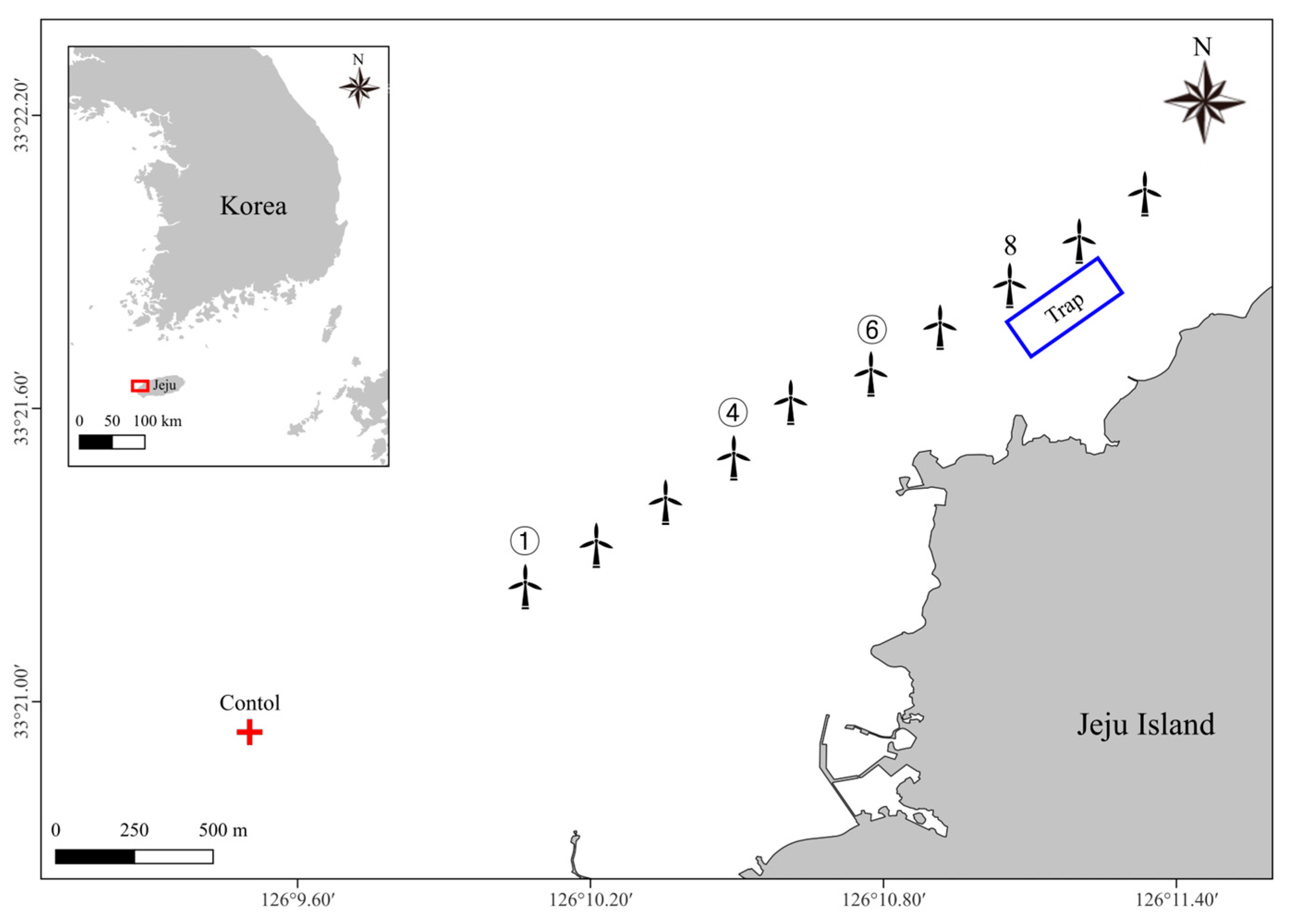
This study was conducted at the Jeju Tamra Offshore Wind Farm (also reported as “Tamna” in some sources; commissioned in 2017) and adjacent coastal waters off Hangyeong-myeon, Jeju Island, Korea (centered at approximately 33°21′41″ N, 126°10′31″ E; WGS84). The wind farm is located approximately 0.5–1.2 km offshore of the coast. The seabed in the study area is characterized by a predominantly rocky substrate, with sand deposits accumulated locally depending on micro-topography. The site has been described as exhibiting typical features of subtropical rocky-reef environments around the southern Korean Peninsula (Figure 1).
Fish assemblages were assessed using video-based methods in June 2022, whereas epifaunal surveys and direct fish collection were conducted in September 2022. A total of four stations were surveyed: three turbine stations within the wind farm and one control station representing nearby natural rocky habitat. Water depth across stations ranged from 18 to 23 m, with limited tidal variation during sampling. The control station was selected as the nearest natural rocky reef outside the wind-farm footprint and was surveyed using the same field protocols (deployment durations and DOV time) as turbine stations to the extent feasible. Because only one reference station was available, comparisons with the control are treated as exploratory.
To minimize overlap in fish responses to baited sampling (i.e., potential re-sampling of the same individuals across stations), the intervals between stations were ≥500 m (Figure 1). This spacing was determined based on reported bait-attraction distances (up to ~450 m under an average current speed of 0.2 m s−1 and fish total length of ~200 mm; [11]). Trap sampling for direct fish collection was conducted near turbine no. 8.

2.2. Stereo-Baited Remote Underwater Video (sBRUV)

To obtain quantitative metrics of fish assemblage size and body length, a SeaGIS stereo-camera system and associated analysis software were used. The stereo-BRUV unit was deployed from a vessel at each station. One 60 min deployment was conducted per station (n = 1) due to operational constraints and recorded continuously for 60 min. A bait bag containing 300 g of thawed mackerel was attached to the system. Deployments were conducted sequentially during daylight hours in June 2022 under calm sea conditions (wave height < 1 m) and good underwater visibility. Each deployment was positioned within approximately 20 m of the turbine foundation at turbine stations.
Recorded footage was analyzed post hoc using SeaGIS calibration tools (CAL) and the stereo calibration cube (CUBE), and fish were measured and enumerated in EventMeasure. Each 60 min deployment was reviewed to annotate fish observations and obtain stereo measurements. Fish assemblage metrics included time to first arrival, MaxN, and Max spp. MaxN and Max spp. were defined as the maximum number of individuals and the maximum number of species, respectively, observed in a single video frame over the 60 min deployment. We used MaxN and Max spp. as conservative relative abundance metrics to avoid double counting. Total spp. was calculated as cumulative species richness recorded during the 60 min deployment. For dominant taxa, total length (TL; mm) of individuals was measured from stereo imagery [12,13,14]. For each station, dominant taxa were defined as the four species with the highest cumulative MaxN across the 60 min footage; these taxa were used for station-wise total-length summaries.

2.3. Diver-Operated Video (DOV)

Although sBRUV is effective for quantifying fish assemblages, it may underestimate small and less mobile benthic taxa (e.g., gobies) that are reported to respond weakly to baited systems. To complement sBRUV and to document species occurrence and vertical habitat distribution around the underwater structures, diver-operated video (DOV) surveys were conducted. Immediately after each sBRUV deployment, two divers recorded video simultaneously while swimming for 10 min at each of three depth strata in sequence (lower–middle–upper) around the turbine foundation (or corresponding habitat at the control site). DOV footage was used primarily for qualitative assessments, and species were identified during post-processing through video review.

2.4. Trap-Based Fish Collection and Morphometrics

To support comparisons with sBRUV-derived measurements and to obtain specimens for gut-content analysis, fish were collected in September 2022 using traps. A total of 50 cylindrical traps (diameter 30 cm, length 50 cm) were deployed on two occasions near turbine no. 8, spatially separated from the video-survey stations. Each trapping event had a soak time of 12 h. The total length (TL) and body weight of captured fish were directly measured in the field. During the first trapping event (n = 101), stomachs were excised using dissection scissors and forceps immediately after morphometric measurements, and preserved for gut-content analysis.
Fish species observed in stereo-BRUV and DOV footage and collected using traps were identified to the lowest practical taxonomic level using regional identification guides (in Korean) [15]. Scientific names followed FishBase (version 04/2025) [16].

2.5. Epifauna Sampling and Laboratory Processing

Epifauna were sampled at three depth strata on each turbine jacket: upper (2–5 m), middle (8–10 m), and bottom (~20 m). At the control station, samples were collected from the natural reef at comparable depth (~20 m).
Samples were collected by divers from three turbine stations (T1, T4, and T6) and the control site, covering the defined depth strata at each station. Because sampling was conducted on rugged rocky substrate and steel tubular jacket surfaces with high structural relief, a 30 × 30 cm quadrat was used to standardize the sampling area. At each station and depth stratum, three replicate samples were collected using a loss-prevention quadrat sampler (a quadrat fitted with a mesh skirt) to minimize the escape or washout of small organisms during collection. Samples were placed into labeled containers and transported to the laboratory, where samples were stored in a freezer until taxonomic processing.
Epifaunal taxa were identified from collected samples using regional taxonomic monographs and field guides (in Korean), including the series and complementary taxonomic keys [17,18,19,20,21,22,23,24,25,26,27,28,29,30]; additional volumes were consulted via the NIBR Biodiversity e-Book library [31]. Epifaunal community descriptors (e.g., taxa richness, density, wet biomass) were calculated by station and depth stratum. Density was standardized to individuals m−2, and wet biomass was expressed as g wet weight m−2. Ecological indices including Margalef’s richness, Pielou’s evenness, and Shannon diversity [32,33,34] were computed for each sampling unit.

2.6. Gut-Content Analysis

After morphometric measurements, stomachs were removed as rapidly as possible using dissection tools. Each stomach was labeled, and 95% ethanol was injected into the stomach to fix gut contents. Samples were then stored in sealed containers filled with 70% ethanol and transported to the laboratory. In the laboratory, stomachs were opened, the presence/absence of contents was recorded, and prey items from non-empty stomachs were identified to the lowest practical taxonomic level. Prey items were identified using regional taxonomic monographs and illustrated guides for decapods, mollusks, polychaetes, and cephalopods (in Korean) [35,36,37,38,39,40,41]. Nomenclature of prey taxa followed WoRMS [42].

2.7. Data Analysis

All statistical analyses were conducted using PRIMER v7 (PRIMER-e, Plymouth, UK) for multivariate procedures (Bray–Curtis similarities, nMDS, and SIMPER) and SPSS ver. 19.0 (SPSS Inc., Chicago, IL, USA) for univariate tests (Levene’s test: car package; Welch’s t-test: stats).

2.7.1. Fish Assemblage Similarity (sBRUV)

To compare fish assemblage similarity among stations, station-level MaxN data across all taxa were used to construct a Bray–Curtis similarity matrix [43]. Assemblage patterns were evaluated using hierarchical cluster analysis and non-metric multidimensional scaling (nMDS).

2.7.2. Comparison of Body Length Between sBRUV Measurements and Captured Specimens

Total length (TL; mm) estimated from stereo-BRUV (sBRUV) footage was compared with TL measured directly from trap-captured individuals for two target species (Sebastiscus marmoratus and Pseudolabrus sieboldi). Comparisons were conducted separately by species using independent samples. Prior to testing for mean differences, homogeneity of variances between methods was evaluated using Levene’s test (median-centered). When variances were heterogeneous, Welch’s two-sample t-test was applied; otherwise, Student’s two-sample t-test assuming equal variances was used. For each species, the mean difference between methods (sBRUV—Trap) was reported with a 95% confidence interval, and effect size was quantified as Hedges’ g to evaluate the magnitude of any systematic difference. Statistical significance was assessed at α = 0.05.

2.7.3. Epifaunal Multivariate Analyses

Multivariate analyses of epifaunal community structure were performed using a Bray–Curtis similarity matrix, with cluster analysis and nMDS. SIMPROF tests were used to assess the significance of clusters, and SIMPER analyses were applied to identify taxa contributing most to among-group differences. Analyses were conducted in PRIMER v7 (PRIMER-E, Auckland, New Zealand).

3. Results

3.1. Fish Diversity Across Survey Methods

Across all survey methods, 23 fish species were recorded during the survey at the Tamra Offshore Wind Farm. Observed species richnesses differed among methods, with 14 species detected by DOV, 18 species by sBRUV, and 7 species by trap sampling. Trap sampling detected additional taxa not observed in the video dataset (e.g., Takifugu niphobles, Plotosus lineatus, and Lotella phycis; Table 1).
Taxonomically, the assemblage comprised 10 orders and 13 families (Table 1). The most species-rich orders were Tetraodontiformes (six species) and Labriformes (five species), followed by Centrarchiformes (four species). At the family level, Labridae (five species) and Tetraodontidae (four species) contributed most to species richness; Sebastidae and Oplegnathidae were represented by two species each, whereas eight families were represented by a single species. Across methods, the most frequently recorded species were Chromis notata, P. sieboldi, and S. marmoratus (detected by all three methods), followed by Halichoeres tenuispinis and Halichoeres poecilopterus (both video methods).

3.2. Fish Assemblage from sBRUV Deployments

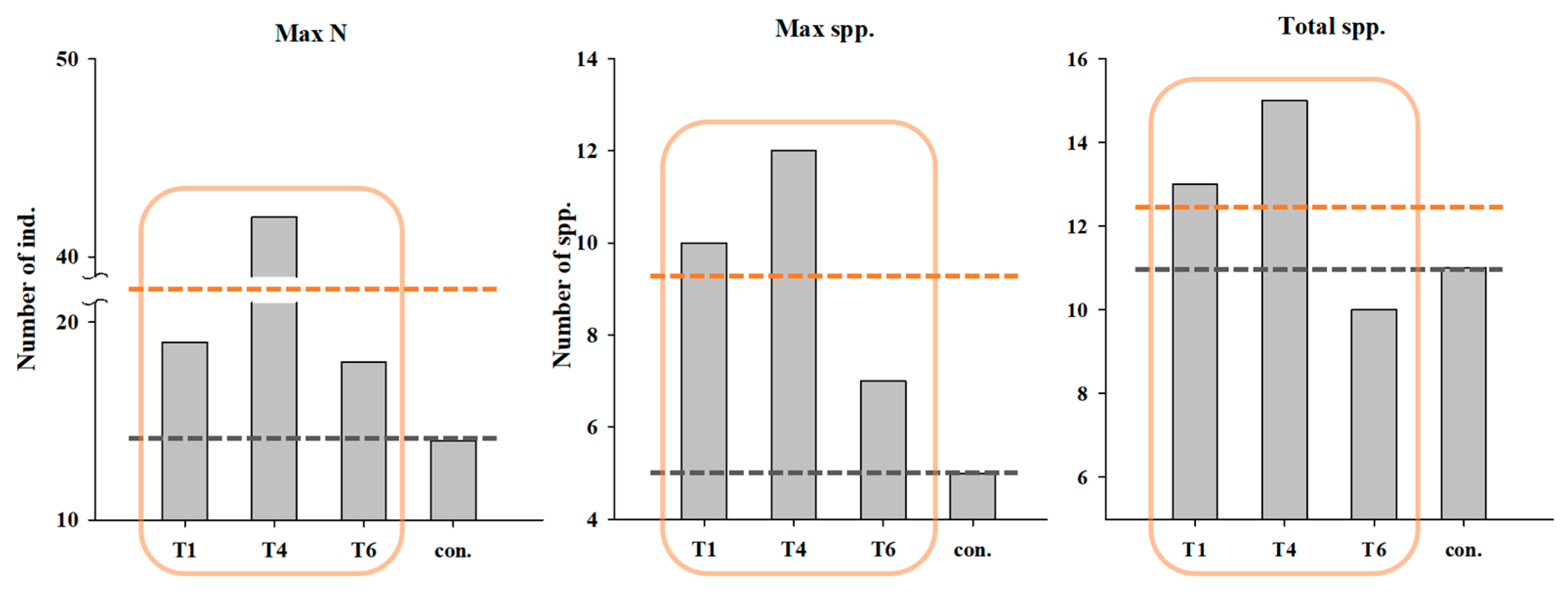
Fish assemblage size was quantified using sBRUV deployments conducted in June 2022 at turbines T1, T4, and T6, and at a control site located west of T1. The maximum number of individuals observed in a single frame (MaxN) at T1, T4, and T6 was 19, 45, and 18 (mean across turbines, 27.3), respectively, whereas MaxN at control site was 14. The maximum number of species observed in a single frame (Max spp.) was 10 at T1, 12 at T4, and 7 at T6 (mean: 9.6), whereas the control site recorded 5. Cumulative species richness over the 1 h deployment (Total spp.) was 13 (T1), 15 (T4), and 10 (T6) (mean: 12.6), compared with 11 at the control site (Figure 2).
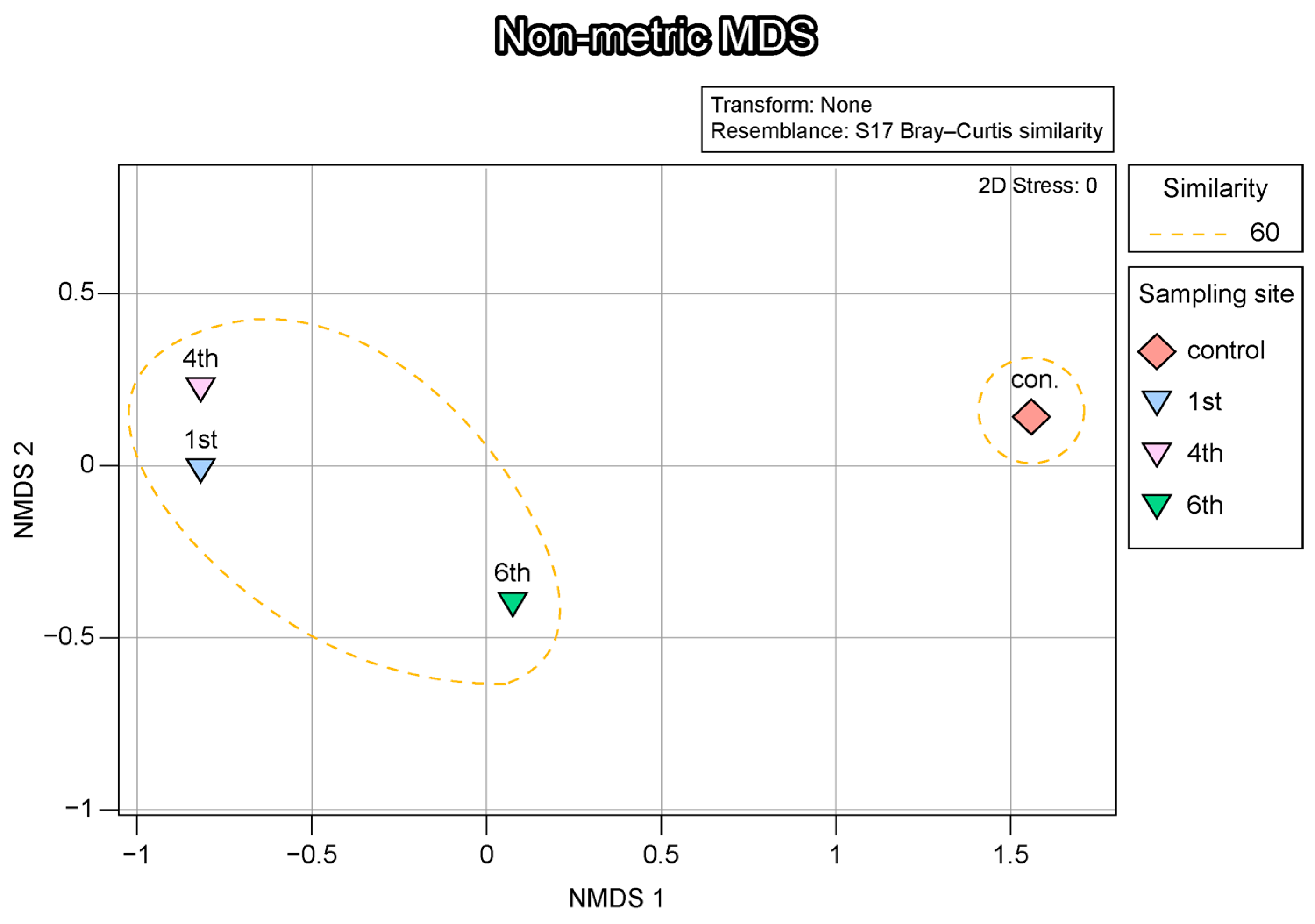
Community similarity among stations was evaluated using non-metric multidimensional scaling (nMDS) based on station-level MaxN values (all taxa; Bray–Curtis similarity). The ordination showed a clear separation of the control station from turbine stations along the primary ordination axis, and the 60% similarity contours delineated two distinct groups: the control station as a single-site cluster and the turbine stations as a separate cluster. Within the turbine group, T1 and T4 were more closely positioned than T6 (Figure 3).

3.3. Size Structure of Dominant Taxa (Total Length, sBRUV)

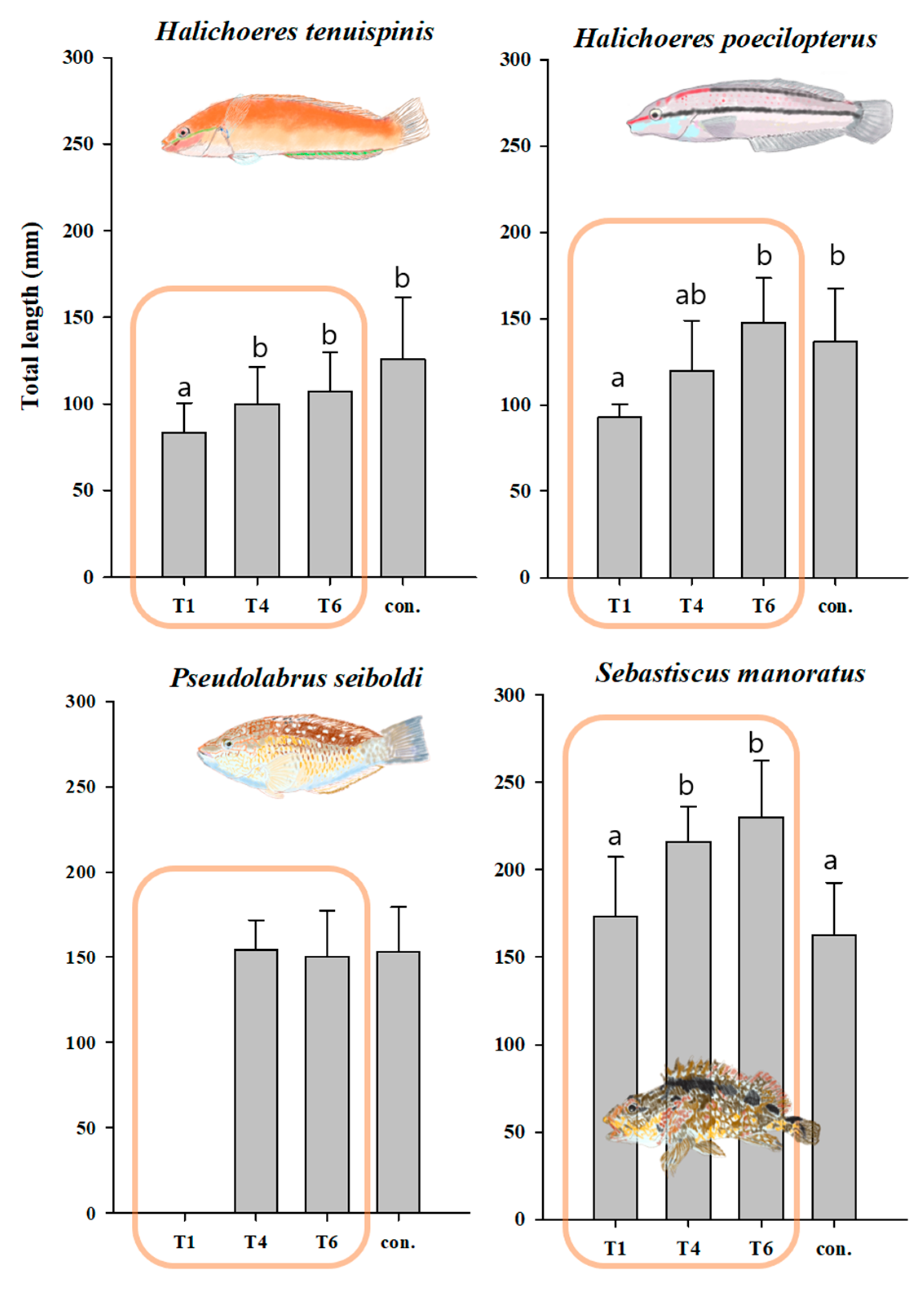
Total length (TL, mm) was summarized for the four dominant taxa at each station. At T1, dominant species were H. tenuispinis, C. notata, S. marmoratus, and A. doederleini; mean TL (range) was 83.13 ± 17.06 (52–123), 96.06 ± 13.88 (62–116), 173.34 ± 32.60 (134–227), and 97.19 ± 14.85 (62–121) mm, respectively.
At T4, dominant species were H. tenuispinis, P. sieboldi, H. poecilopterus, and C. notata; mean TL (range) was 99.93 ± 23.34 (55–146), 154.26 ± 17.29 (114–206), 119.78 ± 28.45 (77–195), and 85.11 ± 23.34 (53–155) mm, respectively.
At T6, dominant species were H. poecilopterus, H. tenuispinis, P. sieboldi, and S. marmoratus; mean TL (range) was 147.42 ± 25.86 (82–192), 107.20 ± 22.33 (71–200), 150.33 ± 26.24 (93–227), and 230.20 ± 27.79 (195–268) mm, respectively.
At the control site, dominant species were M. strigatus, S. marmoratus, P. sieboldi, and P. eoethinus; mean TL (range) was 97.92 ± 16.37 (70–155), 162.75 ± 29.06 (87–219), 153.16 ± 25.43 (116–239), and 138.84 ± 27.77 (87–219) mm, respectively (Figure 4).

3.4. Total Length of Fish by Trap

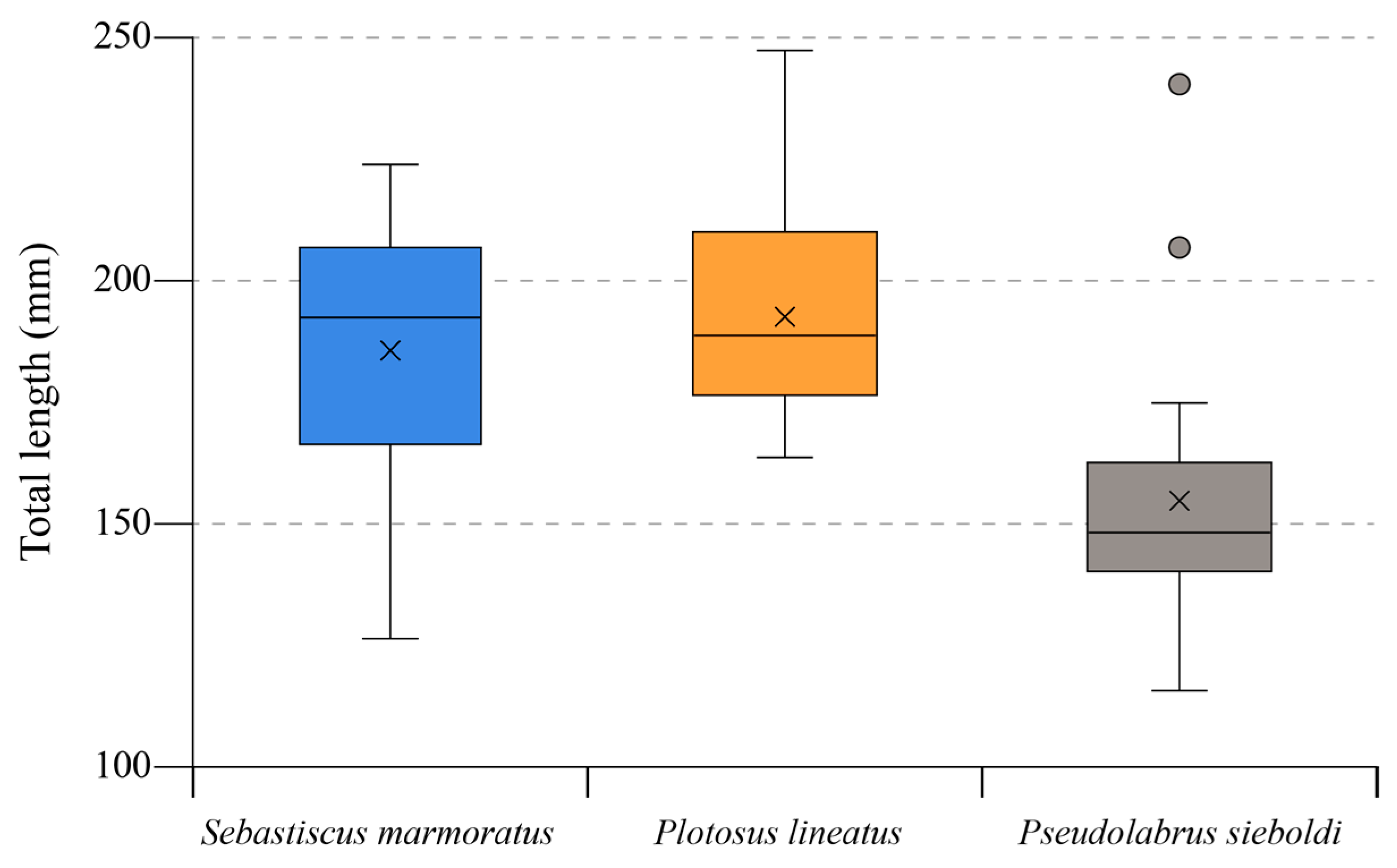
Trap sampling yielded 160 individuals and the catch was dominated by S. marmoratus, P. lineatus, and P. sieboldi. Mean total length (TL) of the dominant species was 185.22 ± 24.48 mm (range 126–223 mm) for S. marmoratus, 191.74 ± 19.31 mm (range 163–246 mm) for P. lineatus, and 154.58 ± 28.03 mm (range 116–239 mm) for P. sieboldi. These trap-derived TL data were subsequently used for method comparisons with sBRUV-derived TL estimates for S. marmoratus and P. sieboldi (Figure 5).
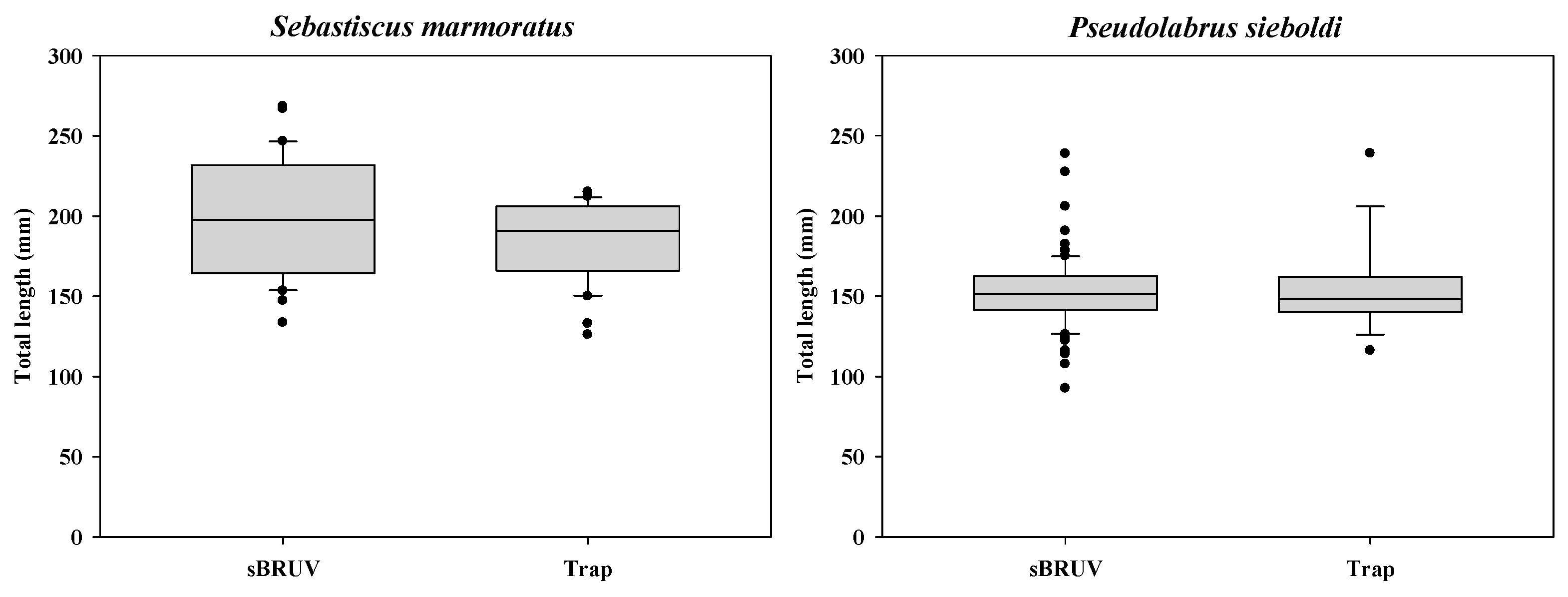
Total length (TL) estimated from sBRUV videos was compared with TL measured from trap-captured specimens for S. marmoratus and P. sieboldi. For S. marmoratus, TL variance differed between methods (Levene’s test, W = 7.93, p = 0.0058); therefore, Welch’s t-test was applied. Mean TL did not differ between sBRUV-derived measurements (185.8 ± 38.1 mm, n = 50) and captured specimens (185.2 ± 24.5 mm, n = 59) (Welch’s t = 0.093, df = 80.94, p = 0.926; mean difference = 0.58 mm, 95% CI [−11.87, 13.03]). For P. sieboldi variances were homogeneous (Levene’s test, W = 0.79, p = 0.377), and mean TL was also similar between sBRUV (154.3 ± 17.5 mm, n = 41) and trap samples (154.6 ± 28.0 mm, n = 19) (Student’s t = −0.044, df = 58, p = 0.965; mean difference = −0.26 mm, 95% CI [−12.11, 11.59]) (Figure 6).

3.5. Epifauna on the Surface of Underwater Construction

Epifaunal assemblages varied among jacket strata and the control site in taxonomic composition, density, and biomass.
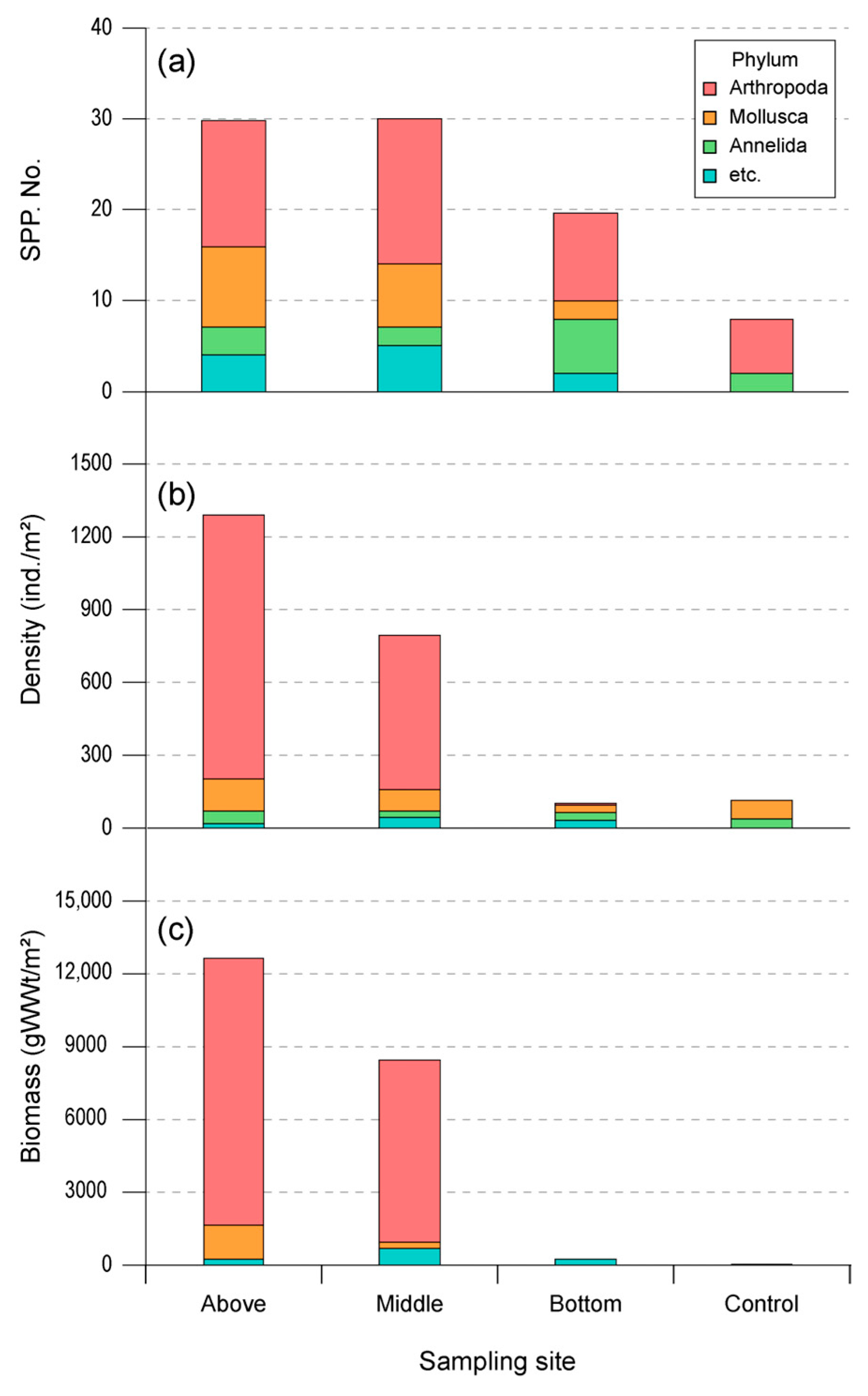
A total of 53 epifaunal taxa were recorded from the underwater structures and the control site. The full epifaunal species list and station/stratum-specific densities are provided in Table S2 (Supplementary Materials). In terms of taxonomic richness, Mollusca comprised the largest proportion (29 taxa, 54.7%), followed by Arthropoda (11 taxa, 20.8%), Polychaeta (Annelida) (7 taxa, 13.2%), and other groups (6 taxa, 11.3%). Species richness per sampling point ranged from 6 to 22 taxa, and richness tended to be higher at the upper and middle jacket levels than at the bottom level and the control site.
Community density (individuals m−2) was dominated by arthropods. Across all samples, Arthropoda accounted for the majority of individuals (552 ind. m−2; 77.9%), followed by Mollusca (86 ind. m−2; 12.8%), Polychaeta (37 ind. m−2; 5.6%), and other groups (23 ind. m−2; 3.8%). Total epifaunal density by sampling point ranged from 66 ind. m−2 to 1940 ind. m−2 (mean 670 ind. m−2), with densities tending to be higher at the upper and middle levels than at the bottom level and the control site.
Biomass (g wet weight m−2) showed a similar among-stratum pattern, with arthropods contributing most of the total. Arthropod biomass averaged 5543.54 g WWt m−2 (87.0%), followed by mollusks (496.06 g WWt m−2; 7.4%), other groups (356.48 g WWt m−2; 5.6%), and polychaetes (3.81 g WWt m−2; 0.1%). Biomass by station ranged from 2.4 to 16,509.9 g WWt m−2 (mean 6372.88 g WWt m−2). The barnacle Megabalanus rosa was the single most influential taxon, comprising 69.6% of total abundance and 85.6% of total biomass; M. rosa was not recorded at the bottom level nor at the control site. The oyster Ostrea circumpicta also contributed substantially at the upper and middle levels, whereas bottom-level and control samples lacked these dominant taxa and exhibited comparatively low total densities (Figure 7).
Diversity indices varied among sampling points. Margalef’s richness index ranged from 1.03 to 2.78 (mean 1.83 ± 0.52), Pielou’s evenness from 0.31 to 0.96 (mean 0.63 ± 0.27), and Shannon diversity from 0.84 to 2.05 (mean 1.43 ± 0.40). Lower evenness and diversity values were associated with samples in which one or a few taxa accounted for a large proportion of individuals or biomass (Table 2).
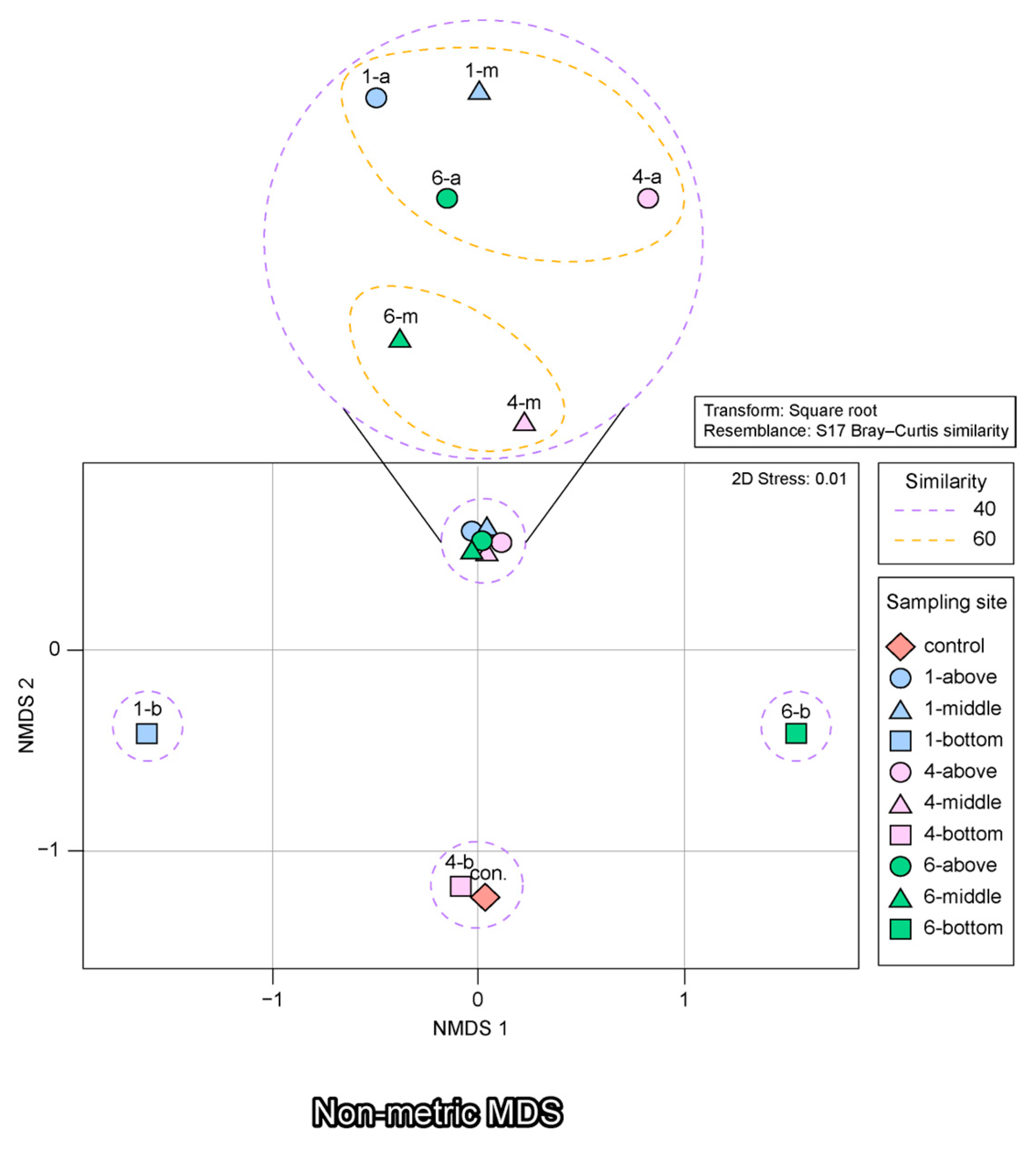
Cluster analysis based on community similarity (40% threshold) grouped all upper and middle stations together and separated them from bottom stations and the control site. The group of upper–middle stations was characterized by high contributions of M. rosa and O. circumpicta, whereas bottom/control samples were distinguished by the absence of these taxa and the presence of alternative taxa (e.g., Lysidice collaris, Figure 8).

3.6. Gut Contents of Trap-Captured Fish

A total of 101 individuals from seven fish species were collected using traps at the Tamra Offshore Wind Farm. An amount of 40 individuals of these had empty stomachs, and gut contents were analyzed for 61 individuals from four species. Overall, 12 prey taxa were identified from the stomach contents. Among individuals with stomach contents, S. marmoratus accounted for 43% of the sampled fish.
To examine correspondence between fish diet and turbine-associated epifauna, prey items were summarized regardless of predator species using both numerical occurrence (counts/frequency) and wet weight biomass (g WWt). By numerical occurrence, crabs dominated the diet (32 individuals; 42%), followed by shrimps (17; 22%), nematodes (11; 14%), and barnacles (9; 12%). Scallops and fish prey each accounted for four individuals (5%). By biomass, fish prey contributed the highest wet weight (7.39 g WWt; 50%), followed by crabs (5.57 g WWt; 38%), shrimps (1.01 g WWt; 7%), barnacles (0.41 g WWt; 3%), scallops (0.19 g WWt; 1%), and nematodes (0.11 g WWt; 1%).
Species-level prey composition for the four dominant predator species is summarized in Table 3, including taxonomic prey items that correspond to epifaunal taxa recorded on turbine structures (highlighted in the table).

4. Discussion

4.1. Fish Assemblage Patterns Around Turbine Foundations

Across all survey methods, 23 fish species were recorded at the Tamra Offshore Wind Farm, with sBRUV identifying the greatest number of species (18), followed by DOV (14) and trap sampling (7). The higher richness observed using the sBRUV system likely reflects the combination of standardized stationary sampling, reduced diver effects, and the ability to review footage repeatedly during post-processing, as well as method-specific detection probabilities across habitats and taxa.
Quantitative sBRUV metrics indicated that fish assemblages were larger and more diverse at turbine-adjacent stations than at the single reference site. Mean MaxN and Max spp. across turbines exceeded the control values, and Total spp. was also higher at turbine stations. Moreover, nMDS based on station-level MaxN values showed a clear separation between turbine stations and the control site, with the 60% similarity contour delineating turbine stations as one group and the control as a distinct single-station cluster. Together, these findings provide quantitative support for differences in assemblage structure between turbine-adjacent stations and a nearby natural rocky-reef reference site (Figure 2 and Figure 3). Because sampling included one reference station and one sBRUV deployment per station, these patterns should be interpreted as exploratory rather than as a definitive estimate of turbine effects.
Species-level patterns were consistent with local habitat use around complex structures. Dominant taxa recorded by sBRUV were primarily labrids (e.g., Halichoeres spp. and P. sieboldi) and rockfish (S. marmoratus), with station-specific variation (Section 3.3; Table 1). These taxa were frequently observed near foundation surfaces and within the water column adjacent to the structures, suggesting that turbine foundations may provide shelter and foraging opportunities comparable to those available on adjacent rocky habitat [3,44,45]. At the same time, the presence of many taxa at both turbine and control sites indicates that turbine foundations are embedded within a broader rocky-reef seascape, and the observed differences likely reflect changes in local habitat complexity, prey availability, and aggregation behavior rather than complete turnover of the regional species pool.
Comparable turbine-associated fish aggregations have been reported in offshore wind farms and other marine infrastructure in multiple regions, including the North Sea and other European regions, where foundations and scour protection create localized hard-substrate habitat and can alter community composition and trophic pathways [46,47,48,49]. For example, studies in the Belgian part of the North Sea documented strong association and feeding activity of gadoids (e.g., pouting) at turbine foundations, consistent with a reef effect and increased local production [6,47]. A broader synthesis of North Sea offshore wind farms highlights that hard-substrate foundations and associated fouling communities can modify trophic pathways and often increase fish abundance within wind farms relative to surrounding soft-bottom habitats [48]. Recent analyses across European wind farms further show site- and species-dependent responses, with biomass of some demersal fishes higher close to foundations [49]. These international patterns align with the family- and species-level dominance observed at Tamra (Table 1) and reinforce the need for continued, standardized monitoring as offshore wind capacity expands.

4.2. Methodological Performance and Interpretation of Multi-Method Surveys

Trap sampling detected several taxa not observed in the video dataset, including T. niphobles, P. lineatus, and L. phycis. These taxa are plausibly under-represented in sBRUV because they include benthic and/or relatively low-mobility species that may be less responsive to baited cameras or more difficult to detect in video imagery under certain behavioral or visibility conditions [7,50]. In contrast, sBRUV provides robust quantitative indices (MaxN, Max spp.) and enables repeatable station-to-station comparisons with reduced observer subjectivity [8,10]. Consistent with previous studies, DOV is valuable for documenting presence and behavior, but it remains less suitable as a stand-alone quantitative tool where repeated counts and diver avoidance are likely [7].
Given these complementary strengths, the combined use of sBRUV (quantitative assemblage metrics), DOV (supplementary observations), and traps (specimen-based validation and diet analysis) provides a practical framework for wind-farm monitoring in Korean coastal waters, where stakeholder demands often require both non-destructive quantitative evidence and specimen-based ecological interpretation.

4.3. Validity of Stereo-Derived Body Length Estimates

A key advantage of sBRUV is its capacity to generate stereo-based length measurements. In this study, TL distributions derived from sBRUV did not differ from those measured from trap-captured specimens for S. marmoratus and P. sieboldi. Although S. marmoratus showed heterogeneous variance between methods, mean TL differences were near zero and effect sizes were essentially zero for both species (Hedges’ g ≈ 0), indicating negligible systematic bias in stereo-derived TL under the sampling conditions applied here. This supports the use of sBRUV-derived TL as body-size data for describing size structure and for station-level comparisons in the present study, while acknowledging that video- and trap-derived datasets represent independent samples and may differ in selectivity for particular size classes.

4.4. Epifauna as a Potential Trophic Mechanism Supporting Fish Aggregation

Epifaunal assemblages on turbine foundations were substantially richer and more productive than those at the control site, with strong vertical stratification (upper and middle strata > lower stratum). The upper–middle jacket strata were characterized by high densities and biomass dominated by large barnacles (M. rosa) and oysters (O. circumpicta), whereas bottom and control samples lacked these dominant taxa and exhibited comparatively low densities and biomass. This pattern indicates that turbine foundations provide extensive hard-substrate habitat capable of supporting abundant epifaunal prey resources
Gut-content analysis provides additional evidence consistent with (but not confirming) a potential trophic linkage between turbine-associated epifauna and fish diets. Prey items were dominated numerically by crabs and shrimps, and biomass contributions were highest for fish prey and crabs. Importantly, multiple prey taxa identified in stomach contents corresponded to epifaunal taxa recorded on turbine structures (as highlighted in Table 3), suggesting that fish captured near the wind farm actively consume turbine-associated epifauna and related taxa [6].
Inference remains limited because fish collection and epifauna sampling were conducted in different months, and gut contents reflect recent feeding histories rather than integrated long-term resource use. Accordingly, gut contents alone cannot establish the origin of prey without complementary tracers (e.g., stable isotopes) [51]. Nevertheless, the observed overlap between dominant foundation epifauna and stomach contents is consistent with the hypothesis that epifauna enhances local prey availability near foundations and thereby contributes to fish aggregation.

4.5. Limitations and Implications for Monitoring and Management

Several limitations should be considered when interpreting these results. First, this study represents a single-survey snapshot with one sBRUV deployment per station and a single reference station, and therefore was not designed to provide a fully replicated test of “turbine effects” on fish assemblages. Second, fish video surveys (June 2022) and epifauna/diet sampling (September 2022) were not temporally synchronized, and traps were deployed near turbine no. 8 rather than at the three sBRUV turbine stations; thus, mechanistic interpretation should be made cautiously. Accordingly, the observed overlap between dominant jacket epifauna and diet items should be interpreted as consistent with (but not demonstrative of) a trophic linkage, and the agreement between stereo-derived and trap-derived length distributions should be interpreted primarily as method comparability given the temporal and spatial offsets.
Future monitoring would benefit from synchronized and co-located sampling (sBRUV, epifauna, and capture-based diet or stable-isotope analyses) within the same seasonal window, multiple reference sites, and repeated deployments across turbines and years (ideally within a BACI or gradient-based design). Despite these constraints, the multi-method framework presented here provides a practical template for routine environmental monitoring around expanding wind-farm infrastructure by integrating quantitative video indices with complementary taxonomic and trophic evidence.
From an applied perspective, our results suggest that jacket foundations can act as localized hard-substrate habitat supporting epifaunal production, and that turbine-adjacent stations in this survey showed higher observed fish assemblage metrics (e.g., MaxN, Max spp., and Total spp.) than the nearby reference station. However, because inference is constrained by limited replication, these patterns should be treated as hypothesis-generating and as a basis for designing operational monitoring rather than as evidence of generalized benefits across the wind farm. For management, a practical implication is that standardized, repeatable sBRUV monitoring, complemented by targeted epifaunal and diet sampling, can provide an auditable framework to track fish assemblages and potential fisheries interactions over time. Where monitoring indicates consistent patterns across replicated surveys, mitigation measures (e.g., minimizing additional disturbance during sensitive periods, integrating fisheries considerations into operational planning) can be evaluated in a structured adaptive-management context [3,4].

5. Conclusions

  • A total of 23 fish species (10 orders, 13 families) were recorded across survey methods at the Tamra Offshore Wind Farm, with sBRUV yielding the highest observed species richness among methods. Wrasses (Labridae) were the most species-rich family, and C. notata, P. sieboldi, and S. marmoratus were the most frequently recorded species across methods (Table 1).
  • Quantitative sBRUV metrics (MaxN, Max spp., Total spp.) and nMDS ordination showed higher fish assemblage metrics and distinct assemblage composition at turbine-adjacent stations relative to the single reference site in this survey; however, inference is limited by the lack of replicated controls and deployments.
  • Stereo-derived TL estimates for dominant taxa were consistent with trap-based TL measurements (negligible effect sizes), supporting the use of sBRUV-derived body length data for size–structure analyses.
  • Turbine foundations supported high-biomass epifaunal assemblages with clear vertical stratification, and stomach contents of captured fish included prey taxa that overlapped with dominant epifaunal groups; these observations are suggestive of a potential trophic linkage but should be interpreted cautiously given the temporal mismatch between surveys.
  • Overall, sBRUV provided non-destructive, repeatable quantification of fish assemblages suitable for monitoring around coastal wind farms, especially when complemented by targeted capture and epifaunal sampling [3,5].

Supplementary Materials

The following supporting information can be downloaded at: https://www.mdpi.com/article/10.3390/jmse14050443/s1, Table S1: Fish species recorded at the Tamra Offshore Wind Farm and control site, with occurrence by survey method and trait information; Table S2: Epifauna species list and densities.

Author Contributions

Conceptualization, H.-J.S. and Y.K.K.; methodology, H.-J.S. and D.-H.K.; formal analysis, S.K. and G.J.; investigation, H.-J.S. and D.-H.K.; writing—original draft preparation, H.-J.S.; writing—review and editing, all authors; visualization, S.K.; supervision, Y.K.K. All authors have read and agreed to the published version of the manuscript.

Funding

This research was funded by A Study on Advancing Environmental Impact Assessment for Offshore Wind Power Development II (2023-046), conducted by the Korea Environment Institute (KEI) upon the request of the Korea Ministry of Environment.

Data Availability Statement

The data presented in this study are contained within the article and Supplementary Materials. Further inquiries can be directed to the corresponding author.

Conflicts of Interest

All authors were employed by Marine Eco-Technology Institute Co., Ltd. Apart from this employment relationship, the authors declare that the research was conducted in the absence of any commercial or financial relationships that could be construed as a potential conflict of interest.

References

  1. Republic of Korea. 2050 Carbon Neutral Strategy of the Republic of Korea: Towards a Sustainable and Green Society; UNFCCC: Bonn, Germany, 2020; Available online: https://unfccc.int/sites/default/files/resource/LTS1_RKorea.pdf (accessed on 23 January 2026).
  2. Song, S.-H. Report 2022: Korea; IEA Wind TCP: Paris, France, 2022; Available online: https://iea-wind.org/wp-content/uploads/2023/12/Korea_2022.pdf (accessed on 23 January 2026).
  3. Methratta, E.T. Distance-Based Sampling Methods for Assessing the Ecological Effects of Offshore Wind Farms: Synthesis and Application to Fisheries Resource Studies. Front. Mar. Sci. 2021, 8, 674594. [Google Scholar] [CrossRef]
  4. Ashley, M.C.; Mangi, S.C.; Rodwell, L.D. The Potential of Offshore Windfarms to Act as Marine Protected Areas—A Systematic Review of Current Evidence. Mar. Policy 2014, 45, 301–309. [Google Scholar] [CrossRef]
  5. Bicknell, A.W.J.; Sheehan, E.V.; Godley, B.J.; Doherty, P.D.; Witt, M.J. Assessing the Impact of Introduced Infrastructure at Sea with Cameras: A Case Study for Spatial Scale, Time and Statistical Power. Mar. Environ. Res. 2019, 147, 126–137. [Google Scholar] [CrossRef] [PubMed]
  6. Reubens, J.; Degraer, S.; Vincx, M. Aggregation and Feeding Behaviour of Pouting (Trisopterus luscus) at Offshore Wind Turbines. Fish. Res. 2011, 108, 223–227. [Google Scholar] [CrossRef]
  7. Andradi-Brown, D.A.; Macaya-Solis, C.; Exton, D.A.; Gress, E.; Wright, G.; Rogers, A.D. Assessing Caribbean Shallow and Mesophotic Reef Fish Communities Using Baited-Remote Underwater Video (BRUV) and Diver-Operated Video (DOV) Survey Techniques. PLoS ONE 2016, 11, e0168235. [Google Scholar] [CrossRef] [PubMed]
  8. Cappo, M.; Harvey, E.S.; Shortis, M.R. Counting and measuring fish with baited video techniques—An overview. In Cutting-Edge Technologies in Fish and Fisheries Science, Proceedings of the Australian Society for Fish Biology Workshop Proceedings, Hobart, TAS, Australia, 28–29 August 2006; Lyle, J.M., Furlani, D.M., Buxton, C.D., Eds.; Australian Society for Fish Biology: Adelaide, SA, Australia, 2007; pp. 101–114. [Google Scholar]
  9. Watson, D.L.; Harvey, E.S.; Anderson, M.J.; Kendrick, G.A. A Comparison of Temperate Reef Fish Assemblages Recorded by Three Underwater Stereo-Video Techniques. Mar. Biol. 2005, 148, 415–425. [Google Scholar] [CrossRef]
  10. Cundy, M.E.; Santana-Garcon, J.; Ferguson, A.M.; Fairclough, D.V.; Jennings, P.; Harvey, E.S. Baited remote underwater stereo-video outperforms baited downward-facing single-video for assessments of fish diversity, abundance and size composition. J. Exp. Mar. Biol. Ecol. 2017, 497, 19–32. [Google Scholar]
  11. Cappo, M.; Speare, P.; De’ath, G. Comparison of Baited Remote Underwater Video Stations (BRUVS) and Prawn (Penaeus latisulcatus) Trawls for Assessing Fish Biodiversity in Inter-Reefal Areas of the Great Barrier Reef Marine Park. J. Exp. Mar. Biol. Ecol. 2004, 302, 123–152. [Google Scholar] [CrossRef]
  12. SeaGIS. CAL; v3.41; SeaGIS: Bacchus Marsh, VIC, Australia, 2021; Available online: https://www.seagis.com.au/bundle.html (accessed on 30 April 2024).
  13. SeaGIS. EventMeasure; v1.98; SeaGIS: Bacchus Marsh, VIC, Australia, 2022; Available online: https://www.seagis.com.au/event.html (accessed on 30 April 2024).
  14. SeaGIS. Calibration Hardware and Measurement Cube Design (1000 × 1000 mm); SeaGIS: Bacchus Marsh, VIC, Australia, 2022; Available online: https://www.seagis.com.au/hardware.html (accessed on 30 April 2024).
  15. Kim, I.S.; Choi, Y.; Lee, C.L.; Lee, Y.J.; Kim, B.J.; Kim, J.H. Illustrated Book of Korean Fishes; Kyohak Publishing Co., Ltd.: Seoul, Republic of Korea, 2005; 615p. (In Korean) [Google Scholar]
  16. Froese, R.; Pauly, D. (Eds.) FishBase; Available online: https://www.fishbase.org (accessed on 23 January 2026).
  17. Barnard, J.L.; Karaman, G.S. Marine Gammaridea Amphipoda; Supplement 13; Australian Museum: Sydney, NSW, Australia, 1991; pp. 1–866. [Google Scholar]
  18. Ko, H.S. Crabs and Zoeas V (Arthropoda: Malacostraca: Decapoda: Brachyura: Dromioidea, Calappoidea, Orithyioidea, Leucosioidea, Pinnotheroidea). In Invertebrate Fauna of Korea; National Institute of Biological Resources (NIBR): Incheon, Republic of Korea, 2018; Volume 21, No. 46. [Google Scholar]
  19. Sim, J.J.; Kim, Y.A. Tetractinellida (Porifera: Demospongiae: Tetractinellida). In Invertebrate Fauna of Korea; National Institute of Biological Resources (NIBR): Incheon, Republic of Korea, 2020; Volume 2, No. 3. [Google Scholar]
  20. Sim, J.J.; Kim, Y.A. Clionaida, Suberitida, Polymastiida, Tethyida (Porifera: Demospongiae: Heteroscleromorpha). In Invertebrate Fauna of Korea; National Institute of Biological Resources (NIBR): Incheon, Republic of Korea, 2021; Volume 2, No. 4. [Google Scholar]
  21. Lee, J.S. Bivalves I (Mollusca: Bivalvia: Pteriomorphia: Arcoida, Mytiloida). In Invertebrate Fauna of Korea; National Institute of Biological Resources (NIBR): Incheon, Republic of Korea, 2013; Volume 19, No. 2. [Google Scholar]
  22. Lee, J.S. Bivalves II (Mollusca: Gastropoda: Vetigastropoda: Trochidae; Bivalvia: Solemyoida, Nuculida). In Invertebrate Fauna of Korea; National Institute of Biological Resources (NIBR): Incheon, Republic of Korea, 2017; Volume 49, No. 3. [Google Scholar]
  23. Lee, J.S. Gastropods III (Mollusca: Gastropoda: Vetigastropoda, Sorbeoconcha). In Invertebrate Fauna of Korea; National Institute of Biological Resources (NIBR): Incheon, Republic of Korea, 2017; Volume 19, No. 4. [Google Scholar]
  24. Lee, J.S. Gastropoda V (Mollusca: Gastropoda: Neogastropoda: Muricidae). In Invertebrate Fauna of Korea; National Institute of Biological Resources (NIBR): Incheon, Republic of Korea, 2018; Volume 19, No. 6. [Google Scholar]
  25. Lee, J.S. Bivalvia III (Mollusca: Bivalvia: Unionoida: Unionidae; Veneroida: Kelliellidae, Trapeziidae, Cyrenidae, Glauconomidae, Sphaeriidae, Glossidae, Veneridae). In Invertebrate Fauna of Korea; National Institute of Biological Resources (NIBR): Incheon, Republic of Korea, 2019; Volume 19, No. 7. [Google Scholar]
  26. Lee, J.S. Gastropoda VI (Mollusca: Gastropoda: Patellogastropoda). In Invertebrate Fauna of Korea; National Institute of Biological Resources (NIBR): Incheon, Republic of Korea, 2020; Volume 19, No. 8. [Google Scholar]
  27. Park, J.H. Hydromedusae (Cnidaria: Hydrozoa). In Invertebrate Fauna of Korea; National Institute of Biological Resources (NIBR): Incheon, Republic of Korea, 2012; Volume 4, No. 3. [Google Scholar]
  28. Imajima, M. Annelida: Polychaeta; Seibutsu Kenkyusha: Tokyo, Japan, 1996; 530p. [Google Scholar]
  29. Imajima, M. Annelida: Polychaeta II; Seibutsu Kenkyusha: Tokyo, Japan, 2001; 542p. [Google Scholar]
  30. Imajima, M. Annelida: Polychaeta III; Seibutsu Kenkyusha: Tokyo, Japan, 2007; 499p. [Google Scholar]
  31. National Institute of Biological Resources (NIBR). Biodiversity e-Book Library. Available online: https://www.nibr.go.kr/cmn/wvtex/nibr/eBook/eBookList.do (accessed on 23 January 2026).
  32. Margalef, R. Information Theory in Ecology. Gen. Syst. 1958, 3, 36–71. [Google Scholar]
  33. Pielou, E.C. Mathematical Ecology; Wiley: New York, NY, USA, 1977; 385p, ISBN 978-0-471-01993-0. [Google Scholar]
  34. Shannon, C.E.; Weaver, W. The Mathematical Theory of Communication; University of Illinois Press: Urbana, IL, USA, 1949. [Google Scholar]
  35. Kim, H.S. Illustrated Flora and Fauna of Korea; Animals: Crabs (Brachyura); Ministry of Education: Seoul, Republic of Korea, 1973; Volume 14, 694p. (In Korean) [Google Scholar]
  36. Kim, H.S. Illustrated Flora and Fauna of Korea; Animals: Shrimps; Ministry of Education: Seoul, Republic of Korea, 1977; Volume 19, 414p. (In Korean) [Google Scholar]
  37. National Fisheries Research and Development Institute (NFRDI). Illustrated Guide to Useful Mollusks of Korea’s Coastal Waters; Guduck Publishing: Busan, Republic of Korea, 1999; 215p. (In Korean) [Google Scholar]
  38. National Fisheries Research and Development Institute (NFRDI). Illustrated Guide to Shrimps of Korea; Hangeul Graphics: Busan, Republic of Korea, 2001; 224p. (In Korean) [Google Scholar]
  39. Min, D.K.; Lee, J.S.; Go, D.B.; Je, J.G. Illustrated Guide to Korean Shellfish; Hangeul Publishing: Seoul, Republic of Korea, 2004; 566p. (In Korean) [Google Scholar]
  40. Baek, U.-I. Illustrated Flora and Fauna of Korea; Animals: Polychaetes; Ministry of Education: Seoul, Republic of Korea, 1989; Volume 31, 764p. (In Korean) [Google Scholar]
  41. Korea Institute of Science and Technology (KIST); Marine Research Institute. Studies on Cephalopods of Korea (I); KIST Marine Research Institute: Seoul, Republic of Korea, 1990; 146p. (In Korean) [Google Scholar]
  42. WoRMS Editorial Board. World Register of Marine Species. Available online: https://www.marinespecies.org (accessed on 23 January 2026).
  43. Bray, J.R.; Curtis, J.T. An Ordination of the Upland Forest Communities of Southern Wisconsin. Ecol. Monogr. 1957, 27, 325–349. [Google Scholar] [CrossRef]
  44. Griffin, K.J.; Robinson, L.A.; West, C.D.; Gloyne-Phillips, I.T.; Unsworth, R.K.F. Assessing Fish and Motile Fauna around Offshore Windfarms Using Stereo Baited Video. PLoS ONE 2016, 11, e0149701. [Google Scholar] [CrossRef] [PubMed]
  45. Lee, S.J.; Ko, J.C.; Yoo, J.T.; Im, Y.J.; Kim, B.Y.; Kim, J.I. Species Composition and Seasonal Variation of Fish Assemblage of the Western Coastal Waters of Jeju Island, Korea. Korean J. Ichthyol. 2009, 21, 167–176. [Google Scholar]
  46. Raoux, A.; Tecchio, S.; Pezy, J.-P.; Lassalle, G.; Degraer, S.; Wilhelmsson, D.; Cachera, M.; Ernande, B.; Le Guen, C.; Haraldsson, M.; et al. Benthic and fish aggregation inside an offshore wind farm: Which effects on the trophic web functioning? Ecol. Indic. 2017, 72, 33–46. [Google Scholar] [CrossRef]
  47. Reubens, J.T.; Vandendriessche, S.; Zenner, A.N.; Degraer, S.; Vincx, M. Offshore Wind Farms as Productive Sites or Ecological Traps for Gadoid Fishes?—Impact on Growth, Condition Index and Diet Composition. Mar. Environ. Res. 2013, 90, 66–74. [Google Scholar] [PubMed]
  48. Degraer, S.; Carey, D.; Coolen, J.W.P.; Hutchison, Z.; Kerckhof, F.; Rumes, B.; Vanaverbeke, J. Offshore wind farm artificial reefs affect ecosystem structure and functioning: A synthesis. Oceanography 2020, 33, 48–57. [Google Scholar] [CrossRef]
  49. Bicknell, A.W.J.; Gierhart, S.; Witt, M.J. Site and species dependent effects of offshore wind farms on fish populations. Mar. Environ. Res. 2025, 205, 106977. [Google Scholar] [CrossRef] [PubMed]
  50. Parker, D.; Winker, H.; Bernard, A.T.F.; Heyns-Veale, E.R.; Langlois, T.J.; Harvey, E.S.; Götz, A. Insights from Baited Video Sampling of Temperate Reef Fishes: How Biased Are Angling Surveys? Fish. Res. 2016, 179, 191–201. [Google Scholar] [CrossRef]
  51. Post, D.M. Using Stable Isotopes to Estimate Trophic Position: Models, Methods, and Assumptions. Ecology 2002, 83, 703–718. [Google Scholar]
Figure 1. Study area and sampling stations at the Tamra Offshore Wind Farm (Jeju, Korea). Three turbine stations within the wind farm and one nearby natural rocky-reef control station were surveyed. All stations were located at 18–23 m depth and were separated by ≥500 m to minimize overlap in fish attraction during baited sampling. Ten offshore wind turbines are indicated by windmill symbols. The three surveyed turbines (T1, T4, and T6) are labeled with numbers inside circles. The control station is marked with a red cross symbol, and the trap-based fish collection area is outlined by a blue box (T8). The inset map (upper left) shows the location of the study area relative to the Korean Peninsula, highlighted by a red box.
Jmse 14 00443 g001
Figure 2. Fish assemblage metrics from stereo-BRUV (sBRUV) deployments at the Tamra Offshore Wind Farm. MaxN and Max spp. represent the maximum number of individuals and species, respectively, observed within a single analyzed frame for each station. Total spp. represents cumulative species richness recorded over the 1 h deployment. Turbine stations (1st, 4th, 6th) are grouped for comparison (boxed in orange). The turbine mean is shown as an orange dashed line, and the control value is shown as a black dashed reference line.
Jmse 14 00443 g002
Figure 3. Non−metric multidimensional scaling (nMDS) ordination of fish assemblage similarity among stations based on sBRUV MaxN data. For each station, MaxN values for all observed species were used to compute assemblage similarity. Symbols denote station types (control vs. turbine stations), with turbine identifiers indicated by numerals. The dashed contour indicates the 60% similarity level.
Jmse 14 00443 g003
Figure 4. Comparison of total length (TL) for dominant fish taxa among sBRUV stations. Total length (mm) derived from stereo measurements is summarized for the dominant taxa at each turbine station (T1, T4, T6) and the control site. Orange boxes highlight turbine stations (impact sites) for visual grouping. Different lowercase letters above bars indicate significant differences among stations based on post hoc multiple comparisons (α = 0.05); bars sharing at least one letter are not significantly different.
Jmse 14 00443 g004
Figure 5. Total length (TL) distributions of the three dominant fish species collected by traps at the Tamra Offshore Wind Farm. Boxplots show TL (mm) for S. marmoratus (n = 59), P. lineatus (n = 35), and P. sieboldi (n = 19). The central line indicates the median, boxes represent the interquartile range (25th–75th percentiles), whiskers extend to 1.5 × IQR, and points denote outliers.
Jmse 14 00443 g005
Figure 6. Comparison of total length (TL) measured from stereo-BRUV (sBRUV) videos and from trap-captured specimens for two fish species. Boxplots show TL (mm) for S. marmoratus (sBRUV, n = 50; Trap, n = 59) and P. sieboldi (sBRUV, n = 41; Trap, n = 19). The central line indicates the median, boxes represent the interquartile range (25th–75th percentiles), whiskers extend to 1.5 × IQR, and points denote outliers. The y-axis denotes total length (mm) in all panels.
Jmse 14 00443 g006
Figure 7. Epifauna composition by depth stratum. Epifaunal composition on jacket structures by depth stratum and at the control site. Stacked bars show (a) species richness (number of taxa) by major phylum, (b) density (ind. m−2), and (c) biomass (g wet weight m−2; WW). Depth strata were defined as upper (2–5 m), middle (8–10 m), and bottom (~20 m, near the seabed). Colors denote major phyla. Species richness is pooled across the three turbines within each depth stratum, whereas density and biomass represent the mean across turbines (n = 3); the control site represents a single sample (n = 1).
Jmse 14 00443 g007
Figure 8. Epifauna community similarity (nMDS). Non-metric multidimensional scaling (nMDS) ordination of epifaunal assemblages based on square-root-transformed abundance data using Bray–Curtis similarity. Points represent individual samples from turbines 1, 4, and 6 across depth strata (upper: 2–5 m; middle: 8–10 m; bottom: ~20 m), with the control site included for comparison. Grouping at the 40% similarity level is indicated in the plot.
Jmse 14 00443 g008
Table 1. Fish species recorded at the Tamra Offshore Wind Farm, with taxonomic affiliation (order and family) and detection by survey method. Presence is indicated by O. DOV, diver-operated video; sBRUV, stereo-BRUV; Trap, trap sampling.
OrderFamilySpeciesDOVsBRUVTrap
LabriformesLabridaeHalichoeres tenuispinisOO
LabriformesLabridaeHalichoeres poecilopterusOO
ScorpaeniformesSebastidaeSebastiscus marmoratusOOO
LabriformesLabridaePseudolabrus sieboldiOOO
LabriformesLabridaePseudolabrus eoethinusOO
BlenniiformesPomacentridaeChromis notataOOO
CentrarchiformesMicrocanthidaeMicrocanthus strigatusOO
TetraodontiformesMonacanthidaeStephanolepis cirrhiferOO
TetraodontiformesTetraodontidaeLagocephalus wheeleri O
LabriformesLabridaeChoerodon azurioOO
AcanthuriformesPomacanthidaeChaetodontoplus septentrionalisOO
ScorpaeniformesSebastidaeSebastes schlegeliiO
CentrarchiformesOplegnathidaeOplegnathus fasciatusOO
CentrarchiformesLatridaeGoniistius zonatusO
ZeiformesZeidaeZeus faberOO
TetraodontiformesMonacanthidaeThamnaconus modestus O
TetraodontiformesTetraodontidaeCanthigaster rivulatus O
KurtiformesApogonidaeApogon doederleini OO
TetraodontiformesTetraodontidaeTakifugu flavipterus O
CentrarchiformesOplegnathidaeOplegnathus punctatus O
TetraodontiformesTetraodontidaeTakifugu niphobles O
SiluriformesPlotosidaePlotosus lineatus O
GadiformesMoridaeLotella phycis O
Total (23)14187
Table 2. Epifaunal diversity indices by station. Epifaunal diversity indices for each turbine and depth stratum and for the control site. Richness, evenness, and diversity are reported as Margalef’s richness index (d), Pielou’s evenness (J′), and Shannon–Wiener diversity (H′), respectively, calculated from epifaunal abundance data. Depth strata are above (2–5 m), middle (8–10 m), and bottom (~20 m).
StationdJ’H’
T1 (ab.)1.850.310.84
T1 (mid.)2.780.471.44
T1 (btm.)1.030.961.55
T4 (ab.)2.430.491.38
T4 (mid.)1.940.421.08
T4 (btm.)1.870.892.05
T6 (ab.)1.980.360.98
T6 (mid.)1.780.531.31
T6 (btm.)1.190.961.72
Con.1.470.931.94
Table 3. Gut contents of the four dominant fish species collected by traps at the Tamra Offshore Wind Farm. Values indicate the number of prey items identified for each predator species. Prey taxa that correspond to epifaunal taxa recorded on turbine foundations are shown in bold.
Scientific NameSebastiscus marmoratusPseudolabrus sieboldiPlotosus
lineatus
Lotella phycisTotal
Balanidae sp.09009
Petrolisthes japonicus00011
Pachycheles stevensii40004
Charybdis japonica40004
Leptodius affinis30317
Leptodius sp.705012
Entricoplax vestita40004
Palaemon sp.00066
Alpheus brevicristatus03104
Metapenaeopsis sp.07007
Ctenoides lischkei40004
Nematoda sp.353011
Gobiidae sp.30014
Total322412977
Disclaimer/Publisher’s Note: The statements, opinions and data contained in all publications are solely those of the individual author(s) and contributor(s) and not of MDPI and/or the editor(s). MDPI and/or the editor(s) disclaim responsibility for any injury to people or property resulting from any ideas, methods, instructions or products referred to in the content.