1. Introduction
The efficient acquisition of marine and land oil and gas resources has always been a core focus in the field of energy exploration and development, where accurate assessment of remaining oil and real-time monitoring are critical challenges for reservoir development and enhancing recovery efficiency [
1,
2,
3]. With millions of active oil and gas wells worldwide, casing wells serve as the primary method for completion and production. Consequently, casing resistivity logging provides essential data for accurately mapping residual oil saturation distribution [
4]. However, traditional electrical logging techniques are constrained by the shielding effect of highly conductive steel casings, making them unsuitable for formation resistivity measurement in casing wells. Existing casing resistivity logging methods typically employ electrode push-off techniques, which rely on focused detection of weak leakage currents to obtain formation resistivity data. These methods face limitations including point-based measurement requirements, necessitating well washing operations such as oil flushing, scale removal, and wax removal, while also being severely affected by environmental factors like casing corrosion and deformation. The rapid rise in casing drilling technology, which replaces drill pipes with casings for rapid completion and eliminates open-hole logging, has further increased demand for continuous formation resistivity measurement in casing wells. Therefore, overcoming the strong electromagnetic interference from steel casings to achieve high-precision continuous formation resistivity measurement through casing is not only a core scientific challenge in developing new methods for measuring formation resistivity through ultra-high conductivity steel casings but also a critical logging requirement for the large-scale application of casing drilling technology [
5,
6].
The development of casing resistivity measurement technology has seen various methods coexist with their respective advantages and limitations, continuously evolving alongside advancements in logging techniques. Current research primarily focuses on the electrode method and transient electromagnetic method. The electrode method originated in the 1930s but faced challenges due to the high conductivity of steel casing, leading to slow progress in early implementations. After the 1980s, breakthroughs in electronic technology enabled PML Company to develop the first casing well resistivity logging prototype in 1988 [
7]. Kaufman [
8] proposed the current diversion model, demonstrating a positive correlation between formation leakage current and resistivity, which laid the theoretical foundation for casing DC logging. Vail et al. refined the formation resistivity approximation model by designing multi-electrode arrays for measuring casing current and electric fields. Schenkel et al. [
9] further introduced correction formulas incorporating casing parameters and wellbore conditions. Wilt M [
10] has developed a low-frequency inter well electromagnetic system for high-resolution imaging of conductivity distribution in inter well formations, which has important application value in petroleum reservoir monitoring. In 1999, Schlumberger launched the casing resistivity CHFR (Cased Hole Formation Resistivity) logging instrument, which employs the electrode method to focus on weak leakage current measurements for determining formation resistivity [
11]. Subsequent researchers proposed forward modeling algorithms for transmission line equations to quantify the effects of casing thickness and radial non-uniform formation. However, the electrode method faces three major technical challenges, Moreover, the cost of well logging is very expensive. The limitations of electrode method for measuring casing resistivity are shown in
Table 1.
Continuous measurement of resistivity using time-domain electromagnetic waves plays a crucial role in reservoir evaluation and production planning optimization for casing wells. The time-domain electromagnetic method overcomes the contact-based limitations of electrode-based techniques through pulse excitation and non-contact secondary field measurement. By utilizing coil measurements during the off-time of primary electromagnetic pulses, this approach enables electrical information acquisition from formations without direct wellbore contact [
12,
13,
14,
15]. Gao et al. [
16] established a calculation method for the response of casing resistivity logging in non-uniform casing wells, quantifying the impact of casing non-uniformity on logging results, and providing theoretical basis for the interpretation of actual logging data and instrument design. Meng et al. [
17] derived theoretical formulas for homogeneous isotropic three-layer media based on electromagnetic field theory, conducted numerical simulations of electromagnetic models at different frequencies, and analyzed the feasibility of ultra-low frequency (1 Hz) electromagnetic wave detection through casing. Song [
18] investigated transient electromagnetic detection theories and methods for production wells, derived response expressions for radial non-uniform casing models under magnetic dipole sources, and clarified the mechanism of transient electromagnetic signals penetrating casing and their distribution patterns in formations. Commer et al. [
19] improved the Dufort-Frankel method based on time-domain finite difference techniques, conducted three-dimensional forward modeling of ground-well transient electromagnetic signals, and calculated transient electromagnetic responses under steel casing conditions. Epov M.I et al. [
20] developed an efficient two-dimensional forward simulation and linear inversion method and software to achieve rapid quantitative inversion of formation resistivity distribution, supporting formation evaluation and geological guidance while drilling. Shen et al. [
21] proposed that different source distances result in different formation responses, and the differential signal reflects variations in formation resistivity, providing new insights for transient electromagnetic logging. Sheng [
22] used the real-axis integration algorithm to simulate the distribution patterns of transient electromagnetic responses in casing wells, and through numerical simulation and experimental verification, confirmed the feasibility of detecting formation resistivity using transient electromagnetic responses in wells. China Institute of Radio Wave Propagation Zhang et al. [
23] proposed a transient electromagnetic over-casing resistivity instrument and operational method for well-to-well transmission, making the measurement of over-casing resistivity with transient electromagnetic methods a reality and further advancing the development of formation resistivity measurement technology in casing wells. China University of Petroleum (East China) Deng et al. [
24] proposed a patented technology for transient electromagnetic wave over-casing resistivity measurement, using late-stage signal apparent resistivity to extract signal coil structures, enhancing the weak signal measurement capability of over-casing formations. Simulation results demonstrated a good correlation between induced signals and resistivity, providing reliable support for continuous formation resistivity measurement in casing wells.
Current transmitted electromagnetic wave resistivity logging faces two major scientific challenges. First, steel casing acts as a highly conductive medium that strongly attenuates electromagnetic field propagation, resulting in extremely weak formation signals typically 1/(10
8 – 10
10) or lower of the casing background signal which makes effective detection difficult with existing methods. Second, electromagnetic field propagation in casing wells involves scale transitions and coupling between eddy currents and scattering fields, rendering traditional open-hole electromagnetic field analytical models ineffective. This necessitates the development of high-precision numerical simulation methods for multi-interface coupling between borehole, casing, and formation [
25]. These challenges significantly hinder transmitted formation resistivity measurement, severely limiting its application in formation evaluation and residual oil monitoring [
26].
To overcome these limitations, this paper proposes an active compensation method based on differential measurements between specially configured coils, enabling the early response of the formation to be identified, the method enhances weak signal detection capabilities in casing formations. A well-to-well transient electromagnetic resistivity instrument was developed, complemented by a ground-based water tank resistivity calibration system. Through fluid resistivity adjustments, formation response curves and fluid resistivity characteristics were obtained. Experimental results demonstrate strong correlation between induced signals and resistivity data, providing reliable support for formation resistivity measurement in casing wells.
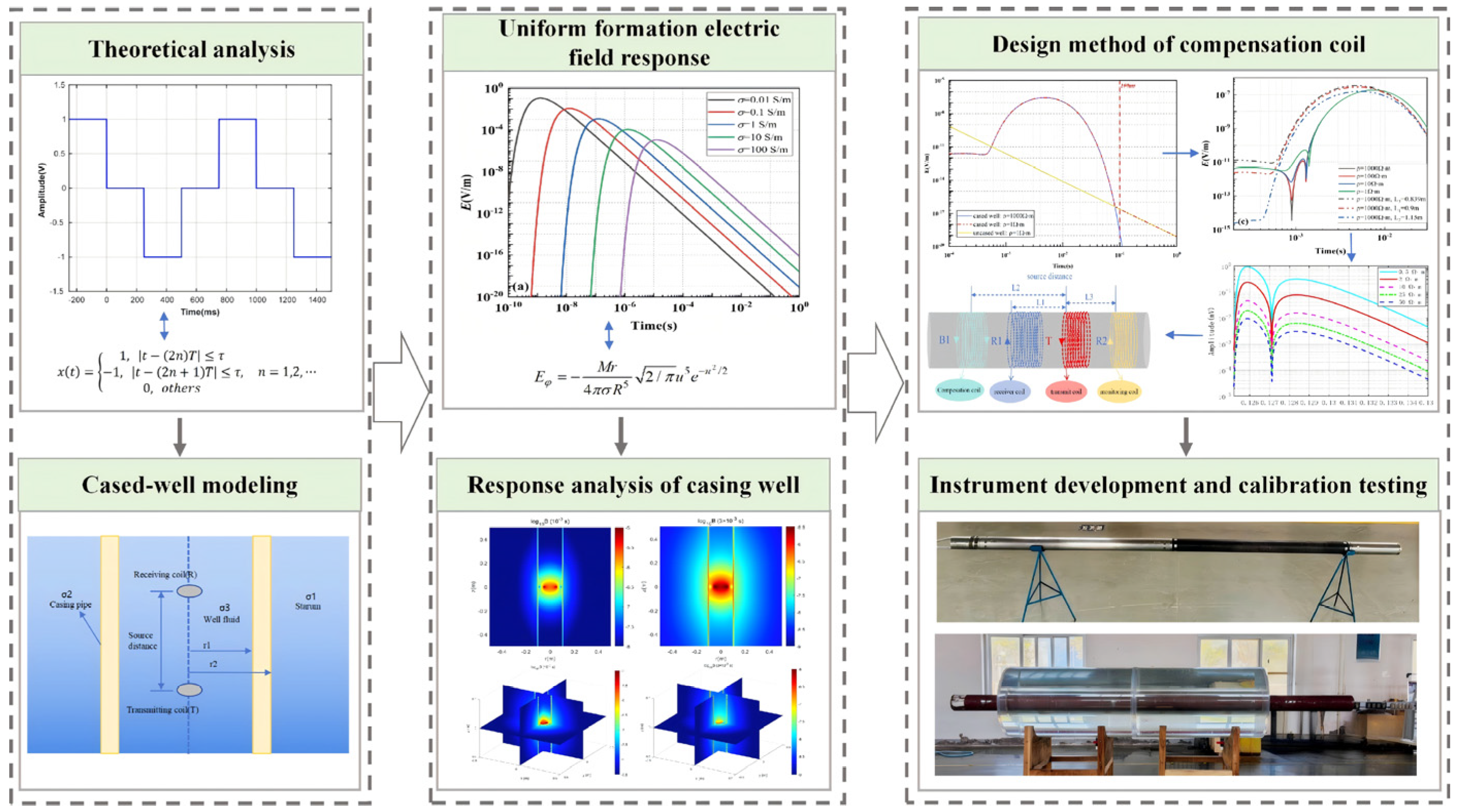
Figure 1 illustrates the workflow diagram that integrates theoretical methodology with instrument development, ultimately validated through calibration system testing to confirm consistency with theoretical approaches.
2. Theoretical Analysis and Model Establishment
In time-domain electromagnetic methods, the excitation field waveform can utilize various periodic pulse sequences, including rectangular, trapezoidal, semi-sinusoidal, triangular, and pseudo-random waveforms. According to Fourier spectrum analysis theory, any periodic pulse wave can be decomposed into multiple sine or cosine harmonic components. In practical applications, periodic bipolar pulse sequences are commonly employed to effectively suppress DC offsets and noise interference in observation systems.
The time-domain electromagnetic method employs bipolar polarity as the current source for the transmitting coil, measuring the induced voltage on the receiving coil after the transmitting current is turned off. This section investigates the response of low-frequency rectangular pulses in a cylindrical layered medium. The transmitting current is a rectangular pulse, and it is assumed that the current has been sustained long enough before t = 0 to establish a stable static magnetic field throughout the space. At t = 0, the transmitting current is abruptly terminated, causing the magnetic field to lose its source and begin to decay. According to the principle of electromagnetic induction, a changing magnetic field generates an electric field, and in conductive regions, induced currents emerge. These induced currents, in turn, produce a magnetic field to slow down the decay rate of the total magnetic field. This process continuously occurs throughout the space, forming a diffusion phenomenon of induced currents. The induced voltage on the receiving coil reflects the rate of change in the total magnetic field at the receiving coil over time. The time-domain and frequency-domain expressions for the bipolar square wave are as follows:
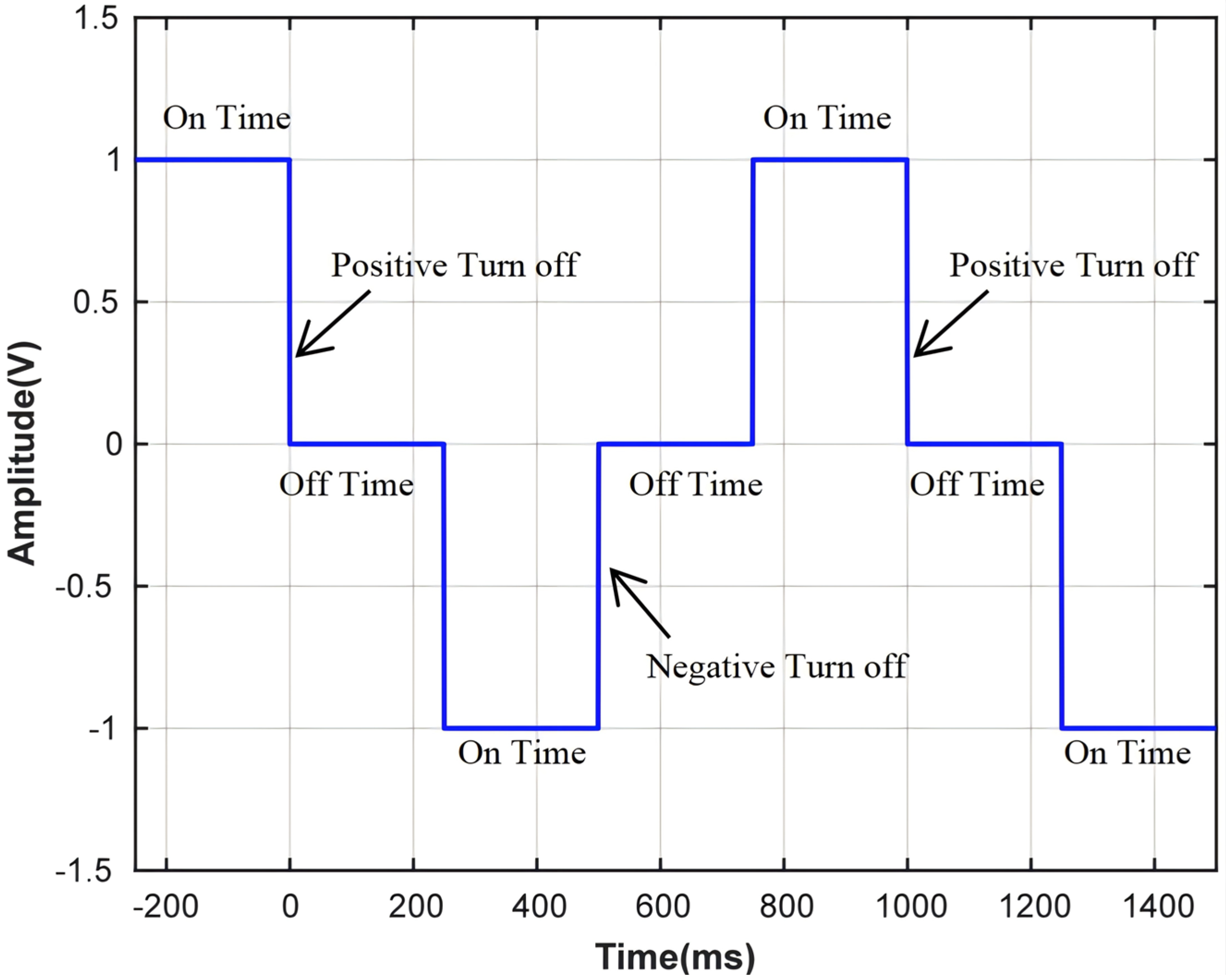
The time-domain waveform of the bipolar square wave is shown in
Figure 2.
In a uniform medium, there
is a transmitting coil with a radius of and turns, through which an alternating current is passed. The alternating electromagnetic field it generates in space varies sinusoidally with time: the electric field is
, and the magnetic field is
, where and are functions of spatial coordinates. The Maxwell’s equations describing the variation in the electromagnetic field are [
8]:
In the formula,
is the conduction current density in the medium, and
is the displacement current density in the medium. For this study, the conditions of
are generally satisfied.
is the source current density in the transmitting coil. As shown in Equation (3), the electric field intensity generated by the transmitting coil in a homogeneous medium satisfies the non-homogeneous Helmholtz equation:
In the wave number
sphere coordinate system, solving Equation (4) reveals that the electric field strength has only a ϕ-direction component.
Here, r denotes the distance from the field point. The transmitting magnetic moment is . is the area of the transmitting coil. is the number of turns of the transmitting coil. is responsible for transmitting current.
The eddy current density generated by the action of
only has a component in the direction of φ:
According to the relationship between electric field intensity and magnetic field intensity, the magnetic field produced by a source at any point in a uniform conductive medium consists of r component and θ component:
In non-conductive homogeneous media, the wave number k is a real number.
The exponential part of the field quantity is
or
(
represents wave velocity). This phenomenon describes how the electromagnetic field generated by a source propagates as waves over distance r, with a phase lag of kr or a time delay collectively known as the delay effect of electromagnetic waves. In contrast, for conductive homogeneous media, the wave number k is a complex number, specifically:
Here, a is the phase coefficient and b is the attenuation coefficient. The exponential part of the field quantity formula is
. After recording the time factor, it is
or
, where V =
a is the wave velocity or phase velocity. Comparing with field quantities in non-conductive media, electromagnetic fields in conductive media propagate as waves, exhibiting both phase shifts and amplitude attenuation. Furthermore, for electromagnetic logging in oil and gas wells, logging devices operate at lower frequency ranges. When
, Equation (12) can be simplified to:
The single-transmitter single-receiver coil assembly, as a basic configuration, demonstrates significant limitations when applied to open-hole and casing wells. In open-hole environments, the absence of casing as an interference factor simplifies the interaction between formation media and electromagnetic fields. When the transmitting coil generates an electromagnetic field, the formation responds to this field based on its electrical properties, and the signals received by the receiving coil primarily originate from electromagnetic induction within the formation.
Take a transmitter-receiver coil assembly as an example, the transmitter current varies
u(
t) according to a first-order step function without the use of a sleeve.
where n denotes the number of turns in the coil.
represents the magnitude of the transmitting current. In cylindrical coordinates, the magnetic vector potential in the frequency domain is:
In the formula
, where
represents the angular frequency,
is the permittivity constant,
is the magnetic permeability constant, and
is the electric conductivity constant. The distance from the field point to the center of the transmitter coil is denoted as
, while
represents the magnetic moment of the transmitter coil, and
is the area of the coil. For electromagnetic methods in oil and gas wells, the logging device operates within a lower frequency range that satisfies:
, the wave number is
. Performing an inverse Fourier transform on Equation (17) yields:
where
, according to Maxwell’s equations, the relationship between the electric field
and the magnetic vector potential
A is:
Assuming the scalar
potential to be zero. In the cylindrical coordinate system, the electric field only has an
direction component
, so the expression for the electric field can be obtained [
27]:
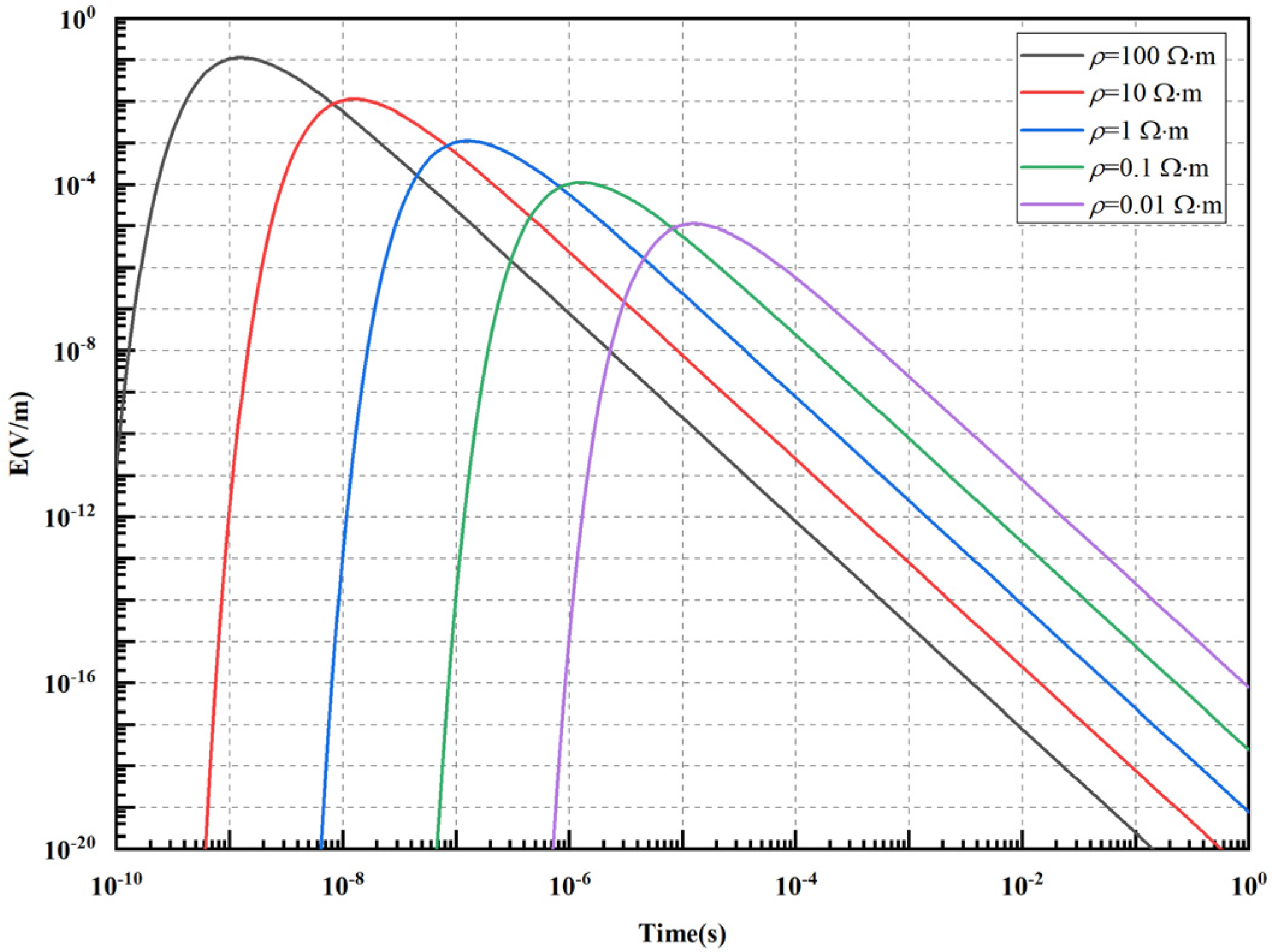
The skin effect principle indicates that lower formation conductivity results in faster electromagnetic wave propagation. Electromagnetic induction generated eddy currents attenuate more rapidly in low-conductivity formations, enabling the secondary field to reach the receiving coil more quickly. To quantify the relationship between formation conductivity and secondary field strength, varying formation conductivity was applied according to Equation (21) to study time-dependent changes in secondary field intensity across different formations. As shown in
Figure 3, the response of secondary field intensity within the 0.01~100 Ω·m resistivity range demonstrates that peak values gradually decrease with increasing conductivity, while the peak occurrence time progressively delays. Furthermore, after the peak, the secondary field intensity response exhibits linear attenuation characteristics in a double-logarithmic coordinate system.
Before the sudden current interruption, a stable magnetic field had already been established in the space, so the electric field remained zero for all t < 0. After the current was cut off, the coil current abruptly became zero, causing its magnetic field to vanish instantly. However, due to electromagnetic induction principles, the abrupt change in magnetic field generated a vortex electric field. If the surrounding medium’s conductivity is non-zero, a vortex current is induced within it. This vortex current aligns with the direction of the current in the energized coil, resulting in the magnetic field produced by the vortex current sharing the same direction as the coil-generated field. Consequently, the total magnetic field in the space does not abruptly vanish but gradually decays. As time t approaches infinity, the total magnetic field approaches zero. According to Maxwell’s equations, the electric field is the time derivative of the magnetic field, meaning the decay rate of the electric field is proportional to that of the magnetic field. Therefore, the electric field strength initially increases rapidly for all t > 0 before gradually decaying, with the peak electric field intensity corresponding to the moment when the magnetic field decay rate reaches its maximum.
3. Time Domain Electromagnetic Signal Response of Three Casing Wells
When single-shot single-receiving coil assemblies are applied to casing wells, the situation becomes highly complex. Casing materials exhibit extremely high electrical and magnetic conductivities, which significantly influence their response to electromagnetic fields. Once the transmitting coil generates an electromagnetic field, the casing rapidly induces powerful eddy currents. The magnetic field strength produced by these eddy currents far exceeds that of formation responses, dominating the entire measurement signal system and completely masking the faint formation response signals.
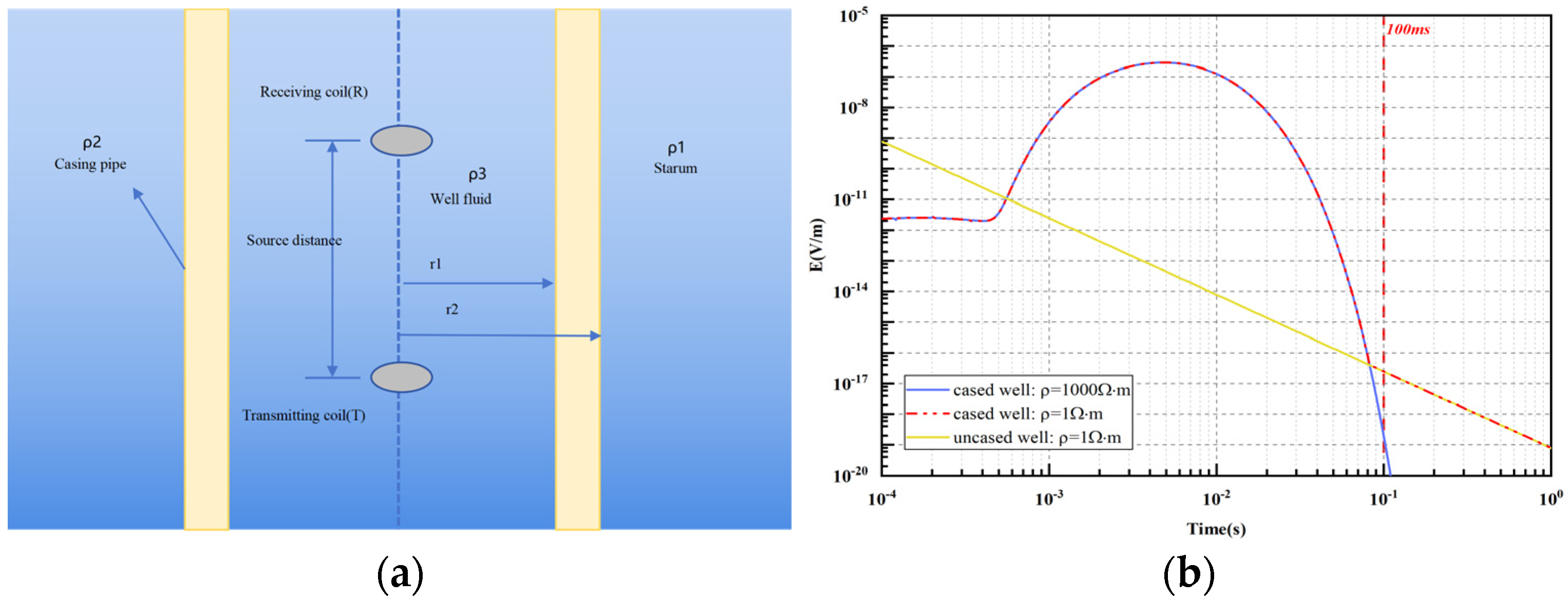
The transient electromagnetic secondary field response in a casing well is calculated using finite element method (FEM) by precisely meshing the model. As shown in
Figure 4a, the casing well model consists of the formation (ρ1), casing (ρ2), and wellbore fluid (ρ3), with inner diameter r1, outer diameter r2, transmitting coil T, and receiving coil R1. The casing and wellbore fluid resistivity are set to ρ2 = 1000 Ω·m and ρ3 = 1 Ω·m, respectively. In this study, the formation conductivity for the casing well ranges from 1 to 1000 Ω·m.
As shown in
Figure 4b, the measurement results in the casing well present a striking contrast. The electromagnetic response signal of the casing exhibits an exceptionally high peak amplitude, while the formation signal is almost entirely drowned out, making it difficult to discern any meaningful formation-related information. In the later stages of the response, the signals from the open-hole well and the casing well overlap under the same formation conductivity, indicating that after 100 ms, the casing response ceases, leaving only the formation response signal. However, the formation signal is too weak for current instruments to detect, so the early-stage signal is considered.
Assuming coaxial transmitting and receiving coils are positioned within a homogeneous isotropic formation with a formation resistivity of 1 Ω·m,
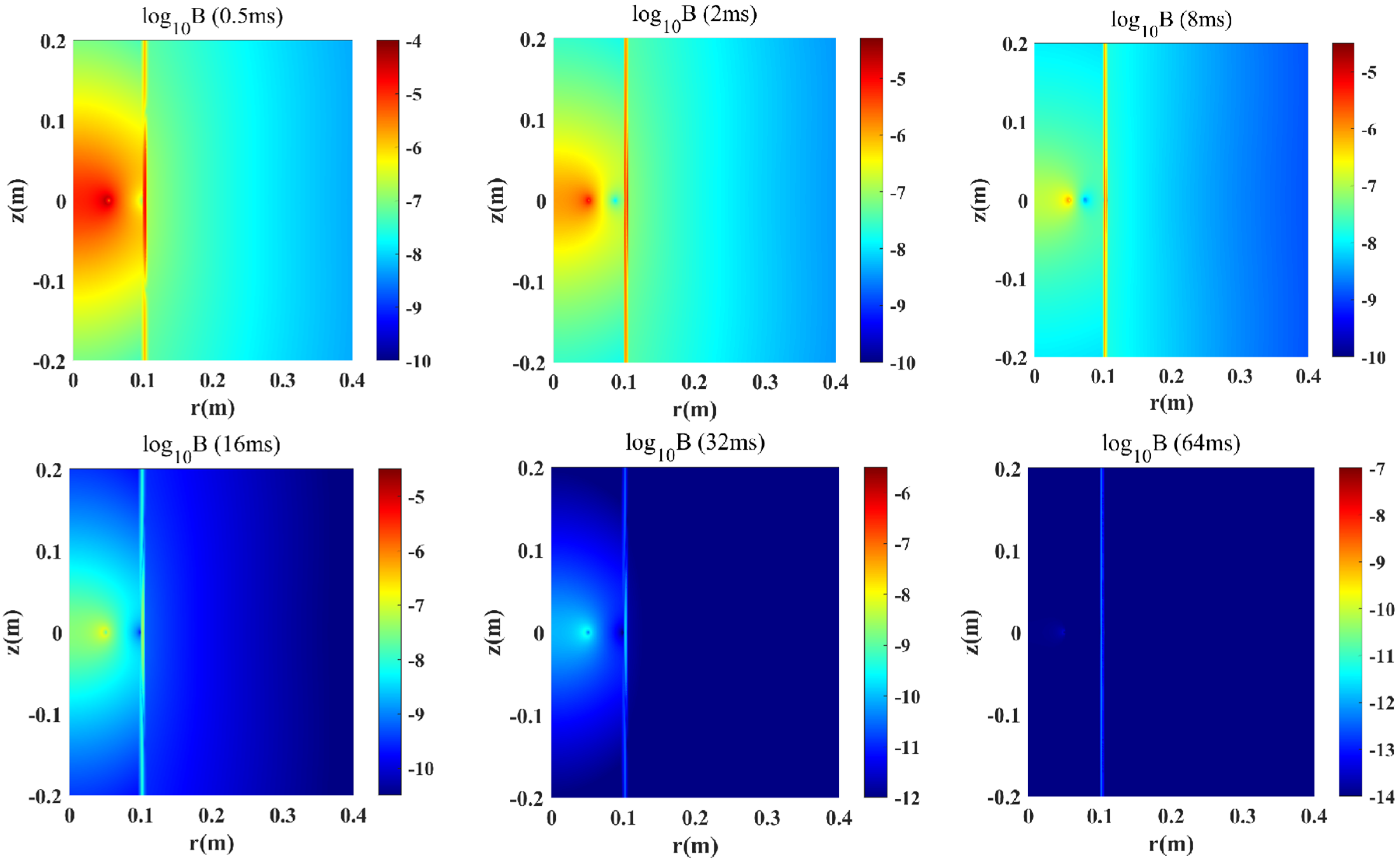
Figure 5 illustrates the induced eddy current density distribution in the formation at different time points after current interruption. The analysis reveals that initial eddy currents concentrate near the transmitter source, gradually propagating deeper into the formation over time. The field strength remains uniform in all radial directions, with the maximum intensity at the eddy center, which consistently lies on the z = 0 plane. The intensity diminishes both vertically and horizontally. Notably, the upper limit of the color scale indicates that eddy currents attenuate progressively during propagation due to the influence of dissipative media. The diffusion velocity of eddy currents is closely related to the formation’s conductivity, with lower conductivity typically resulting in faster diffusion rates.
Owing to the complex frequency spectrum of transient electromagnetic fields, low-frequency components despite their relatively weak penetration capability can traverse the casing to propagate into the formation in cased-well environments. In contrast, high-frequency components are impenetrable to the casing due to its strong electromagnetic properties, resulting in significant electromagnetic energy accumulation within the casing during the cased-well response process.
Figure 5 presents a two-dimensional display of the logarithmic distribution of magnetic induction intensity at different time points (0.5 ms, 2 ms, 8 ms, 16 ms, 32 ms, and 64 ms), clearly demonstrating this characteristic. In the early response phase, the magnetic induction intensity within the casing is approximately three orders of magnitude higher than that in the formation. As the response time extends, both the casing and formation gradually lose electromagnetic energy. Since formation signals are more intense in the early stages (0.5 ms, 2 ms), excluding the influence of the casing surface allows the measured electromagnetic signals to more accurately reflect the true formation resistivity.
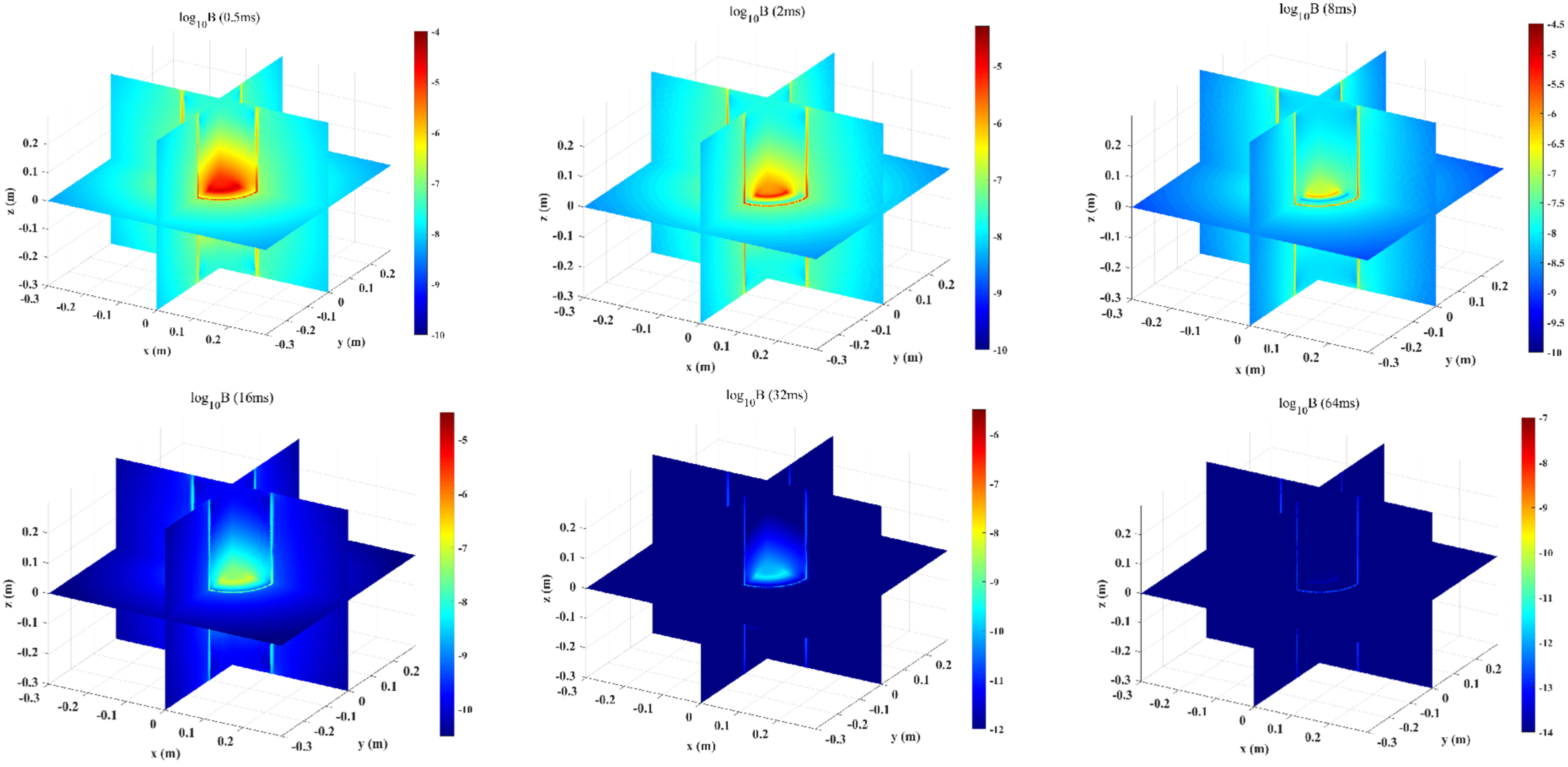
The 3D distribution of magnetic induction B and electromagnetic intensity M in casing well is further analyzed based on the 2D magnetic field and electromagnetic distribution, as shown in
Figure 6.
Figure 6 demonstrates the three-dimensional distribution of magnetic induction intensity in a casing well at different time intervals (0.5 ms, 2 ms, 8 ms, 16 ms, 32 ms, and 64 ms). The analysis reveals that at 2 ms, eddy currents within the casing experience resistance during their propagation from the origin to distant regions, causing current accumulation on the inner casing surface. Between 8 ms and 32 ms, the casing’s high electrical conductivity acts as a current guide. This phenomenon creates two distinct effects. First, it forms localized high-current-density zones near the source on both casing sides, demonstrating magnetic field concentration at the casing edges. Second, it induces aliasing during measurements, where signals predominantly reflect casing characteristics rather than external formation resistivity, posing detection challenges. As current density decreases, eddy current propagation splits into two pathways. The first follows the casing’s longitudinal axis near the source, with its distribution becoming smoother over time while maintaining the highest density. The second pathway extends outward to distant formations, initially increasing then decreasing. Over time, more current accumulates on the casing’s outer surface, leading to gradual density elevation. Color code analysis shows that near-casing current density diminishes during deep formation penetration, indicating rapid attenuation due to dielectric effects.
While the casing induces current concentration that significantly hinders the spread of induced eddy currents into the formation, these currents eventually diffuse through the formation over time, with the external current density gradually exceeding that inside the casing. Nabighian proposed the “smoke ring theory,” which posits that the eddy current center corresponds to the instrument’s current detection depth and serves as the primary source of induced electromotive force in the receiving coil. Thus, measuring induced electromotive force variations at the late-receiving coil reflects formation characteristics. Based on the field distribution in the casing model, the feasibility of measuring formation resistivity outside the casing was investigated, establishing the theoretical foundation for transient electromagnetic wave measurement through casing.
4. New Method for Hard Suppression of Background Signal in Casing
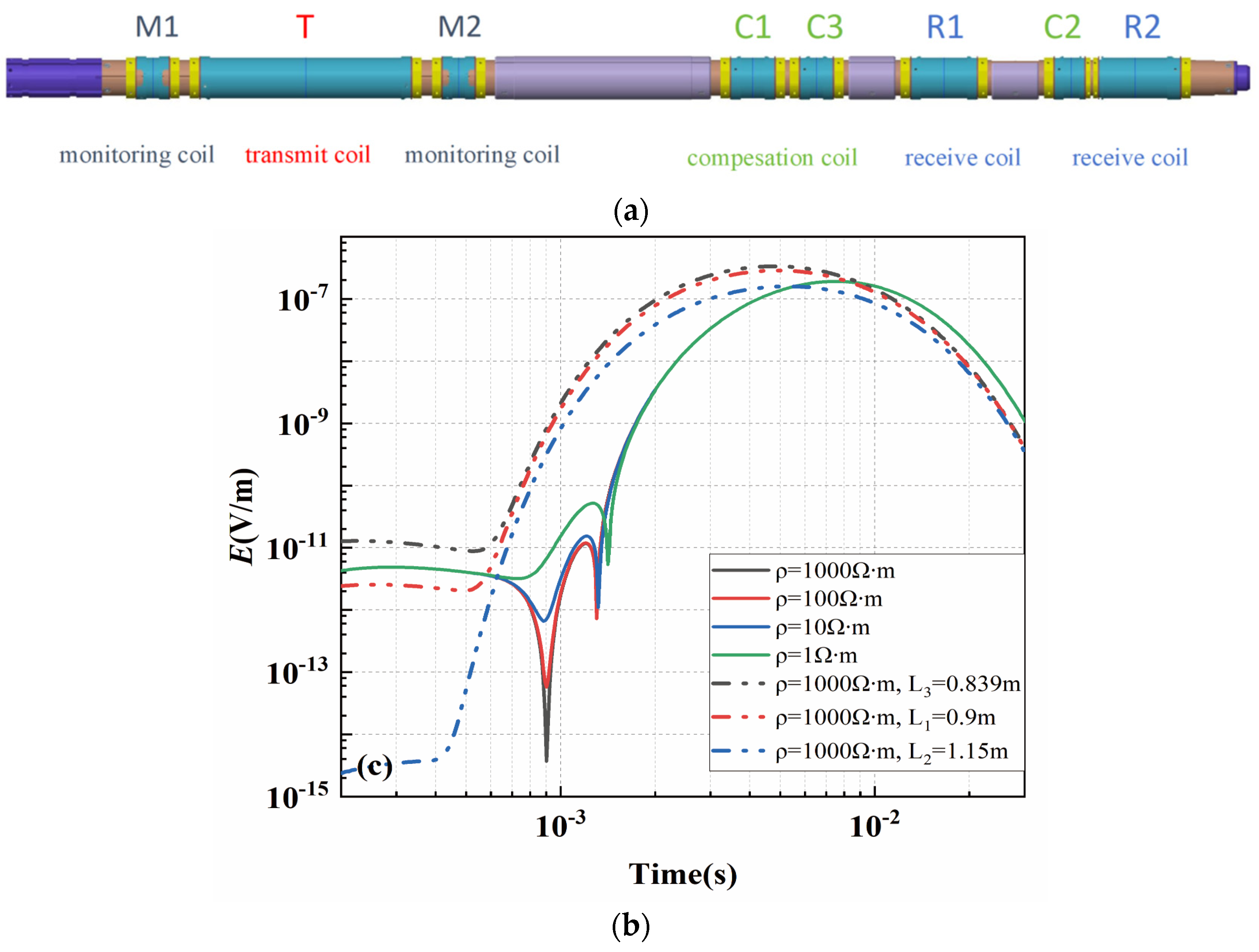
To address the challenge of cabling interference in formation resistivity measurement, a novel approach has been developed. A new combination structure consisting of one transmitter coil and seven receiver coils has been designed. This system includes a primary receiver coil pair (R1/R2) for collecting useful signals, a monitor coil pair (M1/M2), which consists of two coils with opposite orientations to form difference measurements, and three compensation coils (C1/C2/C3) that work in tandem with the receive coils to cancel out cabling effects. By utilizing the cancelation effect of the compensation coil, the influence of the sleeve can be effectively suppressed, and the useful signal in the receiving coil can be highlighted. When determining coil parameters under wellbore 1 Ω·m, casing 1 × 10
−6 Ω·m, and formation 1 Ω·m background conditions, the goal is to minimize the casing background signal (ideally zero) within a specific time window, thereby achieving compensation suppression of casing signals and differential measurement of formation signals.
Figure 7a presents simulation diagrams of the one-transmitter-seven-receivers coil system under varying resistivity conditions.
The system employs intelligent optimization algorithms to determine optimal coil source distance and turns, enabling efficient search for optimal solutions within complex parameter spaces [
28]. A comprehensive coil configuration parameter dataset is established, encompassing critical parameters such as source distance, time, response intensity, and formation resistivity of the receiving coil. Various parameter combinations generate diverse individual samples. During training, continuous parameter adjustments are performed with signal variance as the optimization metric, ultimately yielding coil configuration parameters that achieve high-resolution formation response.
As shown in
Figure 7b, the source distances of the receiving coils R1, R2, and R3 are 0.9 m,1.15 m and 0.839 m respectively. The turns ratio is
. When formation resistivity varies, the combined response curve demonstrates excellent regularity. Based on the designed coil structure, theoretical simulation analysis was conducted to obtain the theoretical waveform diagram of the one transmitter three receiver coil system, as shown in
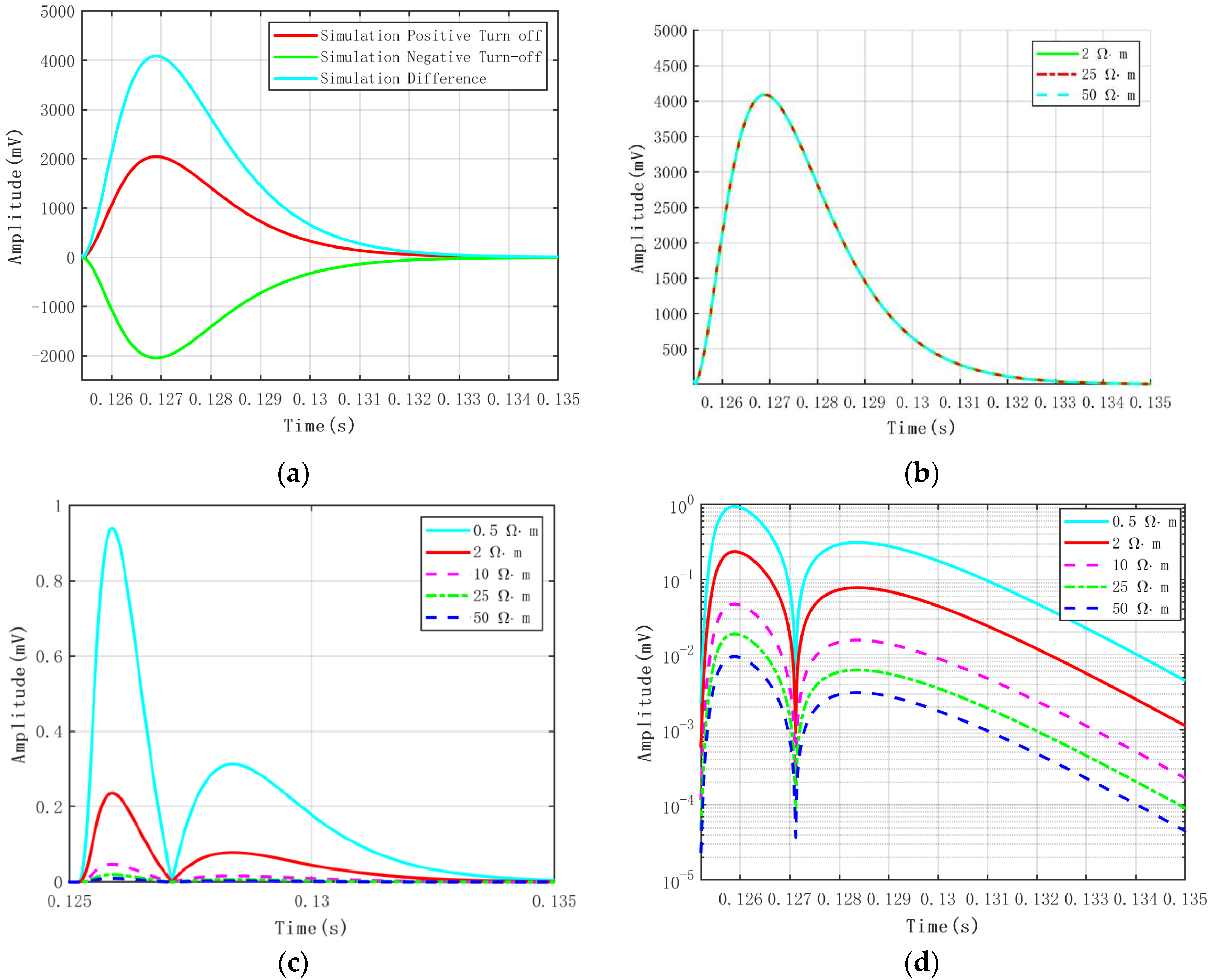
Figure 8.
Figure 8a demonstrates the waveform of the receiving coil after emission shutdown. The red curve represents the waveform after positive emission shutdown, while the green curve shows the waveform after negative emission shutdown. By performing a differential operation between the two waveforms, the light blue waveform is obtained.
Figure 8b presents the receiving coil waveforms under different resistivity conditions, where the waveforms appear nearly identical, making it difficult to distinguish differences.
Figure 8c shows the waveform obtained by subtracting the background signal (air medium) from waveforms under various resistivity conditions. The results clearly reveal distinct waveforms under different resistivity levels. As resistivity decreases (from 50 Ω·m to 0.5 Ω·m), the voltage values gradually increase, consistent with theoretical predictions.
Figure 8d displays the logarithmic transformation of the subtracted waveforms under different resistivity conditions. It is evident that the signal voltage reaches its maximum at 2 ms post-emission shutdown, indicating optimal resolution. It should be noted that in the simulation analysis, both the emission duration and shutdown duration are set to 125 ms. Therefore, the 125 ms interval in the waveform corresponds to 0 ms post-emission shutdown, while 127 ms represents 2 ms post-emission shutdown.
5. Development of Prototype and Calibration Device
Through theoretical analysis, coil structure design was conducted to guide the instrument development. To address the challenge of limited excitation power in over-casing transmission, an FPGA + ARM control system was proposed, employing frequency-adjustable band spectral focusing waveform transmission technology [
29]. This breakthrough overcame the stringent requirements of special working environments, resulting in the following three key innovations: a short-differential magnetic antenna with high-temperature (150 °C) and high-pressure (140 MPa) resistance, a high-efficiency, high-power transmission circuit (100 W), and a highly sensitive, wide-dynamic-range receiving circuit (100 dB).
Figure 9 shows the design structure of the time-domain electromagnetic over-casing resistivity instrument [
23], while
Figure 10 displays its prototype.
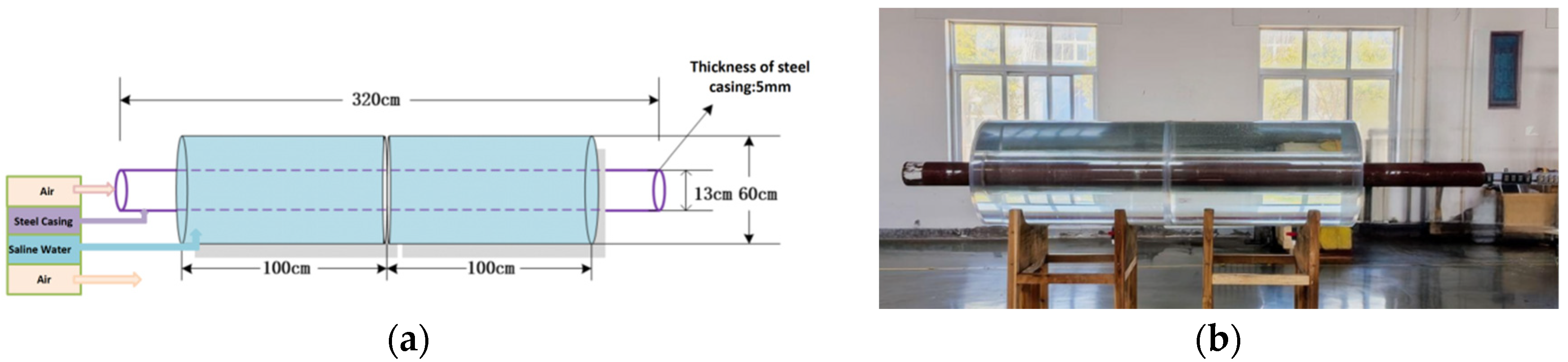
To verify the consistency between the received signal waveform of the instrument under real resistivity conditions and theoretical simulations, a resistivity calibration device for ground water tanks was designed and developed, as shown in
Figure 11. By adjusting fluid resistivity and optimizing calibration coefficients, a time-domain response-resistivity correlation was established. This yielded formation response curves and reactive fluid resistivity characteristics, and transient casing logging instrument acquisition and processing software was developed.
Figure 11a shows the schematic design of the resistivity calibration device for ground water tanks, while
Figure 11b displays its physical prototype. The experimental setup features four-layer radial stratified media with parameters specified in
Table 2. The first layer contains air within the casing, the second layer is the casing itself, the third layer is saline solution in an acrylic tube, and the fourth layer is air outside the acrylic tube.
The casing of the ground water tank resistivity test scale device is of finite length. In order to further study the change rule of the receiving signal of the instrument under different resistivity conditions and verify whether the change rule is consistent with the theoretical simulation of four sections, this section will introduce the change rule of the instrument under different resistivity conditions in the measured environment in detail.
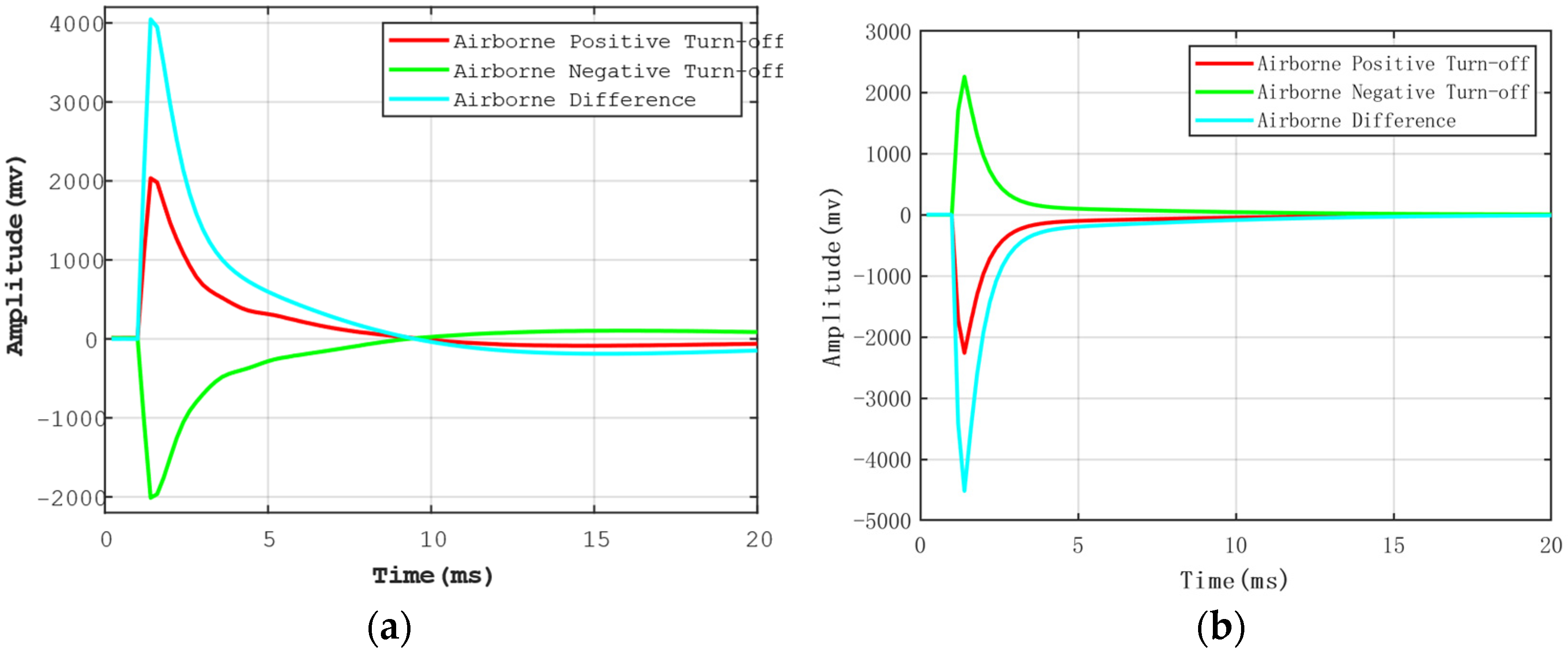
Step 1: Place the instrument into a self-made steel sleeve water tank where air is temporarily present. After powering on the instrument, measure the received signal waveform as shown in
Figure 12. Since the transmitted waveform is a bipolar square wave, all received signals are collected after the transmission is turned off. The transmitted waveform includes both positive and negative shutdown phases, resulting in two distinct received signal waveforms: one during positive shutdown and one during negative shutdown.
Figure 12a shows the received waveform of the compensation coil in air. The red curve represents the received signal waveform during positive shutdown, with a maximum amplitude of approximately 2000 mV; the green curve shows the received signal waveform during negative shutdown, with a maximum amplitude of around −2000 mV; the light blue curve is the maximum amplitude obtained by subtracting the negative shutdown waveform from the positive shutdown waveform, reaching approximately 4000 mV. It can be observed that the received signal amplitude initially peaks at 2 ms and then exhibits exponential decay.
Figure 12b displays the received waveform of the monitoring coil in air. The red curve corresponds to the received signal waveform during positive shutdown, with a maximum amplitude of about 2100 mV; the green curve shows the received signal waveform during negative shutdown, with a maximum amplitude of around −2100 mV; the blue curve represents the maximum amplitude obtained by subtracting the negative shutdown waveform from the positive shutdown waveform, reaching approximately 4400 mV. It is evident that the received signal amplitude initially peaks at 2 ms and then demonstrates exponential decay.
Since the monitoring coil and compensation coil are arranged at different positions relative to the transmitting coil, and the transmitting currents are opposite, the received waveforms exhibit opposite phenomena. Compared to the signal waveform received by the compensation coil in
Figure 12a, the curve of the monitoring coil in
Figure 12b appears smoother.
Step 2: Fill the water tank with tap water and measure the received waveforms of the compensation coil and monitoring coil.
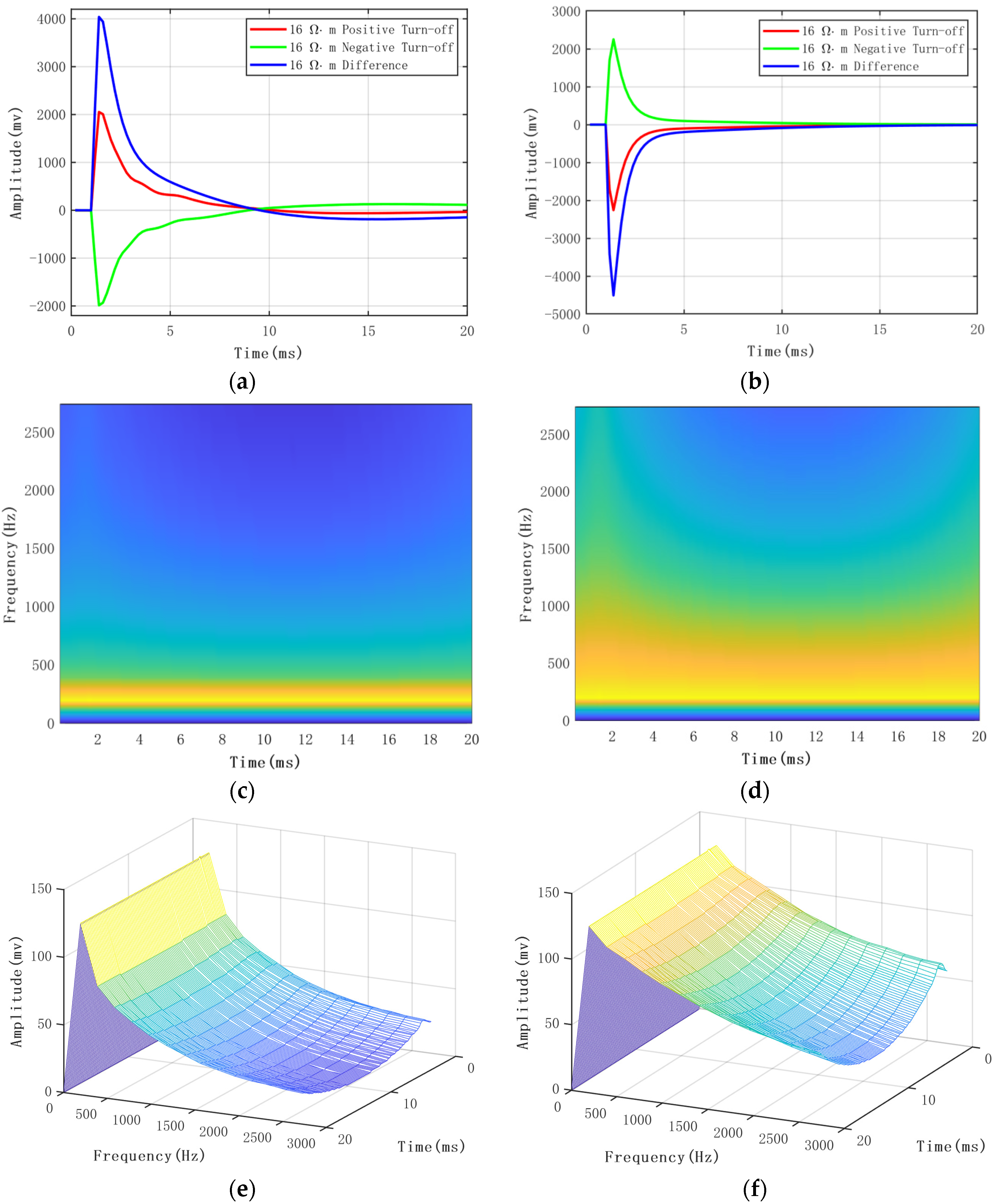
Figure 13 shows the received waveforms of the compensation coil and monitoring coil in 16 Ω·m water.
Figure 13a displays the received waveform of the compensation coil in 16 Ω·m water. The red curve represents the received signal waveform when the positive emission is turned off, with a maximum amplitude of approximately 2000 mV. The green curve shows the received signal waveform when the negative emission is turned off, with a maximum amplitude of around 2000 mV. The light blue curve represents the difference between the positive emission-off waveform and the negative emission-off waveform, yielding a maximum amplitude of approximately 4000 mV. It can be observed that the received signal amplitude initially peaks (within 2 ms) and then exhibits exponential decay.
Figure 13b illustrates the received waveform of the compensation coil in 16 Ω·m water. The red curve shows the received signal waveform when the positive emission is turned off. The green curve represents the received signal waveform when the negative emission is turned off, with a maximum amplitude of approximately 2200 mV. The blue curve represents the difference between the positive and negative emission-off waveforms, with a maximum amplitude of approximately 4500 mV. The observed trend in the received signal waveform in tap water is consistent with its behavior in air.
To conduct a detailed comparison of the spectral characteristics between the compensation coil and the monitoring coil, we performed two-dimensional (2D) and three-dimensional (3D) time-frequency analysis.
Figure 13c shows the 2D time-frequency diagram of the compensation coil’s received signal, while
Figure 13d displays the 2D time-frequency diagram of the monitoring coil’s received signal.
Figure 13e,f present the 3D time-frequency diagrams of the respective signals. The comparison reveals that the monitoring coil’s received signal exhibits a broader spectral bandwidth.
Step 3: First, add salt of varying concentrations to the water tank to adjust the tap water’s resistivity. After each addition, use a gas pump to thoroughly mix the salt. Then, measure the received signals from both the compensation coil and focus coil of the testing instrument, recording multiple data sets. Repeat the process to conduct tests at different resistivity levels.
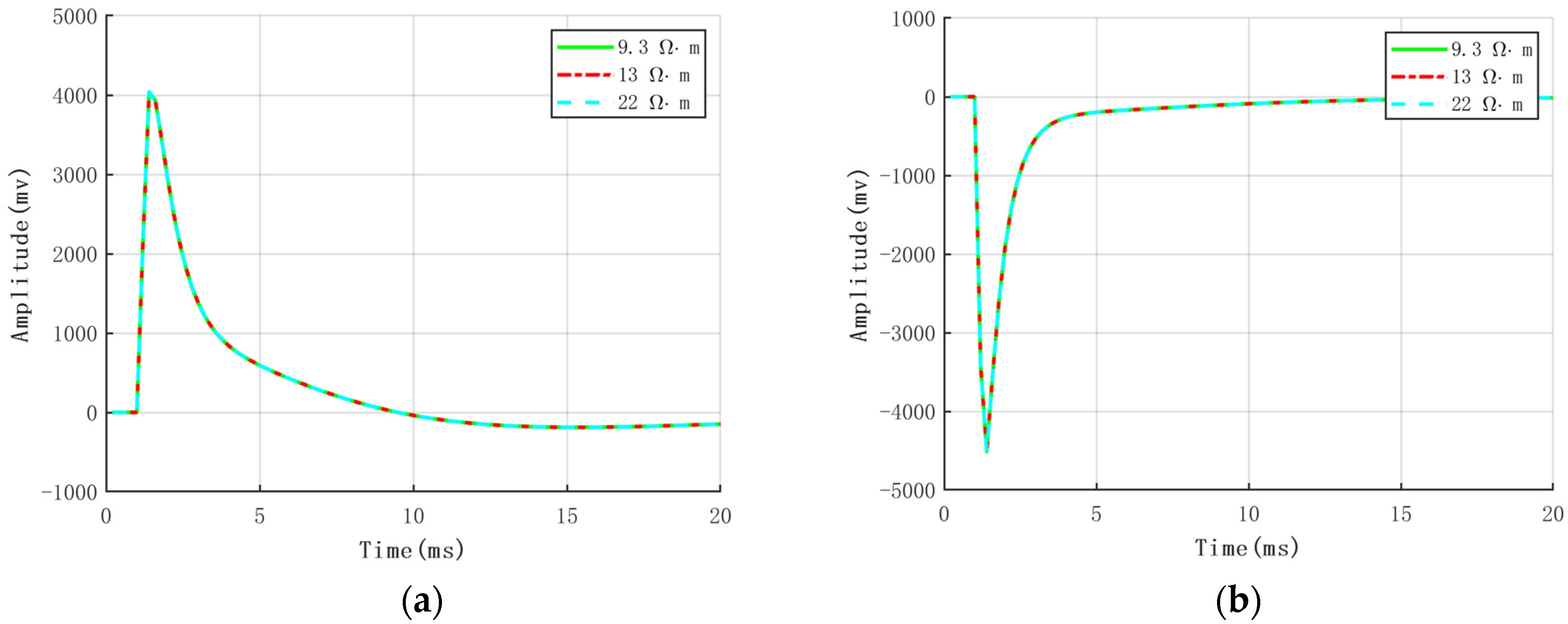
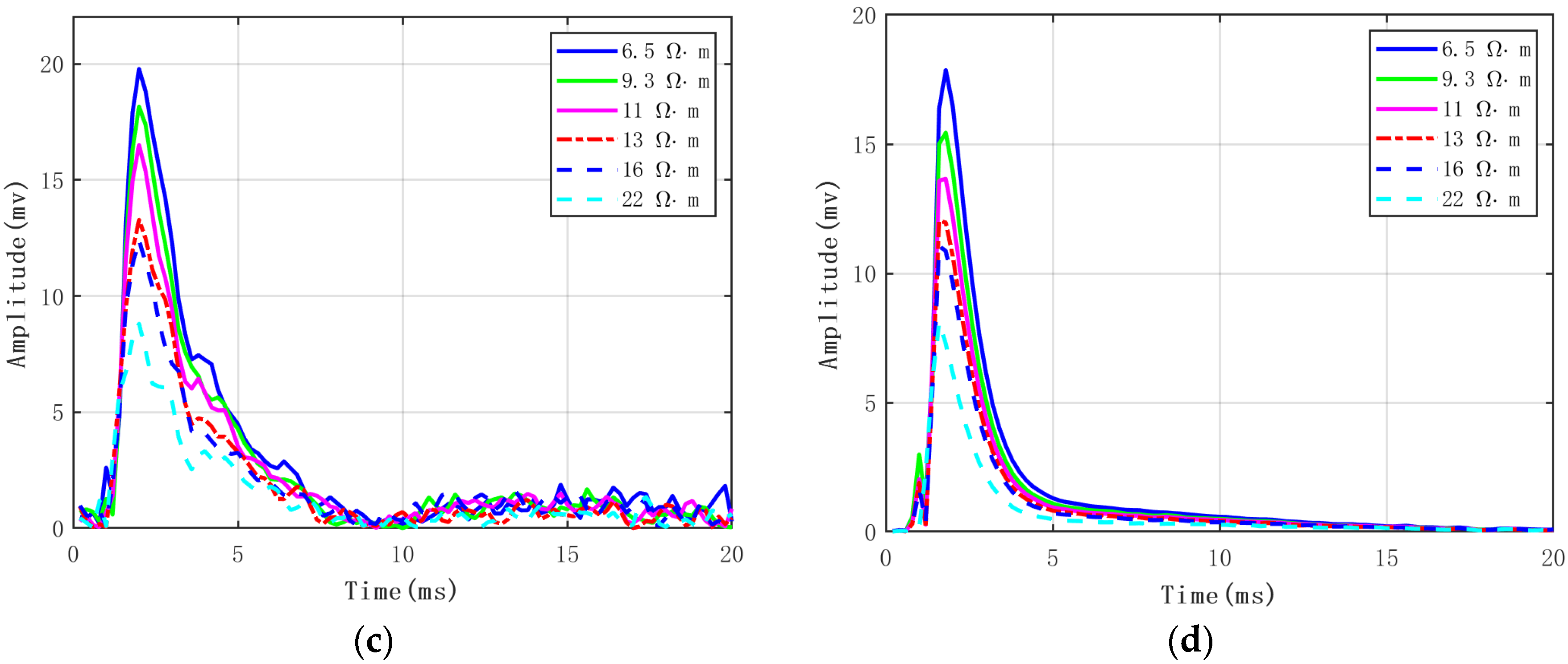
Figure 14 shows the actual measured waveforms under these conditions. Specifically,
Figure 14a compares the received waveforms of the compensation coil at different resistivity levels, while
Figure 14b compares those of the monitoring coil. Due to the large amplitude of the overall curves, the waveforms remain largely consistent across different resistivity levels.
We propose a casing-penetrating resistivity identification method. Using the measurement values from the steel casing water tank in
Figure 11 as a baseline, we subtract this baseline from the amplitude values of water samples with varying resistivities, then reanalyze the data to generate comparative diagrams of the compensation coil and monitoring coil under different resistivity conditions. Specifically,
Figure 14c presents the waveform comparison of the compensation coil’s reception in water with different resistivities after applying the new method, while
Figure 14d displays the waveform comparison of the monitoring coil’s reception in water with varying resistivities under the same method.
According to the test results of the instrument in the ground water tank scale device, the parameters of the receiving voltage amplitude of the compensation coil and the monitoring coil under different resistivity are shown in
Table 3.
Figure 14 clearly demonstrates that the new method significantly improves the resolution of both compensation and monitoring coils in water with varying resistivity levels, enabling clear differentiation between different resistivity ranges. At higher resistivity values, the received signal voltage remains low, while the amplitude progressively increases as resistivity decreases, aligning with theoretical simulation patterns. Compared to
Figure 14c, the curve in
Figure 14d exhibits greater balance and more pronounced trends. This proves the new method’s remarkable advantage in distinguishing different resistivity levels, substantially enhancing formation resolution. The findings provide methodological guidance for further application of this technique in practical production well logging for formation differentiation.
6. Conclusions
The time-domain electromagnetic method (TEM) uses a non-time harmonic field working mode to measure the formation resistivity of metal casing. By separating the casing information from the formation information in the time domain, the formation information outside the metal casing can be obtained, which can effectively evaluate the formation resistivity.
This paper proposes an active compensation method based on differential measurements between specially configured coils, enabling the early response of the formation to be identified, the method enhances weak signal detection capabilities in casing formations. We have developed a ground water tank resistivity calibration device and derived the relationship between time-domain electromagnetic waveform and resistivity by changing the fluid resistivity. Due to the defects of the casing itself, it can affect the received magnetic field signal. Therefore, this instrument and method are more suitable for measurement in new casing wells and well casing conditions. The instrument has the strongest ability to suppress casing within 5 ms before receiving signals, with a minimum resolution of 0.2 Ω·m for resistivity and a maximum detection capability of 150 Ω·m.
We have carried out research and development work on time-domain electromagnetic casing instruments, developed high-temperature resistant (150 °C), high-voltage resistant (140 MPa) short differential magnetic antennas, high-sensitivity receiving circuits with large dynamic range, high-power transmitting circuits, and other high-temperature resistant circuits. We have developed a transient electromagnetic resistivity instrument for wellbore transmission and reception, which provides an effective technical means for dynamic monitoring of oil reservoirs and remaining oil distribution research in land and marine resources.



 ,
,