Article

Evaluation of Wave Attenuation Performance of an Ecological Submerged Breakwater in the Sheyang Coastal Zone, Jiangsu Province, China

1
Marine Geological Survey of Jiangsu Province, Nanjing 210007, China
2
Key Laboratory of Coastal Salt Marsh Ecosystems and Resources, Ministry of Natural Resources, Nanjing 210007, China
3
Laboratory of Coastal and Marine Geology, Third Institute of Oceanography, Ministry of Natural Resources, Xiamen 361005, China
4
Fujian Provincial Key Laboratory of Marine Physical and Geological Processes, Xiamen 361005, China
5
School of Marine Sciences, Nanjing University of Information Science and Technology, Nanjing 210044, China
*
Authors to whom correspondence should be addressed.
J. Mar. Sci. Eng. 2026, 14(4), 364; https://doi.org/10.3390/jmse14040364
Submission received: 4 January 2026 / Revised: 9 February 2026 / Accepted: 9 February 2026 / Published: 14 February 2026
(This article belongs to the Section Coastal Engineering)

Abstract

Under the combined pressures of natural variability and human activities, the area of tidal flats has been gradually decreasing, with most muddy coasts experiencing varying degrees of erosion. The central coast of Jiangsu Province, a world-renowned region for extensive tidal flats, has witnessed intensifying erosion of its muddy coasts in recent years. To mitigate further coastal erosion, an ecological submerged breakwater (ESB) was constructed in the intertidal zone north of the Sheyang River estuary to reduce wave impact on the shoreline. This study evaluates the wave attenuation performance of the ESB based on wave observations conducted at stations deployed on the seaward and landward sides of the structure in May 2025. Results indicate that the breakwater effectively reduces wave height, but its performance exhibits significant dynamic characteristics. During the observation period, the maximum attenuation rate for significant wave height (H1/3) reached 76.3%, with an average rate of 33.8%. Wave dissipation efficiency was closely related to sea state: under calm conditions (H1/3 < 0.4 m), the average attenuation rate was only 18.4%, whereas under severe sea states (H1/3 ≥ 0.4 m), it increased markedly to 57.6%. The wave transmission coefficients (Kt) span a wide range from 0.20 to 0.99, indicating a significant dynamic variability in the wave attenuation performance of the ESB. The performance of the ESB was primarily controlled by two key factors: incident wave height and submergence depth of the structure. Compared to “zonated” natural ecosystems such as oyster reefs, coral reefs, salt marshes, and mangroves, the ESB, as a “linear” engineered structure, achieves comparable wave attenuation within a limited spatial footprint. A promising future strategy involves using the ESB as a frontline defense, integrated with landward ecological restoration measures like salt marsh rehabilitation, to establish a hybrid “grey-green” coastal protection system that synergistically enhances both coastal resilience and ecological function. This study provides a scientific basis for the design and performance evaluation of ecological engineering solutions for protecting eroding muddy coasts.

1. Introduction

Tidal flats are a geomorphological type primarily formed by tidal processes under conditions of abundant fine-grained sediment supply. Located in the most sensitive zone of land–sea interaction [1], they possess significant wave-dissipating and current-weakening functions. Particularly during storms, they can reduce flow velocity, dissipate wave energy, and effectively defend against storm surge impacts on the nearshore, thus playing a crucial role in coastal protection [2,3]. However, under the influences of climate change, sea-level rise, land subsidence, and human activities, tidal flat areas are gradually diminishing [4,5], and most muddy coasts are suffering from varying degrees of erosion [6,7]. Consequently, to protect coastlines from erosion or mitigate its effects, numerous international researchers have conducted extensive studies on coastal protection from both scientific and engineering perspectives. Early coastal protection efforts primarily relied on hard engineering structures, such as the construction of sea dyke [8]. With growing understanding and the deepening of ecological awareness, coastal protection technologies have evolved from early hard engineering approaches to later soft engineering strategies, such as beach nourishment [8], and further to contemporary nature-based solutions for ecological shoreline protection, including the restoration of ecosystems such as mangroves, salt marshes, oyster reefs, and coral reefs [9,10,11]. This progression has facilitated a critical paradigm shift in coastal engineering from “static defense” to “dynamic resilience” [12].
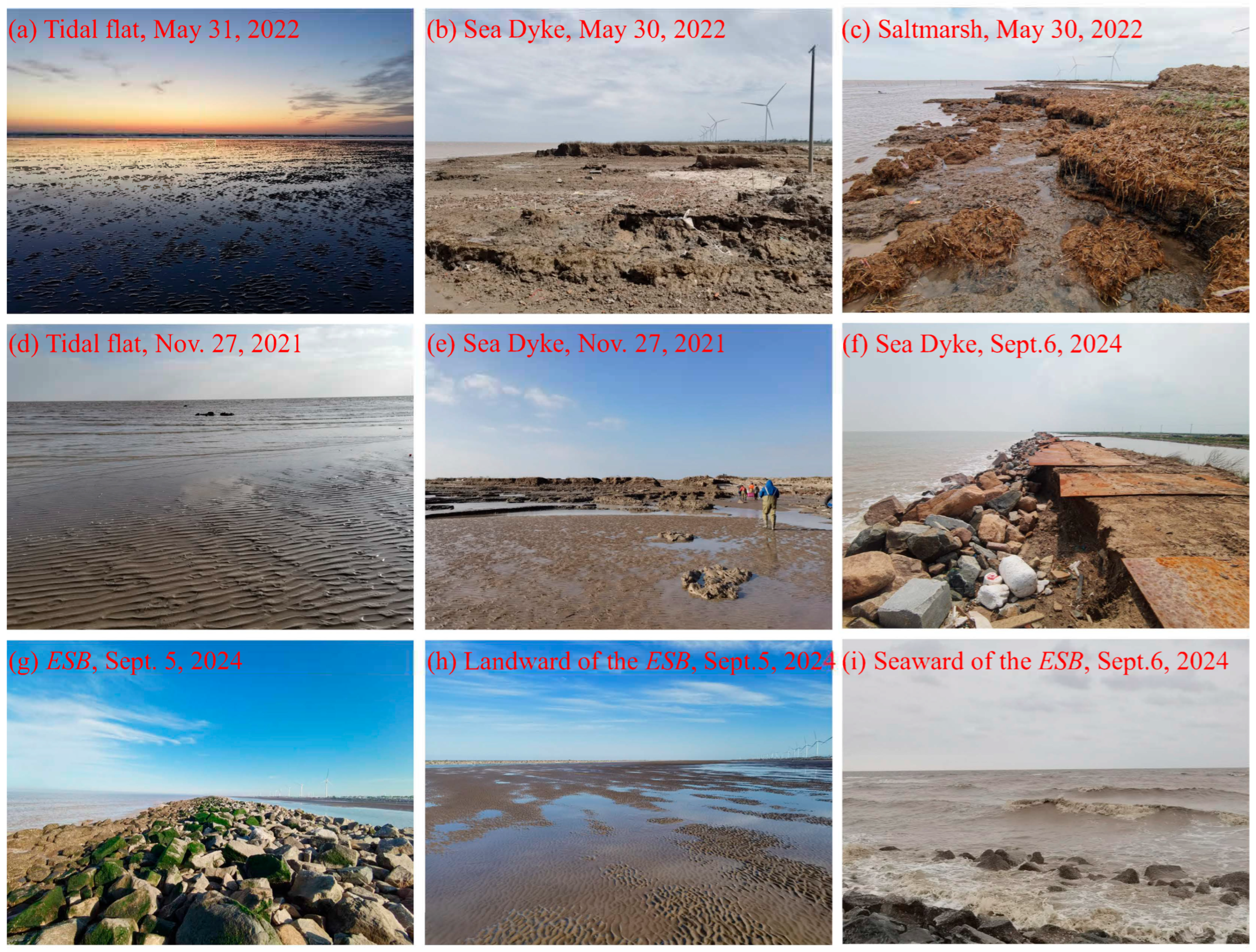
The Jiangsu coast is world-famous for its extensive silty-muddy tidal flats, characterized by both rapid accretion and severe erosion. Following the northward shift of the Yellow River course in 1855, which cut off the massive sediment supply, erosion commenced at the abandoned Yellow River mouth and adjacent coasts. The erosion intensity gradually weakened with increasing distance from the center of the river mouth’s subaqueous delta [13,14]. The Sheyang River estuary, located at the southern end of the abandoned Yellow River delta coast, historically marked a boundary in coastal erosion: areas north of the estuary exhibited erosional trends, while areas to the south showed accretion features due to the southward transport of eroded material from the abandoned river mouth [13,14]. However, over time, especially since around 2000, the coast south of the Sheyang River estuary has also begun to erode, with increasing intensity [15,16,17]. Field surveys reveal severe erosion on both sides of the Sheyang River estuary, leading to the destruction of numerous coastal aquaculture ponds and posing serious threats to roads and coastal infrastructure (Figure 1a–f). Topographic monitoring of tidal flat profiles further confirms a significant narrowing of the intertidal zone and a clear erosional trend in the area [18]. This severe coastal erosion has significantly impacted local socio-economic development and resident property security, highlighting an urgent need for ecological protection and restoration measures.
Currently, the international paradigm for coastal erosion protection is shifting from traditional hard engineering toward nature-based solutions, aiming to enhance coastal resilience and ecosystem services [9,11]. For example, in tropical and subtropical regions, restoring mangrove and coral reef ecosystems is a common coastal protection strategy [19,20]. In temperate and northern subtropical zones, salt marsh vegetation (such as the invasive species Spartina alterniflora or the native Scirpus mariqueter) can effectively attenuate waves through its root and stem structures [21,22], though its efficacy generally requires a sufficiently wide vegetated belt to be fully realized. Additionally, oyster reef restoration is widely used for wave and current attenuation [23], but the delivery of its ecosystem services depends on stable substrate conditions and a relatively long community establishment period.
However, given the rapid narrowing of the tidal flat at the Sheyang River estuary, the above ecological restoration approaches are often inadequate for meeting the region’s need for rapid and effective erosion control, due to either their limited geographical suitability or their long implementation time and large spatial requirements. Therefore, there is a pressing need for an ecological protection measure that can adapt to narrow intertidal zones, be constructed quickly, and provide immediate effectiveness. Accordingly, to curb further coastal erosion, local authorities designed and constructed a rubble-mound ecological submerged breakwater in the intertidal zone on the northern side of the Sheyang River estuary (between Shuangyang Port and Yunliang River) in 2023 (Figure 1g). This structure is intended to directly and rapidly attenuate incident wave energy through its physical form, thereby not only reducing wave-driven erosion of the intertidal zone but also providing favorable habitat for intertidal organisms (Figure 1h), achieving synergistic ecological and hazard-reduction benefits.
This study deployed in situ wave monitoring equipment to synchronously observe wave processes on both sides of the breakwater. The objectives are: (1) to quantitatively evaluate the actual wave-attenuation performance of the ecological submerged breakwater under different hydrological conditions; (2) to elucidate the primary physical mechanisms of energy dissipation based on the observed data; and (3) to compare its wave-attenuation efficacy with that of other typical ecosystems (e.g., salt marshes, oyster reefs), thereby demonstrating the unique advantages and applicability of submerged breakwaters in scenarios characterized by rapid erosion and spatially constrained coastlines. The findings are expected to provide a scientific basis for optimizing future ESB technical designs and for implementing hybrid “grey-green” protection systems.

2. Study Area and Ecological Submerged Breakwater

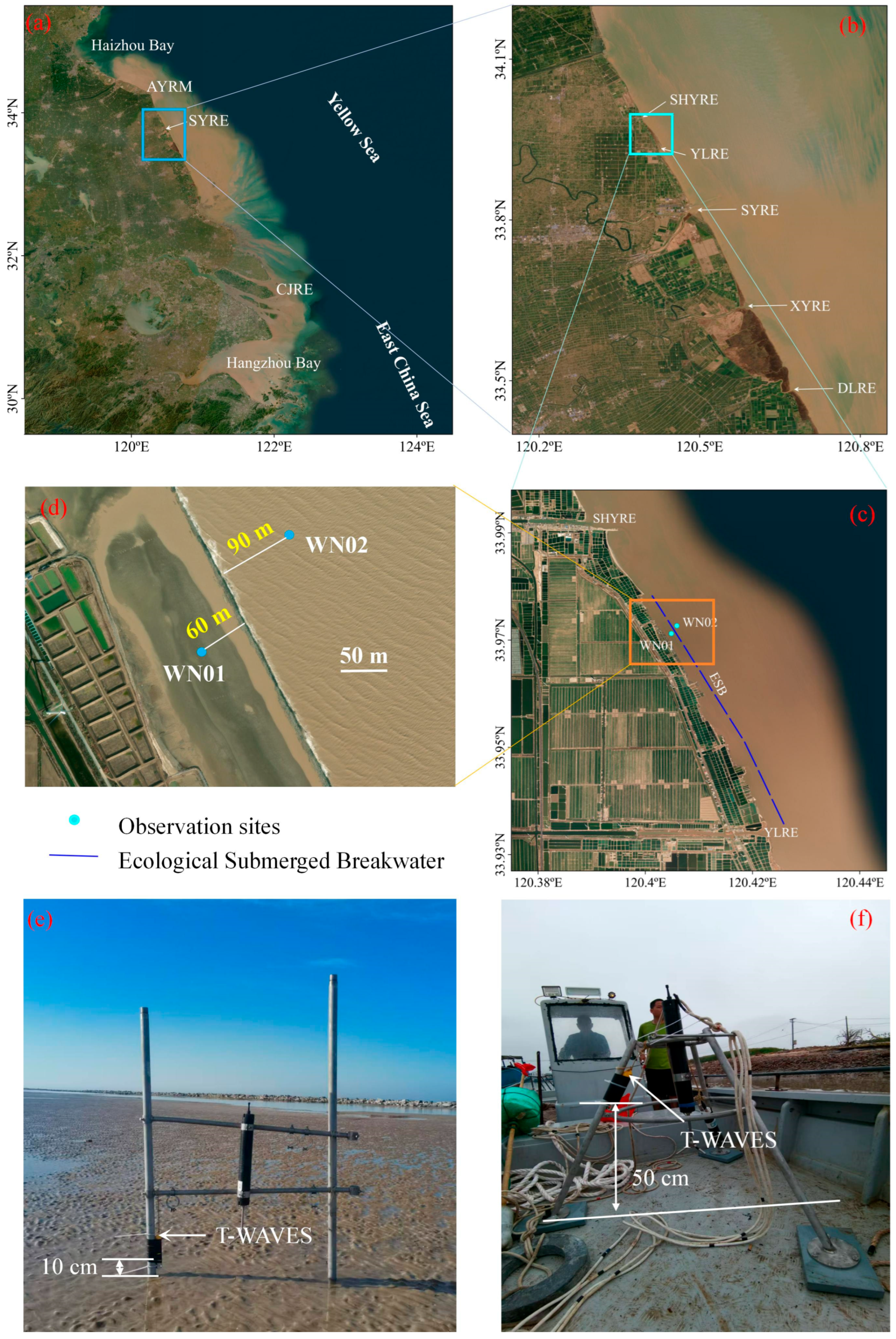
The Sheyang River estuary is located in the central part of the Jiangsu coast (Figure 2b). The tidal regime is irregular semidiurnal, with mean flood and ebb durations of 4 h 49 min and 7 h 36 min, respectively; the maximum tidal range is 4.16 m, and the mean tidal range is 2.15 m.; the tidal current is irregular semidiurnal, primarily influenced by the rotational tidal wave of the South Yellow Sea and the Subei Coastal Current [24]. The intertidal geomorphology of the Sheyang River estuary area is dominated by tidal flats. Based on surveys conducted around 2007, the tidal flat was subdivided into high-tide mudflats, mid-tide silt-mud mixed flats, and low-tide silt-fine sand flats. The silty-muddy flats at mid and high tidal levels covered an area of 56.20 km2, while the silty-sandy flats at low tidal levels covered 84.73 km2 [24].
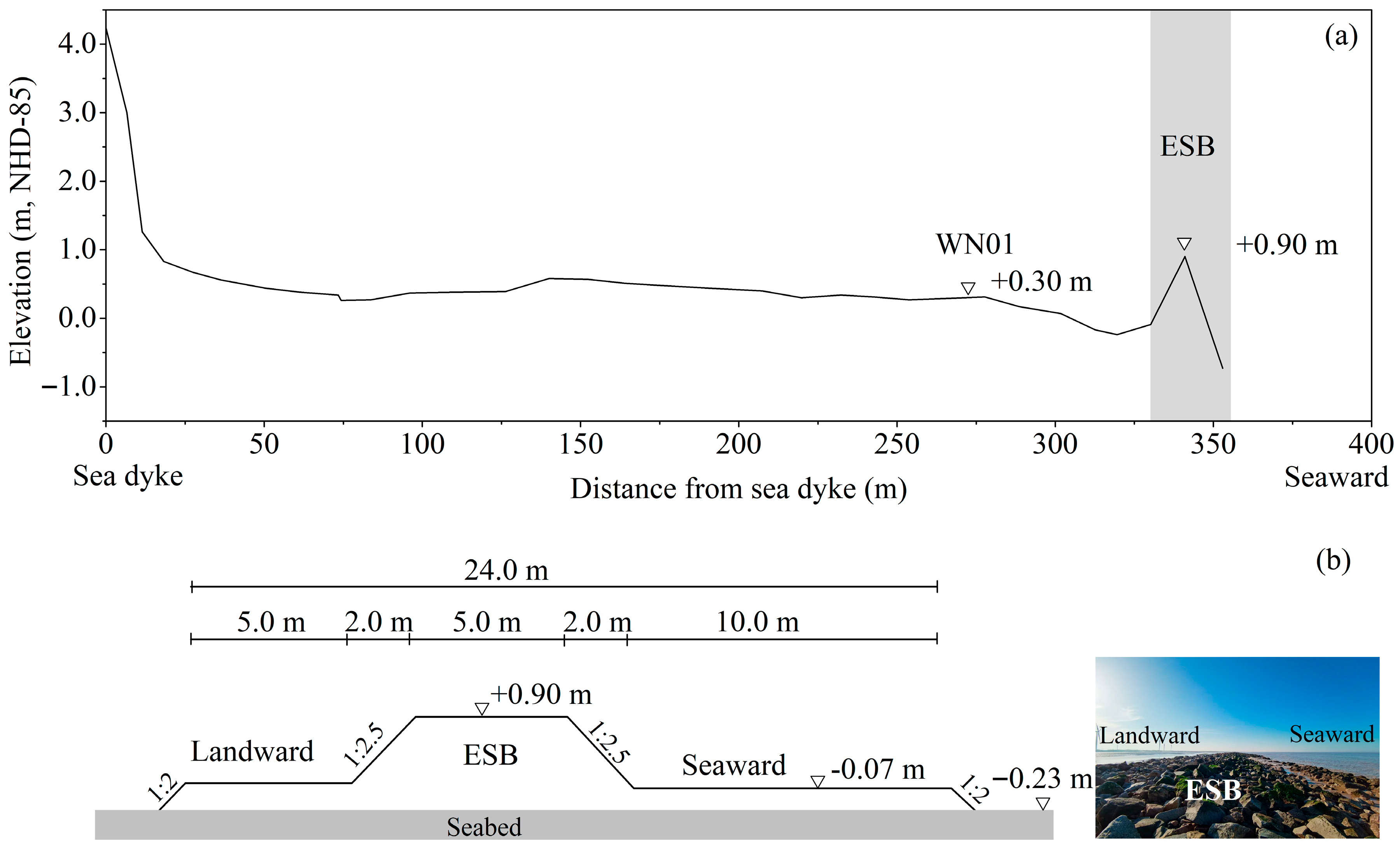
The Ecological Submerged Breakwater (ESB) on the north side of the Sheyang River Estuary was constructed in 2023. It is located in the mid-intertidal zone, approximately 200 to 400 m offshore from the coastal embankment (Figure 3a). At the time of construction, the elevation of the intertidal flat was –0.23 m, referenced to the 1985 National Height Datum (NHD-85; the same datum applies hereafter). The overall width of the breakwater is 24 m, with a crest elevation of +0.90 m and a crest width of 5 m (Figure 3b). The structure was built as a rubble-mound breakwater using graded rock armor. The foundation layer consists of rocks weighing 50 kg to 60 kg, the crest is armored with rocks weighing 400 kg to 600 kg, and the side slopes and toe regions are protected by rocks weighing 100 kg to 300 kg.

3. Methods

3.1. Field Observation

One observation station was established on each side (seaward and landward) at the northern end of the ESB, located north of the Sheyang River estuary and south of Shuangyang Port, for wave measurements (Figure 2c,d). Station WN01 was situated in the intertidal zone landward of the breakwater, 60 m from its edge. The observation frame was installed during low tide by personnel walking onto the flat. A T-Waves wave-tide gauge, manufactured by Beijing Haizhou Saiwei Technology Co., Ltd. (Beijing, China) was mounted on the frame (Figure 2e). The instrument utilizes a pressure sensor to acquire high-frequency, high-accuracy water level records. Wave height and wave period are subsequently computed based on water level fluctuations. The pressure sensor has a measurement range of 0–20 m, an accuracy of 0.05% of full scale (FS), and a resolution of 0.001 kPa. The instrument was deployed on 15 May 2025, and retrieved on 28 May 2025. Station WN02 was located seaward of the breakwater, 90 m from its edge. Observations were conducted using a bottom-mounted tripod platform equipped with a T-Waves wave meter (Figure 2f). This instrument was deployed on 16 May 2025, and retrieved on 29 May 2025. Both instruments were set to continuous sampling mode at a frequency of 4 Hz.
After the observed data were downloaded, wave parameters—including significant wave height (H1/3), one-tenth maximum wave height (H1/10), maximum wave height (Hmax), and mean wave period (Tm)—were calculated and exported at 5 min intervals using the instrument’s proprietary software.

3.2. Wave Transmission and Wave Attenuation Performance of the ESB

The ESB is a submerged, permeable rubble-mound breakwater. The wave transmission id defined as Kt = HL/HO, where HO is the wave height at the seaward edge of the ESB (seaward site), and HL is the wave height at the landward edge of the ESB (landward site). Numerous experimental studies have been conducted on wave transmission over submerged structures (freeboard Rc < 0), leading to various empirical formulas, each with specific applicability and accuracy [25]. Building on previous work and incorporating new experimental data, van Gent et al. proposed a widely applicable empirical formula [26]:
Kt = c1 tanh[−(Rc/HO + c2 (B/Lm) c3 + c4] + c5
In which, B is the crest width of the submerged structure, and Lm is the wave length based on the spectral wave period (Tm): Lm = (g/2π)Tm2, and c1~c5 are coefficients.
Following the Technical Guidelines for Ecological Disaster Mitigation and Restoration in Coastal Zones—Part 6: Oyster Reefs (T/CAOE 21.6-2020) [27], the wave attenuation performance of the ESB. is expressed in terms of the wave height attenuation rate (RwL) [27]:
RwL = (HOHL)/H0 × 100%

4. Results

4.1. Wave Characteristics Seaward and Landward of the ESB

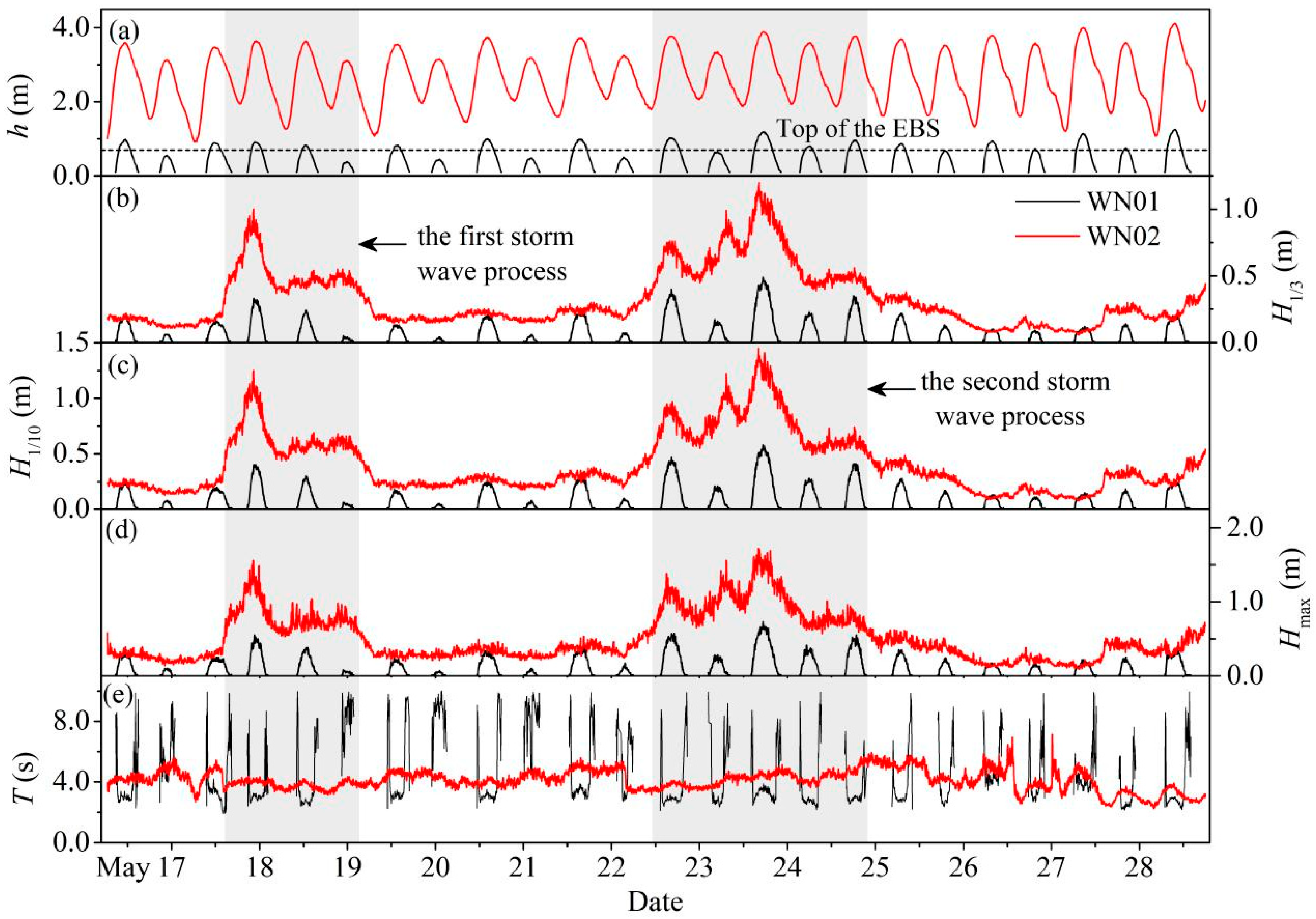
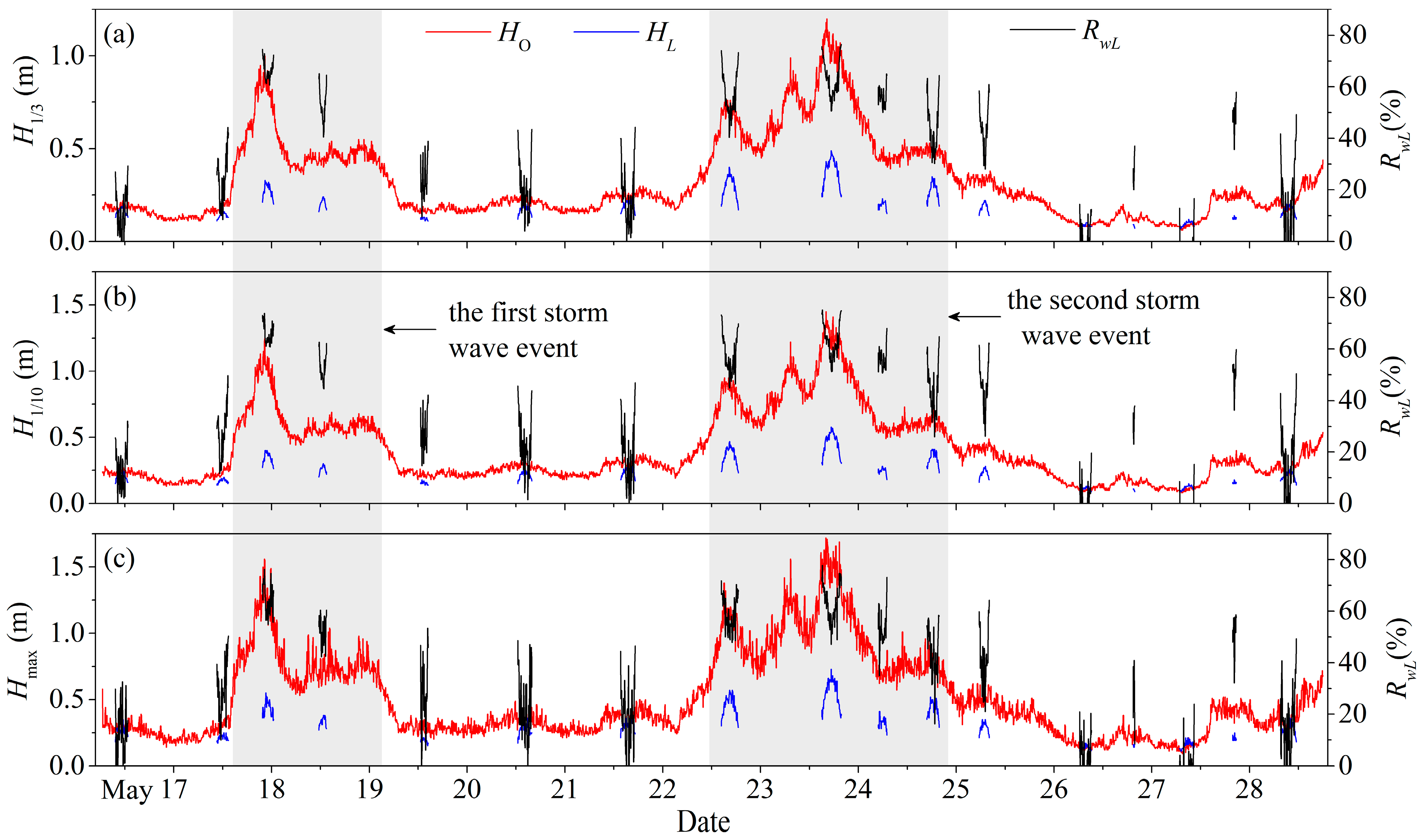
During the observation period, the inundation height (h) at station WN02 outside the ESB ranged from 0.92 m to 4.11 m, while the maximum h at station WN01 in the intertidal zone inside the breakwater was 1.25 m. A total 3595 and 1650 valid wave data sets (5 min intervals) were obtained at stations WN02 and WN01, respectively. Results (Figure 4) show that at WN02, the significant wave height (H1/3) varied between 0.06 m and 1.20 m, with a mean of 0.32 m; the highest one-tenth wave height (H1/10) varied between 0.08 m and 1.45 m, mean 0.40 m; the maximum wave height (Hmax) varied between 0.09 m and 1.72 m, mean 0.51 m; and the mean wave period (T) varied between 2.3 s and 7.1 s, mean 4.1 s. Figure 3 indicates two distinct storm wave events (H1/3 > 0.40 m) during the observation. The first event lasted 37 h, with maximum and mean H1/3 values of 1.00 m and 0.52 m, respectively. The second event lasted 61 h, with corresponding values of 1.20 m and 0.64 m. The two distinct storm wave events also significantly enhanced the contribution of wind-sea energy to the mixed wave field, leading to pronounced, transient fluctuations in the dominant wave period.
At landward station WN01, H1/3 varied between 0 m and 0.48 m (mean 0.10 m), H1/10 between 0 m and 0.58 m (mean 0.13 m), Hmax between 0 m and 0.73 m (mean 0.17 m), and the mean wave period between 1.6 s and 10.0 s (mean 4.6 s). During the first storm event, the maximum and mean H1/3 at WN01 were 0.33 m and 0.11 m, respectively. During the second event, they were 0.49 m and 0.17 m.
Statistical values of wave parameters under different sea states are presented in Table 1.

4.2. Wave Attenuation Performance of the ESB

Comparison of wave observations (Figure 4) shows good consistency in the temporal variation in water level (inundation height) and wave height between the seaward shallow water area and the landward intertidal zone. However, both water level and wave height were significantly lower in the intertidal zone. When the water level was below the breakwater crest, waves on the seaward side were blocked by the structure and had essentially no impact on the intertidal area in the direction of wave propagation. As shown in the tidal-flat topographic profile (Figure 3a) and the time series of wave parameters (Figure 4), waves are able to propagate across the entire ESB toward the sheltered inter-tidal flat once the inundation height exceeds the crest of the ESB by approximately 0.60 m. Therefore, the evaluation of wave attenuation performance in this study focuses solely on periods when the inundation height is above the crest of the ESB. A total of 774 valid data sets meet this criterion, accounting for 21.5% of the total observation period and 46.9% of the time during which the intertidal zone was inundated. Based on these data, the wave attenuation effect of the ecological submerged breakwater can be calculated using Equation (2).
Calculated wave height attenuation rates (RwL) during the observation period are shown in Figure 5. The maximum RwL for H1/3 was 76.3%, with a mean of 33.8%. For H1/10, the maximum was 75.2% (mean 35.0%), and for Hmax, 77.8% (mean 35.0%). Figure 5 also illustrates that wave attenuation was less pronounced under calm sea conditions but became significantly more effective under severe sea conditions (storm waves). Statistical results show that under calm conditions, the maximum and mean RwL for H1/3 were 60.9% and 18.4%, respectively. Under severe conditions, these values increased to 76.3% and 57.6%, respectively.
Statistical values of wave height attenuation rates under different sea conditions are presented in Table 2.

4.3. Wave Transmission Analysis

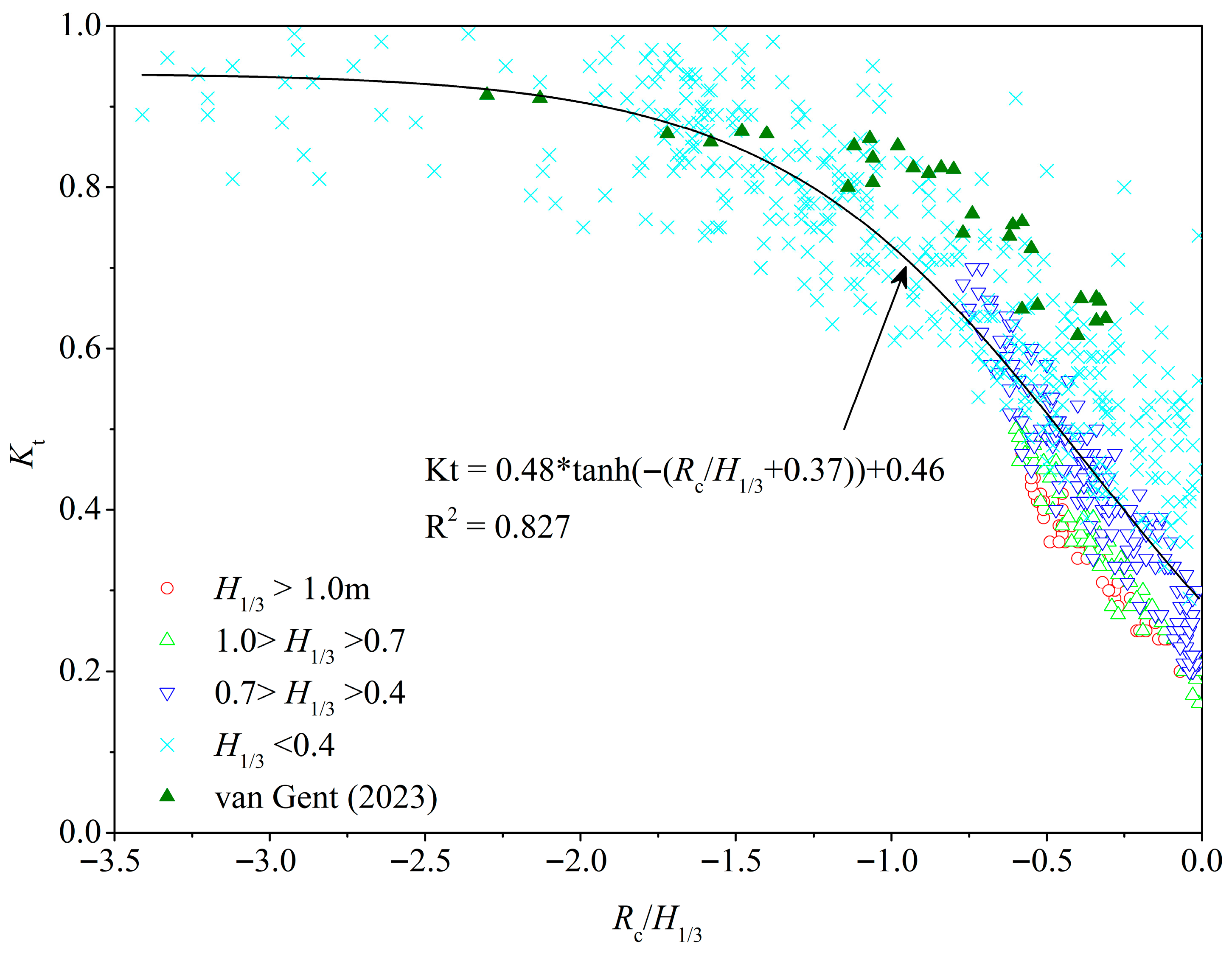
This study obtained in situ measurements of the wave transmission coefficient Kt for waves propagating across the ESB under different incident wave height conditions. As shown in Figure 6, the values of Kt span a wide range from 0.20 to 0.99, indicating a significant dynamic variability in the wave attenuation performance of the ESB.
The observed data clearly demonstrate a systematic influence of incident wave height on Kt. Based on the wave height magnitude, the data can be divided into four ranges:
  • High wave conditions (H1/3 > 1.0 m): Kt values are generally low, predominantly concentrated between 0.3 and 0.5, indicating the most effective wave attenuation under these conditions.
  • Moderately high wave conditions (0.7 m < H1/3 ≤ 1.0 m): The range of Kt values broadens, lying mainly between 0.25 and 0.5.
  • Moderately low wave conditions (0.4 m < H1/3 ≤ 0.7 m): Kt values increase further, distributed approximately between 0.2 and 0.6.
  • Low wave conditions (H1/3 ≤ 0.4 m): Kt values are generally high, mostly greater than 0.5, and exhibit the largest scatter, with some values exceeding 0.8 and even approaching 1.0. This suggests that under low-energy conditions, a substantial portion of the wave energy is transmitted across the ESB.
Furthermore, within each defined wave height range, analysis of Kt variation with relative freeboard Rc/H1/3 shows an overall increasing trend in Kt as Rc/H1/3 decreases (i.e., as the ESB becomes more deeply submerged). This trend is present to varying degrees across all wave height ranges, indicating that relative submergence depth is another key parameter governing the transmission coefficient.

5. Discussion

5.1. Dynamic Characteristics and Mechanisms of Wave Attenuation

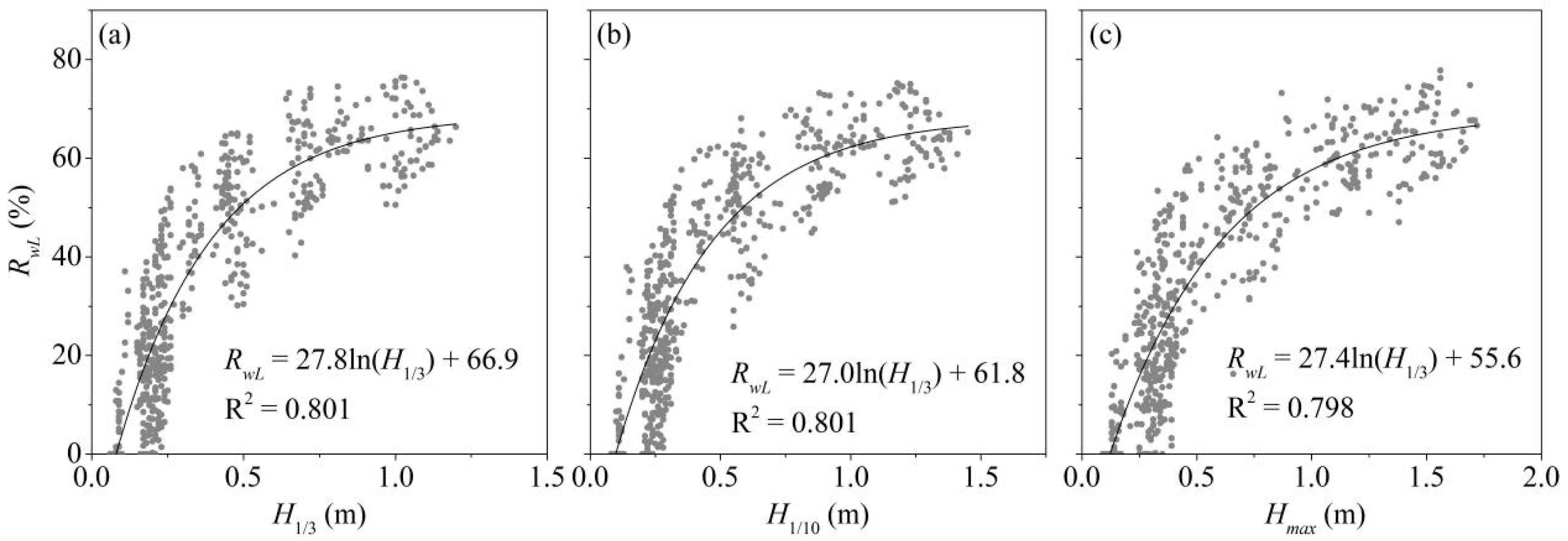
Observation results indicate a highly pronounced dynamic characteristic in the ESB’s wave dissipation effectiveness, varying with incident wave height. Correlation analysis reveals a significant positive relationship between wave height seaward of the ESB and the wave height attenuation rate after the inundation height exceeds the crest level of the ESB, i.e., the attenuation rate is low under calm conditions and increases with increasing wave height, following a logarithmic relationship (Figure 7). This is primarily because under calm conditions, with smaller incident waves, the ratio of wave height to water depth is typically below the critical value for wave breaking, making significant breaking less likely to occur [28]. The primary energy dissipation mechanisms under these conditions stem from two sources: first, viscous resistance and vortex dissipation generated by flow through the structure’s internal pores; and second, frictional losses between waves and rough surface of the breakwater [29,30]. Furthermore, due to the relatively greater water depth, the blocking effect of the ESB is reduced, allowing a portion of the wave energy to more easily pass over or through the structure via wave overtopping and transmission [31,32]. Consequently, the wave height attenuation rate under calm conditions is relatively low.
Under severe sea conditions, wave heights increase significantly. After the inundation height exceeds the crest level of the ESB, waves propagating towards the ESB experience a sharp reduction in water depth over the structure crest, triggering the dominant process of wave breaking. As a result, the wave energy transported from the offshore area is substantially dissipated, and once the wave propagates past the ESB, the energy drops abruptly, accompanied by a marked reduction in wave height [33,34,35]. The statistical results in this study indicate that when the inundation height exceeds the crest of the ESB, a positive logarithmic relationship between wave height and wave height attenuation rate revealed in Figure 7: the wave height attenuation rate increases rapidly with increasing wave height. This demonstrates that the wave-dissipating effect of the ESB is more pronounced under rough sea conditions.
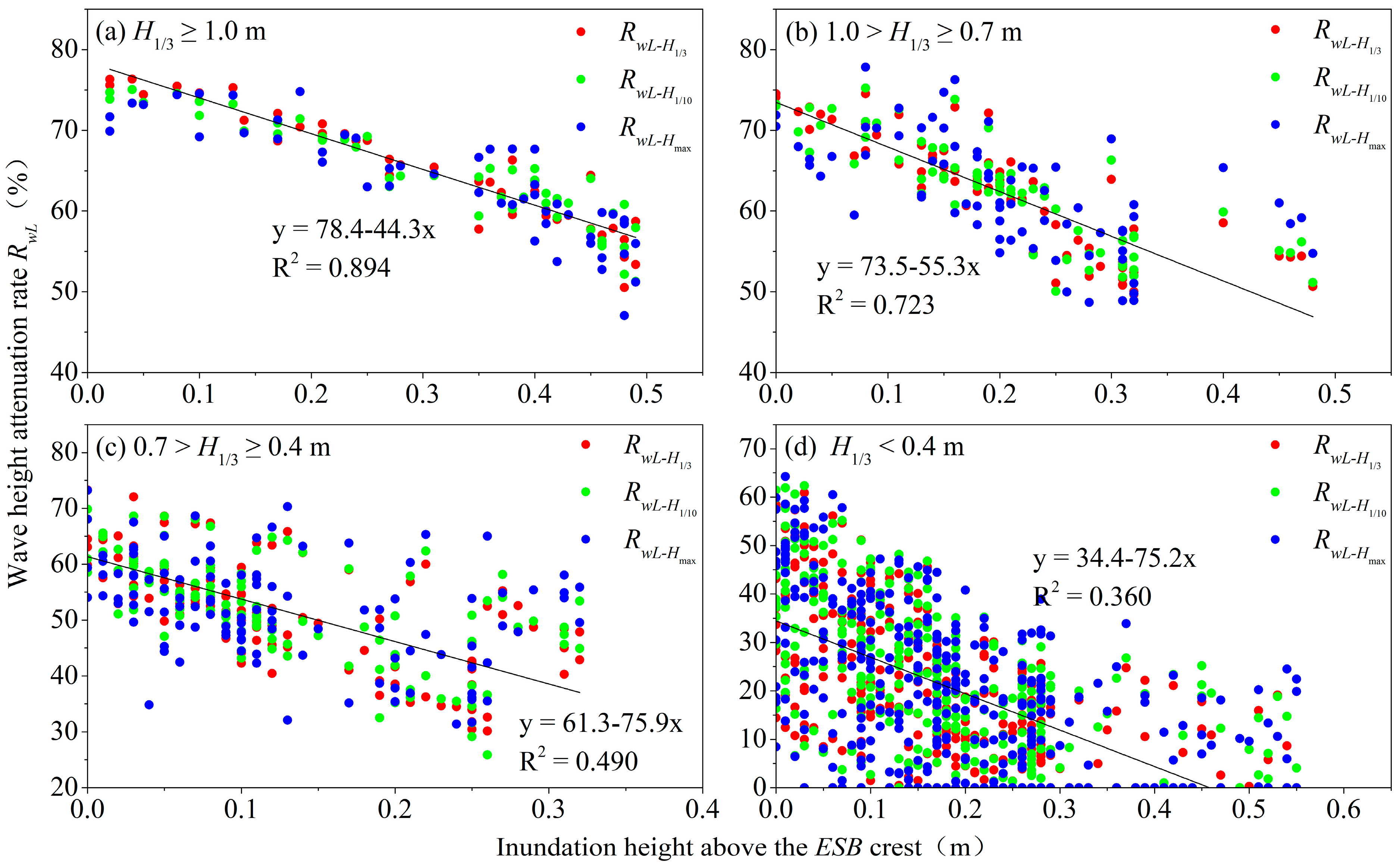
Statistical results further indicate that when the water level exceeds the ESB crest, the wave height attenuation rate gradually decreases with increasing submergence depth, showing a negative correlation. This negative correlation is more pronounced when wave action is stronger, and weakens as wave action diminishes (Figure 8). This is mainly because, when the submergence depth is shallow, the ESB acts as a typical wave breaker, forcing wave breaking [29,30]. However, once the submergence depth exceeds the breakwater crest elevation, the ESB gradually transitions to the role of a porous media dissipator. With increasing submergence depth, more water can flow over or through the structure with less resistance, the intensity of wave breaking weakens, and energy dissipation efficiency declines [36]. Under storm conditions, larger wave heights inherently demand more effective energy dissipation, yet the increased water depth inhibits the most efficient breaking mechanism [37], thereby making the negative correlation more significant. This phenomenon has also been observed in salt marsh environments [22].
Wave period observations further indicate that when the inundation height is below the crest of the ESB, the wave period at the sheltered intertidal station WN01 is longer than that at the station WN02 (Figure 4e). This occurs because long-period swells are more easily transmitted over or diffracted around the ESB, whereas short-period wind waves are largely blocked, leading to a longer average period in the sheltered area [38]. When the inundation height exceeds the crest of the ESB, waves propagate across the entire ESB. At the crest of the ESB, short-period components with higher wave steepness undergo preferential breaking and dissipation, and then the transmitted wave enters the extremely shallow intertidal zone at WN01, where strong nonlinear effects promote energy transfer from low to high frequencies, significantly shortening the mean wave period [26,39], ultimately resulting in a shorter wave period at WN01 compared to WN02.

5.2. Variation in Wave Transmission Coefficient and Its Influencing Factors

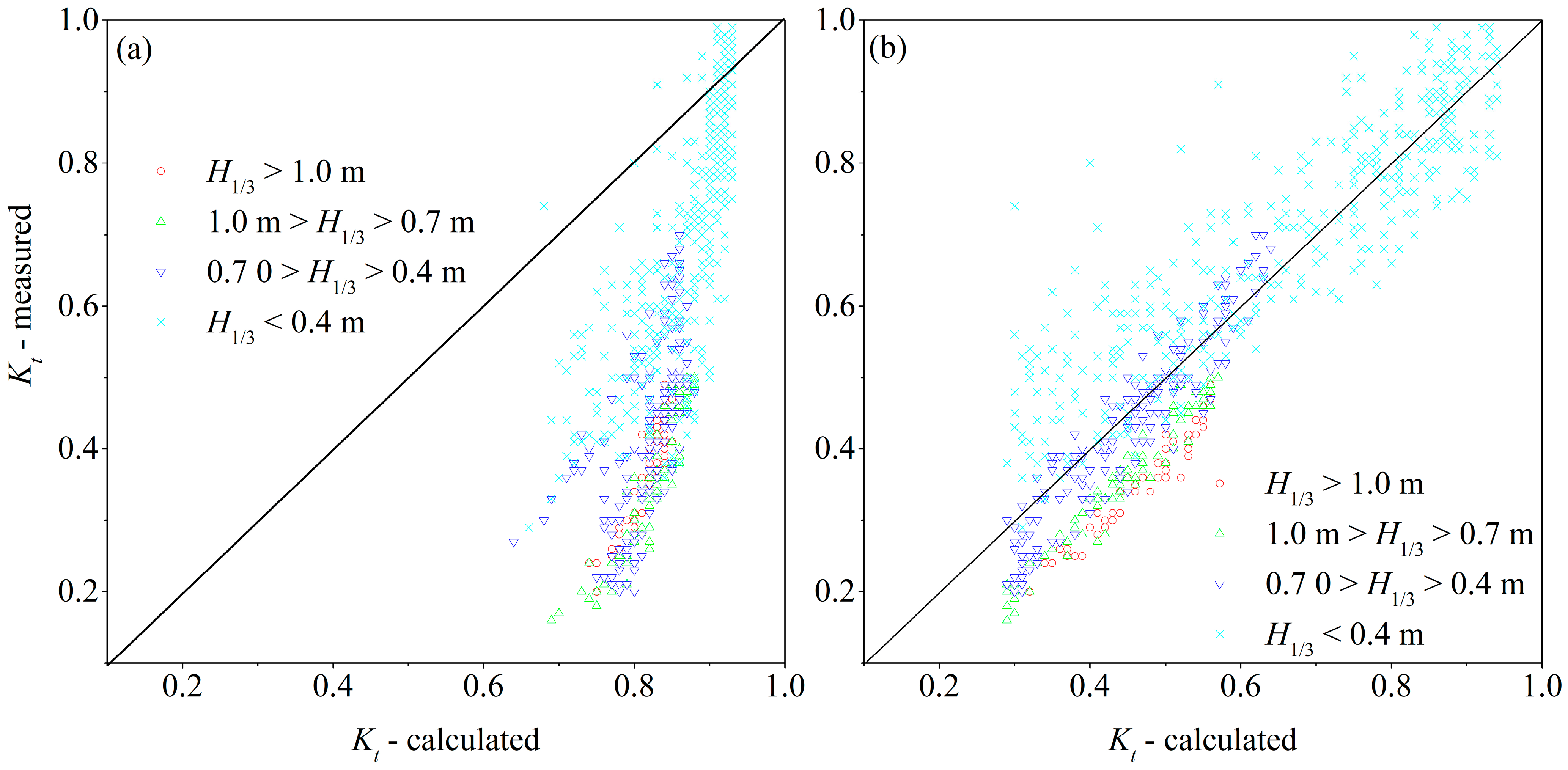
The observational data indicate that the wave transmission Kt is closely related to the relative freeboard Rc/H1/3. As shown in Figure 6. Kt exhibits an overall increasing trend as Rc/H1/3 decreases (i.e., as the structure becomes more deeply submerged).
A comparison between the measured Kt values and the predictions from the van Gent [26] empirical formula (Equation (1)) reveals a significant discrepancy (Figure 9a): the systematic predictions from Equation (1) are generally higher than the measured values. To characterize the in situ response of this ESB, a simplified regression formula was fitted to the field data within the framework of the van Gent [26] formula (Figure 6):
Kt = 0.48 tanh[−(Rc/H1/3 + 0.37)] + 0.46
This formula shows a high correlation with the measured Kt (R2 = 0.827), demonstrating that Rc/H1/3 is the most critical dimensionless parameter driving the variation in the transmission coefficient for this breakwater. The differences in the coefficients of this formula likely reflect deviations between the structural characteristics and environmental conditions of the present breakwater and the assumptions of the empirical expression.
(1)
Differences in structural characteristics. The van Gent formula is primarily calibrated using data from laboratory-scale standard rubble-mound breakwaters. The ESB in this study may possess a higher effective porosity, different rock gradation, or ecological components, all of which can enhance viscous resistance and turbulent dissipation as flow passes through the structure [25,26]. This leads to an actual transmission coefficient lower than that calibrated by the empirical expression.
(2)
Influence of complex wave characteristics. Equation (1) is primarily optimized for regular or narrow-banded waves. However, the directional spectral characteristics of broad-banded irregular waves in the field, combined with potential non-normal wave incidence, can introduce additional energy dissipation mechanisms not fully accounted for simplified models. While the results calculated using the site-specific regression (Equation (3)) show good overall agreement with the observed Kt values, discrepancies under high-wave conditions—where calculations overestimate observations—are primarily attributed to unaccounted wave reflection effects. In reality, wave reflection modifies the incident wave field [26,29], thereby introducing uncertainty into the estimation of the wave transmission coefficient and the evaluation of the wave ESB’s attenuation performance.
(3)
Coupling effect of the extremely shallow water environment. Under low-wave-height conditions, the extremely shallow intertidal environment at the lee-side station WN01 accentuates nonlinear shallow-water effects. The spectral evolution of waves during propagation [29,38] alters the wave spectrum arriving at the measurement point, thereby influencing the Kt calculated based on wave height. This differs from the theoretical context of Equation (1), which is based on assumptions of deep water or uniform water depth.

5.3. Comparative Analysis of Wave Attenuation Performance Between ESB and Similar Ecological Shoreline Structures

The philosophy and practice of coastal erosion protection have undergone a profound paradigm shift. The early “hard protection” stage relied heavily on grey infrastructure like seawalls and revetments, whose core principle was direct resistance to wave energy using solid materials [8]. However, such structures often disrupt land–sea ecological connectivity and may exacerbate erosion on their seaward side [40]. The subsequent “beach nourishment and soft engineering” stage mimicked and reinforced natural processes through methods like artificial sand replenishment and dune construction [8]. Entering the 21st century, protection concepts progressively integrated ecological principles, evolving into the current stage of “ecological engineering and Nature-based Solutions (NbS).” This approach designs protective measures as integral components of the coastal ecosystem, seeking synergy among multiple benefits: protection function, habitat restoration, and carbon sequestration [9,11]. This can effectively enhance the long-term resilience of coastlines to climate change (e.g., sea-level rise, intensified storms) [41] and represents a vital pathway towards sustainable coastal zone development and systemic adaptation.
Nature-based Solutions achieve effective coastal protection by creating or restoring natural habitats such as oyster reefs, coral reefs, salt marshes, and mangroves [41]. Research shows that wave dissipation by oyster reefs and coral reefs primarily relies on their structural roughness. Their effectiveness depends largely on the complexity of the reef structure. Under suitable design and water level conditions, oyster reefs can achieve wave height reduction rates of 30–68% [41,42,43], while coral reefs typically achieve over 50% wave attenuation, with even more significant reduction during severe sea states [19,44,45]. Vegetation (e.g., salt marsh plants, mangroves) primarily dissipates wave energy through drag forces exerted by stems and bottom friction from dense root systems. Their effectiveness is directly related to vegetation width and specific characteristics [10]. For instance, mangroves with widths of 80–100 m can achieve wave height attenuation rates of 62–70% [20,46], demonstrating significant coastal protection during the 2004 Indian Ocean tsunami [47]. In sufficiently wide salt marsh areas, wave height attenuation can reach 100% [21,42]. Different vegetation types exhibit significant differences in dissipating waves with varying energy characteristics; for example, tall Spartina alterniflora provides stronger dissipation than shorter species like Scirpus mariqueter and Spartina patens [21,48]. Vegetation density also noticeably affects dissipation; for example, wave attenuation rates can increase from about 48% at a plant density of 200 units/m2 to 77% at 500 units/m2 [49]. The observations and calculations in this study show that under severe sea conditions, the ESB achieved a maximum H1/3 attenuation rate of 76.3%, with a mean of 57.6%, performance comparable to the aforementioned common ecosystems, indicating that ESB is effective for coastal protection.
In summary, whether for oyster reefs, coral reefs, mangroves, or salt marshes, their wave attenuation effect is closely related to ecosystem width, becoming significant only when the ecosystem forms a sufficiently wide band. Compared to these “zonated” systems, the ESB belongs to a “linear” system, capable of providing significant, immediate wave height reduction within a limited cross-shore space. This makes it particularly suitable for space-constrained intertidal zones or situations requiring rapid establishment of a frontline defense. Furthermore, this study observed that the ESB’s dissipation effect decreases under greater water depths. To further mitigate coastal erosion and ensure the ecological security of coastal areas, an ideal strategy is to use the ESB as a frontline defense to dissipate incoming wave energy, combined with the restoration of salt marshes in the intertidal zone landward of the breakwater. This would further dissipate remaining wave energy and stabilize the beach face, forming an efficient hybrid “grey-green” protection system.

5.4. Limitations

Although this study provides valuable in situ observational data on the wave attenuation performance of the ESB, several limitations remain.
First, there are constraints in the observational and analytical methodologies. Wave interaction with the breakwater induces reflection, which may affect the accurate characterization of incident wave energy. As only one station was deployed on each side (seaward and landward) of the structure, incident and reflected waves were not separated in this study. This may lead to a slight underestimation of the calculated transmission coefficient. Furthermore, due to field constraints and the nature of the collected data, a systematic quantitative comparison and validation against classical theoretical formulae could not be performed.
Second, the depth of data interpretation is limited. The observations primarily yielded integrated wave parameters (wave height and mean period), which effectively describe the overall intensity and temporal scale of the waves but do not provide detailed directional wave energy spectra. The lack of spectral information restricts the precise quantification of the attenuation processes for different frequency components (e.g., wind-sea vs. swell) across the breakwater. It also hinders the direct application of theoretical models that rely on full spectral information in the present analysis.
Finally, the scope of the study is bounded. The description of the breakwater’s structural parameters is relatively generalized, and the range of hydrometeorological conditions covered during the observation period (e.g., wave height, period, water level) is limited. Consequently, the findings are mainly applicable to moderate wave conditions similar to those observed, and extrapolation to broader conditions or different structural configurations should be approached with caution.
To address these limitations, future work could focus on the following: (1) developing and validating a high-resolution wave numerical model suitable for this coastal area to reproduce and extend the observed scenarios through simulation, thereby enabling systematic testing of different theories under controlled variables and a more in-depth quantification of wave spectral evolution mechanisms; and (2) deploying a denser sensor array across the breakwater section to synchronously collect data on inundation height, three-dimensional flow velocity, and wave energy, thereby providing direct observational basis for the fine-scale spatiotemporal analysis of energy dissipation mechanisms.

6. Conclusions

The findings of this study demonstrate that:
(1)
The ecological submerged breakwater (ESB) effectively attenuates wave height, but its performance exhibits significant dynamic characteristics. During the observation period, the average attenuation rates for significant wave height (H1/3), the highest one-tenth wave height (H1/10), and maximum wave height (Hmax) were 33.8%, 35.0%, and 35.0%, respectively. Wave dissipation efficiency was closely related to sea state: under calm conditions, the average attenuation rate was only 18.4%; whereas under severe sea states (two storm wave events), the average attenuation rate increased markedly to 57.6%, with a maximum rate reaching 76.3%. The wave transmission coefficients (Kt) span a wide range from 0.20 to 0.99, indicating a significant dynamic variability in the wave attenuation performance of the ESB. The wave height attenuation rate showed a negative correlation with the submergence depth.
(2)
This study confirms that the intertidal ecological submerged breakwater is an effective coastal wave-dissipating structure. In comparison with oyster reefs, coral reefs, salt marshes, and mangroves, the ESB demonstrates unique advantages as a controllable, efficient, and immediately functional “linear” protective structure. It is particularly well-suited to serve as a frontline component within a coastal protection system or as a stand-alone solution in space-constrained areas. For the future, integrating long-term ecological monitoring with physical observations to investigate the feedback mechanisms between biological community evolution and engineering performance will be a key direction for advancing the ecological submerged breakwater from an engineering technique towards a mature “ecosystem-based adaptation” strategy.

Author Contributions

Conceptualization, Y.F., X.Z. and A.W.; data acquisition, Y.F., X.Z., A.W., W.P., X.Y. and K.O.; data processing, Y.F., A.W. and Z.L.; writing—original draft preparation, Y.F.; writing—review and editing, Y.F., X.Z. and A.W.; funding acquisition, A.W. and X.Z. All authors have read and agreed to the published version of the manuscript.

Funding

This research was funded by the project sponsored by the Foundation of Key Laboratory of Coastal Salt Marsh Ecosystems and Resources, Ministry of Natural Resources (No. KLCSMERMNR202309) and the National Natural Science Foundation of China (No. U22A20585).

Data Availability Statement

The original contributions presented in the study are included in the article. Further inquiries can be directed to the corresponding authors.

Conflicts of Interest

The authors declare no conflicts of interest.

References

  1. Gao, S. Geomorphology and sedimentology of tidal flats. In Coastal Wetlands: An Ecosystem Integrated Approach, 2nd ed.; Perillo, G.M.E., Wolanski, E., Cahoon, D., Hopkinson, C.S., Eds.; Elsevier: Amsterdam, The Netherlands, 2019; pp. 359–381. [Google Scholar]
  2. Schuerch, M.; Spencer, T.; Temmerman, S.; Kirwan, M.L.; Wolff, C.; Lincke, D.; McOwen, C.J.; Pickering, M.D.; Reef, R.; Vafeidis, A.T.; et al. Future response of global coastal wetlands to sea-level rise. Nature 2018, 561, 231–234. [Google Scholar] [CrossRef]
  3. Gao, S.; Jia, J.J.; Yu, Q. Theoretical framework for coastal accretion-erosion analysis: Material budgeting, profile morphology, shoreline change. Mar. Geol. Quat. Geol. 2023, 43, 1–17, (In Chinese with English Abstract). [Google Scholar]
  4. Li, X.; Bellerby, R.; Craft, C.; Widney, S.E. Coastal wetland loss, consequences, and challenges for restoration. Anthr. Coasts 2018, 1, 1–15. [Google Scholar] [CrossRef]
  5. Murray, N.J.; Phinn, S.R.; DeWitt, M.; Ferrari, R.; Johnston, R.; Lyons, M.B.; Clinton, N.; Thau, D.; Fuller, R.A. The global distribution and trajectory of tidal flats. Nature 2019, 565, 222–225. [Google Scholar] [CrossRef]
  6. Walter, R.K.; O’Leary, J.K.; Vitousek, S.; Kitajima, A. Large-scale erosion driven by intertidal eelgrass loss in an estuarine environment. Estuar. Coast. Shelf Sci. 2020, 243, 106910. [Google Scholar] [CrossRef]
  7. Hulskamp, R.; Luijendijk, A.; van Maren, B.; Moreno-Rodenas, A.; Calkoen, F.; Kras, E.; Lhermitte, S.; Aarninkhof, S. Global distribution and dynamics of muddy coasts. Nat. Commun. 2023, 14, 8259. [Google Scholar] [CrossRef] [PubMed]
  8. USACE. Coastal Engineering Manual (EM 1110-2-1100); USACE: Washington, DC, USA, 2002. [Google Scholar]
  9. Temmerman, S.; Meire, P.; Bouma, T.J.; Herman, P.M.; Ysebaert, T.; De Vriend, H.J. Ecosystem-based coastal defence in the face of global change. Nature 2013, 504, 79–83. [Google Scholar] [CrossRef] [PubMed]
  10. Reed, D.; van Wesenbeeck, B.; Herman, P.M.J.; Meselhe, E. Tidal flat-wetland systems as flood defenses: Understanding biogeomorphic controls. Estuar. Coast. Shelf Sci. 2018, 213, 269–282. [Google Scholar] [CrossRef]
  11. Twomey, A.J.; Erickson, K.; Bishop, M.J.; Boddy, K.; Callaghan, D.P.; Cannard, T.; Lovelock, C.E.; Mayer-Pinto, M.; Morris, R.I.; Pomeroy, A.W.M.; et al. Interdisciplinary solutions to enable nature-based solutions for coastal protection achieve ecological and engineering outcomes. Environ. Sci. Policy 2025, 171, 104157. [Google Scholar] [CrossRef]
  12. Singhvi, A.; Luijendijk, A.; van Oudenhoven, A. The grey–green spectrum: A review of coastal protection interventions. J. Environ. Manag. 2022, 311, 114824. [Google Scholar] [CrossRef]
  13. Ren, M.E. Tidal mud flat. In Modern Sedimentation in the Coastal and Nearshore Zones of China; Ren, M.E., Ed.; China Ocean Press: Beijing, China, 1986; 517p. (In Chinese) [Google Scholar]
  14. Zhang, R.S.; Lu, L.Y.; Wang, Y.H. The mechanism and trend of coastal erosion of Jiangsu Province in China. Geogr. Res. 2002, 21, 469–478, (In Chinese with English Abstract). [Google Scholar]
  15. He, J.; Fu, C.L.; Shu, L.Y.; Zhang, G.; Wan, K.C. Analysis on the status quo and cause of erosion and deposition of Yancheng coastline in Jiangsu Province. J. Geol. 2021, 45, 189–196, (In Chinese with English Abstract). [Google Scholar]
  16. Li, M.L.; Wu, S.L.; Gong, X.L.; Yang, L.; Gou, F.G.; Li, J. Characteristics of coastline change under the influence of human activities in central Jiangsu Province from 1989 to 2019. Mar. Sci. 2022, 46, 60–68, (In Chinese with English Abstract). [Google Scholar]
  17. Zhang, W.; Ouyang, K.; Zhang, X.; Wang, A.; Yu, Q.; Ye, X.; Yao, C. Tidal Flat Erosion Processes and Their Dynamic Mechanisms on the South Side of Sheyang River Estuary, Jiangsu Province. J. Mar. Sci. Eng. 2024, 12, 687. [Google Scholar] [CrossRef]
  18. Zhang, X.; Wang, A.; Xu, D.; Ouyang, K.; Liang, H.; Li, H.; Ye, X.; Tao, S.; Yao, C. Petrogeochemistry and mineralization potentiality of the Yuanzijie intrusion in the Zhashui-Shanyang ore deposit cluster, South Qinling. Earth Sci. Front. 2025; in press. (In Chinese with English Abstract). [Google Scholar]
  19. Geldard, J.; Lowe, R.J.; Ghisalberti, M.; Draper, S. Wave attenuation by restored coral reef canopies: Implications for coastal protection. J. Geophys. Res. Ocean. 2025, 130, e2025JC022854. [Google Scholar] [CrossRef]
  20. Reef, R.; Sayers, S. Wave attenuation by Australian temperate mangroves. J. Mar. Sci. Eng. 2025, 13, 382. [Google Scholar] [CrossRef]
  21. Yang, S.L.; Shi, B.W.; Bouma, T.J.; Ysebaert, T.; Luo, X.X. Wave attenuation at a salt marsh margin: A case study of an exposed coast on the Yangtze Estuary. Estuaries Coasts 2011, 35, 169–182. [Google Scholar] [CrossRef]
  22. Zhang, X.; Lin, P.; Gong, Z.; Li, B.; Chen, X. Wave attenuation by Spartina alterniflora under macro-tidal and storm surge conditions. Wetlands 2020, 40, 2162–2515. [Google Scholar] [CrossRef]
  23. Wang, L.; Tan, W.; Thomas, M.; Leung, F.; Stocchino, A. Statistical design of submerged artificial oyster reefs using Design of Experiments and clustering strategies. Coast. Eng. 2025, 200, 104753. [Google Scholar] [CrossRef]
  24. Wang, J. Coastal Mudflat in Jiangsu Province and Their Utilization Potential; China Ocean Press: Beijing, China, 2012; 564p. (In Chinese) [Google Scholar]
  25. Brancasi, A.; Leone, E.; Francone, A.; Scaravaglione, G.; Tomasicchio, G.R. On formulae for wave transmission at submerged and low-crest breakwaters. J. Mar. Sci. Eng. 2022, 10, 1986. [Google Scholar] [CrossRef]
  26. van Gent, M.R.A.; Buis, L.; van den Bos, J.P.; Wüthrich, D. Wave transmission at submerged coastal structures and artificial reefs. Coast. Eng. 2023, 184, 104344. [Google Scholar] [CrossRef]
  27. T/CAOE 21.6-2020; Technical Guideline on Coastal Ecological Rehabilitation for Hazard Mitigation Part 6: Oyster Reef. Chinese Association of Oceanic Engineering: Beijing, China, 2020. (In Chinese)
  28. Al-Towayti, F.A.H.; Teh, H.M.; Ma, Z.; Jae, I.A.; Syamsir, A. Hydrodynamic performance assessment of emerged and sub-merged semicircular breakwaters under random waves: An experimental and empirical study. PLoS ONE 2025, 20, e0313955. [Google Scholar]
  29. van der Meer, J.W.; Briganti, R.; Zanuttigh, B.; Wang, B. Wave transmission and reflection at low-crested structures: Design formulae, oblique wave attack and spectral change. Coast. Eng. 2005, 52, 915–929. [Google Scholar] [CrossRef]
  30. Xu, Y.; Qu, K.; Huang, J.; Lan, G.; Liu, T.; Wen, B. Numerical simulation of wave dissipation characteristics of permeable submerged breakwater under focused wave. Haiyang Xuebao 2022, 44, 121–132, (In Chinese with English Abstract). [Google Scholar]
  31. Zanuttigh, B.; Martinelli, L. Transmission of wave energy at permeable low crested structures. Coast. Eng. 2008, 55, 1135–1147. [Google Scholar] [CrossRef]
  32. Gao, Q.; Wang, T.; Rubinato, M.; Liu, Z.; Zhao, X.; Luo, M. Wave overtopping on a low-crested seawall under extreme waves. Phys. Fluids 2025, 37, 023118. [Google Scholar] [CrossRef]
  33. Kobayashi, N.; Meigs, L.E.; Ota, T.; Melby, J.F. Irregular breaking wave transmission over submerged porous breakwater. J. Waterw. Port Coast. Ocean Eng. 2007, 133, 104–116. [Google Scholar] [CrossRef]
  34. Navarro, W.; Orfila, A.; Orejarena-Rondón, A.; Velez, J.C.; Lonin, S. Wave energy dissipation in a shallow coral reef lagoon using marine X-Band radar data. J. Geophys. Res. Ocean. 2021, 126, e2020JC017094. [Google Scholar] [CrossRef]
  35. Duong, N.T.; Luu, L.X.; Tran, L.H.; Tran, K.Q. Application of Weibull distribution and stable energy concept for numerical solutions of random wave heights. Dyn. Atmos. Ocean. 2025, 110, 101544. [Google Scholar] [CrossRef]
  36. da Silva, R.F.; Hansen, J.E.; Rijnsdorp, D.P.; Lowe, R.J.; Buckley, M.L. The influence of submerged coastal structures on nearshore flows and wave runup. Coast. Eng. 2022, 177, 104194. [Google Scholar] [CrossRef]
  37. Liang, Z.; Huang, G.; Huang, W.; Chen, H.; Yu, K.; Jeng, D.S. Numerical modeling of wave hydrodynamics around submerged artificial reefs on fringing reefs in Weizhou Island of Northern South China Sea. J. Mar. Sci. Eng. 2025, 13, 2031. [Google Scholar] [CrossRef]
  38. van der Meer, J.W.; Daemen, I.J.R.F. Stability and wave transmission at low-crested rubble-mound structures. J. Waterw. Port Coast. Ocean Eng. 1994, 120, 1–19. [Google Scholar] [CrossRef]
  39. Elgar, S.; Guza, R.T. Observations of bispectra of shoaling surface gravity waves. J. Fluid Mech. 1985, 161, 425–448. [Google Scholar] [CrossRef]
  40. Kraus, N.C. The effects of seawalls on the beach: An extended literature review. J. Coast. Res. 1988, SI4, 1–29. [Google Scholar]
  41. Morris, R.; Konlechner, T.M.; Ghisalberti, M.; Swearer, S.E. From grey to green: Efficacy of eco-engineering solutions for nature-based coastal defence. Glob. Change Biol. 2018, 24, 1827–1842. [Google Scholar] [CrossRef]
  42. Willemsen, P.W.J.M.; Borsje, B.W.; Vuik, V.; Bouma, T.J.; Hulscher, S.J.M.H. Field-based decadal wave attenuating capacity of combined tidal flats and salt marshes. Coast. Eng. 2020, 156, 103628. [Google Scholar] [CrossRef]
  43. Hong, X.; Ji, Y.; Yan, J.; Cheng, J.; Wu, S.; Li, Q. Study on the wave-dissipation effect of oyster reefs based on the SWAN numerical model. Water 2023, 15, 2884. [Google Scholar] [CrossRef]
  44. Kim, T.; Kwon, Y.; Hong, S.; Kim, J.; Kown, S.; Lee, J. Wave attenuation analysis for artificial coral reefs using a physical modelling approach. J. Coast. Res. 2021, SI114, 529–533. [Google Scholar] [CrossRef]
  45. Usoltseva, M.; Passaro, M.; Dettmering, D. Effect of coral reefs on wave height observed by satellite altimetry. Remote Sens. Earth Syst. Sci. 2025, 8, 931–944. [Google Scholar] [CrossRef]
  46. Wei, X.; Mo, W.; Xiong, L.; Hu, X.; Cheng, H. Field investigation of wave attenuation in a mangrove forest dominated by Vaicenia marina (Forsk.) Viern. Plants 2025, 14, 135. [Google Scholar] [CrossRef] [PubMed]
  47. Danielsen, F.; Sorensen, M.K.; Olwig, M.F.; Selvam, V.; Parish, F.; Burgess, N.D.; Hiraishi, T.; Karunagaran, V.M.; Rasmussen, M.S.; Harsen, L.B.; et al. The Asian tsunami: A protective role for coastal vegetation. Science 2005, 310, 643. [Google Scholar] [CrossRef]
  48. Foster-Martinez, M.R.; Georgiou, I.Y.; FitzGerald, D.M.; Hughes, Z.J.; Novak, A.; Sakib, M.M. Understanding wave attenuation across marshes: Insights from numerical modeling. J. Mar. Sci. Eng. 2025, 13, 1188. [Google Scholar] [CrossRef]
  49. Ma, M.; Huang, W.; Jung, S.; Oslon, C.; Yin, K.; Xu, S. Evaluating vegetation effects on wave attenuation and dune erosion during hurricane. J. Mar. Sci. Eng. 2024, 12, 1326. [Google Scholar] [CrossRef]
Figure 1. Coastal Scenarios at the Sheyang River Estuary: Erosion on North coast (Top), South coast (Middle), and after the Ecological Submerged Breakwater Construction at North coast (Below).
Jmse 14 00364 g001
Figure 2. Sketch map of study area and observation sites: (a) location of the SYRE, (b) location of the study area, (c) distribution of the ESB, (d) location of observation sites, (e) photograph of instrument deployment at station WN01, (f) photograph of instrument deployment at station WN02 (Note: AYRM: Abandoned Yellow River Mouth; SYRE: Sheyang River Estuary; CJRE: Changjiang River Estuary; SHYRE: Shuangyang River Estuary; YLRE: Yunliang River Estuary; XYRE: Xinyanggang River Estuary; DLRE: Doulonggang River Estuary; ESB: Ecological Submerged Breakwater).
Jmse 14 00364 g002
Figure 3. Cross-shore tidal flat profile (a) and schematic design of the ESB (b) (The elevation of WN02 was not surveyed and therefore cannot be provided.).
Jmse 14 00364 g003
Figure 4. Time series variations in inundation height and wave parameters at observation site inside and outside of the ESB (a): inundation height; (b): significant wave height (H1/3); (c): the highest one-tenth wave height (H1/10); (d): maximum wave height (Hmax); (e): mean wave period; observation period: 16 May to 28 May 2025).
Jmse 14 00364 g004
Figure 5. Comparison of wave heights and variation in wave height attenuation rates (RwL) across the Ecological Submerged Breakwater: (a) H1/3, (b) H1/10, (c) Hmax.
Jmse 14 00364 g005
Figure 6. Measured wave transmission for the ESB. (Note: red open circles: significant wave height > 1 m; green open upright triangles: 0.7 m < significant wave height ≤ 1 m; blue open inverted triangles: 0.4 m < significant wave height ≤ 0.7 m; sky-blue multiplication signs: significant wave height < 0.4 m; green solid upright triangles: data derived from [26]).
Jmse 14 00364 g006
Figure 7. Relationship between wave height and wave height attenuation rate: (a) H1/3, (b) H1/10, (c) Hmax.
Jmse 14 00364 g007
Figure 8. Relationship between inundation height above the ESB crest and wave height attenuation rate in different wave height.
Jmse 14 00364 g008
Figure 9. Measured versus calculated wave transmission coefficients using Equation (1) (a) and Equation (3) (b).
Jmse 14 00364 g009
Table 1. Statistical values of wave parameters during the observation.
Time StageSiteH1/3 (m)H1/10 (m)Hmax (m)T (s)
MaximumMeanMaximumMeanMaximumMeanMean
Entire observation stageWN021.200.321.450.401.720.514.1
WN010.490.100.580.130.730.174.6
Calm sea conditionWN020.440.200.540.250.720.324.1
WN010.230.080.280.100.380.134.8
The fist storm wave eventWN021.000.521.250.641.560.813.8
WN010.330.110.400.140.550.184.9
The second storm wave eventWN021.200.641.450.781.720.974.2
WN010.490.170.580.220.730.274.0
Table 2. Statistical values of wave height attenuation rates under different sea conditions.
Time StageRwL-H1/3 (%)RwL-H1/10 (%)RwL-Hmax (%)
MaximumMeanMaximumMeanMaximumMean
Entire observation stage76.3333.8075.2335.0277.8134.95
Calm sea condition60.8618.3962.3220.3164.2520.45
Rough sea condition76.3357.5775.2357.7177.8157.33
The fist strong wave event74.5260.9073.8360.5276.2759.51
The second strong wave event76.3356.4775.2356.7977.8156.61
Disclaimer/Publisher’s Note: The statements, opinions and data contained in all publications are solely those of the individual author(s) and contributor(s) and not of MDPI and/or the editor(s). MDPI and/or the editor(s) disclaim responsibility for any injury to people or property resulting from any ideas, methods, instructions or products referred to in the content.