Review

Review of Eastern Adriatic Hydromedusae: Unravelling Two Centuries of Records

1
Institute for Marine and Coastal Research, University of Dubrovnik, 20000 Dubrovnik, Croatia
2
Marine Biology Station Piran, National Institute of Biology, 1000 Ljubljana, Slovenia
*
Author to whom correspondence should be addressed.
J. Mar. Sci. Eng. 2026, 14(3), 288; https://doi.org/10.3390/jmse14030288
Submission received: 30 December 2025 / Revised: 24 January 2026 / Accepted: 27 January 2026 / Published: 1 February 2026
(This article belongs to the Section Marine Ecology)

Abstract

The Eastern Adriatic Sea is biogeographically complex, yet knowledge of its hydromedusae is fragmented across two centuries of uneven sampling and shifting taxonomy. This review integrates historical faunistic records (pre-1950), mid-century programmes (1950–2000), modern quantitative time series (post-2000), and citizen science observations to compile an updated checklist of 98 non-siphonophoran hydrozoan taxa. Records are synthesised across eight sub-regions, although the most continuous research has focused on the Northern Adriatic and the open South Adriatic. The clearest long-term signal is in the Northern Adriatic, where diversity collapsed by >60% from the 1960s to the 1980s, largely through the loss of meroplanktonic taxa with benthic polyp stages under eutrophication-driven hypoxia. Since 2000, oligotrophication coincides with a partial recovery, marked by the re-emergence of meroplankton and episodic intrusions of oceanic holoplankton (including Trachymedusae) linked to circulation regimes (BiOS). For the open South Adriatic, bathymetric distributions and diel vertical migration patterns are synthesised to characterise a persistent offshore core. Taxonomic updates and information on non-indigenous and bloom-forming taxa are provided. Methodological biases and gaps, especially polyp-stage ecology and spatial sampling voids, are highlighted, and routine DNA barcoding is recommended. The checklist provides a baseline for tracking change in a shifting ecosystem.

1. Introduction

Hydromedusae, the medusoid phase in the life cycle of most hydrozoans, represent a key component of gelatinous zooplankton communities worldwide [1]. Generally small and translucent, they are easily overlooked, yet function as active predators occupying upper trophic levels within the zooplankton food web, and can influence the community structure and population dynamics of microzooplankton and mesozooplankton, including copepods, cladocerans, and occasionally fish eggs and larvae [2]. Beyond their predatory impact, certain hydromedusan species can be a nuisance or harmful to humans and coastal industries, causing stings, clogging fishing gear, or interfering with aquaculture operations [1,3,4,5,6]. Their limited swimming capacity makes them highly susceptible to advection by currents [3,7], and their sensitivity to environmental parameters such as temperature and water quality positions them as potential indicators of broader ecosystem change [8]. Establishing robust baselines and temporal trends of species composition, distribution, and ecological dynamics is therefore crucial to detecting and interpreting shifts driven by climate change, eutrophication, and biological invasions, as well as being critical in terms of informing marine management [9,10,11,12,13].
In the Adriatic Sea, jellyfish fauna remains less thoroughly studied than in many other European basins, with hydromedusae historically receiving less attention than the more conspicuous scyphozoans and ctenophores. This imbalance persists despite increasing evidence that gelatinous zooplankton can significantly influence pelagic food webs and biogeochemical fluxes [9,11,14]. In the eastern Adriatic, existing syntheses either focus on scyphomedusae and ctenophores [15] or address hydromedusae only at a broad north–south scale for the entire basin [16]. Given the ecological importance of hydromedusae and the documented environmental change in the region, a more detailed understanding of this group is required. The available information is fragmented across time, space, and methodologies, hindering the detection of long-term trends and the integration of historical and contemporary data needed to map ecological change.
The aim of this review is to synthesise historical and recent records across the eastern Adriatic subregions defined here (the northern shelf and bays, Kvarner–Velebit, the central Adriatic channels and islands, the southern coastal bays, and the South Adriatic pit), and to provide an updated checklist aligned with current taxonomy. This synthesis helps reduce key uncertainties in future work, particularly those related to regional coverage biases, taxonomic inconsistencies in historical records, and the stability of meroplanktonic versus holoplanktonic species patterns across subregions and periods.
In this analysis, we focus on solitary hydromedusae sensu stricto and do not include siphonophores. The checklist distinguishes between meroplanktonic and holoplanktonic life cycle types, indicates non-indigenous species and taxa considered by World Register of Marine Species (WoRMS) to be suspect or questionable, and highlights the first and most recent records. In parallel, the review compiles abundance data from key surveys to examine spatial and temporal patterns in community structure, with particular focus on meroplankton versus holoplankton contributions, and synthesises evidence on the ecological roles of hydromedusae, including diurnal vertical migrations and bloom phenomena. Together, these elements provide the first regionally integrated baseline for eastern Adriatic hydromedusae and a framework for assessing future changes.

Historical Background and Recent Research

Research on Adriatic hydromedusae spans more than a century but remains scattered across periods and sub-regions. Work began with Will’s [17] survey of the Gulf of Trieste, which documented six species. Key 19th-century contributions by Busch [18], Claus [19,20], Graeffe [21], and Metchnikoff [22] expanded knowledge of regional medusae and their life cycles. With marine stations established in Trieste and Rovinj, plankton research intensified; Graeffe [21] reported 27 species for the Gulf of Trieste. At the turn of the 20th century, studies by Cori and Steuer [23,24,25] together with the stimulus of Mayer’s monograph laid the groundwork for a first synthesis of the Trieste fauna [26,27]. Joseph [28] described Gonionemus vindobonensis from a Trieste harbour-sourced aquarium system in Vienna; it is now treated as a synonym of Gonionemus vertens.
Basin-wide campaigns followed, with hydromedusae investigated within broader plankton programmes. Neppi [29] reported species from the Rudolf Virchow cruises (1907–1911), and the Austro-Italian Najade/Ciclope series (1911–1914) yielded extensive material: Neppi [30] analysed twelve Najade cruises and recorded 36 species, including two new to science. By contrast, hydromedusan material collected by Ciclope was never located [31]. The Hungarian-led Najade expeditions of 1913–1914, and Pell’s [32] subsequent analyses, added a further 30 taxa; however, Pell appears not to have known of Neppi’s [30] synthesis and therefore overlooked parts of it [31].
In 1913–1914, the Yugoslav Academy in Zagreb initiated Adriatic research with the vessel Vila Velebita. The official volume Biological Observations reported hydromedusae from individual plankton stations [33].
Babić’s work (1910–1912) provided the first comprehensive account for specific coastal areas (Rijeka harbour, Senj, and Vis) and especially Mljet [34]. Later, Hadži [35] gave detailed counts for Kvarner Bay, strengthening the northern coastal baseline. Babnik [31] summarised material from the middle and south Adriatic (1939–1940), extending coverage into deeper offshore waters. In the 1970s, targeted Vila Velebita cruises in Kvarner and the Velebit Channel produced the first systematic records from these basins, documenting a diverse assemblage and several rare or previously unreported species [36,37].
In a synoptic survey of the Northern Adriatic, Benović [38] analysed plankton material collected by the M/B Argonaut during nine cruises in 1965 (January-March, May-September, and December) at 18 stations north of the Lošinj–Fano line, using vertical Hensen net hauls to ~70 m (137 samples).
Following an extended gap in reporting, results from the Andrija Mohorovičić expedition (1974–1976) became available and were synthesised by Benović and Bender [39,40], who documented bathymetric distributions and seasonal patterns in the open middle and south Adriatic. Malej [41] provided a quantitative baseline of zooplankton biomass and structure for the eastern Gulf of Trieste.
Since the 1980s, attention has focused on the northern Adriatic, where a marked decline in hydromedusan diversity was documented and attributed to eutrophication, mucilage formation, and consequent hypoxia/anoxia that eliminated benthic stages of many meroplanktonic hydrozoans [16,42,43,44,45,46]. Comparative syntheses documented a major reduction in taxa richness from the early to the late 20th century [16,44]. Targeted repeat surveys, explicitly designed to test for repopulation by southern and offshore taxa, and indicated that recovery remained incomplete through the end of the century [44]. Miloš and Malej [45] later provided a year-round account of gelatinous zooplankton in the Gulf of Trieste, describing pronounced seasonal shifts in composition, abundance, and biomass, and reporting hydromedusae as the most diverse group.
Continued zooplankton monitoring has tracked broader ecological changes linked to climate variability, reduced Po River discharge, lower nutrient inputs, and declining eutrophication [46,47,48]. Recent assemblages suggest partial recovery of benthic stages, reflected in the return of coastal meroplanktonic species and a stronger winter influx of oceanic forms [49,50].
Detailed studies were later conducted off Dubrovnik [51], around Mljet [52], and especially in the open South Adriatic, focusing on diel vertical migration (DVM) and vertical (bathymetric) distribution [53,54,55,56,57]. In the middle Adriatic, monthly sampling at the fixed open sea station Stončica (Vis) from February 1995 to February 1996 recorded 11 taxa [58]. Collectively, these studies showed that many holoplanktonic hydromedusae perform distinct nocturnal and reverse vertical migrations, structuring predator–prey interactions throughout the water column of the deep southern and central basins [51,53,56,57].
Batistić and Garić [59] re-evaluated Bougainvillia triestina using specimens of different life stages recently collected in two shallow, enclosed coastal sites (Ploče Harbour and Mali Ston Bay, South Adriatic). Rather than analysing a long-term time series or a large-scale oceanographic campaign, this locally focused study shows how targeted coastal sampling can resolve long-standing taxonomic problems.
A modern coastal survey from the Dubrovnik area (October 2012–September 2013) provides recent baseline evidence for hydromedusae in the eastern South Adriatic and, when compared with mid-20th century records, suggests a comparatively stable assemblage relative to northern sectors [60].
Subsequently, the first dedicated hydromedusan surveys of Boka Kotorska Bay appeared [61,62], and preliminary investigations of Albanian coastal and offshore waters extended biogeographic coverage to the southernmost basin [63,64].

2. Methodology

We assembled records from early surveys [17,19,21,29,30,31,32,34,35,65,66], mid-century programmes, and recent quantitative studies, harmonising names to current usage. Taxonomic harmonisation was performed by cross-checking each reported taxon against WoRMS [67] to obtain the currently accepted name and authority, standardising spelling and genus combinations, and retaining the originally reported name in notes to preserve traceability.
In this review, we streamline these expedition datasets by omitting duplicative lists, defined as re-listings of the same sampling event/material across sources and identified by matching expedition/platform, locality/station, and sampling period (and depth/gear when available), while retaining the earliest primary source as the occurrence-defining reference; later papers are cited only when they add taxonomic revision or additional context. In the regional sections, we focus on characteristic taxa, and a comparative table summarises shared composition across regions, following the approach of Benović and Lučić [16].
Early work used mixed plankton gears (e.g., Nansen, Apstein, Richard, Hjort; fish-larval nets), while 1950s–1970s programmes commonly used modified Nansen nets (~250 µm), which likely undersampled small medusae. Later adoption of WP-2 nets (200 µm) and opening–closing samplers improved quantitative estimates. Because mesh, vertical ranges, and designs vary widely, historical vs. contemporary series are compared qualitatively, and quantitative contrasts are made only within coherent time series [39,40,56,57,62,68].
Our insights into the bathymetric distribution of hydromedusae are based on papers by Benović et al. [56], which mapped spring 2002 depth patterns across the middle south Adriatic; Batistić et al. [55], a deep-pit (0–1000 m) baseline; Lučić et al. [57], a short-interval diel migration study quantifying species-specific weighted mean depth shifts and their coupling to light/thermocline structure; and Batistić et al. [68], a high-frequency coastal series (1996) that resolved annual cycles and rapid pulses in gelatinous assemblages near Dubrovnik.
Data for the large hydromedusae such as individuals of the genera Aequorea, Neotima, Geryonia, Olindias, Neoturris, Craspedacusta, and Porpita are given based on results of monitoring performed primarily by visual observation by scientists or by scuba diving, as well as through various citizen science programmes [6,69]. Citizen science and visual observation records were accepted only when supported by diagnostic photographs/video or by collected specimens verified by specialists; otherwise, they were excluded or retained only at a higher taxonomic level.
Compilation of the checklist required careful taxonomic scrutiny and cross-referencing with comprehensive global databases such as the World Register of Marine Species [67], including the World Hydrozoa Database [70] as well as regional Mediterranean checklists [71,72,73].
In accordance with WoRMS, Liriope tetraphylla and Geryonia proboscidalis are here assigned to Limnomedusae (Geryoniidae), despite their traditional placement in Trachymedusae; analogous taxonomic updates were implemented across the checklist to align historical records with current systematics. To provide a robust temporal and spatial baseline of hydromedusan diversity, we compiled a comprehensive checklist from three distinct periods: historic (pre-1950), mid-century (1950–2000), and recent (post-2000). Pre-1950 captures the expedition era and interwar research that established most early faunal baselines, prior to widespread post-war industrialisation and intensified nutrient loading. The 1950–2000 window encompasses the post-war expansion of monitoring programmes and the peak eutrophication/hypoxia era in the northern Adriatic and other impacted areas. Post-2000 represents the modern phase of management-driven oligotrophication, fewer severe hypoxic events, and more standardised multi-year sampling that provides the most comparable contemporary benchmark [46,47,74,75]. This checklist, shown in Table 1, integrates verified records across eight subregions (A–H) of the Eastern Adriatic (Figure 1) and annotates each taxon with life cycle type (meroplanktonic vs. holoplanktonic), taxonomic caveats, and noteworthy trends (bloom formation, rediscovery, or putative extinction [72]), and citizen-science, thereby guiding interpretation of data reliability and highlighting processes such as advection and introductions that shape present-day distributions.

Study Area Eastern Adriatic Sea

The Adriatic Sea is a semi-enclosed basin oriented southeast–northwest, extending from the Strait of Otranto (~40° N) to the Gulf of Trieste (~46° N). It has an average depth of ~252 m and a maximum of 1270 m in the south. Physical and ecological conditions in the Adriatic are shaped by a combination of freshwater inflows, complex circulation patterns, meteorological forcing, and the intrusion of more saline Mediterranean waters along the eastern coast, all modulated by varying anthropogenic pressures [76,77]. One key driver is the Bimodal Oscillating System (BiOS), which alternates the North Ionian Gyre between cyclonic and anticyclonic regimes on pluriannual scales. During cyclonic phases, warmer, saltier Levantine waters enter the Adriatic, whereas anticyclonic phases favour cooler, less saline Modified Atlantic Water; these shifts correlate with changes in zooplankton (including hydromedusae) community composition [51].
For the purposes of this review, the Eastern Adriatic Sea has been subdivided into eight geographic sub-regions to capture its environmental heterogeneity (Figure 1): (A) North Adriatic, (B) Kvarner and Velebit Channel, (C) Middle Adriatic, (D) South Station 100 (Lokrum), (E) Mljet Lakes, (F) Boka Kotorska Bay, (G) Albania, and (H) South Adriatic Pit. Below, we outline the key oceanographic and ecological features of each sub-region, providing context for hydromedusan occurrences.
A.
North Adriatic (NA)
The North Adriatic sub-region encompasses the shallow (<50 m) coastal waters from the Gulf of Trieste southward along the western Istrian coast. This area is the most productive part of the Adriatic, strongly influenced by nutrient-rich freshwater input from the Po River [78]. Seasonal stratification is regularly disrupted by wind mixing and riverine outflow, sustaining higher phytoplankton biomass relative to the rest of the basin. Occasional intrusions of oligotrophic central Adriatic water help modulate this productivity gradient [79], but overall, the North Adriatic remains a moderately eutrophic, shelf environment considering that several recent articles have shown oligotrophication of the system. It is generally well mixed, while late summer–autumn is characterised by thermal stratification [80].
B.
Kvarner and Velebit Channel
Kvarner Bay and the Velebit Channel form a semi-enclosed coastal sub-region in the northern Croatian Adriatic, characterised by an intricate coastline with multiple islands and narrow channels. Depths in the Kvarner–Velebit area reach approximately 50–150 m in the deeper channels [81]. The region experiences some of the strongest bora winds, which drive intense winter mixing and localised dense water formation [81]. This sub-region represents a transition between the nutrient-enriched northern shelf and the more oligotrophic open Adriatic to the south. Localised enrichment can occur near larger cities (e.g., Rijeka) or river outlets, but offshore waters in Kvarner remain relatively clear and highly saline.
C.
Middle Adriatic
The Middle Adriatic refers to the central part of the basin, roughly spanning the waters off central Dalmatia. This region includes intermediate-depth basins (~200–300 m), such as the mid-Adriatic depression (the Pomo/Jabuka Pit, ~270 m deep), which is separated from the deeper southern basin by the Palagruža Sill (~170 m). Open waters of the middle Adriatic are generally oligotrophic and low-production, with clear, high-salinity surface conditions [82]. Nutrient inputs are limited away from the coast, so the microbial food web dominates offshore production. On the other hand, productive hotspots can occur in coastal embayments and channels of the middle Adriatic during intermittent upwelling or runoff events. Overall, the middle Adriatic provides an intermediate milieu between the more productive northern and ultra-oligotrophic southern extremes of the Adriatic Sea.
D.
South Station 100 (Lokrum) (≈42°37′ N, 18°07′ E)
South Station 100 (Lokrum) is a long-term coastal monitoring site in the southern Adriatic, located ~0.5 NM southwest of Lokrum Island near Dubrovnik. The surrounding waters are oligotrophic and are strongly influenced by the inflow of Eastern Mediterranean water. Being situated at the interface of coastal and open sea domains, Station 100 exemplifies the southern Dalmatian coastal environment: surface waters are typically clear and nutrient-poor, yet the proximity to land can introduce occasional nutrient pulses (from rainfall runoff or coastal effluents near Dubrovnik). Notably, long-term observations at this site have shown that hydromedusan community structure responds to basin-scale circulation changes [51], underlining the connectivity between this coastal location and the broader Adriatic Sea dynamics.
E.
Mljet Lakes (≈42.78° N, 17.35° E)
The Mljet Lakes (Veliko jezero and Malo jezero) are two small salt lakes on the island of Mljet, connected to the sea by narrow tidal channels. This unique semi-enclosed system, part of Mljet National Park, has limited water exchange with the open Adriatic, creating distinctive hydrographic conditions. Pronounced stratification occurs, with surface waters warming significantly in summer, while bottom waters can become stagnant and oxygen-poor [52]. These conditions support unusual communities of plankton and jellyfish, including endemic or self-sustaining populations adapted to the lake environment. The Mljet Lakes therefore serve as natural laboratories for studying marine life in isolated, changing environments.
F.
Boka Kotorska Bay
The Bay of Kotor in Montenegro is a fjord-like bay system with complex topography and limited exchange with the open sea. Freshwater from numerous rivers and karst submarine springs flows into the bay, resulting in strong vertical salinity gradients and nutrient enrichment. Consequently, the inner Boka Kotorska is a historically eutrophic environment [83] with high phytoplankton productivity and frequent spring blooms. The outer part of the bay, closer to the open Adriatic, is less nutrient-rich and more mixed with oligotrophic coastal waters, which somewhat mitigates eutrophication in that area. Overall, the Boka Kotorska represents an extreme of the eastern Adriatic coastal spectrum, with high productivity and low biodiversity in its isolated arms, but still influenced by the open sea. Due to these contrasts, the bay is a suitable area for studying the effects of limited circulation and land-based influences on marine ecosystems [84].
G.
Albania (coastal margin)
The Albanian sector of the Adriatic (southeastern Adriatic coast) includes the continental shelf and coastal waters from the border of Montenegro and Albania to the Otranto Strait (approximately 40° north latitude). The Albanian coast is strongly influenced by the inflow of warmer and saltier water from the Ionian Sea entering through Otranto [85]. In the open sea, the Albanian Adriatic is oligotrophic, with low concentrations of nutrients similar to the neighbouring open Mediterranean Sea. However, along the coast, river inflows (such as the Drin and Buna rivers) locally increase productivity and turbidity, especially near river deltas.
H.
South Adriatic Pit (Open South Pit)
The South Adriatic Pit is a deep offshore basin in the southern Adriatic Sea, located approximately between 41° and 42° N latitude and reaching a maximum depth of about 1270 m. This area is characterised by the South Adriatic Gyre, which, together with winter open ocean convection, drives the formation of deep Adriatic water that ventilates the basin [86,87]. The open South Adriatic is a classic oligotrophic “blue ocean” environment: salinity is high (>38 PSU) and nutrient concentrations are very low, resulting in poor primary production comparable to the most oligotrophic parts of the eastern Mediterranean [88,89]. Consequently, planktonic communities are dominated by oceanic taxa [89].

3. Results and Discussion

3.1. Study Areas

3.1.1. Northern Adriatic (NA)

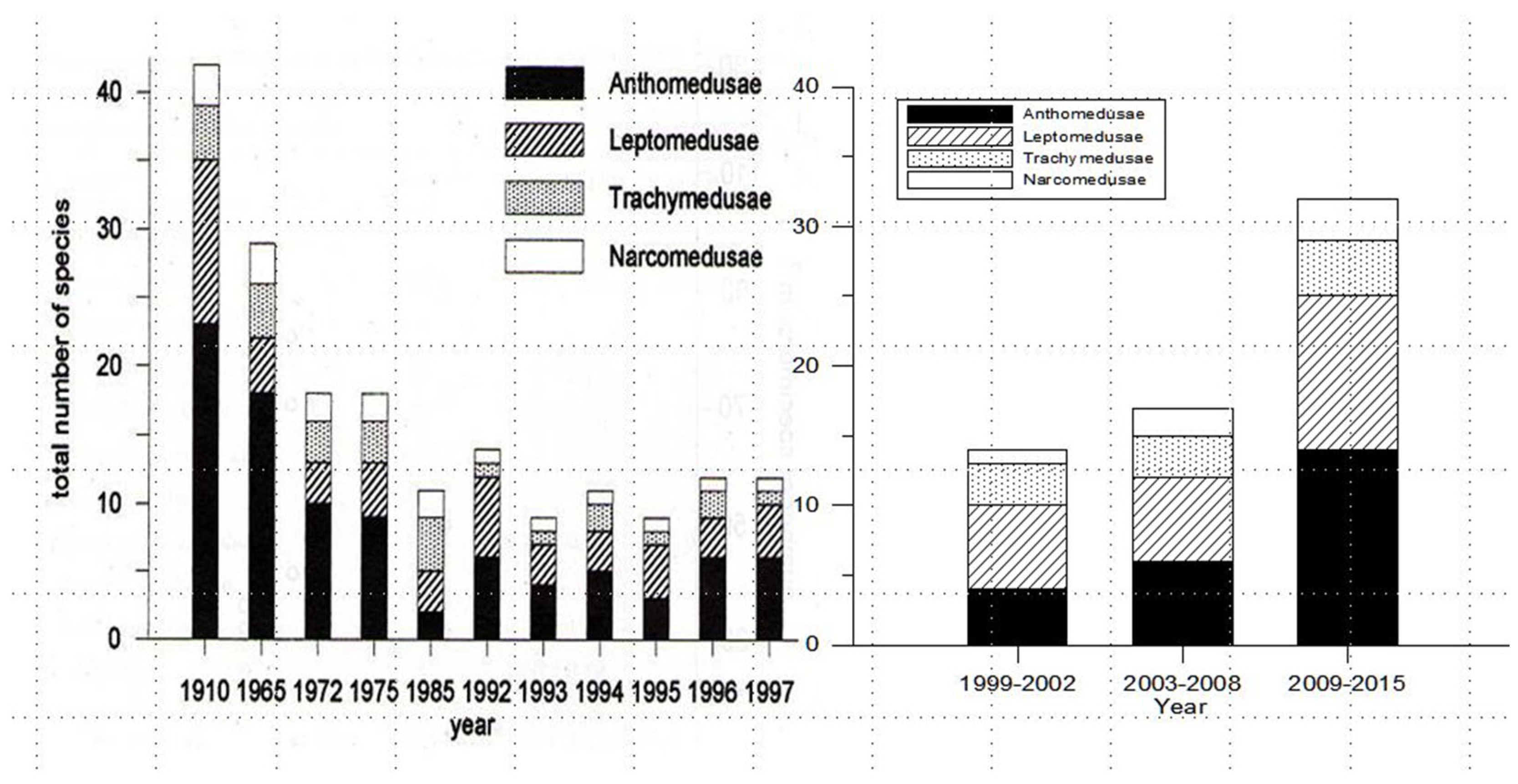
The Northern Adriatic hosts the basin’s longest continuous hydromedusan record, beginning with Will’s 1844 documentation of six species in the Gulf of Trieste [17]; early syntheses [27] were later standardised by Benović and Lučić [16] to a high-diversity baseline of 41 taxa (23 Anthomedusae, 13 Leptomedusae, 2 Limnomedusae, 2 Trachymedusae, and 1 Narcomedusae), 75% of which were meroplanktonic, implying mostly dependence on benthic polyp stages and thus on persistent hard substrates (rock and stable biogenic/artificial surfaces) rather than mobile or frequently buried surfaces. On the eve of large-scale eutrophication, Benović [38] analysed 137 Hensen net hauls from the M/B Argonaut at 18 stations north of the Lošinj–Fano line, documenting 30 hydromedusan taxa and a two-zone structure, with a neritic northern sector and a more southern, mid-Adriatic-influenced sector dominated numerically by the trachymedusa Aglaura hemistoma and Solmaris spp. The post-WWII intensification of Po basin agriculture elevated riverine N and P loads, driving eutrophication and severe seasonal bottom hypoxia in the 1960s–1980s [47,48,90], compressing diversity from >40 to 11–15 taxa by the mid-1980s as reported in the original studies (study-specific snapshots, not recalculated from the cumulative compilation in Table 1) [16,42,44], a more than 60% loss via selective failure of benthic-dependent meroplanktonic taxa and relative persistence or pulsing of holoplanktonic opportunists [4,75,91].
As shown in Figure 2, the multi-year surveys are now the most reliable references for modern North Adriatic hydromedusae. With management-driven oligotrophication and fewer hypoxic events [46,47,74,75], recovery ensued: 24–28 taxa were recorded in 1999–2011, peaking at 31 in 2009–2015 (14 Anthomedusae, 10 Leptomedusae, 3 Trachymedusae, 2 Limnomedusae, 2 Narcomedusae). Order-level contributions also appear to differ among periods (Figure 2): the eutrophication/hypoxia minimum is associated with a pronounced reduction in the meroplanktonic orders (especially Anthomedusae and Leptomedusae), whereas the post-2000 increase is largely driven by a rebound of Anthomedusae, together with a smaller but persistent Trachymedusae–Narcomedusae component that is consistent with offshore influence and advection. This recovery comprised three components with distinct ecological signals: (i) persistent/regular taxa (e.g., Lizzia blondina, Podocorynoides minima, Corymorpha nutans, Stauridiosarsia gemmifera, and Ectopleura dumortierii), forming the foundation of the stabilised post-hypoxia community; (ii) reappeared meroplanktonic taxa (e.g., Clytia spp., Laodicea undulata, and Aequorea forskalea), indicating possible benthic hydroid recolonisation after oligotrophication; and (iii) newly observed/oceanic taxa (e.g., Persa incolorata), signalling strong basin-scale circulation and winter advection from the Southern Adriatic [50]. Taxa were assigned to these components using a criteria-based presence/absence comparison across three time windows (historical baseline; the 1950s–1980s minimum; and modern multi-year surveys, 1999–2011 and 2009–2015): persistent/regular taxa recur across the modern surveys, reappeared taxa occur historically but are absent from the minimum and return post-2000, and newly observed/oceanic taxa appear only in the modern period.
Notably, in the Northern Adriatic Bougainvillia muscus was recorded only in 2009–2014 [50]. Earlier records from this subregion [16] were typically published as Bougainvillia ramosa, now treated as a synonym of B. muscus, thereby extending the apparent temporal occurrence of the taxon beyond the 2009–2014 window. Peak abundances of Lizzia blondina, Podocorynoides minima, Clytia spp., and Solmaris spp. in the same period were comparable to some of the highest hydromedusan densities reported worldwide [49,80,92]. Despite the numerical rebound, controls have shifted from chronic chemical stress to physical hydrography, retention, frontal trapping, and interannual mixing/stratification regimes [6], necessitating standardised, depth-resolved, day–night sampling to distinguish true local stabilisation from transient advective signals in this highly reactive system.

3.1.2. Kvarner and Velebit Channel

Hydromedusan records in the Kvarner and Velebit Channel originate from targeted fieldwork by Babić in years 1910 and 1912, who combined plankton net sampling at sites such as Senj and Rijeka with museum material to document both metagenetic coastal forms and offshore holoplankton. Several species were first noted from the Adriatic based on Senj material [34]. One was Pandea conica (Quoy & Gaimard, 1827) and he examined two specimens (provided by M. Padewieth) and emphasised that P. conica had not previously been recorded from the Adriatic. Interestingly, the species was not recorded later, and this finding for the Adriatic was overlooked when summarising the hydrozoan fauna of the Mediterranean Sea [71] or in broader eastern Adriatic studies [16]. Another hydromedusa collected in Senj harbour was identified as Turris coeca Hartlaub, 1892, now treated as Neoturris pileata (Forsskål, 1775). Babić reported numerous specimens of this medusa, 9–12 mm high with 50–60 marginal tentacles and well-developed gonads, collected in Senj’s waters (including an older specimen dated 10 November 1895), indicating that Neoturris medusae were established in the area. He also recorded Rathkea fasciculata (Péron & Lesueur, 1809, as modified by Haeckel, 1879) from Senj, representing the first Adriatic record of the species. Modern taxonomy places this medusa in the genus Koellikerina (Koellikerina fasciculata as the accepted name, with Rathkea fasciculata regarded as a previous combination). In addition, the medusae of the common hydroid Obelia dichotoma were abundant in Senj plankton.
Around the Kvarner Gulf, including waters near Rijeka, Babić observed several hydromedusan taxa, particularly during his September 1911 cruise. A key finding was Phialidium variabile Claus, 1881, a small leptomedusa now recognised as the medusa stage of Clytia hemisphaerica (Linnaeus, 1767) whose quasi-continuous medusa production is well known [93]. Babić collected numerous specimens in the Velebit Channel and Rijeka Bay. In addition to coastal and meroplanktonic forms, Babić’s records from Senj and Rijeka ncluded several oceanic or deepwater holoplanktonic hydromedusae. Museum specimens from Senj provided early Adriatic records of Rhopalonema velatum, Solmaris flavescens, Solmundella bitentaculata, and, the latter also directly observed in the Rijeka harbour in 1897. These findings underscore the intermittent presence of offshore taxa in coastal northern Adriatic waters, either as strays or during episodic incursions. A preserved Aequorea forskalea (as A. aequorea) medusa was documented from Rijeka (1896) as well as Olindias muelleri (as O. phosphorica) from Senj harbour.
The Kvarner region also yielded further oceanic and pleustonic hydrozoans. Babić’s collections included colonies of Porpita porpita. A single colony of Porpita (as Porpita umbella (O.F. Müller, 1776) was collected at Kraljevica in Kvarner Bay. Babić remarked that Porpita (lacking a medusa stage, but considered pleuston) was rarely observed plankton in the Adriatic; their occurrence in the northern Adriatic (Senj, Rijeka, Kraljevica) was therefore a noteworthy addition to the regional fauna.
Hadži [35] built upon this baseline with structured summer plankton surveys in Bakar Bay (1918), Rijeka Bay, and Pula Harbour (1913), recording 5–15 taxa per site and confirming the persistence of taxa previously reported by Babić. He also discussed environmental controls, particularly stratification and salinity gradients in Bakar. Taxa composition was dominated by small athecate and thecate forms (Bougainvillia, Obelia, Clytia), with occasional open water intrusions.
The regional inventory was further extended by the Vila Velebita cruises in the 1970s [36,37], which reconfirmed many earlier taxa and recorded several very rare hydromedusae, including Slabberia halterata, Corymorpha annulata, Podocoryna areolata, Trichydra pudica, Phialella quadrata, Eucheilota paradoxica and Aglantha elata. Notably, no hydromedusan data have been published for this region since the late 1970s, leaving a major sampling gap. The historical record suggests moderate diversity with episodic oceanic inputs and very rare species, but the current status of the assemblage remains unknown; systematic resampling is needed to assess long-term change, persistence or possible local extinction of rare taxa.

3.1.3. Middle Adriatic

Babić’s coastal survey (1910–1912) documented a variety of species, including several notable first records for the Adriatic—he recorded Cladonema radiatum at the island of Vis, supplemented with museum specimens from localities like Stari Grad (Island of Hvar) [34].
Babnik’s classic survey [31] pulled hydromedusae from fishery investigations in 1939–1940 across the middle and south Adriatic, working primarily off Split and Dubrovnik with material collected during broad trawling campaigns (e.g., “Veli Rat” cruises) and at fixed coastal stations in the Split Channel (station “E,” near Čiovo). She explicitly lists the gear used, the Petersen young-fish trawl, Hensen fish-egg net, Nansen net, and the Helgoland net, and provides station coordinates and plankton notes, making the work unusually transparent for its time.
From these samples she identified 26 hydromedusan taxa (10 Anthomedusae, 11 Leptomedusae, 3 Trachymedusae, and 2 Narcomedusae), offering brief diagnoses, counts, and Adriatic distribution remarks for each.
Along the entire eastern Adriatic coast, Babnik [31] found Hydromedusae, which were not recorded in later surveys: Zanclea implexa, Podocoryna exigua, Lymnorea sp., Proboscidactyla ornata, Ptychogena sp., Tiaropsidium mediterraneum, Ptychogastria asteroids, Arctapodema ampla, Pegantha rubiginosa, and taxa now treated as taxa inquirenda by WoRMS (Sarsia hargitti and Cytaeis pusilla). She also documented Tima flavilabris, a valid taxon in WoRMS. Adriatic usage likely refers to Neotima lucullana (Gulf of Trieste: ref. [27] reported as Tima flavilabris; see [69]).
A single, very poorly preserved aequoreid medusa fragment with characteristic branched radial canals was recorded in the Split Channel (station E) on 4 October 1940, during an intrusion of warm, high-salinity water from the south. On morphological grounds she could only assign it to Zygocanna sp., but subsequent Mediterranean syntheses have interpreted this Indo-Pacific record as Z. vagans Bigelow, 1912 representing a solitary, advected tropical leptomedusa in the middle Adriatic [71]. We retain it in the checklist as Zygocanna vagans (Aequoreidae, Leptothecata), counting it as a meroplanktonic taxon with an undescribed but presumed benthic hydroid stage.
Notably, she described Laodicea ocellata n. sp; she also added several species new to the Adriatic record (Laodicea undulata, Eirene viridula). Ecologically, her material portrayed a warm-water-leaning fauna distinct from the Gulf of Trieste: several northern staples were absent, whereas southern/oceanic indicators (Laodicea undulata, L. ocellata) were frequent. She highlighted seasonal/physical controls (temperature/salinity structure; episodic currents laden with salps) and noted gear selectivity—SCUBA-fragile or near-bottom forms are easily missed by nets, issues that would echo through later time series interpretations.
Finally, Babnik closed with two forward-looking points: (i) the Adriatic already held a surprisingly rich total (she compiled 75 hydromedusan taxa for the basin versus 108 for the whole Mediterranean, 15 apparently Adriatic-only at the time), and (ii) medusae could serve as “leading forms” for rapid plankton characterisation, an early articulation of indicator species logic that underpins modern Adriatic hydrozoan monitoring.
Open sea conditions in the middle Adriatic are further constrained by the NAJADE/Najade cruises synthesised by Pell [32], who listed 30 hydromedusan taxa (28 valid today) across the central Adriatic sector, comprising 14 Anthoathecata, 6 Leptothecata, 5 Trachymedusae, 2 Limnomedusae, and 1 Narcomedusa (Pell, 1938). Her patterns are distinctly oceanic: the surface trachymedusa Aglaura hemistoma dominated most stations, Rhopalonema velatum typified 100–300 m, the deep narcomedusa Solmissus albescens was frequent, and both Oceania armata and multiple Obelia spp. were common, underscoring the role of the mid-Adriatic depression (Pomo/Jabuka Pit) as a conduit for offshore fauna into the central basin.
For the middle coastal Adriatic, a crucial bridge between historical and modern data is provided by the fixed open- sea station Stončica near the island of Vis (43°02′ N, 16°17′ E; 106 m). Monthly vertical tows from 100 m to the surface with a 125 µm Nansen net were conducted from February 1995 to February 1996 at this oligotrophic, high-transparency site within the Institute of Oceanography and Fisheries long-term programme [58]. In that series, 11 hydromedusan taxa were identified, 2 Anthomedusae (Stauridiosarsia gemmifera and Euphysa aurata), 3 Leptomedusae (Laodicea undulata, Obelia spp., and Clytia hemisphaerica), 3 Trachymedusae (Aglaura hemistoma, Persa incolorata, and Rhopalonema velatum), 2 Narcomedusae (Solmundella bitentaculata and Solmaris leucostyla), with A. hemistoma and L. tetraphylla (latter transferred to Limnomedusae) numerically dominating.

3.1.4. South Station 100 (Lokrum)

Coastal hydromedusan dynamics in the southeastern Adriatic were first characterised at a fixed station located ~0.5 NM southwest of Lokrum Island near Dubrovnik, where Batistić et al. [68] carried out 31 daytime vertical hauls (75 m to the surface) at 1–3-week intervals during 1996 using a 200 µm Nansen net in oligotrophic waters influenced by eastern Mediterranean inflow. That series yielded 18 hydromedusan taxa: nine
Nine Anthomedusae (Stauridiosarsia gemmifera, Euphysa aurata, Corymorpha nutans, Zanclea costata, Podocorynoides minima, Podocoryna areolata, Hydractinia spp., Rathkea octopunctata, and Bougainvillia muscus), three Leptomedusae (Laodicea undulata, Obelia spp., and Clytia hemisphaerica), three Trachymedusae (Aglaura hemistoma, Persa incolorata, and Rhopalonema velatum), one Limnomedusae (Liriope tetraphylla), and two Narcomedusae (Solmundella bitentaculata and Solmaris leucostyla) were identified. A subsequent analysis of a long-term Dubrovnik time series (1993–2011; 492 vertical hauls with 200–250 µm nets) showed that hydromedusan composition closely tracks BiOS-driven circulation shifts [51]. The warm–temperate species Niobia dendrotentaculata appeared in 2001–2003, peaked under strongly cyclonic conditions in 2006 (44% of hydromedusae in August; ~16% of the annual total), and then declined without establishing. We define establishment as recurrent occurrence in subsequent years with a consistent seasonal signal; the restriction of N. dendrotentaculata to period from 2001 to 2003 and a single peak in 2006, with no sustained presence thereafter, is consistent with episodic advection and transient amplification via tentacle bulb budding.
In addition, monthly sampling along the eastern South Adriatic coast near Dubrovnik (0–100 m) recorded 18 hydromedusae and listed Odessia maeotica among hydromedusae in Appendix 1 [60]; because those samples derive from the same Dubrovnik coastal sector covered by our South Station 100 regional unit, we retain the record under Lokrum for consistency in regional coding.

3.1.5. Mljet Lakes

In the Mljet saline lakes Veliko Jezero (VJ) and Malo Jezero (MJ), hydromedusan records begin with early 20th-century notes by Babić. In a short report on the “Veliko Jezero” of Mljet, he listed Bougainvillia autumnalis (now a synonym of B. muscus) and Obelia dichotoma, and explicitly mentioned Obelia polyps [34]. In his subsequent basin-wide review of planktonic coelenterates, Babić further noted that a total of eight coelenterate taxa were recorded around Mljet in March 1912, indicating that the lakes already supported a small mixed assemblage of meroplanktonic hydromedusae and scyphozoans well before modern eutrophication and management.
Later quantitative surveys (1996–1998) confirmed that hydromedusae in VJ and MJ remain of relatively low diversity compared with the adjacent open sea [52], assemblages restricted to Anthomedusae and Leptomedusae as Obelia spp. were most frequent and abundant whereas Clytia hemisphaerica, Eirene viridula, and Eutima gracilis were recurrent but sparse [52]. A large Tima sp. (bell 60–84 mm in diameter, 55–75 mm in height, thick mesoglea), most likely Neotima lucullana, occurred consistently below the thermocline and was common in SCUBA observations (e.g., ~3 ind. m−3 at 17–20 m in MJ) yet was never captured in vertical net hauls, underscoring strong gear selectivity against fragile near-bottom medusae [52,69]. The authors restricted the identification to Tima sp., although the only Mediterranean congener known at the time was Tima lucullana (Neotima lucullana nowadays), and they refrained from using the species name because of the small sample size, the large size of medusae, and their sporadic occurrence. Subsequent work showed that N. lucullana can in fact form occasional high-density occurrences in unusual habitats [69]. Overall, the Mljet Lakes are characterised by a taxonomically modest hydromedusan assemblage dominated by a few coastal antho- and leptomedusae, while most gelatinous biomass is contributed by scyphozoans rather than hydrozoans. In particular, the endemic scyphozoan Aurelia relicta [94] formerly reported as Aurelia sp. 5 [95] occurs in dense, often year-round aggregations and underpins a jellyfish-dominated food web in Veliko Jezero, with strong predation on micro- and mesozooplankton; this persistent scyphozoan biomass likely intensifies exploitative competition with co-occurring hydromedusae for shared zooplankton prey [96,97].

3.1.6. Boka Kotorska Bay

Earlier work by Vukanić [61] provided the first modern, year-round description of hydromedusae in Boka Kotorska Bay, against which more recent surveys can be compared. A study of planktonic cnidarians in Boka Kotorska Bay, Montenegro, by Pestorić et al. [62] compiled samples collected from March 2009 to June 2010 and identified a total of 12 hydromedusan taxa (3 Anthomedusae, 5 Leptomedusae, 2 Trachymedusae, 1 Limnomedusae and 1 Narcomedusae). Generally, hydromedusae were not very abundant, with median values rarely exceeding 1 ind. m−3. A notable exception was an extraordinary bloom of Obelia spp. in the Bay of Tivat in December 2009, which reached 341 ind. m−3; this high abundance, coincident with elevated chlorophyll a concentration, is unusual for Adriatic coastal ecosystems. The distribution of hydromedusae varied within the bay: meroplanktonic taxa, particularly from the dominant order Leptomedusae, were more numerous in the inner bays during autumn and winter, whereas holoplanktonic Trachymedusae such as Aglaura hemistoma were significantly more abundant in the outer bay, influenced by the open sea. The study also noted significantly lower hydromedusan densities in spring 2009, possibly due to competition for food with a concurrent bloom of the ctenophore Bolinopsis vitrea [98]. Subsequent work shows that blooms of Bolinopsis vitrea in Boka Kotorska Bay co-occur with the appearance of its predator Beroe ovata [98,99], and that the bay is a recurrent hotspot for blooms of large scyphozoans such as Discomedusa lobata, with increasingly frequent observations of Drymonema dalmatinum and Chrysaora hysoscella [15], taxa that preferentially feed on gelatinous zooplankton, particularly other medusae in the case of D. dalmatinum [100,101]; together, these predators likely intensify intraguild predation and competition within the gelatinous community and further constrain hydromedusan access to prey [15]. Taken together, the 12 taxa recorded by Pestorić et al. [62], even when considered alongside the 8 taxa reported by Vukanić [61], still fall well below the 26 taxa documented by Babnik [31]; Pestorić et al. [62] interpreted this contraction in observed richness as consistent with a decline in biodiversity and emerging signs of environmental degradation in Boka Kotorska Bay, however, Babnik’s broader regional/seasonal coverage and different sampling design could have increased detectability relative to recent local bay studies, so part of the gap may reflect sampling scope.

3.1.7. Albania (Coastal Margin)

Two seasonal surveys (May 2007; January 2008) in the Gulf of Vlorë recorded 11 hydromedusae, including Obelia spp., Clytia spp., Liriope sp. (as Liriope tetraphylla, Table 1), Hydractinia sp., Bougainvillia muscus (as Bougainvillia nana), and Stauridiosarsia gemmifera (reported under the outdated combination Dipurena gemmata) [64]. In addition, the study reports Merga costata under the name Janiopsis costata, reflecting use of a generic placement that is now considered congeneric with Merga [102,103]. Seasonally, the winter cruise added multiple hydromedusan presences (e.g., L. tetraphylla) whereas the spring survey yielded taxa such as S. gemmifera and rare G. proboscidalis. Overall, the study expanded the regional hydromedusan checklist for the southern Adriatic–Albanian margin and underscored the role of exchange with the open sea in maintaining medusan diversity in the gulf [64].
Along the Albanian margin of the South Adriatic (May 2009), a six-station coast-to-open sea transect (A50–A1000) sampled mesozooplankton with Nansen closing nets (125 µm at A50–A150; 200 µm offshore; [63]. Nine hydromedusan taxa were recorded: Rhabdoon singulare, Obelia spp., Eirene viridula, Liriope tetraphylla, Aglaura hemistoma, Persa incolorata, Rhopalonema velatum, Solmundella bitentaculata, and Solmissus albescens. The co-occurrence of oceanic indicators (A. hemistoma, P. incolorata, R. velatum, and S. albescens) at the shelf edge is consistent with strong influence of the East Adriatic Current and associated open sea inflow along this boundary zone [63,104,105].

3.1.8. South Adriatic Pit

Hydromedusan coverage of the South Adriatic can be traced to early offshore station material and supplementary deep samples off Ragusa station (1000 m) reported by Neppi [29], followed by the Najade expeditions sampling the South Adriatic Pit [30,32].
Open-water surveys across the central and southern Adriatic in 1974–1976 documented a diverse offshore hydromedusan assemblage (31 taxa in total) with pronounced seasonality: winter maxima dominated by cold-water trachylines and summer peaks of warm-water neritic forms [39]. The offshore community was consistently structured by holoplanktonic Trachylina (Aglaura hemistoma, Rhopalonema velatum), accompanied by Leptomedusae (Obelia spp., Clytia hemisphaerica), and Limnomedusae Liriope tetraphylla providing an “oceanic” end-member that contrasts with the eutrophication-stressed northern shelf. In this series, the middle Adriatic yielded 17 taxa when genus-level records are included (Leptomedusae 9, Limnomedusae 2, Trachymedusae 4, Narcomedusae 2), and the southern Adriatic 24 taxa (Leptomedusae 10, Limnomedusae 2, Trachymedusae 8, Narcomedusae 4); reconciling these counts with the 22 taxa reported requires excluding the two genus-only entries (Obelia spp., Solmaris spp.). These open-sea results later served as the benchmark for north–south comparisons and for interpreting circulation-driven inflows [16].
Subsequent deep-sea sampling on the northern rim of the South Adriatic Pit (42°20′ N, 17°43′ E) further resolved the vertical structure of this offshore assemblage. Five cruises between April 1993 and June 1994, sampling 0–1000 m with a 250 µm opening–closing net, recorded 11 hydromedusan taxa: two Anthomedusae (Euphysa aurata, Bythotiara murrayi), two Leptomedusae (Obelia spp., Clytia hemisphaerica), one Limnomedusae (Liriope tetraphylla), three Trachymedusae (Aglaura hemistoma, Persa incolorata, Rhopalonema velatum) and three Narcomedusae (Solmundella bitentaculata, Solmaris leucostyla, Solmissus albescens) [55]. These data confirmed a persistent deep-pelagic core dominated by trachyline and narcomedusan taxa.
The spring 2002 “Medusa 1” survey across the middle and southern Adriatic recorded 28 hydromedusan taxa plus the scyphomedusa Paraphyllina intermedia, with peak richness (up to 18 taxa) at the deep-pit stations (P-1, P-2) [56]. Assemblages were numerically dominated by R. velatum (55% of individuals), A. hemistoma (25%) and P. incolorata (8%), largely confined above 200 m. Maximum abundances reached 358 ind. 10 m−3 for R. velatum, 85 ind. 10 m−3 for P. incolorata, 77 ind. 10 m−3 for A. hemistoma and 13 ind. 10 m−3 for Rhabdoon singulare, with higher densities typically observed at night in the upper layer, despite the extremely oligotrophic conditions of the open southern basin.
A complementary 24-hourly time series in July 2003, based on seven consecutive days of stratified sampling from 0 to 1200 m at a ~1200 m station, captured 26 species (24 hydromedusae and 2 scyphomedusae) [57]. Overall maxima occurred between the ~15 m thermocline and 100 m, with R. velatum again dominant, followed by A. hemistoma, R. singulare, P. incolorata and S. albescens. Broad depth ranges (e.g., S. albescens 15–1200 m; R. velatum 0–800 m; P. incolorata 50–1200 m) and weighted mean depth analyses revealed distinct diel vertical migration patterns: R. velatum undertook strong nocturnal ascent from mesopelagic layers (~400–600 m) into the upper 50 m, P. incolorata and S. albescens also shifted upwards at night over wide depth envelopes, whereas A. hemistoma remained largely above the thermocline with limited vertical displacement. These contrasting behaviours indicate clear niche differentiation among dominant holoplanktonic taxa and underscore the joint control of light regime, hydrography and prey layers on deep-pelagic assemblages.
Collectively, the open sea datasets from the South Adriatic Pit [39,55,56,57] define the Adriatic’s offshore end-member for hydromedusae and provide the reference frame for interpreting north–south contrasts and circulation-driven inflows into the northern basin.

3.2. Bloom Phenomena

While conspicuous scyphozoan and ctenophore blooms often dominate attention, hydromedusan blooms can also impose strong top–down pulses on zooplankton [4]. Their drivers are multifactorial and include short temperature windows for medusa production, elevated prey supply, hydrographic retention and convergence (fronts, gyres), and episodes of reduced predation on medusae or their benthic polyps. One plausible predator-release pathway is variation in medusivory (intraguild predation among gelatinous predators): in the northern Adriatic, Drymonema dalmatinum is a specialised predator of other medusae, and interannual shifts in its occurrence may relax top–down control on prey medusae in some years [101]. Bloom phenology can also shift with environmental forcing [4,96]. Hydromedusae, like other jellyfishes, remain understudied because their complex life cycles generate extreme, short-lived peaks in abundance (“blooms”) [106]. Many hydrozoans have a bipartite life cycle that suits variable environments: benthic hydroids persist when conditions are unfavourable and can rapidly release medusae when conditions improve [107]. Yet these small, fragile medusae are often overlooked in plankton ecology because they elude direct observation and standard nets can miss or damage them, so blooms frequently go undetected [106]. A comprehensive mechanistic understanding of triggers for synchronised budding and bloom onset is still limited; candidate drivers include circa-annual rhythms, temperature, salinity, lunar cycles, dissolved oxygen and turbidity, and have been tested in detail for only a few species [8].
Verified high-abundance events along the eastern Adriatic are therefore rare and involve few taxa, often from single stations or campaigns. Coastal meroplanktonic forms can reach striking densities: Clytia spp. up to 1024 ind. m−3 and Obelia spp. up to 140 ind. m−3 in the Mljet saline lake, 341 ind. m−3 in Boka Kotorska Bay and 428 ind. m−3 in Gulf of Trieste [41,52,62]. These semi-enclosed systems are shallow, strongly influenced by freshwater inputs and associated nutrients and typically harbour a hydromedusan fauna with a high proportion of metagenetic taxa, whose benthic polyps exploit abundant hard substrates and can rapidly seed dense, localised medusan swarms. Species of Obelia, for example, are common on coastal substrates, and their medusae occasionally form dense, short-lived blooms [62]. Taken together, the Mljet lakes and analogous semi-enclosed embayments along the coastline (e.g., Bay of Kotor) function as natural laboratories, where isolation, restricted exchange and steep physicochemical gradients shape distinct medusan assemblages and may foster rapid ecological divergence, including the possibility of cryptic or undescribed taxa.
Offshore holoplanktonic medusae also reach high densities, but peaks are generally more moderate than in coastal embayments. In the northern Adriatic, Solmaris spp. attained up to 622 ind. m−3 in depth-stratified surveys [49]. In the extremely oligotrophic open southern Adriatic, variations in the abundance of permanently present hydromedusae are smaller overall, but still show marked day–night contrasts. During spring 2002, maximum abundances reached 358 ind. 10 m−3 for Rhopalonema velatum, 85 ind. 10 m−3 for Persa incolorata, 77 ind. 10 m−3 for Aglaura hemistoma and 13 ind. 10 m−3 for Rhabdoon singulare [56], with higher densities mostly recorded at night in the surface layer. For the mesopelagic endemic narcomedusa Solmissus albescens, which is permanently present in the southern basin, the highest abundance was 10 ind. 10 m−3 in July 2003 [57]. These values represent offshore analogues of coastal blooms and highlight the importance of diel vertical migration and deep-pelagic refuge layers in sustaining holoplanktonic populations.
Finally, several years of monitoring and citizen science observations indicate that blooms of larger hydromedusae along the eastern Adriatic coast are more frequent than suggested by net samples alone. Surface swarms of large, fragile species are often missed or underrepresented in conventional plankton tows, emphasising the need for complementary visual surveys and opportunistic records when assessing bloom frequency and ecological impact.

3.3. Larger Species Notes and Recent Bloom Events

3.3.1. Craspedacusta sowerbii Lankester, 1880

Violić et al. [108] reported a mass occurrence of this freshwater hydromedusa in September 2001 in Lake Kuti, part of the upper Neretva delta. High numbers were again observed in January and February 2002, after which the species was no longer recorded. Likewise, a high abundance of C. sowerbii has been observed in the river Reka near Škocjan caves in July 2012 (Malej pers. obs.). This short-lived but conspicuous events underscores the potential for inland freshwater systems connected to the Adriatic catchment to host non-native hydromedusae.

3.3.2. Aequorea forskalea Péron & Lesueur, 1810

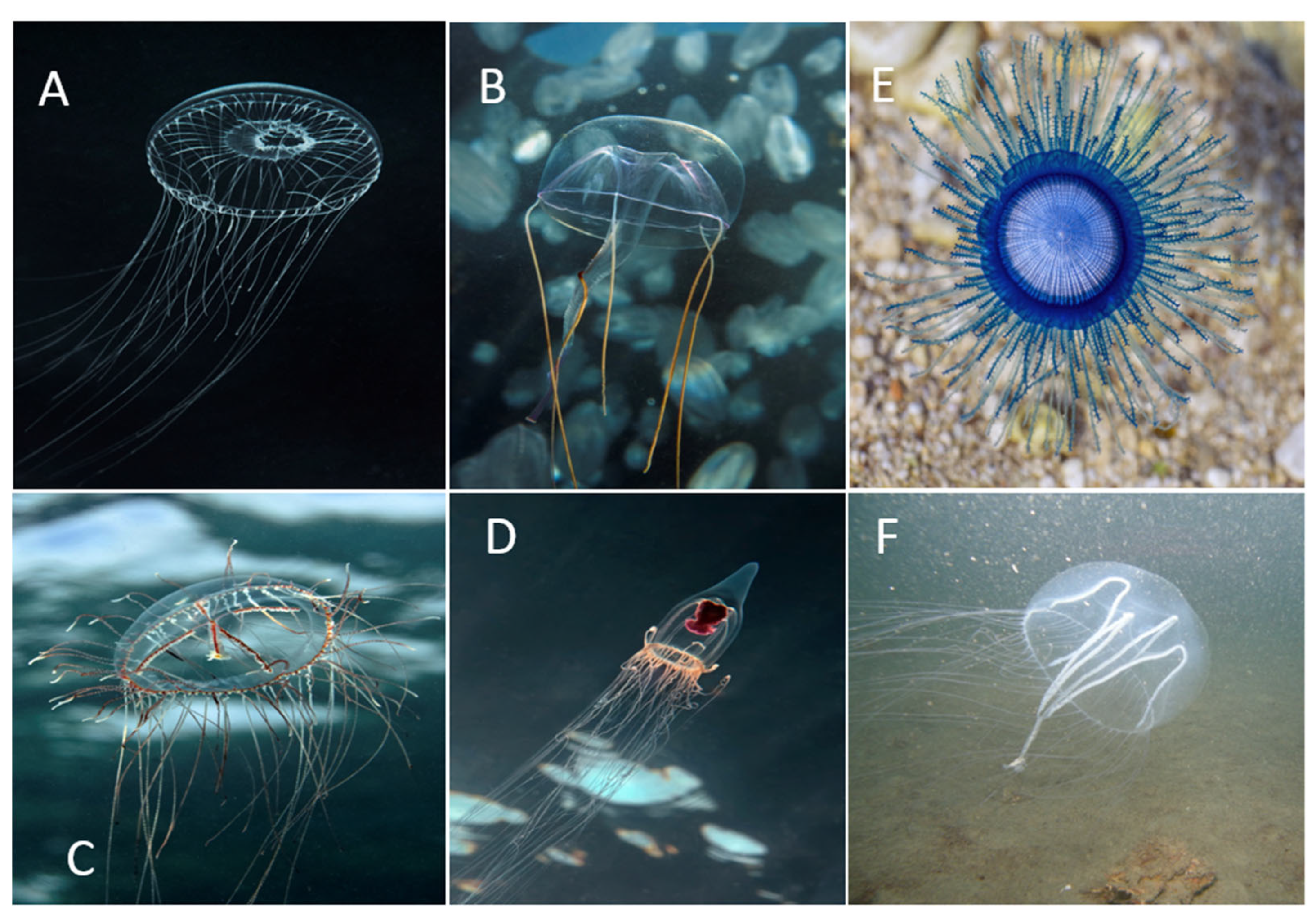
A detailed reassessment of Adriatic Aequorea by Malej et al. [6] shows that the local taxon (A. cf. forskalea) is a cold-season hydromedusa, with winter–spring peaks at ~10–11 °C SST and a significant negative relationship with sea-surface temperature. Highest abundances and recurrent blooms occur in the Gulf of Trieste and the NE Adriatic (Figure 3A), with only sporadic records in central and SE subregions Compared with 1900–1911, the modern medusa season has shortened and the autumn phase has largely disappeared, a pattern the authors attribute to warmer autumns delaying or suppressing medusa release; they therefore regard A. forskalea as a sensitive indicator of winter cooling strength and phenological shifts in northern Adriatic plankton.

3.3.3. Geryonia proboscidalis (Forsskål, 1775)

Historically considered rare and sporadic, but more locally abundant in recent decade. Aggregations were recorded along the Istrian coast in 2017 (patches ~3–4 ind m−3) with numerous stings reported (Figure 3B). Earlier measurements in February 2013 at Soline (Mljet) documented bells ~3.5–8.7 cm. Subsequent single records occurred at P-300 (2018) and the Bay of Piran (2019). These events likely reflect near-shore concentration by currents and episodic advection. Because Geryonia proboscidalis stings and can cause painful envenomation, local blooms present a public health concern and warrant warnings and basic first aid advice for bathers.

3.3.4. Olindias muelleri Haeckel, 1879

Compiled citizen science records (2014–2021) show recurrent summer appearances of Olindias muelleri (previously reported as Olindias phosphorica) across the eastern Adriatic, from the northern Adriatic (Figure 3C) to the Boka Kotorska Bay and with notable aggregations from the central Adriatic coastal areas and occasional late-season persistence. As with G. proboscidalis, the cnidome of O. muelleri contains penetrant nematocysts capable of causing painful skin burns in humans [109]. Reports are mostly from very shallow water or at night and stings were noted during mid-August events. Collectively, these observations indicate a warm-season, coast-proximal pattern with intermittent local blooms along the Croatian and Slovenian coast (Žusterna). Notably, Stari Grad Bay (Hvar Island) hosts a year-round population exhibiting a clear diel habitat shift, benthic by day, pelagic and feeding after sunset (personal observation).

3.3.5. Neoturris pileata (Forsskål, 1775)

Sporadic specimens were reported near Pula in March 2019 at 1 m depth (Figure 3D). Size approximately 25 mm. Specimens also noted along Slovenian coast.

3.3.6. Porpita porpita (Linnaeus, 1758)

Across the eastern Adriatic, reports span multiple seasons and a broad latitudinal range, with sightings on 11 April 2018 and 10 October 2018 (open southern Adriatic, offshore), 7 July 2021 (Biševo, central Adriatic), and 20 August 2023 (Pula, northern Adriatic) (Figure 3E), collectively indicating recurrent, basin-wide occurrences consistent with wind-driven surface transport rather than continuous local presence.

3.3.7. Neotima lucullana (Delle Chiaje, 1823)

Described in detail by Lučić et al. [69], the species showed in summer–autumn 2021 the first numerous and prolonged Mediterranean occurrence, confined to the near-bottom high-salinity wedge (35.2–38.2) in the lower Neretva estuary (Figure 3F). Aggregations persisted from late June to mid-September (bell diameters 15–72 mm; gonad development in specimens >25 mm), declining to single individuals by late October. The study provided the first COI barcode for N. lucullana and demonstrated that this typically marine endemic can establish dense populations in a karstic estuary when a stable marine wedge penetrates upstream, highlighting how hydrographic change and increasing seawater intrusion may reshape the distribution and phenology of such taxa in the eastern Adriatic.
In the updated checklist (Table 1), these case-study species are correspondingly flagged as Bloom and/or CS, with additional NIS, cryptogenic, freshwater and deep-water designations where appropriate, so that qualitative observations of swarms and stings are directly integrated into a standardised ecological status framework.

3.4. Cryptic, Doubtful and Recently Introduced Species

The Indo-Pacific medusa Corymorpha annulata has been reported from the Adriatic from a single specimen only [36], with no subsequent confirmations. The bathypelagic Haliscera bigelowi was first recorded in spring 2002 at a deep-sea station in the southern Adriatic [56]. Arctapodema australis was rarely encountered prior to 2002 but has since been recorded frequently and is now among the typical medusae of the southern Adriatic [57]. Trichydra pudica is a small neritic hydromedusa (family Trichydridae), known in the Adriatic as a non-indigenous taxon: the first regional record is from 1979 [37] with only sporadic subsequent mentions. It is represented by the medusa stage and remains rare in coastal surveys; we therefore retain T. pudica as extant but infrequent in the eastern Adriatic and recommend modern vouchers (imaging, DNA) for any new finds. Gonionemus vertens was retained in the checklist based on the Trieste-linked record of Joseph [28] (published as G. vindobonensis), but is treated here as rare in the absence of modern vouchers or DNA confirmation.
The warm-temperate hydromedusa Niobia dendrotentaculata was first recorded in the Adriatic in 2001, and was abundant in August 2006 in the coastal South Adriatic [51].
Out of 98 recorded taxa (Table 1), cross-referencing our eastern Adriatic checklist with Gravili et al. [72] missing species compilation, defined as Mediterranean taxa not reported for ≥41 years and evaluated using a confidence-of-extinction index (C; C ≥ 95% indicating extinction-level confidence and 80–94% putative extinction-level confidence), identifies overlapping medusae: Zygocanna vagans, Eutonina scintillans, Helgicirrha cari (Syn. H. schulzei/schulzii), Melicertissa adriatica, Eucheilota maasi, Lizzia octostyla, Orchistomella graeffei, Octogonade mediterranea, Tiaropsidium mediterraneum, Protiara tetranema, and Arctapodema ampla (the Adriatic record historically reported as Isonema najadis). These overlaps largely represent legacy and/or rarely reconfirmed records, many complicated by taxonomic instability (e.g., O. graeffei and P. tetranema) or sparse/singleton evidence (e.g., T. mediterraneum and A. ampla), and should be prioritised for targeted re-survey with modern vouchers (high-resolution imaging and DNA barcoding). Importantly, H. cari should not be treated as missing or putatively extinct, as it has recent Adriatic evidence and was re-documented and taxonomically clarified by Schuchert [110].
In addition, our checklist clarifies several further entries: Dicodonium adriaticum (treated as taxon inquirendum, a rare Adriatic endemic but considered extant), Sarsia hargitti (S. producta, taxon inquirendum yet commonly encountered after the 1970s), Cytaeis pusilla (taxon inquirendum, still present in the Mediterranean) and Eucope picta (taxon inquirendum, occasionally recorded). Genus-level records such as Lymnorea, Pandea, Ptychogena, Obelia and Solmaris are retained as present in the region but not resolved to species level.
To conclude the paragraph, in the updated checklist, these taxa are correspondingly flagged as non-indigenous, taxon inquirendum, putatively extinct (as assessed by Gravili et al. [72]), or extant but infrequent (single record), so that our narrative assessment of rarity and uncertainty is directly encoded in a standardised set of ecological status categories and highlights them as priority targets for modern vouchers and re-surveys.

3.5. Biodiversity and Taxa Richness by Region Summarised

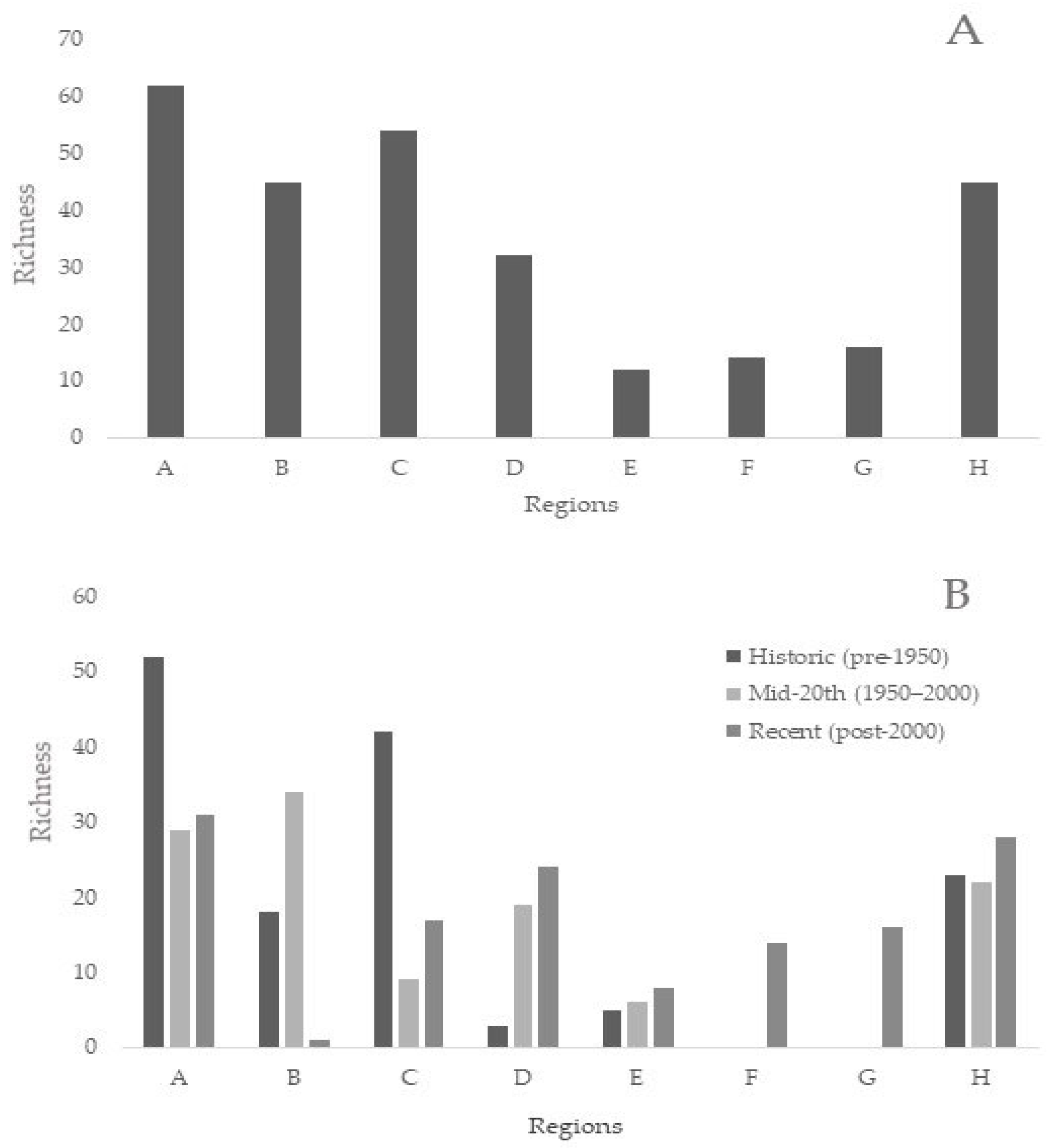
Across the eight sub-regions (A–H), cumulative hydromedusan richness is highly uneven and follows a strong coastal-offshore and north–south gradient. In addition to the coastal–open sea gradient, the available time series and seasonal campaigns indicate a consistent winter–summer axis, with winter assemblages more influenced by offshore advection and holoplanktonic taxa, whereas summer assemblages are more strongly shaped by local production pulses of meroplanktonic medusae in coastal waters [6,68]. Across all compiled sources and periods, totals range from 12 taxa in the Mljet Lakes (E) to more than 60 in the Northern Adriatic (A), with intermediate values in Kvarner–Velebit (B, 45 taxa), the Middle Adriatic (C, 53), South Station 100 (D, 31), Boka Kotorska Bay (F, 14), the Albanian margin (G, 16), and the South Adriatic Pit (H, 45) (Table 1, Figure 4). For the Northern Adriatic, “historical” richness refers to the pre-eutrophication cumulative baseline of >40 taxa compiled from Neppi [27], Neppi and Stiasny [27], and mid-20th-century surveys as standardised by Benović and Lučić [16], whereas “recent” refers to the cumulative total of ~31 taxa recorded in the 1999–2015 WP-2 time series (Figure 2 and Figure 4).
The historically rich North Adriatic (>40 taxa) suffered a >60% collapse during the 1960s–1980s under eutrophication and hypoxia, with a partial rebound since ~2000 as benthic-dependent meroplankton reappeared and oceanic holoplankton episodically intruded, reshaping community composition (Table 2). Semi-enclosed systems (Mljet Lakes; Boka Kotorska) are taxa-poor but dominance-prone, with Obelia spp. routinely prevailing and capable of dense blooms (to ~140–341 ind. m−3) under local enrichment and restricted exchange. Offshore, the South Adriatic Pit maintains a persistent oceanic core (Aglaura hemistoma, Rhopalonema velatum, Solmissus albescens) structured by deep convection, BiOS-linked advection, and diel vertical migration, with peak richness at deep stations during targeted spring–summer campaigns. Kvarner–Velebit shows moderate historical diversity with rare and pleustonic taxa, but a modern sampling gap clouds present status. Along Albania’s coast, recent surveys expanded the checklist and confirmed strong open-sea influence at the shelf edge via oceanic indicators.
Taken together, these contrasts show that life history strategy (meroplankton vs. holoplankton), hydrographic connectivity, and nutrient regimes jointly shape biodiversity patterns, underscoring the need for standardised, depth-resolved, day–night sampling to separate true local recovery from transient advection. Table 2 compiles records by sub-region (A-H) and period, making two patterns apparent: (i) coasts and semi-enclosed basins (A, B, E, F) generally skew meroplanktonic, led by Antho- and Leptomedusae such as Obelia that can dominate under local enrichment (e.g., blooms in the Mljet Lakes and Boka Kotorska), reflecting the advantage of benthic polyps on shallow substrates (noting the modern sampling gap in B); and (ii) open waters and shelf edges (C, H, G, and the coastal–oceanic interface at D) show a higher relative contribution of holoplanktonic taxa, with Trachymedusae (Aglaura hemistoma, Rhopalonema velatum) and deep-water Narcomedusae (e.g., Solmissus albescens) characterising the offshore signal. In total, the checklist comprises 98 non-siphonophoran hydrozoan taxa (Table 1), of which 7 are genus-level entries and 91 are resolved to species level, providing a quantitative backbone for comparing richness and composition among regions. These richness contrasts partly reflect heterogeneous sampling effort and methodology (e.g., intensive century-long coverage in the Northern Adriatic vs. sparse, short campaigns along the Albanian margin), so we interpret them qualitatively rather than as strict inventory completeness. Importantly, the mid-20th (1950–2000) values in Figure 4 represent a pooled, multi-decadal presence list rather than a single community snapshot; this interval spans pre-eutrophication years, the 1960s–1980s hypoxia-driven minimum, and the late-1990s transition, so cumulative richness can appear relatively high even though richness at the eutrophication peak fell to ~11 to 15 taxa [42]. The Northern Adriatic trajectory therefore anchors the temporal signal: a mid-20th-century diversity crash that selectively removed meroplankton during eutrophication/hypoxia, followed by post-2000 partial recovery of meroplankton and episodic northward occurrences of oceanic holoplankton taxa (turnover rather than net richness gain) now visible in Table 1 and Table 2.

3.6. Methodological Constraints: Gear Selectivity and the “Recovery” Signal

One of the main caveats in interpreting long-term variation in Adriatic hydromedusae is the evolution of sampling methodology over the past century. Early campaigns (e.g., before 1950) often used comparatively coarse-mesh gear (e.g., modified Nansen nets ~250 µm, fish/larval nets), which likely undersampled the smallest hydromedusae and early stages [31]. In contrast, modern work commonly uses WP-2 nets (200 µm) or finer meshes (53–125 µm), improving retention of small Anthomedusae and early life stages [56,62]. Accordingly, part of the apparent post-1980s increase in recorded richness (e.g., from ~11 taxa to >30 in the northern Adriatic) can reflect improved detectability rather than ecological change alone [49].
Importantly, however, recovering historical taxa richness (i.e., approaching earlier cumulative baselines) should be distinguished from restoring community structure and function, which would imply the renewed and sustained expression of benthic–pelagic life cycles (polyp persistence, successful medusa production) and associated trophic roles/processes that may respond to changes in hypoxia, substrate conditions, and food web interactions. Finally, even where richness increases and some meroplanktonic taxa reappear, the system may still be shifting toward a novel community state shaped by climate-driven environmental change and altered circulation, with episodic newcomer taxa linked to offshore intrusions [51], so “recovery” does not necessarily imply a return to the historical community configuration. Consistent with this distinction, the reappearance of larger, conspicuous meroplanktonic taxa (e.g., Aequorea), which were well documented in early 20th-century records, absent during the eutrophication crisis, and now recorded again [6], cannot be explained by finer mesh alone, and likely reflects real ecological change in addition to methodological effects.

4. Conclusions

Across all periods, our checklist compiles 98 non-siphonophoran hydromedusan taxa in the eastern Adriatic (91 species and 7 genus-level entries), comprising 45 Anthomedusae, 28 Leptomedusae, 5 Limnomedusae, 11 Trachymedusae, 8 Narcomedusae, and one pleustonic taxon (Porpita porpita). The fauna is strongly dominated by meroplanktonic forms (75 taxa) relative to holoplanktonic ones (22 taxa), consistent with the importance of benthic polyp stages in shaping regional diversity. Richness and composition vary markedly among subregions as reflected in Table 1 and Table 2, reflecting interacting effects of life history strategy, hydrographic connectivity, and nutrient regimes, with the Northern Adriatic providing the clearest long-term signal of eutrophication-driven collapse followed by partial post-2000 recovery. Although the Northern Adriatic still contains the largest share of the regional fauna, its contemporary assemblage remains substantially reduced and now only modestly exceeds richness in the middle and southern basins.
Across the eastern Adriatic wider basin, hydromedusan assemblages are structured primarily along a coastal–open sea and winter–summer axis, as discussed in Section 3.5. Coastal subregions are dominated by meroplanktonic Leptomedusae and Anthomedusae appearing in short, environmentally driven pulses. In offshore waters, holoplanktonic Trachymedusae and Narcomedusae form a disproportionate share of the assemblage and often dominate the open sea signal, particularly in deeper layers. The open southern basin supports a persistent holoplanktonic core with pronounced depth-linked behaviour.
Over nearly two centuries, the interplay of natural variability, anthropogenic stress (e.g., eutrophication and hypoxia), and climatic forcing has driven major shifts. The long-term decline in the northern Adriatic has resulted in the loss of over 60% of historically recorded taxa, particularly those with benthic polyp stages. Recent signs of improvement include the reappearance of meroplanktonic taxa and episodic open sea inflows, though the extent and permanence of this recovery remain uncertain. In particular, bottom marine heatwaves [111] could pose an additional threat to cold-water meroplanktonic taxa by exposing benthic life stages to prolonged thermal stress.
Standardised gear, preserved voucher material, and harmonised sampling windows are now essential for comparability among studies.
The updated taxa checklist presented here serves as both a historical synthesis and a quantitative benchmark for assessing future changes, but transforming the eastern Adriatic from a fragmented historical archive into a predictive observatory addressing critical gaps:
(i)
Benthic polyp gap: The most conspicuous gap concerns the benthic polyp stage of meroplanktonic species. The decline of medusae has been inferred largely from their absence in plankton samples, yet long-term ecological studies of hydroid communities are virtually lacking. Priority should be given to mapping hydroid populations, assessing their condition and reproductive output, and experimentally determining their response to stressors such as hypoxia and temperature change. Such work is crucial for confirming mechanisms of decline, identifying refugia and evaluating recovery potential.
(ii)
Taxonomy identification challenge: accurate species identification, particularly for small or damaged specimens collected with traditional nets. Many historical and recent datasets aggregate taxa at the genus level (e.g., Obelia spp., Clytia spp.), which limits diagnostic and comparative value. Routine molecular integration, especially DNA barcoding, is therefore essential. Recent confirmations of B. triestina and N. lucullana demonstrate how genetic tools resolve taxonomic ambiguities, reveal cryptic diversity, and provide a stable framework for tracking biodiversity over time. Inconsistent nomenclature (e.g., Dipurena/Stauridiosarsia, Janiopsis/Merga) also requires revision. A clear example is Bougainvillia muscus in the Northern Adriatic: modern records report it only in 2009–2014, yet earlier occurrences were typically published as B.ramosa, B. autumnalis and B. nana now synonymized with B. muscus. Reconciling synonymy is therefore essential to avoid false novelty signals in long-term biodiversity assessments.
(iii)
Spatial and sampling gaps: significant structural gaps include the lack of post-1970s data from the Kvarner and Velebit Channel and sparse recent coverage of Boka Kotorska Bay and the Albanian margin leaving large parts of the historical assemblage unassessed under present-day conditions.
Future programmes must be designed to mitigate these gaps, and therefore combine repeated, regionally balanced plankton surveys with dedicated benthic sampling for polyps and routinely incorporate DNA barcoding to stabilise identifications. Standardised, depth-resolved sampling across diel cycles is particularly important for taxa with strong vertical migrations. Semi-enclosed systems such as the Mljet Lakes and Boka Kotorska Bay, with distinctive hydrography and clear boundaries, serve as natural laboratories for investigating life history plasticity, bloom dynamics, and cryptic diversity.
The updated taxa checklist presented here thus serves not only as a historical synthesis but also as a quantitative benchmark against which future changes can be assessed. Turning the eastern Adriatic from a patchy historical archive into a genuinely predictive observatory for hydromedusan diversity and dynamics will depend on whether these methodological and spatial gaps are addressed in the next generation of monitoring and research.

Author Contributions

Conceptualization, I.O. and D.L.; methodology, I.O.; software, B.G.Z.; validation, I.O., D.L., and B.G.Z.; formal analysis, D.L. and A.M.; investigation I.O.; resources, I.O., D.L., and A.M.; data curation, I.O.; writing—original draft preparation, I.O.; writing—review and editing, A.M. and B.G.Z.; visualisation, I.O. and B.G.Z.; supervision, D.L.; project administration, I.O. All authors have read and agreed to the published version of the manuscript.

Funding

This research received no external funding.

Data Availability Statement

No new data were created or analyzed in this study.

Acknowledgments

We thank Marinko Babić and Donat Petricioli for providing photographic material and valuable information on recorded species, and we also thank all contributors who submitted anonymous records through the Citizen Science initiative. During the preparation of this manuscript, the author(s) used Gen AI (chatGPT, 4.1 model) for the purposes of generating ONLY part of the graphical abstract. The authors have reviewed and edited the output and take full responsibility for the content of this publication.

Conflicts of Interest

The authors declare no conflicts of interest.

Abbreviations

The following abbreviations are used in this manuscript:
BiOSBimodal Oscillating System
WoRMSWorld Register of Marine Species
DVMDiel Vertical Migration
WP-2 netUNESCO Working Party 2 (WP-2) standard plankton net
VJVeliko Jezero (Mljet Island, Mljet National Park), a semi-enclosed marine lake
MJMalo Jezero (Mljet Island, Mljet National Park), the smaller inner marine lake
SynSynonym
NANorth Adriatic
CSCitizen Science Record
NISNon-Indigenous Species
MeroMeroplanktonic
HoloHoloplanktonic
TQTaxon Inquirendum (Doubtful validity)
FWFreshwater
PEPutatively Extinct

References

  1. Llorente-Vega, J.L.; Cedeño-Posso, C.; Quirós-Rodríguez, J.A. First Record of Two Leptothecata Medusae (Cnidaria, Hydrozoa) in Colombia with Annotations on Their Distribution and Ecology. Biodivers. Data J. 2025, 13, e138523. [Google Scholar] [CrossRef]
  2. Purcell, J.E. Predation on Fish Larvae and Eggs by the Hydromedusa Aequorea Victoria at a Herring Spawning Ground in British Columbia. Can. J. Fish. Aquat. Sci. 1989, 46, 1415–1427. [Google Scholar] [CrossRef]
  3. Graham, W.M.; Pagès, F.; Hamner, W.M. A Physical Context for Gelatinous Zooplankton Aggregations: A Review. Hydrobiologia 2001, 451, 199–212. [Google Scholar] [CrossRef]
  4. Purcell, J.; Uye, S.; Lo, W. Anthropogenic Causes of Jellyfish Blooms and Their Direct Consequences for Humans: A Review. Mar. Ecol. Prog. Ser. 2007, 350, 153–174. [Google Scholar] [CrossRef]
  5. Baxter, E.J.; Rodger, H.D.; McAllen, R.; Doyle, T.K. Gill disorders in marine-farmed salmon: Investigating the role of hydrozoan jellyfish. Aquacult. Environ. Interact. 2011, 1, 245–257. [Google Scholar] [CrossRef]
  6. Malej, A.; Lučić, D.; Bojanić, N.; Vodopivec, M.; Paliaga, P.; Pestorić, B.; Violić, I.; Supić, N. The Occurrence of the Jellyfish Aequorea cf. forskalea in the Adriatic Sea: Comparison of Historical and Recent Data. Acta Adriat. 2022, 63, 175–192. [Google Scholar] [CrossRef]
  7. Meech, R.W. Phylogenetics of Swimming Behaviour in Medusozoa: The Role of Giant Axons and Their Possible Evolutionary Origin. J. Exp. Biol. 2022, 225, jeb243382. [Google Scholar] [CrossRef] [PubMed]
  8. Pruski, S.; Miglietta, M.P. Fluctuation and Diversity of Hydromedusae (Hydrozoa, Cnidaria) in a Highly Productive Region of the Gulf of Mexico Inferred from High Frequency Plankton Sampling. PeerJ 2019, 7, e7848. [Google Scholar] [CrossRef] [PubMed]
  9. Condon, R.H.; Graham, W.M.; Duarte, C.M.; Pitt, K.A.; Lucas, C.H.; Haddock, S.H.D.; Sutherland, K.R.; Robin-son, K.L.; Dawson, M.N.; Decker, M.B.; et al. Questioning the Rise of Gelatinous Zooplankton in the World’s Oceans. BioScience 2012, 62, 160–169. [Google Scholar] [CrossRef]
  10. Condon, R.H.; Duarte, C.M.; Pitt, K.A.; Robinson, K.L.; Lucas, C.H.; Sutherland, K.R.; Mianzan, H.W.; Bogeberg, M.; Purcell, J.E.; Decker, M.B.; et al. Recurrent jellyfish blooms are a consequence of global oscillations. Proc. Natl. Acad. Sci. USA 2013, 110, 1000–1005. [Google Scholar] [CrossRef]
  11. Licandro, P.; Blackett, M.; Fischer, A.; Hosia, A.; Kennedy, J.; Kirby, R.R.; Raab, K.; Stern, R.; Tranter, P. Biogeography of Jellyfish in the North Atlantic, by Traditional and Genomic Methods. Earth Syst. Sci. Data 2015, 7, 173–191. [Google Scholar] [CrossRef]
  12. Giachini Tosetto, E.; Neumann-Leitão, S.; Nogueira Júnior, M. Sampling Planktonic Cnidarians with Paired Nets: Implications of Mesh Size on Community Structure and Abundance. Estuar. Coast. Shelf Sci. 2019, 220, 48–53. [Google Scholar] [CrossRef]
  13. García-Barón, I.; Giakoumi, S.; Santos, M.B.; Granado, I.; Louzao, M. The Value of Time-Series Data for Conservation Planning. J. Appl. Ecol. 2021, 58, 608–619. [Google Scholar] [CrossRef]
  14. Tinta, T.; Klun, K.; Herndl, G.J. The Importance of Jellyfish–Microbe Interactions for Biogeochemical Cycles in the Ocean. Limnol. Oceanogr. 2021, 66, 2011–2032. [Google Scholar] [CrossRef]
  15. Pestorić, B.; Lučić, D.; Bojanić, N.; Vodopivec, M.; Kogovšek, T.; Violić, I.; Paliaga, P.; Malej, A. Scyphomedusae and Ctenophora of the Eastern Adriatic: Historical Overview and New Data. Diversity 2021, 13, 186. [Google Scholar] [CrossRef]
  16. Benović, A.; Lučić, D. Comparison of hydromedusae findings in the northern and southern Adriatic Sea. Sci. Mar. 1996, 60, 129–135. [Google Scholar]
  17. Will, J.G.F. Horae Tergestinae Oder Beschreibung Und Anatomie der im Herbste 1843 bei Triest Beobachteten Akalephen; Leopold Voss: Leipzig, Germany, 1844. [Google Scholar]
  18. Busch, W. Beobachtungen über Anatomie und Entwickelung Einiger Wirbellosen Seethiere; Abraham Hirschwald: Berlin, Germany, 1851. [Google Scholar]
  19. Claus, C. Studien Über Polypen Und Quallen Der Adria. Acalephen (Discomedusen). Denkschr. Akad. Wiss. Wien 1877, 38, 13–97. [Google Scholar]
  20. Claus, C. Grundzüge Der Zoologie. Zum Wissenschaftlichen Gebrauche, 4th ed.; Elwert: Marburg, Germany, 1880. [Google Scholar]
  21. Graeffe, E. Übersicht Der Seethierfauna Des Golfes von Triest. III. Colenteraten. Arb. Zool. Inst. Univ. Wien 1884, 5, 333–362. [Google Scholar]
  22. Metchnikoff, E. Embryologische Studien an Medusen: Ein Beitrag zur Genealogie der Primitiv-Organe; Alfred Hölder: Wien, Austria, 1886. [Google Scholar]
  23. Cori, C.J.; Steuer, A. Beobachtungen Über Das Plankton Des Triester Golfes in Den Jahren 1899 Und 1900. Zool. Anz. 1901, 24, 111–117. [Google Scholar]
  24. Steuer, A. Beobachtungen Über Das Plankton Des Triester Golfes Im Jahre 1901. Zool. Anz. 1902, 25, 369–372. [Google Scholar]
  25. Steuer, A. Beobachtungen Über Das Plankton Des Triester Golfes Im Jahre 1902. Zool. Anz. 1903, 27, 145–149. [Google Scholar]
  26. Mayer, A.G. Medusae of the World; Carnegie Institution of Washington: Washington, DC, USA, 1910. [Google Scholar]
  27. Neppi, V.; Stiasny, G. Die Hydromedusen Des Golfes von Triest. Arb. Zool. Inst. Univ. Wien 1913, 21, 23–92. [Google Scholar]
  28. Joseph, H. Ein Gonionemus Aus Der Adria. Sitzungsber. Kais. Akad. Wiss. Wien Math.-Naturwissenschaftliche Kl. 1918, 127, 95–158. [Google Scholar]
  29. Neppi, V. Adriatische Hydromedusen. Sitzungsber. Kais. Akad. Wiss. Wien. Math.-Naturwissenschaftliche Kl. 1912, 121, 709–734. [Google Scholar]
  30. Neppi, V. Meduse Adriatiche (Risultato dell’esame del materiale raccolto durante le crociere adriatiche delle nave Najade negli anni 1911–14). Mem. R. Com. Talass. Ital. 1922, 101, 1–38. [Google Scholar]
  31. Babnik, P. Hidromeduze Iz Srednjega in Juznega Jadrana v Letih 1939 in 1940. Acta Adriat. 1948, 3, 275–340. [Google Scholar]
  32. Pell, M. The hydromedusae of the Adriatic, collected by the “Najade”. Mat. Termész Ert. 1938, 57, 919–930. [Google Scholar]
  33. Car, L.; Hadži, J. Izveštaji o Naučnom Istraživanju Jadranskog Mora God. 1913 i 1914. Prir. Istraž. Hrvat. Slav. 1914, 2, 1–34. [Google Scholar]
  34. Babić, K. Planktonički Celenterati Iz Jadranskog Mora. Rad. Jazu Zagreb. 1913, 55, 186–202. [Google Scholar]
  35. Hadži, J. Ljetni Plankton Bakarskog Zaljeva (1918.) te Puljskog i Riječkog (1913.). Prir. Istraž. Kralj. Jugosl. 1930, 16, 172–192. [Google Scholar]
  36. Schmidt, H.-E.; Benović, A. Notes on Hydromedusae (Cnidaria) from the Adriatic Sea. J. Mar. Biol. Assoc. UK 1977, 57, 635–640. [Google Scholar] [CrossRef]
  37. Schmidt, H.E.; Benović, A. Cruises of R/V “Vila Velebita” in the Kvarner Region of the Adriatic Sea, XII.-Hydromedusae (Cnidaria). Thalass. Jugosl. 1979, 15, 193–202. [Google Scholar]
  38. Benović, A. Idromedusae Dell’ Adriatico Settentrionale Nell’ Anno 1965. Boll. Pesca Piscic. Idrobiol. 1973, 2128, 59–70. [Google Scholar]
  39. Benović, A.; Bender, A. Medusae from the Open Waters of the Adriatic Sea. Stud. Mar. 1986, 17–18, 55–74. [Google Scholar]
  40. Benović, A.; Bender, A. Seasonal Distribution of Medusae in the Adriatic Sea. In Modern Trends in the Systematics, Ecology and Evolution of Hydroids and Hydromedusae; Bouillon, J., Boero, F., Cicogna, F., Cornelius, P.F.S., Eds.; Oxford University Press: Oxford, UK, 1987; pp. 117–131. [Google Scholar]
  41. Malej, A. Biomasa in Struktura Zooplanktona Vzhodnega Dela Tržaškega Zaliva. Master’s Thesis, University of Ljubljana, Ljubljana, Slovenia, 1977. [Google Scholar]
  42. Benović, A.; Justić, D.; Bender, A. Enigmatic changes in the hydromedusan fauna of the Northern Adriatic Sea. Nature 1987, 326, 597–600. [Google Scholar] [CrossRef]
  43. Crema, R.; Castelli, A.; Prevedelli, D. Long Term Eutrophication Effects on Macrofaunal Communities in Northern Adriatic Sea. Mar. Pollut. Bull. 1991, 22, 503–508. [Google Scholar] [CrossRef]
  44. Benović, A.; Lučić, D.; Onofri, V. Does Change in an Adriatic Hydromedusan Fauna Indicate an Early Phase of Marine Ecosystem Destruction? Mar. Ecol. 2000, 21, 221–231. [Google Scholar] [CrossRef]
  45. Miloš, Č.; Malej, A. Gelatinous Zooplankton Assemblages in Temperate Coastal Waters Seasonal Variations (Gulf of Trieste, Adriatic Sea). Ann. Ser. Hist. Nat. 2005, 15, 11–20. [Google Scholar]
  46. Mozetič, P.; Solidoro, C.; Cossarini, G.; Socal, G.; Precali, R.; Francé, J.; Bianchi, F.; De Vittor, C.; Smodlaka, N.; Fonda Umani, S. Recent Trends Towards Oligotrophication of the Northern Adriatic: Evidence from Chlorophyll a Time Series. Estuaries Coasts 2010, 33, 362–375. [Google Scholar] [CrossRef]
  47. Cozzi, S.; Giani, M. River Water and Nutrient Discharges in the Northern Adriatic Sea: Current Importance and Long Term Changes. Cont. Shelf Res. 2011, 31, 1881–1893. [Google Scholar] [CrossRef]
  48. Giani, M.; Djakovac, T.; Degobbis, D.; Cozzi, S.; Solidoro, C.; Umani, S.F. Recent Changes in the Marine Ecosystems of the Northern Adriatic Sea. Estuar. Coast. Shelf Sci. 2012, 115, 1–13. [Google Scholar] [CrossRef]
  49. Onofri, I.; Hure, M.; Gangai Zovko, B.; Supić, N.; Ivančić, I.; Lučić, D. Repopulation of Hydromedusans in the Northern Adriatic Sea. In Proceedings of the 5th International Jellyfish Bloom Symposium, Barcelona, Spain, 30 May–3 June 2016. [Google Scholar]
  50. Pierson, J.; Camatti, E.; Hood, R.; Kogovšek, T.; Lučić, D.; Tirelli, V.; Malej, A. Mesozooplankton and Gelatinous Zooplankton in the Face of Environmental Stressors. In Coastal Ecosystems in Transition; American Geophysical Union (AGU): Washington, DC, USA, 2021; pp. 105–127. [Google Scholar] [CrossRef]
  51. Batistić, M.; Garić, R.; Molinero, J.C. Interannual Variations in Adriatic Sea Zooplankton Mirror Shifts in Circulation Regimes in the Ionian Sea. Clim. Res. 2014, 61, 231–240. [Google Scholar] [CrossRef]
  52. Benović, A.; Lučić, D.; Onofri, V.; Pehardia, M.; Carić, M.; Jasprica, N.; Bobanović-Čolić, S. Ecological Characteristics of the Mljet Islands Seawater Lakes (South Adriatic Sea) with Special Reference to Their Resident Populations of Medusae. Sci. Mar. 2000, 64, 197–206. [Google Scholar] [CrossRef]
  53. Benović, A. Diurnal Vertical Migration of Solmissus Albescens (Hydromedusae) in the Southern Adriatic. Mar. Biol. 1973, 18, 298–301. [Google Scholar] [CrossRef]
  54. Benović, A. Hydromedusae (Cnidaria) from Two Stations in the Southern Adriatic and Tyrrhenian Seas in the Year 1967–1968. Proc. Zool. Soc. Lond. Ser. I Mar. Ecol. 1976, 40, 1–10. [Google Scholar]
  55. Batistić, M.; Kršinić, F.; Jasprica, N.; Carić, M.; Viličić, D.; Lučić, D. Gelatinous Invertebrate Zooplankton of the South Adriatic: Species Composition and Vertical Distribution. J. Plankton Res. 2004, 26, 459–474. [Google Scholar] [CrossRef]
  56. Benović, A.; Lučić, D.; Onofri, V.; Batistić, M.; Njire, J. Bathymetric Distribution of Medusae in the open Waters of the Middle and South Adriatic Sea during Spring 2002. J. Plankton Res. 2005, 27, 79–89. [Google Scholar] [CrossRef]
  57. Lučić, D.; Benović, A.; Morović, M.; Batistić, M.; Onofri, I. Diel vertical migration of medusae in the open South-ern Adriatic Sea over a short time period (July 2003). Mar. Ecol. Evol. Persp. 2009, 30, 16–32. [Google Scholar] [CrossRef]
  58. Batistić, M.; Garić, R.; Morović, M. Changes in the Non-Crustacean Zooplankton Community in the Middle Adriatic Sea during the East Mediterranean Transient. Period. Biol. 2016, 118, 21–28. [Google Scholar] [CrossRef]
  59. Batistić, M.; Garić, R. The Case of Bougainvillia Triestina Hartlaub 1911 (Hydrozoa, Cnidaria): A 100-Year-Long Struggle for Recognition. Mar. Ecol. 2016, 37, 145–154. [Google Scholar] [CrossRef]
  60. Hure, M.; Lučić, D.; Gangai Zovko, B.; Onofri, I.; Violić, I. Dynamics of Mesozooplankton Along the Eastern Coast of the South Adriatic Sea. Ann. Ser. Hist. Nat. 2022, 32, 411–430. [Google Scholar]
  61. Vukanić, V. Note on Appearance of Scyphomedusa Chrysaora Hysoscella (Linné, 1766) at Bay of Kotor (Southern Adriatic). Nat. Montenegrina 2006, 5, 49–53. [Google Scholar]
  62. Pestorić, B.; Krpo-Ćetković, J.; Gangai Zovko, B.; Lučić, D. Pelagic Cnidarians in the Boka Kotorska Bay, Monte-Negro (South Adriatic). Acta Adriat. 2012, 52, 289–300. [Google Scholar]
  63. Miloslavić, M.; Lučić, D.; Njire, J.; Gangai Zovko, B.; Onofri, I.; Garić, R.; Žarić, M.; Osmani, F.; Pestorić, B.; Nikleka, E.; et al. Zooplankton composition and distribution across coastal and offshore waters off Albania (Southern Adriatic) in late spring. Acta Adriat. 2012, 53, 155–230. [Google Scholar]
  64. Belmonte, G.; Moscatello, S.; Hajdëri, E.; Vaglio, I.; Denitto, F. Composition and Spatial Distribution of Mesozooplankton along Confinement and Anthropogenic-Impact Gradients in the Gulf of Vlorë (Albania). J. Coast. Res. 2018, 34, 174–184. [Google Scholar] [CrossRef]
  65. Babić, K. Prilog Fauni Jadranskog Mora. Rad. Jazu Zagreb. 1910, 48, 207–235. [Google Scholar]
  66. Grobben, K. Adriatic Medusae Collected by S.M.S. “Najade”. Anz. Akad. Wiss. Wien 1915, 52, 2–5. [Google Scholar]
  67. WoRMS World Register of Marine Species. Available online: https://www.marinespecies.org/ (accessed on 23 November 2025).
  68. Batistić, M.; Jasprica, N.; Carić, M.; Lučić, D. Annual Cycle of the Gelatinous Invertebrate Zooplankton of the Eastern South Adriatic Coast (NE Mediterranean). J. Plankton Res. 2007, 29, 671–686. [Google Scholar] [CrossRef]
  69. Lučić, D.; Onofri, I.; Garić, R.; Violić, I.; Vranješ, M.; Zovko, B.G.; Jurinović, J.; Njire, J.; Hure, M. Ingression of the Hydromedusa Neotima lucullana (Delle Chiaje, 1822) into the Ecosystem of the Neretva River Estuary (South-Eastern Adriatic, Croatia. Acta Adriat. 2022, 63, 165–174. [Google Scholar] [CrossRef]
  70. Schuchert, P.; Cartwright, P.; Choong, H.; Galea, H. World Hydrozoa Database 2025. Available online: https://www.marinespecies.org/hydrozoa (accessed on 23 November 2025).
  71. Bouillon, J.; Medel, M.D.; Pagès, F.; Gili, J.M.; Boero, F.; Gravili, C. Fauna of the Mediterranean Hydrozoa. Sci. Mar. 2004, 68, 5–438. [Google Scholar] [CrossRef]
  72. Gravili, C.; Bevilacqua, S.; Terlizzi, A.; Boero, F. Missing species among Mediterranean non-Siphonophoran Hydrozoa. Biodivers. Conserv. 2015, 24, 1329–1357. [Google Scholar] [CrossRef]
  73. Gravili, C.; Vito, D.D.; Camillo, C.G.D.; Martell, L.; Piraino, S.; Boero, F. The Non-Siphonophoran Hydrozoa (Cnidaria) of Salento, Italy with Notes on Their Life-Cycles: An Illustrated Guide. Zootaxa 2015, 3908, 1–187. [Google Scholar] [CrossRef]
  74. Djakovac, T. Marked Reduction of Eutrophication Pressure in the Northeastern Adriatic in the Period 2000–2009. Estuar. Coast. Shelf Sci. 2012, 115, 25–32. [Google Scholar] [CrossRef]
  75. Djakovac, T.; Supić, N.; Bernardi Aubry, F.; Degobbis, D.; Giani, M. Mechanisms of Hypoxia Frequency Changes in the Northern Adriatic Sea during the Period 1972–2012. J. Mar. Syst. 2015, 141, 179–189. [Google Scholar] [CrossRef]
  76. Civitarese, G.; Gačić, M.; Lipizer, M.; Eusebi Borzelli, G.L. On the Impact of the Bimodal Oscillating System (BiOS) on the Biogeochemistry and Biology of the Adriatic and Ionian Seas (Eastern Mediterranean). Biogeosciences 2010, 7, 3987–3997. [Google Scholar] [CrossRef]
  77. Furlan, E.; Torresan, S.; Critto, A.; Lovato, T.; Solidoro, C.; Lazzari, P.; Marcomini, A. Cumulative Impact Index for the Adriatic Sea: Accounting for Interactions among Climate and Anthropogenic Pressures. Sci. Total Environ. 2019, 670, 379–397. [Google Scholar] [CrossRef]
  78. Brush, M.J.; Giani, M.; Totti, C.; Testa, J.M.; Faganeli, J.; Ogrinc, N.; Kemp, W.M.; Umani, S.F. Eutrophication, Harmful Algae, Oxygen Depletion, and Acidification. In Coastal Ecosystems in Transition; American Geophysical Union (AGU): Washington, DC, USA, 2021; pp. 75–104. [Google Scholar] [CrossRef]
  79. Fuks, D.; Ivančić, I.; Najdek, M.; Lučić, D.; Njire, J.; Godrijan, J.; Marić, D.; Šilović, T.; Paliaga, P.; Blažina, M.; et al. Changes in the Planktonic Community Structure Related to Trophic Conditions: The Case Study of the Northern Adriatic Sea. J. Mar. Syst. 2012, 96–97, 95–102. [Google Scholar] [CrossRef][Green Version]
  80. Boicourt, W.C.; Ličer, M.; Li, M.; Vodopivec, M.; Malačič, V. Sea State. In Coastal Ecosystems in Transition; American Geophysical Union (AGU): Washington, DC, USA, 2021; pp. 21–48. [Google Scholar] [CrossRef]
  81. Vilibić, I.; Zemunik, P.; Šepić, J.; Dunić, N.; Marzouk, O.; Mihanović, H.; Denamiel, C.; Precali, R.; Djakovac, T. Present Climate Trends and Variability in Thermohaline Properties of the Northern Adriatic Shelf. Ocean Sci. 2018, 15, 1351–1362. [Google Scholar] [CrossRef]
  82. Šantić, D.; Šestanović, S.; Šolić, M.; Krstulović, N.; Kušpilić, G.; Ordulj, M.; Gladan, Ž.N. Dynamics of pico-plankton community from coastal waters to the open sea in the Central Adriatic. Mediterr. Mar. Sci. 2013, 15, 179–188. [Google Scholar] [CrossRef]
  83. RAC/SPA-UNEP/MAP. Marine Biodiversity of Boka Kotorska Bay-Pilot Project on Testing Ecosystem Approach (EcAp) Application in Boka Kotorska Bay (Montenegro); Petovic, S., Batakovic, M., Eds.; RAC/SPA-MedMPAnet Project: Tunis, Tunisia, 2014. [Google Scholar]
  84. Campanelli, A.; Bulatovic, M.; Cabrini, F.; Grilli, Z.; Kljajic, R.; Mosetti, E.; Paschini, P.; Penna, P.; Marini, M. Spatial Distribution of Physical, Chemical and Biological Oceanographic Properties, Phytoplankton, Nutrients and Coloured Dissolved Organic Matter (CDOM) in the Boka Kotorska Bay (Adriatic Sea). Geofizika 2009, 29, 215–228. [Google Scholar]
  85. Vilibić, I.; Šepić, J.; Pasarić, M. The Adriatic Sea: A Long-Standing Laboratory for Sea Level Studies. Pure Appl. Geophys. 2017, 174, 3765–3811. [Google Scholar] [CrossRef]
  86. Gačić, M.; Civitarese, G.; Miserocchi, S.; Cardin, V.; Crise, A.; Mauri, E. The Open-Ocean Convection in the Southern Adriatic: A Controlling Mechanism of the Spring Phytoplankton Bloom. Cont. Shelf Res. 2002, 22, 1897–1908. [Google Scholar] [CrossRef]
  87. Manca, B.B.; Kovaĉević, V.; Gaĉić, M.; Viezzoli, D. Dense Water Formation in the Southern Adriatic Sea and Spreading into the Ionian Sea in the Period 1997–1999. J. Mar. Syst. 2002, 33–34, 133–154. [Google Scholar] [CrossRef]
  88. Krom, M.D.; Herut, B.; Mantoura, R.F.C. Nutrient Budget for the Eastern Mediterranean: Implications for Phosphorus Limitation. Limnol. Oceanogr. 2004, 49, 1582–1592. [Google Scholar] [CrossRef]
  89. Siokou-Frangou, I.; Christaki, U.; Mazzocchi, M.G.; Montresor, M.; Ribera d’Alcalá, M.; Vaqué, D.; Zingone, A. Plankton in the Open Mediterranean Sea: A Review. Biogeosciences 2010, 7, 1543–1586. [Google Scholar] [CrossRef]
  90. Justić, D. Hypoxic Conditions in the Northern Adriatic Sea: Historical Development and Ecological Significance. In Modern and Ancient Continental Shelf Anoxia; Tyson, R.V., Pearson, T.H., Eds.; Geological Society Special Publication 58; Geological Society of London: London, UK, 1991; pp. 95–105. [Google Scholar] [CrossRef]
  91. Mozetič, P.; Francé, J.; Kogovšek, T.; Talaber, I.; Malej, A. Plankton Trends and Community Changes in a Coastal Sea (Northern Adriatic): Bottom-up vs. Top-down Control in Relation to Environmental Drivers. Estuar. Coast. Shelf Sci. 2012, 115, 138–148. [Google Scholar] [CrossRef]
  92. Genzano, G.N.; Mianzan, H.W.; Bouillon, J. Hydromedusae (Cnidaria: Hydrozoa) from the temperate southwestern Atlantic Ocean: A review. Zootaxa 2008, 1750, 1–18. [Google Scholar] [CrossRef]
  93. Lucas, C.H.; Williams, D.W.; Wiliams, J.A.; Sheader, M. Seasonal Dynamics and Production of the Hydromedusan Clytia hemisphaerica (Hydromedusa: Leptomedusa) in Southampton Water. Estuaries 1995, 18, 362–372. [Google Scholar] [CrossRef]
  94. Scorrano, S.; Aglieri, G.; Boero, F.; Dawson, M.N.; Piraino, S. Unmasking Aurelia species in the Mediterranean Sea: An integrative morphometric and molecular approach. Zool. J. Linn. Soc. 2017, 180, 243–267. [Google Scholar] [CrossRef]
  95. Ramšak, A.; Ščančar, J.; Horvat, M. Evaluation of Metallothioneins in Blue Mussels (Mytilus galloprovincialis) as a Biomarker of Mercury and Cadmium Exposure in the Slovenian Waters (Gulf of Trieste): A Long-Term Field Study. Acta Adriat. 2012, 53, 71–86. [Google Scholar]
  96. Malej, A.; Turk, V.; Lučić, D.; Benović, A. Direct and Indirect Trophic Interactions of Aurelia sp. (Scyphozoa) in a Stratified Marine Environment (Mljet Lakes, Adriatic Sea). Mar. Biol. 2007, 151, 827–841. [Google Scholar] [CrossRef]
  97. Alvarez Colombo, G.; Benović, A.; Malej, A.; Lučić, D.; Makovec, T.; Onofri, V.; Acha, M.; Madirolas, A.; Mianzan, H. Acoustic Survey of a Jellyfish-Dominated Ecosystem (Mljet Island, Croatia). Hydrobiologia 2009, 616, 99–111. [Google Scholar] [CrossRef]
  98. Lučić, D.; Pestorić, B.; Malej, A.; Lopez-Lopez, L.; Drakulović, D.; Onofri, V.; Miloslavić, M.; Gangai, B.; Onofri, I.; Benović, A. Mass Occurrence of the Ctenophore Bolinopsis vitrea (L. Agassiz, 1860) in the nearshore northern Adriatic Sea (Kotor Bay, Montenegro). Environ. Monit. Assess. 2012, 184, 4777–4785. [Google Scholar] [CrossRef]
  99. Shiganova, T.A.; Dumont, H.J.; Mikaelyan, A.; Glazov, D.M.; Bulgakova, Y.V.; Musaeva, E.I.; Sorokin, P.Y.; Pautova, L.A.; Mirzoyan, Z.A.; Studenikina, E.I. Interactions between the Invading Ctenophores Mnemiopsis leidyi (A. Agassiz) and Beroe Ovata Mayer 1912, and Their Influence on the Pelagic Ecosystem of the Northeastern Black Sea. In Aquatic Invasions in the Black, Caspian, and Mediterranean Seas; Nato Science Series: IV: Earth and Environmental Sciences; Dumont, H., Shiganova, T.A., Niermann, U., Eds.; Kluwer Academic Publishers: Dordrecht, The Netherlands, 2004; Volume 35, pp. 33–70. [Google Scholar] [CrossRef]
  100. Boero, F.; Belmonte, G.; Bracale, R.; Fraschetti, S.; Piraino, S.; Zampardi, S. A Salp Bloom (Tunicata, Thaliacea) along the Apulian Coast and in the Otranto Channel between March–May 2013. F1000Research 2013, 2, 181. [Google Scholar] [CrossRef]
  101. Ciriaco, S.; Faresi, L.; Segarich, M.; Ciriaco, S.; Faresi, L.; Segarich, M. Observations on the Feeding of Drymonema Dalmatinum in the Gulf of Trieste. Diversity 2021, 13, 163. [Google Scholar] [CrossRef]
  102. Bouillon, J. Hydroméduses de La Mer de Bismarck (Papouasie, Nouvelle-Guinée). III. Anthomedusae Filifera (Hydrozoa-Cnidaria). Cah. Biol. Mar. 1980, 21, 307–344. [Google Scholar]
  103. Schuchert, P.; Schuchert, P. The European Athecate Hydroids and Their Medusae (Hydrozoa, Cnidaria): Capitata Part 2. Rev. Suisse Zool. 2010, 117, 337–555. [Google Scholar] [CrossRef]
  104. Šilović, T.; Ljubešić, Z.; Mihanović, H.; Olujić, G.; Terzić, S.; Jakšić, Ž.; Viličić, D. Picoplankton Composition Related to Thermohaline Circulation: The Albanian Boundary Zone (Southern Adriatic) in Late Spring. Estuar. Coast. Shelf Sci. 2011, 91, 519–525. [Google Scholar] [CrossRef]
  105. Viličić, D.; Šilović, T.; Kuzmić, M.; Mihanović, H.; Bosak, S.; Tomažić, I.; Olujić, G. Phytoplankton Distribution across the Southeast Adriatic Continental and Shelf Slope to the West of Albania (Spring Aspect). Environ. Monit. Assess. 2011, 177, 593–607. [Google Scholar] [CrossRef] [PubMed]
  106. Boero, F.; Bouillon, J.; Gravili, C.; Miglietta, M.P.; Parsons, T.; Piraino, S. Gelatinous Plankton: Irregularities Rule the World (Sometimes). Mar. Ecol. Prog. Ser. 2008, 356, 299–310. [Google Scholar] [CrossRef]
  107. Richardson, A.J.; Bakun, A.; Hays, G.C.; Gibbons, M.J. The Jellyfish Joyride: Causes, Consequences and Management Responses to a More Gelatinous Future. Trends Ecol. Evol. 2009, 24, 312–322. [Google Scholar] [CrossRef] [PubMed]
  108. Violić, I.; Lučić, D.; Bojanić, N.; Pestorić, B.; Gangai Zovko, B.; Onofri, I.; Hure, M. Long-term Monitoring of Carnivorous Gelatinous Macrozooplankton in the Area of Dubrovnik-Neretva County (Croatia). Naše More 2022, 69, 22–29. [Google Scholar] [CrossRef]
  109. Aytan, Ü.; Aksu, İ.; Bektaş, Y. Recent occurrence of Olindias muelleri Haeckel, 1879 (Cnidaria, Hydrozoa, Limnomedusae, Olindiidae) in the Aegean Sea. Plankton Benthos Res. 2019, 14, 22–28. [Google Scholar] [CrossRef]
  110. Schuchert, P. Systematic Notes on Some Leptomedusa Species with a Description of Neotima galeai n. Spec. (Hydrozoa, Cnidaria). Rev. Suisse Zool. 2017, 124, 351–375. [Google Scholar] [CrossRef]
  111. Vodopivec, M.; Giordano, F.; Ličer, M.; Salon, S.; Querin, S. Hidden Heath: The Case of 2023 Gulf of Trieste Bot-Tom Marine Heatwave. In Proceedings of the OCS Meeting, Glasgow, UK, 22–27 February 2026. [Google Scholar]
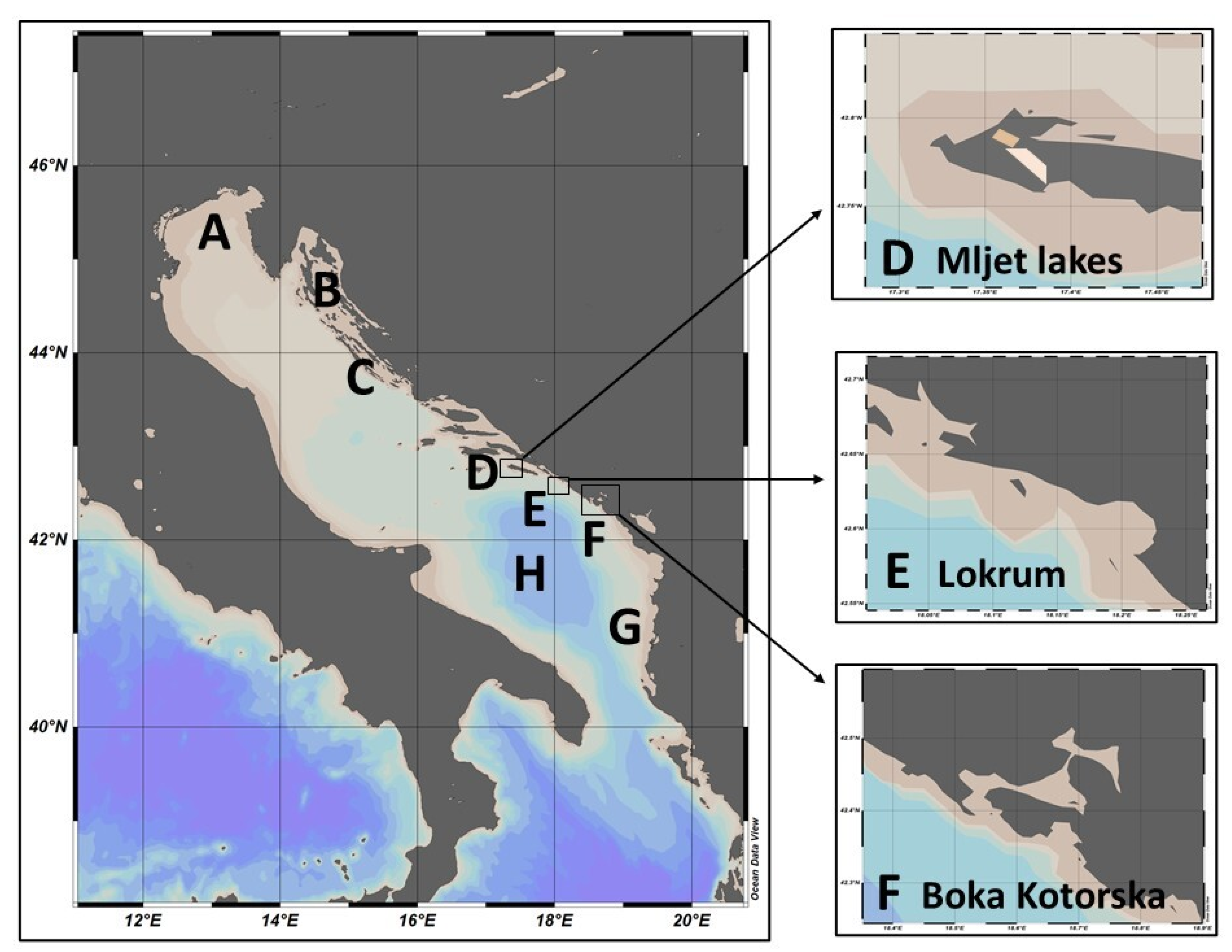
Figure 1. Eastern Adriatic Sea subdivided into eight geographic sub-regions to capture its environmental heterogeneity: (A) North Adriatic, (B) Kvarner and Velebit Channel, (C) Middle Adriatic, (D) South Station 100 (Lokrum), (E) Mljet Lakes, (F) Boka Kotorska Bay, (G) Albania, and (H) South Adriatic Pit.
Jmse 14 00288 g001
Figure 2. Total number of hydromedusan records reported from the North Adriatic, partitioned by order (Anthomedusae, Leptomedusae, Trachymedusae, Narcomedusae), for historical (1910–1997) and recent periods (1999–2015) [49].
Jmse 14 00288 g002
Figure 3. (A) Aequorea forskalea (B) Geryonia proboscidalis (C) Olindias muelleri (D) Neoturris pileata (E) Porpita porpita; (photo courtesy of Marinko Babić) (F) Neotima lucullana (photo courtesy of Donat Petricioli).
Jmse 14 00288 g003
Figure 4. Cumulative taxa richness across the eight subregions. (A) Total cumulative richness (all periods combined) per region. (B) Cumulative richness by period: historic (pre-1950), mid-20th century (1950–2000), and recent (post-2000). Regions: A: North Adriatic; B: Kvarner and Velebit Channel; C: Middle Adriatic; D: South Station 100 (Lokrum); E: Mljet Lakes; F: Boka Kotorska Bay; G: Albania; H: South Adriatic Pit.
Jmse 14 00288 g004
Table 1. Checklist of Eastern Adriatic Hydromedusae (Distribution, Life Cycle, and Ecological Status). Legend: Life Cycle: Mero = Meroplanktonic (has benthic polyp stage); Holo = Holoplanktonic (entirely pelagic). Regions: A = North Adriatic; B = Kvarner and Velebit Channel; C = Middle Adriatic Pomo pit; D = South Station 100 (Lokrum); E = Mljet Lakes; F = Boka Kotorska Bay; G = Albania Coast; H = South Adriatic Pit. Ecological Flags: NIS = non-indigenous species; TQ = Taxon Inquirendum (WoRMS 2025; taxonomically uncertain/doubtful status); Bloom = bloom-forming species; DVM = diel vertical migration (regular day–night vertical movement in the water column); CS = citizen science record; Deep = Bathypelagic/deep-water; FW = freshwater; PE = putatively extinct (sensu [72]) in the Adriatic; C = ref. [72] confidence-of-extinction index (Mediterranean taxa unreported for ≥41 years); thresholds: C ≥ 95% extinction-level confidence, 80–94% putative extinction-level confidence, used here for context only; Stinging = reported to cause noticeable stings/skin irritation in humans.
Species/Taxon (Authority)Life CycleHistoric
(Pre-1950)
Mid-20th (1950–2000)Recent
(Post-2000)
Ecological Flags and Notes
ORDER ANTHOATHECATA (Anthomedusae)
  • Bougainvillia muscus (Allman, 1863)
MeroA, B, C,
E
A, B, D,
H
A, F, GSyn. B. ramosa, B. autumnalis, B. nana
2.
Bougainvillia triestina Hartlaub, 1911
MeroA, C A, CRe-established species [59]
3.
Koellikerina fasciculata (Péron & Lesueur, 1810)
MeroA, B, H Syn. Rathkea fasciculata
4.
Niobia dendrotentaculata Mayer, 1900
Mero DNIS; Episodic advection due to propagulation
5.
Thamnostoma dibalium (Busch, 1851)
MeroA, CBA, H, EReappeared NA record
6.
Cladonema radiatum Dujardin, 1843
Mero A, B No recent records
7.
Eleutheria dichotoma Quatrefages, 1842
Mero A Single record, historic
8.
Corymorpha annulata (Kramp, 1928)
Mero B NIS; Single record; Syn. Euphysora annulata
9.
Corymorpha nutans M. Sars, 1835
MeroA, H, C,
D
A, B, CA, C, D, Persistent NA taxon; Syn. Steenstrupia nutans
10.
Euphysa aurata Forbes, 1848
MeroA, CA, DA, D, F
11.
Sarsia hargitti Mayer, 1910
MeroAA, D TQ; Syn. S. producta
12.
Slabberia halterata Forbes, 1846
MeroA, C A, B Syn. Dipurena halterata
13.
Stauridiosarsia gemmifera (Forbes, 1848)
MeroA, CA, B, C,
D
A, F, GSyn. Sarsia gemmifera
14.
Odessia maeotica (Ostroumoff, 1896)
Mero D
15.
Cytaeis pusilla Gegenbaur, 1857
MeroA, C TQ
16.
Cytaeis tetrastyla Eschscholtz, 1829
MeroCA No recent records
17.
Eucodonium brownei Hartlaub, 1907
MeroABD
18.
Hydractinia sp.
Mero DD, G
19.
Podocoryna areolata (Alder, 1862)
MeroAB, CDSyn. P. hartlaubi,
Hydractinia areolata
20.
Podocoryna carnea (M. Sars, 1846)
MeroA, CDA, HReappeared NA taxon
21.
Podocoryna exigua (Haeckel, 1880)
MeroC Syn. Cytaeis exigua
22.
Podocorynoides minima (Trinci, 1903)
Mero A, B, HA, D, FBloom; Syn. Podocoryne minima
23.
Oceania armata Kölliker, 1853
MeroC, HHHOceanic; Middle/South Adriatic
24.
Turritopsis dohrnii (Weissman, 1883)
MeroA DHistorically recorded as
T. nutricula
25.
Amphinema dinema (Péron & Lesueur, 1810)
Mero A, EA, BA, H
26.
Amphinema rubrum (Kramp, 1957)
Mero HDVM; Syn. Amphinema rubra
27.
Leuckartiara octona (Fleming, 1823)
Mero CA, B, H
28.
Lymnorea sp. Péron & Lesueur, 1810
Mero A, C No recent records
29.
Merga costata (Bouillon, 1980)
Mero GSyn. Janiopsis costata
30.
Merga tergestina (Neppi & Stiasny, 1912)
MeroA, C, H, A, B, C Syn. Tiara tergestina
31.
Neoturris pileata (Forsskål, 1775)
MeroA, B, C,
H
A, B, HACS; Syn. Turris coeca, Tiara pileata
32.
Pandea conica (Quoy & Gaimard, 1827)
MeroB Ref. [34] Senj (considered to be only record for the Adriatic Sea)
33.
Pandea sp.
Mero A
34.
Porpita porpita
Holo B HCS; Syn. Porpita umbella
35.
Proboscidactyla ornata (McCrady, 1859)
Mero A, B, C No recent records
36.
Protiara tetranema (Péron & Lesueur, 1810)
Mero C PE ([72]; C = 49); TQ; Single record
37.
Lizzia blondina Forbes, 1848
MeroA, HA, B, A, D, CBloom; Persistent NA taxon Syn. Podocoryna minuta
38.
Lizzia octostyla (Haeckel, 1879)
MeroA PE ([72]; C = 78)
39.
Rathkea octopunctata (M. Sars, 1835)
MeroA, C, HD
40.
Trichydra pudica Wright, 1857
Mero B NIS; Single finding
41.
Dicodonium adriaticum Graeffe, 1884
MeroAAHTQ
42.
Ectopleura dumortierii (Van Beneden, 1844)
MeroAA, B, CABloom
43.
Zanclea costata Gegenbaur, 1857
MeroAA, B, EA, C
44.
Zanclea implexa (Alder, 1856)
MeroA, C, HD
45.
Rhabdoon singulare Keferstein & Ehlers, 1861
MeroA, HA, B, HA, G, H, Oceanic; DVM; Syn. Rhysomedusa pomponina
46.
Bythotiara murrayi Günther, 1903
Holo CHHDeep
ORDER LEPTOTHECATA
(Leptomedusae)
47.
Aequorea forskalea Péron & Lesueur, 1810
MeroA, B ABloom; CS; Reappeared NA taxon
48.
Zygocanna vagans Bigelow, 1912
MeroC Ref. [31] as Zygocanna sp. (single badly preserved specimen); PE ([72]; C = 100)
49.
Clytia discoida (Mayer, 1900)
Mero B Single record
50.
Clytia folleata (McCrady, 1859)
Mero B Single record
51.
Clytia hemisphaerica (Linnaeus, 1767)
MeroA, B, C,
H
A, B, D,
E, H
A, C, D,
E, G, H
Bloom; Recurrent; Syn. Phialidium hemisphericum
52.
Clytia spp.
Mero A, EBloom
53.
Eucope picta Keferstein & Ehlers, 1861
MeroA, C TQ
54.
Obelia dichotoma (Linnaeus, 1758)
MeroB, ED, E, HD, E, F,
G
55.
Obelia spp.
MeroA, B, C,
E
D, E, HC, D, E,
F, G
Bloom
56.
Eirene viridula (Péron & Lesueur, 1810)
MeroA, CB, EE, F, G
57.
Eutima gegenbauri (Haeckel, 1864)
MeroA, B, CA, B, HA
58.
Eutima gracilis (Forbes & Goodsir, 1853)
MeroC, HA, B, EA, C, D,
E, H
Syn. Eutima insignis, Saphenia gracilis
59.
Eutonina scintillans (Bigelow, 1909)
MeroA PE ([72]; C = 50)
60.
Helgicirrha cari (Haeckel, 1864)
MeroAAA, D, FSyn. H. schulzei/schulzii; Reconfirmed taxon in Mediterranean
61.
Neotima lucullana (Delle Chiaje, 1823)
MeroA E, CBloom; Mass occurrence Neretva; Syn. Tima lucullana (As Tima. Sp. In Mljet Lakes)
62.
Laodicea ocellata Babnik, 1948
MeroCC, BATQ; New NA record Morphological ID
63.
Laodicea undulata (Forbes & Goodsir, 1853)
MeroA, C, HB, DA, D, HReappeared NA taxon
64.
Melicertissa adriatica Neppi, 1915
MeroH PE ([72]; C = 100)
65.
Ptychogena sp.
Mero C Single record, genus level
66.
Eucheilota maasi Neppi & Stiasny, 1911
MeroA, C PE ([72]; C = 96)
67.
Eucheilota paradoxica Mayer, 1900
Mero B Single record
68.
Octophialucium funerarium (Quoy & Gaimard, 1827)
Mero C, HHDVM
69.
Orchistomella graeffei (Neppi & Stiasny, 1911)
MeroA ATQ; PE ([72]; C = 46); Records in North Adriatic after 2000
70.
Mitrocoma annae Haeckel, 1864
MeroC No recent records
71.
Phialella quadrata (Forbes, 1848)
Mero B Single record
72.
Krampella dubia Russell, 1957
Mero A, HH
73.
Octogonade mediterranea Zoja, 1896
MeroH PE ([72]; C = 83)
74.
Tiaropsidium mediterraneum (Metschnikoff, 1886)
MeroC PE ([72]; C = 73); Single record
ORDER LIMNOMEDUSAE
75.
Geryonia proboscidalis (Forsskål, 1775)
HoloA, B A, B, G,
H
Bloom; CS; Stinging
76.
Liriope tetraphylla (Chamisso & Eysenhardt, 1821)
HoloA, C, D,
H
A, B, C,
D, H
A, C, D,
F, G, H
Oceanic dominant (previously counted in Trachymedusae)
Syn. Liriope eurybia
77.
Craspedacusta sowerbii Lankester, 1880
Mero ACFW; Bloom; Lake Kuti, Reka (entrance of Škocjan caves)
78.
Gonionemus vertens A. Agassiz, 1862
MeroA Stinging; Single record as Gonionemus vindobonensis H. Joseph 1918 [28] (now treated as a synonym of G. vertens)
79.
Olindias muelleri Haeckel, 1879
MeroA, B, CAA, C, D,
F
Bloom; CS; Stinging Previous records as Olindias phosphorica plausible after descriptions
ORDER NARCOMEDUSAE
80.
Cunina globosa Eschscholtz, 1829
Holo C, H
81.
Cunina octonaria McCrady 1859
Holo A
82.
Solmissus albescens (Gegenbaur, 1857)
HoloHHF, D, G,
H
Deep; DVM; Mesopelagic
83.
Pegantha rubiginosa (Kölliker, 1853)
Holo C Rare
84.
Solmaris flavescens (Kölliker, 1853)
HoloB, C, EA No recent records; Syn. Solmaris vanhoeffeni
85.
Solmaris leucostyla (Will, 1844)
HoloA, C, HA, D, HC, D, HDVM
86.
Solmaris spp.
HoloA, BB, D, HABloom
87.
Solmundella bitentaculata (Quoy & Gaimard, 1833)
HoloA, B, HB, D, HD, F, G,
H
Oceanic
ORDER TRACHYMEDUSAE
88.
Haliscera bigelowi Kramp, 1947
Holo HDeep; First record 2002
89.
Homoeonema platygonon Maas, 1893
HoloC Deep; offshore Single record
90.
Ptychogastria asteroides (Haeckel, 1879)
HoloC Single record
91.
Aglantha elata (Haeckel, 1879)
Holo BHRare
92.
Aglaura hemistoma Péron & Lesueur, 1810
HoloA, C, D, HA, D, HA, C, D,
F, G, H
Oceanic dominant
93.
Arctapodema ampla (Vanhöffen, 1902)
HoloH PE ([72]; C = 69); Deep; Single Mediterranean record; Syn. Isonema najadis
94.
Arctapodema australis (Vanhöffen, 1912)
Holo HDeep; South Adriatic
95.
Persa incolorata McCrady, 1859
Holo B, D, HA, C, D,
G, H
DVM; Oceanic; Newly in NA
96.
Rhopalonema funerarium Vanhöffen, 1902
HoloHHHSouth Adriatic
97.
Rhopalonema velatum Gegenbaur, 1857
HoloA, B, C,
H
A, B, DA, C, D,
F, G, H
Oceanic dominant
98.
Sminthea eurygaster Gegenbaur, 1857
HoloH HC, HOceanic
Table 2. Meroplanktonic (Mero) and holoplanktonic (Holo) hydromedusan taxa richness by period and subregion (counts). Notes: Values are numbers of taxa. Periods are defined as historic (pre-1950), mid-20th century (1950–2000), and recent (post-2000). Taxa were assigned to meroplanktonic (presence of a benthic stage in the life cycle) or holoplanktonic (no benthic stage) categories following the checklist life cycle coding used in this study. The table reports richness per subregion and period.
SubregionHistoric (Pre-1950) MeroHistoric HoloMid-20th (1950–2000) MeroMid-20th HoloRecent (Post-2000) MeroRecent Holo
A (North Adriatic)457245247
B (Kvarner and Velebit Channel)12628601
C (Middle Adriatic)34872107
D (South Station 100 Lokrum)12127177
E (Mljet Lakes)416080
F (Boka Kotorska Bay)000095
G (Albania)000097
H (South Adriatic Pit)14912101216
Disclaimer/Publisher’s Note: The statements, opinions and data contained in all publications are solely those of the individual author(s) and contributor(s) and not of MDPI and/or the editor(s). MDPI and/or the editor(s) disclaim responsibility for any injury to people or property resulting from any ideas, methods, instructions or products referred to in the content.