1. Introduction
Shallow-water wave problems, primarily studied in the Eulerian framework, are of great significance in coastal, offshore, and port engineering. Because the vertical length scales are much smaller than the horizontal ones, shallow-water waves allow considerable simplification of the governing equations and their numerical treatment. As a result, numerous reduced models have been developed to represent nonlinear water-wave phenomena. Notable examples include Stokes theory [
1], the KdV equation for solitary waves [
2,
3], the Boussinesq equation, and the Saint-Venant equation for shallow-water flow [
4,
5,
6,
7]. In parallel, various numerical methods have been proposed to solve these nonlinear wave equations, including finite difference methods [
8], finite volume methods [
9], Galerkin methods [
10], finite element methods [
11], and boundary element methods [
12], among others. For recent overviews and developments of depth-integrated wave models and numerical methods in coastal and ocean applications, see [
13,
14]. Related rigorous results on the existence and uniqueness of space-periodic and traveling wave solutions have also been established for Eulerian long-wave models in the BBM/RLW family; see, [
15].
Despite extensive research on Eulerian-based approaches, two major challenges persist: the discretization of source terms and the treatment of moving boundaries. Source terms induced by sloping bottoms can compromise the conservation properties of the system [
16], while moving boundaries often introduce complications such as negative water depths and mass conservation errors [
17]. These issues have motivated extensive work on well-balanced and positivity-preserving schemes for shallow-water-type models with complex source terms and wetting–drying processes; see, [
18,
19].
An alternative to the Eulerian perspective is the Lagrangian description [
20,
21,
22], which tracks individual fluid particles to represent the motion. This approach conceptualizes water waves as the movement of a particle system, facilitating straightforward formulations of kinetic and potential energy. For inviscid flows, Hamilton’s variational principle can be naturally applied to derive the governing equations within the Lagrangian framework. Notably, Zhong and Yao [
23] were among the first to adopt a Lagrangian method for studying shallow-water solitary waves. They described wave evolution via horizontal displacement, assumed to be independent of the vertical coordinate, effectively proposing a displacement-based shallow-water approximation. Using Hamilton’s principle, they derived the following displacement shallow-water equation (DSWE) to model the shallow-water systems:
In (1),
denotes the horizontal displacement of a fluid particle,
is the gravitational acceleration, and
is the (still-)water depth. Liu and Lou [
24,
25] subsequently extended (1) to derive a (2+1)-dimensional displacement shallow-water equation (2D-DSWE) to model two-dimensional shallow-water wave problems. Wu et al. [
26] treated the incompressibility condition as a constraint and introduced pressure as a Lagrange multiplier, thereby proposing a novel shallow-water equation based on displacement and pressure (SWE-DP). They further developed a hybrid method to solve the SWE-DP by combining finite element spatial discretization with symplectic time integration [
27].
In earlier studies, the vertical kinetic energy was approximated by retaining only the first three nonlinear terms in the Taylor expansion. Building on this approximation, Wu et al. [
28] derived an extended displacement shallow-water equation (EDSWE) that incorporates higher-order nonlinear terms. Using the exp-function method, they obtained several types of solitary-wave solutions, including conventional convex solitary waves, peaked solitary waves, and looped solitary waves. However, periodic-wave solutions—an important class of traveling waves—were not obtained within that framework.
Although displacement-based shallow-water models derived from variational principles have been developed and extended in several directions (e.g., higher-dimensional generalizations, pressure-constraint formulations, and higher-order nonlinear corrections), two gaps remain. First, exact periodic traveling wave solutions are still scarce for the extended displacement equations, even though periodic waves constitute a fundamental class in coastal and ocean processes. Second, a systematic classification that links wave forms to explicit parameter/root conditions is often missing, which limits the interpretability and reuse of analytical solutions as benchmarks. These gaps motivated the present study, where we derive the EDSWE in a self-contained variational framework and obtain exact traveling wave solutions using elliptic functions, together with explicit root/parameter criteria that distinguish different wave types.
In this paper, we obtain exact traveling wave solutions of the EDSWE using the elliptic-function method, covering both periodic and solitary waves. We further analyze their characteristics and derive the conditions under which different classes of wave solutions arise.
The main contributions of this work are threefold. First, we provide a self-contained variational derivation of the EDSWE within a Lagrangian framework. Second, we construct exact traveling wave solutions in terms of Jacobi elliptic functions. Third, we derive explicit root/parameter conditions for the quartic polynomial that classify cnoidal waves, solitary waves, looped waves, and peaked waves, and we illustrate representative profiles numerically.
2. Extended Displacement Shallow-Water Equations
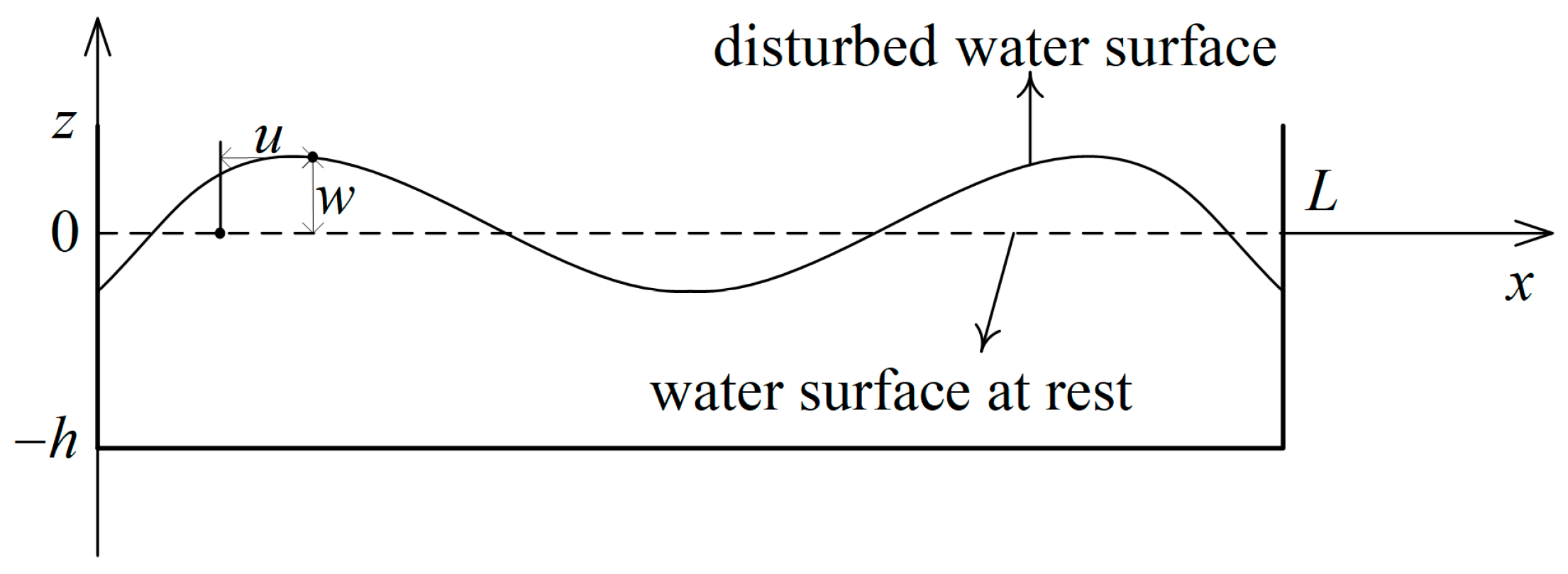
This section derives the governing equations for water waves based on the Lagrangian framework. The fluid is assumed to be inviscid, incompressible, and of constant density. A schematic of the problem is shown in
Figure 1.
Consider a fluid particle whose initial position at time
is
. Its position at a later time
t is denoted by
. The corresponding horizontal and vertical displacements are denoted as
and
, respectively. The still water level is at
and the impermeable bottom is fixed at
, where the vertical velocity vanishes (
). The free surface is defined by
.
The assumption of incompressibility leads to
We now invoke the shallow-water assumption, which posits that the horizontal displacement is independent of the vertical coordinate
z. This implies that
Substituting (4) into (3) yields a simplified relation:
Under the shallow-water assumption in (4), the incompressibility constraint (3) reduces to a direct relation between the vertical displacement and the horizontal strain
, which enables closed-form expressions of the kinetic and potential energies used in the variational derivation.
Integrating (5) with respect to
z and applying the bottom boundary condition
, we obtain an expression for the vertical displacement given as follows:
The kinematic boundary condition at the free surface can be derived by tracking particles on the surface. For a surface particle, its vertical position is given by the surface elevation
, leading to the relation
Differentiating (7) with respect to time
t gives
Note that the surface elevation
in (7) is expressed as a function of the current horizontal position
, rather than the initial particle label
. The distance at time
t between two particles initially at
and
is given by
The horizontal kinetic energy
is given by
where
denotes the horizontal particle velocity.
Under the shallow-water assumption, the vertical velocity profile is approximately linear in
. The resulting vertical kinetic energy
is formulated as
Hence, the total kinetic energy is approximated as
The potential energy
of the system is expressed as
where the boundary conditions
have been applied.
Expanding
in a Taylor series and retaining only the first three terms, we can rewrite Equation (13) as
The Lagrangian functional is defined as the difference between the kinetic and potential energy integrated over the domain
Substituting (12) and (14) into (15) and applying Hamilton’s variational principle yields the DSWE, i.e., Equation (1), which was first proposed by Zhong et al. [
23].
To achieve higher accuracy, the Taylor series expansion can be extended by including the first four terms:
Employing this refined potential energy expression within the same variational framework leads to a new governing equation:
Compared with the DSWE, Equation (17) retains an additional higher-order nonlinear term
and is therefore referred to as the extended DSWE (EDSWE) [
28]. Neglecting this higher-order contribution reduces Equation (17) to the DSWE (1). In the further linear limit
, Equation (17) reduces to
which recovers the familiar long-wave dispersive correction term also appearing in the linearized Eulerian Serre—Green—Naghdi/Boussinesq-type models in constant depth. For readers interested in the detailed variational steps within the displacement formulation and related benchmark validations, we refer to Refs. [
23,
28].
Previous studies have reported numerical solutions and/or particular solitary-wave solutions for the DSWE/EDSWE and compared them with classical benchmark results in the Eulerian setting (see Refs. [
23,
28]). However, a complete analytical traveling wave solution family for the EDSWE, together with explicit generation conditions that classify periodic, solitary, looped, and peaked profiles, has not been systematically presented. In the next section, we derive analytical traveling wave solutions for the EDSWE using elliptic functions.
3. Analytical Traveling Wave Solutions to EDSWE
To derive analytical traveling wave solutions for the EDSWE (17), we introduce the following transformation:
Here,
denotes the wave speed and the plus and minus signs correspond to propagation in the negative and positive
x-directions, respectively. Hereafter,
denotes the traveling wave profile and the prime denotes differentiation with respect to
.
Substituting (18) into (17) yields
where
Integrating (19) with respect to
once, we obtain
Assuming
is sufficiently smooth, we multiply both sides of (21) by
and integrate again with respect to ε, which leads to
where
and
are integration constants to be determined.
Now, let
, Equation (22) can be rewritten as
Next, we separate variables. Equation (23) is rearranged to express the differential
in terms of
, leading to the integral form
where
.
Here is the linear shallow-water wave speed, so the nondimensional parameter quantifies the wave celerity relative to the classical shallow-water limit.
We proceed to solve (24) using the method of elliptic functions. Assume that the fourth-degree polynomial
with real coefficients can be factored as
where
are the roots (which may be real or complex conjugates) of
. Without loss of generality, the four roots can be divided into two groups,
and
, such that the roots within each group are of the same type (both real or complex conjugates). From (25), it follows that
The integration constants
and
can thus be expressed in terms of
. By introducing parameters
, (25) can be recast into the product of two quadratics that are perfect squares with real coefficients:
where
It can be shown that the parameters
are real. Based on (27), the following relation holds:
Now, set
Substituting (27) and (30) into (24) yields
where the coefficients are
The right-hand side of (31) can be transformed into a standard Legendre elliptic integral. Consequently, the solution for (31) can be expressed in terms of elliptic functions. Finally, the water surface profile
is recovered by combining (22) with (7):
The specific form of the solution to (31) depends on the signs of the parameters , , and . These signs, in turn, are determined by the root configurations , which ultimately govern the type of traveling wave (e.g., solitary, cnoidal, etc.). In the following, we classify and present the different wave solutions obtained through this derivation and numerical analysis.
3.1. General Solutions for EDSWE
We first consider the case where the quartic equation has no repeated roots.
3.1.1. Case 1.1: Four Real Roots
If all four roots are real, it can be shown that .
- (a)
Subcase 1.1.1: Assuming , (31) can be rewritten as
where
. The right-hand side of (34) is a standard Legendre elliptic integral, whose solution is
Substituting (35) into (30) yields
- (b)
Subcase 1.1.2: Alternatively, assuming , the solution of (31) becomes
In this case, substituting either (36) or (37) into (33) yields different types of periodic wave solutions, as illustrated in
Figure 2.
3.1.2. Case 1.2: Two Real Roots and One Pair of Complex Conjugates
This case involves two real roots and one pair of complex conjugate roots.
- (a)
Subcase 1.2.1: Without loss of generality, we may assume that and are complex conjugates, while and are real. It can be proved that , then (31) becomes
where
. The solution to (38) is
Substituting (39) into (30) gives
- (b)
Subcase 1.2.2: Conversely, if and are real while and are complex conjugates, the solution to (31) is
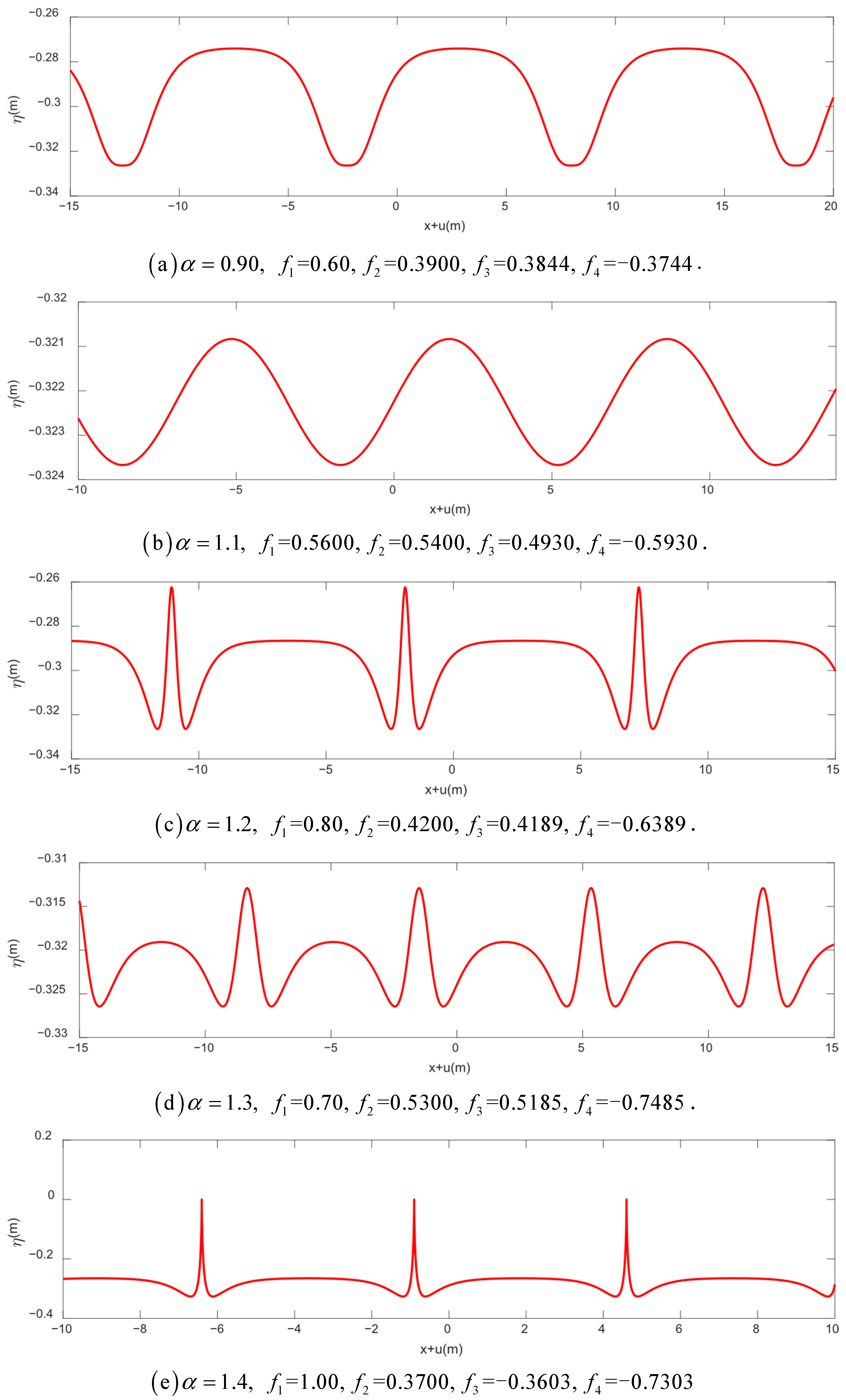
Substituting either (40) or (41) into governing Equation (33) also yields periodic wave solutions. Beyond those in Case 1.1, these configurations produce several novel wave types, as shown in
Figure 3.
3.1.3. Case 1.3: Two Pairs of Complex Conjugate Roots
When all roots form two pairs of complex conjugates, it can be shown that
. The corresponding solution of (31) is
Since this solution is not real-valued, it is not physically relevant and is omitted in what follows.
3.2. Derivation of Solitary Solutions for the EDSWE
Solitary wave solutions to (31) exist only when the quartic equation
admits repeated roots. Assuming
and they are real double roots, and
are either both real or complex conjugates, the parameters can be determined via straightforward computation as
We first consider the case where
and
are real, with
.
3.2.1. Case 2.1: or (i.e., )
Under these conditions, (31) becomes
where
. The solution is
Substituting (45) into (30) yields
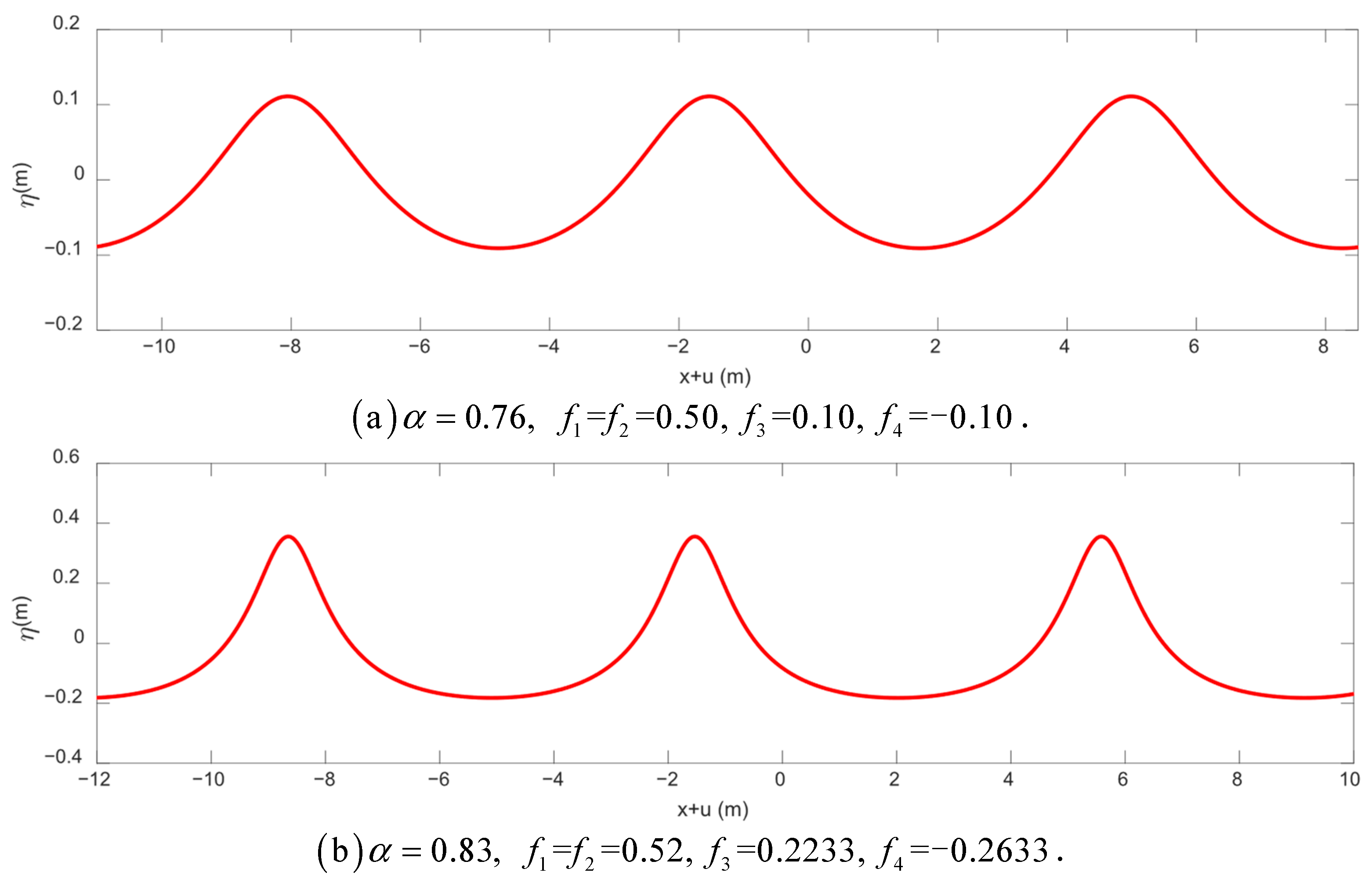
This solution corresponds to a periodic wave profile, as shown in
Figure 4.
3.2.2. Case 2.2: (i.e., )
Here, (31) takes the form
where
. The solution is
This leads to the solitary-wave solution:
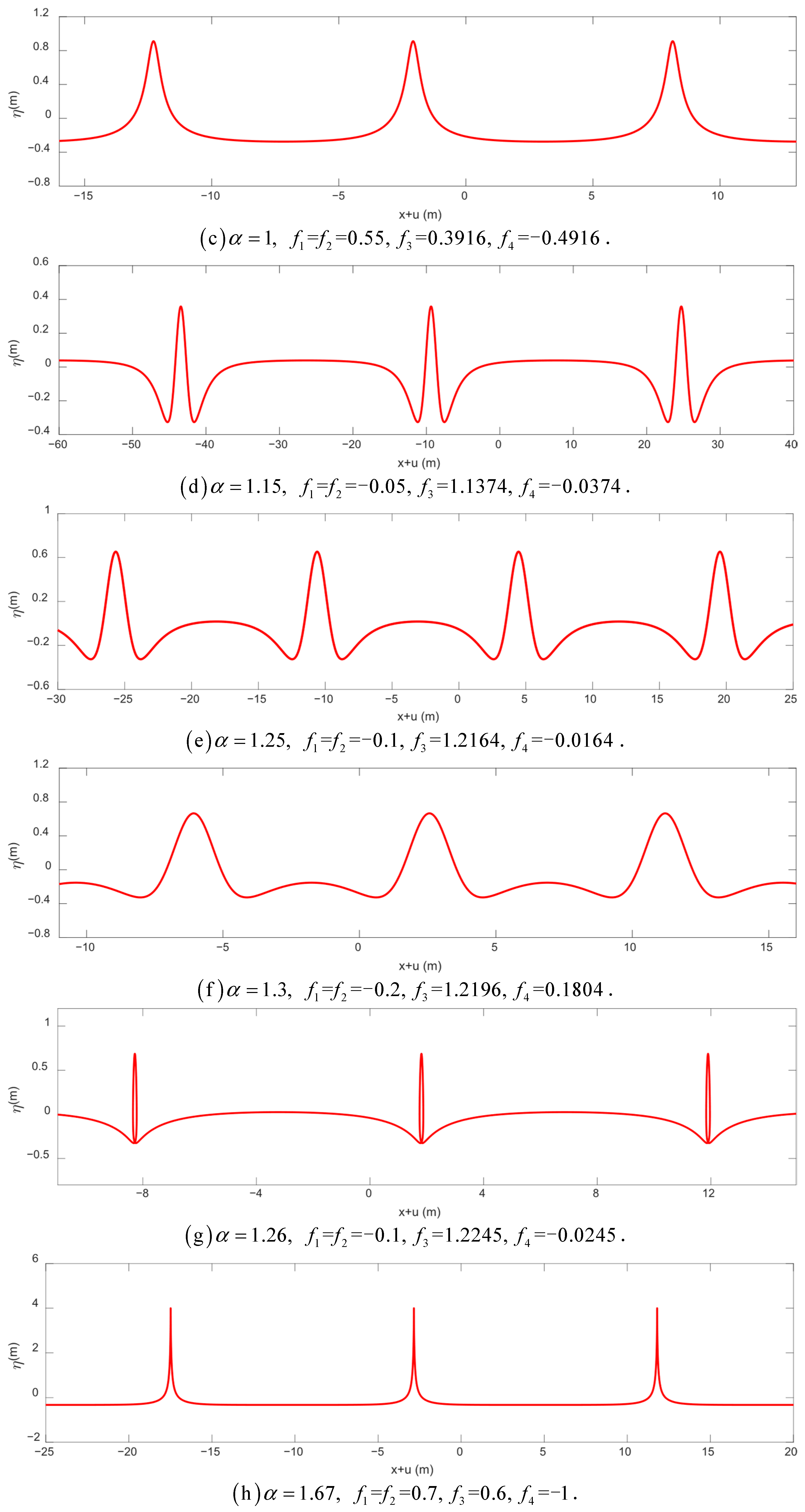
These solutions describe a rich variety of solitary waves, including convex/concave, W-shaped, looped, and peaked solitary waves, as illustrated in
Figure 5. Note that the solitary solutions obtained by the exp-function method in Ref. [
28] constitute a special case of the solution types given by (49).
3.2.3. Case 2.3: and Are Complex Conjugates (i.e., )
In this case, (31) reduces to
the following solution appears:
Since (51) is not real-valued, it is not physically relevant and is therefore omitted in what follows.
Remark 1. Equations (31)–(51) admit equivalent representations under the involution ; this parameter exchange symmetry generates alternative parametrizations within the same solution family. The choice of sign for certain parameters gives rise to four fundamental configurations for each solution class, as summarized in Table 1. To guide the use of
Table 1, we note that
is the dependent variable in (24), whereas
denote the (parameter-dependent) roots of
and are constants.
Table 1 summarizes how different root configurations (real/complex and repeated roots) determine the admissible solution forms and associated wave types in
Section 3.1 and
Section 3.2.
When (i.e., the particle velocity is less than the wave velocity), the surface profile is that of a regular traveling wave with an oscillatory profile. When , some particles exceed the wave velocity, resulting in a looped traveling wave profile. A critical case occurs when , where the water surface gradient becomes infinite at , leading to the formation of sharp peaks at the crest or trough. This analysis confirms that the condition (associated with ) is the key factor responsible for generating sharp-peaked periodic or solitary waves.
3.3. Numerical Example
The characteristics of the traveling wave solutions are determined by the roots
of the quartic
. For each parameter set (specified
and integration constants
K1 and
K2), we compute
and identify the corresponding root configuration/case (
Table 1). We then construct
following
Section 3.1 and
Section 3.2 and obtain
from (33); the relative depth
(where
is the wavelength) is kept below 1/5.
3.3.1. Case 1.1: Four Real Roots
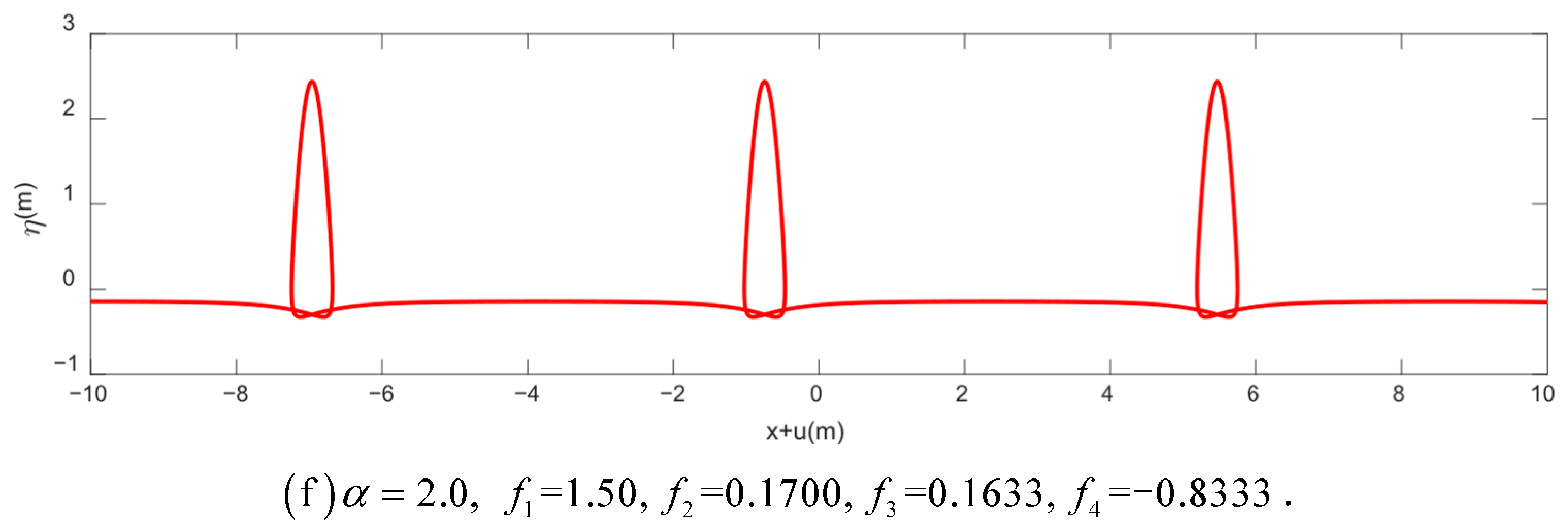
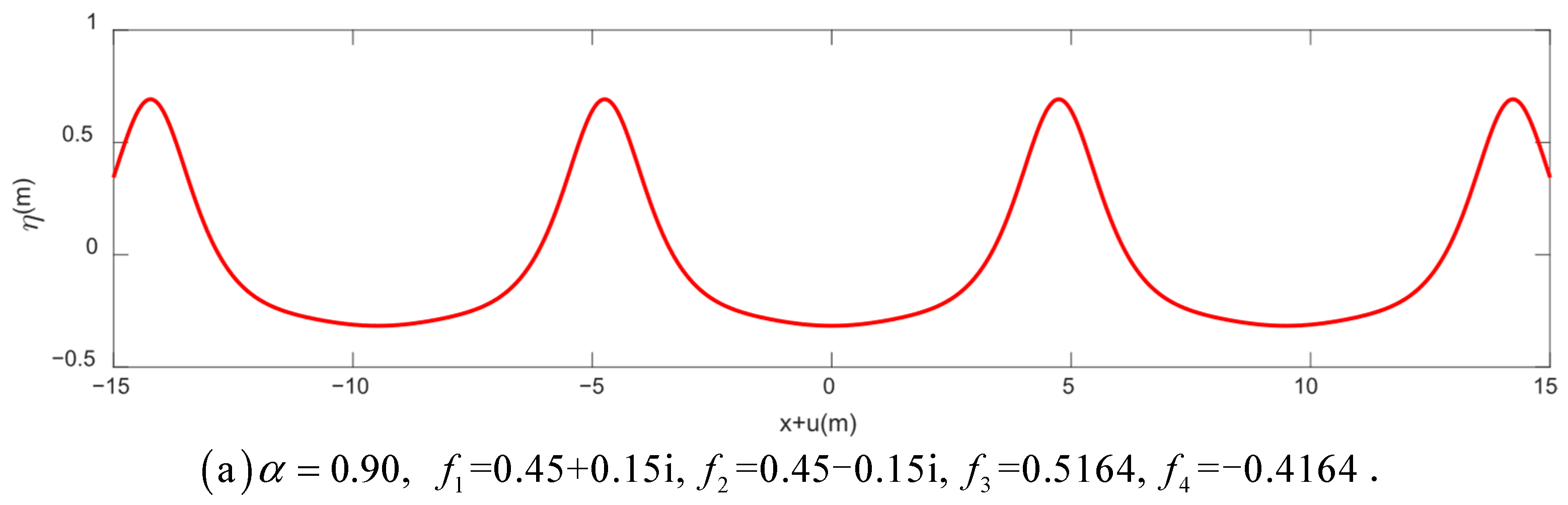
Figure 2 Periodic evolution of water surface in Case 1.1. Here
denote the roots of the quartic polynomial
in Equation (24), which determine the admissible solution type summarized in
Table 1.
Figure 2 illustrates representative periodic traveling wave profiles for this case; as shown in
Figure 2a,c, the waves can exhibit flat-topped (cnoidal-type) profiles. The sequence of panels further shows looped and peaked (sharp) periodic profiles as the root configuration varies and
approaches 1.
Remark 2. The overhanging (looped) wave in Figure 2f likely lies beyond the validity range of depth-integrated shallow-water assumptions and should be regarded as a limiting solution (see Discussion and Conclusions). For the cnoidal waves, as the absolute value of a real root approaches 1, the wave crest becomes progressively narrower and sharper. At , a sharp peak forms, marking the transition from a smooth cnoidal wave to a sharp periodic wave with a formally unbounded slope. Such sharp waves form a distinct class of solutions reported in the literature. Remark 3. In Case 1.1, the mean water level (i.e., the median line of wave height) in Figure 2 lies above or below the still water level (z = 0), depending on the solution. 3.3.2. Case 1.2: Two Real and Two Complex Roots
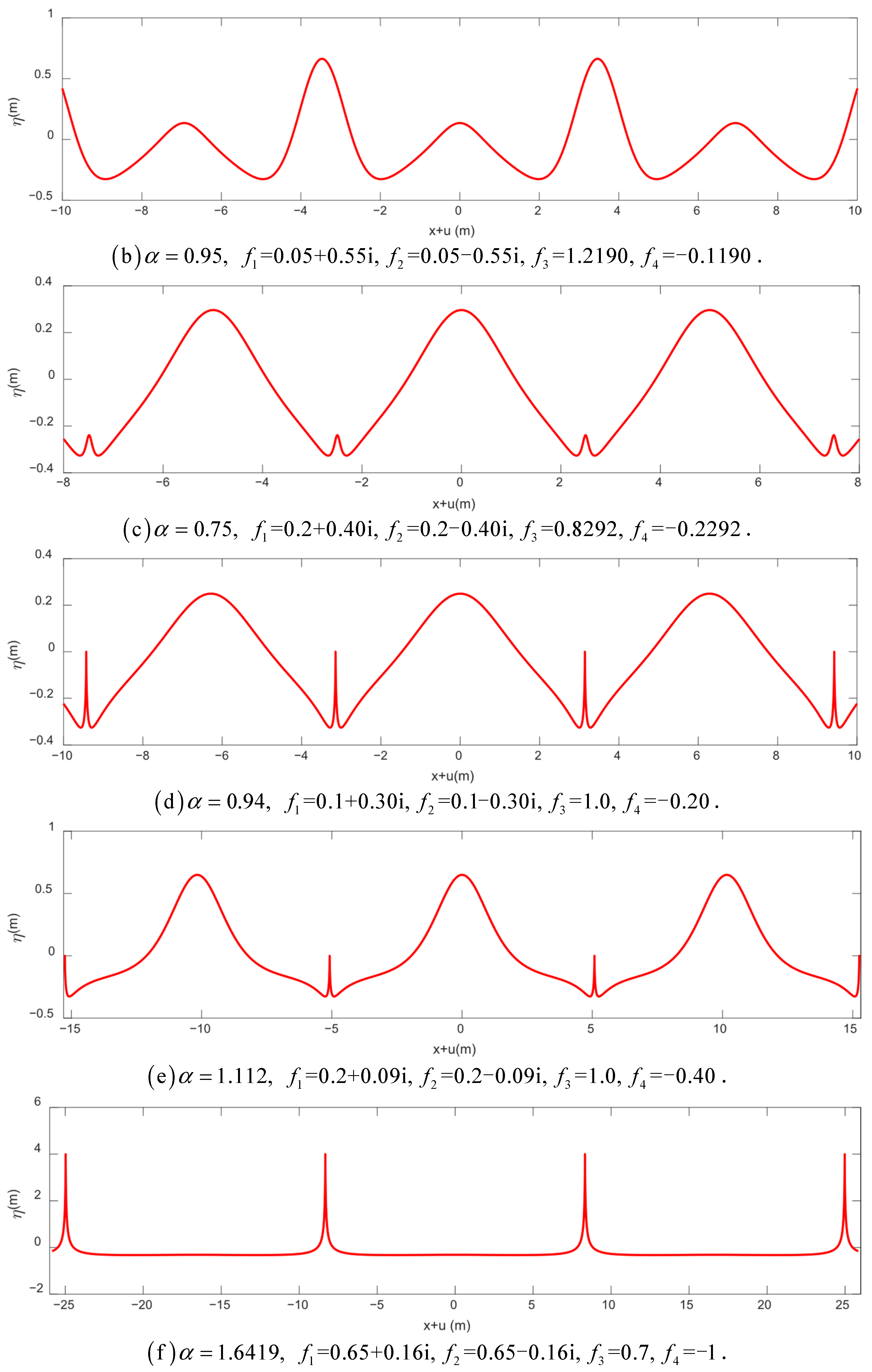
Case 1.2 produces the most diverse periodic wave profiles, a selection of which are shown in
Figure 3. In this case, the root configuration consists of two real roots and one complex—conjugate pair; the complex roots mainly affect the wavelength and mean level, while the real roots govern the overall waveform. In addition to the types found in Case 1.1, this case reveals distinctive periodic solutions, including triangular waves (
Figure 3c,d), a localized spike-like wave (
Figure 3e), and various sharp-peaked periodic profiles.
Remark 4. The complex conjugate roots and influence the wavelength and mean water level. As the magnitude of the imaginary part of these roots increases, the wavelength shortens and the wave height increases. The real roots and primarily govern the waveform itself.
3.3.3. Case 2.1: Repeated Real Roots (Subcase 1)
The periodic traveling wave solutions in Case 2.1 (repeated real roots) are displayed in
Figure 4. Under this repeated-root configuration, the analytical solutions reduce to trigonometric function forms, yielding periodic profiles that include cnoidal-type waves, peaked/anti-peaked periodic waves, and looped waves. The panels illustrate how different parameter/root sets (
) correspond to different waveform families summarized in
Table 1.
3.3.4. Case 2.2: Repeated Real Roots (Subcase 2)
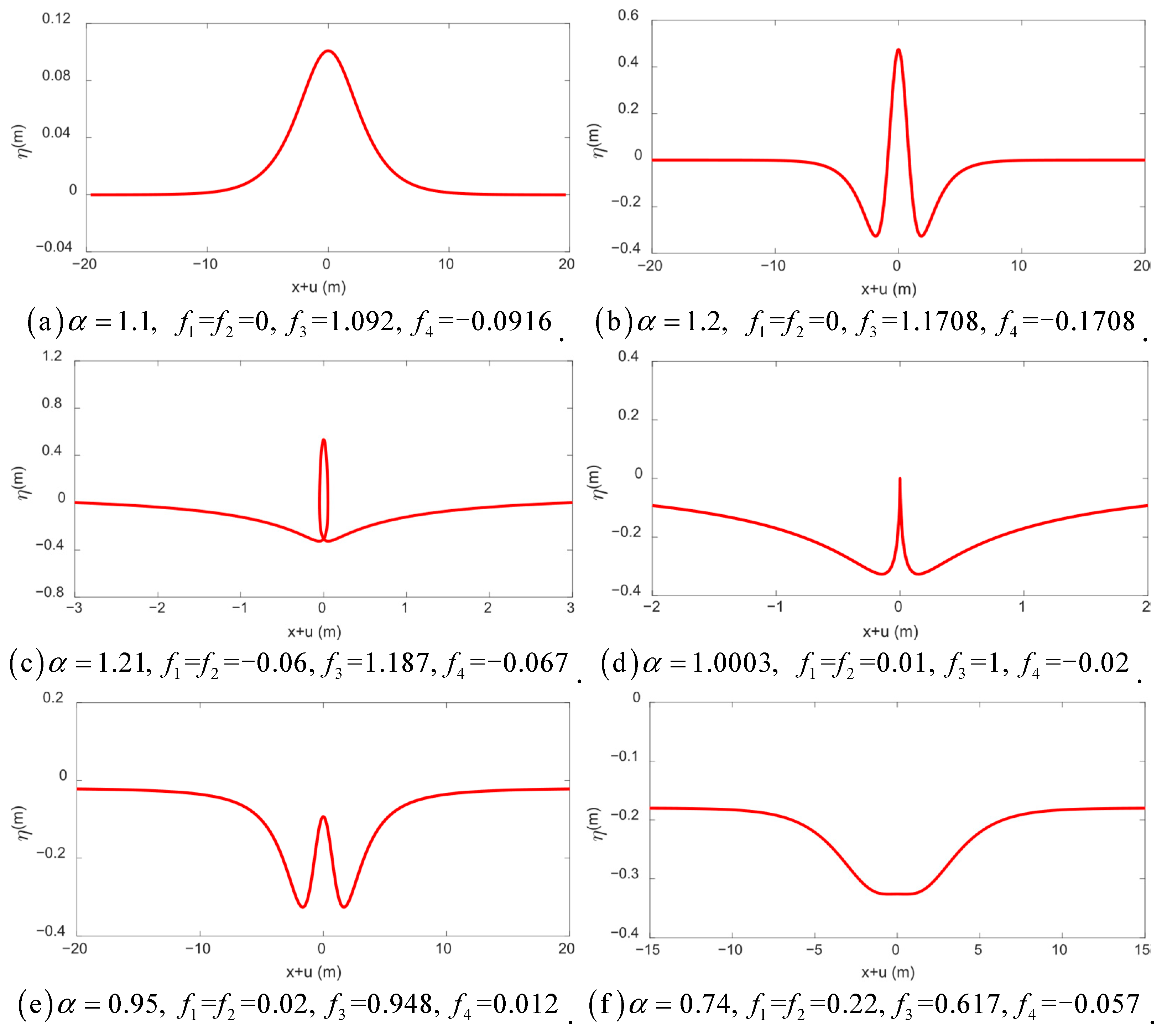
Figure 5 shows representative solitary-wave profiles in Case 2.2 (repeated real roots). Depending on the parameter/root set (
), the solitary-wave solutions exhibit a variety of shapes, including bell-shaped waves, anti-bell-shaped waves (with a flat bottom), W-shaped waves, peaked W-shaped waves, and looped solitary-wave profiles. This figure highlights the root-based classification criteria summarized in
Table 1 and provides representative examples for each solitary-wave family.
Remark 5. The still water level away from the wave crest is influenced by the repeated roots . When these roots are zero, the far-field water level aligns with = 0. For negative or positive roots, it lies below or above = 0, respectively.
4. Discussion
This study establishes an extended displacement shallow-water equations (EDSWE) within a Lagrangian framework via Hamilton’s variational principle. The EDSWE fundamentally differs from Eulerian-based models by adopting the horizontal particle displacement as the primary variable. This approach naturally accommodates large material deformations, providing a direct and intuitive description of complex wave phenomena.
We have systematically derived a comprehensive suite of analytical traveling wave solutions expressed in terms of Jacobi elliptic functions. The nature of these solutions—encompassing cnoidal, periodic sharp/anti-sharp, looped, and solitary waves—is shown to be fundamentally governed by the root configurations of a characteristic quartic equation. A key finding is the identification of critical thresholds (e.g., ) that mark the transition from smooth waveforms to singular ones, such as sharp peaks, which signal the onset of wave breaking.
As a foundational step, this work demonstrates the potential of the Lagrangian displacement method and symplectic theory in the field of hydrodynamics. It provides an analytical framework for exploring strong nonlinearity and wave coherence, offering valuable insights for future studies in fluid mechanics and beyond.
From a coastal and ocean engineering perspective, the derived closed-form solutions and the associated root-based criteria can serve as benchmark cases for validating numerical solvers. They may help delineate shallow-water wave regimes (e.g., cnoidal and solitary) relevant to nearshore modeling and preliminary engineering assessment.
5. Conclusions
This study develops an extended displacement shallow-water equation (EDSWE) in a Lagrangian framework using Hamilton’s variational principle, where the horizontal particle displacement is taken as the primary variable. By applying a traveling wave reduction and the elliptic-function method, we obtain exact traveling wave solutions in terms of Jacobi elliptic functions, covering both periodic and solitary wave types.
The obtained wave forms are classified by the root configurations of an associated quartic polynomial, and explicit root/parameter conditions are summarized to distinguish different solution families, including cnoidal-type periodic waves, solitary waves, looped profiles, and peaked (sharp) profiles. In particular, the critical condition () corresponds to a limiting steepening behavior (formally unbounded surface slope) within the traveling wave framework; such singular profiles may indicate a breakdown of the underlying shallow-water assumptions rather than directly observable free-surface shapes.
Overall, the closed-form solutions and classification criteria provide useful benchmark cases for validating numerical solvers and for diagnosing strongly nonlinear regimes in shallow-water-type modeling.