1. Introduction
For four decades now, the pulse of global trade has been measured in the rhythm of waves—about 90% of the world’s traded goods travel by sea [
1]. It is not just about moving cargo; ports and shipping lanes have woven economies together, accelerating globalization itself. Consider this: between 1990 and 2020, the volume of goods loaded in ports worldwide tripled [
2]. By early 2021, the global merchant fleet had swollen to 100,000 vessels, hauling some 2.136 billion deadweight tons annually [
3]. This trend holds. Even in 2022, maritime routes carried roughly 80% of global trade volume, accounting for more than 70% of its total value [
4]. But this engine of commerce has a visible exhaust. The sheer density of ship traffic now ranks as a major contributor to greenhouse gases. Around ports, emissions from vessels at berth have grown into persistent, unwelcome guests for neighboring cities—often sitting as the third-largest source of local air pollution. While docked, ships typically burn fuel in auxiliary generators to keep the lights on, gulping non-renewable energy and releasing nitrogen oxides (NOx), sulfur oxides (SOx), and fine particulate matter (PM2.5). The COVID-19 pandemic, ironically, highlighted how vital these transport networks are, even as it disrupted the flow of people and freight [
5]. Yet the environmental cost keeps climbing. In 2020 alone, global shipping was responsible for about 16% of all sulfur oxide emissions worldwide [
6]. China’s share of that burden is telling—its shipping sector contributes 8.4% of the country’s SOx and 11.3% of its NOx emissions [
7]. So where does that leave us? The push for greener shipping is not just academic; it is a practical imperative. The International Maritime Organization (IMO) and national governments have rolled out policies to encourage a shift toward cleaner energy. There is a clear focal point: nearly 70% of shipping emissions occur near coasts and in port areas [
8]. That is why the conversation has pivoted to technologies like shore-to-ship power—plugging docked vessels into the grid, ideally fed by renewables, to cut emissions where they hit hardest [
9,
10]. It is no surprise that shore power, all-electric ships, and seaport microgrids are drawing so much research interest [
11,
12].
China’s own “dual carbon” goals—peaking emissions by 2030 and reaching neutrality by 2060—have added momentum. The State Council’s 2030 action plan explicitly calls for greening transport: retrofitting old ships, prioritizing electric vessel development, and boosting the share of new energy vehicles to 40% by 2030. This is not just a national agenda; it is a global industrial direction. Shipping handles over 80% of world trade, and its carbon footprint is huge—about 11% of the global total in 2020, second only to road transport [
13,
14,
15,
16].
Among the green alternatives, pure battery-powered ships stand out. Propelled by energy storage systems, they promise lower operating costs, a smoother ride, and easier integration with smart systems. These vessels, whether fully or partially electric, are inherently more efficient, cleaner, and flexible with energy sources than their diesel-fed cousins. Currently, marine lithium batteries come in several chemistries—lithium iron phosphate, lithium manganate, lithium cobalt oxide, and others. But lithium iron phosphate batteries strike a compelling balance: decent energy density, strong cycle life, a wide operating temperature range, and better safety. Perhaps that is why they are the only marine lithium battery type certified by the China Classification Society—at least for now [
17,
18,
19].
We are already seeing this transition move from blueprint to reality. China’s electric ship sector is gaining speed, with pilot projects multiplying. Back in 2012, a pure solar-powered catamaran debuted on a lake in Xiamen. A decade later, in March 2022, the “Three Gorges 1”—the world’s largest battery-capacity cruise ship—set sail. Then, just months after that, the “Jiangyuan Baihe” began operations as China’s first 120 TEU pure electric inland container ship featuring a “plug-and-pull” battery-swap mode [
20]. Each milestone feels like another step toward a reinvented waterfront. The basic information of some representative domestic electric vessels is summarized in
Table 1.
Then, there is shore power. Ports worldwide are trying to incentivize its use—streamlining billing with digital tools and offering priority berthing to vessels that plug in. The system is simple in concept: when a ship docks, it draws power from the land grid instead of idling its engines. Gothenburg Port offers a glimpse of the potential; its shore power setup cuts emissions by about 95% during berthing, tackling wharf-side pollution head-on [
21,
22]. It is a clean, efficient fix that also supports the wider adoption of electric and hybrid ships.
However, here is the catch. As more ships connect to charge their lithium batteries, ports face a new puzzle: how to predict and manage these sporadic, high-power loads [
23]. The technology works, but integrating it smoothly into the daily rhythm of a port—that is where the real test lies.
When we talk about energy storage, lithium-ion batteries stand out—and for good reason. They pack roughly three times the energy density of lead–acid batteries and double that of nickel–cadmium ones. That is not just a minor upgrade; it reshapes what is possible for power-dependent systems like marine vessels.
But predicting the shore power charging load for ships using lithium batteries? That is where things become tricky. The load depends on a tangle of factors—vessel type, battery capacity, charging rate, and port operation schedules—all interacting in ways that are both complex and uncertain. Traditional forecasting models, often reliant on historical data and linear assumptions, struggle to capture this randomness. So, the question becomes the following: how do we better anticipate such a fluctuating demand?
Enter the Monte Carlo method. By simulating a range of possible scenarios, it offers a more dynamic tool for forecasting. This is not just about precision; it is about giving ship operators actionable insights to manage energy smarter, cut costs, and streamline port operations. On a broader scale, sharper load predictions can mean less fuel burned and fewer emissions—a tangible step toward greener shipping. As research suggests, these approaches support both ecological and operational sustainability [
24].
The story of shore power itself goes back to the late 1980s. Take the Port of Gothenburg in Sweden: in 1989, it began supplying ships with 400 V shore power [
25]. Then, in 2000, ABB launched the world’s first high-voltage shore power system there, running at 6.6 kV/10 kV with an output of 1.25 MW. A decade later, the same port reached 3 MVA/11 kV—making it the largest shore power hub of its time.
Over the past twenty years, the push for high-voltage shore power has gained real momentum. In Europe, Rotterdam started powering inland floating terminals in 2007. By 2012, Belgian ports like Zeebrugge and Antwerp were following suit [
26]. Furthermore, in a significant collective move, five major European ports—Rotterdam, Le Havre, Hamburg, Bremen, and Antwerp—have pledged to provide shore power for container ships exceeding 114,000 TEUs by 2028.
Across the Atlantic, the U.S. has been weaving shore power into its port infrastructure. Princess Cruises’ Juneau Port introduced the technology in 2001, and Long Beach soon adapted it for large cruise ships. From 2012 onward, ports in New York and Seattle joined in [
27]. Sixteen U.S. ports have operational shore power systems, as summarized in
Table 2.
Meanwhile, other regions are catching up. India’s Chidanparana Port upgraded its facilities with ABB’s PCS100 static frequency converters in 2016. Three years later, South Korea’s Incheon Port contracted ABB for a 2000 kVA, 50/60 Hz shore power unit. Policy is driving change too: California set early regulations with its 2014 “Shore Power Requirements”, aiming for 80% adoption by 2020. Come the end of 2025, every European port will be required to offer shore power services.
So where does that leave us today? By June 2020, 45 major ports across the Americas, Europe, and Asia could deliver shore power [
28,
29,
30]. The users range widely—passenger ferries, container ships, cruise liners, roll-on/roll-off vessels, and even oil and gas terminals [
31]. What began as an experiment in Sweden has evolved into a global infrastructure shift, one that might just redefine how ships keep the lights on.
Global awareness of environmental issues is rising, and shore power is no longer confined to major coastal hubs. It is now reaching mid-sized and inland ports, too. What began at roll-on/roll-off ferry terminals has steadily expanded—container terminals and LNG facilities are increasingly adopting the technology [
32].
Take Tianjin Port, for example. In December 2020, it completed what was then Asia’s largest ship shore power system, boasting a total capacity of 40 MVA. But it was not alone. Across China, ports from Shanghai and Xiamen to Ningbo, Dalian, Lianyungang, and even inland sites like Chongqing’s Chaotianmen Wharf have been rolling out their own shore power projects in recent years.
Policy has followed pace, albeit gradually. Back in 2019, the Ministry of Transport issued a notice pushing for wider adoption of shore power. Then, in September 2021, the “Measures for the Administration of Shore Power in Ports and Vessels” laid out clearer guidelines, using fiscal subsidies to encourage uptake—especially across the Yangtze River Basin [
33,
34]. Yet, even by 2024, coastal ports in China still have not achieved full shore power coverage. Why? Regulations remain incomplete, especially when it comes to mandating onboard power reception facilities. In many coastal ports, the rules simply lack teeth. These gaps, frankly, have held back real progress [
35].
But the push is real. Driven by China’s “dual carbon” goals, major ports—Shekou, Shanghai, Zhoushan, Tianjin, and Dalian—are now operating shore power systems spanning both low and high voltages. Nationwide, over 400 shore power setups with capacities exceeding 200 kVA are in place. Shipping companies, meanwhile, have retrofitted around 345 vessels of 3000 tons or more to plug in. Standards are evolving, and the technology is gaining momentum.
That said, let us be clear: shore power cuts portside air pollution and carbon emissions, but it does not erase emissions entirely. They are just shifted back to power plants. So, where does that leave us? The focus is shifting toward pairing shore power with renewable energy—solar, wind, and storage—to truly decarbonize, or even reach net-zero, while ships are docked [
36,
37,
38,
39,
40]. This is not just theoretical. It matters on the ground, making ports greener and more self-sufficient, while boosting grid stability.
Researchers have been digging into the practical challenges. Tan’s team looked at how to allocate shore power capacity across a container network, factoring in how shipping lines choose ports. Their finding? If the capacity is wrong, you might actually increase emissions—thanks to congestion. Wang used game theory to model how governments, ports, and shipping companies interact under different policies. In a case study at Nanjing Port’s Longtan Harbor, subsidies came out ahead of emission taxes or doing nothing, delivering better socioeconomic returns. Peng compared subsidy approaches and found that when budgets are tight, price-based support works better than funding infrastructure directly. Furthermore, in Quebec, researchers warned about “carbon leakage”—where emissions simply move elsewhere—highlighting the need for strong port investment to make emission trading systems effective [
41,
42,
43,
44,
45].
When it comes to forecasting power demand, the Monte Carlo method has become a go-to for dealing with uncertainty. Port energy management, though, has long relied on deterministic models—time-series, regression, and neural networks. These work for steady, predictable loads, but how do they handle the spikey, irregular demand from charging electric ships?
Lately, more probabilistic approaches have entered the scene. In electric ship charging, methods like Improved RAC-GAN generate load scenarios. Over in port microgrid planning, stochastic optimization helps manage renewables and demand uncertainty—think sizing PV-storage shore power systems, integrating electric ferries on island grids, or running lifecycle cost-environmental analyses. There is even work using data to predict ship berthing times to optimize shore power use.
Here is the link: forecasting is not separate from energy management—it enables it. Real-time control depends on knowing what is coming. Good probabilistic forecasting sets the boundaries, turns reaction into foresight. That is exactly what we are doing: building a Monte Carlo framework to simulate shore power loads under different supply modes. The goal? To give ports solid numbers for planning—how much capacity, which technology, and what tariff design—and for pre-operational steps like storage dispatch. In short, better forecasts mean smarter decisions upstream.
But existing models have blind spots when it comes to marine lithium battery charging. First, they often miss the combined randomness of battery capacity, daily voyage distance, and when ships start charging. Second, some generate load profiles without modeling the underlying physics and behavior—which you need to test different charging strategies. Third, we still lack a unified way to compare different shore power technologies—standard AC, high-voltage DC, renewable-based microgrids, and storage-assisted systems—under the same uncertain conditions.
Our study steps in here. Set against China’s “dual carbon” timeline (peak by 2030, neutrality by 2060) and its push for green ports, we built a Monte Carlo framework designed specifically for forecasting marine lithium battery shore power loads. What is new? First, we explicitly model the following key random variables: ship type, battery capacity, daily mileage, and charging start time. Second, we simulate and compare five shore power supply modes in one probabilistic playground—making it possible to directly weigh grid impact and efficiency. Third, we embed optimization (solved with CPLEX) inside the simulation loop to mimic smart charging strategies. This blend of simulation and optimization offers a realistic testbed for policies like demand response or time-of-use tariffs, which align with China’s market-driven approach to scaling shore power.
So how did we approach it?
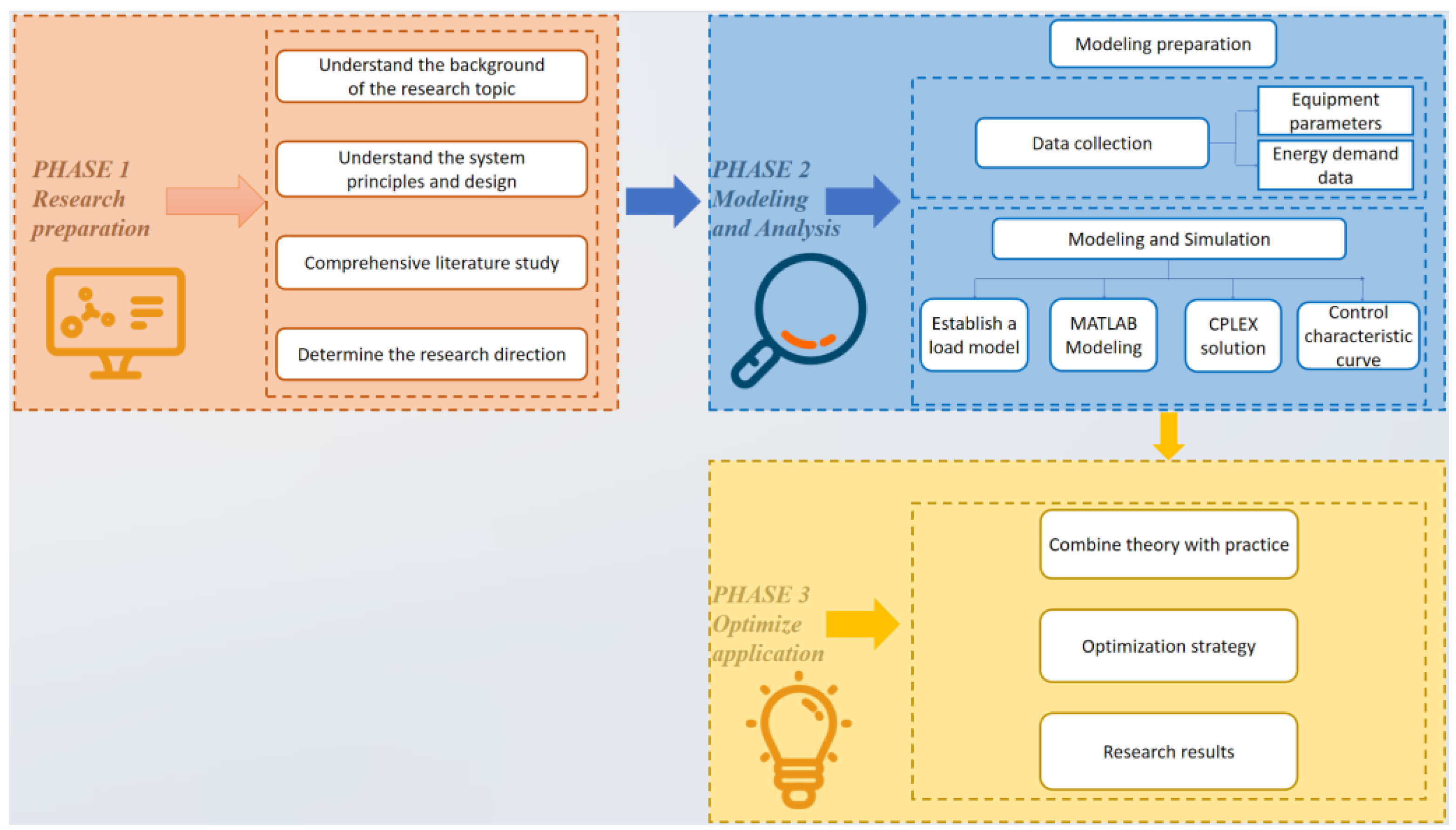
Figure 1 outlines the flow. We started by reviewing the literature and building a mathematical model of ship shore power charging. Next, we focused on optimizing the charging process itself—smoothing out grid load fluctuations and improving efficiency. We then factored in charging power, duration, and frequency, assessing how they shape the load profile. Using MATLAB/YALMIP for modeling and CPLEX within the Monte Carlo loop, we solved the embedded optimization sub-problems efficiently. Finally, we calculated the resulting grid load and generated load curves for analysis. This is not just an academic exercise. It is a practical tool to help ports navigate uncertainty, choose the right technology, and support China’s maritime decarbonization goals with data—not just ambition.
This paper employs the Monte Carlo method to investigate the problem of shore power charging load prediction for marine lithium batteries. This method is based on probability statistics and random sampling and can effectively handle random and uncertain factors in complex systems. It is suitable for charging load prediction affected by multiple variables, such as ship type, battery capacity, charging rate, and port operation time. Firstly, this paper systematically studies the theoretical basis, working principle, and application potential of the Monte Carlo method in load forecasting, clarifies its mathematical principle and algorithm process, and lays the foundation for model construction. Secondly, a detailed analysis was conducted on the structure and working mechanism of the shore power charging system for ship lithium batteries. The generation mechanism and key influencing factors of the charging load were identified, providing accurate input parameters for the prediction model. On this basis, a prediction model based on the Monte Carlo method was constructed. The model structure fully takes into account the complexity and uncertainty of the system. Parameters are optimized based on actual operation data and expert experience, and advanced computing technology is adopted to ensure computational efficiency and prediction accuracy. Finally, the model is verified through multi-scenario and multi-condition experiments. The results show that this model has high prediction accuracy and stability and can effectively deal with complex situations in actual operation.
2. Materials and Methods
2.1. The Basic Theory of the Monte Carlo Method
Have you ever wondered how we predict outcomes in a world full of uncertainty? One answer lies in the Monte Carlo method, a clever blend of chance and computation that feels almost like running digital experiments. At its heart, this approach turns real-world questions into probability models. Think of it as setting up a roulette wheel inside your computer, where every spin represents a possible version of reality.
Instead of solving equations directly, the method generates thousands, even millions, of random scenarios. You might say that it is like replaying a situation again and again under slightly different conditions, watching patterns emerge from the noise. After all those virtual trials, you tally up the results, not for a single right answer, but for a likely range of outcomes, complete with probabilities and margins of error.
What is fascinating is how something so rooted in randomness can bring clarity to messy, complicated problems. It does not claim perfection, of course; these are approximations, informed guesses shaped by the law of large numbers. But in practice, that is often what we need, not an exact figure, but a reliable estimate of what to expect.
So, whether modeling financial markets or simulating physical processes, Monte Carlo offers a way to explore the possible without becoming lost in the improbable. It is a reminder that sometimes, letting chance do the work can reveal order in the chaos.
The Monte Carlo method is often used to calculate high-dimensional integrals, and the formula is as follows [
46]:
Here,
is a random sample point uniformly distributed over the interval;
N is the sample size. As
N→∞, the result converges to the true integral value. Extended to higher dimensions, the formula is as follows:
When faced with complex problems—multidimensional integrals, optimization puzzles, and the like—traditional analytical methods often fall short. That is where the Monte Carlo method steps in. It thrives in uncertainty, turning randomness into insight.
Take predicting shore power charging loads for ship lithium batteries as an example. Real-world factors do not follow neat equations: battery capacity shifts over time, charging rates fluctuate, and port schedules rarely run like clockwork. A deterministic model might struggle here, but the Monte Carlo simulation leans into the chaos. By mimicking the natural randomness in these variables, it paints a load forecast that feels true to life—nuanced, adaptable, and surprisingly practical.
After all, in systems shaped by chance, sometimes the smartest approach is to play the odds.
The application steps of this method in load forecasting are as follows:
- (1)
Based on the actual situation of the system, identify the main uncertain factors affecting the load and construct an appropriate probability distribution model for them. For example, the battery capacity can be assumed to follow a normal distribution, and the charging rate may conform to a uniform distribution.
- (2)
Utilize computers to generate a large number of random numbers to simulate the random changes in the aforementioned uncertain factors. To ensure the accuracy of the simulation results, a sufficient number of random samples need to be generated to cover all possible scenarios.
- (3)
Input random numbers into the probability model for multiple simulation experiments, with each experiment corresponding to a possible load value, and record all simulation results.
- (4)
Conduct statistical analysis on the simulation results, and calculate statistics such as the mean and standard deviation to assess the predicted value and fluctuation range of the load, thereby reflecting the accuracy and reliability of the prediction.
Through the above process, the Monte Carlo method can effectively handle the uncertainties in load forecasting, providing a scientific basis for ship energy management, port operation optimization, energy conservation, and emission reduction.
2.2. The Basic Principle of Ship Charging
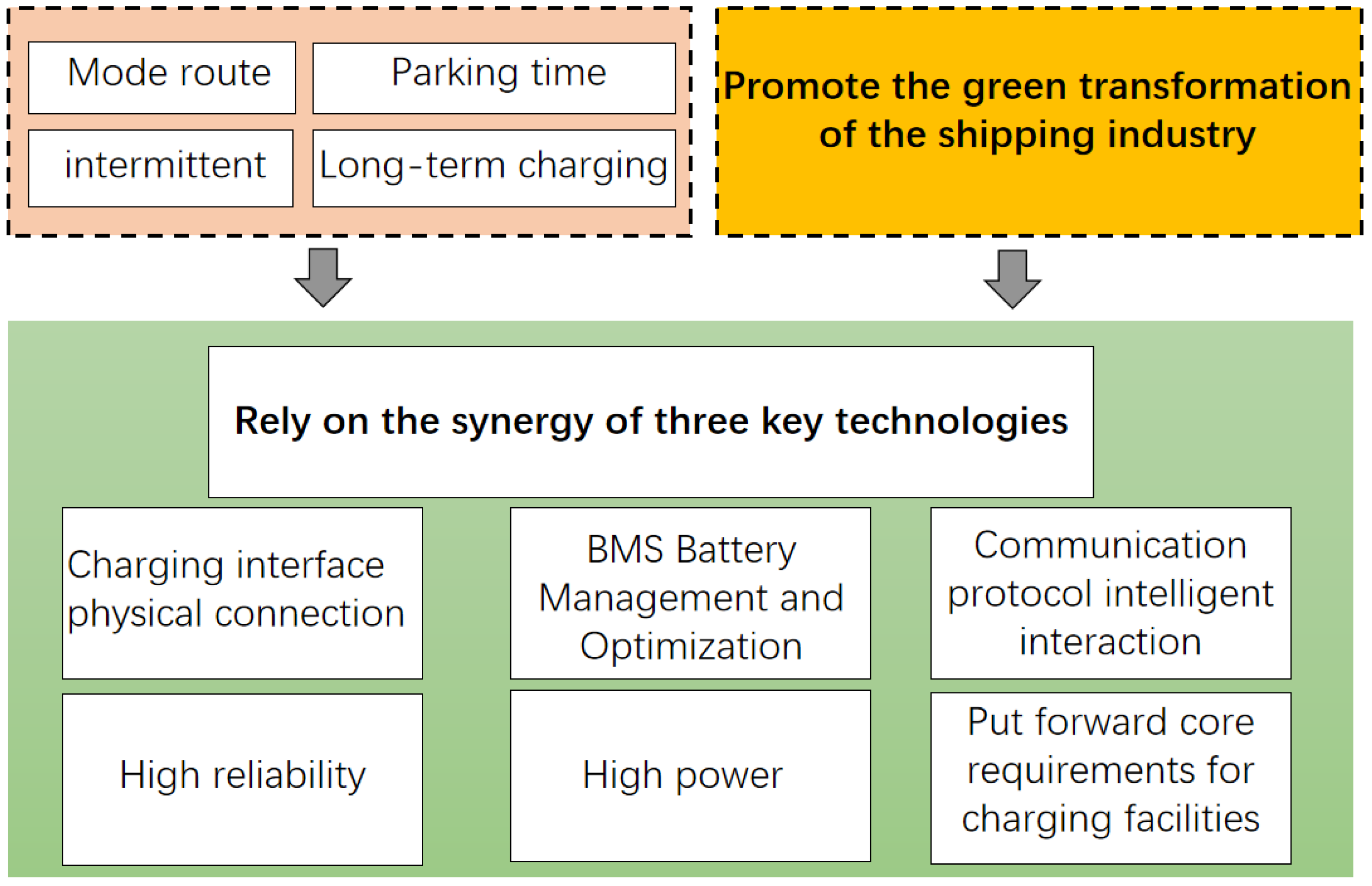
At its heart, charging a ship comes down to one simple task: moving power reliably from the dock to the vessel’s batteries. However, anyone who has watched a busy port in action knows that it is rarely that straightforward. The real challenge lies in performing it efficiently—delivering electricity in a steady stream so ships can get back on the water without long delays.
Making that happen involves a careful dance between hardware and software. On the physical side, you need charging interfaces robust enough to handle maritime conditions, such as salt, motion, and constant wear. Then, there is the battery management system (BMS), which acts like a vigilant watchkeeper, monitoring cell health and temperature in real time. None of this works unless the chargers and the ship can talk to each other, which is where communication protocols come in. They are the silent translators ensuring power flows smartly, not just blindly.
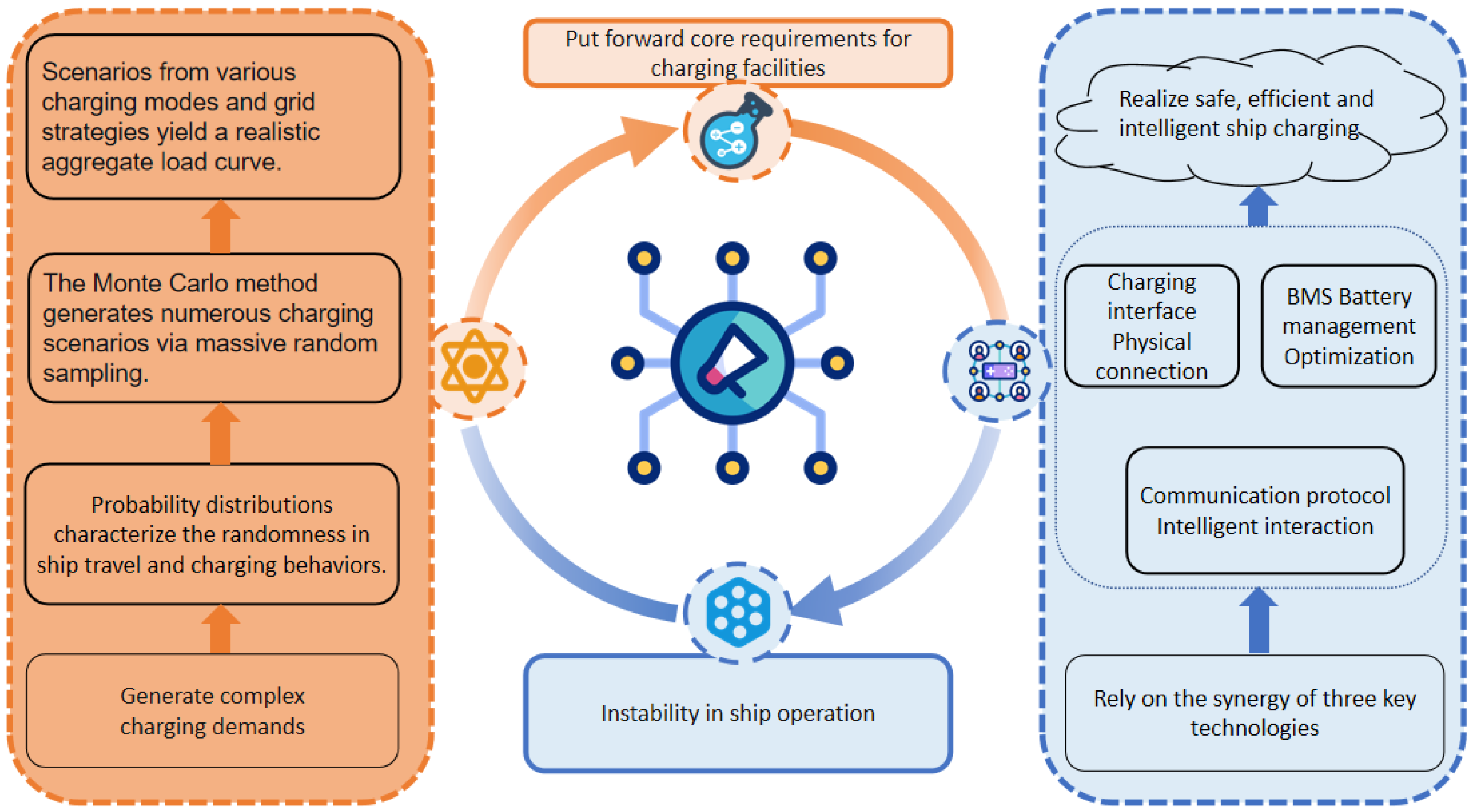
But here is what is often overlooked: charging is not just a technical process. How and when a ship powers up depends on a whole range of factors—from operational schedules and energy pricing to local grid capacity and even weather. (A snapshot of these influences is laid out in
Figure 2). In practice, this means that the best charging strategy is not just about speed; it is about timing, cost, and readiness. Get it right, and you are not just filling a battery—you are keeping commerce moving.
Think of the ship’s charging interface not just as a plug, but as a handshake—one that has to be both quick and reliable. In port, time is money; the connection must be made almost seamlessly, withstanding salt spray, vibrations, and constant use, because even a momentary loss of contact can mean more than just a delay. It is about keeping the power flowing safely, day in and day out.
Behind the scenes, the battery management system acts like a vigilant crew member. It keeps a close watch on every cell—such as voltage, temperature, current, and charge level—ready to react in real time. If something runs too hot, it can throttle the charging rate or kick in the cooling. This is not just protection; it is a way to stretch the battery’s life and make each charge cycle as efficient as possible.
Then, there is the conversation between ship and shore: the charging communication protocol. By sharing data on power needs and grid capacity, the system adjusts charging speed and timing dynamically. In practice, this means avoiding overloading the batteries or the local power supply—a smarter way to manage energy that cuts risks and lifts overall efficiency.
So how does the power actually reach the ship? Picture the grid feeding high-voltage electricity into the port substation, where it is stepped down to a usable medium or low voltage. The heart of the shore-side setup usually includes frequency converters to match the ship’s electrical standards, transformers to fine-tune voltage, and a monitoring system that tracks everything from current to power factor. Finally, via a shore power cabinet on the dock, the vessel plugs into this ready stream of electricity (as illustrated in
Figure 3).
It is true—charging a ship is far more than connecting a cable. Each component, from the physical interface to the digital dialog, plays a role in moving energy safely from port to battery. As the technology matures, these systems are leaning into greater intelligence, aiming not only to power vessels but to do it smarter, with fewer interruptions and a lighter footprint. The shift toward electric shipping, in other words, is being charged one intelligent handshake at a time.
2.3. Modeling Method for Charging Load of Electric Ships
2.3.1. Probability Distribution of Daily Driving Mileage and Initial Charging Time
Think of an electric ship’s daily run not as a fixed number, but more like the rhythm of daily traffic—some days it is a short hop, others a long haul. That variation tends to follow a lognormal pattern. Similarly, the time it docks each evening clusters around a typical hour, falling into a familiar bell curve. Once tied up, if charging begins right away, that start time also fits neatly into a normal distribution.
Since electric vessels share the same operational rhythms and roles as their diesel counterparts, we can look to existing diesel ship data to inform how electric models might behave. In practice, this means the voyage logs from traditional ships offer a realistic foundation for modeling electric fleets—not because the technology is the same, but because human schedules and port routines do not change overnight.
After all, a ship’s job is to sail when needed, whether it is powered by batteries or diesel. This daily pattern, it turns out, leaves a statistical signature we can work with. The expression of the probability density function for the daily voyage mileage is as follows [
47]:
The expression of the probability density function for the initial charging time is as follows [
47]:
2.3.2. Charging Load Calculation Method
Charging load modeling really comes down to three things: when charging starts, how much power flows in, and how long it lasts. If we look at the data we already have, we can analyze the daily travel patterns of electric vessels—how far they go and when they plug in—and sketch those out using a fitting probability density function. Think about it: the distance a vessel covers each day does not just drain the battery; it shapes how much charge is left when it is time to power up again.
So let us say that an electric ship uses about the same energy per nautical mile and tops up once a day. Under that assumption, the tie between its starting charge level and the day’s voyage becomes clear. You could almost picture it—a longer run means the battery starts the charge session hungrier. That connection is not just theoretical; it is what brings the model to life [
48]:
D indicates the driving range.
At present, lithium batteries are mainly used as power batteries in electric ships, and the two-stage charging method of constant current and constant voltage is widely adopted. During the charging process, its charging power can be approximately regarded as constant.
When the charging power is treated as constant power charging, it is assumed that the electric vessel is fully charged each time. Generally, it can be set to 1. Therefore, the relationship between the charging duration and the daily mileage can be expressed as follows [
48]:
where
P is charging power and
η is the charging and discharging power.
2.4. Definition of Five Shore Power Supply Scenarios
How do different shore power technologies hold up under the same unpredictable charging demand? To find out, we designed and simulated five distinct supply scenarios, moving from conventional passive setups to actively managed systems. Here is how each is configured and modeled within our Monte Carlo Optimization framework.
Scenario 1: Conventional AC Shore Power. This is the standard, widely used setup: ships plug into the port’s low-voltage AC grid through connection boxes. The system delivers power passively—no integrated controls and no batteries. In our simulation, each vessel draws between 3 and 4 kW at random, with charging start times and duration also left to chance. What you receive is essentially a disordered, uncoordinated load profile. It works, but it does not adapt.
Scenario 2: High-Voltage DC (HVDC) Shore Power. Here, we step up to medium- or high-voltage DC connections, often deployed for larger vessels that need faster charging. For comparison, we kept the same random timing as Scenario 1 but bumped the power range to 40–60 kW per ship. The result? Higher energy delivery in the same erratic pattern—like turning up the volume on the same unpredictable song.
Scenario 3: Renewable Energy-Based Shore Power. Imagine a shore power system mostly fed by onsite solar. We modeled a 2 MWp PV installation, fairly typical for a medium-sized port in the Yangtze River Delta. There is no dedicated storage here; instead, we used a typical solar generation profile for the Wuxi area, then added random variability to account for weather. In each simulation run, the net load on the main grid became the difference between the random ship demand (using Scenario 1’s power parameters) and the equally unpredictable solar output. It is cleaner, but at the mercy of the clouds.
Scenario 4: Smart Microgrid Shore Power. Now things become more interesting. This scenario models an actively managed port microgrid that brings together local solar, a 2 MWh/1 MW battery storage system (operating between 20% and 90% state of charge), and controllable ship loads—all orchestrated by a central energy management system (EMS). During each Monte Carlo trial, the EMS solves a real-time optimization problem (using a CPLEX solver) to schedule battery use and shift charging loads. The goal is not just to supply power, but to minimize peak demand from the main grid while meeting all operational constraints. In this setup, the battery acts like a flexible, in-house buffer, smoothing out the microgrid’s own energy flow.
Scenario 5: Energy Storage-Assisted Shore Power. What if we paired a large, dedicated battery directly with conventional shore power infrastructure? That is Scenario 5. Here, a bigger 4 MWh/2 MW battery (cycling between 10% and 95% SOC) operates on a fixed peak-shaving schedule: charging hard during off-peak nighttime hours (say, midnight to 6 a.m.) and discharging when ship demand is expected to peak (like late afternoon). Individual ship charging remains as stochastic as in Scenario 1, but the battery flattens the overall load presented to the grid. Unlike the microgrid’s integrated buffer, this system functions more like a grid-side shock absorber—sized specifically to take the edge off demand peaks.
By defining these five scenarios—each with its own operational flavor—we can systematically tease out how different levels of technological sophistication, from passive supply to actively managed storage, shape a port grid’s response to the inherent uncertainty of marine battery charging. The differences in battery role and sizing between Scenarios 4 and 5, in particular, highlight a quiet but important design choice: are you optimizing inside the fence, or supporting the grid outside?
2.5. Probabilistic Modeling of Input Parameters for Monte Carlo Simulation
To ensure the reproducibility and robustness of the Monte Carlo simulation and to quantitatively characterize the key uncertainties in charging load forecasting, all key stochastic input variables are defined with specific probability distributions.
The selection of distribution types and their parameters is based on the following sources: (1) analysis of available operational data (indicative ranges from ships listed in
Table 1) and technical specifications; (2) typical values or operational patterns reported in the relevant literature; and (3) in cases where precise empirical distributions are unavailable, the application of reasonable assumptions (uniform distribution) for preliminary exploration and comparative analysis, with their impact examined via sensitivity analysis. The primary variables and their distributions are summarized in
Table 3.
Assumptions on Variable Independence and Correlation: (1) Ship type is the primary independent categorical variable. It determines the sampling range for Battery Capacity (E). (2) Daily Voyage Mileage (D) and Initial Charging Start Time (
tstart) are modeled as independent variables. This is a simplifying assumption, acknowledging that while a correlation may exist, its effect on the aggregate load profile is secondary for our large-scale simulation purpose. (3) Charging Duration (tcharge) is a derived, non-random variable calculated deterministically using Equation (6): tcharge = (E × D)/(
P ×
η), where P is the charging power depending on the mode. (4) The selection between conventional and fast-charging modes for the relevant scenarios follows the deterministic rules described in
Section 2.6. (5) Note on Variable Independence Assumptions: In this model, Daily Voyage Mileage (D) and Initial Charging Start Time (
tstart) are modeled as mutually independent random variables. This is a reasonable simplifying assumption, as a ship’s daily operational distance is primarily determined by its cargo mission and route, while its berthing and charging start time are more influenced by factors such as port scheduling, cargo handling completion, and grid electricity pricing periods, with weak direct coupling between the two.
Furthermore, in the aggregated load simulation of a large-scale fleet (hundreds of ships), the effect of such weak correlations at the individual vessel level on the overall load curve shape and peak magnitude is secondary [
30]. Incorporating potential correlations between variables is a direction for future research, which could further enhance prediction accuracy.
2.6. Load Modeling of Three Charging Methods
How do we model the unpredictable rhythms of electric ships? These vessels do not follow fixed schedules; their movements are more random, which makes them an interesting and broadly relevant case to study. To capture this, we looked at key factors, like how they charge, the characteristics of their batteries, and actual usage patterns—daily mileage and when they typically plug in—and blended these with existing statistical data. Each factor was described using a suitable probability density function, and then we turned to Monte Carlo simulation to bring the picture to life.
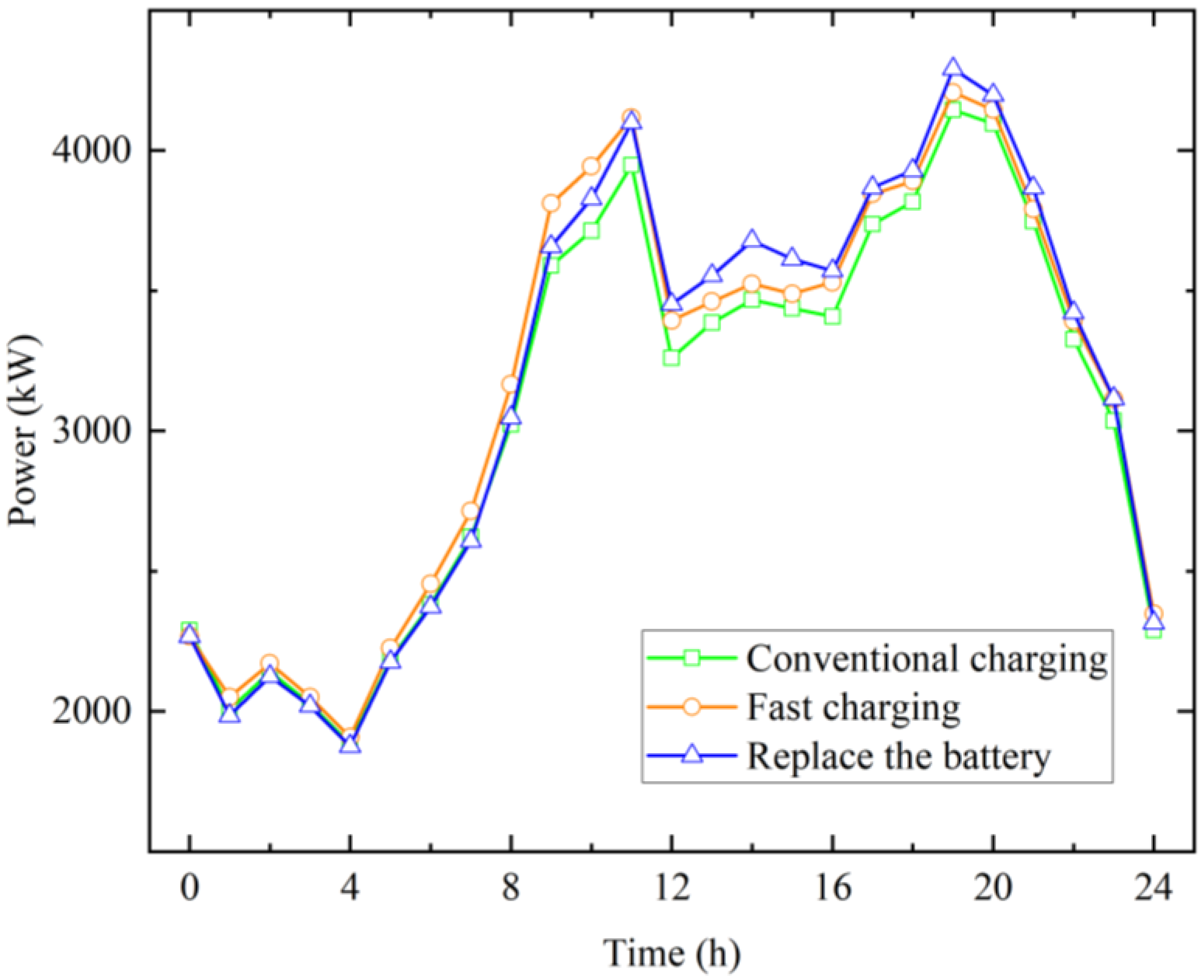
We started by sketching the daily charging load curve for a single ship. Once that was in place, we combined the curves for N vessels, gradually building up a portrait of large-scale electric ship charging demand. Finally, we overlaid this result onto a typical daily load profile to see how the two interact.
For conventional charging, we assumed power draws vary evenly between 3 and 4 kW—imagine it as a steady, low-key hum rather than a surge. In practice, this means that the charging power fits a uniform distribution, which keeps the model grounded and relatable [
49]:
The fast-charging method has a relatively high charging power and a short charging time, usually only about 30 min. Based on the usage habits of most electric vessels and the arrangement of commuting time, it is assumed that the starting charging time for fast charging is between 7:30 and 9. The four time periods of 30, 12:00–14:00, 16:30–19:30, and 19:30–23:00, respectively, account for 20%, 20%, 40%, and 20% of the total number of electric vessels participating in rapid charging, and the starting charging time follows a uniform distribution within each time period [
49].
In the formula, t1 represents the starting moment of each charging period and t2 represents the end moment.
Assuming that the charging power of the fast-charging mode follows a uniform distribution within the range of 40 to 60 kW, its probability density can be expressed as follows [
49]:
Since fast charging is similar to a gas station, it is assumed that the initial charging follows a normal distribution. The corresponding probability density function expression can be expressed as follows [
47]:
Since battery replacement and charging involves concentrating the batteries of electric vessels for charging during the off-peak period at night, it is assumed that the initial charging also follows a normal distribution. The conventional charging method is adopted for centralized charging.
We assume that the initial charging time follows a uniform distribution from 22:00 to 24:00. This assumption is based on the following considerations: (1) ports typically designate nighttime periods (after 22:00) as off-peak electricity pricing intervals to encourage load shifting and reduce grid stress, thereby guiding vessels to concentrate their charging during this period; (2) referring to the actual operational patterns of inland ports such as Wuxi Port, electric vessels tend to complete charging during low-cost nighttime hours to reduce operational expenses; and (3) in the absence of precise charging time distribution data, a uniform distribution serves as a reasonable and conservative simplification of charging behavior within this time window. Its probability density function expression can be expressed as follows [
49]:
The sensitivity analysis in
Section 2.6 offers further support for this approach; even when we tweak the parameters for initial charging time across a plausible range, the load factor rankings among shore power options do not budge, and our central findings hold.
How sensitive are the results to input uncertainty? We tested key inputs—like the spread in charging start times and the daily voyage mileage distribution—adjusting each by ±20% from baseline. What emerged was reassuring: although absolute load values shifted somewhat, the relative performance of the five systems stayed consistent. Take load factor, for instance. Energy storage-assisted power consistently topped the chart (above 0.70), while renewable-based systems lingered toward the lower end. That pattern held for other metrics, too, like peak-to-valley difference.
So, despite reasonable uncertainty in our inputs, the study’s core message remains intact: different shore power modes do place meaningfully different demands on the grid. We ran the same checks on our assumption of uniform battery capacity—and again, the comparisons stood firm within the defined range. In short, the numbers may wiggle a little, but the story they tell does not change.
2.7. The Calculation Process of Charging Load for Electric Ships Based on the Monte Carlo Method
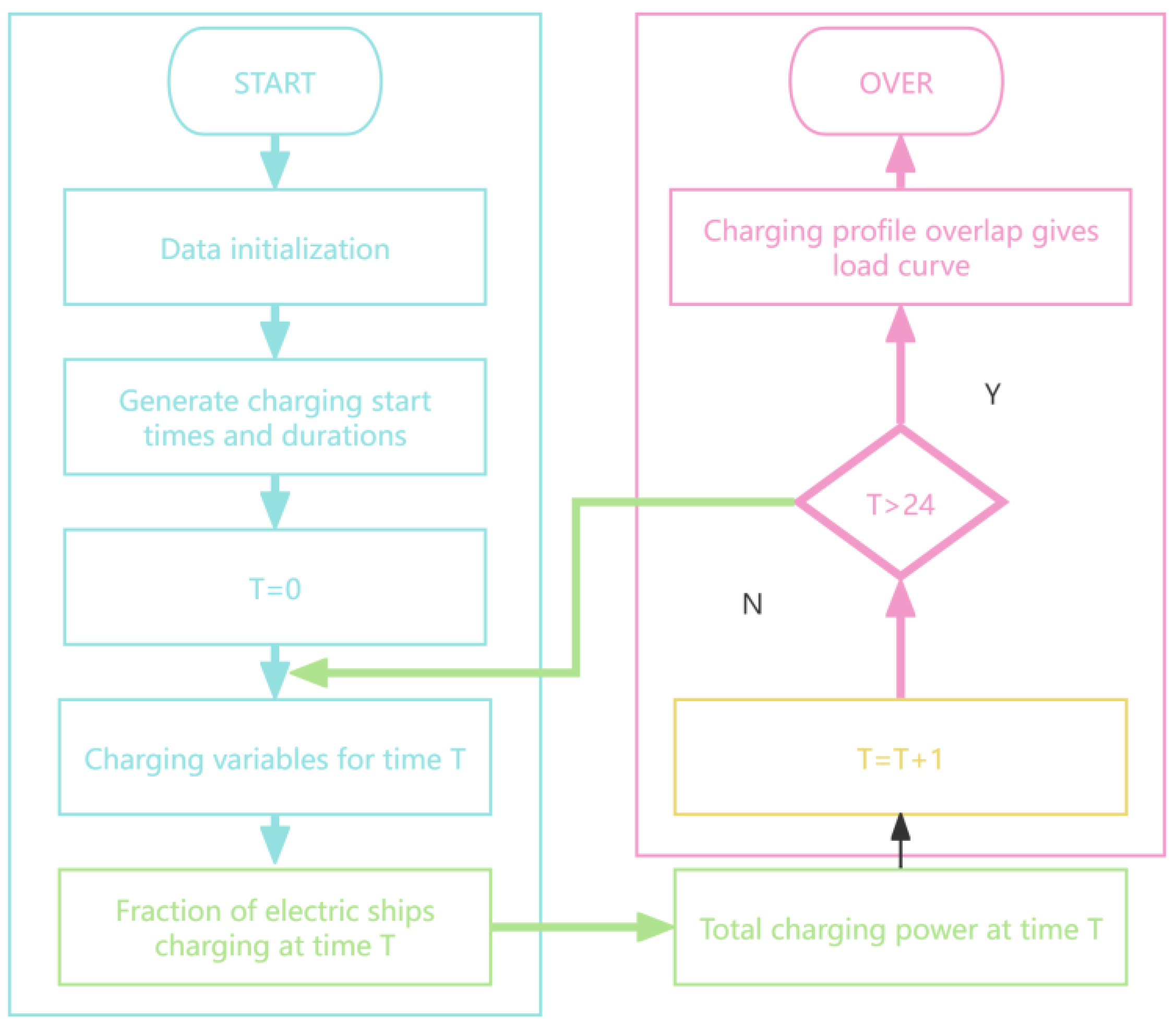
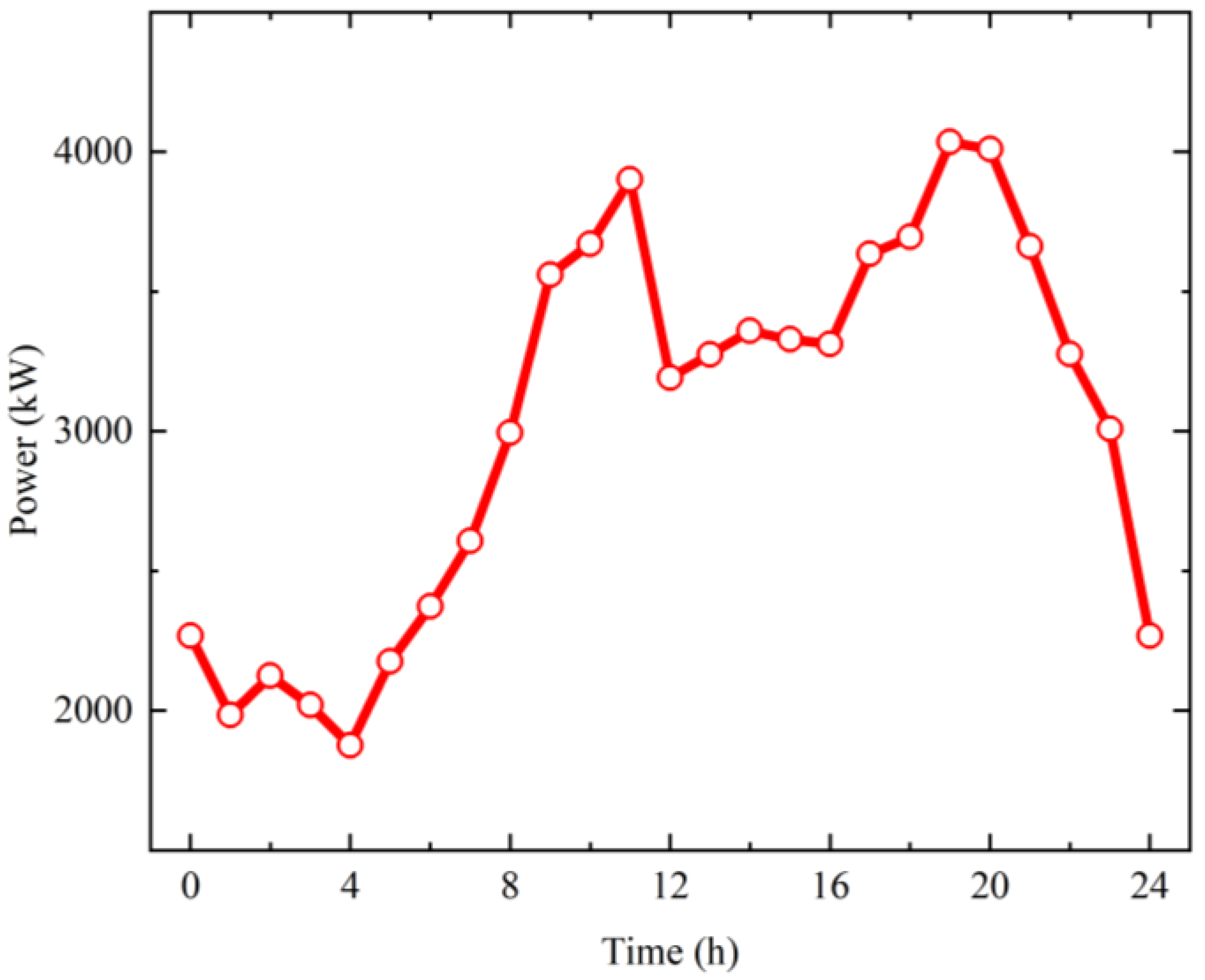
Figure 4 sketches out a Monte Carlo setup for estimating how much power a fleet of electric vessels will draw at any given hour T. We are working under the assumption that when a vessel starts charging and how long it charges are unrelated—statistically independent, in other words. The model tests three approaches to charging and discharging, each designed to play nicer with the grid: plain old plug-in-whenever charging, charging that is shifted to off-peak times, and a smarter strategy that also pushes energy back to the grid during high-demand periods. Each method is fine-tuned to match typical daily load patterns.
Here is how the simulation runs. First, we set up probability distributions for all the uncertain inputs—things like when charging starts and how long it lasts, based on what we laid out earlier. Then, for every time slice T across the 24 h cycle, we pull random values that meet the rules of the charging strategy that we are testing, figure out what share of the fleet is actively charging or discharging at that moment, and scale it up to a total power figure.
Take disordered charging as an exmaple: it is basically business as usual, with vessels plugging in whenever they need to, no schedule attached. Controlled charging is more strategic—it limits charging to the late-night lull, between 22:30 and midnight, to avoid adding strain when the grid is already busy. The most active strategy, controlled charge–discharge, does something rather clever: it taps into the vessels’ batteries during the morning and evening peak hours (around 8:00 and 19:00) to help shave demand, then quietly refills them overnight.
A few practical choices shape the model. Morning discharge, for instance, kicks off at 8:00 and uses half the battery capacity expected for the day’s travel—a balance between grid relief and keeping the vessels operational. Evening discharge waits until 19:00, partly to avoid degrading the batteries by depleting them too early. When it is time to recharge overnight, we spread those start times evenly across the 90 min window from 22:30 to 24:00.
You could think of it as a structured yet flexible dance between the fleet and the grid. Once the clock passes 24:00, the simulation wraps up, leaving us with a detailed profile of power demand—or supply—across the whole day.
On the Simulation’s Design and Reliability. We ran 10,000 independent Monte Carlo trials for each scenario—such as the case with 400 ships operating within the smart microgrid. A sample of this size is not arbitrary; it is what gives the resulting load profiles their statistical weight.
But how can we be sure 10,000 runs were enough? We kept an eye on the daily peak load—a key metric—tracking its moving average over the final 1000 iterations. Once that average shifted by less than 0.1% relative to the overall mean, we considered the simulation settled. In practice, that point came well before the final trial, which tells us that the model had genuinely stabilized.
Scaling the Fleet: Does Size Change the Story? What happens if the number of ships varies? We tested fleets from 100 to 800 vessels. Unsurprisingly, the total load scales fairly linearly with fleet size—more ships means more demand. Yet the underlying patterns held firm: the relative shape of the load curves, the ranking of shore power options, and performance indicators like load factor hardly budged. This means that insights drawn from the 400-ship case reflect behavior across a realistic range of operations.
When Inputs Are Not Set in Stone. Any model relies on assumptions, and ours is no exception. To check whether uncertainties in key inputs—like the spread in charging start times or the daily voyage distance—would sway the conclusions, we tweaked them by ±20% from baseline values.
Here is what held: while absolute load values shifted somewhat, the relative standing of the five shore power systems stayed consistent. Take load factor, for instance. Energy storage-assisted shore power consistently topped the chart (staying above 0.70), while renewable-based systems lingered toward the lower end. Even when we tested the assumption of a uniformly distributed battery capacity, the comparative outcomes remained intact across its defined range.
So, does parameter uncertainty blur the picture? Not really. The core finding—that different shore power modes impose distinct grid impacts—proves robust under reasonable variation.
2.8. Integration of the CPLEX Solver for Optimization Sub-Problems
To map out charging for each vessel under the Monte Carlo approach from
Section 2.6, we need to solve a scheduling puzzle—especially for the “controlled charging” and “controlled charge–discharge” modes. The goal here is to decide not just when each ship plugs in or feeds back power, but at what level. We frame this as a mixed-integer linear programming (MILP) model aimed at keeping the grid’s peak load in check, or smoothing out the spikes and dips in demand. Of course, the model has to play by the following rules: battery capacity, power limits, and each vessel’s own timetable.
In practice, the modeling and simulation were conducted using MATLAB (Version R2025a, MathWorks, Natick, MA, USA) with the YALMIP toolbox (Version 2025.01, J. Löfberg, Sweden) for problem formulation. The embedded optimization sub-problems within each Monte Carlo trial were solved using the CPLEX solver (Version 12.10, IBM, Armonk, NY, USA). For the cross-validation in
Section 3.2, a high-fidelity discrete-event simulation model was built on the AnyLogic platform (Version 9.0.0, AnyLogic North America, Oakbrook Terrace, IL, USA). Why CPLEX? Well, scheduling multiple vessels across discrete time slots becomes combinatorially tricky—fast. CPLEX handles that heavy lifting with reliable, high-performance algorithms, usually delivering an optimal or near-optimal schedule without eating up too much computation time. That efficiency is what made our large-scale simulation (all 10,000 iterations of it) actually doable.
Once CPLEX returns its optimized timetable for each vessel, we simply roll those individual schedules into a total load profile for that trial. It is a bit like assembling a jigsaw: each piece fits into a broader picture of how the whole port’s energy demand plays out.
2.9. Nomenclature
For clarity, the key mathematical symbols used throughout the modeling framework are listed in
Table 4.
4. Results and Discussion
4.1. Case Information
Nestled in the heart of Jiangsu Province, Wuxi Port anchors itself within the bustling core of the Yangtze River Delta. More than just a dock along the Beijing–Hangzhou Grand Canal, it functions as a vital logistical pulse point for the region—a place where goods begin and end their journeys, steadily fueling the industrial and commercial engine of Wuxi and southern Jiangsu.
Walk along its quays and you will see more than just containers and bulk carriers. What moves through here tells a story of the local economy: steel and construction materials for building, coal and grain for energy and sustenance, and chemical raw materials for manufacturing. The port handles an impressive volume year after year, supported by modern giants—gantry and quay cranes that load and unload with rhythmic precision.
It is the connections, though, that truly define Wuxi Port. Through the ancient veins of the Grand Canal and the Yangtze River system, it links seamlessly with Shanghai, Suzhou, Nanjing, and beyond. This is not just a static facility; it is a dynamic node in a living waterway network, one that has adapted over time to keep trade flowing efficiently.
You might wonder—how does an inland port hold such sway? Much of it comes down to geography and foresight. Situated where canal meets industry, it offers a cost-effective and reliable alternative to crowded roads and railways. While it may not have the coastline of a major seabound harbor, its strategic placement on interior waterways gives it a quiet, steady advantage.
In many ways, Wuxi Port mirrors the character of the region itself: practical, well-connected, and invariably in motion. It does not just handle cargo; it sustains livelihoods, enables growth, and quietly keeps the rhythms of daily commerce ticking.
Wuxi Port is quietly undergoing a shift. As China pursues its ambitious carbon goals, the port has turned its attention to the docks, where berthed ships have long relied on diesel generators—a familiar source of fumes and rumble. Now, the push is to plug those vessels into something cleaner. Shore power technology is steadily being rolled out, allowing ships to turn off their engines and draw electricity directly from the port’s grid. It is more than just a technical upgrade. Take, for instance, some of the terminals already equipped with this system. One combines shore power with a rather sleek addition: a 2 MWp solar array that soaks up sunlight to help charge everything from container carriers to bulk freighters idling along the inland waterways. That means that on a sunny day, a ship might literally be powered by sunlight—an idea that still feels quietly revolutionary in the heavy industry of freight. Of course, new infrastructure alone will not change habits. Here, the port aligns with broader provincial policies that encourage ships to connect to shore power—often with the help of discounted rates or subsidies. Is it enough to tip the scales? Time will tell, but the direction seems clear. Slowly, and without much fanfare, the noisy, smoky docks of yesterday are being rewired for a quieter, cleaner tomorrow.
Walking along Wuxi Port, you will notice that it is the smaller workhorses that keep things moving—container ships, bulk carriers, and barges—mostly inland vessels that navigate the region’s waterways, with a handful geared for the broader currents of the Yangtze trunk line. To keep this flow steady, the port has quietly embraced an intelligent management system, one that cuts down ship turnaround time and trims those idle hours spent waiting at the docks.
Then, there is the shore power setup. Drawing from the city’s grid at 380 V or 10 kV, it meets national technical standards and adapts to what different ships need. But here is where things become more interesting—Wuxi is not just sticking to the rulebook. There is talk already of widening shore power coverage, sharpening those smart management tools, and teaming up with other ports across the Yangtze Delta. The goal? A network that does not just function, but communicates.
But does any of this really hold up in practice? Take their prediction model, for instance. In a recent trial at Wuxi Inland Port, they simulated a full day’s operations—running charging scenarios for 300, 400, 500, and even 600 vessels. The numbers, laid out in
Table 6, offer a fairly convincing look at how the system might perform when things become busy. In a port that is growing smarter by the day, that kind of foresight could make all the difference.
When we look at the global fleet, bulk carriers and container ships dominate—making up about four-fifths of all vessel traffic. Passenger and special operation vessels each occupy a smaller slice, around 10%, respectively. Now, for these ships to go electric, we have assumed battery capacities roughly eight times their simulated power demand—a practical estimate to ensure that they can handle typical operational cycles.
This brings us to the real challenge, how to power them in port. Instead of sticking with conventional AC shore connections, several alternatives are worth exploring. One is high-voltage direct current, which cuts down on conversion losses. Another taps directly into renewable sources—think solar energy or wind fed straight into the dock. Then, there is the idea of charging a smart microgrid, letting the port itself balance supply and demand. Additionally, we cannot ignore the role of on-site energy storage, which could smooth out peaks and support the grid during high demand.
Each of these approaches has its own trade-offs, of course. But together, they sketch a more flexible, and potentially greener, future for how ships plug in.
4.2. Interpretation of Digital Data and Throughput Scope
To make sense of our simulation, we need to ground its numbers in reality—what do those inputs actually represent at a real port? This section walks through the data fed into the Monte Carlo model and connects it to the concrete world of cranes, cargo, and river traffic.
At the heart of the simulation are four stochastic inputs, each defined by probability distributions. Their ranges are not arbitrary; they are drawn from operational patterns of electric vessels on China’s inland waterways and typical port routines.
Take battery capacity. It spans a wide spectrum—from a modest 50 kWh for small freighters up to 7500 kWh for the largest all-electric cruise ships (
Table 1). The uniform distributions we assigned mirror this actual technological spread across ship types.
Daily voyage mileage, meanwhile, follows a lognormal distribution. In practice, this captures the rhythm of inland shipping: most vessels cover between 20 and 150 km a day, the kind of short-to-medium hauls you would see along canals like the Beijing–Hangzhou Grand Canal.
Then, there is fleet size. We ran simulations for 300 to 600 vessels—a range that mirrors the pulse of a mid-to-large inland port, say Wuxi Port, on a busy week. With 400–500 electric container ships, bulk carriers, and passenger vessels moving regularly, you are looking at an annual cargo throughput in the ballpark of 5 to 15 million metric tons. That is no backwater figure; it is what keeps major logistics hubs in the Yangtze River Delta humming. Simulating 300 and 600 vessels simply lets us test quieter and busier scenarios.
All these inputs feed into our Monte Carlo and optimization engine, which then spits out the performance metrics—peak load, load factor, and peak-to-valley difference—discussed later in
Section 4.2 and
Section 4.3. By laying out the data here, along with what it means in port terms, the model’s assumptions come into focus. And the comparisons between different shore power systems that follow? They are not just numerical results; they are reflections of real choices facing ports tomorrow.
4.3. Simulation of Charging Load for Electric Ships Based on the Monte Carlo Method
Walk through any major port today and you will notice a quiet shift taking place: docked ships are turning off their rumbling diesel generators and plugging into the port’s own power supply. This practice, known as shore power, is not as simple as it sounds—in fact, ports are experimenting with several distinct approaches. Broadly speaking, we can group them into five varieties, each with its own technical profile and potential niche. The most common is conventional AC shore power, the workhorse of the bunch, which is reliable and widely deployed. Then, there is high-voltage DC shore power, which offers greater efficiency for larger vessels—imagine it as a dedicated fast-charging lane for megaships. Alongside these, ports are increasingly integrating renewable energy shore power, drawing directly from solar panels or wind turbines installed along the wharf. Smarter still are smart microgrid shore power systems, which balance supply and demand in real time, almost like an intelligent energy conductor. Finally, some setups now include auxiliary energy storage shore power, where batteries smooth out fluctuations and store excess green energy for when it is needed most. In this analysis, we will run simulation models to see how each configuration performs under real-world port conditions—because in the end, it is not just about having options, but knowing which one fits the rhythm of the harbor.
4.3.1. Conventional AC Shore Power for Electric Vessels
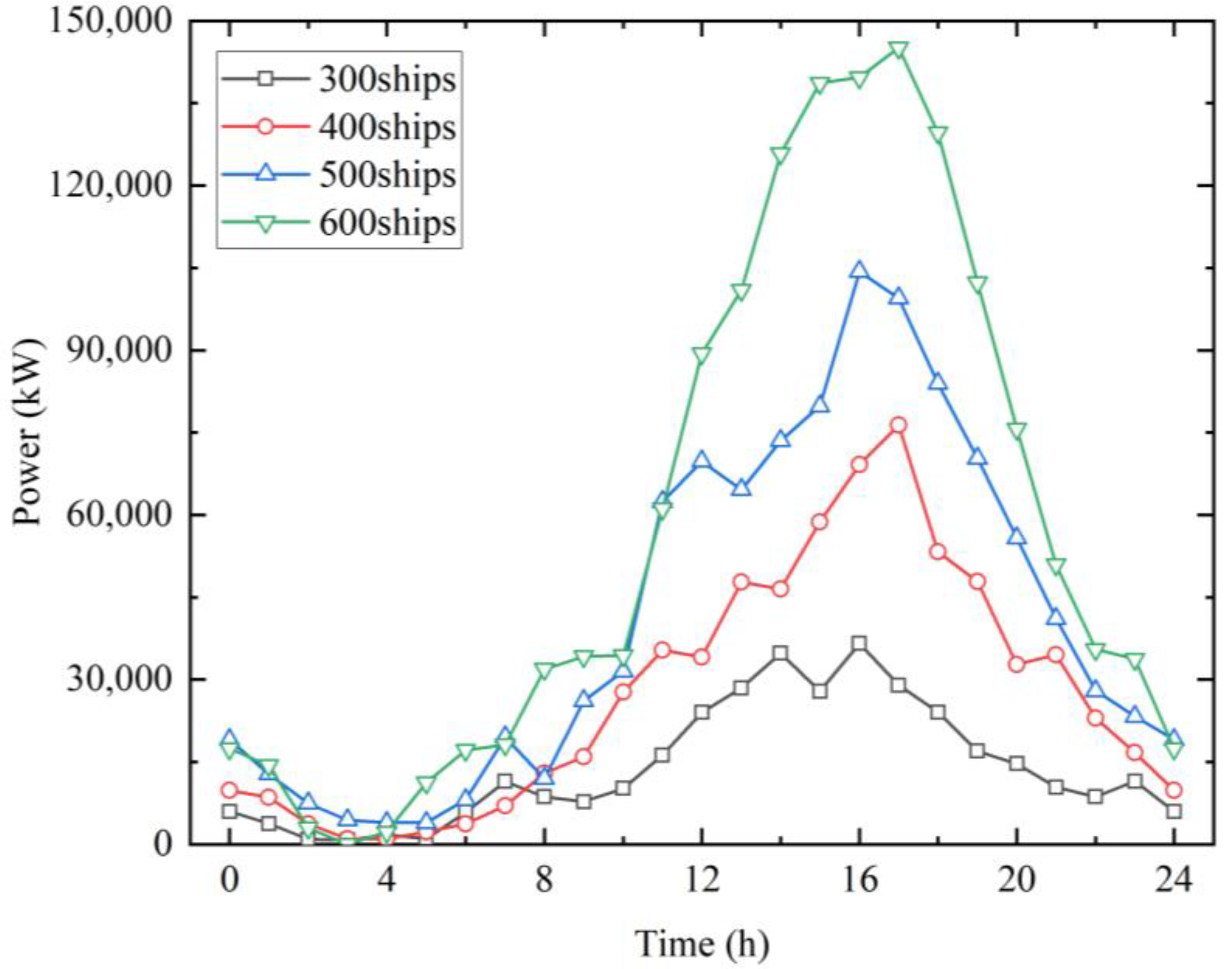
Under the conventional AC shore power charging mode, the grid load after ships of different scales were connected was simulated and analyzed. The result is shown in
Figure 7.
In the scenario of 300 ships, the load peaked at 36,568.5 kW at 16:00, having a relatively small impact on the power grid.
In the scenario of 400 ships, the peak load increased to 76,417.2 kW (occurring at 5 p.m.), which began to have a certain impact on the power grid.
In the scenario of 500 ships, the peak load further rose to 104,317 kW (at 16:00), and the pressure on the power grid significantly increased.
In the scenario of 600 vessels, the peak load reached as high as 145,119 kW (at 5 p.m.), causing a strong impact on the power grid.
The simulation results show that as the number of ships increases, the load on the power grid rises significantly, especially when the scale is 500 or more, the conventional AC shore power system faces considerable power supply pressure.
4.3.2. High-Voltage Direct Current Shore Power for Electric Vessels
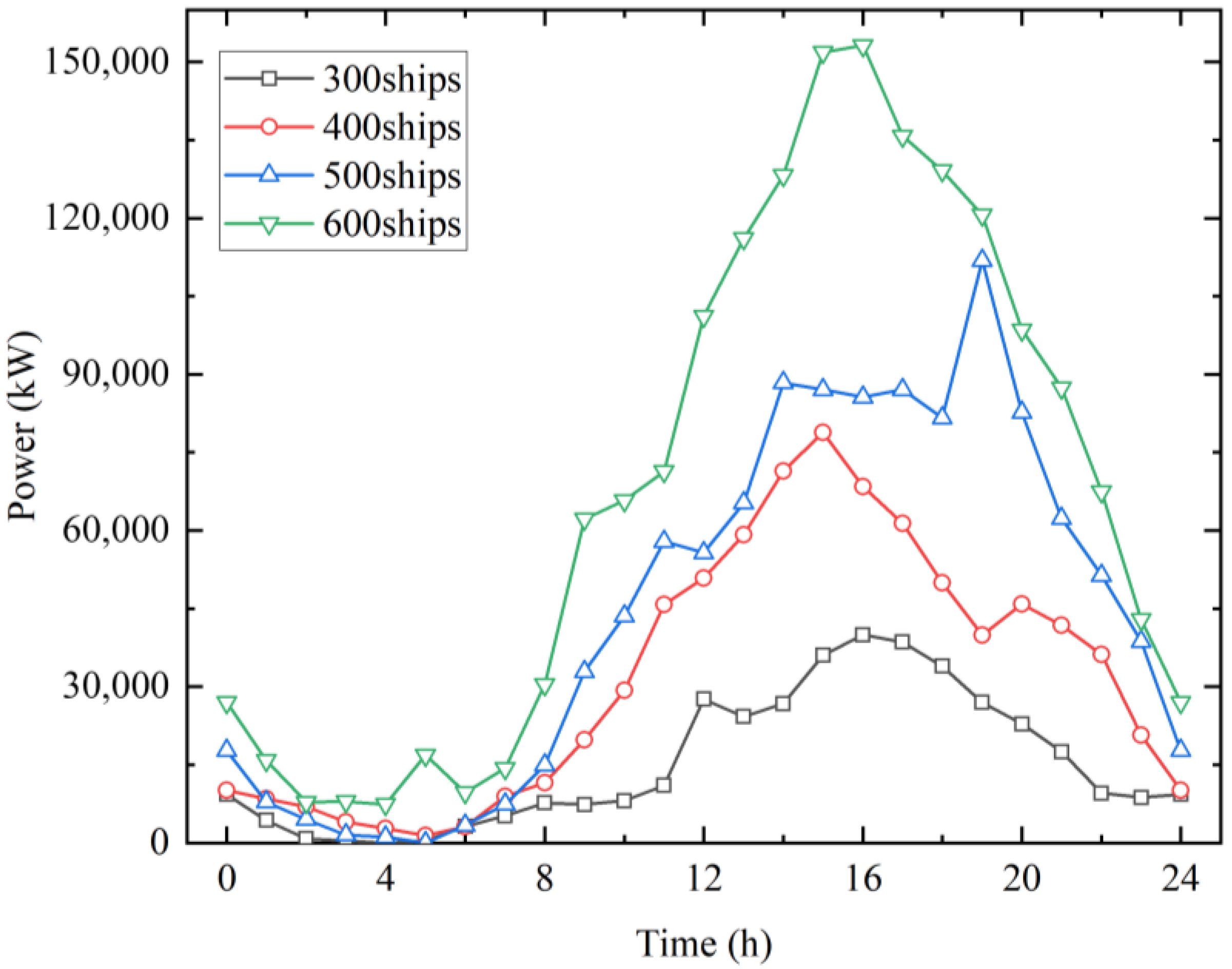
Under the high-voltage direct current shore power mode, the grid load after ships of different scales were connected was simulated and analyzed (the results are shown in
Figure 8). This system can provide high-power direct current for vessels at port to replace the power generation of fuel-powered auxiliary engines, reducing pollution and carbon emissions in the port area.
In the scenario of 300 ships, the peak load was 39,990.3 kW (occurring at 4 p.m.), causing a relatively small impact on the power grid.
In the scenario of 400 ships, the peak load increased to 78,855.6 kW (at 15:00), which began to have a certain impact on the power grid.
In the scenarios of 500 and 600 vessels, the peak loads reached 111,882 kW (at 19:00) and 153,168.6 kW (at 16:00), respectively, causing a significant impact on the power grid.
The simulation results show that although the high-voltage direct current shore power system has the capacity for high-power supply, with the increase in the number of ships, the power grid still faces considerable pressure.
4.3.3. Renewable Energy-Based Shore Power for Electric Vessels
The renewable energy-based shore power system for electric vessels is a green energy solution that integrates clean energy generation—primarily photovoltaic (PV) systems for this case study—with port power supply. The installed capacity of the PV system is 2 MWp, providing a theoretical maximum daily generation of approximately 8 MWh under standard test conditions, which is used as the basis for the normalized generation profile in the simulation. This mode aims to reduce pollution and carbon emissions during vessel berthing. Ports can deploy PV panels on-site or procure green power through external agreements.
To align with the probabilistic forecasting framework of this study, the output of the PV system is modeled as an uncertain variable. A typical daily PV generation pattern for the Wuxi region is used as a baseline. To account for the inherent variability and intermittency of solar energy due to weather changes, a random adjustment is applied to this baseline profile in each Monte Carlo simulation trial. This approach ensures that the renewable generation input reflects real-world uncertainty, consistent with the treatment of ship-related stochastic variables.
The baseline-normalized PV generation profile (from 00:00 to 23:00) is defined by the following hourly capacity factors: 0, 0, 0, 0, 0, 0.1, 0.3, 0.5, 0.7, 0.9, 1.0, 1.0, 0.9, 0.8, 0.7, 0.5, 0.3, 0.1, 0, 0, 0, 0, 0, 0.
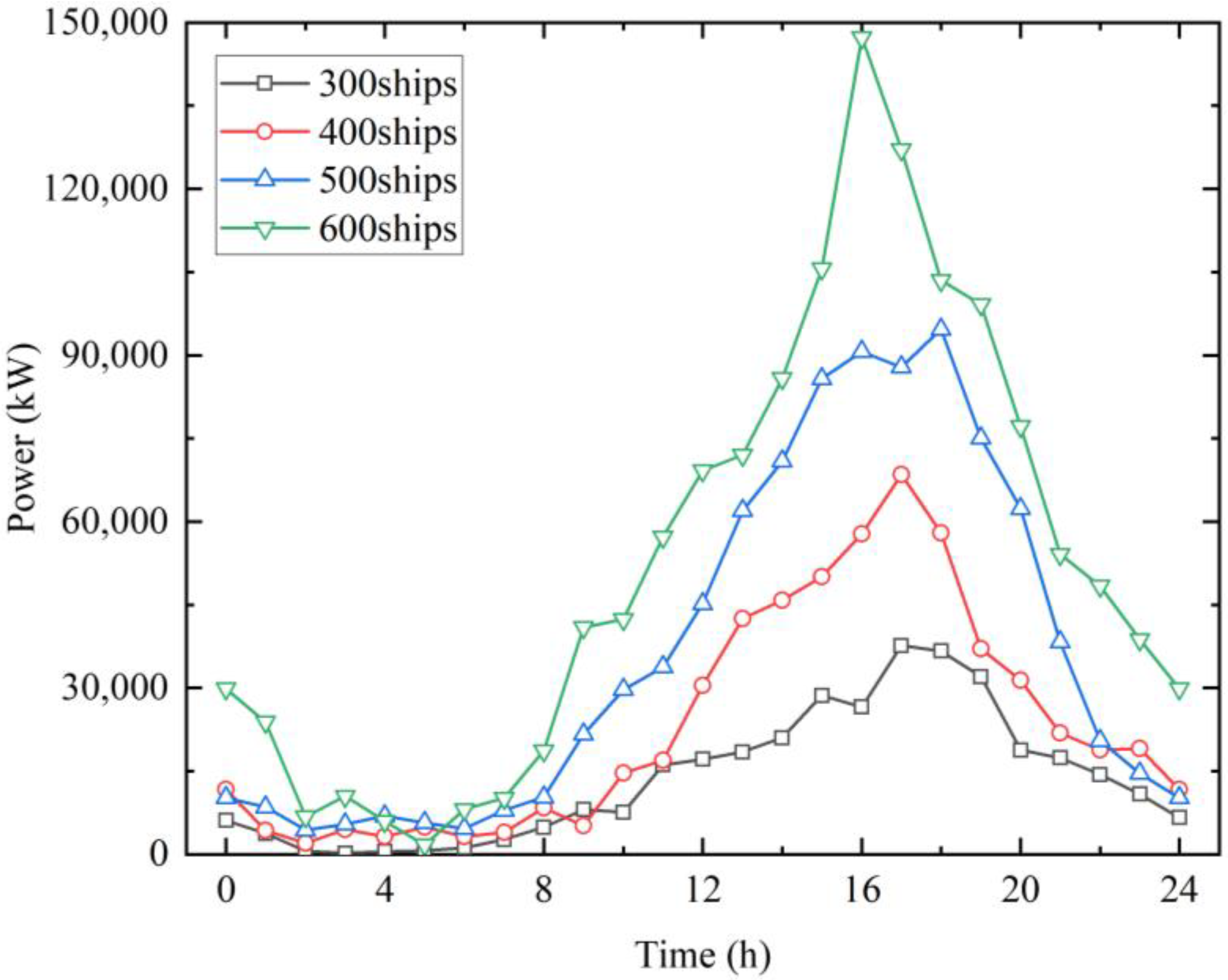
We calculate the main grid’s net load in this mode by taking the total stochastic charging demand of the vessels and subtracting the solar PV generation produced in the same Monte Carlo trial. After running 10,000 simulations, the average load profiles for different fleet sizes emerge—
Figure 9 lays them out clearly.
What stands out in
Figure 9 is how solar generation and charging demand push and pull against each other, carving distinct shapes into the net load curve. Take the 400-vessel case as an example: in the quiet early morning hours, around 2 to 3 AM, net load bottoms out near 2025 kW. Then, as daylight fades later in the day, demand climbs steadily until it hits a steep peak—roughly 68,526 kW between 5 and 6 PM. That is the evening squeeze: solar output drops off just as boats are still lining up to charge.
What does all this variation mean for the grid? In short, renewable-based shore power does not just change the load—it introduces real unpredictability. With 400 vessels, this setup gives us the lowest average load factor of any configuration we studied, just 0.33. You could read that number as a warning: when intermittent sun meets steady charging needs, the grid still carries most of the weight, especially after sunset. That is the inherent constraint of relying on renewables alone. It also hints at why pairing solar with storage or smart controls—like the microgrid approaches we will discuss next—tends to deliver smoother, more resilient performance.
In the simulation of renewable energy shore power, the maximum load of 300 vessels was 37,638.9 kW, and the impact on the shore power grid was relatively small. In the simulations of 400 and 500 vessels, the maximum load reached 68,526.4 kW and 94,690 kW, respectively. At this point, the load had significantly increased and had a certain impact on the grid. Under the simulation of the last 600 ships, the maximum load reached 147,331.8 kW. At this time, the shore power load was the largest, and the impact on the power grid was also the greatest.
4.3.4. Intelligent Microgrid Shore Power for Electric Ships
The intelligent microgrid shore power system integrates distributed energy, energy storage, and intelligent control technologies to build a local independent power grid in the port area. It coordinates renewable energy, energy storage systems, traditional power grids, and ship loads to achieve efficient, flexible, and low-carbon power supply.
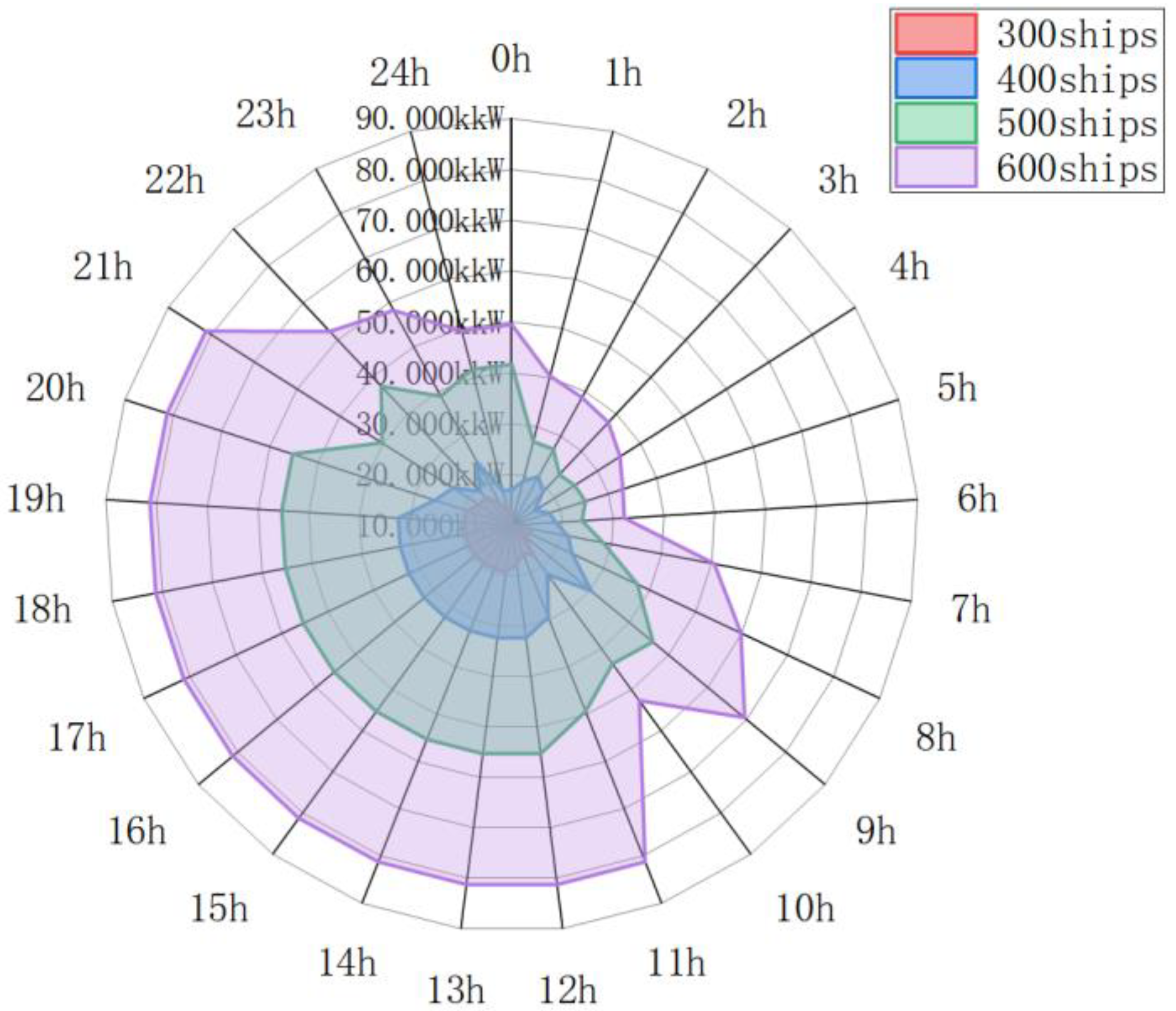
The charging load simulation was carried out under this system, and the results are shown in
Figure 10.
In the scenario of 300 ships, the peak load was 23,067.45 kW (occurring at 4 p.m.), having a minimal impact on the power grid.
In the scenario of 400 ships, the peak load was 41,079.2 kW (at 17:00), and the impact on the power grid was still relatively small.
In the scenarios of 500 and 600 vessels, the peak loads reached 67,855.5 kW (at 4 p.m.) and 87,931.8 kW (at 2 p.m.), respectively, which began to have a certain impact on the power grid.
The simulation results show that the intelligent microgrid system achieves peak shaving and valley filling through load transfer and exhibits good grid adaptability and stability under different ship scales.
4.3.5. Electric Ship Energy Storage Assists Shore Power
Energy storage-assisted shore power is a hybrid power supply solution that combines battery energy storage systems with traditional shore power, aiming to enhance power supply flexibility, stability, and the utilization rate of renewable energy, while reducing the impact on the power grid. This system is particularly suitable for high-power ship charging, ports with weak power grids, or scenarios with a high proportion of renewable energy.
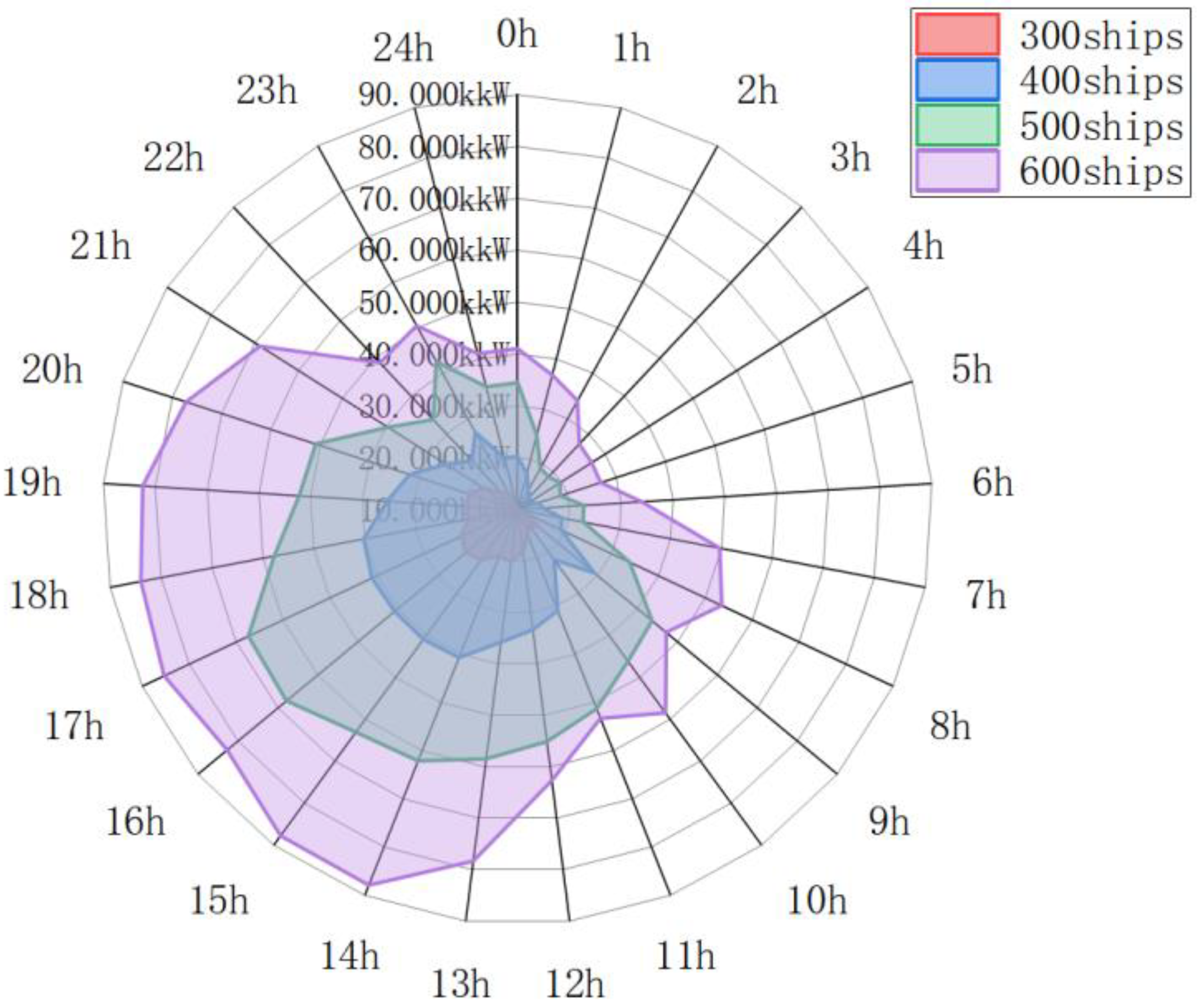
Energy storage assistance utilizes the energy storage system to balance the electricity demand during high- and low-load periods. The data obtained through the simulation of energy storage assistance charging for electric vessels is shown in
Figure 11. As shown in
Figure 11, it is a simulation of the port power grid load under the shore power assisted by energy storage. Under the simulation of 300 ships, the ship load curve decreases from 0 to 3 h, reaches the minimum value of 7433.34 kW at 3 and 4 h, and starts to rise from 5 h. With the increase in ships using electricity, the load curve begins to rise, reaching the maximum load of 19,321.86 kW from 13 to 20 h The curve began to show a downward trend after 9 p.m. When the number of ships is 400, the curve decreases from 0 to 4 o’clock, reaches the minimum of 15,287.2 kW at 4 o’clock, begins to rise slowly after 5 o’clock, reaches the maximum load of 32,371.08 kW from 12 o’clock to 7 o’clock, and starts to decline after 8 o’clock. When the number of ships increases to 500, the curve shows a downward trend from 0 to 6 o’clock, reaching the minimum load of 23,869.6 kW at 6 o’clock. From 7 to 12 o’clock, with the increase in the number of ships, the load curve rises, reaching the maximum load of 55,334.5 kW from 12 to 20 o’clock, and then the load curve begins to decline. For the scenario with 600 vessels, the load curve initially decreases from 0 to 6 h, reaching a minimum of 32,184.36 kW at 6 h. From 7 to 11 h, the curve showed an upward trend as the number of ships charged increased. At this time, the maximum load reached 81,279 kW from 11 to 9 p.m., and the curve began to decline after 10 p.m.
In the energy storage-assisted shore power simulation, the maximum load for 300 vessels was 19,321.86 kW. Under the simulation of 400 vessels, the maximum load reached 32,371.08 kW. Under the simulations of 500 vessels and 600 vessels, the maximum loads were 55,334.5 kW and 32,184.36 kW, respectively. The maximum load of 300 and 400 vessels has a relatively small impact on the power grid, while 500 and 600 vessels have a certain influence on it.
4.4. Comparison of Simulation Results
Our sensitivity analysis in
Section 2.6 confirms that these comparative findings hold true across varying fleet sizes—not just in theory, but in practice. Take a look at the load curves in
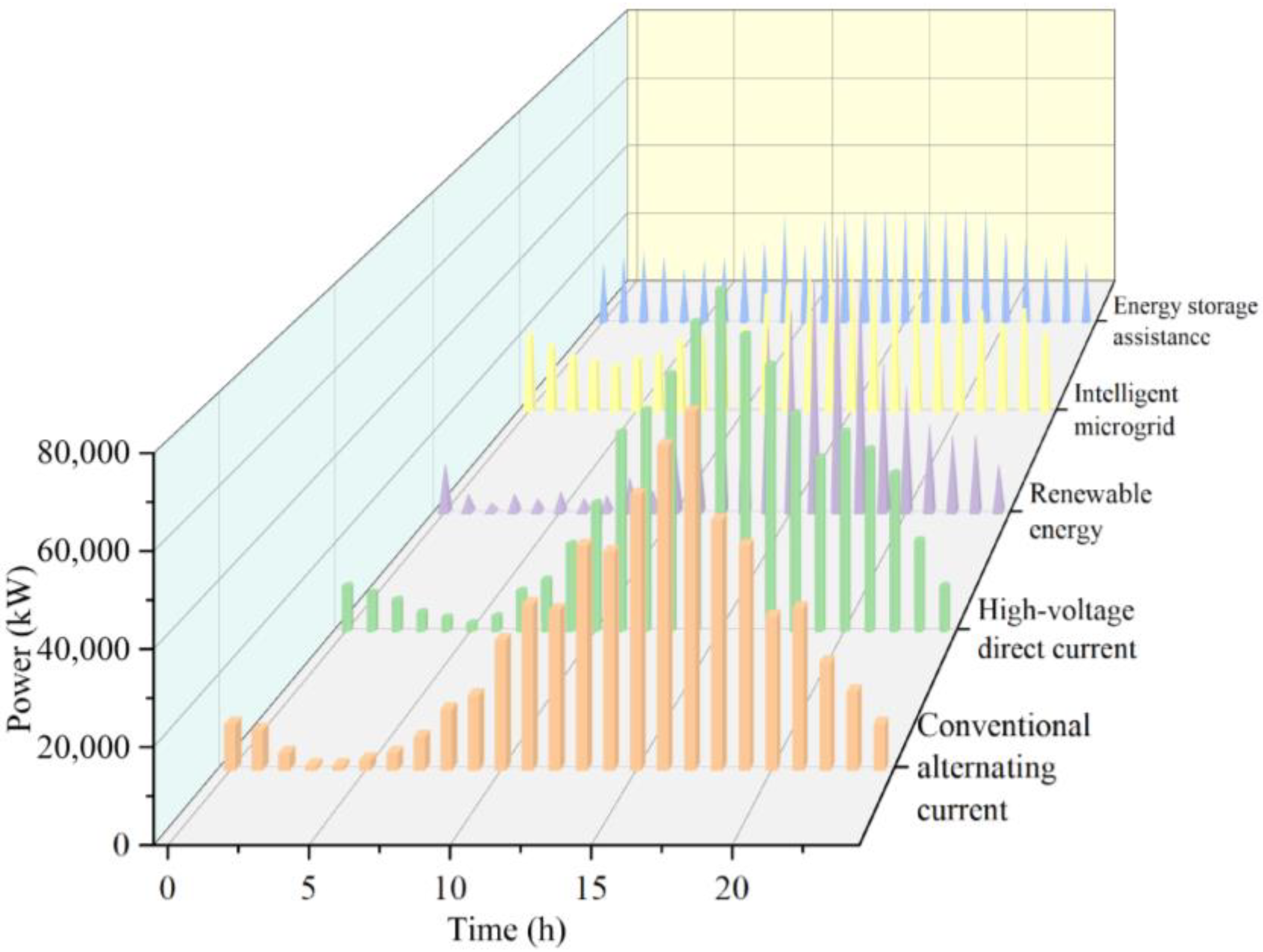
Figure 12. Here, you can see how conventional AC shore power, high-voltage DC shore power, and renewable-energy shore power each show sharp fluctuations over a 24 h period, which, frankly, would place a real strain on the grid. In contrast, smart microgrid shore power and energy storage-assisted shore power trace far steadier lines, easing that burden considerably.
The differences become even clearer in
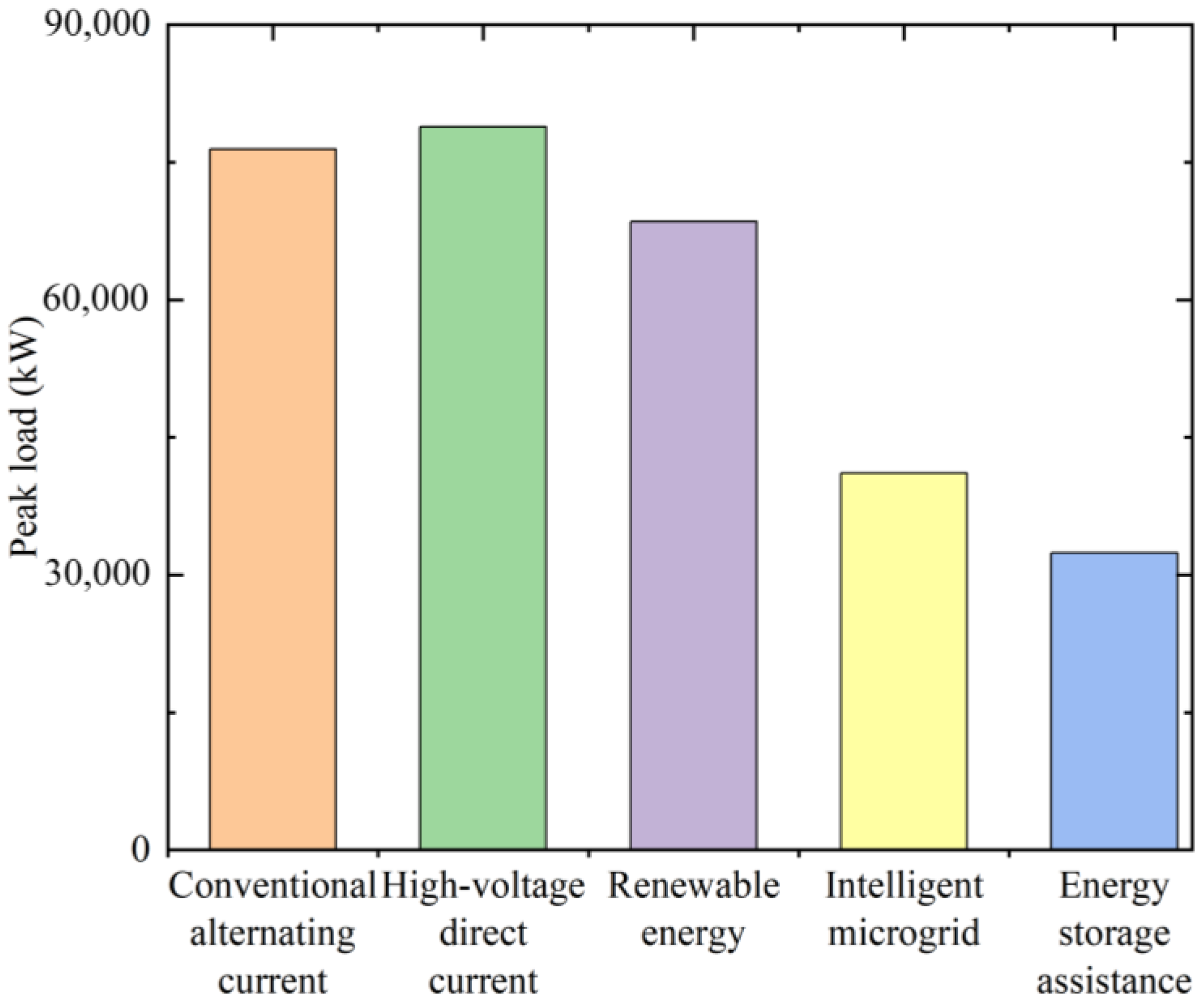
Figure 13, which compares peak loads. High-voltage DC shore power tops the list at 78,855.6 kW, with conventional AC shore power close behind at 76,417.2 kW. Renewable energy shore power comes in at 68,526.4 kW, while smart microgrid shore power sits at 41,079.2 kW. It is the energy storage-assisted shore power that really stands apart—its peak is barely a blip, just 80.93 kW.
What about the swing between high and low demand?
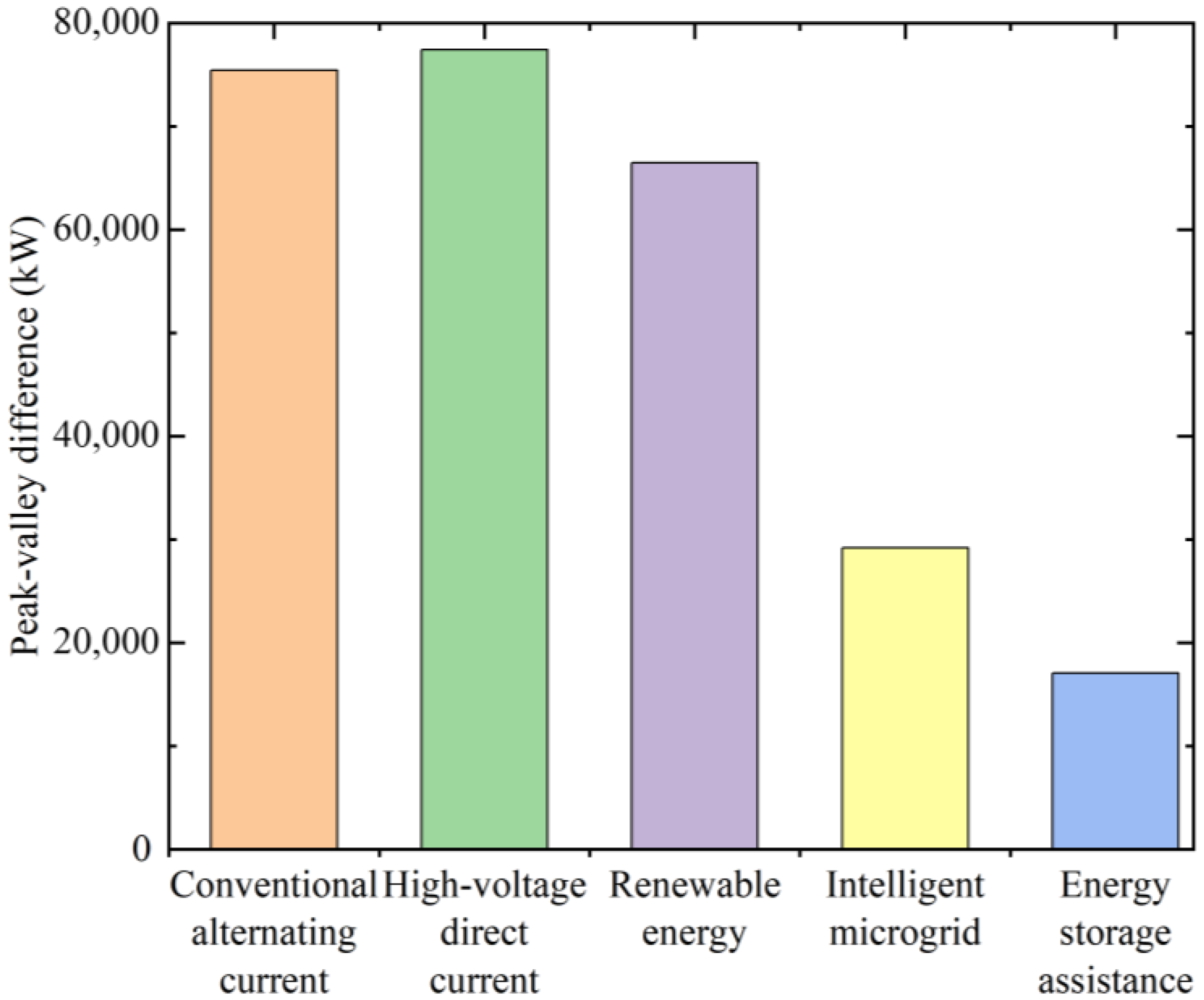
Figure 14 lays out the peak-to-valley differences. Again, high-voltage DC shore power leads at 193.54 kW, followed by conventional AC shore power at 188.57 kW and renewable energy shore power at 166.25 kW. The smart microgrid shore power shows more moderation at 72.94 kW, but the storage-assisted system remains in a league of its own, with a difference of only 32.37 kW. In other words, it does not just reduce the peak—it flattens the curve.
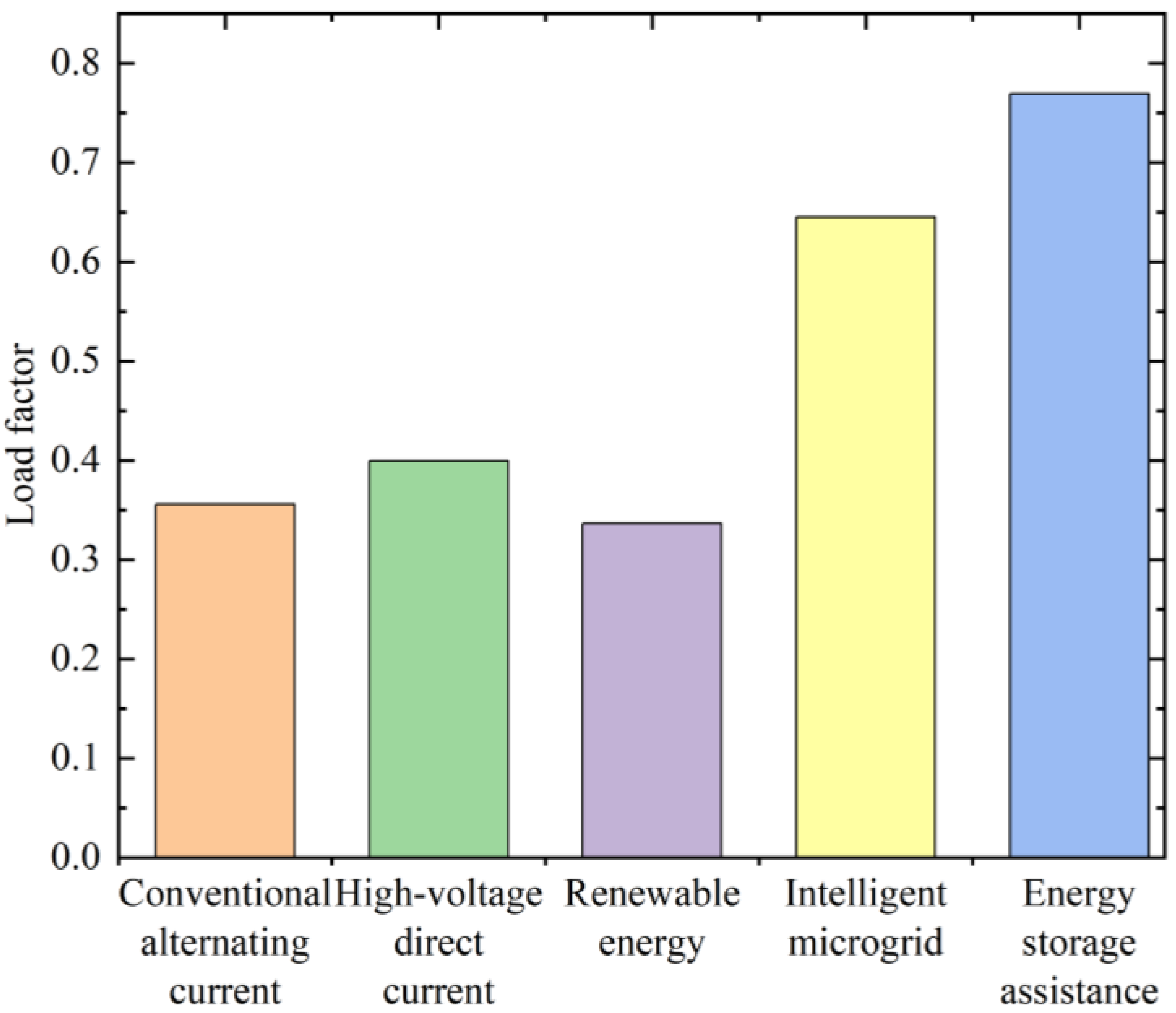
Figure 15 shows the comparison of load factors. Energy storage-assisted shore power was the highest (0.76), followed by smart microgrid shore power (0.64), high-voltage direct current shore power (0.39), and conventional AC shore power (0.35), and renewable energy shore power was the lowest (0.33). The higher the load factor, the more stable the load and the higher the equipment utilization rate.
Comprehensive analysis shows that the two new shore power models, namely, the smart microgrid and energy storage assistance, perform significantly better than the traditional shore power forms in terms of smoothing the load, reducing the peak–valley difference, and improving the power consumption efficiency.
4.5. Engineering Significance and Uncertainty Analysis of Load Factors
We simulated five different shore power setups using Monte Carlo methods, and the load factors that emerged tell their own story: conventional AC shore power came in at 0.35, high-voltage DC at 0.39, renewable-based systems at 0.33, smart microgrids at 0.64, and storage-assisted setups reached 0.76. These are not just abstract numbers—they provide a tangible measure of how each system interacts with the grid and operates day to day. But what do they really mean in practice? Let us walk through the thinking behind them.
At the heart of our model is a shift from talking generally about “uncertainty” to actually building it into the calculations. We took real variables—think battery capacity, daily voyage distance, and when charging starts—and gave them probability distributions based on observed data (
Table 3). This approach means that every output, from load curves to peak demand, carries its own built-in band of likelihood. So when you see a load factor here, it is not a single fixed value; it is more like a reasoned estimate, complete with its own confidence interval.
Take the spread between the results, for instance. That leap from 0.33 for renewable shore power up to 0.76 for systems with energy storage is not accidental—it hints at how flexibility and buffer capacity change the game. In practice, a higher load factor often signals smoother grid integration and better asset use, something grid operators notice almost immediately.
By modeling uncertainties directly, we move past what sometimes feels like educated guessing. Instead, the output reflects a range of real-world conditions, giving engineers a practical toolkit for planning and comparison. After all, in port electrification, what works on paper has to hold up when ships come in.
- (1)
The load factor—essentially how close average demand runs to peak—tells you a great deal about the rhythm of electricity use and how hard infrastructure is working. When that number edges toward one, the grid breathes more steadily. Transformers and cables can operate nearer to their full capacity for longer stretches, which means that we are using them more fully and, in turn, lowering the cost per unit of electricity delivered. But what do the load factors from this study really offer beyond numbers and confidence intervals? In practice, they act as a bridge—connecting probabilistic forecasts to decisions that energy managers actually have to make. Take infrastructure planning, for instance. In a system with a low load factor, like conventional AC shore power, you are forced to plan for spikes. That means building in substantial extra capacity from the start, which drives up upfront investment. On the other hand, when you integrate energy storage to smooth out demand, the load factor rises. Suddenly, you can size equipment closer to the average load rather than the peak. The result? A far more economical design from the outset.
- (2)
Think of the load factor as a pulse reading—it tells you how efficiently a system is being dispatched. When you see the high numbers posted by smart microgrids and storage-assisted setups, what you are really seeing is their ability to flatten out the net load curve. They do this by shifting loads and charging or discharging batteries in a coordinated dance. For port operators, that is practical intelligence: it shapes time-of-use pricing, guides demand response, and makes room for more renewable energy. A smoother load profile does not just look better on paper. It actually eases the strain on grid frequency regulation and cuts the need to fire up fossil-fuel peakers. Over time, this means lower costs and fewer emissions. So, in practice, the load factor can do double duty—it is not only a measure of dispatch potential, but also a useful gauge of how “green” and cost-effective a shore power system really is. You might even say that it gives operators a clearer story about where their investments are paying off.
- (3)
The numbers tell a clear story: not all shore power is used the same way. Some systems run at a steady clip, while others sit idle for long stretches. This efficiency gap—what we call the load factor—is not random. It comes down to how each system is built and managed. Take conventional AC and high-voltage DC shore power. Here, everything depends on when ships arrive and how much charge they need. The system does not regulate demand; it simply reacts. That means that power use tends to cluster in sharp peaks, with deep valleys in between. The result? A lower overall load factor. Then, there is shore power fueled by renewables. Cleaner, certainly—but also at the mercy of the weather. Output swings with sunlight and wind, creating a tricky intermittency. In one simulation, a 2 MWp solar array helped cover daytime demand, yet its generation peaked around noon, hours before the evening charging rush. When ships needed power after dark, the system leaned harder on the main grid, amplifying load swings. In fact, this mismatch led to the lowest load factor of all the modes studied. It is a reminder that green infrastructure is not just about installation; it is about integration. Without smart timing or storage, even a clean energy source can strain the grid that it is meant to help.
- (4)
By weaving together distributed energy resources, loads, and a smart control system, this setup can coordinate internal assets with impressive efficiency. Take the 0.64 factor—it tells us that the system is already making headway in smoothing out demand peaks and valleys, largely by optimizing when to charge and drawing more on local renewables. Think of it like a kind of energy ballet: storage units charge up when the grid is quiet, then release power during busy hours. That daily rhythm shifts energy across time, flattening the port’s net load curve in the process. In fact, it is that very capability that pushes its load factor to 0.76—a figure that not only reflects better grid friendship, but also suggests that we are better utilizing the equipment already in place. You could say the system is not just responding to demand; it is quietly orchestrating it.
- (5)
The load factors in this study come from probabilistic models and random sampling—so yes, they carry some uncertainty. But just how reliable are they? To find out, we ran 10,000 Monte Carlo trials for each scenario, landing on 95% confidence intervals that look like this: conventional AC shore power sits between 0.34 and 0.36, high-voltage DC between 0.38 and 0.40, renewable energy-based between 0.32 and 0.34, smart microgrid between 0.63 and 0.65, and energy storage-assisted between 0.75 and 0.77. What stands out is how narrow each range is. That points to stable simulations and, frankly, fairly trustworthy estimates. In practice, these intervals are not just statistical ornaments—they give engineers a realistic risk boundary when making decisions. Say you are planning a smart microgrid system; you could reasonably lean on the conservative end, around 0.63, for selecting equipment. Looking ahead, as we gather more accurate input data—the real-world distributions of parameters—these confidence bands should tighten further. That, in turn, could sharpen planning and investment choices down the line. It is a reminder that even solid numbers leave room to refine, adapt, and improve.
The load factors and confidence intervals you see here come from a probabilistic model—built on the existing literature, typical parameters, and what we believe are reasonable assumptions. We have stress-tested the core findings through sensitivity analysis, and they hold up. That said, a model is only as reliable as the probability distributions we feed into it.
Going forward, the real work lies in teaming up with port operators. If we can obtain more detailed, real-world records of how vessels actually operate and recharge, we will be able to fine-tune those input parameters. Better data do not just calibrate the model—they tighten the confidence intervals and turn our forecasts into practical, actionable guidance for engineers. In other words, what is on paper starts to match what happens at the port.
From Forecasting to Management Decision Support
The comparative analysis of the five shore power modes, facilitated by the Monte Carlo framework, provides a direct decision-support tool for port authorities and grid operators. For instance, the low load factor of renewable energy-based shore power (0.33) highlights a key management challenge: the temporal mismatch between intermittent generation and charging demand. This insight dictates that adopting this technology must be coupled with management strategies, such as supplemental grid purchase agreements or integrated storage mandates. Conversely, the high load factor of energy storage-assisted shore power (0.76) quantifies its inherent grid-friendly nature, justifying its higher initial investment by demonstrating superior asset utilization and reduced need for grid reinforcement. Therefore, the forecasting model’s output is not an end in itself but a vital input for strategic technology selection, risk-informed capacity planning, and the design of operational protocols, which are the core components of port energy management systems.
4.6. Implications for Policy Implementation and Port Management in China
The numbers from this study do not just sit on a page—they speak directly to the practical realities of building greener ports along China’s coast. Take the smart microgrid and storage-assisted shore power systems, which posted load factors of 0.64 and 0.76, as examples. That is not just incremental improvement; it is solid technical ground for policymakers who are drafting incentives and subsidies, much like those outlined in the “Action Plan for Carbon Dioxide Peaking Before 2030”. In practice, these systems could dramatically ease peak demand on the grid, potentially saving millions in upgrade costs—a real bottleneck in the race to expand shore power infrastructure. Then, there is the renewable energy mode, trailing behind with a load factor of 0.33. The figure itself tells a story: intermittency remains a stubborn hurdle. Solar and wind generation often miss the mark when ships need to plug in. If we are serious about decarbonizing ports—not just on paper, but in operation—policies cannot just encourage renewables; they ought to tie storage firmly into the plan. China’s push for integrated “PV-Storage-Charging” port systems makes sense here, but without storage, the green intent may fall short. Beyond the comparisons, there is the forecasting tool itself. By generating confidence intervals for key metrics, it hands port operators and grid planners something they have often lacked: a way to quantify risk. That means better planning amid uncertainty, smarter tariff designs, and a clearer path toward hitting emission targets. In the end, what this research offers is a bridge—from high-fidelity simulation to the messy, decision-driven world of policy. In China’s maritime sustainability journey, that link may be what turns strategic ambition into daily practice.