Article

Study on Hydrodynamics and Water Exchange Capacity in the Changhai Sea Area Based on the FVCOM Model

1
Operational Oceanography Institute (OOI), Dalian Ocean University, Dalian 116023, China
2
College of Marine Science Technology and Environment, Dalian Ocean University, Dalian 116013, China
3
Liaoning Key Laboratory of Marine Real-Time Warning, Dalian 116013, China
4
Dalian Technology Innovation Center for Operational Oceanography, Dalian 116013, China
5
Dalian Xinghaiwan Laboratory, Dalian 116013, China
6
ZONECO Group Co., Ltd., Dalian 116007, China
7
Business School, Dalian University of Foreign Languages, Dalian 116044, China
*
Authors to whom correspondence should be addressed.
These authors contributed equally to this work.
J. Mar. Sci. Eng. 2026, 14(2), 162; https://doi.org/10.3390/jmse14020162
Submission received: 12 December 2025 / Revised: 6 January 2026 / Accepted: 9 January 2026 / Published: 12 January 2026
(This article belongs to the Section Physical Oceanography)

Abstract

Water exchange capacity is critical for maintaining marine environmental quality and supporting the sustainable development of aquaculture. This study applies a high-resolution three-dimensional FVCOM hydrodynamic model coupled with the DYE-RELEASE module. The model was validated against tidal, current, and thermohaline observations. Water residence time (Tre) was used as the primary evaluation metric, supplemented by analyses of residual circulation, material diffusion, and regional variability, to systematically quantify the water exchange mechanisms and seasonal variations in the coastal waters of Changhai County under the combined influence of tides, wind forcing, and thermohaline conditions. Results show that overall residual currents in Changhai County are weak (average velocity: 0.032 m s−1). However, local circulations and stagnation zones frequently develop near islands and channels, strongly influencing material diffusion. In summer, water exchange is primarily controlled by thermohaline effects, which strengthen density stratification, suppress vertical mixing, and modify circulation patterns, thereby reducing the efficiency of tide-driven exchange. Water exchange is weakest near Guanglu Island (46.6–48.6 d) and strongest near Haiyang Island (13–14 d). In winter, wind forcing dominates, enhancing vertical mixing and accelerating water renewal. Residence time in the Changshan Archipelago–Guanglu Island region decreases by 30–50% compared with summer. Overall, winter water renewal is 15–25% more efficient than in summer. This study demonstrates that water exchange in Changhai County is regulated by the combined effects of tides, wind forcing, and thermohaline dynamics. The identified spatial heterogeneity and seasonal characteristics provide a scientific basis for optimizing aquaculture planning and mitigating marine environmental risks.

1. Introduction

Hydrodynamics and the associated water exchange processes are fundamental mechanisms regulating material transport, energy transfer, and biogeochemical cycles in marine systems. These processes directly affect regional water quality, ecosystem stability, and the dispersion of pollutants. Systematic investigation of the key controlling factors and seasonal variations in hydrodynamic structures and water exchange processes provides important theoretical insights and practical guidance for marine environmental protection, sustainable resource use, and ecological engineering.
Internationally, water exchange capacity is mainly studied using traditional box models, Lagrangian particle tracking, and convection–diffusion approaches, with most applications focusing on enclosed or semi-enclosed bays and artificial reefs [1]. Because water exchange is difficult to measure directly through experiments or field observations, numerical simulation has become the primary approach for quantifying exchange processes in complex marine environments. As a result, metrics such as half-exchange time (Th) [2] and flushing time (Tf) [3] have been developed. However, these metrics primarily reflect overall average exchange capacity and struggle to resolve the spatial heterogeneity of water exchange or the retention effects in locally critical areas (e.g., around island groups). Therefore, this study uses residence time (Tre) [4] as the core metric for assessing water exchange capacity, Residence time, defined as the time required for water concentrations to decrease to 1/e of their initial values, effectively quantifies regional variations in exchange capacity. It has been widely applied to evaluate water exchange in diverse environments, including enclosed bays, open shelves, and archipelagic seas [5,6]. By definition, longer residence times generally indicate lower exchange capacity, which can promote pollutant accumulation and hinder the cycling of biogenic elements. This, in turn, can cause deterioration of aquaculture environments and ecosystem degradation.
Changhai County is located in the northern Yellow Sea, off the eastern coast of the Liaodong Peninsula. The county is characterized by numerous islands, an irregular coastline, and marked variations in water depth, and is entirely surrounded by the sea (Figure 1). The region relies mainly on aquaculture, with abundant marine resources and extensive farming areas. In recent years, however, intensive aquaculture has undermined marine ecosystem stability, causing seasonal and progressive declines in bottom dissolved oxygen [7], Water exchange capacity, a key factor regulating pollutant transport and supporting self-purification, directly determines the ecological carrying capacity of the region. It is therefore critical for the sustainable development of marine aquaculture [8].
Hydrodynamic processes in the study area are jointly controlled by tides, wind forcing, and temperature–salinity structures, resulting in pronounced seasonal circulation patterns. Previous studies have demonstrated that tidal forcing dominates residual circulation and material transport in many coastal and island systems, forming the fundamental background of water exchange processes [9]. Subsequent studies have shown that wind forcing can significantly modify tidal-driven circulation by enhancing horizontal transport and vertical mixing, thereby accelerating water exchange and reducing residence time, particularly during strong monsoon periods [10]. In contrast, freshwater inputs and thermohaline gradients have been found to induce baroclinic circulation and stratification, which can suppress vertical mixing and slow water renewal in stratified seasons [11,12]. Despite these advances, most existing studies have focused on individual drivers or simplified forcing scenarios, and only a limited number have explored water exchange under combined wind and thermohaline forcing, often without resolving isobath-crossing transport or regional-scale residence time variability [13]. In the waters off Changhai County, no study has yet systematically quantified the spatiotemporal patterns of water exchange and residence time under the integrated effects of tides, seasonal winds, and thermohaline gradients, nor assessed the relative contributions of these drivers across seasons. Addressing this gap is essential for understanding regional exchange mechanisms and for supporting aquaculture management and ecological conservation in island-dominated coastal systems.
In summary, this study uses the FVCOM model to conduct multi-scenario numerical experiments that incorporate tidal, wind, and thermohaline data. By integrating the DYE-RELEASE tracer module, the study systematically quantifies spatiotemporal variations and residence time characteristics of water exchange in the waters off Changhai County under different dynamic conditions. The findings provide scientific guidance for optimizing aquaculture planning, conserving marine ecosystems, and promoting sustainable resource use.

2. Materials and Methods

2.1. Model Overview

The Finite Volume Coastal Ocean Model (FVCOM) is a three-dimensional numerical ocean model based on the finite volume method, a free surface, and primitive equations. It uses a σ-coordinate system in the vertical direction to better represent complex seabed topography and an unstructured horizontal grid to more accurately capture intricate coastlines. FVCOM has been widely applied in coastal and regional ocean simulations, yielding reliable results. Based on the Boussinesq approximation and the hydrostatic assumption, the three-dimensional primitive equations for continuity, momentum, salinity, and temperature are expressed as Equations (1)–(6):
u x + v y + ω σ = 0
u t + u u x + v u y + ω u σ = f v 1 ρ 0 P x + σ ( K m u σ ) + x ( A m u x ) + y ( A m u y )
v t + u v x + v v y + ω v σ = f u 1 ρ 0 P y + σ ( K m v σ ) + x ( A m v x ) + y ( A m v y )
P σ = ρ g
S t + u S x + v S y + ω S σ = σ ( K h S σ ) + x ( A h S x ) + y ( A h S y )
T t + u T x + v T y + ω T σ = σ ( K h T σ ) + x ( A h T x ) + y ( A h T y )
where u, v, and ω represent velocity components in the x, y, σ directions, respectively; f is the Coriolis parameter; ρ and ρ0 are the water density and reference density, respectively; and P denotes the total pressure of air and water. Am and Ah denote the horizontal momentum and thermal diffusion coefficients, respectively; Km and Kh represent the vertical eddy viscosity and thermal diffusion coefficients; and T and S denote temperature and salinity. To investigate the transport of conservative substances, this study uses the DYE-RELEASE module, which treats dissolved conservative substances as tracers of the study-area water body. The governing equations of the water quality module are given as:
D C t + D u C x + D v C v + ω C σ 1 D σ ( K h C σ ) D F c = D C 0 ( x , y , σ , t )
In the equation, C denotes the concentration of the conservative substance, D represents the water depth, and C0 denotes the initial concentration of the conservative substance. The velocity components (u, v, and ω) in the x, y, and σ directions, as well as the vertical diffusion coefficient (Kh), are defined as described above. Fc represents the horizontal diffusion term of the tracer transport equation.

2.2. Model Configuration

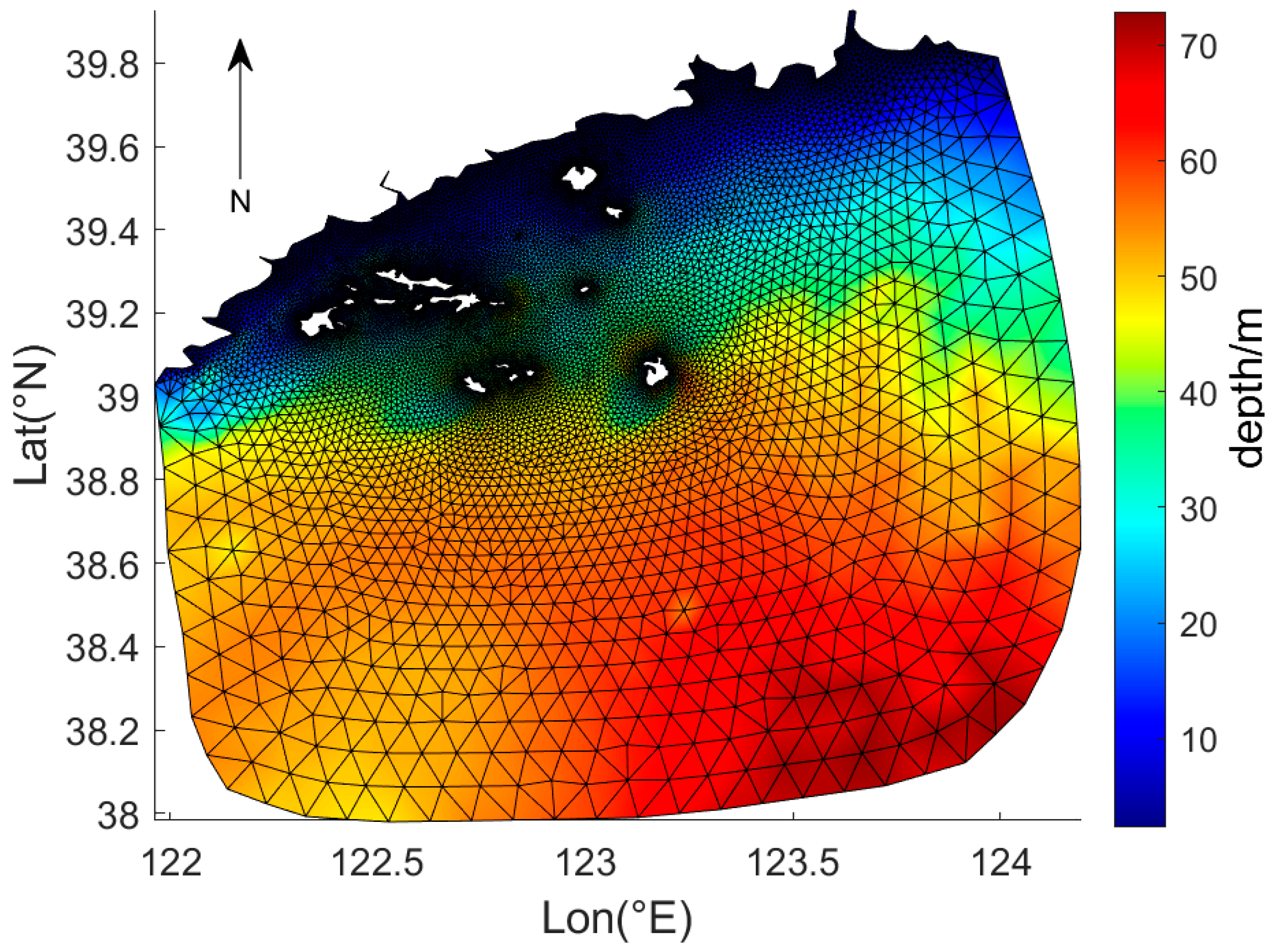
The scope of the research area is shown in Figure 1. The computational domain extends from 37.9–39.8° N and 122–124.3° E (Figure 2), encompassing the Changhai County island group and adjacent open waters. Bathymetric data were obtained from ETOPO1 and refined with nautical chart data near the coastline and islands. The model used the mean sea level of the Yellow Sea as the reference plane, consistent with the baseline of observational data in the study area. To capture the effects of Changhai County’s complex shoreline on hydrodynamics, the horizontal grid resolution varied from 10 km at the open boundaries to <1 km near the islands. Vertically, the model employed sigma coordinates with eight layers, resulting in 9894 nodes and 18,981 cells across the domain. For numerical stability under the CFL condition, the outer time step was set to 1 s and the inner time step to 10 s. The model also included dry–wet grid detection with a minimum water depth threshold of 0.05 m.
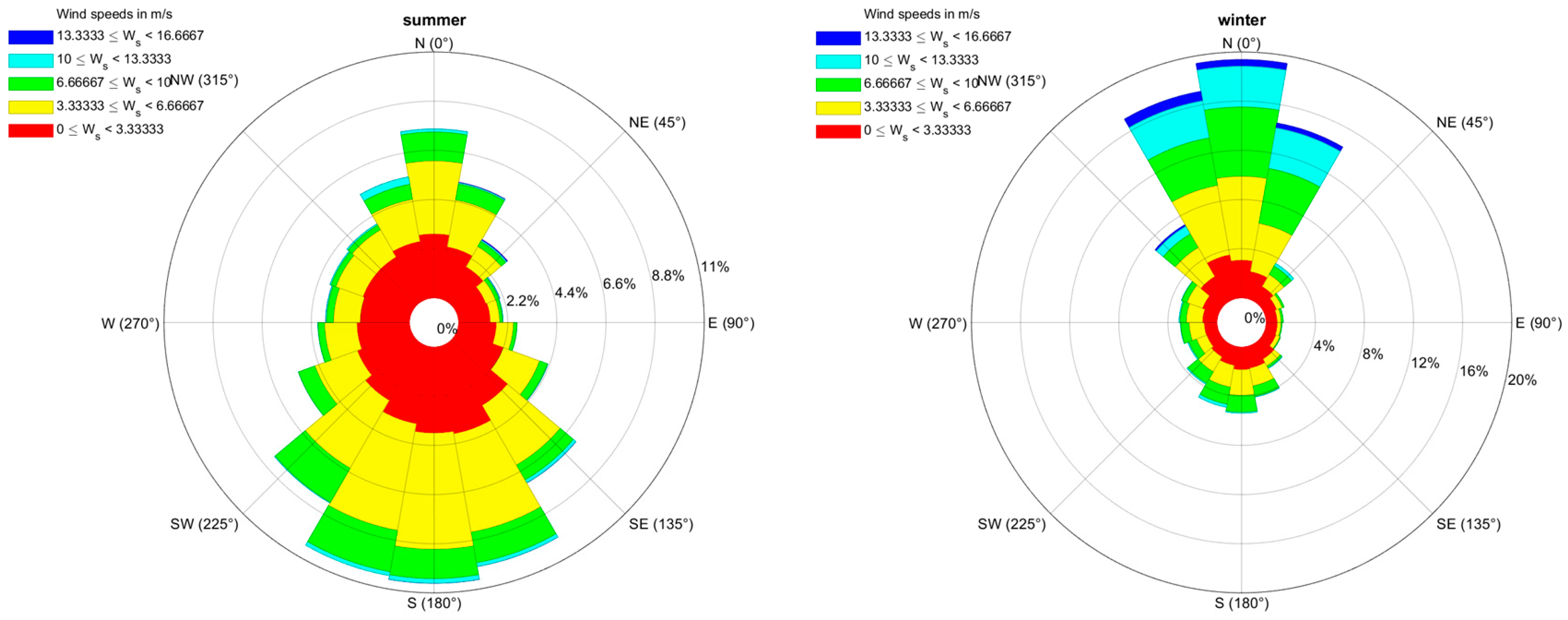
Open-boundary tidal levels were forced using the harmonic constants of eight major tidal constituents (O1, K1, P1, Q1, M2, S2, N2, K2) derived from the Ocean Tidal Prediction Software (OTPS, version 3.2). Wind forcing was provided by ERA5, the fifth-generation atmospheric reanalysis from the European Centre for Medium-Range Weather Forecasts (ECMWF), using 10 m wind fields (https://cds.climate.copernicus.eu/datasets/reanalysis-era5-single-levels?tab=overview, accessed on 1 December 2025). The ERA5 dataset has a spatial resolution of 0.25° × 0.25° and a temporal resolution of 1 h. Figure 3 shows wind rose diagrams for summer and winter in Changhai County and adjacent waters. Prevailing southerly winds dominate in summer, whereas stronger northerly winds prevail in winter. The mean wind speed during the winter half-year was 5.84 m s−1. Additional surface meteorological forcing from ERA5—including evaporation, precipitation, sea-level pressure, shortwave and longwave radiation, and sensible and latent heat fluxes—was included to simulate air–sea interactions affecting upper-ocean temperature and salinity. Temperature and salinity fields were obtained from the Copernicus Marine Environment Monitoring Service (CMEMS) global ocean reanalysis (https://marine.copernicus.eu/, accessed on 1 December 2025), with a spatial resolution of 0.083° × 0.083° and a temporal resolution of 1 d.
Simulations were performed for two representative seasons: summer 2023 and winter 2023–2024 (Table 1). Each simulation included a one-month spin-up to achieve hydrodynamic equilibrium. The selected simulation periods are representative of typical seasonal hydrodynamic conditions in the northern Yellow Sea. According to long-term wind and hydrographic statistics, the summer period is characterized by stable stratification and prevailing southerly winds, whereas the winter period features strong northerly monsoon winds and enhanced vertical mixing. Therefore, although the investigated periods are limited in time, they capture the dominant seasonal forcing mechanisms controlling water exchange in the Changhai Sea area.
Although parameter and boundary uncertainties may affect absolute values, the present study emphasizes relative differences among forcing scenarios, which are less sensitive to reasonable parameter variations.
To further assess the reliability of the model results, we applied the SKILL metric to evaluate performance. This metric is widely used in hydrodynamic model validation [14] because it reduces the influence of extreme values on validation outcomes. The formula is given as [15]:
S K I L L = 1 i = 1 N | M i O i | 2 i = 1 N | M i O ¯ | + | O i O ¯ | 2
where Mi and Oi represent the modeled and observed variables, respectively, and Ō denotes the mean of the observations SKILL. The SKILL score quantitatively measures the agreement between simulations and observations. Table 2 summarizes model performance categories based on SKILL values [16].

3. Results and Discussion

3.1. Model Validation

Model validation was carried out using observed tidal currents and local tide table data. Validation sites were chosen at key locations in the Changhai County waters (Figure 1), including core aquaculture zones (W1, W2), open-water sites (S1, S2), and temperature–salinity stations (T1, T2).

3.1.1. Tide Level Validation

Hourly tide-level data were obtained from the China National Marine Science Data Center (https://mds.nmdis.org.cn/, accessed on 2 December 2025) for Xiaochangshan Island (39.222° N, 122.667° E) and Haiyang Island (39.069° N, 123.142° E). Data accuracy was assessed through quality control, with an error range of ±3–10 cm.
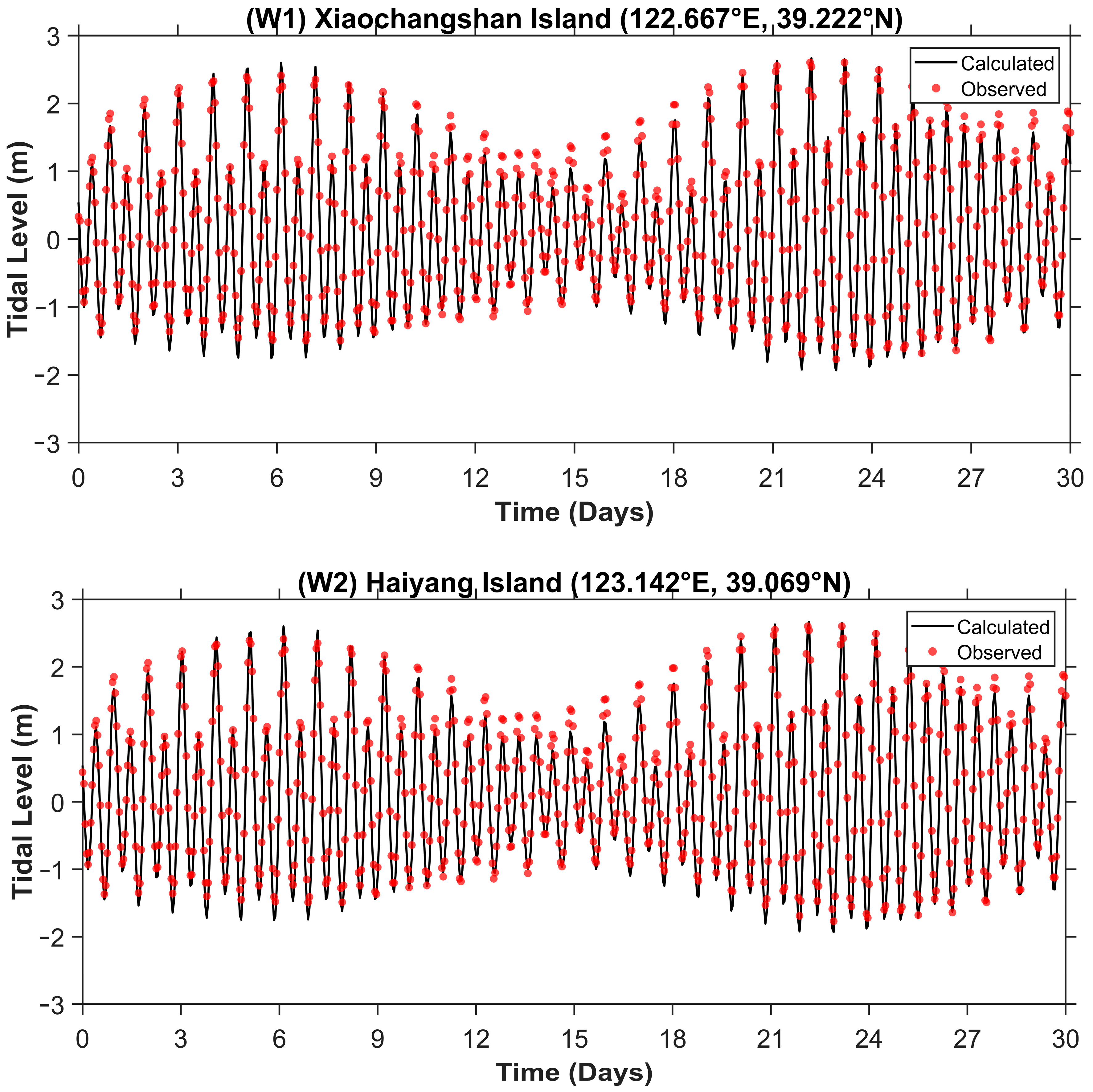
Figure 4 compares simulated and observed tidal heights over a 30-day period starting on 1 July 2024, using tide gauge data from Haiyang Island and Xiaochangshan Island. The simulations closely match the observations, with SKILL scores of 0.976 at Xiaochangshan Island and 0.970 at Haiyang Island, indicating that the model reproduces local hydrodynamic processes with high accuracy. Notably, the tidal validation period (July 2024) is independent of the scenario simulations (summer 2023 and winter 2023–2024; Table 1). This separation ensures that model reliability is tested against recent observational data. The model was applied to analyze water exchange and material transport during the study periods only after successful validation.
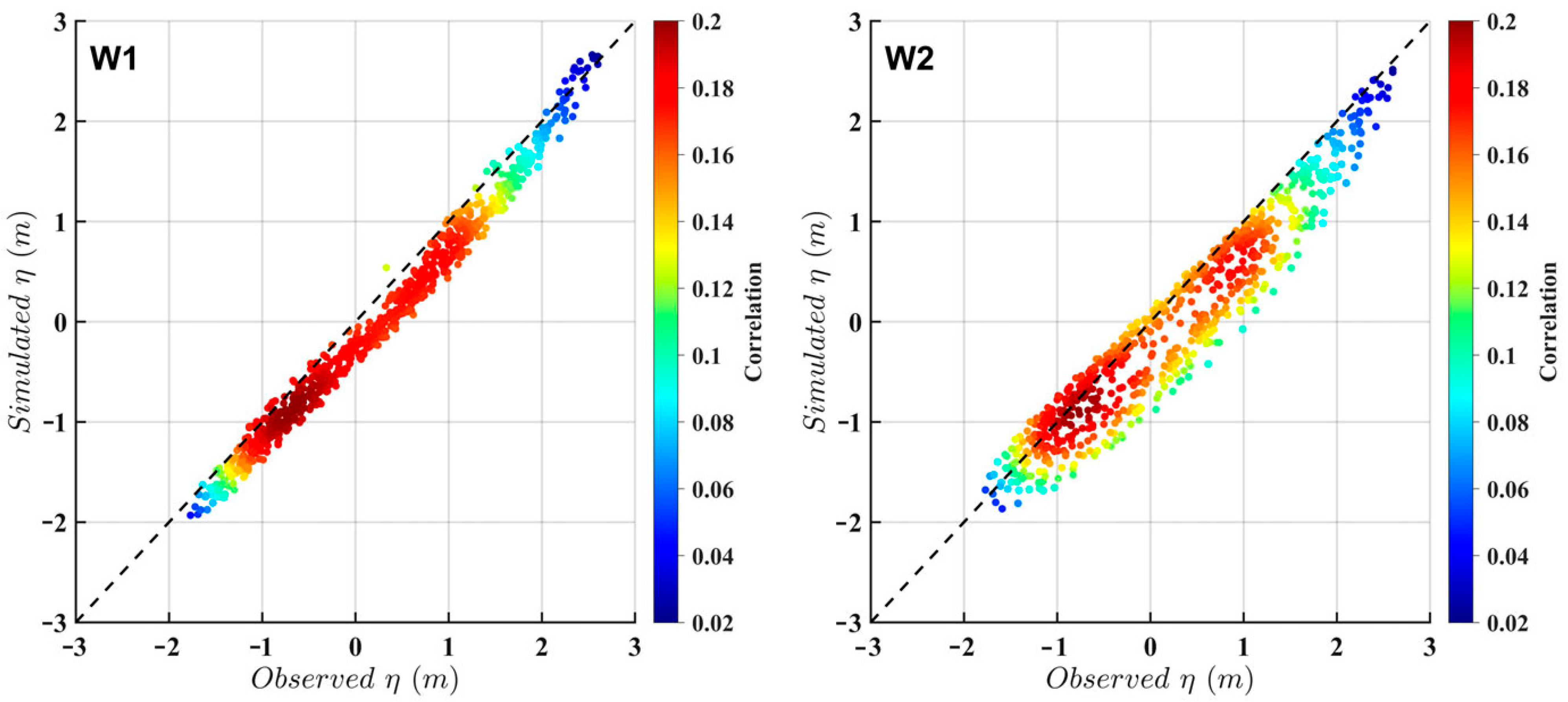
To further evaluate model performance, we compared observed and simulated water levels using a scatter plot (Figure 5). Most data points cluster near the 1:1 diagonal line, where observed and simulated values coincide, indicating strong correlation [17]. This demonstrates strong agreement between simulations and observations, confirming the model’s reliability.

3.1.2. Verification of Tidal Currents and Temperature–Salinity

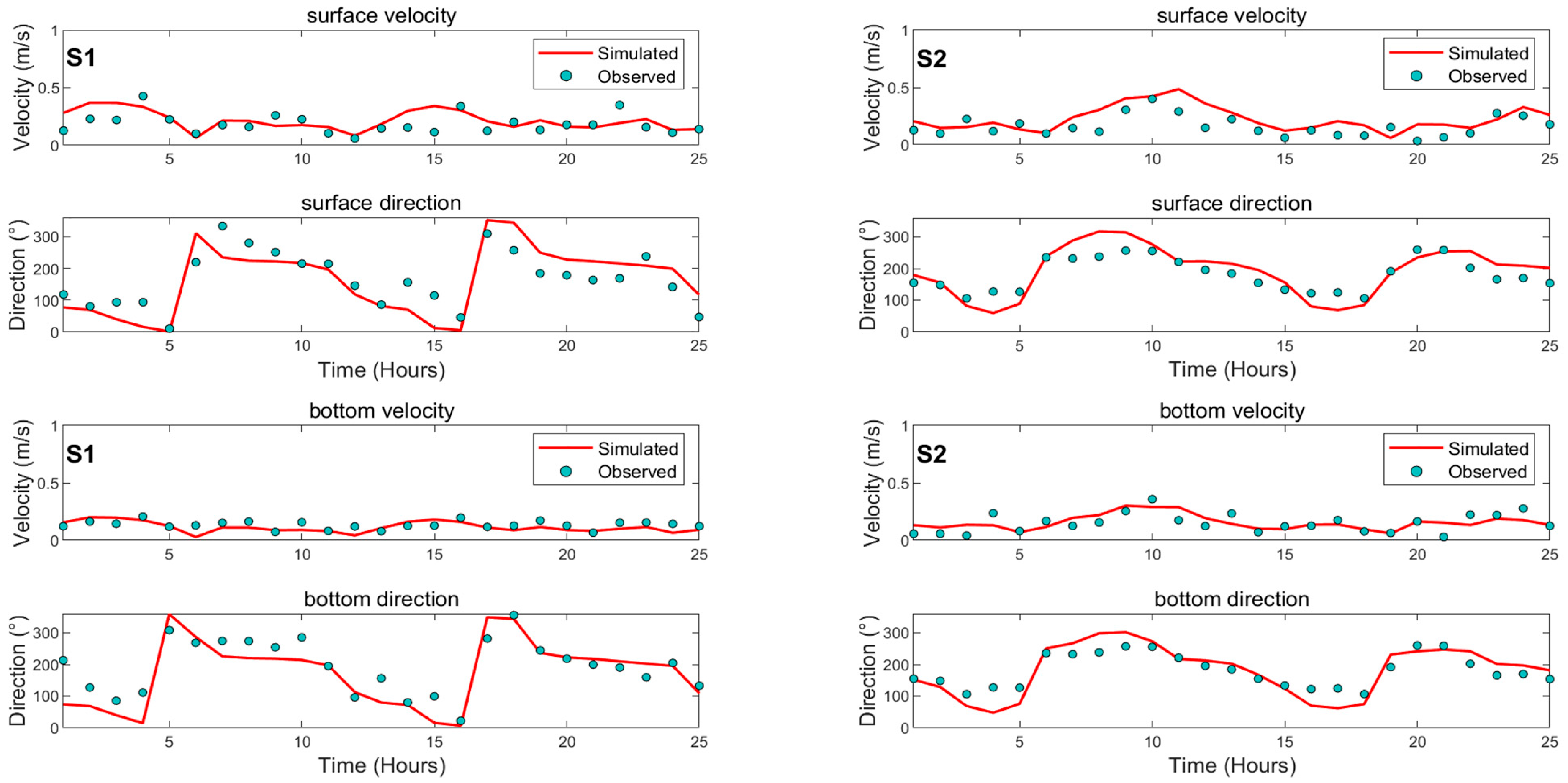
The accuracy of the simulated flow field was assessed using velocity data from tidal stations S1 and S2 (Figure 6). As shown in Figure 6, both simulated and observed values yield SKILL scores above 0.6 (Table 3). Therefore, the model effectively reproduces the flow field in this region.
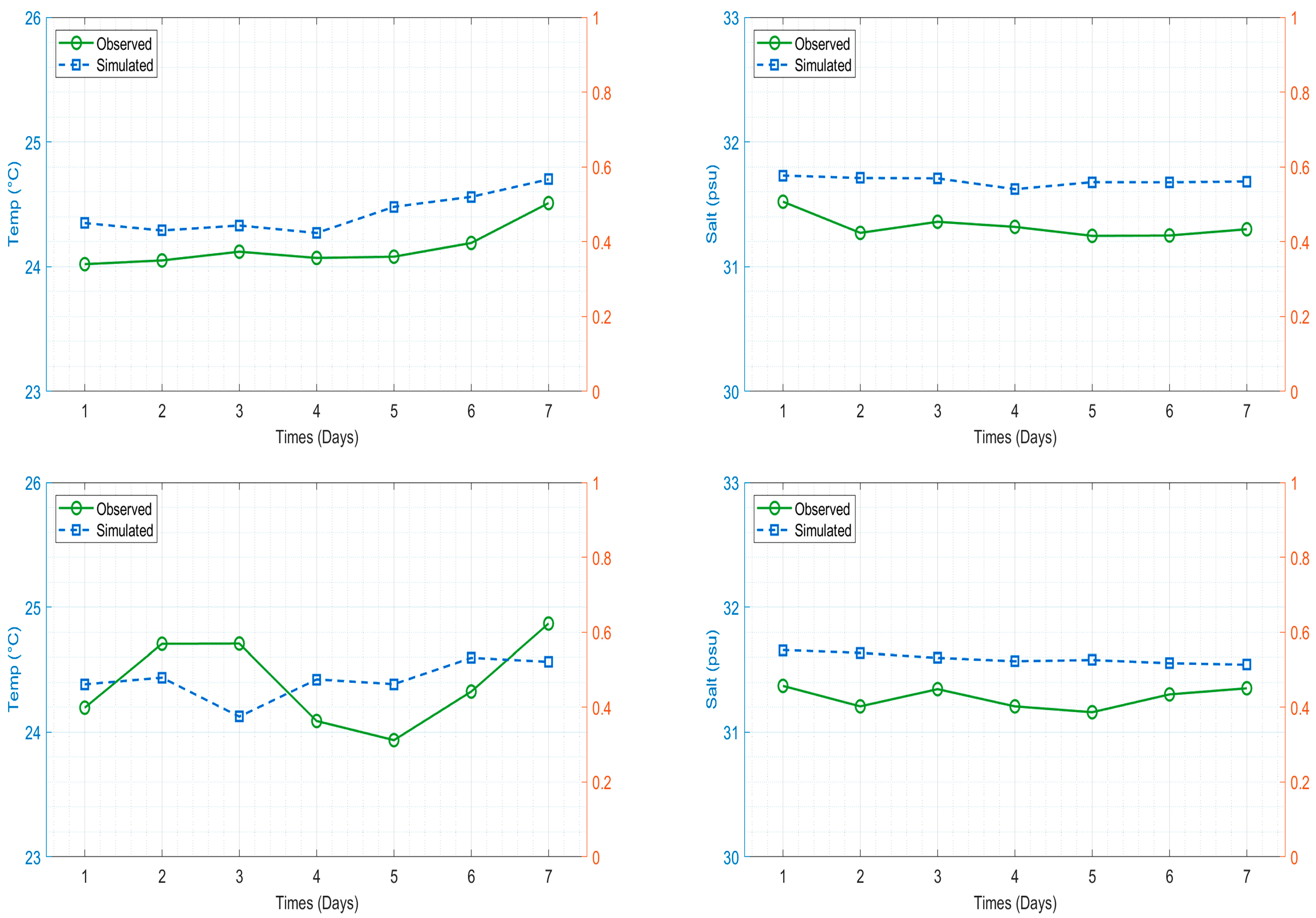
Figure 7 shows the comparison between simulated and observed surface temperature and salinity. Temperature validation data were obtained from daily averages at Zhangzidao and Xiaohaodao, while salinity data were derived from the HYCOM reanalysis (https://ncss.hycom.org/thredds/ncss/grid/GLBy0.08/expt_93.0/ts3z/2024/dataset.html, accessed on 2 December 2025). The validation period covers one week, from August 2 to 8. Results indicate satisfactory performance, with a maximum error of ~0.5. Deviations are mainly attributed to complex topography near the islands. Thus, this validation provides reasonable support for applying the model with the temperature–salinity module in subsequent analyses.

3.1.3. Analysis of Tidal Field Results

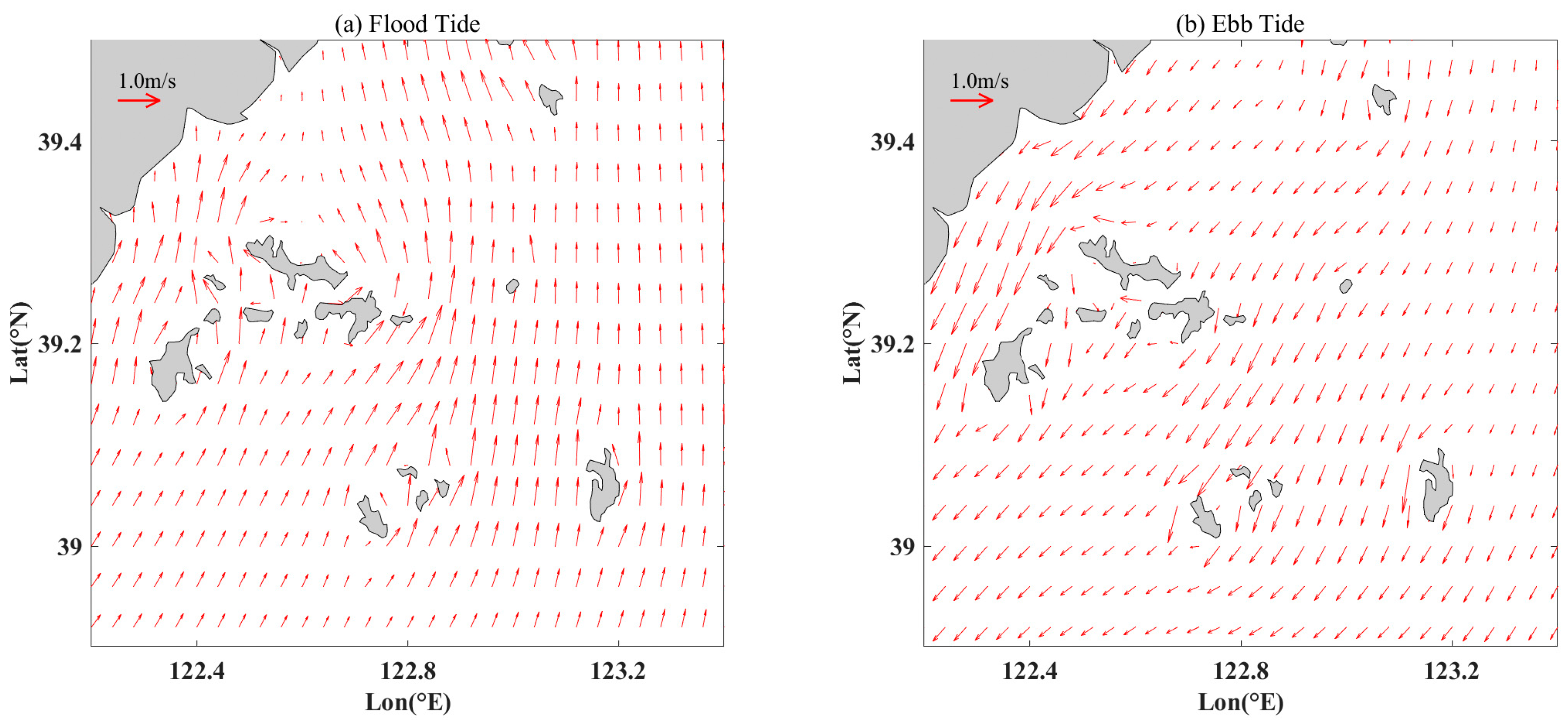
Tides are a major driver of water movement in nearshore and estuarine areas, strongly influencing water exchange. First, periodic back-and-forth flows transport water masses by advection, facilitating exchange with adjacent open waters. Second, when tidal currents pass through complex topography (e.g., islands or channels), they generate strong velocity shear that enhances turbulent mixing and vertical diffusion [18]. The tidal field in Changhai County lies along a major propagation path of the large rotational tidal system in the Bohai and Yellow Seas, and shows distinct local characteristics. Its tidal type manifests as a regular semi-diurnal tide. Figure 8 shows the flow field distribution during peak flood and ebb tides in Changhai County and adjacent waters. The figure indicates that tidal flow in Changhai County generally follows a southwest–northeast orientation, forming a recirculating pattern. During flood tide, the flow moves landward from the open sea. The island configuration of Changhai County generates characteristic around-island circulation: one branch flows northeastward along the eastern and western channels of Guanglu Island, while another flows northwestward around the eastern side of Changshan Island, replenishing the coastal waters. The average velocity is 0.263 m s−1. At high tide, velocity decreases. In the channels around Xiaochangshan and Dachangshan Islands, the average velocity reaches 0.553 m s−1, exceeding the 0.425 m s−1 in the open sea. During ebb tide, flow reverses southwestward with an average velocity of 0.249 m s−1, slightly lower than during peak flood. The islands create a sheltering effect, producing a localized countercurrent north of Xiaochangshan Island. Differences between high and low tides mainly result from the stronger offshore tidal forcing at high tide. At low tide, water movement is gravity-driven but must overcome island topographic resistance, causing a slight velocity reduction.
Model validation results demonstrate that the FVCOM coupled model established in this study accurately reflects the spatiotemporal characteristics of hydrodynamics in the Changhai Sea area. This section systematically investigates the influence of hydrodynamics on water exchange in Changhai County, focusing on four key aspects: vertical stratification, Eulerian residual currents, diffusion of conserved substances, and spatiotemporal distribution of residence time. Further analysis examines the water exchange mechanisms between Changhai County and adjacent sea areas, along with their seasonal variations.

3.2. Seasonal and Spatial Patterns of Vertical Stratification

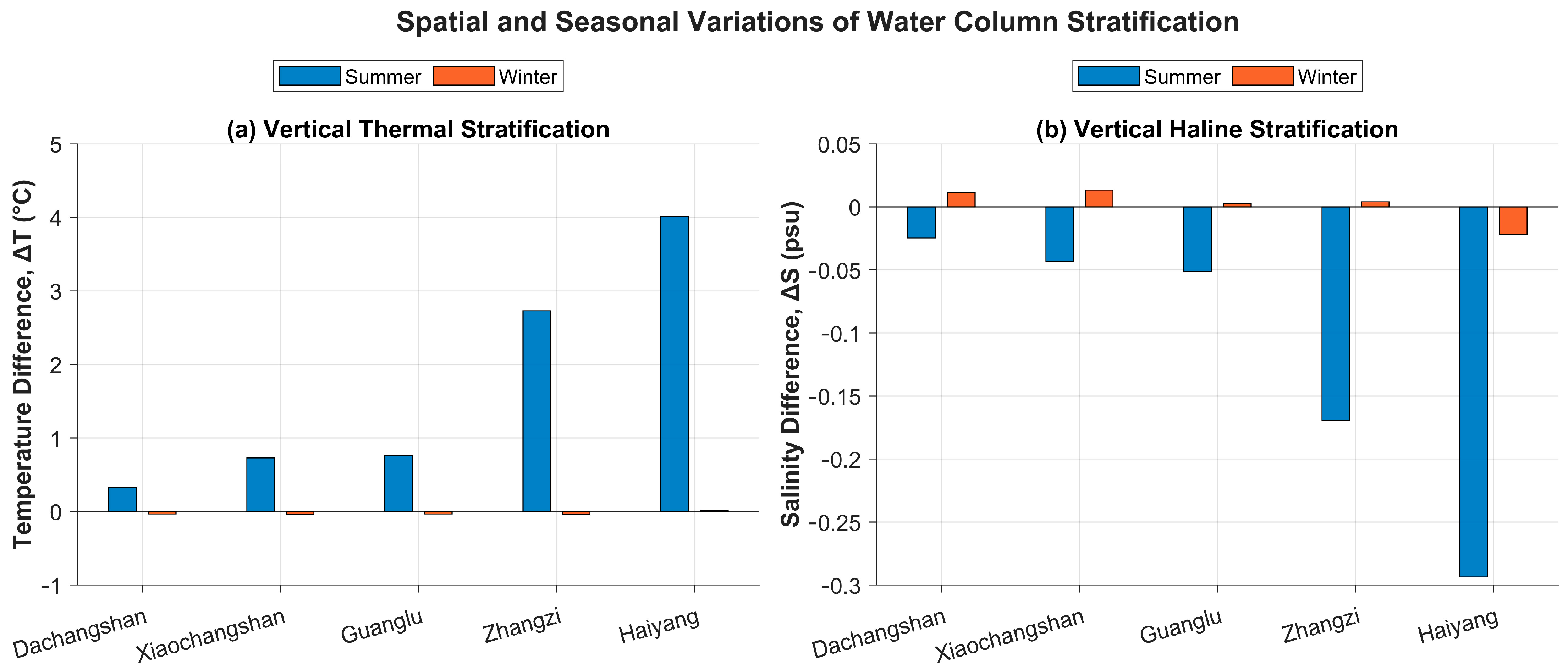
Vertical stratification showed strong seasonal and spatial variability (Figure 9). In summer, temperature differences (ΔT) ranged from ~0.5 °C in the nearshore northern bays to ~3 °C in the southern offshore waters near Zhangzi and Haiyang Islands, reflecting the development of a pronounced seasonal thermocline. In winter, ΔT approached zero throughout the region, indicating complete vertical mixing. Salinity differences (ΔS) were slightly negative (−0.05–−0.30 psu) in summer and near zero in winter, consistent with surface freshwater inputs and wind-driven mixing.
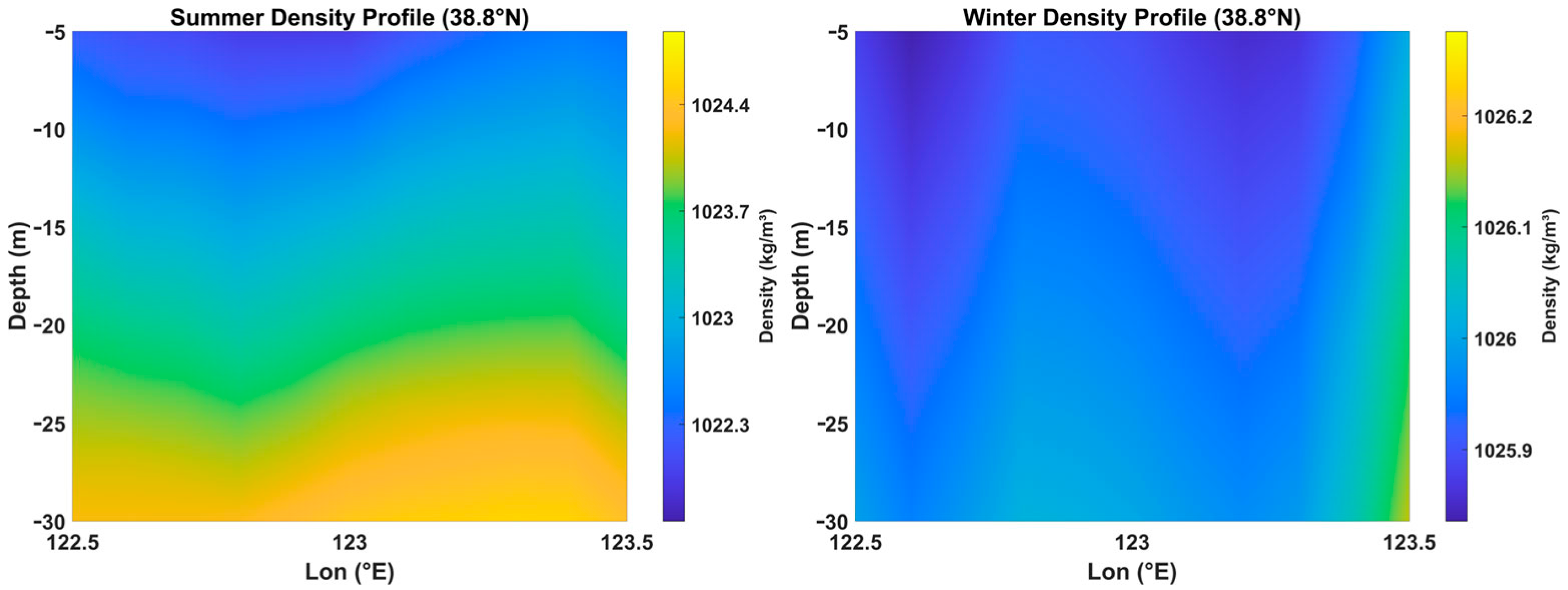
To further quantify the intensity and spatial variability of vertical stratification, density profiles were calculated using the GSW (Gibbs Seawater) toolbox based on the simulated temperature and salinity fields (Figure 10). The results show that the summer water column exhibits a pronounced vertical density gradient, with a regional-scale surface–bottom density difference (Δρ) reaching up to approximately 2 kg m−3, indicating strong thermal and haline stratification. In contrast, the winter density field is nearly homogeneous (Δρ < 0.2 kg m−3), suggesting complete vertical mixing driven by strong wind forcing and convective overturning.
This density-based stratification characterization provides a more robust description of vertical stability than temperature alone and clearly reveals that enhanced stratification in summer suppresses vertical mixing and weakens water exchange.
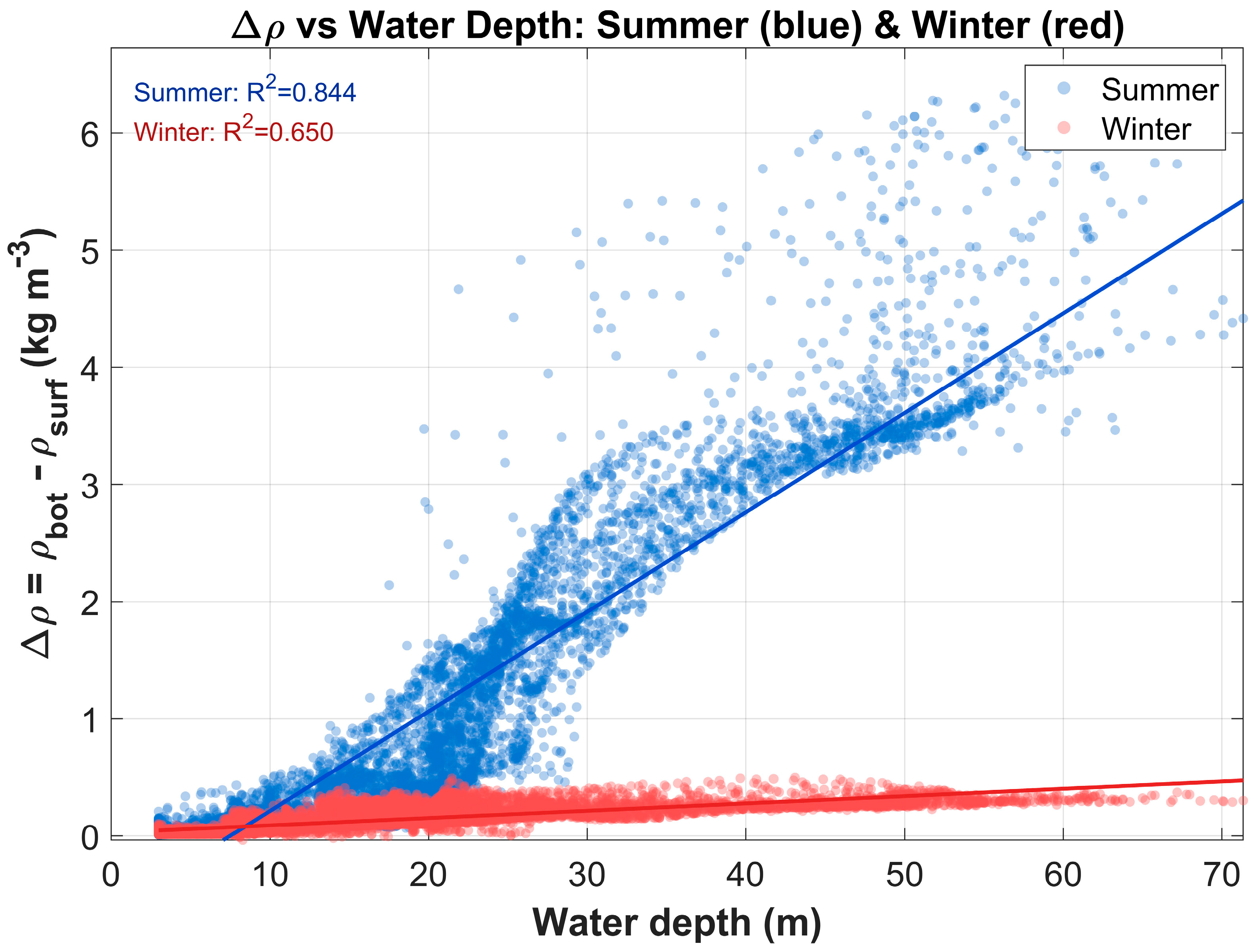
The relationship between Δρ and water depth further supports this spatial pattern (Figure 11). Δρ increases monotonically with depth (R2 = 0.84 in summer; R2 = 0.65 in winter), indicating that stratification intensifies with increasing bathymetry. In nearshore shallow zones (depth < 20 m), tidal and wind-driven mixing efficiently homogenize the water column, leading to weak stratification (Δρ ≈ 0.07–0.09 kg m−3). In contrast, deeper offshore regions (depth > 40 m) around Zhangzi and Haiyang Islands exhibit typical local Δρ values of approximately 0.4–0.6 kg m−3, suggesting enhanced vertical stability and reduced mixing.
These results are consistent with previous observations in the Bohai and northern Yellow Seas [19], confirming that bathymetry and seasonal forcing jointly regulate the strength of stratification, which in turn influences local water exchange capacity and ecological processes.

3.3. Eulerian Residual Currents

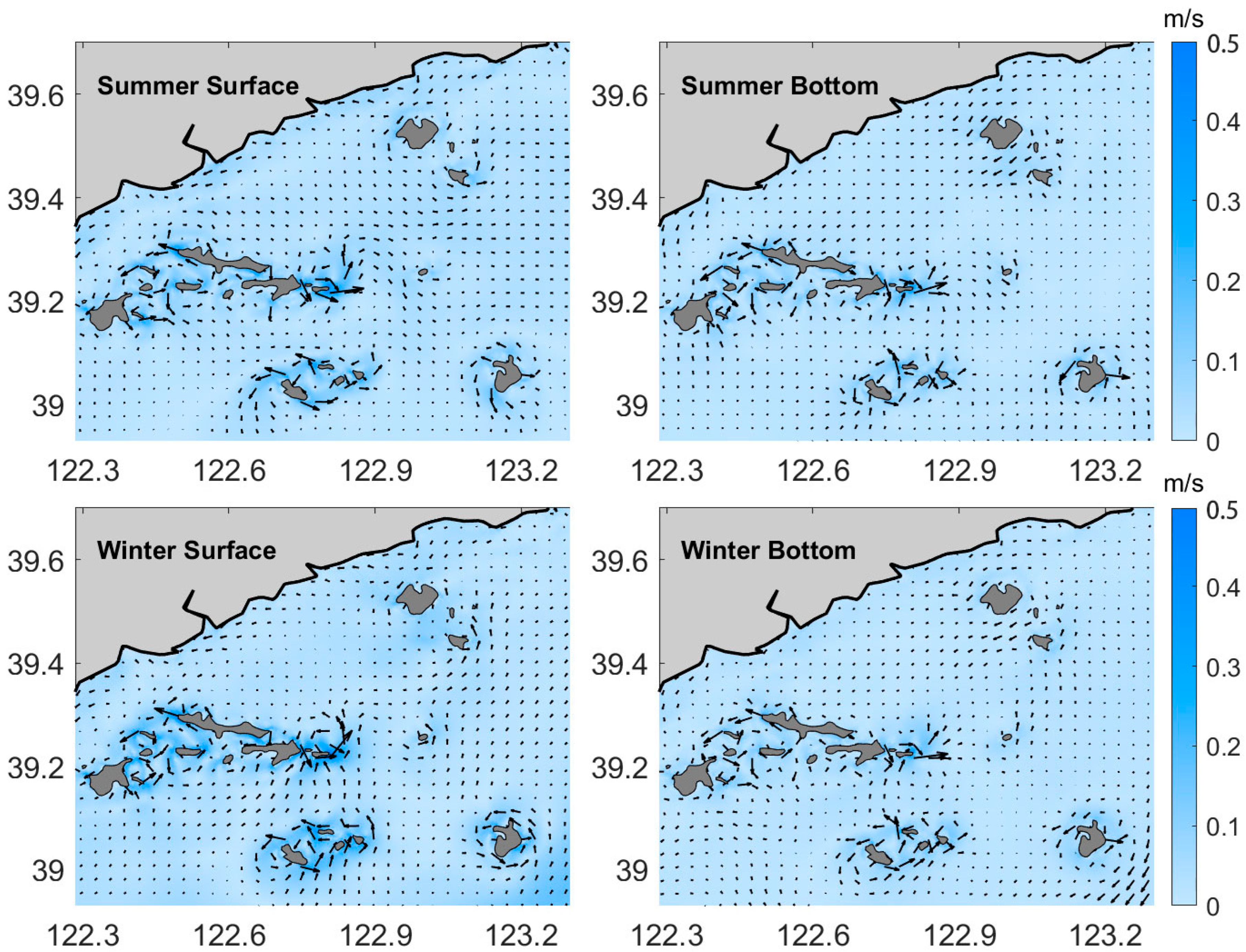
Eulerian residual currents arise from the combined effects of tidal nonlinearities (e.g., bottom friction, topographic flow) and external forcing (e.g., wind, thermohaline baroclinicity). Although typically only 1/5 to 1/10 the magnitude of tidal currents (<0.1 m s−1), residual currents are the primary drivers of conservative substance transport (e.g., pollutants, nutrients) across tidal cycles, playing a crucial role in their dispersion in coastal waters. Model outputs after 25 h of stable operation reveal residual flow fields in both surface and bottom layers (Figure 12). Overall residual flow in Changhai County is weak, with summer surface average velocities ranging from 0.0255 to 0.0373 m s−1 and bottom velocities from 0.0163 to 0.0243 m s−1. In winter, surface velocities increase to 0.0376–0.0690 m s−1, while bottom velocities range from 0.0131 to 0.0368 m s−1 (Table 4). Winter surface residual velocities increase by 30–85% compared with summer, whereas seasonal variation in bottom residual flow is smaller (maximum < 65%). Seasonal variation is modest, mainly because stronger winter wind stress drives upper-layer movement, while bottom friction limits the response of lower-layer residual currents.
Residual currents display a gradient of “stronger nearshore, weaker offshore,” with higher values near island coasts (0.0308 m s−1) and lower values offshore (0.0244 m s−1). Overall, residual currents generally circulate counterclockwise. In areas with complex topography, such as around Zhangzi and Haiyang Islands, vortex-like local circulation develops due to flow-around effects.

3.4. Concentration Diffusion Distribution

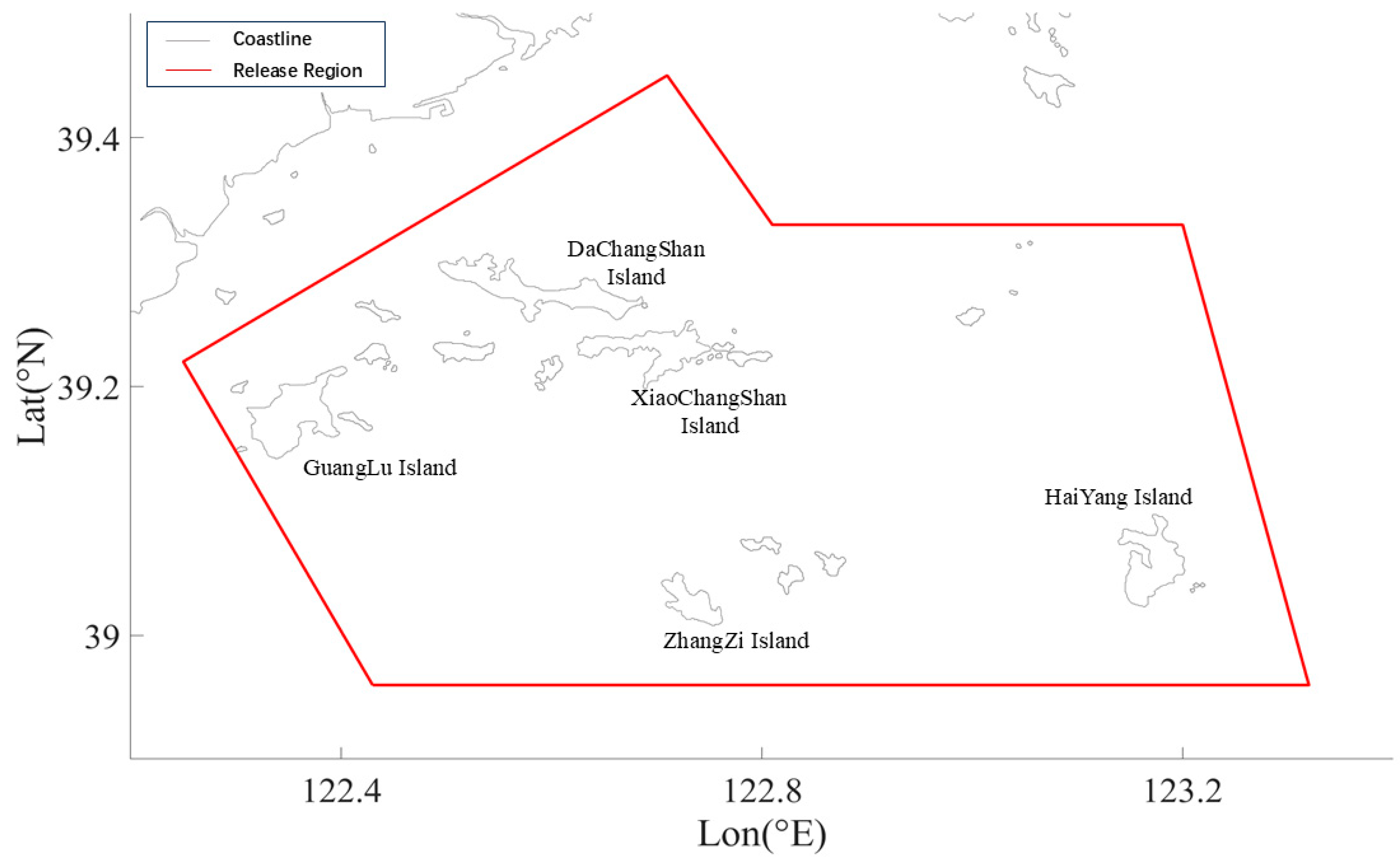
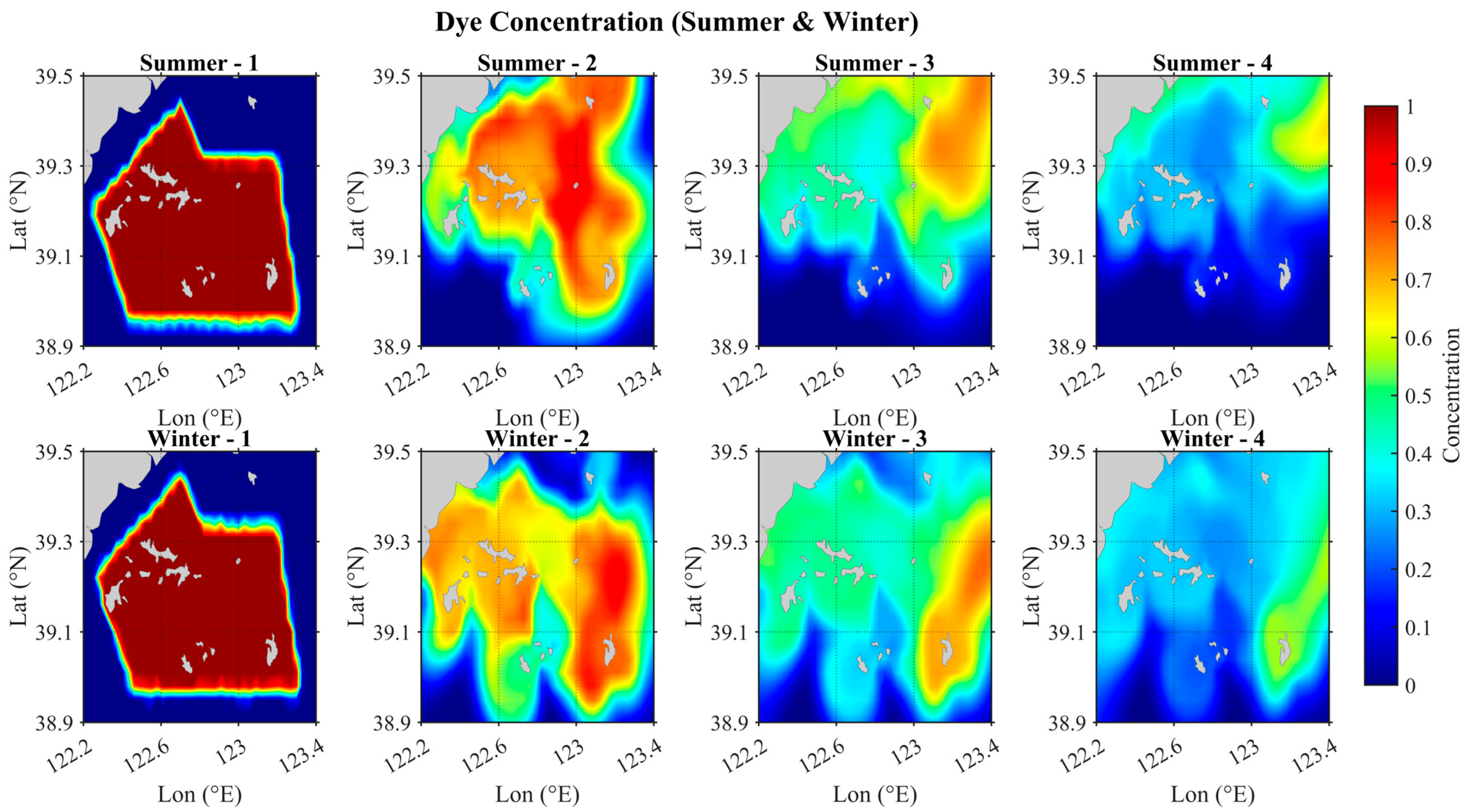
To quantitatively assess water exchange efficiency in Changhai County, we simulated the diffusion of conservative tracers in summer and winter using a coupled tracer module. Tracers were released within the administrative boundaries of Changhai County (Figure 13). The initial concentration was set to 1 inside the release zone and 0 in offshore waters. Concentration distributions were extracted at four time points—initial, day 30, day 60, and day 90—for analysis. Simulation results are shown in Figure 14, which illustrates the temporal evolution of average concentration across the study area. The diffusion process shows marked seasonal variations and spatial heterogeneity in tracer transport from the release zone. By day 30, substantial diffusion had occurred in both summer and winter. High-concentration areas (>0.5) within the release zones decreased by 5.85% in summer and 12.70% in winter relative to the initial state. This indicates faster diffusion in winter than in summer: the average concentration in the Changshan Islands release zone had fallen to 68.1% in winter, while it remained at 71.42% in summer. By day 60, overall diffusion in both seasons exhibited a “northeast-southeast” bidirectional extension. This pattern aligns with the dominant southwest–northeast reciprocating tidal flow described earlier (Figure 8). The reciprocating flow in Changhai County and adjacent waters slows material diffusion, However, in winter the diffusion distance toward the open sea increased by ~22% compared to summer, reflecting the role of stronger residual currents in accelerating transport. By day 90, most tracers had diffused into the open ocean, with average concentrations <0.2%. In winter, residual concentrations persisted around some islands (e.g., Ocean Island), averaging 0.56%. Spatially, diffusion near oceanic islands was faster in summer, with a monthly decline rate ~10% higher than in winter and a total duration reduction 36% greater. This difference reflects the role of local circulation. In summer, strong open-water residual currents (0.0373 m s−1) around islands accelerate outward transport. In winter, however, residual currents form circum-island flows that hinder diffusion. Around Guanglu Island and the Changshan Archipelago, diffusion accelerated in winter, extending ~23 km farther than in summer. In summer, diffusion around Guanglu Island was hindered by weak residual currents and clockwise local circulation. In winter, stronger residual currents driven by winds disrupted local circulation near Guanglu Island, thereby enhancing diffusion.

3.5. Residence Time Distribution and Mechanisms

The waters of Changhai County and adjacent seas are strongly influenced by tides, wind-driven currents, and thermohaline baroclinic forcing. These forcings and their interactions affect regional water exchange to varying degrees, all showing marked seasonal variation [20]. Therefore, we quantified both the independent and interactive effects of each factor using multi-scenario experiments [21]. Using the validated FVCOM model, we investigated the water exchange capacity of Changhai County and adjacent waters through residence time (Tre). Six numerical experiments with different forcing conditions were conducted (Table 5). Controlled experiments allowed us to isolate the regulatory roles of tides, wind, and temperature–salinity forcing on water exchange.
Tracer release ranges and initial concentrations were consistent with Section 3.2, and all simulations were run until Tre reached stabilization.

3.5.1. Summer Residence Time Analysis

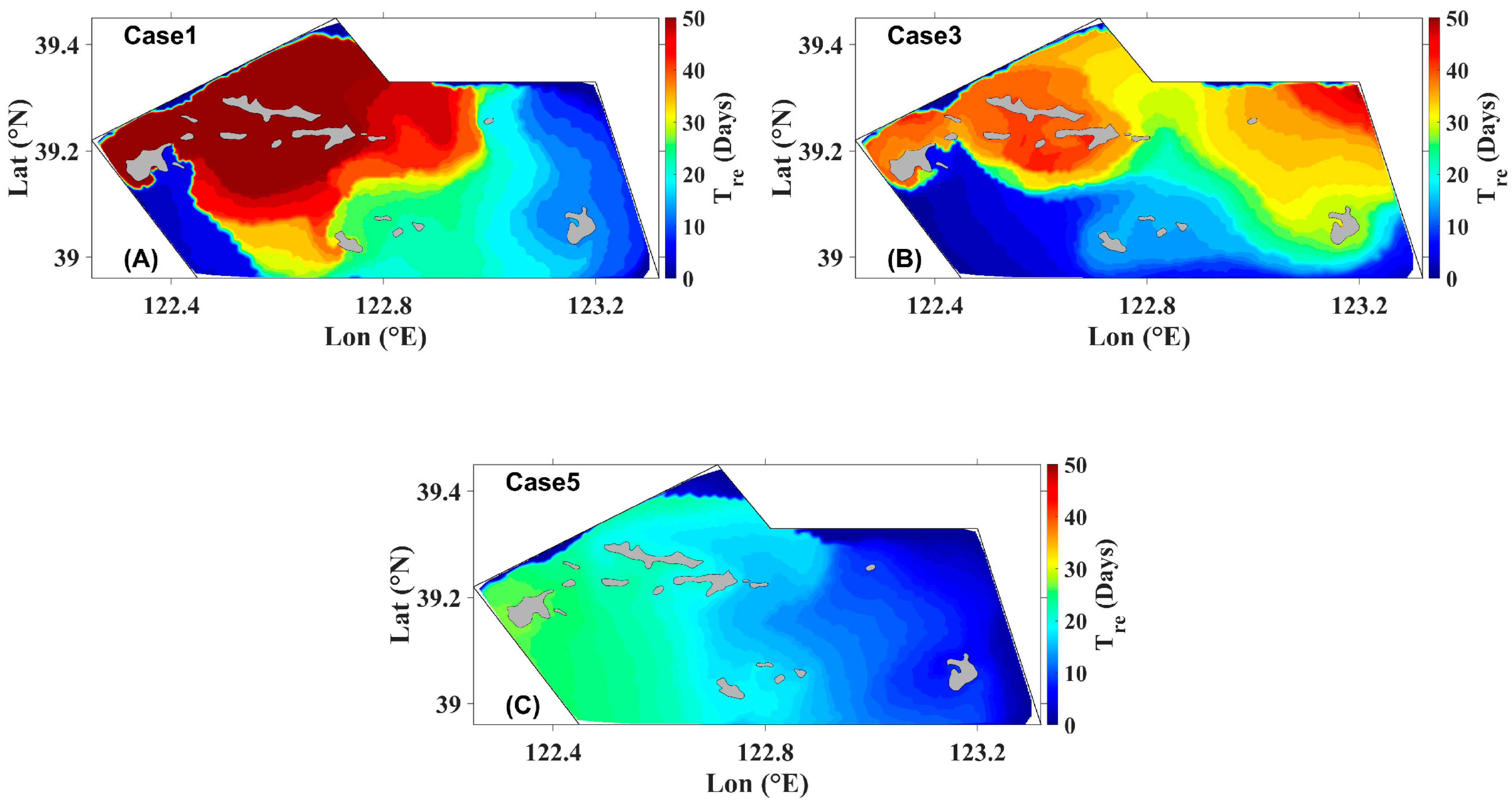
Figure 15 illustrates the spatial distribution of Tre under different dynamic forcing conditions (Cases 1, 3, and 5) in summer. For clarity, the surface, middle, and bottom layer data have been vertically averaged. The marked influence of forcing factors on Tre highlights the sensitivity of water exchange capacity to varying conditions.
In Case 5 (Figure 15C), tidal currents interact with the thermohaline structure to generate density-gradient-driven geostrophic and baroclinic flows [22], which enhance horizontal transport between islands [23]. The average Tre is 17 days, with the shortest value of 14.51 days in the eastern Oceanic Islands and northeastern Changshan Islands, indicating the highest summer exchange efficiency. Tidal mixing also disrupts local stratification, facilitating exchange between bottom waters and the open ocean. Together, these processes make Case 5 the scenario with the shortest Tre and most rapid summer water renewal.
In Case 3 (Figure 15B), tidal and wind effects operate without thermohaline forcing, eliminating density-driven exchange mechanisms. Water circulation is driven primarily by tides and wind. The overall average Tre increases to 26.77 days, about 10 days longer than in Case 5, with a local maximum (39.62–40.26 days) in the central Changshan Archipelago, between Dachangshan and Xiaochangshan Islands. The mechanism is as follows: prevailing southerly winds in summer (average speed 4.05 m/s) enhance vertical mixing through wind stress, but the complex archipelago topography induces stagnant vortices on leeward sides of islands or in semi-enclosed bays (e.g., northwest of Guanglu Island). These vortices substantially reduce the efficiency of outward material transport [24]. In addition, wind-driven Ekman currents may be blocked by island topography, reducing flux and exchange [25]. Together, these factors weaken regional water exchange, yielding much higher Tre values in Case 3 than in Case 5.
In Case 1 (Figure 15A), the interaction between wind and strong thermohaline stratification yields a Tre of 37.12 days. The Changshan Archipelago–Guanglu Island region shows a summer Tre peak of 46.62–48.64 days, the lowest exchange efficiency among all scenarios [26]. The main reason is the nonlinear response of wind–temperature–salinity interaction: strong summer stratification (vertical temperature difference of 4–6 °C) suppresses wind-driven mixing, limiting exchange between surface waters—where Ekman transport converges and forms high-concentration zones on the leeward side of Guanglu Island—and bottom waters. Moreover, under stratified conditions, the directional mismatch between baroclinic currents (counterclockwise) and wind-driven currents (southwestward) generates local “circulation blockages,” further inhibiting diffusion. This finding confirms that thermohaline structure promotes exchange most effectively under windless summer conditions, whereas wind forcing may locally suppress exchange under strong stratification.

3.5.2. Winter Residence Time Analysis

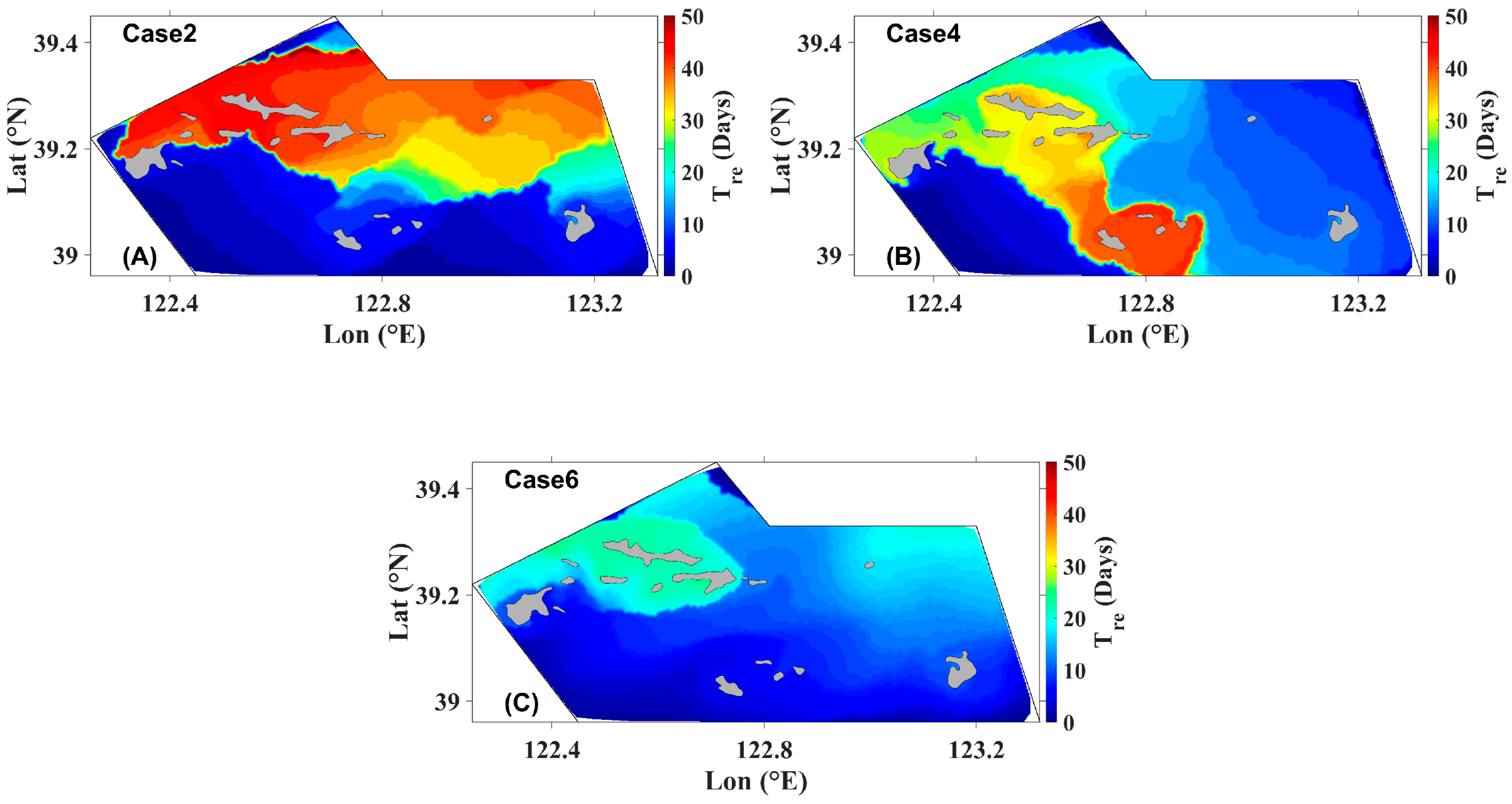
Figure 16 shows the spatial distribution of Tre in winter under different forcing scenarios: In winter, when wind forcing dominates, Tre ranges from 5 to 43.4 days—significantly shorter than in summer—and its spatial pattern is markedly altered.
In Figure 16C (Case 6), water exchange is mainly governed by density gradients and stratification. Stronger vertical mixing in winter weakens the thermohaline structure, thereby reducing its effect on large-scale exchange. Tre is generally low (5–15 days) and spatially uniform. Local stagnation zones occur only near the Changshan Islands and narrow channels, where velocity shear increases Tre to 22–23 days, though variations remain smaller than in summer. This suggests that winter thermohaline effects are more localized.
In Figure 16B (Case 4), the strong northwest monsoon dominates, driving conservative matter southeastward. Wind effects, however, vary regionally. In most areas (e.g., Changshan Archipelago and Guanglu Island), wind-driven currents accelerate transport, reducing Tre by 10–15 days. Near Zhangzi Island, by contrast, wind-driven flows interact with island-circumventing currents, forming return flows or stagnant zones [27]. Here, Tre increases to 38.7 days, reducing local exchange efficiency. Thus, wind forcing shows a regional coexistence of enhancement and inhibition.
In Figure 16A (Case 2), the overall concentration decay is slower than in single-factor cases, suggesting a synergistic effect of wind forcing and stratification that reduces regional transport. This interaction likely induces local circulation and stagnation, inhibiting diffusion. Nevertheless, compared with summer, water exchange is faster, with an average Tre of 23.7 days. Around the Changshan Islands and Guanglu Island, Tre is much shorter than the summer range of 40.96–43.4 days. This demonstrates that Changhai County has stronger water exchange capacity in winter than in summer.
Table 6 presents the residence time responses across different regions of Changhai County under varying dynamic conditions. Overall, water exchange in Changhai County is faster during the winter half-year than in the summer half-year. In summer, exchange capacity is weaker near Guanglu Island but stronger near Haiyang Island. In winter, capacity increases around Guanglu Island, with Zhangzi Island and Haiyang Island exhibiting the highest exchange rates [28].

3.6. Regional Concentration Variations

To quantify regional differences in residence time, this study applies regional remnant function to analyze concentration change rates under different hydrodynamic conditions [29]. This approach illustrates the spatial heterogeneity of material transport (Figure 17 and Figure 18) and provides a more intuitive assessment of regional water exchange efficiency [30]. The regional remnant function was calculated from the onset of dye release and continuously tracked over the entire simulation period following the release. Regional divisions are based on the administrative boundaries of Changhai County (Figure 13).

3.6.1. Summer

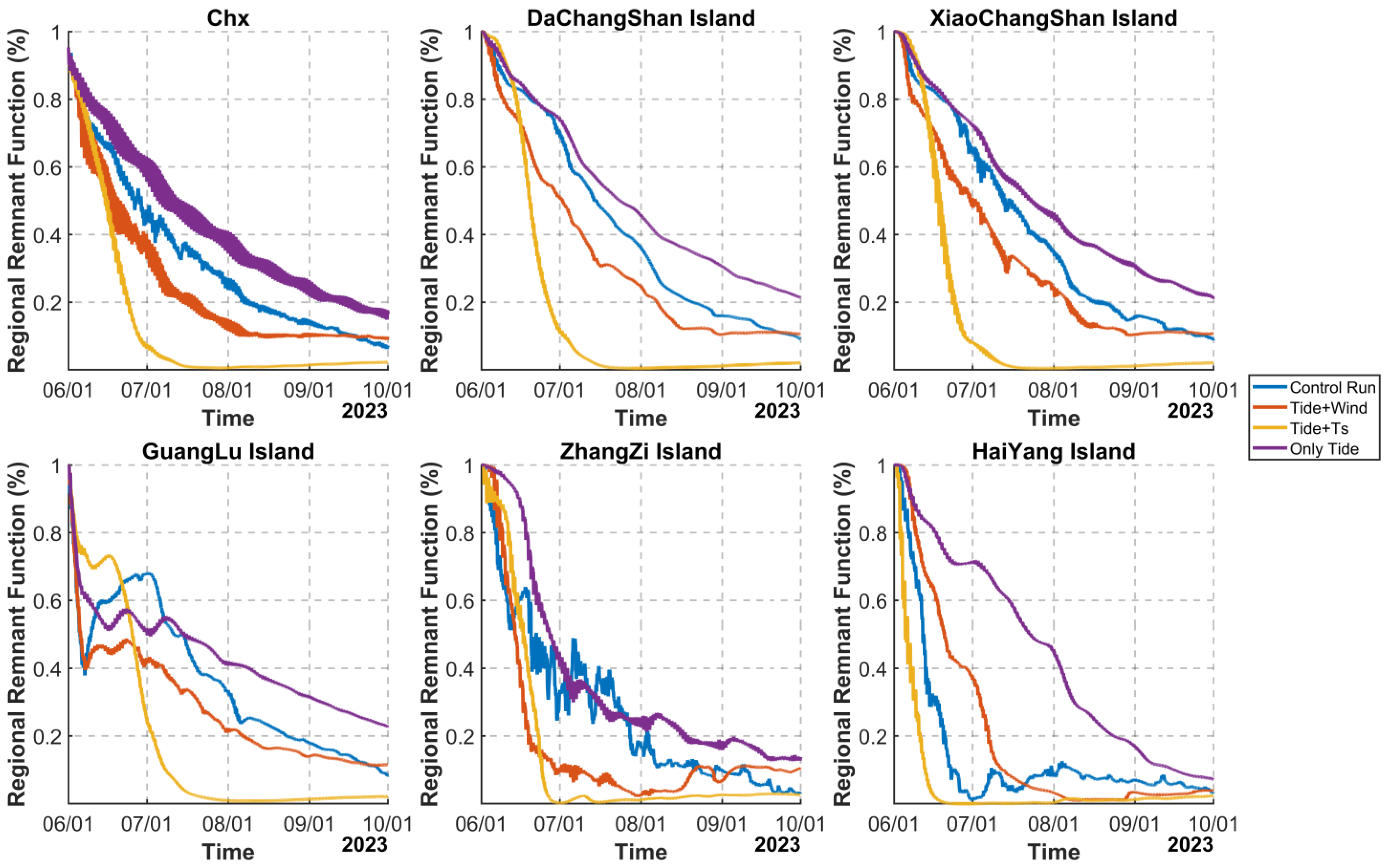
Figure 17 shows regional remnant function for six subregions in summer under four dynamic scenarios.
Under tidal-only conditions, concentration decline was slowest across all regions, with minimal inter-regional variation. This indicates that tides exert only a weak driving force on material transport, while their periodicity constrains and slows overall migration [31]. With the addition of the summer monsoon, concentration decay accelerates markedly. Compared with the tidal-only scenario, all regions reach equivalent concentrations about 30 d earlier. This demonstrates that wind stress substantially enhances horizontal transport and vertical mixing, thereby accelerating diffusion and migration. Wind forcing increases kinetic energy by intensifying currents and turbulence, thereby improving water exchange efficiency.
Under combined tidal and thermohaline forcing, concentration decline across Changhai County increases about fourfold relative to the tidal-only scenario. This primarily stems from the density gradient formed by the thermohaline distribution generating additional baroclinic and density-driven currents under tidal currents, thereby enhancing horizontal transport and vertical mixing efficiency. Compared with tidal-only conditions, coupling tides with thermohaline structures not only accelerates horizontal diffusion but also promotes dilution and migration by altering flow fields and enhancing vertical exchange [32].
However, in the control run with both wind and thermohaline forcing, some regions (e.g., the Changshan and Zhangzi Islands) showed reduced water exchange capacity. A likely mechanism is the interaction between wind stress and stratification, which generates local circulatory or stagnant structures that inhibit diffusion and transport.
In summary, both wind forcing and thermohaline structures strongly influence material transport: wind mainly promotes horizontal transport, whereas thermohaline forcing enhances vertical mixing [33]. However, their coupled interaction under specific topographic conditions can trigger nonlinear feedback, reducing local water exchange capacity.

3.6.2. Winter

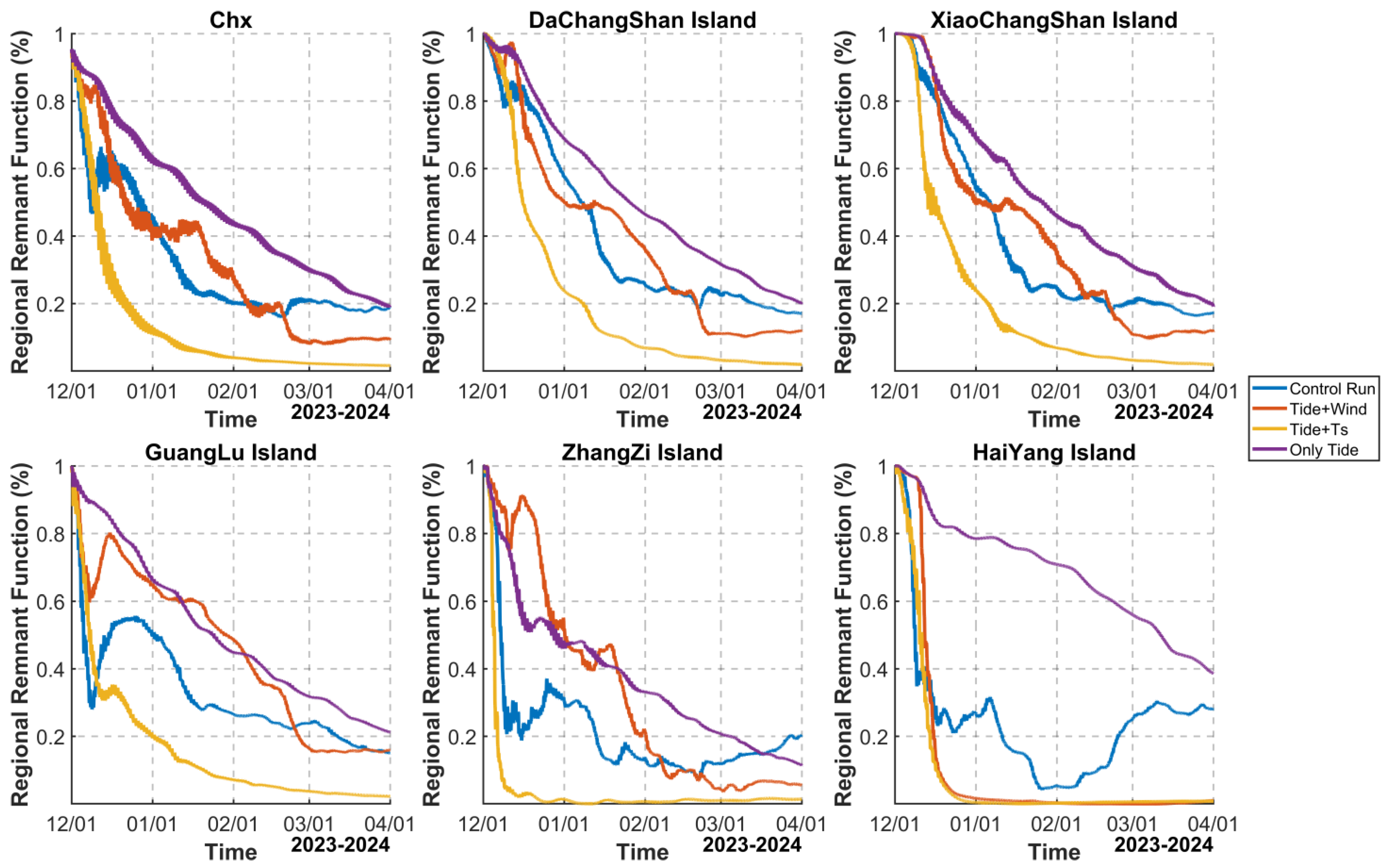
As shown in Figure 18, the winter regional remnant function indicate that under tidal forcing alone, material migration is slowest. Most regions maintain high concentrations throughout the simulation, indicating that tides have limited capacity to drive winter diffusion—a pattern consistent with summer. In contrast, under wind forcing, material transport accelerates significantly. In many regions, concentration decay occurred over 20 days earlier than in the tidal-only case, especially near Guanglu, Zhangzi, and Haiyang Islands. This demonstrates that winter winds, as the dominant external forcing, strongly enhance coastal and offshore transport, playing a decisive role in water renewal.
Under temperature–salinity forcing, most regions also showed accelerated concentration decline, with rapid decay during the initial phase (December–January). Across Changhai County, 50% dispersion occurred within 15 days, and near some islands (e.g., Zhangzi and Haiyang), the fastest decline occurred in just 5 days. This reflects enhanced winter vertical mixing, where weakened stratification facilitates exchange between surface and bottom waters [34], thereby improving overall transport efficiency.
In the control run, adding both wind and thermohaline forcing accelerated concentration decline in most areas, demonstrating synergistic effects between wind-driven and thermohaline disturbances during winter. For example, near Guanglu and Xiaochangshan Islands, the blue curve declined faster than in single-driver cases, indicating enhanced transport efficiency from combined effects. However, in some regions (e.g., Zhangzi and Haiyang Islands), reductions under wind-only or thermohaline-only forcing were initially faster, suggesting effects of complex interactions between wind and thermohaline dynamics [35,36].
In some areas, particularly around Zhangzi Island and the Changshan Archipelago, localized fluctuations or even rebounds remained observable in the mid-to-late stages. This may result from tidal phase modulation and topography-controlled circulation [37], indicating that local mechanisms strongly regulate water exchange under complex dynamics.
This study focuses on two representative seasonal periods rather than long-term climatology, with the aim of elucidating the dominant mechanisms controlling water exchange under typical summer and winter forcing conditions. Although the investigated periods are limited in duration, they capture the primary seasonal contrasts in hydrodynamic and thermohaline processes that characterize the northern Yellow Sea.
Comparison between summer and winter simulations shows that the winter control run exhibits a steeper regional remnant function, indicating more efficient water renewal. This behavior reflects the stronger and more persistent winter monsoon, which enhances horizontal transport and vertical mixing. Similar wind-enhanced water exchange and reduced residence times during winter have been widely reported in monsoon-influenced coastal and shelf seas, such as the Bohai and northern Yellow Seas, where winter winds substantially intensify circulation and material transport [38]. As shown in Figure 17 and Figure 18, the overall winter water exchange rate in the Changhai County waters is approximately 15–25% higher than that in summer, consistent with these previous findings.
By combining material transport experiments with residence time analysis, our results further demonstrate that wind forcing is the primary driver of seasonal variability in water exchange. Thermohaline stratification modulates this process by suppressing vertical mixing during summer, while its interaction with wind forcing in winter enhances vertical exchange and accelerates material attenuation and diffusion. This coupled wind–stratification control has also been identified in other seasonally stratified coastal systems [39], where baroclinic effects play a critical role in regulating exchange efficiency. In contrast, simulations forced by tides alone produce the slowest exchange rates, particularly within the Changshan Archipelago, highlighting the sensitivity of island-dominated regions to wind and thermohaline disturbances [40]. Seasonal comparisons further reveal pronounced spatial heterogeneity: exchange near Guanglu Island is weaker in summer but stronger around Haiyang Island, while Zhangzi and Haiyang Islands exhibit the highest exchange rates under combined forcing. These results emphasize the importance of local bathymetry and island geometry in regulating regional water exchange capacity.

4. Conclusions

This study employed the FVCOM model coupled with the DYE-RELEASE module to investigate the spatiotemporal characteristics and controlling mechanisms of water exchange in the coastal waters of Changhai County under multiple hydrodynamic scenarios. The main conclusions are summarized as follows:
(1) Water exchange in the study area is jointly regulated by tides, wind forcing, and thermohaline processes. Sensitivity experiments indicate that simulations including combined forcing produce significantly faster material attenuation than tide-only cases, with regional exchange rates increasing by approximately 20–40% depending on location. Around island groups, localized circulations and retention structures strongly modulate material transport, leading to pronounced spatial contrasts in exchange efficiency.
(2) Water exchange exhibits marked seasonal variability. In summer, strong stratification (surface–bottom density difference up to ~2 kg m−3 in deeper offshore regions) suppresses vertical mixing and slows water renewal. In contrast, winter monsoon winds substantially weaken stratification (Δρ < 0.2 kg m−3) and enhance vertical and horizontal transport. As a result, winter residence times (5–43.4 d) are consistently shorter than those in summer (17–48.6 d), and the overall winter water exchange rate is approximately 15–25% higher than in summer.
(3) Pronounced spatial heterogeneity in water exchange is evident across the Changhai County waters, primarily controlled by bathymetry and island-induced circulation. Nearshore shallow areas (water depth < 20 m) exhibit weak stratification (Δρ ≈ 0.07–0.09 kg m−3) and efficient vertical mixing, resulting in relatively rapid water renewal. In contrast, deeper offshore regions (>40 m) show enhanced stratification (Δρ ≈ 0.4–0.6 kg m−3), which tends to suppress vertical mixing and locally reduce exchange efficiency under stratification-dominated conditions.
However, under multi-driver forcing, the combined effects of wind, tides, and thermohaline processes significantly enhance water exchange in exposed offshore areas, particularly around Zhangzi and Haiyang Islands, where stronger wind-driven circulation partially overcomes stratification-induced constraints. By comparison, the Changshan Archipelago, characterized by dense island distribution and narrow channels, exhibits higher sensitivity to wind and thermohaline disturbances and generally maintains slower exchange due to persistent retention and wake effects.
(4) This study has several limitations that should be acknowledged. First, the analysis focuses on two representative seasonal periods rather than long-term interannual variability, which may limit the assessment of climate-scale influences on water exchange. Second, the hydrodynamic simulations are not coupled with ecosystem or biogeochemical modules; therefore, the direct responses of biological or chemical processes to water exchange dynamics are not explicitly resolved. Third, wave–current interactions and submesoscale processes are not considered, which may locally influence mixing and transport in shallow and island-dominated regions.
Future work should incorporate high-resolution observations and data assimilation, consider wave–current interactions and submesoscale processes, and couple ecosystem–biogeochemical modules to improve model performance. Extending water exchange research to ecological risk assessment and aquaculture management will provide scientific support for sustainable development and spatial planning in Changhai County waters.

Author Contributions

Conceptualization, J.S.; methodology, J.G. and C.B.; validation, J.T., resources, M.L.; data curation, D.J. and Y.Z.; writing—original draft preparation, M.Y.; supervision, Q.S. All authors have read and agreed to the published version of the manuscript.

Funding

Liaoning Province Science Data Center (2025JH27/10100005); Science and Technology Plan of Liaoning Province (2024JH2/102400061); Dalian Science and Technology Innovation Fund (2024JJ11PT007); Dalian Science and Technology Program for Innovation Talents of Dalian (2022RJ06); Liaoning Province Education Department Scientific research platform construction project (LJ212410158039, LJ232410158056); Basic scientific research funds of Dalian Ocean University (2024JBPTZ001, 2024JBQNZ002).

Data Availability Statement

Data are contained within the article.

Acknowledgments

We thank the Data Support from National Marine Scientific Data Center (Dalian) (http://odc.dlou.edu.cn/, accessed on 7 December 2025), National Science & Technology Infrastructure, Liaoning Marine and Polar Science Data Center, Dalian Marine Science Data Center for providing valuable data and information. We also thank the reviewers for carefully reviewing the manuscript and providing valuable comments to help improve this paper.

Conflicts of Interest

Authors Dawei Jiang, Ming Li and Yuan Zhang were employed by the company ZONECO Group Co., Ltd. The remaining authors declare that the research was conducted in the absence of any commercial or financial relationships that could be construed as a potential conflict of interest.

References

  1. Takeoka, H. Fundamental Concepts of Exchange and Transport Time Scales in a Coastal Sea. Cont. Shelf Res. 1984, 3, 311–326. [Google Scholar] [CrossRef]
  2. Cao, X.; Xing, C.; Yu, J.; Ma, Y.; Shi, W.; Lv, X. Wave Effects on Water Exchange Capacity in the Dalian Bay: A Numerical Study. J. Mar. Sci. Eng. 2025, 13, 367. [Google Scholar] [CrossRef]
  3. Kuang, C. Impact of Large-Scale Reclamation on Hydrodynamics and Flushing in Victoria Harhour, Hong Kong. J. Coast. Res. 2013, 29, 128–143. [Google Scholar] [CrossRef]
  4. Monsen, N.E.; Cloern, J.E.; Lucas, L.V.; Monismith, S.G. A Comment on the Use of Flushing Time, Residence Time, and Age as Transport Time Scales. Limnol. Oceanogr. 2002, 47, 1545–1553. [Google Scholar] [CrossRef]
  5. Cucco, A.; Umgiesser, G. Modeling the Venice Lagoon Residence Time. Ecol. Model. 2006, 193, 34–51. [Google Scholar] [CrossRef]
  6. Takeoka, H. Exchange and Transport Time Scales in the Seto Inland Sea. Cont. Shelf Res. 1984, 3, 327–341. [Google Scholar] [CrossRef]
  7. Zhang, W.; Han, S.; Zhang, D.; Shan, B.; Wei, D. Variations in Dissolved Oxygen and Aquatic Biological Responses in China’s Coastal Seas. Environ. Res. 2023, 223, 115418. [Google Scholar] [CrossRef]
  8. Liu, X.; Zhang, X. Impacts of High-Density Suspended Aquaculture on Water Currents: Observation and Modeling. J. Mar. Sci. Eng. 2022, 10, 1151. [Google Scholar] [CrossRef]
  9. Song, J.; Guo, J.; Li, J.; Mu, L.; Liu, Y.; Wang, G.; Li, Y.; Li, H. Definition of Water Exchange Zone between the Bohai Sea and Yellow Sea and the Effect of Winter Gale on It. Acta Oceanol. Sin. 2017, 36, 17–25. [Google Scholar] [CrossRef]
  10. Yan, J.; Zhai, F.; Gu, Y.; Liu, X.; Li, P.; Liu, Z.; Wang, Y. Drastic Fluctuation in Water Exchange Between the Yellow Sea and Bohai Sea Caused by Typhoon Lekima in August 2019: A Numerical Study. J. Geophys. Res. Ocean. 2023, 128, e2022JC019260. [Google Scholar] [CrossRef]
  11. Andreev, A.G.; Pipko, I.I. Influence of Wind and Yukon River Runoff on Water Exchange between the Bering and Chukchi Seas. Izv. Atmos. Ocean. Phys. 2023, 59, 1427–1434. [Google Scholar] [CrossRef]
  12. Shang, J.; Sun, J.; Tao, L.; Li, Y.; Nie, Z.; Liu, H.; Chen, R.; Yuan, D. Combined Effect of Tides and Wind on Water Exchange in a Semi-Enclosed Shallow Sea. Water 2019, 11, 1762. [Google Scholar] [CrossRef]
  13. Mou, L.; Niu, Q.; Xia, M. The Roles of Wind and Baroclinic Processes in Cross-Isobath Water Exchange within the Bohai Sea. Estuar. Coast. Shelf Sci. 2022, 274, 107944. [Google Scholar] [CrossRef]
  14. Warner, J.C.; Geyer, W.R.; Lerczak, J.A. Numerical Modeling of an Estuary: A Comprehensive Skill Assessment. J. Geophys. Res. Ocean. 2005, 110, 2004JC002691. [Google Scholar] [CrossRef]
  15. Willmott, C.J. On the Validation of Models. Phys. Geogr. 1981, 2, 184–194. [Google Scholar] [CrossRef]
  16. Opdyke, D. Hydrodynamics and Water Quality: Modeling Rivers, Lakes, and Estuaries. Eos Trans. Am. Geophys. Union 2008, 89, 366. [Google Scholar] [CrossRef]
  17. Lin, H.; Chen, Z.; Hu, J.; Cucco, A.; Zhu, J.; Sun, Z.; Huang, L. Numerical Simulation of the Hydrodynamics and Water Exchange in Sansha Bay. Ocean Eng. 2017, 139, 85–94. [Google Scholar] [CrossRef]
  18. Hendrawan, I.G.; Asai, K. Numerical Study on Tidal Currents and Seawater Exchange in the Benoa Bay, Bali, Indonesia. Acta Oceanol. Sin. 2014, 33, 90–100. [Google Scholar] [CrossRef]
  19. Li, J.; Li, G.; Xu, J.; Dong, P.; Qiao, L.; Liu, S.; Sun, P.; Fan, Z. Seasonal Evolution of the Yellow Sea Cold Water Mass and Its Interactions with Ambient Hydrodynamic System. J. Geophys. Res. Ocean. 2016, 121, 6779–6792. [Google Scholar] [CrossRef]
  20. Honfo, K.J.; Chaigneau, A.; Morel, Y.; Duhaut, T.; Marsaleix, P.; Okpeitcha, O.V.; Stieglitz, T.; Ouillon, S.; Baloitcha, E.; Rétif, F. Water Mass Circulation and Residence Time Using Eulerian Approach in a Large Coastal Lagoon (Nokoué Lagoon, Benin, West Africa). Ocean Model. 2024, 190, 102388. [Google Scholar] [CrossRef]
  21. Xiong, J.; Shen, J.; Qin, Q.; Du, J. Water exchange and its relationships with external forcings and residence time in Chesapeake Bay. J. Mar. Syst. 2021, 215, 103497. [Google Scholar] [CrossRef]
  22. Lü, X.; Qiao, F.; Xia, C.; Wang, G.; Yuan, Y. Upwelling and Surface Cold Patches in the Yellow Sea in Summer: Effects of Tidal Mixing on the Vertical Circulation. Cont. Shelf Res. 2010, 30, 620–632. [Google Scholar] [CrossRef]
  23. Deng, F.; Jia, F.; Shi, R.; Zhang, S.; Lian, Q.; Zong, X.; Chen, Z. Influence of Stratification and Wind Forcing on the Dynamics of Lagrangian Residual Velocity in a Periodically Stratified Estuary. Ocean Sci. 2024, 20, 499–519. [Google Scholar] [CrossRef]
  24. Conlon, L.M.; Xue, H.; Morello, S.L.; Yund, P.O. Nearshore Flow Patterns in a Complex, Tidally Driven System in Summer: Part I. Model Validation and Circulation. J. Geophys. Res. Ocean. 2018, 123, 2401–2421. [Google Scholar] [CrossRef]
  25. Guo, H.; Spall, M.A. Topographic Influences on the Wind-Driven Exchange between Marginal Seas and the Open Ocean. J. Phys. Oceanogr. 2021, 51, 3663–3678. [Google Scholar] [CrossRef]
  26. Liu, X.; Dunne, J.P.; Stock, C.A.; Harrison, M.J.; Adcroft, A.; Resplandy, L. Simulating Water Residence Time in the Coastal Ocean: A Global Perspective. Geophys. Res. Lett. 2019, 46, 13910–13919. [Google Scholar] [CrossRef]
  27. Cáceres-Euse, A.; Morales-Márquez, V.; Molcard, A. On the Observed Wind-Driven Circulation Response in Small Semienclosed Bays. J. Phys. Oceanogr. 2023, 53, 2245–2261. [Google Scholar] [CrossRef]
  28. Guo, J.R.; Song, J.; Xia, Y.Y.; Bao, X.W.; Liu, Y.L.; Chen, X.P.; Yao, Z.G.; Yuan, Z.Y. Numerical Simulation of Exchange of POC and DOC in the Sea Waters Adjacent to Changhai County, Liaoning Province, China. Part I: Model Development and Verification. Period. Ocean Univ. China 2015, 45, 18–26. [Google Scholar] [CrossRef]
  29. Deng, T.; Duan, H.-F.; Keramat, A. Water Exchange Capability Induced by Seasonal and Regional Variability: Assessment of Hong Kong Waters. Mar. Pollut. Bull. 2024, 206, 116732. [Google Scholar] [CrossRef] [PubMed]
  30. Lin, L.; Liu, D.; Fu, Q.; Guo, X.; Liu, G.; Liu, H.; Wang, S. Seasonal Variability of Water Residence Time in the Subei Coastal Water, Yellow Sea: The Joint Role of Tide and Wind. Ocean Model. 2022, 180, 102137. [Google Scholar] [CrossRef]
  31. Sun, J.; Peng, L.; Zhu, X.; Li, Z.; Shi, H.; Zhan, C.; You, Z. The Effects of Changes in the Coastline and Water Depth on Tidal Prism and Water Exchange of the Laizhou Bay, China. Front. Mar. Sci. 2024, 11, 1459482. [Google Scholar] [CrossRef]
  32. Lupiola, J.; Bárcena, J.F.; García-Alba, J.; García, A. Characteristics and Driving Mechanisms of Mixing and Stratification in Suances Estuary Using the Potential Energy Anomaly Budget Equation. Front. Mar. Sci. 2025, 12, 1531684. [Google Scholar] [CrossRef]
  33. Mao, M.; Xia, M. Seasonal Dynamics of Water Circulation and Exchange Flows in a Shallow Lagoon-Inlet-Coastal Ocean System. Ocean Model. 2023, 186, 102276. [Google Scholar] [CrossRef]
  34. Kim, B.; Kim, S.; Kwon, S.; Kang, D.; Kim, E. Variability in Water Temperature Vertical Distribution and Advective Influences: Observations from Early Summer 2021 in the Central Yellow Sea. J. Mar. Sci. Eng. 2024, 12, 1963. [Google Scholar] [CrossRef]
  35. Burchard, H. Combined Effects of Wind, Tide, and Horizontal Density Gradients on Stratification in Estuaries and Coastal Seas. J. Phys. Oceanogr. 2009, 39, 2117–2136. [Google Scholar] [CrossRef]
  36. Hu, Y.; Yu, F.; Si, G.; Sun, F.; Liu, X.; Diao, X.; Chen, Z.; Nan, F.; Ren, Q. The Seasonal Evolution of the Yellow Sea Cold Water Mass Circulation: Roles of Fronts, Thermoclines, and Tidal Rectification. Ocean Model. 2024, 190, 102375. [Google Scholar] [CrossRef]
  37. Zhang, Q.; Su, M.; Yao, P.; Chen, Y.; Stive, M.J.F.; Wang, Z.B. Dynamics of a Tidal Current System in a Marginal Sea: A Case Study of the Yellow Sea, China. Front. Mar. Sci. 2020, 7, 596388. [Google Scholar] [CrossRef]
  38. Cui, L.; Li, M.; Zu, T.; Cai, Z. Seasonality of Water Exchange in the Northern South China Sea from Hydrodynamic Perspective. Water 2023, 16, 10. [Google Scholar] [CrossRef]
  39. Du, J.; Park, K.; Wright, K.; Hu, X.; Kiaghadi, A.; Schoenbaechler, C.; Hua, J. Quantifying the Flushing Time of Major Coastal Bays in the Northern Gulf of Mexico from 20-Year Simulations. Estuaries Coasts 2026, 49, 34. [Google Scholar] [CrossRef]
  40. Luo, C.; Lin, L.; Shi, J.; Liu, Z.; Cai, Z.; Guo, X.; Gao, H. Seasonal Variations in the Water Residence Time in the Bohai Sea Using 3D Hydrodynamic Model Study and the Adjoint Method. Ocean Dyn. 2021, 71, 157–173. [Google Scholar] [CrossRef]
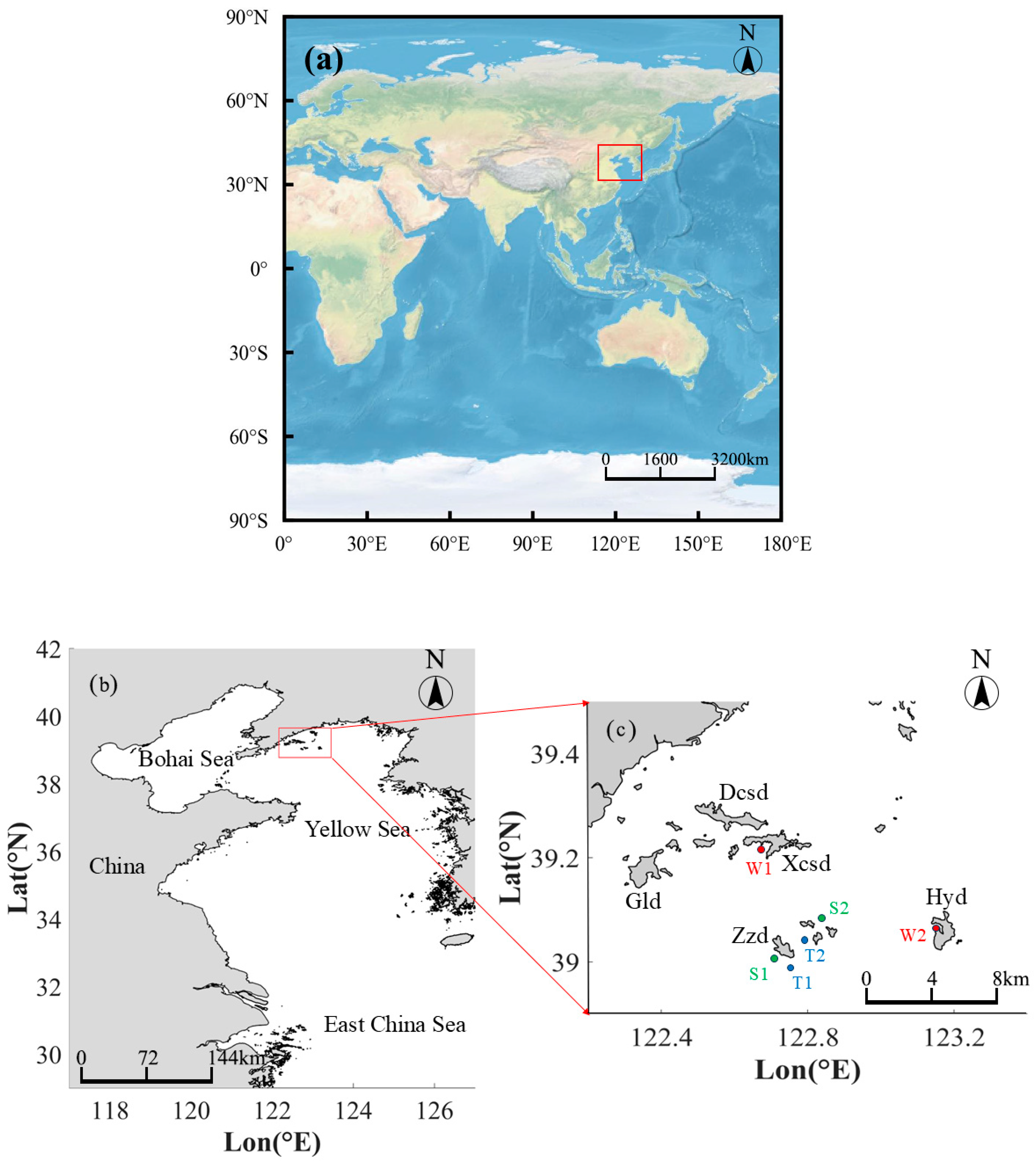
Figure 1. (a) A large area map. The red box indicates the location of the area shown in (b) below. (b) Regional map of the Bohai, Yellow and East China Seas; the red box indicates the northern Yellow Sea. (c) Enlarged view of the study area showing the Changhai County research zone and observation sites used for model validation. (Dcsd is DaChangShan Island, Xcsd is XiaoChangShan Island, Gld is GuangLu Island, Zzd is ZhangZi Island, Hyd is HaiYang Island. W1 and W2 are tidal level verification points, S1 and S2 are tidal current verification points, and T1 and T2 are temperature and salinity verification points).
Jmse 14 00162 g001
Figure 2. Computational domain grid and bathymetry. The black areas indicate where the grid has been encrypted, the white areas represent islands.
Jmse 14 00162 g002
Figure 3. Seasonal wind forcing. (Left) wind speed and direction in summer (June–October 2023). (Right) wind speed and direction in winter (December 2023–April 2024). Colors represent wind speed magnitudes.
Jmse 14 00162 g003
Figure 4. Comparison of observed and simulated water levels at two tide gauge stations in Changhai County: W1—Xiaochangshan Island; W2—Haiyang Island. Red dots indicate observations, while black lines denote simulations.
Jmse 14 00162 g004
Figure 5. Scatter plot of observed and simulated water levels at two stations.
Jmse 14 00162 g005
Figure 6. Comparison of simulated and observed current velocity and direction (stations shown in Figure 1). Green dots indicate observations; red lines denote simulations.
Jmse 14 00162 g006
Figure 7. Comparison of simulated and observed temperature and salinity. Top: T1; bottom: T2. Green solid circles represent observations; blue dashed circles denote simulations.
Jmse 14 00162 g007
Figure 8. Flow field during peak flood and ebb tides in Changhai County.
Jmse 14 00162 g008
Figure 9. Differences in surface and bottom layer temperatures and salinity in different regions.
Jmse 14 00162 g009
Figure 10. Summer-Winter Sea Water Density Profile at 38.8° N in the Research Area.
Jmse 14 00162 g010
Figure 11. Comparison Chart of Δρ vs. Water Depth for Summer/Winter.
Jmse 14 00162 g011
Figure 12. Seasonal variation of Eulerian residual currents in Changhai County.
Jmse 14 00162 g012
Figure 13. Release area zoning map (red boxes indicate release zones).
Jmse 14 00162 g013
Figure 14. Distribution of conservative tracer concentration in Changhai County.
Jmse 14 00162 g014
Figure 15. Spatial distribution of seawater residence time (Tre) under different summer scenarios ((A) Case 1; (B) Case 3; (C) Case 5).
Jmse 14 00162 g015
Figure 16. Spatial distribution of seawater residence time (Tre) under different winter scenarios. ((A) Case 2; (B) Case 4; (C) Case 6).
Jmse 14 00162 g016
Figure 17. The material migration patterns under diverse dynamic conditions in different regions during summer: Blue: all conditions (tides, temperature, salinity, and wind, in both seasons); Red: tides + wind; Yellow: tides + temperature and salinity; Purple: tides only.
Jmse 14 00162 g017
Figure 18. The material migration patterns under diverse dynamic conditions in different regions during winter: Blue: all conditions (tides, temperature, salinity, and wind, in both seasons); Red: tides + wind; Yellow: tides + temperature and salinity; Purple: tides only.
Jmse 14 00162 g018
Table 1. The simulation times for summer and winter cases.
Starting TimeDye Release TimeEnd Time
Summer1 May 20231 June 20231 October 2023
Winter1 November 20231 December 20231 April 2024
Table 2. The model evaluation based on the SKILL indicator.
SKILL ValueModel Evaluation
>0.65Excellent
0.50–0.65Very Good
0.20–0.50Good
<0.20Poor
Table 3. The competence in modeling velocity magnitudes and directions (denoted by SKILL indicator).
StationsSur.VelSur.DirBot.VelBot.Dir
S10.65660.89650.61020.9110
S20.74150.89970.75490.9181
Table 4. The seasonal variations of Eulerian residual currents in Changhai Sea Area (m/s).
SeasonDeep-LevelDcsdXcsdZzdGldHyd
SummerSurface0.03350.02750.02550.03540.0373
Bottom0.02430.01970.01630.01650.0222
WinterSurface0.04390.04170.03760.04920.0690
Bottom0.03680.02190.01310.01990.0248
Table 5. Model settings for different experimental scenarios.
CaseSeasonTidesWindTemperature & SalinityDescription
Case1SummerYesYesYesSummer control run including tides, wind, and thermohaline forcing
Case2WinterYesYesYesWinter control run including tides, wind, and thermohaline forcing
Case3SummerYesYesNoSensitivity experiment excluding thermohaline effects in summer
Case4WinterYesYesNoSensitivity experiment excluding thermohaline effects in winter
Case5SummerYesNoYesSensitivity experiment excluding wind forcing in summer
Case6SummerYesNoYesSensitivity experiment excluding wind forcing in winter
Table 6. The regional water residence times of different cases (unit: days).
Summer CasesChxDcsdXcsdZzdGldHyd
Case141.2761.0059.5026.2156.0813.04
Case325.2141.9239.8615.8839.7930.92
Case518.1721.9619.2519.5028.257.29
Winter Cases
Case235.7145.2142.678.547.639.38
Case420.9635.1734.8342.429.4212.21
Case611.4624.3823.005.4210.512.38
Chx denotes the Changhai County domain average; Dcsd, Xcsd, Zzd, Gld, and Hyd denote DaChangshan Island, XiaoChangshan Island, Zhangzi Island, Guanglu Island, and Haiyang Island, respectively.
Disclaimer/Publisher’s Note: The statements, opinions and data contained in all publications are solely those of the individual author(s) and contributor(s) and not of MDPI and/or the editor(s). MDPI and/or the editor(s) disclaim responsibility for any injury to people or property resulting from any ideas, methods, instructions or products referred to in the content.