
Next Article in Journal
Performance of Oil Spill Identification in Multiple Scenarios Using Quad-, Compact-, and Dual-Polarization Modes
Previous Article in Journal
Integrated Sail–Hull–Turbine Assessment for Wind Power Generation Ship Using Experiment and CFD
error_outline You can access the new MDPI.com website here. Explore and share your feedback with us.
 
 
Article

Sedimentary–Tectonic Evolution and Paleogeographic Characteristics of the Paleozoic in the Ordos Basin

1
Department of Geology, Northwest University, Xi’an 710069, China
2
Research Institute of Exploration and Development, PetroChina Changqing Oilfield Company, Xi’an 710000, China
*
Author to whom correspondence should be addressed.
J. Mar. Sci. Eng. 2026, 14(2), 112; https://doi.org/10.3390/jmse14020112
Submission received: 28 October 2025 / Revised: 30 December 2025 / Accepted: 1 January 2026 / Published: 6 January 2026

Abstract

As a tectonically stable and extensively superimposed basin situated in the North China Craton, the Ordos Basin hosts abundant reserves of oil, natural gas, and coal within its Paleozoic strata, rendering it a focal area in energy-related geological research. The basin’s evolutionary history provides a comprehensive record of key geological transitions—from an Early Paleozoic carbonate platform to Late Paleozoic marine–continental transitional deposits and ultimately to continental clastic sedimentation—largely governed by the regional tectonic dynamics associated with the North China Plate. This study presents a systematic review of the sedimentary and tectonic evolution of the Paleozoic sequence in the basin. Findings indicate that during the Early Paleozoic, the basin developed under a passive continental margin setting, characterized by widespread epicontinental marine carbonate deposition. By the Late Ordovician, subduction of the Qinqi Ocean triggered the Caledonian orogeny, resulting in regional uplift across the basin, widespread erosion, and a significant hiatus in Middle to Late Ordovician sedimentation, which facilitated the formation of paleo-weathered crust karst reservoirs. In the Late Paleozoic, the basin evolved into an intracratonic depression. From the Late Carboniferous to the Early Permian, the Hercynian tectonic event influenced the transformation from isolated rift basins to a broad epicontinental sea, leading to the deposition of critical coal-bearing strata within marine–continental transitional facies. Starting in the Middle Permian, the closure of surrounding oceanic domains induced widespread tectonic uplift, shifting the depositional environment to a terrestrial fluvial-lacustrine system and marking the termination of marine sedimentation in the region. Based on the comprehensive research findings, this study underscores that the superposition, inheritance, and interaction of multiple tectonic events are the primary controls on the paleogeographic architecture and sedimentary.

1. Introduction

The Paleozoic Era witnessed pivotal transformations in Earth’s tectonic geography [1]. The North China Block (NCB), among the ancient continental nuclei, was situated as an independent continent within the Paleo-Tethys Ocean. Its tectonic setting evolved from a stable passive margin to an active continental margin in response to the convergence and eventual collision with neighboring plates, such as Siberia and the South China Block [2]. This dynamic tectonic history is archived in the sedimentary successions of its cratonic basins. Within this context, the Paleozoic strata of the Ordos Basin offer an exceptional record. This record documents the shift from a Cambrian–Ordovician shallow marine carbonate platform to a Carboniferous–Permian paralic and terrestrial siliciclastic system [3]. Deciphering this tectono-sedimentary archive is crucial for assessing hydrocarbon and coal resources of the Ordos basin.
As the largest and most stable intracratonic basin within the NCB, the Ordos Basin contains immensely rich oil, gas, and coal deposits in its Paleozoic strata, making it a perennial focal point for energy research [4,5,6,7,8,9]. The formation and distribution of these resources are fundamentally controlled by the basin’s complex, multi-stage tectonic evolution [9]. The Paleozoic tectonic framework of the basin was dominantly shaped by two major events: (1) The Caledonian Orogeny during the Early Paleozoic induced extensive crustal uplift and erosion, leading to regional sedimentary hiatus between the Middle Ordovician and Lower Carboniferous, and facilitating the formation of economically significant paleokarst reservoirs within Ordovician carbonate rocks [10,11,12,13]. (2) The Hercynian Orogeny during the Late Paleozoic, which governed the tectonic transition from a post-rift marginal depression to a broad intracratonic foreland basin, accompanied by a fundamental shift in depositional environments from marine to continental [14]. Tectonic changes are manifested through inheritance, reactivation, and superposition across diverse basin types—including passive margins, foreland basins, and superimposed basins—giving rise to a complex, multi-phase tectono-sedimentary architecture that exerts a significant influence on hydrocarbon accumulation [15,16,17]. It is widely accepted that following the amalgamation of numerous microcontinental blocks into a unified North China Block by the end of the Paleoproterozoic (~1.85 Ga), the subsequent evolution of its sedimentary cover from the Mesoproterozoic through the early Paleozoic and into the late Paleozoic largely conformed to the tectonic framework and depositional patterns of the unified block [18,19].
In recent years, breakthrough progress has been made in research on the tectonic evolution [20,21,22], deep-seated characteristics [23], sequence stratigraphic division [24,25], sedimentary facies distribution [26,27], basin-mountain coupling relationships [16,17], and restoration of the prototype basin [28,29] of the Ordos Basin. However, with the advancement of exploration and development, the continuous addition of well data, and the vast production potential of the Paleozoic strata, a more comprehensive and detailed understanding of the sedimentary–tectonic evolution and paleogeographic characteristics of the Paleozoic in the Ordos Basin is required. Based on field outcrops, well logging data, and geochemical data, this paper systematically reviews the sedimentary and tectonic evolutionary framework of the Paleozoic in the Ordos Basin and delves into its dynamic relationship with regional tectonic movements. The research aims to provide a prerequisite for rationally assessing and selecting exploration targets and to offer a scientific basis for the strategic planning of oil and gas exploration directions in the Paleozoic strata of this basin.

2. Geological Setting

2.1. Tectonic Location

The Ordos Basin developed upon the stable, ancient crystalline basement of the west part of the North China Craton (NCC). The NCC itself formed through the amalgamation of several Archean to Paleoproterozoic microcontinental blocks, culminating in its final cratonization at ~1.85 Ga [30,31,32,33,34,35,36,37]. Since then, and throughout most of the Paleozoic, it behaved as a relatively rigid and stable continental block [38].
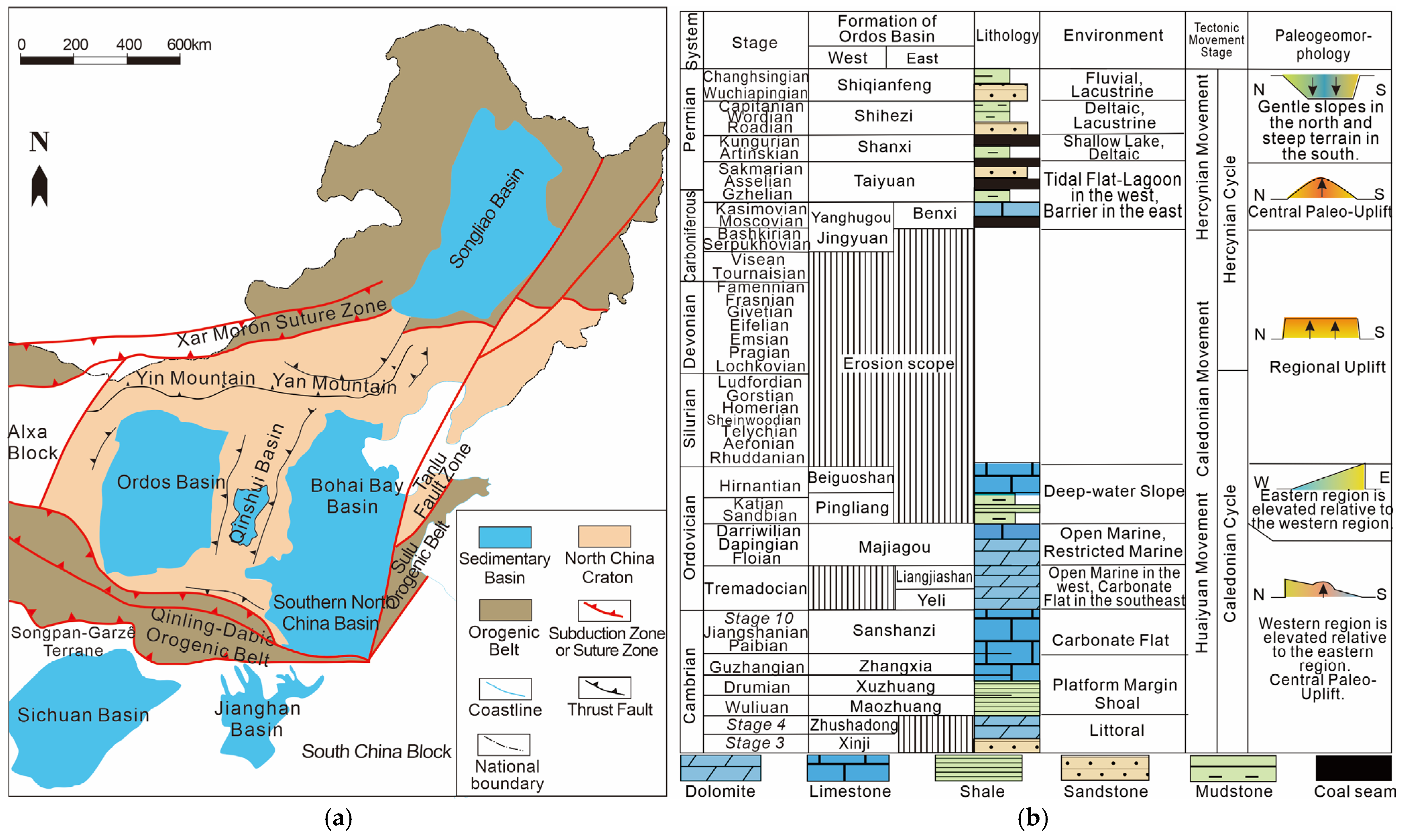
The present-day Ordos Basin is a large, Meso-Cenozoic intracratonic depression situated in the western part of the NCC. Its current geometry is a north–south elongated rectangle, bounded by a series of Cenozoic rift systems and orogenic belts [39] (Figure 1). The Paleozoic evolution of the basin, however, was governed by a different set of plate tectonic boundaries. Its tectonic history was primarily influenced by the opening and closing of the Paleo-Asian Ocean to its north and the Qinling Ocean (a branch of the Paleo-Tethys) to its south [17]. The convergence and eventual closure of these oceanic domains exerted first-order controls on the basin’s subsidence patterns, sediment provenance, and depositional systems [9,40,41,42].

2.2. Paleozoic Tectono-Sedimentary Evolution

The Paleozoic history of the Ordos Basin is best described by two-stage evolution, reflecting a fundamental shift in its tectonic setting and basin type.
During Early Paleozoic stage, the Ordos region was characterized by a passive margin tectonic setting [27,43], which facilitated the deposition of a thick and regionally extensive carbonate series. The Cambrian System consists of the Xinji, Zhushadong, Maozhuang, Xuzhuang, Zhangxia, and Sanshanzi Formations, recording several transgressive–regressive cycles [44]. The Ordovician is dominated by the widespread Majiagou Formation (massive platform carbonates), overlain by the more restricted Pingliang and Beiguoshan Formations [45]. This stage was terminated by the Caledonian Orogeny, which caused regional uplift, marine regression, and prolonged subaerial exposure, leading to pervasive karstification of the Ordovician carbonates.
In the Late Paleozoic, the Ordos Block transitioned from a marine sedimentary environment to a continental sedimentary environment, with the tectonic setting shifting from a cratonic marginal depression to an intra-cratonic depression. The dominant sedimentary type during this period was clastic rocks. From the Silurian to the Middle Carboniferous, the Ordos Block underwent a phase of convergent collision and uplift-erosion. The ocean basins in the northern and southwestern parts of North China closed successively, leading to intracontinental orogeny [46]. This resulted in the widespread absence of Silurian strata in the North China region, while only the Hexi Corridor area retained marine sediments from the Silurian to the Devonian periods (Figure 1b; [47]). Starting from the Late Carboniferous, the Qrdos area began to receive sediments again, successively developing the Upper Carboniferous Benxi Formation, the Lower Permian Taiyuan Formation and Shanxi Formation, the Middle Permian Shihezi Formation, and the Upper Permian Shiqianfeng Formation [48].

3. Materials and Methods

3.1. Field Outcrop Observations

Field geological survey constitutes a fundamental approach for investigating the sedimentary–tectonic evolution and paleogeographic characteristics of the Paleozoic in the Ordos Basin. Centered on systematic outcrop observations, this study aims to reconstruct the Paleozoic tectonic settings and spatiotemporal evolution within the basin, following a logic that progresses from phenomena to genetic mechanisms. Priority is given to selecting standard profiles characterized by continuous stratigraphic exposure, relatively weak tectonic deformation, complete sedimentary records, and regional correlation significance. For example, the Cambrian profile at Suyukou in the Helan Mountains of Ningxia, China, was chosen to decipher the sedimentary sequence of the Early Paleozoic passive continental margin; the Ordovician profile at Qinglongshan in Tongxin of Ningxia, China, the Carboniferous profile at Hulusitai in Inner Mongolia, China, and the Permian profile at Xuefengchuan in Hancheng of Shaanxi, China, respectively, represent sedimentary records of different tectonic units and ages on the western margin, southern margin, and interior of the basin. Field observations focus on sedimentary facies transition surfaces, stratigraphic boundaries, and special lithologic layers (e.g., coal seams, limestone beds) to characterize the thickness variations, contact relationships, and tectonic deformation of the Paleozoic strata in the periphery of the Ordos Basin.

3.2. Well Log Interpretation

Well logging data provide primary information on stratigraphic development. The distribution of Paleozoic strata within the basin and their contact relationships are identified based on well data. This study utilized data from over 500 wells to accurately delineate the spatial distribution and evolutionary sequence of the Paleozoic strata in the basin. First, a basin-wide lithological interpretation template for Paleozoic well logs was established. Based on the lithological assemblage characteristics of different strata, including Cambrian carbonate rocks, Ordovician marine limestone, and Carboniferous-Permian paralic coal-bearing strata, logging curves sensitive to lithology, physical properties, and gas content—such as natural gamma ray (GR), acoustic interval transit time (AC), deep lateral resistivity (RD), and neutron porosity (CNL)—were optimized to develop effective lithological identification charts. Through the standardization and meticulous interpretation of logging data from hundreds of wells, the bottom interfaces of key stratigraphic sequence, including the Cambrian, Majiagou Formation, Lower Paleozoic, Shanxi Formation, and Shihezi Formation, were precisely delineated for each well. Subsequently, cross-section stratigraphic correlations at a basin scale were conducted. The well log interpretation and cross-section correlation were conducted using ResFormSTAR (Version V1.0). By constructing multiple cross-well profiles across different tectonic units of the basin, variations in stratigraphic thickness, pinch-out and overlap relationships, and the spatial distribution of major unconformities—such as those between the Cambrian and Ordovician, and between the Carboniferous and Benxi Formation—were clearly revealed. This process not only validated the rationality of sequence boundary delineation but also directly demonstrated the control of Paleozoic palaeogeographic patterns on stratigraphic deposition. Finally, based on dense well control data combined with typical outcrop information, structural and sedimentary frameworks were illustrated through stratigraphic thickness data.

4. Early Paleozoic Tectonic and Paleogeographic Evolution

4.1. Cambrian–Middle Ordovician

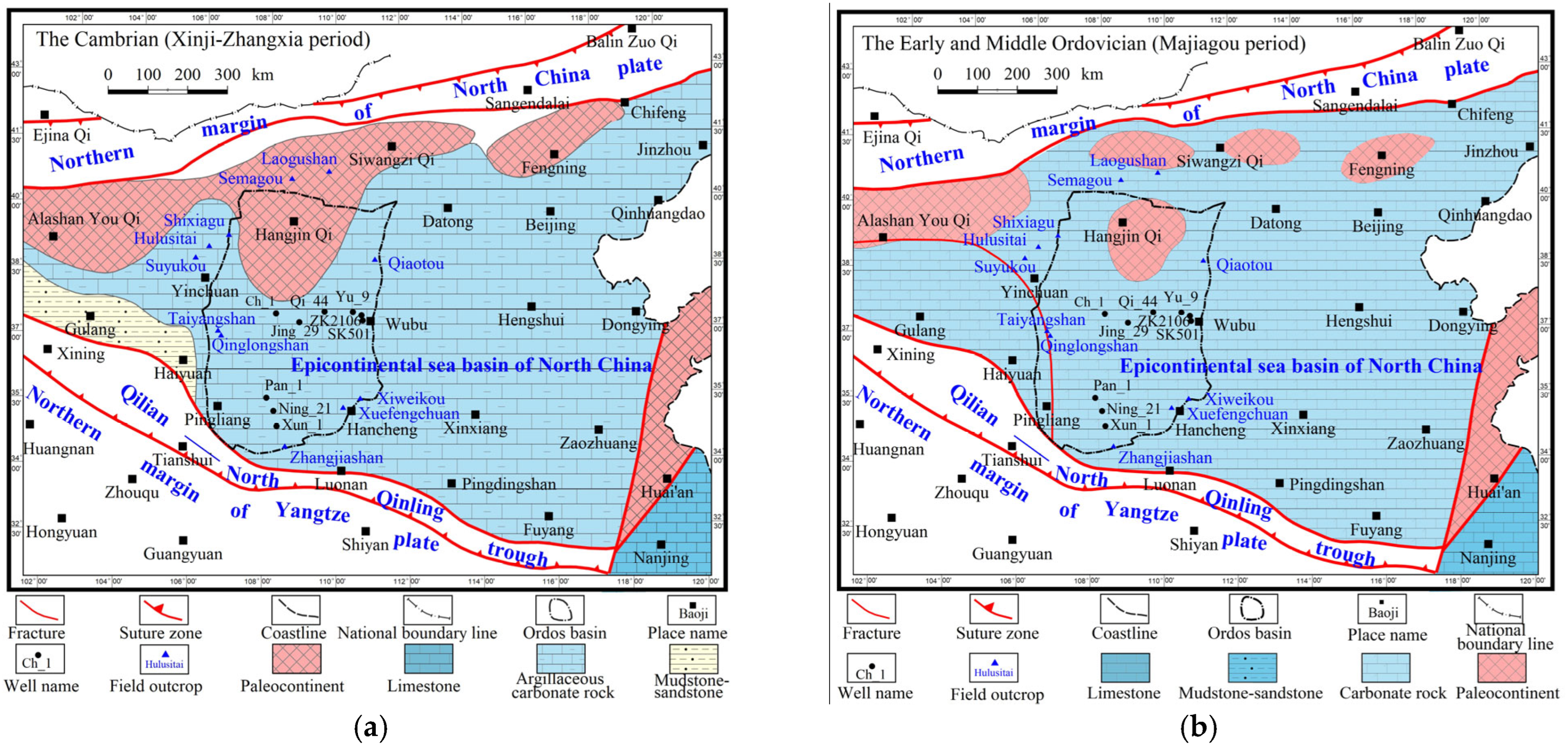
During the Cambrian to Middle Ordovician, the Ordos Block was situated within a passive continental margin setting. In the Early Cambrian, the North China Plate inherited tectonic stress patterns from the late Neoproterozoic, leading to the development of an east–west-oriented uplift zone in the northern region (Figure 2). The northward subduction of the Shangdan Ocean gave rise to the North Qinling island arc belt, whereas the southern margin of the North China Plate remained a stable, gently subsiding passive continental margin [49]. During the Late Cambrian to Early Ordovician Liangjiashan stage, bidirectional subduction of the Erlangping Ocean Basin (southern margin of the North China Craton) and the Paleo-Asian Ocean (northern margin) triggered a transition of the tectonic stress field from north–south extension to north–south compression. This tectonic transition triggered a widespread marine regression across the Ordos Basin area, resulting in the emergence of extensive paleo-landmasses within the basin interior, with sedimentation restricted to peripheral zones. During the Early–Middle Ordovician Majiagou stage, sustained near north–south compressive stresses intensified structural differentiation between uplifted and depressed regions. Overall, the evolution of the Ordos Basin from the Cambrian to the Middle Ordovician encompassed the establishment of an epicontinental sea, progression through a shallow marine environment to a central paleo-uplift.
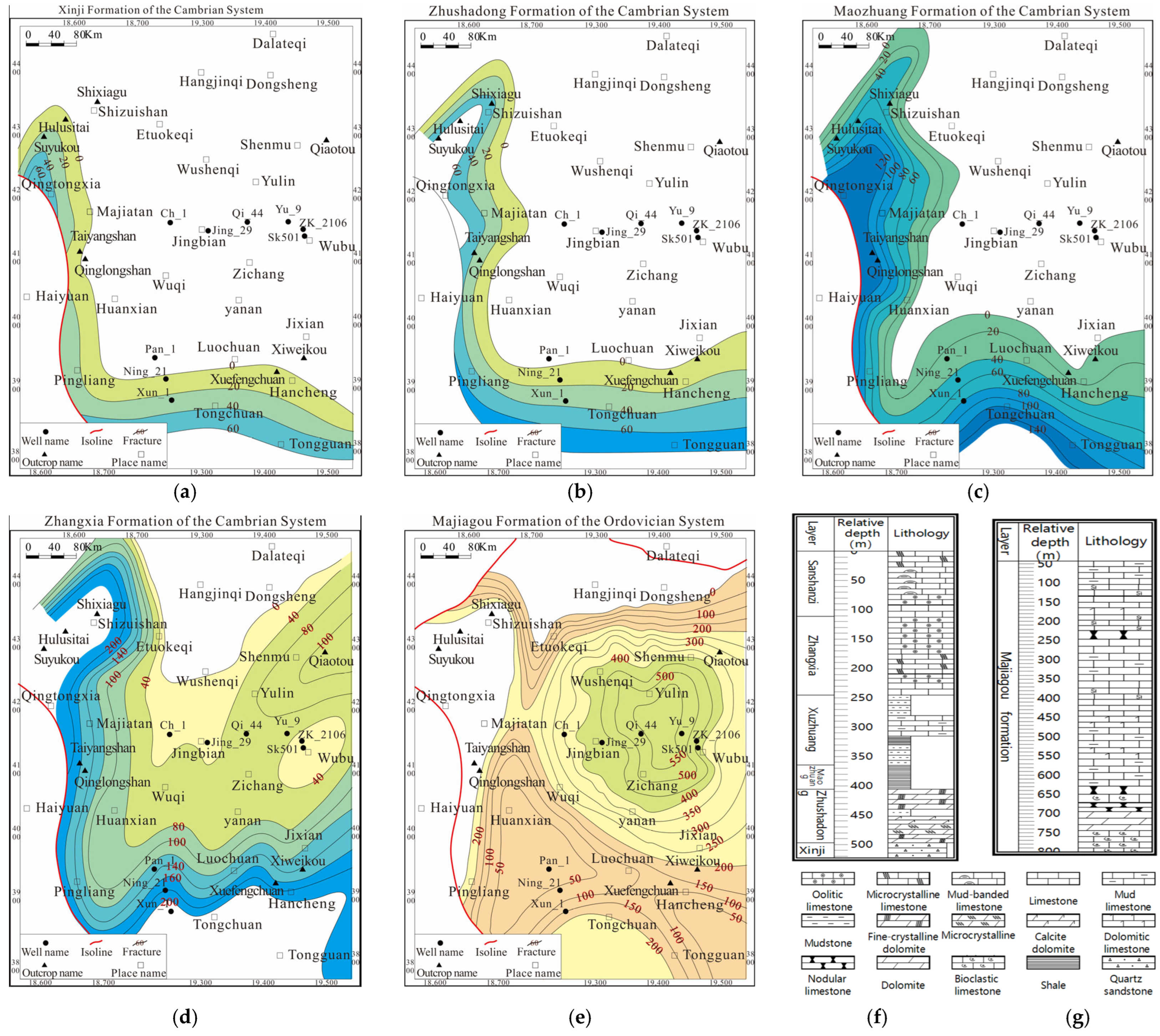
During deposition of the Lower Cambrian Xinji Formation, there was a relatively unified depositional area on the western and southern margins of the Ordos Basin, characterized by the gradual thickening of sedimentary strata from east to west and from north to south, illustrated using a cool-color palette in Figure 3. The depositional area dominated by terrigenous phosphorus-bearing clastic rocks extended southward to the southwest. The supply of terrigenous materials was from the north to the south and from the east to the west. During this period, there was no relatively independent central paleo-uplift in the Ordos region. From north to south during the Xinji period, there were the North China Craton, the shallow-water shelf-shelf margin and deep-water basins on the western and southern margins. The seawater came from the south and advanced from south to north. The hydrodynamic conditions are mainly dominated by tidal action, supplemented by wave action, and there is also a presence of storm action. Storm sediments were formed in the phosphorus-rich sediments of the Xiji Formation, indicating that the formation of phosphorus deposits is closely related to storm action. During the Xinji period, volcanic eruptions also had an impact, especially in the clastic rocks in the southern part of North China, where volcanic ash was quite common. It is speculated that the cause might be related to the volcanic eruptions caused by seafloor spreading in the deep-sea area of the North Qilian–North Qinling to the south.
In the sedimentary period of the Cambrian Zhushadong Formation, the basic tectonic features of the western and southern margins of the Ordos Basin were largely similar to those of the Xinji period. The main changes were the expansion of the depositional area to the north and the retreat of the ancient landmass to the north. Significant changes have occurred in this depositional area, except for the part where the marine transgression overlaid the ancient land, which contains a small amount of terrigenous sediment, while all the other sediments are composed of carbonate rocks. The sedimentary characteristics still indicated a shallow marine environment under a stable platform epicontinental sea, mainly consisting of carbonate platform gentle slopes, with the development of shore tidal flats and shallow subtidal carbonate gentle slopes.
By the Middle Cambrian (Maozhuang Formation), the primary tectonic features included northward expansion of the depositional area, contraction of the North China paleocontinent, and the emergence of local uplifts that separated the Qinling Sea. The content of terrigenous clastic materials in the sediment increased significantly to the north, and decreased to the south. From south to north, the content of terrigenous materials gradually increased, indicating that the source area was in the northern part of the depositional area, and there was no southern source area; the overall ancient tectonic features were mainly a southward gently inclined shelf slope environment. The range of marine transgression continued to expand to the north, and the area of the ancient land erosion zone significantly decreased; the main feature was a shallow marine environment under a stable platform epicontinental sea. During the Xuzhuang period, the main part began to transition to an open platform carbonate environment, the range of marine transgression continued to expand, and the land area continued to shrink. The Late Xu Zhuang stage to Early Zhang Xia stage represents the peak of t marine transgression in the North China epicontinental sea. Warm and shallow seawater extensively covered the existing tidal flat environment, thereby forming an extensive shallow sea depositional area. The Ordos block was an open shallow sea environment during the Zhangxia period, and was connected to the North Qilian–North Qinling Trough on its west and south sides, and there was no “Qinling Ancient Land” or “Southwest Huashan Ancient Land”.
The tectonic framework during the Early to Middle Cambrian was strongly influenced by inherited basement faults, particularly evident in the development of a rift trough extending into the basin along its southwestern margin. Within the basin, relatively low-lying areas also exhibited a northeastward extension, reflecting the structural control exerted by underlying basement faults. However, from the Late Cambrian onward, the tectonic regime of the Ordos Basin underwent a significant transformation, becoming markedly distinct from that of the earlier Cambrian period. The influence of basement faults diminished considerably and became negligible. During this period, the Yimeng Uplift and the Wushenqi Uplift in the northern part of the basin coalesced with the Zhenyuan Uplift in the southwest, giving rise to a prominent north–south-trending paleo-uplift in the central and western regions of the basin. Sedimentation was largely restricted to the periphery of these uplifted areas. Meanwhile, the Lvliang Ancient Landmass persisted in the eastern part of the basin, contributing to an overall paleogeographic configuration characterized by alternating uplifted blocks and subsiding depocenters—indicative of the coexistence of paleo-highs and sedimentary basins. Regionally, the Late Cambrian crustal uplift and marine regression were well-documented in the Ordos Basin and its adjacent areas. Drilling data from multiple exploration wells in the study area directly demonstrate unconformable relationships—the Majiagou Formation rests directly overlying on different stratas of the Upper Cambrian. This tectonic event drove northeastward marine retreat: the North China epicontinental sea progressively contracted, while the uplift belts along the western and southern margins of the North China Craton expanded northward continuously.
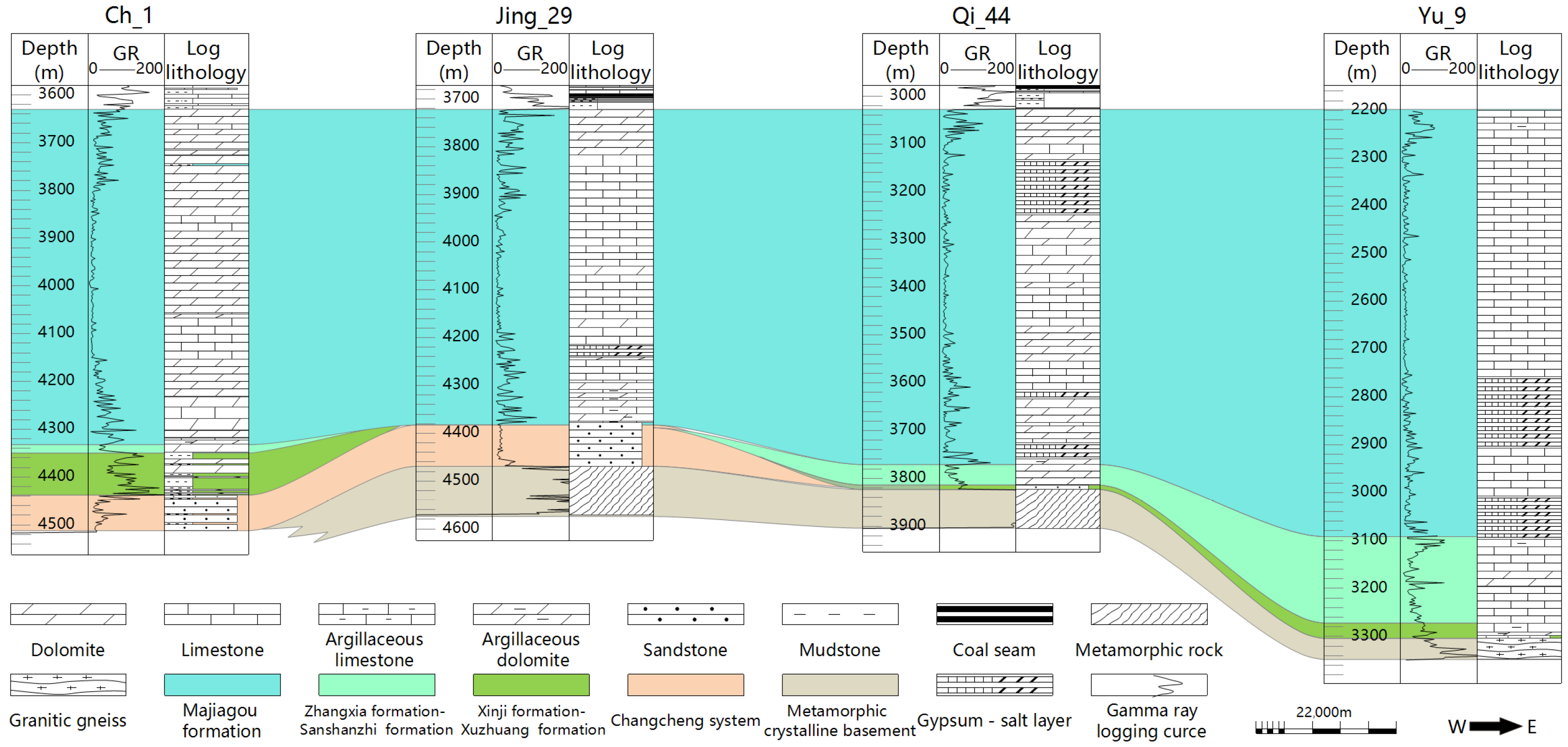
Compared with the early Early Ordovician, the paleoenvironment during the Majiagou period experienced significant changes (Figure 3e). A large-scale marine transgression in the study area disrupted the pre-existing land–sea configuration, resulting in a distribution pattern resembling that of the late Cambrian. The paleogeography was characterized by low elevations in the south and high in the north, as well as low in the west and high in the east. From the east and northeast, the North China Sea extended over the southeastern margin uplift zone; the Qinling Sea advanced from the south to the north; and the Qilian Sea expanded from the west to the east. The regional depositional environment was predominantly composed of tidal flats, open marine platforms, restricted marine settings, and saline lake environments. During the key stratigraphic interval of the Majiagou Formation, the eastern and western seaways became fully connected, although differences in sedimentary systems were evident between the eastern basin and the southwestern margin. In the eastern basin, dolomitic limestone, limestone, dolomite, mudstone-rich limestone, and gypsum were developed, whereas on the southwestern margin, the succession was primarily composed of limestone, calcareous dolomite, and dolomitic limestone (Figure 4). By the end of Majiagou Formation deposition, the regional tectonic regime in the Ordos Basin and the Qilian–Qinling orogenic belt underwent a fundamental transformation, marked by the subduction of the Qilian–Qinling oceanic crust replacing the previous lithospheric extensional regime. This tectonic shift triggered a large-scale regression across the central Ordos region, leading to its emergence as a paleo-upland. Consequently, the main part of the Ordos area had evolved into an uplifted block, with sedimentation confined to the western and southern margins [50].
Under the aforementioned paleogeographic framework, the Ordos Basin witnessed a transition from turbid-water deposits containing clastic rocks to clear-water deposits largely devoid of clastic rocks during the Early-Middle Cambrian to the Middle Ordovician. The outcrop profile at Suyukou in the central Helan Mountains comprehensively documents the sedimentary evolution of the Cambrian strata (Figure 3f). The Lower Cambrian Xinji Formation unconformably overlies the underlying Sinian and older strata, characterized primarily by phosphorous-bearing clastic rocks. Its upper boundary is marked by quartz sandstone or brecciated dolomitic limestone in conformable contact with the overlying Zhushadong Formation, with a thickness of 20 m. The Zhushadong Formation, conformably overlying the Xinji Formation, represents the first carbonate rock assemblage of the Cambrian, composed mainly of medium to thick-bedded dolomite and limestone, with a profile thickness of approximately 90 m. The Maozhuang Formation at Suyukou conformably overlies thick massive dolomite and limestone of the Xinji Formation, while in other areas it may unconformably overlie the Jixian strata or older strata, characterized by shale development. Compared to the Xinji and Zhushadong Formations, the Maozhuang Formation is more widely distributed, with exposures not only at Suyukou and Zhengmuguan in the central Helan Mountains but also at Taosigou and Wangquankou in the northern Helan Mountains, as well as in the Qinglongshan area east of Tongxin. The Xuzhuang Formation distinctly differs lithologically from the Maozhuang Formation, comprising a mixed deposition of shale and limestone with uneven thicknesses, where limestones often exhibit stromatolitic and oolitic structures. Regionally, the Xuzhuang Formation is distinguished by prominent purplish-red or variegated shales, contrasting with the overlying Zhangxia Formation, which is dominated by limestone. The Zhangxia Formation is characterized by widespread thick-bedded oolitic limestone, serving as a key marker bed regionally correlatable and distinguishing it from the underlying Xuzhuang Formation and overlying Sanshanzi Formation. On the western margin of the Ordos Basin and adjacent areas, the Sanshanzi Formation consists mainly of carbonate rocks, including gray to dark gray thin-bedded limestone, argillaceous banded limestone, medium to thick-bedded fine-grained limestone, and stromatolitic limestone, with thin-bedded lithologies predominant and thick oolitic limestone less developed. The Ordovician and Cambrian strata in the Ordos Basin exhibit an unconformable contact. During the Early Ordovician, sedimentation of the Yeli and Liangjiashan Formations was restricted to the eastern basin margin (Figure 1b). This was followed by the development of the extensive Majiagou Formation carbonate platform facies (Figure 4) across the basin interior.

4.2. Late Ordovician

Following the deposition of the Majiagou Formation, the most pivotal regional tectonic events during the Early Paleozoic were: (1) the northward subduction of the Shangdan Ocean in the Qilian–Qinling region; (2) the collision and accretion between the North China Craton (NCC) and the Yangtze Craton. Under this dynamic background, the tectonic nature of the western and southern margins of the Ordos underwent significant changes, mainly manifested as the transformation from the lithospheric extensional tectonic regime of the Cambrian-Early Ordovician to the tectonic regime of the northward subduction of the Shangdan oceanic crust and the convergence and docking of the North China and Yangtze plates in the Middle-Late Ordovician-Silurian. Correspondingly, the tectonic background of the western and southern margins of the Ordos also changed from the passive continental margin of the Cambrian–Early Ordovician to the active continental margin of the Middle-Late Ordovician-Silurian.
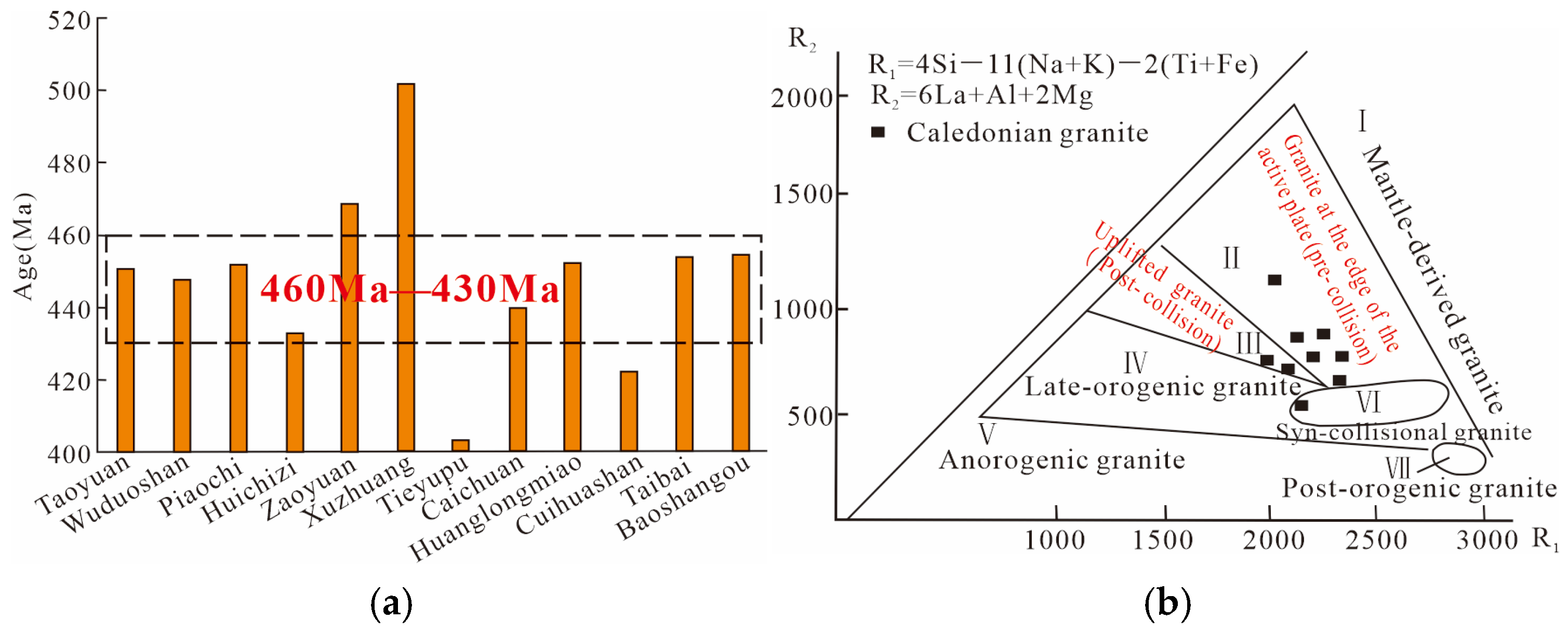
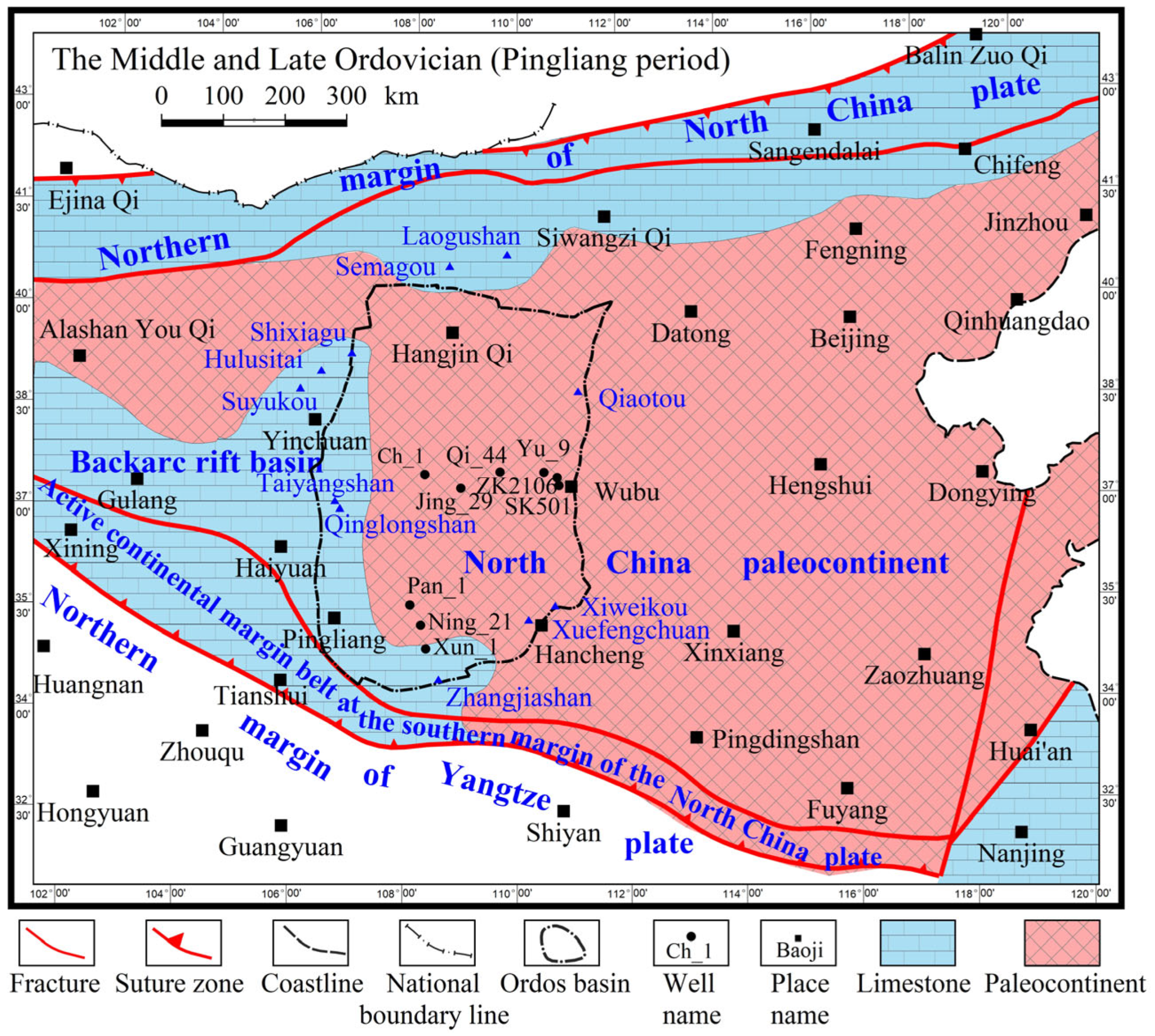
Entering the Late Ordovician, the subduction of the Qin-Qi Ocean and the Xing-Meng Ocean further intensified the north–south compression. The analysis results of the age and geochemistry of the Caledonian granites in the Qinling show that the development of island-arc and subduction and collision granites is the product of the subduction and collision tectonic evolution of the North Qilian–North Qinling orogenic belt plates, marking the transformation of the basin’s nature from passive continental margin to active continental margin [51] (Figure 5). The subduction of the Qilian–Qinling oceanic crust led to a transformation of the tectonic regime. The North China Block experienced overall uplift, with the main part of the Ordos region rising to become ancient land. Clastic slopes and turbidites developed along its western and southern margins, forming a back-arc marginal sea environment during the Pingliang Period (Figure 6).
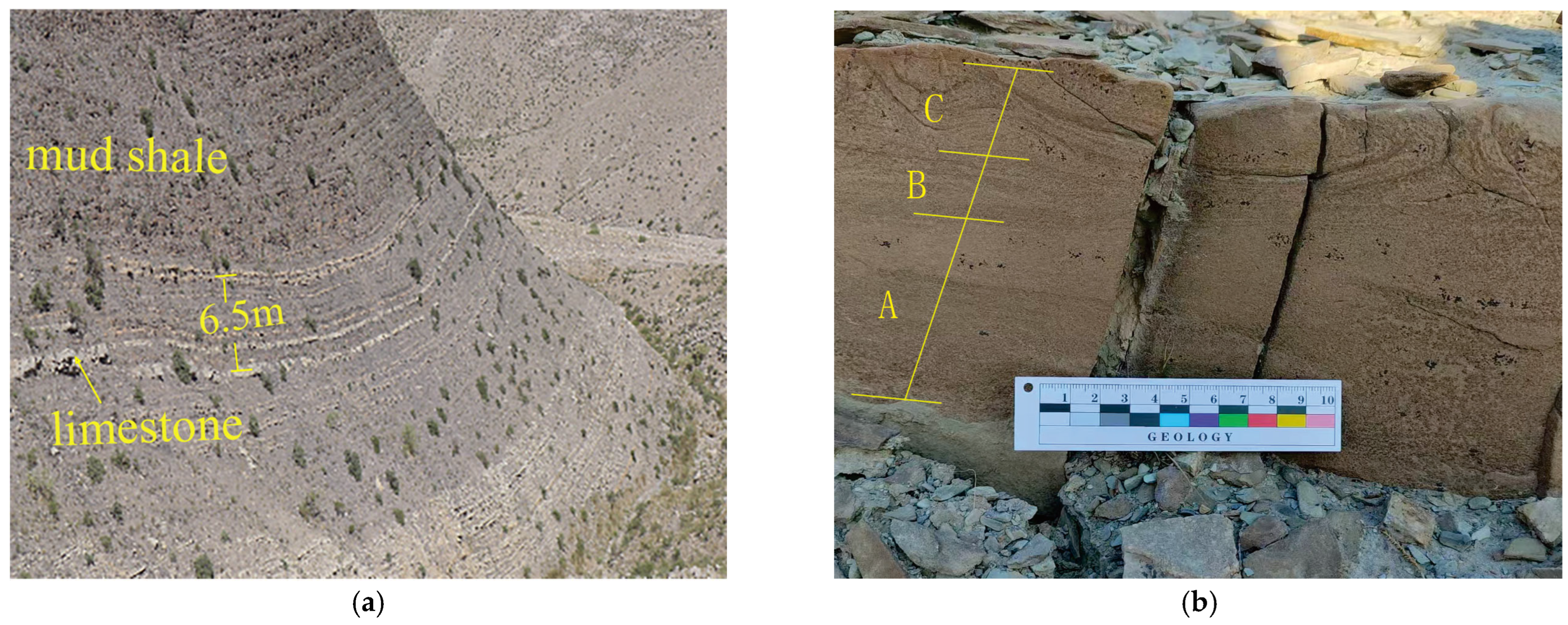
The Shixiagu profile in Wuhai is particularly representative. The lower member of Pingliang Formation is mainly composed of grayish-black penite shale, interspersed with sandy shale, limestone, sandstone, etc., Figure 7a shows a stable distribution of limestone with a thickness of approximately 30 cm developed in the sandy shale. The upper member is turbid rock series mainly composed of grayish-green sandstone and shale (mudstone) interbedded limestone. Figure 7b illustrates a classic Bouma sequence within the Pingliang Formation turbidites, consisting of a massive, graded bedding (A segment) overlain by parallel lamination (B segment) and ripple lamination (C segment). The load structure observed further supports rapid deposition under conditions of sediment density instability, consistent with the interpreted turbidity current origin of this layer. Compared to the Pingliang Period, the paleogeographic environment during the Beiguoshan Period did not change significantly [25]. By the end of the Late Ordovician, influenced by the Caledonian movement, global sea levels dropped. The Ordos Block was widely uplifted and eroded, while the Xingmeng Ocean, Qin-Qi Ocean, and Helan Aulacogen closed successively and transformed into intercontinental orogenic belts. No deposition occurred within the basin.
During the Late Ordovician, the overall sedimentary assemblage characteristics displayed a regression sequence. On the basis of the closure of the Qilian–North Qinling Cambrian–Ordovician ocean basin at the end of the Late Ordovician, the Middle Qilian–Luoxi block, Alxa–Erdos block and Yangtze block collided and joined together to form a back-arc residual sea basin. The Late Caledonian movement at the end of the Silurian finally ended the evolution history of the Early Paleozoic marine basins in the Qilian–North Qinling region, thereby completing the collage of the Erdos block, Alxa block, Middle Qilian–Luoxi block, Qaidam block and the Caledonian island arc belt of North Qinling, forming a vast Caledonian unified continent composed of blocks and Caledonian tectonic belts. They served as the basement of the Late Paleozoic sedimentary basins and controlled the formation and evolution of the Late Paleozoic sedimentary basins [52].

5. Late Paleozoic Tectonic and Paleogeographic Evolution

5.1. Late Carboniferous (Benxi Stage) to Early Permian (Taiyuan Stage)

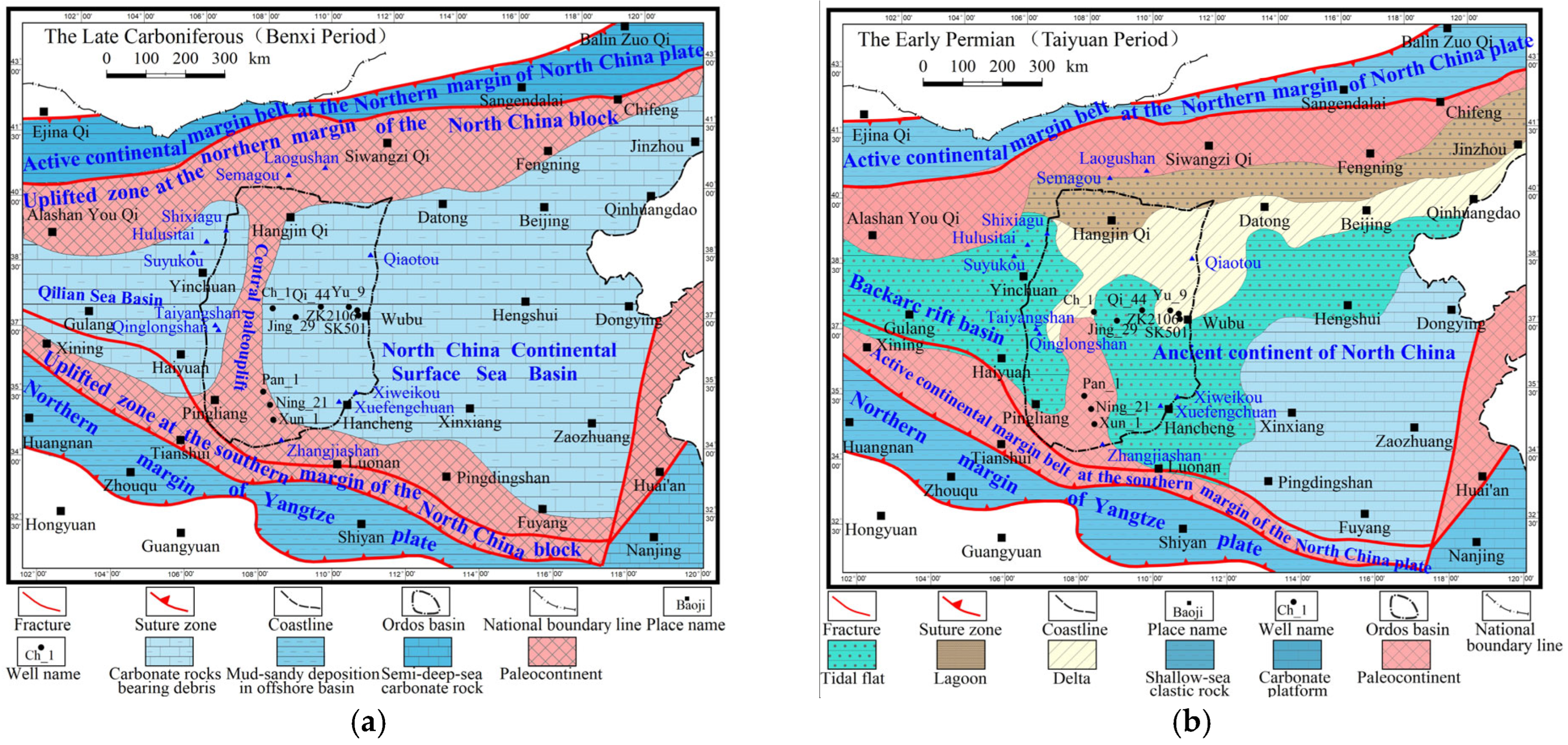
From the Benxi stage of the Late Carboniferous to the Taiyuan stage of the Early Permian, the Ordos Block experienced a phase characterized by reactivated marine troughs. During this period, the Ordos area and the broader North China region underwent prolonged uplift, resulting in extensive weathering and denudation that persisted for approximately 140 million years. By the mid-stage of the Hercynian orogeny, peripheral tectonic features—including the Qin-Qi Sea Trough, the Xing-Meng Sea Trough, and the Helan Aulacogen—were reactivated, inducing regional subsidence across the Ordos Block. Marine transgression did not significantly affect the central part of the block until the Late Carboniferous. During the Late Carboniferous, driven by regional tectonic settings, basement subsidence, and basin-margin faulting, the southern margin of the North China Plate and the central Ordos Block underwent uplift. Consequently, two distinct Carboniferous basins were developed along the western and eastern margins of the Ordos Block: the Helan Mountain Carboniferous Basin and the North China Shelf Sea Basin (Figure 8a). Sedimentary facies exhibited prominent east–west differentiation. Central paleo-uplift and rift basins coexisted with shallow shelf seas, and the paleotopography was characterized by a southern uplift and northern dip. In general, the north–south trending central paleo-uplift served as a critical paleogeographic barrier separating the Qilian Sea from the North China Sea. During the Taiyuan stage of the Early Permian, sustained regional subsidence facilitated the continuous transgression of seawater from both the eastern and western sides, which eventually submerged the central uplift zone and established a widely distributed, unified marine environment (Figure 8b).
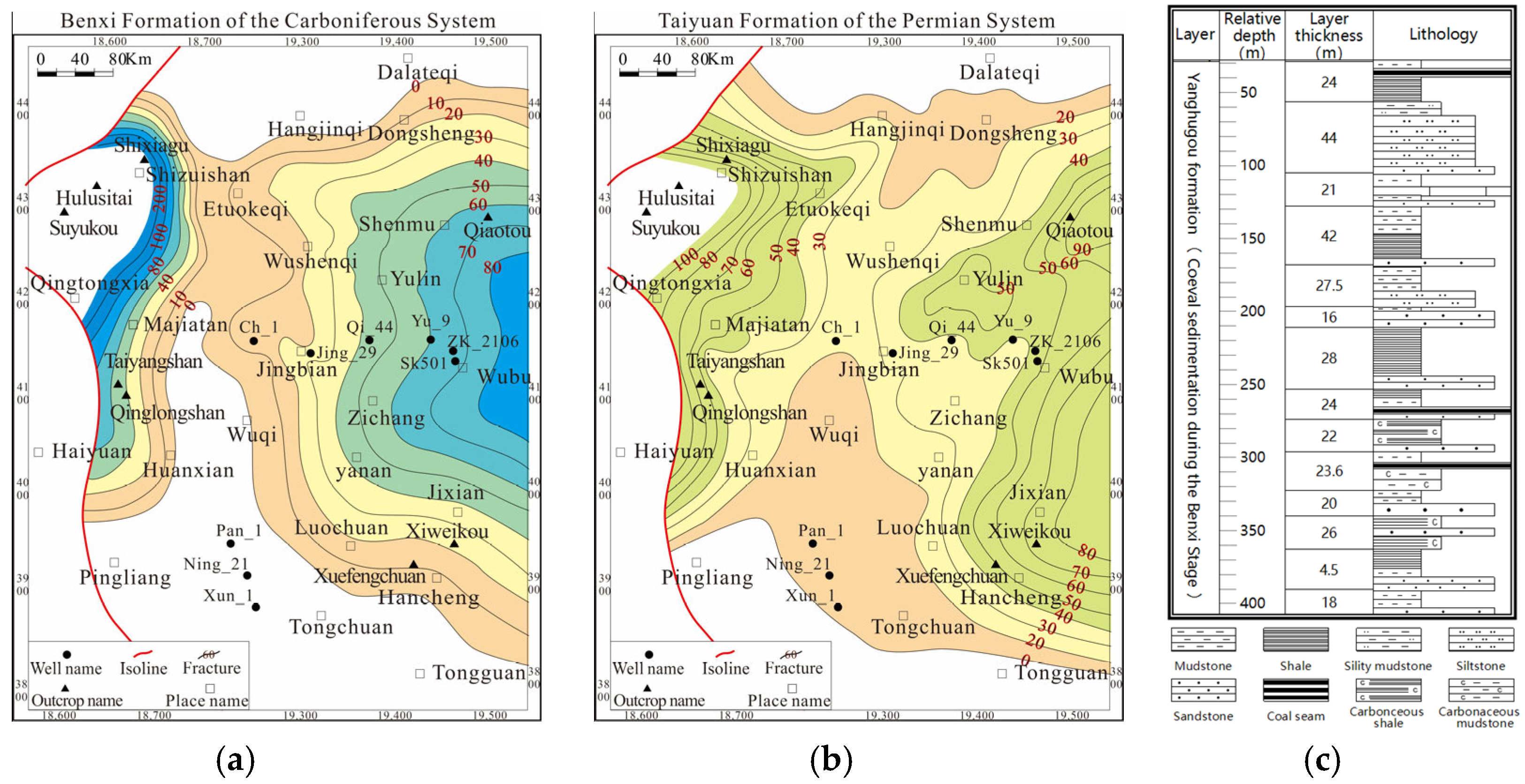
During the early phase of the Late Carboniferous, as the carbonate platform gradually subsided, seawater transgressed into the region from both eastern and western margins. The Qilian Sea from the west advanced across the platform, while the western margin subsided, forming a trumpet-shaped embayment open to the southwest (Figure 9). Hydrodynamic conditions were primarily controlled by tidal currents, resulting in well-developed tidal deposits. Fan deltas along the northeastern margin continued to prograde, whereas tidal flats were distributed along the northern and eastern peripheries. Elsewhere, lagoonal and shallow marine environments prevailed, maintaining the depositional pattern established earlier in the Late Carboniferous. Concurrently, the area east of the Central Paleouplift subsided, giving rise to a restricted epicontinental sea with an eastern opening. A composite sedimentary system comprising a shelf carbonate platform, clastic barrier islands, and shallow-water deltas developed over the paleo-weathering crust. Shallow-water deltas were located along the northeastern margin, while barrier islands, lagoons, and shallow seas occupied the central and southern regions. The Hulustai section in Inner Mongolia on the western basin margin represents a typical later Carboniferous profile, recording its sedimentary evolution. As shown in Figure 9c, the Yanghugou Formation (coeval sedimentation during Benxi stage) comprises an assemblage of shale, sandstone, limestone lenses, and multiple coal seams, with lithology largely comparable to the contemporaneously deposited Benxi Formation.
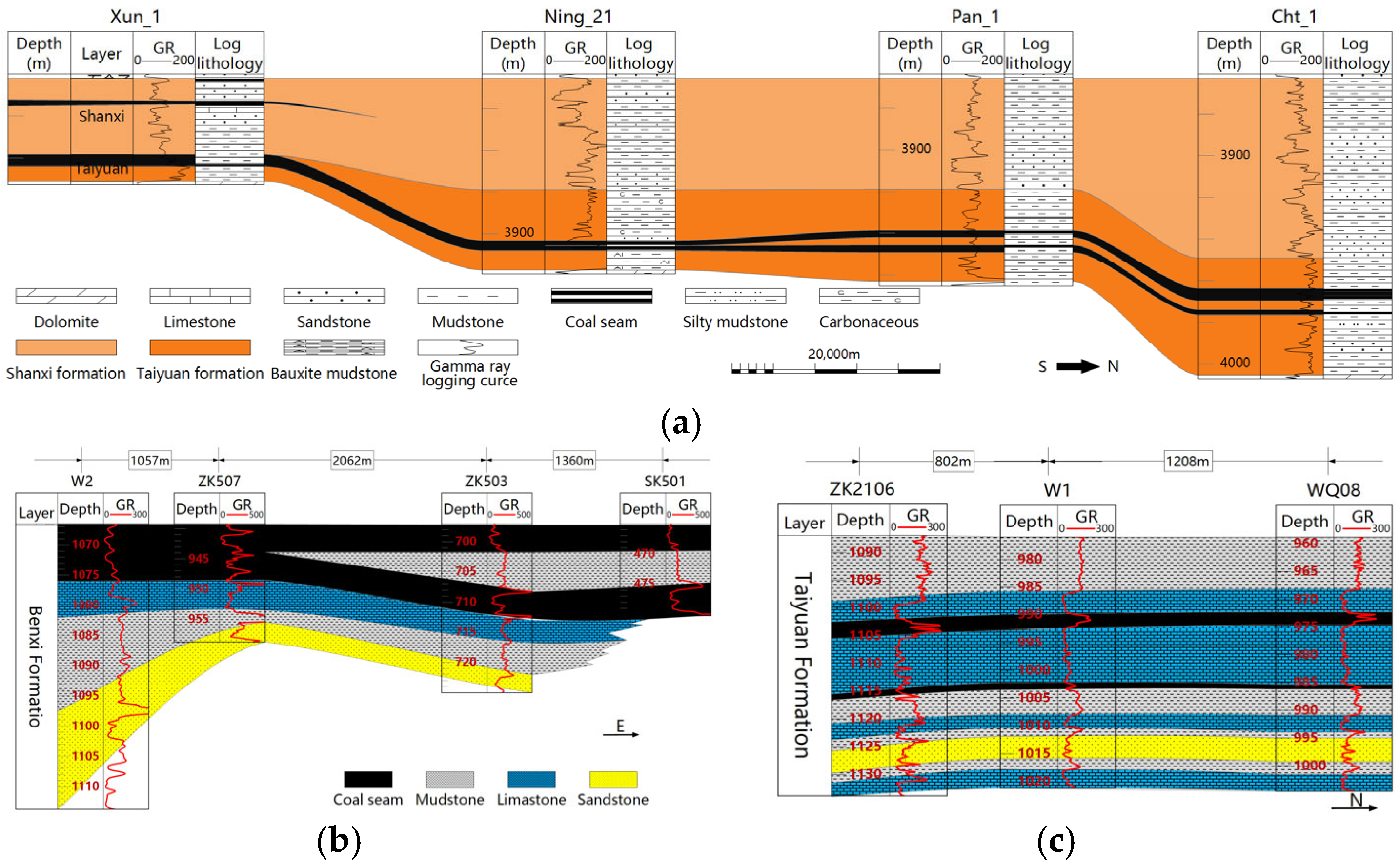
In the late stage of the Late Carboniferous, basin infill occurred under a regressive setting. Continued subsidence allowed the eastern and western seaways to extend further over the Central Paleouplift, preserving a paleogeographic configuration broadly similar to that of the late Early Late Carboniferous. Sandstone reservoirs remained poorly developed, characterized by thin individual layers, limited lateral continuity, and restricted spatial distribution. These reservoirs mainly consisted of barrier island and tidal channel sandstones, as well as shallow-water delta and fan delta deposits. By the end of the Late Carboniferous, the regional tectonic pattern was characterized by uplift in the north and subsidence in the south. The seawater retreated southward, leaving a large area of water-covered environment, which was conducive to the growth and reproduction of plants. Tidal flats developed on a large scale, forming large-scale and widely distributed main coal seams of the Carboniferous (Figure 10). The formation of regional stable coal seams marked the cessation of the rifting activities on the west margin and the beginning of a new evolutionary stage.
During the Early Permian, following the establishment of a tectonic regime characterized by northern uplift and southern tilting, seawater from the east advanced from an east-southeastern direction, traversed the central paleo-uplift, and merged with the western marine realm, resulting in the formation of a unified epicontinental sea. The western margin evolved into a post-rift depression and became a relatively subsiding zone within the open epicontinental sea. As shown in the isopach map of the Taiyuan Formation (Figure 9b), the extent of the paleo-uplift had markedly diminished, and the distribution of sedimentary strata extended significantly farther southward compared to that of the Benxi Formation. Nevertheless, the central paleouplift extending from north to south continues to act as a significant barrier separating the Qilian Sea from the North China Sea, and the trichotomous framework of the fundamental paleotectonic configuration during this period remains intact.

5.2. Early Permian (Shanxi Stage) to Shiqianfeng Stage

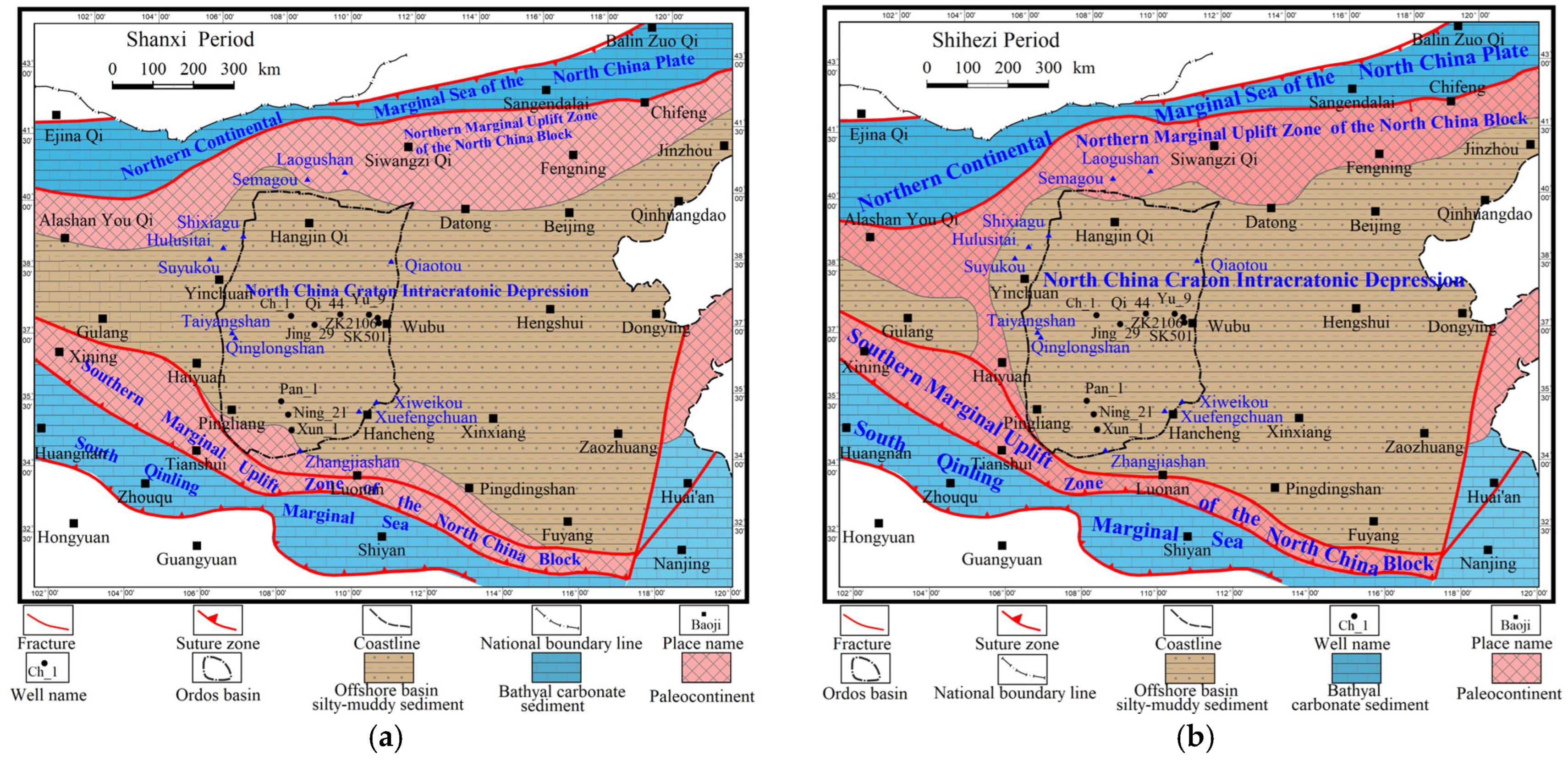
The North China Platform has undergone extensive uplift due to the northward subduction of the southern Qin-Qi Ocean and the southward subduction of the northern Xing-Meng Ocean [53,54,55]. This tectonic regime induced rapid marine regression from both the eastern and western margins of the basin, resulting in the transformation of the entire region into a unified depression (Figure 11). Sedimentation occurred under regressive conditions, with gradual subsidence of the basin and progressive expansion of the depositional area. Notably, the northern margin of the basin underwent significant uplift, leading to the disappearance of the previous east–west facies differentiation pattern. It was replaced by a new north–south-oriented topographic gradient and an associated sedimentary facies zonation. The accretion of the Hercynian fold belt around the North China Platform further expanded terrestrial areas, supplying abundant terrigenous clastic material for basin infill. During the Shihezi period of the Middle Permian, tectonic activities in the northern part of the basin were strengthened once again. This ancient landmass was uplifted and its area expanded. During the Shiqianfeng period of the Late Permian, due to the closure of the Xingmeng Ocean in the north, the southern Mianlue Ocean was still in the stage of subduction and weakening [56,57]. This led to a further uplift of the North China Platform. Consequently, the basin evolved into an inland lake basin, and the sedimentary environment completely shifted to a continental depositional system.
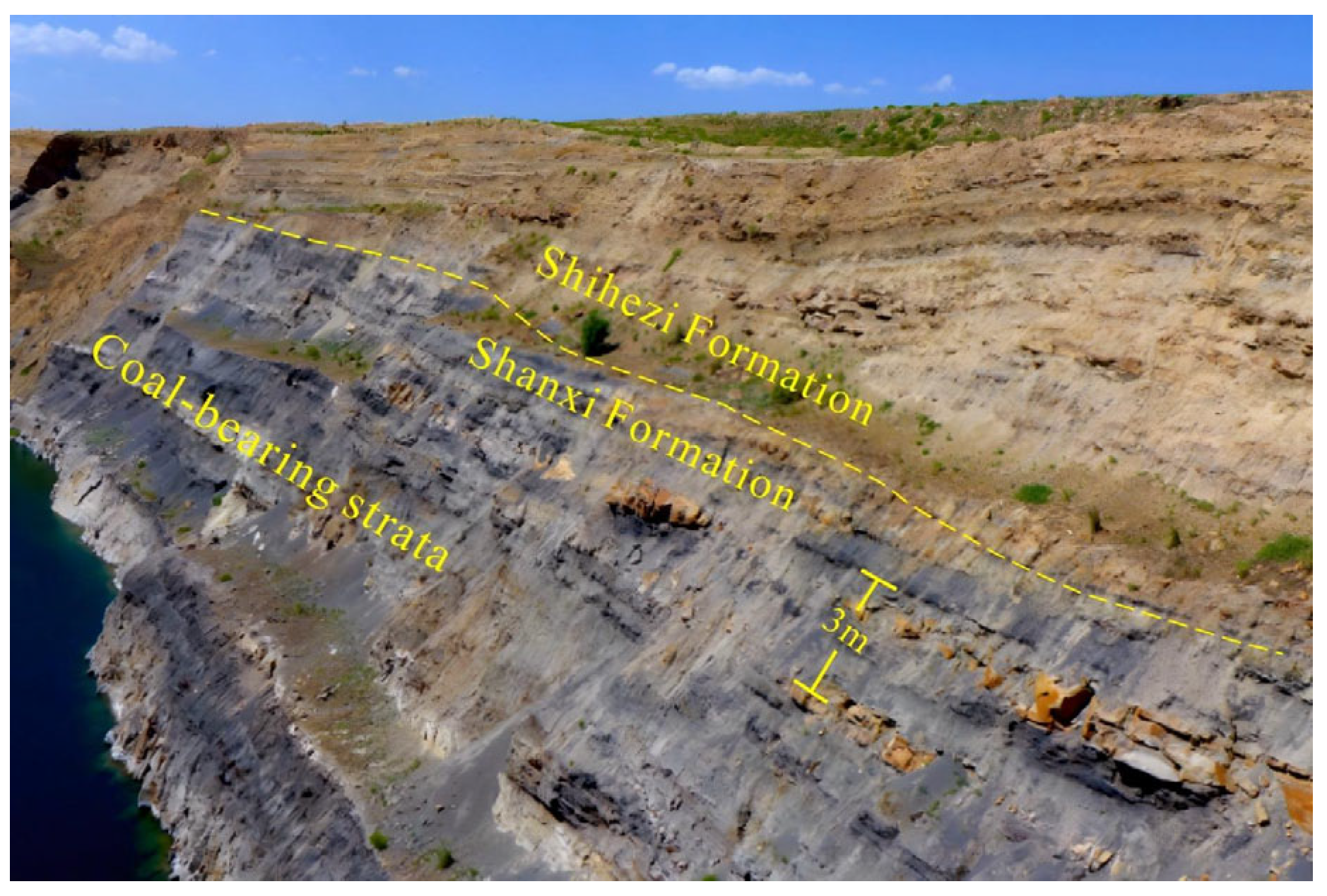
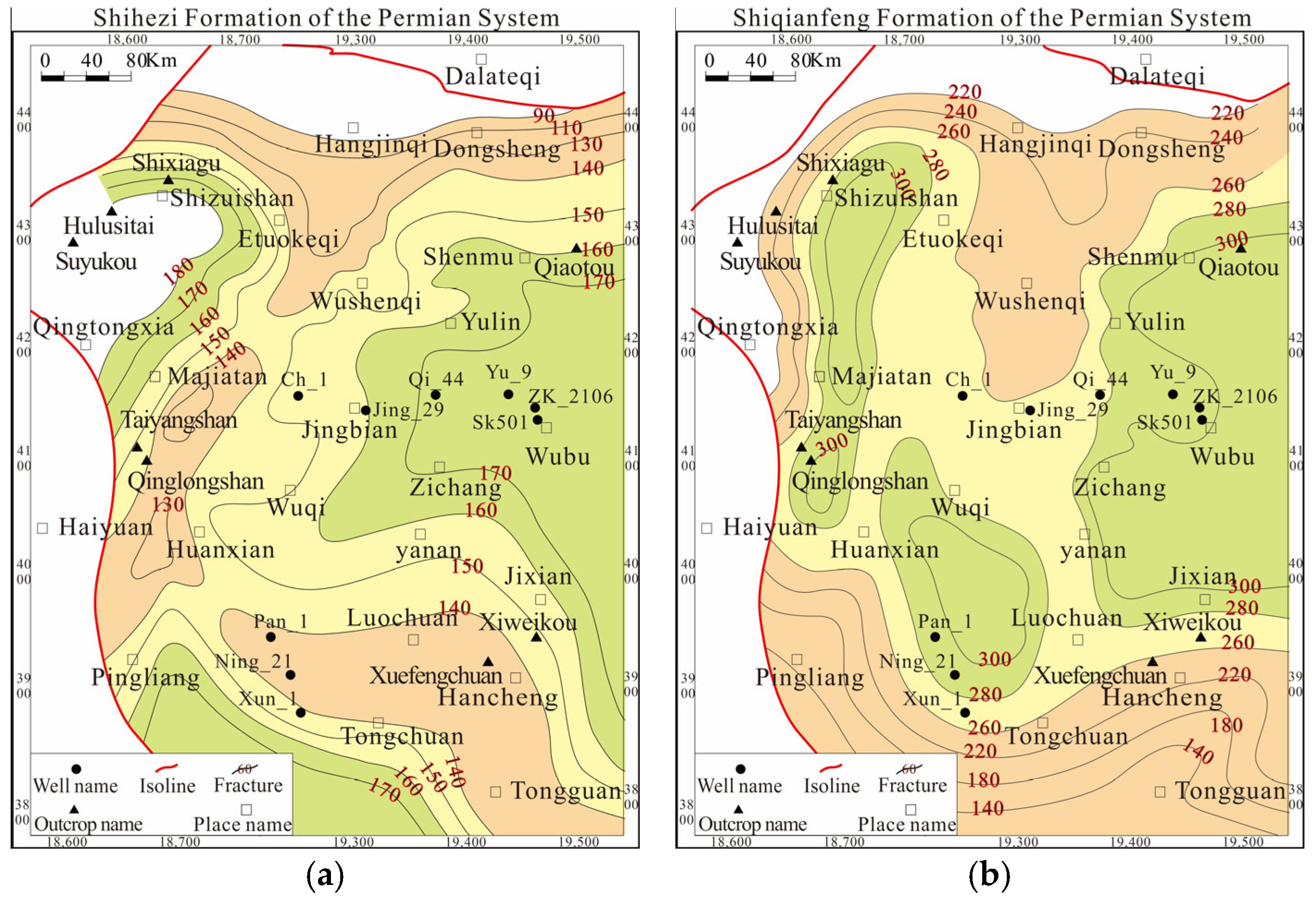
The suitable palaeoclimate and palaeogeography conditions in the late Early Permian resulted in the formation of relatively stable coal seams (Figure 12), which together with the carboniferous coal seams constituted the main gas source rocks of the Upper Paleozoic. Compared with the sedimentary of Early Permian, the paleostructural features of Shihezi period of the Ordos area have changed obviously (Figure 13, cool-tone colors indicate areas of thicker deposits.), mainly as follows: the range of central paleouplift has shifted to the west obviously; Weibei uplift disintegrated and some relative uplift areas became relative depression areas. The extent of the depositional area is obviously shifted to the south. The original uplift area in the southern margin of the North China Platform has been transformed into depositional area, and the source is mainly composed of the active continental margin in the south Qinling area and the uplift belt of the active tectonic background in the North Qinling area. The Shihezi Formation was derived from distinctly different provenance regions compared to the Benxi, Taiyuan, and Shanxi Formations, which is the fundamental reason that the sandstone composition of Shihezi Formation in Ordos Basin is quite different from that of Benxi Formation, Taiyuan Formation and Shanxi Formation.
In the Middle Permian, the paleoclimate changed to semi-arid and arid, and coal accumulation no longer reappeared. This area evolved into an offshore inland depression, which was occasionally affected by sea water. The discovery of glauconite in the lower member of the Shihezi Formation is the record of marine deposition. The north–south differential subsidence of the basin increased, the northern source area was further uplifted, and the terrigenous clastic supply was sufficient, forming a set of extremely thick and variegated terrigenous clastic sedimentary formations. The sandstone reservoir is very developed with large thickness, and the lithology combination is mainly composed of shoreline shallow lacustrine argillaceous rocks, which constitute the regional cap of Upper Paleozoic gas-bearing series.
At the end of the Hercynian cycle, the Qinling Trough subducted northward again, and the Xingmenghai Trough in the north margin disappeared due to the junction of the Siberian plate and the North China Plate, and the North China platform uplifted as a whole, and the sea water withdrew from the North China Basin. The sedimentary basin evolved into an inland lake basin, the sedimentary environment was completely transformed into a continental system, with river and lake deposits as the main body, and the climate became dry, forming the red clastic rock sedimentary formation of Shiqianfeng Formation. It can be seen from the contour map of stratum thickness of Shiqianfeng Formation that the paleotectonic features of the Ordos area have changed obviously compared with Shihezi Formation (Figure 13b). The changes are as follows: the central paleouplift has disappeared completely; the main tectonic pattern of the basin began to change from the early east–west zoning to the north–south zoning. From north to south, they are Yimeng Uplift, central Depression and Weibei Uplift in south. Therefore, in the Late Permian, there was no relatively unified central palaeouplift.

6. Conclusions

(1)
The Paleozoic evolution of the basin is characterized by distinct episodic phases, exhibiting a strong coupling between sedimentary systems and tectonic settings. During the Early Paleozoic, the basin developed on a passive continental margin, hosting extensive marine carbonate deposits. In the Late Paleozoic, it evolved into an intracratonic depression, with sedimentation shifting predominantly to transitional marine–continental and continental clastic sequences. This large-scale transformation was primarily driven by the interactions between the North China Plate and surrounding plates, as well as the tectonic evolution of the Paleo-Asian Ocean and the Qinqi Ocean.
(2)
The Caledonian orogeny, the most significant tectonic event of the Early Paleozoic, induced regional uplift, prolonged weathering, and denudation, resulting in the formation of a widespread paleo-weathered crust and karst reservoir at the top of the Ordovician strata. This reservoir has since become a key target for natural gas exploration in the region. The subsequent Hercynian orogeny played a pivotal role in transforming the basin from a rifted bay to a large inland depression during the Late Paleozoic and significantly influenced the spatial distribution of major coal-measure source rocks.
(3)
By the Late Carboniferous to Early Permian, the paleotectonic framework was marked by east–west differentiation, delineating the Qilian Sea from the North China Sea under the influence of the Central Paleo-Uplift. However, by the Late Permian, this configuration shifted to a north–south zonation, characterized by the Yimeng Uplift, Central Depression, and Weibei Uplift. This reorganization directly responded to the final amalgamation of peripheral orogenic belts—such as the North Qinling and Xingmeng orogenic belts—and signified the complete transition of the basin into an inland setting, thereby establishing the structural foundation for Mesozoic basin development.

Author Contributions

Conceptualization, L.Z. and Y.W.; methodology, J.R.; software, H.W. and J.L.; validation, L.Z.; formal analysis, J.L.; investigation, J.W.; resources, J.R.; data curation, Y.W. and H.W.; writing—original draft preparation, H.W.; writing—review and editing, Y.W. and J.R.; visualization, J.L.; supervision, L.Z.; project administration, J.R.; funding acquisition, J.R. All authors have read and agreed to the published version of the manuscript.

Funding

This paper is supported by the major science and technology project of PetroChina Changqing Oilfield Company, “Comprehensive Interpretation and Basic Geological Research of Ordos Basin Seismic Framework and Large Section” (2023DZZ02).

Data Availability Statement

The original contributions presented in this study are included in the article material. Further inquiries can be directed to the corresponding author.

Conflicts of Interest

Authors Junfeng Ren, Jing Luo and Jiayi Wei were employed by the company PetroChina Changqing Oilfield. The remaining authors declare that the research was conducted in the absence of any commercial or financial relationships that could be construed as a potential conflict of interest.

References

  1. Kröner, A.; Wilde, S.A.; Zhao, G.C.; O’Brien, P.J.; Sun, M.; Liu, D.Y.; Wan, Y.S.; Liu, S.W.; Guo, J.H. Zircon geochronology and metamorphic evolution of mafic dykes in the Hengshan Complex of northern China: Evidence for late Palaeoproterozoic extension and subsequent high-pressure metamorphism in the North China Craton. Precambrian Res. 2006, 146, 45–67. [Google Scholar] [CrossRef]
  2. Zhao, G.C. Metamorphic evolution of major tectonic units in the basement of the North China Craton: Key issues and discussion. Acta Petrol. Sin. 2009, 25, 1772–1792, (In Chinese with English Abstract). [Google Scholar]
  3. Zhao, Z.; Guo, Y.; Wang, Y.; Lin, D. Study Progress in Tectonic Evolution and Paleogeography of Ordos Basin. Spec. Oil Gas Reserv. 2012, 19, 15–19, (In Chinese with English Abstract). [Google Scholar]
  4. Fu, J.H.; Wei, X.S.; Ren, J.F. Distribution and genesis of large-scale Upper Paleozoic lithologic gas reservoirs on Yi-Shaan Slope. Pet. Explor. Dev. 2008, 35, 664–667+691, (In Chinese with English Abstract). [Google Scholar]
  5. Yang, Z.; He, S.; Zou, C.N.; Li, Q.Y.; Chen, Z.Y. Coupling relationship between reservoir diagenesis and natural gas accumulation of Daniudi Gas Field in North Ordos Basin. Acta Pet. Sin. 2010, 31, 373–378+385, (In Chinese with English Abstract). [Google Scholar]
  6. Yang, H.; Fu, J.H.; Liu, X.S.; Meng, P.L. Accumulation conditions and exploration and development of tight gas in the Upper Paleozoic of the Ordos Basin. Pet. Explor. Dev. 2012, 39, 295–303, (In Chinese with English Abstract). [Google Scholar] [CrossRef]
  7. Fu, S.T.; Fu, J.H.; Xi, S.L.; Huang, Z.L. Geological characteristics of Ordovician marine shale gas in the Ordos Basin and its prospects. China Pet. Explor. 2021, 26, 33–44, (In Chinese with English Abstract). [Google Scholar]
  8. Liu, C.Y.; Wang, J.Q.; Zhang, D.D.; Zhao, H.G.; Zhao, J.F.; Huang, L.; Wang, W.Q.; Qin, Y. Genesis of rich hydrocarbon resources and their occurrence and accumulation characteristics in the Ordos Basin. Oil Gas Geol. 2021, 42, 1011–1029, (In Chinese with English Abstract). [Google Scholar]
  9. He, F.Q.; Wang, F.B.; Guo, L.G.; An, C. Evolution of prototype basin and change of tectonic-sedimentary pattern in Paleozoic, Ordos Basin. Pet. Geol. Exp. 2022, 44, 373–384, (In Chinese with English Abstract). [Google Scholar]
  10. Li, J.; Zhang, W.Z.; Luo, X.; Hu, G.Y. Paleokarst reservoirs and gas accumulation in the Jingbian field, Ordos Basin. Mar. Pet. Geol. 2008, 25, 401–415. [Google Scholar] [CrossRef]
  11. He, J.; Fang, S.X.; Hou, F.H.; Yan, R.H.; Zhao, Z.J.; Yao, J.; Tang, X.J.; Wu, G.R. Vertical zonation of weathered crust ancient karst and reservoir evaluation and prediction-A case study of M55-M51 sub-members of Majiagou Formation in gas fields, central Ordos Basin, NW China. Pet. Explor. Dev. 2013, 40, 572–581. [Google Scholar] [CrossRef]
  12. Abdi, A.; Gharaie, M.H.M.; Bádenas, B. Internal wave deposits in Jurassic Kermanshah pelagic carbonates and radiolarites (Kermanshah area, West Iran). Sediment. Geol. 2014, 314, 47–59. [Google Scholar] [CrossRef]
  13. Zhu, L.W.; Wang, Z.L.; Zhang, B.; Wei, L.; Feng, Q.H.; Lei, X.; Chen, L. Characteristics of paleogeomorphology and paleokarstification and the impact on natural gas accumulation: A case study of upper assemblage of Majiagou formation in central Sulige gas field, Ordos Basin, China. Carbonates Evaporites 2019, 34, 1353–1366. [Google Scholar] [CrossRef]
  14. Wang, Z.W.; Liu, L.; Hu, J.L.; Wang, F.; Li, D.; Zhang, J.Q.; Zhu, S.Y.; Zhang, R.; Zhao, F.; Zhang, C.G.; et al. Sedimentary system and palaeogeographic evolution of Ordos Basin, northern China. Mar. Pet. Geol. 2024, 160, 106620. [Google Scholar] [CrossRef]
  15. Hu, C.L.; Zhang, Y.F.; Jiang, Z.X.; Wang, M.; Han, C.; Algeo, T.J. Tectonic and paleogeographic controls on development of the Early-Middle Ordovician Shanganning carbonate platform, Ordos Basin, North China. AAPG Bull. 2020, 104, 565–593. [Google Scholar] [CrossRef]
  16. He, D.F.; Cheng, X.; Zhang, G.W.; Zhao, W.Z.; Zhao, Z.; Liu, X.S.; Bao, H.P.; Fan, L.Y.; Zou, S.; Kai, B.Z.; et al. Scope, nature, and exploration significance of Ordos Basin during geological historical periods, NW China. Pet. Explor. Dev. 2025, 52, 855–871. [Google Scholar] [CrossRef]
  17. Ju, Y.; Wang, W.; Ren, Z.; Yang, Z.; Liu, K.; Hou, B.; Xiao, L. Multi-stageevolution of the Ordos Basin: Its coupled basin-mountain systems and energy resources. Sci. China Earth Sci. 2025, 68, 2426–2473, (In Chinese with English Abstract). [Google Scholar] [CrossRef]
  18. Zhai, M.G. Evolution of the North China Craton and Early Plate Tectonics. Acta Geol. Sin. 2012, 86, 1335–1349, (In Chinese with English Abstract). [Google Scholar]
  19. Zhao, G.C. The evolution of supercontinents and the formation of the East Asian continent. In Proceedings of theAnnual Meeting of Chinese Geoscience Union, Changsha, China, 12–15 July 2015. (In Chinese with English Abstract). [Google Scholar]
  20. Meng, Q.R.; Wu, G.L.; Fan, L.G.; Wei, H.H. Tectonic evolution of early Mesozoic sedimentary basins in the North China block. Earth Sci. Rev. 2019, 190, 416–438. [Google Scholar] [CrossRef]
  21. Zhao, J.F.; Liu, C.Y.; Huang, L.; Zhang, D.D.; Wang, D.; Wang, D. Paleogeography reconstruction of a multi-stage modified intracratonicbasin—A case study from the Jurassic Ordos Basin, Western North China Craton. J. Asian Earth Sci. 2020, 190, 104191. [Google Scholar] [CrossRef]
  22. Zhao, L.; Zou, Y.; Liu, P.H.; Sun, W.Q.; Zhang, R.C.; Zhou, L.G.; Zhai, M.G. An early Precambrian “orogenic belt” exhumed by the Phanerozoic tectonic events: A case study of the eastern North China Craton. Earth-Sci. Rev. 2023, 241, 104416. [Google Scholar] [CrossRef]
  23. Wang, W.; Zhao, Y.; Liu, X.C.; Hu, J.M.; Wei, C.J.; Xiao, W.J.; Du, J.X.; Wang, S.L.; Zhan, L.Q. Metamorphism of diverse basement gneisses of the Ordos Basin: Record of multistage Paleoproterozoic orogenesis and constraints on the evolution of the western North China Craton/Characteristics and genetic mechanism of the Mesoproterozoic rift system, Ordos Basin, China. Precambrian Res. 2019, 328, 48–63. [Google Scholar]
  24. Lv, D.W.; Shen, Y.Y.; van Loon, A.J.T.; Raji, M.; Zhang, Z.H. Sequence stratigraphy of the Middle Jurassic Yan’an Formation (NE Ordos Basin, China), relationship with climate conditions and basin evolution, and coal maceral’s characteristics. J. Palaeogeogr. 2023, 26, 779–795. [Google Scholar]
  25. Liu, M.C.; Wu, S.; Wan, X.L.; Li, Z.; Fan, J.M. Sequence stratigraphy and sedimentary facies characteristics of the shale strata of Yanchang Formation in Qingcheng Oilfield, Ordos Basin. J. Palaeogeogr. 2024, 10, 1086298. [Google Scholar]
  26. Li, W.H.; Zhang, Q.; Li, Z.Y.; Li, K.Y.; Guo, Y.Q.; Feng, J.P.; Chen, Q.; Yuan, Z.; Ma, Y. Lithofacies palaeogeography and sedimentary evolution of Ordos Basin and its periphery. J. Northwest Univ. Nat. Sci. 2024, 54, 929–949, (In Chinese with English Abstract). [Google Scholar]
  27. Guo, Y.Q.; Li, B.Q.; Li, B.; Li, W.H.; Cao, H.X.; Liao, Y.; Wu, Z.Z.; Fei, S.X.; Zhang, Q.; Chen, Q.; et al. Sedimentary system and palaeogeographic evolution of Ordos Basin, northern China. J. Palaeogeogr. 2025, 14, 501–534. [Google Scholar] [CrossRef]
  28. Zhao, W.Z.; Wang, X.M.; Guo, Y.R.; Liu, H.Q.; Bai, Y.L. Restoration and tectonic reworking of the Late Triassic basin in western Ordos Basin. Pet. Explor. Dev. 2006, 33, 6–13, (In Chinese with English Abstract). [Google Scholar]
  29. Zhai, Y.H.; He, D.F.; Kai, B. Tectonic-depositional environment and prototype basin evolution of Middle-Late Permian in Ordos Basin and adjacent areas. Lithol. Reserv. 2024, 36, 32–44, (In Chinese with English Abstract). [Google Scholar]
  30. Zhai, M.G.; Liu, W.J. Paleoproterozoic tectonic history of the North China Craton: A review. Precambrian Res. 2003, 122, 183–199. [Google Scholar] [CrossRef]
  31. Kröner, A.; Wilde, S.A.; Li, J.H.; Wang, K.Y. Age and evolution of a late Archean to Paleoproterozoic upper to lower crustal section in the Wutaishan/Hengshan/Fuping terrain of northern China. J. Asian Earth Sci. 2004, 24, 577–595. [Google Scholar] [CrossRef]
  32. Zhao, G.C.; Sun, M.; Wilde, S.A.; Li, S.Z. Late Archean to Paleoproterozoic evolution of the North China Craton: Key issues revisited. Precambrian Res. 2005, 136, 177–202. [Google Scholar] [CrossRef]
  33. Kusky, T.; Windley, B.F.; Zhai, M.G. Tectonic evolution of the North China Block: From orogen to cratontoorogen. Geol. Soc. Lond. Spec. Publ. 2007, 280, 1–34. [Google Scholar] [CrossRef]
  34. Zhai, M.G. Cratonization and the Ancient North China Continent: A summary and review. Sci. China Earth Sci. 2011, 54, 1110–1120. [Google Scholar] [CrossRef]
  35. Zhai, M.G.; Santosh, M. Metallogeny of the North China Craton: Link with secular changes in the evolving Earth. Gondwana Res. 2013, 24, 275–297. [Google Scholar] [CrossRef]
  36. Zhao, G.C.; Zhai, M.G. Litho tectonic elements of Precambrian basement in the North China Craton: Review and tectonic implications. Gondwana Res. 2013, 23, 1207–1240. [Google Scholar] [CrossRef]
  37. Zhao, G.C.; Cawood, P.A.; Li, S.Z.; Wilde, S.A.; Sun, M.; Zhang, J.; He, Y.H.; Yin, C.Q. Amalgamation of the North China Craton: Key issues and discussion. Precambrian Res. 2012, 222–223, 55–76. [Google Scholar] [CrossRef]
  38. Zhai, M.G. Tectonic evolution of the north China craton. J. Geomech. 2019, 25, 722–745, (In Chinese with English Abstract). [Google Scholar]
  39. Qiu, H.B.; Lin, W.; Chen, Y.; Faure, M. Jurassic–Early Cretaceous tectonic evolution of the North China Craton and Yanshanian intracontinental orogeny in East Asia: New insights from a general review of stratigraphy, structures, and magmatism. Earth-Sci. Rev. 2023, 237, 104320. [Google Scholar] [CrossRef]
  40. Sun, X.Y.; Zhao, L.Q.; Zhan, Y.; Wang, Q.L.; Yang, H.B.; Liu, X.H. Electrical structures in the central part of the North China Craton and their implications for the mechanism of Craton destruction. Tectonophysics 2023, 862, 229959. [Google Scholar] [CrossRef]
  41. Yan, X.Y.; Yang, D.B.; Xu, W.L.; Quan, Y.K.; Wang, A.Q.; Hao, L.R.; Wang, F. Identification of metasomatic components in lithospheric mantle under multiple tectonic regimes: Insights from Early Cretaceous mafic rocks in the northeastern North China Craton. Lithos. 2023, 454–455, 107262. [Google Scholar] [CrossRef]
  42. Yu, H.T.; Xu, Z.J.; Cheng, R.H.; Zhang, Z.; Gao, D. Late Mesozoic transformation from the compressive to extensional tectonic regime of the Eastern North China Craton: Sedimentary records from the North Yellow Sea Basin. J. Asian Earth Sci. 2023, 256, 105809. [Google Scholar] [CrossRef]
  43. Peng, H.; Wang, J.Q.; Liu, C.Y.; Zhao, H.G.; Huang, L.; Zhao, X.C.; Zhang, S.H.; Liang, C.; Wang, Z.; Cattò, S.; et al. Long-term and multiple stage exhumation ofthe Ordos Basin, western North China Craton: Insights from seismic reflection, borehole and geochronological data. Earth-Sci. Rev. 2023, 238, 104349. [Google Scholar] [CrossRef]
  44. Liu, X.Y.; Wei, L.B.; Liu, B.X.; Zhang, L.; Guo, W.; Zhang, J.W.; Zheng, J. Characteristics of natural gas accumulation in the Cambrian weathered crust in southwestern Ordos Basin. Nat. Gas Ind. B 2021, 8, 421–430, (In Chinese with English Abstract). [Google Scholar] [CrossRef]
  45. Gu, N.; Zhang, J.T.; Jin, X.H.; Yang, F.; Liu, L. Ordovician reservoirs in Fuxian area: Gas accumulation patterns and their implications for the exploration of lower Paleozoic carbonates in the southern Ordos Basin. Energy Geosci. 2024, 5, 100225, (In Chinese with English Abstract). [Google Scholar] [CrossRef]
  46. Zhao, X.C.; Liu, C.Y.; Wang, J.Q.; Zhao, Y.; Wang, L.; Zhang, Q.H. Detrital zircon U-Pb ages of Paleozoic sedimentary rocks from the eastern Hexi Corridor Belt (NW China): Provenance and geodynamic implications. Sediment. Geol. 2016, 339, 32–45. [Google Scholar]
  47. Yin, J.Y.; Slavík, L.; Wang, Z.H.; Shen, Z.; Zhang, X.S.; Liu, Y.L.; Ma, J.; Gong, Y.M.; Zong, R.W. The Silurian–Devonian Boundary of China: Review and perspectives. Earth-Sci. Rev. 2024, 254, 104805. [Google Scholar] [CrossRef]
  48. Sun, J.P.; Dong, Y.P. Stratigraphy and geochronology of Permo-Carboniferous strata in the Western North China Craton: Insights into the tectonic evolution of the southern Paleo-Asian Ocean. Gondwana Res. 2020, 88, 201–219. [Google Scholar] [CrossRef]
  49. Bai, Y.L.; Ma, Y.H.; Huang, Y.; Liao, J.B.; Liu, X.G. Properties of Continental Margin and its Hydrocarbon Exploration Significance in Cambrian in the Southern Ordos Kratogen of North China. Acta Geol. Sin. (Engl. Ed.) 2013, 87, 777–803. [Google Scholar]
  50. Kusky, T.M.; Li, J. Paleoproterozoic tectonic evolution of the North China Craton. J. Asian Earth Sci. 2003, 22, 383–397. [Google Scholar] [CrossRef]
  51. Luo, F.H.; Gong, H.J.; Liu, H. Early-paleozoic rapakivi-textured granite from the North Qinling (Central China): Implications for crust-mantle interactions in a post-collisional setting. Mineral. Petrol. 2024, 118, 281–303. [Google Scholar] [CrossRef]
  52. Dong, Y.P.; Zhang, C.W.; Yang, Z. A new model of the early Paleozoic tectonics and evolutionary history in the Northern Qinling China. Geophys. Res. Abstr. 2010, 12, 222–230. [Google Scholar]
  53. Xiao, W.J.; Kröner, A.; Windlye, B. Geodynamic evolution of Central Asia in the Paleozoic and Mesozoic. Int. J. Earth Sci. 2009, 98, 1185–1188. [Google Scholar] [CrossRef]
  54. Wang, Z.W.; Liu, L.; Hu, J.L.; Li, D.; Chen, H.D.; Zhu, S.Y.; Zhang, C.G.; Zhao, J.X. Spatiotemporal evolution of the early Permian multi-source-to-sink system in the northwestern margin of the North China Block: Implications for the paleogeographic reconstruction along the southern margin of the Paleo-Asian Ocean. Palaeogeogr. Palaeoclimatol. Palaeoecol. 2024, 655, 112500. [Google Scholar] [CrossRef]
  55. Yang, Q.; Shi, W.; Li, X.G.; Wang, T.Y.; Lin, M. Structural patterns and ages of Permian-Triassic multistage strike-slip faulting in the Chifeng area, southeastern Inner Mongolia, China: Implications for the final closure of the Paleo-Asian Ocean. J. Asian Earth Sci. 2024, 263, 106006. [Google Scholar] [CrossRef]
  56. Xiao, W.J.; Windley, B.F.; Sun, S.; Li, J.L.; Huang, B.C.; Han, C.M.; Yuan, C.; Sun, M.; Chen, H.L. A tale of amalgamation of three Permo-Triassic collage systems in central Asia: Oroclines, sutures and terminal accretion. Annu. Rev. Earth Planet. Sci. 2015, 43, 477–507. [Google Scholar] [CrossRef]
  57. Dong, Y.P.; Santosh, M. Tectonic architecture and multiple orogeny of the Qinling Orogenic Belt, Central China. Gondwana Res. 2016, 29, 1–40. [Google Scholar] [CrossRef]
Figure 1. Tectonic location of the Ordos Basin in the North China Craton (a) and its stratigraphic evolution characteristics of Paleozoic (b) (modified from [3]).
Jmse 14 00112 g001
Figure 2. Tectono-sedimentary pattern of the North China Plate during the Cambrian (a) and the Early and Middle Ordovician (b).
Jmse 14 00112 g002
Figure 3. Paleotectonic pattern of the Upper Cambrian and the Middle Ordovician in Ordos. (a) Xinji period; (b) Zhushadong period; (c) Maozhuang period; (d) Zhangxia period; (e) Majiagou period; (f) Suyukou outcrop; (g) Qinglongshan outcrop.
Jmse 14 00112 g003
Figure 4. Stratigraphic correlation of typical wells in the Lower Paleozoic strata of the Ordos Basin.
Jmse 14 00112 g004
Figure 5. Dating and geochemical analysis results of the galedonian granites in Luonan area. (a) isotope age distribution map; (b) illustration of subducting granite R1–R2.
Jmse 14 00112 g005
Figure 6. Tectono-sedimentary pattern of the North China Plate during the Late Ordovician Pingliang stage.
Jmse 14 00112 g006
Figure 7. Clastic rock slope of Lower member (a) and turbidite sedimentary system of the Upper member (b) of Ordovician Pingliang Formation in Wuhai: (a) Lower member of Pingliang formation; (b) Upper member of Pingliang formation: A—massive, graded bedding, B—parallel amination, C—ripple lamination.
Jmse 14 00112 g007
Figure 8. Tectono-sedimentary pattern of the North China Plate during the Late Carboniferous (a) and Early Permian (b).
Jmse 14 00112 g008
Figure 9. Paleotectonic pattern of Benxi Formation of Carboniferous system during depositional period in Ordos area. (a) Benxi period; (b) Taiyuan period; (c) Hulusitai outcrop.
Jmse 14 00112 g009
Figure 10. Widely distributed coal seams of the Late Carboniferous and Early Permian. (a) Taiyuan Formation of the central part; (b) Benxi Formation of the eastern part; (c) Taiyuan Formation of the eastern part.
Jmse 14 00112 g010
Figure 11. Tectono-sedimentary pattern of the North China Plate during the Early Permian Shanxi period (a) and Shihezi period (b).
Jmse 14 00112 g011
Figure 12. Permian Shanxi Formation coal-bearing continental depositional system located at the western margin of the Ordos Basin.
Jmse 14 00112 g012
Figure 13. Paleotectonic pattern of Shihezi stage (a) and Shiqianfeng stage (b) in Ordos Basin.
Jmse 14 00112 g013
Disclaimer/Publisher’s Note: The statements, opinions and data contained in all publications are solely those of the individual author(s) and contributor(s) and not of MDPI and/or the editor(s). MDPI and/or the editor(s) disclaim responsibility for any injury to people or property resulting from any ideas, methods, instructions or products referred to in the content.