Article

Experimental Comparisons of the Wave Attenuation Characteristics Among Different Flexible-Membrane Breakwaters

1
School of Naval Architecture, Ocean and Energy Power Engineering, Wuhan University of Technology, Wuhan 430063, China
2
South China Sea Fisheries Research Institute, Key Laboratory of Open-Sea Fishery Development, Ministry of Agriculture and Rural Affairs, Guangzhou 510300, China
3
Sanya Tropical Fisheries Research Institute, Hainan Engineering Research Center of Deep-Sea Aquaculture and Processing, Sanya 572024, China
*
Authors to whom correspondence should be addressed.
J. Mar. Sci. Eng. 2026, 14(1), 78; https://doi.org/10.3390/jmse14010078 (registering DOI)
Submission received: 27 October 2025 / Revised: 8 December 2025 / Accepted: 26 December 2025 / Published: 31 December 2025
(This article belongs to the Section Ocean Engineering)

Abstract

In this paper, physical experiments were conducted to analyze the wave attenuation characteristics of a combinational breakwater in a 2D piston-type wave flume. The proposed breakwater consisted of a box and double flexible membranes, one of which was fixed on both sides of the box, while the other was positioned at a specific distance from the box sides. The flexible membranes dropped down naturally and formed a U shape. Optimal configuration parameters of the proposed breakwater were determined separately through a series of comparison experiments among mooring breakwaters in regular waves; the box draft d was determined by a box-type breakwater and the membrane spacings Lu and Ld from the box sides were determined by a U-shaped flexible-membrane breakwater, where the wave attenuation coefficients versus kh and B/λ were provided. Then, using the literature, the present box–membrane breakwater with membrane spacings was compared to two similar flexible-membrane breakwaters. One was the above-mentioned U-shaped flexible-membrane breakwater, the other was a box–membrane breakwater in which the flexible membranes were directly fastened on the box sides. The results indicate that with optimal configuration parameters, the wave attenuation performance of the proposed breakwater had been enhanced due to the increase in both dissipating and reflecting wave energy.

1. Introduction

Free surface breakwaters (FSBs) or floating breakwaters (FBs) are coastal engineering structures that can provide a sheltered region to protect the mariculture zone. FBs such as the box-type, pontoon-type, frame-type, mat-type, tethered-float-type, and horizontal-plate-type [1] generally offer a simpler configuration and lower construction difficulty and cost, as well as higher reusability when comprehensively compared with traditional bottom-mounted breakwaters [2]. The wave attenuation mechanism of FBs mainly comprises reflecting and dissipating waves.
A box-type breakwater is a common FB with a simple box structure, which blocks incident waves dominantly by wave reflection. In addition to acting as a breakwater, it can also serve as a road, warehouse, anchor ship, or fishing dock, so a number of investigations on the hydrodynamic performances of box-type FBs with different improving configurations can be found. As the single-box FBs are relatively ineffective in attenuating long waves, the side-by-side-boxes structure was developed in breakwaters to broaden the breakwater breadth and elevate the wave attenuation performance for relatively long waves. Karmakar et al. [3] experimentally compared the wave attenuation characteristics of single-box-type FB and double box-type FBs. Yang et al. [4] investigated two floating boxes rigidly connected by horizontal plates and found that this reduced the transmission coefficient by 0.4, at most, compared to two floating boxes without rigid plate connection. Diamantoulaki and Angelides [5] numerically studied the wave attenuation performance of an array of boxes flexibly connected by hinges under monochromatic linear waves of different wave headings. Ji et al. [6] experimentally studied the wave attenuation characteristics of double-row detached FBs which outperformed a single-row FB through enhanced energy dissipation caused by eddies and the moon-pool effect. Chen and Wu [7] numerically investigated the wave attenuation characteristics of two surface-piercing fixed boxes without connection by the Desingularized Boundary Integral Equation Method, and found that the transmission coefficient of two boxes reached a valley band where the Bragg resonance occurred. Chen et al. [8] numerically studied the wave attenuation characteristics and dynamic responses of two independent moored floating boxes using the δ-Smoothed Particle Hydrodynamics model, which was validated by experimental tests, and the results demonstrated that the movement of the two floating boxes was detrimental to the Bragg resonance reflection effect.
Beyond approaches that improve wave attenuation performance by leveraging multiple attenuations, researchers have investigated adding appendages to box-type breakwaters to dissipate long-wave energy by disturbing wave particle orbits or utilizing friction between appendage structures and wave particles. He et al. [9] experimentally compared the hydrodynamic performance of a rectangular box-type breakwater with and without pneumatic chambers which could boost wave energy dissipation. Alizadeh [10] studied the performance of a box with attached rigid plates on both its front and rear faces under regular waves. Ji et al. [11] conducted experiments to measure the wave attenuation performance of a hollow box whose upper surface was appended with four perforated-plate compartments which could reduce the motion response and mooring force. He et al. [12] experimentally analyzed the wave protection and motion response performances of a rectangular floating breakwater with upper surface slotting to insert multiple through-penetrating vertical plates extending externally, demonstrating that the primary function of vertical plates as wave-dissipating components is due to water-body confinement. Hu et al. [13] numerically and experimentally researched the interactions between regular waves and a floating box with adjacent porous baffles positioned both upstream and downstream, and corresponding experiments were also conducted to ensure the accuracy of the numerical results. Nevertheless, this kind of breakwater still encounters the challenge of resisting relatively long waves, which leads to enlarging the breakwater dimension accompanied by the loss of economic efficiency.
Since relying on rigid breakwaters proves insufficient and prohibitively expensive for effective wave attenuation in the face of longer waves, researchers have begun incorporating flexible appendages into FBs to enhance wave attenuation performance and reduce costs. Kee and Kim [14] numerically researched the interaction of water waves with a tensioned vertical flexible membrane attached to a solid cylindrical buoy through the Boundary Element Method (BEM), and showed that the wave attenuation performance of FBs under long waves could be enhanced by adding the underwater appurtenance, the numerical results of which were soon validated by a series of experiments carried by Kim et al. [15] in a two-dimensional regular and irregular wave tank. Cho et al. [16] proposed a dual cylindrical buoy attached with vertical flexible membranes which were then numerically investigated under oblique incident waves, and the results demonstrated that the wave attenuation performance of a dual membrane breakwater can be significantly enhanced compared to the single membrane case. Briggs et al. [17] experimentally tested the Rapidly Installed Breakwater System (RIBS) which attached the fabric membrane to a rigid frame, like a ‘Venetian blind,’ to permit rapid and expedient deployment, reducing Sea State 3 wave conditions to Sea State 2 for safe vessel operations. Hermanson [18] studied the wave attenuation performance of a vertical flexible membrane attached to FBs through experiments and found that the attaching membrane can reduce the average transmission coefficient by about 12–17%. Kee [19], utilizing the BEM, numerically studied the hydrodynamic characteristics of a floating rectangle pontoon attached with triple vertical porous membranes underneath, demonstrating that long vertical porous membranes taking a major fraction of the water column can significantly increase the overall wave attenuation performance in normal and oblique incident waves, including long waves. The above-mentioned flexible-membrane breakwaters had a common feature of using pre-tensioned flexible membranes to reflect waves, which requires huge weights to tauten the flexible membranes especially in larger waves, resulting in difficulty meeting the tension requirements for the weights and the flexible membranes. In view of this, Wu et al. [20] experimentally presented a flexible-membrane appendage without pretension in which two-layer arc membranes naturally hung down from a rectangular box, achieving nearly 50% wave attenuation under longer waves due to introducing a new wave-absorbing mechanism, including the movements of the flexible membranes and of the massive water enveloped in the flexible membranes. Based on the single-box–membrane breakwater of Wu et al. [20], Wu et al. [21] implemented the experiments of a side-by-side box–membrane breakwater, enhancing the wave-blocking ability by additional Bragg reflection and wave energy exhaustion in the gap between two boxes. In addition, Wu et al. [22] removed the box and put forward a bilayer slack U-shaped flexible-membrane breakwater, where the outer membrane was separated from the inner membrane, posing a strong hindering-wave ability mainly through absorbing wave energy.
This study, also based on the single-box–membrane breakwater of Wu et al. [20], and introducing the U-shaped flexible-membrane breakwater presented by Wu et al. [22], proposes a new box–membrane combinational breakwater, combining the advantages of both in terms of reflecting waves and wave-energy dissipating. In this proposed breakwater, the outer membrane is separated from the box sides, unlike that of Wu et al. [20] which was fastened together with the inner membrane on the box sides, according the design of Wu et al. [22]. Compared with the proposed breakwater of Wu et al. [22], this study added a box above the inner membrane. The dynamic motion response modeled by a two-way fluid–structure interaction (FSI) of the U-shaped flexible membranes is comparatively complex; thus we opted to prioritize experimental investigation as the primary research approach. And in this study, the investigated breakwaters were all moored instead of fixed as in Wu et al. [20] and Wu et al. [22]. While acknowledging the broader mooring system influence, this investigation prioritized the evaluation of the wave attenuation characteristics of the proposed breakwater, reserving mooring system analyses for subsequent research. For the proposed breakwater under mooring, the box draft d was determined through varying the draft of a naked mooring box, and the two membrane spacings separated from two box sides were optimized through adjusting the spacings of a mooring U-shaped flexible-membrane breakwater. Then, this proposed breakwater was compared to the box-type breakwater and the U-shaped flexible-membrane breakwater with respect to wave attenuation performance and mechanism, all under mooring. Finally, compared to the box-type flexible-membrane breakwater presented by Wu et al. [20], it was not fixed but was moored. In this paper, the tested breakwaters had the same sizes for box and membranes.
These preliminary experiments were carried out in a 2D piston-type wave flume under regular waves, where wave elevations were acquired by wave gauges for the hydrodynamic coefficients of transmission coefficient, reflection coefficient, and energy dissipation coefficient. The rest of the paper is organized as follows: Section 2 describes the experimental setup. Section 3 defines three hydrodynamic coefficients. In Section 4, the results are provided and discussed. In Section 5, the conclusions of this study are summarized.

2. Experimental Setup

2.1. The Proposed Breakwater

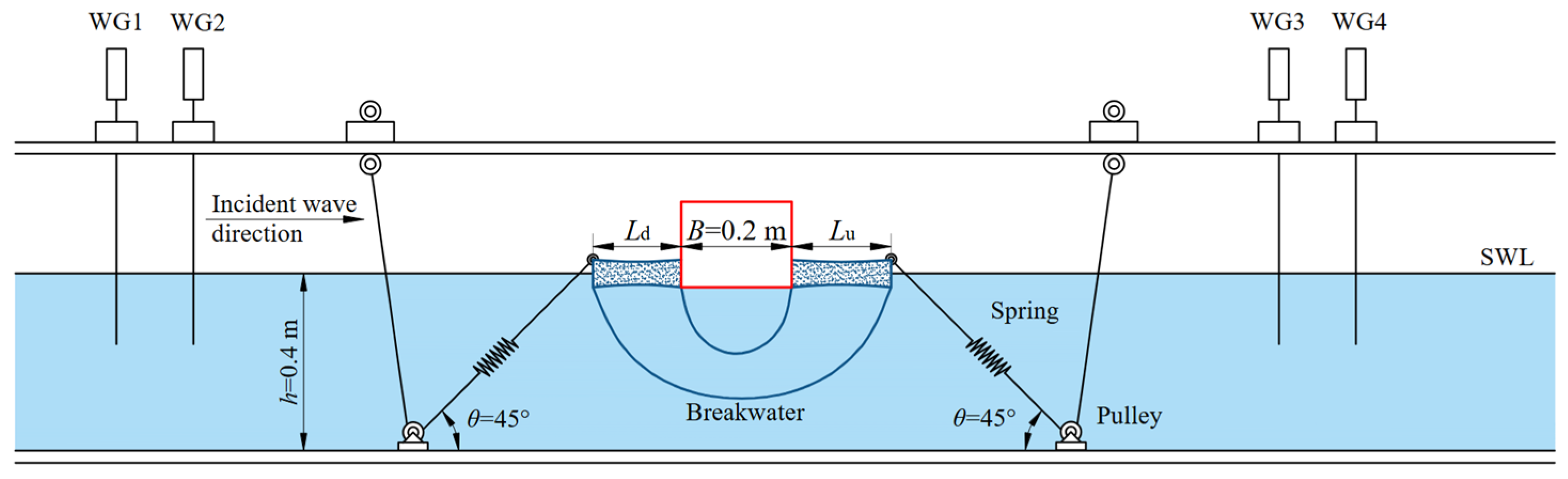
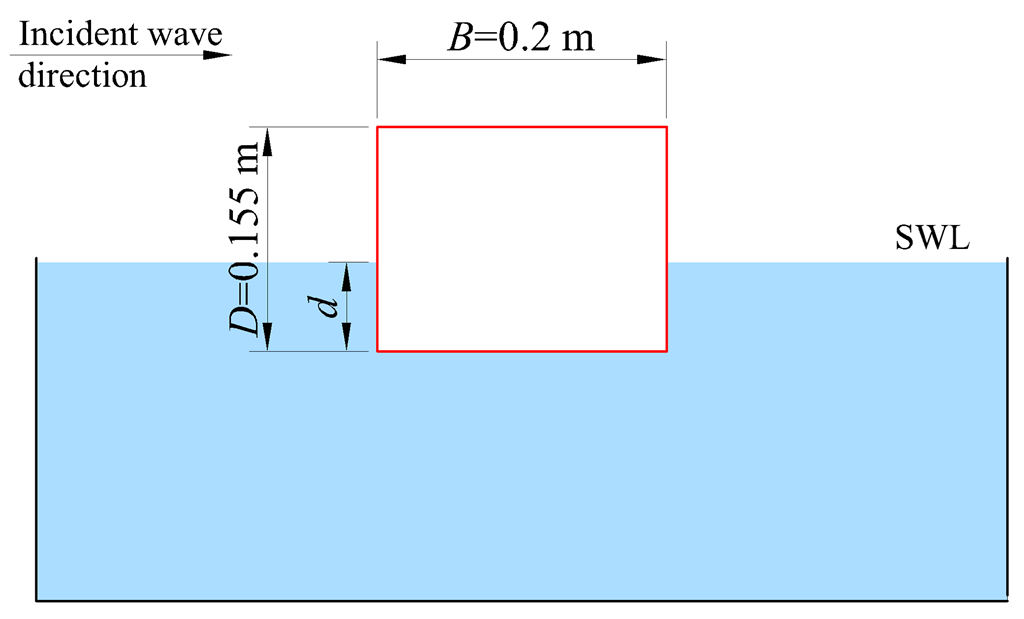
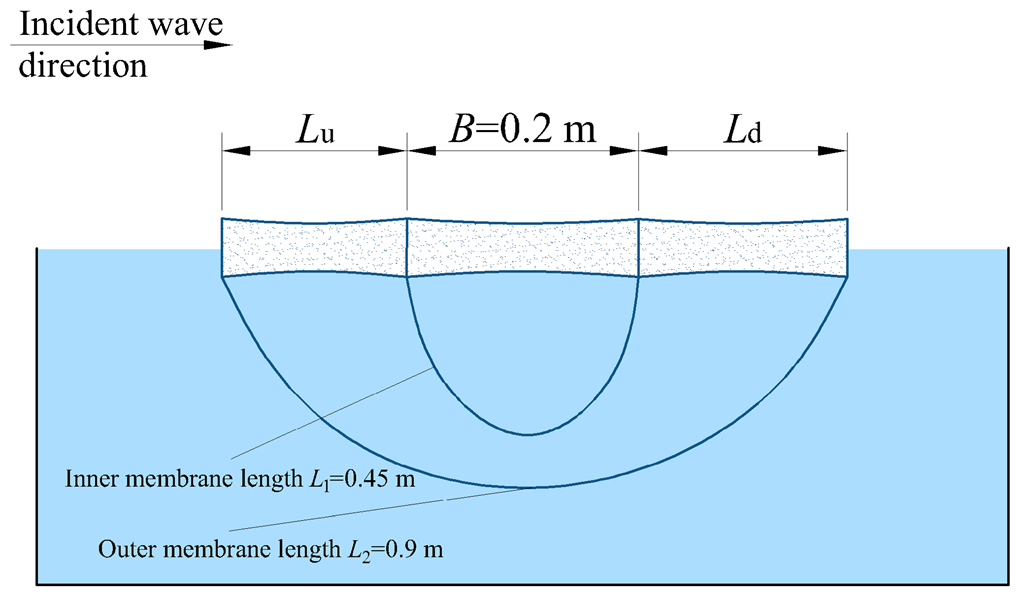
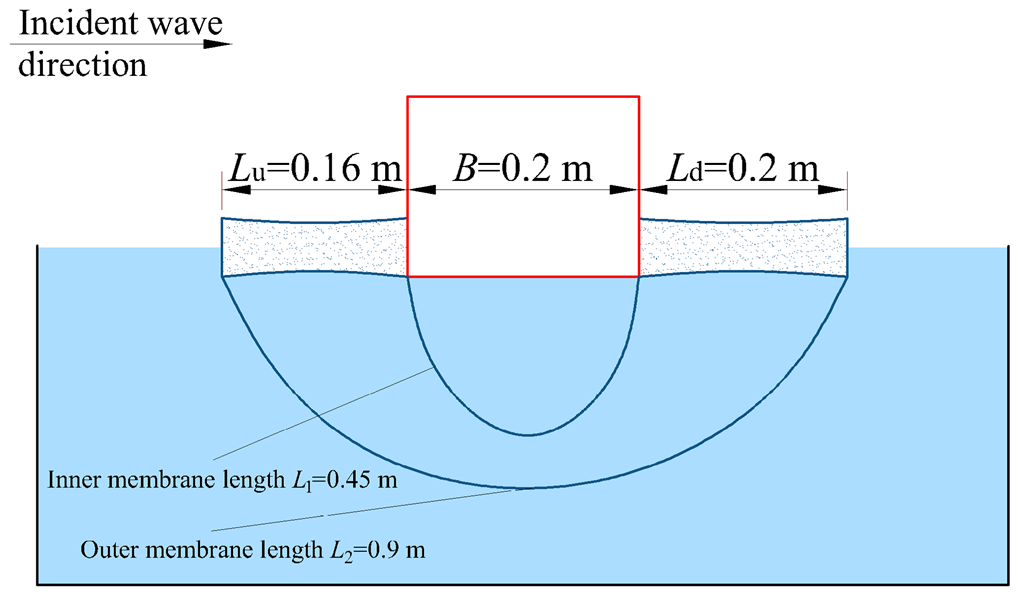
Herein, a new configuration of a box–membrane breakwater was developed by combining the box-flexible membrane breakwater presented by Wu et al. [20] with the U-shaped flexible-membrane breakwater presented by Wu et al. [22]. The schematic diagram of the proposed new box–membrane combinational breakwater is depicted in Figure 1. It consisted of a wooden box (length L = 0.595 m; box width B = 0.2 m; height D = 0.155 m, as in Wu et al. [21]), U-shaped transparent PVC flexible membranes (1.0 mm thick; length of inner membrane L1 = 0.45 m; length of outer membrane L2 = 0.9 m), and six flexible buoys. The U-shaped transparent Poly Vinyl Chloride (PVC) flexible membranes were made of a common tablecloth, whose density of 1220 kg/m3 was slightly weightier than water, with the choice of membrane geometry referring to Wu et al. [22]. The outer membrane was separated from the two box sides in spacings of Lu and Ld, while the inner flexible membrane was fixed directly on both sides of the box. The flexible membranes dropped down freely to form the inner and outer layers of the U-shaped flexible membranes and both layers did not touch the bottom. Such a design had the objective of mitigating waves more effectively than the breakwater of Wu et al. [20], based on retaining the merits of the breakwater in Wu et al. [22] related to wave energy dissipation, and retaining the multiple roles of the box-type breakwater.

2.2. The Tested Breakwaters

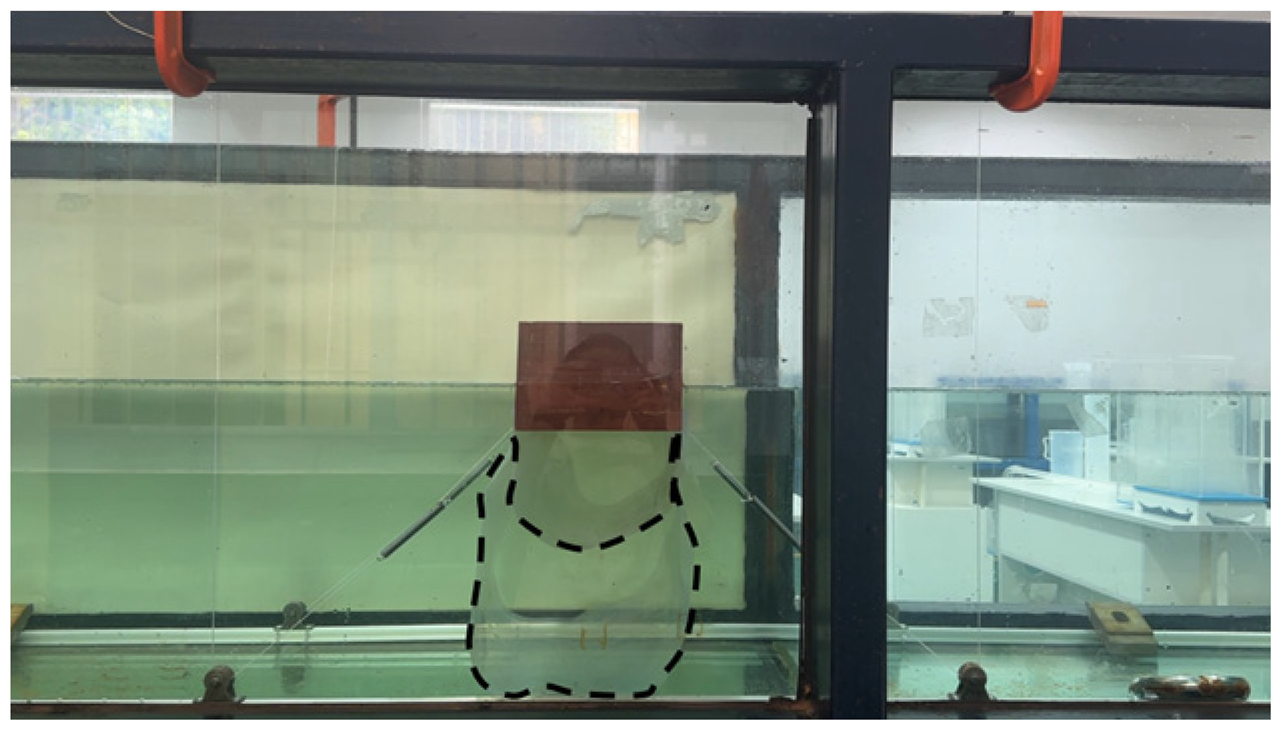
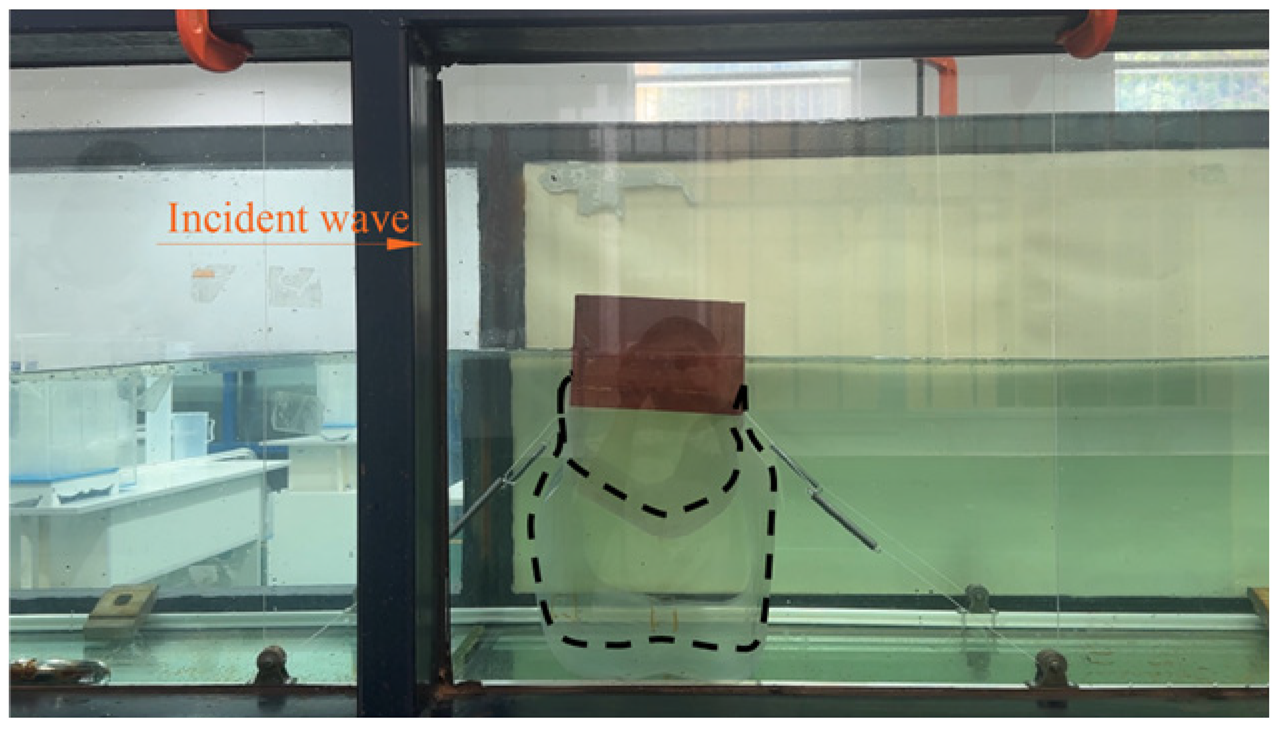
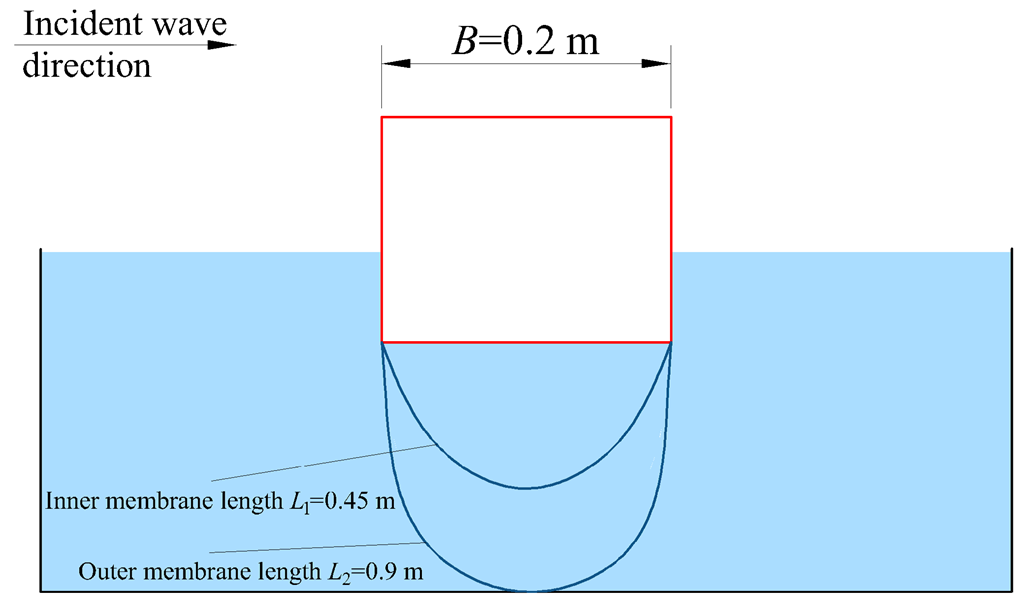
To verify the effectiveness of the optimization by incorporating auxiliary buoys on both sides of the box and positioning the flexible outer membrane at a specific distance from the box, preliminary mooring experiments were carried out to separately decide the draft d of the box and the spacings Lu and Ld of bilayer membranes of the novel type of box–membrane combinational breakwater. Specifically, the wave attenuation performance of a moored box breakwater (Model 1, length L = 0.595 m; width B = 0.2 m; height D = 0.155 m), whose size was identical to the box in the proposed breakwater, was experimentally investigated with various drafts d. Meanwhile, the buoy–membrane breakwater (Model 2; middle buoy length, which was equal to the box width, was 0.2 m), consisting of bilayer membranes attached by buoys, was introduced with the same membrane length as in proposed breakwater, which derived from the U-shaped flexible-membrane breakwater proposed by Wu et al. [22], and physical experiments was conducted on the wave attenuation performance of Model 2 under different upstream-side spacings (length of left buoy) Lu = 0.16, 0.18, and 0.2 m and downstream-side spacings (length of right buoy) Ld = 0.16, 0.18, and 0.2 m, with the choice of membranes spacing referring to Wu et al. [22]. Thereby, not only the optimal draft d of Model 1 and the upstream-side and downstream-side spacing (Lu, Ld) of Model 2, but also the reference parameters of the optimal new box–membrane combinational breakwater (Model 3) were obtained through these preliminary experiments. To investigate the effectiveness of the proposed new box–membrane breakwater, we conducted a comparative experiment of wave attenuation performance between the new box–membrane combinational breakwater (Model 3) and the box-type flexible-membrane breakwater (Model 4, Lu = 0 m; Ld = 0 m; B = 0.2 m; L1 = 0.45 m; L2 = 0.9 m) proposed by Wu et al. [20]. The models tested are presented in Table 1 and the detailed parameters of the models are listed in Table 2.
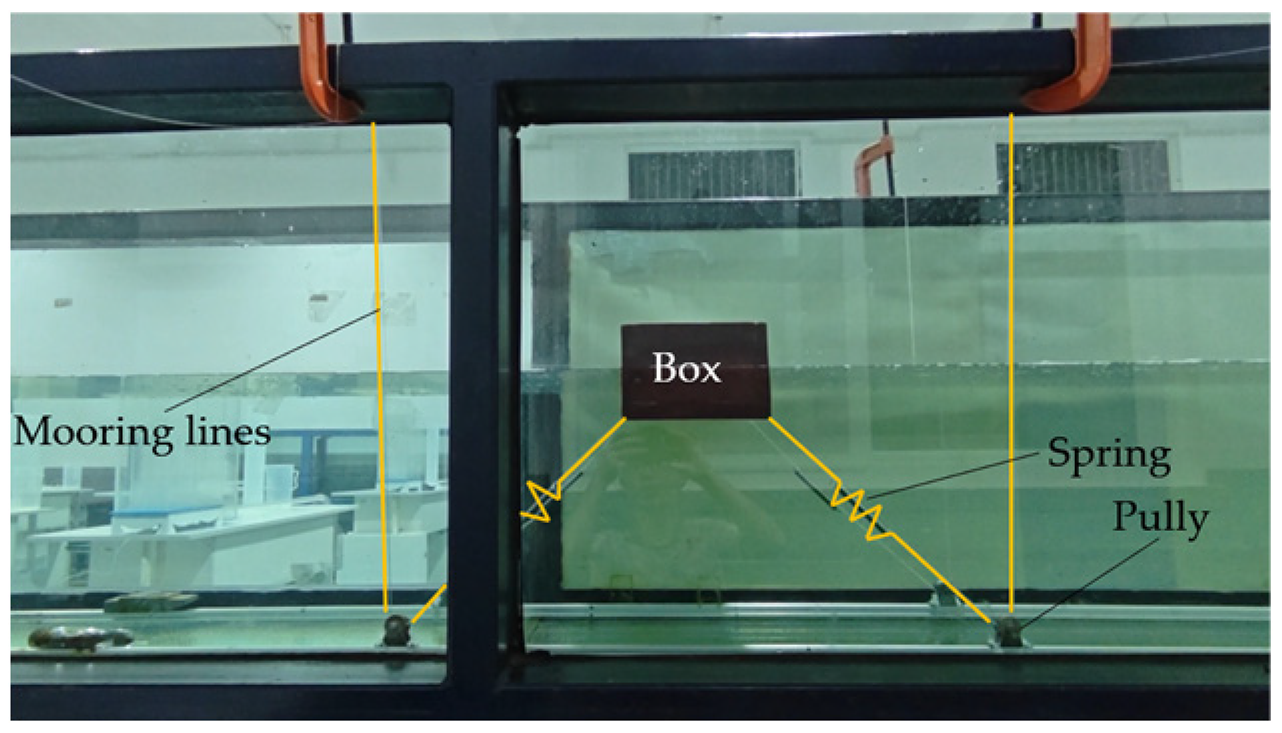
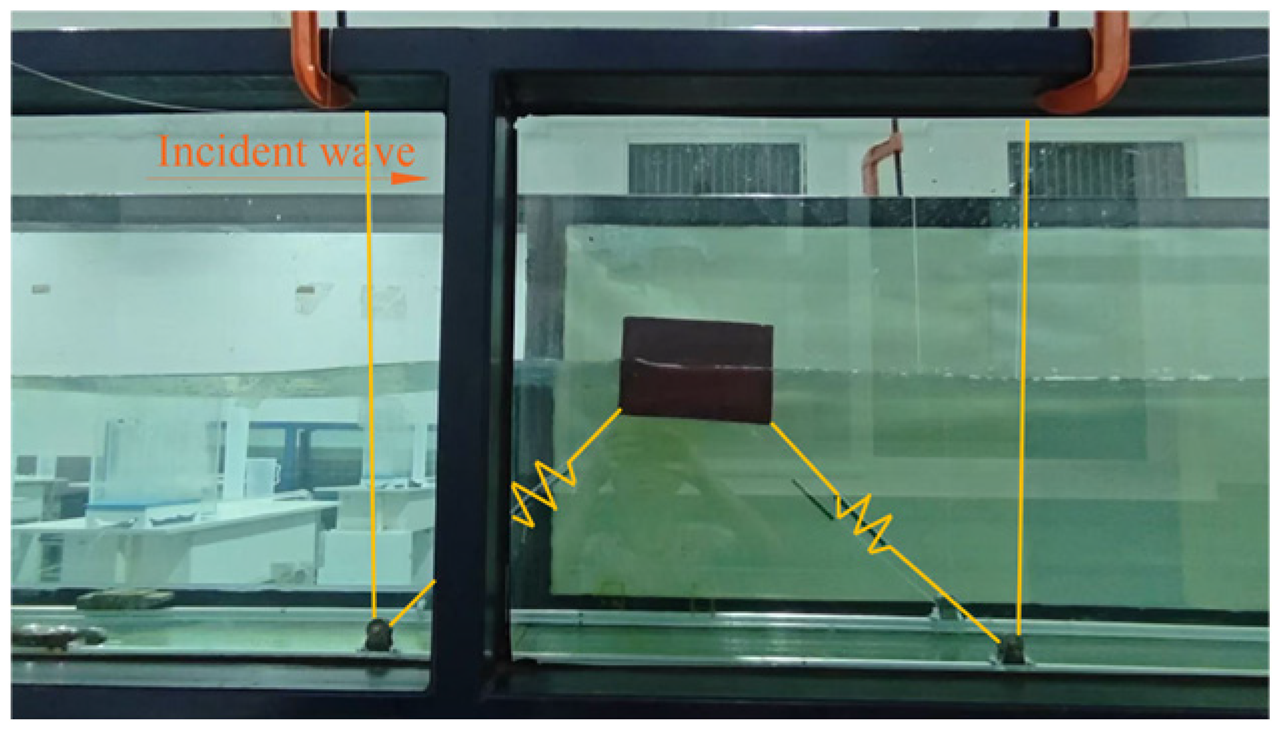
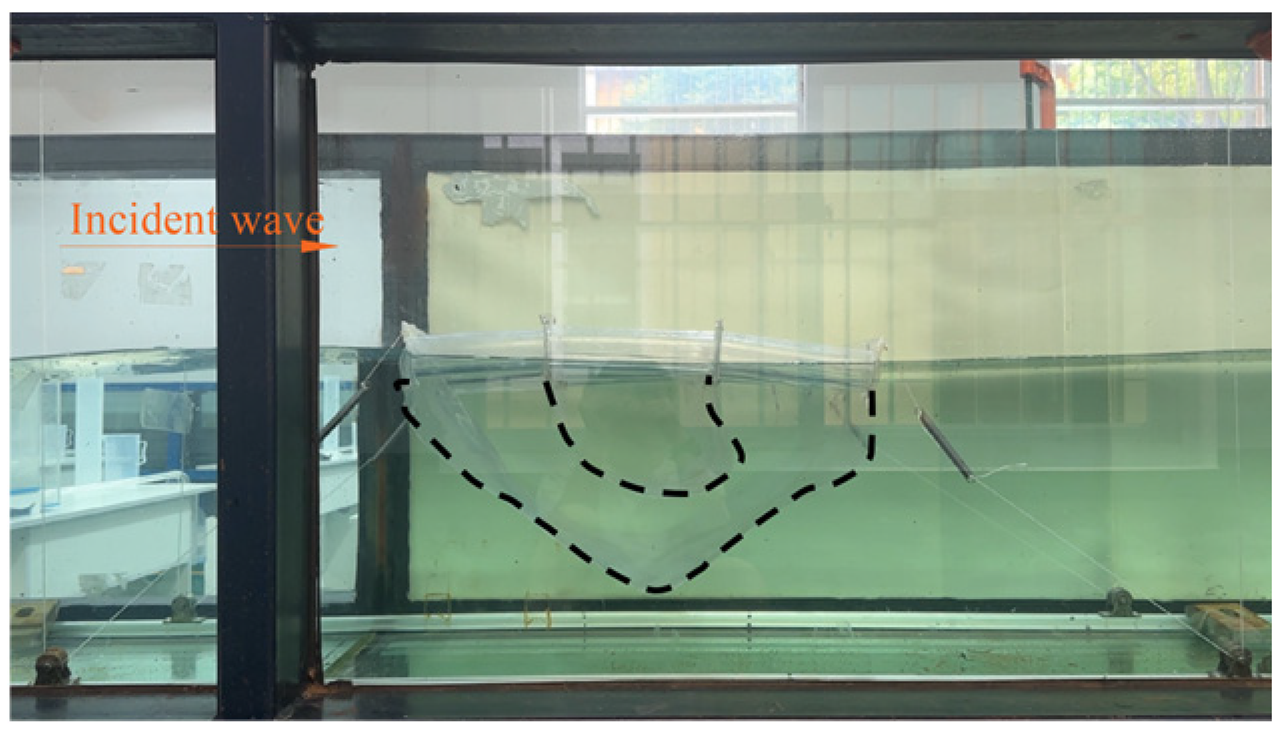
All the tested breakwaters were moored by a four-point symmetric mooring system on the bottom of the breakwater using wire ropes, with a mooring angle θ = 45°. Four wire ropes serving as the mooring lines were symmetrically attached to the corner nodes of the bottom of the breakwater; each wire was connected to a tension spring after threading through four pulleys fixed to the flume bed. The mooring method moored the structure on both sides by mooring lines with a certain mooring angle referred to in Jonkman’s research [23]. The mooring lines extended to the flume top, where their free ends were secured via screw-fastened clamps, enabling precise tension adjustment and the spring was used to simulate the stiffness of the mooring lines with a stiffness coefficient of 3.13 kN/m which was assumed to be constant. Applying a modest pretension of 250 N to each mooring line helped reduce horizontal drift while allowing vertical heave motion, which is a common laboratory practice when adjusting model restoring and the similar uses of springs to simulate mooring line stiffness at model scale, and controlled pretension to control the horizontal drift of the main structure under waves can also be found in recent experimental mooring setups such as in Zhai et al. [24]. The sketch of the experimental facilities arrangement is shown in Figure 2.

2.3. Experimental Facilities

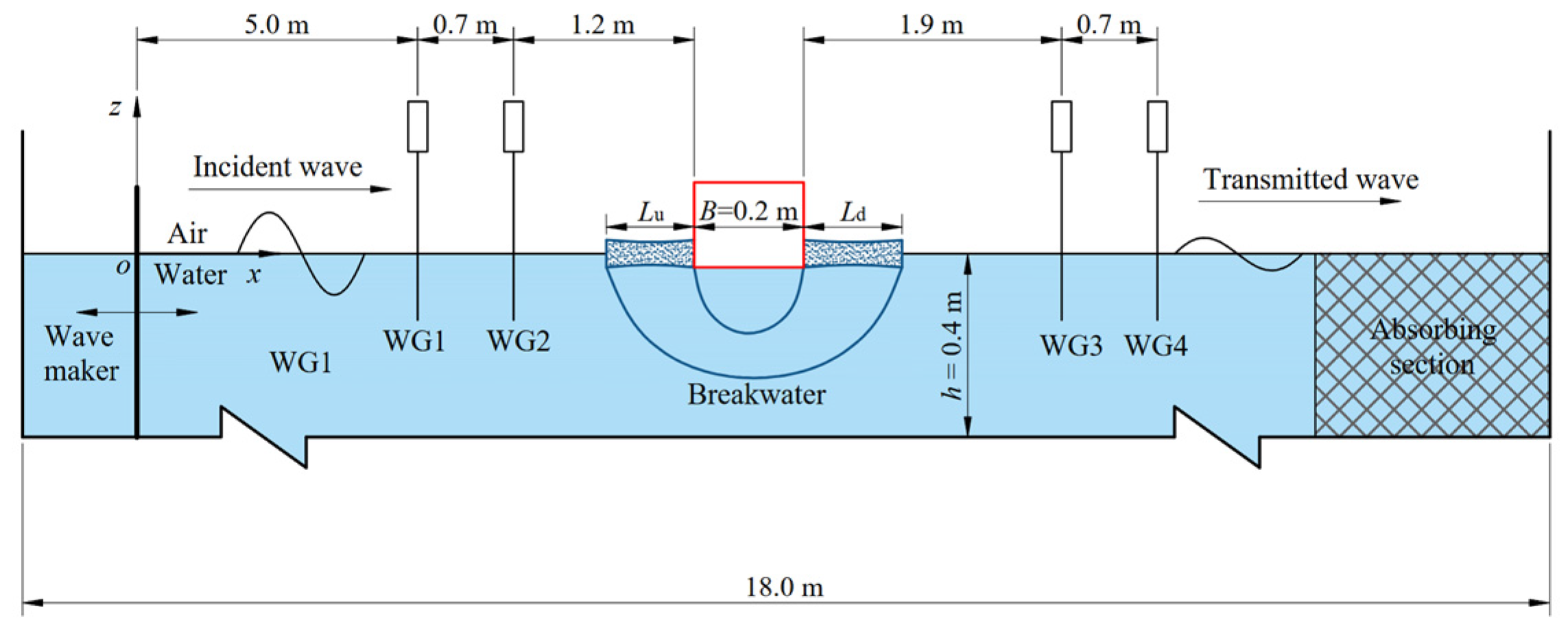
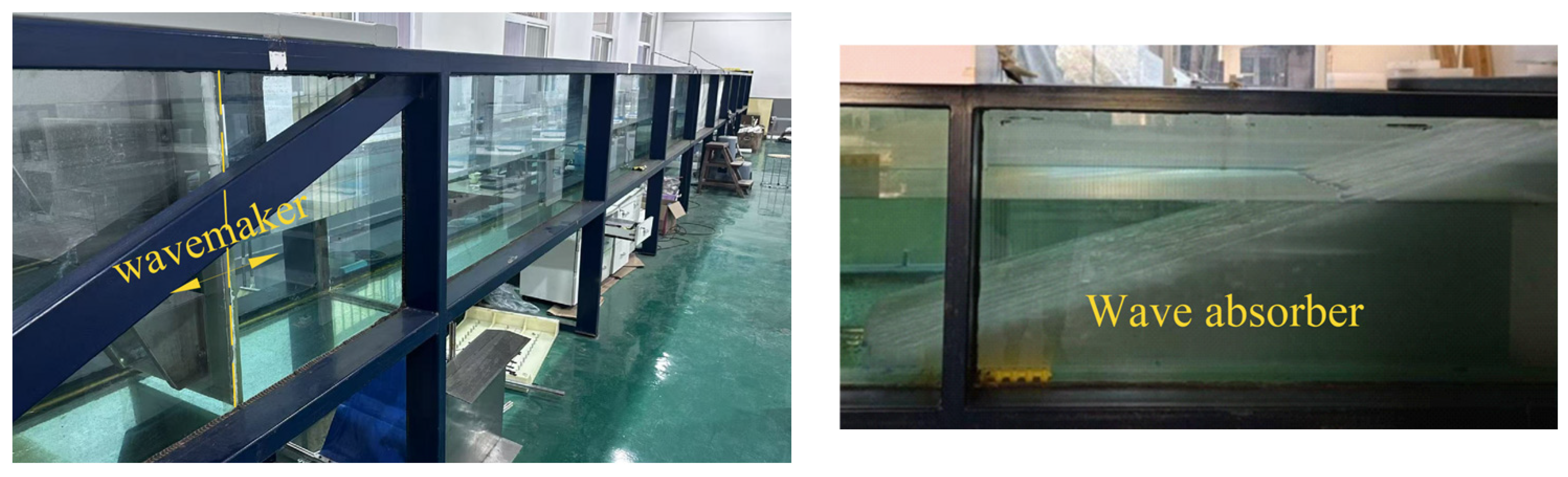
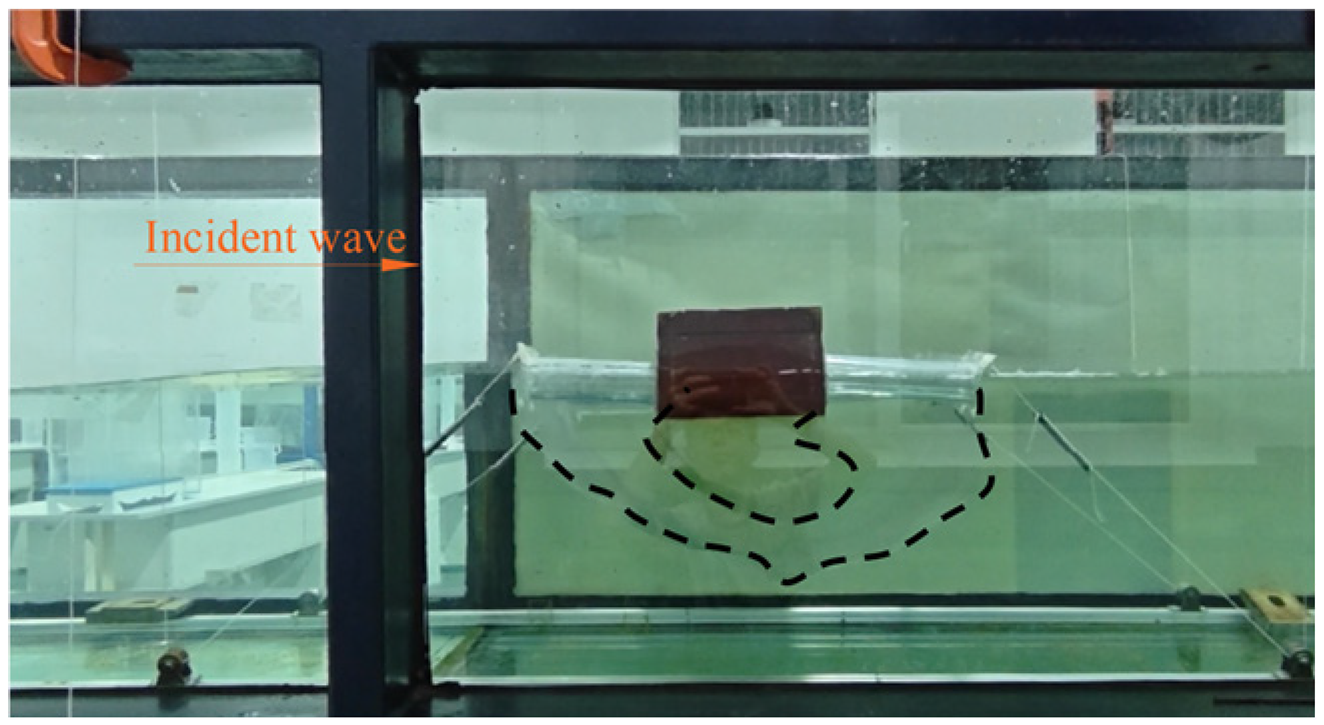
The arrangement of the wave gauges and tested breakwater (Models 1–4) in the wave flume is sketched in Figure 3. The dimension of the wave flume in the Laboratory of Fluid Mechanics at Wuhan University of Technology (Figure 4) is 18 m × 0.6 m × 0.8 m, where the wave height and period exhibit repeatability and stability errors of less than 5% and 0.5%, respectively, and the decrease in the degree of wave height per unit distance in the flume is less than 2%, mainly due to fluid viscosity [25]. A piston-type wavemaker controls the push plate to carry on the reciprocating motion to create the wave with a maximum stroke of ±300 mm and a set of porous triangle boards is set up at the tail end of the flume as a wave absorber, as shown in Figure 4. The wave elevations are acquired by the capacitance-type digital wave gauges, and the absolute error is less than ±1 mm.
The leading edge of the tested breakwater was fixed at 6.9 m from the wavemaker. Wave gauges WG1 and WG2 fixed in front of the breakwater were used for the reflected waves, while gauges WG3 and WG4 placed behind the breakwater were intended for the transmitted waves. The distances between the wave gauges are shown in Figure 3. It should be noted that WG1 and WG2 (WG3 and WG4) act as substitutes for each other in case the measurement fails.

2.4. Wave Conditions

The water depth was h = 0.4 m and was kept constant. The wave periods T varied within 0.8 s to 1.76 s, and corresponding wavelengths λ varied between 0.986 m and 3.182 m according to the dispersion relation. Wave steepness H/λ was selected as 0.02 and water depth h was chosen as 0.4 m. As can be seen in Table 3, the wave parameters were designed based on the water depth and length of the flume, as well as the wave making conditions of the flume. The actual experimental wave heights were slightly smaller than the wave heights H of Table 3 due to the fluid viscosity and the slits between the wavemaker and the flume walls.
Before each test, the flexible membrane part of the models (except for Model 1) was restored, and the free surface was stationary.

3. The Hydrodynamic Coefficients

3.1. Transmission Coefficient

The transmission coefficient Kt is defined as the ratio of the transmitted wave height Ht to the incident wave height Hi:
K t = H t H i .
where both Ht and Hi are obtained directly from the wave elevations measured by WG3 (see Figure 2). Hi is an average value of several wave heights without the model, and Ht is that with the model (breakwater).
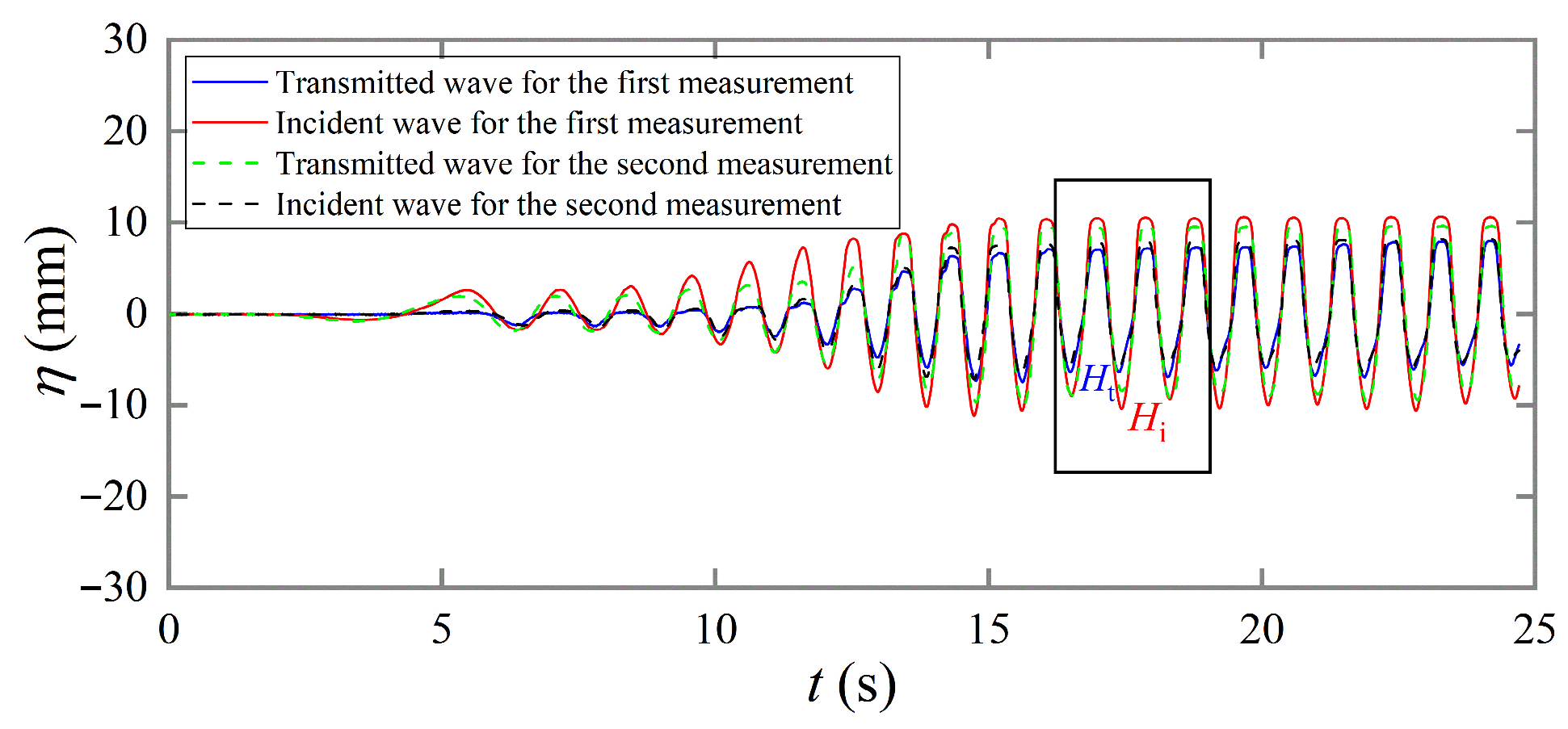
To assess reproducibility, each test condition was conducted twice and the corresponding incident and transmitted wave elevations were compared directly, with an example shown in Figure 5. As illustrated by the wave elevations time history curves of Ht1 and Ht2 obtained from WG3 with Model 1 under draft d = 0.05 m and the corresponding Hi1 and Hi2 measured by WG3 without the breakwater, the two runs exhibited only minor differences in both the incident and transmitted wave elevations. Here, Ht1 and Ht2 denote the transmitted wave heights obtained from the first and second experimental runs with Model 1, respectively, while Hi1 and Hi2 represent the corresponding incident wave heights measured without the breakwater.
More importantly, despite the minor differences in the raw wave elevation records, the resulting transmission coefficients obtained from the two runs remained highly consistent (e.g., Kt1 = 0.710 and Kt2 = 0.713 for the example in Figure 5), yielding an averaged value of Kt = 0.71. It can be seen that the difference between Kt1 and Kt2 calculated from the two measurements was not significant. This demonstrates that the transmission coefficient, as a main non-dimensional coefficient, is insensitive to small run-to-run variations in wave elevations and therefore provides repeatability assessments and a relatively robust and reproducible characterization of the experiment. Accordingly, the reported Kt values in this study were obtained by averaging the two independent runs for each test condition. For repeatability assessments of other hydrodynamic parameters, the same procedure was applied to their calculation following the same statistical analysis framework.
Here, wave elevations measurements reveal relatively flat wave crests during winter months, though the underlying mechanisms remain undetermined.

3.2. Reflection Coefficient

The reflection coefficient Kr can be determined from the ratio of the reflected wave height Hr to the incident wave height Hi:
K r = H r H i .
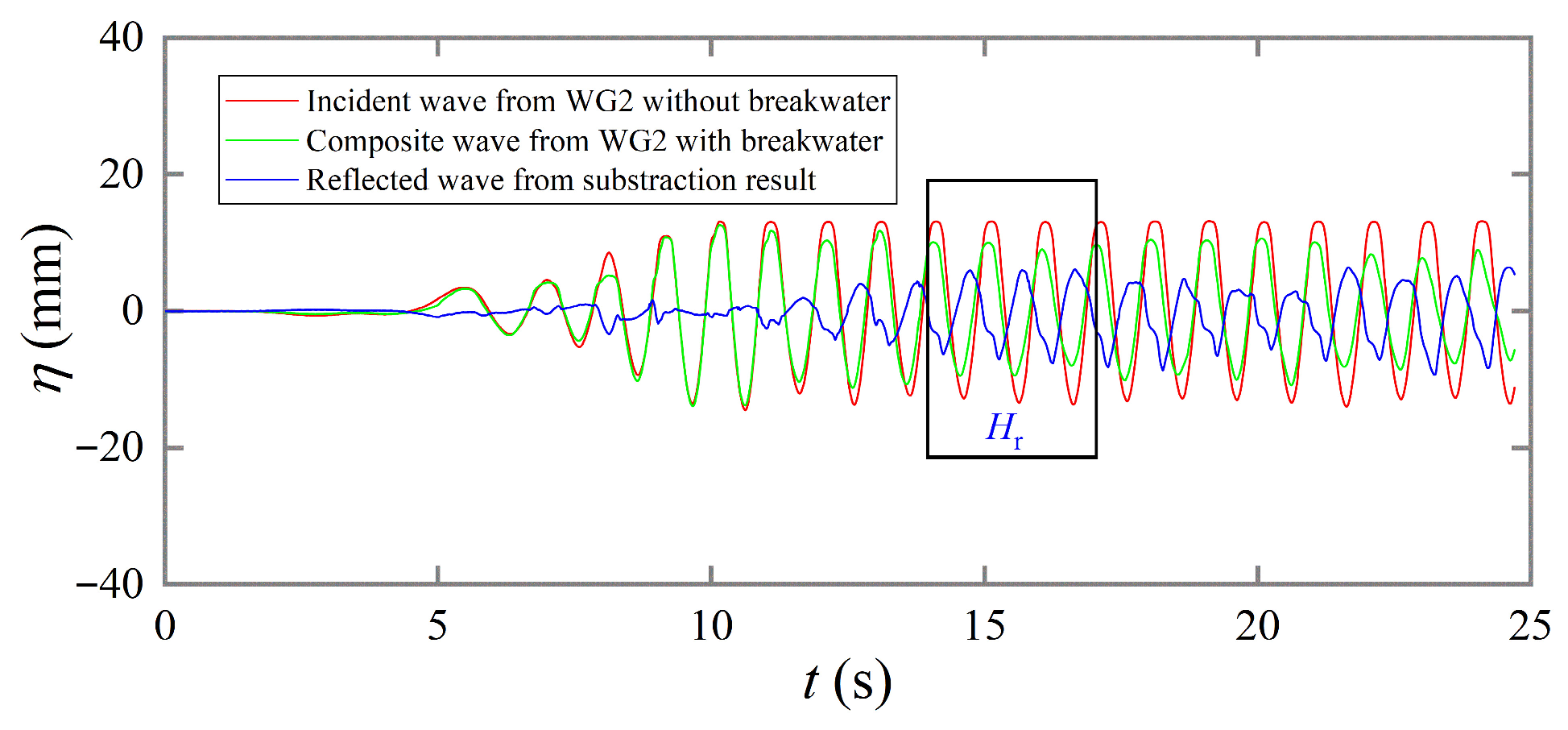
The incident wave height Hi is the averaged value of several wave heights measured by WG2 (see Figure 2) without the model. A composite wave, which is the superposition of the incident wave with the reflected wave by the breakwater, is obtained by WG2 with the breakwater. By subtracting the incident wave from the composite wave, the reflected wave height Hr is obtained by the average value of the wave heights in the steady section of the subtraction result [26,27], as in the case of Model 3, which is shown in the box frame of Figure 6.
In this paper, the number j of the steady wave contour for incident waves, reflected waves and transmitted waves is chosen as N = 3 due to the limitation of both the shorter wave-flume length and the longer wave length. The Hi and Hr can be further written as
H i = 1 N j = 1 N H i j H r = 1 N j = 1 N H r j .

3.3. Energy Dissipation Coefficient

The transmission coefficient Kt, reflection coefficient Kr, and energy dissipation coefficient Ke satisfy the following relationship according to the principle of energy conservation [26]:
K t 2 + K r 2 + K e 2 = 1 .

4. Discussion

4.1. The Influence of Draft d on the Breakwater of Model 1

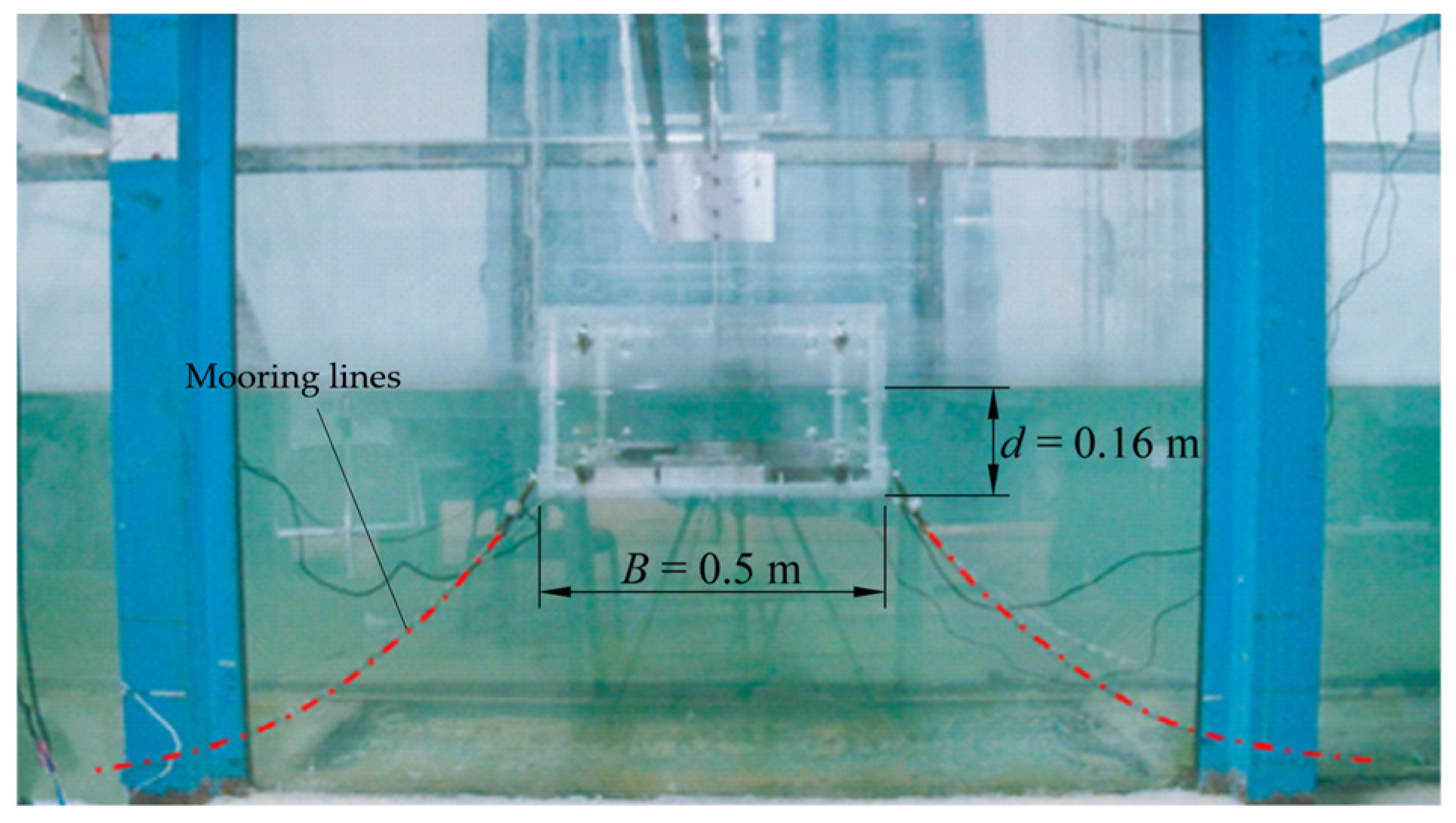
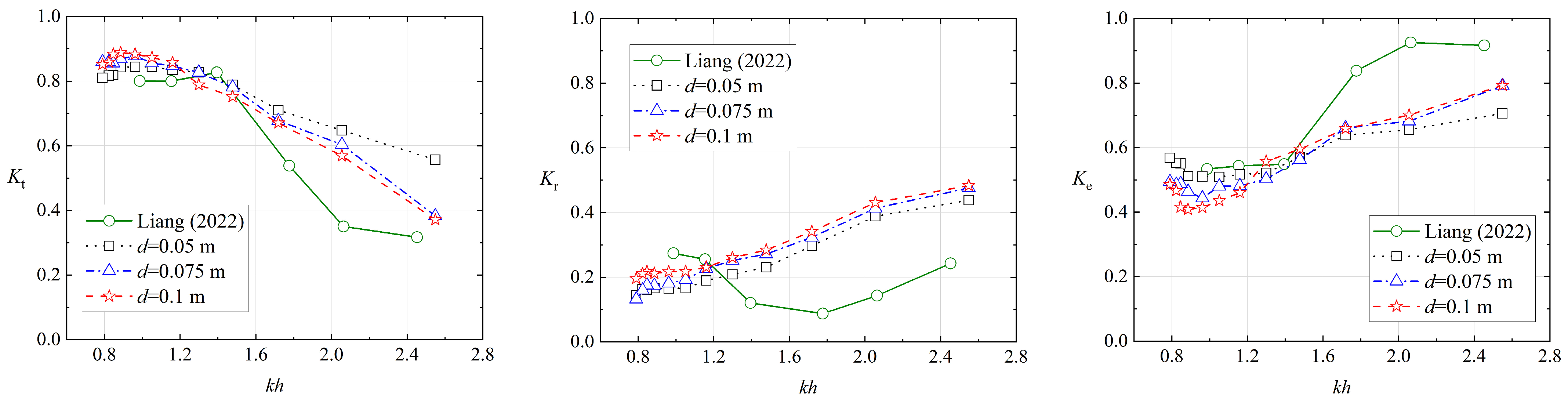
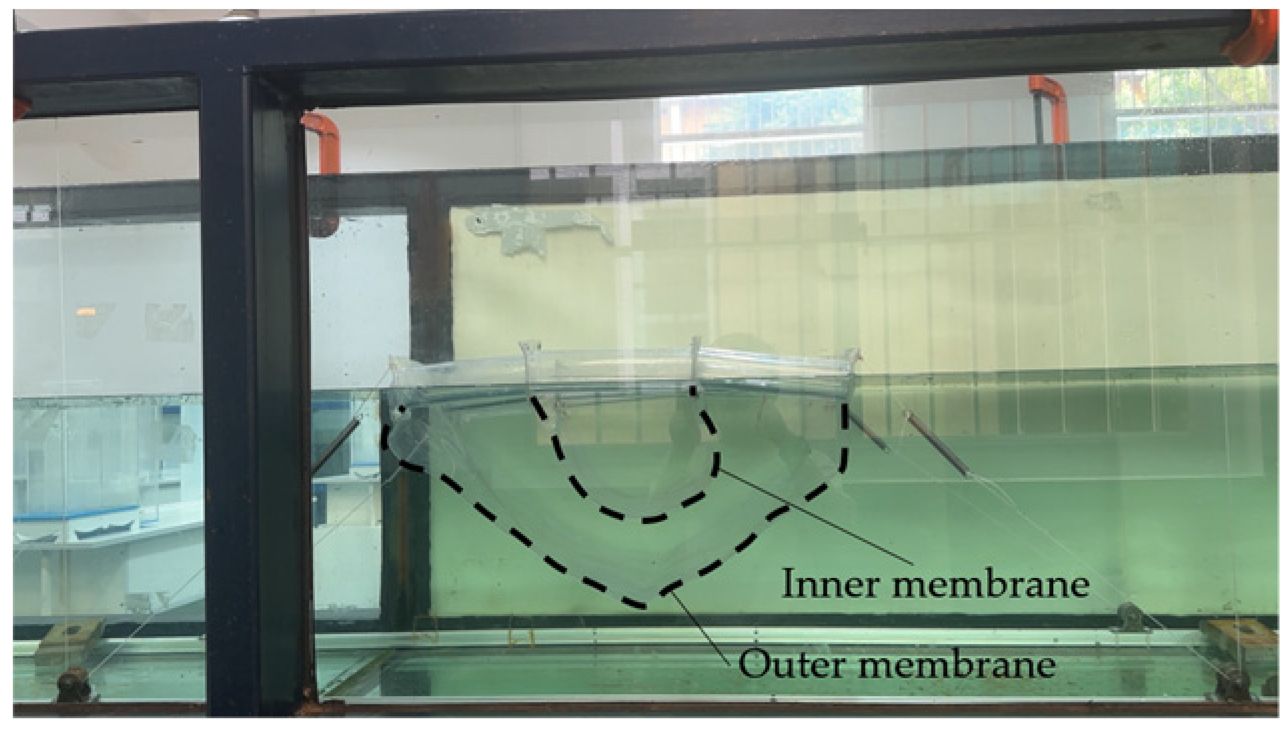
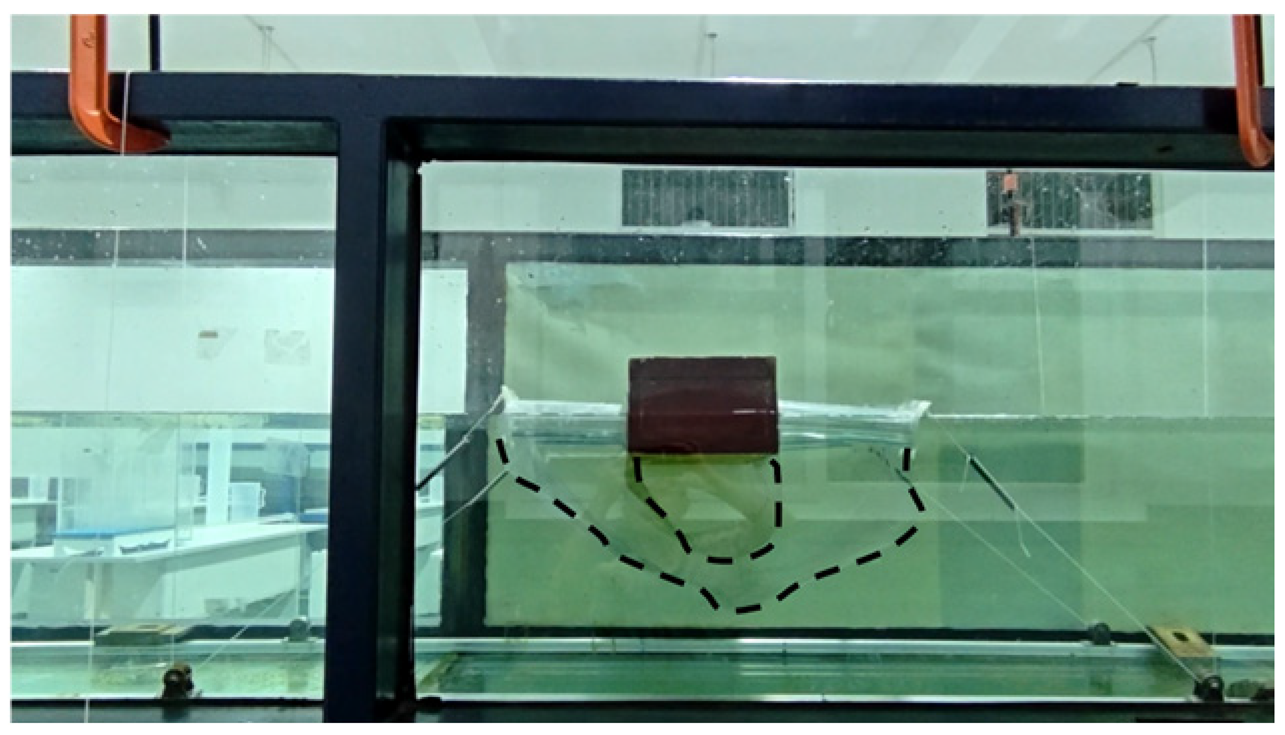
In this section, except for investigating the influence of draft d on the breakwater of Model 1, the moored box-type breakwater (Model 1) is compared with the moored box-type breakwater of Liang et al. [28] with respect of wave attenuation performance to verify the present experiments. The photograph of the breakwater of Liang et al. [28] is shown in Figure 7, and its geography parameters and tested wave parameters are listed in Table 4, as well as those of Model 1. Figure 8 shows the variations in hydrodynamic coefficients with dimensionless relative water depth kh for Model 1 and the breakwater of Liang et al., where k = 2π/λ is wave number. Model 1 was tested with three drafts d = 0.05, 0.075, and 0.1 m, under water depth h = 0.4 m; the Liang et al. [28] breakwater had a draft of d = 0.16 m, under h = 0.6 m. Their wave conditions are referred to in Table 4.
It can be seen from Figure 8 that the hydrodynamic coefficients of Model 1 and the breakwater of Liang et al. [28] are both at the same level, and the transmission coefficients Kt of Model 1 under three drafts and the moored box-type breakwater of Liang et al. [28] all exhibit an increasing-then-decreasing trend with increasing kh, which demonstrates the validity of the present experiments. What is more, Model 1 with a middle draft d = 0.075 m achieves better attenuation performance than Model 1 with a shallower draft d = 0.05 m through higher reflection and comparable wave attenuation performance to Model 1 with the deeper draft d = 0.1 m, for shorter waves. In the meantime, the moored Model 1 with the deeper draft d = 0.1 m exhibits a relatively high transmission coefficient Kt under longer waves, which corresponds to the observation of comparatively more intense motion response of the moored Model 1 and thus generates more radiation waves during the test, deteriorating the wave attenuation performance [29]. Here, the deeper the box is immersed, the more the incident waves can be reflected through the wetted surface, which can be validated by the curves of reflection coefficient Kr in Figure 8.
Due to the comparatively good wave attenuation performance of the moored Model 1 with middle draft d = 0.075 m under regular waves in various frequency bands in the experiments, for the new box–membrane combinational breakwater (Model 3) proposed in this study we selected middle draft d = 0.075 m in subsequent mooring tests.

4.2. The Influence of Upstream-Side Spacing Lu on the Breakwater of Model 2

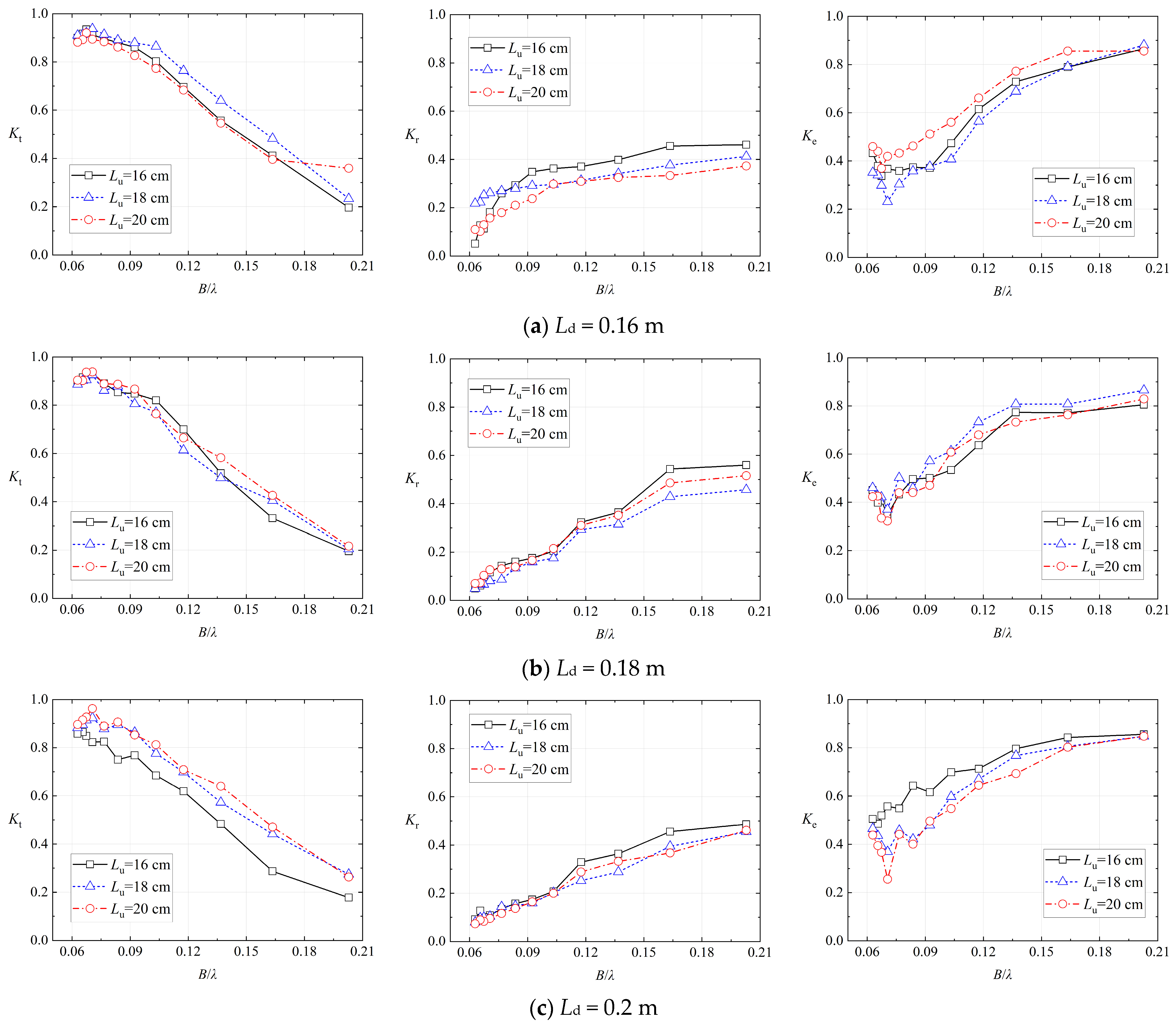
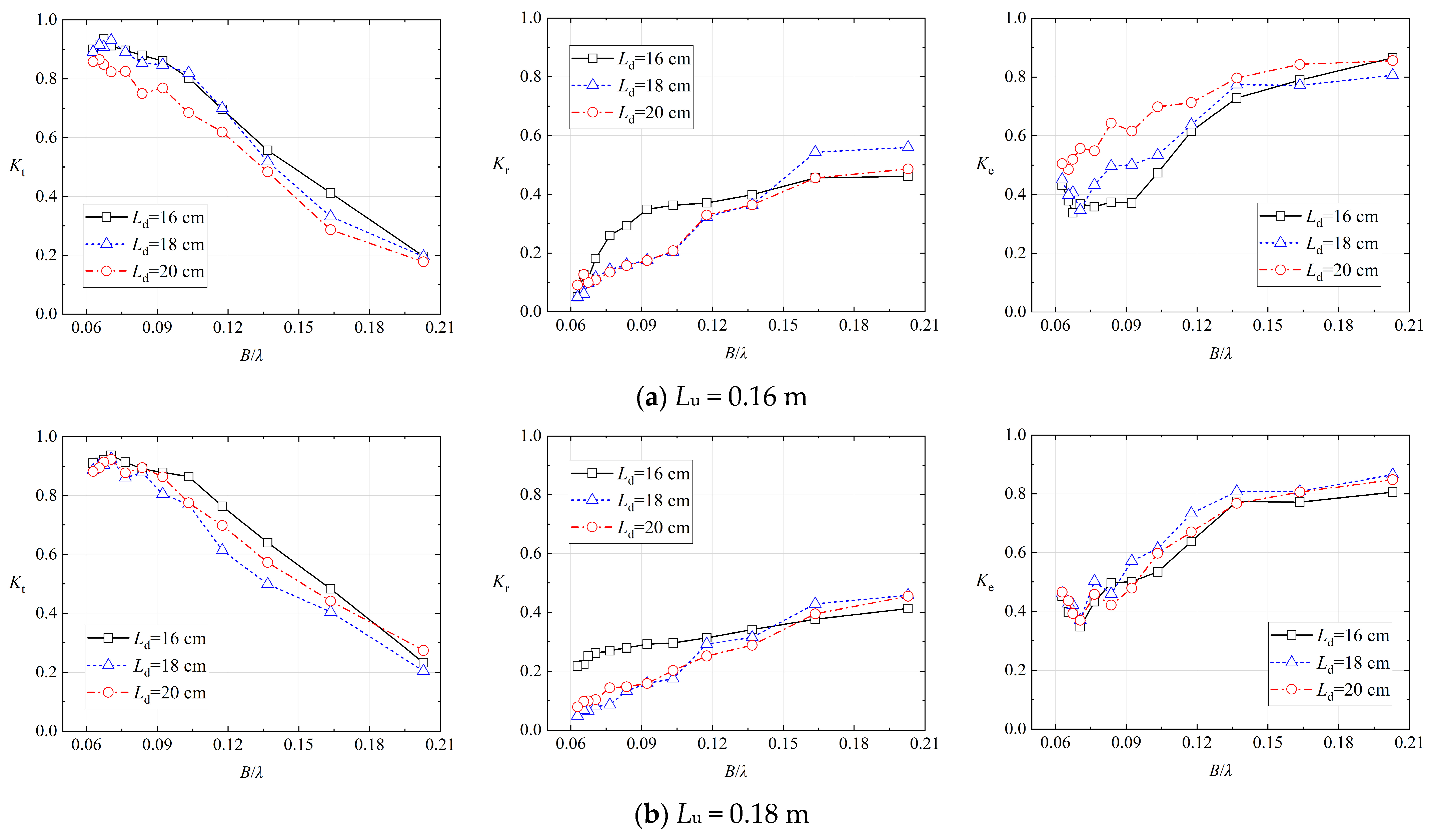
Figure 9 reveals the variation in hydrodynamic coefficients of different Lu (0.16, 0.18, and 0.2 m) with relative widths B/λ for the buoy–membrane breakwater (Model 2) consisting of bilayer membranes attached by buoys under constant Ld = 0.16, 0.18, and 0.2 m, respectively, where water depth h = 0.4 m and wave steepness H/λ = 0.02.
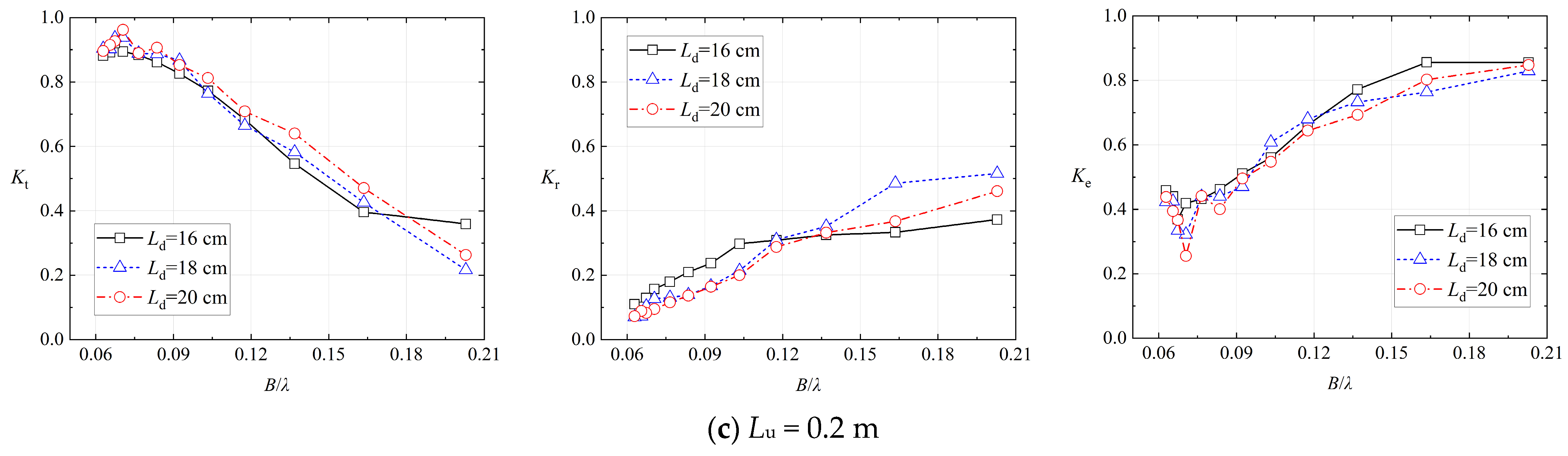
As can be seen in the transmission coefficient Kt curves in Figure 9a,b as well as Figure 9c, under different Lu and Ld, the transmission coefficient Kt of Model 2 generally decreases with the increase in B/λ. What is more, when Lu = 0.16 m and Ld = 0.2 m, the transmission coefficient Kt of the Model 2 is relatively low, and the model with this structural dimension has the best wave attenuation performance among the different structural dimensions, which provided a reference for the “short-front long-back” design for the proposed new box–membrane combinational breakwater in subsequent experiments. As shown in Figure 9a, when Ld = 0.2 m (i.e., Lu < Ld), the smaller the distance Lu, the better the wave attenuation performance of Model 2, which indicates that increasing the width of the model does not necessarily enhance its wave attenuation performance.
In the reflection coefficient Kr curves in Figure 9, the reflection coefficient Kr of Model 2 with different structural dimensions shows an overall upward trend with the increase in B/λ, indicating that the model has higher reflection for shorter waves. When the downstream-side spacings Ld are kept constant, the model with shorter upstream-side spacing Lu = 0.16 m corresponds to a relatively larger reflection coefficient than those of the models with other Lu, which shows that strategic shortening of Lu has the function of simultaneously reducing transmission and increasing reflection of Model 2 under relatively smaller wavelengths, meanwhile providing a reference of the short-front design for the Model 3.
By comprehensively comparing the Kt and Ke curves of Model 2, it can be seen that the model has relatively low Kt with high Ke, indicating that the wave attenuation mechanism of the flexible membrane system primarily could be directed to the dissipation of wave energy. The water column trapped by the bilayer flexible membranes can absorb wave energy, and the deformation motion of the flexible membranes oscillates in a manner of phase cancellation [22]. The dissipation coefficient Ke curves in Figure 9 indicate that the dissipation coefficient of Model 2 generally increases with the growth in B/λ, validating that the model has a stronger dissipation effect on waves with smaller wavelengths. Moreover, the impact of models with different structural dimensions on wave energy dissipation capacity is not significantly different. Nevertheless, when B/λ < 0.103, the energy dissipation coefficient of the model with Lu = 0.16 m and Ld = 0.2 m is higher than that of models with other Lu and Ld, which indicates that the model with these structural dimensions can maintain a relatively stronger ability to dissipate waves under long waves compared to models with other structural dimensions. Based on the comparatively stronger energy consumption capabilities of the model with Lu = 0.16 m and Ld = 0.2 m across the selected wave frequency bands, it can be concluded that drawing lessons from this “short-front long-back” design for the Model 3 can lead to its better energy consumption performance.

4.3. The Influence of Downstream-Side Spacing Ld on the Breakwater of Model 2

Figure 10 reveals the variation in hydrodynamic coefficients of different Ld = 0.16, 0.18, and 0.2 m with relative widths B/λ for the buoy–membrane breakwater (Model 2) consisting of bilayer membranes attached by buoys under constant Lu = 0.16, 0.18, and 0.2 m, where water depth h = 0.4 m and wave steepness H/λ = 0.02.
It can be observed from the transmission coefficient curves in Figure 10a,b as well as Figure 10c, that the transmission coefficient Kt generally shows a decreasing trend with the increase in the B/λ. As demonstrated in Figure 10a for the Model 2 with Lu = 0.16 m, the models with longer Ld can achieve better wave attenuation performance and dissipate more wave energy compared to those with shorter Ld, the reason for which lies in the fact that longer Ld can increase the relative width of the model and the distance of wave energy dissipation, and increasing the width of the breakwater could bring to optimization the wave attenuation performance. As can be seen in the reflection coefficient Kr curves in Figure 10, when the downstream-side spacing Lu is kept constant, the model with shorter downstream-side spacing Ld = 0.16 m generally corresponds to a comparatively larger reflection coefficient under B/λ < 0.103. Based on the above analysis, strategic shortening of Lu has the function of simultaneously increasing reflection and reducing transmission of Model 2 under long waves, meanwhile providing a reference for the short-front design for the Model 3.

4.4. The Comparisons of Model 3 to Model 1 and Model 2

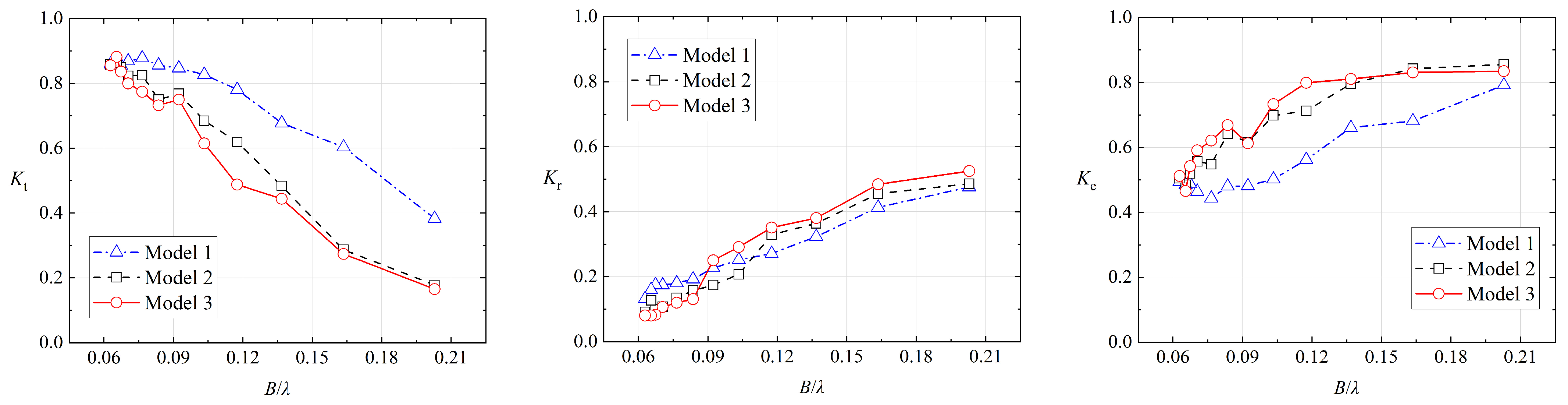
This section aims to investigate the influence of the bilayer membranes attached by buoys on wave attenuation characteristics of the proposed breakwater through a comparison of hydrodynamic coefficients between Model 3 and Model 1, while the effect of the box is examined by comparing Model 3 with Model 2. Figure 11 presents the variation tendency of hydrodynamic coefficients varying with relative width B/λ for single moored box-type breakwater (Model 1, d = 0.075 m), the buoy–membrane breakwater (Model 2, Lu = 0.16 m; Ld = 0.2 m; B = 0.2 m; L1 = 0.45 m; L2 = 0.9 m) consisting of bilayer membranes attached by buoys and the newly proposed box–membrane combinational breakwater (Model 3, Lu = 0.16 m; Ld = 0.2 m; B = 0.2 m; L1 = 0.45 m; L2 = 0.9 m), when water depth h = 0.4 m, wave steepness H/λ = 0.02, and draft d = 0.075 m. For comparative analysis, Model 1 is developed by removing the bilayer membranes from Model 3 and equipped with the same box and draft d = 0.075 m as Model 3. Similarly, Model 2 is introduced by eliminating the main box from Model 3 and has the same bilayer membranes and upstream-side and downstream-side spacing (Lu, Ld) as Model 3. The detailed parameters of models are listed in Table 2.
As seen in the transmission coefficient curves in Figure 11, the transmission coefficient Kt of the three models generally decreases with increasing B/λ as the wavelength increases. And the new box–membrane combinational breakwater (Model 3) consistently exhibits the lowest transmission coefficients across the designed wave periods and has improved wave attenuation performance by 56.8%, at most, compared to Model 1 under B/λ = 0.203 and by 21.2%, at most, compared to Model 2 under B/λ = 0.118, outperforming Model 1 and Model 2 as the wave period increases, because Model 3 exhibits the highest reflection under B/λ > 0.084 and the most severe wave energy dissipation, while B/λ is less than 0.137 in three models. This indicates that combining the box and the bilayer membranes attached by buoys is effective in optimizing the wave attenuation performance by providing more wave reflection for short waves and more wave energy dissipation for long waves.
What is more, as revealed in Figure 11, the wave attenuation performance and wave energy dissipation of Model 1 are significantly and stably weaker than those of Model 2 and Model 3, which manifests that applying flexible membranes to the box-type breakwater contributes to higher wave energy dissipation of the breakwater. The reason lies in the fact that the water column enclosed by the bilayer membranes can actually dissipate a significant amount of wave energy, given that its mass is relatively large compared to that of the breakwater itself, which also demonstrates that the part of the bilayer membranes attached to the buoys can primarily serve as an energy dissipation component to improve the wave attenuation performance.

4.5. The Comparisons of Model 3 and Model 4 for the Influence of the Spacings

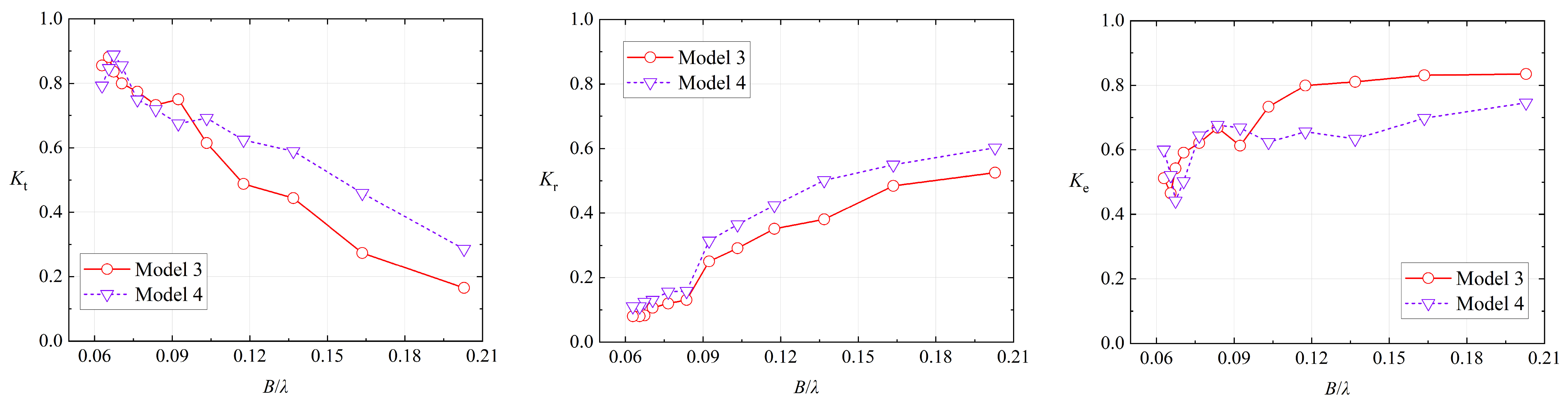
Figure 12 presents the variations in variation tendency of transmission coefficient Kt, reflection coefficient Kr, and energy dissipation coefficient Ke with relative width B/λ for the new box–membrane combinational breakwater (Model 3, Lu = 0.16 m; Ld = 0.2 m; B = 0.2 m; L1 = 0.45 m; L2 = 0.9 m) and box-type flexible-membrane breakwater (Model 4, B = 0.2 m; L1 = 0.45 m; L2 = 0.9 m) proposed by Wu et al. [20] with no spacings (i.e., Lu = 0 m; Ld = 0 m), water depth h = 0.4 m, wave steepness H/λ = 0.02, and draft d = 0.075 m. The detailed parameters of the models are listed in Table 2.
As shown in the transmission coefficient curves in Figure 12, the Kt of both Model 3 and Model 4 generally decrease with increasing B/λ as the wavelength increases. And the curves of transmission and energy dissipation coefficients in Figure 12 demonstrate that, for short wavelength waves with B/λ > 0.103, the wave attenuation performance and the wave energy dissipation of Model 3 is significantly and stably stronger than that of Model 4 and has improved wave attenuation performance by 47.29% compared to Model 4 at most under B/λ = 0.164, because attaching buoys can increase the relative width of the model and the distance of wave energy dissipation to a certain extent, as increasing the width of the breakwater is effective in optimizing the wave attenuation performance for short-period waves. Another reason for the enhanced wave attenuation performance to the short wave domain is that the oscillation of flexible membranes and water column enclosed when waves pass through a structure can actually dissipate a large amount of energy [21], and due to the longer top distance of the flexible membranes in Model 3 compared to Model 4, the bilayer flexible membranes in Model 3 are able to enclose a larger mass of the water column than those in Model 4, therefore resulting in a stronger wave energy dissipation ability, which can be validated by the energy dissipation coefficient curves in Figure 12.
It is also interesting to see, in the reflection coefficient Kr curves in Figure 12, that the Model 3 attached buoys, with the outer membrane that is positioned at a specific distance from the box, have lower reflection but better attenuation performance, in contrast to Model 4 with bilayer membranes directly fixed to the box. We attribute the reasons to the fact that when the incident waves approach Model 3, they first encounter the upstream-side buoy and the water column enclosed by the membranes, which dissipate a portion of the incident wave energy before the waves reach the box. Consequently, the waves that eventually impinge upon the box in Model 3 carry less energy compared to those directly acting on the box in Model 4, which results in weaker reflected waves. Moreover, the reflected waves from the box in Model 3 must pass through the upstream-side buoy again before propagating to the wave gauge for obtaining the reflected waves, therefore dissipating the wave energy. This indicates that the boxes in two models are the primary source of wave reflection in the breakwaters, and meanwhile, the addition of the buoys modifies the configuration, especially enabling the flexible membranes to trap a greater mass of oscillating water column to dissipate wave energy, resulting in enhanced wave energy dissipation and wave attenuation performance.

5. Conclusions

In this paper, a new box–membrane combinational breakwater is proposed. Preliminary experiments were conducted to explore potential structural optimizations for the proposed breakwater and to assess its wave attenuation performance. Preliminary mooring experiments were carried out on the box and the bilayer membranes attached separately by the buoys of the novel type of box–membrane combinational breakwater, based on which a middle draft was selected for the box and a “short-front long-back” arrangement was chosen for the bilayer membranes. The new box–membrane combinational breakwater proposed in this paper can achieve relatively good wave attenuation performance.
Increasing the model’s width and adding buoys could enhance wave attenuation stability, but the wave energy dissipation mechanisms of flexible membranes require further investigation. Furthermore, due to the effectiveness of addition of the U-shaped flexible membrane, testing models with more flexible materials and similar criteria for dynamic response of flexible membranes are necessarily needed to evaluate their wave dissipation performance for practical engineering applications. Another limitation of our study lies in insufficient statistical analysis and research into the influence of the factors that real-world conditions typically involve, such as the mooring system and the dynamic response of the breakwater; irregular, multidirectional waves; and three-dimensional effects, which are not addressed in the present work. In addition, the new design of box–membrane combinational breakwater requires further numerical investigation of its motion state and force in the flow field, and flexible membranes need to be modeled by a two-way fluid–structure interaction (FSI) method.

Author Contributions

Conceptualization, J.-P.W.; methodology, J.-P.W., M.-L.C., X.Y. and S.-M.W.; software, J.-P.W.; formal analysis, J.-P.W., M.-L.C. and X.Y.; writing—original draft preparation, J.-P.W. and M.-L.C.; writing—review and editing, J.-P.W., M.-L.C. and S.-M.W.; visualization, M.-L.C. and X.Y.; supervision, J.-P.W. and S.-M.W.; project administration, S.-M.W.; funding acquisition, S.-M.W. All authors have read and agreed to the published version of the manuscript.

Funding

This research was funded by Guangdong Basic and Applied Basic Research Foundation (No. 2024A1515010053), Hainan Provincial Natural Science Foundation of China (No. 323MS121), and the Central Public-Interest Scientific Institution Basal Research Fund, CAFS (No. 2023TD58).

Data Availability Statement

The original contributions presented in the study are included in the article. Further inquiries can be directed to the corresponding authors.

Acknowledgments

The authors would like to sincerely thank Zao-Jian Zou from the School of Ocean and Civil Engineering at Shanghai Jiao Tong University for his invaluable guidance in theoretical knowledge and manuscript preparation.

Conflicts of Interest

The authors declare no conflicts of interest.

References

  1. Dai, J.; Wang, C.M.; Utsunomiya, T.; Duan, W. Review of recent research and developments on floating breakwaters. Ocean Eng. 2018, 158, 132–151. [Google Scholar] [CrossRef]
  2. Dong, H.Y. Study on Hydrodynamic Characteristics of Pontoon-Plate Type Floating Breakwaters. Ph.D. Thesis, Dalian University of Technology, Dalian, China, 2009. [Google Scholar]
  3. Karmakar, D.; Bhattacharjee, J.; Guedes Soares, C. Scattering of gravity waves by multiple surface-piercing floating membrane. Appl. Ocean Res. 2013, 39, 40–52. [Google Scholar] [CrossRef]
  4. Yang, B. Experimental Investigation on Influence Factor of Twin-Pontoon-Plate Floating Breakwater. Master’s Thesis, Dalian University of Technology, Dalian, China, 2014. [Google Scholar]
  5. Diamantoulaki, I.; Angelides, D.C. Analysis of performance of hinged floating breakwaters. Eng. Struct. 2010, 32, 2407–2423. [Google Scholar] [CrossRef]
  6. Ji, C.Y.; Bian, X.Q.; Cheng, Y.; Yang, K. Experimental study of hydrodynamic performance for double-row rectangular floating breakwaters with porous plates. Ships Offshore Struct. 2019, 14, 737–746. [Google Scholar] [CrossRef]
  7. Chen, C.Z.; Wu, J.P. Study on Wave attenuation characteristics of two box structures. In Proceedings of the 30th International Ocean and Polar Engineering Conference, Shanghai, China, 11–16 October 2020. [Google Scholar]
  8. Chen, Y.; Liu, Y.; Meringolo, D.D.; Hu, J. Study on the hydrodynamics of a twin floating breakwater by using SPH method. Coast. Eng. 2023, 179, 104230. [Google Scholar] [CrossRef]
  9. He, F.; Huang, Z.; Wing-Keung Law, A. Hydrodynamic performance of a rectangular floating breakwater with and without pneumatic chambers: An experimental study. Ocean Eng. 2012, 51, 16–27. [Google Scholar] [CrossRef]
  10. Alizadeh, M.J.; Kolahdoozan, M.; Tahershamsi, A.; Abdolali, A. Experimental study of the performance of floating breakwaters with heave motion. Civ. Eng. Infrastruct. J.-CEIJ 2014, 47, 59–70. [Google Scholar] [CrossRef]
  11. Ji, C.; Deng, X.; Cheng, Y. An Experimental study of double-row floating breakwaters. J. Mar. Sci. Technol. 2019, 24, 359–371. [Google Scholar] [CrossRef]
  12. He, F.; Li, J.; Pan, J.; Yuan, Z. An experimental study of a rectangular floating breakwater with vertical plates as wave-dissipating components. Appl. Ocean Res. 2023, 133, 103497. [Google Scholar] [CrossRef]
  13. Hu, K.Z.; Xu, T.J.; Wang, S. Hydrodynamic investigation of a new type of floating breakwaters integrated with porous baffles. Appl. Ocean Res. 2025, 154, 104380. [Google Scholar] [CrossRef]
  14. Kee, S.T.; Kim, M.H. Flexible membrane wave barrier. II: Floating/submerged buoy-membrane system. J. Waterw. Port Coast. Ocean Eng. 1997, 123, 82–90. [Google Scholar] [CrossRef]
  15. Kim, M.H.; Edge, B.L.; Kee, S.T.; Zhang, L. Performance evaluation of buoy-membrane wave barriers. In Proceedings of the 25th International Conference on Coastal Engineering, Orlando, FL, USA, 2–6 September 1996. [Google Scholar]
  16. Cho, I.H.; Kee, S.T.; Kim, M.H. Performance of dual flexible membrane wave barriers in oblique waves. J. Waterw. Port Coast. Ocean Eng. 1998, 124, 21–30. [Google Scholar] [CrossRef]
  17. Briggs, M.; Ye, W.; Demirbilek, Z.; Zhang, J. Field and numerical comparisons of the RIBS floating breakwater. J. Hydraul. Res. 2002, 40, 289–301. [Google Scholar] [CrossRef]
  18. Hermanson, M.W. Physical Modeling of a Floating Breakwater with a Membrane. Master’s Thesis, University of Florida, Monterey, CA, USA, 2003. [Google Scholar]
  19. Kee, S.T. Floating pontoon-membrane breakwater. J. Ocean Sci. Technol. 2004, 1, 49–57. [Google Scholar]
  20. Wu, J.P.; Mei, T.L.; Zou, Z.J. Experimental study on wave attenuation performance of a new type of free surface breakwater. Ocean Eng. 2022, 244, 110447. [Google Scholar] [CrossRef]
  21. Wu, J.P.; Li, C.R.; Qi, J.J.; Xu, X.Y.; Li, J.N.; Zhang, X.X.; Qin, Q.; Zhou, Z.R. Experimental study on the hydrodynamic performance of a side-by-side box-membrane breakwater. Ocean Eng. 2024, 302, 117658. [Google Scholar] [CrossRef]
  22. Wu, J.P.; Yi, X.; Zou, Z.J.; Zhan, P.; Chen, C.C. Experimental study on the hydrodynamic performance of a U-shaped flexible membrane breakwater. In Proceedings of the 42nd International Conference on Ocean, Offshore and Arctic Engineering, Melbourne, Australia, 11 June 2023. [Google Scholar]
  23. Jonkman, J.M. Dynamics of offshore floating wind turbines-model development and verification. Wind Energy 2009, 12, 459–492. [Google Scholar] [CrossRef]
  24. Zhai, H.; Yan, C.; Shi, W.; Zhang, L.; Zeng, X.; Han, X.; Michailides, C. Experimental Study on the Hydrodynamic Analysis of a Floating Offshore Wind Turbine Under Focused Wave Conditions. Energies 2025, 18, 4140. [Google Scholar] [CrossRef]
  25. Pan, J.; Wu, J.P.; Jiang, M.S.; Zheng, X.W.; Zhao, X.S. Performance test and analysis on small piston-type wave flume. J. Wuhan Univ. Technol. (Transp. Sci. Eng.) 2017, 41, 995–998. (In Chinese) [Google Scholar] [CrossRef]
  26. Wu, J.P.; Luo, H.Y.; Zou, Z.J.; Chen, C.Z.; Yi, X.; Zhan, P. Estimation of reflected and incident waves for breakwater tests in a 2D wave flume in regular waves. J. Ocean Eng. Sci. 2025; in press. [Google Scholar] [CrossRef]
  27. Ding, W.W.; Yue, W.Z.; Sheng, S.W.; Wu, J.P.; Zou, Z.J. Numerical and experimental study on the Bragg reflection of water waves by multiple vertical thin plates. J. Mar. Sci. Eng. 2022, 10, 1464. [Google Scholar] [CrossRef]
  28. Liang, J.; Liu, Y.; Chen, Y.; Li, A. Experimental study on hydrodynamic characteristics of the box-type floating breakwater with different mooring configurations. Ocean Eng. 2022, 254, 111296. [Google Scholar] [CrossRef]
  29. Ruol, P.; Martinelli, L.; Pezzutto, P. Formula to predict transmission for π-type floating breakwaters. J. Waterw. Port Coast. Ocean Eng. 2013, 139, 1–8. [Google Scholar] [CrossRef]
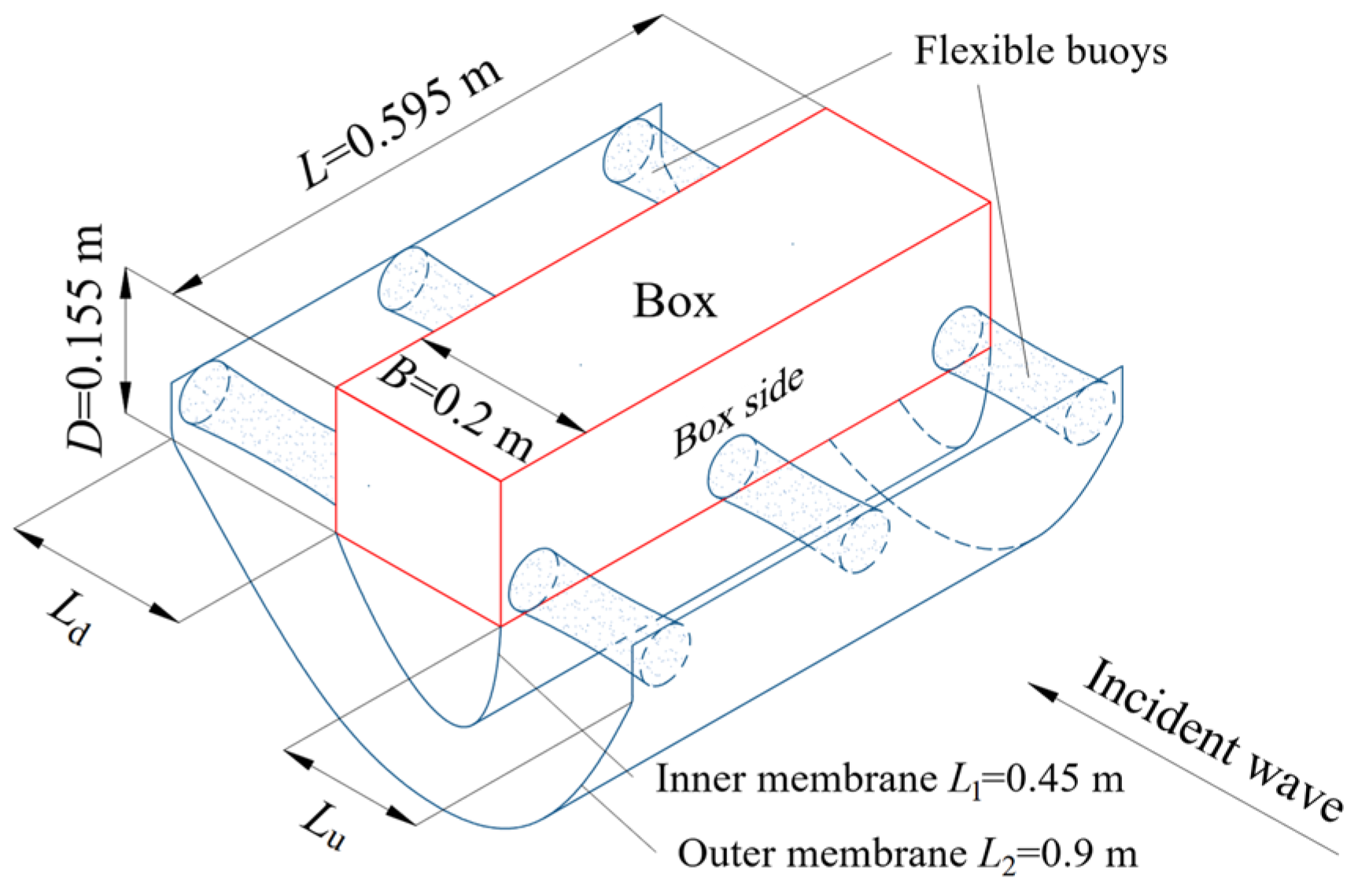
Figure 1. The schematic diagram of the new box–membrane combinational breakwater.
Jmse 14 00078 g001
Figure 2. Sketch of the mooring breakwater (Model 3).
Jmse 14 00078 g002
Figure 3. The sketch of the experimental setup (Model 3).
Jmse 14 00078 g003
Figure 4. The wave flume.
Jmse 14 00078 g004
Figure 5. Incident wave height Hi and transmitted wave height Ht from WG3 (Model 1, T = 1.0 s; H/λ = 0.02; Hi1 = 19.981 mm; Ht1 = 14.196 mm; Kt1 = 0.710; Hi2 = 18.925 mm; Ht2 = 13.503 mm; Kt2 = 0.713; Kt = 0.71).
Jmse 14 00078 g005
Figure 6. Reflected wave height Hr from subtraction result (Model 4, T = 1.0 s; H/λ = 0.02; Hi = 26.74 mm; Hr = 13.41 mm; Kt = 0.501).
Jmse 14 00078 g006
Figure 7. The photograph of the breakwater of Liang et al. [28].
Jmse 14 00078 g007
Figure 8. The hydrodynamic coefficients of Model 1 versus kh under three drafts d and their comparison with the breakwater of Liang et al. [28].
Jmse 14 00078 g008
Figure 9. The hydrodynamic coefficients of Model 2 versus B/λ under three upstream-side spacings Lu.
Jmse 14 00078 g009
Figure 10. The hydrodynamic coefficients of Model 2 versus B/λ under three spacings Ld.
Jmse 14 00078 g010aJmse 14 00078 g010b
Figure 11. The hydrodynamic coefficients of Model 1, Model 2, and Model 3 vary with B/λ.
Jmse 14 00078 g011
Figure 12. The hydrodynamic coefficients of Model 3 and Model 4 vary with B/λ.
Jmse 14 00078 g012
Table 1. The photographs and sketches of the tested breakwaters.
Photographs in Calm WaterPhotographs in WavesSketches
Jmse 14 00078 i001Jmse 14 00078 i002Jmse 14 00078 i003
Model 1
Jmse 14 00078 i004Jmse 14 00078 i005Jmse 14 00078 i006
Model 2
Jmse 14 00078 i007Jmse 14 00078 i008Jmse 14 00078 i009
Model 3
Jmse 14 00078 i010Jmse 14 00078 i011Jmse 14 00078 i012
Model 4
Table 2. The parameters of the tested models.
ModelRectangular Box Size (m)Membrane Length (m)Lu (m)Ld (m)
LBDdInnerOuter
Model 10.5950.20.1550.05, 0.075, 0.01----
Model 20.5950.2--0.450.90.16, 0.18, 0.20.16, 0.18, 0.2
Model 30.5950.20.1550.0750.450.90.160.2
Model 40.5950.20.1550.0750.450.900
Table 3. Wave parameters.
T (s)λ (m)H/λH (mm)h (m)
0.8–1.760.986–3.1820.0219.74–63.660.4
Table 4. The parameters of the compared breakwaters.
BreakwaterBox Size (m)Mooring Systemh (m)T (m)H (m)H/λ
BdStiffness (kN/m)Pretension Force (N)
Liang (2022) [28]0.50.162.3600.61.0–1.80.10.026–0.065
Model 10.20.05
0.075
0.1
3.132500.40.80–1.760.020–0.0640.02
Disclaimer/Publisher’s Note: The statements, opinions and data contained in all publications are solely those of the individual author(s) and contributor(s) and not of MDPI and/or the editor(s). MDPI and/or the editor(s) disclaim responsibility for any injury to people or property resulting from any ideas, methods, instructions or products referred to in the content.