1. Introduction
Amid the global energy transition and pursuit of “dual carbon” goals, natural gas hydrates are recognized as a key 21st-century energy source due to their abundance and clean, low-carbon profile [
1]. Their successful commercial exploitation is strategically vital for energy security and system decarbonization. A fundamental challenge, however, lies in the weakly cemented nature of hydrate-bearing sediments. Production-induced hydrate dissociation weakens the formation matrix, leading to instability and substantial sand production. This, in turn, risks wellbore clogging, equipment damage, and operational failures [
2]. As demonstrated by numerous international field trials (
Table 1), sand production has become a primary technical challenge impeding the safe, stable, and sustained development of hydrate resources. Consequently, developing effective sand control technologies is a crucial engineering prerequisite for achieving large-scale commercial production.
Currently, sand control strategies for hydrate reservoirs are primarily adapted from the technological frameworks of conventional oil and gas operations. These methods are generally classified into mechanical, chemical, and composite techniques [
11]. Among these, mechanical sand control is the most widely implemented approach, employing filter devices such as wire-wrapped screens, slotted liners, and expandable screens to physically retain sand particles. Chemical sand control involves the injection of consolidating agents—such as resins or gels—to bond formation grains and thereby enhance overall formation stability. Composite techniques, such as high-permeability fracture packing, integrate the advantages of both mechanical and chemical approaches, achieving effective sand retention while maintaining reservoir productivity. Notably, gravel packing with post-drilling installation of wire-wrapped screens is widely deployed in conventional unconsolidated sandstone reservoirs and is considered a highly promising completion method for hydrate production [
12,
13]. Its effectiveness has been demonstrated at both laboratory and field pilot scales during gas hydrate production trials. For example, Lee et al. [
14] evaluated the performance of various commercial sand screens under depressurization using a visual setup informed by Japan’s 2013 field test, confirming their practical potential. Yu et al. [
15] utilized a custom-designed system to simulate full-section and zonal sand production from silty reservoirs, investigating how gravel pack permeability changes over time. Dong et al. [
16] developed a laboratory apparatus for simulating gravel packing in horizontal wells, incorporating factors like fluid loss and screen eccentricity to systematically analyze how flow rate and wellbore inclination affect α-wave and β-wave packing. Moreover, Li et al. [
17] proposed a gravel sizing design criterion termed “blocking the coarse while passing the fine,” specifically tailored for clay-rich siltstone reservoirs in the Shenhu area of the South China Sea. This criterion was successfully validated during China’s second offshore hydrate production test [
10].
While gravel packing is a robust sand control technique renowned for its operational simplicity and long-term reliability, it encounters significant obstacles in hydrate reservoirs. Standard practices, notably the use of wire-wrapped screen, are challenged by the high risk of screen clogging from fine silt particles and the potential for wellbore instability during the open-hole phase prior to screen deployment. To overcome these challenges, a novel drill pipe pullback gravel packing method has been recently proposed, offering a pathway to more efficient and safer sand control in the complex formations. This technique involves simultaneously pumping gravel-laden fluid through the drill pipe and pulling it back immediately after drilling. In this approach, upon completion of drilling, gravel-carrying fluid is injected directly through the internal channel of the drill pipe while simultaneously retracting the pipe. By creating the sand control barrier under fully enclosed conditions, it fundamentally avoids the exposed wellbore phase, thereby effectively mitigating the risks of slot plugging and formation collapse. However, the drill pipe pullback gravel packing process entails complex hydrodynamic interactions involving liquid–solid coupling and granular packing. Its performance is governed by interdependent parameters like injection rate and sand-carrying ratio, yet the underlying flow regimes and governing mechanisms are not fully understood. Given the high cost and time intensity of large-scale experiments, numerical simulation offers a viable and efficient alternative for elucidating these phenomena prior to field implementation.
Recently, coupled numerical methods (like Computational Fluid Dynamics and Discrete Element Method, CFD-DEM) have been widely applied to investigate particle transport in hydrate formations. Specifically, Guo et al. [
18] employed a CFD-DEM model to simulate complex gravel packing in multi-branch horizontal wellbores for hydrate production, analyzing the effect of branch angle and length on filling efficiency. Deng et al. [
12] focused on the gravel packing sand control mechanism, utilizing a CFD-DEM coupling model to elucidate three distinct blocking stages and analyze two main types of blockage. Ismail et al. [
19] utilized CFD-DEM to model sand retention behaviors for wire-wrapped screens, identifying three key mechanisms of sand bridging (stable, intermittent, and continuous collapse) and investigating the effects of slot width ratios. However, the majority of prior work addresses conventional gravel packing methods where the inner screen and wash pipe assembly remain static during injection. The hydrodynamic mechanism of the drill pipe pullback process remains largely unexplored, which constitutes the critical research gap. Accordingly, this study employs a validated coupled CFD-DEM to numerically investigate the drill pipe pullback gravel packing process in a horizontal hydrate wellbore. The work aims to delineate gravel transport, settling, and packing structure under various operational parameters and to elucidate how key factors govern the final packing effectiveness. The findings are expected to provide a scientific basis for optimizing this technique in field applications.
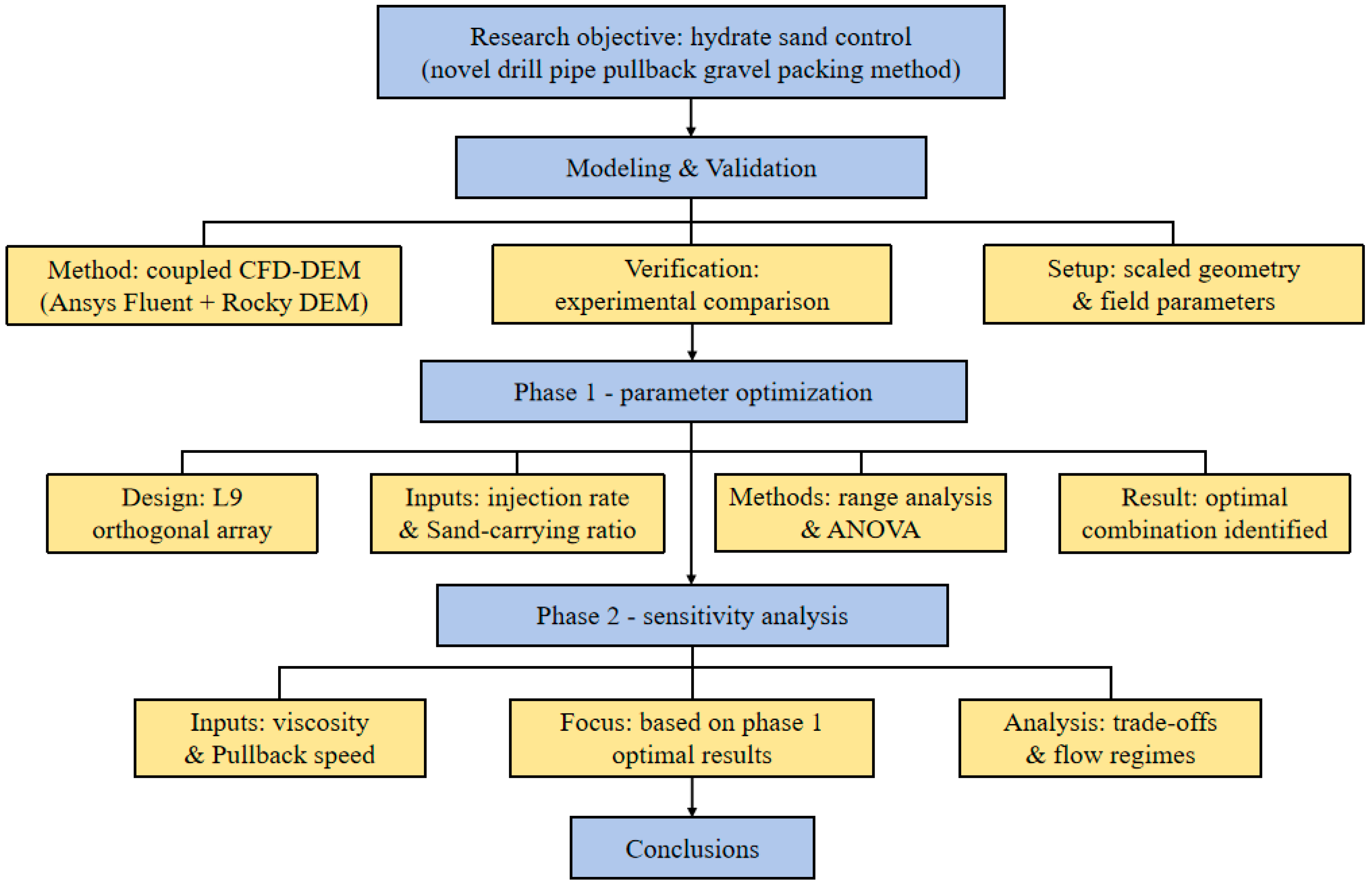
To provide a clear overview of the research methodology and logical framework, a technical roadmap is presented in
Figure 1. This flowchart illustrates the process, beginning with numerical model construction and validation, followed by Phase 1 parameter optimization and Phase 2 sensitivity analysis.
3. Simulation Design and Optimization
The numerical simulation is conducted in two sequential phases. The first phase (Phase 1) systematically examines the core parameters, including injection rate and sand-carrying ratio, to determine their individual influences and identify the optimal combination. Building on these results, the second phase (Phase 2) introduces two additional parameters (i.e., carrier fluid viscosity and pullback speed) to analyze their synergistic influence on flow dynamics and bed stability. As Phase 2 is based on the outcome of Phase 1, this section focuses on detailing the design rationale and experimental scheme for Phase 1. The corresponding details for Phase 2 are provided subsequently in
Section 5.
In this study, the injection rate refers to the total slurry inflow rate. The sand-carrying ratio is defined as the bulk gravel volume ratio (including voids). To determine the actual solid volume fraction, a packing density coefficient of 0.625 is applied. Consequently, the maximum nominal ratio of 60% corresponds to a solid volume fraction of 37.5%, ensuring the slurry remains strictly within the pumpable range for marine operations. Given that the injection rate and sand-carrying ratio are two core governing parameters, a two-factor orthogonal design is adopted. This approach efficiently distinguishes the individual influences and interactions between these parameters, enabling the identification of the optimal combination with a minimal yet highly representative set of numerical experiments, thereby ensuring both computational efficiency and result reliability.
Based on field conditions and preliminary investigations, three levels are selected for each parameter: the injection rate is set at 0.8 m
3/min, 1.2 m
3/min, and 1.6 m
3/min, and the sand-carrying ratio at 30%, 45%, and 60%. This results in an L9(3
2) orthogonal array, detailing the 9 simulation cases in
Table 4. Furthermore, based on preliminary estimations related to the selected injection rates and sand-carrying ratios, the drill pipe pullback speed and simulation duration are fixed at 0.2 m/s and 8 s for all cases. This duration allows for a pullback distance of 1.6 m, which is sufficient to establish a quasi-steady state for the gravel packing profile. This setting ensures that the dynamic bed formation mechanism is fully captured while keeping the injection point well within the computational domain to avoid outlet boundary interference.
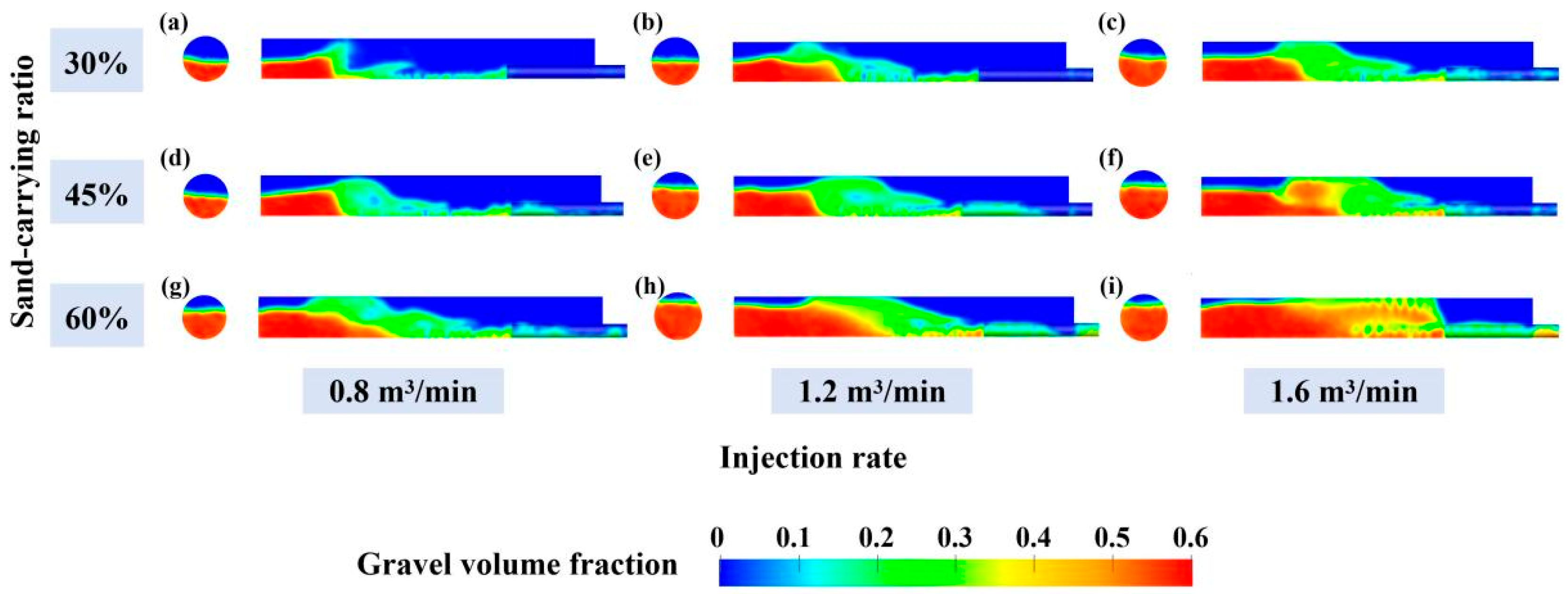
Figure 5 presents the simulation results for the 9 preliminary orthogonal test cases. The visual inspection indicates universally poor packing performance across this parameter range, characterized by significant upper-wellbore voids and a gravel front lagging far behind the drill pipe, likely due to a parameter–speed mismatch. However, the simulation results also reveal a critical trend: packing effectiveness improves substantially with increases in both injection rate and sand-carrying ratio. For instance,
Figure 5a–c show that raising the injection rate from 0.8 m
3/min to 1.6 m
3/min markedly increases packing bed height due to greater gravel supply. And this improvement correlates with a distinct hydrodynamic enhancement: the drill pipe injection velocity doubles (from 1.54 to 3.09 m/s), increasing jet momentum, while the average annular velocity rises from 0.20 to 0.40 m/s, significantly improving particle transport capacity. Similarly,
Figure 5c,f,i indicate that increasing the sand-carrying ratio from 30% to 60% produces a more uniform gravel distribution and advanced packing front. Notably, under the highest parameter combination [i.e., Case (i): 1.6 m
3/min injection rate and 60% sand-carrying ratio], the densest gravel accumulation and steadiest front propagation are exhibited, suggesting that this high gravel supply rate better matches the pullback speed, thereby enabling more effective packing.
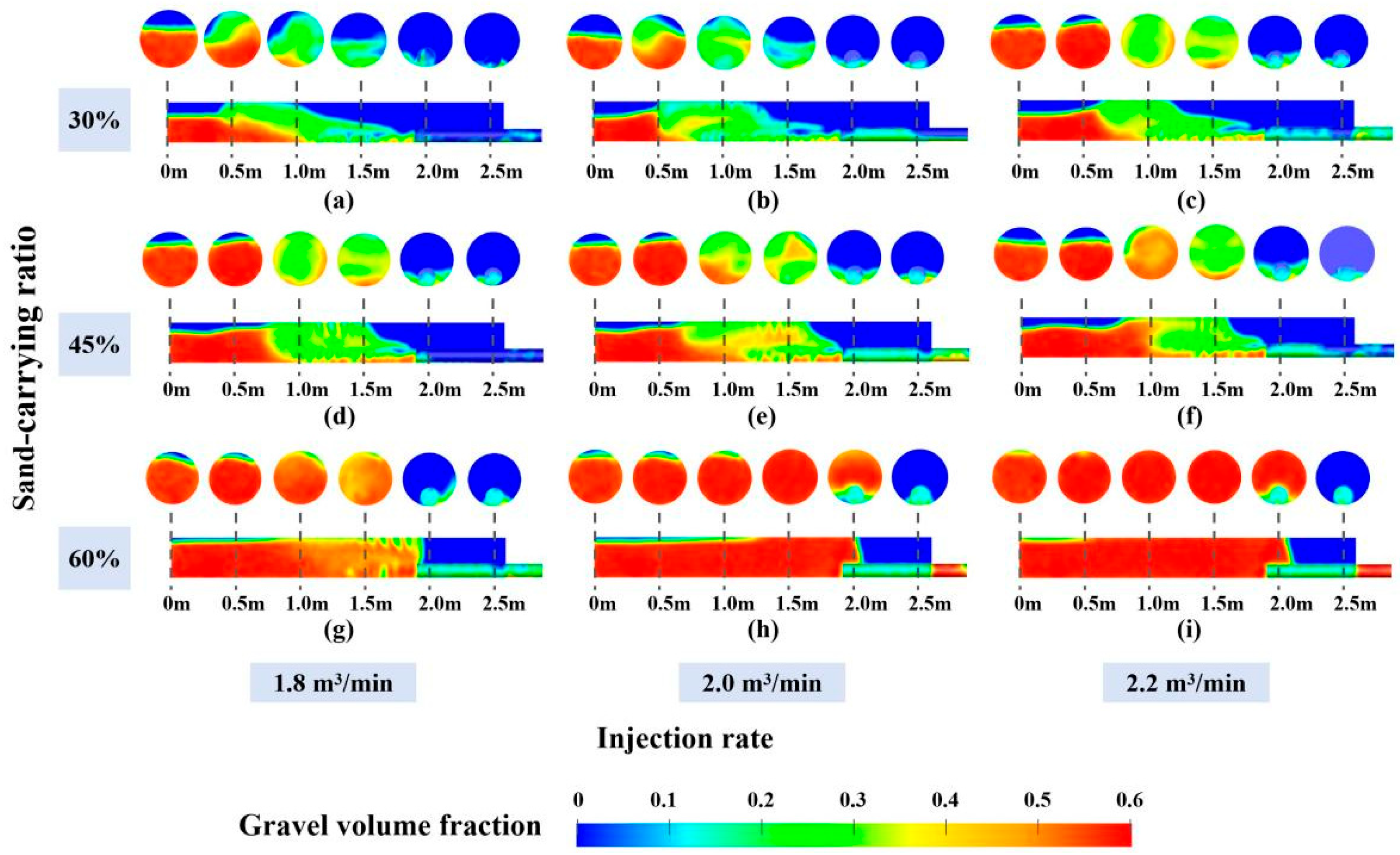
This finding suggests that the initially defined parameter range is likely set too low, since even the best-performing combination within that range fails to deliver adequate packing performance. Based on this evaluation, a second set of orthogonal experiments is designed to refine parameter selection and validate flow and deposition behavior under high-rate conditions. In this new experimental setup, the injection rate is increased to three higher levels (1.8 m
3/min, 2.0 m
3/min, and 2.2 m
3/min). The sand-carrying ratio levels remain unchanged to reflect practical field limitations, with the aim of achieving improved packing performance. The 9 additional test configurations are listed in
Table 5, while all other simulation parameters are maintained consistent with the previous round.
5. Sensitivity Analysis of Carrier Fluid Viscosity and Pullback Speed
While the preceding orthogonal tests identify the injection rate and sand-carrying ratio as critical factors and determine their optimal parameter combination, the interdependence of process parameters under complex field conditions must be considered. Specifically, the rheological properties of the carrier fluid (represented by its viscosity) and operational parameters (such as the drill pipe pullback speed) are critical, as they govern gravel transport and settling, wellbore flow field distribution, and final bed stability. To develop a more comprehensive parameter system for sand control packing, a sensitivity analysis is performed based on the previously optimized parameters (Cases 17 and 18 in
Table 7). This analysis further investigates the effects of carrier fluid viscosity and pullback speed on packing effectiveness. The specific design of the simulation scheme is listed in
Table 9.
A total of 8 simulation cases are conducted according to
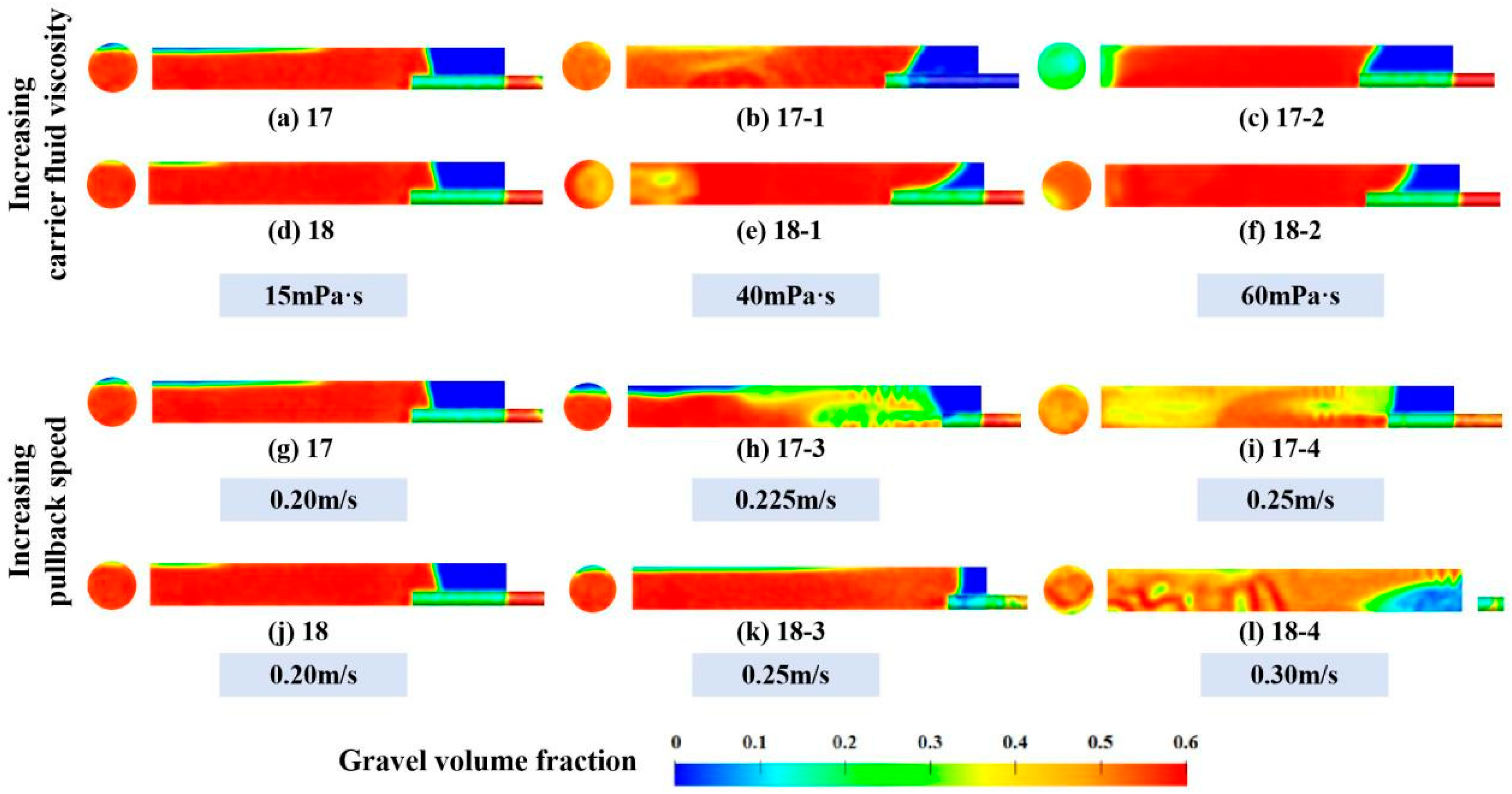
Table 9. The resulting gravel volume fraction contour plots at the final simulation time (8 s;
Figure 8) clearly show that both carrier fluid viscosity and drill pipe pullback speed significantly influence the gravel packing structure and density. The effect of carrier fluid viscosity on packing performance exhibits a twofold nature, being both beneficial and inhibitory. At relatively low viscosities, an increase enhances the fluid’s carrying capacity, reduces particle settling velocity, prolongs suspension time, and facilitates transport to higher positions, thereby increasing the overall stable bed height. For example, as shown in
Figure 8a,b, increasing the viscosity from 15 mPa·s to 40 mPa·s markedly elevates the stable bed height and improves packing effectiveness at the bottom of the wellbore. However, a further increase to 60 mPa·s [
Figure 8b,c] excessively hinders particle settling and compaction, leading to a localized decrease in the volume fraction and preventing maximum densification at the wellbore end. It is worth noting that in high-viscosity cases, gravel accumulation appears near the upper wellbore. This phenomenon is attributed to the fluidization effect during dynamic injection, where, consistent with the viscous term in the Ergun equation, the elevated viscous drag dominates over gravity. This force balance keeps particles suspended in the upper annulus during the active pumping phase, significantly delaying their settling. This indicates that while a moderate viscosity increase improves bed height and uniformity, an excessively high viscosity impedes particle deposition and the formation of a dense and stable packing structure.
In contrast, an increase in the drill pipe pullback speed adversely affects packing effectiveness. As the gravel conveyance conduit, a faster retraction reduces the gravel supply per unit length and time. This shortens the particle residence time, hindering localized settling and the formation of a densely packed bed. For instance, as shown in
Figure 8g,h, increasing the speed from 0.2 m/s to 0.225 m/s reduces the bed height and yields a visibly sparser structure. Conversely, under a high sand-carrying ratio, an excessively slow pullback speed may cause gravel to accumulate too rapidly near the drill pipe exit. In such cases, the advanced gravel pack can outpace the drill pipe, increasing the operational risk of pipe burial or sticking [e.g.,
Figure 8j]. Therefore, precise control of the pullback speed is critical to ensure smooth retraction and prevent such operational failures.
In summary, unlike the consistently positive effects of injection rate and sand-carrying ratio, the impacts of carrier fluid viscosity and pullback speed are characterized by significant trade-offs and potential drawbacks. While a moderate increase in viscosity enhances carrying capacity and raises the bed height, excessive viscosity beyond an optimal threshold impedes particle settling and compromises packing density at the wellbore end. Similarly, pullback speed necessitates optimization within a defined range: while a faster speed reduces the risk of pipe burial, it also leads to lower packing density, and an excessively slow speed introduces operational risks. Consequently, rather than a single optimum, the selection of viscosity and pullback speed necessitates a compromise between packing efficiency, final density, and operational safety.



 ,
,