Abstract
Drill pipe pullback gravel packing is a novel sand control method for marine natural gas hydrate reservoirs, enabling rapid and uniform filling by synchronizing fluid injection with pipe retraction. However, the complex liquid–solid two-phase flow mechanisms and parameter sensitivities in this dynamic process remain unclear. To address this gap, a coupled Computational Fluid Dynamics and Discrete Element Method (CFD-DEM) approach is adopted in accordance with the trial production requirements in the South China Sea. This investigation systematically analyzes the relative contributions of injection rate (0.8–2.2 m3/min) and sand-carrying ratio (30–60%) to the packing effectiveness. Additionally, the effects of carrier fluid viscosity and drill pipe pullback speed are explored. Results show that injection rate and sand-carrying ratio positively affect performance, with sand-carrying ratio as the decisive factor, exhibiting an impact approximately 73 times greater than that of the injection rate. Optimal parameters in this study are injection rate of 2.2 m3/min and sand-carrying ratio of 60%, which yield the highest gravel volume fraction and stable bed height. Furthermore, it is also found that while increasing carrier fluid viscosity improves bed height, excessive viscosity hinders particle settling and compaction. Similarly, a trade-off exists for the pullback speed to balance packing density and pipe burial risks. These findings provide a theoretical basis for optimizing sand control operations in hydrate trial productions.
1. Introduction
Amid the global energy transition and pursuit of “dual carbon” goals, natural gas hydrates are recognized as a key 21st-century energy source due to their abundance and clean, low-carbon profile [1]. Their successful commercial exploitation is strategically vital for energy security and system decarbonization. A fundamental challenge, however, lies in the weakly cemented nature of hydrate-bearing sediments. Production-induced hydrate dissociation weakens the formation matrix, leading to instability and substantial sand production. This, in turn, risks wellbore clogging, equipment damage, and operational failures [2]. As demonstrated by numerous international field trials (Table 1), sand production has become a primary technical challenge impeding the safe, stable, and sustained development of hydrate resources. Consequently, developing effective sand control technologies is a crucial engineering prerequisite for achieving large-scale commercial production.
Table 1.
Overview of international natural gas hydrate field production tests.
Currently, sand control strategies for hydrate reservoirs are primarily adapted from the technological frameworks of conventional oil and gas operations. These methods are generally classified into mechanical, chemical, and composite techniques [11]. Among these, mechanical sand control is the most widely implemented approach, employing filter devices such as wire-wrapped screens, slotted liners, and expandable screens to physically retain sand particles. Chemical sand control involves the injection of consolidating agents—such as resins or gels—to bond formation grains and thereby enhance overall formation stability. Composite techniques, such as high-permeability fracture packing, integrate the advantages of both mechanical and chemical approaches, achieving effective sand retention while maintaining reservoir productivity. Notably, gravel packing with post-drilling installation of wire-wrapped screens is widely deployed in conventional unconsolidated sandstone reservoirs and is considered a highly promising completion method for hydrate production [12,13]. Its effectiveness has been demonstrated at both laboratory and field pilot scales during gas hydrate production trials. For example, Lee et al. [14] evaluated the performance of various commercial sand screens under depressurization using a visual setup informed by Japan’s 2013 field test, confirming their practical potential. Yu et al. [15] utilized a custom-designed system to simulate full-section and zonal sand production from silty reservoirs, investigating how gravel pack permeability changes over time. Dong et al. [16] developed a laboratory apparatus for simulating gravel packing in horizontal wells, incorporating factors like fluid loss and screen eccentricity to systematically analyze how flow rate and wellbore inclination affect α-wave and β-wave packing. Moreover, Li et al. [17] proposed a gravel sizing design criterion termed “blocking the coarse while passing the fine,” specifically tailored for clay-rich siltstone reservoirs in the Shenhu area of the South China Sea. This criterion was successfully validated during China’s second offshore hydrate production test [10].
While gravel packing is a robust sand control technique renowned for its operational simplicity and long-term reliability, it encounters significant obstacles in hydrate reservoirs. Standard practices, notably the use of wire-wrapped screen, are challenged by the high risk of screen clogging from fine silt particles and the potential for wellbore instability during the open-hole phase prior to screen deployment. To overcome these challenges, a novel drill pipe pullback gravel packing method has been recently proposed, offering a pathway to more efficient and safer sand control in the complex formations. This technique involves simultaneously pumping gravel-laden fluid through the drill pipe and pulling it back immediately after drilling. In this approach, upon completion of drilling, gravel-carrying fluid is injected directly through the internal channel of the drill pipe while simultaneously retracting the pipe. By creating the sand control barrier under fully enclosed conditions, it fundamentally avoids the exposed wellbore phase, thereby effectively mitigating the risks of slot plugging and formation collapse. However, the drill pipe pullback gravel packing process entails complex hydrodynamic interactions involving liquid–solid coupling and granular packing. Its performance is governed by interdependent parameters like injection rate and sand-carrying ratio, yet the underlying flow regimes and governing mechanisms are not fully understood. Given the high cost and time intensity of large-scale experiments, numerical simulation offers a viable and efficient alternative for elucidating these phenomena prior to field implementation.
Recently, coupled numerical methods (like Computational Fluid Dynamics and Discrete Element Method, CFD-DEM) have been widely applied to investigate particle transport in hydrate formations. Specifically, Guo et al. [18] employed a CFD-DEM model to simulate complex gravel packing in multi-branch horizontal wellbores for hydrate production, analyzing the effect of branch angle and length on filling efficiency. Deng et al. [12] focused on the gravel packing sand control mechanism, utilizing a CFD-DEM coupling model to elucidate three distinct blocking stages and analyze two main types of blockage. Ismail et al. [19] utilized CFD-DEM to model sand retention behaviors for wire-wrapped screens, identifying three key mechanisms of sand bridging (stable, intermittent, and continuous collapse) and investigating the effects of slot width ratios. However, the majority of prior work addresses conventional gravel packing methods where the inner screen and wash pipe assembly remain static during injection. The hydrodynamic mechanism of the drill pipe pullback process remains largely unexplored, which constitutes the critical research gap. Accordingly, this study employs a validated coupled CFD-DEM to numerically investigate the drill pipe pullback gravel packing process in a horizontal hydrate wellbore. The work aims to delineate gravel transport, settling, and packing structure under various operational parameters and to elucidate how key factors govern the final packing effectiveness. The findings are expected to provide a scientific basis for optimizing this technique in field applications.
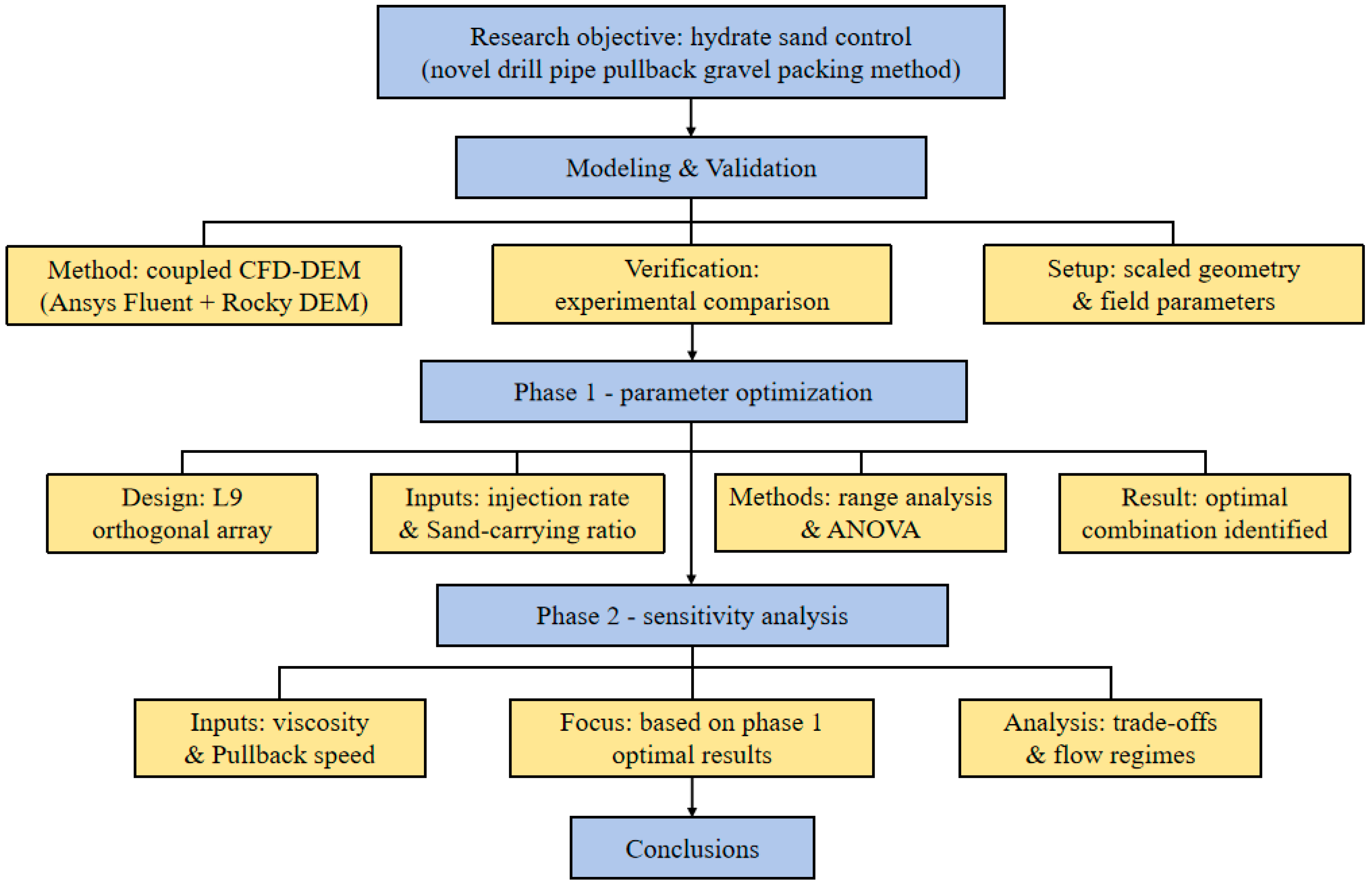
To provide a clear overview of the research methodology and logical framework, a technical roadmap is presented in Figure 1. This flowchart illustrates the process, beginning with numerical model construction and validation, followed by Phase 1 parameter optimization and Phase 2 sensitivity analysis.
Figure 1.
Technical roadmap and research framework.
2. Numerical Method and Model Construction
2.1. CFD-DEM Approach and Validation
The drill pipe pullback gravel packing process involves complex liquid–solid two-phase flow. The continuous carrier fluid is governed by the principles of fluid mechanics, while the motion of discrete gravel particles is tracked using Newton’s laws of motion. To accurately capture the interactions between these phases, this study employs a coupled CFD-DEM approach for the simulation.
In this coupled framework, Ansys Fluent solves the fluid flow field, while Rocky DEM tracks the motion of individual gravel particles. The coupling between the two phases is achieved through bidirectional data exchange: fluid-derived forces (e.g., drag and pressure gradients) on particles are computed and transferred to the DEM solver, while particle data (position and velocity) are returned to update the fluid calculation, thereby closing the coupling loop.
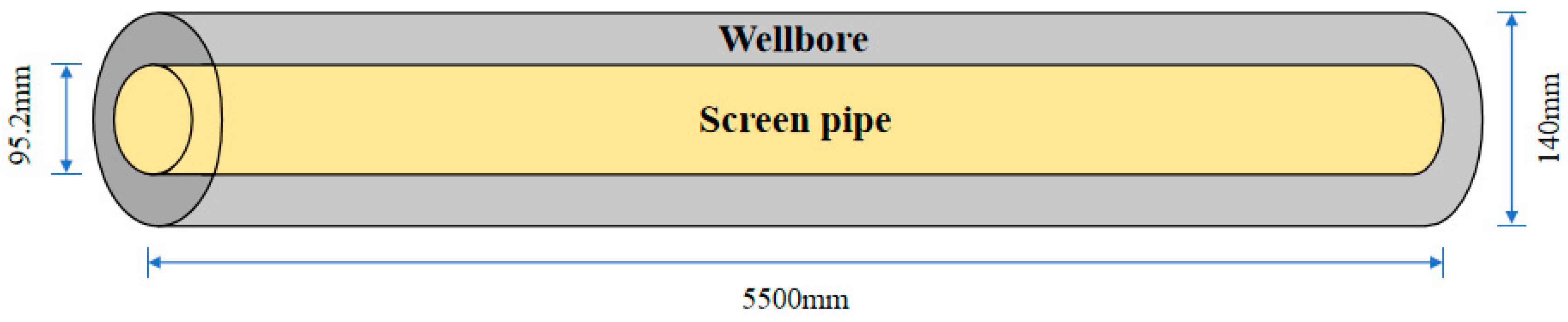
To validate the simulation methodology and the selected particle–liquid interaction models, this study is benchmarked against the laboratory experiments of Dong et al. [20] on gravel packing in horizontal/highly deviated wells. A simulation model matching the experimental geometry (Figure 2) is constructed with a wellbore inner diameter of 140 mm, a screen outer diameter of 95.2 mm, and a model length of 5.5 m. Operational parameters, including a 5% sand-carrying ratio, 0 mm screen eccentricity, and an injection rate of 100~600 L/min, are replicated as detailed in Table 2.
Figure 2.
Schematic of the validation model.
Table 2.
Parameter Values for Validation Simulation.
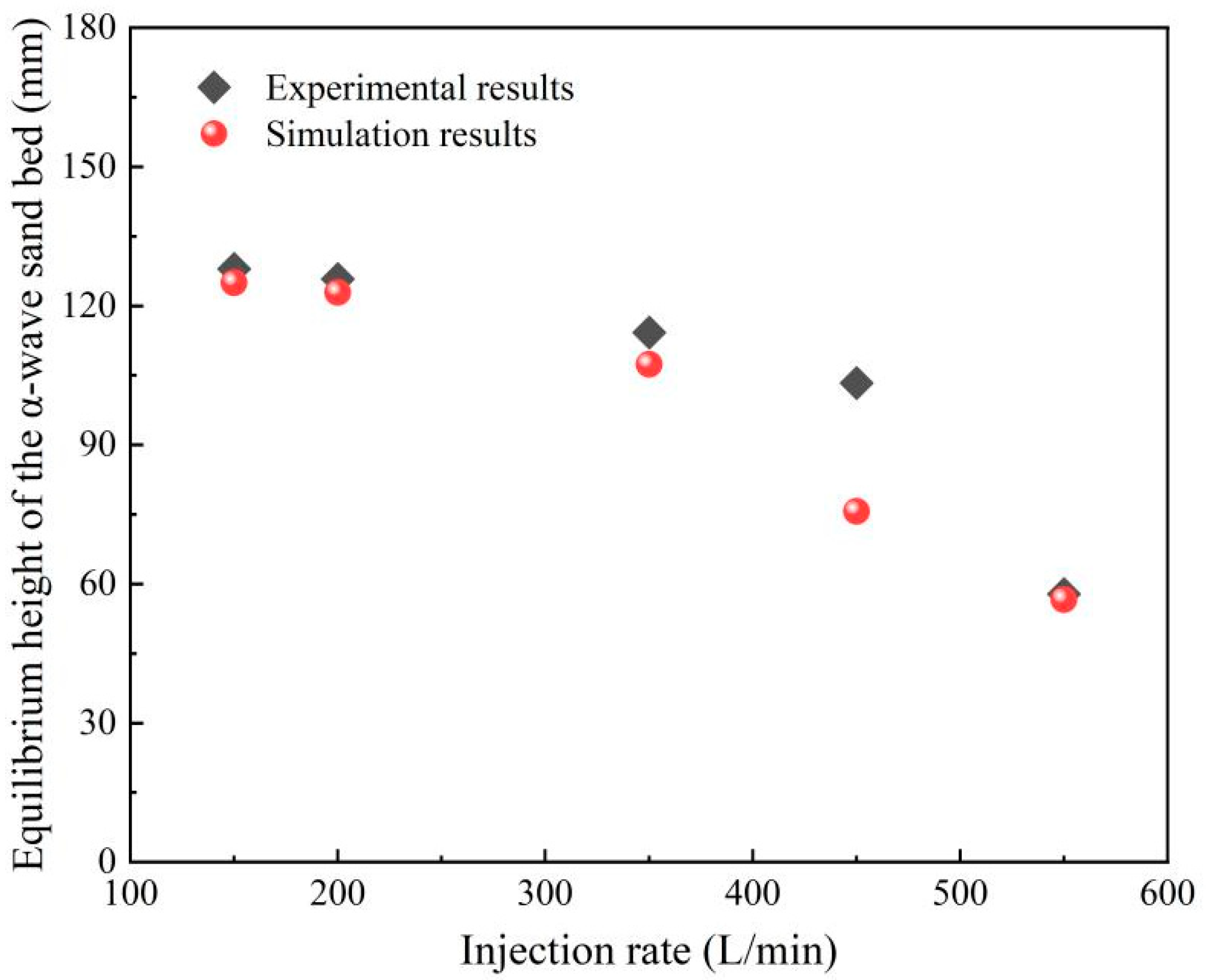
Figure 3 compares the simulated α-wave equilibrium bed height against experimental data from the validated model. The results demonstrate excellent agreement in both trend and magnitude. While minor deviations occur under specific conditions—potentially due to experimental uncertainty or localized model approximations—the overall consistency is strong, with all errors remaining within an acceptable margin. This high level of consistency validates the accuracy of the adopted CFD-DEM approach in simulating gravel transport and packing, thereby providing a credible foundation for subsequent investigations.
Figure 3.
Comparison of simulation and experimental results for validation.
2.2. Model Construction and Parameter Settings
The numerical model for this study is based on engineering data from a hydrate trial production plan in the South China Sea. Since a full-scale simulation is computationally prohibitive, the geometry is rationally simplified while preserving key physical features and flow dynamic similarity. Specifically, the horizontal section is scaled down from 260 m to 2.6 m (1:100 ratio), while the radial dimensions—including the 311 mm wellbore and 104.8 mm drill pipe—are retained at a 1:1 field scale to function as a representative elementary volume (REV). This preserves the annular velocity field, ensuring that key dimensionless numbers (e.g., Reynolds and Archimedes numbers) match field conditions. Furthermore, the 2.6 m length is determined based on the hydraulic diameter (Dh = 206.2 mm). The domain length exceeds 12 Dh, surpassing the standard requirement (10 Dh) for establishing fully developed flow and stable particle transport. This simplification model (Figure 4) thus enhances computational efficiency without compromising the fidelity of core physical processes.
Figure 4.
Schematic of the simplified model for the drill pipe pullback simulation.
In the simulation, boundary conditions are set as follows: The inlet at the front face of the drill pipe is defined as a velocity inlet for the gravel-laden fluid. To minimize end effects, injection starts approximately three pipe diameters from the wellbore end. The wellbore outlet face is set as a pressure outlet to reflect the actual operational conditions. Detailed parameters and case setups are listed in Table 3. Specifically, the gravel diameter is set to 0.6 mm, corresponding to the median diameter (d50) of the standard 20/40 mesh quartz sand (425–850 μm) used in the field. The static friction coefficient is defined as 0.7, reflecting an internal friction angle of approximately 35°, typical for angular quartz grains. Furthermore, to strictly ensure numerical stability in the coupled CFD-DEM framework, the fluid cell size is explicitly set to 20 mm, maintaining a grid-to-parcel ratio of approximately 3.3 relative to the coarse-grained parcel (6 mm). This ratio adheres to the volume-averaging principle to prevent non-physical divergence caused by overly fine meshes. Throughout the simulation, numerical convergence is strictly monitored by ensuring that the residuals for continuity and momentum equations satisfy the convergence criteria at each time step.
Table 3.
Specific parameter settings for the horizontal wellbore drill pipe pullback simulation.
3. Simulation Design and Optimization
The numerical simulation is conducted in two sequential phases. The first phase (Phase 1) systematically examines the core parameters, including injection rate and sand-carrying ratio, to determine their individual influences and identify the optimal combination. Building on these results, the second phase (Phase 2) introduces two additional parameters (i.e., carrier fluid viscosity and pullback speed) to analyze their synergistic influence on flow dynamics and bed stability. As Phase 2 is based on the outcome of Phase 1, this section focuses on detailing the design rationale and experimental scheme for Phase 1. The corresponding details for Phase 2 are provided subsequently in Section 5.
In this study, the injection rate refers to the total slurry inflow rate. The sand-carrying ratio is defined as the bulk gravel volume ratio (including voids). To determine the actual solid volume fraction, a packing density coefficient of 0.625 is applied. Consequently, the maximum nominal ratio of 60% corresponds to a solid volume fraction of 37.5%, ensuring the slurry remains strictly within the pumpable range for marine operations. Given that the injection rate and sand-carrying ratio are two core governing parameters, a two-factor orthogonal design is adopted. This approach efficiently distinguishes the individual influences and interactions between these parameters, enabling the identification of the optimal combination with a minimal yet highly representative set of numerical experiments, thereby ensuring both computational efficiency and result reliability.
Based on field conditions and preliminary investigations, three levels are selected for each parameter: the injection rate is set at 0.8 m3/min, 1.2 m3/min, and 1.6 m3/min, and the sand-carrying ratio at 30%, 45%, and 60%. This results in an L9(32) orthogonal array, detailing the 9 simulation cases in Table 4. Furthermore, based on preliminary estimations related to the selected injection rates and sand-carrying ratios, the drill pipe pullback speed and simulation duration are fixed at 0.2 m/s and 8 s for all cases. This duration allows for a pullback distance of 1.6 m, which is sufficient to establish a quasi-steady state for the gravel packing profile. This setting ensures that the dynamic bed formation mechanism is fully captured while keeping the injection point well within the computational domain to avoid outlet boundary interference.
Table 4.
Preliminary orthogonal experimental design scheme for drill pipe pullback simulation.
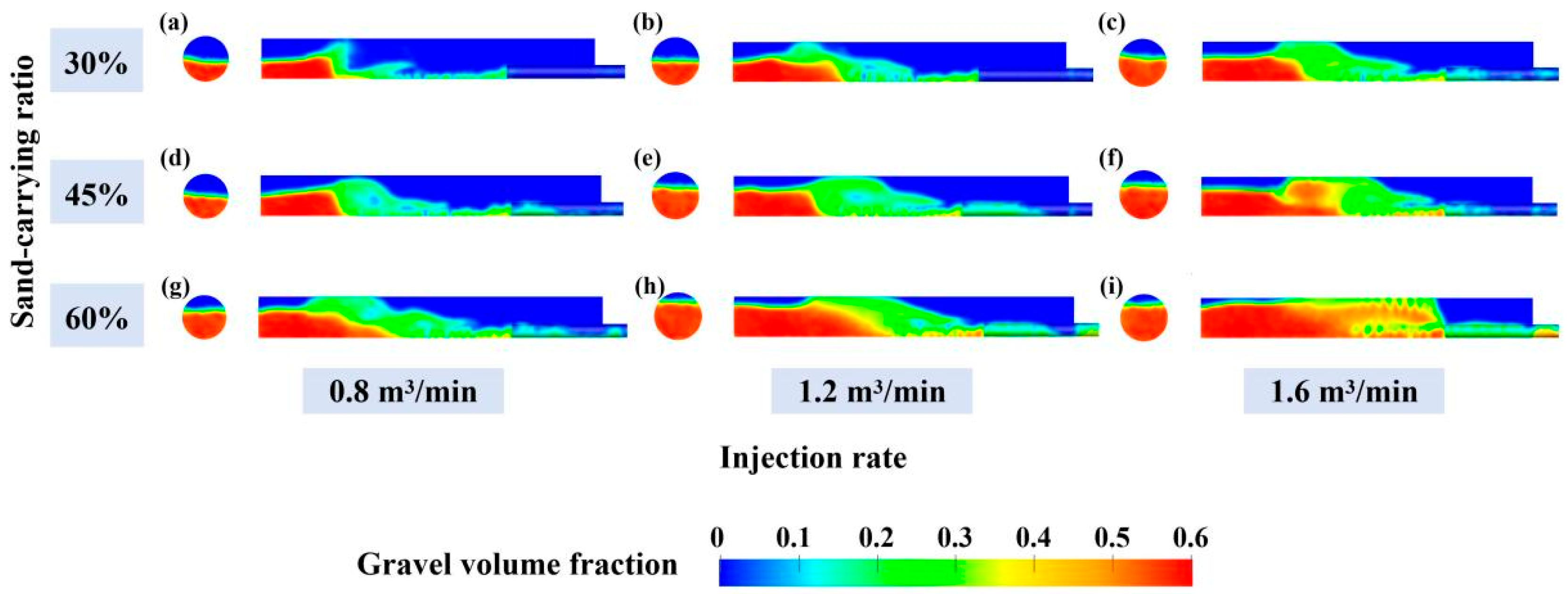
Figure 5 presents the simulation results for the 9 preliminary orthogonal test cases. The visual inspection indicates universally poor packing performance across this parameter range, characterized by significant upper-wellbore voids and a gravel front lagging far behind the drill pipe, likely due to a parameter–speed mismatch. However, the simulation results also reveal a critical trend: packing effectiveness improves substantially with increases in both injection rate and sand-carrying ratio. For instance, Figure 5a–c show that raising the injection rate from 0.8 m3/min to 1.6 m3/min markedly increases packing bed height due to greater gravel supply. And this improvement correlates with a distinct hydrodynamic enhancement: the drill pipe injection velocity doubles (from 1.54 to 3.09 m/s), increasing jet momentum, while the average annular velocity rises from 0.20 to 0.40 m/s, significantly improving particle transport capacity. Similarly, Figure 5c,f,i indicate that increasing the sand-carrying ratio from 30% to 60% produces a more uniform gravel distribution and advanced packing front. Notably, under the highest parameter combination [i.e., Case (i): 1.6 m3/min injection rate and 60% sand-carrying ratio], the densest gravel accumulation and steadiest front propagation are exhibited, suggesting that this high gravel supply rate better matches the pullback speed, thereby enabling more effective packing.
Figure 5.
Gravel volume fraction contour plots for the preliminary orthogonal experimental cases. The plots correspond to the nine experimental cases detailed in Table 4. (a) Case 1; (b) Case 2; (c) Case 3; (d) Case 4; (e) Case 5; (f) Case 6; (g) Case 7; (h) Case 8; (i) Case 9.
This finding suggests that the initially defined parameter range is likely set too low, since even the best-performing combination within that range fails to deliver adequate packing performance. Based on this evaluation, a second set of orthogonal experiments is designed to refine parameter selection and validate flow and deposition behavior under high-rate conditions. In this new experimental setup, the injection rate is increased to three higher levels (1.8 m3/min, 2.0 m3/min, and 2.2 m3/min). The sand-carrying ratio levels remain unchanged to reflect practical field limitations, with the aim of achieving improved packing performance. The 9 additional test configurations are listed in Table 5, while all other simulation parameters are maintained consistent with the previous round.
Table 5.
Additional orthogonal experimental design scheme for drill pipe pullback simulation.
4. Results and Analysis
4.1. Qualitative Analysis of Packing Structure
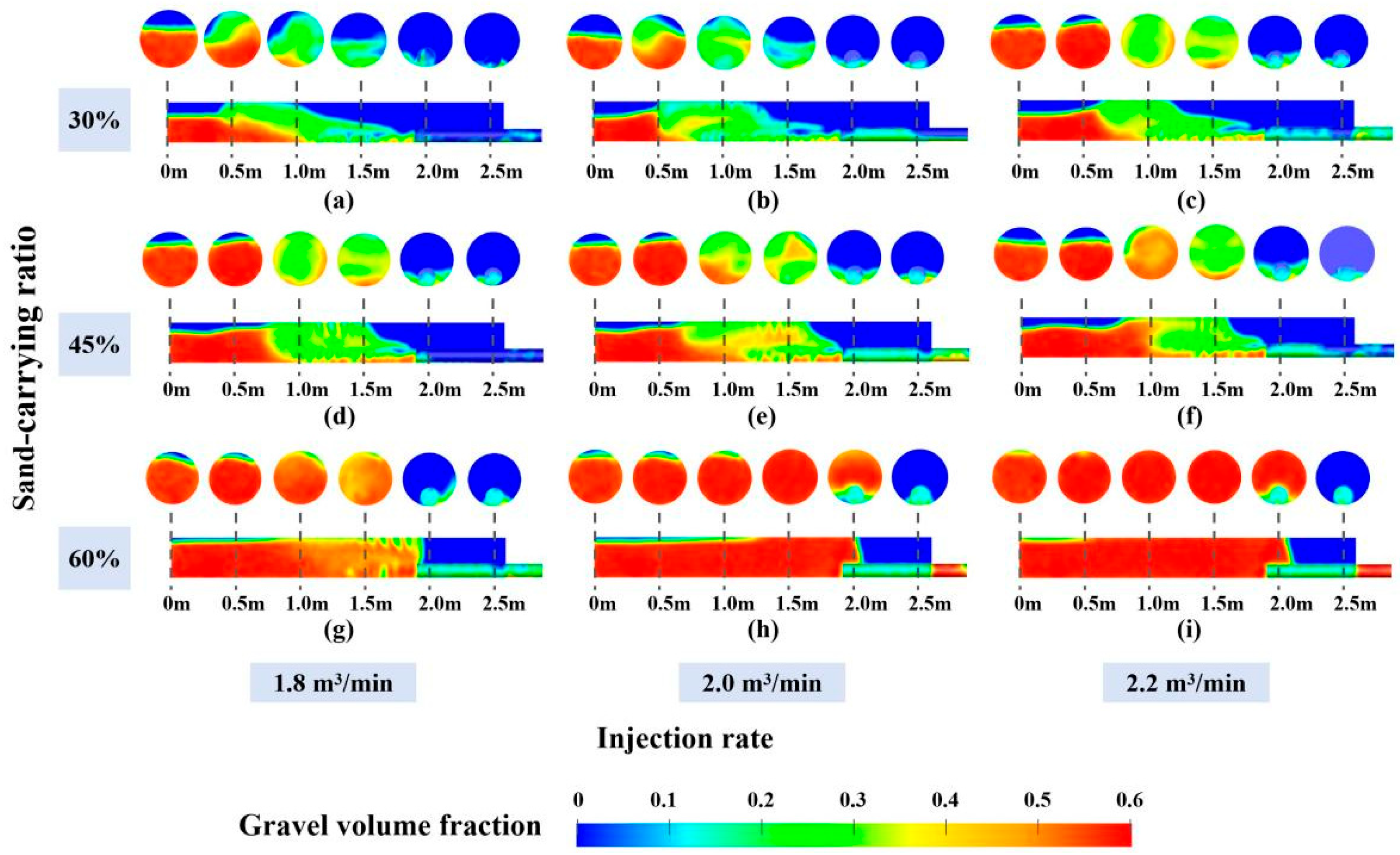
Simulation of the 9 additional orthogonal test cases listed in Table 5 generates corresponding contour plots of gravel volume fraction. As shown in Figure 6, these plots provide an intuitive qualitative visualization of how varying injection rates and sand-carrying ratios influence gravel transport and deposition patterns. To facilitate a clear comparison of packing performance across the different schemes, Figure 6 displays contour plots of the gravel volume fraction at longitudinal and various transverse cross-sections, all recorded at the 8 s simulation mark. From a macroscopic structural perspective, the packing process exhibits similar dynamic characteristics across all scenarios: continuous slurry inflow at the drill pipe exit disturbs previously settled gravel, forming a dynamic influence zone. As this energy dissipates, gravel gradually settles farther from the exit, ultimately establishing a relatively stable packing bed. Nevertheless, the specific process parameters employed lead to considerable variations in the final packing structure and overall performance.
Figure 6.
Gravel volume fraction contour plots for the additional experimental cases. The plots correspond to the nine experimental cases detailed in Table 5. (a) Case 10; (b) Case 11; (c) Case 12; (d) Case 13; (e) Case 14; (f) Case 15; (g) Case 16; (h) Case 17; (i) Case 18.
Analysis of the injection rate effect, as shown in Figure 6a–c, reveals that increasing the rate from 1.8 m3/min to 2.2 m3/min yields a slight rise in stable bed height and a moderately denser gravel accumulation. To be specific, this parameter increase elevates the average annular velocity from 0.45 m/s to 0.54 m/s. This higher velocity directly enhances the fluid’s turbulent carrying capacity, thereby reducing premature settling and promoting more effective gravel transport to the far end of the wellbore. Overall, however, varying the injection rate has a relatively limited impact on the overall packing structure. In contrast, the influence of the sand-carrying ratio is considerably more pronounced and critical. For instance, as shown in Figure 6i, increasing the sand-carrying ratio to 60% results in the formation of a dense and stable packed bed (with a gravel volume fraction exceeding 0.6), demonstrating desirable packing performance from the drill pipe exit to the end of the wellbore. Conversely, as depicted in Figure 6c,f, when the sand-carrying ratio remains at or below 45%, the gravel volume fraction is noticeably low within the high-velocity zone near the drill pipe exit, even though a stable bed of some height forms at the distal end. In this near-exit region, particles are subjected to strong fluid disturbances, resulting in loose packing and an unsatisfactory overall outcome.
Therefore, this qualitative analysis of the packing structure supports the preliminary finding that while both the injection rate and the sand-carrying ratio influence the final packing performance, the sand-carrying ratio plays a more decisive role in controlling the packing structure and density. In fact, its degree of influence is significantly greater than that of the injection rate.
4.2. Quantitative Evaluation of Packing Performance
To address the quantitative evaluation of gravel packing effectiveness under different combinations of injection rate and sand-carrying ratio, this study introduces a quantitative analysis methodology. Based on relevant study [21], we characterize the effectiveness using two key metrics: the filling ratio and the packing height. A comprehensive evaluation index is then derived from a weighted combination of these two metrics. The packing height index, filling ratio index, and the overall comprehensive index are defined by Equations (1), (2), (3) and (4), respectively.
where is the dimensionless packing height evaluation index; is the wellbore inner diameter (m); is the packing height (m); is the dimensionless filling ratio evaluation index; is the total volume of the wellbore (m3); is the volume of the gravel packed within the wellbore (m3); N is the dimensionless comprehensive evaluation index for horizontal well gravel packing effectiveness, where a larger value signifies a better packing effect; and and are the weighting coefficients for the packing height and filling ratio indices, respectively. Based on existing literature [21], these coefficients are set to 0.25 and 0.75, respectively.
In this study, “stable bed height” and “central longitudinal section gravel volume fraction” are adopted as the core metrics for evaluating packing effectiveness. The former primarily reflects the vertical extent of effective gravel accumulation, whereas the latter serves to characterize the overall wellbore filling ratio. Both metrics are extracted and compiled through post-processing of the simulation results for each group, with the specific data detailed in Table 6.
Table 6.
Summary of simulation results for the additional experimental cases.
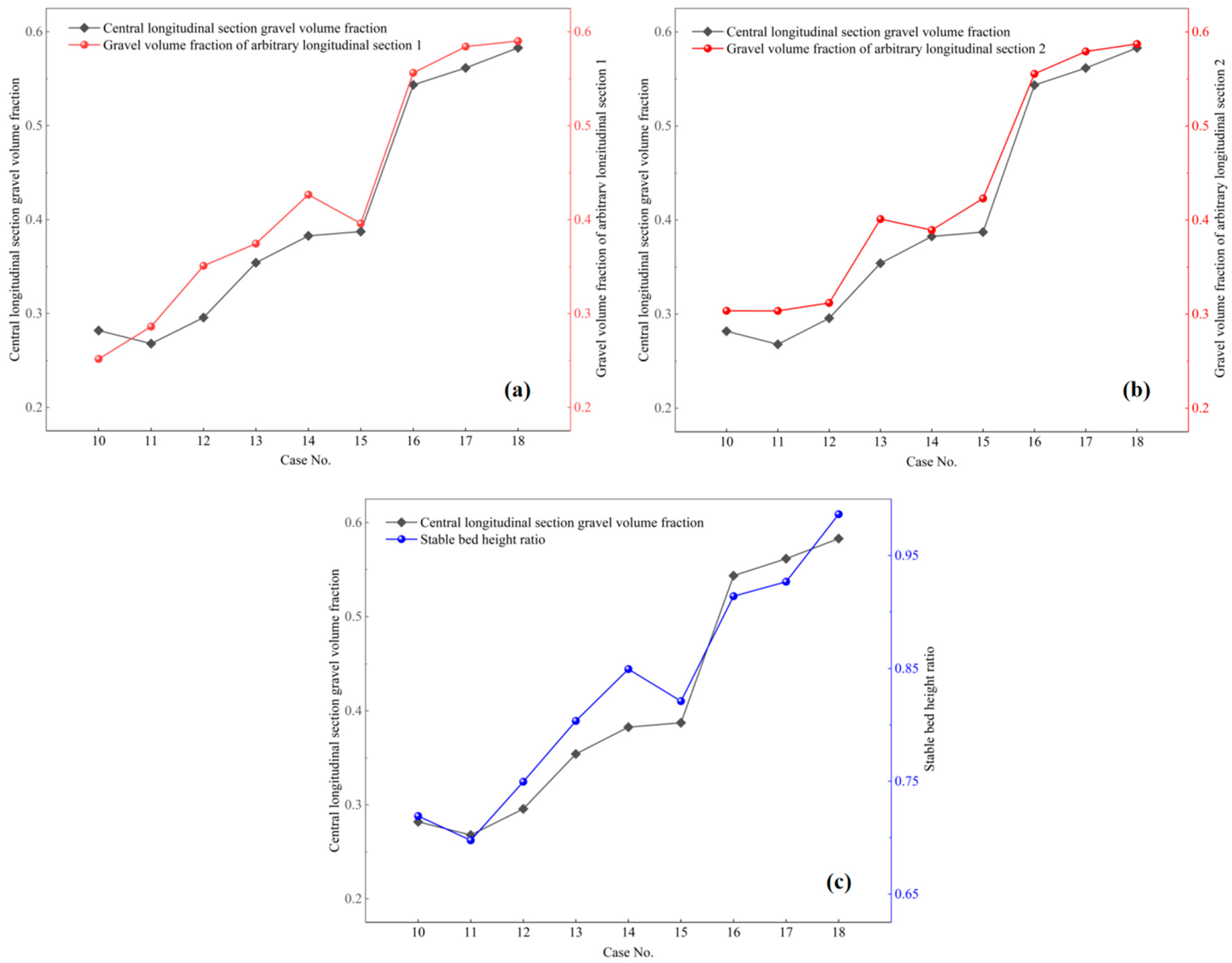
To validate the evaluation system, we assess the representativeness of its two core metrics. The “stable bed height” is directly measured from simulations; however, the two-dimensional (2D) “central longitudinal section gravel volume fraction” requires justification for representing the overall three-dimensional (3D) packing structure. We compare it against the gravel volume fractions of two other arbitrary longitudinal sections [Figure 7a,b]. The results show consistent trends and close numerical agreement, confirming that the central longitudinal section is a valid proxy for the overall 3D packing characteristics. Furthermore, after non-dimensionalization, the “stable bed height” metric and “volume fraction” metrics themselves exhibit highly congruent variation patterns [Figure 7c], collectively corroborating the reliability of the evaluation system.
Figure 7.
Comparison between the central longitudinal section gravel volume fraction and other metrics: (a) gravel volume fraction of arbitrary longitudinal section 1; (b) gravel volume fraction of arbitrary longitudinal section 2; (c) stable bed height ratio.
Therefore, the central longitudinal section gravel volume fraction effectively represents the overall 3D packing characteristics. The evaluation system, which integrates this metric with the stable bed height, is highly credible, thereby establishing a robust foundation for subsequent quantitative analysis. Based on this system, the evaluation indices for all simulated operating conditions are calculated and summarized in Table 7.
Table 7.
Evaluation indices for simulation results of the additional experimental cases.
To investigate the influence of each process parameter on packing effectiveness and to identify the optimal parameter combination from the orthogonal test results, we performed a mean analysis on the comprehensive indices in Table 7, following the principles of orthogonal experimental design [21]. This method assesses the average impact of a single factor at different levels by calculating the arithmetic mean of the simulation results for each level, as defined by Equation (5). The optimal experimental scheme is determined by selecting the level with the most favorable mean value for each factor and combining them into a parameter set. The results of this mean analysis are presented in Table 8.
where represents the average experimental result index for the i-th level of the injection rate factor; is the sum of the experimental result indices corresponding to the i-th level of that factor; and is the number of trials conducted at that i-th level. Similarly, represents the average experimental result index for the i-th level of the sand-carrying ratio factor.
Table 8.
Mean evaluation indices for the additional experimental cases.
The optimal experimental scheme is thus determined by selecting the best-performing level for each factor. As clearly revealed in Table 8, the data elucidates the influence trends and relative contributions of both factors on gravel packing effectiveness. For the injection rate, the average evaluation index exhibits a distinct monotonic increase as the rate rises from 1.8 m3/min to 2.2 m3/min, indicating a consistently positive effect within the studied parameter range. In contrast, the sand-carrying ratio exerts a far more substantial influence. Its mean index surges from 0.3262 to 0.6379—an increase exceeding 95%. This demonstrates that a higher ratio more effectively enhances dense gravel accumulation and overall packing quality. The mean analysis conclusively identifies the optimal level for both factors as the highest value within their respective experimental ranges: an injection rate of 2.2 m3/min and a sand-carrying ratio of 60%. The combination yields the maximum comprehensive index of 0.6715, representing the condition for optimal packing effectiveness and the highest bed stability in the investigated parameter space.
To quantify the statistical significance and relative contributions of each factor, an Analysis of Variance (ANOVA) is also employed. This method assesses the significance of a factor by the proportion of its sum of squares (of deviations) to the total. The analysis reveals that the sum of squares for the sand-carrying ratio (0.1534) is approximately 73 times greater than that of the injection rate (0.0021), a difference of two orders of magnitude. This confirms that the sand-carrying ratio is the dominant factor governing packing effectiveness, while the injection rate has a comparatively minor impact. This quantitative conclusion is fully consistent with the qualitative findings observed in the contour plots in Section 4.1, mutually confirming that the sand-carrying ratio should be the primary factor for optimization in field operations.
5. Sensitivity Analysis of Carrier Fluid Viscosity and Pullback Speed
While the preceding orthogonal tests identify the injection rate and sand-carrying ratio as critical factors and determine their optimal parameter combination, the interdependence of process parameters under complex field conditions must be considered. Specifically, the rheological properties of the carrier fluid (represented by its viscosity) and operational parameters (such as the drill pipe pullback speed) are critical, as they govern gravel transport and settling, wellbore flow field distribution, and final bed stability. To develop a more comprehensive parameter system for sand control packing, a sensitivity analysis is performed based on the previously optimized parameters (Cases 17 and 18 in Table 7). This analysis further investigates the effects of carrier fluid viscosity and pullback speed on packing effectiveness. The specific design of the simulation scheme is listed in Table 9.
Table 9.
Experimental parameters for sensitivity analysis of carrier fluid viscosity and pullback speed.
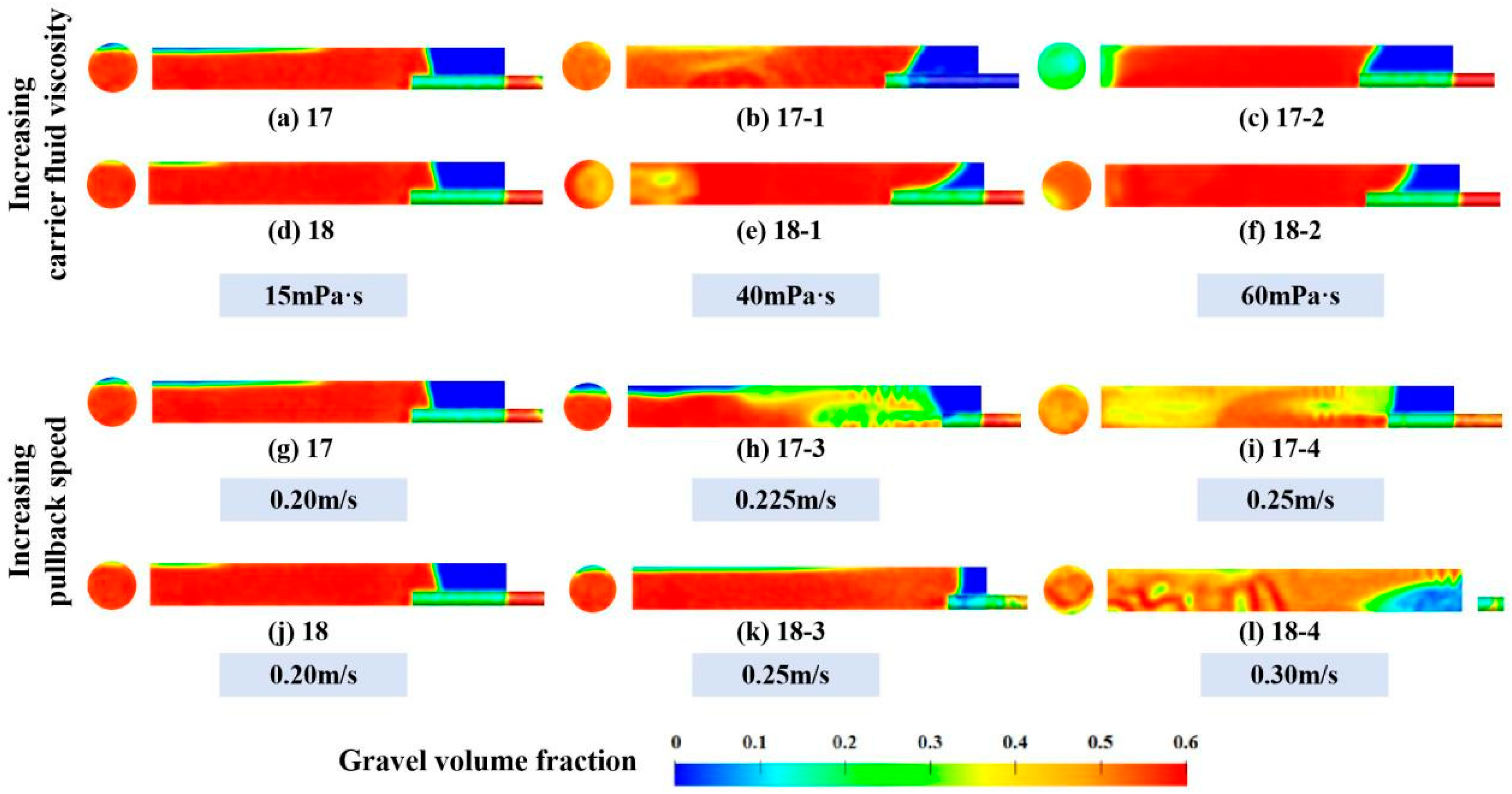
A total of 8 simulation cases are conducted according to Table 9. The resulting gravel volume fraction contour plots at the final simulation time (8 s; Figure 8) clearly show that both carrier fluid viscosity and drill pipe pullback speed significantly influence the gravel packing structure and density. The effect of carrier fluid viscosity on packing performance exhibits a twofold nature, being both beneficial and inhibitory. At relatively low viscosities, an increase enhances the fluid’s carrying capacity, reduces particle settling velocity, prolongs suspension time, and facilitates transport to higher positions, thereby increasing the overall stable bed height. For example, as shown in Figure 8a,b, increasing the viscosity from 15 mPa·s to 40 mPa·s markedly elevates the stable bed height and improves packing effectiveness at the bottom of the wellbore. However, a further increase to 60 mPa·s [Figure 8b,c] excessively hinders particle settling and compaction, leading to a localized decrease in the volume fraction and preventing maximum densification at the wellbore end. It is worth noting that in high-viscosity cases, gravel accumulation appears near the upper wellbore. This phenomenon is attributed to the fluidization effect during dynamic injection, where, consistent with the viscous term in the Ergun equation, the elevated viscous drag dominates over gravity. This force balance keeps particles suspended in the upper annulus during the active pumping phase, significantly delaying their settling. This indicates that while a moderate viscosity increase improves bed height and uniformity, an excessively high viscosity impedes particle deposition and the formation of a dense and stable packing structure.
Figure 8.
Simulation results for gravel packing effectiveness under different carrier fluid viscosities and pullback speeds. The plots correspond to the experimental cases detailed in Table 5 (Cases 17 and 18) and Table 9. (a) Case 17; (b) Case 17-1; (c) Case 17-2; (d) Case 18; (e) Case 18-1; (f) Case 18-2; (g) Case 17; (h) Case 17-3; (i) Case 17-4; (j) Case 18; (k) Case 18-3; (l) Case 18-4.
In contrast, an increase in the drill pipe pullback speed adversely affects packing effectiveness. As the gravel conveyance conduit, a faster retraction reduces the gravel supply per unit length and time. This shortens the particle residence time, hindering localized settling and the formation of a densely packed bed. For instance, as shown in Figure 8g,h, increasing the speed from 0.2 m/s to 0.225 m/s reduces the bed height and yields a visibly sparser structure. Conversely, under a high sand-carrying ratio, an excessively slow pullback speed may cause gravel to accumulate too rapidly near the drill pipe exit. In such cases, the advanced gravel pack can outpace the drill pipe, increasing the operational risk of pipe burial or sticking [e.g., Figure 8j]. Therefore, precise control of the pullback speed is critical to ensure smooth retraction and prevent such operational failures.
In summary, unlike the consistently positive effects of injection rate and sand-carrying ratio, the impacts of carrier fluid viscosity and pullback speed are characterized by significant trade-offs and potential drawbacks. While a moderate increase in viscosity enhances carrying capacity and raises the bed height, excessive viscosity beyond an optimal threshold impedes particle settling and compromises packing density at the wellbore end. Similarly, pullback speed necessitates optimization within a defined range: while a faster speed reduces the risk of pipe burial, it also leads to lower packing density, and an excessively slow speed introduces operational risks. Consequently, rather than a single optimum, the selection of viscosity and pullback speed necessitates a compromise between packing efficiency, final density, and operational safety.

6. Conclusions
Motivated by the trial production demands for natural gas hydrates in the South China Sea, this study employs a coupled CFD-DEM approach to simulate the solid–liquid two-phase flow during drill pipe pullback gravel packing. The effects of key process parameters—including injection rate, sand-carrying ratio, carrier fluid viscosity, and pullback speed—on the packing dynamics and final effectiveness are systematically analyzed. The main conclusions are as follows:
- (1)
- Both injection rate and sand-carrying ratio positively affect packing performance, driven, respectively, by the enhanced kinetic energy and increased volumetric solid supply. Based on the integrated evaluation index, the optimal parameter combination is identified as an injection rate of 2.2 m3/min and a sand-carrying ratio of 60%.
- (2)
- The sand-carrying ratio is quantitatively confirmed as the decisive factor. Its statistical contribution is approximately 73 times greater than that of the injection rate, indicating that optimizing the sand-carrying ratio is prioritized over injection rate for effective sand control.
- (3)
- Carrier fluid viscosity and pullback speed exhibit critical trade-offs. While moderate viscosity improves transport, excessive viscosity induces dominant drag forces that hinder gravitational settling and reduce packing density. Similarly, the pullback speed must be optimized to balance the risk of pipe burial against the need for a dense bed structure.
Future research will focus on following two areas: investigating the complex interplay among process parameters and extending the current hydrodynamic model to overcome the limitations of the rigid, mono-sized assumptions for more realistic reservoir simulations.
Author Contributions
Methodology, J.S. (Jiaxin Sun), H.Z. and F.Q.; Software, M.C. and H.Z.; Validation, M.C.; Investigation, J.S. (Jiudong Shi), H.Z. and F.Q.; Resources, H.S., L.L., Y.Y. and F.N.; Data curation, M.C. and J.S. (Jiudong Shi); Writing—original draft, M.C.; Writing—review and editing, H.S., J.S. (Jiaxin Sun), H.Z. and F.N.; Visualization, M.C., H.Z. and F.Q.; Supervision, H.S., J.S. (Jiaxin Sun), W.X., Z.L. and F.N.; Project administration, H.S., W.X., Z.L., L.L., Y.Y. and F.N.; Funding acquisition, F.N. All authors have read and agreed to the published version of the manuscript.
Funding
This work was supported by the Guangdong Basic and Applied Basic Research Foundation (2020B0301030003), National Natural Science Foundation of China (42372361), National Science Foundation for Distinguished Young Scholars (42225207), the Key Field Science and Technology Program of Nansha District (2023ZD017), the geological survey projects of China Geological Survey (Grant number DD20221700 and DD20230063) and Fundamental Research Funds for the Central Universities of China University of Geosciences (Wuhan) (2024XLA48).
Data Availability Statement
The original contributions presented in this study are included in the article. Further inquiries can be directed to the corresponding authors.
Conflicts of Interest
The authors declare that they have no known competing financial interests or personal relationships that could have appeared to influence the work reported in this paper.
Nomenclature
| Abbreviations | Description | Unit |
| CFD | Computational Fluid Dynamics | — |
| DEM | Discrete Element Method | — |
| REV | Representative Elementary Volume | — |
| ANOVA | Analysis of Variance | — |
| Symbol | ||
| L | Model length | mm |
| D | Wellbore inner diameter | mm |
| d | Drill pipe diameter | mm |
| d50 | Gravel particle median diameter | mm |
| Dh | Hydraulic diameter | mm |
| ΨHb | Packing height evaluation index | — |
| Hb | Packing height | m |
| Rw | Wellbore inner diameter | m |
| ΨP | Filling ratio evaluation index | — |
| Vw | Total volume of the wellbore | m3 |
| Vp | Volume of the gravel packed within the wellbore | m3 |
| αHb | Weighting coefficient for the packing height index | — |
| αP | Weighting coefficient for the filling ratio index | — |
| N | Comprehensive evaluation index | — |
| Sum of indices for the i-th level of injection rate | — | |
| Average index for the i-th level of injection rate | — | |
| ri | Number of trials conducted at i-th level | — |
| Sum of indices for the i-th level of sand-carrying ratio | — | |
| Average index for the i-th level of sand-carrying ratio | — |
References
- Chong, Z.R.; Yang, S.H.B.; Babu, P.; Linga, P.; Li, X. Review of natural gas hydrates as an energy resource: Prospects and challenges. Appl. Energy 2016, 162, 1633–1652. [Google Scholar] [CrossRef]
- Yao, Y.; Li, D.; Liang, D. Research progress on hydraulic fracturing of natural gas hydrate reservoir. Adv. New Renew. Enengy 2020, 8, 282–290. [Google Scholar]
- Grover, T. Natural Gas Hydrates-Issues for Gas Production and Geomechanical Stability; Texas A&M University: College Station, TX, USA, 2008. [Google Scholar]
- Grover, T.; Holditch, S.A.; Moridis, G. Analysis of Reservoir Performance of Messoyakha Gas Hydrate Field. In Proceedings of the ISOPE International Ocean and Polar Engineering Conference, Vancouver, BC, Canada, 6 July 2008. [Google Scholar]
- Li, Z.; Liu, J.; Li, Z.; Li, Y.; Zhang, H.; Wang, D.; Pang, H. A new model for quantitative prediction of sand production during natural gas hydrate exploitation by depressurization recovery. Acta Pet. Sin. 2019, 40 (Suppl. 2), 160. [Google Scholar]
- Zuo, R.; Li, Y. The research and successful production test for NGH in Alaska North Slope, USA. Explor. Eng. Rock Soil Drill. Tunneling 2017, 44, 1–17. [Google Scholar]
- Chee, S.; Leokprasirtkul, T.; Kanno, T.; Osawa, O.; Sudo, Y.; Takekoshi, M.; Yu, H.; Yamamoto, K. A Deepwater Sandface Monitoring System for Offshore Gas Hydrate. In Proceedings of the Offshore Technology Conference, Houston, TX, USA, 5 May 2014. [Google Scholar]
- Qiu, K.; Yamamoto, K.; Birchwood, R.; Chen, Y. Well-integrity evaluation for methane-hydrate production in the deepwater Nankai Trough. SPE Drill. Complet. 2015, 30, 52–67. [Google Scholar] [CrossRef]
- Li, J.; Ye, J.; Qin, X.; Qiu, H.; Wu, N.; Lu, H.; Xie, W.; Lu, J.; Peng, F.; Xu, Z. The first offshore natural gas hydrate production test in South China Sea. China Geol. 2018, 1, 5–16. [Google Scholar] [CrossRef]
- Ye, J.; Qin, X.; Xie, W.; Lu, H.; Ma, B.; Qiu, H.; Liang, J.; Lu, J.; Kuang, Z.; Lu, C. Main progress of the second gas hydrate trial production in the South China Sea. Geol. China 2020, 47, 557–568. [Google Scholar]
- Wang, W. Study on Sand Control Technology of Radial Wells in Natural Gas Hydrate Reservoir; China University of Petroleum: Beijing, China, 2022. [Google Scholar]
- Deng, F.; Wen, L.; Li, G.; Fan, B.; Gong, N.; Chen, S. Study of the blocking mechanism in gravel packing based on CFD-DEM. Particuology 2024, 90, 164–178. [Google Scholar] [CrossRef]
- Li, Y.; Wu, N.; Gao, D.; Chen, Q.; Liu, C.; Yang, D.; Jin, Y.; Ning, F.; Tan, M.; Hu, G. Optimization and analysis of gravel packing parameters in horizontal wells for natural gas hydrate production. Energy 2021, 219, 119585. [Google Scholar] [CrossRef]
- Lee, J.; Ahn, T.; Lee, J.Y.; Kim, S.J. Laboratory Test to Evaluate the Performance of Sand Control Screens During Hydrate Dissociation Process by Depressurization. In Proceedings of the Tenth ISOPE Ocean Mining and Gas Hydrates Symposium, Szczecin, Poland, 22 September 2013; Petroleum and Marine Resources Division, Korea Institute of Geoscience and Mineral Resources: Daejeon, Republic of Korea, 2013. [Google Scholar]
- Yu, L.; He, J.; Ye, J. Sand production control: A test on gravel packed sand. Sci. Technol. Eng. 2020, 20, 3933–3939. [Google Scholar]
- Dong, C.Y.; Wu, L.; Wang, A.P.; Liu, C.; Zhang, Q. Experimental simulation of gravel-packing in horizontal and highly deviated well. J. China Univ. Petrol. 2010, 34, 74–82. [Google Scholar]
- Li, Y.; Hu, G.; Liu, C.; Wu, N.; Chen, Q.; Liu, L.; Li, C. Gravel sizing method for sand control packing in hydrate production test wells. Pet. Explor. Dev. 2017, 44, 1016–1021. [Google Scholar] [CrossRef]
- Guo, T.; Wang, W.; Yang, X.; Chen, M.; Xu, H.; Guan, L.; Lv, M. Numerical simulation of gravel packing in multi-branch horizontal wells in hydrate reservoirs based on CFD-DEM coupling. Geoenergy Sci. Eng. 2025, 244, 213445. [Google Scholar] [CrossRef]
- Ismail, N.I.; Kuang, S.; Yu, A. CFD-DEM study of particle-fluid flow and retention performance of sand screen. Powder Technol. 2021, 378, 410–420. [Google Scholar] [CrossRef]
- Dong, C.Y.; Wang, A.P.; Wu, L.; Liu, C.M. An Integrated Probability Model for α Wave Bed Height in Horizontal and Highly Deviated Wells and its Experimental Simulation Verification. J. Exp. Mech. 2010, 25, 199–206. [Google Scholar]
- Dong, C.Y.; Zhang, Q.; Qu, Z.Q. Perpendicular numerical Trial for Horizontal Well Gravel-packing Optimization. Oil Drill. Prod. Technol. 2004, 26, 42–44. [Google Scholar]
Disclaimer/Publisher’s Note: The statements, opinions and data contained in all publications are solely those of the individual author(s) and contributor(s) and not of MDPI and/or the editor(s). MDPI and/or the editor(s) disclaim responsibility for any injury to people or property resulting from any ideas, methods, instructions or products referred to in the content. |
© 2025 by the authors. Licensee MDPI, Basel, Switzerland. This article is an open access article distributed under the terms and conditions of the Creative Commons Attribution (CC BY) license (https://creativecommons.org/licenses/by/4.0/).