Article

Response of Size-Fractionated Phytoplankton to Environmental Variables in Gwangyang Bay Focusing on the Role of Small Phytoplankton


1
Department of Environmental Oceanography, Chonnam National University, Yeosu 59626, Republic of Korea
2
School of Earth Sciences and Environmental Engineering, Gwangju Institute of Science and Technology, Gwangju 61005, Republic of Korea
3
Seaweed Research Institute, National Institute of Fisheries Science, Haenam 59002, Republic of Korea
4
Marine Environment Research Division, National Institute of Fisheries Science, Busan 46083, Republic of Korea
5
Department of Ocean Integrated Science, Chonnam National University, Yeosu 59626, Republic of Korea
*
Author to whom correspondence should be addressed.
These authors contributed equally to this work.
J. Mar. Sci. Eng. 2025, 13(12), 2298; https://doi.org/10.3390/jmse13122298
Submission received: 23 October 2025 / Revised: 30 November 2025 / Accepted: 2 December 2025 / Published: 3 December 2025
(This article belongs to the Section Marine Ecology)

Abstract

Responses of size-fractionated phytoplankton to environmental variables—particularly temperature, euphotic depth, and ammonium—were investigated in Gwangyang Bay to identify the phytoplankton groups responsible for estuarine blooms. Carbon-normalized biomass clearly showed the dominance of nanoplankton during summer and microplankton during winter. A combination of microscopy and flow cytometry analyses revealed that cryptophytes dominated the summer bloom, whereas diatoms dominated the winter bloom. Polynomial regression models indicated that diatom-dominated microplankton biomass declined sharply with increasing temperature and ammonium, while cryptophyte-dominated nanoplankton and cyanobacteria-dominated picoplankton biomass increased with rising temperature and decreased with increasing euphotic depth. These results highlight the substantial role of small phytoplankton (nanoplankton and picoplankton) in the bay ecosystem, where concerns over declining water quality and reduced nitrate availability are ongoing.

1. Introduction

Estuarine ecosystems are versatile with regard to the dynamics of environmental variables such as physical and chemical parameters [1]. Although estuaries are characterized by a large range of primary production across the globe, with a mean of 252 gC m−2 yr−1 [2], and temperate estuaries experience a bloom maximum that may exceed 30 µg/L of chlorophyll a [3], the phytoplankton composition in the estuarine ecosystem is often regulated by factors affecting phytoplankton ecology and physiology [4,5]. Large cells appear to dominate in estuaries because large phytoplankton can augment their size as a function of anthropogenic input of enriched nutrients, and zooplankton grazing on large cells is slower than that on smaller cells [6]. In addition, the interactive role of high nutrient levels and low temperature can propel the dominance of large phytoplankton in the freshwater-to-marine continuum ecosystem, yet warming accelerates the Q10 temperature coefficient of zooplankton grazing, which transcends the Q10 of phytoplankton growth when temperatures exceed 15 °C, thereby mitigating large phytoplankton blooms [6].
Small phytoplankton (nanoplankton and picoplankton) can account for more than 50% of the estuarine phytoplankton biomass and primary production [7], primarily consisting of cyanobacteria (e.g., phycocyanin-containing cyanobacteria and phycoerythrin-containing cyanobacteria), picoeukaryotes [8,9], and nanoplankton [10,11]. The considerable contribution of small phytoplankton to primary producer-driven carbon has been proposed in relation to a reduction in river discharge during a dry season in Gwangyang Bay, which is influenced by discharge from the Seomjin River [12]. Nanoplankton blooms caused by cryptophytes also occur in the bay system when tides translocate cryptophytes from freshwater to brackish water [13] or when turbidity inhibits the growth of diatoms [14,15]. The interactive effects of top-down (i.e., zooplankton grazing) and bottom-up (i.e., nutrients) processes accompany the patterns of less grazing on microplankton and a more sensitive response of nanoplankton to nutrient status drive diatom and cryptophyte blooms in different seasons, while nanoplankton experience relatively moderate zooplankton grazing compared to picoplankton [16]. Moreover, a recent study of the long-term variation in phytoplankton biomass speculated that the water environment of Gwangyang Bay has shifted toward a condition that may favor small phytoplankton growth because the euphotic depth shoaled and ammonium levels increased [17].
The roles of light penetration and ammonium consequentially restrict the accumulation of phytoplankton biomass in Gwangyang Bay [17]. As nitrate limitation prompts intracellular nitrogen recycling and a reduction in carbon fixation in diatoms [18,19], the hostile environment would negatively impact the growth of microplankton, particularly, diatoms. The comparative ability to assimilate ammonium enables picoplankton to account for major ammonium utilization in coastal waters [20,21]. Beyond the trophic mode, coastal warming can shuffle phytoplankton community [22] in environments where the surface temperature of Korean coastal waters has increased by 0.01–0.06 °C/yr since the 1970s [23], and thermal effluents from power plants have generated complex estuarine environments, elevating the bay temperature [24,25].
Given the clear evidence of the significant effect of environmental variables on phytoplankton biomass, which size or group of phytoplankton is mainly responsible for the declining biomass has not been investigated in Gwangyang Bay. Thus, we examined the responses of size-fractionated phytoplankton, including pico-, nano-, and microplankton, to environmental variables, specifically temperature and ammonium, which are recognized as the main drivers controlling phytoplankton biomass in this ecosystem [17]. To reach our goal, we utilized size-fractionated chlorophyll a (chl a) and phytoplankton communities quantified using microscopy and flow cytometry, and statistical analyses were applied to scrutinize the relationship of the size-fractionated phytoplankton with the environmental variables.

2. Materials and Methods

2.1. Field Surveys

Gwangyang Bay is located on the southwestern coast of Korea and is surrounded by multiple major industrial complexes, which are responsible for anthropogenic input of nutrients [17]. An annual mean of 2.3 × 10⁸ tons of freshwater is discharged into Gwangyang Bay from the Seomjin River [26]. During field surveys in May, August, and November 2020 as well as February 2021, which were representative of spring, summer, fall, and winter, respectively, samples were collected at 11 sites throughout Gwangyang Bay and the Yeosu Channel (Figure 1). Temperature, salinity, dissolved oxygen (DO), and pH were measured at each sampling site using a portable multi parameter platform (YSI ProDSS; YSI Inc., Yellow Springs, OH, USA). Water samples were collected using a Niskin water sampler (General Oceanics, Miami, FL, USA) at 1 m below the water surface, and 1 L seawater samples were fixed in polyethylene bottles with Lugol’s solution at a final concentration of 1%. The samples were covered with aluminum foil to inhibit fixative degradation by sunlight and kept in a cooler with ice until delivered to the laboratory. At each site, 10 L of additional samples were collected in acid-washed polyethylene carboys to obtain chl a, flow cytometry, and nutrient samples at the laboratory. Upon arrival at the laboratory, triplicate 500 mL seawater samples were filtered onto GF/F filters (47 mm; Whatman plc, Maidstone, UK) to measure the total chl a. Triplicate water samples were filtered sequentially through 20 and 2 µm polycarbonate track-etched membrane filters (47 mm) and GF/F filters to obtain size-fractionated chl a (picoplankton < 2 µm; nanoplankton 2–20 µm; microplankton > 20 µm). For flow cytometry analysis, 4.5 mL of triplicate samples collected at each site were preserved with buffered formalin at a final concentration of 1% (0.5 mL) and stored in a −80 °C freezer until analysis. Dissolved nutrient samples were collected in 20 mL high-density polyethylene vials by filtering onto pre-combusted GF/F filters (25 mm; 450 °C for 2 h), and samples were stored in a −20 °C freezer until analysis.

2.2. Analysis of the Size-Fractionated Phytoplankton Community and Water Quality Data

Phytoplankton communities were quantified using microscopy and flow cytometry. For microscopic observation, 1 L samples brought to the laboratory were settled for 48 h to allow the particles to settle to the bottom of the bottles, after which the supernatant was carefully removed. The residue was transferred into 200 mL glass tubes and allowed to settle for another 48 h to generate the final 10 mL samples [27]. Phytoplankton communities were enumerated at the species level, when possible, after 1 mL of the final sample was mounted on a Sedgewick Rafter counting chamber using an optical microscopy (Olympus CX23, Olympus Corporation, Tokyo, Japan) with a magnification of 100× and 400×. The final cell density was presented in cells/L, and dominant groups, such as diatoms, dinoflagellates, and cryptophytes, were further analyzed (Supplementary Tables S1–S4).
Size-fractionated chl a was measured using a TrilogyTM fluorometer (Turner Designs, Sunnyvale, CA, USA) after extracting chl a with 90% acetone for 24 h at −20 °C [28]. The relative abundance of the size-fractionated phytoplankton groups (pico-, nano-, and microplankton) was determined based on the carbon-to-chl a ratio, which was 28 for picoplankton, 40 for nanoplankton [29], and 60 for microplankton [30]. Dissolved inorganic nutrients (e.g., nitrite, ammonium, phosphorus, and silicate) were analyzed in duplicate using an SEAL QuAAtro Auto Analyzer (Seal Analytical Ltd., Southampton, UK) at NIFS [31,32,33].

2.3. Data Analysis

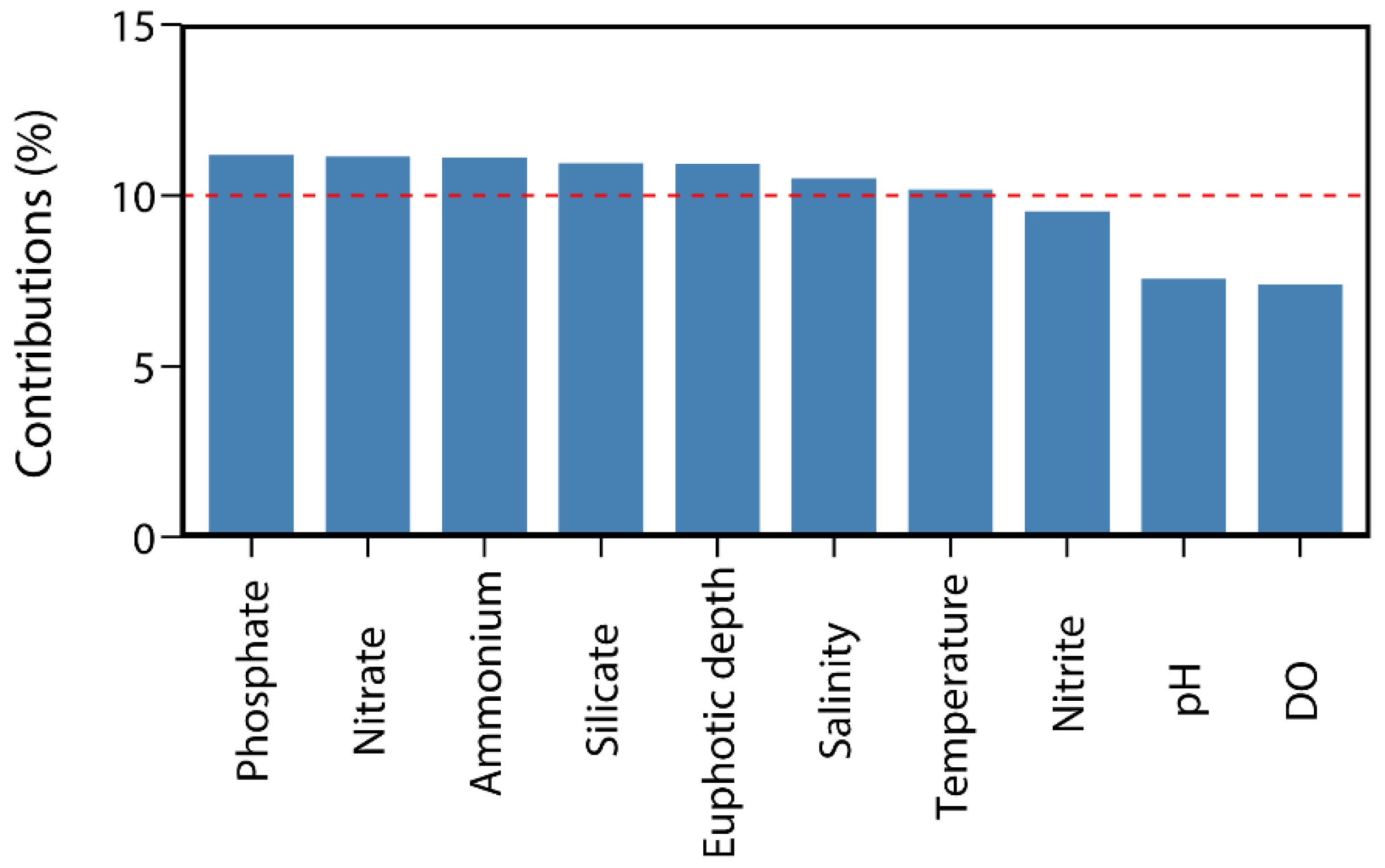
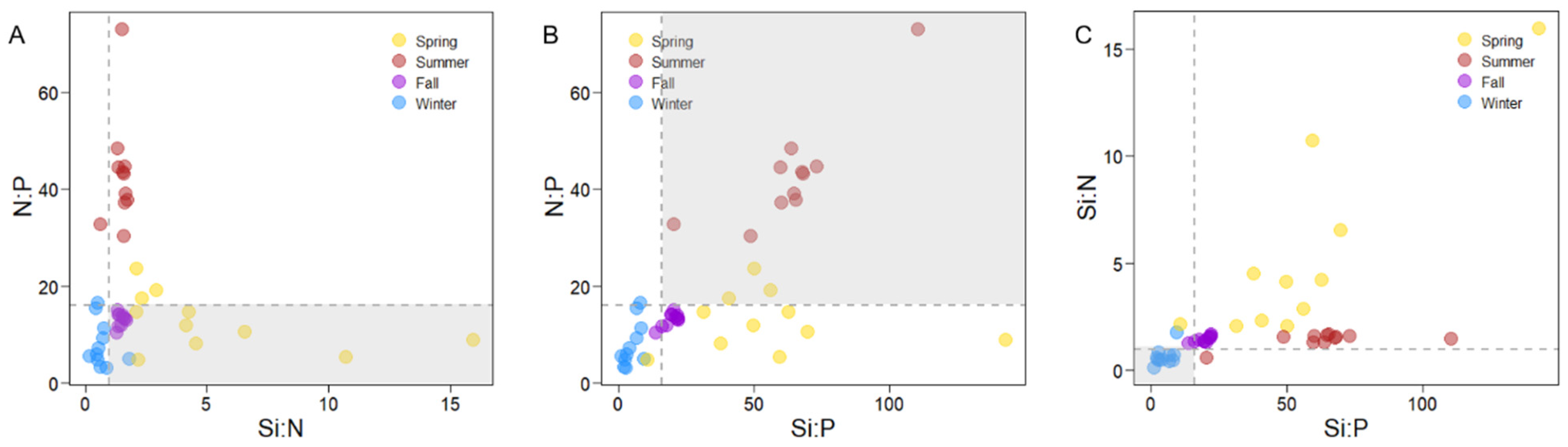
Euphotic depth, in which light penetrates and photosynthesis can occur, was derived from a light extinction coefficient (Kd) as follows: 4.61/Kd [34] after calculating Kd using Secchi depth based on a globally and locally applied equation, Kd = 1.7/Zs, where Zs is the Secchi depth measured using a Secchi disk [17,35]. Stoichiometric limitations were presented through the comparison of three nutrient elements: Redfield-Brzezinski nutrient ratios (N:P:Si = 16:1:16) were utilized to find nutrient limitations by detecting samples falling in the criteria of N:P < 16 and Si:N > 1 for N-limitation, N:P > 16 and Si:P > 16 for P-limitation, and Si:N < 1 and Si:P < 16 for Si-limitation [36]. Analysis of similarities (ANOSIMs) provided a way to test whether there were spatially and seasonally significant differences in pico-, nano-, and microplankton abundance, respectively. A Kruskal–Wallis test was performed to compare the mean of each environmental variable among the four seasons, and the exact p-value was presented. Principal component analysis (PCA) was performed to determine the most influential environmental variables in the Gwangyang Bay environment, and variables with a contribution to the principal components greater than 10% were chosen for the correlation matrix (Figure 2). Correlation coefficients and statistical significance, denoted by the number of asterisks (* = p < 0.05, ** = p < 0.01, *** = p < 0.001), were presented. Polynomial regression models of size-fractionated chl a relative to temperature and ammonium were performed to assess the non-linear or linear relationships between phytoplankton biomass in each group and the two variables. Statistical analyses were executed in R version 3.6.2 (R Foundation for Statistical Computing, Vienna, Austria) using the ‘FactoMineR’ package for the PCA, ‘corrplot’ package for the correlation matrix, ‘vegan’ package for ANOSIM, and ‘lme4’ package for the polynomial regression models. Plots were generated using the package ‘ggplot2’.

3. Results

3.1. Environmental Conditions in the Water Column

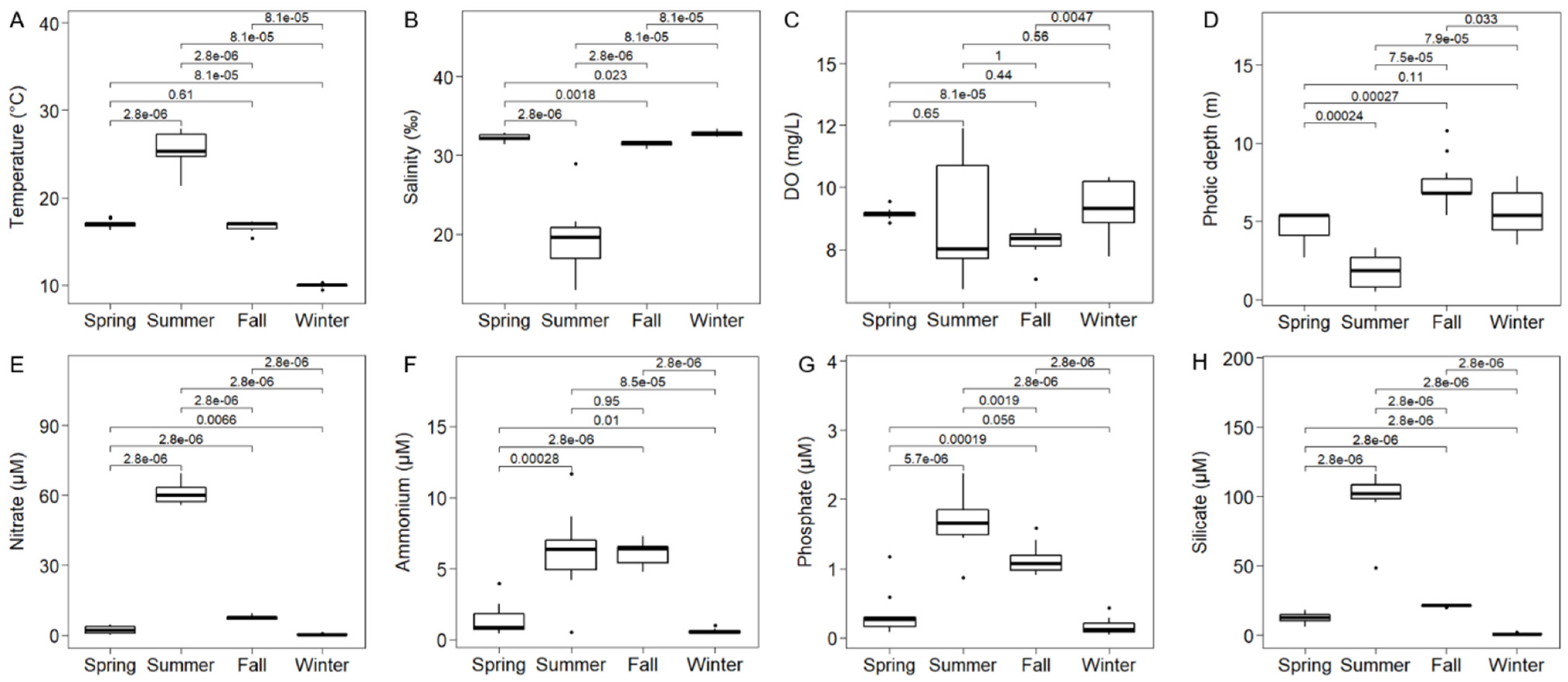
Temperature was significantly higher in the summer and lower in the winter (p < 0.05 for both; Kruskal–Wallis test), while no significant difference was detected between spring and fall (p > 0.05; Kruskal–Wallis test; Figure 3A). Salinity decreased sharply in the summer and remained above 30 ‰ in other seasons (Figure 3B), and DO varied seasonally (p < 0.05; Kruskal–Wallis test; Figure 3C). Euphotic depth declined dramatically to less than 5 m in the summer and remained more than 5 m in the other seasons (Figure 3D).
In summer, dissolved inorganic nutrient levels were significantly higher than those in the other seasons (p < 0.05; Kruskal–Wallis test; Figure 3E–H); however, levels remained low in the spring and winter, except for ammonium and phosphate, which were relatively high in fall at above 5 and 1 µM, respectively (Figure 3F,G). Redfield-Brzezinski nutrient ratios (N:P:Si = 16:1:16) showed N-limitation in the spring, P-limitation mostly in the summer, and Si-limitation in the winter (Figure 4A–C).

3.2. Seasonal Variation in Size-Fractionated Phytoplankton

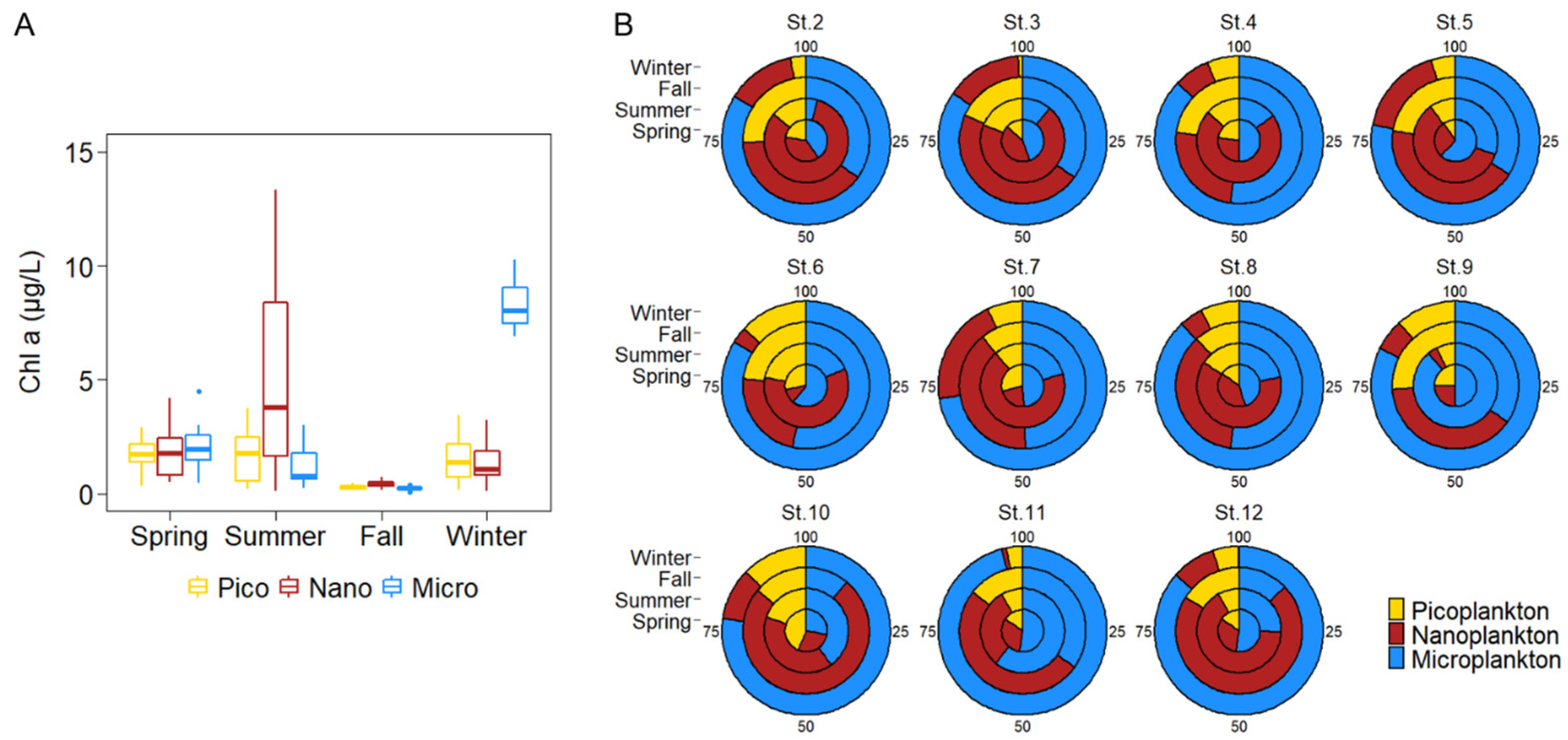
Size-fractionated chl a showed relatively consistent levels among groups in the spring and fall, whereas chl a of nanoplankton (mean of 5.27 µg/L) and microplankton (mean of 8.27 µg/L) was significantly high in the summer and winter, respectively (Figure 5A). Chl a of picoplankton ranged from a mean of 0.29 µg/L in the fall to a mean of 1.76 µg/L in the summer (Figure 5A). The relative abundance of size-fractionated chl a exhibited dominance of nanoplankton (56%) in the summer and microplankton (84%) in the winter (Figure 5B). Interestingly, the dominance of summer nanoplankton was restricted in the inner sites (68% at St. 2–8 and 35% at the outer sites of St. 9–12), whereas the dominance of winter microplankton occurred throughout the study region (82% at the inner sites and 86% at the outer sites). The relative abundance of picoplankton varied from a mean of 7% in the winter to a mean of 22% in the spring, but the relative abundance was fairly and spatially consistent (ANOSIM; p > 0.05; Figure 5B).
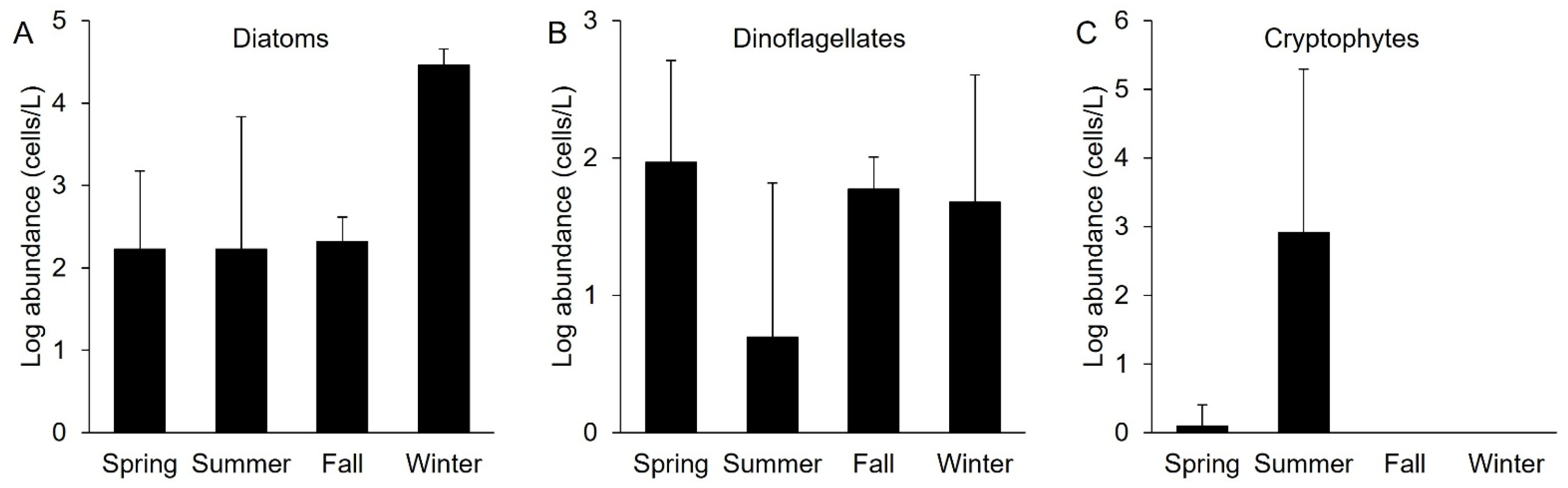
Log abundance (log cells/L) of the major phytoplankton groups was enumerated. The log abundance of diatoms was consistent from spring to fall, with a mean of 2.26 log cells/L, but the level sharply increased in winter to a mean of 4.46 log cells/L (Figure 6A). The log abundance of dinoflagellates stayed lower than 2.00 log cells/L throughout the year (Figure 6B), while the log abundance of cryptophytes sharply increased to a mean of 2.92 log cells/L, and this group was not present in fall and winter (Figure 6C).

3.3. Correlation Between Environmental Variables and Size-Fractionated Phytoplankton

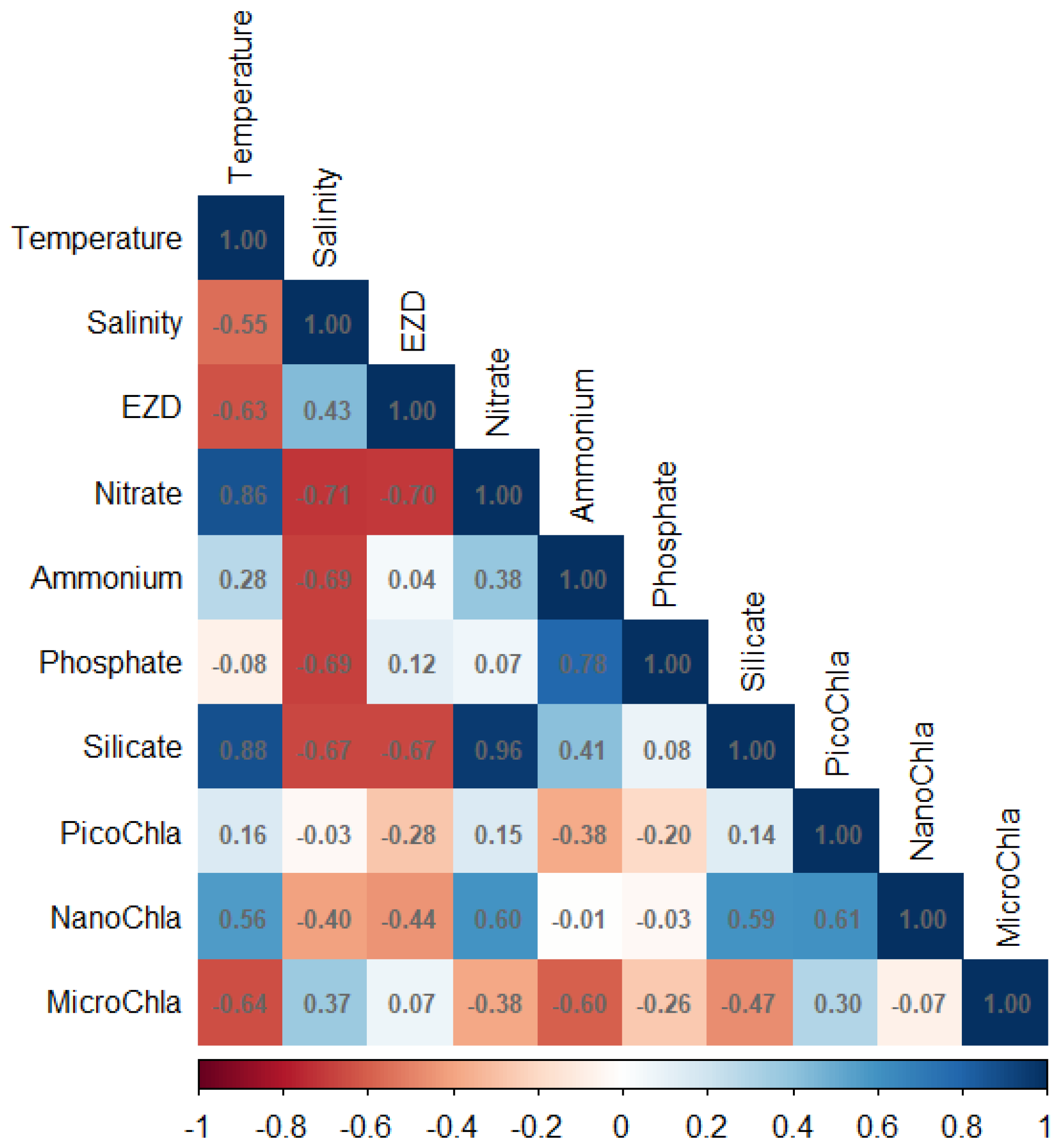
The dynamics of size-fractionated phytoplankton were tightly related to environmental conditions. Temperature had a significantly negative correlation with salinity (correlation coefficient = −0.61; p < 0.001) but showed closely positive correlations with nutrients (Figure 7). Picoplankton was not significantly correlated with physical variables (e.g., temperature and salinity), except for euphotic depth (correlation coefficient = −0.27; p < 0.05), whereas nanoplankton and microplankton were significantly correlated with those parameters. Nanoplankton was strongly and positively correlated with temperature (correlation coefficient = 0.56; p < 0.001) but strongly and negatively correlated with salinity (correlation coefficient = −0.55; p < 0.001), whereas microplankton exhibited the opposite pattern (correlation coefficient with temperature = −0.70 and that with salinity = 0.34; p < 0.001 and p < 0.05, respectively; Figure 7). Nanoplankton was more significantly correlated with euphotic depth than picoplankton (correlation coefficient = −0.44; p < 0.01; Figure 7). The correlation of picoplankton with nutrients was not remarkable, but that of nanoplankton and microplankton was statistically outstanding. Nanoplankton was significantly and positively correlated with nitrate and silicate (correlation coefficient = 0.59 and p < 0.001 for both variables), whereas microplankton was significantly and negatively correlated with all types of dissolved inorganic nutrients (correlation coefficient = −0.69 for ammonium, −0.39 for nitrate, −0.63 for phosphate, and −0.47 for silicate; p < 0.001 for ammonium and phosphate and p < 0.01 for nitrate and silicate; Figure 7).
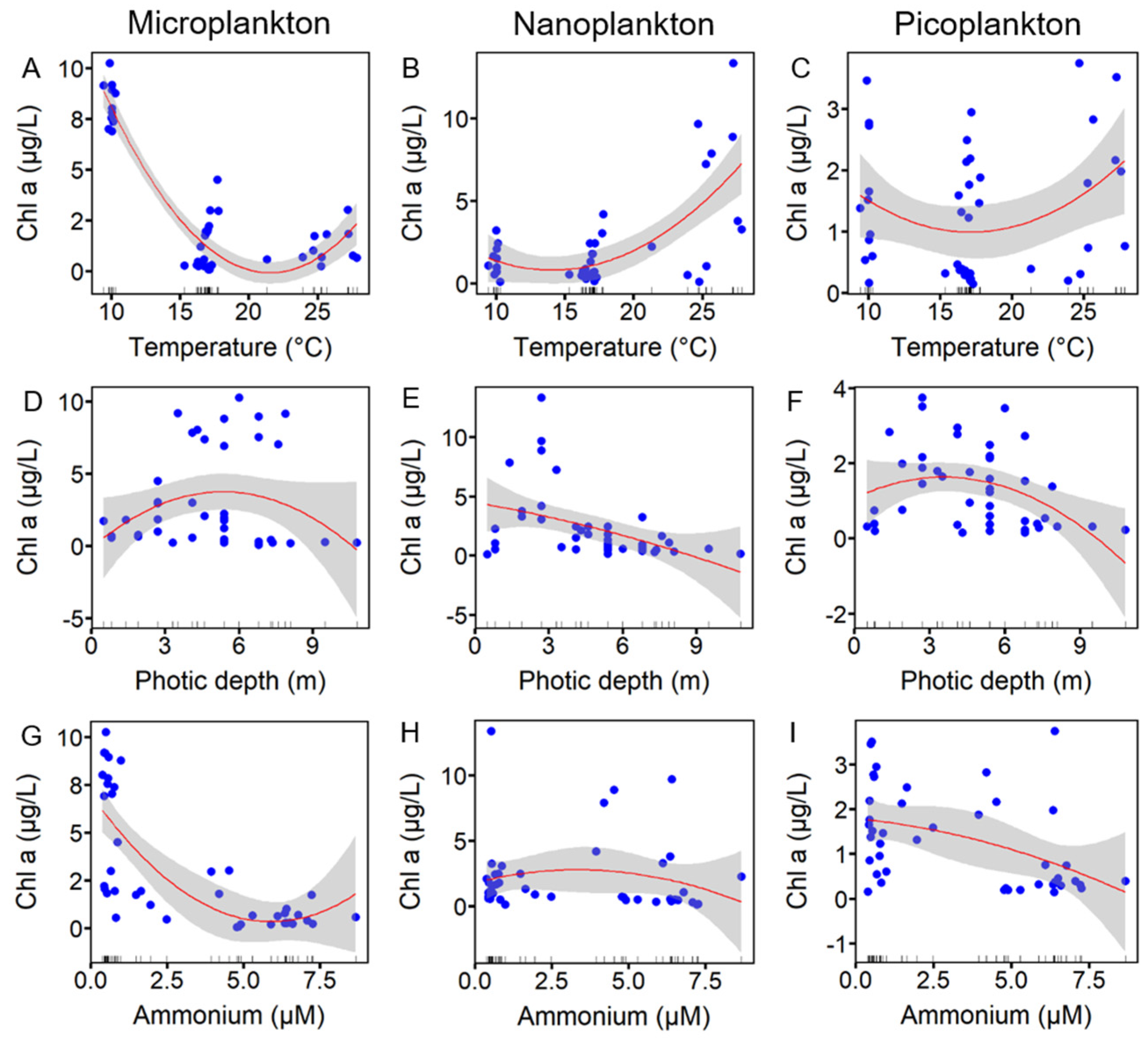
The polynomial regression models showed a sharp decline in microplankton but a substantial increase in nanoplankton and a gradual increase in picoplankton in response to increasing temperature (Figure 8A–C). Although nanoplankton and picoplankton responded negatively to euphotic depth, a slight increase in microplankton was predicted, with a peak at around 6 m of euphotic depth (Figure 8D–F). Microplankton dramatically decreased and picoplankton declined slightly in response to an ammonium increase, but nanoplankton remained relatively stable across the same range of ammonium variation (Figure 8G–I). In May, a total of 20 genera and 32 phytoplankton species were identified, consisting of 17 genera and 29 species of diatoms (91% of the total species), 2 genera and 2 species of dinoflagellates (6%), and 1 genus of cryptophytes (3%; Supplementary Table S1). The genus Chaetoceros (10 species) contributed the most to the assemblage, followed by Pseudo-nitzschia (3 species) and Thalassiosira (2 species) (Supplementary Table S1). In contrast, a greater species diversity was recorded in September, with 41 genera and 70 species observed. These included 27 genera and 50 species of diatoms (72%), 11 genera and 17 species of dinoflagellates (25%), and 1 genus of cryptophytes and euglenoides (1%; Supplementary Table S2). The genus Chaetoceros (13 species) remained dominant, followed by Guinardia (4 species) and Prorocentrum (4 species) (Supplementary Table S2).

4. Discussion

The responses of size-fractionated phytoplankton to temperature and ammonium were investigated to assess the role of important environmental variables in phytoplankton dynamics in Gwangyang Bay. Diatom-dominated microplankton were abundant throughout the study region in winter, during which temperature was low and silicate was limited, whereas cryptophyte-dominated nanoplankton were largely responsible for phytoplankton communities in the summer, during which temperature was high and phosphate was limited. Despite picoplankton abundance remaining moderately stable throughout the year, this group followed the pattern of nanoplankton in response to variations in temperature and ammonium, indicating that picoplankton prefers pursuing a similar ecological niche to that of nanoplankton. Given that deleterious conditions for large phytoplankton growth, such as elevated temperature and ammonium, have been aggravated in Gwangyang Bay [17], nanoplankton and picoplankton will most likely be dominant under ongoing deteriorating environmental conditions.

4.1. Seasonal Variations in Environmental Variables

Temperature and salinity clearly showed seasonal variation in the temperate estuarine ecosystem (Supplementary Figure S1), with significantly high temperatures and low salinity in the summer and significantly low temperatures and relatively high salinity in winter. The dramatic decline in salinity in summer indicates that Seomjin River runoff largely affects the Gwangyang Bay ecosystem. Consistent with our results, the Seomjin River discharges an annual mean of 2.3 × 10⁸ tons of freshwater to Gwangyang Bay [26], and the salinity gradient from Seomjin River to Yeosu Channel is usually attributed to the summer discharge [37].
The positive correlation with temperature and negative correlation with salinity suggest that dissolved inorganic nutrients were largely controlled by Seomjin River runoff, which has a greater impact in the summer [15]. Interestingly, ammonium and phosphate levels stayed high in the fall, indicating that other sources may play an additional role in the ammonium and phosphate supply during the dry season. This region is surrounded by eight major industrial complexes (Supplementary Figure S1 in Kang et al. [17]), and the urban population has been growing for the last few decades around Gwangyang, contributing to the input of industrial waste and domestic wastewater in the bay system [38,39].

4.2. Characteristics of the Nanoplankton Bloom Dominated by Cryptophytes

With an increase in temperature and a decrease in salinity, nanoplankton predominated with mean chl a of 5.27 µg/L in summer. Our polynomial regression models depicted that nanoplankton biomass substantially increased with warming and was relatively stable with elevated ammonium. In contrast, microplankton biomass dramatically decreased with rising temperature and also tended to decrease with increasing ammonium. This suggests that nanoplankton were able to adapt to high temperatures and ammonium, whereas cool waters and low ammonium favored microplankton growth. During the summer bloom, the nanoplankton community was mostly composed of cryptophytes (i.g., Chroomonas sp.; Supplementary Tables S1–S4) and during the winter bloom, the microplankton community was mostly composed of diatoms (i.g., Eucampia zodiacus; Supplementary Tables S1–S4), meaning that Gwangyang bay ecosystems confer primary trophic supporters on almost monospecific phytoplankton communities during bloom seasons.
Cryptophytes can survive in a wide range of salinities, from freshwater to brackish water and to marine water [40,41]. Top-down (i.e., fed by ciliates) and bottom-up (i.e., feed on bacteria) processes can control the bloom of cryptophytes in coastal waters [42,43], while relatively moderate zooplankton grazing rates and a sensitive response to nutrient availability can cause more rapid proliferation of cryptophytes in the inner bay compared to the in outer bay in Gwangyang Bay [16]. Overall, this suggests that cryptophytes are a major player for transferring carbon from prokaryotes to higher eukaryotic groups [44]. For decades, cryptophytes have been detected throughout the year in Gwangyang Bay [14,45]. Although there has been no evidence of bacterivory by cryptophytes in Gwangyang Bay, cryptophyte abundance peaks in summer with temperature elevation, and bacterial abundance is positively correlated with temperature [46], suggesting that bacterivory is likely a potential mechanism for cryptophyte proliferation in this ecosystem during summer [44].
While the distribution of cryptophytes also heavily involves physical conditions such as tides [13] and turbidity [14] in this ecosystem, the negative correlation with euphotic depth was another mechanism triggering the summer bloom. Barone and Naselli-Flores [47] illustrated that cryptophyte growth can be enhanced under adverse conditions, in which high turbidity drives low light penetration. A previous long-term study showed that a reduction in river discharge declined the loading and dilution of suspended particles and caused progressive light attenuation in the study region [17]. Concomitantly, this study clearly showed that the cryptophyte bloom peaked when shallow euphotic depth prevailed.
Unlike other phytoplankton groups, such as diatoms whose nitrate uptake is inhibited by high levels of ammonium (usually ammonium > 4 µM) [48], the ability of cryptophytes to endure high ammonium levels is usually linked to cryptophyte blooms in coastal waters where anthropogenic eutrophication is problematic [49]. Our polynomial regression models revealed that any level of ammonium did not significantly affect nanoplankton biomass, indicating that the nutrient status in Gwangyang Bay will favor the growth of cryptophytes. In addition, the Redfield ratio profoundly exhibited excessive P-limitation in the summer, indicating that cryptophytes strongly require phosphate to form blooms or that mixotrophy (i.e., switching from utilizing dissolved nutrients to feeding on bacteria) may be an alternative means of obtaining the required phosphate. Our observations were congruent with those of Bazin et al. [50], who showed that high levels of phosphate determine a shift to cryptophyte blooms along the fresh-to-saline continuum of the Segura River in Spain, and with those of Šupraha et al. [49], who reported that elevated phosphate supports cryptophyte blooms in the Krka River estuary in the Mediterranean Sea. Salonen and Jokinen [51] also described that cryptophytes efficiently shift from autotrophy to phagotrophy upon severe nutrient limitation.

4.3. Characteristics of the Microplankton Bloom Dominated by Diatoms

Loosening light limitation and decreasing temperatures in the winter led to microplankton predominating throughout the study region, comprising 84% of the total phytoplankton biomass with a range from 73% to 96%. Polynomial regression models showed that microplankton sharply declined in response to temperature elevation but slightly increased with euphotic depth, with the maximum biomass at a depth of 6 m, which indicates that cooler temperatures and increased light availability can favor diatom dominance in this ecosystem. In accordance with our results, a gradual shift in diatom blooms to the winter was proposed in the southern coastal waters of Korea because the ongoing rise in water temperatures with climate change will shift the optimal temperature range to the winter, while small phytoplankton will more likely take over the open niche [52].
The winter bloom was predominated by a chain-forming diatom, Eucampia zodiacus, whose abundance is negatively correlated with temperature in the southern coastal waters of Korea [53]. This cosmopolitan species is found throughout the year in temperate coastal waters, indicating that vegetative cells are present at the background level even under unfavorable conditions [54], and the blooms occur at relatively low temperatures in coastal waters [15,55]. In agreement with our polynomial regression model results that showed a positive response of microplankton to euphotic depth up to 6 m depth, Ito et al. [56] revealed that Eucampia zodiacus blooms initiate due to expanded light availability when euphotic depth reaches the bottom layer.
The severity of N-limitation gradually decreased throughout the year, except in summer when sufficient nutrients were supplied via Seomjin River runoff. True N-limitation was maximum in the spring and moderate in the fall, while nitrogen was relatively limited in the winter. Together with N-limitation, Si was extremely limited in winter, potentially indicating the combination of substantial consumption of silicate by Eucampia zodiacus during bloom formation and a decreased supply of silicate via river runoff during the dry season. The restricted contribution of river discharge in the winter was also disclosed in the correlation matrix, which confirmed significantly positive correlations of nitrogen and silicate with temperature but significantly negative correlations with salinity. Considering that the levels of dissolved nutrients exceeded the nutrient deficiency (dissolved inorganic nitrogen = 1 µM, dissolved inorganic phosphorus = 0.2 µM, silicate = 2 µM) [57], nutrient limitation might determine the bloom duration rather than the cell growth.

4.4. Predictable Change in the Dominant Phytoplankton Group in Gwangyang Bay

It is well reported that large phytoplankton primarily dominate in estuarine ecosystems due to the advantage of utilizing enriched nutrients and experiencing less grazing effect by zooplankton [6]. In estuarine ecosystems, physical factors such as tidal dispersion can control the spatial distribution of phytoplankton blooms [58,59], while nutrient availability and water quality can temporally regulate bloom dynamics [34,60,61,62]. In Gwangyang Bay, reduced input from Seomjin River after the Juam Dam construction and anthropogenic activities such as dredging and reclamation have driven an increased influence of nutrients originating from industrial complexes or urban wastewater [63], and have led to increased transformation toward finer sediments, respectively [64]. Given that nanoplankton dominated under conditions of euphotic depth shoals and that elevated ammonium did not significantly impact the nanoplankton bloom, the role of nanoplankton in ecosystem dynamics will increase with the ongoing variation. In addition, picoplankton biomass remained comparatively stable throughout the year, indicating that the seed population of picoplankton is consistently present and that picoplankton blooms may readily occur in response to environmental variation.
Considering that small phytoplankton biomass (nanoplankton and picoplankton) increased in response to rising temperature, as shown in the polynomial regression models, and the active coastal warming underway around the Korean peninsula [65] and worldwide [66], the synergistic effects of decreased water quality and increased temperatures will accelerate changes in the phytoplankton community and distribution. Particularly, enhanced functioning of Synechococcus is expected in Gwangyang Bay [67], and PE cyanobacteria, which are typically confined to high salinity waters, can potentially expand their spatial distribution within Gwangyang Bay [68]. A consequential influence on estuarine food webs and biogeochemical cycles is anticipated. However, the impacts of anthropogenically induced climate change on the estuarine ecosystem have not been examined in depth; thus, further investigation into the responses of the Gwangyang Bay phytoplankton community to future climate change is required.

5. Conclusions

This study elucidated the size-fractionated responses of phytoplankton communities to key environmental variables in Gwangyang Bay, highlighting temperature, euphotic depth, and ammonium as major determinants of seasonal dynamics. The results revealed a clear seasonal shift between cryptophyte-dominated nanoplankton blooms in summer and diatom-dominated microplankton blooms in winter. Nanoplankton thrived under high temperatures, low salinity, and shallow euphotic depth, whereas microplankton favored cooler and more illuminated conditions. The analysis demonstrated that ongoing eutrophication, reduced light penetration, and elevated ammonium levels are progressively creating conditions unfavorable for large phytoplankton growth while favoring small phytoplankton dominance. In particular, cryptophytes appeared tolerant of high ammonium and limited phosphate, suggesting their adaptive advantage under anthropogenically influenced conditions. With the continuing trend of coastal warming and declining water quality, small phytoplankton such as nanoplankton and picoplankton are expected to play increasingly central roles in primary production and nutrient cycling in Gwangyang Bay. Overall, this study underscores the importance of size-structured approaches in understanding estuarine phytoplankton ecology and provides crucial insight into how future climatic and anthropogenic stressors may reshape community composition and ecosystem function. Continued long-term monitoring and experimental investigations are necessary to predict and manage the trajectory of phytoplankton dynamics under changing environmental conditions in estuarine systems.

Supplementary Materials

The following supporting information can be downloaded at: https://www.mdpi.com/article/10.3390/jmse13122298/s1, Figure S1: Result from principal component analysis showing the relationship among environmental variables and contribution of environmental variables to the study region; Tables S1–S4: Seasonal species composition of phytoplankton community identified using a light miscroscope (cells/L).

Author Contributions

Writing—original draft preparation and data analysis, E.L.; writing—original draft preparation and data analysis, C.-W.K.; writing—review and editing, C.-K.K.; investigation and funding acquisition, C.S.K.; investigation and funding acquisition, J.L.; writing—review and editing and supervision, Y.K. All authors have read and agreed to the published version of the manuscript.

Funding

This research was supported by National Institute of Fisheries and Science (NIFS; 2025025).

Data Availability Statement

The raw data supporting the conclusions of this article will be made available by the authors on request.

Acknowledgments

We appreciate researchers and students who assisted with the sampling data analysis.

Conflicts of Interest

The authors declare that they have no known competing financial interests or personal relationships that could have appeared to influence the work reported in this paper.

References

  1. Da, J.W., Jr.; Kemp, W.M.; Yáñez-Arancibia, A.; Crump, B.C. Estuarine Ecology; John Wiley & Sons: Hoboken, NJ, USA, 2012. [Google Scholar]
  2. Cloern, J.E.; Foster, S.; Kleckner, A. Phytoplankton primary production in the world’s estuarine-coastal ecosystems. Biogeosciences 2014, 11, 2477. [Google Scholar] [CrossRef]
  3. Smayda, T.J. What is a bloom? A commentary. Limnol. Oceanogr. 1997, 42, 1132–1136. [Google Scholar] [CrossRef]
  4. Smayda, T.J. Adaptive ecology, growth strategies and the global bloom expansion of dinoflagellates. J. Oceanogr. 2002, 58, 281–294. [Google Scholar] [CrossRef]
  5. Smayda, T.J. Complexity in the eutrophication-harmful algal bloom relationship, with comment on the importance of grazing. Harmful Algae 2008, 8, 140–151. [Google Scholar] [CrossRef]
  6. Cloern, J.E. Why large cells dominate estuarine phytoplankton. Limnol. Oceanogr. 2018, 63, S392–S409. [Google Scholar] [CrossRef]
  7. Gaulke, A.K.; Wetz, M.S.; Paerl, H.W. Picophytoplankton: A major contributor to planktonic biomass and primary production in a eutrophic, river-dominated estuary. Estuar. Coast. Shelf Sci. 2010, 90, 45–54. [Google Scholar] [CrossRef]
  8. Worden, A.Z.; Nolan, J.K.; Palenik, B. Assessing the dynamics and ecology of marine picophytoplankton: The importance of the eukaryotic component. Limnol. Oceanogr. 2004, 49, 168–179. [Google Scholar] [CrossRef]
  9. Wu, W.; Huang, B.; Zhong, C. Photosynthetic picoeukaryote assemblages in the South China Sea from the Pearl River estuary to the SEATS station. Aquat. Microb. Ecol. 2014, 71, 271–284. [Google Scholar] [CrossRef]
  10. McCarthy, J.; Taylor, W.R.; Loftus, M. Significance of nanoplankton in the Chesapeake Bay estuary and problems associated with the measurement of nanoplankton productivity. Mar. Biol. 1974, 24, 7–16. [Google Scholar] [CrossRef]
  11. Pan, L.; Zhang, J.; Zhang, L. Picophytoplankton, nanophytoplankton, heterotrohpic bacteria and viruses in the Changjiang Estuary and adjacent coastal waters. J. Plankton Res. 2007, 29, 187–197. [Google Scholar] [CrossRef]
  12. Kim, Y.; Lee, J.H.; Kang, J.J.; Lee, J.H.; Lee, H.W.; Kang, C.K.; Lee, S.H. River discharge effects on the contribution of small-sized phytoplankton to the total biochemical composition of POM in the Gwangyang Bay, Korea. Estuar. Coast. Shelf Sci. 2019, 226, 106293. [Google Scholar] [CrossRef]
  13. Lee, M.; Park, B.S.; Baek, S.H. Tidal influences on biotic and abiotic factors in the Seomjin River Estuary and Gwangyang Bay, Korea. Estuaries Coasts 2018, 41, 1977–1993. [Google Scholar] [CrossRef]
  14. Bae, S.W.; Kim, D.; Kim, Y.O.; Moon, C.H.; Baek, S.H. The influences of additional nutrients on phytoplankton growth and horizontal phytoplankton community distribution during the autumn season in Gwangyang Bay, Korea. Korean J. Environ. Biol. 2014, 32, 35–48. [Google Scholar] [CrossRef]
  15. Baek, S.-H.; Kim, D.; Son, M.; Yun, S.-M.; Kim, Y.-O. Seasonal distribution of phytoplankton assemblages and nutrient-enriched bioassays as indicators of nutrient limitation of phytoplankton growth in Gwangyang Bay, Korea. Estuar. Coast. Shelf Sci. 2015, 163, 265–278. [Google Scholar] [CrossRef]
  16. Kang, Y.; Oh, Y. Different roles of top-down and bottom-up processes in the distribution of size-fractionated phytoplankton in Gwangyang Bay. Water 2021, 13, 1682. [Google Scholar] [CrossRef]
  17. Kang, Y.; Kang, Y.-H.; Kim, J.-K.; Kang, H.Y.; Kang, C.-K. Year-to-year variation in phytoplankton biomass in an anthropogenically polluted and complex estuary: A novel paradigm for river discharge influence. Mar. Pollut. Bull. 2020, 161, 111756. [Google Scholar] [CrossRef]
  18. Bender, S.J.; Durkin, C.A.; Berthiaume, C.T.; Morales, R.L.; Armbrust, E.V. Transcriptional responses of three model diatoms to nitrate limitation of growth. Front. Mar. Sci. 2014, 1, 3. [Google Scholar] [CrossRef]
  19. Kolber, Z.; Zehr, J.; Falkowski, P. Effects of growth irradiance and nitrogen limitation on photosynthetic energy conversion in photosystem II. Plant Physiol. 1988, 88, 923–929. [Google Scholar] [CrossRef]
  20. Metzler, P.M.; Glibert, P.M.; Gaeta, S.A.; Ludlam, J.M. New and regenerated production in the South Atlantic off Brazil. Deep Sea Res. Part I Oceanogr. Res. Pap. 1997, 44, 363–384. [Google Scholar] [CrossRef]
  21. Harrison, W.G.; Wood, L.J.E. Inorganic nitrogen uptake by marine picoplankton: Evidence for size partitioning. Limnol. Oceanogr. 1988, 33, 468–475. [Google Scholar] [CrossRef]
  22. Feng, Y.; Chai, F.; Wells, M.L.; Liao, Y.; Li, P.; Cai, T.; Zhao, T.; Fu, F.; Hutchins, D.A. The combined effects of increased pCO2 and warming on a coastal phytoplankton assemblage: From species composition to sinking rate. Front. Mar. Sci. 2021, 8, 274. [Google Scholar] [CrossRef]
  23. Min, H.-S.; Kim, C.-H. Interannual variability and long-term trend of coastal sea surface temperature in Korea. Ocean Polar Res. 2006, 28, 415–423. [Google Scholar] [CrossRef]
  24. Kim, T.-W.; Lee, K.; Park, K.-T.; Kim, M. Sulfur hexafluoride as a complementary method for measuring the extent of point-source thermal effluents. Mar. Pollut. Bull. 2008, 56, 1294–1302. [Google Scholar] [CrossRef]
  25. Kim, J.-K.; Kwak, K.-I.; Kim, M.-W. Diffusion characteristic of surface thermal effluents in Gwangyang Bay. J. Korean Soc. Mar. Environ. Energy 2006, 44–51. [Google Scholar]
  26. Kim, J.-H.; Lee, I.-C.; Kong, H.-H.; Ok, K. Seasonal Variation of Inflowing Pollutant Loads and Water Quality in Gwangyang Bay. In Conference Proceedings of The Korean Society for Marine Environment & Energy. pp. 82–87. Available online: https://www.dbpia.co.kr/pdf/pdfView.do?nodeId=NODE01012090&width=1920 (accessed on 1 December 2025).
  27. Kim, H.-J.; Yeong Park, J.; Ho Son, M.; Moon, C.-H. Long-Term Variations of Phytoplankton Community in Coastal Waters of Kyoungju city Area. Korea Soc. Fish. Mar. Sci. Educ. 2016, 28, 1417–1434. [Google Scholar] [CrossRef]
  28. Welschmeyer, N.A. Fluorometric analysis of chlorophyll-a in the presence of chlorophyll-b and pheopigments. Limnol. Oceanogr. 1994, 39, 1985–1992. [Google Scholar] [CrossRef]
  29. Montagnes, D.J.S.; Berges, J.A.; Harrison, P.J.; Taylor, F.J.R. Estimating carbon, nitrogen, protein, and chlorophyll a from volum in marine phytoplankton. Limnol. Oceanogr. 1994, 39, 1044–1060. [Google Scholar] [CrossRef]
  30. Gobler, C.J.; Koch, F.; Kang, Y.; Berry, D.L.; Tang, Y.Z.; Lasi, M.; Walters, L.; Hall, L.; Miller, J.D. Expansion of harmful brown tides caused by the pelagophyte, Aureoumbra lagunensis DeYoe et Stockwell, to the US East Coast. Harmful Algae 2013, 27, 29–41. [Google Scholar] [CrossRef]
  31. Jones, M.N. Nitrate reduction by shaking with cadmium—Alternative to cadmium columns. Water Res. 1984, 18, 643–646. [Google Scholar] [CrossRef]
  32. Parsons, T.R.; Maita, Y.; Lalli, C.M. A Manual of Chemical and Biological Methods for Seawater Analysis; Pergamon: Oxford, UK, 1984. [Google Scholar] [CrossRef]
  33. Price, N.; Harrison, P. Comparison of methods for the analysis of dissolved urea in seawater. Mar. Biol. 1987, 94, 307–317. [Google Scholar] [CrossRef]
  34. Cloern, J.E. Turbidity as a control on phytoplankton biomass and productivity in estuaries. Cont. Shelf Res. 1987, 7, 1367–1381. [Google Scholar] [CrossRef]
  35. Poole, H.; Atkins, W. Photo-electric measurements of submarine illumination throughout the year. J. Mar. Biol. Assoc. United Kingd. 1929, 16, 297–324. [Google Scholar] [CrossRef]
  36. Brzezinski, M.A. The Si:C:N ratio of marine diatoms: Interspecific variability and the effect of some environmental variables. J. Phycol. 1985, 21, 347–357. [Google Scholar] [CrossRef]
  37. Kwon, K.-Y.; Moon, C.-H.; Kang, C.-K.; Kim, Y.-N. Distribution of particulate organic matters along the salinity gradients in the Seomjin River estuary. J. Korean Fish. Aquat. Sci. 2002, 35, 86–96. [Google Scholar]
  38. Kim, D.I.; Park, C.K.; Cho, H.S. Ecological modeling for water quality management of Kwangyang Bay, Korea. J. Environ. Manag. 2005, 74, 327–337. [Google Scholar] [CrossRef] [PubMed]
  39. Lee, D.I.; Cho, H.S.; Cho, C.R.; Lee, J.H.; Kang, J.H.; Choi, M.H.; Kim, D.H.; Yoon, J.S. Pollution Sources and Temporal Variations of Pollutant Loads in Kwangyang Bay Watershed. In Conference Proceedings of The Korean Society for Marine Environment & Energy. pp. 201–208. Available online: https://www.dbpia.co.kr/pdf/pdfView.do?nodeId=NODE00856534&width=1920 (accessed on 1 December 2025).
  40. Clay, B.L.; Kugrens, P.; Lee, R.E. A revised classification of Cryptophyta. Bot. J. Linn. Soc. 1999, 131, 131–151. [Google Scholar] [CrossRef]
  41. Klaveness, D. Biology and ecology of the Cryptophyceae: Status and challenges. Biol. Oceanogr. 1989, 6, 257–270. [Google Scholar]
  42. Johnson, M.D.; Beaudoin, D.J.; Frada, M.J.; Brownlee, E.F.; Stoecker, D.K. High grazing rates on cryptophyte algae in Chesapeake Bay. Front. Mar. Sci. 2018, 5, 241. [Google Scholar] [CrossRef]
  43. Yoo, Y.D.; Seong, K.A.; Jeong, H.J.; Yih, W.; Rho, J.-R.; Nam, S.W.; Kim, H.S. Mixotrophy in the marine red-tide cryptophyte Teleaulax amphioxeia and ingestion and grazing impact of cryptophytes on natural populations of bacteria in Korean coastal waters. Harmful Algae 2017, 68, 105–117. [Google Scholar] [CrossRef]
  44. Grujcic, V.; Nuy, J.K.; Salcher, M.M.; Shabarova, T.; Kasalicky, V.; Boenigk, J.; Jensen, M.; Simek, K. Cryptophyta as major bacterivores in freshwater summer plankton. ISME J. 2018, 12, 1668–1681. [Google Scholar] [CrossRef]
  45. Shim, J.H.; Shin, Y.K.; Lee, W.H. On the phyroplankton distribution in the Kwangyang Bay. J. Korean Soc. Oceanogr. 1984, 19, 176–186. [Google Scholar]
  46. Shiah, F.-K.; Ducklow, H.W. Temperature and substrate regulation of bacterial abundance, production and specific growth rate in Chesapeake Bay, USA. Mar. Ecol. Prog. Ser. 1994, 103, 297. [Google Scholar] [CrossRef]
  47. Barone, R.; Naselli-Flores, L. Distribution and seasonal dynamics of Cryptomonads in Sicilian water bodies. Hydrobiologia 2003, 502, 325–329. [Google Scholar] [CrossRef]
  48. Dugdale, R.; Wilkerson, F.; Parker, A.E.; Marchi, A.; Taberski, K. River flow and ammonium discharge determine spring phytoplankton blooms in an urbanized estuary. Estuar. Coast. Shelf Sci. 2012, 115, 187–199. [Google Scholar] [CrossRef]
  49. Šupraha, L.; Bosak, S.; Ljubešić, Z.; Mihanović, H.; Olujić, G.; Mikac, I.; Viličić, D. Cryptophyte bloom in a Mediterranean estuary: High abundance of Plagioselmis cf. prolonga in the Krka River estuary (eastern Adriatic Sea). Sci. Mar. 2014, 78, 329–338. [Google Scholar]
  50. Bazin, P.; Jouenne, F.; Deton-Cabanillas, A.-F.; Pérez-Ruzafa, Á.; Véron, B. Complex patterns in phytoplankton and microeukaryote diversity along the estuarine continuum. Hydrobiologia 2014, 726, 155–178. [Google Scholar] [CrossRef]
  51. Salonen, K.; Jokinen, S. Flagellate grazing on bacteria in a small dystrophic lake. In Flagellates in Freshwater Ecosystems; Springer: Berlin/Heidelberg, Germany, 1988; pp. 203–209. [Google Scholar]
  52. Kang, Y.; Kang, H.-Y.; Kim, D.; Lee, Y.-J.; Kim, T.-I.; Kang, C.-K. Temperature-dependent bifurcated seasonal shift of phytoplankton community composition in the coastal water off southwestern Korea. Ocean Sci. J. 2019, 54, 467–486. [Google Scholar] [CrossRef]
  53. Baek, S.H.; Lee, M.; Park, B.S.; Lim, Y.K. Variation in phytoplankton community due to an autumn typhoon and winter water turbulence in southern Korean coastal waters. Sustainability 2020, 12, 2781. [Google Scholar] [CrossRef]
  54. Nishikawa, T.; Hori, Y.; Nagai, S.; Miyahara, K.; Nakamura, Y.; Harada, K.; Tada, K.; Imai, I. Long time-series observations in population dynamics of the harmful diatom Eucampia zodiacus and environmental factors in Harima-Nada, eastern Seto Inland Sea, Japan during 1974–2008. Plankton Benthos Res. 2011, 6, 26–34. [Google Scholar] [CrossRef]
  55. Nishikawa, T.; Yamaguchi, M. Effect of temperature on light-limited growth of the harmful diatom Eucampia zodiacus Ehrenberg, a causative organism in the discoloration of Porphyra thalli. Harmful Algae 2006, 5, 141–147. [Google Scholar] [CrossRef]
  56. Ito, Y.; Katano, T.; Fujii, N.; Koriyama, M.; Yoshino, K.; Hayami, Y. Decreases in turbidity during neap tides initiate late winter blooms of Eucampia zodiacus in a macrotidal embayment. J. Oceanogr. 2013, 69, 467–479. [Google Scholar] [CrossRef]
  57. Dortch, Q.; Whitledge, T.E. Does nitrogen or silicon limit phytoplankton production in the Mississippi River plume and nearby regions? Cont. Shelf Res. 1992, 12, 1293–1309. [Google Scholar] [CrossRef]
  58. Cloern, J.E. Tidal stirring and phytoplankton bloom dynamics in an estuary. J. Mar. Res. 1991, 49, 203–221. [Google Scholar] [CrossRef]
  59. Dijkstra, Y.M.; Chant, R.J.; Reinfelder, J.R. Factors Controlling Seasonal Phytoplankton Dynamics in the Delaware River Estuary: An Idealized Model Study. Estuaries Coasts 2019, 42, 1839–1857. [Google Scholar] [CrossRef]
  60. Glibert, P.M.; Wilkerson, F.P.; Dugdale, R.C.; Raven, J.A.; Dupont, C.L.; Leavitt, P.R.; Parker, A.E.; Burkholder, J.M.; Kana, T.M. Pluses and minuses of ammonium and nitrate uptake and assimilation by phytoplankton and implications for productivity and community composition, with emphasis on nitrogen-enriched conditions. Limnol. Oceanogr. 2016, 61, 165–197. [Google Scholar] [CrossRef]
  61. Parker, A.E.; Dugdale, R.C.; Wilkerson, F.P. Elevated ammonium concentrations from wastewater discharge depress primary productivity in the Sacramento River and the Northern San Francisco Estuary. Mar. Pollut. Bull. 2012, 64, 574–586. [Google Scholar] [CrossRef] [PubMed]
  62. Spetter, C.V.; Popovich, C.A.; Arias, A.; Asteasuain, R.O.; Freije, R.H.; Marcovecchio, J.E. Role of nutrients in phytoplankton development during a winter diatom bloom in a eutrophic South American estuary (Bahía Blanca, Argentina). J. Coast. Res. 2015, 31, 76–87. [Google Scholar] [CrossRef]
  63. Lee, Y.-S.; Kang, C.-K.; Choi, Y.-K.; Lee, S.-Y. Origin and spatial distribution of organic matter at Gwangyang Bay in the Fall. J. Korean Soc. Oceanogr. 2007, 12, 1–8. [Google Scholar]
  64. Kim, S.-J.; Lee, H.-I.; Kim, D.-C.; Shin, I.-C. Changes in sedimentary process by POSCO’s dredging and reclaming in the Kwangyang Bay. In Conference Proceedings of Journal of the Korean Society for Marine Environmental Engineering 2000. pp. 61–65. Available online: https://www.dbpia.co.kr/pdf/pdfView.do?nodeId=NODE00850729&width=1920 (accessed on 1 December 2025).
  65. Hyun, J.-H.; Choi, K.-S.; Lee, K.-S.; Lee, S.H.; Kim, Y.K.; Kang, C.-K. Climate Change and Anthropogenic Impact Around the Korean Coastal Ecosystems: Korean Long-term Marine Ecological Research (K-LTMER). Estuaries Coasts 2020, 43, 441–448. [Google Scholar] [CrossRef]
  66. Harley, C.D.G.; Randall Hughes, A.; Hultgren, K.M.; Miner, B.G.; Sorte, C.J.B.; Thornber, C.S.; Rodriguez, L.F.; Tomanek, L.; Williams, S.L. The impacts of climate change in coastal marine systems. Ecol. Lett. 2006, 9, 228–241. [Google Scholar] [CrossRef]
  67. Kim, Y.; Jeon, J.; Kwak, M.S.; Kim, G.H.; Koh, I.; Rho, M. Photosynthetic functions of Synechococcus in the ocean microbiomes of diverse salinity and seasons. PLoS ONE 2018, 13, e0190266. [Google Scholar] [CrossRef]
  68. Xia, X.; Lee, P.; Cheung, S.; Lu, Y.; Liu, H. Discovery of Euryhaline Phycoerythrobilin-Containing Synechococcus and Its Mechanisms for Adaptation to Estuarine Environments. mSystems 2020, 5, e00842-20. [Google Scholar] [CrossRef]
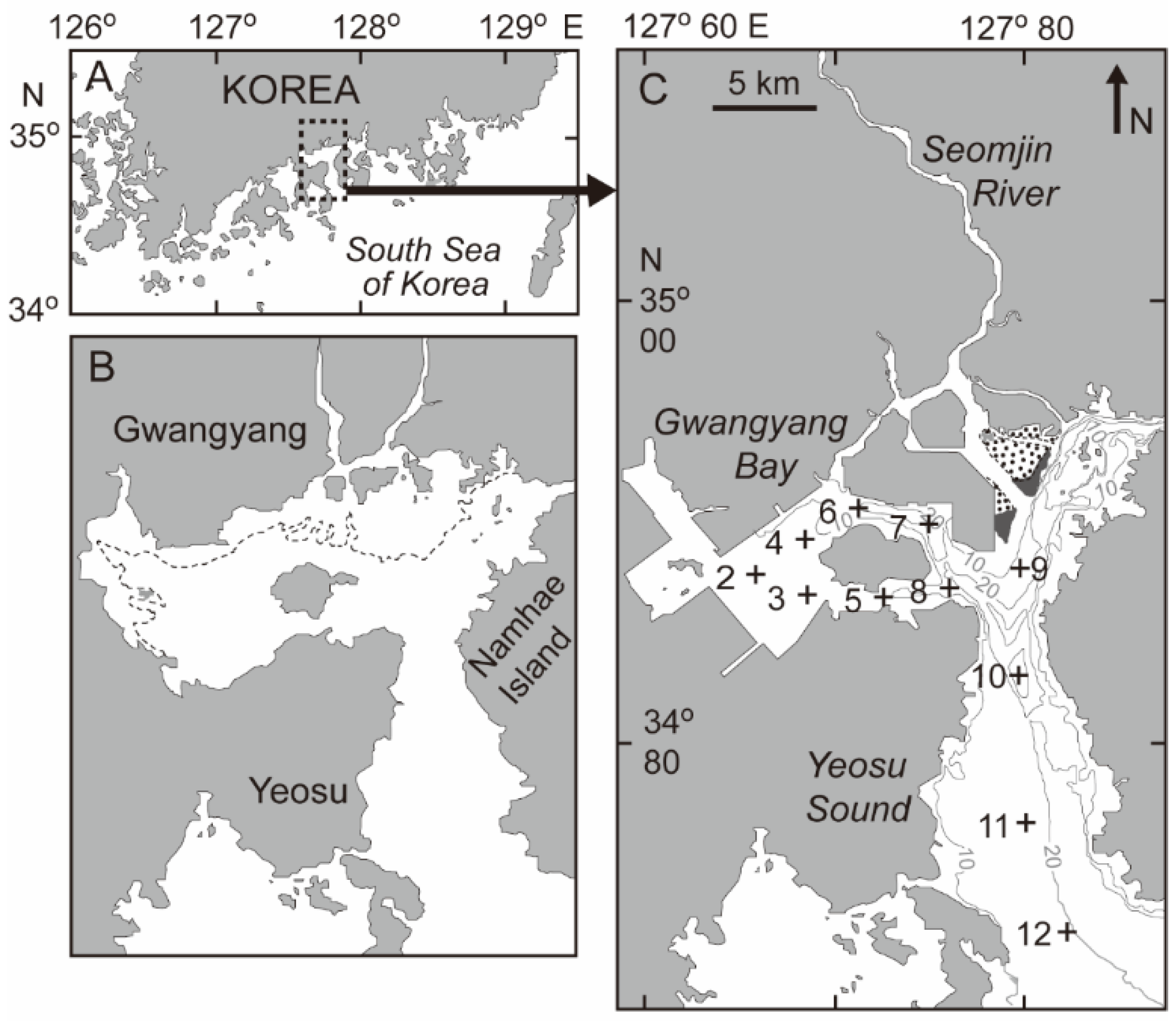
Figure 1. Map showing (A) the location of Gwangyang Bay, (B) the geomorphology of the bay before the reclamation of tidal flat in 1982 and the broken line denotes the lowest water line, and the (C) sampling stations from Gwangyang Bay to Yeosu Channel.
Jmse 13 02298 g001
Figure 2. Principal component analysis (PCA) contribution (%) using the environmental variables. Variables contributing more than 10% were selected for subsequent correlation analysis. The red dashed line represents the significant threshold. PCA results are presented in Supplementary Figure S1.
Jmse 13 02298 g002
Figure 3. Physical and chemical variables during the sampling periods. (A) Temperature (°C), (B) salinity (‰), (C) dissolved oxygen (DO; mg/L), (D) euphotic depth (m), (E) NO3− (µM), (F) NH4+ (µM), (G) PO43− (µM), and (H) Si(OH)4 (µM). A Kruskal–Wallis test was performed to compare the mean of the environmental variables among four seasons.
Jmse 13 02298 g003
Figure 4. Redfield-Brzezinski nutrient ratios (N:P:Si = 16:1:16) showing the nutrient limitation. (A) Si:N vs. N:P showing the N-limitation, (B) Si:P vs. N:P showing the P-limitation, and (C) Si:P vs. Si:N showing the Si-limitation. Gray shading indicates the nutrient limitation of each nutrient compound.
Jmse 13 02298 g004
Figure 5. Size-fractionated chlorophyll a (chl a; µg/L) and the relative abundance of size-fractionated phytoplankton based on carbon content during the sampling periods. (A) Size-fractionated chl a of all stations, and (B) the proportion of carbon content of each phytoplankton size.
Jmse 13 02298 g005
Figure 6. Log abundance (log cells/L) of the major phytoplankton groups in Gwangyang Bay during the sampling periods: (A) diatoms, (B) dinoflagellates, and (C) cryptophytes.
Jmse 13 02298 g006
Figure 7. Correlation matrix of environmental variables and size-fractionated chl a. Environmental variables include temperature, salinity, euphotic depth, NH4+, NO3−, PO43−, and Si(OH)4, and the phytoplankton size included pico-, nano-, and microplankton.
Jmse 13 02298 g007
Figure 8. Polynomial regression models between major environmental variables and size-fractionated chlorophyll a. (AC) Responses of size-fractionated phytoplankton to temperature, (DF) responses of size-fractionated phytoplankton to euphotic depth, and (GI) responses of size-fractionated phytoplankton to NH4+.
Jmse 13 02298 g008
Disclaimer/Publisher’s Note: The statements, opinions and data contained in all publications are solely those of the individual author(s) and contributor(s) and not of MDPI and/or the editor(s). MDPI and/or the editor(s) disclaim responsibility for any injury to people or property resulting from any ideas, methods, instructions or products referred to in the content.