Article

Study of Ice Load on Hull Structure Based on Full-Scale Measurements in Bohai Sea

1
College of Computer Science and Technology, Zhejiang University, Hangzhou 310058, China
2
China Ship Development and Design Center, Wuhan 430064, China
3
State Key Laboratory of Industrial Equipment Structure Analysis and Optimization and CAE Software, Dalian University of Technology, Dalian 116024, China
*
Author to whom correspondence should be addressed.
J. Mar. Sci. Eng. 2025, 13(12), 2297; https://doi.org/10.3390/jmse13122297
Submission received: 6 November 2025 / Revised: 29 November 2025 / Accepted: 1 December 2025 / Published: 3 December 2025
(This article belongs to the Special Issue Dynamics and Control of Marine Mechatronics)

Abstract

Ice load is a crucial factor when designing structures for polar vessels. Due to the unpredictable nature of sea ice mechanics and the complexity of ship structures, obtaining ice load characteristics through full-scale measurements is considered more effective and reliable. However, conducting full-scale tests in the Arctic for China can be time-consuming and expensive. Using the natural ice fields in the Bohai Sea for full-scale tests can provide valuable insights into the study of ice load. To study ice load characteristics, full-scale measurements were carried out during icebreaker navigation trials in the ice zone of Bohai Sea. Distributed shear strain sensors were installed to measure the ice-induced structural strain on the starboard of the bow, and the local ice loads were determined based on the influence coefficient matrix method. Additionally, video cameras were utilized to record ice conditions, including ice type and thickness. By analyzing the data, the Rayleigh separation method was used to extract the process of ice load action. Statistical analysis was performed on the peak ice load values, with a particular emphasis on the various types of sea ice, ice thickness, and ship speed. The results show that the action period, peak value, mean value, and waveform of ice loads obtained in the full-scale measurement are consistent with the full-scale data of other icebreakers. The conclusion supports the effectiveness and feasibility of conducting ship ice load characteristic testing in the Bohai Sea.

1. Introduction

With the intensification of global warming, glaciers in the Antarctic and Arctic regions are melting at an accelerated rate [1], and the development potential of polar resources is gradually emerging. Under the trend of China actively promoting the construction of the “Polar Silk Road”, the demand for polar equipment is increasing, especially polar ships used for the exploration, development, and transportation of oil and gas resources in ice-covered areas. An important aspect that distinguishes polar ships from conventional ships lies in the ice-resistant design of their structures. The hull structure faces more severe challenges to its safety due to violent collisions with sea ice.
The foundation for developing the ice-resistant design of polar ships is to obtain the characteristics of sea ice loads. Research methods for ice loads include empirical formulas [2,3], numerical simulations [4,5,6], model tests [7,8], and full-scale on-board monitoring [9,10]. Among these, full-scale on-board monitoring is the most direct and reliable method to obtain ice load information. Arctic-rim countries such as Norway [11,12] and Finland [13] started full-scale ice load measurement work on ships as early as the 1960s and have made significant progress in aspects such as full-scale ice load measurement methods [14,15], identification algorithms [16,17], and characteristic analysis [18]. Japan and South Korea, also near-Arctic countries, began to focus on full-scale ice load measurement work on ships in the late 20th century and the early 21st century, respectively. Most of the measurement work by Japanese scholars has been concentrated in the Sea of Okhotsk and Antarctica, with research focuses on ice loads and influencing factors of icebreaking performance [19,20]. South Korean scholars, relying on the icebreaker ARAON, have continuously carried out measurement work in the Chukchi Sea for more than a decade, and have achieved rapid development in test schemes and ice load characteristic analysis [21,22,23]. In contrast, China started full-scale ice load measurement work on ships relatively late, with fewer voyages in ice-covered areas, and research on ice load characteristics and ship–ice interaction mechanisms is relatively insufficient. The accumulation of ice load data mainly comes from scientific expeditions to the Arctic and Antarctic in recent years [24] and commercial navigation by polar transport ships after the opening of the Arctic Northeast Passage [25], with relatively limited voyages and routes. In addition, Chinese scholars have actively carried out icebreaking test research on inland river icebreakers, and have measured the ice loads on the hull structures of icebreakers during artificial intervention icebreaking in the ice breakup period of the Yellow River and the ice-induced vibration of inland river icebreakers in the Songhua River during the icebreaking process [26]. However, there are certain differences between river ice and sea ice in terms of physical and mechanical properties, movement characteristics, etc., so the characteristics of river ice loads cannot be directly extended to sea ice loads.
As the sea area where ice forms with the lowest latitude in the Northern Hemisphere, the Bohai Sea provides unique geographical conditions for China’s full-scale icebreaking testing on ships. In recent years, with the development of offshore platforms on ice-covered areas of the Bohai Sea, Chinese scholars’ understanding of and research on sea ice have also been rapidly growing. The main contents of this research include basic research on sea ice and on-site monitoring of ice loads and ice-induced vibration of offshore platforms. The seawater salinity and climate of the Bohai Sea are relatively similar to those of polar regions [27]. The icebreaking test in this paper was conducted in the sea area near the Jinzhou 20-2 Offshore Platform (40°30′ N, 121°21′ E). This sea area has minimal freshwater input, resulting in a seawater salinity close to that of oceanic seawater and higher than the average salinity of the Bohai Sea. In winter, especially under the influence of strong cold air masses, the air temperature in the Bohai Sea can overlap with the winter temperature range of Arctic coastal regions. During the test, the sea ice thickness in the Bohai Sea generally ranged from 5 to 20 cm, with a maximum thickness of up to 35 cm. Arctic sea ice gradually grows and thickens from the thin ice stage, and the range of ice thickness involved in this paper was highly consistent with the typical thickness of Arctic sea ice in its early growth stage. The results of on-site sea ice tests along the Bohai Sea coast also showed similarities in physical and mechanical properties between Bohai Sea ice and polar sea ice [28]. To summarize, the consistency between the Bohai Sea and polar regions in key factors such as air temperature, salinity, ice thickness, and mechanical properties provided crucial support for the comparability of their ice load characteristics. In terms of on-site monitoring, the sea ice failure modes and ice-induced vibration mechanisms under the interaction between platform structures and sea ice in the ice-covered areas of the Bohai Sea have also been widely recognized by scholars outside of China [29]. In addition, the sea ice management system for platforms in the ice-covered areas of the Bohai Sea imposes requirements on the emergency icebreaking and ice-area maneuvering capabilities of Bohai icebreakers [30]. Therefore, based on the current research status and research needs of Bohai Sea ice, it is necessary to conduct full-scale ship icebreaking tests during the ice formation period of the Bohai Sea, and comparatively analyze whether the distribution characteristics of Bohai Sea ice loads and polar sea ice loads are similar, so as to explore the feasibility of constructing a Bohai-based polar-like sea ice test site.
Focusing on the icebreaking tests of icebreakers during the ice formation period of the Bohai Sea, this paper conducts full-scale ship measurements of the Bohai Sea’s ice conditions, ice-induced strain responses of hull structures, and ship navigation information. Local ice loads on a hull are identified using the influence coefficient matrix method, and similarities between the distribution characteristics of Bohai Sea ice loads and polar sea ice loads are discussed.

2. Instrumentation of Full-Scale Measurement

2.1. Ice Load Measurement System

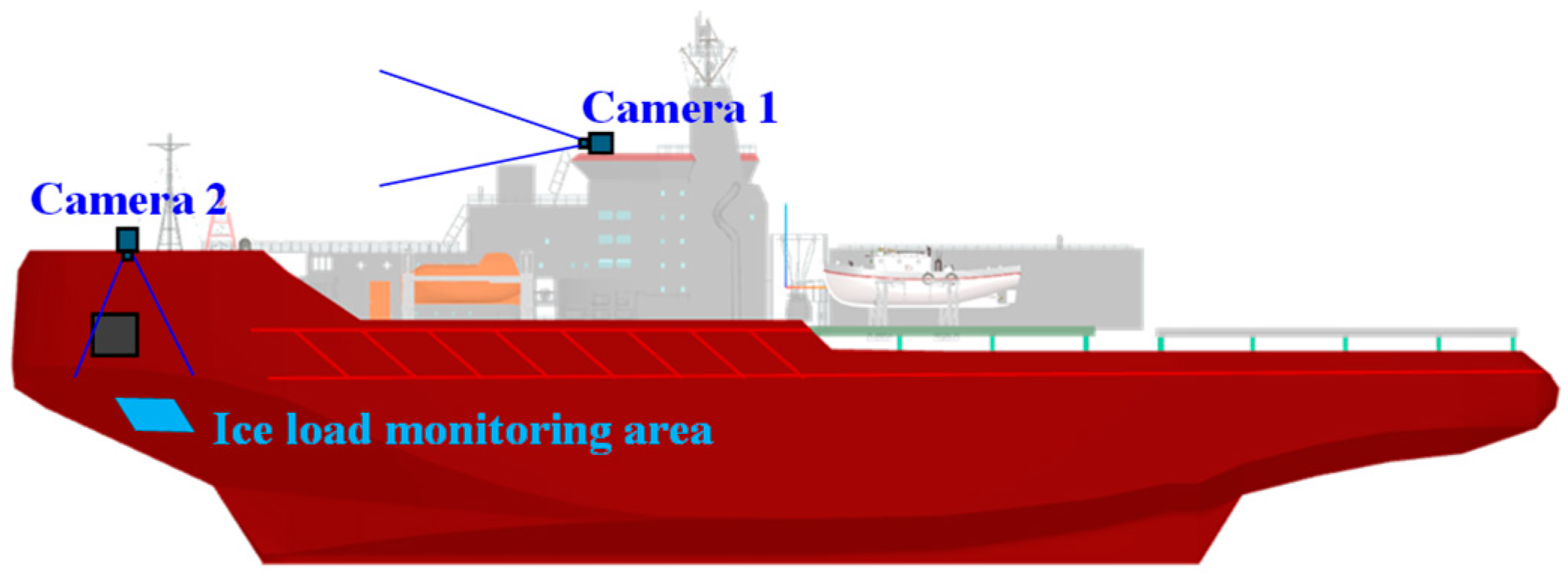
To obtain the characteristics of ice loads on hull structures during icebreaking navigation in the Bohai Sea during its ice formation period, ice load measurement on a hull structure using ship-borne monitoring equipment was carried out using the icebreaker Sun Yat-sen University Polar The icebreaker has a length of 78.95 m, a molded breadth of 17.22 m, a draft of 8.16 m, a designed icebreaking class of Canadian CAC4, and an equivalent IACS ice class of PC4. To acquire the ice-induced strain responses of the local hull structure and the corresponding sea ice conditions during the icebreaking process, a strain measurement scheme based on biaxial resistance strain gauge sensors and a sea ice image measurement scheme based on ship-borne cameras were designed, respectively. A schematic diagram of the measurement equipment layout is shown in Figure 1.
To acquire sea ice parameters such as sea ice type, ice concentration, and ice thickness, a sea ice image measurement scheme based on a shipborne camera system was implemented. Two high-definition cameras were installed on the compass deck and the ship’s side, respectively, to monitor the overall ice conditions in the ship’s forward direction and the ice conditions on the port side.
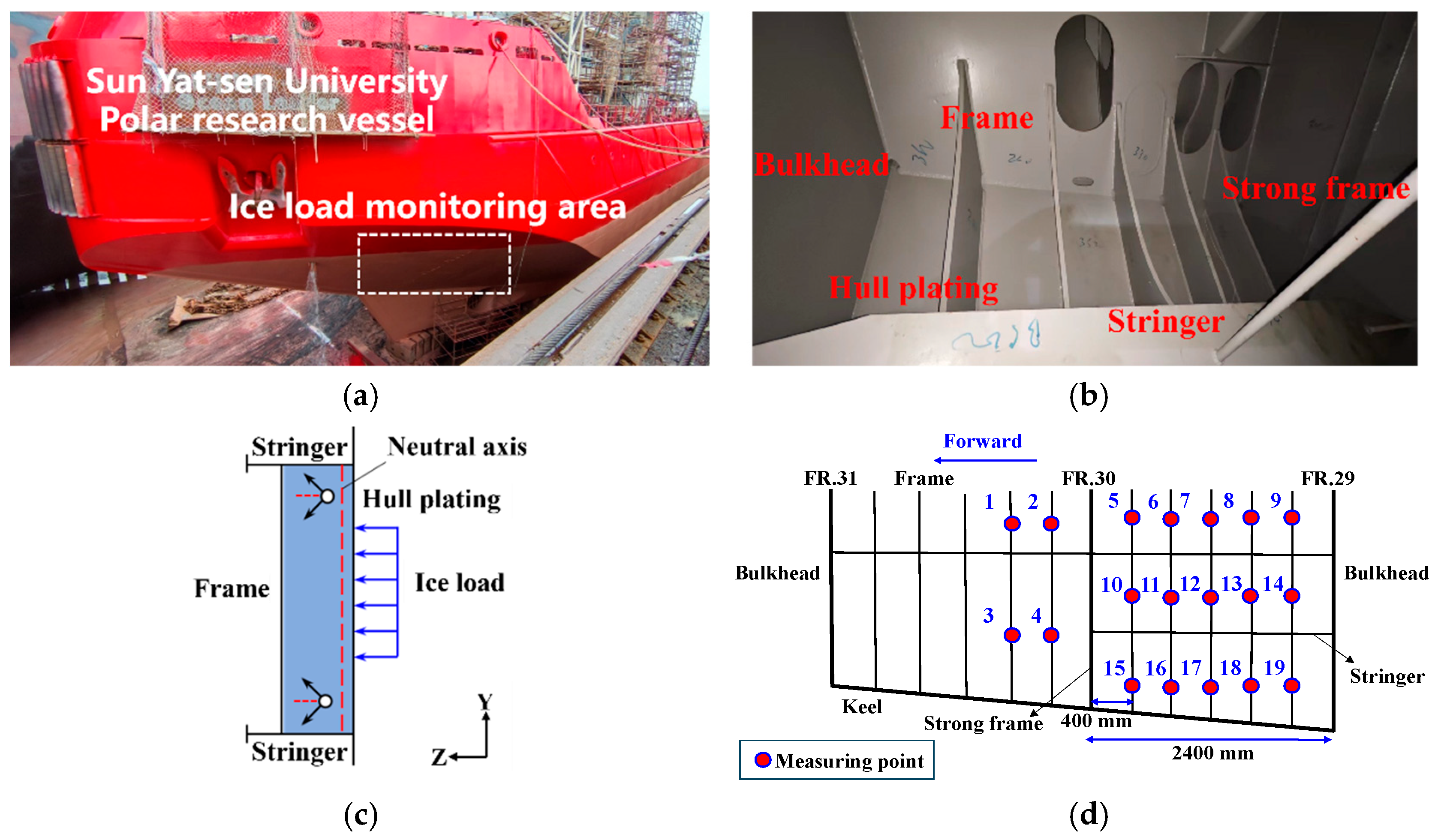
The external and internal structural diagrams of the ice load measurement area are shown in Figure 2a and Figure 2b, respectively. The schematic diagram of the strain measurement scheme based on biaxial resistance strain gauge sensors is presented in Figure 2c. The shear strain of the frames can be measured using symmetrically arranged biaxial rectangular rosette sensors, and thus the ice load can be indirectly calculated through the difference in ice-induced shear strain obtained from two shear strain measuring points (one at the upper part and the other at the lower part of the same frame) [31]. In addition, the ice load monitoring area was expanded by arranging an array of measuring points to obtain more comprehensive ice load distribution characteristics. Considering the difficulty in installing strain sensors, a total of 19 measuring points were arranged in the measurement area, which were evenly distributed in the key areas of each frame inside the forepeak tank. The schematic diagram is shown in Figure 2d.

2.2. Route and Ice Condition

Recently, the “Sun Yat-sen University Polar” vessel completed its icebreaking test in the Bohai Sea area. Sea ice conditions were closely related to the ice loads on the hull structure. Therefore, it was necessary to conduct measurement and analysis of sea ice conditions along the ship’s route in ice-covered areas, so as to provide ship navigation information and sea ice information input for the analysis of ship–ice interaction processes.
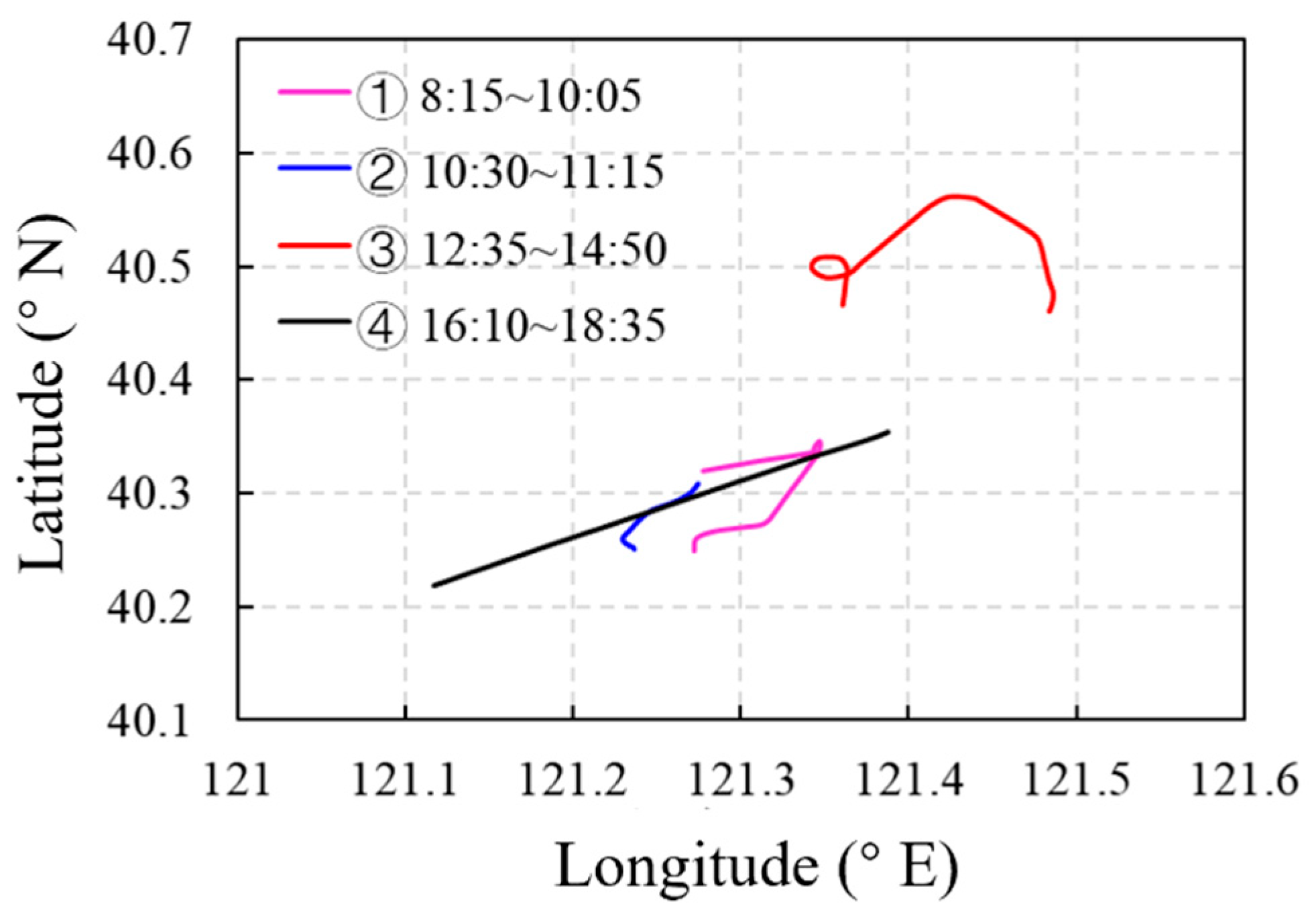
The Bohai Sea icebreaking test was carried out in the sea area near the Jinzhou 20-2 Offshore Platform (40°30′ N, 121°21′ E). During the test, the sea ice thickness generally ranged from 5 to 20 cm, with a maximum ice thickness of up to 35 cm. The icebreaking tests were conducted during the peak ice season of the Bohai Sea. The full-scale ship tests mainly covered typical navigation conditions such as straight sailing, turning, and circling, and a total of four sets of route information were recorded, as shown in Figure 3. The time histories of ship speed corresponding to the four routes are shown in Figure 4. The records of navigation conditions and ship speed provide ship information inputs for the analysis of ice loads on the hull structure during the icebreaking test.
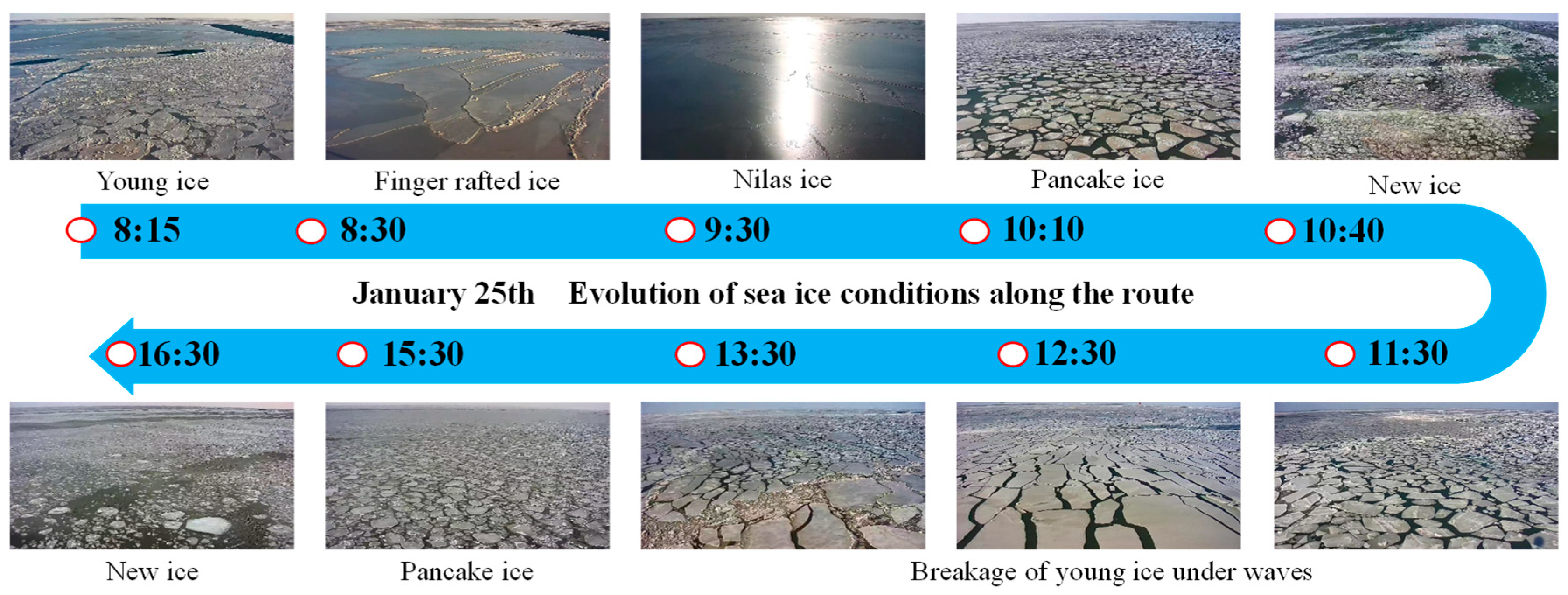
Bohai Sea ice is characterized by its thin thickness, high fluidity, uneven spatial distribution, and significant diversity [32]. During the icebreaking test period, the sea ice conditions showed significant changes, as shown in Figure 4. Since all Bohai Sea ice is first-year ice and has a short growth cycle, the sea ice types during the test could be classified into new ice, nilas ice, pancake ice, and young ice according to their formation stages. New ice has a small volume and thin thickness and is easily pushed away by the waves generated by the ship’s movement, so its impact on the ship structure can be ignored. Nilas ice shows typical level ice characteristics in terms of surface morphology, but its thickness generally does not exceed 10 cm. During the drift of sea ice, when nilas ice interacts with other segments of level ice, it easily forms finger rafted ice [33]. Pancake ice can be formed either by direct freezing of new ice or by the breaking of nilas ice, and its morphology is characterized by small-sized portions of broken ice. Young ice is mainly formed by the continuous growth of nilas ice, but it is easily broken into larger-sized pieces of broken ice under the action of swells; a small proportion of young ice is formed by the refreezing of pancake ice. From the perspective of surface morphology, nilas ice and young ice formed by refreezing appear as level sea ice with low thickness, while pancake ice and broken young ice appear as broken ice with different sizes and concentrations, and finger rafted ice shows typical rafted ice characteristics. Therefore, although there Bohai Sea ice does not include ice ridges or icebergs, its morphological characteristics show a high similarity to polar sea ice, especially in terms of the distribution and dynamic behavior of broken ice and level ice.

3. Ice Load Identification Method

3.1. Principle of the ICM Method

As a classical method for identifying ice loads on ship structures, the ICM method [30] proposes two assumptions for ice loads generated by ship–ice collisions. The first assumption is that the ice load is applied slowly, and the local strain response of the structure is assumed to be only the deformation caused by the static effect of the external load at a certain moment, without considering the dynamic response of the ice load. The second assumption is that the ice load is uniformly distributed in each monitoring sub-area, without considering the local high-pressure areas under the action of ice load in a single monitoring area.
Specifically, the ICM method is based on the linear elasticity hypothesis, and the relationship between ice loads and ice-induced strains is expressed as follows:
δ p = γ
In the formula, δ is the inverse matrix of the influence coefficient matrix, p is the ice load, and γ is the shear strain difference between the two measuring points on the same frame.
Expanding the above formula:
δ 11 δ 12 δ 1 i δ 1 n δ 21 δ 22 δ 2 i δ 2 n δ i 1 δ i 2 δ i i δ i n δ n 1 δ n 2 δ n i δ n n p 1 p 2 p i p n = γ 1 γ 2 γ i γ n
In the formula, n is the number of ice-induced strain response differences; γ i i = 1,2 , , n is the ice-induced shear strain difference at the i-th frame; p i i = 1,2 , , n is the ice load value in the sub-area where the i-th frame is located; δ i j i , j = 1,2 , , n is an element in the flexibility matrix δ , representing the influence of the ice load in the sub-area where the j-th frame is located on the strain response at the i-th frame.
When the sub-area where the i-th frame is located is subjected to a unit ice load while all other sub-areas are in an unloaded state, Formula (2) becomes
δ 11 δ 12 δ 1 i δ 1 n δ 21 δ 22 δ 2 i δ 2 n δ i 1 δ i 2 δ i i δ i n δ n 1 δ n 2 δ n i δ n n 0 0 1 0 = δ 1 i δ 2 i δ i i δ n i
Apply a unit ice load individually and sequentially in each sub-area. The flexibility matrix δ can be completely constructed based on the strain differences in each group. After obtaining all elements of the matrix, the inverse calculation of matrix δ can be performed to obtain the influence coefficient matrix C . By multiplying the ice-induced strain data measured from the full-scale ship with the influence coefficient matrix C , the inverse identification of the full-scale ship’s ice load is realized.

3.2. Construction of the Ice Load Identification Model

3.2.1. Ice-Induced Strain Signal Preprocessing

Preprocessing of strain data refers to the necessary processing steps such as verification, screening, and sorting performed before data classification or grouping. In hull ice load monitoring, data preprocessing mainly includes the selection of sampling frequency, as well as noise reduction and zero-drift removal of data. To ensure the validity of sampled data and the accuracy of subsequent analysis, it is crucial to select an appropriate sampling frequency. The frequency components of ship structural responses in ice-covered areas are complex, including not only ice load excitation frequencies but also excitation frequencies of other mechanical equipment and natural frequencies of the structure. Therefore, when monitoring structural responses, it is necessary to consider not only ice load excitation frequencies but also the influences of other frequency components. In addition, the selection of sampling frequency needs to balance practical constraints. Theoretically, the higher the sampling frequency, the higher the degree of reduction in the signal amplitude and the smaller the sampling error. However, high sampling frequency is limited by the maximum sampling frequency of the acquisition equipment; at the same time, it leads to a sharp increase in data volume, generating large-capacity data files and placing higher requirements on storage and processing capabilities. Based on the above discussion, the sampling frequency of the monitoring system of the “Zhongshan University Polar” vessel was set to 200 Hz.
During ship navigation strain measurement, the collected signals are inevitably interfered by various noise sources, mainly including environmental noise (such as wave impact and mechanical vibration) and instrument noise (such as sensor drift and electromagnetic interference). These noises significantly reduce the signal-to-noise ratio (SNR) of the measured data, thereby affecting the accuracy and reliability of subsequent analysis. Therefore, it is crucial to adopt effective signal preprocessing methods to improve data quality. This paper employs a digital signal processing technology based on moving average filtering. This method features simple calculations and an excellent real-time performance, making it particularly suitable for processing long-time series data such as ship navigation strain measurement. Its core principle is to calculate the local average through a sliding-window mechanism, and its mathematical expression is as follows:
y ( n ) = 1 M k = 0 M 1 x n k
In the formula, x ( n ) is the original signal; y ( n ) is the filtered signal; and M is the window length.

3.2.2. Construction of the Influence Coefficient Matrix

Given that it is difficult to conduct accurate load application tests under full-scale ship conditions, a numerical simulation method was used to construct a local finite element model of the hull so as to obtain the influence coefficient matrix. Based on drawings of the hull structure and the measured data of the forepeak tank area, the key structural parameters in the strain monitoring area were accurately determined. Table 1 details the geometric parameters of the key structures in the forepeak tank of the Sun Yat-sen University Polar vessel.
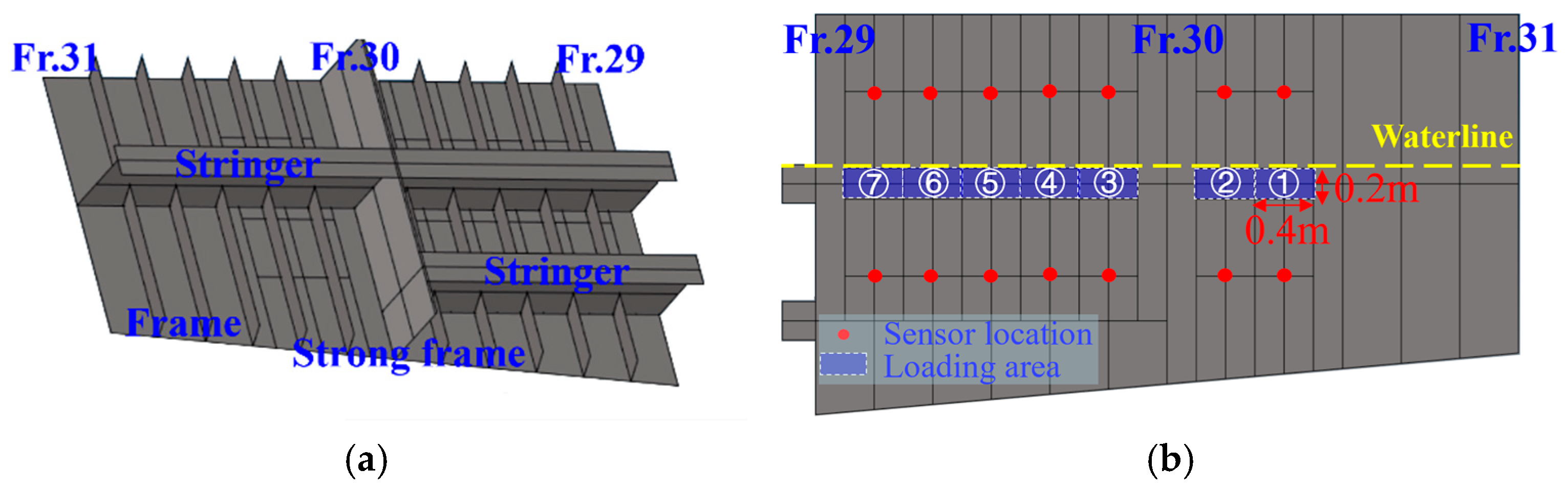
Based on the above information, a finite element model of the starboard hull plate in the forepeak tank of the Sun Yat-sen University Polar vessel was established, as shown in Figure 5a. The model was constructed using SHELL181 shell elements. The mesh division balances calculation accuracy and efficiency, and the boundary conditions were set as fixed constraints on all four sides to simulate the support conditions of the actual hull structure.
Considering that the thickness of Bohai Sea ice is generally less than 0.2 m, the loading area (i.e., sub-monitoring area) in the finite element model was set below the ship’s waterline. The height of each area was set to 0.2 m and the width was 0.4 m (the spacing between two ordinary frames). There were a total of 7 loading areas, as shown in Figure 5b. A unit load was applied to each area sequentially to obtain each element in the inverse matrix C of the influence coefficient matrix. The calculated condition number of the matrix satisfied cond (c) < 10, indicating weak ill-conditioning. However, considering the inevitable noise interference in the measured signals, the Tikhonov regularization algorithm was used to improve the accuracy of solving the system of equations. The approximate solution of the ice load obtained after Tikhonov regularization can be expressed as follows:
F = c T c + λ I 1 c T Δ γ e r r
In the formula, I is the identity matrix; Δ γ e r r is the shear strain difference under noise interference; and λ is the regularization parameter. When λ = 0 , the solution is the least-squares solution.

3.3. Identification Results of Ice Loads

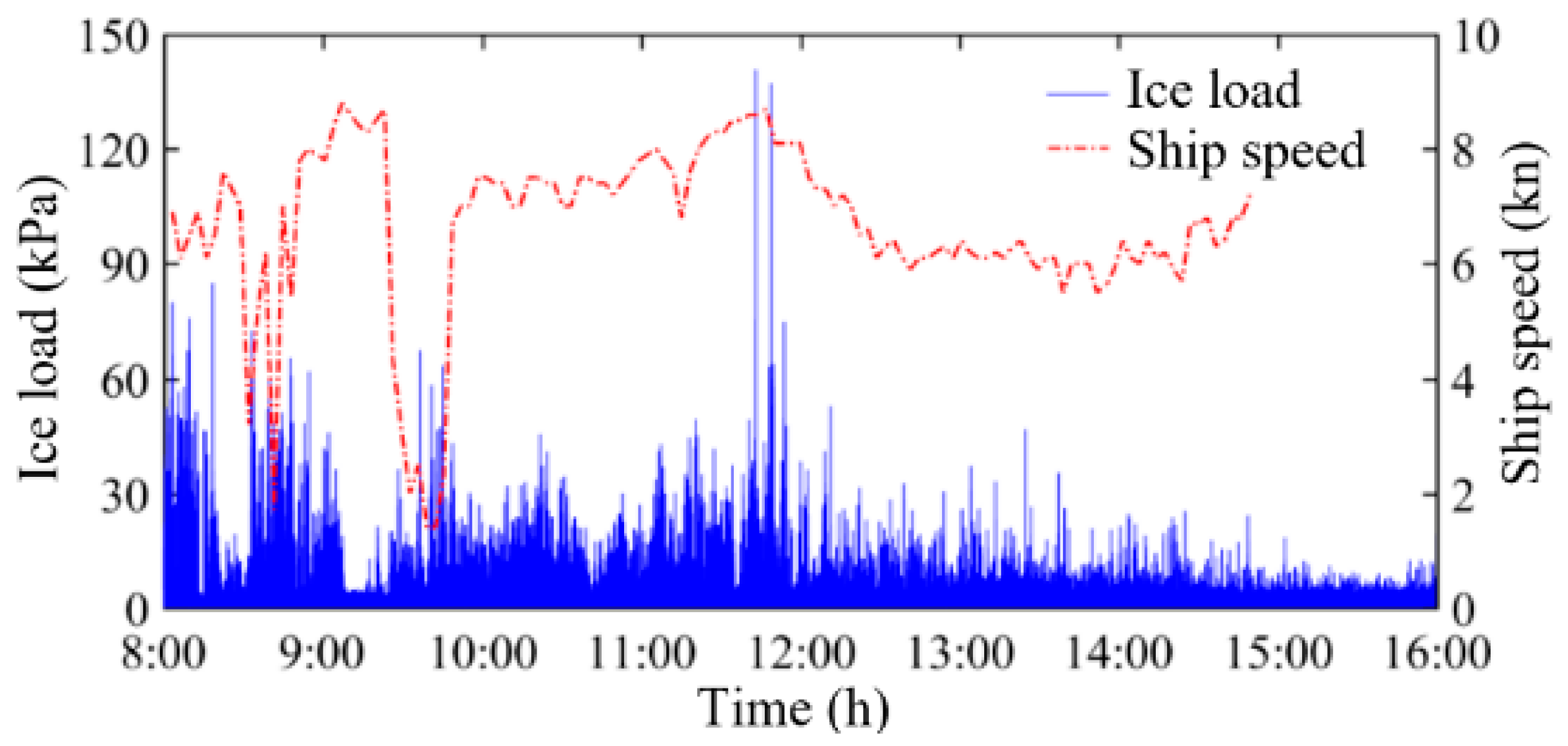
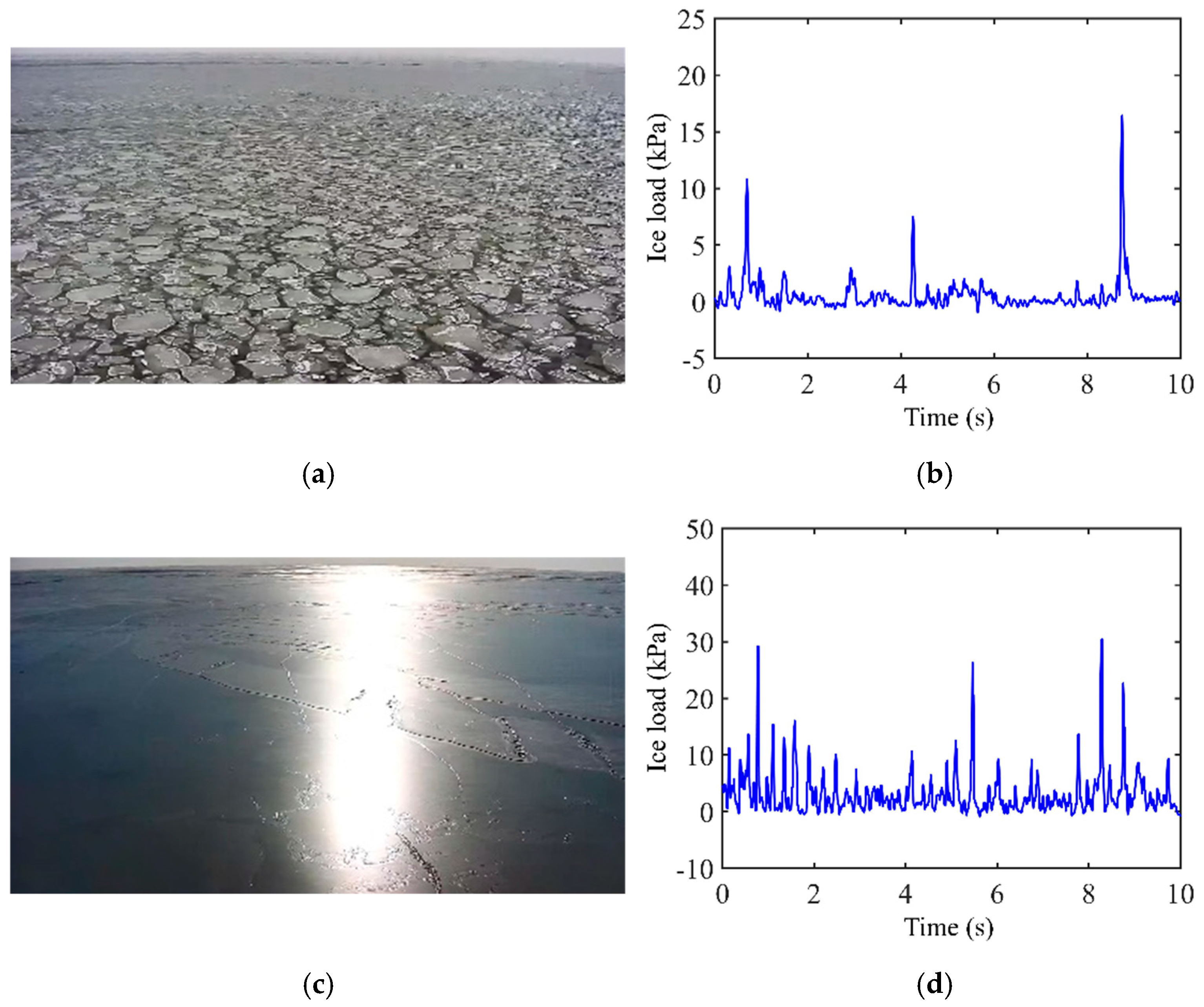
Based on the established ice load identification model, inverse identification of ice loads on the “Sun Yat-sen University Polar” vessel during its navigation in the Bohai Sea was conducted. Figure 6 presents the total time-history curves of local hull ice loads and ship speed during the icebreaking test. Due to the randomness of sea ice distribution and changes in ship speed, the ice loads exhibited significant random characteristics. Considering the diversity of Bohai Sea ice types, this paper further analyzes the ice load characteristics under different typical ice conditions. The results show that the ice load characteristics of nilas ice, young ice, and finger rafted ice exhibit level ice properties, but there are significant differences in their thicknesses; in contrast, pancake ice and broken young ice show obvious broken ice properties, among which the broken young ice has a higher concentration. Taking pancake ice and nilas ice as examples, the time-history curve characteristics of broken ice and level ice were analyzed, as shown in Figure 7. The figure displays images of sea ice conditions under typical ice scenarios and ice load time-history curves within a 10 s period. In general, the ice loads showed obvious dynamic characteristics with short action durations. Specifically, due to the small size of pancake ice and large gaps between ice pieces, when the ship sailed in the pancake ice area, the bow wave effect pushed small sea ice pieces away, resulting in fewer collisions and relatively lower ice load values. When sailing in the level ice area, the ice loads occurred more frequently with relatively stable peak values, and the generated ice loads were significantly higher than those in the pancake ice area.

4. Characteristics of Ice Load

4.1. Determination of Ice Load Event

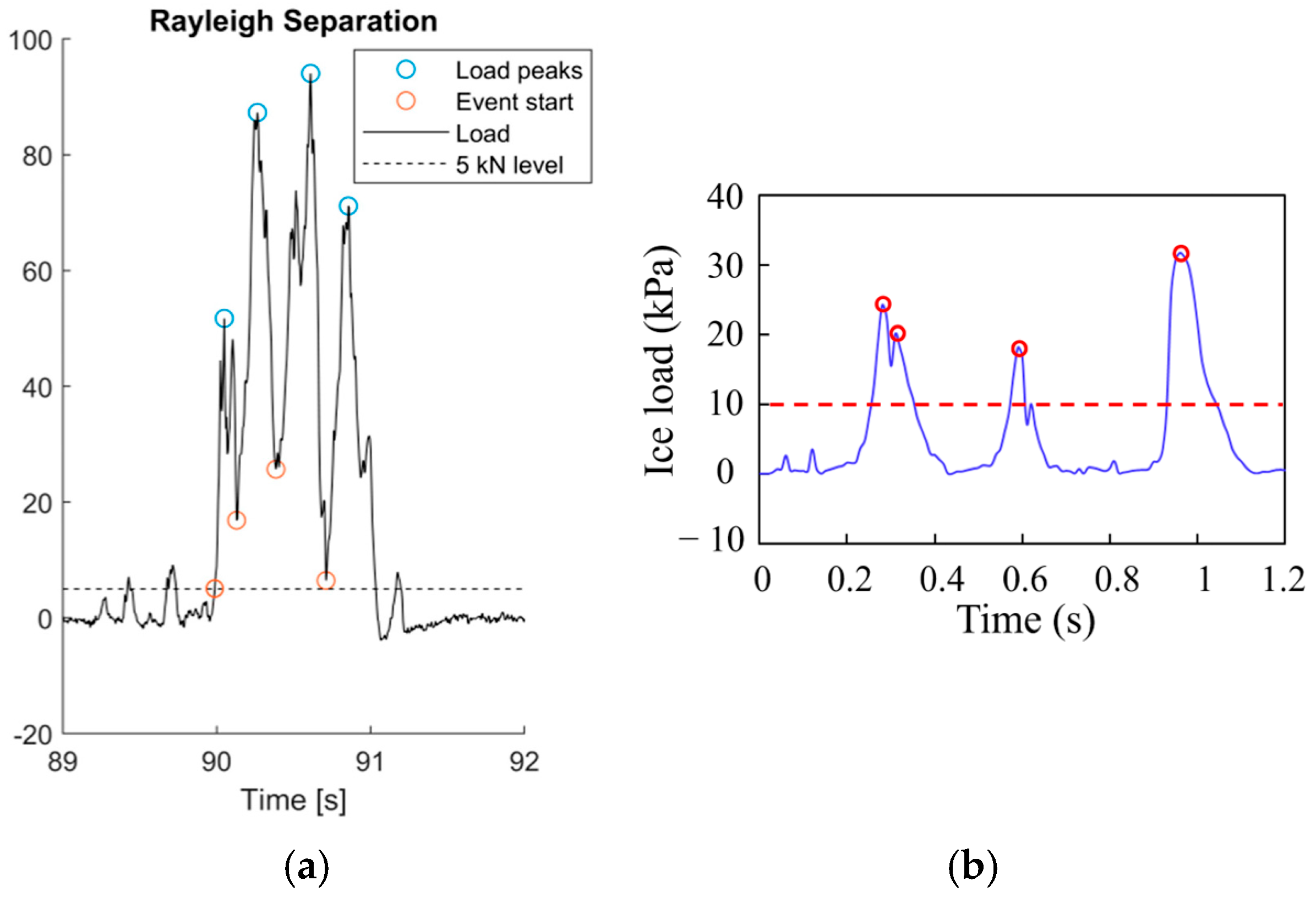
A complete ship–ice collision consists of contact, penetration, and separation processes between the hull structure and sea ice [17]; therefore, obvious loading and unloading phases appear on the time-history curve of complete ice load. Peak extraction is the basis for ice load event extraction. Under high sampling frequency, the “glitch” phenomenon in the ice-induced strain time-history curve is reflected in the identified ice load time-history curve, so relying solely on simple threshold judgment will lead to the extraction of incorrect peaks. The Rayleigh classification method establishes a relatively scientific judgment basis by considering a comparison between two adjacent peaks and the valley between them [34], as shown in Figure 8a. Rayleigh separation eliminates the influence of signal noise on ice load peak extraction by setting a threshold and treating the valley as the end of the current ice load cycle and the start of the next ice load cycle; the time difference between two valleys is the ice load cycle. Characteristic parameters of ice load events such as peaks, valleys, action cycles, loading time, and unloading times can be obtained simultaneously using the Rayleigh separation method. Figure 8b shows the extraction of ice load characteristic values based on the Rayleigh separation method, with the threshold used in the example being 10 kPa.

4.2. Characteristics of Ice Load Time-History Curves

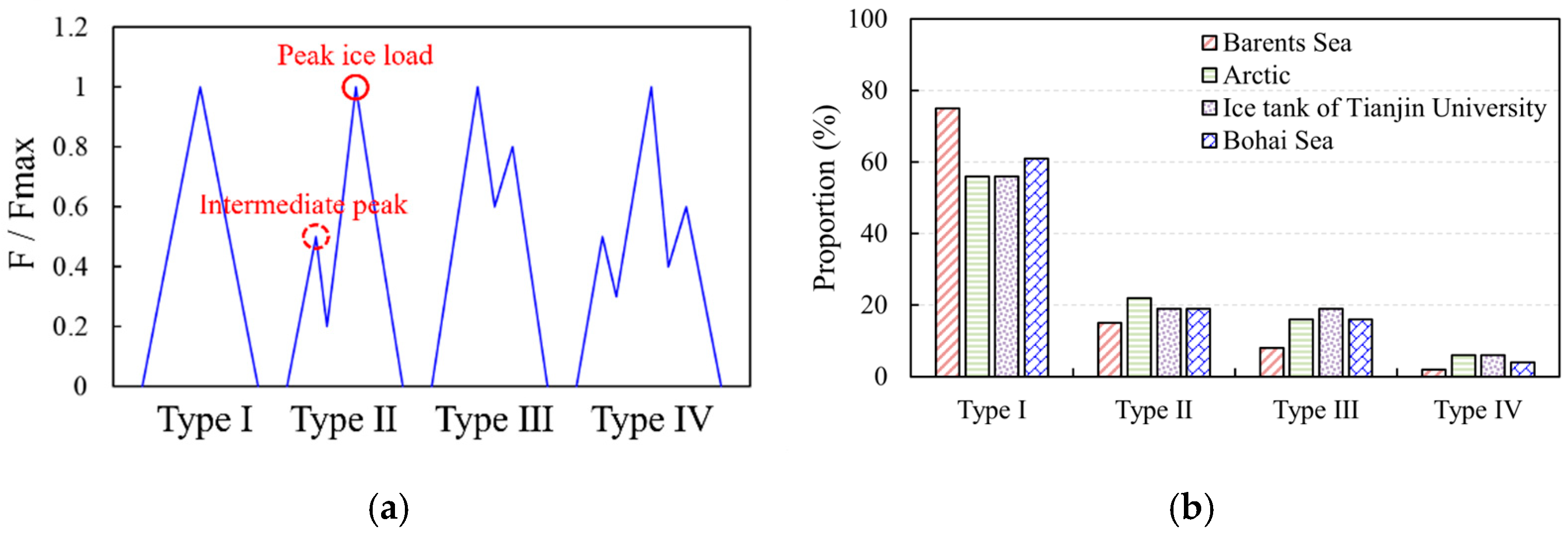
The waveform characteristics of the ice load time-history curves were closely related to the ship–ice interaction process. When sea ice came into contact with the ship hull, the ice load entered the loading phase; as the interaction between the structure and sea ice proceeded, the ice load continued to increase until it reached the maximum value. After the sea ice exhibited failure behaviors such as local breakage (including crushing failure, bending failure, and splitting failure), the interaction force between the sea ice and the structure gradually weakened, and the ice load entered the unloading phase until the end of the load cycle. However, between the loading and unloading phases of the ice load, secondary breakage of sea ice may occur, including the simultaneous action of surrounding sea ice and re-contact of locally broken sea ice, leading to the phenomenon of multiple peaks. In this case, an ice load event manifested as the superposition of two or more ice load events. Therefore, in the classification and statistics of ice load time histories, they could be divided into four types based on the presence of intermediate peaks: single-peak ice load, intermediate peak in the loading phase, intermediate peak in the unloading phase, and intermediate peaks in both the loading and unloading phases [18]. Schematic diagrams of the four types of ice load time-history curves are shown in Figure 9a.
For the above four ice load action forms, Figure 9b summarizes the statistical results of ice load time-history characteristics from the currently published literature, and incorporates the ice load time-history characteristics of the “Sun Yat-sen University Polar” vessel during its navigation in the Bohai Sea into the comparative analysis. The results show that the distribution of ice load time-history curve types in the Bohai Sea and polar regions [18,22] exhibits good consistency. The proportion of single-peak ice load form in polar navigation is relatively higher, which is because polar navigation generally occurs during the ice-melting period; during this period, sea ice in polar seas exists mainly in the form of broken ice and there are a large number of melt ponds, thus reducing the phenomenon of secondary breakage of sea ice.

4.3. Characteristics of Ice Loads Periods and Peak Values

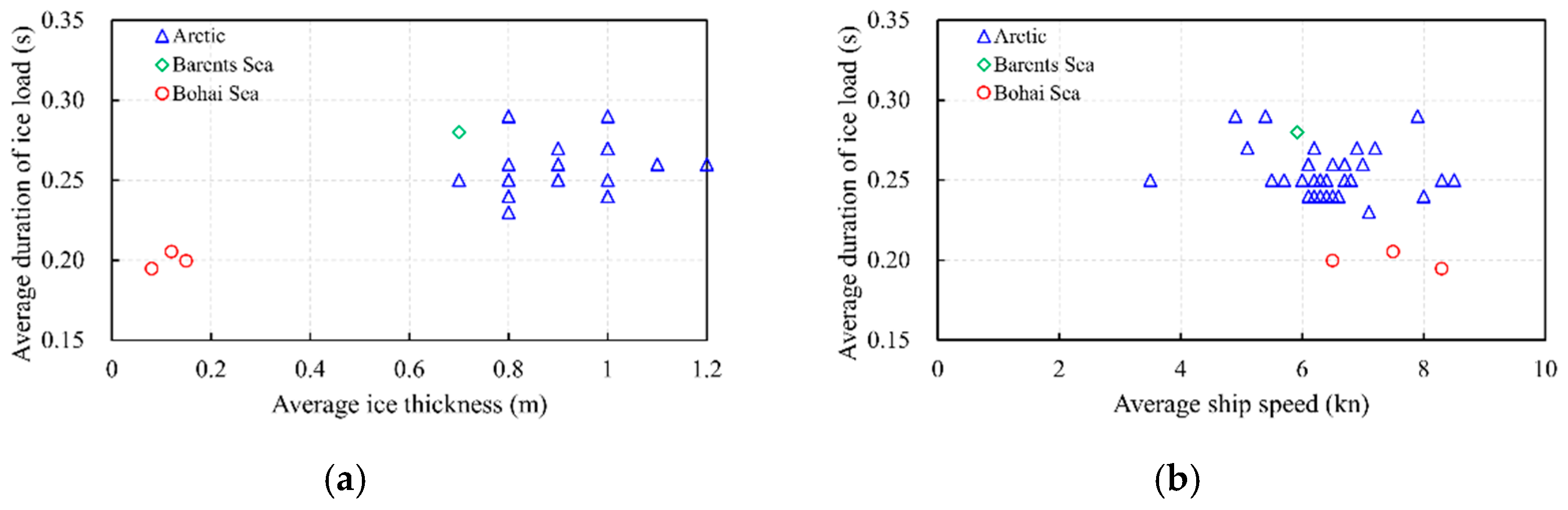
The ice load action period is defined as the duration of a single ice load event, including loading time and unloading time. This paper compares the average ice load action period of the “Sun Yat-sen University Polar” vessel during its navigation of the Bohai Sea with ice load action period data from other sea areas (Xuelong 2’s Arctic navigation in 2021 [35] and ARAON’s navigation in the Barents Sea of the Arctic in 2010 [18]). The relationship between the average ice load action period and the average sea ice thickness is shown in Figure 10a. Analysis indicates that, although there is a slight difference between the average ice load action period in the Bohai Sea and that in polar regions, the overall gap is small, and both show a trend of increasing with the increase in ice thickness. The relationship between the average ice load action period and the average ship speed is shown in Figure 10b; in contrast, the correlation between the average ice load action period and ship speed is weak. The reason is that, under the bending failure mode, an increase in ice thickness leads to an increase in the area and time length of sea ice breakage, thereby increasing ship–ice contact time. For ship speed, changes in speed have little impact on the nominal strain rate (interaction speed/ship length) during the ship–ice interaction process, resulting in the average ice load action period being unaffected by changes in ship speed.
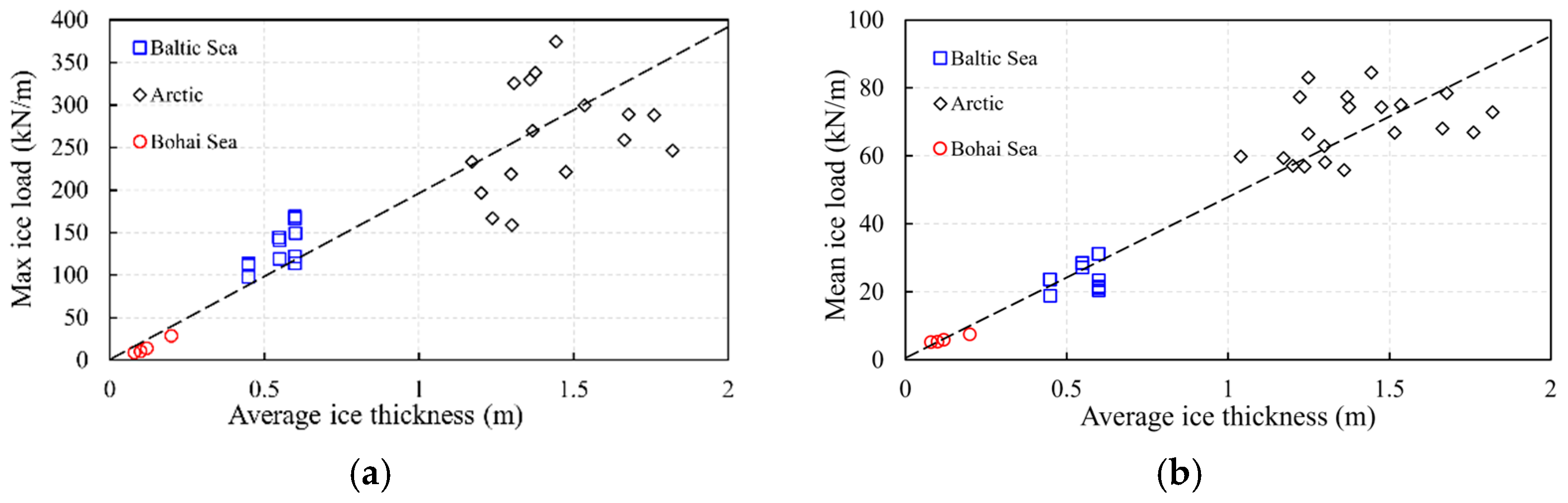
There are various characterization methods for ice loads, including local total ice force (kN), surface load (MPa), and line load (kN/m). Considering the “linear” load characteristic of ice loads, line load is usually used for analysis in research. The calculation method is either dividing the local total ice force by the frame spacing or multiplying the surface load by the load height. In this paper, the identified ice load peaks of the “Sun Yat-sen University Polar” vessel in the Bohai Sea are compared with the ice load data of the “Xuelong” vessel during its navigation in the Arctic Central Passage in 2017 [22] and the MT Uikku during its navigation in the Gulf of Finland in the Baltic Sea [36], as shown in Figure 11. The results show that there is a significant linear relationship between the ice load peak and ice thickness. Both the average value and maximum value of the Bohai Sea ice load in this study correlated with the variation trend lines of ice load peak and ice thickness. It is worth noting that the ice load data of the “Xuelong” and MT Uikku were derived from ship icebreaking tests during the ice-melting period, while the sea ice in the Bohai Sea was in the growth period during icebreaking, and its strength was higher than that of polar sea ice. However, the influence of strength on the ice load peak is not obviously reflected in the variation trend lines of ice load peak and ice thickness. This is mainly because the ice load has strong randomness, making it difficult to control variables to analyze the influence of a single factor. Among the many factors affecting ice load, the influence of ice thickness on the ice load peak is significantly higher than that of sea ice strength.

5. Conclusions

Based on an icebreaking navigation test during the ice season of the Bohai Sea, this study conducts full-scale measurements of sea ice conditions and ice loads on the hull structure, analyzes the characteristics of sea ice in the Bohai Sea during the ice season, identifies the distribution of local ice loads on the hull during the icebreaking test using the influence coefficient matrix method, and compares the measurements of local ice loads on the hull during navigation in ice-covered areas of polar and sub-polar seas. The main research conclusions of this paper are as follows:
(1)
The time-domain characteristics of the measured ice load time histories in the Bohai Sea ice area were similar to those in icy areas of the polar sea, the load periods and peaks are consistent with the measurements from the Arctic cruise.
(2)
The action period of ice loads in the Bohai Sea followed the same relationship as that obtained from full-scale ship tests in polar regions, i.e., the action period of ice loads is positively correlated with ice thickness but is not significantly affected by ship speed;
(3)
Both the maximum and average values of ice load peaks in the Bohai Sea conformed to the same relationship between ice load peaks and average ice thickness established in other sea areas.

Author Contributions

G.Z. and C.Z. conceptualized this study; X.X. and R.L. carried out this study, performed the calculations, and drafted the paper; S.H., X.C. and S.J. conducted the review and editing of the paper. All authors have read and agreed to the published version of the manuscript.

Funding

This research was supported by the National key research and development program (Grant No. 2024YFC2816403), Research and Development Program (Grant No. CBG2N21-2-3), National Natural Science Foundation of China (Grant Nos. 52101300, 52192693, 52192690, 42176241).

Data Availability Statement

The data presented in this study are available on request from the corresponding authors.

Acknowledgments

The authors would like to show their appreciation to the crew of Sun Yat-sen University Polar Icebreaker for their support during the onboard measurements.

Conflicts of Interest

The authors declare no conflicts of interest.

References

  1. Ebinger, C.K.; Zambetakis, E. The geopolitics of Arctic melt. Int. Aff. 2009, 85, 1215–1232. [Google Scholar] [CrossRef]
  2. Lindqvist, G. A straightforward method for calculation of ice resistance of ships. In Proceedings of the 10th International Conference Port and Ocean Engineering Under Arctic Conditions (POAC 1989), Luleå, Sweden, 12–16 June 1989; pp. 722–735. [Google Scholar]
  3. Riska, K.; Wilhelmson, M.; Englund, K.; Leiviskä, T. Performance of Merchant Vessels in Ice in the Baltic, Winter Navigation Research Board; Finnish Maritime Administration: Helsinki, Finland, 1997. [Google Scholar]
  4. Lilja, V.P.; Polojärvi, A.; Tuhkuri, J.; Paavilainen, P. A free, square, point-loaded ice sheet: A finite element-discrete element approach. Mar. Struct. 2019, 68, 102644. [Google Scholar] [CrossRef]
  5. Su, B.; Riska, K.; Moan, T. A numerical method for the prediction of ship performance in level ice. Cold Reg. Sci. Technol. 2010, 60, 177–188. [Google Scholar] [CrossRef]
  6. Aksnes, V. A simplified interaction model for moored ships in level ice. Cold Reg. Sci. Technol. 2010, 63, 29–39. [Google Scholar] [CrossRef]
  7. Zhou, L.; Riska, K.; Polach, R.B.; Moan, T.; Su, B. Experiments on level ice loading on an icebreaking tanker with different ice drift angles. Cold Reg. Sci. Technol. 2013, 85, 79–93. [Google Scholar] [CrossRef]
  8. Polach, R.B.; Ehlers, S. Heave and pitch motions of a ship in model ice: An experimental study on ship resistance and ice breaking pattern. Cold Reg. Sci. Technol. 2011, 68, 49–59. [Google Scholar] [CrossRef]
  9. Kotovirta, V.; Karvonen, J.; Polach, R.B.; Berglund, R.; Kujala, P. Ships as a sensor network to observe ice field properties. Cold Reg. Sci. Technol. 2011, 65, 359–371. [Google Scholar] [CrossRef]
  10. Ralph, F.; McKenna, R.; Gagnon, R. Iceberg characterization for the bergy bit impact study. Cold Reg. Sci. Technol. 2008, 52, 7–28. [Google Scholar] [CrossRef]
  11. Suyuthi, A.; Leira, B.; Riska, K. Short term extreme statistics of local ice loads on ship hulls. Cold Reg. Sci. Technol. 2012, 82, 130–143. [Google Scholar] [CrossRef]
  12. Fredriksen, Ø. Ice-Induced Loading on Ship Hull During Ramming. Master’s Thesis, Norwegian University of Science and Technology, Trondheim, Norway, 2012. [Google Scholar]
  13. Li, F.; Goerlandt, F.; Kujala, P.; Lehtiranta, J.; Lensu, M. Evaluation of selected state-of-the-art methods for ship transit simulation in various ice conditions based on full-scale measurement. Cold Reg. Sci. Technol. 2018, 151, 94–108. [Google Scholar] [CrossRef]
  14. Leira, B.; Børsheim, L.; Espeland, Ø.; Amdahl, J. Ice-load estimation for a ship hull based on continuous response monitoring. J. Eng. Marit. Environ. 2009, 223, 529–540. [Google Scholar] [CrossRef]
  15. Suyuthi, A.; Leira, B.; Riska, K. A generalized probabilistic model of ice load peaks on ship hulls in broken-ice fields. Cold Reg. Sci. Technol. 2014, 97, 7–20. [Google Scholar] [CrossRef]
  16. Suominen, M.; Kujala, P.; Romanoff, J.; Remes, H. Influence of load length on short-term ice load statistics in full-scale. Mar. Struct. 2017, 52, 153–172. [Google Scholar] [CrossRef]
  17. Kotilainen, M.; Vanhatalo, J.; Suominen, M.; Kujala, P. Predicting ice-induced load amplitudes on ship bow conditional on ice thickness and ship speed in the Baltic Sea. Cold Reg. Sci. Technol. 2017, 135, 116–126. [Google Scholar] [CrossRef]
  18. Ritch, R.; Frederking, R.; Johnston, M.; Browne, R.; Ralph, F. Local ice pressures measured on a strain gauge panel during the CCGS Terry Fox bergy bit impact study. Cold Reg. Sci. Technol. 2008, 52, 29–49. [Google Scholar] [CrossRef]
  19. Takimoto, T.; Uto, S.; Oka, S.; Murakami, C.; Izumiyama, K. Mearsurement of ice load exerted on the hull of icebreaker SOYA in the southern sea of Okhotsk. In Proceedings of the 18th IAHR International Symposium on Ice, Sapporo, Japan, 28 August–1 September 2006. [Google Scholar]
  20. Yamauchi, Y.; Mizuno, S.; Tsukuda, H. The Icebreaking Performance of SHIRASE in the Maiden Antarctic Voyage. In Proceedings of the Twenty-First International Offshore and Polar Engineering Conference, Maui, HI, USA, 19–24 June 2011. [Google Scholar]
  21. Lee, J.H.; Kwon, Y.H.; Rim, C.W.; Lee, T.K. Characteristics analysis of local ice load signals in ice-covered water. Int. J. Nav. Archit. Ocean Eng. 2016, 8, 66–72. [Google Scholar] [CrossRef]
  22. Kwon, Y.H.; Lee, T.K.; Choi, K. A study on measurements of local ice pressure for ice breaking research vessel “Araon” at the Amundsen Sea. Int. J. Nav. Archit. Ocean Eng. 2015, 7, 490–499. [Google Scholar] [CrossRef]
  23. Jeon, M.; Min, J.K.; Choi, K.; Ha, J.S. Estimation of local ice load by analyzing shear strain data for the IBRV Araon. In Proceedings of the 24th International Conference on Port and Ocean Engineering Under Arctic Conditions, Busan, Republic of Korea, 11–16 June 2017. [Google Scholar]
  24. Wang, J.; Chen, X.; Sun, K.; Ji, S. Far-field identification of ice loads on ship structures by radial basis function neural network. Ocean Eng. 2023, 282, 115072. [Google Scholar] [CrossRef]
  25. He, S.; Chen, X.; Kong, S. Measurement and identification of ice loads on hull structures in far field based on dynamic effects. Chin. J. Ship Res. 2021, 16, 54–63. [Google Scholar] [CrossRef]
  26. Du, Y.; Sun, L.; Pang, F.; Li, H.; Gao, C. Experimental research of hull vibration of a full-scale river icebreaker. J. Mar. Sci. App. 2020, 19, 182–194. [Google Scholar] [CrossRef]
  27. Chen, X.; Wang, A.; Ji, S. Comparative study of the brittle-ductile transition between level ice and rafted ice based on uniaxial compression experiments. Int. J. Mater. Struct. Integr. 2021, 14, 255–272. [Google Scholar] [CrossRef]
  28. Ji, S.; Liu, H.; Li, P.; Su, J. Experimental Studies on the Bohai Sea Ice Shear Strength. J. Cold Reg. 2013, 27, 244–254. [Google Scholar] [CrossRef]
  29. Yue, Q.; Bi, X. Ice-Induced Jacket Structure Vibrations in Bohai Sea. J. Cold Reg. 2000, 14, 81–92. [Google Scholar] [CrossRef]
  30. Fenz, D.; Younan, A.; Piercey, G.; Barrett, J.; Ralph, F.; Jordaan, I. Field measurement of the reduction in local pressure from ice management. Cold Reg. Sci. Technol. 2018, 156, 75–87. [Google Scholar] [CrossRef]
  31. Jo, Y.; Choi, J.; Park, S.; Han, S. Sensor arrangement for ice load monitoring to estimate local ice load in Arctic vessel. In Proceedings of the International Conference on Port and Ocean Engineering Under Arctic Conditions, Busan, Republic of Korea, 11–16 June 2017. [Google Scholar]
  32. Xu, J.; Shi, Q.; Song, A.; Fan, Y.; Li, T. Sea Ice Engineering in China. J. Coast. Res. 1991, 7, 759–770. [Google Scholar]
  33. Hopkins, M.A.; Tuhkuri, J.; Lensu, M. Rafting and ridging of thin ice sheets. J. Geophys. Res. Oceans. 1999, 104, 13605–13613. [Google Scholar] [CrossRef]
  34. Suominen, M.; Li, F.; Lu, L.; Kujala, P.; Bekker, A.; Lehtiranta, J. Effect of maneuvering on ice-induced loading on ship hull: Dedicated full-scale tests in the Baltic Sea. J. Mar. Sci. Eng. 2020, 8, 759. [Google Scholar] [CrossRef]
  35. Wang, J.; Yuan, K.; Ji, S. Method of monitoring and identifying ice load on ship structures and analysis of its spatial-temporal characteristics. Shipbuild. Chin. 2023, 64, 41–56. [Google Scholar] [CrossRef]
  36. Suominen, M.; Kujala, P. Variation in short-term ice-induced load amplitudes on a ship’s hull and related probability distributions. Cold Reg. Sci. Technol. 2014, 106, 131–140. [Google Scholar] [CrossRef]
Figure 1. Diagram of the installation location of ship-based monitoring equipment.
Jmse 13 02297 g001
Figure 2. Measurement scheme of ice-induced strain of hull structure. (a) External diagram of the monitoring area. (b) Internal structural diagram of the monitoring area. (c) Schematic diagram of shear strain measurement. (d) Schematic diagram of array-type strain measuring point layout.
Jmse 13 02297 g002
Figure 3. Ship route obtained by GPS.
Jmse 13 02297 g003
Figure 4. Sea ice conditions in the Bohai Sea during the test.
Jmse 13 02297 g004
Figure 5. Simplified finite element model of monitoring zone. (a) Local finite element model. (b) Schematic diagram of measuring point positions and loading area.
Jmse 13 02297 g005
Figure 6. Time-history curve of local ice load and ship speed during icebreaking test.
Jmse 13 02297 g006
Figure 7. Time-history curves of ice load under typical ice conditions. (a) Pancake ice (broken ice). (b) The ice load during navigation in pancake ice. (c) Nilas ice (level ice). (d) The ice load during navigation in nilas ice.
Jmse 13 02297 g007
Figure 8. Ice load event extraction based on Rayleigh separation method. (a) Schematic diagram of Rayleigh separation method [35]. (b) Extraction of ice load events in this paper.
Jmse 13 02297 g008
Figure 9. Comparison of characteristics of ice load time-history curves. (a) Classification of ice load time-history curves. (b) Comparison of ice loads between Bohai Sea ice and ice in other sea areas.
Jmse 13 02297 g009
Figure 10. Comparison of ice load action period. (a) Relationship between duration of ice load and ice thickness. (b) Relationship between duration of ice load and ship speed.
Jmse 13 02297 g010
Figure 11. Relationship between peak ice load and ice thickness. (a) Relationship between max ice load and ice thickness. (b) Relationship between mean ice load and ice thickness.
Jmse 13 02297 g011
Table 1. Structural dimensions of each component in the forepeak tank of the Sun Yat-sen University Polar vessel.
Component NameParameterValue/mm
Hull platingThickness40
StringerWeb height × Flange width ×
Web thickness × Flange thickness
700 × 50 × 20 × 26
Strong frameWeb thickness20
Ordinary frameWeb height × Web thickness340 × 21
Ordinary frame spacing400
Disclaimer/Publisher’s Note: The statements, opinions and data contained in all publications are solely those of the individual author(s) and contributor(s) and not of MDPI and/or the editor(s). MDPI and/or the editor(s) disclaim responsibility for any injury to people or property resulting from any ideas, methods, instructions or products referred to in the content.