You are currently viewing a new version of our website. To view the old version click .
Journal of Marine Science and Engineering
  • Article
  • Open Access

31 October 2025

Investigation on the Aeroelastic Characteristics of Ultra-Long Flexible Blades for an Offshore Wind Turbine in Extreme Environments

,
,
,
,
and
1
College of Artificial Intelligence, Harbin Institute of Technology, Shenzhen 518055, China
2
Goldwind Science & Technology Co., Ltd., Beijing 100176, China
3
College of Frontier Sciences, Harbin Institute of Technology, Shenzhen 518055, China
*
Author to whom correspondence should be addressed.
This article belongs to the Topic Advancements in Cost-Effective and Reliable Floating Offshore Wind Technologies: From Innovative Design to System Integration

Abstract

With the growing demand for wind turbines in deep offshore regions, frequent typhoon disasters at sea have impeded the continued development of the wind power industry. To address the problem of typhoons destroying offshore wind power facilities, this paper investigates the aeroelastic characteristics of long flexible blades on ultra-large offshore wind turbines under typhoon loads. The WRF numerical model is employed for high-precision simulations of Typhoon Mangkhut (No. 1822). By optimizing parameterization schemes and incorporating 3DVAR data assimilation techniques, typhoon wind speed profiles in the target sea area are obtained. Based on IEA 15 MW offshore wind turbine data, 3D unsteady CFD models and full-scale finite element models of the blades are established to acquire the aerodynamic loads and structural responses of the blades in typhoon environments. The results indicate that, under extreme typhoon loads and considering wind shear and tower shadow effects, the forces near the blade root are greater; the maximum out-of-plane aerodynamic force occurs at the 14% span position of the blade at 90° azimuth, and the maximum torsional aerodynamic moment is experienced at the 26.5% span position of the blade at 270° azimuth. When the blade pitch angle and rotor yaw angle do not reach ideal states, the deflection of ultra-long flexible blades can increase by up to 3.26 times. These findings overcome the limitations of traditional uniform wind field studies and provide a theoretical basis for subsequent coping strategies for offshore blades under typhoon conditions.

1. Introduction

In the context of the profound transformations in the global energy system, renewable energy has become a core component of national energy strategies due to its clean and sustainable attributes, serving as a key pathway to achieving sustainable development goals [1]. Wind energy, as the most widely distributed clean energy source globally, accounted for 43% of installed capacity in 2020, representing the highest share among all renewable energies [2]. With global population growth and urbanization, land resources are becoming increasingly scarce and expensive, leading to greater attention being paid to offshore wind power development, which does not occupy valuable onshore space [3]. Moreover, the vast and flat ocean surface, free from obstacles such as mountains, results in higher wind speeds and lower turbulence intensities at sea, making offshore wind resources more abundant than onshore ones [4].
However, the abundant offshore wind resources are accompanied by frequent typhoons. Typhoons are not merely intense storms but unique meteorological disasters with complex physical characteristics [5]. They bring not only extreme wind speeds but also high turbulence intensities, rapid and severe wind direction changes, and prolonged durations; these hazardous features [6] cause loads on wind turbine structures far exceeding those from conventional strong winds. Pandey [7] analyzed data from 77 typhoons over the past 40 years, highlighting the critical role of El Niño events in inducing large-scale sea surface temperature anomalies during typhoon seasons. Global warming has increased sea surface temperatures by 0.4 °C to 0.7 °C, resulting in a 35% enhancement in typhoon intensity.
Tan [8] advanced the understanding of typhoon evolution dynamics through research on key dynamic and thermodynamic processes for and prediction of the evolution of typhoon intensity and structure. The study demonstrated that, given a vortex position, tropical cyclone (TC) intensity and structure are closely correlated; meanwhile, TC track influences TC intensity and structure, and TC track is simultaneously affected by TC intensity and structure. Liu [9] analyzed typhoon frequency characteristics and proposed a model based on stochastic process theory to describe the number of typhoons occurring in the time domain. By integrating historical typhoon data from 2000 to 2016, more accurate predictions were achieved compared to traditional models.
Research shows that typhoons at sea are not only increasing in terms of probability but also increasing in terms of wind speed and pressure intensity. Under the current trend of wind turbine upsizing, the lengthening and softening characteristics of blades become prominent, exacerbating the dynamic stiffening effect and rotational softening effect induced by stiffness reduction [10], which indicates that the aerodynamic loads and internal structural stresses experienced by the blades are also more complex [11].
During extreme weather events such as typhoons, blades are prone to complex aeroelastic instabilities like flutter [12], leading to wind turbine damage. Historical incidents include Typhoon Capricorn causing severe damage to six 6.25 MW wind turbines in the Wenchang wind farm in Hainan [13]; Typhoon Maemi resulting in blade fractures on three wind turbines, the collapse of two, and foundation destruction leading to the overturning of one on Miyako Island [14]; and Typhoon Usagi damaging eight wind turbines in the Shanwei wind farm, with 35 broken blades and total economic losses of USD 16 million [15]. Therefore, investigating the blade load characteristics of offshore wind turbines under extreme conditions such as typhoons holds significant practical importance. Research approaches for wind turbines in extreme environments can be categorized into wind tunnel experiments and numerical simulations.
Yan [16] examined the impact of unsteady aerodynamic effects on wind turbine towers in extreme environments through wind tunnel tests measuring nacelle shell wind pressure variations. The results indicate that wind speed changes enhance nacelle wind pressure fluctuations, with local wind pressures during wind speed reduction far exceeding those at the same change rate during wind speed increase. Wang [17] constructed a vibration simulation model for a 5 MW wind turbine under typhoon conditions using multi-body dynamics methods, predicting vibration responses considering multi-stage effects. The findings show that typhoon progression causes periodic changes in wind turbine resonance modes, exciting higher-order blade vibration modes and shifting primary resonance modes. Tang [18] studied the performance of an NH1500 wind turbine at a single parked position in typhoon environments, establishing steady-state wind models for different wind speeds and turbulence intensities. The research revealed that the tower reduces the average aerodynamic loads and amplitudes on the rotor, with tower vortex shedding being delayed under specific winds when downstream of the blades.
Leng [19] combined actuator line theory with multi-body dynamics to investigate the aeroelastic responses of a 5 MW wind turbine under extreme wind conditions, finding that, as wind speed increases, blade aerodynamic loads and tip deflections increase, exciting high-frequency vibrations in the blade flapwise direction and making aerodynamic loads more unstable. Yao [20] conducted load reduction research on a wind turbine with feathering faults under typhoon conditions using CFD and finite element methods to obtain the aeroelastic responses of a 5 MW wind turbine. The results show that active yawing can reduce blade aerodynamic loads by over 90% and maximum tip deflections by 75%. Wang [21] simulated the dynamic responses of a parked 5 MW wind turbine, comparing the differences between 2D and 3D models in average wind speed simulations. The findings indicate that, in the typhoon eyewall region, 2D models underestimate average blade and tower responses by 8% and 24%, respectively, though the differences are minimal in outer vortex regions.
Yang [22] compared the impacts of steady wind, turbulent wind, and Typhoon Saola on traditional offshore wind turbine systems using coupled simulation tools for a 5 MW wind turbine with two-stage planetary and one-stage parallel-shaft gear transmission. The results show significant torque fluctuations on low- and high-speed shafts in the typhoon eyewall region, with more pronounced low-speed shaft thrust fluctuations in the typhoon peripheral strong-wind areas. Qin [23] employed the SIMO-RFLEX-Aerodyn coupled program to study the wind-induced vibration characteristics of an offshore wind turbine during Typhoon Hagupit, constructing computational models for the foundation, tower, and blades based on Euler beam elements. The results reveal that, during typhoon passage, wind–wave coupled loads excite tower vibrations near the first-order modal frequency, but wind provides aerodynamic damping that suppresses tower vibrations.
The above studies indicate that the existing research on wind turbines in typhoon environments predominantly employs numerical simulation approaches, typically focusing on small-to-medium-sized wind turbines. These studies often construct wind turbine models using simplified equivalent methods and perform simulations under relatively uniform or idealized wind speed conditions, which diverge from the actual scenarios of increasingly large wind turbines in highly pulsating typhoon environments. Moreover, the nonlinear effects and dynamic stall sensitivities of ultra-long flexible blades pose challenges for accurately describing blade aerodynamic and structural responses. Therefore, this paper comprehensively accounts for the turbulence–wind shear effects and the tower shadow effect, employing high-fidelity full-scale models to investigate ultra-long flexible blades under extreme environmental conditions while comprehensively analyzing the impacts of yaw and pitch variation on the aerodynamic loads and structural response characteristics of the blades.
The research object of this study is the 15 MW offshore wind turbine released by the International Energy Agency (IEA) in 2020 (with blade lengths exceeding 100 m), whose blades exhibit ultra-long flexible characteristics and enjoy high recognition in the academic community [24]. The wind field details under typhoon conditions are precisely characterized through WRF and CFD downscaling numerical simulation methods. The typhoon model validity is verified by comparing migration paths, wind pressures, and wind speed indicators with observational data. On this basis, the aerodynamic load characteristics of ultra-long flexible blades in typhoon environments are investigated and the distribution features of different aerodynamic loads along the spanwise direction analyzed, as well as the influences of rotor yaw and blade pitch on aerodynamic loads. Innovatively, under the condition of fully considering the complexity of the blade operating environment, high-fidelity full-scale blade structural response numerical simulations are conducted, analyzing the variation patterns of structural deflections and stresses, thereby providing a scientific basis for the wind turbine’s structural optimization and its safe operation. This holds significant theoretical significance and engineering value for enhancing the design reliability of wind turbines in extreme environments and the accuracy of aeroelastic responses.

2. Numerical Model

This research employs WRF and CFD downscaling numerical simulation methods to precisely characterize wind field details in typhoon environments and deeply investigate the load characteristics of blades on a 15 MW offshore wind turbine under typhoon effects, analyzing load distributions such as aerodynamic forces on the blades under various operating conditions. Thus, it encompasses three components: the typhoon simulation model, the wind turbine blade aerodynamic load model, and the blade structural response model.

2.1. Typhoon Model

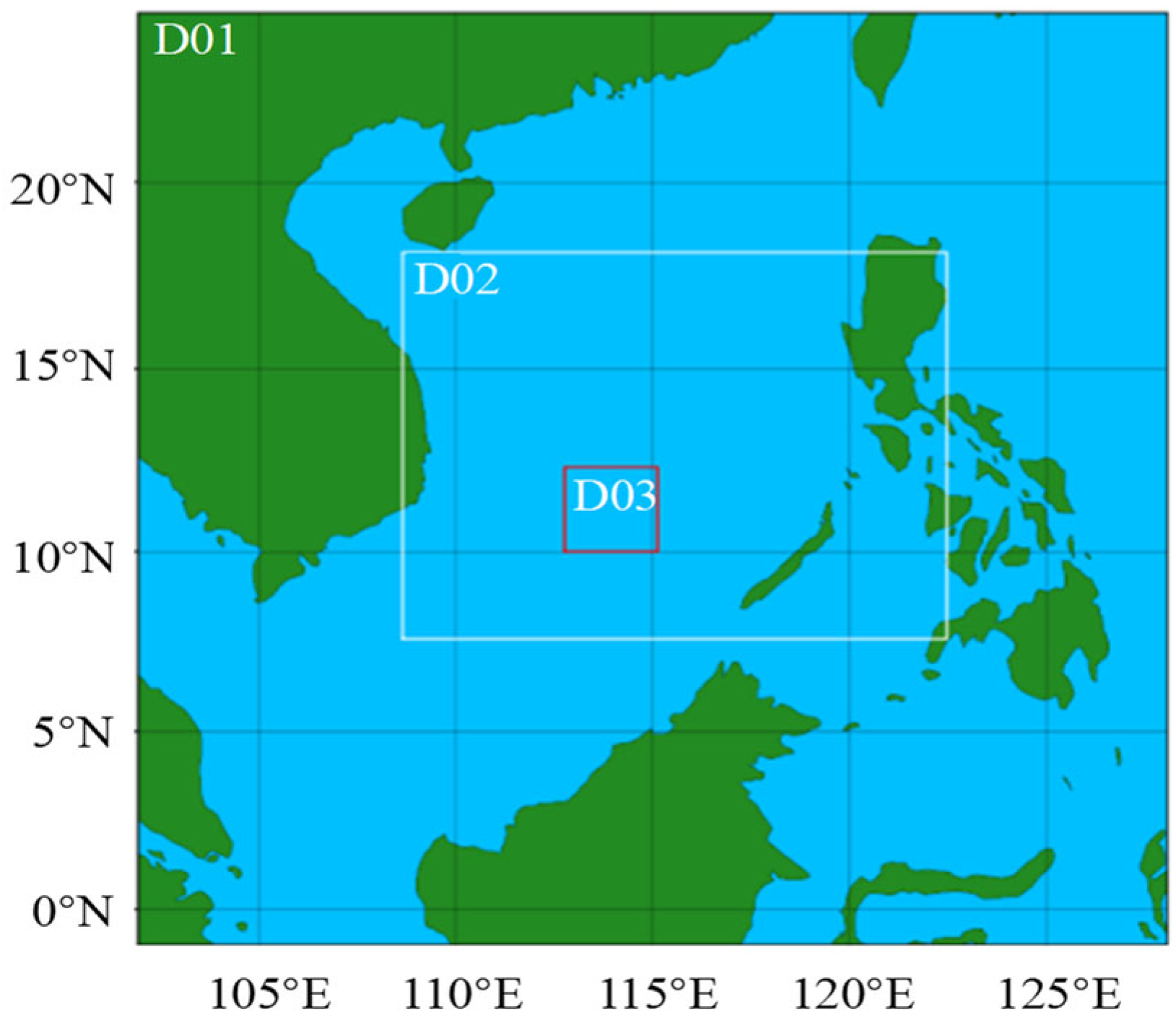
This research constructs a triple-nested grid system based on the WRF (Weather Research and Forecasting) numerical model to enhance the precision of typhoon wind field simulations. The parent domain (D01) adopts a 13.5 km horizontal resolution (211 × 211 grids), the first nested domain (D02) has a 4.5 km resolution (217 × 217 grids), and the innermost nested domain (D03) is further refined to 1.5 km (241 × 241 grids).
This configuration enables the progressive resolution of the typhoon’s macroscopic weather background (D01) into a high-precision, unsteady wind field in the region encompassing the wind turbine (D03), from which key physical quantities such as wind speed and turbulence intensity are extracted as inlet boundary conditions and background initial fields for the CFD computational domain.
All domains are centered on the typhoon and employ a two-way feedback mechanism for multi-scale dynamic coupling. Vertically, 37 eta levels are used, with exponential refinement in the near-surface layer (0–1 km height range) deploying 10 vertical levels and the model top pressure set to 5000 hPa to enhance the resolution of tropospheric top dynamic processes.
The microphysics scheme is the Lin scheme; longwave radiation is handled by the RRTM scheme, shortwave radiation by the Goddard scheme, and land surface processes by the Noah model; and dynamics are non-hydrostatic across all domains. Numerical integration time steps are dynamically adjusted by nesting level (D01: 81 s, D02: 27 s, D03: 9 s), with output intervals of 6 h. Figure 1 illustrates the longitude and latitude range of the typhoon simulation area, as well as the terrain markers.
Figure 1. Typhoon simulation area.
The simulated typhoon in this research is Tropical Cyclone Mangkhut (No. 1822), which formed in the northwestern Pacific on 7 September 2018 with an initial near-center maximum wind speed of 18 m/s. Under the dominant forcing of the subtropical high-pressure system, it moved along a northwestward trajectory. On September 15, it entered an explosive development phase, with the central pressure dropping to 905 hPa (international standard units) and the near-core maximum wind speed reaching 65 m/s (corresponding to super-typhoon intensity).
By 17:00 on 16 September (UTC+8), the system had made landfall on Luzon Island, the Philippines, at 45 m/s near-center wind speed (strong typhoon level) and 930 hPa central pressure. It weakened to typhoon level in the South China Sea the next day and made a third landfall along the coast of Taishan, Jiangmen City, Guangdong Province, with a central wind speed of 33 m/s and pressure of 955 hPa, causing extreme storm surges and heavy rainfall in the Guangdong–Hong Kong–Macao Greater Bay Area.
The above description indicates that, in terms of intensity and representativeness, Typhoon Mangkhut serves as one of the strongest typhoons affecting the South China Sea region in recent years, with its extreme wind conditions providing a critical “design load case” for evaluating the survivability and ultimate load response of ultra-large wind turbines. In terms of path and regional relevance, the trajectory of Mangkhut traversing the South China Sea represents a typical typhoon path in this area, which is precisely the key region for future offshore wind power development, thereby endowing this study with a clear engineering application context.

2.2. Blade Aerodynamic Model

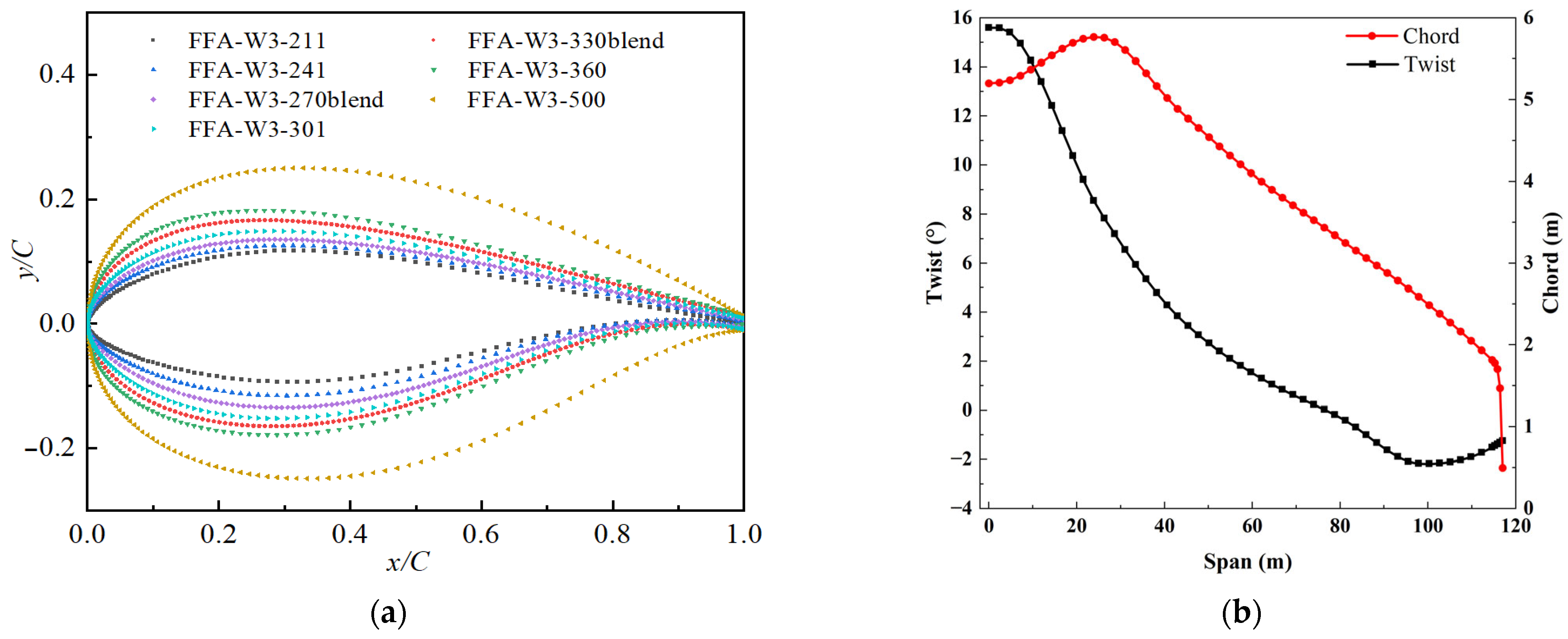
The research object is the IEA 15 MW offshore wind turbine, which has a rotor diameter of 240 m and blade length of 117 m [24]. The blade has a segmented airfoil configuration, with sectional geometric features tailored to the mechanical and aerodynamic requirements of different blade segments, and the spanwise distribution information is shown in Figure 2.
Figure 2. Geometric information of the 15 MW offshore wind turbine blade: (a) blade airfoil family; (b) spanwise distribution of blade section parameters.
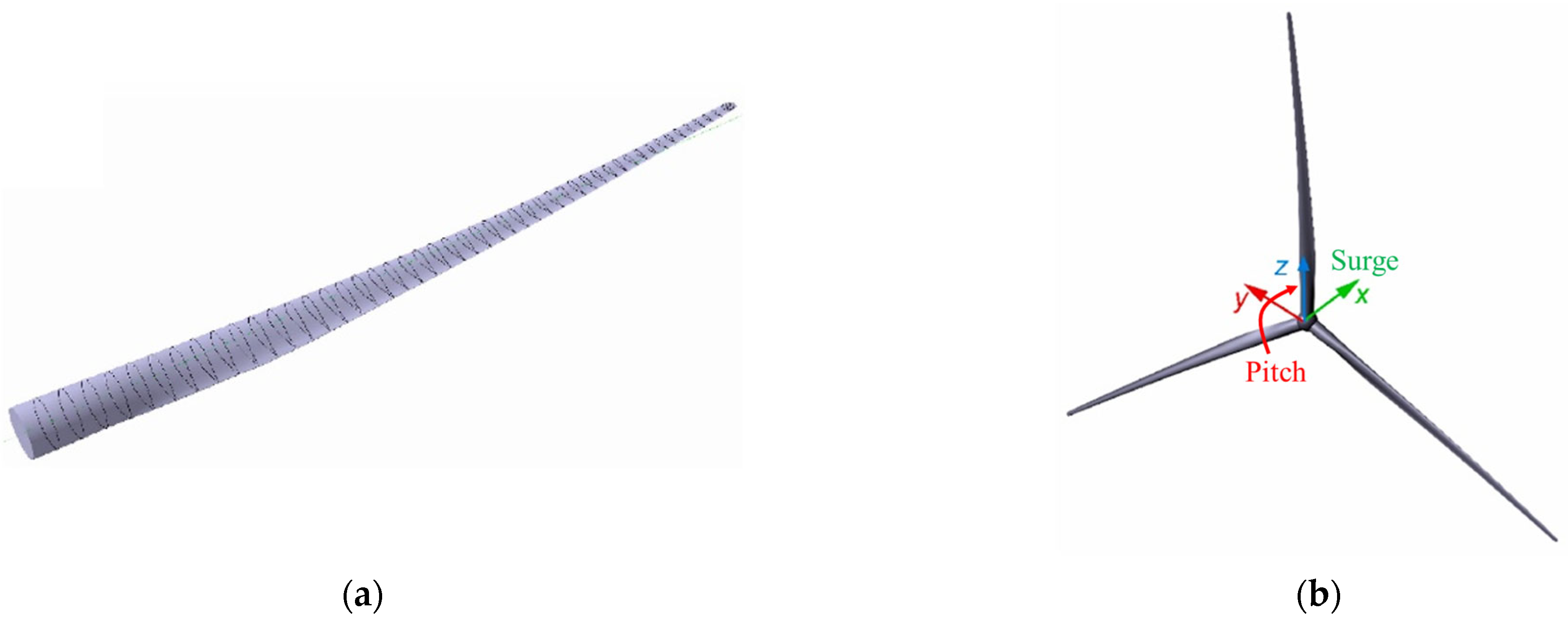
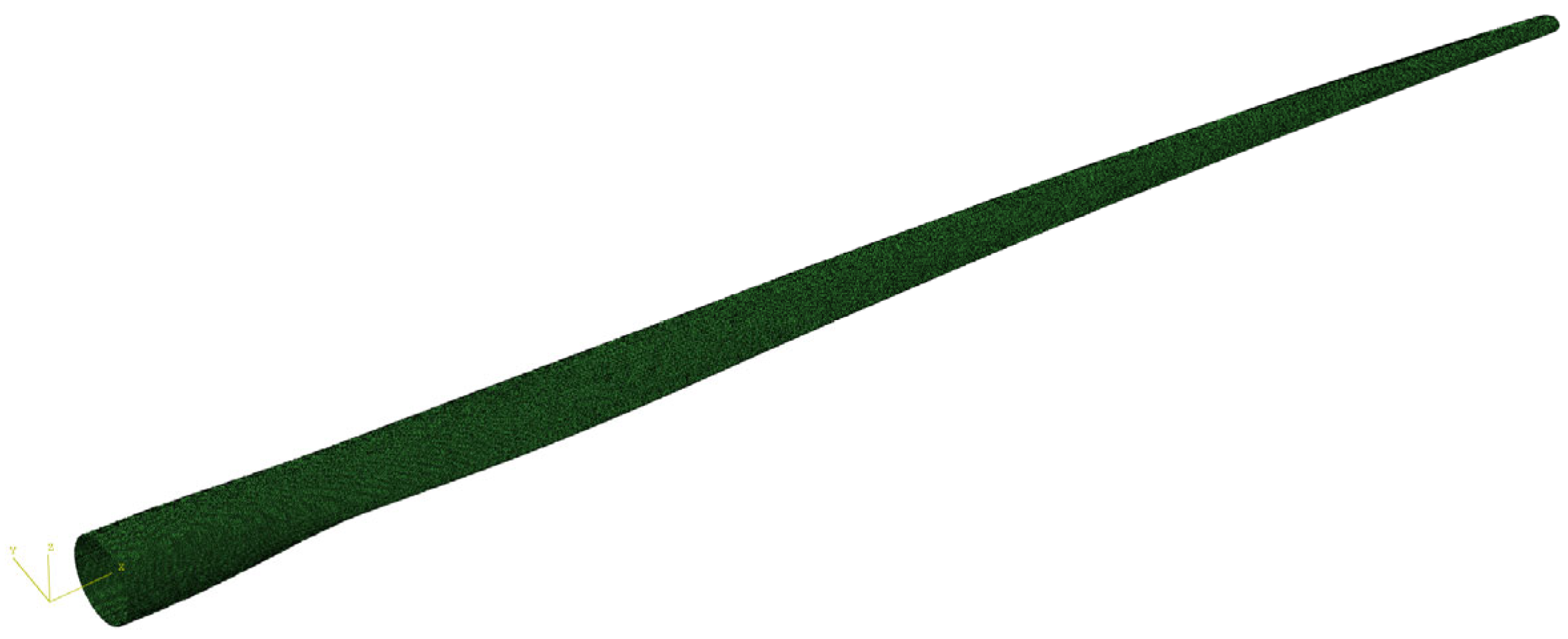
The aforementioned geometric information is used to generate discrete points in three-dimensional space via macro commands with spline curve fitting algorithms to obtain smooth airfoil contours. Surface construction methods are employed to build the full-scale blade geometric model, and, with the hub as the reference, a circular array operation is performed according to the 15 MW wind turbine’s three-blade layout, thereby constructing the complete wind turbine rotor structure shown in Figure 3.
Figure 3. Geometric model of the 15 MW offshore wind turbine blade: (a) blade; (b) rotor.
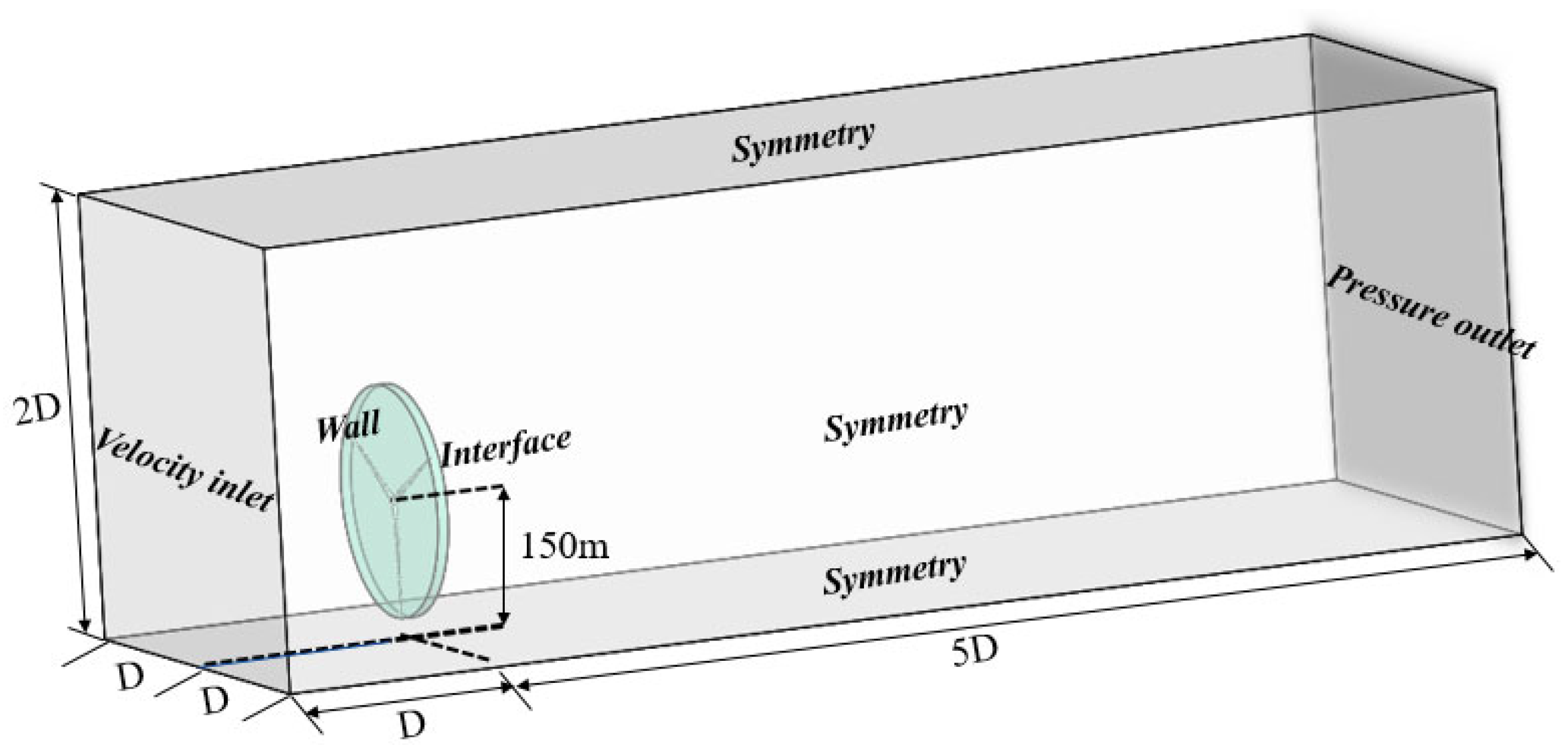
In the CFD numerical simulation process, rational construction of the computational domain topology is critical for simulation accuracy: overly small domains cause boundary effect interferences, while excessively large domains lead to exponential increases in grid numbers and computational resource consumption. Ref. [25] indicates that, using rotor diameter D as the unit, lateral domain sizes of 2–3D and longitudinal sizes of 5–6D effectively balance accuracy and efficiency. Based on these findings, a multi-reference frame model comprising an external stationary domain and an internal rotating domain is constructed, with the rotating domain diameter at 2D, the stationary domain inlet 1D from the rotor center, and the outlet extending to 5D, forming a progressive flow field development space, as shown in Figure 4.
Figure 4. Schematic diagram of the CFD computing domain.
For boundary conditions, interface coupling methods handle flow field transfers at dynamic–static domain interfaces, with sliding mesh techniques enabling momentum exchange between rotating and stationary domains. Blade surfaces adopt no-slip wall conditions, inlet boundaries are set with uniform inflow velocity profiles, outlet boundaries use pressure relaxation conditions, and lateral walls apply symmetry boundaries to simulate infinite spanwise space. The SST k-ω model was preferred over alternative eddy-viscosity closures because it combines the robust near-wall behavior of the standard k-ω formulation with the freestream-independence of the k-ε model through a zonal blending function [26]. Thus, the turbulence model selected is the SST k-ω model, which accurately captures boundary layer separation and wake evolution characteristics.

2.3. Blade Structural Model

Based on the existing blade geometric model, a full-scale finite element model of the blade is further established. The basic structural information of the 15 MW blade is shown in Table 1 [24].
Table 1. The basic properties of the 15 MW long flexible blade.
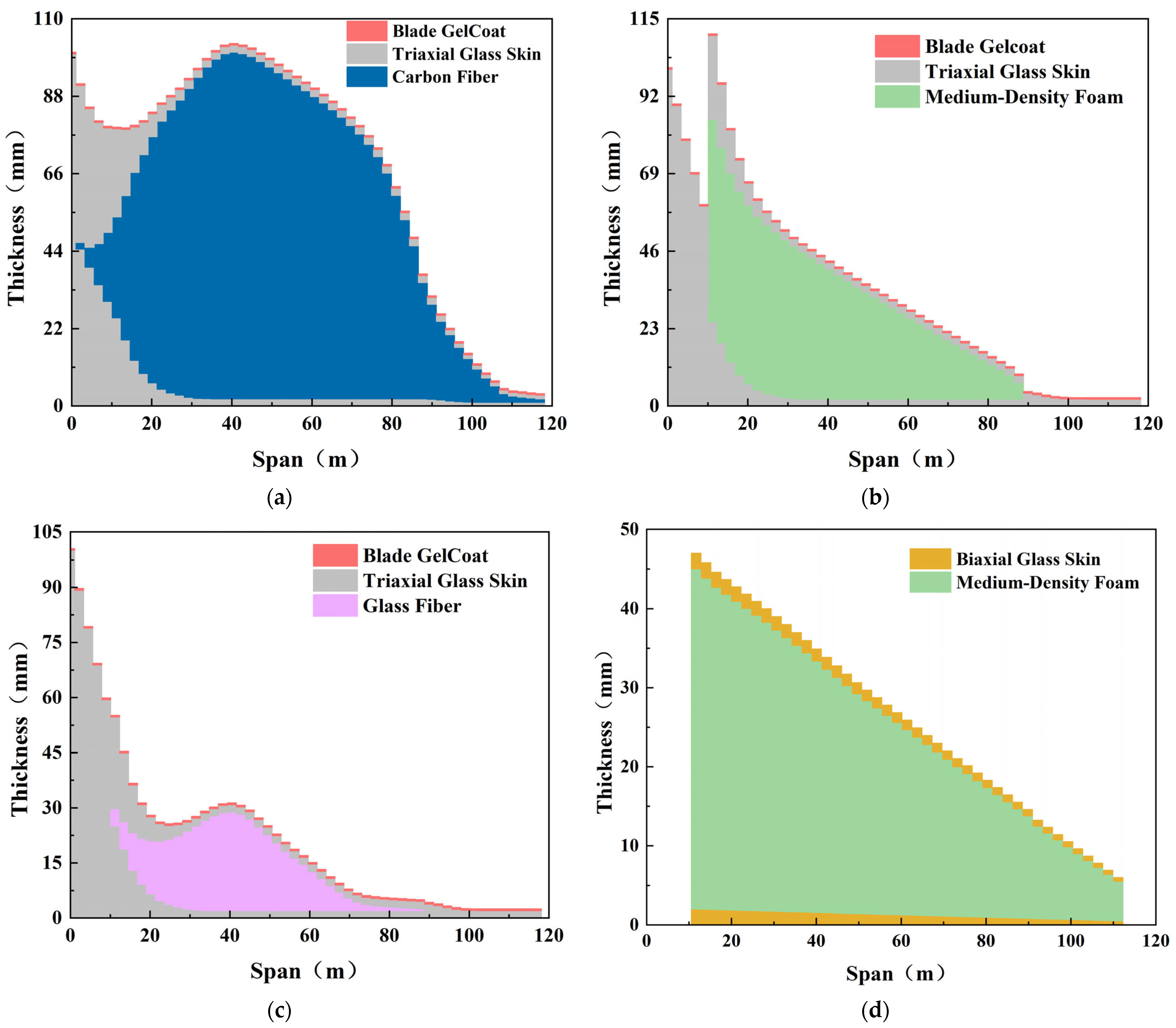
For blade material allocation, a zoning design method is adopted, dividing the blade cross-section into five key regions: the leading-edge spar, leading-edge panel, main spar, trailing-edge panel, and trailing-edge spar. According to the 15 WM technical report, the blade material is divided into different zones, including the blade gelcoat, glass fiber, and medium-density foam. The material properties are listed in Table 2.
Table 2. Laminate material properties of the blade layers.
The specific distribution scheme of composite laminate layers along the blade span is shown in Figure 5.
Figure 5. Composite material distribution of 15 MW offshore blade: (a) spar cap; (b) panel; (c) leading edge and trailing edge; (d) shear web.
The constructed full-scale finite element model of the 15 MW ultra-long flexible blade is shown in Figure 6.
Figure 6. Full-scale finite element model of blade.

3. Typhoon-Induced Blade Load and Responses

3.1. Model Validation

3.1.1. Typhoon Model Verification

The accuracy assessment of the typhoon model encompasses three aspects: typhoon track (central latitude and longitude), central pressure, and maximum near-center wind speed. To enhance typhoon simulation precision, this study systematically evaluates the sensitivity of microphysical processes and cumulus convection parameterization to typhoon wind field simulations. The Yonsei University Boundary Layer Scheme combined with the new Kain–Fritsch Cumulus Parameterization Scheme exhibits optimal simulation performance by coordinating interactions between boundary layer processes and deep convection mechanisms, and is thus selected as the preferred parameterization configuration for typhoon intensity simulations.
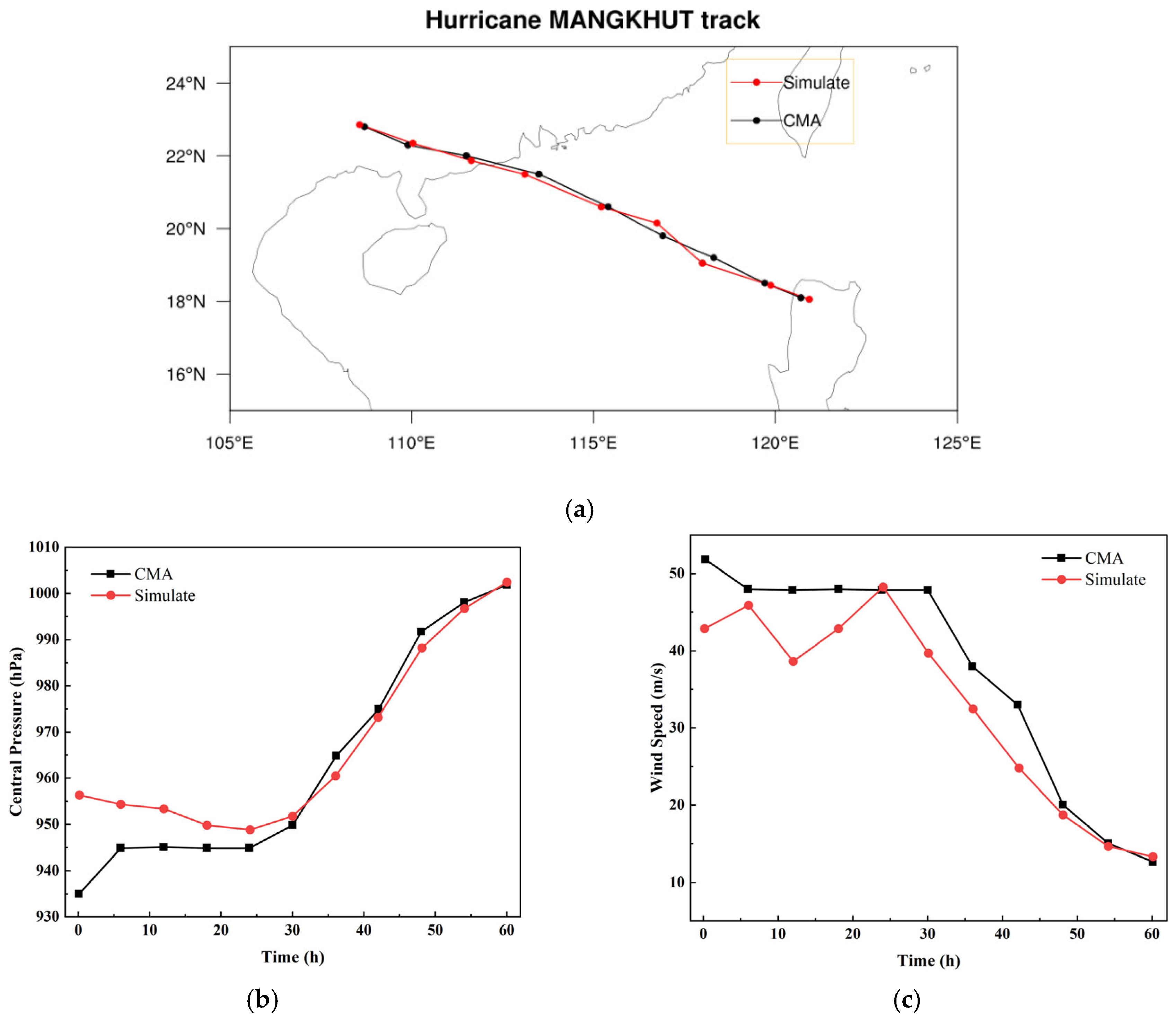
Furthermore, on the basis of the determined scheme, a three-dimensional variational assimilation system (3DVAR) is integrated to perform spatiotemporal fusion of multi-source observational data, effectively optimizing the dynamic and thermodynamic structures of the initial field [27]. Figure 7 presents the simulation results after 3DVAR processing, where the black polyline represents the best track observational data from the publicly accessible database of the China Meteorological Administration (CMA).
Figure 7. Comparative analysis of Typhoon Mangkhut data assimilation: (a) central latitude and longitude; (b) central pressure; (c) maximum wind speed at the center.
Figure 7 illustrates that the numerical simulation based on 3DVAR data assimilation technology significantly improves the simulation accuracy of Typhoon Mangkhut. Regarding track simulation, the post-assimilation trajectory deviation is markedly reduced, and nearly coincides with the CMA best track observational data after landfall. For intensity evolution simulation, the central pressure exhibits an average positive bias of 5 hPa in the first 24 h of integration, with errors decreasing to within 2 hPa thereafter; the maximum wind speed simulation shows relatively larger errors compared to CMA best track data, but achieves high consistency with observations after landfall. These improvements confirm that data assimilation techniques, through the assimilation of radar radial winds, AMSU-A microwave data, and sea surface temperature data, effectively enhance initial field quality, thereby improving both track and wind speed simulation accuracies and providing a reliable technical reference for strong typhoon numerical forecasting.

3.1.2. Blade Aerodynamic Model Verification

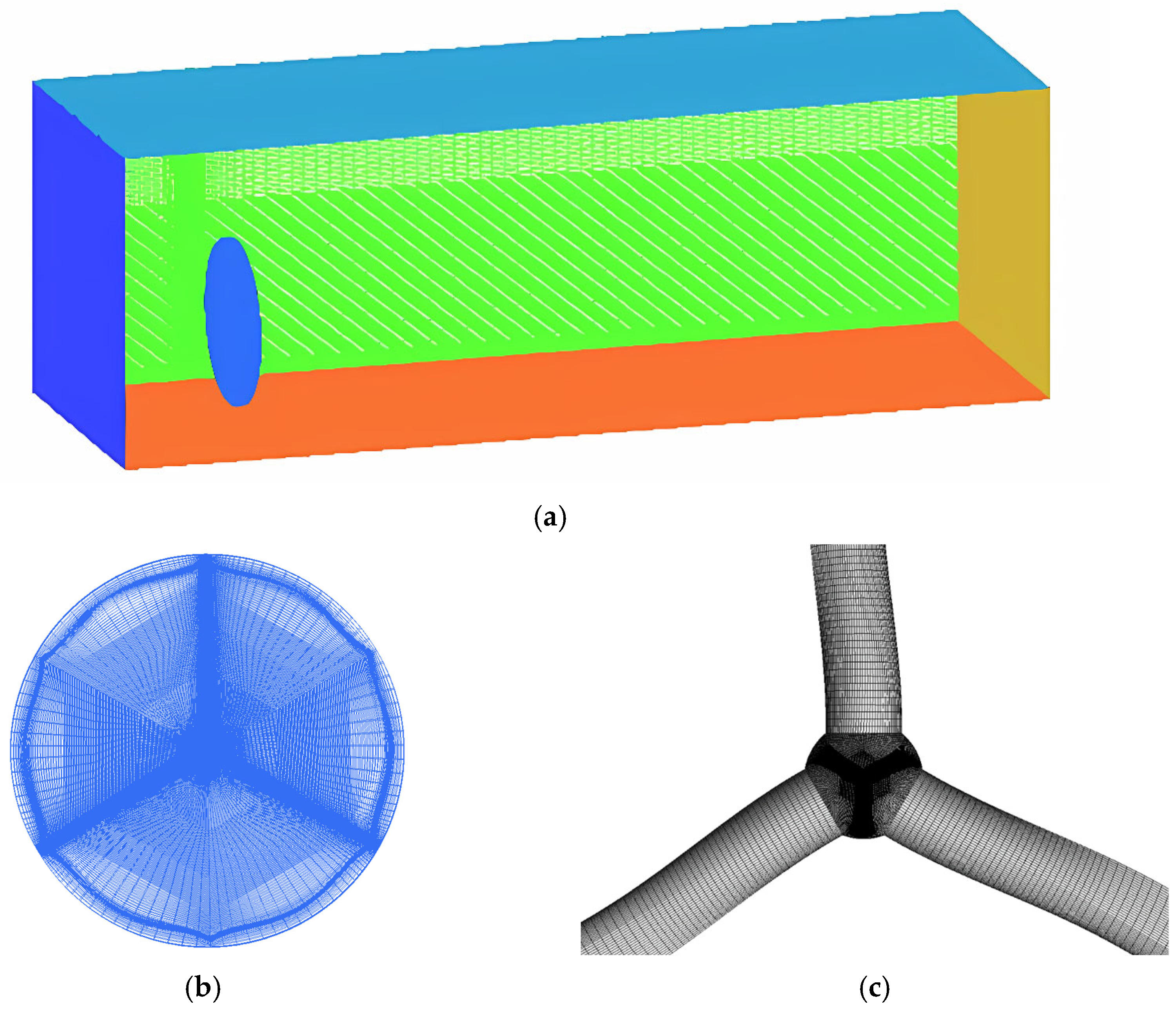
The validation of the 15 MW offshore blade aerodynamic model is divided into independence verification and official benchmark operating condition aerodynamic performance verification. The independence verification further comprises grid independence and time step independence verifications. Structured grids are employed for domain meshing in the CFD simulations, with refinement applied to the blade rotation region and its surroundings. Grid densification is implemented at the front and rear positions of the stationary domain near the rotation domain, and boundary layers of specific thickness are assigned to the blade and hub surfaces. The meshing results are shown in Figure 8.
Figure 8. CFD simulation model of 15 MW wind turbine: (a) 3D mesh of all computational domains; (b) mesh of the rotating domain; (c) rotor mesh.
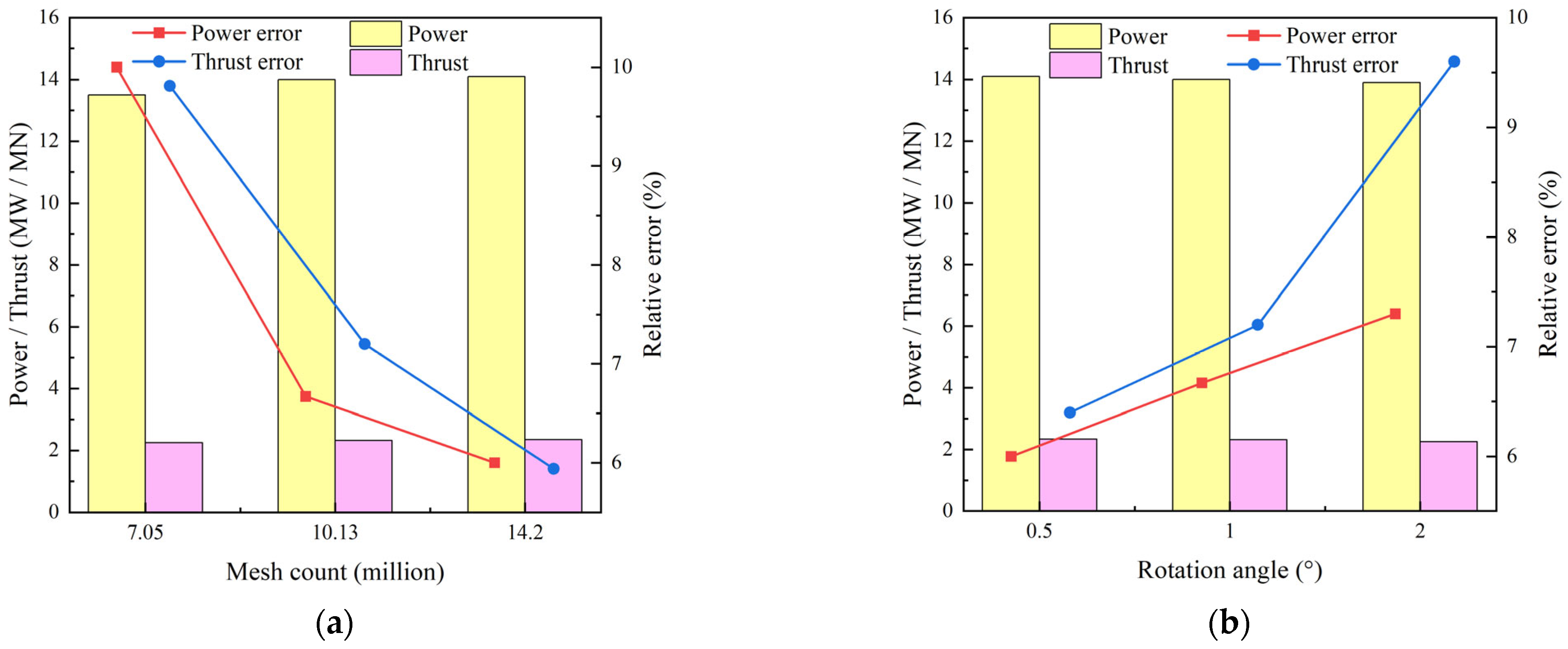
Grid independence verification is a critical step in numerical simulation studies, aimed at systematically analyzing the influence of grid density on numerical solutions to determine the optimal balance between computational accuracy and resource consumption. This process plays a decisive role in ensuring the reliability of numerical results. This study adopts a global refinement strategy for comparative analysis across three grid counts: 7.05 million, 10.13 million, and 14.20 million. The results are presented in Figure 9a.
Figure 9. CFD model independence verification results: (a) mesh parameters; (b) time step parameters.
The results indicate that, with 7.05 million grids, the computed thrust and power deviate substantially from the literature data, with errors of up to 10%, indicating that this grid scale fails to meet engineering requirements. As the grid size decreases and the grid count increases to 10.13 million, the power error reduces to 6.67%, markedly improving simulation accuracy. Further increasing the grid count to 14.20 million yields a power error converging to 6%, with limited accuracy gains compared to 10.13 million grids but significantly higher computational costs. Based on the balance between computational accuracy and efficiency, this study ultimately selects 10.13 million grid cells for subsequent numerical simulations.
In time step independence verification, time steps corresponding to blade rotations of 0.5° to 1° are commonly selected [28]. For comparative purposes, this study adopts time steps corresponding to blade rotations of 0.5°, 1°, and 2°, with all cases using 10.13 million grids, as shown in Figure 9b. Smaller time steps yield results closer to design performance values and faster convergence; however, the 0.5° time step incurs excessive computational demands with marginal accuracy improvements. Considering both computational efficiency and simulation accuracy, a 1° time step (corresponding to 0.0224 s) is ultimately selected as the optimal scheme.
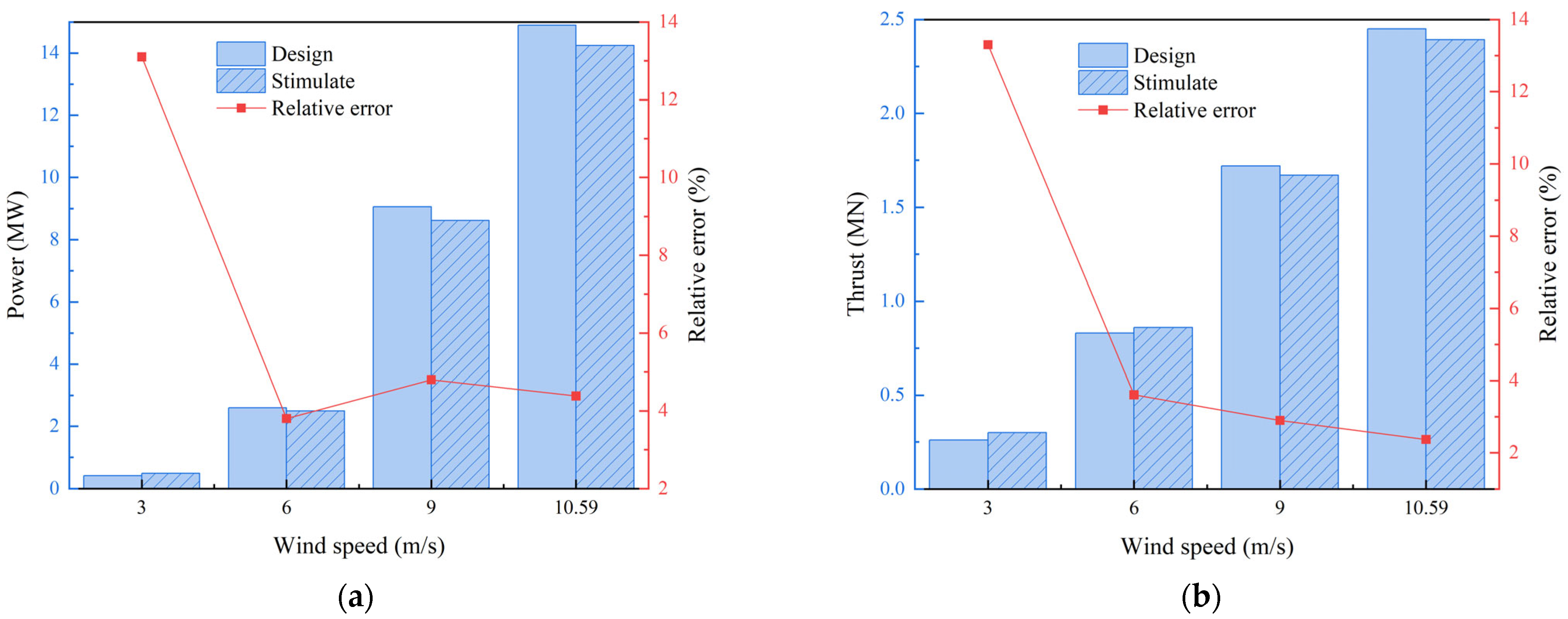
The 15 MW wind turbine employs a variable-speed variable-pitch coordinated control strategy for power optimization, with a rated wind speed of 10.59 m/s. To validate the computational method’s reliability, turbine power and thrust at inflow wind speeds of 3 m/s, 6 m/s, 9 m/s, and 10.59 m/s are extracted and compared against official design data, with results shown in Figure 10.
Figure 10. Aerodynamic performance verification of a 15 MW offshore wind turbine: (a) power; (b) thrust.
The results show that, prior to reaching the rated wind speed, turbine output power and thrust increase with wind speed, consistent with the trends in the design data. Relative errors are larger in the cut-in wind speed phase, partly due to the inherently small absolute values of power and thrust at low wind speeds, where minor numerical differences amplify relative errors.
Additionally, the pitch angle is not fully open during cut-in, differing substantially from the optimal pitch for power extraction (operating state). However, as this study does not address low-wind-speed phases, no model adjustments are made for this stage. Overall, although the computed values are slightly lower than the reference data, errors remain within 5%, within acceptable bounds, confirming the effectiveness and accuracy of the numerical simulation method.

3.1.3. Blade Structural Model Verification

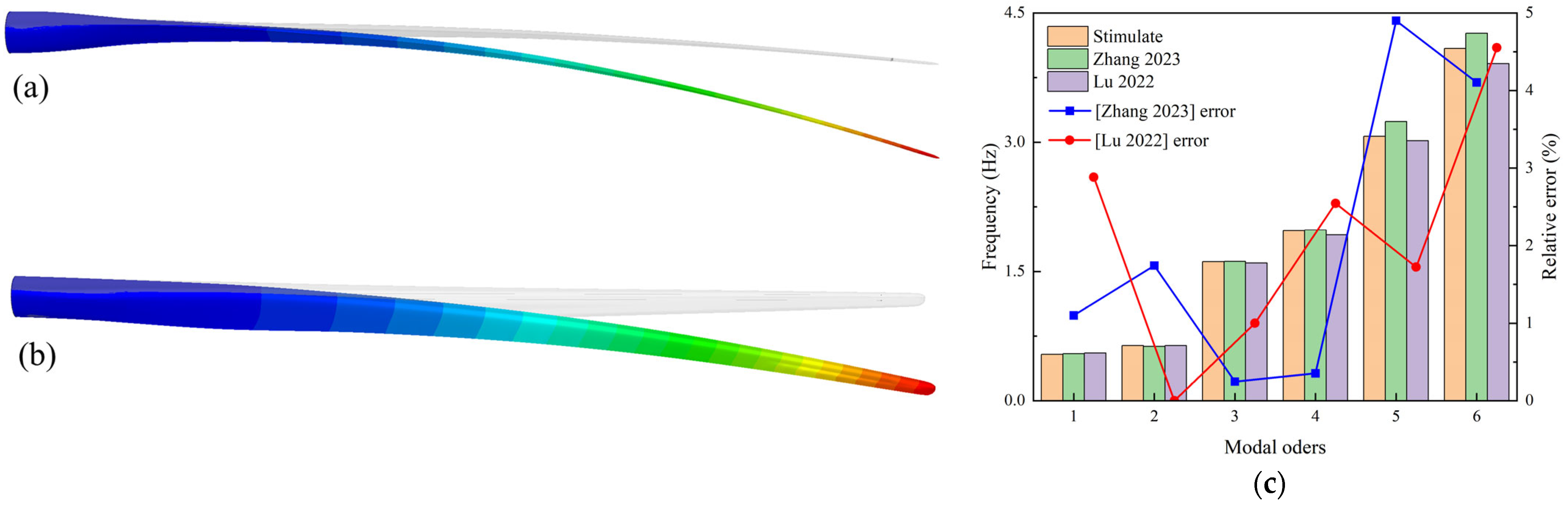
The validation of the full-scale blade structural model includes blade total mass and the first six modal frequencies, compared against the IEA 15 MW technical report [24], Ref. [29], and Ref. [30]. The modal results are shown in Figure 11.
Figure 11. Modal analysis of 15 MW offshore wind turbine blade: (a) flapwise modal; (b) edgewise modal; (c) comparison of modal frequency [29,30].
Statistical comparison with official data reveals a relative error of 0.89% for blade mass, 3.67% for the first flapwise modal frequency, and 1.88% for the first edgewise modal frequency. Against the published literature, the maximum modal frequency error is within 5%, satisfying computational accuracy requirements. These results provide a reliability guarantee for subsequent numerical simulations of blade structural responses under extreme conditions.

3.2. Typhoon Vertical Wind Profile Analysis

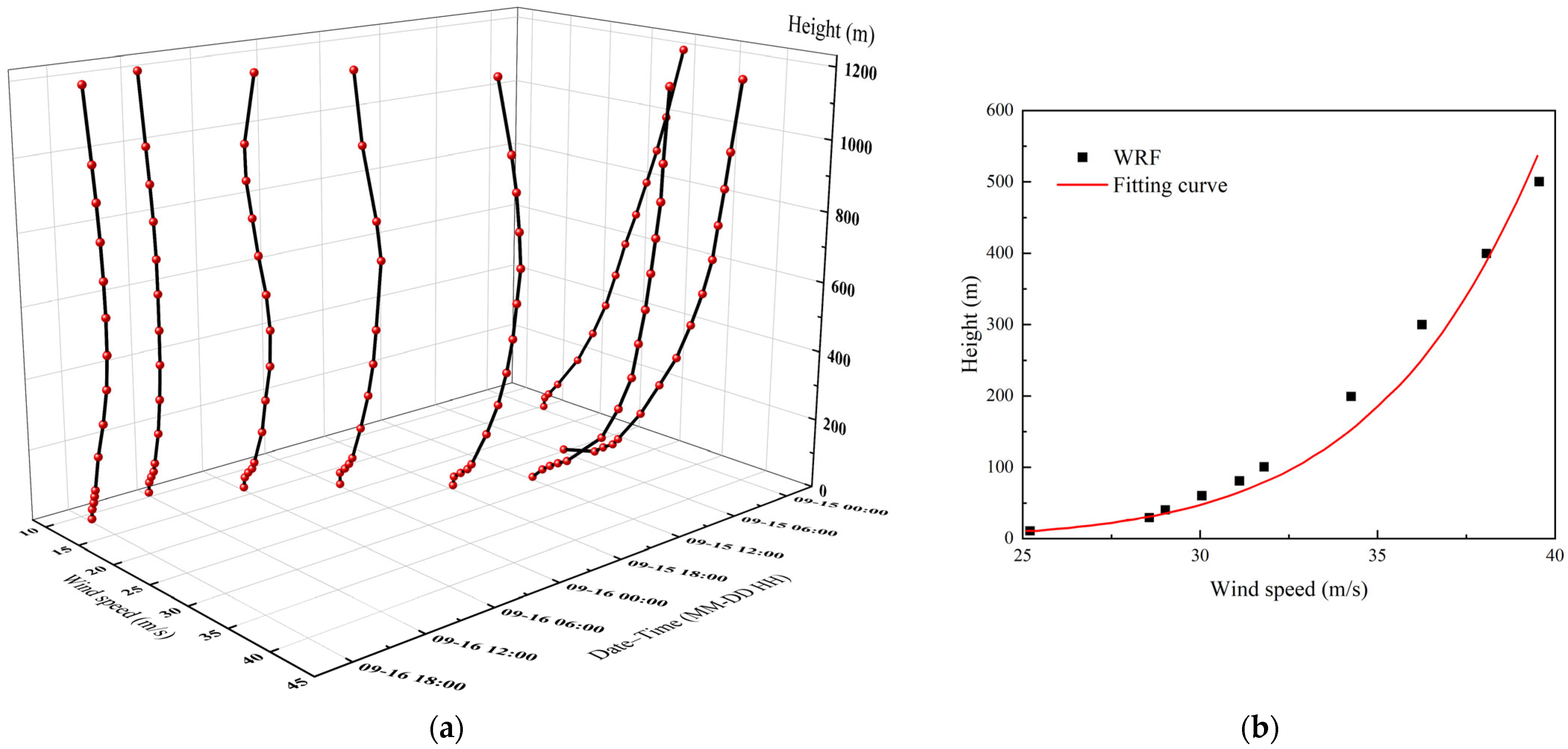
Building on the validated typhoon simulation parameter scheme, this study investigates the spatiotemporal evolution characteristics of the vertical wind speed profile in the eyewall of Typhoon Mangkhut. Figure 12a presents the wind profiles at different times on September 15 to 16. The results reveal a typical stratified structure in the vertical wind speed distribution: within 0–700 m, wind speed increases monotonically with altitude, following an exponential distribution pattern; beyond 700 m, the rate of increase slows, gradually stabilizing. As the typhoon approaches, wind speeds intensify, peaking at 44 m/s, before subsequently diminishing.
Figure 12. Typhoon Mangkhut simulation results: (a) wind speed profiles at different moments; (b) fitting curve at the moment of maximum wind speed.
At the maximum wind speed moment, a near-surface wind speed profile model for the typhoon is constructed using nonlinear least-squares fitting, conforming to the typhoon power law distribution [31]. The mathematical expression is as follows:
V H = V h H h α
where VH is the wind speed at height H, Vh is the observed wind speed at reference height h, and is the wind shear exponent.
The expression for near-surface turbulence intensity is as follows:
I u = 0.282 × ( h 10 ) 0.116
where Iu is the turbulence intensity at height h, and 0.282 is the nominal turbulence intensity at a height of 10 m, derived from the synchronous measurements of Typhoon Mangkhut in Ref. [32].
Calculations indicate that an exponent of 0.116 yields the best fit for the wind speed profile, with high reliability in characterizing the near-surface typhoon wind field (coefficient of determination R2 = 0.999), as shown in Figure 12b. Notably, significant wind speed features are observed at the 10 m reference height, with a diminishing vertical gradient, consistent with atmospheric boundary layer theory predictions.

3.3. Blade Aerodynamic Load Analysis

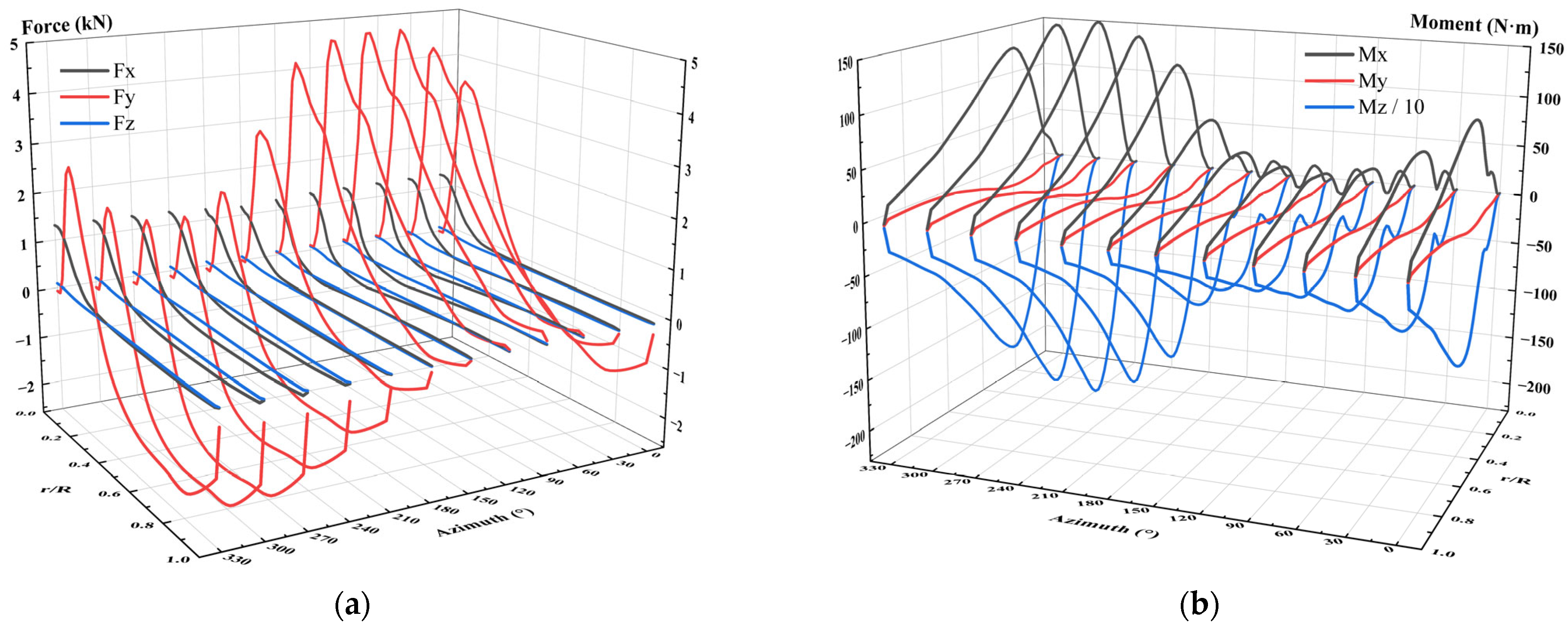
To obtain aerodynamic loads on the wind turbine more aligned with actual typhoon conditions, simulations of the 15 MW blade incorporate not only the wind shear effects of Typhoon Mangkhut but also tower shadow effects. During wind turbine parking, all blades are in the feathered position (90° pitch). Aerodynamic forces (Fx, Fy, Fz) and moments (Mx, My, Mz) along the blade span are extracted to analyze blade loads at different azimuth angles, with the results presented in Figure 13.
Figure 13. Spanwise distribution of aerodynamic loads on blades under rotor ideal conditions: (a) aerodynamic forces at different azimuth angles; (b) aerodynamic moments at different azimuth angles.
The subscripts of aerodynamic forces F and moments M denote the coordinate axes, as labeled in Figure 3b. The aerodynamic loads at each spanwise position of the blade are obtained by integrating the surface pressure field and wall shear stress field of that cross-section in CFD, and the mathematical expression is as follows:
F = S ( p n + τ ) d S M = S r × ( p n + τ ) d S
where F and M are both aerodynamic vectors, S is the integration surface of the blade element, p denotes the fluid pressure, n is the unit outward normal vector of the blade element (pointing from the wall to the fluid domain), τ is the wall shear stress tensor (generated by fluid viscosity), and r is the position vector from the aerodynamic center to the surface element dS.
From the blade coordinate system schematic described previously, the X-direction aligns with the inflow, pointing downstream toward the hub; the Y-direction follows the blade motion in the rotor plane; and the Z-direction extends from root to tip. Figure 13a shows that, in a parked wind turbine with blades feathered, the blade primarily experiences Fy (in-plane) forces, followed by Fx (out-of-plane) forces, with minimal axial tensile forces. The variation of Fy from root to tip first increases then decreases, transitioning from positive to negative, where opposing Fy directions induce strong shear at spanwise junctions. Fy reaches positive extrema at 30–150° azimuth angles and negative extrema at 210–300° azimuth angles. Fx decreases continuously to zero along the span but shows minimal variation with the azimuth angle.
Figure 13b indicates that the dominant aerodynamic moment is Mz, exerting strong torsional effects on the blade, all negative, suggesting a tendency to further increase the pitch angle in this state. The range of Mx exceeds that of My, implying greater in-plane than out-of-plane moment effects. Aerodynamic moments initially decrease then increase with azimuth angle, reaching minima at 90–120° across all directions. These results demonstrate that, with tower shadow effects, blade aerodynamic loads under tailwind are not minimized at 180° azimuth; interference between the blade and tower at 180° disrupts the conventional notion that lower vertical wind speeds yield smaller loads during typhoons.
Statistical analysis reveals that the maximum and minimum aerodynamic force extrema occur in-plane, with the maximum of 4.83 kN at 14.3% span on the 90° azimuth blade and the minimum of −2.69 kN at 57.1% span on the 270° azimuth blade. Aerodynamic moment extrema occur at 26.5% span on the 270° azimuth blade, with the maximum in-plane value of 161.6 N·m and the minimum torsional value of −2306 N·m.

3.3.1. Influence of Wind Turbine Yaw

Due to the rapidly varying characteristics of typhoons [31], yaw motors employed in wind turbines typically operate at low rotational speeds [33], preventing the rotor plane from aligning instantaneously with the wind direction under typhoon conditions. Furthermore, to avoid frequent control actions that shorten the yaw system lifespan, the servo motor is generally activated only after wind direction changes persist for a specified duration [34], further intensifying the loading on wind turbines under yawed conditions in extreme typhoon environments. Therefore, to investigate the variation patterns of blade aerodynamic loads under yaw, analyses of blade aerodynamic loads at different azimuth angles were conducted for yaw angles ranging from −10° to 10°. This yaw range represents the general criterion for determining whether the wind turbine yaw system is activated; when the wind direction deviation exceeds this range, the yaw motor initiates to align the rotor with the wind [35]. The results are as follows:
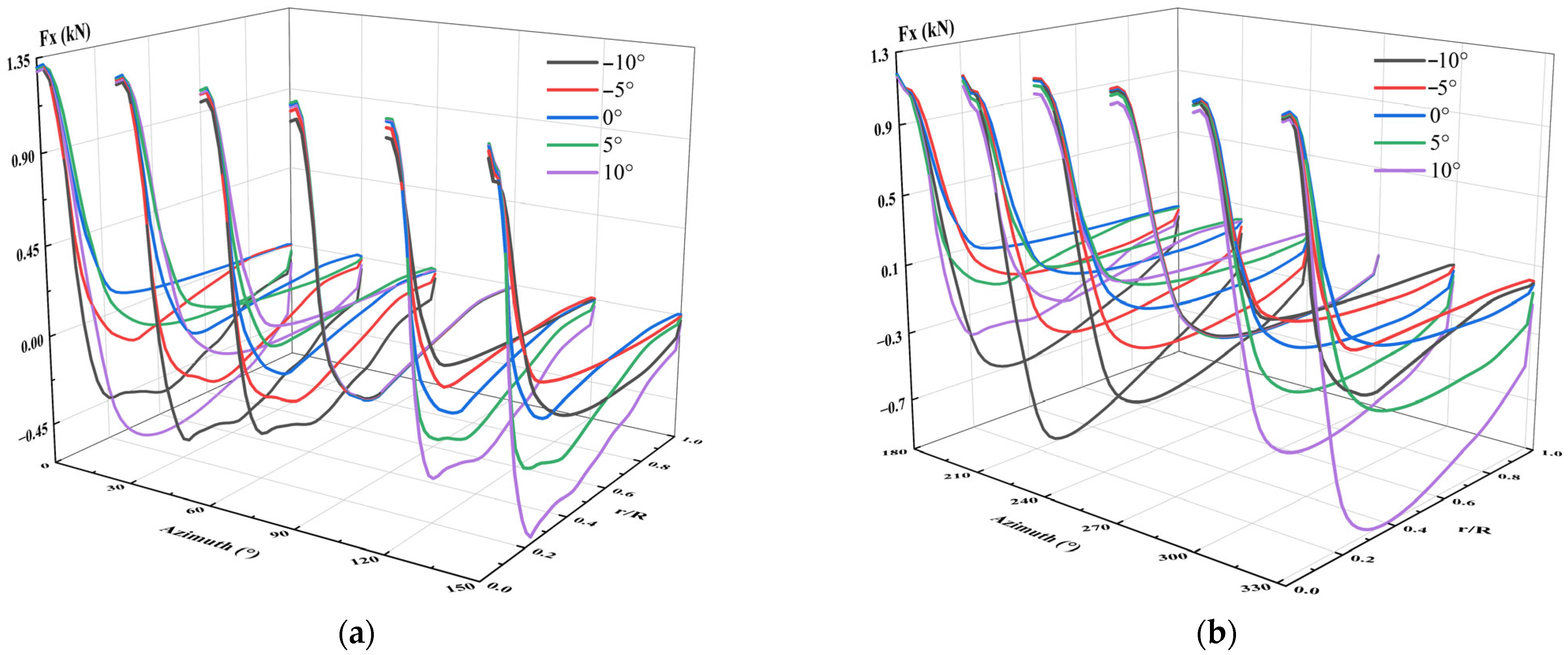
Given the negligible magnitudes of Fz and My from prior analysis, they are excluded from yaw influence studies. Figure 14 shows that Fx variations along the span at various yaw angles generally follow a decrease-then-increase pattern, attributable to the 90° pitch angle where the angle of attack is solely determined by geometric twist. Per Figure 2b, the 15 MW blade geometric twist follows a logarithmic decrease along the span, with significantly larger values near the root, resulting in greater out-of-plane forces there.
Figure 14. Aerodynamic loads on blade under rotor yawed conditions (out-of-plane): (a) blade azimuth angles from 0° to 150°; (b) azimuth angles from 180° to 330°.
At 90° and 270° azimuth angles, yaw has minimal impact on Fx, as horizontal blade positions maintain approximate original angles of attack despite shifting from uniaxial (along X) to biaxial (X and Z) inflow alignment. This indicates the insensitivity of out-of-plane forces on ultra-long flexible blades to spanwise flow changes under small yaw angles.
Fx at different azimuth angles is highly sensitive to yaw variations, with a minimum range of 347.4 N at 0° yaw. This range increases by 95.45% and 219.8% for positive yaws and by 33.68% and 214.3% for negative yaws. This suggests stronger influences from positive yaw on out-of-plane forces, due to asymmetric suction/pressure surface geometries amplifying Fx fluctuations.
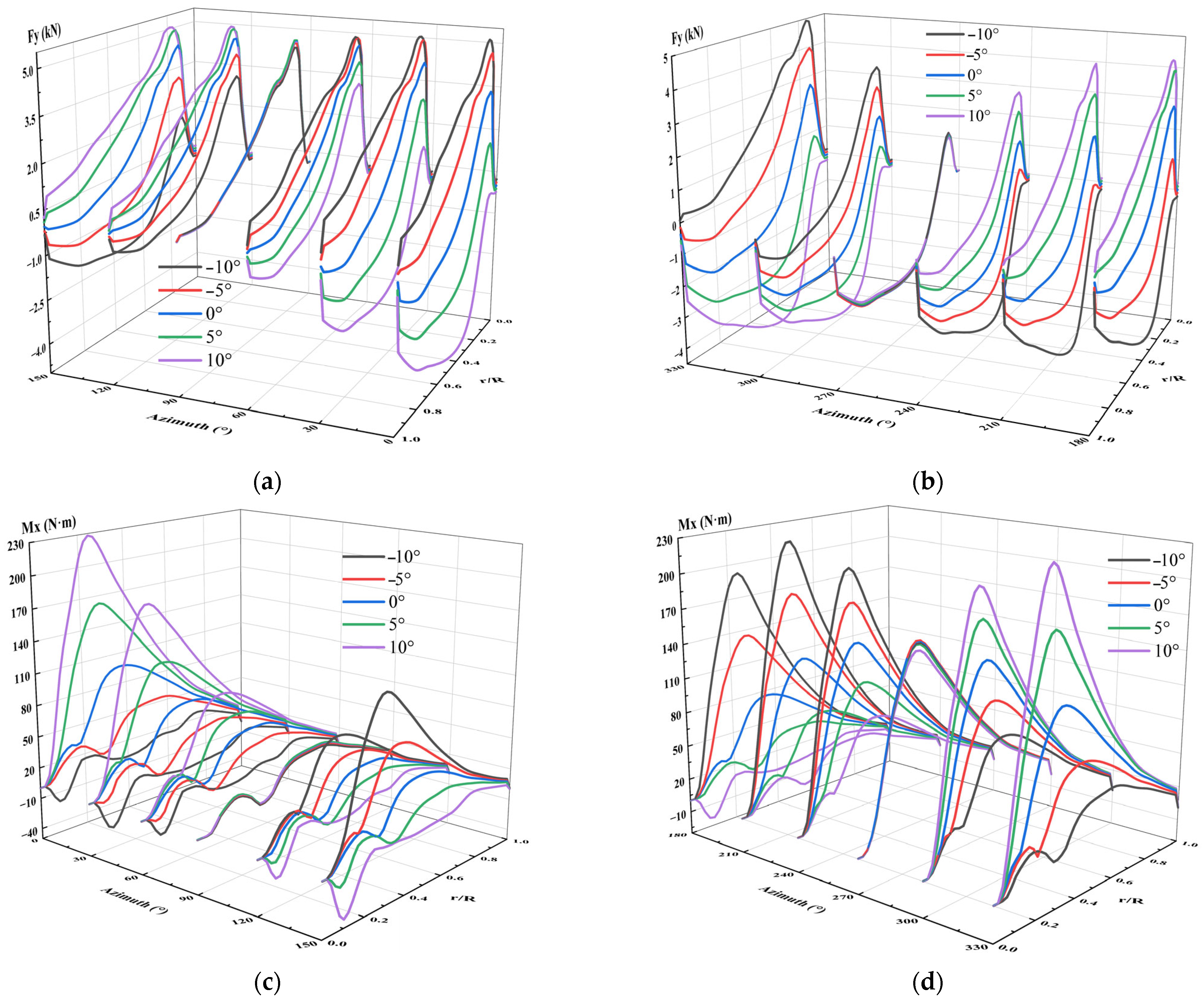
Figure 15 illustrates that in-plane aerodynamic characteristics of the 15 MW blade under typhoon extremes vary with the azimuth angle similarly to out-of-plane ones. At 90° or 270° azimuth, Fy and Mx curves across yaw angles are nearly identical, indicating the insensitivity of in-plane loads on offshore long flexible blades to small yaw changes in high winds. However, Fy and Mx trends along the span diverge across yaw angles, implying that azimuthal symmetry fails to ensure consistent in-plane characteristics, owing to asymmetric suction/pressure surface layouts, which manifest in-plane during blade feathering.
Figure 15. Aerodynamic loads on blade under rotor yawed conditions (in-plane): (a) Fy distribution at blade azimuth angles from 0° to 150°; (b) Fy distribution at blade azimuth angles from 180° to 330°; (c) Mx distribution at blade azimuth angles from 0° to 150°; (d) Mx distribution at blade azimuth angles from 180° to 330°.
At 10° yaw, Fy increases then decreases with azimuth, minimizing at 330–360° (0°) and maximizing at 150°. At −10° yaw, the pattern reverses, minimizing at 210° and maximizing at 0–30°. Bounded by horizontal positions, positive yaw yields a larger Fy at 90–270° azimuth than no yaw, while negative yaw yields a larger Fy below 90° or above 270°.
In-plane moment Mx is predominantly positive along the span, indicating overall moments from suction to pressure surfaces, promoting transition to operational rotation. At 210–330° azimuth, Mx increases then decreases with span, peaking at 20–30%; at 0–180° azimuth, it exhibits more complex increase–decrease–increase–decrease patterns. Overall, 0° azimuth yields maximum in-plane loads under both positive and negative yaw, rendering it the most adverse.
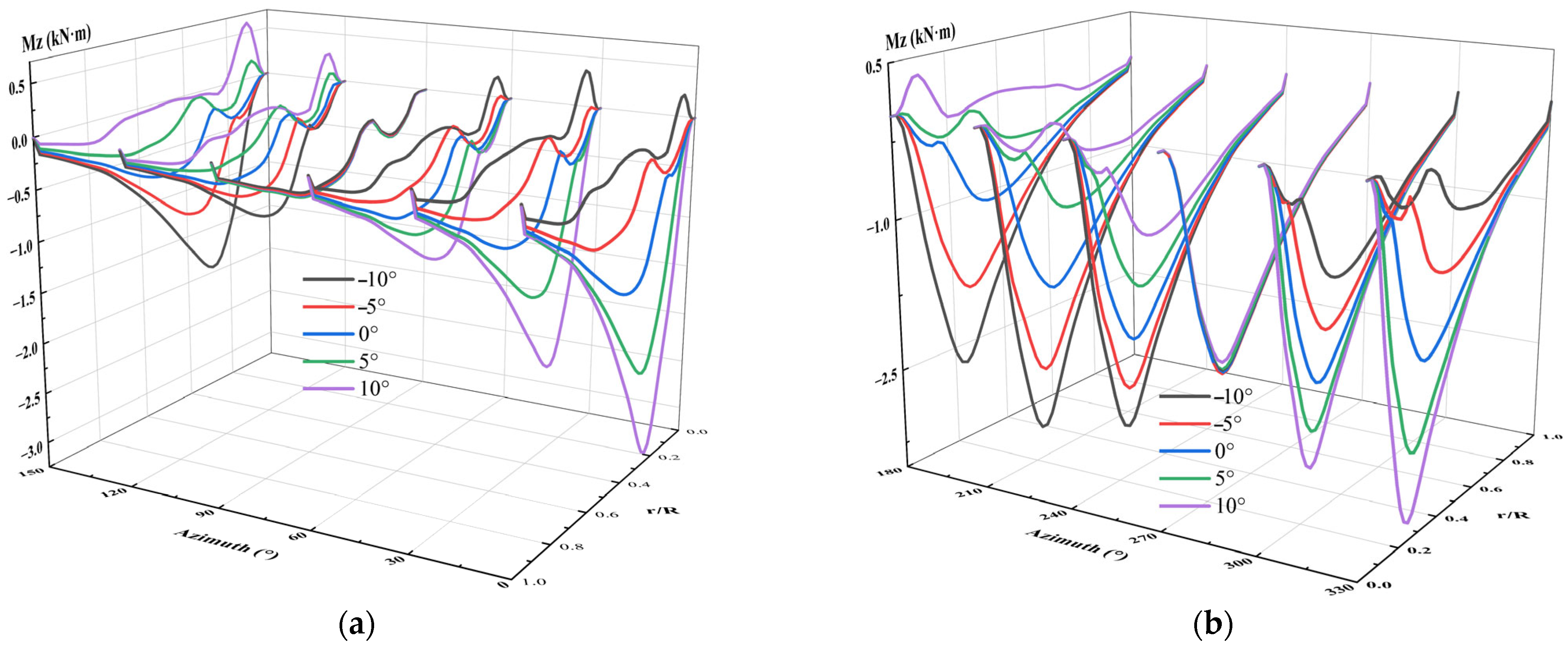
Figure 16 shows that, at horizontal positions, Z-axis torsional moments remain insensitive to small rotor yaw changes. In most azimuths, yaw exacerbates negative torsional moments, simplifying Mz spanwise trends to quadratic decrease-then-increase curves. Only at 60–120° azimuth does yaw fail to alter Mz patterns, as feathered blades with suction surfaces upward and pressure surfaces downward interact with vertical shear, reducing suction pressures and increasing pressure ones, reinforcing existing Mz distributions and resisting small yaw influences.
Figure 16. Aerodynamic torsional loads on blade under rotor yaw conditions (about the blade axis): (a) blade azimuth angles from 0° to 150°; (b) blade azimuth angles from 180° to 330°.
At 120–240° azimuth, negative yaw intensifies torsion while positive yaw alleviates it; at 0–60° or 330–360°, positive yaw intensifies and negative alleviates. This symmetric azimuthal influence on Mz suggests minimal impact from suction/pressure geometries on torsional loads.
Statistics show that, at 0° azimuth, positive yaw most intensifies Mz torsion (125.4% increase over no yaw), while negative yaw most alleviates it (73.25% reduction). At 210° azimuth, positive yaw most alleviates (68.93% reduction) and negative most intensifies (77.02% increase). This indicates the potential for 0° azimuth torsional moments to shift from minimum to maximum loads; under short-term typhoon direction forecasts, −10° yaw can reduce torsional moments.

3.3.2. Influence of Blade Pitch

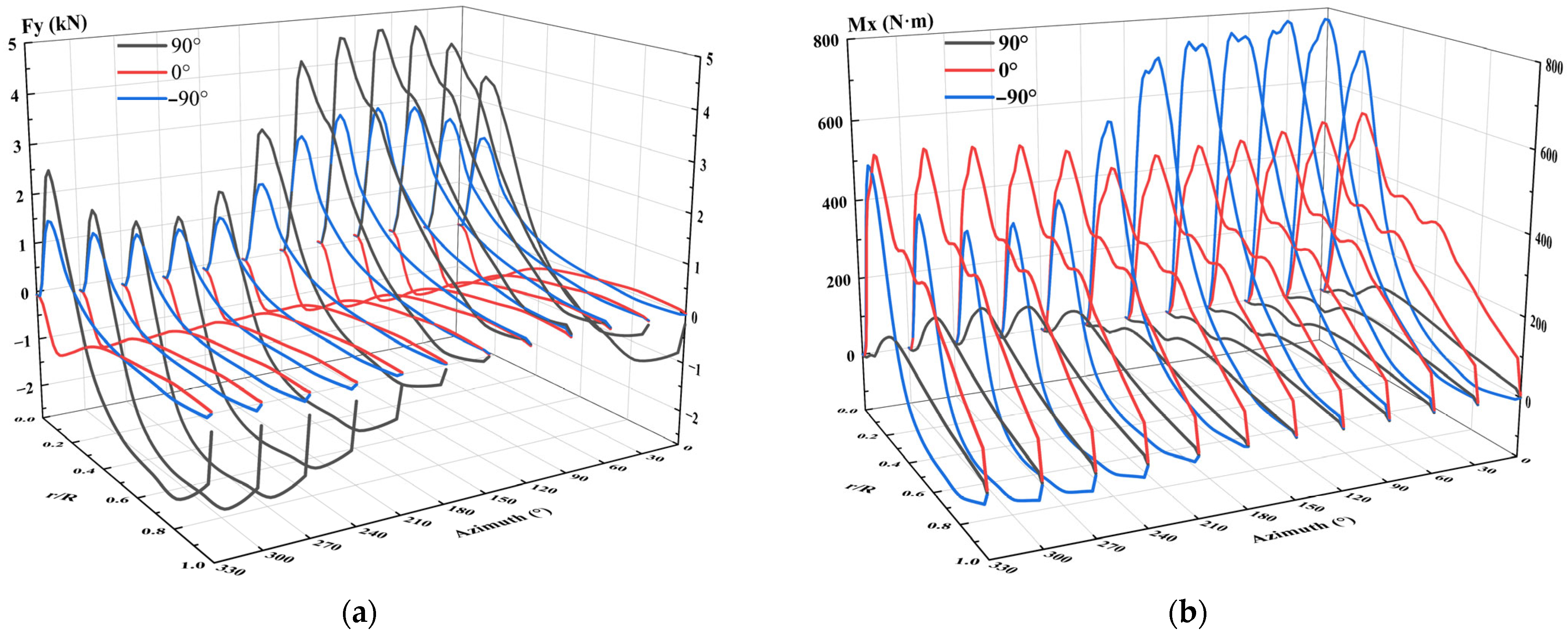
Under typhoon extremes, a parked wind turbine typically feathers its blades, but system faults may cause feathering failure, retaining 0° pitch. Though rare, to explore blade aerodynamic loads under extremes, this study analyzes load patterns at various pitches. Additionally, as some studies [36] indicate lower loads in a reversed position (trailing edge windward, −90° pitch), this is included to verify its applicability to offshore ultra-long flexible blades during typhoons. The results are as follows:
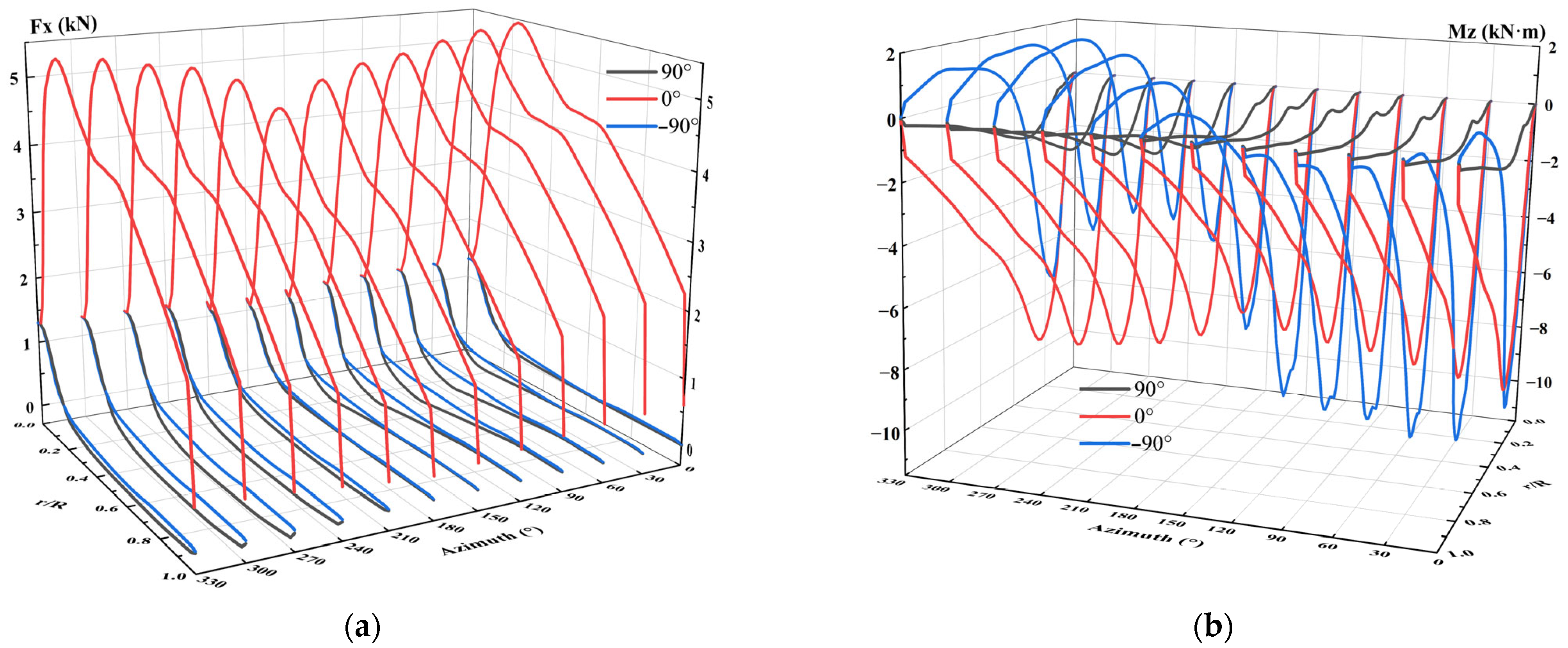
Figure 17 shows identical root aerodynamic loads across pitches, as root aerodynamics approximate cylindrical geometry, invariant to pitch-induced angle-of-attack changes. This confirms the diminishing pitch influence near the root.
Figure 17. Spanwise distribution of blade aerodynamic loads under different blade pitch angles (out-of-plane): (a) Fx distribution at blade azimuth angles from 0° to 330°; (b) Mz distribution at blade azimuth angles from 0° to 330°.
At 90° pitch, absolute Fx and Mz are minimized across azimuths, affirming feathering to be optimal under typhoon extremes. At 0° pitch, minima occur at 180° azimuth, highlighting pronounced tower shadow effects reducing out-of-plane thrust.
In Figure 17a, 0° pitch Fx substantially exceeds the 90° and −90° pitches, as feathering and reversing align the chord with the inflow, mitigating out-of-plane forces. Compared to feathering, 0° and −90° pitches increase the maximum Fx by 43 and 1.67 times (at 0° and 90° azimuth) and minima by 42 and 62.56% (at 180°), underscoring the avoidance of pitch in the operating state to minimize out-of-plane forces during typhoons.
Figure 17b shows reversed Mz trends closer to the operating state than the feathered state. At 0–180° azimuth, reversed negative peaks exceed the operating state; at 210–360°, the reversed distribution exhibits positive peaks mid-span and near the tip, indicating strong torsional shear in transition zones, prone to trailing-edge failure.
Figure 18 presents in-plane load curves versus the azimuth at various pitches, confirming substantial loads in reversed feathering during typhoons. Combined with Figure 16, this validates the limited load reduction from reversing on offshore ultra-long flexible blades, with potential moment amplification, rendering it unsuitable for extreme load mitigation.
Figure 18. Spanwise distribution of blade aerodynamic loads under different blade pitch angles (in-plane): (a) Fy distribution at blade azimuth angles from 0° to 330°; (b) Mx distribution at blade azimuth angles from 0° to 330°.
Figure 18a shows feathered in-plane forces occasionally exceeding reversed and operating states, with the operating state minimizing them. In the operating state, in-plane forces align with the chord (pressure facing inflow); aerodynamically, drag dominates over lift, yielding low in-plane components. Feathered Fy origins and trends have been summarized previously; though larger than others, it induces axial stresses and shears bolstered by internal shear webs.
Figure 18b indicates that the operating state and reversed Mx substantially exceed the feathered state, enhancing rotational drive. Reversed Mx is larger at 0–180° azimuth, the operating state at 210–330°. Compared to feathering, the reversed maximum Mx increases 14.58 times (60° azimuth), the operating state 6.34 times (0° azimuth).
In-plane rotational torque comprises aerodynamic torque from Fy lever arms and direct pitch moments. Feathering balances positive/negative Fy, relying on Mx; low Mx at 90° yields minimal shutdown torques. Pitch in the operating state superimposes force and moment, maximizing them; the reversed state relies on an integrated large Mx, also yielding high torques.

3.3.3. Comprehensive Performance of Rotor

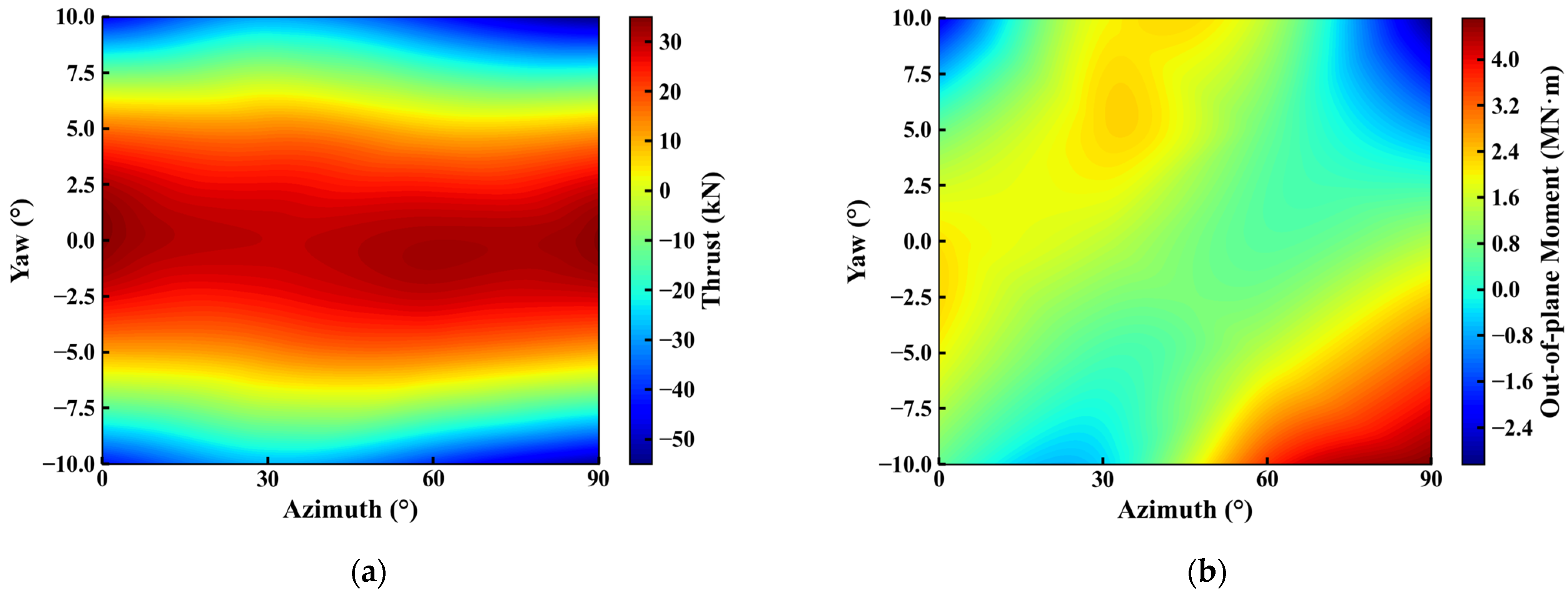
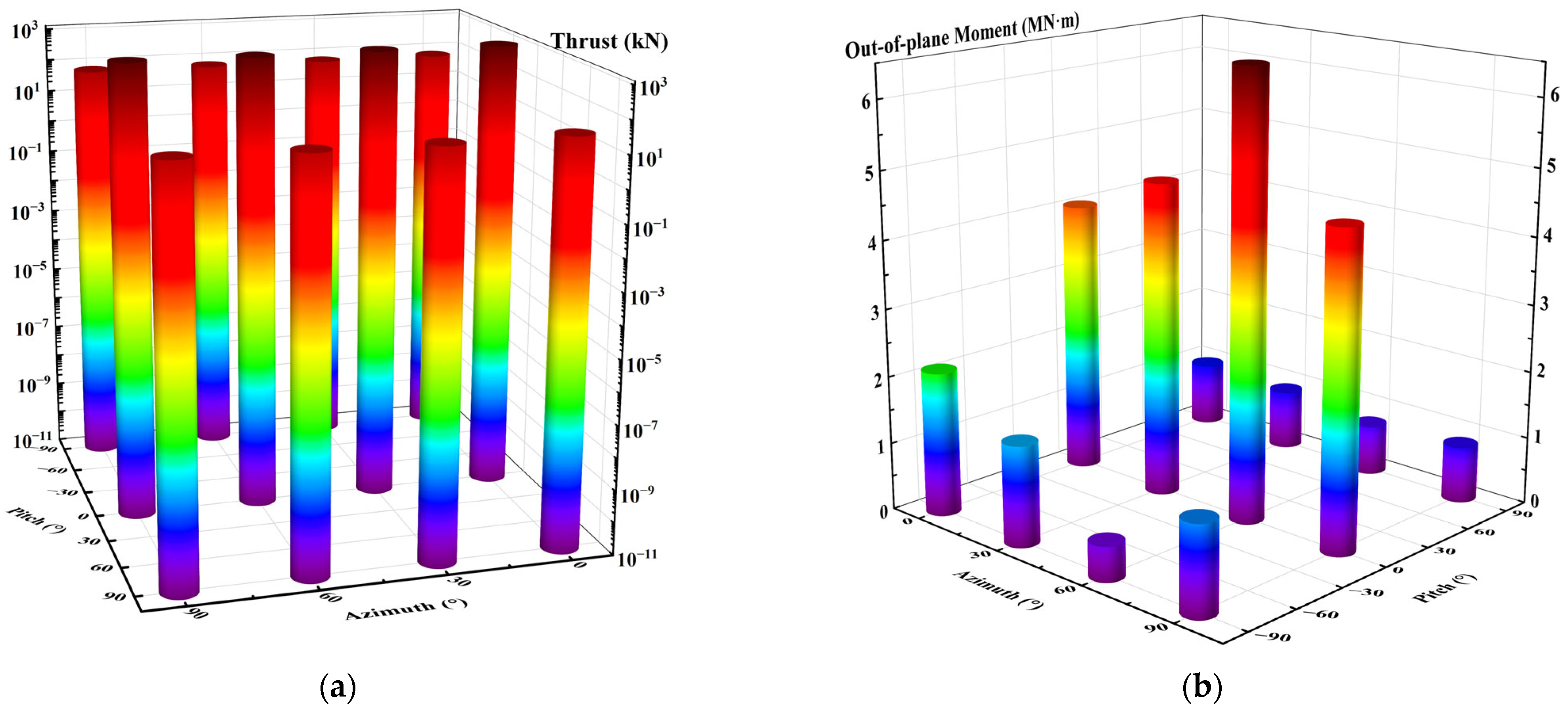
To ensure reasonable aerodynamic inputs for subsequent aeroelastic and fatigue calculations, overall typhoon loads on the ultra-large turbine are assessed under ideal (normal) and adverse (maximum load) rotor angles, with the most loaded blade azimuth among three being selected for aeroelastic inputs. Offshore turbines, especially floating ones, are sensitive to wind–wave–current coupling and surge/pitch motions; thus, rotor thrust and pitch moments are evaluation metrics. The statistics are as follows:
In Figure 19, the azimuth is marked by the first blade. Figure 19a shows positive thrust at 0° yaw and negative thrust below −5° or above 5°, indicating that yaw reduces thrust, potentially reversing to “pull”.
Figure 19. Aerodynamic loads on the wind turbine rotor under different yaw angles: (a) wind turbine surge direction; (b) wind turbine pitch direction.
Though at their maximum at 0° yaw and 0° azimuth (34.6 kN), absolute values govern aeroelastic/fatigue impacts; at 10° yaw and 90° azimuth, thrust is −54.89 kN, designating this as adverse for extrema.
Figure 19b shows asymmetric pitch moment variations with yaw, lacking directional increases/decreases, due to azimuthal influences on the three-blade synthesis, dispersing values unlike thrust. This complexity implies greater yaw impacts on pitch moments during typhoons; no yaw minimizes them, with extrema at larger yaws. The maximum occurs at −10° yaw and 90° azimuth (4.71 MN·m).
Statistics indicate maximum adverse thrust and pitch moment loads on 330° azimuth blades; ideal thrust on 120° blades; pitch moment on 240° blades.
Figure 20a shows the operating state thrust near 103 kN, which far others; the reversed exceeds the feathered, confirming inferior reduction from reversing versus feathering. A 0° pitch and 0° azimuth are most adverse (1.25 MN thrust), 35.24 times the ideal maximum, affirming feathering load reduction.
Figure 20. Aerodynamic loads on the wind turbine rotor under different blade pitch angles: (a) wind turbine surge direction; (b) wind turbine pitch direction.
Figure 20b mirrors pitch influences on moments, with the operating state exceeding others. A 0° pitch and 30° azimuth are most adverse (4.68 MN·m moment), 3.92 times the ideal maximum. The reversed maximum increases 1.25 times ideally, but the minimum decreases by 31.02%, indicating high load variability and instability.
Adverse statistics: maximum thrust on 0° azimuth blades, pitch moment on 30° azimuth blades. The ideal aligns with the yaw phase.

3.4. Blade Structural Response Analysis

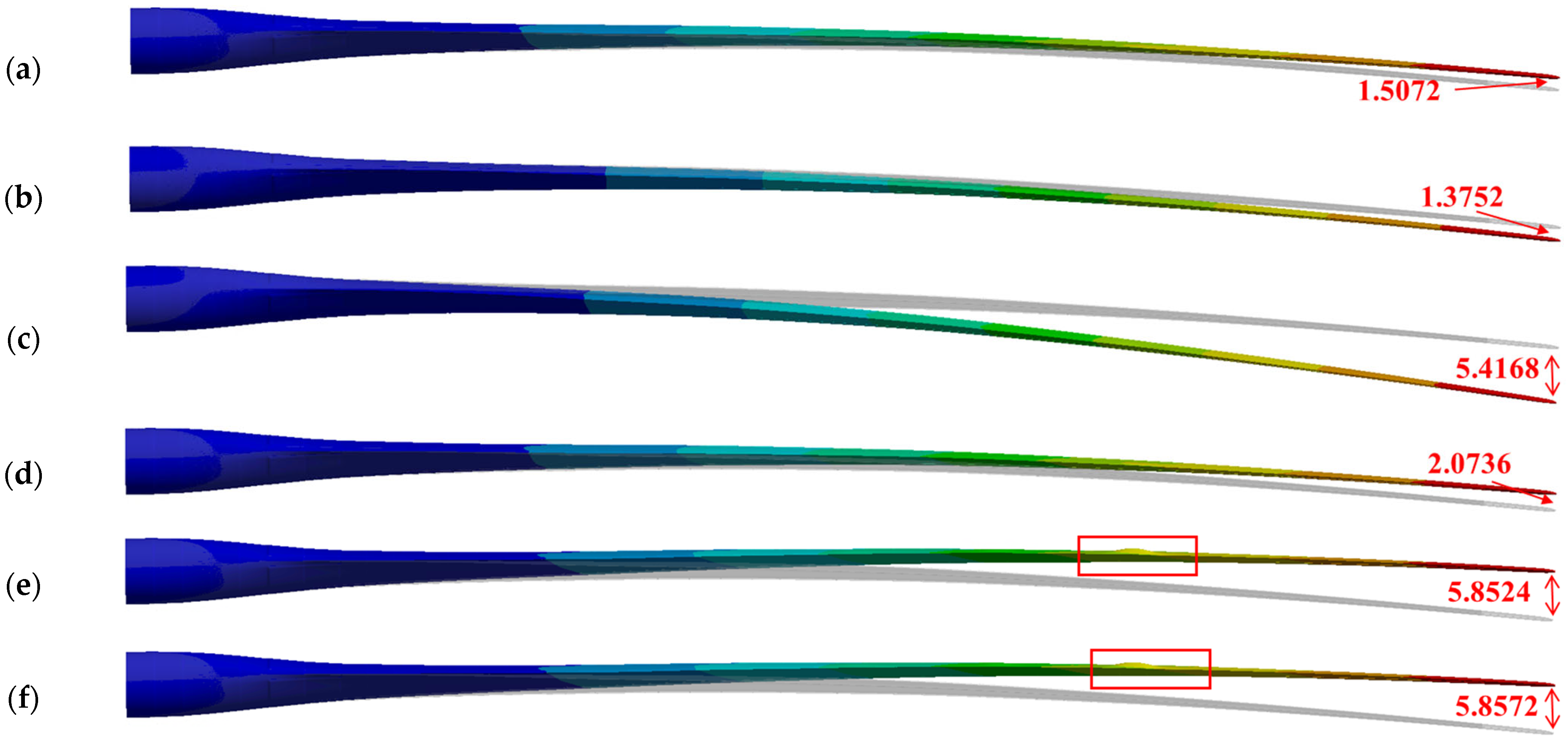
By importing the CFD wind loads corresponding to the respective operating conditions, the structural response of the 15 MW blade in typhoon environments is calculated using a high-fidelity finite element model. Compared to equivalent models, this calculation method can describe more details of blade deflection and represents the most reliable approach currently available for computing the structural response of ultra-long flexible blades. Figure 21 illustrates the blade deflection results in extreme environments, with the unit being meters.
Figure 21. Structural deflection of 15 MW blade in extreme environment: (a) rotor ideal state with blade azimuth angle at 120°; (b) rotor ideal state with blade azimuth angle at 240°; (c) rotor yaw angle at 10° and blade azimuth angle at 330°; (d) rotor yaw angle at −10° and blade azimuth angle at 330°; (e) blade pitch angle at 0° and azimuth angle at 0°; (f) blade pitch angle at 0° and azimuth angle at 30°.
Figure 21 shows that pitch variations maximally influence offshore blades during typhoons; at 0° pitch, maximum deflections exceed 5.8 m, with evident torsion at 70% span, further reducing the local angle of attack. In Figure 21b,c, deflections align with the pre-bend; for azimuth >180°, the upward pre-bend yields opposing geometric forces, but shear-overlaid upward forces prevail. Yaw significantly amplifies this: +10° increases same-direction deflection by 2.94 times; −10° increases opposite-direction deflection by 50.79%.
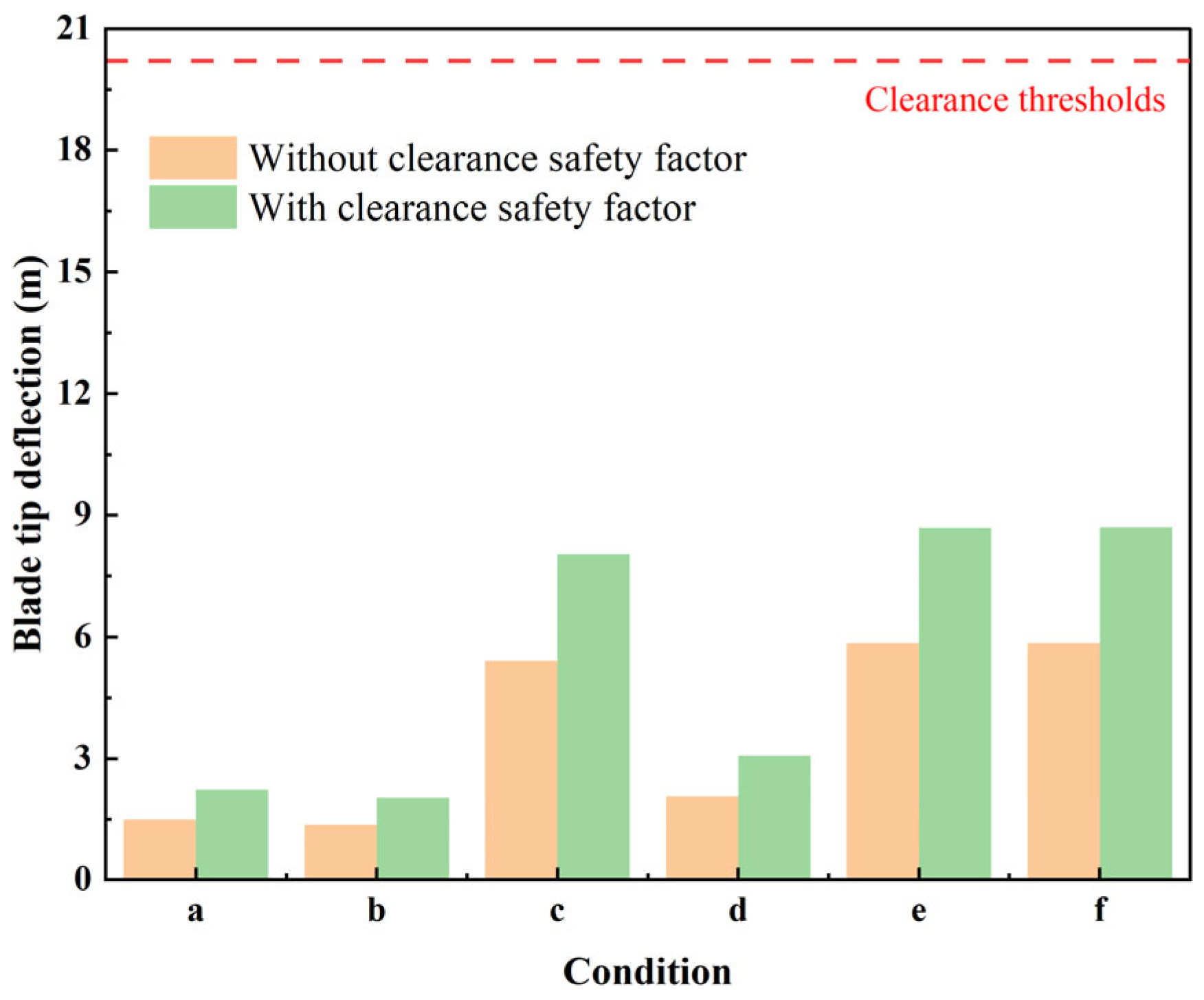
According to IEC 61400 [37], the blade–tower clearance is evaluated based on the ultimate blade deflections in the above six cases, as shown in Figure 22.
Figure 22. Blade tip-to-tower clearance statistics.
The IEA 15 MW technical report indicates that the blade–tower clearance is 30 m. The allowable maximum blade deflection, derived through the combined safety factor, is 20.2 m, which is substantially greater than the maximum blade tip deflections under various operating conditions. Figure 22 demonstrates that the parked 15 MW wind turbine can withstand the instantaneous loading from Typhoon Mangkhut, with sufficient tower clearance distance reserved in the design.
Statistics versus ideal rotor: for thrust, yaw increases tip deflection 2.59 times, von Mises stress 3.91 times, and pitch 2.88 times and 3.95 times; for pitch moment, yaw increases deflection 50.79%, stress 19.8%, and pitch 3.26 times and 1.89 times. These affirm that feathering effectively reduces typhoon loads, extending ultra-long flexible blade life, and underscore that feathering is a necessity in high winds.

4. Conclusions

In response to the high frequency and intensity of typhoons confronting offshore wind turbines, this study investigates the aerodynamic and structural response characteristics of ultra-long flexible blades under extreme high-wind conditions. Utilizing validated Typhoon Mangkhut profile data, aerodynamic loads on the offshore wind turbine are computed. The spanwise distribution characteristics of blade aerodynamic forces and moments at different azimuth angles are analyzed, the influence patterns of rotor yaw and blade pitch on ultra-long flexible blades are explored, and the variation characteristics of blade structural responses are examined based on blade wind loads under ideal and most-adverse conditions. The following conclusions are drawn:
(1) By evaluating three indicators—central latitude and longitude, pressure, and maximum wind speed—of Typhoon Mangkhut, the spatiotemporal evolution patterns of the typhoon are precisely described. Within a height of 0~700 m, the variation follows an exponential growth pattern; beyond 700 m, the wind speed change rate gradually decreases. Capturing the maximum wind speed moment of Mangkhut, wind profile parameters are constructed using the nonlinear least-squares method. The optimal effect is achieved with a wind profile exponent of 0.116.
(2) In simulating aerodynamic loads on offshore wind turbines, the dual influences of wind shear and tower shadow effects are comprehensively considered, enabling more realistic investigation of aerodynamic loads on ultra-long flexible blades under typhoon conditions. In the parked wind turbine ideal state, the aerodynamic loads on the blade in three directions are at their maximum in-plane, followed by out-of-plane, and at their smallest in the tensile direction. The maximum Fy is 4.83 kN, occurring at the 14.3% span position of the blade at 90° azimuth angle.
(3) The study of the superimposed effects of yaw on blades in typhoon environments reveals that out-of-plane aerodynamic forces are highly sensitive to yaw variations, with the spanwise variation range of Fx increasing by up to 219.8% as the yaw angle changes. When the absolute yaw angle exceeds 5°, the rotor experiences a forward thrust of 54.89 kN and a forward pitch moment of −3.01 MN·m; offshore wind turbines with floating foundations require particular attention to this characteristic.
(4) The influence of pitch in the operating state on blade aerodynamic loads is primarily manifested in out-of-plane forces, increasing the maximum Fx by 43 times and maximum rotor thrust by 35.24 times compared to the feathered state, demonstrating that blade pitching not only affects wind energy capture efficiency but also provides load reduction assurance for wind turbines under extreme conditions. The load reduction effect of reversed feathering is inferior to feathering, indicating that a 90° pitch angle remains the optimal choice for ultra-long flexible blades during wind turbine parking.
(5) Wind loads derived from CFD grids are mapped onto the finite element grid of the 15 MW blade structure. Simulation results show that the operating state has the greatest impact on blade structural response, increasing the maximum tip deflection by 3.26 times and the maximum von Mises stress by 3.95 times. The blade azimuth angle and rotor yaw angle can produce mutually reinforcing or offsetting effects on structural deflections.

Author Contributions

Conceptualization, M.Z.; data curation, Q.W. and F.X.; formal analysis, W.L.; investigation, Y.F.; project administration, Y.F.; resources, J.Y.; supervision, M.Z.; validation, W.L.; visualization, W.L.; writing—original draft, W.L.; writing—review and editing, W.L. All authors have read and agreed to the published version of the manuscript.

Funding

This work was supported by the National Key Research and Development Program of China (grant no. 2022YFB4201400), the Guangdong Science and Technology Department through the Guangdong–Hong Kong–Macao Joint Innovation Program (no. 2024A0505040006), the Shenzhen Science and Technology Program (KJZD20230923114259049), the National Natural Science Foundation of China (52301317), and the Guangdong Basic and Applied Basic Research Foundation (2024A1515011587).

Data Availability Statement

The original contributions presented in this study are included in this article. Further inquiries can be directed to the corresponding author.

Conflicts of Interest

Author Jianjun Yang was employed by the company Goldwind Science & Technology Co., Ltd. The remaining authors declare that this research was conducted in the absence of any commercial or financial relationships that could be construed as potential conflicts of interest.

Abbreviations

The following abbreviations are used in this manuscript:
WRFWeather Research and Forecasting
CMAChina Meteorological Administration
3DVARThree-Dimensional Variational Assimilation
CFDComputational Fluid Dynamics
FEMFinite Element Method
IEAInternational Energy Agency

References

  1. Liu, L.; Wang, Z.; Wang, Y.; Wang, J.; Chang, R.; He, G.; Tang, W.; Gao, Z.; Li, J.; Liu, C.; et al. Optimizing wind/solar combinations at finer scales to mitigate renewable energy variability in China. Renew. Sustain. Energy Rev. 2020, 132, 110151. [Google Scholar] [CrossRef]
  2. Amjith, L.R.; Bavanish, B. A review on biomass and wind as renewable energy for sustainable environment. Chemosphere 2022, 293, 133579. [Google Scholar] [CrossRef]
  3. McCoy, A.; Musial, W.; Hammond, R.; Mulas Hernando, D.; Duffy, P.; Beiter, P.; Perez, P.; Baranowski, R.; Reber, G.; Spitsen, P. Offshore Wind Market Report: 2024 Edition; National Renewable Energy Laboratory: Golden, CO, USA, 2024.
  4. Costoya, X.; DeCastro, M.; Carvalho, D.; Gómez-Gesteira, M. On the suitability of offshore wind energy resource in the United States of America for the 21st century. Appl. Energy 2020, 262, 114537. [Google Scholar] [CrossRef]
  5. Li, J.; Pan, S.; Chen, Y.; Yao, Y.; Xu, C. Assessment of combined wind and wave energy in the tropical cyclone affected region: An application in China seas. Energy 2022, 260, 125020. [Google Scholar] [CrossRef]
  6. Liu, F.; Xu, E.; Zhang, H. An improved typhoon risk model coupled with mitigation capacity and its relationship to disaster losses. J. Clean. Prod. 2022, 357, 131913. [Google Scholar] [CrossRef]
  7. Pandey, R.S.; Liou, Y.A. Typhoon strength rising in the past four decades. Weather Clim. Extrem. 2022, 36, 100446. [Google Scholar] [CrossRef]
  8. Tan, Z.M.; Lei, L.; Wang, Y.; Xu, Y.; Zhang, Y. Typhoon track, intensity, and structure: From theory to prediction. Adv. Atmos. Sci. 2022, 39, 1789–1799. [Google Scholar] [CrossRef]
  9. Liu, G.; Li, X.; Wang, J.; Kou, Y.; Wang, X. Research on the statistical characteristics of typhoon frequency. Ocean Eng. 2020, 209, 107489. [Google Scholar] [CrossRef]
  10. Liao, W.; Zhang, M.; Yang, J.; Fan, Y.; Deng, Y. Blades Flutter Suppression in Large Wind Turbines: A Review. Acta Energiae Solaris Sin. 2025, 46, 556–566. [Google Scholar]
  11. Zhang, X.; Zhang, L.; Wang, K.; Cui, X.; Jing, Z.; Liu, Z.; Liu, S.; Lu, J.; Zhang, Y.; Li, J. Bionic inspired flutter suppression method for offshore ultra-long wind turbine blades. Renew. Energy 2025, 239, 122091. [Google Scholar] [CrossRef]
  12. Liao, W.; Zhang, M.; Yang, J.; Fan, Y.; Du, T.; Deng, Y. A Bidirectional Tuned Mass Damper for Flutter Suppression in Ultra-Large Offshore Wind Turbine Flexible Blades. J. Mar. Sci. Eng. 2025, 13, 1776. [Google Scholar] [CrossRef]
  13. Niu, Y. Victims of Super Typhoon Yagi Include Hainan Wind Farm. Dialogue. Earth. (11 September 2024). Available online: https://dialogue.earth/en/digest/victims-of-super-typhoon-yagi-include-hainan-wind-farm/ (accessed on 10 September 2025).
  14. Ishihara, T.; Yamaguchi, A.; Takahara, K.; Mekaru, T.; Matsuura, S. An analysis of damaged wind turbines by typhoon Maemi in 2003. In Proceedings of the Sixth Asia-Pacific Conference on Wind Engineering, Seoul, Republic of Korea, 12–14 September 2005; pp. 1413–1428. [Google Scholar]
  15. Chen, X.; Xu, J.Z. Structural failure analysis of wind turbines impacted by super typhoon Usagi. Eng. Fail. Anal. 2016, 60, 391–404. [Google Scholar] [CrossRef]
  16. Yan, B.; Yuan, Y.; Zhou, X.; Li, Y.; Yang, Q.; Liu, Q.; Yang, W.; Han, J. Experimental study of non-stationary aerodynamic effects on the wind turbine nacelles under extreme wind events. Phys. Fluids 2024, 36, 116103. [Google Scholar] [CrossRef]
  17. Wang, H.; Ke, S.T.; Wang, T.G.; Zhu, S.Y. Typhoon-induced vibration response and the working mechanism of large wind turbine considering multi-stage effects. Renew. Energy 2020, 153, 740–758. [Google Scholar] [CrossRef]
  18. Tang, D.; Xu, M.; Mao, J.; Zhu, H. Unsteady performances of a parked large-scale wind turbine in the typhoon activity zones. Renew. Energy 2020, 149, 617–630. [Google Scholar] [CrossRef]
  19. Leng, J.; Li, G.; Duan, L. The impact of extreme wind conditions and yaw misalignment on the aeroelastic responses of a parked offshore wind turbine. Ocean Eng. 2024, 313, 119403. [Google Scholar] [CrossRef]
  20. Yao, Y.; Huang, S.; Wang, K.; Zhao, M.; Liu, H. Study on the aeroelastic response of wind turbine blades with pitch system failure and strategies for typhoon resistance. Ocean Eng. 2025, 324, 120734. [Google Scholar] [CrossRef]
  21. Wang, Y.; Yang, Q.; Li, T.; Hong, X. Feasibility of typhoon models and wind power spectra on response analysis of parked wind turbines. J. Wind Eng. Ind. Aerodyn. 2023, 242, 105579. [Google Scholar] [CrossRef]
  22. Yang, Q.; Liu, Y.; Wu, S.; Yu, M.; Xie, J.; Xue, X. Super typhoon impact on the dynamic behavior of floating offshore wind turbine drivetrains: A comprehensive study. Ocean Eng. 2024, 312, 119084. [Google Scholar] [CrossRef]
  23. Qin, M.; Shi, W.; Chai, W.; Fu, X.; Li, L.; Li, X. Extreme structural response prediction and fatigue damage evaluation for large-scale monopile offshore wind turbines subject to typhoon conditions. Renew. Energy 2023, 208, 450–464. [Google Scholar] [CrossRef]
  24. Gaertner, E.; Rinker, J.; Sethuraman, L.; Zahle, F.; Anderson, B.; Barter, G.E.; Abbas, N.; Meng, F.; Bortolotti, P.; Skrzypinski, W.; et al. IEA Wind TCP Task 37: Definition of the IEA 15-Megawatt Offshore Reference Wind Turbine; National Renewable Energy Laboratory: Golden, CO, USA, 2020.
  25. Li, L.; Wang, Y.; Liu, Y. Wind velocity prediction at wind turbine hub height based on CFD model. In Proceedings of the 2013 International Conference on Materials for Renewable Energy and Environment, Chengdu, China, 19–21 August 2013; Volume 1, pp. 411–414. [Google Scholar]
  26. Menter, F.R. Two-equation eddy-viscosity turbulence models for engineering applications. AIAA J. 1994, 32, 1598–1605. [Google Scholar] [CrossRef]
  27. Shen, F.; Zhang, J.; Cheng, S.; Pei, C.; Xu, D.; Yuan, X. Impact of FY-3D MWRI and MWHS-2 Radiance Data Assimilation in WRFDA System on Forecasts of Typhoon Muifa. Remote Sens. 2025, 17, 3035. [Google Scholar] [CrossRef]
  28. Ammara, I.; Leclerc, C.; Masson, C. A viscous three-dimensional differential/actuator-disk method for the aerodynamic analysis of wind farms. J. Sol. Energy Eng. 2002, 124, 345–356. [Google Scholar] [CrossRef]
  29. Zhang, Y.; Song, Y.; Shen, C.; Chen, N.Z. Aerodynamic and structural analysis for blades of a 15MW floating offshore wind turbine. Ocean Eng. 2023, 287, 115785. [Google Scholar] [CrossRef]
  30. Lu, M.M.; Ke, S.T.; Wu, H.X.; Gao, M.E.; Tian, W.X.; Wang, H. A novel forecasting method of flutter critical wind speed for the 15 MW wind turbine blade based on aeroelastic wind tunnel test. J. Wind Eng. Ind. Aerodyn. 2022, 230, 105195. [Google Scholar] [CrossRef]
  31. Cao, S.; Tamura, Y.; Kikuchi, N.; Saito, M.; Nakayama, I.; Matsuzaki, Y. Wind characteristics of a strong typhoon. J. Wind Eng. Ind. Aerodyn. 2009, 97, 11–21. [Google Scholar] [CrossRef]
  32. Zhang, Q.; Lu, C.; Yang, H.; Tan, M.; Xiang, D. Analysis of the vertical characteristics of horizontal wind near the surface of shenzhen during the visit of typhoon mangkhut. Guangdong Meteorol. 2021, 43, 6–10. [Google Scholar]
  33. Castillo, R.; Pol, S. Wind tunnel studies of wind turbine yaw and speed control effects on the wake trajectory and thrust stabilization. Renew. Energy 2022, 189, 726–733. [Google Scholar] [CrossRef]
  34. Zhang, J.; Wang, J.; Yan, S. The effect of yaw speed and delay time on power generation and stress of a wind turbine. Int. J. Green Energy 2023, 20, 153–165. [Google Scholar] [CrossRef]
  35. Kumar, R.; Stallard, T.; Stansby, P.K. Large-scale offshore wind energy installation in northwest India: Assessment of wind resource using Weather Research and Forecasting and levelized cost of energy. Wind. Energy 2021, 24, 174–192. [Google Scholar] [CrossRef]
  36. Cai, C.; Yang, Y.; Jia, Y.; Wu, G.; Zhang, H.; Yuan, F.; Qian, Q.; Li, Q. Aerodynamic load evaluation of leading edge and trailing edge windward states of large-scale wind turbine blade under parked condition. Appl. Energy 2023, 350, 121744. [Google Scholar] [CrossRef]
  37. IEC 61400-1; Wind Energy Generation Systems—Part 1: Design Requirements. International Electrotechnical Commission: Geneva, Switzerland, 2019.
Disclaimer/Publisher’s Note: The statements, opinions and data contained in all publications are solely those of the individual author(s) and contributor(s) and not of MDPI and/or the editor(s). MDPI and/or the editor(s) disclaim responsibility for any injury to people or property resulting from any ideas, methods, instructions or products referred to in the content.

Article Metrics

Citations

Article Access Statistics

Multiple requests from the same IP address are counted as one view.