Abstract
Harmful algal blooms (HABs) pose increasing threats to marine ecosystems and fisheries worldwide, creating an urgent need for efficient wide-area monitoring schemes. Satellite remote sensing offers a promising approach. However, quantitative, real-time HAB monitoring via satellites remains underdeveloped. Here, we evaluated the applicability of the Normalized Red Tide Index (NRTI), originally developed for Korean waters using the Geostationary Ocean Color Imager (GOCI), in detecting and quantifying HAB in the southern California Current. Our integrated monitoring encompassed two distinct regions of the California Current—Monterey Bay (central California) and La Bocana (Baja California)—separated by a 1470-km stretch of coastline and characterized by blooms of multiple HAB species. Our objectives were threefold: (1) to validate the relationship between NRTI and HAB cell densities through field measurements, (2) to evaluate the performance of hyperspectral NRTI derived from in situ reflectance measurements compared to existing multispectral indices including MODIS ocean color products, and (3) to assess the capability of multispectral sensors to represent NRTI by comparing multispectral-derived indices against hyperspectral NRTI measurements. We found species-specific relationships between hyperspectral NRTI and in situ HAB cell densities, with Prorocentrum gracile in Baja California showing a robust logarithmic fit (R2 = 0.92) and multi-species assemblage (dominated by Akashiwo sanguinea) in Monterey Bay displaying a weak, positive correlation. MODIS-derived NRTI values were consistently lower than hyperspectral estimates due to reduced spectral resolution, but the two datasets were strongly correlated (R2 = 0.97), allowing for reliable tracking of relative bloom intensity. MODIS applications further captured distinct bloom dynamics across regions, with localized nearshore blooms in Baja California and broader offshore expansion in Monterey Bay. These results suggest that the NRTI-based monitoring scheme can effectively quantify HAB intensity across broad geographic scales, but its application requires explicit consideration of regional HAB assemblages.
1. Introduction
In the 21st century, growing anthropogenic pressures have fundamentally altered marine environments, reshaping oceanographic processes, biogeochemical cycles, and ecosystem structure and functioning [1,2,3,4,5,6,7]. Among the important consequences of these changes is the growing frequency, intensity, and spatial extent of Harmful Algal Blooms (HABs), likely fueled by anthropogenic nutrient enrichment and climate change [8,9]. Improving the monitoring and forecasting capacity for HAB is currently in growing demand because of their acute impacts on ecosystems and human societies [10,11,12]. HAB species may produce biotoxins that cause illness and mortality in marine animals and humans [11,13,14]. In other cases, mass decay of bloom-forming algae rapidly depletes oxygen [15], triggering hypoxia and mass die-offs of nearshore organisms [16]. As a result, HABs can destabilize marine ecosystems, reduce fishery and aquaculture yields, and pose significant risks to human health [10,17].
High-resolution monitoring of HAB extent and intensity is essential for elucidating spatiotemporal dynamics, identifying outbreak mechanisms, and improving forecast capabilities. The last two decades have witnessed growing efforts across nations to develop effective monitoring and forecasting schemes for HAB [18,19,20,21,22]. In particular, satellite-based detection of HAB has emerged as a powerful monitoring tool in recent years. However, the absence of a universally applicable detection method for satellite imagery continues to limit our monitoring and forecasting capacity across a broad geographic scale.
Recently launched and upcoming hyperspectral missions, including NASA’s Plankton, Aerosol, Cloud, ocean Ecosystem (PACE) and the Geostationary Littoral Imaging and Monitoring Radiometer (GLIMR), promise to significantly enhance the detection of phytoplankton community composition and HAB species through improved spectral resolution [23,24]. Nonetheless, multispectral sensors such as MODIS, Sentinel-2 MSI, and Sentinel-3 OLCI remain indispensable for operational and retrospective HAB monitoring because of their global coverage, high temporal frequency, and multi-decadal archives. Developing robust indices for multispectral sensors is therefore critical for maintaining observational continuity between existing and next-generation hyperspectral missions.
Satellite-based detection of HAB has traditionally relied on indices such as chlorophyll-a (Chl-a), Fluorescence Line Height (FLH), and Maximum Chlorophyll Index (MCI) [25,26,27]. However, these indices do not directly capture HAB presence or cell density. To address this limitation, we recently developed the Normalized Red Tide Index (NRTI), which estimates HAB intensity using the bimodal spectral peaks of HAB species in the visible range (550 nm and 680 nm) [28]. In subsequent work, we demonstrated the effectiveness of NRTI for quantifying red tide events in Korean coastal waters [29]. Nonetheless, its applicability to other regions with distinct oceanographic and geomorphic environments remains untested. Broader application of NRTI across diverse regions and coastal systems is required to rigorously evaluate its potential as a universal HAB index.
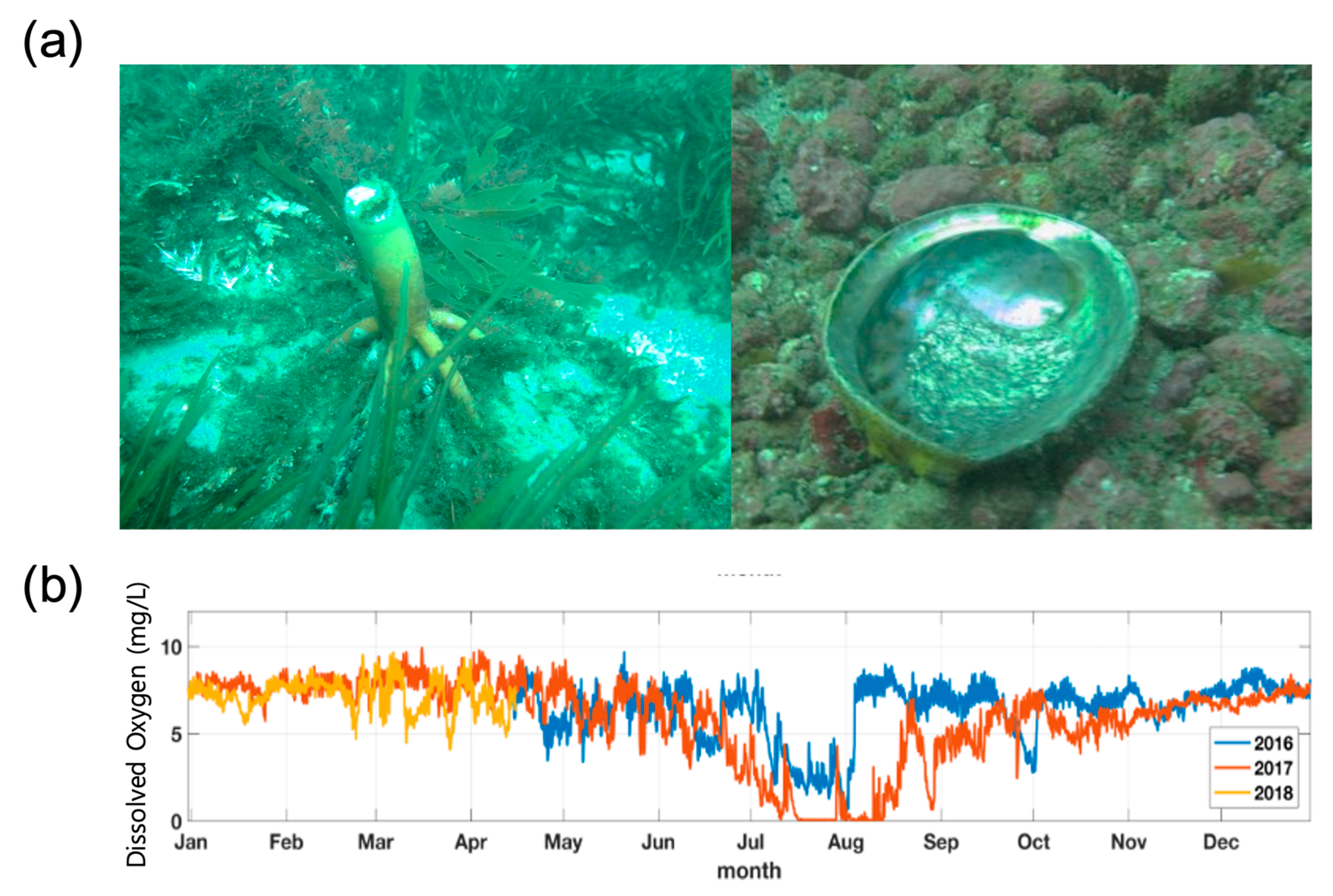
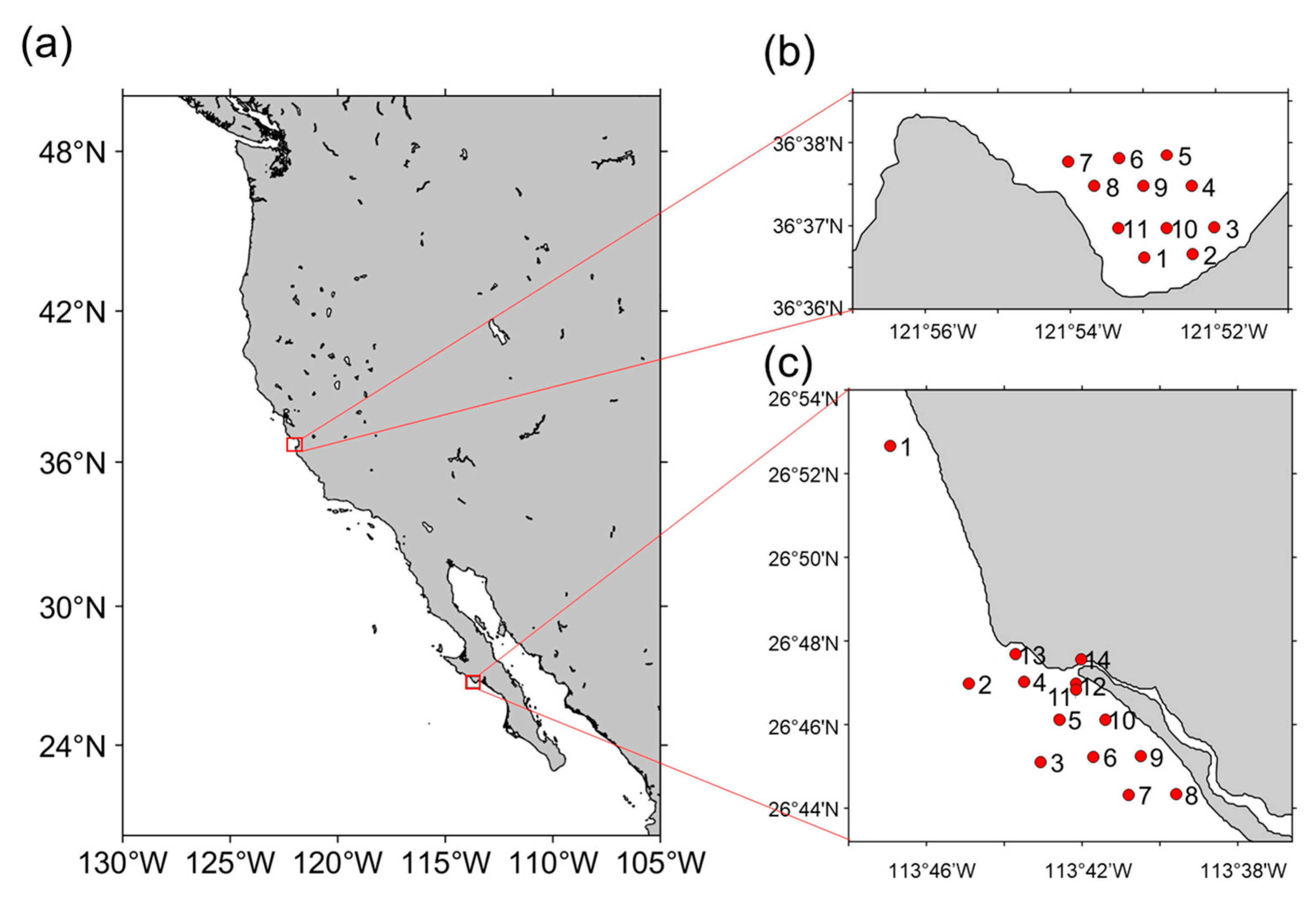
In this study, we assessed the applicability of NRTI for detecting and quantifying HAB in the California Current, a cold-water eastern boundary current extending from British Columbia, Canada, to Baja California, Mexico (Figure 1) [30,31]. As one of the five major coastal upwelling systems, the California Current supports highly productive fisheries due to nutrient-rich upwelling waters [32,33]. However, upwelling also transports low-oxygen, nutrient-rich waters to the surface, fueling algal blooms and exacerbating hypoxic events [34]. For example, Prorocentrum micans blooms off the Baja coast in 2017, coinciding with strong upwelling, caused widespread degradation of kelp forests and mass mortality of benthic animals [35,36] (Figure 2). To date, the spatiotemporal variability of HABs along the latitudinal and upwelling gradient of the California Current remains insufficiently understood.
Figure 1.
(a) The location of two study regions along the southern California Current: central California (Monterey Bay, CA, USA) and Baja California (La Bocana, Baja California Sur, Mexico). (b,c) The sampling stations for seawater reflectance and HAB species in Monterey Bay and La Bocana, respectively. The numbers next to the red dots represent the station numbers for each field site.
Figure 2.
(a) Mass mortality events that occurred in Baja California during 2017 under severe HAB and hypoxia events. Photos depict the aftermath of kelp forest loss and mass mortality of commercially important abalones (Haliotis spp.). (b) Time series of dissolved oxygen at La Bocana, in 2017 (blue: 2016, orange: 2017, yellow: 2018). The oxygen data were derived from Low et al. (2021) [36].
Our study focused on two different regions of the southern California Current: central California (Monterey Bay) and Baja California (La Bocana). Both regions are characterized by strong seasonal upwelling, high ecosystem productivity, and recurrent HAB events [11,37,38,39]. Despite these shared features, the regions differ markedly in other oceanographic and geomorphic settings: Monterey Bay is defined by submarine canyon systems and receives substantial riverine freshwater and nutrient inputs, whereas Baja California has a broader continental shelf and minimal river discharge under its arid climate [40,41]. HAB assemblages also differ, with Monterey supporting higher dinoflagellate diversity linked to nutrient heterogeneity, while Baja California is dominated by more oligotrophic-adapted taxa [39,42]. These similarities and contrasts make the two regions an ideal comparison for evaluating the robustness and transferability of NRTI-based algorithms across distinct oceanographic regimes.
We conducted in situ measurements of water reflectance and HAB cell densities in both regions between 2018 and 2019, during which a particularly severe HAB event impacted the Baja coasts. We combined the in situ data and satellite-derived ocean color data (MODIS) to develop an NRTI-based HAB algorithm for each region. Finally, we evaluated the performance of the hyperspectral NRTI alongside a multispectral NRTI derived by applying the MODIS sensor response function to the measured reflectance.
2. Methods and Materials
2.1. Study Sites
Our study was carried out in two regions along the southern California Current separated by >1470 km: central California (Monterey Bay, CA, USA; 36.627087° N, 121.881359° W) and Baja California (La Bocana, Baja California Sur, Mexico; 26.719895° N, 113.699546° W). Monterey Bay is characterized by strong seasonal upwelling, high marine productivity, and well-documented harmful algal bloom events [39,43]. In particular, during the 2014–2016 northeast Pacific warming anomaly, the area experienced a massive Pseudo-nitzschia bloom in spring 2015, which produced the highest biotoxin concentrations (domoic acid) ever recorded in the bay’s history [39].
The Baja California coast is characterized by an arid subtropical climate with less than 100 mm annual precipitation, low population density, and minimal land-based nutrient inputs. Yet, prevailing northwesterly winds in the region promote persistent upwelling [41,44], generating nutrient-rich waters that fuel high productivity and strong oxygen/temperature variability along the coast [45,46]. The region has previously seen more than 80 HAB events [42], including mass blooms of Prorocentrum in 2017 [35,36] (Figure 2).
2.2. In Situ Data Collection
We systemically collected hyperspectral radiometric data and seawater physicochemical data from both study regions between 2018 and 2019. Our sampling in Baja California coincided with the onset of a severe red tide event in July 2018, which persisted for approximately six weeks until mid-August. Data collection was performed at 14 discrete stations, spaced 10 s to 100 s of meters along the coast off La Bocana (Figure 1c). At each station, we measured seawater radiance and solar irradiance using an in-water hyperspectral ocean color radiometer (HyperOCR, Satlantic Inc, Halifax, NS, Canada, 350–800 nm, 136 channels) and collected 50 mL water samples at ~0.3 m depth using a 5-L Niskin bottle (General Oceanics, Miami, FL, USA). In the laboratory, water samples were preserved with 5% formalin, and HAB species were enumerated and identified from 1-mL subsamples.
We collected in situ data at Monterey Bay in September 2019, during which a red tide occurred in the southern portion of the bay. We used the same sampling protocol as in the Baja to collect seawater reflectance and HAB species data across 11 discrete stations, spaced 400 to 500 m apart.
2.3. Satellite Data Acquisition and Analysis
The Moderate Resolution Imaging Spectroradiometer (MODIS) aboard Aqua has provided near-daily global observations since 2002, covering a 2330 km swath with 36 spectral bands at spatial resolutions of 250–1000 m. Its visible and near-infrared channels include 412, 443, 469, 488, 531, 547, 555, 645, 667, 678, 748, and 869 nm.
We used MODIS Aqua Level-3 daily remote sensing reflectance (Rrs) data at 4-km spatial resolution (R2022, v.2.4.0-T2025.14) obtained from NASA’s Ocean Biology Processing Group (OBPG) to monitor HAB events in Baja California and Monterey Bay during 2018–2019. Although this study focuses on these two years corresponding to in situ observations, the MODIS Aqua archives span more than 22 years (2002 to 2025), representing the longest continuous ocean-color time series available.
This extensive temporal record is one of the main reasons for selecting MODIS, as it enables future assessments of long-term red tide variability and climate-related trends using a consistent, well-validated dataset. Despite its coarser spatial resolution compared with newer sensors such as Sentinel-2 or Sentinel-3, MODIS provides unparalleled temporal depth and basin-wide coverage, making it well suited for developing and validating the NRTI algorithm and for extending analyses to multi-decadal scales.
2.4. Application of Normalized Red Tide Index
In previous works [28,29], we successfully applied NRTI to GOCI data as a proxy for red/brown tide intensity in Korean coastal waters. Unlike FLH, which primarily represents chlorophyll-a concentration, NRTI captures the distinct spectral signatures associated with red-colored HAB. NRTI incorporates not only the red-wavelength fluorescence signal but also spectral features in the green band, allowing more effective discrimination of red/brown tides from other HAB. NRTI approach has not yet been applied to MODIS data or evaluated for HAB detection in the California Current System, where strong upwelling drives high background primary productivity.
NRTI is formulated based on the spectral characteristics of red/brown algal blooms, showing two spectral peaks at 555 nm and 680 nm which are characteristic result of the absorption and fluorescence by pigments in red/brown bloom-forming algae groups (dinoflagellates and certain diatoms). As red tide cell density increases, spectral contrast also increases due to enhanced pigment absorption and fluorescence [47,48,49], producing high NRTI values.
The index is constructed from the product of the peak heights at 555 nm and 680 nm. Each peak height is calculated relative to a linear baseline between neighboring bands:
The raw Red Tide Index (RTI) is then expressed as:
Finally, normalization is applied to reduce the influence of baseline variability in reflectance, yielding the NRTI:
where P555 (P680) represents the height of the first (second) peak in the spectrum. The schematic diagram and procedure are introduced in [28]. The normalization step (Equation (4)) makes NRTI robust across the California Current System’s extreme range of water conditions, from clear oligotrophic southern waters to highly turbid upwelling zones, ensuring consistent detection of red-edge features regardless of baseline reflectance levels. This approach enables reliable cross-regional comparisons and long-term trend analysis across the diverse optical environments spanning from Baja California to the Pacific Northwest.
MODIS has similar spectral channels to GOCI. We modified NRTI for MODIS as follows: 490 nm, 555 nm, 660 nm, 680 nm, 745 nm → 488 nm, 551 nm, 667 nm, 678 nm, 748 nm. For in situ hyperspectral reflectance measurements, each peak wavelength (555 and 680) was determined as the wavelength corresponding to the maximum within the green (500–599 nm) and red (679–730 nm) regions, respectively. The peak in the green and red regions typically occurred between 568–573 nm and 686–702 nm. The reference wavelength 660 was replaced by the wavelength corresponding to the minimum within the red trough (599–679 nm), which generally ranged between 664–672 nm. The reflectance values at 490 and 745 were extracted at 490 nm and 745 nm, respectively.
2.5. Statistical Analysis and Uncertainty Estimation
To evaluate the relationships among hyperspectral NRTI, MODIS NRTI, and in situ red tide cell density (RTD), we performed nonlinear regression analyses using power and logarithmic models, depending on the best fit to the observed data. Specifically, the relationships between MODIS and hyperspectral NRTI were described by a power function of the form:
where x and y represent NRTI values, and a and b are fitted coefficients obtained through nonlinear least-squares optimization. The relationship between red tide cell density and NRTI followed a logarithmic model:
y = a·xb
y = a·ln(x) + b
These regressions were fitted using MATLAB R2024b functions fit and fitlm. The coefficient of determination (R2) was calculated as:
and the model uncertainty was quantified using the root mean square error (RMSE):
where n is the number of observations, is the observed value, is the model-predicted value, and is the mean of observed values. The statistical significance (p-value) was obtained from the F-statistic of each regression model.
3. Result
3.1. HAB Species Composition and Spatial Distribution
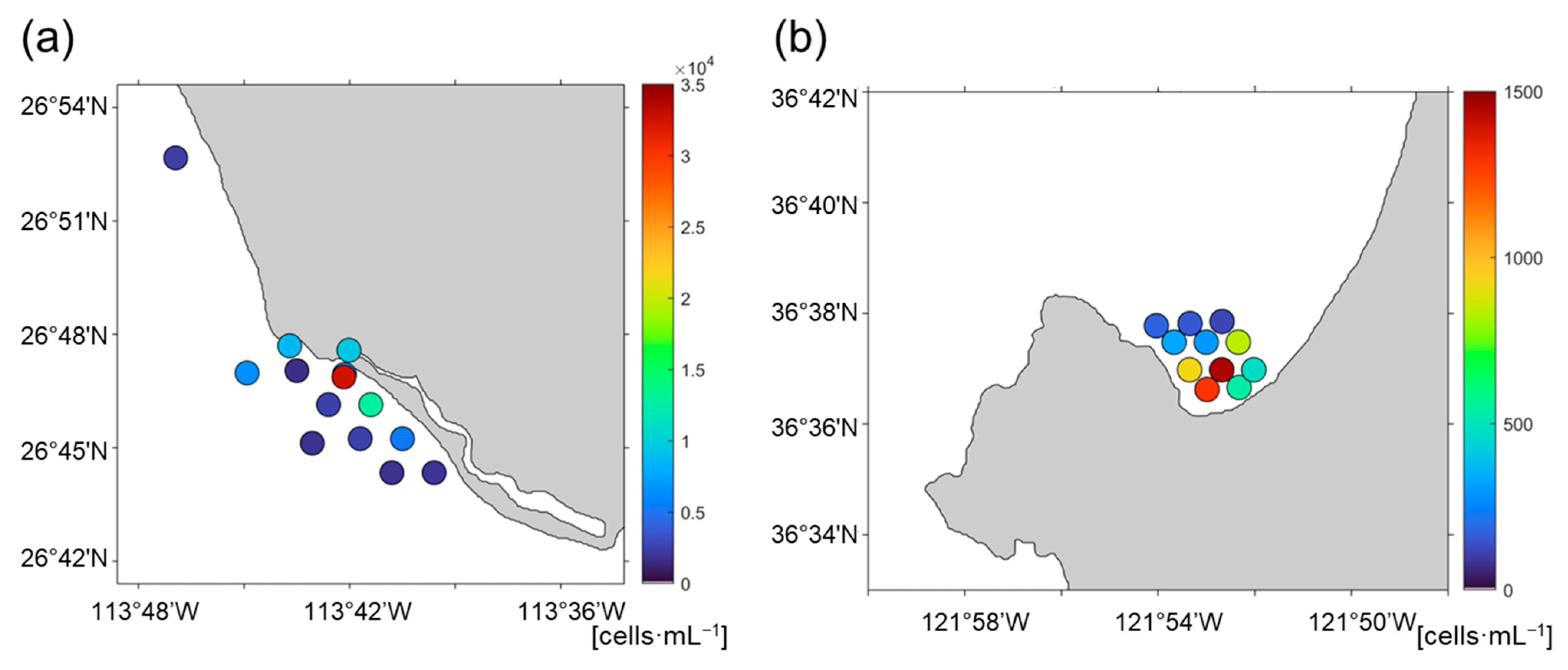
Surface water samples collected in July 2018 from 14 stations at La Bocana revealed that HAB assemblage was composed entirely of Prorocentrum gracile (Figure 3a). The cell density of P. gracile ranged from 115 cells·mL−1 to 28,052 cells·mL−1 (mean ± SE = 6946 ± 2178 cells·mL−1) (Figure 3a). The densities were higher near the mouth of the tidal creek, which stretched ~15 km inland (station 14 in Figure 1c), and declined progressively off-shore (Figure 3a). A distinct HAB front was observed between stations 11 and 12 (Figure 1c, Figure 3a and Figure S1), with cell densities sharply contrasting on either side—28,052 cells·mL−1 at station 12 (inshore side) and 7421 cells·mL−1 at station 11 (offshore side) on 10 July 2018.
Figure 3.
Locations of Rrs and HAB species sampling in (a) La Bocana and (b) Monterey Bay. Colors represent HAB cell density (cells·mL−1) measured from each location.
In Monterey Bay, Akashiwo sanguinea was the most dominant HAB species in September 2019 sampling (mean ± SE = 275 ± 75 cells·mL−1), comprising 45% of all cell counts, followed by Prorocentrum micans (68 ± 15 cells·mL−1) (16%). The remaining 29% of HAB cell counts consisted of Ceratium sp., Pseudo-nitzschia sp., and unidentified dinoflagellates.
3.2. Spectral Reflectance and NRTI Distribution
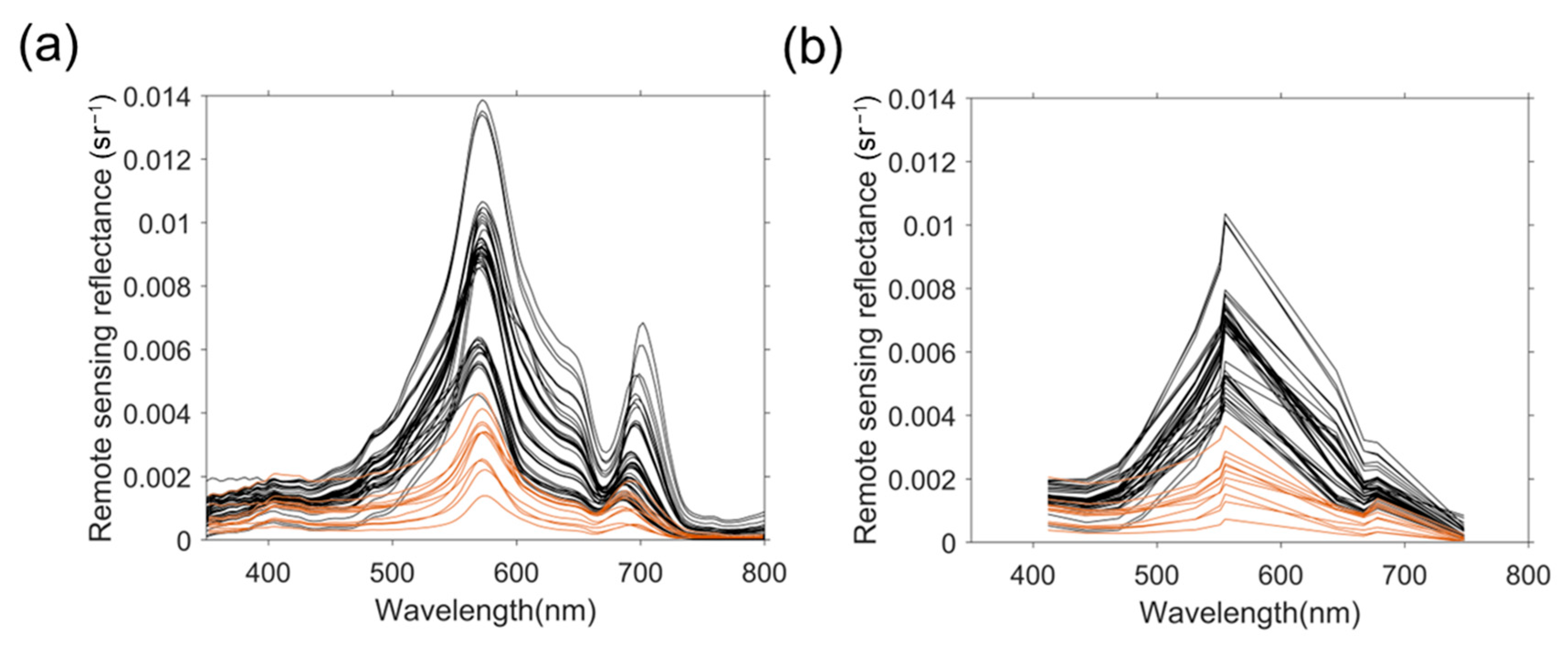
In situ Rrs(λ) of each cruise showed the typical spectral shape of red-colored HAB (Figure 4a), which has two spectral peaks at 560 nm and 680 nm by pigment absorption and fluorescence [28]. The hyperspectral Rrs further showed steep declines near 600, 650, and 730 nm, coupled with pronounced increases around 550 and 680 nm. Spectra from Monterey Bay (brown line in Figure 4a) resembled those from La Bocana (black line in Figure 4a): both displayed a primary peak between 568–573 nm, while the secondary peak between 686–702 nm occurred at slightly different central wavelengths but shared more consistent trough (664–672 nm) alignment. From spectral reflectance (Figure 4a), NRTI values in La Bocana ranged from 283 to 106,870, with the maximum value at station 11 coinciding with the highest HAB cell density (32,474 cells·mL−1, Figure 3a). Spatial variability in NRTI also closely mirrored the distribution of HAB cell density.
Figure 4.
Remote sensing reflectance (Rrs, sr−1) spectra at two study locations: (a) in situ measurements obtained with a spectroradiometer and (b) simulated spectra representing the reflectance that would be observed by the MODIS-Aqua sensor. Black and brown lines represent data from La Bocana (7 July 2018) and Monterey Bay (12 September 2019), respectively.
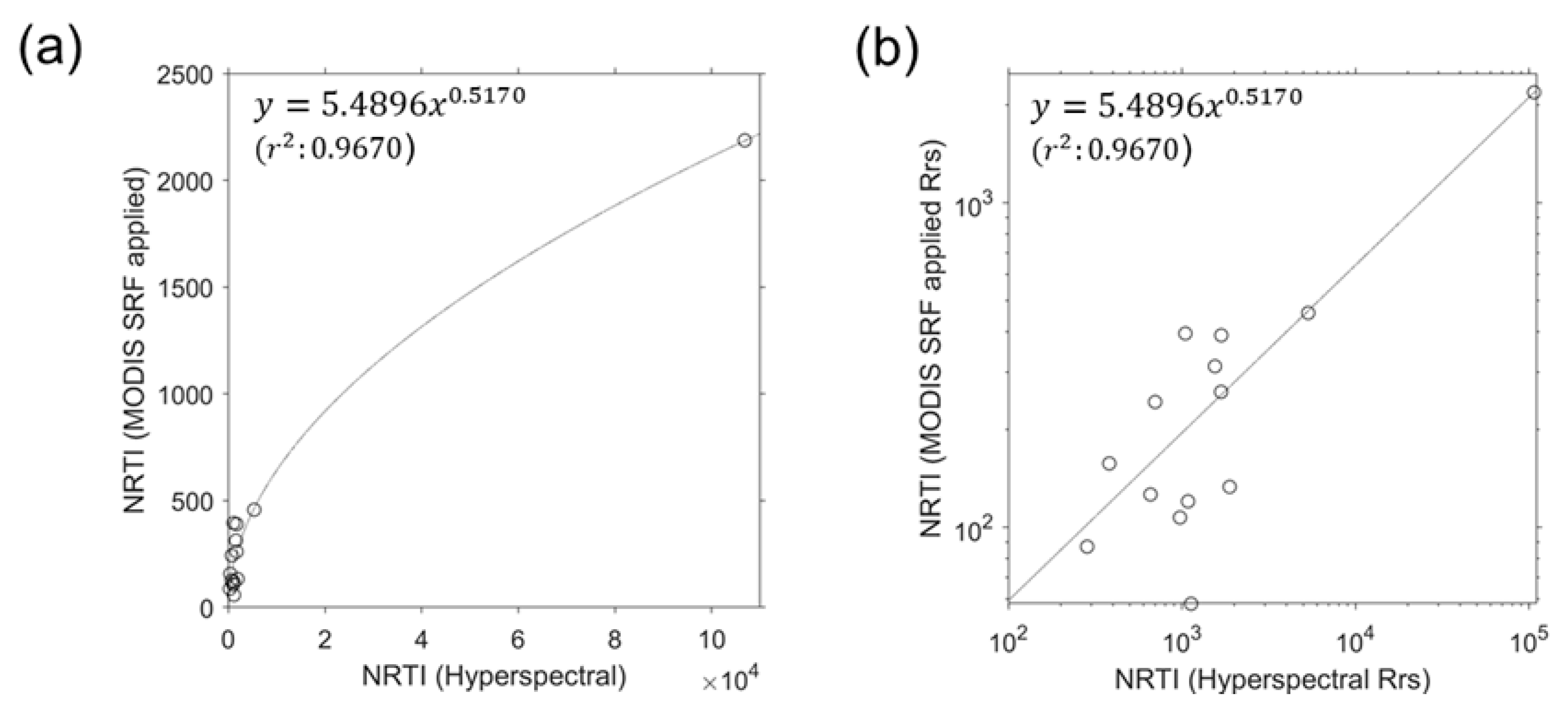
We applied the MODIS spectral response function to hyperspectral Rrs measurements to simulate how MODIS captures red-colored HAB signatures (Figure 4b). The multispectral Rrs derived from MODIS channels was able to reproduce the characteristic bimodal peaks of HAB spectra. However, because MODIS lacks bands around the sharp spectral changes near 700 nm, it substantially underestimated Rrs678 while overestimating Rrs667, thereby reducing the apparent sharpness of the second peak and yielding lower NRTI values (range: 58–2187). Despite this systematic underestimation relative to hyperspectral Rrs (NRTI range: 283–106,870), the two datasets showed a strong linear relationship (Figure 5; r2 = 0.967, RMSE = 102.38), confirming that MODIS can reliably capture relative variation in HAB intensity.
3.3. Relationship Between Red Tide Density and NRTI
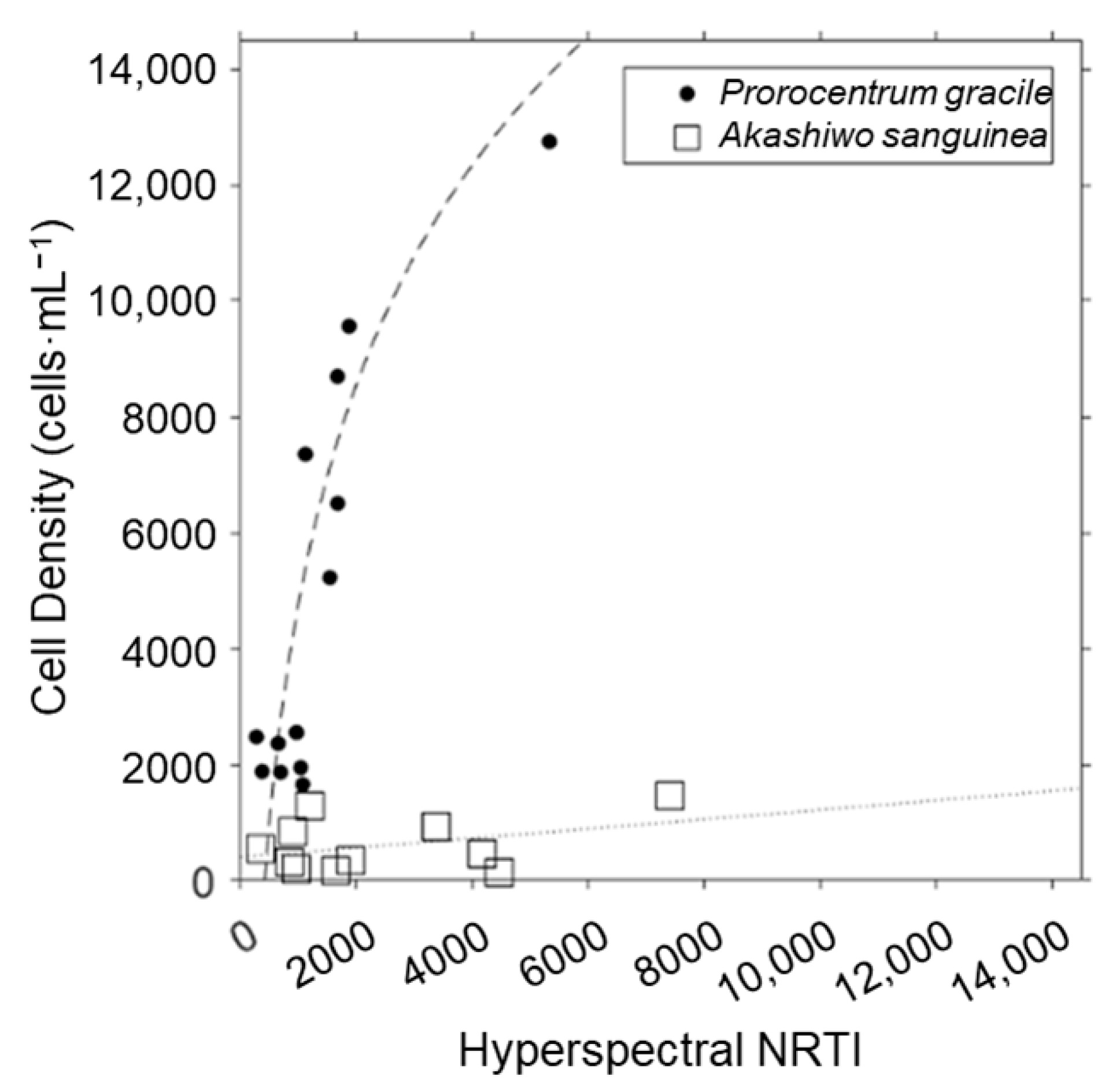
We found NRTI to be applicable to our study region based on spectral characteristics. To quantify red tide density from hyperspectral Rrs, we compared in situ red tide density (RTD) with in situ NRTI at the same stations (Figure 6). In Baja California, P. gracile exhibited a strong logarithmic relationship with NRTI (R2 = 0.9170, p-value < 0.001, RMSE = 2444 cells·mL−1), described by RTD = 5487∙ln(NRTI) − 33179. The highest cell density (32,474 cells·mL−1) observed at Station 11 was considerably greater than the others but still aligned well with the fitted logarithmic trend (NRTI: 106,870). This station was located within a frontal convergence zone where an exceptionally dense bloom was visually confirmed in the field (Figure S1). When this point was excluded, the logarithmic relationship remained highly significant (R2 = 0.8820, p-value < 0.001, RMSE = 2189 cells·mL−1), confirming the robustness of the NRTI-RTD relationship across bloom magnitudes. Although the extreme bloom at Station 11 (La Bocana) was not displayed in Figure 6 to maintain scale clarity, it was included in the regression analysis.
Figure 6.
Modeled relationship between hyperspectral NRTI and red tide cell density (solid dot: Prorocentrum gracile in La Bocana, square: Akashiwo sanguinea in Monterey Bay). The logarithmic regression line for P. gracile (R2 = 0.9170, p-value < 0.001) was derived from all 14 stations, including the extreme bloom at Station 11 (Figure S1).
In Monterey Bay, the mixture of red/brown color species, including A. sanguinea, P. micans, etc., also showed a positive relationship with NRTI (open squares in Figure 6), albeit an insignificant one (R2 = 0.1451, p-value = 0.247, RTD = 0.0818∙NRTI + 396.1).
3.4. NRTI Application to MODIS Data
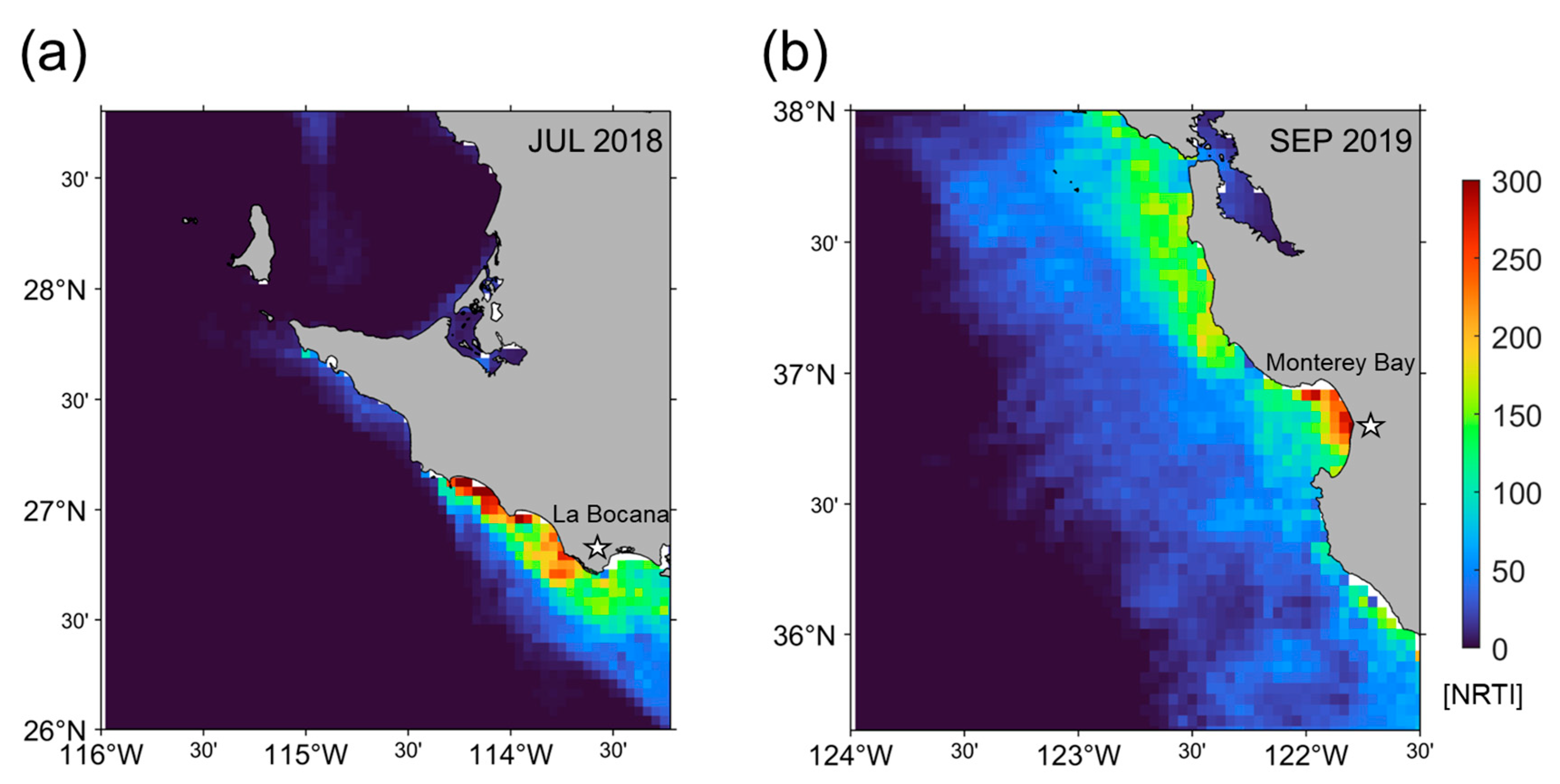
We applied the NRTI scheme to daily 4-km MODIS Rrs data from 2002 to 2024. Figure 7 illustrates the monthly median NRTI of the two focal regions during HAB events (July 2018 for Baja California; September 2019 for central California). These MODIS-derived NRTI maps illustrated the spatial variability of HAB along the Pacific coast, showcasing two distinct bloom occurrences separated by over 1400 km. Figure 7a depicts a concentrated red tide event near La Bocana, Baja California in July 2018, where NRTI values reach moderate to high intensities (150–200+) in a relatively localized coastal area. The HAB event observed in Monterey Bay during September 2019 was characterized by higher NRTI values (250–300) and broader offshore distribution (Figure 7b).
Figure 7.
MODIS-derived monthly median NRTI in (a) the coast of the Vizcaino Peninsula (La Bocana) in July 2018 and (b) central California (Monterey Bay) in September 2019.
4. Discussion
Our study applied NRTI to detect and quantify HAB events in two distinct regions of the southern California Current [31,50]. In situ measurements confirmed that dominant HAB species in both regions exhibited the characteristic bimodal spectral peaks (550 and 680–700 nm) [51,52], with particularly strong correlations between NRTI values and cell densities in La Bocana, where the bloom was dominated by a single species (P. gracile). Although originally developed for Korean waters using the GOCI satellite, our results show that NRTI has strong potential for broader application [53,54]. A key strength of this index lies in its capacity to extract red/brown HAB signals even under highly dynamic water conditions, including turbid coastal environments [55,56]. Indeed, its robust performance across the wide gradients of turbidity and chlorophyll-a observed in Korean waters [28] underscores its suitability for deployment in other heterogeneous coastal environments worldwide.
A major outcome of this study is the successful application of NRTI to MODIS data, demonstrating its adaptability beyond its original design for the GOCI sensor [28]. This cross-platform applicability is possible because both sensors contain bands spanning the critical red–NIR region that captures the bimodal spectral signature of red-colored HAB [57,58]. Importantly, the normalization step within the NRTI formulation enhances robustness by minimizing the influence of background variability (e.g., turbidity, chlorophyll-a), enabling consistent performance across different sensors [59,60,61]. While MODIS-derived NRTI values were 5–50 times lower than those from hyperspectral Rrs due to reduced spectral resolution and underestimation of the red fluorescence peak (particularly around 680 nm), the two datasets showed a strong correlation (R2 =0.97) [62]. This indicates that, despite absolute discrepancies, MODIS can reliably track relative changes in bloom intensity [63,64]. Moreover, this strong correlation suggests that an empirical conversion function can be developed to translate MODIS-derived values into hyperspectral equivalents, facilitating their absolute operational use. Establishing such a calibration framework in future work would enable seamless integration between multispectral and hyperspectral observations [65,66]. These results demonstrate that NRTI is not sensor-specific but a versatile, transferable algorithm capable of leveraging widely available MODIS archives for retrospective and real-time HAB monitoring [53,54]. This adaptability broadens the utility of NRTI for global applications, offering a scalable and cost-effective tool to monitor HAB dynamics across diverse regions [67].
Our results reveal regional contrasts in red tide dynamics between Baja California and central California, underscoring the diverse manifestations of HAB events within the California Current system. Along the Vizcaíno Peninsula, blooms of P. gracile were highly localized, confined to a narrow nearshore band with relatively uniform cell size. In contrast, the Monterey Bay bloom, dominated by A. sanguinea and other taxa, exhibited a much broader spatial footprint, with elevated NRTI signals extending offshore from the river mouth. These differences may reflect distinct underlying mechanisms of bloom development: coastal confinement and local hydrographic controls in Baja California versus riverine influence and broader circulation patterns in Monterey Bay. To fully address the observed spatial heterogeneity, it is critical to consider underlying oceanographic and ecological drivers. For the localized P. gracile blooms near the Vizcaíno Peninsula, the confinement is likely driven by persistent, intense upwelling and resultant strong offshore Ekman transport, creating a narrow, highly productive coastal upwelling shadow that retains motile dinoflagellates and limits cross-shelf dispersion [35]. In contrast, the expansive A. sanguinea bloom in Monterey Bay, while benefiting from riverine nutrient loading, appears subject to larger-scale advective and retention mechanisms. Circulation within the bay, often influenced by the Monterey Submarine Canyon and associated mesoscale eddy activity, facilitates the broad offshore extension of the bloom observed in the NRTI signal [68]. Furthermore, regional differences in water column stratification and the resulting vertical nutrient supply critically influence the selection of bloom taxa and their ultimate spatial morphology [69]. Such spatial heterogeneity highlights the importance of MODIS’s wide swath coverage for capturing the full range of bloom dynamics across heterogeneous coastal domains. By linking NRTI with MODIS imagery, our study demonstrates the feasibility of detecting and quantifying HABs across both localized and expansive bloom types. This integrative approach provides a robust framework for monitoring spatiotemporal variability of HAB in the California Current, offering critical insights into its regional driver, impacts, and management.
In La Bocana, we observed an almost monospecific bloom of P. gracile, with relatively uniform cell size across stations. This likely contributed to the strong fit between NRTI values and in situ cell densities. In such cases, NRTI provides a reliable estimate of red tide intensity. However, in blooms composed of multiple species or with variable cell sizes, such as those observed in Monterey Bay, NRTI may serve more reliably as an indicator of total cell biomass rather than a predictor of cell density [28]. The differing slopes between P. gracile in La Bocana and HAB assemblage in Monterey Bay (Figure 6) illustrate how species traits shape this scaling relationship. A. sanguinea, which accounted for 45% of all HAB cell counts in Monterey Bay, are significantly larger than P. gracile (mean length: 71.214 ± 1.64 µm vs. 32.411 ± 0.44 µm) and contain more pigment per individual [70,71]. As a result, NRTI rises rapidly with relatively modest increases in A. sanguinea and total cell numbers, yielding a shallower slope in the NRTI–density relationship. By contrast, the smaller, more numerous P. gracile cells generate spectral signals that scale more directly with cell counts, producing a steeper slope. These results emphasize that species identity and cellular characteristics influence how NRTI values relate to density. Despite these interspecific differences, our findings show that spectral Rrs and multispectral satellite sensors such as MODIS can robustly capture red tide occurrence and intensity, provided that HAB species composition is considered during interpretation.
The use of satellite-based monitoring schemes enables effective, large-scale tracking of HAB events in remote and ecologically sensitive regions such as Baja California. By providing near-real-time data on bloom initiation, intensity, and dissipation, this approach offers critical support for managing upwelling-driven ecosystems where nutrient enrichment drives both high productivity and recurrent HAB outbreaks. Severe HAB can devastate coastal benthic habitats that underpin vital ecosystem functions and services, such as biodiversity enhancement, carbon sequestration, and fishery production [5,72,73]. NRTI framework can help guide ecosystem and resource management, providing agencies with a data-driven tool for forecasting risks to key habitats, aquaculture/fisheries, and human health.
NRTI is broadly applicable for detecting red tide events; however, whether it can be applied universally requires further investigation, as certain limitations remain. Its performance may vary under optically complex conditions such as highly turbid estuaries, mixed-species blooms, or oligotrophic waters where background reflectance differs substantially. Moreover, NRTI performs most accurately when HAB assemblages are dominated by a few species, suggesting that its sensitivity may decrease in mixed-species blooms. The present uncertainty analysis, expressed as the RMSE between hyperspectral and MODIS-derived NRTI and between cell density and hyperspectral NRTI, quantifies these limitations and emphasizes that regional calibration remains essential for robust application. Future work should thus focus on refining NRTI parameterization across diverse optical regimes and validating it under different bloom compositions and environmental contexts.
In conclusion, our study demonstrates the applicability of NRTI for detecting and quantifying HABs using MODIS satellite data in the southern California Current, an upwelling-driven system with frequent bloom occurrences. By extending the index beyond its original application, we highlight its potential as a scalable and transferable tool for large-scale HAB monitoring in dynamic coastal regimes. Looking ahead, coupling NRTI with emerging hyperspectral missions (e.g., PACE, GLIMR) and long-term in situ networks will further enhance its precision and predictive capacity. As HAB frequency and intensity continue to rise under global change, such integrated approaches will be critical for managing ecosystem health and supporting the resilience of dependent human societies.
Supplementary Materials
The following supporting information can be downloaded at: https://www.mdpi.com/article/10.3390/jmse13112044/s1, Figure S1. Photo illustrations of (a) a well-developed HAB front (stations 11 & 12) observed in La Bocana, Baja California Sur, on 7 July 2018 (left bottom photos showing Prorocentrum gracile in 1 mm × 1 mm grid) and (b) a true color Planetscope image with 3-m spatial resolution showing development of a distinct HAB front (white arrow) on 10 July 2018. Figure S2. Photo illustrations of (a) HAB outbreak in Monterey Bay on 12 September 2019 and main phytoplankton species responsible (Akashiwo sanguinea, Ceratium spp., and Prorocentrum sp.) and (b) true color image of Sentinel-2 10-m spatial resolution showing the area affected by HAB on the same day (yellow box). Table S1. Summary of FEDECOOP sensor deployment sites (Low et al., 2021) [36].
Author Contributions
Conceptualization, M.-S.L.; methodology, M.-S.L.; investigation, M.-S.L., A.S., F.M. and J.L.; formal analysis, J.L. and M.-S.L.; resources, J.L. and F.M.; writing—original draft preparation, M.-S.L., J.L. and F.M.; writing—review and editing, M.-S.L., J.L., F.M., K.A. and C.B.W.; supervision, J.L., F.M. and K.A.; funding acquisition, J.L. and F.M. All authors have read and agreed to the published version of the manuscript.
Funding
This research was supported by National Science Foundation (NSF) of USA (Grant no. 1736830 and 2108566), National Research Foundation of Korea (NRF), funded by the Ministry of Science and ICT (Grant no. RS-2024-00335062 & Grant no. RS-2024-00406740).
Data Availability Statement
The data presented in this study are available on request from the corresponding authors.
Acknowledgments
Authors thank Natalie Low, Ben Burford, and James Fahlbusch for assistance with the field experiment; Oliver Fringer and Joe Adelson for providing the radiometer; Kyungha Lee for phytoplankton species classification; Sonia Lagos-Elizald for cell counting; Juan Domingo Aguilar, Arturo Hernandez, and Alfonso Romero for local information and support in the field; and Stephen Monismith for helpful discussions.
Conflicts of Interest
Author Alexandra Smith was employed by the company Switchbox. The remaining authors declare that the research was conducted in the absence of any commercial or financial relationships that could be construed as a potential conflict of interest.
References
- Jackson, J.B.; Kirby, M.X.; Berger, W.H.; Bjorndal, K.A.; Botsford, L.W.; Bourque, B.J.; Bradbury, R.H.; Cooke, R.; Erlandson, J.; Estes, J.A. Historical overfishing and the recent collapse of coastal ecosystems. Science 2001, 293, 629–637. [Google Scholar] [CrossRef]
- Altieri, A.H.; Gedan, K.B. Climate change and dead zones. Glob. Change Biol. 2015, 21, 1395–1406. [Google Scholar] [CrossRef]
- Nagelkerken, I.; Connell, S.D. Global alteration of ocean ecosystem functioning due to increasing human CO2 emissions. Proc. Natl. Acad. Sci. USA 2015, 112, 13272–13277. [Google Scholar] [CrossRef] [PubMed]
- Lee, J.; Hughes, B.B.; Kroeker, K.J.; Owens, A.; Wong, C.; Micheli, F. Who wins or loses matters: Strongly interacting consumers drive seagrass resistance under ocean acidification. Sci. Total Environ. 2022, 808, 151594. [Google Scholar] [CrossRef] [PubMed]
- Lee, J.; Gambi, M.C.; Kroeker, K.J.; Munari, M.; Peay, K.; Micheli, F. Resilient consumers accelerate the plant decomposition in a naturally acidified seagrass ecosystem. Glob. Change Biol. 2022, 28, 4558–4576. [Google Scholar] [CrossRef] [PubMed]
- Halpern, B.S.; Frazier, M.; O’Hara, C.C.; Vargas-Fonseca, O.A.; Lombard, A.T. Cumulative impacts to global marine ecosystems projected to more than double by mid-century. Science 2025, 389, 1216–1219. [Google Scholar] [CrossRef]
- Seo, Y.; Kim, T.; Lee, J. Seasonally Intensified Mud Shrimp Bioturbation Hinders Seagrass Restoration. J. Mar. Sci. Eng. 2025, 13, 1824. [Google Scholar] [CrossRef]
- Brandenburg, K.M.; Velthuis, M.; Van de Waal, D.B. Meta-analysis reveals enhanced growth of marine harmful algae from temperate regions with warming and elevated CO2 levels. Glob. Change Biol. 2019, 25, 2607–2618. [Google Scholar] [CrossRef]
- Dai, Y.; Yang, S.; Zhao, D.; Hu, C.; Xu, W.; Anderson, D.M.; Li, Y.; Song, X.-P.; Boyce, D.G.; Gibson, L. Coastal phytoplankton blooms expand and intensify in the 21st century. Nature 2023, 615, 280–284. [Google Scholar] [CrossRef]
- Berdalet, E.; Fleming, L.E.; Gowen, R.; Davidson, K.; Hess, P.; Backer, L.C.; Moore, S.K.; Hoagland, P.; Enevoldsen, H. Marine harmful algal blooms, human health and wellbeing: Challenges and opportunities in the 21st century. J. Mar. Biol. Assoc. UK 2016, 96, 61–91. [Google Scholar] [CrossRef]
- Anderson, D.M.; Fensin, E.; Gobler, C.J.; Hoeglund, A.E.; Hubbard, K.A.; Kulis, D.M.; Landsberg, J.H.; Lefebvre, K.A.; Provoost, P.; Richlen, M.L. Marine harmful algal blooms (HABs) in the United States: History, current status and future trends. Harmful Algae 2021, 102, 101975. [Google Scholar] [CrossRef] [PubMed]
- Hallegraeff, G.M.; Anderson, D.M.; Belin, C.; Bottein, M.-Y.D.; Bresnan, E.; Chinain, M.; Enevoldsen, H.; Iwataki, M.; Karlson, B.; McKenzie, C.H. Perceived global increase in algal blooms is attributable to intensified monitoring and emerging bloom impacts. Commun. Earth Environ. 2021, 2, 117. [Google Scholar] [CrossRef]
- Landsberg, J.H. The effects of harmful algal blooms on aquatic organisms. Rev. Fish. Sci. 2002, 10, 113–390. [Google Scholar] [CrossRef]
- Van Dolah, F.M. Marine algal toxins: Origins, health effects, and their increased occurrence. Environ. Health Perspect. 2000, 108, 133–141. [Google Scholar] [CrossRef]
- Hallegraeff, G.M. Harmful algal blooms: A global overview. Man. Harmful Mar. Microalgae 2003, 33, 1–22. [Google Scholar]
- Laffoley, D.; Baxter, J. Ocean deoxygenation: Everyone’s problem-causes, impacts. In Consequences and Solutions; IUCN: Gland, Switzerland, 2019. [Google Scholar]
- Brown, A.R.; Lilley, M.; Shutler, J.; Lowe, C.; Artioli, Y.; Torres, R.; Berdalet, E.; Tyler, C.R. Assessing risks and mitigating impacts of harmful algal blooms on mariculture and marine fisheries. Rev. Aquac. 2020, 12, 1663–1688. [Google Scholar] [CrossRef]
- Tomlinson, M.C.; Stumpf, R.P.; Ransibrahmanakul, V.; Truby, E.W.; Kirkpatrick, G.J.; Pederson, B.A.; Vargo, G.A.; Heil, C.A. Evaluation of the use of SeaWiFS imagery for detecting Karenia brevis harmful algal blooms in the eastern Gulf of Mexico. Remote Sens. Environ. 2004, 91, 293–303. [Google Scholar] [CrossRef]
- Ishizaka, J.; Kitaura, Y.; Touke, Y.; Sasaki, H.; Tanaka, A.; Murakami, H.; Suzuki, T.; Matsuoka, K.; Nakata, H. Satellite detection of red tide in Ariake Sound, 1998–2001. J. Oceanogr. 2006, 62, 37–45. [Google Scholar] [CrossRef]
- Anderson, C.R.; Kudela, R.M.; Kahru, M.; Chao, Y.; Rosenfeld, L.K.; Bahr, F.L.; Anderson, D.M.; Norris, T.A. Initial skill assessment of the California harmful algae risk mapping (C-HARM) system. Harmful Algae 2016, 59, 1–18. [Google Scholar] [CrossRef] [PubMed]
- Lee, M.-S.; Park, K.-A.; Chae, J.; Park, J.-E.; Lee, J.-S.; Lee, J.-H. Red tide detection using deep learning and high-spatial resolution optical satellite imagery. Int. J. Remote Sens. 2020, 41, 5838–5860. [Google Scholar] [CrossRef]
- Aláez, F.M.B.; Palenzuela, J.M.T.; Spyrakos, E.; Vilas, L.G. Machine learning methods applied to the prediction of pseudo-nitzschia spp. blooms in the Galician rias baixas (NW Spain). ISPRS Int. J. Geo-Inf. 2021, 10, 199. [Google Scholar] [CrossRef]
- Dierssen, H.; Gierach, M.; Guild, L.; Mannino, A.; Salisbury, J.; Schollaert Uz, S.; Scott, J.; Townsend, P.; Turpie, K.; Tzortziou, M. Synergies between NASA’s hyperspectral aquatic missions PACE, GLIMR, and SBG: Opportunities for new science and applications. J. Geophys. Res. Biogeosci. 2023, 128, e2023JG007574. [Google Scholar] [CrossRef]
- Cetinić, I.; Rousseaux, C.S.; Carroll, I.T.; Chase, A.P.; Kramer, S.J.; Werdell, P.J.; Siegel, D.A.; Dierssen, H.M.; Catlett, D.; Neeley, A. Phytoplankton composition from sPACE: Requirements, opportunities, and challenges. Remote Sens. Environ. 2024, 302, 113964. [Google Scholar] [CrossRef]
- Binding, C.; Greenberg, T.; Bukata, R. The MERIS Maximum Chlorophyll Index; its merits and limitations for inland water algal bloom monitoring. J. Great Lakes Res. 2013, 39, 100–107. [Google Scholar] [CrossRef]
- Ryan, J.P.; Davis, C.O.; Tufillaro, N.B.; Kudela, R.M.; Gao, B.-C. Application of the hyperspectral imager for the coastal ocean to phytoplankton ecology studies in Monterey Bay, CA, USA. Remote Sens. 2014, 6, 1007–1025. [Google Scholar] [CrossRef]
- Choi, J.-K.; Min, J.-E.; Noh, J.H.; Han, T.-H.; Yoon, S.; Park, Y.J.; Moon, J.-E.; Ahn, J.-H.; Ahn, S.M.; Park, J.-H. Harmful algal bloom (HAB) in the East Sea identified by the Geostationary Ocean Color Imager (GOCI). Harmful Algae 2014, 39, 295–302. [Google Scholar] [CrossRef]
- Lee, M.-S.; Park, K.-A.; Micheli, F. Derivation of red tide index and density using geostationary ocean color imager (GOCI) data. Remote Sens. 2021, 13, 298. [Google Scholar] [CrossRef]
- Lee, M.-S.; Park, K.-A.; Kim, G. Incidence of harmful algal blooms in pristine subtropical ocean: A satellite remote sensing approach (Jeju Island). Front. Mar. Sci. 2023, 10, 1149657. [Google Scholar] [CrossRef]
- Douglass, E.; Roemmich, D.; Stammer, D. Interannual variability in northeast Pacific circulation. J. Geophys. Res. Ocean. 2006, 111, C04001. [Google Scholar] [CrossRef]
- Hickey, B.M. The California current system—Hypotheses and facts. Prog. Oceanogr. 1979, 8, 191–279. [Google Scholar] [CrossRef]
- Cury, P.; Bakun, A.; Crawford, R.J.; Jarre, A.; Quinones, R.A.; Shannon, L.J.; Verheye, H.M. Small pelagics in upwelling systems: Patterns of interaction and structural changes in “wasp-waist” ecosystems. ICES J. Mar. Sci. 2000, 57, 603–618. [Google Scholar] [CrossRef]
- Kämpf, J.; Chapman, P. Upwelling Systems of the World; Springer: Cham, Switzerland, 2016. [Google Scholar]
- Breitburg, D.; Levin, L.A.; Oschlies, A.; Grégoire, M.; Chavez, F.P.; Conley, D.J.; Garçon, V.; Gilbert, D.; Gutiérrez, D.; Isensee, K. Declining oxygen in the global ocean and coastal waters. Science 2018, 359, eaam7240. [Google Scholar] [CrossRef]
- Boch, C.; Micheli, F.; AlNajjar, M.; Monismith, S.; Beers, J.; Bonilla, J.; Espinoza, A.; Vazquez-Vera, L.; Woodson, C. Local oceanographic variability influences the performance of juvenile abalone under climate change. Sci. Rep. 2018, 8, 5501. [Google Scholar] [CrossRef] [PubMed]
- Low, N.H.; Micheli, F.; Aguilar, J.D.; Arce, D.R.; Boch, C.A.; Bonilla, J.C.; Bracamontes, M.Á.; De Leo, G.; Diaz, E.; Enríquez, E. Variable coastal hypoxia exposure and drivers across the southern California Current. Sci. Rep. 2021, 11, 10929. [Google Scholar] [CrossRef]
- Hickey, B.M. Coastal oceanography of western North American from the tip of Baja California to Vancouver Island, coastal segment (8, E). Sea 1998, 11, 345–393. [Google Scholar]
- Checkley Jr, D.M.; Barth, J.A. Patterns and processes in the California Current System. Prog. Oceanogr. 2009, 83, 49–64. [Google Scholar] [CrossRef]
- Ryan, J.; Kudela, R.; Birch, J.; Blum, M.; Bowers, H.; Chavez, F.; Doucette, G.; Hayashi, K.; Marin III, R.; Mikulski, C. Causality of an extreme harmful algal bloom in Monterey Bay, California, during the 2014–2016 northeast Pacific warm anomaly. Geophys. Res. Lett. 2017, 44, 5571–5579. [Google Scholar] [CrossRef]
- Breaker, L.C.; Broenkow, W.W. The circulation of Monterey Bay and related processes. Oceanogr. Mar. Biol. Annu. Rev. 1994, 32, 1–64. [Google Scholar]
- Durazo, R. Seasonality of the transitional region of the California Current System off Baja California. J. Geophys. Res. Ocean. 2015, 120, 1173–1196. [Google Scholar] [CrossRef]
- Gárate-Lizárraga, I. Harmful algae blooms along the coast of the Baja California Peninsula. Harmful Algae News 2011, 44, 6–7. [Google Scholar]
- Kudela, R.M.; Pitcher, G.; Probyn, T.; Figueiras, F.; Moita, M.T.; Trainer, V. Harmful algal blooms in coastal upwelling systems. Oceanogr. Soc. 2005, 18, 184–197. [Google Scholar] [CrossRef]
- Bakun, A.; Nelson, C.S. The seasonal cycle of wind-stress curl in subtropical eastern boundary current regions. J. Phys. Oceanogr. 1991, 21, 1815–1834. [Google Scholar] [CrossRef]
- Durazo, R.; Baumgartner, T. Evolution of oceanographic conditions off Baja California: 1997–1999. Prog. Oceanogr. 2002, 54, 7–31. [Google Scholar] [CrossRef]
- Zaytsev, O.; Cervantes-Duarte, R.; Montante, O.; Gallegos-Garcia, A. Coastal upwelling activity on the Pacific shelf of the Baja California Peninsula. J. Oceanogr. 2003, 59, 489–502. [Google Scholar] [CrossRef]
- Kahru, M.; Mitchell, B.G. Spectral reflectance and absorption of a massive red tide off southern California. J. Geophys. Res. Ocean. 1998, 103, 21601–21609. [Google Scholar] [CrossRef]
- Cannizzaro, J.P.; Carder, K.L.; Chen, F.R.; Heil, C.A.; Vargo, G.A. A novel technique for detection of the toxic dinoflagellate, Karenia brevis, in the Gulf of Mexico from remotely sensed ocean color data. Cont. Shelf Res. 2008, 28, 137–158. [Google Scholar] [CrossRef]
- Kim, W.; Moon, J.-E.; Park, Y.-J.; Ishizaka, J. Evaluation of chlorophyll retrievals from Geostationary Ocean color imager (GOCI) for the north-east Asian region. Remote Sens. Environ. 2016, 184, 482–495. [Google Scholar] [CrossRef]
- Huyer, A. Coastal upwelling in the California current system. Prog. Oceanogr. 1983, 12, 259–284. [Google Scholar] [CrossRef]
- Pan, J.; Fang, T.; Xie, S.; Xu, N.; Zhong, P. Isolation and Characterization of Photosensitive Hemolytic Toxins from the Mixotrophic Dinoflagellate Akashiwo sanguinea. Mar. Drugs 2025, 23, 153. [Google Scholar] [CrossRef]
- Vernet, M.; Neori, A.; Haxo, F. Spectral properties and photosynthetic action in red-tide populations of Prorocentrum micans and Gonyaulax polyedra. Mar. Biol. 1989, 103, 365–371. [Google Scholar] [CrossRef]
- Doxaran, D.; Lamquin, N.; Park, Y.-J.; Mazeran, C.; Ryu, J.-H.; Wang, M.; Poteau, A. Retrieval of the seawater reflectance for suspended solids monitoring in the East China Sea using MODIS, MERIS and GOCI satellite data. Remote Sens. Environ. 2014, 146, 36–48. [Google Scholar] [CrossRef]
- Park, M.-S.; Lee, S.; Ahn, J.-H.; Lee, S.-J.; Choi, J.-K.; Ryu, J.-H. Decadal measurements of the first Geostationary Ocean Color Satellite (GOCI) compared with MODIS and VIIRS data. Remote Sens. 2021, 14, 72. [Google Scholar] [CrossRef]
- Ahn, Y.-H.; Lie, H.-J.; Moon, J.-E. Variations of water turbidity in Korean waters. In Proceedings of the International Symposium on Progress in Coastal Engineering and Oceanography, Seoul, Republic of Korea, 9–11 September 1999; Korean Society of Coastal and Ocean Engineers: Seoul, Republic of Korea, 1999; pp. 45–53. [Google Scholar]
- Lee, M.-S.; Park, K.-A.; Moon, J.-E.; Kim, W.; Park, Y.-J. Spatial and temporal characteristics and removal methodology of suspended particulate matter speckles from Geostationary Ocean Color Imager data. Int. J. Remote Sens. 2019, 40, 3808–3834. [Google Scholar] [CrossRef]
- Ahn, Y.-H.; Shanmugam, P. Detecting the red tide algal blooms from satellite ocean color observations in optically complex Northeast-Asia Coastal waters. Remote Sens. Environ. 2006, 103, 419–437. [Google Scholar] [CrossRef]
- Hu, C.; Muller-Karger, F.E.; Taylor, C.J.; Carder, K.L.; Kelble, C.; Johns, E.; Heil, C.A. Red tide detection and tracing using MODIS fluorescence data: A regional example in SW Florida coastal waters. Remote Sens. Environ. 2005, 97, 311–321. [Google Scholar] [CrossRef]
- Feng, C.; Ishizaka, J.; Wang, S. A simple method for algal species discrimination in East China Sea, using multiple satellite imagery. Geosci. Lett. 2022, 9, 12. [Google Scholar] [CrossRef]
- Shang, S.; Lee, Z.; Lin, G.; Hu, C.; Shi, L.; Zhang, Y.; Li, X.; Wu, J.; Yan, J. Sensing an intense phytoplankton bloom in the western Taiwan Strait from radiometric measurements on a UAV. Remote Sens. Environ. 2017, 198, 85–94. [Google Scholar] [CrossRef]
- Zeng, C.; Binding, C.E. Consistent multi-mission measures of inland water algal bloom spatial extent using MERIS, MODIS and OLCI. Remote Sens. 2021, 13, 3349. [Google Scholar] [CrossRef]
- Hu, C.; Cannizzaro, J.; Carder, K.L.; Muller-Karger, F.E.; Hardy, R. Remote detection of Trichodesmium blooms in optically complex coastal waters: Examples with MODIS full-spectral data. Remote Sens. Environ. 2010, 114, 2048–2058. [Google Scholar] [CrossRef]
- Kahru, M.; Michell, B.G.; Diaz, A.; Miura, M. MODIS detects a devastating algal bloom in Paracas Bay, Peru. EoS Trans. Am. Geophys. Union 2004, 85, 465–472. [Google Scholar] [CrossRef]
- Siswanto, E.; Ishizaka, J.; Tripathy, S.C.; Miyamura, K. Detection of harmful algal blooms of Karenia mikimotoi using MODIS measurements: A case study of Seto-Inland Sea, Japan. Remote Sens. Environ. 2013, 129, 185–196. [Google Scholar] [CrossRef]
- Adam, E.; Mutanga, O.; Rugege, D. Multispectral and hyperspectral remote sensing for identification and mapping of wetland vegetation: A review. Wetl. Ecol. Manag. 2010, 18, 281–296. [Google Scholar] [CrossRef]
- Yokoya, N.; Grohnfeldt, C.; Chanussot, J. Hyperspectral and multispectral data fusion: A comparative review of the recent literature. IEEE Geosci. Remote Sens. Mag. 2017, 5, 29–56. [Google Scholar] [CrossRef]
- Mumby, P.; Green, E.; Edwards, A.; Clark, C. The cost-effectiveness of remote sensing for tropical coastal resources assessment and management. J. Environ. Manag. 1999, 55, 157–166. [Google Scholar] [CrossRef]
- Ryan, J.P.; Fischer, A.M.; Kudela, R.M.; Gower, J.F.; King, S.A.; Marin III, R.; Chavez, F.P. Influences of upwelling and downwelling winds on red tide bloom dynamics in Monterey Bay, California. Cont. Shelf Res. 2009, 29, 785–795. [Google Scholar] [CrossRef]
- Kudela, R.; Seeyave, S.; Cochlan, W. The role of nutrients in regulation and promotion of harmful algal blooms in upwelling systems. Prog. Oceanogr. 2010, 85, 122–135. [Google Scholar] [CrossRef]
- Ciotti, A.M.; Lewis, M.R.; Cullen, J.J. Assessment of the relationships between dominant cell size in natural phytoplankton communities and the spectral shape of the absorption coefficient. Limnol. Oceanogr. 2002, 47, 404–417. [Google Scholar] [CrossRef]
- Morel, A.; Bricaud, A. Theoretical results concerning light absorption in a discrete medium, and application to specific absorption of phytoplankton. Deep Sea Res. A Oceanogr. Res. Pap. 1981, 28, 1375–1393. [Google Scholar] [CrossRef]
- Kim, J.-H.; Lee, H.W.; Lee, J.; Kim, M.; Lee, K.; Kim, C.; Kang, E.J.; Kim, Y.R.; Yoon, Y.J.; Lee, S.B. Carbon dioxide removal (CDR) potential in temperate macroalgal forests: A comparative study of chemical and biological net ecosystem production (NEP). Mar. Pollut. Bull. 2025, 210, 117327. [Google Scholar] [CrossRef] [PubMed]
- Zu Ermgassen, P.S.; McCormick, H.; Debney, A.; Fariñas-Franco, J.M.; Gamble, C.; Gillies, C.; Hancock, B.; Laugen, A.T.; Pouvreau, S.; Preston, J. European native oyster reef ecosystems are universally collapsed. Conserv. Lett. 2025, 18, e13068. [Google Scholar] [CrossRef]
Disclaimer/Publisher’s Note: The statements, opinions and data contained in all publications are solely those of the individual author(s) and contributor(s) and not of MDPI and/or the editor(s). MDPI and/or the editor(s) disclaim responsibility for any injury to people or property resulting from any ideas, methods, instructions or products referred to in the content. |
© 2025 by the authors. Licensee MDPI, Basel, Switzerland. This article is an open access article distributed under the terms and conditions of the Creative Commons Attribution (CC BY) license (https://creativecommons.org/licenses/by/4.0/).