Article

Establishment and Optimization of a High-Coefficient In Vitro Shoot Organogenesis System for Garlic Cultivar Gailiangsuan


1
College of Horticulture, Northwest A&F University, Yangling 712100, China
2
State Key Laboratory for Crop Stress Resistance and High–Efficiency Production, Northwest A&F University, Yangling 712100, China
*
Author to whom correspondence should be addressed.
Agriculture 2026, 16(7), 811; https://doi.org/10.3390/agriculture16070811
Submission received: 14 February 2026 / Revised: 13 March 2026 / Accepted: 3 April 2026 / Published: 5 April 2026
(This article belongs to the Section Crop Production)

Abstract

Garlic (Allium sativum L.) is an important vegetable with high nutritional and medicinal value. Its reliance on asexual reproduction causes variety degradation and low propagation efficiency, severely limiting the garlic industry. This study established an efficient shoot organogenesis system for the garlic cultivar Gailiangsuan through optimizing tissue culture protocols. Various explants, media, and hormone combinations were tested to determine the optimal conditions for improving in vitro propagation efficiency. The results demonstrated that for garlic inflorescence explants, immature inflorescences protruding 0–5 cm from the leaf sheath or not protruding were the optimal explants, exhibiting the highest shoot number. The Gamborg B5 (B5) medium supplemented with a hormone combination of zeatin (ZT) 2 mg/L + indole-3-acetic acid (IAA) 0.05–0.2 mg/L at the first stage and ZT 0.2 mg/L + IAA 0.05 mg/L at the second stage was the most effective for improving in vitro propagation efficiency. For in vitro stem disc culture, the B5 medium containing 6-benzylaminopurine (6–BA) 2 mg/L + 1-naphthaleneacetic acid (NAA) 0.2 mg/L was optimal. Moreover, a sucrose concentration of 7% was identified as optimal for microbulb development, resulting in significantly larger microbulbs than those grown in a medium with 3% sucrose. These results provide a technical basis for large-scale production of high-quality garlic seedlings.

1. Introduction

Garlic (Allium sativum L.), a pivotal member of the genus Allium, not only serves as a globally utilized condiment but also possesses significant medicinal value in the pharmaceutical and health sectors, owing to its high content of bioactive compounds such as allicin [1]. As the global demand for high-quality garlic continues to escalate, industrialized garlic production is confronted with increasingly stringent requirements [2,3]. However, most commercial garlic cultivars are sterile and rely entirely on vegetative propagation via single cloves or bulbils, resulting in a low multiplication coefficient—typically less than 10-fold [4,5]. This necessitates a substantial quantity of seed garlic, thereby significantly elevating cultivation costs. Moreover, prolonged vegetative propagation facilitates the accumulation of viruses in plants, leading to germplasm degeneration that results in reduced bulb size, diminished stress resistance, and sharp yield declines, severely constraining the large-scale and intensive development of the garlic industry [6,7,8].
Plant tissue culture technology provides an effective solution to the traditional propagation challenges of garlic, as it ensures high propagation efficiency, effectively eliminates viruses within the plant, and precisely retains the superior traits of the mother plant compared with traditional methods [9]. This allows for the rapid production of a large quantity of uniform, high-quality seedlings in a short period, making it the core technical approach for high-quality garlic seedling breeding and germplasm innovation [10,11,12,13]. In recent years, different explants isolated from garlic tissue—including root tip, young leaf, bulbil, shoot tip, and basal plate—have been extensively cultured and studied to establish micropropagation systems [14,15,16,17,18,19,20,21,22]. Among the various explants, garlic inflorescences and stem discs are particularly promising candidates. The garlic inflorescences, which contain bulbils and pedicels, seem to be an ideal explant for the efficient induction of regenerants and seedling cultivation, since they exhibit strong cell division activity, low viral content, and cause minimal damage to the mother plant during tissue culture collection [23,24,25]. The stem discs are shortened, fleshy stem structures at the base of the garlic bulb, which function both as a nutrient reservoir and a meristematic center, rich in nutrients and active cells; they therefore have an extremely high potential for dedifferentiation and redifferentiation. Furthermore, the collection of stem discs is not restricted by season, as they can be obtained from mature bulbs. They also possess high genetic stability, which provides the possibility for year-round, uninterrupted seedling production and the preservation of superior germplasm [26,27,28].
The formation of shoots in garlic culture is strongly influenced by the concentration and composition of the medium’s plant growth regulators (PGRs). Auxin is one PGR that plays a role in callus formation, cell suspension, and root growth. Another type of PGR that also plays an essential role is cytokinin, which affects cell division, shoot proliferation, root growth inhibition, and tuber induction [29]. The interaction of the two PGRs simultaneously on a specific medium can affect the growth and morphogenesis of plant tissue [30]. Research on the in vitro propagation of garlic has been widely published. Previous studies have demonstrated that a combination of 6–BA and NAA can effectively induce the proliferation of stem disc explants in the short-day garlic varieties Bhima Omkar and Bhima Purple [13]. Afzaz et al. cultured garlic cloves from four Iranian native garlic genotypes on MS media with 1.5 mg/L BA + 0.5 mg/L IBA and 0.5 mg/L 2-iP + 0.25 mg/L NAA, respectively, added to produce the highest bulblet number (at least 20 bulblets) [2]. Kristina et al. showed that the PGRs of callus from garlic CV. Sangga Sembalun, which was regenerated from the meristem of bulbil, produced the most shoots at 0.1 ppm NAA + 1 ppm BAP [31]. Fitrahtunnisa et al. showed that the largest callus diameter was observed in the Sangga Sembalun variety under IAA treatment at 5 ppm (2.75 mm), while the smallest callus diameter was produced by the Geol variety under IBA treatment at 3 ppm (1.20 mm) [32]. Maryono et al. demonstrated that shoot formation on irradiated garlic callus at the dose of 10 Gy can be promoted by applying 2 ppm TDZ or 2 ppm ZT in B5 medium [33]. These findings demonstrated that the composition of culture media should vary depending on the garlic variety and the specific explant used [17].
Therefore, establishing an efficient and stable tissue culture system specifically for garlic inflorescences and stem discs is of great significance for garlic (Allium sativum L.) CV. Gailiangsuan propagation efficiency and obtaining high-quality seedlings.

2. Materials and Methods

2.1. Study Context

The explants used in this study included immature inflorescences and stem discs (fresh samples) collected during March–June 2024 from garlic (Allium sativum L.) CV. Gailiangsuan, a major cultivar in northern China, which was planted in the garlic germplasm repository at the Horticultural Experimental Station (34°16′ N, 108°4′ E) of Northwest A&F University, Yangling, Shaanxi Province, China. The experiments were conducted at the State Key Laboratory for Crop Stress Resistance and High-Efficiency Production (Northwest A&F University) from March 2024 to January 2025. In this research, Gailiangsuan was used as the experimental material to establish a highly efficient and rapid shoot organogenesis system through optimizing explant types and culture medium formulations, thereby providing technical support for stable yield and quality improvement of garlic cultivation.

2.2. Surface Sterilization of Explants

After thorough washing under running tap water, garlic explants were surface-sterilized with 75% (v/v) ethanol (ANNJET; Shandong Anjie High-tech Disinfection Technology Co., Ltd., Dezhou, China) for 1 min, followed by immersion in 5% sodium hypochlorite solution (available chlorine content) (Shandong Lircon Disinfection Technology Co., Ltd., Dezhou, China) with vigorous shaking for 20 min. Finally, the explants were rinsed four times with sterile distilled water on a laminar flow bench and set aside for use.

2.3. Comparison of Propagation Efficiency of Immature Inflorescences at Different Stages

Garlic inflorescences were categorized into four grades (A, B, C, D) based on the exserted length of the spathe sheath (Table 1).
After surface sterilization, the scape, bract, immature bulbils, and floral or primordium residues were excised. The remainder was trimmed into a dome shape aseptically. With the cut surface downwards, the dome-like explants were then transferred into a glass jar (250 mL with vented screw lid, Jinan Pulangte Plant Biological Technology Co., Jinan, China) containing 25 mL of medium, with four explants per jar.
The culture medium consisted of B5 [34] basal medium (PM1321; Beijing Coolaber Technology Co., Ltd., Beijing, China) supplemented with 30 g/L of sucrose (Guangdong Guanghua Sci-Tech Co., Ltd., Shantou, China), 7 g/L agar (Sigma Chemical Co., St. Louis, MI, USA), 2 mg/L of ZT (CZ12031; Coolaber, Beijing, China), and 0.05 mg/L of IAA (CI6431; Coolaber, China), adjusted to pH 5.8 before autoclaving [32,33]. The PGRs were sterilized with a 0.22 µm cellulose acetate filter (Sartorius, Göttingen, Germany), and the medium with sucrose and agar was autoclaved for 15 min at 121 °C.
The cultures were maintained at 23 ± 2 °C under a 16 h photoperiod with a light intensity of 40 μmol/(m2 s). The average number of shoots and the shoot length per explant were recorded at 40, 50, and 60 days after inoculation. Each treatment included at least 10 biological replicates. Each replicate consisted of a dome-like explant.

2.4. Comparison of Propagation Efficiency of Immature Inflorescences on Different Basal Media

Inflorescences from grades A, B, and C were used as explants. Two types of basal media were tested—Murashige and Skoog (MS) [35] basal medium (M519; PhytoTech Labs, Lenexa, KS, USA) and B5—both adjusted to pH 5.8. All media were supplemented with 30 g/L of sucrose, 7 g/L of agar, 2 mg/L of ZT, and 0.05 mg/L of IAA [34,35]. Culture conditions were the same as described above. The average number of shoots and the shoot length per explant were recorded at 52 days after inoculation, and this time frame was referenced from previous studies. Each treatment included at least 10 biological replicates.

2.5. Comparison of Propagation Efficiency of Immature Inflorescences Under Different Hormone Combinations

Inflorescences of grade B were used as explants, with B5 medium as the basal medium. All media contained 30 of g/L sucrose and 7 g/L of agar, and the pH was adjusted to 5.8. Four concentration gradients were established for both ZT (0, 1, 2, 3 mg/L) and IAA (0, 0.05, 0.1, 0.2 mg/L), resulting in a total of 16 combinations. The culture conditions were the same as above. The average number of shoots and shoot length per explant were recorded at 52 days after inoculation.
Sequential hormone application: Inflorescences of grades C were used as explants on B5 basal media supplemented with 30 g/L of sucrose, 7 g/L of agar, and a pH 5.8. Two culture stages were defined:
Stage 1: From inoculation to 30 days post-inoculation (dpi), all explants were cultured on the medium with a fixed hormone concentration of 2 mg/L of ZT and 0.05 mg/L of IAA.
Stage 2: From 30 dpi to 60 dpi, the explants were cultured on a medium divided into two groups:
2B: Hormone concentration remained unchanged.
0.2B: Hormone concentration was adjusted to 0.2 mg/L ZT and 0.05 mg/L IAA.
Culture conditions were the same as above. The average number of shoots and shoot length per explant were recorded at 52 days after inoculation. Each treatment included at least 10 biological replicates.

2.6. Comparison of Propagation Efficiency of Garlic Stem Discs Under Different Hormone Combinations

Garlic stem discs were used as explants. Garlic cloves cut into small cubes that contained the basal part of the stem were sterilized. After surface sterilization, each stem disc was cut into four pieces, which were placed on B5 media supplemented with 30 g/L of sucrose and 7 g/L of agar and adjusted to pH 5.8 in a glass jar (250 mL with a vented screw lid) containing 25 mL of medium with four explants per jar. Four concentration gradients were established for both 6–BA (0, 1, 2, 3 mg/L) (B800; PhytoTech Labs, USA) and NAA (0, 0.05, 0.1, 0.2 mg/L) (N600; PhytoTech Labs, USA), resulting in a total of 16 combinations. Culture conditions were the same as described previously. The average number of shoots and the shoot length per explant were recorded at 52 days after inoculation. Each treatment included at least 20 biological replicates. Each replicate was one quarter of a stem disc.

2.7. Comparison of Microbulb Development Under Different Sucrose Concentrations

After shoots cultured on stem discs reached 2 cm in length (about one month), they were transferred to fresh medium supplemented with 0.1 mg/L of IAA and 7 g/L of agar, with pH adjusted to 5.8. Two sucrose concentrations (30 g/L and 70 g/L) were tested to compare garlic microbulb development [17,32]. The culture conditions were the same as above, and the size of the microbulbs was compared at 52 days after transfer.

2.8. Statistical Analysis

The raw data were recorded in WPS Office and processed in SPSS 25. A one-way ANOVA was performed in SPSS 25, with statistically homogeneous groups identified via the LSD test (p < 0.05) for mean comparisons. To evaluate potential interaction effects among treatments, an interaction effect analysis was also conducted in SPSS 25. The entropy-weighted TOPSIS method (where TOPSIS stands for Technique for Order Preference by Similarity to Ideal Solution) was employed to objectively rank the groups based on multiple evaluation criteria in PyCharm 2024.1. This approach objectively calculates entropy weights for each evaluation index, thereby eliminating subjective weighting bias, and then determines the optimal treatment group by computing the closeness coefficient using the TOPSIS algorithm. Finally, all visualizations were generated using Origin 2026.

3. Results

3.1. Optimization of Explants and Medium for Rapid Propagation of Immature Inflorescences

3.1.1. Propagation Efficiency of Immature Inflorescence Explants at Different Developmental Stages

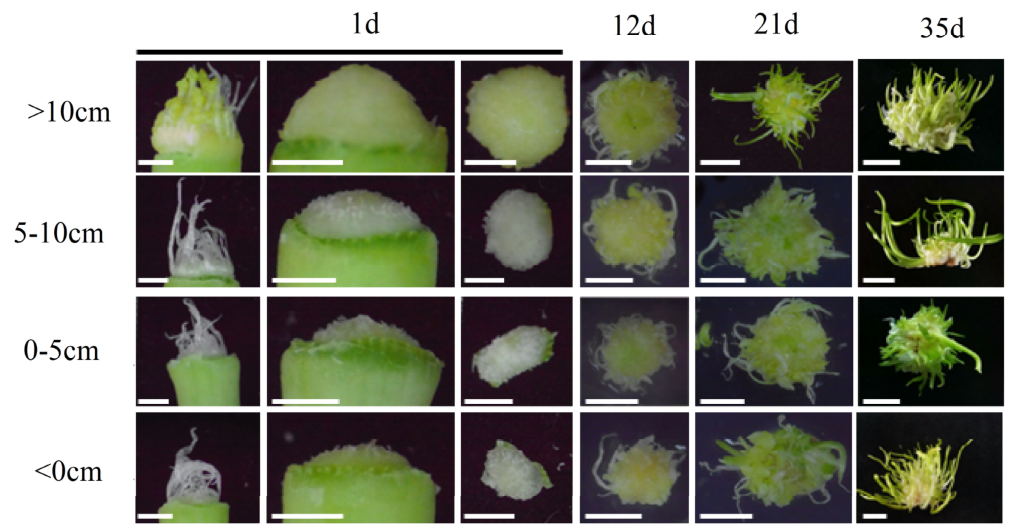
As shown in Figure 1, adventitious shoots initiated sequentially after 12 days of culture, with larger immature garlic inflorescences displaying earlier shoot emergence. By day 35, all explants had formed shoots; however, the number of shoots differed significantly across the various explant groups.
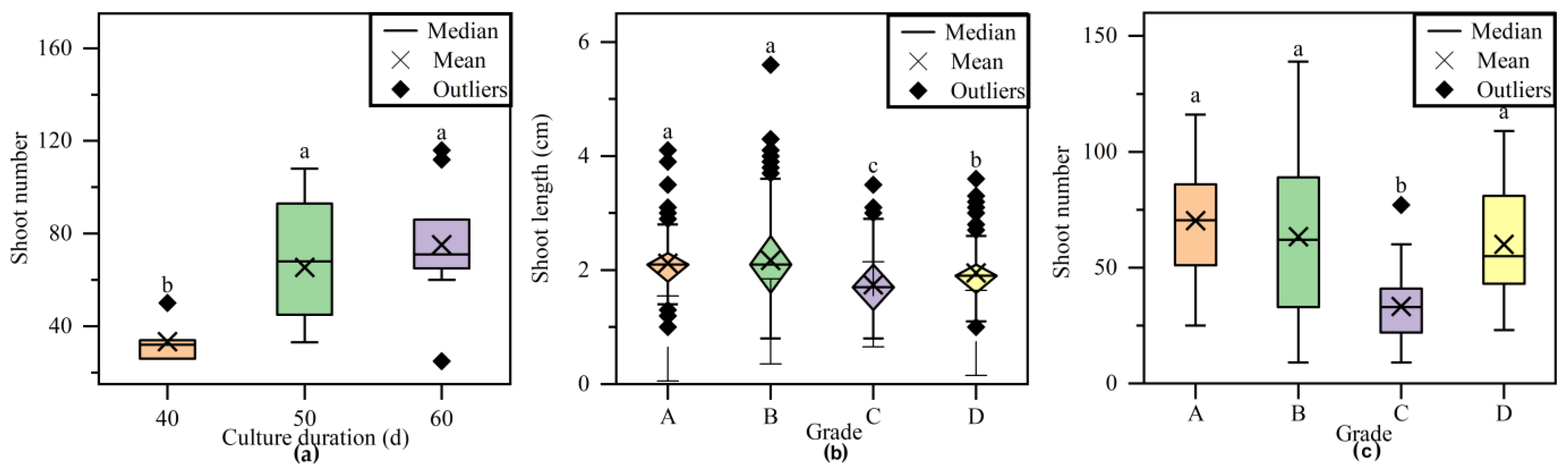
To analyze the temporal dynamics of shoot formation, immature inflorescences (<0 cm, Grade A) were compared across different culture durations (Figure 2a). After 40 days of culture, the median number of shoots was 32.0, with a narrow interquartile range (IQR) of 8.0, indicating a concentrated data distribution. At 50 days, the median shoot number increased to 68.0, accompanied by a wider IQR of 48.0. By 60 days, the median shoot number stabilized at 71.0 (IQR = 21), although three outliers were observed. Statistical comparison revealed that shoot numbers at 50 and 60 days were significantly higher than those at 40 days; however, no significant difference was found between the 50-day and 60-day groups.
Furthermore, shoot length and number were compared across different immature inflorescence explant grades (Grades A–D) (Figure 2b,c). For shoot length (Figure 2b), Grades A and B showed higher box positions (median = 2.1 cm). Grade A exhibited a centralized, compact, and symmetrical distribution (IQR = 0.5), while Grade B had the highest median but the widest range (IQR = 1.0). Grade C had the lowest median (1.7 cm), with a relatively symmetrical distribution, and Grade D was centrally compact with a median of 1.9 cm. Post hoc tests indicated no significant difference between Grades A and B, both of which were significantly longer than Grades C and D; Grade D was also significantly longer than Grade C.
Regarding shoot number (Figure 2c), Grade A showed the smallest IQR (35.0) and the highest median (70.5 shoots), closely followed by Grade B (median = 62.0 shoots), which had the widest data range. Grade C had the lowest median (33.0 shoots), while Grade D had a median of 55.0 shoots, with a box position slightly lower than that of Grade B. Post hoc analysis revealed no significant differences among Grades A, B, and D, and all three grades produced significantly more shoots than Grade C.
In summary, Grades A and B exhibited superior proliferation coefficients, rendering them the most suitable explants for efficient rapid propagation of garlic immature inflorescence.

3.1.2. Propagation Efficiency of Immature Inflorescence Explants on Different Media

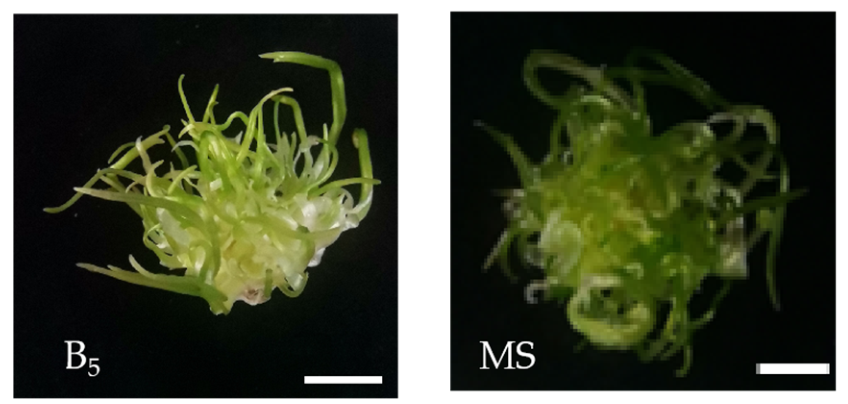
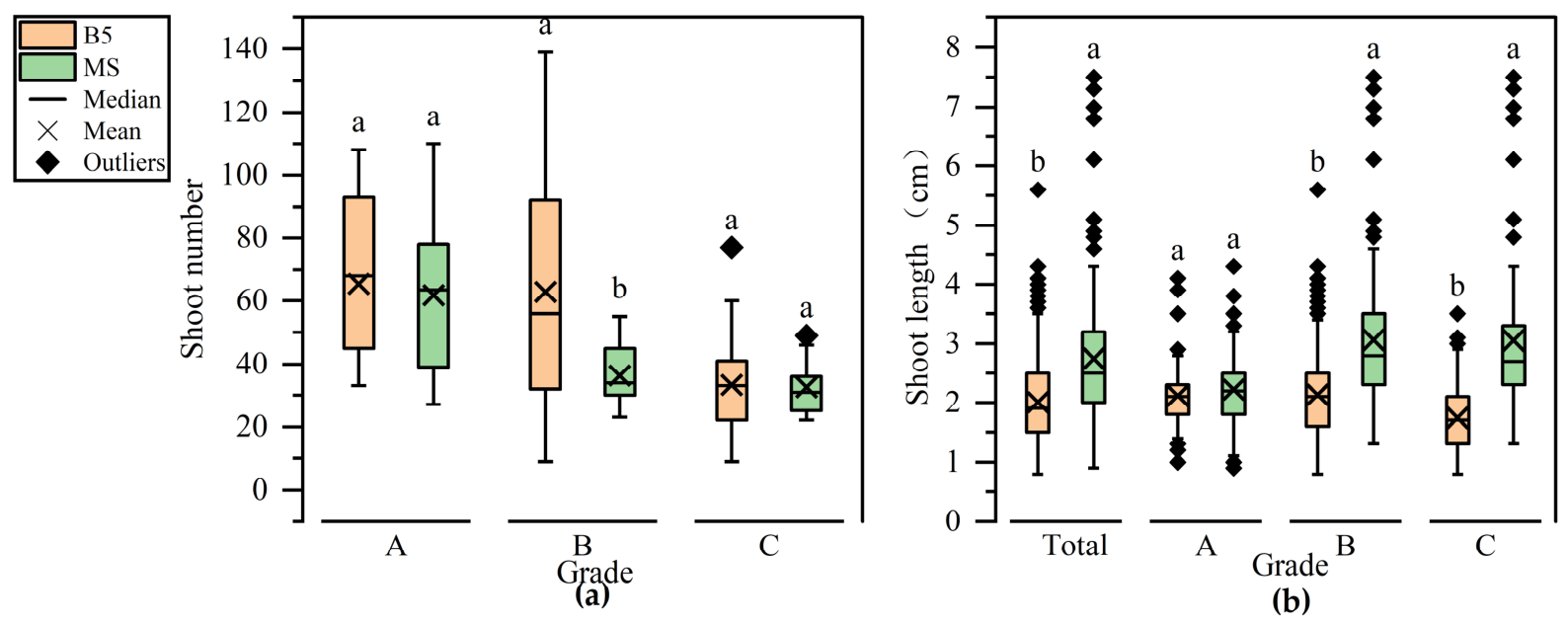
To determine the most suitable medium for the immature inflorescence, we first compared their growth and differentiation on B5 and MS media. It was observed that adventitious shoots cultured on MS medium were more prone to vitrification than those on B5 medium, which was not conducive to subsequent operations (Figure 3). Box plots were employed to systematically compare the characteristics of shoot number and length under B5 and MS media. Figure 4a shows that in terms of shoot number, the median and mean values of grades A, B, and C on B5 medium were 7.9%, 52.9%, and 6.4% higher, respectively, with Grade B exhibiting a significant increase compared with MS medium. Regarding shoot length (Figure 4b), the elongation of adventitious shoots of grades B and C was 33.3% and 58.8% longer on MS medium than on B5 medium, respectively. Therefore, our results demonstrate that B5 medium is more suitable for the propagation of immature inflorescences of garlic.

3.1.3. Propagation Efficiency Under Different Hormone Combinations

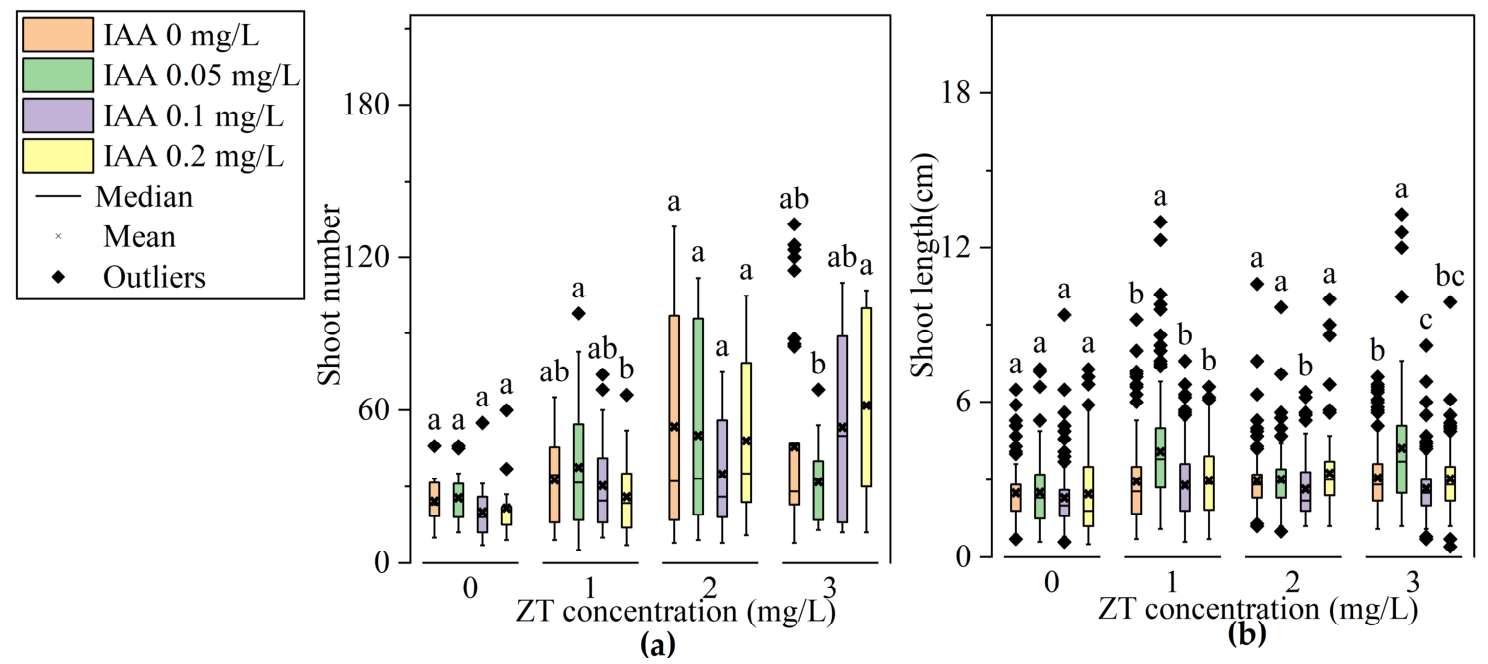
To determine the most suitable medium, we next identified the optimal hormone combination for the propagation of immature inflorescence on B5 media, and inflorescences of grades B were used as explants. The results showed that ZT, IAA, and their interaction (ZT × IAA) all exerted highly significant effects on the propagation coefficient and adventitious shoot size of garlic immature inflorescences (Table 2).
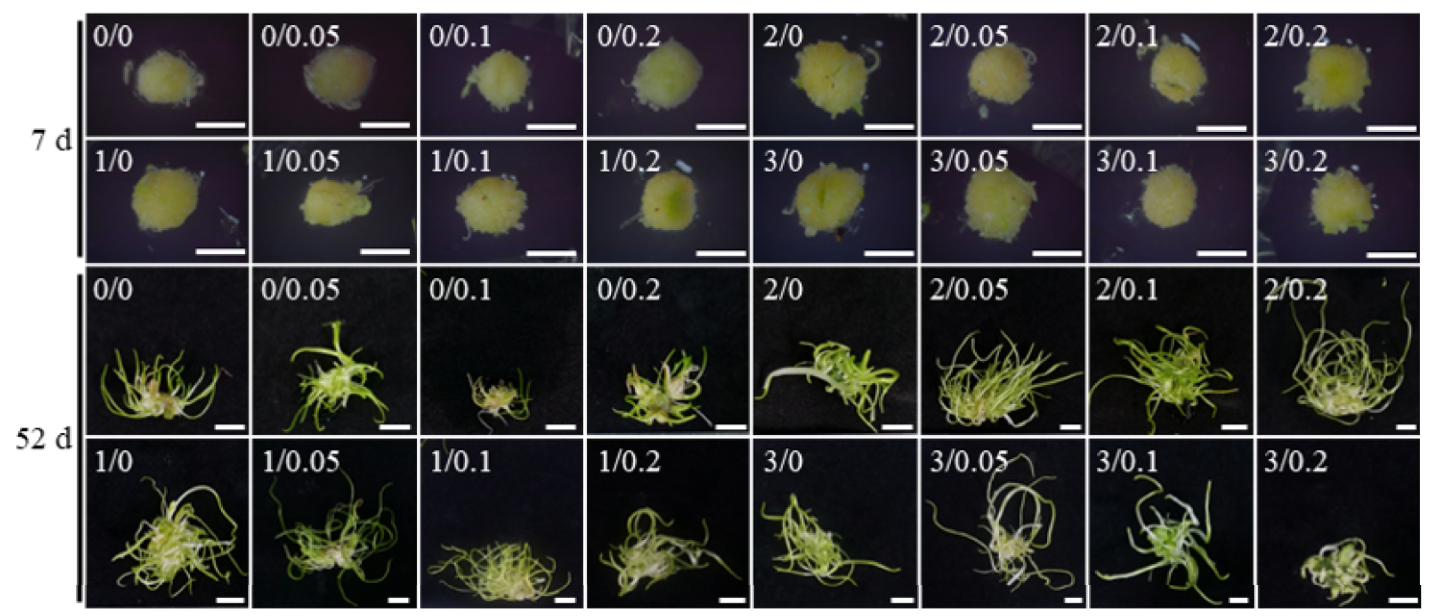
Comparative analysis of regeneration efficiency from immature inflorescences, based on shoot number and growth status, revealed the following results: At 7 days post-inoculation (7 d), no significant morphological differences were observed among explants under all hormone treatments (Figure 5). By 52 d, the shoot number and growth status of adventitious shoots differed significantly. As shown in Figure 6a, when ZT was 0 mg/L, shoot numbers remained consistently low regardless of IAA concentration, with box plots positioned near the baseline and no significant differences among IAA levels. At 1 mg/L ZT, shoot numbers increased significantly, and the highest proliferation was obtained with 0.05 mg/L IAA, where the propagation coefficient reached 32.0, which was 28.5% higher than that at 0.2 mg/L IAA. At 2 mg/L ZT, shoot numbers further increased in most treatments, and the maximum propagation coefficient of 35.0 was achieved with 0 mg/L IAA. At 3 mg/L ZT, a decline in shoot number was observed compared to 1 or 2 mg/L ZT. For adventitious shoot length, our results indicated that in the absence of ZT (0 mg/L), shoot length was low across all IAA levels, with no significant differences. At 1–3 mg/L ZT, shoot length increased; treatment with 0.05 mg/L IAA reached 3.8 cm, which was longer than those under other IAA concentrations. At 2 mg/L ZT, data distribution was compact and results were consistent (Figure 6b).
To comprehensively evaluate propagation efficiency, the entropy method was used to weight shoot number and length, followed by TOPSIS analysis to calculate the distance between the positive and negative ideal solutions (D+ and D) and the relative closeness (C) to ideal solutions. According to Table 3, the top four treatments in propagation efficiency were 2/0.05, 2/0.2, 2/0.1, and 1/0.05.
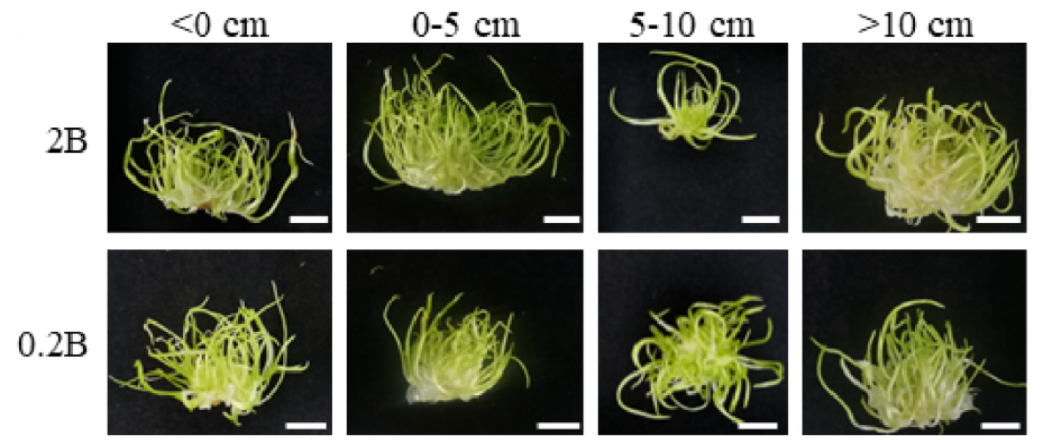
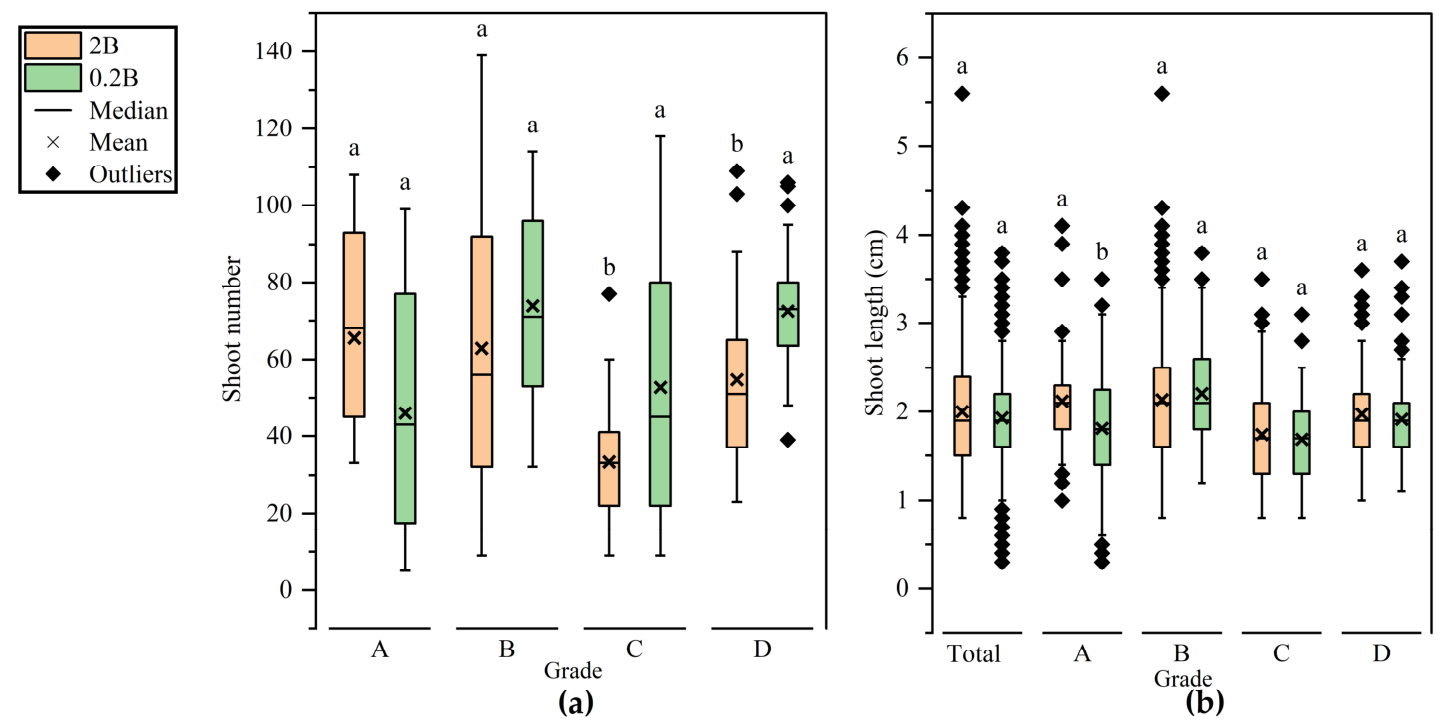
Moreover, we divided the regenerated shoot culture process into shoot induction and shoot proliferation stages to further optimize the hormone combination. At stage 1, all explants were cultured on medium containing a fixed hormone combination of 2 mg/L ZT and 0.05 mg/L IAA. At stage 2, they were transferred to medium supplemented with either 2 mg/L of ZT + 0.05 mg/L of IAA (2B) or 0.2 mg/L of ZT + 0.05 mg/L of IAA (0.2B). The results showed no obvious difference in plant growth status between the 2B and 0.2B media (Figure 7). As shown in Figure 8a, for Grade A, the 2B medium was more conducive to increasing shoot number, with the box position slightly higher than that of 0.2B, although the difference was not significant. Conversely, in Grades B, C, and D, the box positions under 0.2B were higher than those under the 2B medium, with Grades C and D exhibiting a significant increase of 36.4% and 46.1% in shoot number, respectively. Figure 8b indicates that there was no significant difference in shoot length among all grades.

3.2. Optimization of Hormone Combinations for Rapid Propagation of Stem Discs of Garlic

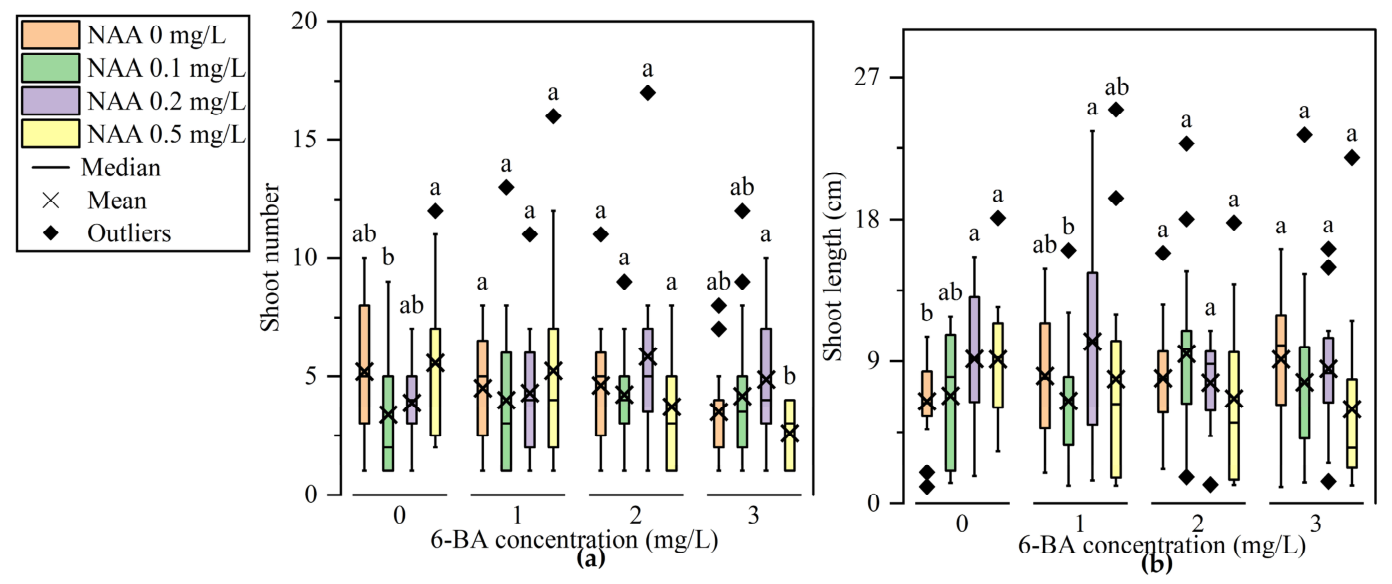
In addition to immature inflorescences, we also established an in vitro rapid shoot organogenesis system using garlic stem discs as explants. Table 4 demonstrated that both 6–BA and the interaction between 6–BA and NAA exerted highly significant effects on shoot number, while NAA alone had a significant effect. As for shoot length, neither 6–BA nor NAA alone showed a significant influence; only the interaction between 6–BA and NAA exhibited a significant effect.
Comparative analysis of shoot number and growth status following stem disc inoculation is presented in Figure 9. As shown in Figure 9a and Figure 10, at 0 mg/L 6–BA, the highest shoot number was observed in the 0.5 mg/L NAA treatment, which was 175.0% higher than that in the 0.1 mg/L NAA group. At 6–BA concentrations of 1 or 2 mg/L, no significant differences were detected among the various treatments. At 3 mg/L 6–BA, the shoot number slightly decreased compared with the 2 mg/L 6–BA treatment. Under this concentration, the 0.2 mg/L NAA treatment produced the maximum shoot number of 4.0, which was significantly higher than that in the 0.5 mg/L NAA group.
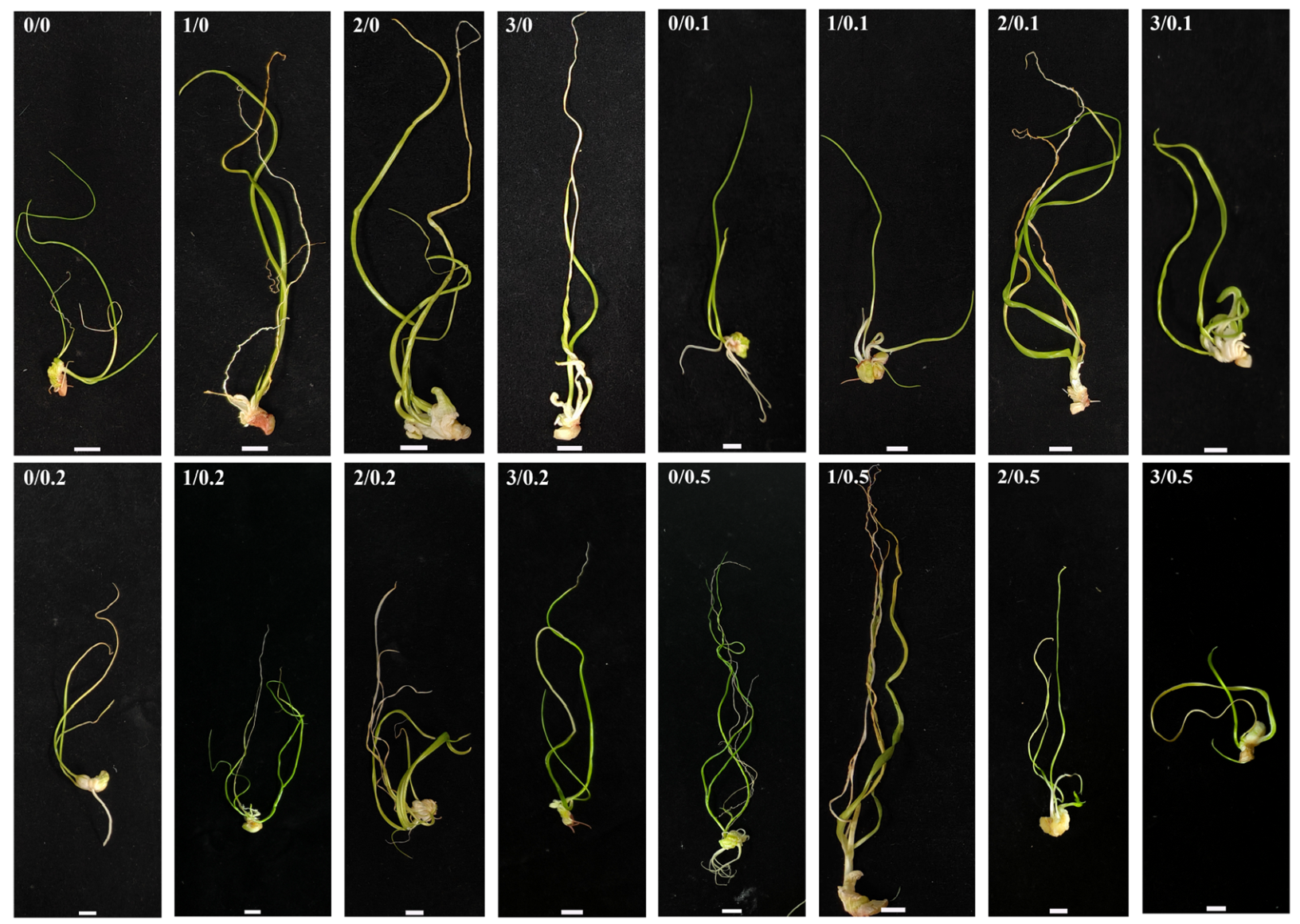
As shown in Figure 9b and Figure 10, at 0 mg/L 6–BA, shoot length increased with rising NAA concentrations; the boxes for 0.2 and 0.5 mg/L NAA were significantly higher than that of the 0 mg/L NAA group. At 1 mg/L 6–BA, the maximum shoot length of approximately 10.2 cm was obtained at 0.2 mg/L NAA. However, at 6–BA concentrations of 2 and 3 mg/L, although no significant differences in shoot number were observed, the shoot length was notably lower in the 0.5 mg/L NAA subgroup compared to others.
To comprehensively evaluate the effects of various treatments on the propagation efficiency of garlic stem discs, the entropy method was used to calculate the weights of shoot number and length. The comprehensive score for each treatment was determined using the entropy-weighted TOPSIS method. As shown in Table 5, the top four treatments ranked by propagation efficiency were 0/0.5, 2/0.2, 1/0.5, and 3/0.2. Taken together, the optimal hormone combinations for the propagation medium using stem discs of garlic were determined to be 6–BA 2 mg/L + NAA 0.2 mg/L or 6–BA 0–1 mg/L + NAA 0.5 mg/L

3.3. Optimization of Sucrose Concentrations for Development of Garlic Microbulbs

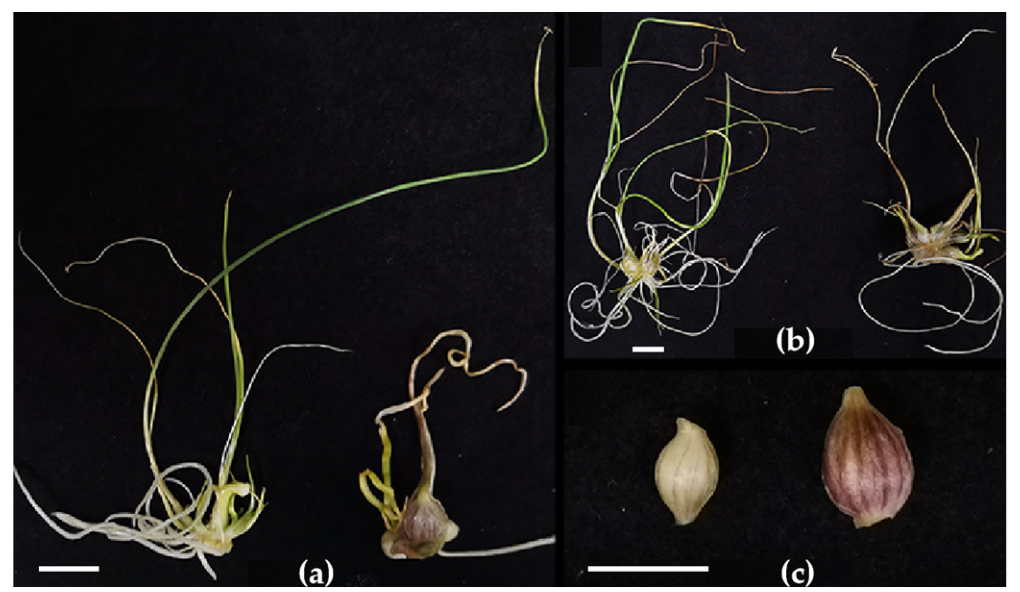
To compare the effects of sucrose on the development of microbulbs in garlic, we cultured adventitious shoots on media supplemented with different sucrose concentrations. The results showed that when the sucrose concentration was 7%, both the number and size of microbulbs were significantly greater than those grown at 3% sucrose (Figure 11).

4. Discussion

A medium can be defined as a formulation of inorganic salts and organic compounds required for crop nutrition. There are various formulations, each containing 6 to 40 compounds [36]. In this study, we found that B5 medium was more suitable for the differentiation of inflorescences than MS medium, resulting in higher overall shoot number and less vitrification (Figure 3 and Figure 4a). An analysis of the components revealed that, compared to the MS medium, the B5 medium has a lower total concentration of inorganic salts, with the ammonium nitrogen concentration accounting for only 1/10 of that in the MS medium. Although high concentrations of NH4+ can be rapidly absorbed and assimilated by plant cells, this assimilation process is highly energy-consuming. Moreover, its absorption is accompanied by the release of H+ into the medium, which easily leads to a sharp drop in pH. Furthermore, when the NH4+ concentration exceeds a certain threshold, it exerts obvious cytotoxicity, interfering with the cell membrane potential and decoupling the oxidative phosphorylation process, thereby inhibiting normal physiological activities of the cells [37]. Cells of floral organs feature thin cell walls, active metabolism, and are extremely sensitive to environmental changes. This additional physiological burden and environmental fluctuation induced by high ammonium can easily lead to browning, vitrification, or even direct death of explants. Studies by Nagakubo et al. and Luciani et al. have indicated that during the regeneration and propagation of garlic varieties such as Howaito roppen, a high ratio of KNO3/NH4Cl not only significantly promotes the formation of multiple shoots but also reduces vitrification in tissue-cultured seedlings. This may also explain the higher incidence of vitrified seedlings in MS medium observed in this study [38,39]. Additionally, the organic composition is also essential for maintaining normal growth and differentiation of explants. Compared with the B5 medium B5, the organic components in MS medium lack glycine, pyridoxine hydrochloride (vitamin B6), niacin, and thiamine [40,41]. Glycine can increase the frequency of shoot regeneration [42]; thiamine maintains cell viability and regeneration capacity and thus facilitates the development of floral organs [41]; and pyridoxine hydrochloride promotes organogenesis of the shoot tip [43], while niacin can improve the propagation coefficient of adventitious buds [44]. This experiment indicated that these four types of organic matter can significantly improve the shoots’ regeneration ability. Therefore, we speculate that the low concentrations of inorganic salts and NH4+, together with the high concentration of glycine, pyridoxine hydrochloride (vitamin B6), thiamine and niacin in B5 medium, are important factors contributing to the high propagation efficiency of inflorescences from garlic.
Different plant species and explant types typically require an optimized plant regeneration system and an appropriate size, respectively. Studies by Ayabe and Xing et al. have shown that the size of stem segment explants significantly influences the efficiency and quality of shoot regeneration [26,45]. Wen et al. divided the inflorescences of garlic variety G064 into five grades according to diameter, and the results indicated that the regeneration rate and average number of shoots decreased with the reduction in inflorescence diameter, with a diameter of 4.5–5.5 mm being the optimal for adventitious shoot regeneration in G064 inflorescences [40]. In this study, we classified the garlic inflorescences into four grades based on the length protruding from the leaf sheath. Our results indicated that explants with a protrusion length of 0–5 cm and <0 cm from the leaf sheath exhibited the highest propagation efficiency and were the most suitable for adventitious shoot regeneration,, and the results suggest that shoot proliferation stabilizes by 50 days, which was therefore selected as the standard duration for statistical analysis.
In vitro plant regeneration primarily involves cell dedifferentiation and redifferentiation, processes that are regulated by plant hormones in the culture medium. Optimizing the concentration and ratios of auxins and cytokinins in the medium is thus the key to achieving efficient propagation of garlic via tissue culture [46,47]. In practical experiments, the types, concentrations, and combinations of hormones are highly complex. Skoog and Miller proposed that the appropriate plant hormones vary depending on whether the explants are derived from different plants or the same plant at different developmental stages [48]. Bekheet, S.A. reported that 2 mg/L of 6–BA + 2 mg/L of NAA in the medium achieved the best synergistic effect, with garlic variety Balady stem disc explants producing the maximum number of shoots (6.6 per explant) and the longest shoot length (6 cm) [49]. Meena, S et al. found that the stem disc explants cultured on a medium supplemented with 1 mg/L of 6–BA + 0.1 mg/L of NAA produced the highest regeneration rate, with an average of 3.2 plants per explant [50]. Xu et al. demonstrated that the ratio of 1 mg/L of 6–BA + 1.0 mg/L of NAA was optimal for inducing seedling regeneration from stem disc explants of garlic variety Chinese jiaotou, yielding 17 plants per explant [17]. However, Ayabe and Sumi found that high concentrations of NAA or BAP inhibit the budding response of the garlic stem disc yielding shoots [26]. In this study, we demonstrated that the hormone combination of 6–BA 2 mg/L + NAA 0.2 mg/L induced the maximum number and longest elongation of regenerated seedlings from stem disc explants of garlic, which reveals that the optimal hormone formulation for different garlic varieties exhibits minor variations and thus requires tailored optimization accordingly.
Compared with research on garlic stem discs, research on the effects of different hormone combinations on the adventitious shoot organogenesis system of garlic inflorescences is relatively limited. Wen et al. demonstrated that an optimal combination of 6–BA and NAA achieved the highest propagation efficiency for garlic inflorescences, with a maximum of 23.4 plantlets per explant [40]. In this study, we selected ZT and IAA as alternative hormonal regulators to 6–BA and NAA for screening the optimal cytokinin–auxin ratio in the culture medium for garlic inflorescence propagation. Our results identified two optimal hormonal formulations for the propagation of immature inflorescences of garlic: 2 mg/L of ZT combined with 0.05–0.2 mg/L of IAA, and 1 mg/L of ZT combined with 0.05 mg/L of IAA. This approach achieved a maximum propagation efficiency of 50.0 plantlets per explant, which was superior to the efficiencies reported in prior related studies, demonstrating that this ZT–IAA combination is a viable and effective option for in vitro culture of garlic inflorescences. Furthermore, previous research has reported that high ZT concentrations are a double-edged sword, inducing abundant shoot formation while inhibiting shoot elongation and forming stunted, clustered multiple shoots [51]. Consistent with prior findings, we found in this study that a two-step culture strategy—initial proliferation on a medium supplemented with a high ZT concentration, followed by transfer to a low-ZT medium for shoot elongation—markedly enhances the production of garlic regenerated plantlets, yielding both high propagation efficiency and optimal shoot length.
In plant tissue culture, sucrose functions as both the primary carbon source and osmotic regulatory substance in the medium, and it may act as a signaling molecule to regulate endogenous hormone balance, thereby determining the morphogenesis, growth rate, and final quality of garlic microbulbs. For example, an 8–10% sucrose concentration has been shown to facilitate bulb formation in the garlic cultivars Ito and Quiteria [52], while a 10–12% sucrose concentration is more conducive to bulb formation in the cultivars GC002, GC008, GC009, and GC0025 [51]. Greedharry et al. found that elevating the sucrose concentration in the medium to 9% resulted in significant increases in bulb number per plant, bulb formation rate, bulb diameter, and fresh bulb weight [53]. Longo et al. reported that a 5% sucrose concentration was the optimal level for bulb formation and development [54], whereas Xu et al. demonstrated that a medium supplemented with 12% sucrose exerted a positive effect on the formation and development of bulbs in the Chinese jiaotou garlic cultivar [17]. Kim et al. reported that supplementation with 11% sucrose helped in direct bulblet regeneration from root tips of garlic at a higher frequency [55]. In this study, we observed that the garlic microbulbs developed a significantly larger diameter when cultured on a medium with 7% sucrose compared to a 3% sucrose concentration, which indicates that an appropriate increase in sucrose concentration also enhances microbulb formation in this cultivar.

5. Conclusions

In summary, we have successfully established an efficient shoot organogenesis system for garlic CV. Gailiangsuan, the details of which are as follows:
(1) Optimal Explants: Immature inflorescences protruding 0–5 cm from the leaf sheath, or those not protruding from the leaf sheath (<0 cm), exhibited high propagation coefficients and are suitable for rapid multiplication.
(2) Optimal Media and Hormone Combinations: The B5 medium was superior to the MS medium for immature inflorescences proliferation. Furthermore, the most effective hormone formulations for shoot regeneration from immature inflorescences were determined to be ZT 2 mg/L + IAA 0.05–0.2 mg/L, or ZT 1 mg/L + IAA 0.05 mg/L.
(3) Optimal Culture Strategy: A two-stage culture strategy—culturing in media with high ZT concentrations during the initial stage followed by transfer to media with low ZT concentrations—resulted in a higher propagation coefficient.
(4) Optimal Stem Disc Propagation: The optimal hormone combinations were identified as 6–BA 2 mg/L + NAA 0.2 mg/L, or 6–BA 0–1 mg/L + NAA 0.5 mg/L.
(5) Optimal Sucrose Concentration for Microbulb Development: Media containing 7% sucrose produced significantly larger microbulbs.

Author Contributions

Conceptualization, S.C. and S.W.; methodology, S.W.; validation, Shufen Wang, X.N., K.Z. and J.W.; formal analysis, S.W., B.L. and Q.Z.; investigation, S.W., X.N. and B.L.; resources, S.C. and H.L.; data curation, S.W., X.N. and Q.Z.; writing—original draft preparation, S.W. and X.N.; writing—review and editing, X.W., M.H. and B.L.; supervision, S.W.; project administration, S.W. and M.H.; funding acquisition, S.W. and M.H. All authors have read and agreed to the published version of the manuscript.

Funding

This research was funded by the National Key Research and Development Program of China (grant no. 2023YFD1600201).

Institutional Review Board Statement

Not applicable.

Data Availability Statement

The original contributions presented in this study are included in the article. Further inquiries can be directed to the corresponding author.

Conflicts of Interest

The authors declare no conflicts of interest.

Abbreviations

The following abbreviations are used in this manuscript:
ZTZeatin
NAA1-Naphthaleneacetic acid
6-BA6-Benzylaminopurine
IAAIndole-3-acetic acid
PGRsPlant growth regulators
IQRInterquartile range
dpiDays post-inoculation
B5Gamborg B
MSMurashige and Skoog

References

  1. Jain, M.; Patil, N.; Mohammed, A.; Hamzah, Z. Valorization of garlic (Allium sativum L.) byproducts: Bioactive compounds, biological properties, and applications. J. Food Sci. 2025, 90, e70152. [Google Scholar] [CrossRef]
  2. Afzaz, M.H.; Mozafari, J.; Sanjari, S. Micropropagation and somaclonal variation in Iranian genotypes of garlic (Allium sativum L.). PLoS ONE 2025, 20, e0331782. [Google Scholar] [CrossRef]
  3. De Greef, D.; Barton, E.M.; Sandberg, E.N.; Croley, C.R.; Pumarol, J.; Wong, T.L.; Das, N.; Bishayee, A. Anticancer potential of garlic and its bioactive constituents: A systematic and comprehensive review. Semin. Cancer Biol. 2021, 73, 219–264. [Google Scholar] [CrossRef] [PubMed]
  4. Yalamalle, V.R.; Tomar, B.S.; Singh, M. Quality Seeds Production of Onion and Garlic: Challenges and Opportunities. In Proceedings of the National Seminar on Strategic Management of Production & Post–Harvest Technologies of Onion, Garlic & Potato, New Delhi, India, 11–12 March 2019; pp. 90–102. [Google Scholar]
  5. Burba, J.L. Garlic (Allium sativum L.) Genetic Improvement and Seed Production. Possibilities of Adaptation to Variable Environments. Colomb. J. Hortic. Sci. 2009, 3, 28–44. [Google Scholar]
  6. Tchorzewska, D.; Derylo, K.; Blaszczyk, L.; Winiarczyk, K. Tubulin cytoskeleton during microsporogenesis in the male–sterile genotype of Allium sativum and fertile Allium ampeloprasum L. Plant Reprod. 2015, 28, 171–182. [Google Scholar] [CrossRef] [PubMed]
  7. Izquierdo Oviedo, H.; Gómez, O. Criollo–9, un Cultivar de Ajo Resistente a las Enfermedades Fitopatógenas y Elevado Potencial de Rendimiento. Cult. Trop. 2012, 33, 68. [Google Scholar]
  8. Messiaen, C.H. Les Allium Alimentaires Reproduits par Voie Végétative; Editions Quae: Versailles, France, 1993; p. 302. [Google Scholar]
  9. Teixeira da Silva, J.A.; Gulyas, A.; Magyar-Tabori, K.; Wang, M.R.; Wang, Q.C.; Dobranszki, J. In vitro tissue culture of apple and other Malus species: Recent advances and applications. Planta 2019, 249, 975–1006. [Google Scholar] [CrossRef]
  10. Robledo-Paz, A.; Manuel, H. Biotechnological tools for garlic propagation and improvement. In Innovations in Biotechnology; Agbo, E.C., Ed.; InTech: Rijeka, Croatia, 2012; ISBN 978–953–307–817–6. [Google Scholar]
  11. Izquierdo-Oviedo, H.; Disotuar, R.; González, M.C.; González, S.J. Micropropagation of garlic (Allium sativum L.) and determination of the genetic stability of the plantlets obtained by AFLP markers. Biotecnol. Apl. 2016, 33, 4211–4218. [Google Scholar]
  12. Salomon, R. Virus diseases in garlic and the propagation of virus–free plants. In Allium Crop Science: Recent Advances; Brewster, J.L., Rabinowitch, H.D., Eds.; CABI Publishing: Wallingford, UK, 2002; pp. 311–327. [Google Scholar]
  13. Murkute, A.A.; Gawande, S.J. Production of virus free planting material through meristem culture in short day garlic cultivars Bhima Omkar and Bhima Purple. J. Essent. Biol. 2018, 39, 286–290. [Google Scholar] [CrossRef]
  14. Hassan, M.N.; Haque, M.S. An efficient protocol for somatic embryogenesis of garlic (Allium sativum L.) using root tip as explant. J. Bangladesh Agric. Univ. 2014, 12, 1–6. [Google Scholar] [CrossRef]
  15. Manjunathagowda, D.C.; Jayaswall, K.; Singh, M.; Sagar, R.; Chaturvedi, P. Thermotherapy of cloves for in–vitro mericlone production for healthy and sustainable management of garlic germplasm. Indian J. Tradit. Knowl. 2021, 20, 262–266. [Google Scholar]
  16. Gad El-Hak, S.E.N.H.; Ahmed, K.Z.; Moustafa, Y.M.; Ezzat, A.S. Growth and cytogenetical properties of micro–propagated and successfully acclimatized garlic (Allium sativum L.) clones with a modified shoot tip culture protocol. J. Hortic. Sci. Ornam. Plants 2011, 3, 115–129. [Google Scholar]
  17. Xu, Z.; Um, Y.-C.; Kim, C.-H.; Lu, G.; Guo, D.-P.; Liu, H.-L.; Bah, A.A.; Mao, A. Effect of plant growth regulators, temperature and sucrose on shoot proliferation from the stem disc of Chinese jiaotou (Allium chinense) and in vitro bulblet formation. Acta Physiol. Plant. 2008, 30, 521–528. [Google Scholar] [CrossRef]
  18. Mostafa, H.H.; Wang, H.; Song, J.; Li, X. Effects of genotypes and explants on garlic callus production and endogenous hormones. Sci. Rep. 2020, 10, 4867. [Google Scholar] [CrossRef]
  19. Fan, B.; He, R.; Shang, Y.; Xu, L.; Wang, N.; Gao, H.; Wang, Z. System construction of virus–free and rapid–propagation technology of Baodi garlic (Allium sativum L.). Sci. Hortic. 2017, 225, 498–504. [Google Scholar] [CrossRef]
  20. Ebi, M.; Kasai, N.; Masuda, K. Small inflorescence bulbils are best for micropropagation and virus elimination in garlic. HortScience 2000, 35, 735–737. [Google Scholar] [CrossRef]
  21. Kenel, F.; Eady, C.; Brinch, S. Efficient Agrobacterium tumefaciens–mediated transformation and regeneration of garlic (Allium sativum L.) immature leaf tissue. Plant Cell Rep. 2010, 29, 223–230. [Google Scholar] [CrossRef] [PubMed]
  22. Fereol, L.; Chovelon, V.; Causse, S.; Michaux-Ferriere, N.; Kahane, R. Evidence of a somatic embryogenesis process for plant regeneration in garlic (Allium sativum L.). Plant Cell Rep. 2002, 21, 197–203. [Google Scholar] [CrossRef]
  23. Ma, Y.; Wang, H.L.; Zhang, C.J.; Kang, Y.Q. High rate of virus–free plantlet regeneration via garlic scape–tip culture. Plant Cell Rep. 1994, 14, 65–68. [Google Scholar] [CrossRef]
  24. Xiong, Z.Q.; Li, S.J.; Liu, G.Q.; Huang, B.J. Studies on garlic (Allium sativum L.) rachis in vitro culture. J. Nanjing Agric. Univ. 2000, 23, 25–28. [Google Scholar]
  25. Zhang, S.Z.; Li, J.R. Establishment of a novel rapid propagation system—Adventitious shoots regeneration system in the inflorescence of garlic (Allium sativum). J. Shandong Agric. Univ. (Nat. Sci.) 2007, 38, 159–162. [Google Scholar]
  26. Ayabe, M.; Sumi, S. Establishment of a novel tissue culture method, stem disc culture, and its practical application to micropropagation of garlic (Allium sativum L.). Plant Cell Rep. 1998, 17, 773–779. [Google Scholar] [CrossRef] [PubMed]
  27. Luciani, G.F.; Mary, A.K.; Pellegrini, C.; Curvetto, N.R. Effects of explants and growth regulators in garlic callus formation and plant regeneration. Plant Cell Tiss. Organ Cult. 2006, 87, 139–143. [Google Scholar] [CrossRef]
  28. Peat, G.; Jones, M. A protocol for rapid, measurable plant tissue culture using stem disc meristem micropropagation of garlic. Sch. Sci. Rev. 2012, 93, 93–98. [Google Scholar]
  29. Zulkarnain, Z. Kultur Jaringan Tanaman; Bumi Aksara: Jakarta, Indonesia, 2011. [Google Scholar]
  30. Wattimena, G.A. Bioteknologi Tanaman; Institut Pertanian Bogor: Bogor, Indonesia, 1992. [Google Scholar]
  31. Kristina, N.; Herawati, N.; Resigia, E. Shoots and Roots Induction of Garlic on Different Composition of Plant Growth Regulators and Photoperiod. Proc. IOP Conf. Ser. Earth Environ. Sci. 2023, 1177, 012025. [Google Scholar] [CrossRef]
  32. Fitrahtunnisa, F.; Supriati, Y.; Yufdy, M.P.; Mastur; Ahmad, F.; Wiguna, G.; Handayani, T.; Handayani, T.; Roostika, I. The Use of Auxin to Regenerate Embryogenic Callus of Indonesian Local Garlic Varieties. In Proceedings of the IOP Conference Series: Earth and Environmental Science, Tashkent, Uzbekistan, 17–19 October 2024; Volume 1377, p. 012098. [Google Scholar]
  33. Maryono, M.Y. Somatic Embryogenesis on Irradiated Callus of Garlic (Allium sativum L.). In Proceedings of the Journal of Physics: Conference Series, Bandung, Indonesia, 26 February 2020; Volume 1436, p. 012115. [Google Scholar] [CrossRef]
  34. Gamborg, O.L.; Miller, R.A.; Ojima, K. Nutrient Requirements of Suspension Cultures of Soybean Root Cells. Exp. Cell Res. 1968, 50, 151–158. [Google Scholar] [CrossRef]
  35. Murashige, T.; Skoog, F. A Revised Medium for Rapid Growth and Bio Assays with Tobacco Tissue Cultures. Physiol. Plant. 1962, 15, 473–497. [Google Scholar] [CrossRef]
  36. Mujica, H.; Mogollón, N. Bulbificación in Vitrode Ajo (Allium sativum L.) con Adición de Citocininas y Sacarosa en el Medio de Cultivo. Bioagro 2004, 16, 55–60. [Google Scholar]
  37. Hazrati, R.; Zare, N.; Asghari-Zakaria, R.; Sheikhzadeh, P.; Johari-Ahar, M. Factors affecting the growth, antioxidant potential, and secondary metabolites production in hazel callus cultures. AMB Expr. 2022, 12, 109. [Google Scholar] [CrossRef]
  38. Nagakubo, T.; Nagasawa, A.; Ohkawa, H. Micropropagation of garlic through in vitro bulblet formation. Plant Cell Tiss. Organ Cult. 1993, 32, 175–183. [Google Scholar] [CrossRef]
  39. Luciani, G.F.; Marinangeli, P.A.; Curvetto, N.R. Increasing nitrate/ammonium ratio for improvement of garlic micropropagation. Sci. Hortic. 2001, 87, 11–20. [Google Scholar] [CrossRef]
  40. Wen, Y.B.; Liu, X.X.; Liu, H.J.; Wu, C.N.; Meng, H.W.; Cheng, Z.H. High-frequency direct shoot organogenesis from garlic (Allium sativum L.) inflorescence and clonal fidelity assessment in regenerants. Plant Cell Tiss. Organ Cult. 2020, 141, 275–287. [Google Scholar] [CrossRef]
  41. Nagasawa, A.; Finer, J. Development of morphogenic suspension cultures of garlic (Allium sativum L.). Plant Cell Tiss. Organ Cult. 1988, 15, 183–187. [Google Scholar] [CrossRef]
  42. Ramakrishnan, M.; Ceasar, S.A.; Duraipandiyan, V.; Ignacimuthu, S. Efficient plant regeneration from shoot apex explants of maize (Zea mays) and analysis of genetic fidelity of regenerated plants by ISSR markers. Plant Cell Tiss. Organ Cult. 2014, 119, 183–196. [Google Scholar] [CrossRef]
  43. Zhang, Y.M.; Li, X.; Chen, Z.; Li, J.-F.; Lu, J.Y.; Zhou, W.Z. Shoot organogenesis and plant regeneration in Agave hybrid. Sci. Hortic. 2013, 161, 30–34. [Google Scholar] [CrossRef]
  44. Roy, J.; Banerjee, N. Induction of callus and plant regeneration from shoot-tip explants of Dendrobium fimbriatum Lindl. var. Oculatum Hk. f. Sci. Hortic. 2003, 97, 333–340. [Google Scholar] [CrossRef]
  45. Xing, L.D. Regeneration System In Vitro of Chive (Allium schoenoprasum L.). Master’s Thesis, Huazhong Agricultural University, Wuhan, China, 2009. [Google Scholar]
  46. Carbajal Cruz, N.N. Termoterapia y Cultivo in Vitrode Ajo (Allium sativum L.) para la Eliminación del Virus del Enanismo Amarillo de la Cebolla. Master’s Thesis, Universidad Autónoma de Nuevo León, Monterrey, Mexico, 2018. [Google Scholar]
  47. Khan, S.; Al-Qurainy, F.; Nadeem, M. Biotechnological Approaches for Conservation and Improvement of Rare and Endangered Plants of Saudi Arabia. Saudi J. Biol. Sci. 2012, 19, 1–11. [Google Scholar] [CrossRef]
  48. Skoog, F.; Miller, C.O. Chemical Regulation of Growth and Organ Formation in Plant Tissues Cultivated in Vitro. Symp. Soc. Exp. Biol. 1957, 11, 118–131. [Google Scholar]
  49. Bekheet, S.A.; El-Sawy, S.M.; Rihan, H.Z.; Al-Whaibi, M.H. Micropropagation of garlic (Allium sativum L.) bulbils as affected by gamma irradiation. Am. J. Plant Sci. 2014, 5, 1318–1329. [Google Scholar]
  50. Meena, S.; Kumar, S.; Sharma, A.; Kaur, G.; Singh, M. Micropropagation and genetic fidelity assessment of garlic (Allium sativum L.) using RAPD markers. Int. J. Mol. Sci. 2022, 22, 8367. [Google Scholar]
  51. Roksana, M.R. Micropropagation and Improvement of Garlic (Allium sativum L.) Through In Vitro Techniques. Master’s Thesis, University of Rajshahi, Rajshahi, Bangladesh, 2012. [Google Scholar]
  52. Santos, A.P.d.; Oliveira, R.; Oliveira, R.C.d.; Luz, J.M.Q. Sucrose and hyperhydricity in the micropropagation of garlic seeds in vitro. Rev. Ciênc. Agron. 2026, 57, e202493270. [Google Scholar] [CrossRef]
  53. Greedharry, P.; Boodhram, K.I.D.; Koyelas, C. In vitro propagation of garlic (Allium sativum L.) from meristem culture. Curr. Agric. Res. J. 2024, 12, 623–638. [Google Scholar] [CrossRef]
  54. Longo, A.E.O.; Siqueira, W.J.; Passos, I.R.D.S.; Scott, M.D.S.; de Azevedo Filho, J.A. Micropropagação e bulbificação in vitro de alho (Allium sativum L.). Plant Cell Cult. Micropropag. 2012, 8, 18–26. [Google Scholar]
  55. Kim, S.; Guo, D.; Jung, D.; Kwon, S. Multiple Shoot Regeneration and in VitroBulblet Formation from Garlic Callus. J. Plant Biotechnol. 2003, 5, 95–99. [Google Scholar]
Figure 1. In vitro shoot regeneration of immature inflorescences (d: days after inoculation; scale bars: 2 mm for 1–12 d, 5 mm for 21 d, 1 cm for 35 d).
Agriculture 16 00811 g001
Figure 2. Shoot regeneration of immature garlic inflorescences from various grades at different post-inoculation culture stages. (a) Number of adventitious shoots of immature inflorescences at various culture stages after inoculation; (b,c) length (b) and number (c) of adventitious shoots from grade A, B, C, D immature inflorescences. Statistical differences were determined using one-way ANOVA with LSD (p < 0.05 significance level). Identical lowercase letters indicate values for treatments belonging to statistically identical groups.
Agriculture 16 00811 g002
Figure 3. In vitro shoot regeneration of garlic inflorescences on different media (bar = 1 cm).
Agriculture 16 00811 g003
Figure 4. Shoot regeneration of immature garlic inflorescences on different media. (a,b) Number (a) and length (b) of adventitious shoots from grade A–C and total immature inflorescences on different media. Statistical differences were determined using one-way ANOVA with LSD (p < 0.05 significance level). Identical lowercase letters indicate values for treatments belonging to statistically identical groups.
Agriculture 16 00811 g004
Figure 5. Shoot regeneration under different hormone concentrations; bars = 5 mm; the notation “0/0” represents ZT 0 mg/L/IAA 0 mg/L, etc. (bar = 1 cm).
Agriculture 16 00811 g005
Figure 6. Number (a) and length (b) of shoots under different hormone concentrations. Statistical differences were determined using one-way ANOVA with LSD (p < 0.05 significance level). Identical lowercase letters indicate values for treatments belonging to statistically identical groups.
Agriculture 16 00811 g006
Figure 7. In vitro shoot regeneration of garlic immature inflorescences (bar = 1 cm).
Agriculture 16 00811 g007
Figure 8. Number (a) and length (b) of adventitious shoots from grade A–D and total immature inflorescences on different ZT-supplemented media. Statistical differences were determined using one-way ANOVA with LSD (p < 0.05 significance level). Identical lowercase letters indicate values for treatments belonging to statistically identical groups.
Agriculture 16 00811 g008
Figure 9. Number (a) and length (b) of adventitious shoots from stem discs under different hormone concentrations. Statistical differences were determined using one-way ANOVA with LSD (p < 0.05 significance level). Identical lowercase letters indicate values for treatments belonging to statistically identical groups.
Agriculture 16 00811 g009
Figure 10. In vitro shoot regeneration of garlic stem discs under different hormone concentrations; the notation “0/0” represents 6–BA 0 mg/L/NAA 0 mg/L, etc. (bar = 1 cm).
Agriculture 16 00811 g010
Figure 11. Development of microbulbs under different sucrose concentrations. (a) Left: 3% sucrose; Right: 7% sucrose; (b) Left: 3% sucrose; Right: 7% sucrose; (c) Left: 3% sucrose; Right: 7% sucrose (bar = 1 cm) [34].
Agriculture 16 00811 g011
Table 1. Four grades of garlic inflorescences.
Gradethe Exserted Length of the Spathe Sheath
Grade AInflorescences not protruding from the sheath (<0 cm).
Grade BInflorescences protruding 0–5 cm from the sheath (0–5 cm).
Grade CInflorescences protruding 5–10 cm from the sheath (5–10 cm).
Grade DInflorescences protruding > 10 cm from the sheath (>10 cm).
Table 2. Effects of ZT and IAA and their interaction on propagation efficiency of immature inflorescences.
FactorsConcentrations (mg/L)Shoot NumberShoot Length (cm)
ZT020.3 d2.2 d
136.0 b3.2 a
224.4 a2.8 c
337.0 c3.0 b
IAA026.4 d2.8 b
0.0552.4 a3.4 a
0.130.8 c2.3 c
0.238.48 b2.7 b
AnovaF-test
ZT****
IAA****
ZT × IAA****
Data with different letters in the same column indicate significant difference between means at the 5% probability level by LSD. ** significant difference at 0.01 level (ANOVA and LSD’s multiple range test).
Table 3. Results of entropy weight TOPSIS method for evaluating the propagation efficiency of immature garlic inflorescences under different hormone concentrations.
D+DCRank
0/00.3884135340.0316748780.07540050312
0/0.050.3770297290.0429723060.10231451810
0/0.10.4199151110016
0/0.20.3857513610.0341867280.08140897311
1/00.2857781330.1341732990.3194971825
1/0.050.210806040.2095516910.4985079984
1/0.10.3463431590.0736691210.1753975417
1/0.20.413905220.0106101570.02499357513
2/00.4189731690.0059934250.01410328415
2/0.050.0105955790.4195639830.9753682581
2/0.10.1809337590.239308980.569454173
2/0.20.0335703920.3868975450.9201594492
3/00.3547943660.0655305890.1559045878
3/0.050.3425657560.078815330.1870405026
3/0.10.4140428850.0072003620.0170931214
3/0.20.3762968090.0437419940.1041379849
Table 4. Effects of 6–BA, NAA and their interaction on the propagation efficiency of the garlic stem disc.
FactorsConcentrations (mg/L)Shoot NumberShoot Length (cm)
6–BA03.8 c6.4 a
15.5 a8.4 a
24.9 b7.1 a
34.5 b5.8 a
NAA04.9 a7.6 a
0.14.1 b6.3 a
0.24.9 a6.9 a
0.54.8 a7 a
AnovaF-test
6–BA**ns
NAA*ns
6–BA × NAA***
Data with different letters in the same column indicate significant difference between means at the 5% probability level by LSD. * Significant difference at 0.05 level; ** significant difference at 0.01; ns indicates not significant.
Table 5. Results of entropy weight TOPSIS method for evaluating the propagation efficiency of garlic stem discs under different hormone concentrations.
D+DCRank
0/00.0497519020.0915823690.6479841635
0/0.10.0945255420.0297900970.23963273915
0/0.20.0689194860.0592608560.4623240611
0/0.50.0160909990.1105857420.8729759021
1/00.053114810.0714305270.5735303198
1/0.10.0777684030.0498830180.39077526512
1/0.20.0535545110.0783669160.5940423627
1/0.50.0347444440.0953652050.7329602833
2/00.0503037430.0749536690.5983970766
2/0.10.0565424570.0710251760.5567648629
2/0.20.0304439480.1152641070.7910620082
2/0.50.0848240380.0407913040.32473186414
3/00.0825706090.0490685310.37275031413
3/0.10.065583870.0588925910.47312231110
3/0.20.0393642970.0852845810.6841985434
3/0.50.1242236020016
Disclaimer/Publisher’s Note: The statements, opinions and data contained in all publications are solely those of the individual author(s) and contributor(s) and not of MDPI and/or the editor(s). MDPI and/or the editor(s) disclaim responsibility for any injury to people or property resulting from any ideas, methods, instructions or products referred to in the content.