Article

Integrating Plant Height into Hyperspectral Inversion Models for Estimating Chlorophyll and Total Nitrogen in Rice Canopies


School of Geography and Planning, Chengdu University of Technology, Chengdu 610059, China
*
Author to whom correspondence should be addressed.
Agriculture 2026, 16(6), 656; https://doi.org/10.3390/agriculture16060656
Submission received: 23 December 2025 / Revised: 8 March 2026 / Accepted: 10 March 2026 / Published: 13 March 2026

Abstract

Rice undergoes rapid growth and exhibits a high demand for nutrients during the tillering and booting stages. SPAD readings, which reflect relative leaf chlorophyll status, and leaf nitrogen content (LNC) are key indicators of plant nutritional status, directly influencing photosynthetic efficiency and biomass accumulation, while plant height (PH) reflects canopy structure and nutrient availability. Establishing quantitative relationships among these traits at key growth stages is essential for stage-specific precision rice management. In this study, Unmanned Aerial Vehicle (UAV) hyperspectral imagery and ground-truth measurements of SPAD, LNC, and PH were collected from rice fields in Qingbaijiang District, Chengdu, China. Twelve vegetation indices (VIs) were calculated, and three machine learning algorithms—partial least squares regression (PLSR), support vector regression (SVR), and random forest regression (RFR)—were employed to develop stage-specific retrieval models. A stage-specific modeling framework integrating PH with hyperspectral data was developed to statistically enhance estimation accuracy at the tillering and booting stages. The optimal models for SPAD readings and LNC achieved R2 values of 0.916 and 0.936, respectively. The results indicate that integrating canopy structural information with hyperspectral features can improve the estimation accuracy of SPAD-related chlorophyll indicators and nitrogen status in rice. Under the controlled field conditions of this study, the proposed framework provides a plot-scale proof-of-concept demonstration for UAV-based stage-specific nitrogen monitoring.

1. Introduction

Oryza sativa is one of the world’s most important staple crops and plays a central role in global food security owing to its high productivity and yield stability [1]. For instance, Zheng reviewed the monitoring of canopy nitrogen in rice and wheat and emphasized that nitrogen nutrition is a key determinant of crop yield and grain quality [2]. Moharana reported that spatial variability in LNC is closely associated with leaf chlorophyll status, photosynthetic efficiency, and plant height in rice, underscoring the physiological coupling between nitrogen and canopy structure [3]. During key developmental stages, such as tillering and booting, critical phenotypic traits—including SPAD readings, LNC, and PH—are closely associated with photosynthetic efficiency, nitrogen allocation, and, ultimately, yield formation [4]. However, excessive nitrogen fertilization remains common practice and has been identified as a major cause of low nitrogen use efficiency and environmental degradation in paddy ecosystems [5,6]. Recent studies have demonstrated that UAV-based hyperspectral and multispectral techniques provide a viable approach for precise and high-throughput phenotypic monitoring and nitrogen management in rice production systems.
Conventional approaches for measuring these traits are limited by destructive sampling, low efficiency, and poor scalability. Spectrophotometric assays for chlorophyll, for instance, require destructive sampling and are prone to photodegradation artifacts [7,8], while portable chlorophyll meters provide only point-based readings that are inadequate for large-scale applications [9]. Similarly, the Kjeldahl method for determining LNC is highly accurate but labor-intensive and time-consuming [10,11], and manual measurements of PH further constrain operational efficiency [12]. Collectively, these methods cannot meet the spatial and temporal resolution demands of precision agriculture [13].
UAV-based remote sensing has emerged as a promising alternative, enabling non-destructive, high-resolution crop monitoring [14,15]. While multispectral and RGB sensors are widely adopted, their limited spectral bands restrict the accurate quantification of biochemical traits such as chlorophyll and nitrogen [16]. In contrast, hyperspectral imaging provides continuous narrowband spectral data, allowing for the detection of subtle reflectance features associated with pigment absorption [17,18]. Nevertheless, canopy reflectance represents a complex mixture of biochemical and structural signals, where variations in canopy structure (e.g., density, leaf angle, or height) are often associated with additional variability in canopy reflectance, which complicates estimation of biochemical parameters [19,20,21,22].
To address this challenge, this study proposes a UAV-based hyperspectral retrieval framework that integrates spectral and structural information for estimating rice SPAD readings and LNC. Specifically, spectral VIs were combined with PH as an auxiliary canopy-related variable to statistically enhance model robustness. Three machine learning algorithms—PLSR, SVR, and RFR—were implemented to construct and evaluate stage-specific retrieval models. The objective of this study was to develop and evaluate stage-specific models for estimating SPAD readings and LNC at key growth stages and to evaluate whether incorporating canopy-related structural information is associated with improving estimation accuracy. This study was conducted in the rice paddies of Qingbaijiang District, Chengdu, and provides a practical framework for UAV-based stage-specific nitrogen monitoring. Given that the experiment was performed at a single site during one growing season using a single rice cultivar, the primary aim was to examine the feasibility of integrating hyperspectral and structural information for estimating chlorophyll- and nitrogen-related traits at the plot scale. The transferability of the proposed framework across different environments, cultivars, and growing seasons warrants further investigation.

2. Materials and Methods

2.1. Experimental Area and Experimental Design

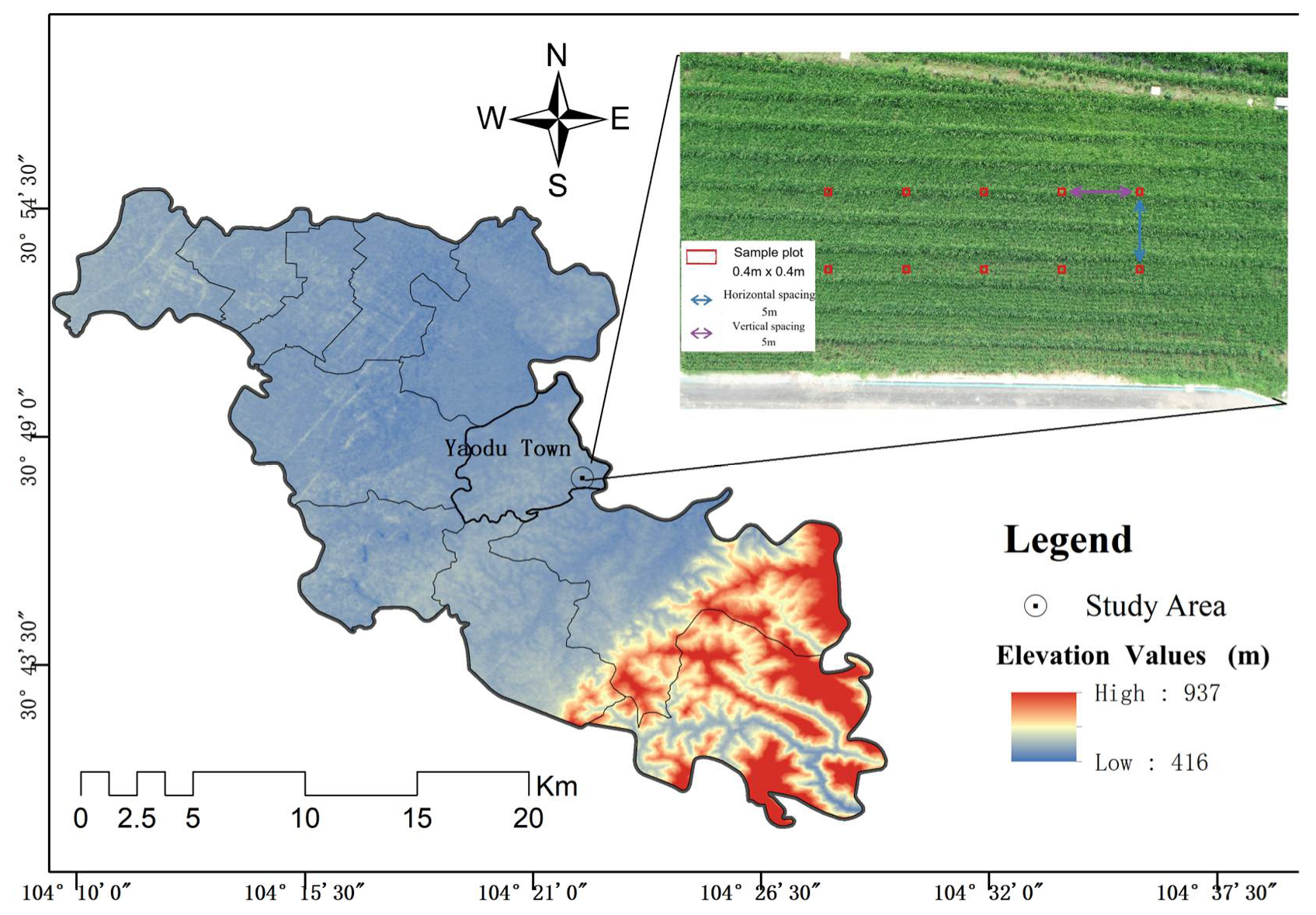
The study was conducted in permanent prime farmland located in Yaodu Town (104°23′ E, 30°48′ N; Figure 1), Qingbaijiang District, Chengdu City, Sichuan Province, China. This area lies within the Longquan Mountain tectonic fold belt and is characterized by gently undulating terrain, with elevations ranging from 454.2 to 492.7 m above sea level. The region experiences a humid subtropical monsoon climate, with a mean annual temperature of 16.5 °C, average annual precipitation of approximately 900 mm, and about 300 frost-free days per year. These favorable light–thermal conditions provide an optimal agroecological environment for the cultivation of rice [23].
The experimental field comprised ten uniform plots (0.16 square meter), separated by 5 m buffer zones to minimize border effects and ensure independent sampling. Hyperspectral data were acquired under clear and windless conditions using a UAV-based imaging system during two key phenological stages: the tillering stage (15 June 2022) and the booting stage (5 July 2022). Concurrently, ground-based measurements of SPAD readings, LNC, and PH were recorded to provide reference data for model development [24,25].

2.2. Experimental Technical Route and Flow

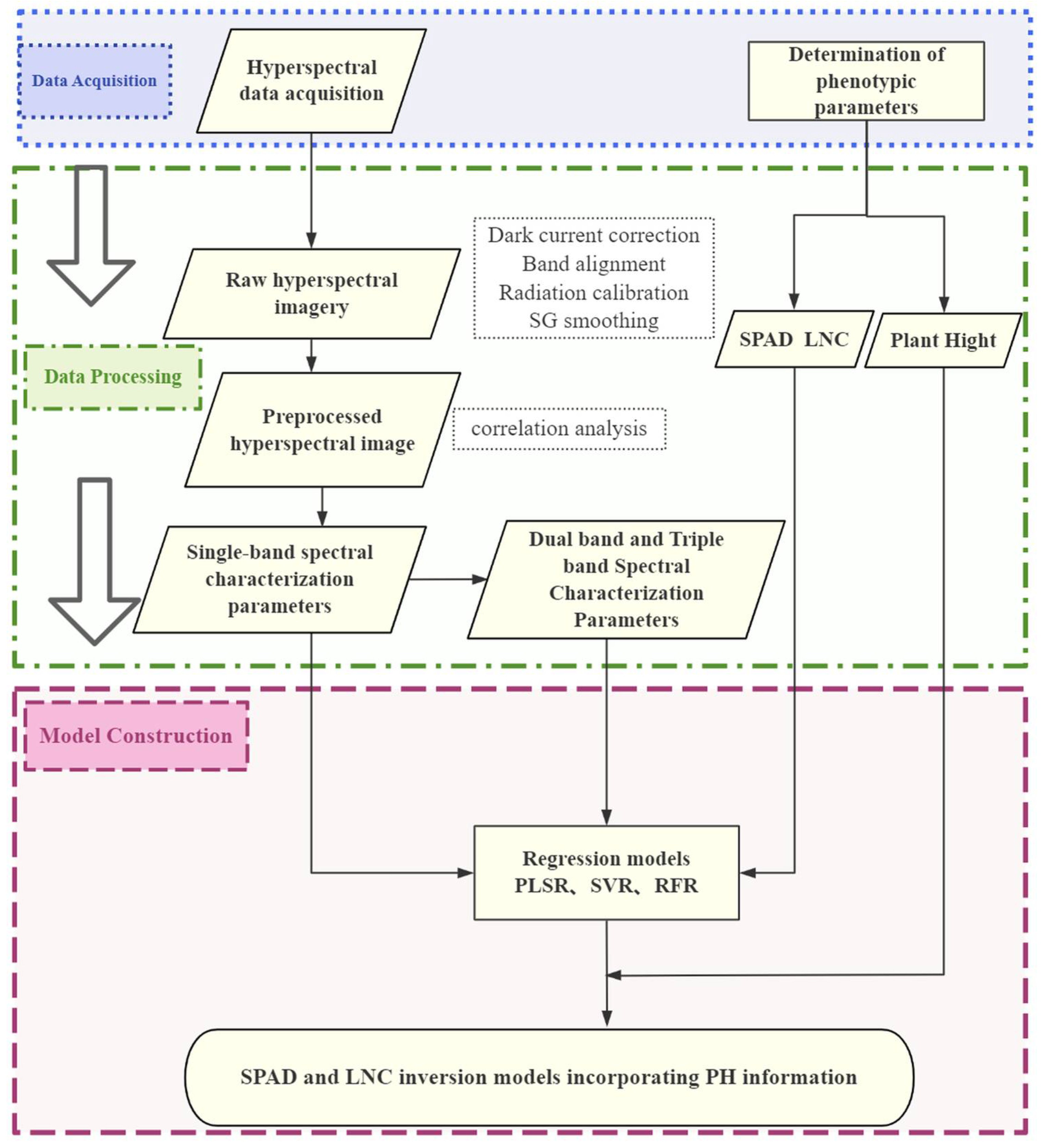
Based on the experimental layout described above, the overall technical workflow of the study (Figure 2) consisted of three main phases: data acquisition, data preprocessing, and model development. During data preprocessing, the raw UAV hyperspectral imagery underwent dark-current correction, band-to-band registration, and radiometric calibration to ensure radiometric consistency. The Savitzky–Golay (SG) smoothing filter was applied to reduce noise and enhance spectral fidelity [25]. Subsequently, correlation analysis was used to identify spectral bands significantly correlated with SPAD readings and LNC, which were then employed to construct VIs for model input [26].
For estimation modeling, three regression algorithms—PLSR, SVR, and RFR—were implemented in Python (version 3.10). Hyperparameter optimization was performed using k-fold cross-validation to achieve optimal model performance. All ground sampling points were precisely georeferenced to ensure spatial correspondence between field measurements and hyperspectral imagery. Model performance was evaluated using the coefficient of determination (R2) and root mean square error (RMSE) [27]. Finally, a synergistic modeling framework integrating PH with spectral features was established to enhance the accuracy and robustness of SPAD readings and LNC retrieval models.

2.3. Data Acquisition for Rice Phenotypic Parameters

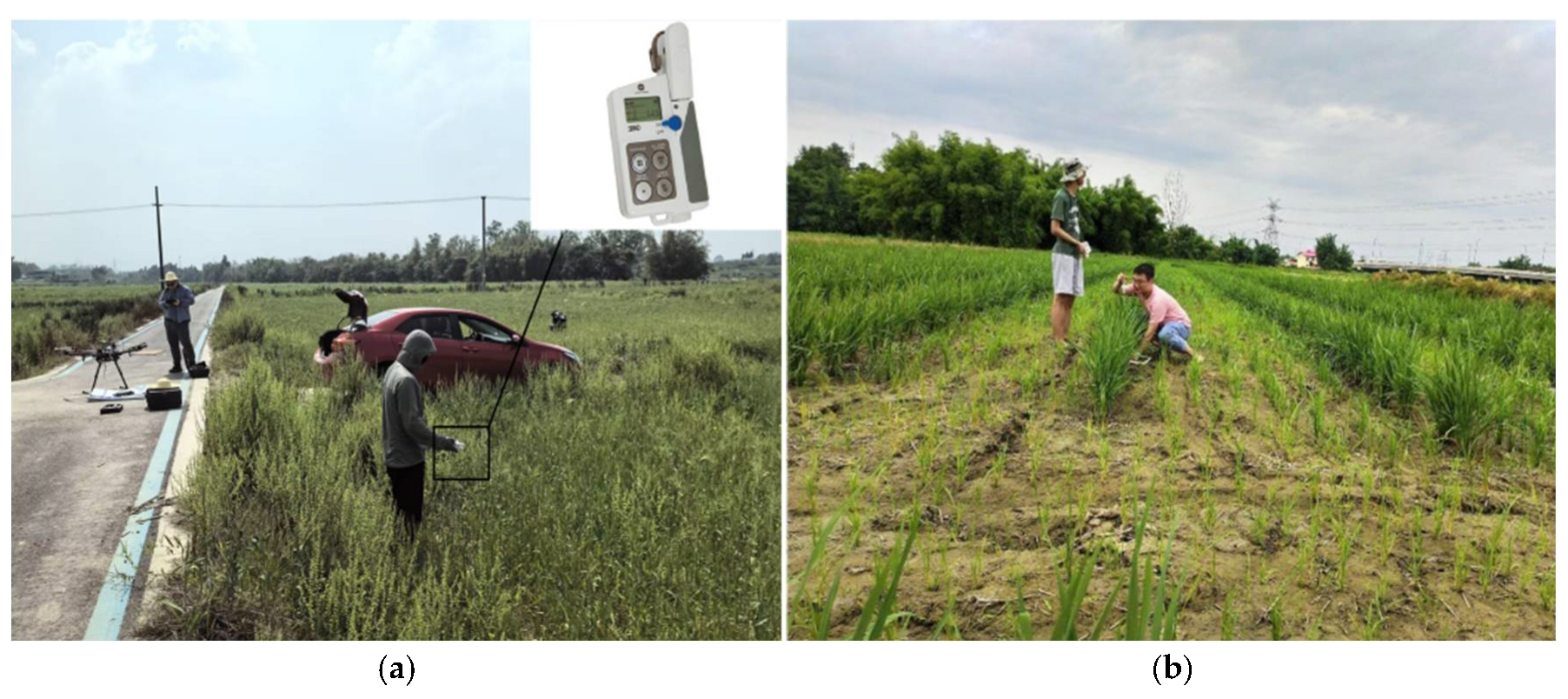
SPAD measurements were acquired using a handheld chlorophyll meter (SPAD-502 Plus, Konica Minolta, Tokyo, Japan), which provides an indirect optical index related to leaf chlorophyll status (Figure 3a). The SPAD meter estimates leaf greenness by measuring the differential transmittance of red and near-infrared radiation through the leaf, which is strongly related to chlorophyll absorption in the red region. Consequently, SPAD readings are widely used as a rapid and non-destructive proxy indicator of leaf chlorophyll status, although they do not represent a direct measurement of chlorophyll concentration. For each plot, three fully expanded healthy leaves from representative plants were selected. Six measurements were taken per leaf (avoiding the midrib and located at approximately one-third and two-thirds of the leaf length from the tip), and the average of these measurements was calculated to obtain the mean SPAD reading for each leaf. The mean values of the three leaves were then averaged to determine the plant-level SPAD reading. To ensure consistency with UAV-derived canopy-level predictors, SPAD readings were summarized at the plot level and used for model calibration and validation. This protocol generated 100 datasets across both phenological stages.
Concurrently, PH was measured using graduated rulers (Figure 3b), recording vertical distances from the ground surface to the tallest leaf apex. Five plants per plot were sampled following Kong et al. [21]. For LNC determination, stems and leaves collected in the field were immediately separated, enzyme-inactivated at 105 °C for 30 min and dried at 75 °C until constant weight. Dried samples were ground into a fine powder and analyzed for total nitrogen content using the micro-Kjeldahl digestion method with sulfuric acid followed by distillation titration [28,29]. LNC was expressed on a dry matter basis and aggregated at the plot scale by averaging measurements from sampled plants, thereby matching the spatial support of canopy-level hyperspectral observations. This process produced a total of 100 valid nitrogen concentration datasets (Table 1).

2.4. UAV Hyperspectral Image Acquisition and Preprocessing

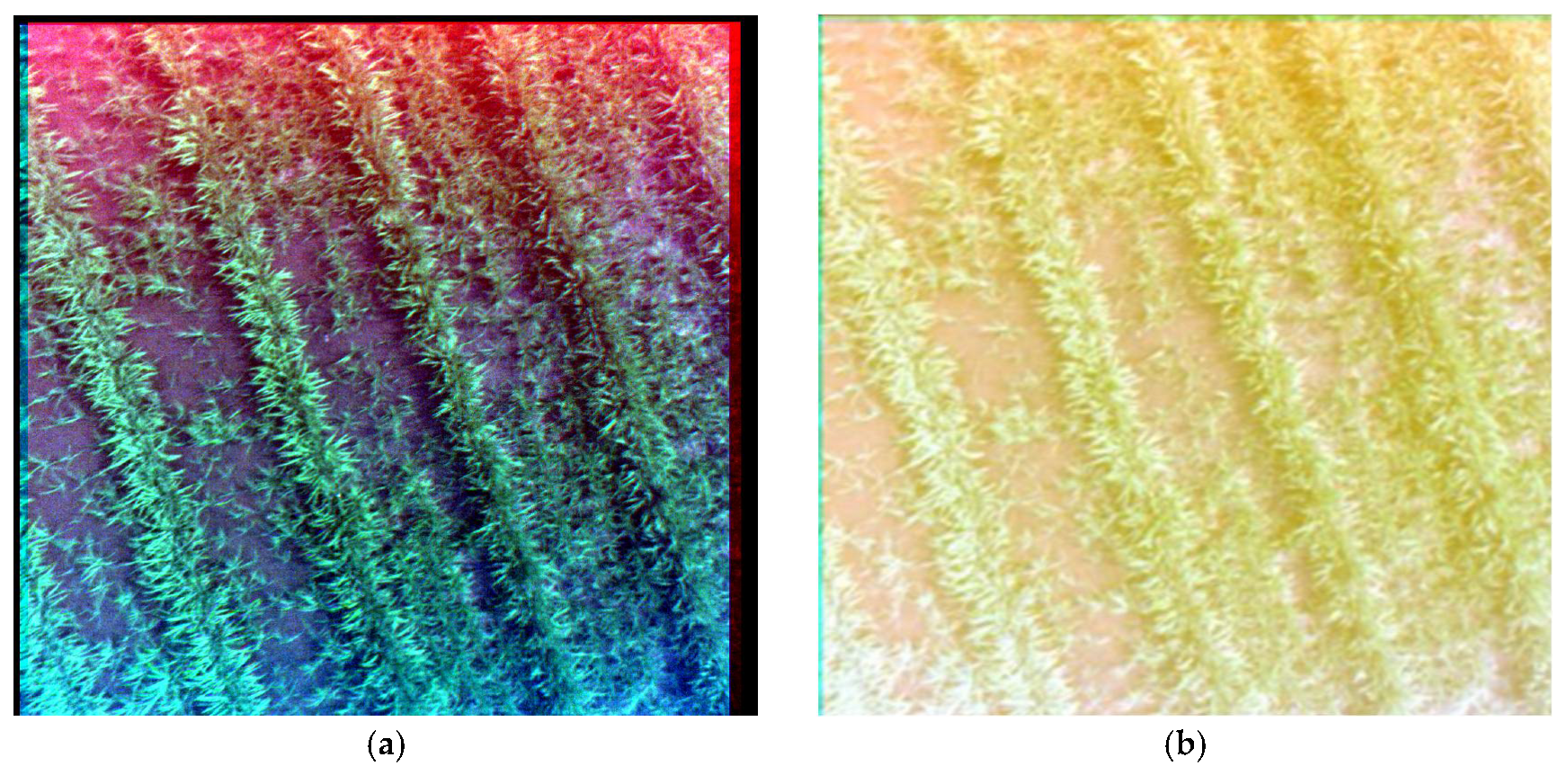
We integrated UAV-based hyperspectral remote sensing with synchronous ground-truthing to acquire multi-source datasets. Imagery was collected using a DJI UAV (M600 Pro, DJI Innovations, Shenzhen, China) equipped with a SENOP-Rikola sensor (SENOP Rikola, Senop Oy, Oulu, Finland, 500–900 nm, 64 bands, 10 nm bandwidth) at 20 m above ground under clear skies (11:00–14:00), with nadir orientation and 0.5 s exposure, ensuring high-fidelity data (Figure 4a) aligned with field measurements.
The acquired raw hyperspectral images first underwent dark current correction and band-to-band registration to reduce sensor noise and eliminate spatial offsets between spectral bands. Subsequently, radiometric calibration was performed using the white panel calibration method, where ENVI 5.6 software was employed to convert raw digital number (DN) values into surface reflectance of ground objects. This process mitigated the influence of solar irradiance variations and sensor response differences on spectral information.
Following radiometric calibration, Regions of Interest (ROIs) were delineated for each experimental plot based on the ENVI software. Only pixels corresponding to the rice canopy within each plot were selected, excluding areas at plot edges, bare soil, water surfaces, and shadows. The spectral reflectance values of all pixels within each ROI were averaged to obtain a representative reflectance spectrum for the plot.
To further suppress spectral noise while preserving key biochemical absorption features, the reflectance spectra were smoothed using the SG filtering method [30]. The above preprocessing workflow yielded standardized spectral reflectance data, establishing a reliable data foundation for subsequent model construction and analysis.

2.5. Model Construction and Evaluation

First, Pearson correlation analysis was performed to identify spectral reflectance features significantly correlated with SPAD readings, LNC, and PH across narrow bands at both the tillering and booting stages. In this study, sensitive wavelengths were defined as the spectral bands showing the strongest absolute Pearson correlation with the target parameters. Rather than applying a fixed correlation threshold, wavelengths were ranked by their correlation strength, and the most strongly associated bands were selected for constructing single-band features and vegetation indices. Importantly, for each data partition, both correlation analysis and wavelength screening were conducted exclusively within the training subset to prevent information leakage.
Based on the principles of vegetation index construction, two-band and three-band indices showing the strongest correlations with each target trait were subsequently developed and optimized through an exhaustive search to identify potentially informative spectral combinations [31]. To mitigate the overfitting risk associated with exhaustive index construction under limited sample conditions, feature selection was strictly nested within each cross-validation training fold. Specifically, wavelength ranking, index construction, and screening were performed independently within each training subset, while the validation subset remained uninvolved in any feature selection procedure. This nested design ensured unbiased model evaluation and effectively avoided optimistic performance estimates caused by information leakage.
To eliminate potential confounding between phenological development and biochemical parameter variation, all correlation analyses and subsequent model constructions were conducted separately for the tillering and booting stages.
Based on correlation strength and preliminary stability assessments, a subset of representative indices—including one single-band, six dual-band, and five three-band indices—was retained for subsequent comparative analysis. Given the strong collinearity inherent in hyperspectral bands, feature robustness was evaluated primarily through performance consistency across resampling iterations rather than individual wavelength-level significance testing. The mathematical expressions and wavelength configurations of these indices are summarized in Table 2.
Using the 12 selected spectral features, three machine learning models were constructed. In this framework, the preceding correlation analysis served as a filter-based feature selection step, eliminating redundant variables to retain representative predictors. Notably, no explicit projection-based dimensionality reduction was applied, as the number of predictors was already controlled relative to the sample size. Furthermore, PLSR extracts latent variables during calibration, while SVR and RFR enhance robustness through regularization and random feature selection mechanisms, respectively.
To improve robustness with limited data, a stratified validation strategy was adopted. Model parameter optimization was performed using k-fold cross-validation (k = 5). Given the relatively small total sample size (n = 100), the 5-fold cross-validation procedure was repeated five times using different random data partitions. The average R2 and RMSE values across all repeated runs were used to guide parameter selection and evaluate model stability. This repeated resampling strategy was implemented to reduce the variance associated with a single data split and to mitigate potential overfitting arising from limited training samples [32].
Table 2. Dual-band and three-band VIs.
Vegetation Index
(Two-Band)
FormulaVegetation Index (Three-Band)Formula
Normalized   Difference   Spectral   Index   ( N D S I ) [33] R i R j R i + R j VI 1 R i R j R j + R k
Difference   Spectral   Index   ( D S I ) [34] R i R j VI 2 R i R j + R k
Ratio   Spectral   Index   ( R S I ) [34] R i R j VI 3 R i R j × R k
Specific   Absorption   Spectral   Index   ( S A S I ) [35] R i R j R i + R j + 0.5 × 1.5 VI 4 R i R j R j R k
Optimized   Specific   Absorption   Spectral   Index   ( OSASI ) [36] R i R j R i + R j + 0.16 × 1.16 VI 5 R i R j R i + R j 2 R k
Enhanced   Spectral   Index   ( ESI 2 ) [37] R i R j × 2.5 R i + R j × 2.4 + 1
Note: Ri, Rj, and Rk denote the spectral reflectance values at arbitrary wavelengths within the effective spectral range of the sensor (510–887 nm).
Final model evaluation was conducted using an independent test set (70% training, 30% testing) that was not involved in any stage of feature screening or parameter tuning. This external validation assessed predictive consistency under field conditions and provided an additional safeguard against overfitting. Model performance was quantified using R2 and RMSE to evaluate plot-scale and growth-stage generalization ability.
Within the Python 3.10 environment, a parameter fusion framework was further implemented: PH was systematically integrated with the aforementioned 12 spectral features to construct fused parameter sets. The refined SPAD/LNC models were then evaluated using the independent test set, with R2 and RMSE metrics quantifying the effectiveness of PH fusion.
It should be clarified that although plant height is developmentally related to growth stage, in this study it was treated as a canopy structural descriptor rather than a phenological classifier. Its contribution was evaluated within each growth stage to avoid stage-driven discrimination effects. Therefore, the observed performance improvement from PH integration reflects complementary structural information within stage-specific modeling rather than indirect stage classification. PH was used as an auxiliary structural feature to statistically enhance model performance; this study does not imply that PH causally corrects spectral bias. Rather, its contribution reflects statistical associations within each growth stage.
The evaluation formulas used in this study are shown in Equations (1) and (2). y i represents the i th actual value, y i ^ denotes the predicted value for the i th sample, y ¯ is the mean value of all actual measurements, and n stands for the total number of samples.
R 2 = 1 i = 1 n y i y i ^ 2 i = 1 n y i y ¯ 2
RMSE = 1 n i = 1 n y i y i ^ 2

3. Results

3.1. Screening of Spectral Characteristic Parameters

Analysis of narrow bands within the 500–900 nm range revealed that the sensitive wavelengths for SPAD readings and LNC are concentrated in the near-infrared (NIR) region. Specifically, the band exhibiting the strongest correlation with SPAD is 864 nm, and for LNC, it is 857 nm; at the booting stage, the optimal band for SPAD is 846 nm, while for LNC, it remains 857 nm (Table 3). The NIR region is sensitive to leaf structure and photosynthetic activity, making it effective for detecting variations in leaf chlorophyll status and nitrogen concentration.
Dual-band indices enhance sensitivity to specific biochemical traits by reducing background noise and highlighting spectral contrasts. From all possible two-band combinations, six indices with the highest correlations were selected (Table 4).
During the tillering stage, SPAD readings were most sensitive to the green (515–521 nm), red (677 nm), and NIR (857–864 nm) regions. Among these, DSI and RSI showed strong negative correlations, while OSASI and SASI were positively correlated. For LNC, RSI (r = −0.978), NDSI (r = 0.980), and OSASI (r = 0.970) showed the strongest correlations, mainly within the red-edge and NIR ranges. At the booting stage, wavelengths sensitive to SPAD readings shifted toward the chlorophyll absorption region (670–680 nm). LNC remained highly correlated, with RSI (r = 0.921) and OSASI (r = 0.916) maintaining strong retrieval potential.
While dual-band indices improved correlation strength, they may still overlook nonlinear interactions among spectral regions. Therefore, exhaustive spectral combinations were used to generate and evaluate three-band VIs, from which five indices (VI1–VI5) showing the highest correlation coefficients were retained (Table 5).
During the tillering stage, correlations with SPAD readings ranged from 0.808 to 0.861, with VI3 achieving the strongest negative correlation (r = −0.861). At the booting stage, sensitivity to SPAD readings increased further, with VI1 (red and NIR combination) exhibiting the strongest negative correlation (r = −0.913). For LNC retrieval, VI2 demonstrated the highest positive correlation (r = 0.981) at tillering, closely followed by VI3 (r = −0.980). At the booting stage, the correlation slightly decreased, with VI1 showing the best performance (r = 0.931).
Overall, three-band indices generally exhibited higher correlation levels than single- and dual-band indices under the current dataset.

3.2. Inversion Effect of SPAD and LNC

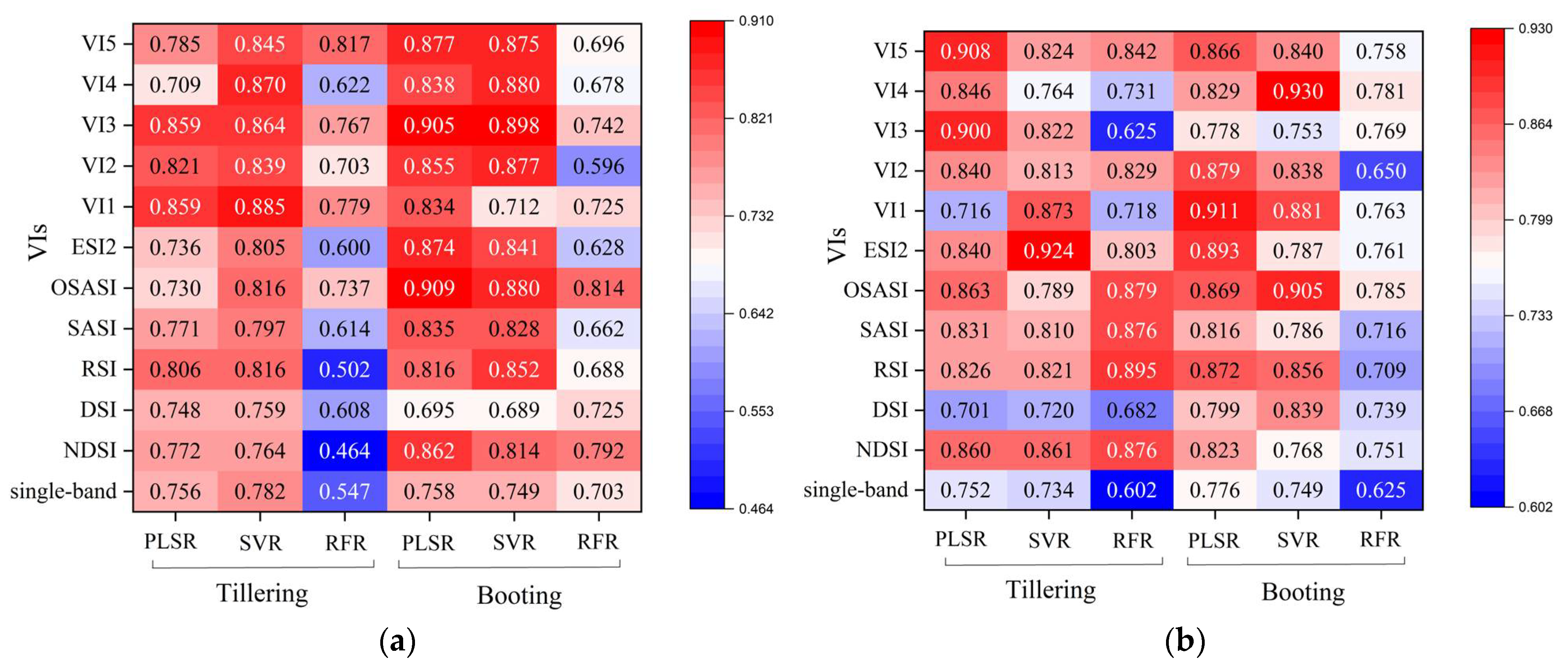
Using heatmap analysis, the performance of multiple VIs combined with three machine learning algorithms (PLSR, SVR, and RFR) for estimating rice SPAD readings and LNC at different growth stages was systematically evaluated.
For SPAD estimation at the tillering stage (Figure 5a), the VI1–SVR model achieved the highest accuracy (R2 = 0.885), followed by VI1–PLSR and VI3–PLSR. In contrast, the overall performance of the RFR models was relatively poor, and some combinations exhibited signs of overfitting; even the best-performing RFR combination (VI5) achieved an R2 value of only 0.817.
At the booting stage, the OSAVI–PLSR model produced the highest accuracy (R2 = 0.909), with VI3–PLSR showing comparable performance (R2 = 0.905), which can be attributed to the more stable spectral characteristics of mature leaves. The SVR models maintained high predictive accuracy at this stage, with VI3–SVR (R2 = 0.898) approaching the optimal performance. By comparison, RFR models were more susceptible to redundant spectral information and interference from visible bands, resulting in inferior performance; only the OSASI–RFR model reached an acceptable accuracy level (R2 = 0.814).
For LNC estimation at the tillering stage (Figure 5b), the ESI2–SVR model demonstrated superior flexibility and adaptability, achieving the highest accuracy (R2 = 0.924). In addition, VI5–PLSR (R2 = 0.908) as well as the RSI–RFR and NDSI–RFR combinations also yielded relatively high accuracy; however, the stability of the RFR model declined at subsequent phenological stages. Overall, SVR exhibited the strongest robustness for LNC estimation. The VI4–SVR model achieved the highest accuracy at the booting stage (R2 = 0.930) and showed relatively stable performance across both growth stages.
PLSR remained competitive for specific indices and growth stages (e.g., VI5 at the tillering stage, R2 = 0.908), although its cross-stage consistency was slightly inferior to that of SVR. In contrast, RFR displayed pronounced stage dependency, with a substantial reduction in accuracy at the booting stage (R2 = 0.758).
Overall, SVR achieved a favorable balance between high accuracy and stability for both SPAD reading estimation and LNC estimation, making it particularly suitable for cross-stage applications. PLSR ranked second, performing well under specific index–stage combinations, whereas RFR showed limited stability and a higher risk of overfitting, and is therefore less suitable as a primary model for practical estimation.

3.3. Inversion Model Construction of SPAD Readings and LNC Using Spectral Features with Auxiliary PH Information

This study developed a multi-source collaborative estimation framework for rice SPAD readings and LNC estimation by integrating PH with twelve spectral features to evaluate their associations and clarify the role of PH in improving the estimation accuracy of rice canopy traits, including SPAD readings and LNC. Based on ground-measured data collected at the tillering and booting stages, the performance of PLSR, SVR, and RFR was systematically compared under two modeling architectures: spectral-only models and PH–spectral fusion models.

3.3.1. SPAD Reading Estimation Modeling and Validation Using Synergistic Plant Height Information

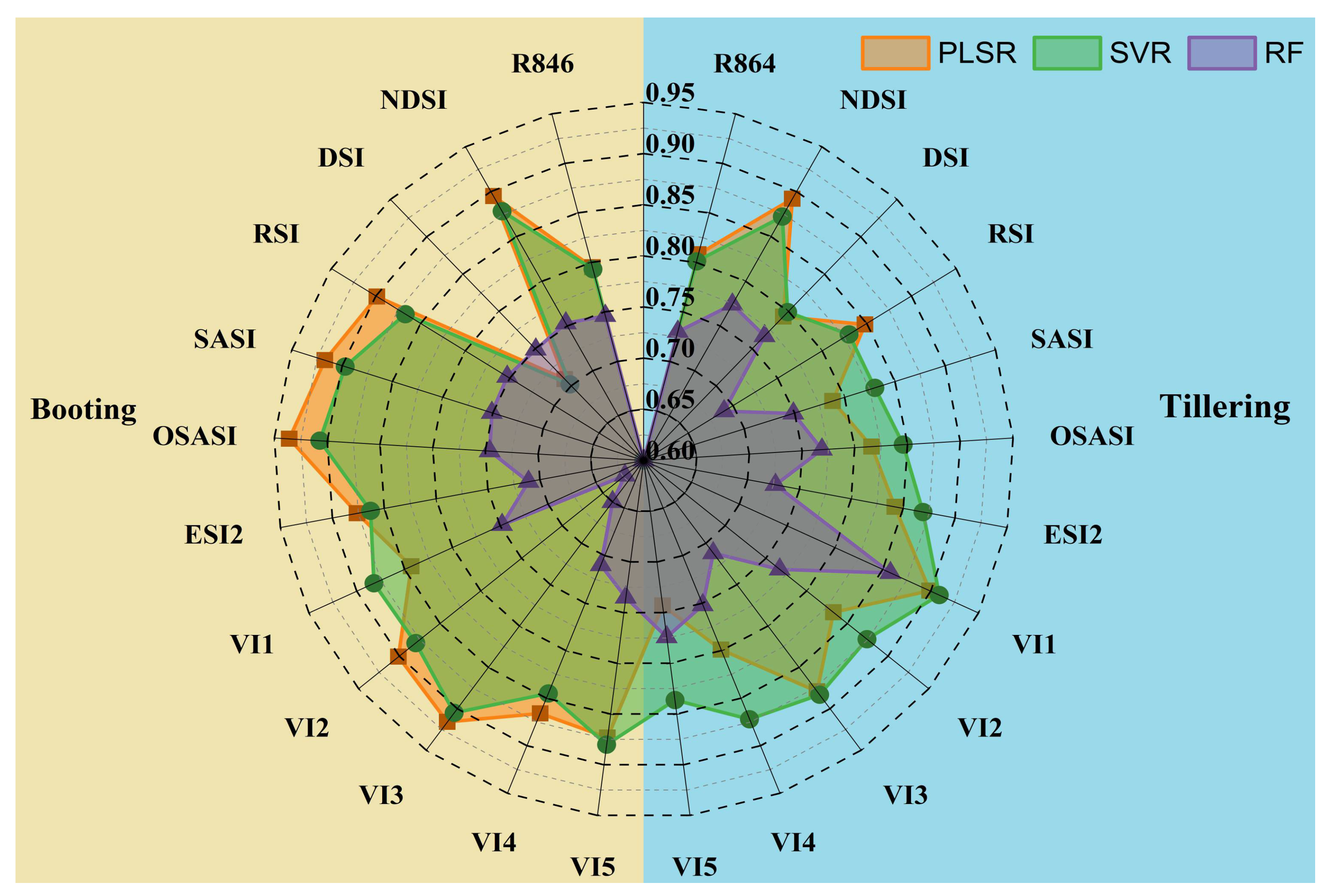
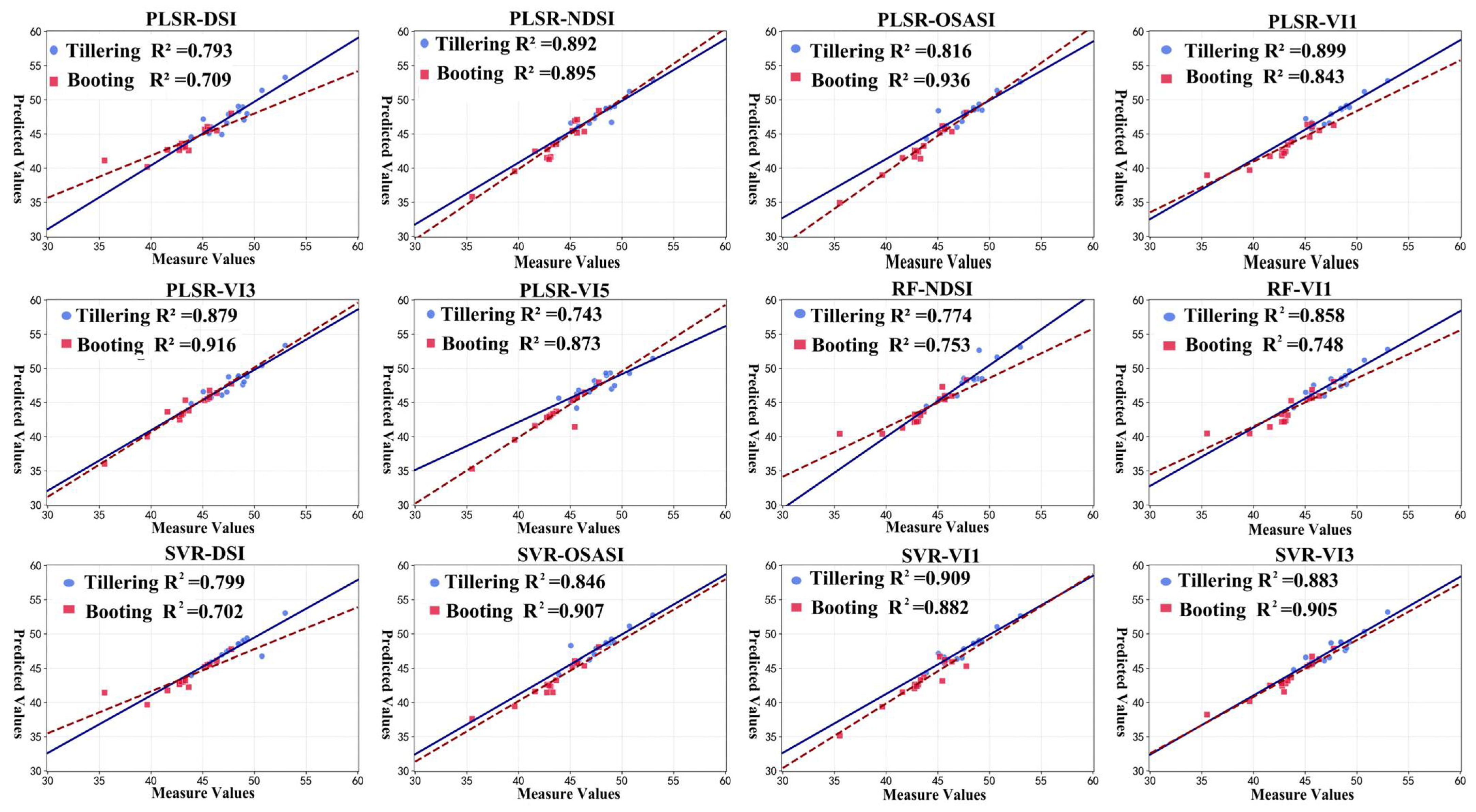
The incorporation of PH was associated with improved accuracy and greater model stability in SPAD reading estimation, as shown in Figure 6, where the left panel represents the tillering stage and the right panel represents the booting stage. Among the three algorithms, PLSR and SVR exhibited more stable and reliable performance, whereas RFR was more susceptible to spectral redundancy under complex canopy conditions, increasing the risk of overfitting. The inclusion of PH was associated with changes in the statistical relationships among spectral indices, which may help explain reduced multicollinearity between visible and near-infrared bands under certain modeling conditions. Figure 7 presents the fitting results of the three models, further illustrating their predictive behavior and stage-dependent responses under PH–spectral feature fusion.
For PLSR at the tillering stage, the VI1 model achieved the highest accuracy (R2 = 0.899), followed by NDSI (R2 = 0.892), while VI5 showed the weakest performance (R2 = 0.743). Notably, the DSI model exhibited an R2 value of 0.948 in the training dataset but decreased to 0.793 in the testing dataset, indicating a moderate tendency toward overfitting. At the booting stage, OSASI achieved the highest accuracy (R2 = 0.936), followed by VI3 (R2 = 0.916).
The SVR model demonstrated strong flexibility in handling nonlinear relationships. At the tillering stage, VI1 performed best (R2 = 0.909), whereas DSI showed the lowest accuracy (R2 = 0.799) and clear overfitting, with an R2 value difference of 0.162 between the training and validation datasets accompanied by increased RMSE. At the booting stage, OSAVI achieved the highest accuracy (R2 = 0.907), followed by VI3–SVR (R2 = 0.905), while DSI remained the weakest combination (R2 = 0.702).
Comparatively, the RFR model exhibited limited generalization capability. At the tillering stage, VI1 achieved the highest accuracy (R2 = 0.858), whereas RSI performed the worst (R2 = 0.690), with substantial degradation in predictive performance and an R2 value difference of 0.159 between the training and validation datasets, along with increased RMSE. At the booting stage, the performance of RFR further declined, and even the best-performing NDSI model achieved an R2 value of only 0.753. Owing to the inherent structural characteristics of decision-tree-based models, RFR exhibits limitations in capturing continuous canopy–spectral response relationships, and the inclusion of PH provides only limited improvement in its estimation performance.

3.3.2. LNC Inversion Modeling and Validation Using Synergistic Plant Height Information

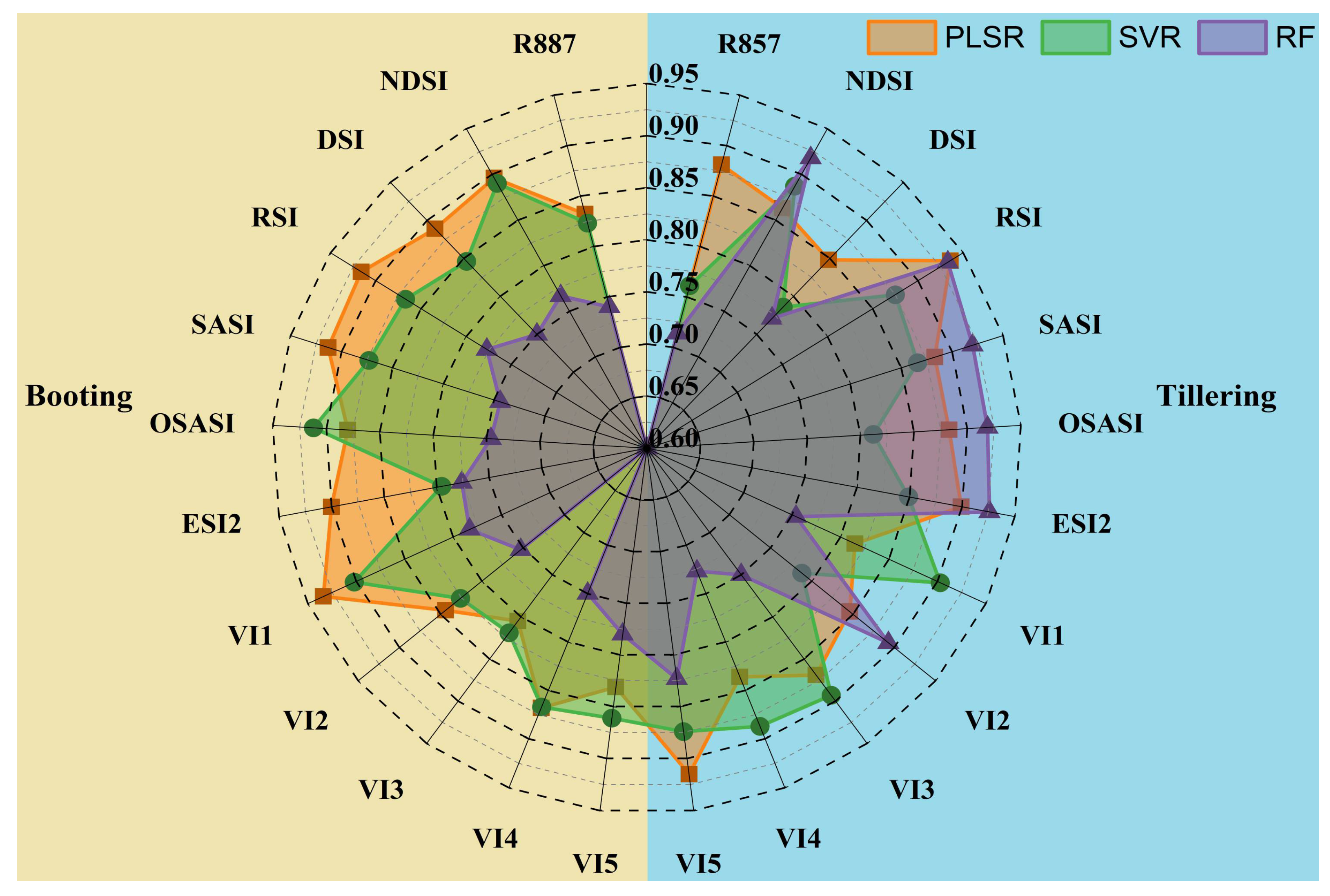
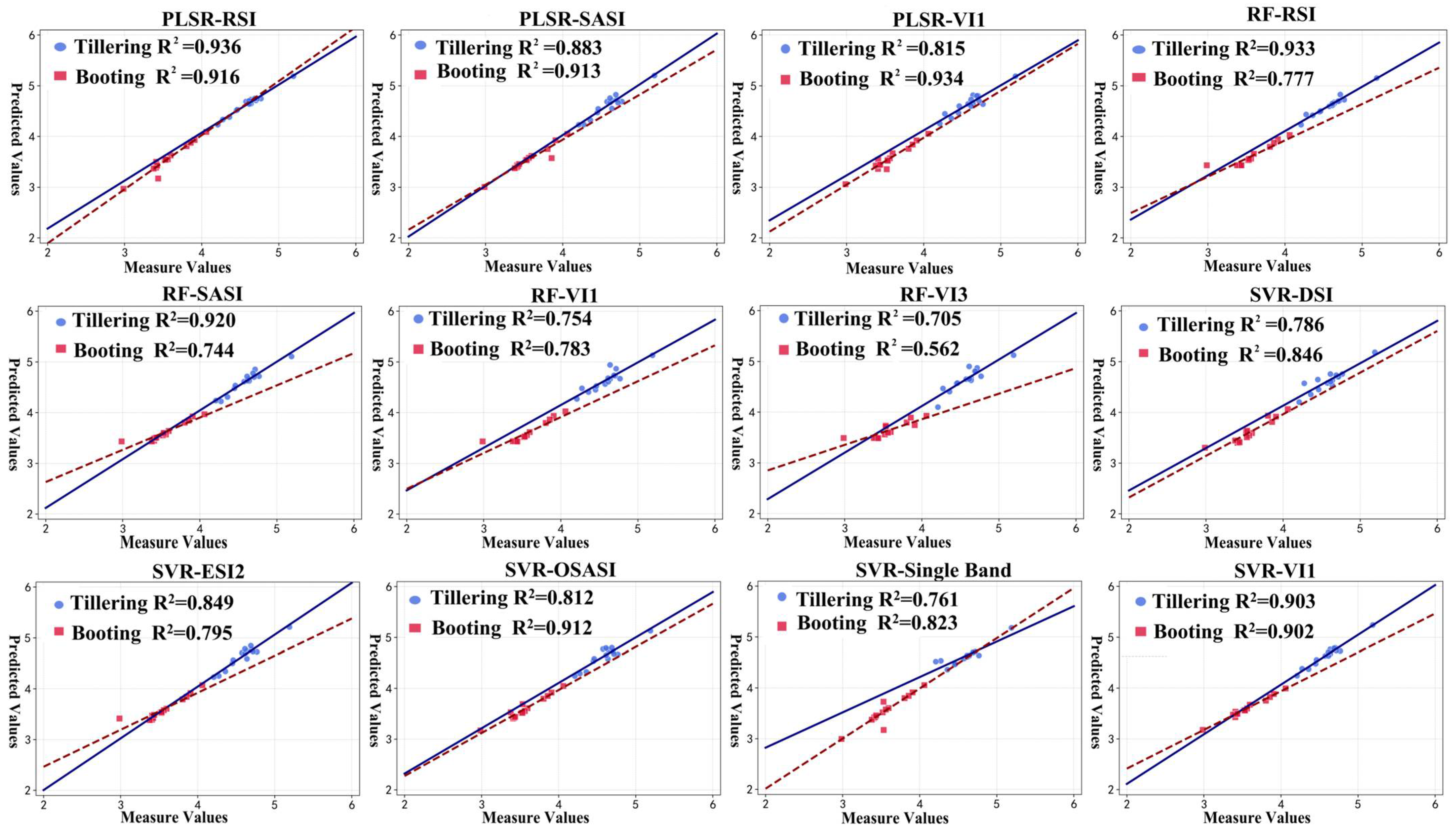
The coupling with PH was associated with higher accuracy of LNC estimation. As shown in Figure 8, the retrieval performance (R2) of the three models is presented, with the left side representing the tillering stage and the right side the booting stage. Among the three regression approaches, PLSR and SVR consistently exhibited higher stability and estimation accuracy across growth stages, whereas RFR was more susceptible to spectral redundancy and overfitting. The integration of PH was associated with improved model robustness, potentially reflecting its ability to provide complementary canopy-related information not fully captured by spectral features alone. The estimation results of the three models shown in Figure 9 further illustrate the potential value of incorporating PH as an auxiliary variable for representing canopy-related variability in the modeling process.
Within the PLSR framework at the tillering stage, RSI achieved the highest LNC estimation accuracy (R2 = 0.936), whereas VI1 exhibited the lowest performance (R2 = 0.815). Meanwhile, the difference between the training and validation R2 values for RSI was small (0.047; training R2 = 0.983 and validation R2 = 0.936), indicating good generalization capability. At the booting stage, RSI and SASI remained among the better-performing indices (R2 = 0.916–0.913). VI1 achieved the best performance at the booting stage, demonstrating good stage-to-stage consistency, with a validation R2 value of 0.936 and only a 0.2% decrease compared with the tillering stage.
The SVR model exhibited strong nonlinear mapping capability and adaptability across phenological stages. At the tillering stage, the VI1-based model achieved the highest accuracy (R2 = 0.903), whereas the single-band R857 model showed the poorest performance (R2 = 0.761). Among these, the DSI-based model displayed a clear tendency toward overfitting, as its validation R2 = 0.786 decreased markedly relative to the training R2 = 0.984, accompanied by a concurrent increase in RMSE. At the booting stage, the OSASI-based model achieved the highest accuracy (R2 = 0.912), surpassing that of the weakest ESI2-based model (R2 = 0.795) by 14.7%
By contrast, the PH-coupled RFR model exhibited weaker generalization ability and greater sensitivity to canopy structural complexity. At the tillering stage, the RSI-based model achieved the highest accuracy (R2 = 0.933), outperforming the weakest VI3-based model (R2 = 0.750) by 24.4%; the ratio-based index SASI also showed relatively strong performance (R2 = 0.920). However, at the booting stage, the VI1-based model performed best (R2 = 0.783), while VI3 remained the weakest combination (R2 = 0.562), and overall model accuracy continued to decline. The maximum achievable accuracy of the RFR models decreased from 0.933 at the tillering stage to 0.783 at the booting stage.
Overall, PH–spectral fusion substantially enhanced LNC estimation accuracy across different growth stages. This pattern is consistent with the stable performance of RSI under the PLSR framework and the consistently high accuracy of VI1 within the SVR model across stages. Comparative analysis among models indicates that SVR exhibits stronger adaptability in cross-stage applications, with optimal model accuracy increasing from 0.903 at the tillering stage to 0.912 at the booting stage. Although PLSR showed a slight reduction in accuracy at the booting stage, it maintained high overall performance throughout the phenological cycle and achieved the highest accuracy when combined with the OSAVI index. Overall, PLSR demonstrated superior stability and peak accuracy, while SVR showed greater advantages in modeling complex nonlinear relationships and cross-stage applications; in contrast, the estimation performance of RFR was comparatively unsatisfactory.

3.4. Influence of Fusion Parameters on Model Accuracy

3.4.1. Impact of Fusion Parameters on the Accuracy of SPAD Inversion Models

(1)
Impact of PH Fusion on SPAD Inversion Accuracy Across Phenological Stages and VIs
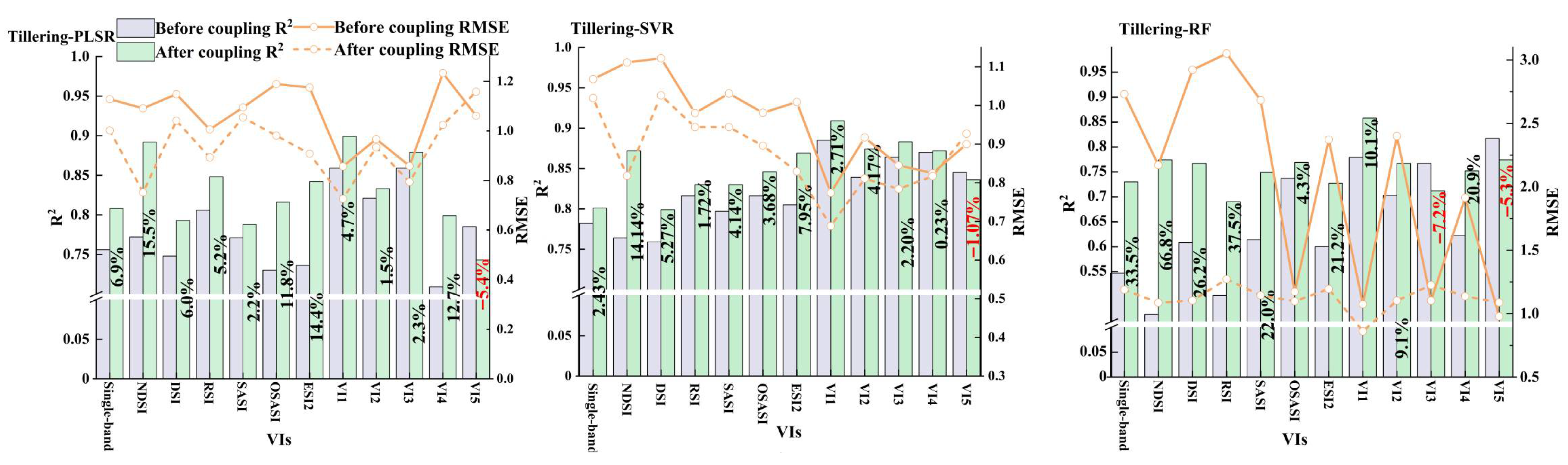
The inclusion of PH was associated with improved SPAD reading estimation accuracy across all models and growth stages. Figure 10 compares SPAD estimation results before and after PH coupling for different VIs, where R2 value (bars) and RMSE (lines) are jointly presented to clearly illustrate accuracy enhancements at the tillering stages.
At the tillering stage, model robustness was generally low due to the sparse canopy structure and strong interference from soil background and illumination conditions. After incorporating PH, canopy spatial structural information was effectively supplemented, leading to marked improvements in both the accuracy and stability of SPAD estimation. For the PLSR model, 11 out of the 12 vegetation indices showed increased R2 values and reduced RMSE after PH coupling. Among them, NDSI, ESI2, and VI4 exhibited the most pronounced responses, while only VI5 showed a decline in performance. For example, the R2 value of NDSI increased from 0.772 to 0.892, and the RMSE decreased from 1.091 to 0.752, indicating that PH may help compensate for certain limitations in spectral information under specific modeling conditions.
The SVR model exhibited trends similar to those of PLSR during the tillering stage, with 11 vegetation indices showing higher R2 values and lower RMSE after PH integration. NDSI showed the largest improvement, with R2 value increasing from 0.764 to 0.872 and RMSE decreasing from 1.111 to 0.818. ESI2 and VI1 also exhibited stable improvements, whereas VI4 showed relatively limited enhancement.
In contrast, the RFR model displayed a polarized response to PH fusion at the tillering stage. Vegetation indices with weaker baseline performance (R2 ≈ 0.5–0.6) generally benefited from PH integration, whereas indices with stronger baseline performance, such as VI3 and VI5, experienced a decline in accuracy. Specifically, the R2 value of VI3 decreased from 0.767 to 0.712, with RMSE increasing from 1.103 to 1.226, while VI5 showed a reduction in R2 value from 0.817 to 0.774 and an increase in RMSE from 0.979 to 1.088. These results suggest that when spectral features alone are sufficient to support RFR modeling, the additional inclusion of PH may perturb existing feature relationships, consequently degrading model performance.
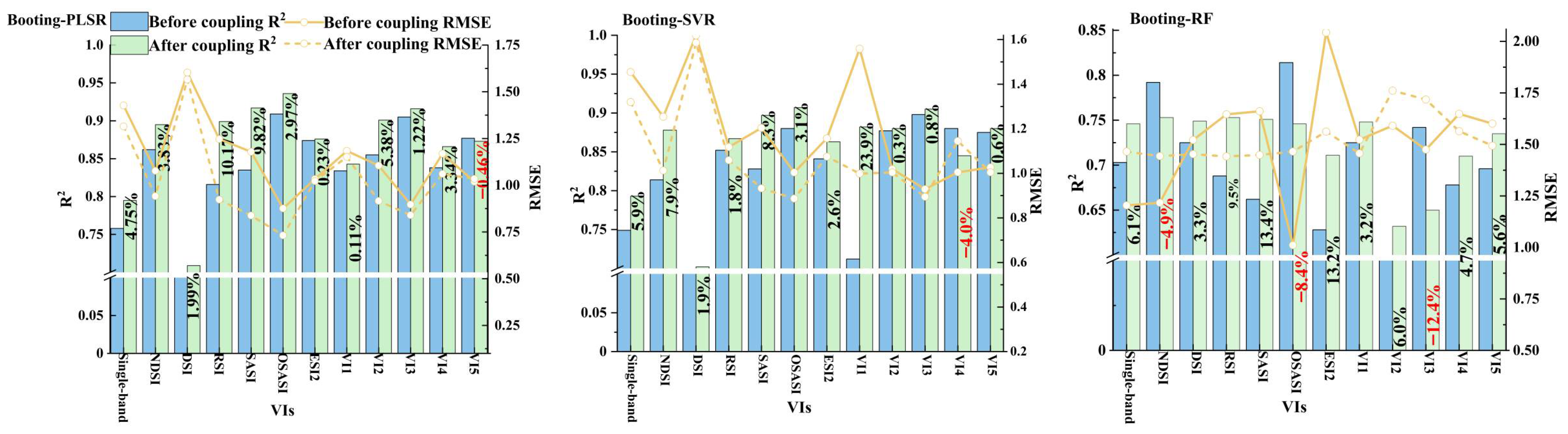
During the booting stage (Figure 11), the canopy becomes more closed, with higher leaf area index and stronger spectral saturation and spatial heterogeneity. The effect of PH integration varies among models. For PLSR, PH coupling increased or maintained R2 value for nearly all vegetation indices, with only VI5 slightly decreasing. Improvements were mainly seen in RMSE reduction, with RSI, SASI, and OSASI showing over 25% decrease, indicating that PH primarily enhances accuracy by reducing prediction error.
The SVR model showed strong but uneven responses. About 10 indices had increased R2 values, with VI2 showing the largest gain (R2 value 0.712 to 0.882; RMSE 1.559 to 0.999), whereas VI4 declined (R2 value 0.880 to 0.845; RMSE 1.005 to 1.145).
For RFR, most indices had higher R2 value after PH coupling, but RMSE increased for over half of them, suggesting that under complex canopy conditions, PH does not always improve accuracy and error simultaneously.
(2)
Integrated Analysis of Model Stability and Overall Performance in SPAD readings Inversion After PH Fusion
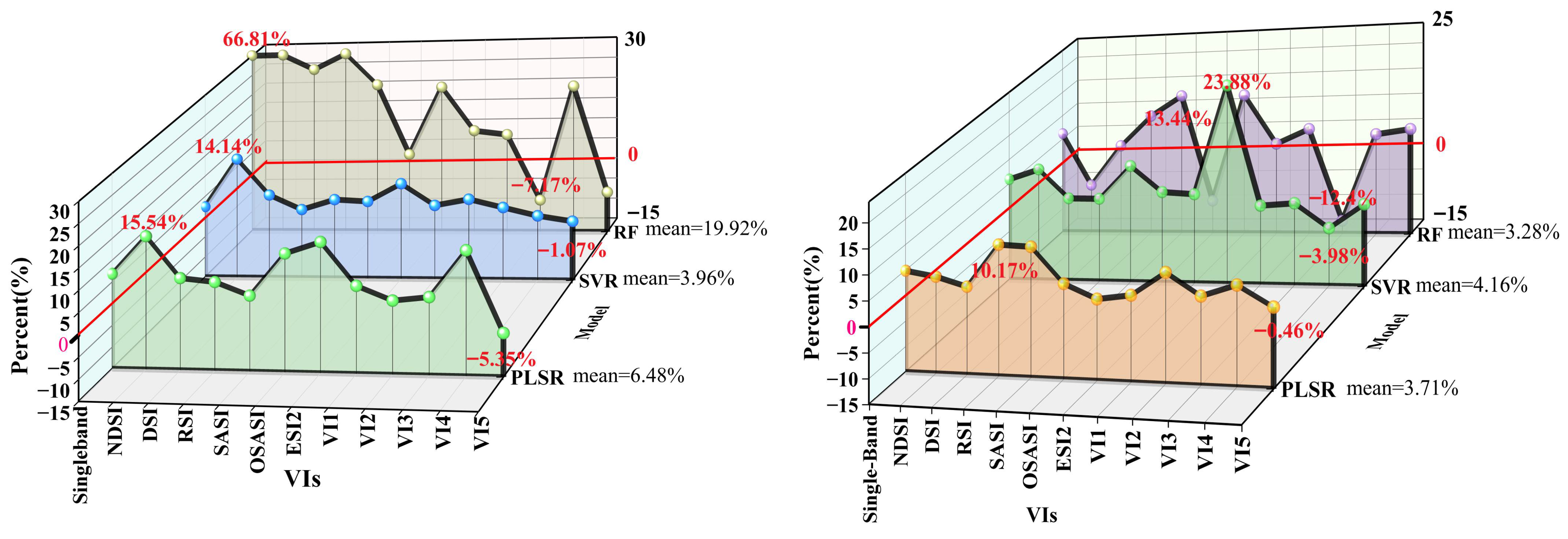
These results suggest that integrating PH information is generally associated with improved estimation accuracy of SPAD readings across different vegetation indices and modeling approaches. As shown in Figure 12, PH integration exhibits a clear and systematic enhancement in SPAD estimation performance. Under all vegetation indices and fusion conditions, estimation accuracy at both growth stages achieved stable and quantifiable improvements.
During the tillering stage, the overall improvement trend remained consistent; however, due to the relatively low and uniform canopy structure, the magnitude of improvement was comparatively smaller. The PLSR model showed an average improvement of 6.48%, while the SVR model maintained a stable gain of approximately 3.96% across all indices. Although the RFR model exhibited the largest relative improvement (19.92%), its estimation accuracy without PH integration was substantially lower; thus, even after improvement, its final performance remained inferior to that of the PLSR and SVR models.
In terms of capturing coupled spectral–structural information, the RFR model demonstrated the strongest sensitivity. Among the top seven improvements, six were achieved using RFR, with the NDSI–RFR combination showing a particularly pronounced enhancement of 66.81%. Even the best-performing model without PH integration, VI1–SVR (R2 = 0.909), exhibited a further improvement of 2.71% after PH coupling. Similarly, the second-best model, NDSI–PLSR, achieved an improvement of 15.54%, while maintaining a high R2 value of 0.892.
During the booting stage, the average R2 value improvements for the PLSR, SVR, and RFR models were 3.70%, 4.41%, and 3.28%, respectively. At the individual index level, nearly all vegetation indices showed positive gains. For example, the VI1–SVR model achieved the largest improvement (23.88%). The OSASI–PLSR model attained the highest estimation accuracy (R2 = 0.936) while still benefiting from PH integration with a 2.97% improvement. In addition, the SASI–PLSR model simultaneously achieved high accuracy (R2 = 0.917) and a substantial improvement of 9.82%, demonstrating robust overall performance.
Collectively, these results suggest that incorporating PH as an auxiliary variable can help stabilize statistical relationships between spectral signals and biochemical parameters within stage-specific modeling frameworks, thereby enabling consistent performance gains across models and growth stages.

3.4.2. Assessment of the Impact of Fusion Parameters on the Accuracy of LNC Inversion Models

(1)
Impact of PH Fusion on LNC Inversion Accuracy Across Phenological Stages and VIs
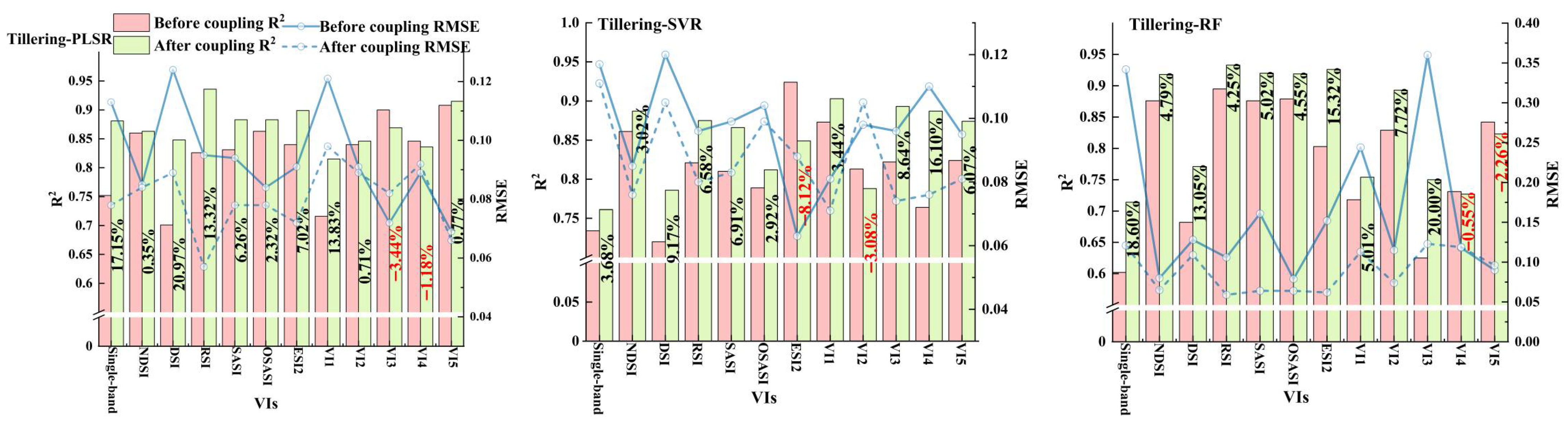
During the tillering stage (Figure 13), the canopy is not yet fully closed and vegetation coverage remains low, making the spectral representation of LNC highly susceptible to background interference and scale effects. After the introduction of PH, the overall estimation accuracy improved to varying degrees across models.
In the PLSR model, a generally positive response to PH was observed. Among the 12 vegetation indices, 10 exhibited increased R2 values, with a pronounced average improvement. Notably, R857 and DSI showed substantial gains, while RSI achieved the highest absolute accuracy, with R2 value increasing from 0.826 to 0.936 and RMSE decreasing markedly from 0.095 to 0.057. For the SVR model, PH integration also led to improvements in both R2 and RMSE for most vegetation indices. The most significant enhancement was observed for VI4, with the R2 value increasing from 0.764 to 0.887 and RMSE decreasing from 0.110 to 0.076. However, the performance of ESI2 deteriorated after PH integration, indicating that unfavorable interactions may exist between PH and certain index features.
The RFR model exhibited the most pronounced improvements during the tillering stage. For example, the R2 value of VI3 increased from 0.625 to 0.750, and ESI2 showed a substantial enhancement, with the R2 value rising from 0.803 to 0.926. Nevertheless, for some indices (e.g., OSASI and VI5), a slight decline in R2 value was observed after PH coupling, suggesting that the inclusion of additional structural information may introduce redundancy.
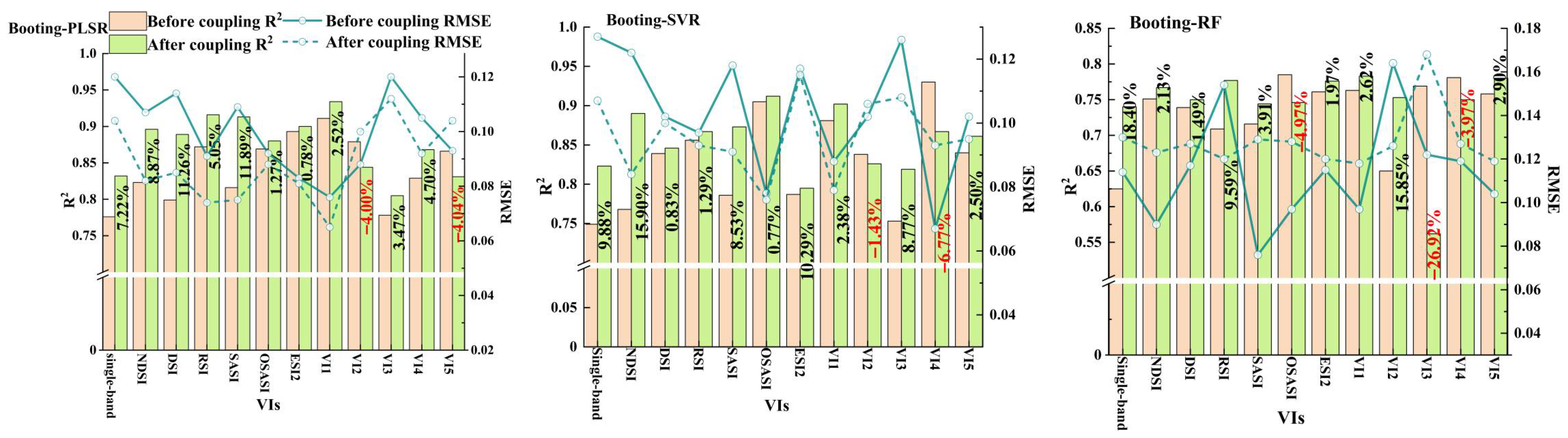
As the crop entered the booting stage (Figure 14), canopy structure became increasingly complex, and the influence of PH integration on different models showed more pronounced divergence. In the PLSR model, stable accuracy improvements were maintained. For instance, the R2 values of DSI and SASI increased to 0.889 and 0.913, respectively. The SVR model remained relatively robust during this stage, with most vegetation indices benefiting from PH integration. Among them, NDSI showed the most notable improvement, with R2 value increasing from 0.768 to 0.890 and RMSE decreasing from 0.122 to 0.084. In contrast, the performance of VI4 declined substantially after PH integration, suggesting an unfavorable coupling between PH and this index.
For the RFR model, PH integration did not lead to consistent error reduction during the booting stage. Although some indices (e.g., R857 and VI2) achieved notable improvements in R2 value, RMSE increased for most indices, resulting in enlarged prediction errors. This indicates that under conditions of increased canopy height and structural heterogeneity, PH integration may induce overfitting in the RFR model, thereby compromising its generalization capability.
(2)
Integrated Analysis of Model Stability and Performance Differences in LNC Inversion After PH Fusion
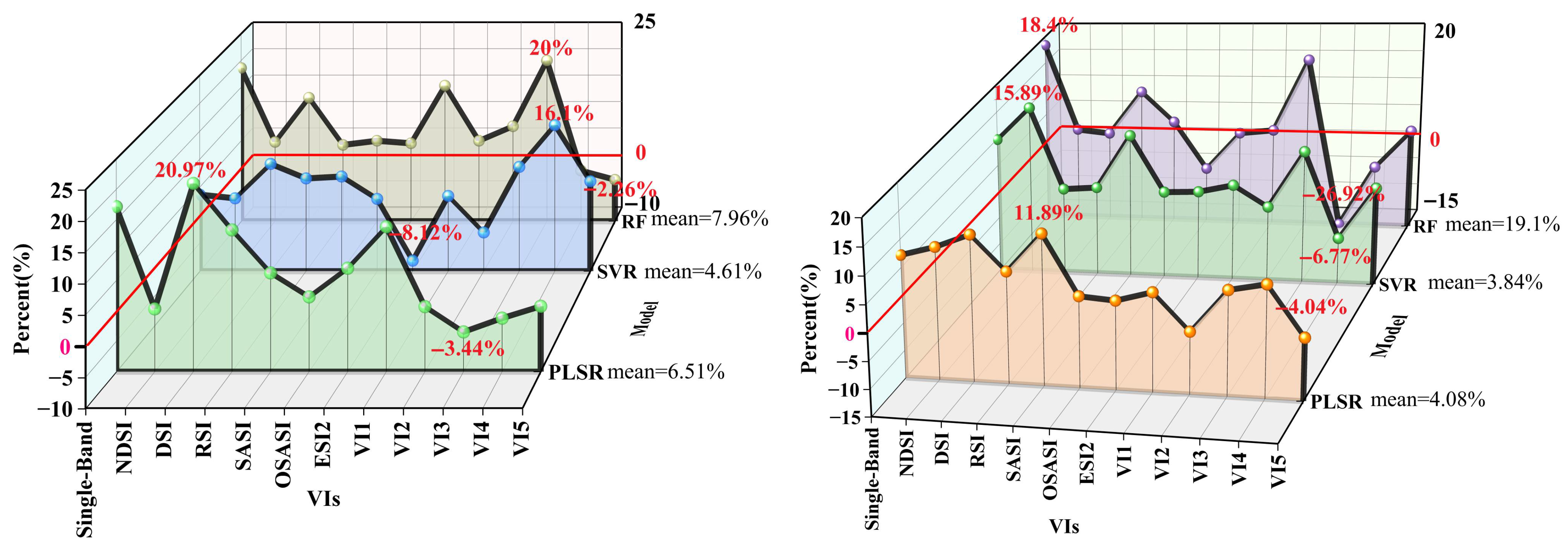
This study demonstrates that integrating PH information consistently improves LNC estimation across various VIs and modeling approaches. As shown in Figure 15, PH fusion exhibits distinct stage-dependent improvement patterns.
During the tillering stage, the average increases in R2 value were 6.51% for SVR, 4.61% for PLSR, and 7.96% for RFR, with RFR exhibiting the largest overall improvement. The response to PH integration varied among vegetation indices, and combinations involving indices sensitive to canopy structural variation generally showed larger accuracy gains. Specifically, the R2 value of the DSI–PLSR model increased by 20.97% and reached a value of 0.848. The VI4–SVR combination showed an increase of 16.10%, with the R2 value rising to 0.887, while the VI3–RFR model exhibited a 20.00% improvement and achieved an R2 value of 0.750. The highest absolute accuracy during this stage was obtained by the RSI–PLSR combination, which achieved an R2 value of 0.936 while maintaining an improvement of 13.32%.
At the booting stage, the overall magnitude of improvement after PH integration decreased. The average R2 value increases were 4.08% for SVR, 3.85% for PLSR, and 1.92% for RFR. Among the three models, SVR exhibited a relatively balanced improvement across different vegetation indices. Several index–model combinations still demonstrated notable accuracy gains. The SASI–PLSR combination showed an improvement of 11.89% and achieved an R2 value of 0.913. The NADI–SVR model improved by 15.89%, reaching an R2 value of 0.890. In addition, the single-band model exhibited an R2 value increase of 18.40% and reached a value of 0.740. The VI1–PLSR combination obtained the highest absolute accuracy at this stage, achieving an R2 value of 0.934, although its improvement rate was relatively low at 2.52%.
Overall, the incorporation of PH information exerted a positive influence on LNC estimation accuracy at both growth stages, with the strength of improvement varying with canopy development. Larger accuracy gains were more frequently observed during the tillering stage, whereas at the booting stage, the improvements became more moderate but remained consistently present across most models.

4. Discussion

Focusing on the synergistic modeling of plant height (PH) and hyperspectral indices, this study explored how their integration influences the retrieval of rice SPAD readings and LNC across different growth stages. By first evaluating overall performance improvements, we can then examine stage-specific mechanisms, computational efficiency, robustness under spectral saturation, and finally the study limitations.

4.1. Overall Improvement in SPAD Readings and LNC Retrieval Accuracy Through Integration of PH and Spectral Parameters

For SPAD readings retrieval, PLSR models based on spectral indices demonstrated high accuracy across different growth stages. In the tillering stage, the VI1–PLSR model achieved an R2 of 0.899, which was notably higher than the accuracy levels typically reported for booting-stage models in previous studies [38]. In the booting stage, the R2 of the OSASI–PLSR model further increased to 0.936, significantly surpassing the R2 values commonly observed in single-spectral wheat estimation models [39]. This suggests that in growth stages characterized by increasingly complex canopy structure, parameter integration can effectively mitigate background interference and enhance the model’s responsiveness to variations in leaf greenness reflected by SPAD readings.
For LNC retrieval, the PH-fusion models also showed significant advantages. The PH–RSI–PLSR model in the tillering stage achieved high-precision results with R2 = 0.936 and RMSE = 0.057%, representing an improvement in retrieval accuracy of 28.2% and 33.2%, respectively, compared to spectral–texture fusion BP neural network models (R2 = 0.73) [33] and BWO–ELM models (R2 = 0.7028) [40]. In the booting stage, the VI1–PLSR model achieved an R2 of 0.934, clearly outperforming red-edge multi-index fusion methods (R2 = 0.85) [41] and multi-source image fusion approaches (R2 = 0.76) [42]. These results indicate that synergistic modeling of PH and hyperspectral information has consistent applicability across different growth stages.

4.2. Growth-Stage-Specific Responses and Mechanistic Interpretation of PH Fusion in Within-Stage Models

The improvement in model performance from PH fusion exhibited distinct differences between growth stages. In the tillering stage, PH fusion increased the average R2 of PLSR-based SPAD reading retrieval models by 6.48% and reduced RMSE by 11.73%. At this stage, the rice canopy is not yet fully closed, and vertical structural information can effectively supplement spectral features, thereby enhancing the model’s sensitivity to changes in canopy structure.
During the booting stage, the compensatory effect of PH was more pronounced. The R2 of the SASI–PLSR model improved by 9.8% and RMSE decreased by 28.9%, effectively alleviating interference issues caused by canopy closure and soil-background mixing in hyperspectral data [43]. Moreover, the OSASI index achieved an R2 of 0.936 in the booting stage, exceeding the retrieval accuracy of existing red-edge fusion methods (R2 = 0.85) [41]. PH fusion also significantly reduced fluctuations in retrieval accuracy across different growth stages, mitigating to some extent the common issue of “declined accuracy across growth stages” observed in UAV-based crop monitoring studies [44]. As crop biomass and plant height increase, leaf nitrogen concentration typically declines due to the nitrogen dilution effect. Therefore, the improvement in LNC retrieval accuracy following PH fusion may partly stem from the model’s learning of LNC variation trends under growth-stage backgrounds.

4.3. Computational Efficiency Advantages and Application Potential Under Feature Optimization

The synergistic integration of PH and spectral information not only enhanced model accuracy but also enabled a reduction in the model’s reliance on high-dimensional features, which is expected to decrease computational complexity compared to full-spectrum modeling. In the booting stage, stable and reliable estimation results were obtained using only 5 input variables, representing a reduction in computational complexity of 28.6–37.5% compared to methods requiring 7–8 variables [38]. In the tillering stage, core indices such as VI1 and RSI maintained high accuracy with R2 exceeding 0.93 even under extremely simplified feature combinations, clearly outperforming complex fusion schemes that depend on more than 15 RGB, multispectral, or texture features [42].
These results indicate that the PH fusion method improves feature utilization efficiency and is expected to reduce model complexity while maintaining retrieval accuracy, providing a more operational technical pathway for the application of UAV-based hyperspectral technology in regional-scale agricultural monitoring.

4.4. PH Fusion Mitigates Spectral Saturation and Improves Model Robustness

Spectral saturation is a major factor limiting hyperspectral retrieval accuracy, particularly in high-biomass or canopy-closed stages. This study found that under clearly defined growth stages, incorporating PH significantly reduced the model’s sensitivity to spectral saturation under high-biomass conditions. In the tillering stage, PH fusion reduced the RMSE of the RSI-based model by 40.0%, substantially weakening the spectral saturation effects reported in previous studies [45] and outperforming traditional canopy compensation methods based on texture features [46].
In contrast, the reduction in RMSE during the booting stage was 18.6% [47], indicating that once canopy height stabilizes, the ability of PH to compensate for saturation effects diminishes. This growth-stage-specific variation aligns with changes in the sensitivity of canopy spectral responses across different rice growth stages, further demonstrating that the PH fusion method exhibits good robustness and application potential under clearly defined phenological conditions. This study employed PH as an exogenous structural parameter and did not further incorporate image texture features as comparative variables. Future studies could systematically compare the differences and complementarity between PH and texture features in alleviating spectral saturation and enhancing retrieval robustness, under conditions of larger sample sizes and multiple growth stages.

4.5. Limitations and Future Perspectives

This study has several limitations that should be considered when interpreting the results and guiding future research.
First, there are limitations in experimental scope. The dataset was derived from a single site, single growing season, and single rice cultivar, with model validation conducted under relatively homogeneous agronomic conditions. Although stage-specific modeling was applied to reduce phenological interference, the robustness of the framework across different cultivars, environmental gradients, and growing seasons remains uncertain. Future studies should incorporate multi-site and multi-year datasets to comprehensively evaluate model generalizability.
Furthermore, there are limitations in sample size and model stability. The relatively limited number of samples increases the potential risk of overfitting, particularly when exhaustive spectral index construction and machine learning algorithms are employed. While nested feature selection, repeated cross-validation, and independent test sets were implemented to mitigate information leakage and enhance robustness, small-sample conditions inherently increase variance in model performance. Expanding sample size and data heterogeneity will be essential for more reliable generalization assessment.
Third, there are limitations related to spatial dependence. All sampling plots were distributed within a single experimental field with relatively short inter-plot distances, making it difficult to completely exclude potential spatial autocorrelation. The random train–test split strategy does not explicitly enforce spatial independence, which may lead to slightly optimistic performance estimates. Future research should adopt spatially blocked or geographically independent validation strategies to more rigorously assess model transferability under spatially independent conditions.
In addition, there are limitations in structural variable interpretation and scalability. PH was incorporated as a structural descriptor to improve hyperspectral estimation performance; however, the present study does not establish a causal relationship between PH and spectral or biochemical parameters. The observed improvements reflect statistical associations within growth stages rather than confirmed mechanistic correction effects. Moreover, PH was obtained through manual ground measurements, which limits direct scalability for large-area applications. Importantly, the proposed framework relies on structural information rather than the specific measurement modality of PH. In practical applications, canopy structural descriptors could be derived from UAV-based canopy height models or phenological indicators such as thermal time metrics. Accordingly, the current implementation should be regarded as a proof-of-concept demonstration of spectral–structure integration, and future work should prioritize fully remote sensing-based structural substitution to enhance operational applicability.
Overall, expanding spatial–temporal coverage, increasing sample size, adopting spatially independent validation schemes, and integrating remotely sensed structural metrics will be critical steps toward improving model robustness, mechanistic interpretability, and practical scalability.

5. Conclusions

This study evaluated the effect of integrating plant height (PH) with UAV-based hyperspectral features for stage-specific estimation of rice SPAD readings and leaf nitrogen concentration (LNC). The results consistently demonstrate that incorporating canopy structural information enhances model robustness and predictive stability within individual growth stages. By complementing spectral variables with vertical canopy structure, PH alleviates the limited expression of single spectral features across phenological phases, leading to measurable improvements in both SPAD readings and LNC retrieval accuracy.
Different modeling algorithms exhibited distinct responses to structural–spectral integration. PLSR and SVR showed stable adaptability to the integrated feature set, whereas RFR was more sensitive to feature redundancy under highly correlated combinations. These findings highlight the importance of algorithm selection and feature management in structural–spectral collaborative modeling.
Based on stage-specific performance, the following practical recommendations are proposed under field-scale and defined phenological conditions:
(1)
Tillering Stage: For SPAD monitoring, the SVR–VI1 model is recommended to fully capture nonlinear relationships between multi-band spectra and chlorophyll. For LNC retrieval, the PLSR–RSI model is preferred, as it performs stably in integrating visible and red-edge information and is suitable for early-growth monitoring.
(2)
Booting Stage: For SPAD readings retrieval, the PLSR–VI3 model is recommended, as it effectively utilizes red-edge and near-infrared band features, aligning with the spectral stability of mature leaves. For LNC estimation, the PLSR–VI1 model performed best, making it suitable for mid-to-late season nitrogen nutrition assessment.
The spectral–structural collaborative modeling framework developed in this study demonstrates the potential of integrating canopy structural information with hyperspectral features for improving rice growth monitoring and nitrogen status assessment. Its primary strength lies in enhancing the consistency of parameter retrieval within individual growth stages under field conditions. Given that the experiment was conducted at a single field site, the findings should be interpreted primarily as a plot-scale evaluation of the proposed spectral–structural modeling strategy. Future research should expand spatial and temporal coverage, incorporate multi-site and multi-year datasets, and further refine structural descriptors to strengthen model robustness and broader applicability.

Author Contributions

Conceptualization, D.X. and J.H.; methodology and formal analysis, D.X.; validation, D.X.; investigation and data curation, Y.S.; writing—original draft, D.X. and Y.S.; writing—review and editing, Y.S. and G.L.; resources, supervision, project administration, and funding acquisition, J.H. All authors have read and agreed to the published version of the manuscript.

Funding

This research was supported by the Key Laboratory of the Evaluation and Monitoring of Southwest Land Resources (Ministry of Education) under Grant No. TDSYS202406 and funded by the Chengdu Technology Innovation R&D Project of Chengdu Science and Technology Bureau (Grant No. 2022-YF05-01090-SN). The APC was funded by the same projects.

Data Availability Statement

The data that support the findings of this study will be made available in a public repository after the publication of this manuscript.

Acknowledgments

The authors gratefully acknowledge the support from the Qingbaijiang Agricultural Technology Extension Station and the Remote Sensing and Geospatial Information Laboratory, Chengdu University of Technology.

Conflicts of Interest

The authors declare no conflicts of interest. The funders had no role in the design of the study; in the collection, analyses, or interpretation of data; in the writing of the manuscript; or in the decision to publish the results.

Abbreviations

The following abbreviations are used in this manuscript:
UAVUnmanned Aerial Vehicle
PHPlant Height
LNCLeaf Nitrogen Concentration
VIVegetation Index
PLSRPartial Least Squares Regression
SVRSupport Vector Regression
RFRRandom Forest Regression
R2Coefficient of Determination
RMSERoot Mean Square Error

References

  1. Hou, Y.P.; Kong, L.L.; Li, Q.; Qin, Y.B.; Yu, L.; Xie, J.G.; Yin, C.X. Effects of different fertilization modes on nutrient uptake and soil nutrient balance in rice. Northeast Agric. Sci. 2018, 43, 1–8. [Google Scholar] [CrossRef]
  2. Zheng, J.; Song, X.; Yang, G.; Du, X.; Mei, X.; Yang, X. Remote Sensing Monitoring of Rice and Wheat Canopy Nitrogen: A Review. Remote Sens. 2022, 14, 5712. [Google Scholar] [CrossRef]
  3. Moharana, S.; Dutta, S. Spatial variability of chlorophyll and nitrogen content of rice from hyperspectral imagery. ISPRS J. Photogramm. Remote Sens. 2016, 122, 17–29. [Google Scholar] [CrossRef]
  4. Holman, F.H.; Riche, A.B.; Michalski, A.; Castle, M.; Wooster, M.J.; Hawkesford, M.J. High Throughput Field Phenotyping of Wheat Plant Height and Growth Rate in Field Plot Trials Using UAV Based Remote Sensing. Remote Sens. 2016, 8, 1031. [Google Scholar] [CrossRef]
  5. Nayak, D.; Saetnan, E.; Cheng, K.; Wang, W.; Koslowski, F.; Cheng, Y.-F.; Zhu, W.Y.; Wang, J.-K.; Liu, J.-X.; Moran, D.; et al. Management opportunities to mitigate greenhouse gas emissions from Chinese agriculture. Agric. Ecosyst. Environ. 2015, 209, 108–124. [Google Scholar] [CrossRef]
  6. Ju, X.; Xing, G.; Chen, X.; Zhang, S.; Zhang, L.; Liu, X.; Cui, Z.; Yin, B.; Christie, P.; Zhu, Z.; et al. Reducing environmental risk by improving N management in intensive Chinese agricultural systems. Proc. Natl. Acad. Sci. USA 2009, 106, 3041–3046. [Google Scholar] [CrossRef]
  7. Chen, L.; Chang, Q.R.; Gao, Y.F.; Luo, L.L.; Zheng, Y. Hyperspectral estimation model of chlorophyll content in kiwifruit leaves. J. Northwest A&F Univ. (Nat. Sci. Ed.) 2020, 48, 79–89, 98. [Google Scholar] [CrossRef]
  8. Xue, X.; Wu, Y.E. Determination of chlorophyll content in wheat leaves and its relationship with SPAD values. Hubei Agric. Sci. 2010, 11, 2701–2702, 2751. [Google Scholar] [CrossRef]
  9. Ai, T.C.; Li, F.M.; Zhou, Z.A.; Zhang, M.; Wu, H.R. Correlation between chlorophyll content and SPAD values in crop leaves. J. Hubei Agric. Coll. 2000, 20, 6–8. [Google Scholar]
  10. Li, Z.; Li, Z.; Fairbairn, D.; Li, N.; Xu, B.; Feng, H.; Yang, G. Multi-LUTs method for canopy nitrogen density estimation in winter wheat by field and UAV hyperspectral. Comput. Electron. Agric. 2019, 162, 174–182. [Google Scholar] [CrossRef]
  11. Kalra, Y. (Ed.) Handbook of Reference Methods for Plant Analysis, 1st ed.; CRC Press: Boca Raton, FL, USA, 1997. [Google Scholar] [CrossRef]
  12. Araus, J.L.; Cairns, J.E. Field high-throughput phenotyping: The new crop breeding frontier. Trends Plant Sci. 2014, 19, 52–61. [Google Scholar] [CrossRef]
  13. Zhang, C.; Kovacs, J.M. The application of small unmanned aerial systems for precision agriculture: A review. Precis. Agric. 2012, 13, 693–712. [Google Scholar] [CrossRef]
  14. Feng, H.; Yang, Z.T.; Chen, H.; Wu, L.H.; Li, C.; Wang, N.J. Estimation of summer maize SPAD based on UAV multispectral images. Trans. Chin. Soc. Agric. Mach. 2022, 53, 211–219. [Google Scholar]
  15. Hunt, E.R.; Daughtry, C.S.T. What good are unmanned aircraft systems for agricultural remote sensing and precision agriculture? Int. J. Remote Sens. 2018, 39, 5345–5376. [Google Scholar] [CrossRef]
  16. Xu, X.; Fan, L.; Li, Z.; Meng, Y.; Feng, H.; Yang, H.; Xu, B. Estimating leaf nitrogen content in corn based on information fusion of multiple-sensor imagery from UAV. Remote Sens. 2021, 13, 340. [Google Scholar] [CrossRef]
  17. Bendig, J.; Yu, K.; Aasen, H.; Bolten, A.; Bennertz, S.; Broscheit, J.; Gnyp, M.L.; Bareth, G. Combining UAV-based plant height from crop surface models, visible, and near infrared vegetation indices for biomass monitoring in barley. Int. J. Appl. Earth Obs. Geoinf. 2015, 39, 79–87. [Google Scholar] [CrossRef]
  18. Wang, W.; Wu, Y.; Zhang, Q.; Zheng, H.; Yao, X.; Zhu, Y.; Cao, W.; Cheng, T. AAVI: A novel approach to estimating leaf nitrogen concentration in rice from unmanned aerial vehicle multispectral imagery at early and middle growth stages. IEEE J. Sel. Top. Appl. Earth Obs. Remote Sens. 2021, 14, 6716–6728. [Google Scholar] [CrossRef]
  19. Shu, M.; Zuo, J.; Shen, M.; Yin, P.; Wang, M.; Yang, X.; Tang, J.; Li, B.; Ma, Y. Improving the estimation accuracy of SPAD values for maize leaves by removing UAV hyperspectral image backgrounds. Int. J. Remote Sens. 2021, 42, 5864–5883. [Google Scholar] [CrossRef]
  20. Wang, Z.; Skidmore, A.K.; Wang, T.; Darvishzadeh, R.; Heiden, U.; Heurich, M.; Latifi, H.; Hearne, J. Canopy foliar nitrogen retrieved from airborne hyperspectral imagery by correcting for canopy structure effects. Int. J. Appl. Earth Obs. Geoinf. 2017, 54, 84–94. [Google Scholar] [CrossRef]
  21. Kong, Y.R.; Wang, L.J.; Feng, H.K.; Xu, Y.; Liang, L.; Xu, L.; Yang, X.D.; Zhang, Q. Leaf area index estimation using UAV hyperspectral band selection. Spectrosc. Spectral Anal. 2022, 42, 933–939. [Google Scholar] [CrossRef]
  22. Zheng, H.; Ma, J.; Zhou, M.; Li, D.; Yao, X. Enhancing the nitrogen signals of rice canopies across critical growth stages through the integration of textural and spectral information from unmanned aerial vehicle (UAV) multispectral imagery. Remote Sens. 2020, 12, 957. [Google Scholar] [CrossRef]
  23. Chen, X.Y. A Study on the Effect of Land Shareholding Cooperatives on Farmers’ Income. Master’s Thesis, Sichuan Agricultural University, Chengdu, China, 2019. [Google Scholar] [CrossRef]
  24. Jiang, Y.F.; Qi, J.G.; Chen, B.W.; Yan, M.; Huang, L.J.; Zhang, L. Fine classification of mangrove species based on UAV hyperspectral imagery and machine learning. Remote Sens. Technol. Appl. 2021, 36, 1416–1424. [Google Scholar] [CrossRef]
  25. Thenkabail, P.S.; Smith, R.B.; De Pauw, E. Hyperspectral VIs and their relationships with agricultural crop characteristics. Remote Sens. Environ. 2000, 71, 158–182. [Google Scholar] [CrossRef]
  26. Li, Z.; Xu, X.; Feng, H.; Yang, H.; Xu, B. Estimating rice leaf nitrogen concentration using UAV hyperspectral data and machine learning methods. Comput. Electron. Agric. 2023, 206, 107669. [Google Scholar] [CrossRef]
  27. Chlingaryan, A.; Sukkarieh, S.; Whelan, B. Machine learning approaches for crop yield prediction and nitrogen status estimation in precision agriculture: A review. Comput. Electron. Agric. 2018, 151, 61–69. [Google Scholar] [CrossRef]
  28. Fu, Y.; Yang, G.; Pu, R. An overview of crop nitrogen status assessment using hyperspectral remote sensing: Current status and perspectives. Eur. J. Agron. 2021, 124, 126241. [Google Scholar] [CrossRef]
  29. Chen, P.; Haboudane, D.; Tremblay, N.; Wang, J.; Vigneault, P.; Li, B. New spectral indicator assessing the efficiency of crop nitrogen treatment in corn and wheat. Remote Sens. Environ. 2010, 114, 1987–1997. [Google Scholar] [CrossRef]
  30. Honkavaara, E.; Saari, H.; Kaivosoja, J.; Pölönen, I.; Hakala, T.; Litkey, P.; Mäkynen, J.; Pesonen, L. Processing and assessment of spectrometric, stereoscopic imagery collected using a lightweight UAV spectral camera for precision agriculture. Remote Sens. 2013, 5, 5006–5039. [Google Scholar] [CrossRef]
  31. Clevers, J.G.P.W.; Gitelson, A.A. Remote estimation of crop and grass chlorophyll and nitrogen content using red-edge bands on Sentinel-2 and -3. Int. J. Appl. Earth Obs. Geoinf. 2013, 23, 344–351. [Google Scholar] [CrossRef]
  32. Shi, B.T.; Chang, Q.R.; Cui, X.T.; Jiang, D.Y.; Chen, X.K.; Wang, Y.N.; Huang, Y. LAI estimation of winter wheat based on Sentinel-2 multispectral data and machine learning algorithm. J. Cereal Crops 2021, 6, 752. [Google Scholar] [CrossRef]
  33. Rouse, J.W.; Haas, R.H.; Scheel, J.A.; Deering, D.W. Monitoring vegetation systems in the Great Plains with ERTS. In Proceedings of the 3rd Earth Resource Technology Satellite Symposium; NASA: Washington, DC, USA, 1974; Volume 1, pp. 48–62. Available online: https://ntrs.nasa.gov/citations/19740022614 (accessed on 30 January 2026).
  34. Pearson, R.L.; Miller, L.D. Remote mapping of standing crop biomass for estimation of productivity of shortgrass prairie. In Proceedings of the 8th International Symposium on Remote Sensing of Environment; Willow Run Laboratories, Environmental Research Institute of Michigan: Ann Arbor, MI, USA, 1972. [Google Scholar]
  35. Jiang, Z.; Huete, A.R.; Didan, K.; Miura, T. Development of a two-band enhanced vegetation index (EVI2) without a blue band. Remote Sens. Environ. 2008, 112, 3833–3845. [Google Scholar] [CrossRef]
  36. Tornos, L.; Domínguez, J.A.; Moyano, M.C.; Recuero, L.; Cicuéndez, V.; García-García, M.J.; Palacios-Orueta, A. Assessment of the SASI Spectral Shape Index Time Series for Mapping Rice Ecosystems in the Mediterranean Region. Agronomy 2021, 11, 1365. [Google Scholar] [CrossRef]
  37. Bannari, A.; Morin, D.; Bonn, F.; Huete, A.R. A review of vegetation indices. Remote Sens. Rev. 1995, 13, 95–120. [Google Scholar] [CrossRef]
  38. Dai, S.Y. Monitoring Rice Growth Based on UAV Multispectral Imagery. Master’s Thesis, Jiangsu University, Zhenjiang, China, 2024. [Google Scholar]
  39. Zhou, Q.; Wang, J.J.; Huo, Z.Y.; Liu, C.; Wang, W.L.; Ding, L. Estimation of canopy SPAD values in wheat at different growth stages using UAV multispectral imagery. Spectrosc. Spectr. Anal. 2023, 43, 1912–1920. [Google Scholar] [CrossRef]
  40. Li, S.L.; Xu, C.Y.; Wang, N.; Cao, H.N.; Yu, F.H. Research on rice nitrogen UAV hyperspectral inversion based on BWO-ELM. J. Intell. Agric. Equip. 2024, 5, 14–21. [Google Scholar] [CrossRef]
  41. Cui, X.; Han, W.; Zhang, H.; Cui, J.; Ma, W.; Zhang, L.; Li, G. Estimating soil salinity under sunflower cover in the Hetao Irrigation District based on unmanned aerial vehicle remote sensing. Land Degrad. Dev. 2023, 34, 84–97. [Google Scholar] [CrossRef]
  42. Xu, S.Z. Remote Sensing Monitoring of Rice Nitrogen Content Based on UAV Multi-Source Image Information Fusion. Master’s Thesis, Jiangsu University, Zhenjiang, China, 2023. [Google Scholar] [CrossRef]
  43. Ma, W.; Han, W.; Zhang, H.; Cui, X.; Zhai, X.; Zhang, L.; Shao, G.; Niu, Y.; Huang, S. UAV multispectral remote sensing for the estimation of SPAD values at various growth stages of maize under different irrigation levels. Comput. Electron. Agric. 2024, 227, 109566. [Google Scholar] [CrossRef]
  44. Liu, Y.; Hatou, K.; Aihara, T.; Kurose, S.; Akiyama, T.; Kohno, Y.; Lu, S.; Omasa, K. A Robust Vegetation Index Based on Different UAV RGB Images to Estimate SPAD Values of Naked Barley Leaves. Remote Sens. 2021, 13, 686. [Google Scholar] [CrossRef]
  45. Wu, W.; Li, J.; Zhang, Z.; Ling, C.; Lin, X.; Chang, X. Estimation model of LAI and nitrogen content in tea tree based on hyperspectral image. Trans. Chin. Soc. Agric. Eng. 2018, 34, 195–201. [Google Scholar] [CrossRef]
  46. Guo, Y.; Jing, Y.; Wang, L.; Huang, J.; He, J.; Feng, W.; Zheng, G. UAV multispectral image-based nitrogen content prediction and the transferability analysis of the models in winter wheat plant. Chin. J. Agric. Sci. 2023, 56, 850–865. [Google Scholar] [CrossRef]
  47. Li, J.-M.; Chen, X.-Q.; Yang, Q.; Shi, L.-S. Deep learning models for estimation of paddy rice leaf nitrogen concentration based on canopy hyperspectral data. Acta Agron. Sin. 2021, 47, 1342–1350. [Google Scholar] [CrossRef]
Figure 1. Location of the study area.
Agriculture 16 00656 g001
Figure 2. Flowchart of the experimental methodology.
Agriculture 16 00656 g002
Figure 3. Field measurement of rice phenotypic parameters. (a) Measurement of rice SPAD values using a chlorophyll meter; (b) measurement of rice plant height.
Agriculture 16 00656 g003
Figure 4. Comparison between the hyperspectral raw image and the SG-smoothed image: (a): hyperspectral raw image; (b): SG-smoothed image.
Agriculture 16 00656 g004
Figure 5. Heatmap of determination coefficients for SPAD readings and LNC retrieval using PLSR, SVR, and RFR models: (a) SPAD retrieval: left for tillering stage, right for booting stage; (b) LNC retrieval: left for tillering stage, right for booting stage.
Agriculture 16 00656 g005
Figure 6. Comparative radar plots of SPAD readings retrieval performance (R2) for PLSR, SVR, and RFR models after incorporating PH: left and right panels represent the tillering and booting stages, respectively.
Agriculture 16 00656 g006
Figure 7. Scatter plots of measured versus predicted SPAD readings using selected representative indices: illustrating the performance of the SPAD readings retrieval model combined with PH.
Agriculture 16 00656 g007
Figure 8. Comparative radar plots of LNC retrieval performance (R2) for PLSR, SVR, and RFR models after incorporating PH: left and right panels represent the tillering and booting stages, respectively.
Agriculture 16 00656 g008
Figure 9. Scatter plots of measured versus predicted LNC values using selected representative indices: illustrating the performance of the LNC retrieval model combined with PH.
Agriculture 16 00656 g009
Figure 10. Comparative analysis of SPAD readings retrieval performance across different vegetation indices before and after PH coupling: during the tillering stage.
Agriculture 16 00656 g010
Figure 11. Comparative analysis of SPAD readings retrieval performance across different vegetation indices before and after PH coupling: during the booting stage.
Agriculture 16 00656 g011
Figure 12. Comparative analysis of SPAD readings retrieval performance across different vegetation indices before and after PH coupling: left and right panels represent the tillering and booting stages, respectively.
Agriculture 16 00656 g012
Figure 13. Comparative analysis of LNC retrieval performance across different vegetation indices before and after PH coupling: during the tillering stage.
Agriculture 16 00656 g013
Figure 14. Comparative analysis of LNC retrieval performance across different vegetation indices before and after PH coupling: during the booting stage.
Agriculture 16 00656 g014
Figure 15. Percentage improvement in R2 value for LNC estimation after incorporating PH across VIs for PLSR, SVR, and RFR models: left and right panels represent the tillering and booting stages, respectively.
Agriculture 16 00656 g015
Table 1. Statistics of PH, SPAD readings, and LNC in rice at two growth stages.
Growth StageMeasured ParameterMaximumMinimumMeanStandardDeviation Coefficient of Variation
TilleringPH/cm80.3348.3462.077.0611.37
SPAD55.6334.6747.724.018.40
LNC/%5.612.994.600.439.46
BootingPH/cm115.5595.64107.384.143.86
SPAD49.3135.5044.382.575.79
LNC/%4.202.983.660.225.88
Note: The CV was calculated as the ratio of the standard deviation to the mean, expressed as a percentage (CV = SD/Mean × 100%).
Table 3. Characteristic parameters of SPAD and LNC based on a single band.
Growth StageAgronomic ParameterWave Length (nm)Correlation Coefficient
TilleringSPAD8640.816
LNC8570.817
BootingSPAD8460.674
LNC8870.776
Table 4. Dual-band-based characteristic parameters of SPAD and LNC.
Growth StageCharacteristic ParameterSPADLNC
Wave Length (nm)Correlation CoefficientWave Length (nm)Correlation Coefficient
TilleringNDSI515, 857−0.847798, 6770.980
DSI864, 6960.840720, 798−0.933
RSI515, 857−0.85677, 798−0.978
SASI864, 6770.849798, 7020.960
OSASI857, 5210.850798, 6890.970
ESI2677, 864−0.851702, 798−0.959
BootingNDSI827, 6770.903798, 6770.914
DSI821, 7130.782707, 882−0.861
RSI677, 827−0.904792, 6770.921
SASI821, 7020.849689, 887−0.905
OSASI833, 6840.875677, 887−0.916
ESI2702, 821−0.847887, 689−0.851
Table 5. Characteristic parameters of SPAD and LNC derived from three bands.
Growth StageSpectral IndexSPADLNC
Wave Length (nm)Correlation CoefficientWave Length (nm)Correlation Coefficient
TilleringVI1510, 792, 749−0.856545, 773, 605−0.873
VI2785, 510, 7730.852785, 677, 7730.981
VI3737, 792, 864−0.861677, 672, 798−0.98
VI4648, 653, 8510.808545, 798, 605−0.866
VI5648, 851, 653−0.809773, 545, 6050.873
BootingVI1677, 833, 840−0.913798, 689, 6180.931
VI2677, 689, 833−0.906798, 618, 6890.927
VI3689, 821, 833−0.858689, 887, 887−0.899
VI4677, 726, 7130.677634, 785, 653−0.733
VI5713, 689, 7260.673785, 634, 6530.734
Disclaimer/Publisher’s Note: The statements, opinions and data contained in all publications are solely those of the individual author(s) and contributor(s) and not of MDPI and/or the editor(s). MDPI and/or the editor(s) disclaim responsibility for any injury to people or property resulting from any ideas, methods, instructions or products referred to in the content.