Article

Genome-Wide Identification and Expression Pattern of the Cuticular Protein Family in Honeybee Apis mellifera During Adult Cuticle Formation Stages

1
College of Bee Science, Fujian Agriculture and Forestry University, Fuzhou 350002, China
2
Honeybee Research Institute, Fujian Agriculture and Forestry University, Fuzhou 350002, China
3
College of Animal Science, Fujian Agriculture and Forestry University, Fuzhou 350002, China
*
Authors to whom correspondence should be addressed.
These authors contributed equally to this work.
Agriculture 2026, 16(6), 641; https://doi.org/10.3390/agriculture16060641
Submission received: 1 February 2026 / Revised: 4 March 2026 / Accepted: 9 March 2026 / Published: 11 March 2026

Abstract

Cuticular proteins (CPs)—key components of the insect exoskeleton—not only regulate development but also serve as structural barriers that enhance resistance against environmental stressors. This study identified CP gene families in Apis mellifera and analyzed their expression patterns during the worker capped brood development stages from mature larva to pre-eclosion. Using a comprehensive genome-wide bioinformatic approach, we identified 85 CP genes in A. mellifera which comprise six families: CPR (n = 43), CPAPs (n = 27), CPF (n = 2), Tweedle (n = 2), CPLCP (n = 8) and Apidermin (n = 3). Analysis of CP gene evolutionary relationship revealed that each CP family forms a distinct, relatively independent clade. Domain and motif analyses confirmed that all CPR members harbor a conserved Chitin_Bind_4 domain, consistent with CPR family structures in other taxa. Additionally, CPAP members possess one or three Chitin-binding Peritrophin-A domain (CBM_14), CPF members possess a conserved Pupal cuticle protein C1 domain (Cuticle_3), and Tweedle members contain a conserved domain of unknown function (DUF243). In addition, the analysis found no conserved domain within the CPLCP and Apidermin families. RNA-seq data revealed dynamic expression patterns of AmCPs during pupal development, with each gene family displaying a relatively characteristic temporal profile. Quantitative PCR validation of eight highly expressed CPR genes at 9 days post-capping confirmed the RNA-seq results. This work provides a comprehensive bioinformatic characterization and transcriptional analysis of CP genes in A. mellifera, offering a foundation for future functional studies on cuticle formation and identifying candidate genes potentially involved in cuticle development in honeybees. This work relies on transcriptomic data and in silico analyses. All proposed biological roles are hypothetical and require experimental validation.

1. Introduction

The insect cuticle, as the outermost physical barrier, plays a critical role not only in defending against pathogen invasion and environmental stress but also in morpho-genesis, water retention, and supporting normal locomotion [1,2,3]. For these reasons, the cuticle has been widely targeted in studies focused on pest management. In contrast, for honeybees, which are essential pollinators in ecosystems [4], a deeper understanding of the structure, function, and formation mechanisms of this critical physical barrier during their development is of great significance for safeguarding bee health. The structural and functional properties of the cuticle largely depend on its main proteinaceous components: the cuticular proteins (CPs) [5]. Therefore, accurate identification of CPs is fundamental to a comprehensive understanding of their structural and functional roles during insect development. Based on conserved amino acid motifs and domain architecture, insect CPs have been systematically classified into more than 13 protein families, providing a critical framework for comparative and functional genomic studies [6]. Among these, the CPR family is the largest and is defined by the presence of a conserved Rebers & Riddiford (R&R) consensus motif, which functions as a chitin-binding domain [7,8,9,10]. Based on variations in conserved amino acid sequences, the CPR proteins are further subdivided into three subfamilies: RR-1, RR-2, and RR-3 [5,11]. The RR-1 subfamily is primarily associated with soft and flexible cuticles, the RR-2 subfamily with hard and sclerotized cuticles, while the function and localization of the RR-3 subfamily remain poorly characterized [12]. Other major CP families include CPAP (comprising CPAP1 and CPAP3) [13], Tweedle [14], CPF/CPFL [10], low-complexity (CPLCA, CPLCG, CPLCW, CPLCP) [15], CPCFC [16], and the Hymenoptera-specific Apidermin families [17].
While CP genes have been systematically identified in model insects, knowledge remains very limited in the honeybee. In recent decades, systematic, genome-wide identification of CP genes has been performed in numerous model and pest insects, revealing significant compositional divergence across taxa that likely reflects differences in life history and ecological niches. Comprehensive CP repertoires have been established for Drosophila melanogaster (173 genes) [18], Bombyx mori (220) [19], Manduca sexta (248) [20], Anopheles sinensis (250) [21], Bactrocera dorsalis (164) [22], and many others [3,23,24,25]. In contrast, to date, only a handful of A. mellifera CPs have been experimentally characterized from an initial annotated set of 47 genes [6,26]. These include AmelCPR14, an ecdysteroid-responsive gene crucial for adult cuticle differentiation [27]; three members of the Hymenoptera-specific Apidermin family [17]; and two Tweedle family genes, AmelTwdl1 and AmelTwdl2 [28].
CP genes exhibit stage-specific expression patterns during metamorphosis in model insects such as B. mori, D. melanogaster, and Anopheles gambiae. These genes often exhibit stage-specific expression peaks associated with molting and metamorphosis, as documented in B. mori [19,29], A. gambiae [10], and D. melanogaster [30]. However, systematic studies on the expression profiles and biological functions of CP genes during honeybee development remains remarkably sparse. As a holometabolous insect, the honeybee undergoes four distinct developmental stages: egg, larva, pupa, and adult. Larvae undergo six molts before transitioning to the adult stage, with the pupal-to-adult molt being particularly significant. This transition involves substantial remodeling of cuticular morphology and protein composition [31], structural changes that depend on the precise spatiotemporal expression of genes involved in cuticle formation.
This study investigated the dynamic changes of CP genes during the development of A. mellifera, with a particular focus on the sealed brood stage. We conducted a genome-wide re-annotation of CP genes in A. mellifera using updated genomic data to establish a complete gene catalog. We subsequently performed phylogenetic analysis alongside D. melanogaster and Tribolium castaneum to corroborate their classification and infer evolutionary relationships. Furthermore, we utilized transcriptomic data from the A. mellifera capped brood (including 0, 3, 6, and 9 days post-capping) to analyze the expression dynamics of CPs during pupal formation and examine their temporal expression profiles. Finally, we validated the expression profiles of key genes via RT-qPCR, laying a foundation for future functional studies on the molecular mechanisms of cuticle development in A. mellifera.

2. Materials and Methods

2.1. Identification and Chromosomal Mapping of CP Genes

To identify CP family members in A. mellifera, we downloaded the genomic sequence, annotation files, protein sequences, and coding sequences (CDS) from the National Center for Biotechnology Information (NCBI Assembly: Amel_HAv3.1). To ensure the reliability of CP family member identification, we obtained reference CP sequences from the model insect D. melanogaster from FlyBase and CPAP family members from the red flour beetle, T. castaneum, from the literature. Additionally, Hidden Markov models (HMMs) for CP family domains (Pfam: PF00379, PF01607, etc.) were retrieved from the Pfam 38.1 database [32]. We performed a new genome-wide search using the updated genome assembly and more sensitive domain profiles to ensure completeness and correct possible annotation errors.
First, potential CP genes were identified and extracted using HMMER search with an E-value threshold of 1 × 10⁻⁵ to locate sequences containing CP domains [33]. Subsequently, these candidate sequences were subjected to BLASTp v2.17.0+ alignment with the CP families of D. melanogaster and T. castaneum, using an E-value threshold of 1 × 10⁻⁵, a sequence identity cutoff of ≥40%, and a query coverage of ≥50% [34]. The results were then integrated with the initial HMMER search results to yield a filtered gene set. The CPR family, being the largest CP family, was identified using the conserved R&R motif (PF00379) and validated by BLAST alignment against the D. melanogaster CPR cuticle protein family. The CPR family members were further classified into RR-1 and RR-2 subfamilies using the online tool CutProtFam-Pred (http://aias.biol.uoa.gr/CutProtFam-Pred/home.php; accessed on 10 August 2025 ) [35]. CPF family genes were identified based on the conserved motif (PF11018) and corroborated by BLAST alignment with the D. melanogaster cuticle protein family. For the CPAP family, members were identified using known T. castaneum CPAP1 and CPAP3 sequences obtained from the literature, in conjunction with the conserved motif (PF01607). Tweedle family genes were identified using the conserved Tweedle motif (PF03103) and verified through BLAST alignment with the D. melanogaster cuticle protein family. CPLCP family genes were validated by BLAST alignment against the CP family of D. melanogaster. Apidermin family members, which are unique to Hymenoptera, were retrieved directly from the NCBI database. To determine the chromosomal locations and systematically name the identified CP gene family members, we utilized the genome annotation (GFF) file and mapped the genes onto chromosomes using the TBtools v2.414 software according to their chromosomal positions [36].

2.2. Phylogenetic Analysis and Classification of CP Gene Families

To perform phylogenetic analysis, we selected CP gene family members from D. melanogaster (CPR, Tweedle, CPLCP, and CPF families), CPAP family members from T. castaneum and three defined members of the Apidermin family as references. D. melanogaster and T. castaneum were chosen because they are representative model species of the other two major holometabolous orders (Diptera and Coleoptera, respectively). Their well-characterized CP families provide robust evolutionary contexts and functional references for the newly identified CP genes in A. mellifera. A phylogenetic tree of A. mellifera CPs was constructed based on the alignment of these gene sequences. Multiple sequence alignments were generated using MAFFT v7.525 and subsequently trimmed with trimAl v1.5.rev0. The tree was reconstructed using IQ-TREE v3.0.1, with ModelFinder automatically selecting the best-fit model [37], and branch support was assessed by 1000 bootstrap replicates. Finally, the tree was edited and visualized using iTOL v7 [38], and only branches supported by a bootstrap value of 70 or greater are shown.

2.3. Analysis of Conserved Motifs and Domains

Conserved motifs were identified using the MEME suite website (https://meme-suite.org/; accessed on 16 August 2025) [39]. Conserved domains were analyzed using the Batch Web CD-Search Tool provided by the National Center for Biotechnology Information. Furthermore, the conserved motifs and domains of the AmCP gene family were analyzed and visualized using TBtools software [36].

2.4. Prediction of Transcription Factor Binding Sites for the AmCPR Gene Family

To investigate the potential regulatory mechanisms underlying the stage-specific expression of CP genes, the 2000 bp sequence upstream of the transcription start site (TSS) of each target gene was retrieved from the JASPAR database and defined as the putative promoter region. This analysis aimed to identify enriched transcription factor binding sites (TFBS) that may coordinate the temporal expression patterns observed during pupal development. The JASPAR database (http://jaspar.genereg.net/; accessed on 7 October 2025) was utilized [40], with available data filtered by a threshold of q-value ≤ 0.5. The online tool TBtools was used to predict and identify potential TFBS within the promoter regions, followed by statistical analysis and visualization of the results.

2.5. Expression Pattern Analysis

In our previous work, A. mellifera bodies from worker capped brood developmental stages were prepared. Subsequently, RNA isolation was performed, followed by the construction of strand-specific cDNA libraries for RNA-seq [41]. The raw sequencing data has been deposited in the NCBI Sequence Read Archive (SRA) under BioProject accession number PRJNA750060 (SRR15258500, SRR15258499, SRR15258488, SRR15258483, SRR15258482, SRR15258481, SRR15258480, SRR15258479, SRR15258478, SRR15258477, SRR15258498, SRR15258497). For analysis, we selected transcriptomic data from untreated whole-body honeybee samples collected at 0, 3, 6, and 9 days post-capping (designated as time points D0, D3, D6, and D9, respectively), with three biological replicates per time point.
The raw reads were processed using fastp v0.18.0 for quality control and adapter trimming. The resulting clean reads were aligned to the A. mellifera reference genome (assembly Amel_HAv3.1) using HISAT2 v2.1.0. Transcript assembly and abundance estimation were performed with StringTie v1.3.1 [42], which calculated expression levels in fragments per kilobase of transcript per million mapped reads (FPKM). In this study, our objective with the transcriptomic data was strictly limited to visualizing the general expression patterns and trends of the CP gene family across different developmental stages/tissues (presented as heatmaps).

2.6. Sample Preparation and RT-qPCR Analysis

An empty comb was placed in a queen-right colony to restrict the queen’s oviposition to a specific period, thereby obtaining honeybee eggs of synchronized age. The egg comb was subsequently transferred to a brood-rearing colony for larval care. Five days after transfer, when larvae were nearing the capping stage, the comb was inspected every 2 h to identify newly capped brood cells (capped within a 2 h window). The comb sections containing these synchronized capped brood were then carefully excised. These excised comb sections were incubated in a climate-controlled chamber (ALISN(Shanghai)CO.,LTD., Shanghai, China) at 35 ± 0.2 °C and 75% relative humidity (RH) for 3, 6, and 9 days, respectively [43]. The developmental stages sampled immediately after capping and after 3, 6, and 9 days of incubation are designated as D0, D3, D6, and D9, respectively. All collected capped brood samples were flash-frozen in liquid nitrogen and stored at −80 °C for subsequent use.
To validate the reliability of RNA-seq data and explore the functions of CPR family members, RT-qPCR validation was performed. Total RNA was extracted from the whole-body samples using the Transzol® Up Plus RNA Kit (TransGen Biotech, Beijing, China). Subsequently, cDNA was synthesized from the extracted total RNA via reverse transcription and used as the template for amplifying target genes. Quantitative PCR (qPCR) reactions were prepared following the manufacturer’s instructions for the PerfectStart® Green qPCR SuperMix kit (TransGen Biotech, Beijing, China). Three biological replicates were performed for each sample, and three technical replicates were conducted for each biological replicate. The relative expression levels of the target genes were calculated using the 2−∆∆Ct method [44], with actin serving as the reference gene. The honeybee β-actin gene, previously validated as a stable reference gene for various tissues and stages [45,46], was used as an internal control. For comparisons involving more than two groups, statistical significance was assessed using one-way analysis of variance (ANOVA), followed by Tukey’s honestly significant difference (HSD) post hoc test for multiple comparisons. Differences were considered statistically significant at p < 0.05. Significant differences among groups were indicated by different lowercase letters (e.g., a, b, c) above the corresponding bars in the figures; groups sharing the same letter are not significantly different. All statistical analyses were performed using GraphPad Prism v8.0.2.
Primers were designed using NCBI Primer-BLAST (https://www.ncbi.nlm.nih.gov/tools/primer-blast/, accessed on 25 August 2026) (Table 1). The specificity of the primers was verified by melting curve analysis, which showed a single peak for all products. Primers were designed to be 18–22 bp long with Tm values between 58 °C and 61 °C to facilitate optimal amplification.

2.7. Statistical Analysis

Each experiment was performed with three biological replicates. Results are expressed as mean ± standard deviation (SD). Target gene expression was quantified relative to the reference gene actin using the 2−∆∆Ct method. For experiments with multiple groups, one-way ANOVA was performed to determine overall statistical significance, followed by Tukey’s HSD post hoc test for pairwise comparisons. A p-value < 0.05 was considered statistically significant. In all figures, groups labeled with different lowercase letters (a, b, c) indicate significant differences, while groups sharing the same letter are not statistically different. The GraphPad Prism software was utilized for all statistical analyses.

3. Results

3.1. Identification and Chromosomal Localization of CP Genes in A. mellifera

Based on the A. mellifera genome downloaded from NCBI, the AmCPs genes of A. mellifera were identified using HMMs (Pfam: PF00379, PF01607, etc.) and BLAST alignment (CP proteins from D. melanogaster and CPAP family from T. castaneum). A total of 85 CPs, belonging to six distinct families, were identified. These comprised 43 CPRs, 27 CPAPs, 8 CPLCPs, 2 CPFs, 2 Tweedle, and 3 Apidermins. The CPR family, named for the presence of the “R&R consensus” motif, was the largest and most widely distributed among the identified CPs. Among these, 43 genes containing the R&R conserved region were identified in the western honeybee genome. Using CutProtFam-Pred, these were further classified into the RR-1 (17 genes) and RR-2 (21 genes) subfamilies. The remaining five sequences could not be assigned to either subfamily and were therefore categorized as CPRN (CPR unclassified). The identified CPR gene family members in A. mellifera were systematically named AmCPR1 to AmCPR43, following the numerical order of chromosomes 1 to 16 (Table S1). CPAPs have been identified in many insect species. They are classified into two families based on the number of chitin-binding domain type 2 (ChtBD2) motifs they contain: CPAP1 proteins possess a single ChtBD2 domain, whereas CPAP3 proteins possess three. In the present study, we identified 16 CPAP1 and 11 CPAP3 genes. Following the established nomenclature, these were named AmCPAP1-a to AmCPAP1-p and AmCPAP3-a to AmCPAP3-k, respectively, based on their chromosomal positions (Tables S2 and S3). This systematic nomenclature scheme was subsequently applied to the remaining CP gene families, as AmCPF (Table S4), AmTweedle (Table S5), Apidermin (Table S6), and AmCPLCP (Table S7).
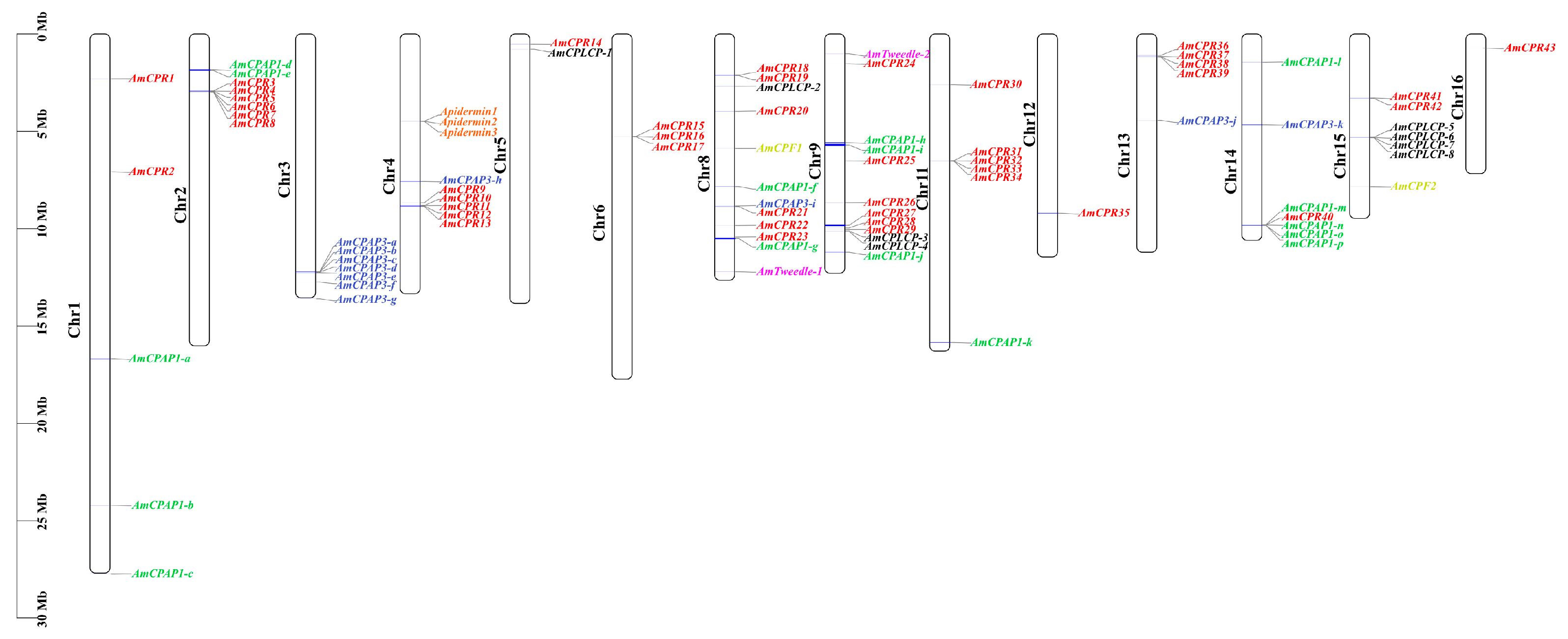
Chromosomal localization analysis revealed that the 85 AmCP genes are distributed across 14 chromosomes. The highest gene densities were found on chromosomes 8 and 9, whereas chromosomes 5, 12, and 16 harbored the fewest genes. AmCPR genes were present on most chromosomes, with notable clusters on chromosomes 2, 8, and 9, each containing six genes. The AmCPAP1 family showed the greatest abundance on chromosome 14. AmCPAP3 genes were primarily concentrated on chromosome 3. AmCPLCP genes are predominantly located on chromosomes 9 and 15. AmCPF genes were dispersed across chromosomes 8 and 15. AmTweedle genes were scattered on chromosomes 8 and 9, and Apidermin family genes were predominantly located on chromosome 4 (Figure 1). Fourteen gene clusters were identified across 14 chromosomes, with each cluster comprising 2 to 6 genes.

3.2. Phylogenetic Analysis of CPs

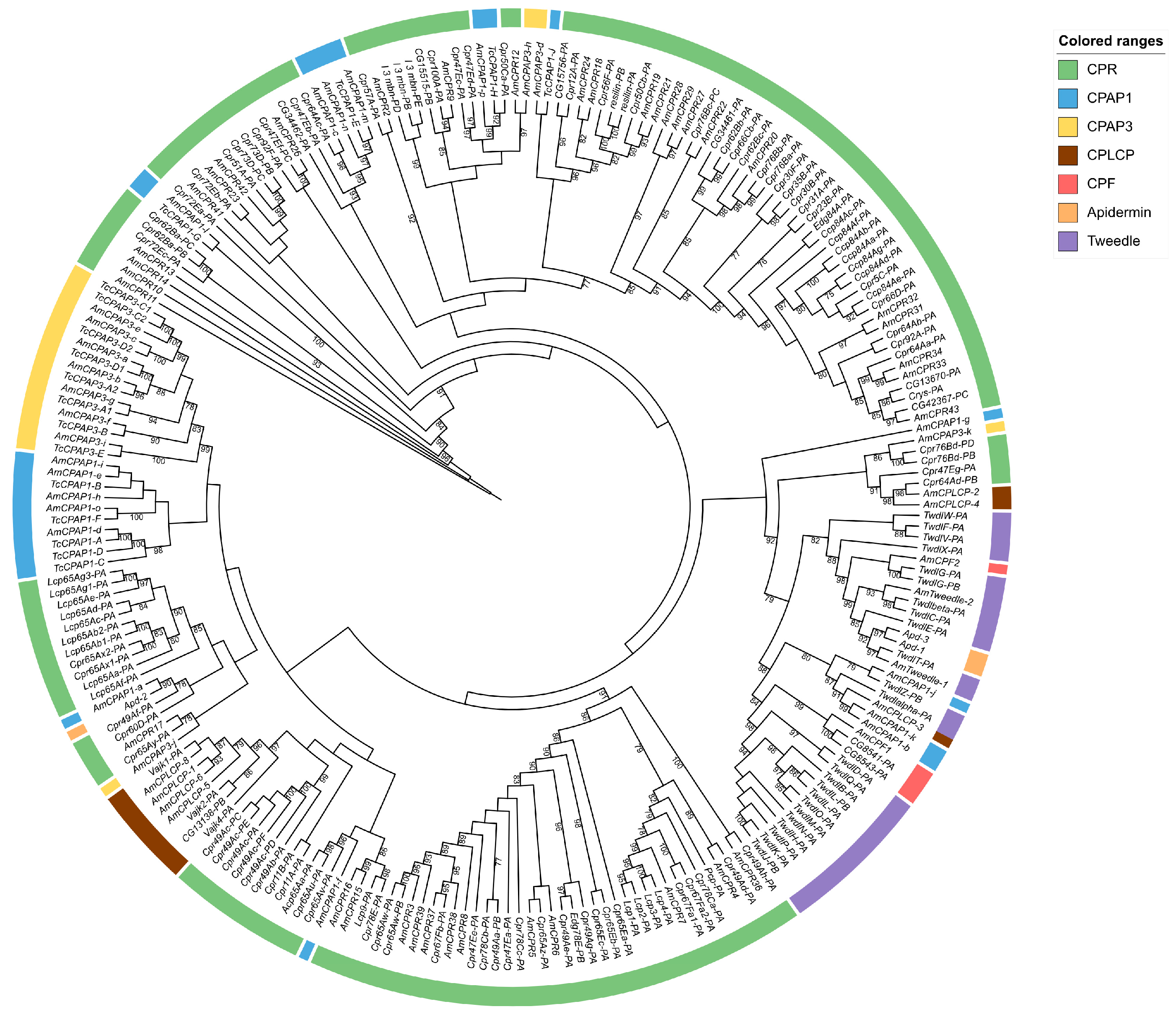
To investigate the evolutionary relationships of the identified CP genes, a phylogenetic tree was constructed using the maximum likelihood method (Figure 2). The tree topology recovered six major clades, which strictly align with the CP families initially identified based on their conserved structural domains (as detailed in Section 3.3): CPR, CPAPs, CPF, Tweedle, CPLCP, and Apidermin. While most families formed well-defined clusters, some deep ancestral nodes exhibited intermingled branching patterns between different families. For instance, the CPR family—the largest and most widely distributed—displayed a polytomic and dispersed topology rather than a single monophyletic clade. This pattern is likely due to the inherent structural features of CPs, where short, conserved motifs are flanked by highly divergent sequences, potentially weakening the phylogenetic signal at deep evolutionary nodes. Within the specific subfamilies, CPAP1 and CPAP3 exhibited high conservation, with A. mellifera genes clustering robustly with their orthologs from T. castaneum and D. melanogaster. Members of the Tweedle family formed a single, cohesive cluster in A. mellifera, with the majority of nodes supported by bootstrap values exceeding 90%. Notably, the Apidermin family genes formed a distinct group with no orthologs detected in the reference species, further supporting their Hymenoptera-specific nature. These phylogenetic groupings are consistent with the subsequent analysis of motif compositions and domain architectures.

3.3. Analysis of Conserved Domains and Motifs

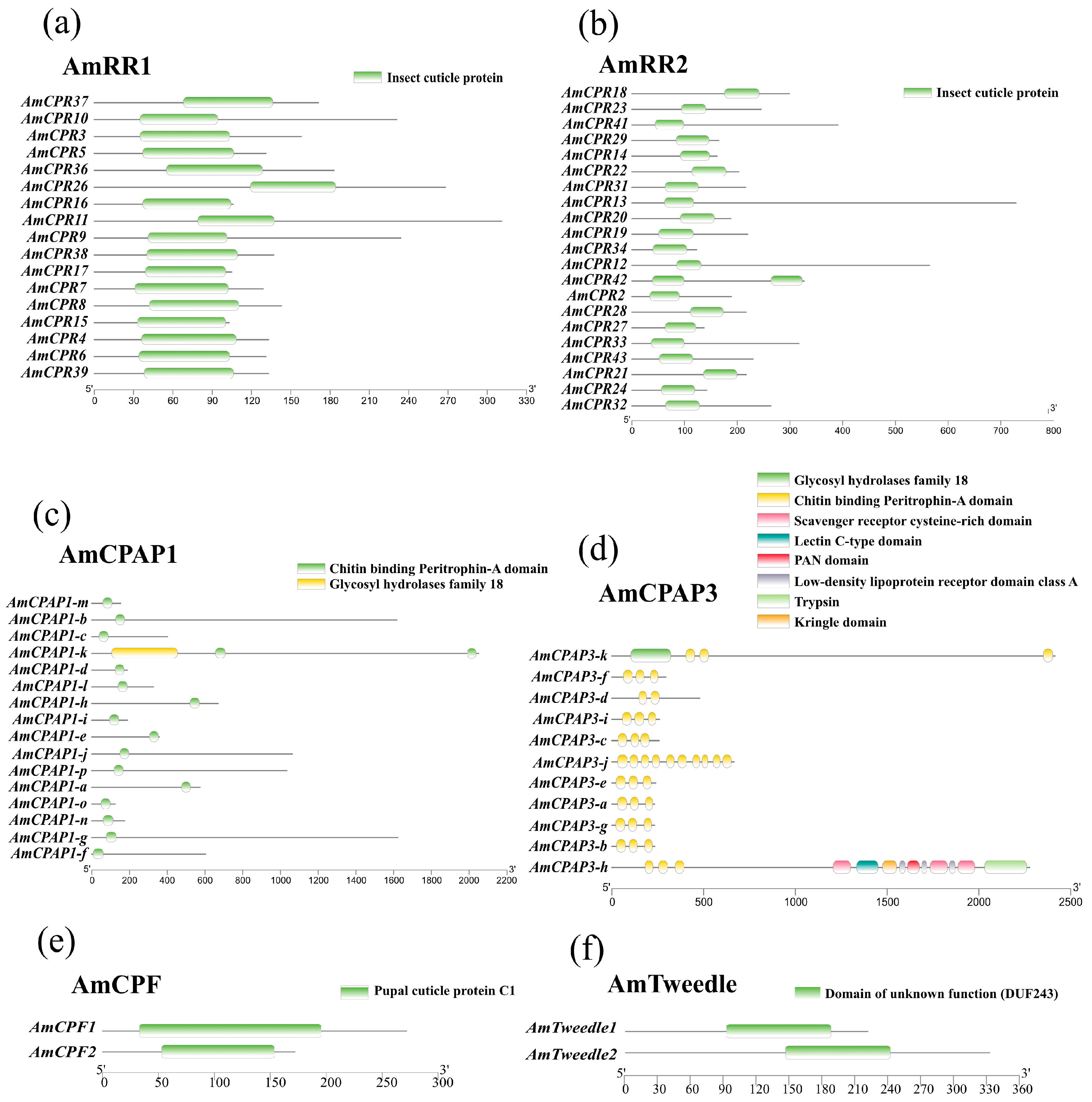
Conserved domain analysis revealed that all AmCPR family members (both RR-1 and RR-2) contain the PF00379 (insect cuticle protein domain) (Figure 3a,b). Within the AmCPAP family, most AmCPAP1 members possess a single PF01607 (Chitin-binding Peritrophin-A domain). Exception was AmCPAP1-k, which was found to contain two such domains (Figure 3c). Similarly, most AmCPAP3 members harbor three PF01607 domains. However, AmCPAP3-j and AmCPAP3-d were exceptions to this pattern (Figure 3d). Members of the AmCPF family possess a conserved PF11018 (Pupal cuticle protein C1 domain) (Figure 3e). Members of the AmTweedle family contain a conserved PF03103 (DUF243 domain) (Figure 3f). In contrast, in the AmCPLCP and Apidermin families, no known conserved Pfam domains were detected. The conserved domain is largely in agreement with the phylogenetic groupings.
Sequence logos generated by WebLogo revealed the consensus motif for the CPR family as G-x(8)-G-x(6)-Y-x-A-D-x(2,3)-G-F. Within this family, the AmRR1 subfamily motif was G-x-Y-x(4)-P-D-G-x(4)-V-x-Y-x-A-x-E-x-G-F-x(3)-G-x-H-x-P-x(2)-P-P, while the AmRR2 subfamily motif was G-x-Y-x(4)-P-D-G-x(4)-V-x-Y-A-D-x(3)-G-F (Figure S1a). For the AmCPAP1 family, the motifs were C-x(12)-C-x(7)-C and C-x(5)-C, whereas the CPAP3 family motifs were C-x(9)-C-x(12)-C and C-x(5)-C (Figure S1b). The AmCPF and Apidermin families each contain a single conserved motif, whereas the AmCPLCP and AmTweedle family harbors three. Notably, the Apidermin family is characterized by a high alanine content; the AmCPLCP family is characterized by a high proline content. (Figure S1c–f).

3.4. Analysis of TFBS in CPR Promoter Regions

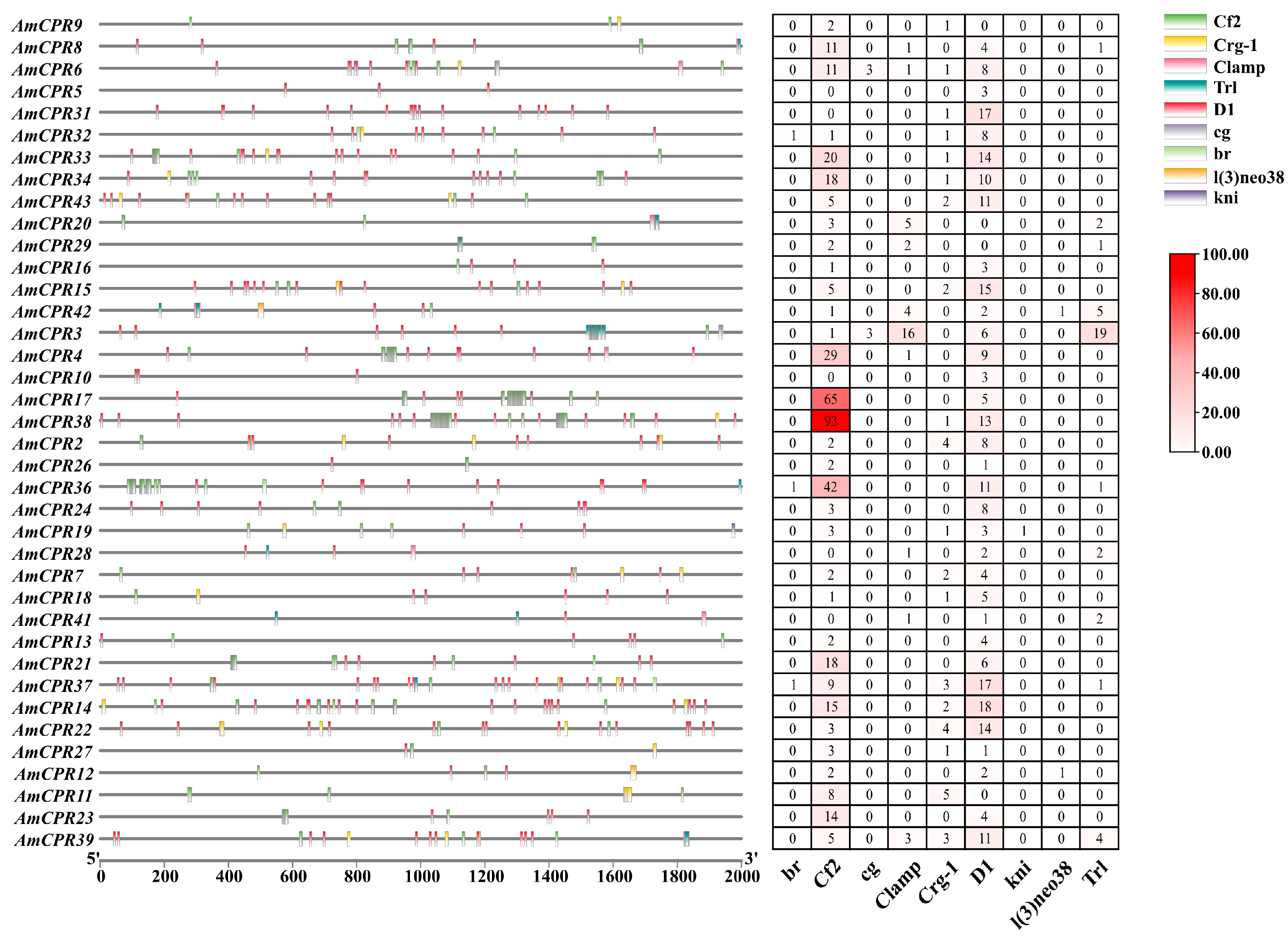
During insect development, the CPR family, which constitutes a major subset of CPs and comprises numerous members, plays a pivotal role. We hypothesize that its expression is precisely regulated by a multi-layered transcriptional network. To investigate the transcriptional regulation of the AmCPR gene family, we performed a systematic prediction of TFBS within the 2000 bp promoter regions using the JASPAR database. This analysis predicted a total of nine distinct transcription factor binding motifs. Among these, the binding sites for Cf2, D1, and Crg-1 were significantly enriched (Figure 4). The predicted motifs included those for transcription factors implicated in development and differentiation (e.g., Cf2 and Br), as well as the circadian rhythm-associated factor Crg-1. At the level of chromatin structure and epigenetic regulation, binding sites were predicted for factors involved in dosage compensation and chromatin adaptation (Clamp), chromatin modification and gene expression regulation (e.g., Trl), heterochromatin-associated protein D1, and Polycomb response element binding protein cg. Additionally, binding motifs for l(3)neo38, associated with neuromuscular junction and brain development, and the transcriptional repressor Kni were also identified.

3.5. Expression Profiling of CP Genes During Pupal Development

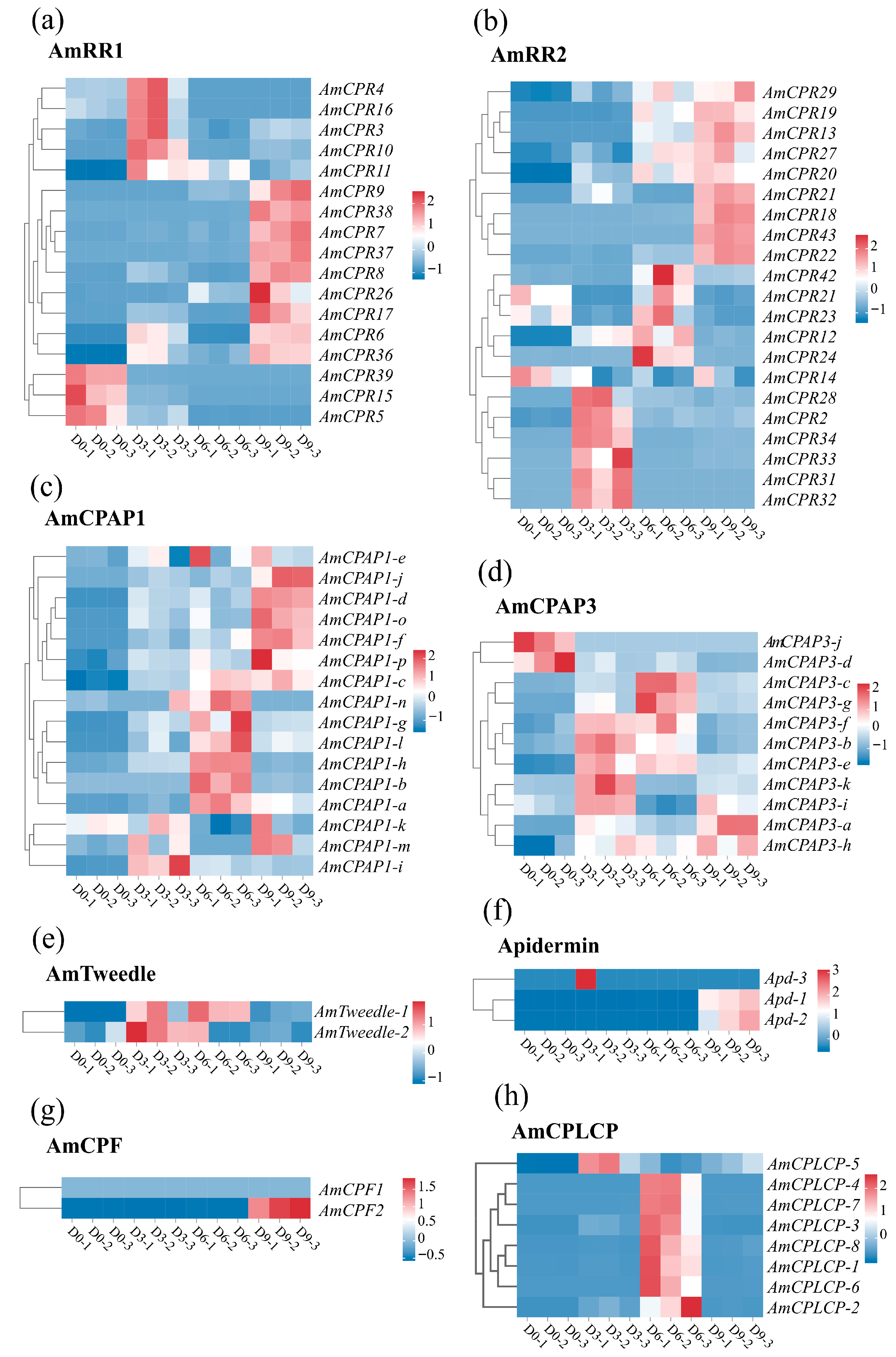
Expression profiles of the AmCPs genes across pupal development were analyzed at 0, 3, 6, and 9 days post-capping, corresponding to four developmental stages: early pupal stage (D0, newly capped large larva), prepupal stage (D3, one day before pupation), mid-pupal stage (D6), and late pupal stage (D9) (Figure 5a–h). The results showed that nine AmRR1 genes (typically associated with soft cuticles) and nine AmRR2 genes (typically associated with rigid cuticles) exhibited high expression levels (FPKM ≥ 10) at 9 days post-capping, suggesting that these genes may be involved in the formation of the adult cuticle. Five AmRR1 and six AmRR2 genes exhibited primarily expressed at 3 days post-capping, indicating a potential role in the assembly of the new pupal cuticle. A smaller subset of genes showed elevated expression at 0 and 6 days post-capping (Figure 5a,b). Within the CPAP family, AmCPAP1 genes were primarily highly expressed at 6 and 9 days post-capping (Figure 5c). AmCPAP3 genes were predominantly expressed at 3 and 6 days post-capping (Figure 5d), implying they may function as chitin-binding proteins during cuticle assembly. Similarly, genes of the Tweedle family were mainly expressed at 3 days post-capping (Figure 5e). Apidermin family genes were expressed at 9 days post-capping (Figure 5f). In the AmCPF family, AmCPF2 was highly expressed at 9 days post-capping (Figure 5g). AmCPLCP family genes were primarily expressed at 6 days post-capping (Figure 5h), suggesting these low-complexity proteins may contribute to cuticle properties during mid-pupal development.

3.6. Expression Patterns of Selected CPR Gene Family Members During Pupal Development

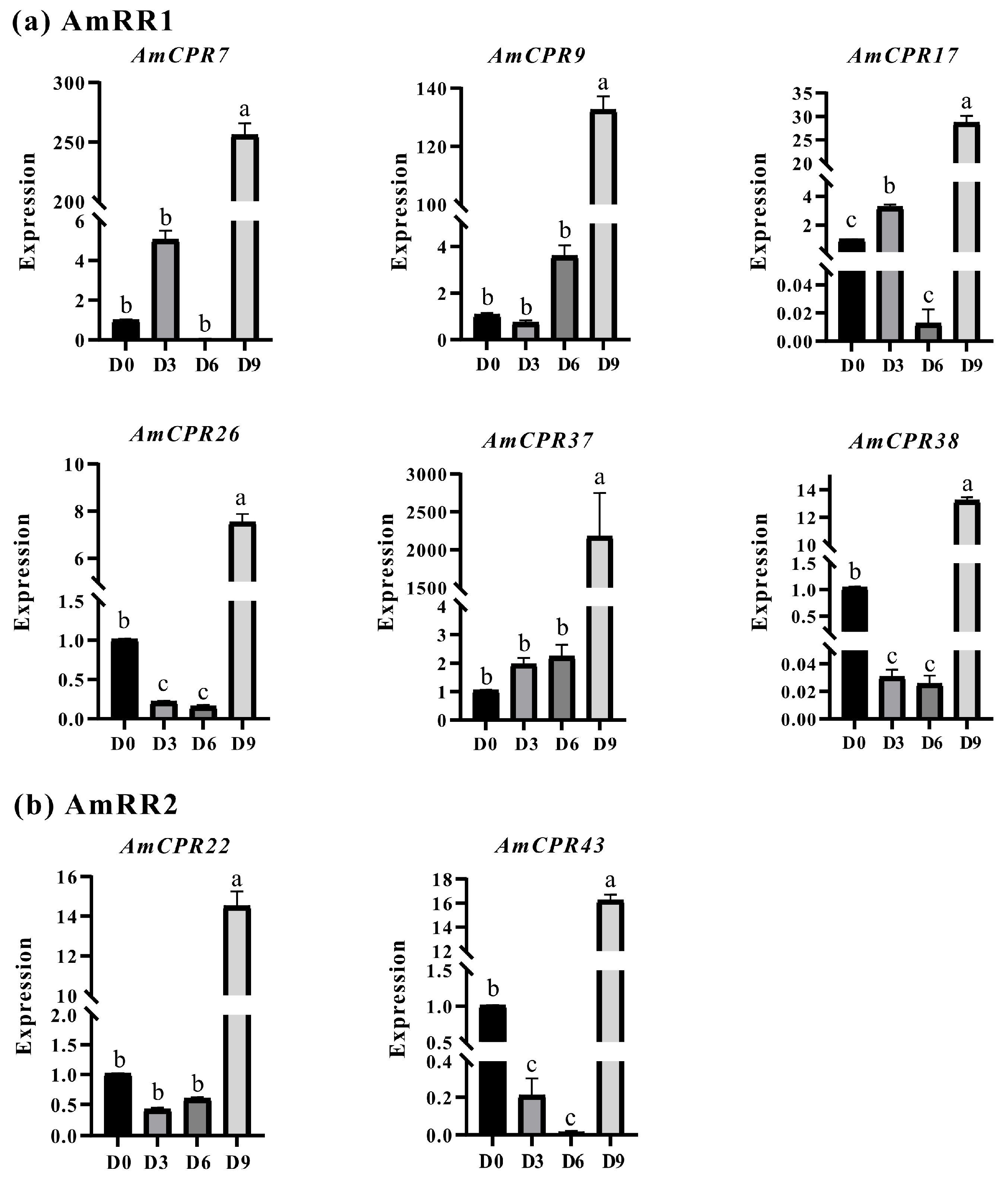
To validate the expression of AmCPR family members identified via RNA-seq, eight genes exhibiting high expression at 9 days post-capping were selected for qRT-PCR analysis (comprising 6 AmRR1 and 2 AmRR2 genes). For all tested genes, the expression patterns determined by qRT-PCR were consistent with those derived from the RNA-seq data, confirming the reliability of the transcriptomic sequencing results (Figure 6).

4. Discussion

In this study, a total of 85 CP genes were systematically identified in the genome of A. mellifera, accounting for 0.30% of its total gene count (28,344). Comparative analysis of CP gene proportions across species reveals that the CP gene content in A. mellifera (0.30%) is comparable to that in D. melanogaster (0.29%), but significantly lower than that in B. mori (1.17%). This result suggests that, compared to the lepidopteran B. mori, the CP gene family in A. mellifera has not undergone expansion and may instead show a trend toward reduction. In contrast, when compared with the dipteran D. melanogaster, the CP gene composition has remained relatively conserved. This difference may reflect distinct evolutionary selective pressures on cuticular structure and function among insect lineages, shaped by their adaptation to diverse life histories and ecological niches. For instance, Diaphorina citri possesses 159 CP genes [47], Cnaphalocrocis medinalis has 191 [48], and B. mori contains 220 [19]. These data indicate significant interspecific variation in CP gene number, which may be attributed to divergent ecological niches. A notable example is the malaria mosquito (A. gambiae), which inhabits a high-risk environment and exhibits a notable expansion of gene clusters within the CPR family, particularly the RR-2 subtype [6]. The AmCPR family constitutes the largest proportion within the A. mellifera CP family, comprising 17 AmRR-1, 21 AmRR-2, and 5 AmRR-N subfamily genes. The latter could not be classified by CutProtFam-Pred and may represent a novel subfamily. Among the six families identified in this study, CPR, CPAP, CPF, and Tweedle are widely conserved across insects. In contrast, CPLCP comprises low-complexity, proline-rich proteins, and the Apidermin family is specific to the honeybee. This family is primarily composed of five types of hydrophobic amino acids and contains the AAPA/V tetrapeptide motif, commonly found in hard cuticle. Its structure is thought to be an adaptation to the transition between the protected larval developmental stage and the highly specialized adult life stage in bees [17]. The 85 AmCP genes were non-randomly distributed across the chromosomes. The tight clustering of genes within these loci suggests that they likely evolved through tandem duplication events. Furthermore, analysis of conserved domains and motifs revealed that the domain composition within each AmCP family is conserved with that in other insects. All AmCPR family members contain the Chitin_bind_4 domain, indicating a conserved chitin-binding capability. Motif differences between the RR-1 and RR-2 subfamilies are likely determinants of the distinct physical properties of the cuticle they help form.
The relationship between CP gene expression patterns and molting is complex. The Tweedle family is widely recognized for its crucial role in new cuticle formation during metamorphosis in insects. For example, in L. migratoria, LmTwdl1 is highly expressed prior to molting, and its knockdown results in disrupted cuticular structure and subsequent molting failure [49]. Previous studies have also demonstrated that in the oriental fruit fly (B. dorsalis), genes CPAP3-A1, -B, -E, and -E2 are constitutively highly expressed in the larval cuticle, with expression peaking prior to pupation; their knockdown leads to delayed pupation or mortality [50]. Conversely, the peak expression of some CP genes can occur after molting. For instance, TcCPR69 in the red flour beetle (T. castaneum) shows its highest expression on the first day following each larval molt [51]. Similarly, in the cotton aphid (Aphis gossypii), the expression of AgSgAbd-2-like (a CPR family member) increases significantly after every molting event [52]. In addition to their close association with molting, CPs play crucial roles during the developmental period from the late pupal stage to adulthood in insects, primarily contributing to the final formation, sclerotization, and tanning of the adult cuticle. In A. gambiae, CPF3 and CPF4 are significantly up-regulated prior to adult eclosion [10]. These proteins participate in the assembly of the outer cuticle in a chitin-independent manner, thereby driving the rapid deposition, sclerotization, and other biological functions associated with adult emergence. Existing research on honeybee CPs has revealed the specific roles of certain proteins in metamorphosis. For example, AmelCPR14 expression is significantly up-regulated during the pupal and pharate adult stages [27], while AmelTwdl1 and AmelTwdl2 exhibit increased expression in the late pupal stage [28]. By integrating transcriptomic analysis, this study systematically delineated the distinct expression patterns of different CP gene families during the capped brood developmental stages of A. mellifera. For instance, the expression of AmTweedle genes, along with a subset of AmCPR and AmCPAP genes, peaked on day 3 post-capping, which corresponds to the day preceding pupal ecdysis. The up-regulation at this stage suggests their potential involvement in the formation of the new cuticle, a possibility that requires functional validation. Furthermore, the majority of AmCPR and Apidermin genes were highly expressed on day 9 post-capping, the late pupal stage. Their expression during this phase suggests a potential role in adult eclosion, though experimental evidence is needed to confirm this association.
This study focused on six AmRR1 genes and two AmRR2 genes that were highly expressed at day 9 post-capping. Based on their expression patterns, we hypothesize that these genes may play a role in adult cuticle formation through chitin-binding activity. Impairment of their function may lead to disorganization of the cuticular structure and subsequent eclosion failure, although experimental testing is required to validate this prediction. The CPR family represents the predominant protein type in the insect cuticle. In other insect species, RR-1 genes are typically involved in the formation of flexible cuticle, such as that found in intersegmental membranes, the gut, and larval integument. For example, in T. castaneum, TcCPR69 promotes cuticle formation by binding chitin, and its loss results in 100% larval mortality [51]. Similarly, knockdown of AgSgAbd-2-like in A. gossypii) disrupts endocuticle formation, leading to structural abnormalities and approximately 80% mortality [52]. In contrast, RR-2 genes are associated with rigid or sclerotized cuticle. In T. castaneum, TcCPR27 and TcCPR18 are required for maintaining the mechanical properties and waterproofing function of the elytra [53]. In the migratory locust (L. migratoria), LmACP7 is expressed in the wing cuticle, and its deficiency causes aberrant wing morphology [54]. Furthermore, RR-2 proteins are implicated in environmental responses. For instance, in the pea aphid (Acyrthosiphon pisum), the expression of RR-2 genes is downregulated under short-day conditions, a process linked to reproductive transition [55]. Based on these reported functions in other insects and the temporal expression patterns observed in this study, the nine AmCPR genes highly expressed at the late pupal stage emerge as candidates for future functional investigations. This study provides a foundation for future research to further elucidate the functions of AmCPR genes and their specific roles in linking CP activity to adult cuticle development in insects. We acknowledge several limitations. The primary findings rely on transcriptomic data without confirmatory protein-level analysis, and the functional roles of identified genes lack experimental validation. Therefore, mechanistic interpretations remain correlative and require further investigation.

5. Conclusions

In this study, we systematically identified 85 CP genes in A. melifera and classified them into six distinct families. We constructed a stage-specific expression atlas of different CPs during the capped brood period. The findings reveal that Tweedle and selected CPR/CPAP genes peak at prepupal stage (3 day post-capping), coinciding with new cuticle formation, while most CPR and Apidermin genes show maximal expression at late pupal stage (9 day post-capping), suggesting critical roles in adult cuticle maturation and eclosion. The identification of candidate genes potentially involved in adult cuticle development lays a foundation for future functional studies. This work provides theoretical insights and valuable genomic resources for functional studies on cuticle formation, thereby enriching our understanding of honeybee physiology.

Supplementary Materials

The following supporting information can be downloaded at: https://www.mdpi.com/article/10.3390/agriculture16060641/s1, Table S1: Nomenclature of the CPR gene family in A. mellifera.; Table S2: Nomenclature of the AmCPAP1 gene family in A. mellifera; Table S3: Nomenclature of the AmCPAP3 gene family in A. mellifera; Table S4: Nomenclature of the AmCPF gene family in A. mellifera; Table S5: Nomenclature of the AmTweedle gene family in A. mellifera; Table S6: Nomenclature of the Apidermin gene family in A. mellifera; Table S7. Nomenclature of the AmCPLCP gene family in A. mellifera; Figure S1: WebLogo analysis of conserved motifs of AmCP in A. mellifera.

Author Contributions

Conceptualization, X.Z. and M.C.; methodology, J.S. (Jiaqi Sun) and M.C.; software, J.S. (Jiaqi Sun), M.C. and C.Z.; validation, J.S. (Jiaqi Sun) and M.C.; formal analysis, X.Z., J.S. (Jiaqi Sun) and M.C.; investigation, J.S. (Jiaqi Sun), M.C., J.X., Y.L., J.S. (Jiaqi Shang), S.Z. and X.X.; resources, X.Z., S.Z. and X.X.; data curation, J.S. (Jiaqi Sun), M.C. and C.Z.; Writing—original draft preparation, X.Z. and J.S. (Jiaqi Sun); Writing—review and editing, X.Z., M.C., S.Z. and X.X.; visualization, J.S. (Jiaqi Sun); supervision, X.X., S.Z. and B.Z.; project administration, X.Z., X.X. and S.Z.; funding acquisition, X.Z., S.Z. and X.X. All authors have read and agreed to the published version of the manuscript.

Funding

This work was supported by the earmarked fund for the China Agriculture Research System (CARS-44-KXJ11), Natural Science Foundation of China (31902218), Fujian Natural Science Foundation Project (2021j01079), Quanzhou High-Level Talents Program (2023CT015), FAFU innovation funds for research (KFA20064A, KFB23197, and KFB23101A) and National Innovation Funds for Undergraduates (202510389047).

Institutional Review Board Statement

Not applicable.

Data Availability Statement

The datasets presented in this study can be found online repositories. The names of the repository/repositories and accession number(s) can be found below: NCBI SRA database (accession number: PRJNA750060).

Acknowledgments

We thank Chenyang Li and Miao Jia for their laboratory assistance.

Conflicts of Interest

The authors declare that this study was conducted without any business or financial relationships that could be perceived as a potential conflicts of interest.

References

  1. Li, D.; Pei, X.; Ye, Y.; Wang, X.; Wang, Z.; Chen, N.; Liu, T.; Fan, Y.; Zhang, C. Cuticular Hydrocarbon Plasticity in Three Rice Planthopper Species. Int. J. Mol. Sci. 2021, 22, 7733. [Google Scholar] [CrossRef]
  2. Qin, G.; Lapidot, S.; Numata, K.; Hu, X.; Meirovitch, S.; Dekel, M.; Podoler, I.; Shoseyov, O.; Kaplan, D.L. Expression, Cross-Linking, and Characterization of Recombinant Chitin Binding Resilin. Biomacromolecules 2009, 10, 3227–3234. [Google Scholar] [CrossRef]
  3. Liu, J.; Li, S.; Li, W.; Peng, L.; Chen, Z.; Xiao, Y.; Guo, H.; Zhang, J.; Cheng, T.; Goldsmith, M.R.; et al. Genome-Wide Annotation and Comparative Analysis of Cuticular Protein Genes in the Noctuid Pest Spodoptera litura. Insect Biochem. Mol. Biol. 2019, 110, 90–97. [Google Scholar] [CrossRef]
  4. Bartomeus, I.; Potts, S.G.; Steffan-Dewenter, I.; Vaissière, B.E.; Woyciechowski, M.; Krewenka, K.M.; Tscheulin, T.; Roberts, S.P.M.; Szentgyörgyi, H.; Westphal, C.; et al. Contribution of Insect Pollinators to Crop Yield and Quality Varies with Agricultural Intensification. PeerJ 2014, 2, e328. [Google Scholar] [CrossRef] [PubMed]
  5. Andersen, S.O. Insect Cuticular Sclerotization: A Review. Insect Biochem. Mol. Biol. 2010, 40, 166–178. [Google Scholar] [CrossRef] [PubMed]
  6. Willis, J.H. Structural Cuticular Proteins from Arthropods: Annotation, Nomenclature, and Sequence Characteristics in the Genomics Era. Insect Biochem. Mol. Biol. 2010, 40, 189–204. [Google Scholar] [CrossRef] [PubMed]
  7. Rebers, J.E.; Riddiford, L.M. Structure and Expression of a Manduca sexta Larval Cuticle Gene Homologous to Drosophila Cuticle Genes. J. Mol. Biol. 1988, 203, 411–423. [Google Scholar] [CrossRef]
  8. Rebers, J.E.; Willis, J.H. A Conserved Domain in Arthropod Cuticular Proteins Binds Chitin1. Insect Biochem. Mol. Biol. 2001, 31, 1083–1093. [Google Scholar] [CrossRef]
  9. Togawa, T.; Nakato, H.; Izumi, S. Analysis of the Chitin Recognition Mechanism of Cuticle Proteins from the Soft Cuticle of the Silkworm, Bombyx mori. Insect Biochem. Mol. Biol. 2004, 34, 1059–1067. [Google Scholar] [CrossRef]
  10. Togawa, T.; Augustine Dunn, W.; Emmons, A.C.; Willis, J.H. CPF and CPFL, Two Related Gene Families Encoding Cuticular Proteins of Anopheles gambiae and Other Insects. Insect Biochem. Mol. Biol. 2007, 37, 675–688. [Google Scholar] [CrossRef]
  11. Vannini, L.; Willis, J.H. Localization of RR-1 and RR-2 Cuticular Proteins within the Cuticle of Anopheles gambiae. Arthropod Struct. Dev. 2017, 46, 13–29. [Google Scholar] [CrossRef]
  12. Iconomidou, V.A.; Willis, J.H.; Hamodrakas, S.J. Unique Features of the Structural Model of ‘Hard’ Cuticle Proteins: Implications for Chitin–Protein Interactions and Cross-Linking in Cuticle. Insect Biochem. Mol. Biol. 2005, 35, 553–560. [Google Scholar] [CrossRef]
  13. Jasrapuria, S.; Specht, C.A.; Kramer, K.J.; Beeman, R.W.; Muthukrishnan, S. Gene Families of Cuticular Proteins Analogous to Peritrophins (CPAPs) in Tribolium castaneum Have Diverse Functions. PLoS ONE 2012, 7, e49844. [Google Scholar] [CrossRef]
  14. Guan, X.; Middlebrooks, B.W.; Alexander, S.; Wasserman, S.A. Mutation of TweedleD, a Member of an Unconventional Cuticle Protein Family, Alters Body Shape in Drosophila. Proc. Natl. Acad. Sci. USA 2006, 103, 16794–16799. [Google Scholar] [CrossRef]
  15. Cornman, R.S.; Willis, J.H. Annotation and Analysis of Low-Complexity Protein Families of Anopheles gambiae That Are Associated with Cuticle. Insect Mol. Biol. 2009, 18, 607–622. [Google Scholar] [CrossRef]
  16. Vannini, L.; Bowen, J.H.; Reed, T.W.; Willis, J.H. The CPCFC Cuticular Protein Family: Anatomical and Cuticular Locations in Anopheles gambiae and Distribution throughout Pancrustacea. Insect Biochem. Mol. Biol. 2015, 65, 57–67. [Google Scholar] [CrossRef] [PubMed]
  17. Kucharski, R.; Maleszka, J.; Maleszka, R. Novel Cuticular Proteins Revealed by the Honey Bee Genome. Insect Biochem. Mol. Biol. 2007, 37, 128–134. [Google Scholar] [CrossRef]
  18. Karouzou, M.V.; Spyropoulos, Y.; Iconomidou, V.A.; Cornman, R.S.; Hamodrakas, S.J.; Willis, J.H. Drosophila Cuticular Proteins with the R&R Consensus: Annotation and Classification with a New Tool for Discriminating RR-1 and RR-2 Sequences. Insect Biochem. Mol. Biol. 2007, 37, 754–760. [Google Scholar] [CrossRef] [PubMed]
  19. Futahashi, R.; Okamoto, S.; Kawasaki, H.; Zhong, Y.; Iwanaga, M.; Mita, K.; Fujiwara, H. Genome-Wide Identification of Cuticular Protein Genes in the Silkworm, Bombyx mori. Insect Biochem. Mol. Biol. 2008, 38, 1138–1146. [Google Scholar] [CrossRef] [PubMed]
  20. Dittmer, N.T.; Tetreau, G.; Cao, X.; Jiang, H.; Wang, P.; Kanost, M.R. Annotation and Expression Analysis of Cuticular Proteins from the Tobacco Hornworm, Manduca sexta. Insect Biochem. Mol. Biol. 2015, 62, 100–113. [Google Scholar] [CrossRef]
  21. Liu, B.; Qiao, L.; He, Q.; Zhou, Y.; Ren, S.; Chen, B. Genome-Wide Identification, Characterization and Evolution of Cuticular Protein Genes in the Malaria Vector Anopheles sinensis (Diptera: Culicidae). Insect Sci. 2018, 25, 739–750. [Google Scholar] [CrossRef]
  22. Chen, E.; Hou, Q.; Dou, W.; Wei, D.; Yue, Y.; Yang, R.; Yang, P.; Yu, S.; De Schutter, K.; Smagghe, G.; et al. Genome-Wide Annotation of Cuticular Proteins in the Oriental Fruit Fly (Bactrocera dorsalis), Changes during Pupariation and Expression Analysis of CPAP3 Protein Genes in Response to Environmental Stresses. Insect Biochem. Mol. Biol. 2018, 97, 53–70. [Google Scholar] [CrossRef]
  23. Zhao, X.; Gou, X.; Qin, Z.; Li, D.; Wang, Y.; Ma, E.; Li, S.; Zhang, J. Identification and Expression of Cuticular Protein Genes Based on Locusta migratoria Transcriptome. Sci. Rep. 2017, 7, 45462. [Google Scholar] [CrossRef]
  24. Yang, C.; Yang, P.; Zhang, S.; Shi, Z.; Kang, L.; Zhang, A. Identification, Expression Pattern, and Feature Analysis of Cuticular Protein Genes in the Pine Moth Dendrolimus punctatus (Lepidoptera: Lasiocampidae). Insect Biochem. Mol. Biol. 2017, 83, 94–106. [Google Scholar] [CrossRef] [PubMed]
  25. Li, F.; Lu, J.; Liu, Z.; Huang, X. Genome-Wide Identification of Cuticular Protein Genes in the Social Aphid Pseudoregma bambucicola and the Functional Role of PbamCPR-54 in Soldier Hindleg Development. Insect Biochem. Mol. Biol. 2026, 186, 104455. [Google Scholar] [CrossRef]
  26. The Honeybee Genome Sequencing Consortium. Insights into Social Insects from the Genome of the Honeybee Apis mellifera. Nature 2006, 443, 931–949. [Google Scholar] [CrossRef]
  27. Soares, M.P.M.; Elias-Neto, M.; Simões, Z.L.P.; Bitondi, M.M.G. A Cuticle Protein Gene in the Honeybee: Expression during Development and in Relation to the Ecdysteroid Titer. Insect Biochem. Mol. Biol. 2007, 37, 1272–1282. [Google Scholar] [CrossRef] [PubMed]
  28. Soares, M.P.M.; Silva-Torres, F.A.; Elias-Neto, M.; Nunes, F.M.F.; Simões, Z.L.P.; Bitondi, M.M.G. Ecdysteroid-Dependent Expression of the Tweedle and Peroxidase Genes during Adult Cuticle Formation in the Honey Bee, Apis mellifera. PLoS ONE 2011, 6, e20513. [Google Scholar] [CrossRef] [PubMed]
  29. Okamoto, S.; Futahashi, R.; Kojima, T.; Mita, K.; Fujiwara, H. Catalogue of Epidermal Genes: Genes Expressed in the Epidermis during Larval Molt of the Silkworm Bombyx mori. BMC Genom. 2008, 9, 396. [Google Scholar] [CrossRef]
  30. Sobala, L.F.; Wang, Y.; Adler, P.N. Correction: ChtVis-Tomato, a Genetic Reporter for in Vivo Visualization of Chitin Deposition in Drosophila. Development 2016, 143, 3638. [Google Scholar] [CrossRef]
  31. Chihara, C.J.; Silvert, D.J.; Fristrom, J.W. The Cuticle Proteins of Drosophila melanogaster: Stage Specificity. Dev. Biol. 1982, 89, 379–388. [Google Scholar] [CrossRef]
  32. Paysan-Lafosse, T.; Andreeva, A.; Blum, M.; Chuguransky, S.R.; Grego, T.; Pinto, B.L.; Salazar, G.A.; Bileschi, M.L.; Llinares-López, F.; Meng-Papaxanthos, L.; et al. The Pfam Protein Families Database: Embracing AI/ML. Nucleic Acids Res. 2025, 53, D523–D534. [Google Scholar] [CrossRef] [PubMed]
  33. Eddy, S.R. Accelerated Profile HMM Searches. PLoS Comput. Biol. 2011, 7, e1002195. [Google Scholar] [CrossRef]
  34. Camacho, C.; Coulouris, G.; Avagyan, V.; Ma, N.; Papadopoulos, J.; Bealer, K.; Madden, T.L. BLAST+: Architecture and Applications. BMC Bioinform. 2009, 10, 421. [Google Scholar] [CrossRef] [PubMed]
  35. Ioannidou, Z.S.; Theodoropoulou, M.C.; Papandreou, N.C.; Willis, J.H.; Hamodrakas, S.J. CutProtFam-Pred: Detection and Classification of Putative Structural Cuticular Proteins from Sequence Alone, Based on Profile Hidden Markov Models. Insect Biochem. Mol. Biol. 2014, 52, 51–59. [Google Scholar] [CrossRef] [PubMed]
  36. Chen, C.; Chen, H.; Zhang, Y.; Thomas, H.R.; Frank, M.H.; He, Y.; Xia, R. TBtools: An Integrative Toolkit Developed for Interactive Analyses of Big Biological Data. Mol. Plant 2020, 13, 1194–1202. [Google Scholar] [CrossRef]
  37. Minh, B.Q.; Schmidt, H.A.; Chernomor, O.; Schrempf, D.; Woodhams, M.D.; von Haeseler, A.; Lanfear, R. IQ-TREE 2: New Models and Efficient Methods for Phylogenetic Inference in the Genomic Era. Mol. Biol. Evol. 2020, 37, 1530–1534. [Google Scholar] [CrossRef]
  38. Letunic, I.; Bork, P. Interactive Tree of Life (iTOL) v6: Recent Updates to the Phylogenetic Tree Display and Annotation Tool. Nucleic Acids Res. 2024, 52, W78–W82. [Google Scholar] [CrossRef]
  39. Bailey, T.L.; Boden, M.; Buske, F.A.; Frith, M.; Grant, C.E.; Clementi, L.; Ren, J.; Li, W.W.; Noble, W.S. MEME Suite: Tools for Motif Discovery and Searching. Nucleic Acids Res. 2009, 37, W202–W208. [Google Scholar] [CrossRef]
  40. Fornes, O.; Castro-Mondragon, J.A.; Khan, A.; van der Lee, R.; Zhang, X.; Richmond, P.A.; Modi, B.P.; Correard, S.; Gheorghe, M.; Baranašić, D.; et al. JASPAR 2020: Update of the Open-Access Database of Transcription Factor Binding Profiles. Nucleic Acids Res. 2020, 48, D87–D92. [Google Scholar] [CrossRef]
  41. Zhu, C.; Xu, X.; Zhou, S.; Zhou, B.; Liu, Y.; Xu, H.; Tian, Y.; Zhu, X. WGCNA Based Identification of Hub Genes Associated with Cold Response and Development in Apis mellifera Metamorphic Pupae. Front. Physiol. 2023, 14, 1169301. [Google Scholar] [CrossRef]
  42. Pertea, M.; Pertea, G.M.; Antonescu, C.M.; Chang, T.; Mendell, J.T.; Salzberg, S.L. StringTie Enables Improved Reconstruction of a Transcriptome from RNA-Seq Reads. Nat. Biotechnol. 2015, 33, 290–295. [Google Scholar] [CrossRef]
  43. Wang, Q.; Xu, X.; Zhu, X.; Chen, L.; Zhou, S.; Huang, Z.Y.; Zhou, B. Low-Temperature Stress during Capped Brood Stage Increases Pupal Mortality, Misorientation and Adult Mortality in Honey Bees. PLoS ONE 2016, 11, e0154547. [Google Scholar] [CrossRef]
  44. Livak, K.J.; Schmittgen, T.D. Analysis of Relative Gene Expression Data Using Real-Time Quantitative PCR and the 2-ΔΔCT Method. Methods 2001, 25, 402–408. [Google Scholar] [CrossRef]
  45. Zhu, X.; Cao, M.; Li, C.; Zhu, C.; Li, H.; Tian, Y.; Shang, J.; Sun, J.; Zhou, B.; Wu, X.; et al. Biochemical and Transcriptomic Analysis Reveals Low Temperature-Driven Oxidative Stress in Pupal Apis mellifera Neural System. Insects 2025, 16, 250. [Google Scholar] [CrossRef]
  46. Lourenço, A.P.; Mackert, A.; Dos Santos Cristino, A.; Simões, Z.L.P. Validation of Reference Genes for Gene Expression Studies in the Honey Bee, Apis mellifera, by Quantitative Real-Time RT-PCR. Apidologie 2008, 39, 372–385. [Google Scholar] [CrossRef]
  47. Yuan, C.; Gao, Y.; Liu, Y.; Fan, J.; Yuan, Y.; Yi, L.; Jing, T.; Dou, W.; Wang, J. Candidatus Liberibacter Asiaticus Influences the Emergence of the Asian Citrus Psyllid Diaphorina citri by Regulating Key Cuticular Proteins. Insect Sci. 2025, 32, 501–514. [Google Scholar] [CrossRef] [PubMed]
  48. Guo, P.; Guo, Z.; Liu, X. Cuticular Protein Genes Involve Heat Acclimation of Insect Larvae under Global Warming. Insect Mol. Biol. 2022, 31, 519–532. [Google Scholar] [CrossRef]
  49. Song, T.; Yang, M.; Wang, Y.; Liu, Q.; Wang, H.; Zhang, J.; Li, T. Cuticular Protein LmTwdl1 Is Involved in Molt Development of the Migratory locust. Insect Sci. 2016, 23, 520–530. [Google Scholar] [CrossRef]
  50. Hou, Q.; Chen, E.; Dou, W.; Wang, J. Knockdown of Specific Cuticular Proteins Analogous to Peritrophin 3 Genes Disrupt Larval and Ovarian Development in Bactrocera dorsalis (Diptera: Tephritidae). Insect Sci. 2021, 28, 1326–1337. [Google Scholar] [CrossRef] [PubMed]
  51. Xie, J.; Peng, G.; Wang, M.; Zhong, Q.; Song, X.; Bi, J.; Tang, J.; Feng, F.; Gao, H.; Li, B. RR-1 Cuticular Protein TcCPR69 Is Required for Growth and Metamorphosis in Tribolium castaneum. Insect Sci. 2022, 29, 1612–1628. [Google Scholar] [CrossRef]
  52. Guo, M.; Qu, X.; Cheng, S.; Wang, H.; Xue, Y.; Shen, J.; Wang, D. The Endocuticle Structural Glycoprotein AgSgAbd-2-like Is Required for Cuticle Formation and Survival in the Melon Aphid Aphis gossypii. Insect Sci. 2026, 33, 172–182. [Google Scholar] [CrossRef]
  53. Arakane, Y.; Lomakin, J.; Gehrke, S.H.; Hiromasa, Y.; Tomich, J.M.; Muthukrishnan, S.; Beeman, R.W.; Kramer, K.J.; Kanost, M.R. Formation of Rigid, Non-Flight Forewings (Elytra) of a Beetle Requires Two Major Cuticular Proteins. PLoS Genet. 2012, 8, e1002682. [Google Scholar] [CrossRef]
  54. Zhao, X.; Gou, X.; Liu, W.; Ma, E.; Moussian, B.; Li, S.; Zhu, K.; Zhang, J. The Wing-Specific Cuticular Protein LmACP7 Is Essential for Normal Wing Morphogenesis in the Migratory locust. Insect Biochem. Mol. Biol. 2019, 112, 103206. [Google Scholar] [CrossRef]
  55. Gallot, A.; Rispe, C.; Leterme, N.; Gauthier, J.-P.; Jaubert-Possamai, S.; Tagu, D. Cuticular Proteins and Seasonal Photoperiodism in Aphids. Insect Biochem. Mol. Biol. 2010, 40, 235–240. [Google Scholar] [CrossRef]
Figure 1. The localization of AmCP genes of Apis mellifera on chromosomes. At the left of the chromosome is the number of that chromosome. On the right side of every chromosome are the names of the genes. Different gene families are distinguished by color: red represents the AmCPR family, green represents the AmCPAP1 family, blue represents the AmCPAP3 family, yellow represents the AmCPF family, purple represents the AmTweedle family, black represents the AmCPLCP family and orange represents the Apidermin family.
Agriculture 16 00641 g001
Figure 2. Phylogenetic tree constructed using the maximum likelihood method, featuring CP genes from A. mellifera, D. melanogaster, and T. castaneum. Different gene families are highlighted with colored borders: green for the CPR family, purple for Tweedle, blue for CPAP1, yellow for CPAP3, brown for CPLCP, orange for Apidermin and red for CPF.
Agriculture 16 00641 g002
Figure 3. Conserved domain analysis of CP families in A. mellifera. A box in the upper-right corner of each panel represents a conserved domain, with distinct colors denoting different domains. Analysis revealed that: (a) All AmRR1 members contain an insect cuticle protein domain; (b) All AmRR2 members also possess an insect cuticle protein domain; (c) Most AmCPAP1 members harbor a single chitin-binding Peritrophin-A domain; (d) Most AmCPAP3 members contain three chitin-binding Peritrophin-A domains; (e) AmCPF members possess a conserved pupal cuticle protein C1 domain; (f) AmTweedle members contain a conserved domain of unknown function (DUF243).
Agriculture 16 00641 g003
Figure 4. Transcription factor binding profile and heatmap visualization of the AmCPR gene family member. Different colored boxes represent different transcription factor. Different number and colour of the squares representing the number of different transcription factor.
Agriculture 16 00641 g004
Figure 5. Temporal Expression Profiles of CP Genes of A. mellifera at 0, 3, 6, and 9 days post-capping. Heatmaps were generated based on the individual values from all three biological replicates. (a,b) Members of the AmRR1 and AmRR2 subfamilies within the AmCPR family exhibited complex expression patterns, with multiple genes showing significant up-regulation prior at 9 days post-capping. (c) AmCPAP1 family genes were primarily highly expressed during 6 and 9 days post-capping. (d) The expression peaks of AmCPAP3 family genes predominantly occurred 3 and 6 days post capping (e) AmTweedle family genes were mainly highly expressed at 3 days post-capping. (f) Apidermin family genes were specifically and highly expressed at 9 days post-capping. (g) Within the CPF family, AmCPF2 was specifically up-regulated at 9 days post-capping. (h) AmCPLCP family genes were primarily highly expressed on day 6, post-capping.
Agriculture 16 00641 g005
Figure 6. Temporal expression analysis of eight selected AmCPR in A. mellifera at 0, 3, 6, and 9 days post-capping by qRT-PCR. (a) Expression patterns of the AmRR1 subfamily genes (AmCPR7, AmCPR9, AmCPR17, AmCPR26, AmCPR37, AmCPR38). (b) Expression of the AmRR2 subfamily genes (AmCPR22, AmCPR43). The qRT-PCR results showed a consistent expression trend with the transcriptomic (RNA-seq) data, collectively confirming that the expression of these genes peaks prior to 9 days post-capping. Data are shown as mean ± SD (n = 3). Different lowercase letters indicate significant differences with p ≤ 0.05 between groups (Tukey’s honestly test) (analysis of variance with Tukey’s honestly significant difference test).
Agriculture 16 00641 g006
Table 1. Primers used for RT-qPCR.
GenesPrimer Sequences (5′–3′)
LOC412202F: AGTTTTTGCCATGAAGACGATCC
R: GCTACCAGTAACATCGAGGGA
LOC413115F: CATTATGGATGCCGTATTCGTGT
R: CCATCCCCAGCCAAATACCT
LOC724624F: GCCAAGTGGGTTTGTCATCG
R: CCATTTTCTGTATCGTAACTGTAGG
LOC724735F: GGAAATTCGCAAGTCGAGAACAG
R: CCTCCTCGAAAGTGATGCCA
LOC726950F: TCAACGAGATGAAATCGCTCGC
R: ACCAGGACGATTGGGAGCTT
LOC727392F: TCATCATGCAGCGCATATTATTGA
R: CTGGGGTGTATACTGCGGTT
LOC107964828F: AGAAGCGGAATACATGGCCTA
R: CGTGTACGTTACCGTCCGAA
LOC552350F: GCATCACGGTTAAGACTGCG
R: TTAAGAGGGCAGCCTGTGGA
ActinF: TGCCAACACTGTCCTTTCTG
R: AGAATTGACCCACCAATCCA
Disclaimer/Publisher’s Note: The statements, opinions and data contained in all publications are solely those of the individual author(s) and contributor(s) and not of MDPI and/or the editor(s). MDPI and/or the editor(s) disclaim responsibility for any injury to people or property resulting from any ideas, methods, instructions or products referred to in the content.