Article

Impact of Different Groups of Active Substances for Fungal Control on Vineyard Soil Microbiota and Pesticide Residue Profiles


by
M. Dolores Loureiro-Rodríguez
1,*,
M. José Graña-Caneiro
1,
Anxo Vázquez-Arias
1,
Ester Abarquero
1,
Isaac Rodríguez
2,
Victoria Fernández-Fernández
2,
María Ramil
2,
Katerina Štůsková
3,
Lucie Frejlichová
3,
M. Sonia Rodríguez-Cruz
4,
Jesús M. Marín-Benito
4 and
Emilia Díaz-Losada
1
1
Estación de Viticultura e Enoloxía de Galicia-Axencia Galega da Calidade Alimentaria (AGACAL), Ponte San Clodio s/n, 32428 Leiro-Ourense, Spain
2
Department of Analytical Chemistry, Nutrition and Food Sciences, ARCUS-Aquatic One Health Research Centre, Universidade de Santiago de Compostela (USC), Constantino Candeira s/n, 15782 Santiago de Compostela, Spain
3
Mendeleum-Institute of Genetics, Mendel University in Brno, Valticka 334, 691 44 Lednice, Czech Republic
4
Institute of Natural Resources and Agrobiology of Salamanca (IRNASA-CSIC), Cordel de Merinas 40-52, 37008 Salamanca, Spain
*
Author to whom correspondence should be addressed.
Agriculture 2026, 16(3), 344; https://doi.org/10.3390/agriculture16030344
Submission received: 5 December 2025 / Revised: 21 January 2026 / Accepted: 25 January 2026 / Published: 30 January 2026
(This article belongs to the Section Agricultural Soils)

Abstract

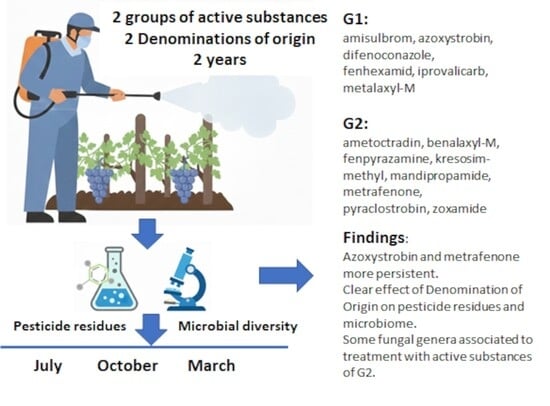
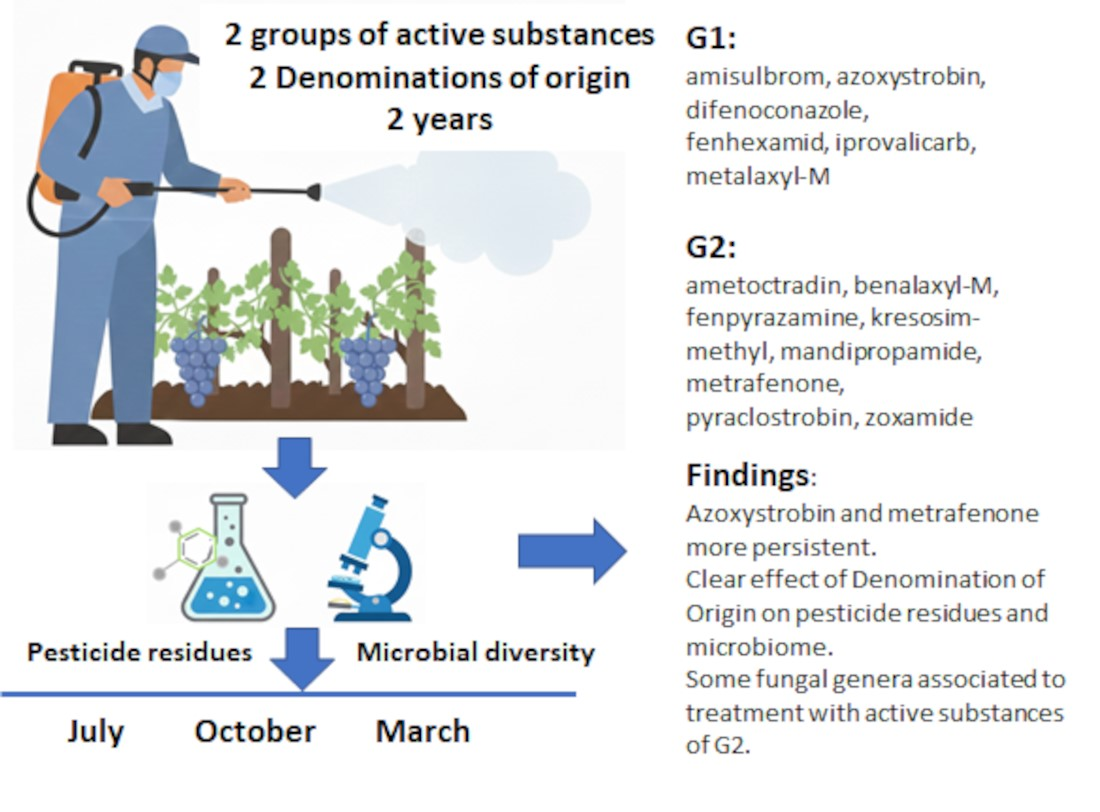
Pesticide use in agriculture can have negative collateral effects on the environment. In this study, two groups of treatments (G1 and G2) based on active substances (ASs) with different mobility were evaluated in order to determine pesticide residues in the soil and their impact on soil microbial populations in two vineyards located in two Denominations of Origin (D.O.). Soil samples were collected in July, October, and the following March over two consecutive years. Pesticide residues were analyzed by liquid chromatography–tandem mass spectrometry (LC-MS/MS) after QuEChERS extraction. Microbial genera were identified by the amplification of the fungal ITS regions with the universal primers ITS86F and ITS4R, and the bacterial 16S rRNA gene (V4 region) with primers 515F and 806R. Although G1 consistently showed higher residues, primarily attributable to azoxystrobin, no significant differences were observed between the two pesticide groups in the total pesticide residues or diversity of microbial communities. The factors D.O., campaign, and sampling month influenced the concentration of residues. Several ASs exhibited different dissipation dynamics depending on the D.O. Azoxystrobin and metrafenone were the most persistent in soil. The LEfSe analysis associated four beneficial fungal genera with the G2 group. The judicious selection of ASs can help to minimize the pesticide residues in soil and their harmful effects on beneficial genera.

Graphical Abstract

1. Introduction

The utilization of plant protection products (PPPs) is imperative to control pests and diseases, thereby facilitating the attainment of substantial yields and enhanced crop quality. It has been estimated that more than 45% of global food production is lost due to pest and disease pressure [1]. According to the Food and Agriculture Organization (FAO), the global utilization of pesticides in agricultural contexts attained 3.73 million tons in 2023 (https://www.fao.org/). In the European Union, approximately 292,000 tons were sold, of which 39% corresponded to fungicides and bactericides. France and Spain were the primary purchasers in terms of volume, accounting for 23% and 18%, respectively (https://ec.europa.eu/).
It is estimated that less than 5–15% of applied PPPs reach the target organisms, while the remainder is deposited in the environment, contributing to pollution [2]. Indeed, approximately 80% of European agricultural soils contain pesticide residues [3,4], contributing with the largest spatial footprint to land degradation—approximately 52% of the cumulative agricultural area [5]. Spain, in particular, has one of the largest land areas in Europe (0.19 million km2) at high risk of pesticide pollution [6].
The fate of pesticides in the environment is significantly influenced by their intrinsic properties, soil characteristics, and climatic factors [7,8]. These factors determine their persistence in soil or their mobility to other environmental compartments. Major off-target processes include adsorption–desorption, dissipation and degradation, leaching or infiltration, runoff, and volatilization. Pesticide half-life is contingent upon moisture, temperature, and soil type [9]. High levels of organic matter, moisture, and cation exchange capacity in soil, as well as neutral-to-alkaline soil pH, promote pesticide degradation. Conversely, acidic, nutrient-poor soils exhibit diminished degradation capacity [10]. Evidence of their persistence is observed, as some long-banned pesticides are still found in soils [4].
Soil microbial communities play a fundamental role in soil health and fertility. Specifically, they influence plant health and growth, soil texture and structure, nutrient cycling, and biodiversity [11]. These communities are modulated by multiple factors, including the climate, soil management practices, and soil chemical and physical properties [12,13,14], among others.
Pesticides exert a substantial influence on the diversity and functionality of the soil microbiome, leading to a decline in diversity and impacting pivotal organisms, such as nitrogen-fixing bacteria, ultimately lowering soil fertility [6,15,16]. Exposure to multiple pesticides can produce synergistic effects on microbial soil communities, resulting in a decrease in litter decomposition rates and soil aggregation [17]. Furthermore, soil fauna communities are also negatively affected [18]. Runoff and leaching have the potential to contaminate surface and groundwater, thereby impacting aquatic ecosystems and drinking water, and thus posing risks to animal and human health [19]. Human exposure may also occur through direct contact or the consumption of contaminated agriculture products, including wine. Indeed, associations between pesticide exposure and cancer, as well as other chronic human diseases, have been reported [20]. The aforementioned effects underscore the necessity of meticulously selecting ASs that guarantee crop protection while concurrently minimizing ecological disruption.
The grapevine is a crop with particularly high PPP demands, using a greater diversity of ASs than most other perennial crops [21,22]. Tang et al. [6] evaluated the residues in soil in nine cropping systems worldwide, reporting that orchards and vineyards exhibited the highest levels of soil pesticide residues and the greatest number of detected compounds.
Synthetic pesticide applications in viticulture have demonstrated negative effects on soil fertility and microbiota, as well as on water quality and wines [23]. In recent years, the prohibition of numerous ASs due to their adverse environmental impacts, together with an increasing interest in sustainable practices from grape growers and wine consumers, has fostered a shift toward low-risk and biocontrol products. However, in regions experiencing high pest and disease pressure, these alternatives may prove insufficient for achieving adequate control, making chemical pesticides necessary. Consequently, it is essential to select ASs that effectively protect the crop while minimizing environmental contamination.
Galicia, an autonomous community located in northwestern Spain, comprises five wine Denominations of Origin. The coastal zones are predominantly influenced by an Atlantic climate, which gradually transitions to intermediate or Mediterranean conditions in inland areas. These climatic gradients shape wine profiles and cultivars selection; additionally, they modulate the selection of ASs and their application rates.
The Rías Baixas Denomination of Origin (D.O.) is characterized by a strongly oceanic climate with mild temperatures and abundant rainfall [24]. These conditions result in a high pressure for fungal diseases, particularly downy mildew, endemic in this region, typically requiring, on average, 16 phytosanitary treatments per year. In contrast, the Ribeiro D.O. presents an oceanic–Mediterranean transitional ecoclimate, with lower rainfall and higher temperatures, being classified as temperate-warm and sub-humid, with notably cold nights [24,25].
In this study, two phytosanitary treatment programs—each involving different ASs currently used in grapevine cultivation in Galicia, with different mobilities in soil—were selected to evaluate their residues in soil, their dissipation over time, and their impact on soil microbiota in two experimental plots located in the above-described regions. The objective was to obtain verified data concerning the behavior and effects of these ASs in these regions, with the ultimate goal of providing winegrowers with recommendations about their use to minimize soil pollution.

2. Materials and Methods

2.1. Location and Experimental Design

The study was conducted between 2023 and 2025 in two vineyards located in the Rías Baixas (Val do Salnés sub-area, Pontevedra, Spain, 42°31′23.4″ N 8°44′32.7″ W, 71 m a.s.l.) and Ribeiro (Ourense, Spain, 42°21′36.8″ N 8°07′06.4″ W, 116 m a.s.l.) Denominations of Origin (D.O.s). The Rías Baixas vineyard was established in 2001 with the Albariño variety grafted onto 196-17 Castel rootstock, trained on a modified vertical trellis system (VSP), and pruned to a single Royat Cordon. Vine spacing was 1.25 m × 3.35 m, with spontaneous vegetation maintained as a cover crop. The experimental design consisted of a randomized block layout with three replications of 40 plants per treatment.
The Ribeiro vineyard was established in 2006 with the Brancellao variety grafted onto 196-17 Castel rootstock, trained on a vertical trellis system (VSP), and pruned to a single Royat Cordon. Plant spacing was 2.5 m × 1 m. Tillage was performed prior to budburst and twice during the growing season. This vineyard also followed a randomized block design with three replications of 28 plants per treatment. Climatic data were obtained from meteorological stations near the vineyards through the MeteoGalicia network (https://www.meteogalicia.gal/).
Two groups of phytosanitary products (G1 and G2) were applied according to risk-based criteria in both vineyards to control fungal diseases. The active substances (ASs) were selected based on those most commonly used in both regions. The ASs of G1 are catalogued as slightly-to-moderately mobile, while those of G2 are catalogued mostly as non-mobile. The products applied, and their application dates, are summarized in Table S1, while Table 1 provides the properties of each AS.

2.2. Soil Samplings

At the beginning of the study, soil samplings were analyzed for physicochemical parameters, including texture, pH, organic matter, assimilable elements, and cation exchange capacity, as well as soil microbiota composition.
Three additional soil sampling events were conducted each year to determine pesticide residues and microbial community dynamics: during the period of maximum phytosanitary treatment application (summer: July 2023 and 2024), after harvest (autumn: October 2023 and 2024), and prior to the beginning of the subsequent treatment campaign (spring: March 2024 and 2025).
Phytosanitary treatments were applied at the same phenological stages in both regions. Due to climatic differences between the two D.O.s, phytosanitary treatments in the Ribeiro vineyard were carried out several days later than in the Rías Baixas one. Consequently, samplings in Ribeiro D.O. were also delayed to ensure the same interval between the last application of PPPs and soil sampling.
Each sample consisted of five subsamples taken from the same predetermined points within each repetition using an Edelman simple fixed-handle auger. The first and last subsampling points were located 4 m from the beginning and end of each plot, and the remaining three points were located equidistantly between them. Soil from the five points was composited into a single sample of approximately 1 kg. Sampling was performed 20 cm from the vine row—where pesticide runoff from the canopy typically accumulates—at two depths: 0–10 cm and 10–20 cm.

2.3. Pesticide Analysis

Soil samples were air-dried, sieved to 2 mm, and homogenized prior to physicochemical characterization and pesticide analysis. QuEChERS extraction, without additional clean-up steps, was employed as a sample preparation technique. Extraction conditions were adapted from a previous study, using 2.5 g of sieved soil, 2.5 mL of ultrapure water, and 5 mL of acetonitrile, with 2.5% in formic acid, in the process. Magnesium sulphate (6 g) and sodium acetate (1.5 g) were combined as salting-out sorbents during the QuEChERS extraction [27]. A fraction of the organic extract was filtered (a 0.22 µm hydrophobic syringe filter was used) and stored at −20 °C until analysis.
Compounds were determined by liquid chromatography–tandem mass spectrometry (LC-MS/MS) using a Waters Acquity LC system, connected to an XEVO TQD mass spectrometer (Waters, Milford, MA, USA). LC separations were carried out using a C18-type reversed-phase column (Zorbax Eclipse Plus, 50 mm × 2.1 mm, 1.8 µm) provided by Agilent (Wilmington, DE, USA). Acetonitrile and ultrapure water, both 0.1% in formic acid, were employed as mobile phase [28]. Target compounds were determined in the multiple reaction monitoring (MRM) mode, considering two transitions per compound. The LC-MS/MS method covered the determination of organic fungicides employed in field experiments, except Folpet and Dithianon. Limits of quantification for the rest of the compounds varied between 1 ng/g and 2.5 ng/g.

2.4. Microbial Population Analysis

Soil samples were stored at −70 °C until analysis. DNA was extracted from 250 mg of thawed soil samples using the DNeasy® PowerSoil® Pro Kit (Qiagen GmbH, Hilden, Germany) following the manufacturer’s protocol. DNA concentration in each sample was quantified using a NanoDrop One spectrophotometer (Thermo Fisher Scientific, Verona, MA, USA). The final DNA extract was adjusted to 10–15 ng/μL.
The first PCR was carried out in a final volume of 12.5 μL, containing 1.25 μL of template DNA, 0.5 μM of each primer, 3.13 μL of Supreme NZYTaq 2× Green Master Mix (NZYTech, Lisboa, Portugal), and ultrapure water to the final volume.
For DNA Library preparation and sequencing, separate libraries were generated for each target taxonomic group using specific primer sets and reaction conditions.
Bacterial library preparation: A ~300 bp fragment of the 16S rRNA gene (V4 region) was amplified using the following primers that included Illumina sequencing primer sequences at their 5′ ends:
Forward-515F-Y (5′ GTG YCA GCM GCC GCG GTA A 3′) [29].
Reverse-806R (5′ GGA CTA CNV GGG TWT CTA AT 3′) [30].
Thermal cycling conditions for the bacterial library preparation were as follows: initial denaturation at 95 °C for 5 min; 25 cycles of 95 °C for 30 s, 47 °C for 45 s, and 72 °C for 45 s; followed by a final extension at 72 °C for 7 min.
Fungal library preparation: A ~300 bp fragment of the ITS2 region was amplified using the following primers, with Illumina sequencing primer sequences at their 5′ ends:
Forward-ITS86F (5′ GTG AAT CAT CGA ATC TTT GAA 3′) [31].
Reverse-ITS4R (5′ TCC TCC GCT TAT TGA TAT GC 3′) [32].
Thermal cycling conditions in this case were as follows: 95 °C for 5 min; 30 cycles of 95 °C for 30 s, 49 °C for 45 s, and 72 °C for 45 s; with a final extension at 72 °C for 7 min.
A subsequent PCR step was performed, adding tailed primers with indexed adapters for multiplexing different libraries in the same sequencing pool. This reaction was carried out under identical conditions to the first PCR but limited to 5 cycles with an annealing temperature of 60 °C. A negative control without DNA (BPCR) was included in each PCR reaction to monitor for potential contamination.
The size of the libraries was assessed on 2% agarose gels stained with GreenSafe (NZYTech, Lisboa, Portugal) and visualized under UV light. Libraries were purified using Mag-Bind RXNPure Plus magnetic beads (Omega Biotek, Norcross, GA, USA), according to the manufacturer’s protocol.
Final libraries were pooled in equimolar concentrations based on quantification with a Qubit dsDNA HS Assay (Thermo Fisher Scientific, Waltham, MA, USA) and sequenced on a portion of a NovaSeq PE250 flow cell (Illumina, San Diego, CA, USA), targeting a total output of 16 gigabases.

2.5. Data Analysis

Pesticide concentrations below their limits of quantification (LOQs) were assigned a value of zero for statistical analysis, since the products had been applied but their concentrations were below detectable levels.
Pesticide concentration data were analyzed using the XLSTAT-Pro 201610 statistical package (Addinsoft 2009, Paris, France). Data normality and homogeneity of variances were evaluated using the Shapiro–Wilk and Levene tests, respectively. Group comparisons were conducted using Student’s t-test or the Mann–Whitney U test when parametric assumptions were not met. Additionally, a multifactorial ANOVA was applied, considering D.O., campaign, sampling depth, and sampling month as fixed factors, including their interactions, and post hoc comparisons were performed using Tukey’s HSD (α = 0.05).
Concerning bioinformatic analysis, FastQC-0.10.1 was used to visualize the ITS2 sequence quality [33]. Data were processed in SEED v2.0.3 [34], and raw paired-end reads were joined by the usage of fastq-join [35]. Extraction using ITSx v1.1.2 was used to cover the full-length ITS2 region [36]. Analysis of fungal diversity was performed by the clustering of all ITS2 sequences into operational taxonomic units (OTUs) [37] at a similarity of 97%, by USEARCH v11.0.667. Removal of chimeric sequences was carried out by the UPARSE method [38]. The most abundant sequences were selected to represent each OTU for identification by BLASTn search implemented in BLAST + 2.5.0 against UNITE version 8.1, released 2.2.2019 [39]. Sequences with non-fungal hits, without hits, or with e-values BLASTn search result > 10−50 were excluded for increasing chances for obtaining only taxa belonging to the fungal kingdom [40,41].
A total of 84 soil samples were analyzed using the Microbiomeanalyst.ca platform. Microbial abundance and diversity metrics were assessed. Alpha diversity indices (Chao1 and Shannon) were analyzed across strata, defined by D.O., sampling depth, campaign, and sampling month. Differences between treatment groups were evaluated using the non-parametric Mann–Whitney U test, with p-value adjustment for multiple comparisons.
Beta-diversity was evaluated through Principal coordinate analysis (PCoA) based on the Bray–Curtis dissimilarity index, using PERMANOVA with Benjamini–Hochberg false discovery rate (FDR) correction. Linear Discriminant Analysis Effect Size (LEfSe) was used to identify genera that differed significantly in relative abundance across the evaluated factors (sampling month, campaign, D.O., and treatment group).

3. Results

3.1. Edaphoclimatic Characterization of the Vineyards

Soil from the Rías Baixas vineyard exhibited higher organic matter content and pH, as well as greater concentrations of phosphorus and calcium than that from the Ribeiro vineyard. Soil texture was similar between both sites, although sand content was higher and clay content was lower in the Rías Baixas D.O. (Table 2).
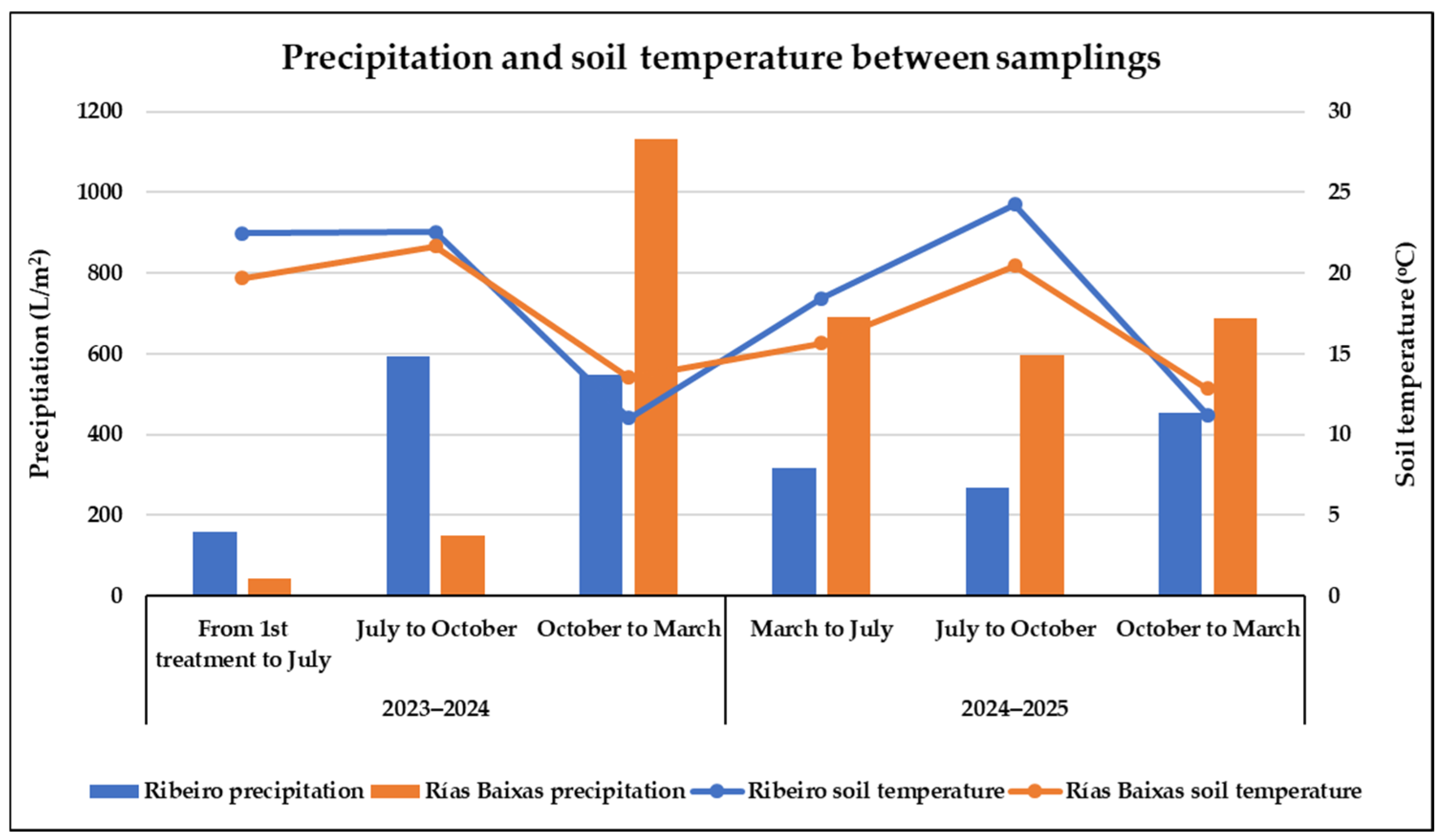
Regarding climatic conditions across sampling periods, Rías Baixas, with an Atlantic climate, generally showed higher precipitation levels, as expected, except during the period between the onset of the treatment applications and the second sampling (October). This second sampling in Rías Baixas was carried out before the heavy rainfall that affected both regions in late October 2023. In Ribeiro, however, samples were collected in November, as continuous rain prevented access to the vineyard. Across the two years of study, average soil temperature at −0.1 m depth was higher in Ribeiro than in Rías Baixas, except during winter, when this pattern was reversed (Figure 1).

3.2. Pesticide Residues in Soil Samples

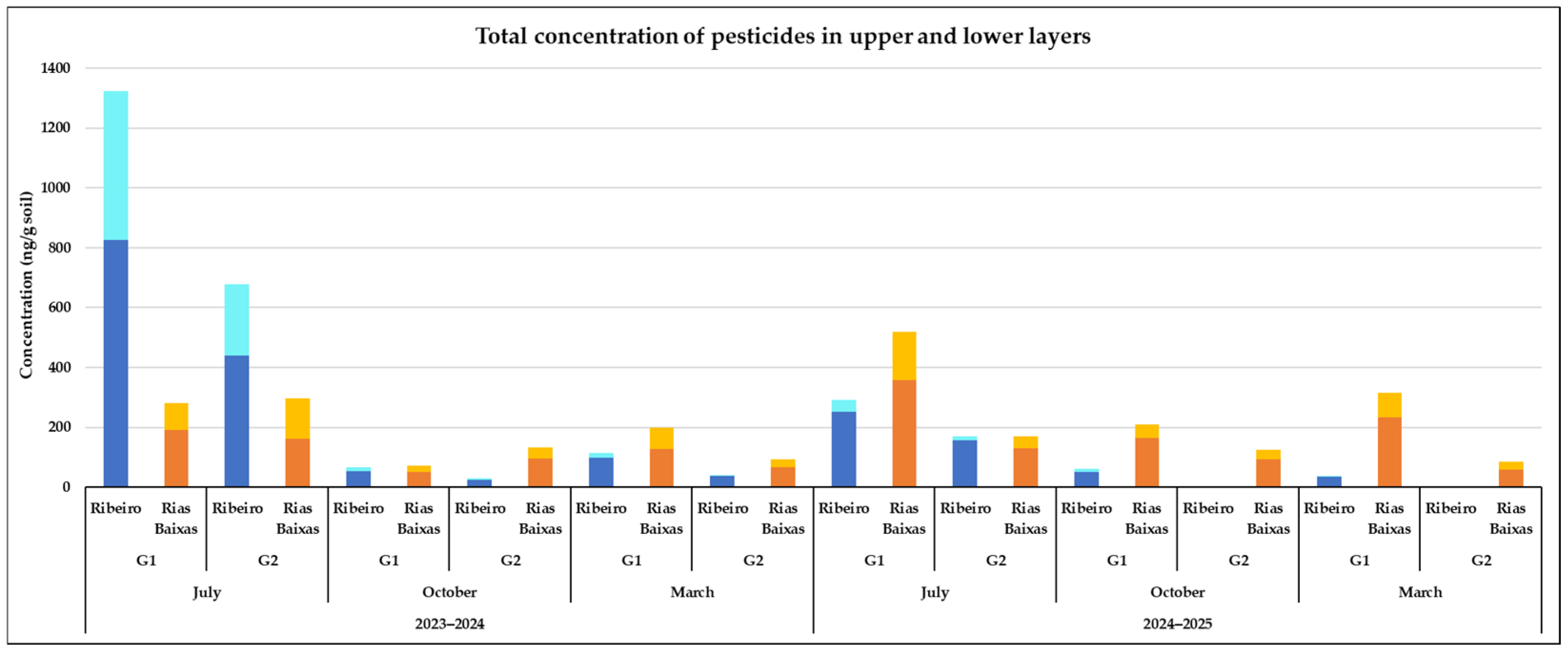
The comparison of the two groups of ASs revealed that total G1 residue concentrations were consistently higher than those of G2 in all sampling events in the Ribeiro D.O. A similar pattern was observed in Rías Baixas, except during the second sampling (October 2023), when residues showed the opposite trend (Table 3, Figure 2). However, significant differences in the total residue concentrations between the two treatment groups were only detected in Ribeiro in March 2024 in the upper layer, as well as in the July 2024 sampling in the lower layer in both Rías Baixas and Ribeiro. When considering total residues at each sampled depth, the proportion of residues in the upper layer was higher in Ribeiro than in Rías Baixas, except for the first sampling (summer of year 1) in the G1 group (Figure S1).
Residues of all ASs in the G1 group, except difenoconazole, exhibited significant differences between D.O.s. Difenoconazole and the metalaxyl-M soil metabolite CGA62826 were also significantly affected by the sampling month and depth. Metalaxyl-M and CGA62826 were further influenced by the sampling campaign. Several significant interactions were detected, particularly between D.O. and the other evaluated factors. Indeed, significant interactions between D.O. and sampling month were found for all the ASs residues (Table S2).
Regarding G2 residues, fewer significant differences were detected. Benalaxyl-M, fenpyrazamine, and pyraclostrobin were significantly influenced by sampling depth; ametoctradin and total G2 by month of sampling; ametoctradin, benalaxyl-M, and total G2 by campaign; and ametoctradin, pyraclostrobin, and total G2 residues by D.O. In this group, only significant interactions between the D.O. and sampling month were detected for ametoctradin (Table S2), although in the post hoc test, it was detected that all the ASs in Ribeiro presented several significant differences between sampling months. While in Rías Baixas, metrafenone, pyraclostrobin, and total G2 showed no significant temporal variation (Table S3).
Considering the sum of residues of both soil layers (0–20 cm), the pesticide dissipation over time was faster in the Ribeiro vineyard (Figure 2). Indeed, significant differences were observed between D.O.s for azoxystrobin, fenhexamid, metalaxyl-M, and total G1 residues. For the G2 group, significant differences related to D.O. were detected for total G2 residues, benalaxyl-M, fenpyrazamine, mandipropamide, and metrafenone. Dissipation over time was also influenced by the campaign for fenhexamid, iprovalicarb, and metalaxyl-M in G1, and for benalaxyl-M in G2. Several significant interactions were also found (Table S4).
Within the G1 group, azoxystrobin was consistently detected in all sampling events in both D.O.s and exhibited the highest concentrations among all ASs in both years. Iprovalicarb reached levels comparable to azoxystrobin during the summer 2023 sampling in Ribeiro, and the sum of these two ASs accounted for approximately 90% of total residues at that time. The remaining ASs were residual. Amisulbrom was detected exclusively in the summer 2023 sampling in Ribeiro. Metalaxyl-M was present in nearly all sampling events, although always at low concentrations, while its acid metabolite CGA62826 was only detected in the first two samplings in both D.O.s. The data further showed that, although summer 2023 concentrations of azoxystrobin, fenhexamid, and iprovalicarb were noticeably higher in Ribeiro than in Rías Baixas, subsequent samplings revealed similar concentrations in both D.O.s, or even lower levels in Ribeiro, particularly for azoxystrobin, that persisted through time in Rías Baixas. Metalaxyl displayed a relatively balanced distribution between the upper and lower soil depths, whereas the other ASs accumulated primarily in the upper layer (Table 3).
Regarding the G2 ASs, ametoctradin appeared at a high concentration in the summer 2023 sampling in Ribeiro, but it was present only at residual levels thereafter. Metrafenone residues persisted over time, mainly in Rías Baixas. Kresosim-methyl was only detected in one sampling in Ribeiro. Benalaxyl-M, pyraclostrobin, and zoxamide remained at residual levels throughout all sampling events (Table 3). To sum up, azoxystrobin and metrafenone were identified as the most persistent ASs within the G1 and G2 groups, respectively, in both experimental plots.

3.3. Microbial Communities in Soil

3.3.1. Fungal Communities

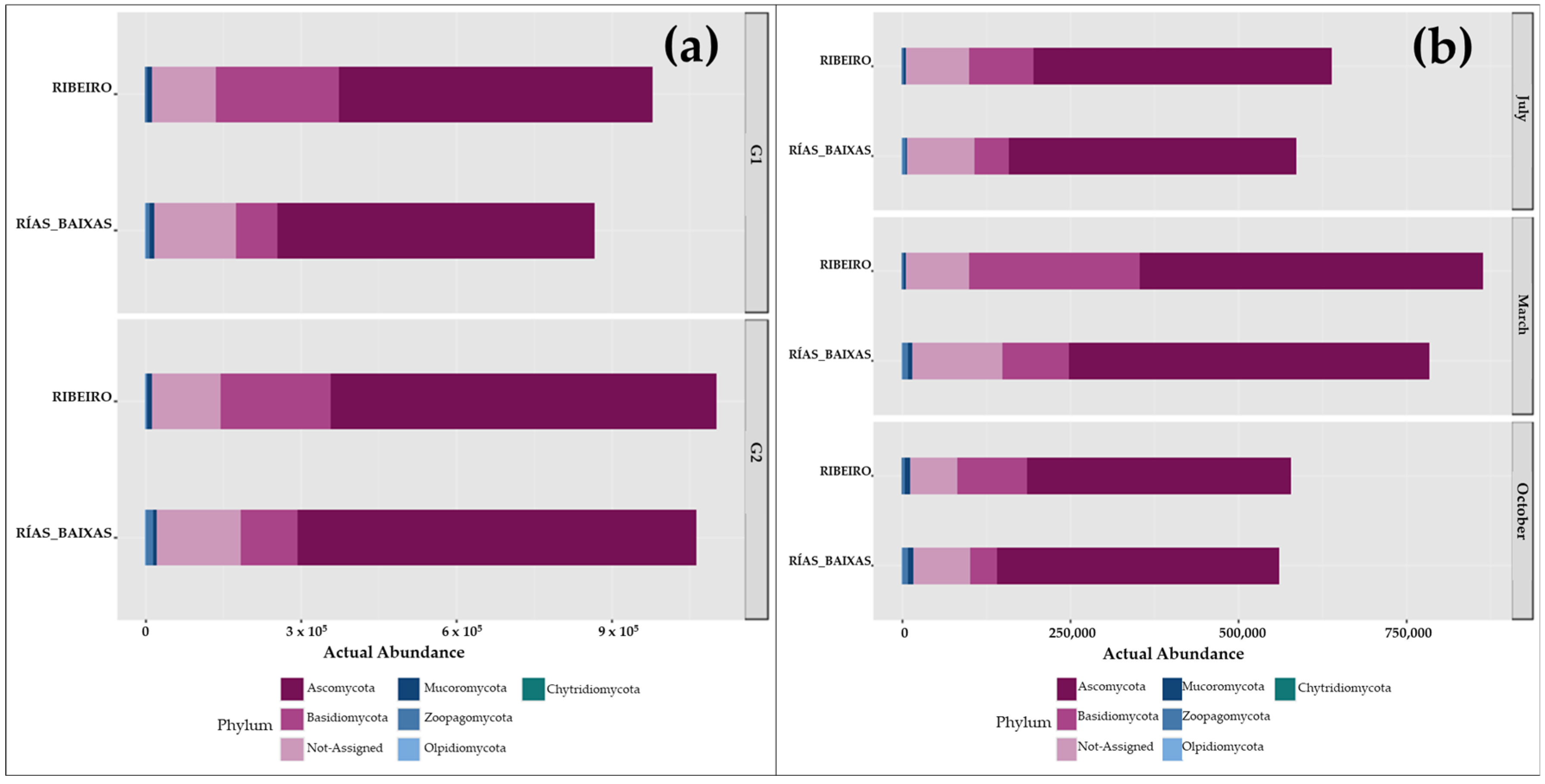
A total of 174 fungal genera were identified. In both D.O.s, Ascomycota was the dominant phylum, followed by Basidiomycota in Ribeiro. In Rías Baixas, a higher actual abundance of Zoopagomycota and Not-Assigned phyla was observed compared with Ribeiro. The G2 treatment group showed slightly higher overall fungal abundance than G1 in both D.O.s (Figure 3a). In general, fungal actual abundance was higher in Ribeiro and reached its maximum in March (Figure 3b).
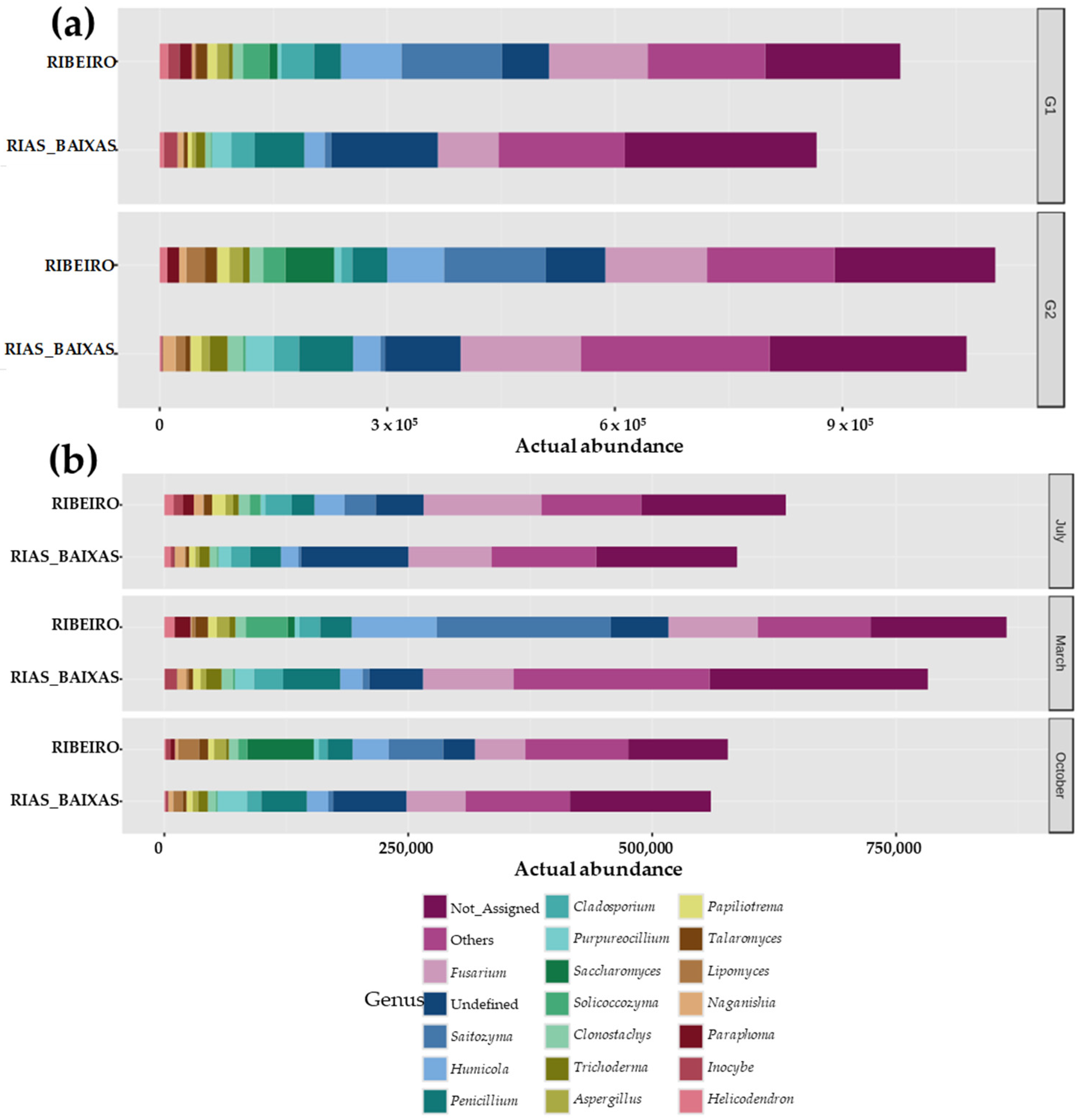
Among the identified genera, Fusarium, Saytozima, Humicola, and Penicillium were the most abundant in both D.O.s (Figure 4). Inocybe spp. exhibited low levels in G2, but showed abundance values up to 1000-fold higher in G1 in both D.O.s. In contrast, Clonostachys, Naganishia, Purpureocillium, and Trichoderma genera were more abundant in G2 than in G1. Saccharomyces spp. displayed high abundance in Ribeiro, but only residual abundance in Rías Baixas (Figure 4a). When abundance patterns were examined across sampling months, Inocybe exhibited contrasting trends between D.O.s; this genus sharply increased in March in Rías Baixas, but nearly disappeared in Ribeiro. Lypomyces increased markedly in October but had declined again in March. In Ribeiro, Humicola, Paraphoma, Saitozyma, and Solicoccozyma showed pronounced increases in March, while Saccharomyces peaked in October (Figure 4b).
Alpha-diversity indices (Chao1 and Shannon) did not show significant differences (p < 0.05) between G1 and G2 for the fungal community; therefore, both treatment groups were pooled for subsequent analysis.
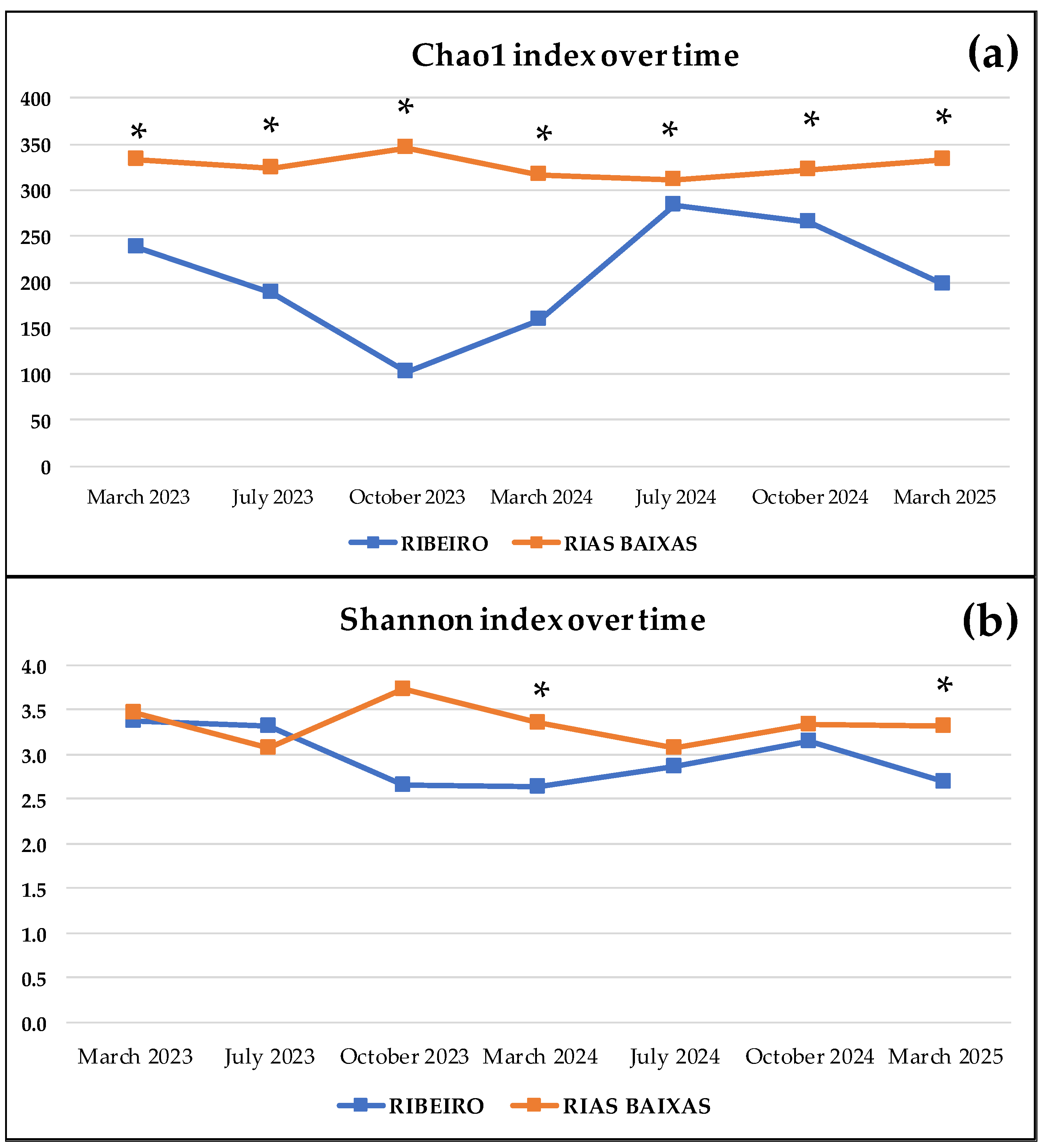
The Chao1 index remained stable over time in Rías Baixas, whereas in Ribeiro, with lower values in all the samplings, experienced great fluctuations. Significant differences between the two D.O.s were detected across all sampling dates (Figure 5a). Concerning the Shannon index, it was also lower in Ribeiro, except in the second sampling, but the significant differences were lower (Figure 5b, Table S5).
When comparing the same sampling month across different campaigns, significant differences in Chao1 were found for the July and October samplings in Ribeiro. The Shannon index differed significantly for the March (2023 vs. 2024, and 2023 vs. 2025) and July samplings in Ribeiro, and the October samplings in Rías Baixas (Table S5).
Temporal comparisons between the three samplings within the same campaign revealed significant differences in the Chao1 index between July and October of the 2023–2024 campaign, and between July and March, as well as between October and March in 2024–2025 for Ribeiro. In Rías Baixas, significant differences were observed between July–October and October–March in 2023–2024. For the Shannon index, significant differences were detected between July and March in the 2023–2024 campaign, and between October and March 2024–2025 in Ribeiro. In Rías Baixas, significant differences were found between October and March 2023–2024 and between July and October 2024–2025 (Table S5).
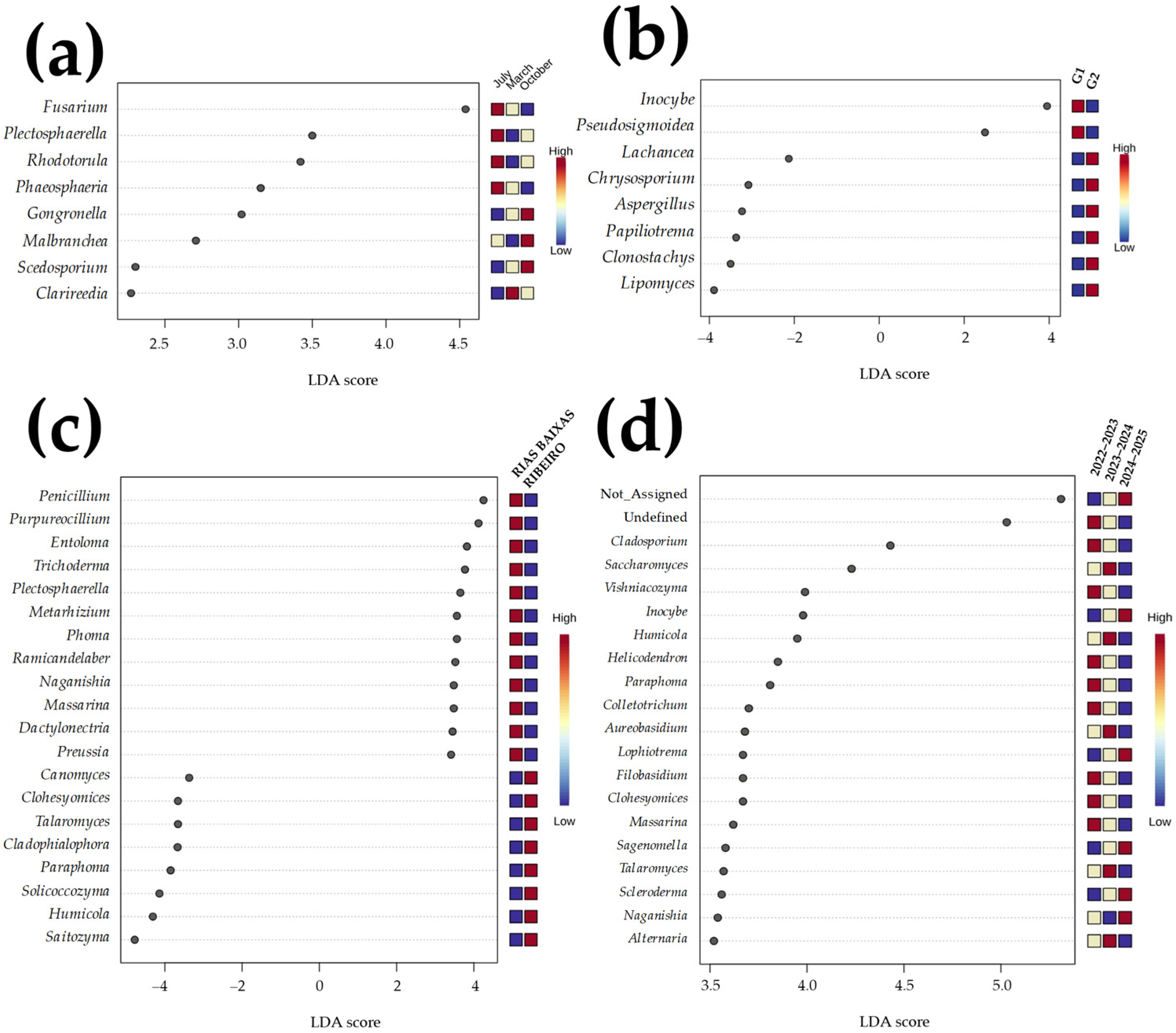
Linear discriminant analysis effect size (LEfSe) revealed significant differences in several fungal genera. When analyzing differences across months, eight genera showed significant differences, with Fusarium being predominant, along with several other genera, in July. Grongonella, Malbranchea, and Scedosporium increased in October, whereas Clarireedia was more abundant in March (Figure 6a). Eight genera also differed significantly between treatment groups, with Inocybe and Pseudosigmoidea significantly more abundant in G1 compared to G2, while the remaining genera showed higher abundance in G2 (Figure 6b). When the LEfSe was conducted by D.O. and campaign, the analysis identified a larger set of more than 20 differential genera (Figure 6c,d). The top 20 genera distinguishing Rías Baixas and Ribeiro are shown in Figure 6c, with Penicillium and Purpureocillium standing out in Rías Baixas, and Saytozima and Humicola in Ribeiro. Differences among campaigns were also evident, with Cladosporium exhibiting the greatest LDA score in the 2022–2023 campaign (Figure 6d).
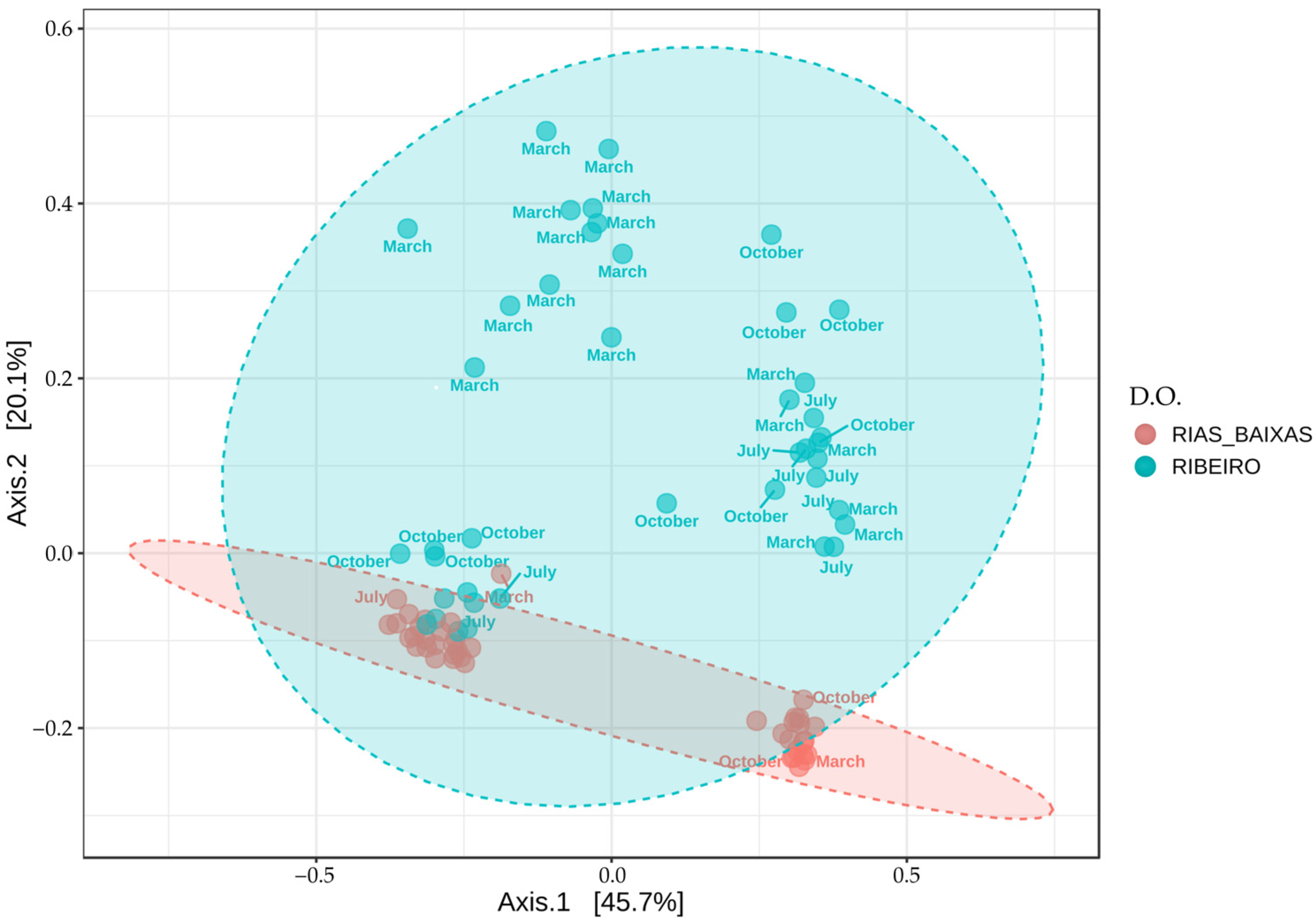
Beta diversity analysis using a PCoA plot, based on the Bray–Curtis index and PERMANOVA, demonstrated a clear separation between Rías Baixas and Ribeiro, as well as the grouping by month (Figure 7). Indeed, D.O. explained 65.8% of the total variability.
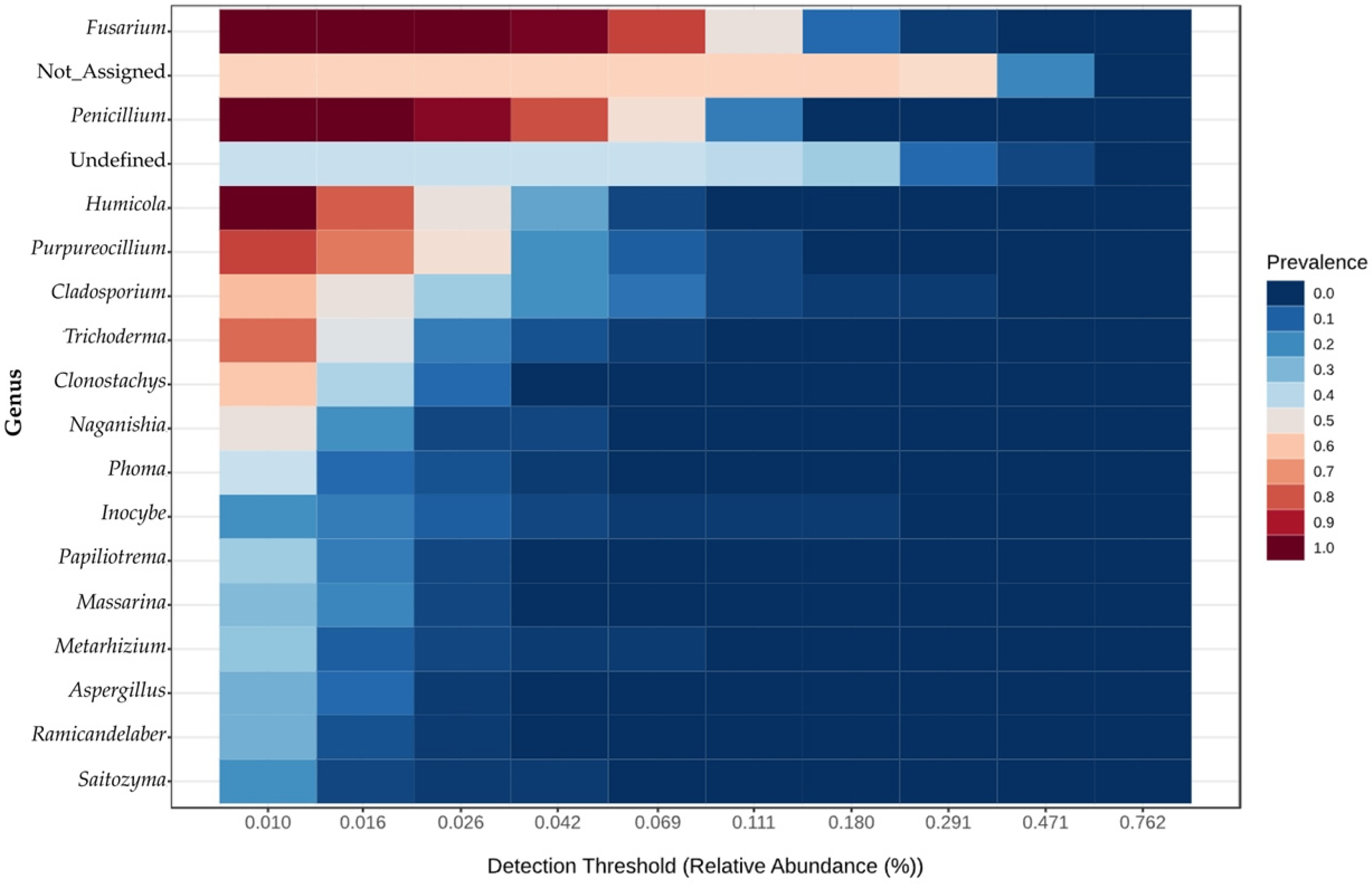
The analysis of the fungal core microbiome detected a dominance of Fusarium, Penicillium, Humicola, and Purpureocillium genera (Figure 8).

3.3.2. Bacterial Communities

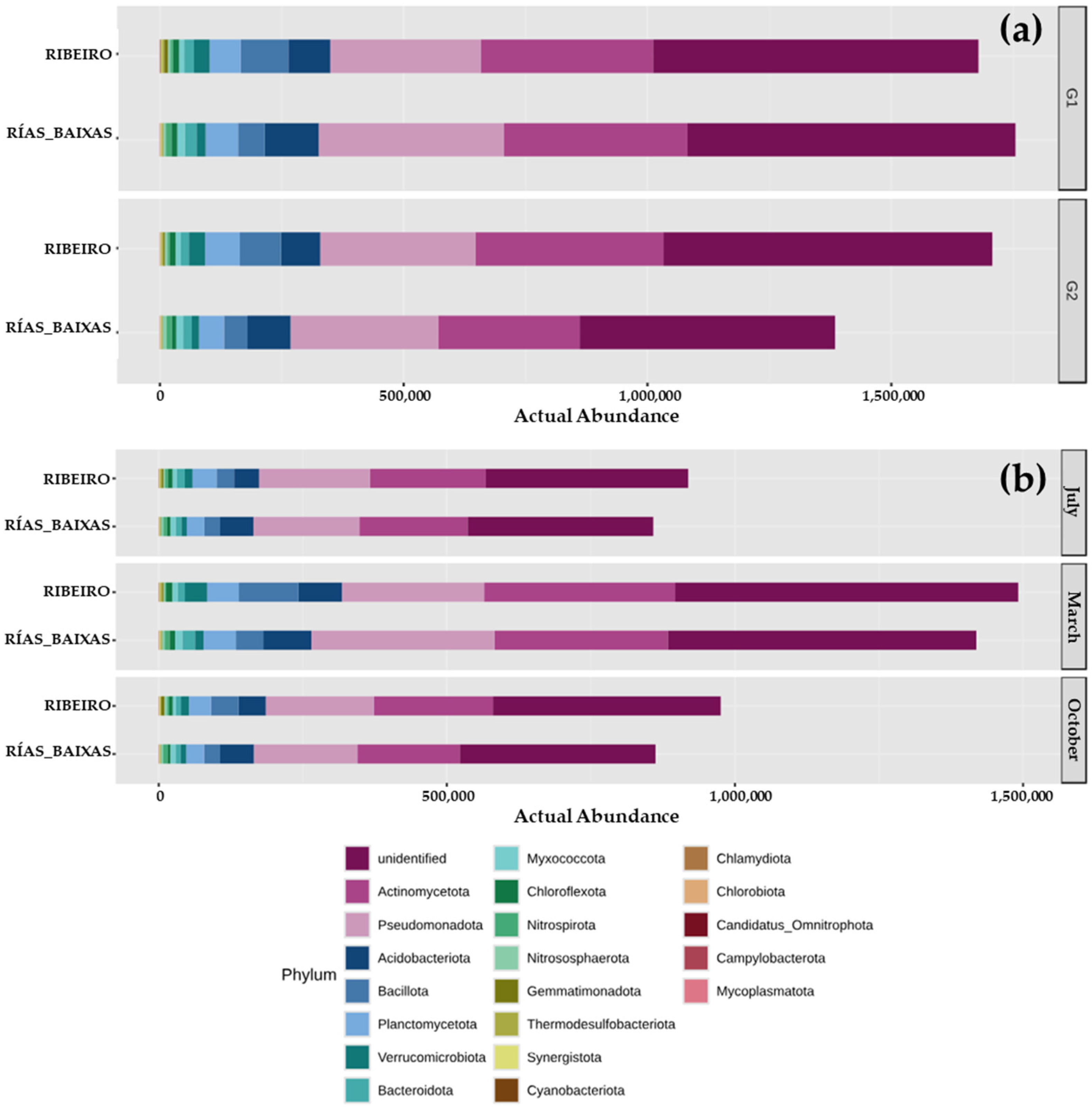
A total of 227 bacterial genera were identified. The most abundant phyla were Actinomycetota and Pseudomonadota. The Verrucomicrobiota phylum greatly increased in Ribeiro in March. This phylum, together with Bacillota (syn. Firmicutes), was more abundant in Ribeiro. Actual abundance was not influenced by treatment group (Figure 9).
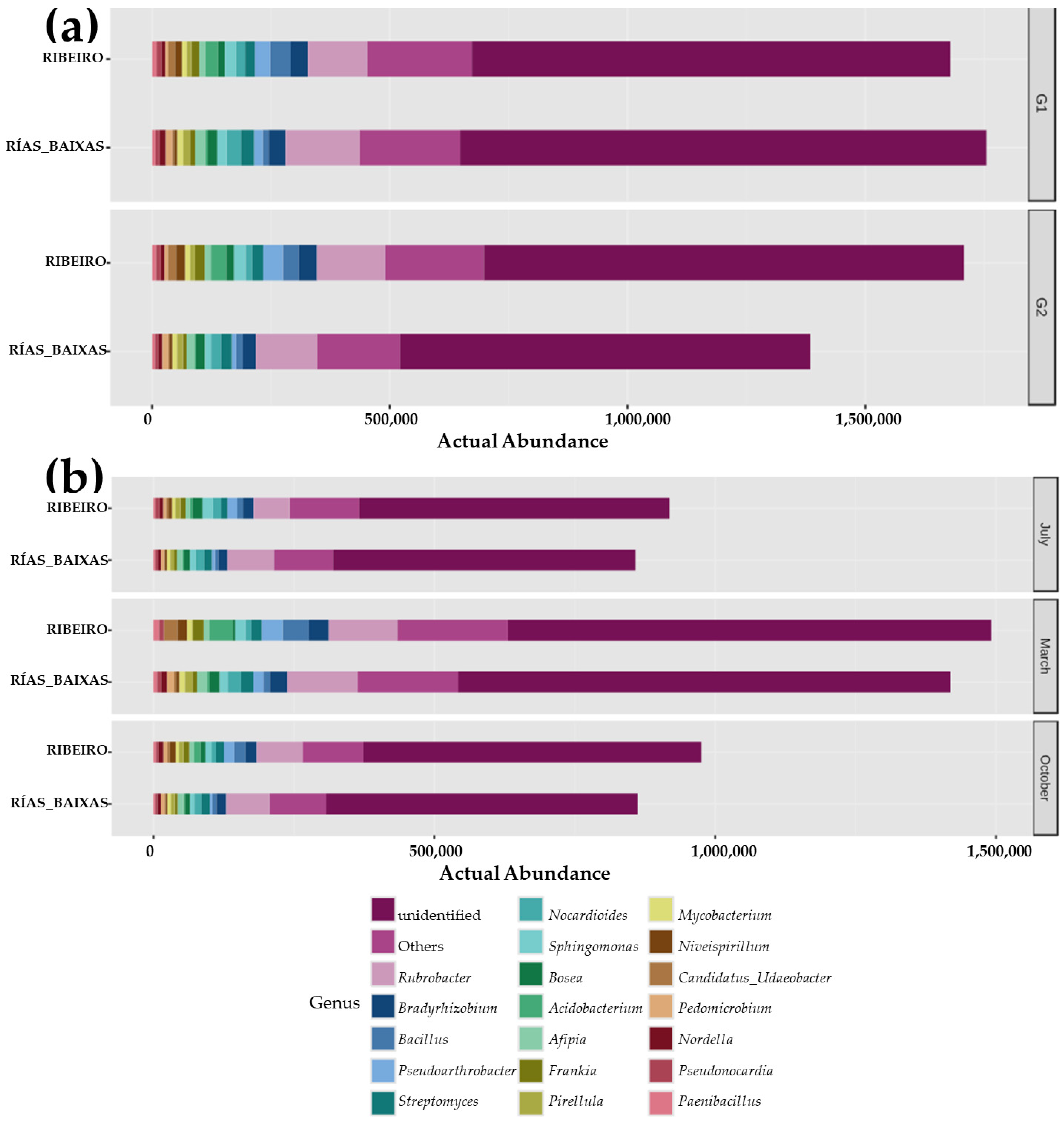
Among the identified genera, Rubrobacter was the most abundant in both D.O.s, followed far behind by Bradyrhizobium, Bacillus, Pseudarthrobacter, and others. Bacillus had a greater abundance in Ribeiro. A high abundance of unidentified genera was detected. Actual abundance greatly increased in March; Bacillus, Pseudarthrobacter, and Acidobacterium stood out that month (Figure 10).
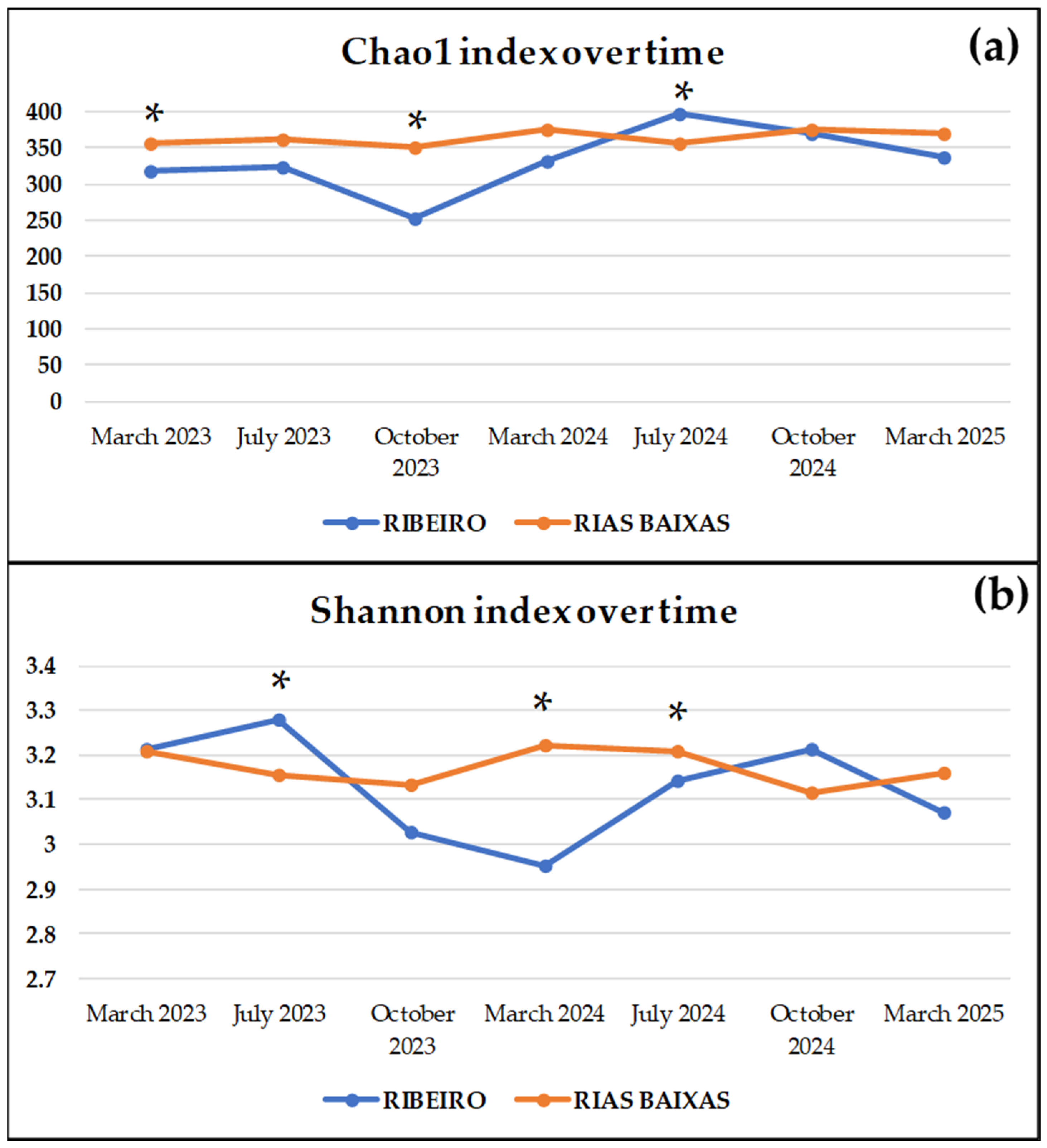
The Chao1 index for Rías Baixas remained stable across time. The experiment began with similar Shannon index values in both D.O., but from here on, the index experienced great fluctuations in Ribeiro (Figure 11). Significant differences in both diversity indices between D.O.s, between campaigns, and between the different sampling months were found. Chao1 was higher in almost all of the samplings for Rías Baixas, with significant differences in March and October 2023 compared to Ribeiro. Ribeiro surpassed Rías Baixas in July 2024, also being significant in this sampling (Table S6).
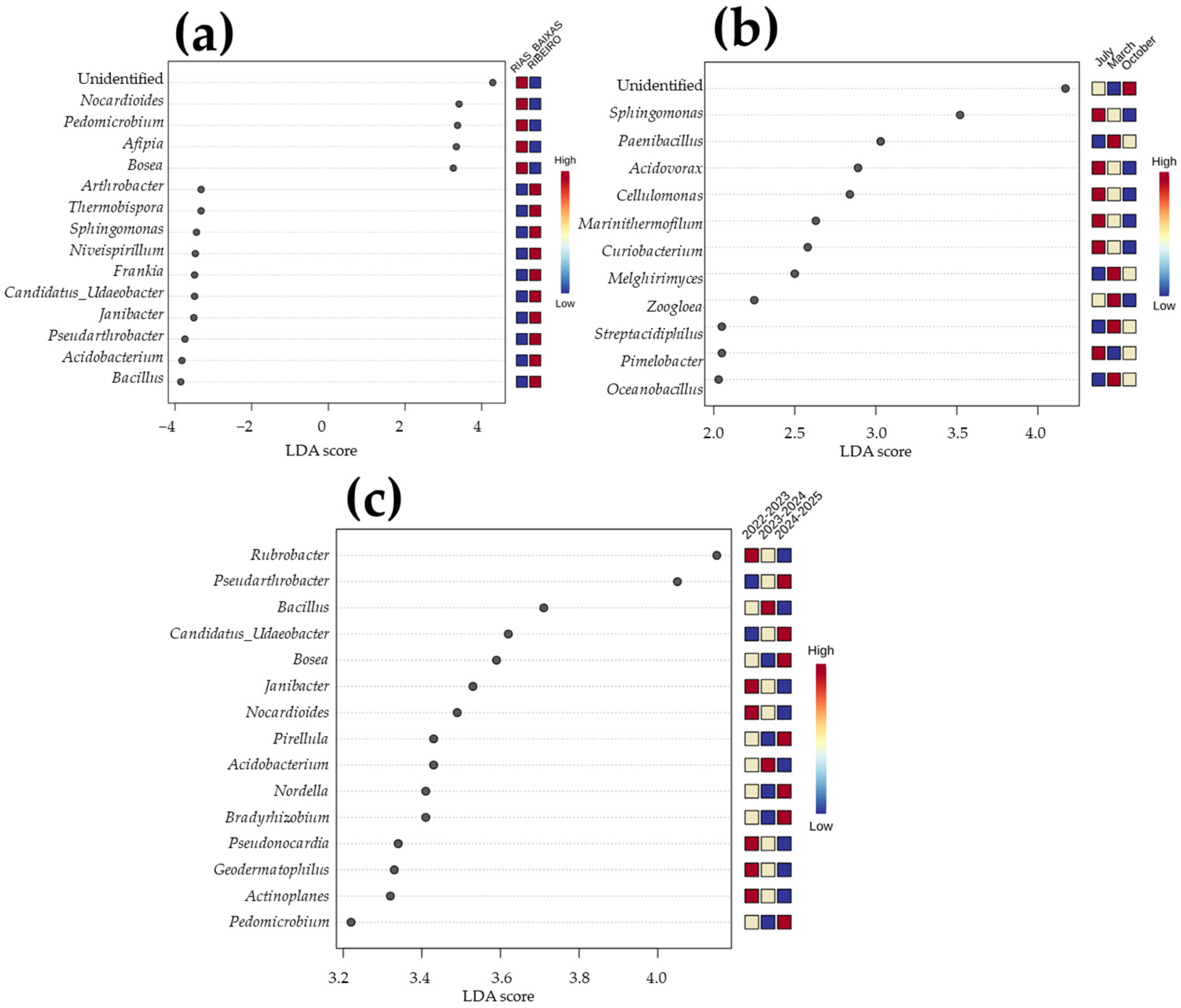
Linear discriminant analysis effect size (LEfSe) revealed significant differences in a great number of bacterial genera, particularly when the D.O. (minimum of 100 genera) and sampling campaign (78 genera) were considered (Figure 12). When analyzing differences across D.O.s, Rías Baixas presented a high LDA score for Nocardioides, Pedomicrobium, Afipia, and Bosea, and Ribeiro for Bacillus, Acidobacterium, and Pseudarthrobacter (Figure 12a). Twelve genera differentiated between months, with Sphingomonas standing out in July, and Paenibacillus in March (Figure 12b). Rubrobacter stood out in the 2022–2023 campaign, and Pseudoarthrobacter in the 2024–2025 one (Figure 12c). No genus differentiated between the two groups of phytosanitary treatments.
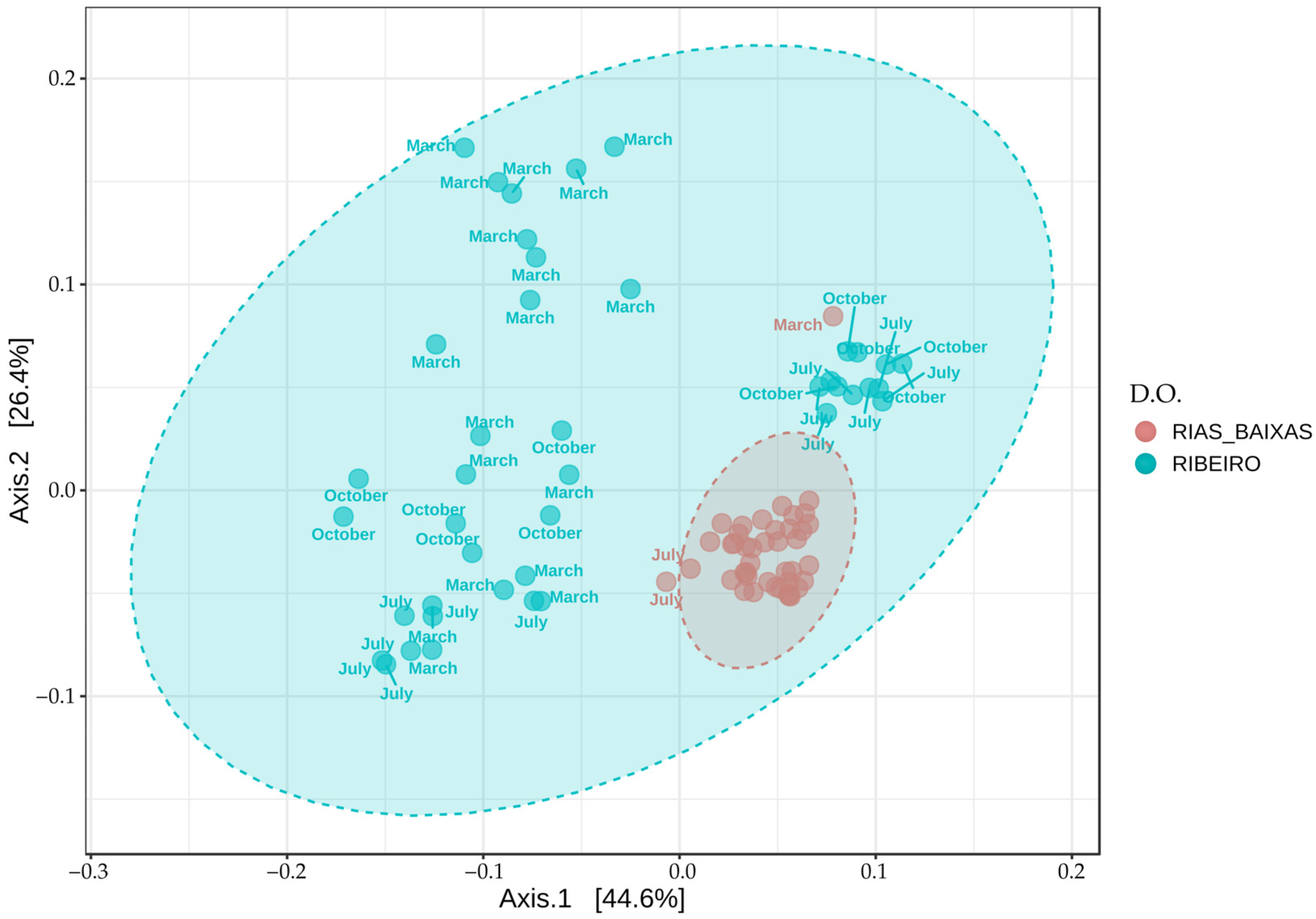
Beta diversity analysis using a PCoA plot based on the Bray–Curtis index and PERMANOVA demonstrated a clear separation between Rías Baixas and Ribeiro, as well as a certain grouping by month, as seen for fungi (Figure 13).
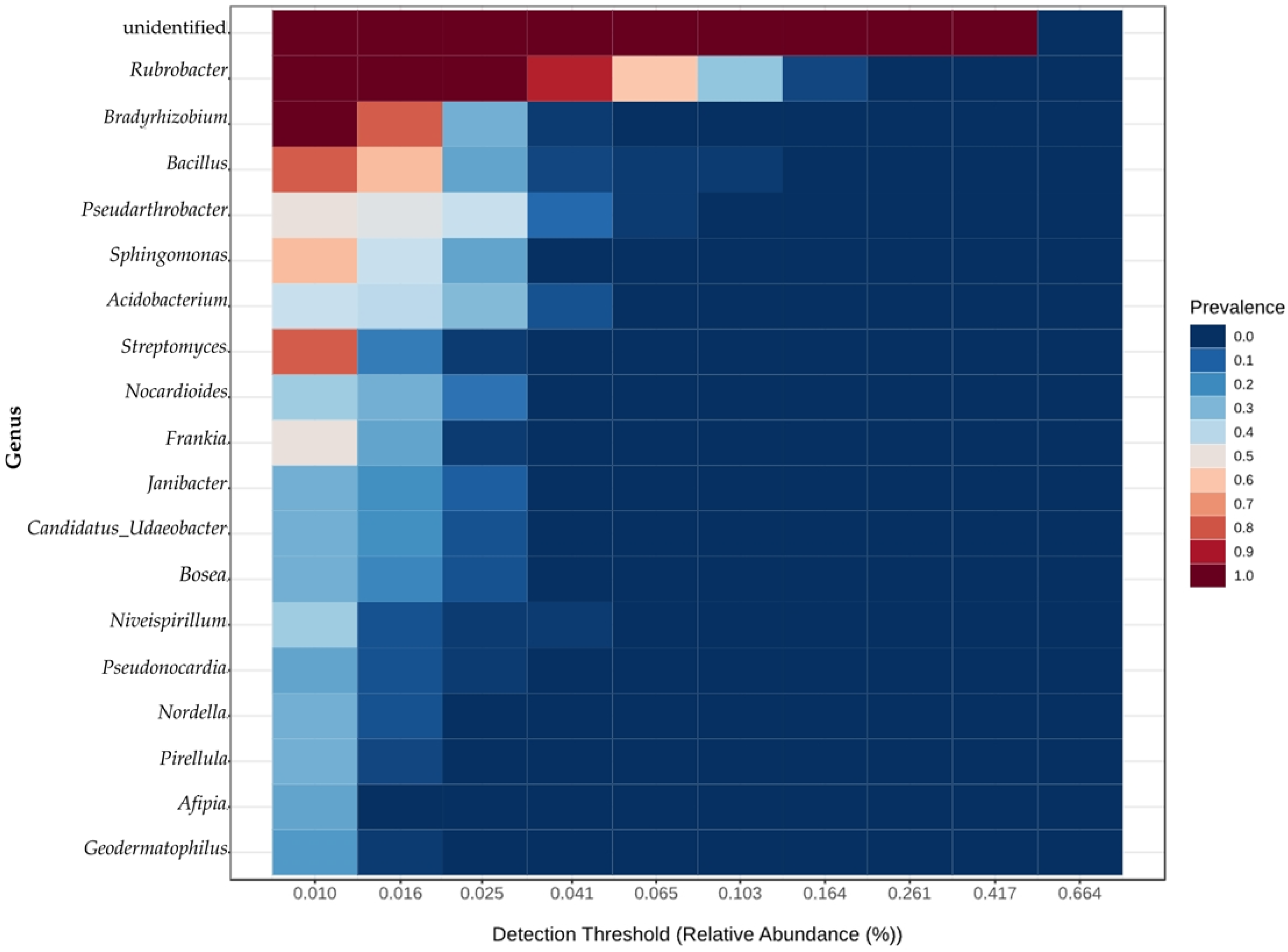
The analysis of the bacterial core microbiome showed a dominance of several genera, mainly Rubrobacter, Bradyrhizobium, Bacillus, Streptomyces, and Sphingomonas (Figure 14).

4. Discussion

4.1. Differential Behavior of the Active Substances in Soil

Maximum residue limits (MRLs) for pesticides are established for food and drinking water. However, despite their negative effects on soil health and fertility, no legal thresholds currently exist for pesticide residues in soils within the European Union.
The grapevine is among the crops with the highest demand for plant protection treatments, particularly in humid and temperate regions, such as Galicia, leading to pesticide contamination in soils. In fact, copper contamination—stemming from its extensive use in conventional and organic viticulture and its strong capacity to accumulate in soils—has been documented in vineyards in this region [42], along with its negative impacts on soil enzymatic activity [43]. Additional studies in the region have reported pesticide contamination in soils, bodies of water, and wines [44,45,46].
In this study, the combined effect of several pesticides and their dynamics under real field conditions was assessed in two vineyards with contrasting edaphoclimatic characteristics. Rías Baixas is distinguished by higher precipitation and lower soil temperatures during the period of maximum pesticide accumulation, while soil from this Denomination of Origin (D.O.) exhibited higher pH and organic matter content compared to the Ribeiro D.O. These differences can significantly influence pesticide persistence and mobility, as reported by Barmettler et al. [27]. These authors observed regional differences in total pesticide residues in Swiss vineyard soils that were attributed to soil organic carbon content (affecting sorption processes), temperature regimes (affecting microbial degradation), and disease pressure.
Pesticide residues were most detected in periods of high application frequency, as expected. Overall, the G1 group exhibited higher residue levels than the G2 group. In the case of G1, the greatest concentrations were observed for azoxystrobin and iprovalicarb, both of which were the most frequently applied, with three treatments per year. Azoxystrobin, an AS for controlling black rot and powdery and downy mildews, was the sole AS classified as persistent among those utilized in this study. It exhibits low water solubility and slight mobility, which explains its persistence over time, and the consistently higher residues observed in the G1 group compared to G2. These findings are consistent with those of Barmettler et al. [27], who detected azoxystrobin in vineyard soils despite it not having been applied in the preceding five years, pointing to its strong sorption to the soil as the most probable explanation for its presence.
Iprovalicarb, an AS against downy mildew, was applied a few days prior to the July sampling. This, in conjunction with the high frequency of applications, was responsible for the elevated residues detected in that sampling. This compound was classified as non-persistent in soil, with moderate water solubility and mobility, which was consistent with the very low residues detected in subsequent samplings (October and March).
Metalaxyl-M was detected in nearly all samplings, albeit at low concentrations. This AS has been reported as one of the most frequently detected in vineyards [27,47]. Manjarres-López et al. [47] evaluated pesticide residues in both water and vineyard soils in La Rioja (Spain) over a three-season period, encompassing spring, summer, and autumn. They detected metalaxyl and its metabolite CGA-62826 at maximum concentrations in groundwater from vineyard wells; however, CGA-62826 was not detected in soil samples. Metalaxyl was detected in spring and summer water samples; however, its presence in soil was less ubiquitous, attributable to its classification as leachable, a classification based on its high water solubility and GUS index. Significant correlations were also found between certain pesticide concentrations and soil properties, such as the organic matter and clay content in that study. Metalaxyl has also been noticed in groundwater samples at levels that exceeded environmental quality standards in the Tidone viticultural area [48]. Furthermore, in 50% of wells and springs in La Rioja, metalaxyl was identified, along with two of its degradation products (CGA-62826 and CGA-92370) in over 30% of the samples [49]. In the present study, CGA-62826 was detected in the soil during the initial year, albeit at low concentrations. It has been reported that the degree of degradation of metalaxyl-M to CGA-62826 exhibits significant variation, with levels ranging from 89% in a German soil sampling to less than 1% in a Cameroonian soil sampling after a 90-day period. This discrepancy is likely attributable to the presence of distinct microbial degradation communities [50].
Regarding the G2 active substances (ASs), ametoctradin demonstrated a high concentration in the Ribeiro D.O. in the summer sampling in both soil layers during the first year. This observation is likely attributable to its application five days prior. This AS has a low water solubility and is classified as non-mobile and non-persistent, which explains why only residual levels were detected in subsequent samplings. Zoxamide appeared at low concentrations in July and became virtually undetectable thereafter, which is consistent with its classification as a non-persistent and slightly mobile AS. Indeed, zoxamide residues were not detected in November samplings conducted in several Swiss vineyards where it had been applied [27]. Several ASs exhibited contrasting behaviors depending on the D.O. Benalaxyl-M, fenpyrazamine, and metrafenone almost completely disappeared over time in Ribeiro, whereas in Rías Baixas their concentrations declined more gradually, particularly for metrafenone. It is worth noting that metrafenone was among the pesticides that contributed most to the overall pesticide residue burden in a study conducted across 62 vineyards in Switzerland [27].
Overall, ASs persisted longer in Rías Baixas than in the Ribeiro D.O. This could be attributed to the higher organic matter content in the Rías Baixas vineyard, which likely enhanced AS sorption, thereby slowing their downward leaching, as well as the lower soil temperature in the months with the highest concentration of residues. The vineyard soils in both D.O.s had a texture conducive to pesticide transport to water, characterized by clay contents below 20% and sand contents above 45% [7]. The transmission-to-water risk values calculated based on soil permeability and adsorbency, combined with AS solubility and half-life, indicated that metalaxyl-M maintained consistently high transmission risk values across different soil textures. In contrast, azoxystrobin exhibited the lowest transmission-to-water risk values, suggesting that it may be preferable when aiming to reduce the risk of water contamination [7]. These findings are consistent with the results of our study, as azoxystrobin was detected at relatively high concentrations in soil, whereas metalaxyl-M was present only at residual levels.
Residues were predominantly detected in the upper soil layer (0–10 cm), with the Ribeiro D.O. exhibiting higher percentages compared to the Rías Baixas D.O.—an exception being observed in the first sampling (July 2023), where both D.O.s exhibited almost equal distribution for G1 residues. This may be associated with the higher precipitation levels that occurred between the onset of treatments and the July 2023 sampling in Ribeiro, in conjunction with the greater mobility of G1 substances. In this regard, a study conducted in two Swiss viticultural regions with contrasting edaphoclimatic conditions revealed that differences in pesticide residues were attributed to different sorption capacity in the humic layer, and to different precipitation patterns [27].
Residues of the ASs examined in this study are frequently detected in finished wines, mainly fenhexamid, iprovalicarb, and metalaxyl, among others. These compounds were detected at concentrations below the maximum residue limits (MRLs) established for grapes, since no MRLs exist specifically for wines [51]. A recent study revealed that wines produced in Galicia exhibited AS levels below their respective grape MRLs, with the highest detection frequencies in the Rías Baixas D.O. for iprovalicarb, mandipropamide, and metalaxyl, and in Ribeiro for metalaxyl, dimetomorph, and mandipropamide. The highest concentrations in wine corresponded to iprovalicarb and fenhexamid in Rías Baixas, and metalaxyl and fenpyrazamine in Ribeiro. Overall, wines from Rías Baixas presented a noticeably higher total pesticide concentration than those from Ribeiro [44], likely due to the higher number of phytosanitary treatments typically applied in this D.O.

4.2. Effect of Pesticides and Location on Soil Microbiome

4.2.1. Impact on Fungal Communities

Environmental stressors such as pesticides may drive microbial community differentiation, altering microbial interactions, reducing diversity, and ultimately compromising agroecosystem sustainability.
Concerning the fungal communities, Ribeiro exhibited a slightly higher abundance compared to Rías Baixas, with a peak observed in March and a significant decline in October. Ascomycota was the most abundant fungal phylum, followed by Basidiomycota, a finding that aligns with the results of previous vineyard studies [52,53]. Zoopagomycota, comprising species that are primarily mycoparasites as well as parasites and pathogens of small animals [54], was more abundant in Rías Baixas. This phylum has been correlated with higher nitrogen, organic matter, and C/N ratios in a vineyard study comparing two different soil profiles [14], which aligns with the soil characteristics of Rías Baixas. The most frequent genus was Fusarium, identified together with Cladosporium, as the dominant taxa across vineyards in Australia, Denmark, Germany, Portugal, and South Africa in a global microbiome survey of 200 vineyards in 13 countries. This genus encompasses numerous plant pathogens and fruit-spoilage species [55]. In vineyards, it has been observed to exacerbate the severity of grapevine trunk diseases [56]. Other prevalent genera included Saitozyma (associated with Ribeiro), Humicola, and Penicillium. Saitozyma, which has been demonstrated to be positively correlated with the available soil potassium in a study with rainfed rice–potato cropping systems [57], has also been shown to inhibit Fusarium oxysporum infection in brinjal [58]. Indeed, the Ribeiro soil contained higher potassium levels than that of Rías Baixas. The core microbiome was dominated by Fusarium, Penicillium, and Humicola, genera that were likewise identified as core constituents in the global vineyard study previously cited [55].
Multiple factors shape microbial communities, including soil management practices and climatic parameters, with seasonality (winter, spring, summer, and autumn) exerting the greatest impact on fungal communities in a study conducted in two vineyards with different soil management practices [59]. In our study, several parameters were assessed. No significant differences were detected in fungal richness or diversity among the two groups of ASs evaluated. Nevertheless, the influence of the D.O. was significant. The fungal richness (Chao1 index) differed consistently between Rías Baixas and Ribeiro across all the samplings. Additionally, the diversity (Shannon index) was also significant in the March samplings collected in the 2023 and 2024 campaigns. Rías Baixas exhibited higher fungal richness and diversity, possibly due to contrasting edaphoclimatic conditions.
Although no significant differences were found in the fungal richness of diversity between the two groups of treatments, the LEfSe analysis identified eight discriminating genera that distinguished G1 from G2, with six genera exhibiting higher abundance under the G2 treatment, and two under G1. It has been established that certain species of Lachancea and Clonostachys function as biocontrol agents against plant pathogens [60,61], whereas Aspergillus and Lipomyces are known pesticide-degrading organisms [62]. These species exhibited higher abundance in G2. Future studies should be conducted to evaluate the potential harmful effects of each individual AS on these differential species.
Several fungal genera also differentiated the two D.O.s in the LEfSe analysis. Rías Baixas showed a high abundance of several beneficial genera, including Purpureocillium, Trichoderma, and Metarhizium. These genera include species known as having the capacity for phosphate solubilization, major decomposition activity, and antagonism against pathogens [63,64], as well as for their ability to degrade herbicides [65,66]. The increased presence of Metarhizium, an entomopathogenic genus, has been associated with high C/N ratios in soil [67]. In our study, this genus was more abundant in Rías Baixas, which displayed a slightly higher C/N ratio than Ribeiro. Conversely, this D.O. also harbored pathogenic genera, such as Dactylonectria, which includes species responsible for grapevine trunk diseases [68], and Penicillium, a major grapevine pathogen. In the global study of vineyard soils across four continents, Penicillium and Trichoderma were identified as part of the core microbiome [55].
With regard to the sampling months, several genera showed higher abundance in July, including Fusarium, Plectosphaerella, Rhodotorula, and Phaeosphaeria, but declined in subsequent months. Rhodotorula is a genus of basidiomycete yeasts commonly found in soil, air, water, and on plant surfaces. R. mucilaginosa has been shown to stimulate arbuscular mycorrhizal colonization in soybean and red clover [69]. Plectosphaerella species have been associated with root and collar rots in various horticultural crops [70]. However, P. cucumerina has been successfully tested as a biocontrol agent against Alternaria spp. [71].

4.2.2. Impact on Bacterial Communities

With regard to bacterial communities, no significant differences were attributable to the different treatment groups. As observed for fungal communities, the bacterial richness in Rías Baixas was more stable and generally higher than in Ribeiro. This may be attributed to the tillage practice, which has been demonstrated to disrupt the microbiome, with a particular impact on fungal communities [72].
The most abundant phylum was Actinomycetota (syn. Actinobacteria, Actinobacteriota, and Actinomycetes), followed by Pseudomonadota (syn. Proteobacteria). The present findings contrast with findings from other studies; for example, Gobbi et al. [55], in a global vineyard survey, reported Proteobacteria, followed by Actinobacteria, as the most abundant phyla worldwide, consistent with results from Malla et al. [73]. The latter study indicated that Proteobacteria were predominant in pesticide-contaminated agricultural soils, possibly due to their adaptive capacity to pesticides.
Ni et al. [23] demonstrated, in steppe grassland soils, a positive association between pesticide diversity and bacterial richness, driven by the enrichment in neutral and specialist taxa capable of degrading or resisting pesticides. Malla et al. [73] also reported a significantly higher abundance of Pseudomonas, Bradyrhizobium, Paenibacillus, and Nocardioides genera in pesticide-contaminated agricultural soils compared to natural soils, suggesting their potential role in pesticide degradation. In our study, several genera reported as pesticide degraders were identified, including Nocardioides, Bacillus, Bosea, Streptomyces, Sphingomonas, and Paenibacillus [62].
Rubrobacter, followed by Bradyrhizobium, Bacillus, and Pseudarthrobacter, were the most abundant genera. The first three were core microbiome members. Rubrobacter spp., reported as playing a vital role in nutrient cycling and adaptation to extreme conditions, were abundant in a topsoil from three commercial apple orchards in Tunisia, as well as in a study conducted in a landscape with vascular plants, biocrust, and bare substrate in Spain, with both locations presenting a semiarid Mediterranean climate [74,75]. This genus has also been detected in Mediterranean vineyards exposed to dry, hot summers [76]. Indeed, the order Rubrobacteridae is highly represented in extremely hot and/or acidic ecosystems characterized by severe desiccation conditions [77]. Despite the more arid conditions in Ribeiro, both D.O.s may experience summer drought. For instance, during June and July 2024, precipitation levels in Ribeiro amounted to a mere 6.8 L/m2, compared with 135.2 L/m2 in the previous year; in Rías Baixas, rainfall reached 81.2 L/m2 in 2023 and 103 L/m2 in 2024 during the same period. However, no differences between sampling periods were found for Rubrobacter. Bradyrhizobium, a nitrogen-fixing bacterium, has also been reported as adaptive to biotic and abiotic stresses [78].
A large number of genera differentiated the two D.O.s. Indeed, the PCoA revealed a clear clustering by D.O., which was particularly pronounced for Rías Baixas. Nocardioides spp., previously reported as pesticide-degrading organisms [62], were particularly prominent in Rías Baixas. A study conducted in the Ribeiro D.O. identified this genus as a core member under transitional and conventional management, although it was not important under organic management [79]. Nocardioides was also associated with a specific vineyard in a study of three vineyards in the Lambrusco D.O.C. region [80]. Members of this genus have been reported to degrade a wide range of pollutants, including aromatic compounds, hydrocarbons, haloalkanes, nitrogen heterocyclics, and polyester pollutants [81].
Sphingomonas, another genus cited as pesticide-degrading [62], was prominent in July. Wei et al. [82] observed that, on berries, this genus was negatively correlated with sunshine hours and positively with precipitation. Furthermore, it was enriched at mid-maturity compared with other genera; this latter pattern is consistent with our findings in soil. This genus is a grape epiphyte involved in litter decomposition in ecosystems; it can depolymerize lignin, degrade polycyclic aromatic hydrocarbons, and enhance plant growth under stressful conditions. Furthermore, it has also been consistently detected in all stages of must fermentation [83,84].

5. Conclusions

Despite the greater mobility of the ASs of the G1 group, few significant differences in total soil residues were found between the two treatment groups. However, a clear influence of the D.O. was detected on the total soil residues, as well as on the residues of the individual ASs, with Rías Baixas presenting a slower dissipation rate. It is noteworthy that azoxystrobin, which also presented the highest residue levels, and metrafenone were the most persistent ASs, which suggests negative implications associated with soil health.
Four beneficial fungal genera were present in a significantly high abundance in the G2 group. This observation suggests that some of the ASs of the G1 group may exert a negative effect on these genera. Subsequent studies involving the ASs of this group should be performed to ascertain the ASs implicated, so as not to recommend their use to the grape growers in order to preserve soil health.

Supplementary Materials

The following supporting information can be downloaded at: https://www.mdpi.com/article/10.3390/agriculture16030344/s1, Figure S1: Percentage of pesticide residues in upper and lower layers for each D.O., group of treatments, sampling month, and campaign; Table S1: Active substances (ASs) employed in each group of treatments and application data in the Rías Baixas and Ribeiro Denominations of Origin (D.O.s.). Superscript before ASs indicate the target disease; Table S2: Results of the ANOVA test showing significant differences (p < 0.05) for the main treatment factors in the concentration of each AS; Table S3: Significant differences (p < 0.05) in the pesticide residues between sampling months; Table S4: Results of the ANOVA test showing significant differences (p < 0.05) for the main treatment factors in the percentage of pesticide dissipation (0–20 cm) over time (periods from July to October, July to March, and October to March); Table S5: Significant differences (p < 0.05) in Chao1 and Shannon indices for fungal communities when contrasting between D.O.s, campaigns, and months; Table S6: Significant differences (p < 0.05) in Chao1 and Shannon indices for bacterial communities when contrasting D.O.s, campaigns, and months.

Author Contributions

Conceptualization, E.D.-L., M.D.L.-R., M.J.G.-C., I.R., J.M.M.-B. and M.S.R.-C.; methodology, M.R., M.D.L.-R. and J.M.M.-B.; validation, V.F.-F., K.Š. and E.A.; formal analysis, E.D.-L. and A.V.-A.; investigation, M.D.L.-R., M.J.G.-C., E.A., V.F.-F., K.Š. and L.F.; resources, A.V.-A., L.F. and M.R.; data curation, A.V.-A., V.F.-F. and K.Š.; writing—original draft preparation, M.D.L.-R. and I.R.; writing—review and editing, E.D.-L., I.R., J.M.M.-B. and M.S.R.-C.; visualization, A.V.-A.; supervision, I.R. and E.D.-L.; project administration, E.D.-L. and M.R.; funding acquisition, E.D.-L., I.R., J.M.M.-B. and M.S.R.-C. All authors have read and agreed to the published version of the manuscript.

Funding

This research is part of the project TED2021–129962B-C43, funded by the Spanish Ministry of Science and Innovation (MICIU/AEI/10.13039/501100011033), and by the European Union NextGeneration EU/PRTR. Ester Abarquero is grateful for her predoctoral contract (ref. INIA-2020-0012) granted by MICIU/AEI/10.13039/501100011033 and ESF Investing in your future. Anxo Vázquez-Arias is grateful for his predoctoral contract (ref. PRE2022-103198) funded by MICIU/AEI/10.13039/501100011033 and European Social Fund Plus (ESF+). María Dolores Loureiro-Rodríguez gratefully acknowledges the Xunta de Galicia, which, under Resolution of the Axencia Galega de Innovación of 29 July 2021, granted her a Senior Talent Program contract. This research used the infrastructure acquired by project CZ.02.1.01/0.0/0.0/16_017/0002334 Research Infrastructure for Young Scientists, which is co-financed by the Operational Program of Research, Development and Education.

Institutional Review Board Statement

Not applicable.

Data Availability Statement

The original contributions presented in this study are included in the article. Further inquiries can be directed to the corresponding author.

Acknowledgments

We thank David Gramaje and Aleš Eichmeier for the critical review of the manuscript.

Conflicts of Interest

The authors declare no conflicts of interest.

Abbreviations

The following abbreviations are used in this manuscript:
ASActive substance
D.O.Denomination of origin
LC-MS/MSLiquid Chromatography–tandem mass spectrometry
PPPPlant protection products
PCoAPrincipal coordinate analysis

References

  1. Abhilash, P.C.; Singh, N. Pesticide Use and Application: An Indian Scenario. J. Hazard. Mater. 2009, 165, 1–12. [Google Scholar] [CrossRef] [PubMed]
  2. Rodríguez-Seijo, A.; Pérez-Rodríguez, P.; Arias-Estévez, M.; Gómez-Armesto, A.; Conde-Cid, M.; Santás-Miguel, V.; Campillo-Cora, C.; Ollio, I.; Lloret, E.; Martínez-Martínez, S.; et al. Occurrence, Persistence and Risk Assessment of Pesticide Residues in European Wheat Fields: A Continental Scale Approach. J. Hazard. Mater. 2025, 494, 138291. [Google Scholar] [CrossRef]
  3. Silva, V.; Mol, H.G.J.; Zomer, P.; Tienstra, M.; Ritsema, C.J.; Geissen, V. Pesticide Residues in European Agricultural Soils—A Hidden Reality Unfolded. Sci. Total Environ. 2019, 653, 1532–1545. [Google Scholar] [CrossRef]
  4. Vieira, D.C.S.; Yunta, F.; Baragaño, D.; Evrard, O.; Reiff, T.; Silva, V.; De La Torre, A.; Zhang, C.; Panagos, P.; Jones, A.; et al. Soil Pollution in the European Union—An Outlook. Environ. Sci. Policy 2024, 161, 103876. [Google Scholar] [CrossRef]
  5. Prăvălie, R.; Borrelli, P.; Panagos, P.; Ballabio, C.; Lugato, E.; Chappell, A.; Miguez-Macho, G.; Maggi, F.; Peng, J.; Niculiță, M.; et al. A Unifying Modelling of Multiple Land Degradation Pathways in Europe. Nat. Commun. 2024, 15, 3862. [Google Scholar] [CrossRef]
  6. Tang, F.H.M.; Maggi, F. Pesticide Mixtures in Soil: A Global Outlook. Environ. Res. Lett. 2021, 16, 044051. [Google Scholar] [CrossRef]
  7. McGinley, J.; Harmon O’Driscoll, J.; Healy, M.G.; Ryan, P.C.; Mellander, P.E.; Morrison, L.; Callery, O.; Siggins, A. An Assessment of Potential Pesticide Transmission, Considering the Combined Impact of Soil Texture and Pesticide Properties: A Meta-analysis. Soil Use Manag. 2022, 38, 1162–1171. [Google Scholar] [CrossRef] [PubMed]
  8. Rasool, S.; Rasool, T.; Gani, K.M. A Review of Interactions of Pesticides within Various Interfaces of Intrinsic and Organic Residue Amended Soil Environment. Chem. Eng. J. Adv. 2022, 11, 100301. [Google Scholar] [CrossRef]
  9. Wołejko, E.; Jabłońska-Trypuć, A.; Wydro, U.; Butarewicz, A.; Łozowicka, B. Soil Biological Activity as an Indicator of Soil Pollution with Pesticides—A Review. Appl. Soil Ecol. 2020, 147, 103356. [Google Scholar] [CrossRef]
  10. Arp, H.P.H.; Hale, S.E. Assessing the Persistence and Mobility of Organic Substances to Protect Freshwater Resources. ACS Environ. Au 2022, 2, 482–509. [Google Scholar] [CrossRef] [PubMed]
  11. Wang, X.; Chi, Y.; Song, S. Important Soil Microbiota’s Effects on Plants and Soils: A Comprehensive 30-Year Systematic Literature Review. Front. Microbiol. 2024, 15, 1347745. [Google Scholar] [CrossRef] [PubMed]
  12. Burns, K.N.; Kluepfel, D.A.; Strauss, S.L.; Bokulich, N.A.; Cantu, D.; Steenwerth, K.L. Vineyard Soil Bacterial Diversity and Composition Revealed by 16S rRNA Genes: Differentiation by Geographic Features. Soil Biol. Biochem. 2015, 91, 232–247. [Google Scholar] [CrossRef]
  13. Burns, K.N.; Bokulich, N.A.; Cantu, D.; Greenhut, R.F.; Kluepfel, D.A.; O’Geen, A.T.; Strauss, S.L.; Steenwerth, K.L. Vineyard Soil Bacterial Diversity and Composition Revealed by 16S rRNA Genes: Differentiation by Vineyard Management. Soil Biol. Biochem. 2016, 103, 337–348. [Google Scholar] [CrossRef]
  14. Mezzatesta, D.; Oyuela Aguilar, M.; Gobbi, A.; Pistorio, M.; Hansen, L.H.; Buscema, F.; Piccoli, P.; Berli, F. Soil-Associated Fungal and Prokaryotic Diversity Influenced by Stoniness, Depth and Vintage in a High-Altitude Vineyard. OENO One 2024, 58, 1–12. [Google Scholar] [CrossRef]
  15. Alengebawy, A.; Abdelkhalek, S.T.; Qureshi, S.R.; Wang, M.-Q. Heavy Metals and Pesticides Toxicity in Agricultural Soil and Plants: Ecological Risks and Human Health Implications. Toxics 2021, 9, 42. [Google Scholar] [CrossRef]
  16. Walder, F.; Schmid, M.W.; Riedo, J.; Valzano-Held, A.Y.; Banerjee, S.; Büchi, L.; Bucheli, T.D.; Van Der Heijden, M.G.A. Soil Microbiome Signatures Are Associated with Pesticide Residues in Arable Landscapes. Soil Biol. Biochem. 2022, 174, 108830. [Google Scholar] [CrossRef]
  17. Meidl, P.; Lehmann, A.; Bi, M.; Breitenreiter, C.; Benkrama, J.; Li, E.; Riedo, J.; Rillig, M.C. Combined Application of up to Ten Pesticides Decreases Key Soil Processes. Environ. Sci. Pollut. Res. 2024, 31, 11995–12004. [Google Scholar] [CrossRef]
  18. Beaumelle, L.; Tison, L.; Eisenhauer, N.; Hines, J.; Malladi, S.; Pelosi, C.; Thouvenot, L.; Phillips, H.R.P. Pesticide Effects on Soil Fauna Communities—A Meta-analysis. J. Appl. Ecol. 2023, 60, 1239–1253. [Google Scholar] [CrossRef]
  19. Charalampous, A.C.; Machera, K.; Miliadis, G.E.; Koupparis, M.A. The Spatial and Temporal Distribution/Variation of Pesticide Residues in Viotikos Kifissos Basin before and after the Application of a Low Input Crop Management System. A Three-Year Study. Int. J. Environ. Anal. Chem. 2015, 95, 1263–1282. [Google Scholar] [CrossRef]
  20. Pathak, V.M.; Verma, V.K.; Rawat, B.S.; Kaur, B.; Babu, N.; Sharma, A.; Dewali, S.; Yadav, M.; Kumari, R.; Singh, S.; et al. Current Status of Pesticide Effects on Environment, Human Health and It’s Eco-Friendly Management as Bioremediation: A Comprehensive Review. Front. Microbiol. 2022, 13, 962619. [Google Scholar] [CrossRef]
  21. Mark, J.; Fantke, P.; Soheilifard, F.; Alcon, F.; Contreras, J.; Abrantes, N.; Campos, I.; Baldi, I.; Bureau, M.; Alaoui, A.; et al. Selected Farm-Level Crop Protection Practices in Europe and Argentina: Opportunities for Moving toward Sustainable Use of Pesticides. J. Clean. Prod. 2024, 477, 143577. [Google Scholar] [CrossRef]
  22. González, M.; Sánchez, J.I.L.; Bravo, K.A.S.; Cabal, M.D.C.; Pérez-Santín, E. Review: Presence, Distribution and Current Pesticides Used in Spanish Agricultural Practices. Sci. Total Environ. 2022, 845, 157291. [Google Scholar] [CrossRef]
  23. Ni, B.; Xiao, L.; Lin, D.; Zhang, T.-L.; Zhang, Q.; Liu, Y.; Chen, Q.; Zhu, D.; Qian, H.; Rillig, M.C.; et al. Increasing Pesticide Diversity Impairs Soil Microbial Functions. Proc. Natl. Acad. Sci. USA 2025, 122, e2419917122. [Google Scholar] [CrossRef]
  24. Carrera, L.; Fernández-González, M.; Aira, M.J.; Espinosa, K.C.S.; Otero, R.P.; Rodríguez-Rajo, F.J. Airborne Plasmopara Viticola Sporangia: A Study of Vineyards in Two Bioclimatic Regions of Northwestern Spain. Horticulturae 2025, 11, 228. [Google Scholar] [CrossRef]
  25. Blanco-Ward, D.; Queijeiro, J.M.G.; Jones, G.V. Spatial Climate Variability and Viticulture in the Miño River Valley of Spain. Vitis 2007, 46, 63–70. [Google Scholar]
  26. PPDB—Pesticides Properties DataBase. Available online: https://sitem.herts.ac.uk/aeru/ppdb/ (accessed on 25 November 2025).
  27. Barmettler, E.; Van Der Heijden, M.G.A.; Rösch, A.; Egli-Künzler, L.; Dubuis, P.-H.; Mackie-Haas, K.A.; Lutz, S.; Bucheli, T.D. Double the Trouble: High Levels of Both Synthetic Pesticides and Copper in Vineyard Soils. Environ. Pollut. 2025, 375, 126356. [Google Scholar] [CrossRef] [PubMed]
  28. Castro, G.; Pérez-Mayán, L.; Rodríguez-Cabo, T.; Rodríguez, I.; Ramil, M.; Cela, R. Multianalyte, High-Throughput Liquid Chromatography Tandem Mass Spectrometry Method for the Sensitive Determination of Fungicides and Insecticides in Wine. Anal. Bioanal. Chem. 2018, 410, 1139–1150. [Google Scholar] [CrossRef]
  29. Parada, A.E.; Needham, D.M.; Fuhrman, J.A. Every Base Matters: Assessing Small Subunit rRNA Primers for Marine Microbiomes with Mock Communities, Time Series and Global Field Samples. Environ. Microbiol. 2016, 18, 1403–1414. [Google Scholar] [CrossRef] [PubMed]
  30. Apprill, A.; McNally, S.; Parsons, R.; Weber, L. Minor Revision to V4 Region SSU rRNA 806R Gene Primer Greatly Increases Detection of SAR11 Bacterioplankton. Aquat. Microb. Ecol. 2015, 75, 129–137. [Google Scholar] [CrossRef]
  31. Turenne, C.Y.; Sanche, S.E.; Hoban, D.J.; Karlowsky, J.A.; Kabani, A.M. Rapid Identification of Fungi by Using the ITS2 Genetic Region and an Automated Fluorescent Capillary Electrophoresis System. J. Clin. Microbiol. 1999, 37, 1846–1851. [Google Scholar] [CrossRef] [PubMed]
  32. White, T.J.; Bruns, T.; Lee, S.; Taylor, J. Amplification and Direct Sequencing of Fungal Ribosomal RNA Genes for Phylogenetics; Elsevier: Amsterdam, The Netherlands, 1990; pp. 315–322. [Google Scholar]
  33. Andrews, S. Babraham Bioinformatics—FastQC A Quality Control Tool for High Throughput Sequence Data. Available online: https://www.bioinformatics.babraham.ac.uk/projects/fastqc/ (accessed on 25 November 2025).
  34. Větrovský, T.; Baldrian, P.; Morais, D. SEED 2: A User-Friendly Platform for Amplicon High-Throughput Sequencing Data Analyses. Bioinformatics 2018, 34, 2292–2294. [Google Scholar] [CrossRef] [PubMed]
  35. Aronesty, E. Comparison of Sequencing Utility Programs. Open Bioinforma. J. 2013, 7, 1–8. [Google Scholar] [CrossRef]
  36. Bengtsson-Palme, J.; Ryberg, M.; Hartmann, M.; Branco, S.; Wang, Z.; Godhe, A.; De Wit, P.; Sánchez-García, M.; Ebersberger, I.; De Sousa, F.; et al. Improved Software Detection and Extraction of ITS1 and ITS 2 from Ribosomal ITS Sequences of Fungi and Other Eukaryotes for Analysis of Environmental Sequencing Data. Methods Ecol. Evol. 2013, 4, 914–919. [Google Scholar] [CrossRef]
  37. Blaxter, M.; Mann, J.; Chapman, T.; Thomas, F.; Whitton, C.; Floyd, R.; Abebe, E. Defining Operational Taxonomic Units Using DNA Barcode Data. Philos. Trans. R. Soc. B Biol. Sci. 2005, 360, 1935–1943. [Google Scholar] [CrossRef]
  38. Edgar, R.C. UPARSE: Highly Accurate OTU Sequences from Microbial Amplicon Reads. Nat. Methods 2013, 10, 996–998. [Google Scholar] [CrossRef]
  39. Nilsson, R.H.; Larsson, K.-H.; Taylor, A.F.S.; Bengtsson-Palme, J.; Jeppesen, T.S.; Schigel, D.; Kennedy, P.; Picard, K.; Glöckner, F.O.; Tedersoo, L.; et al. The UNITE Database for Molecular Identification of Fungi: Handling Dark Taxa and Parallel Taxonomic Classifications. Nucleic Acids Res. 2019, 47, D259–D264. [Google Scholar] [CrossRef]
  40. Baldrian, P.; Větrovský, T.; Lepinay, C.; Kohout, P. High-Throughput Sequencing View on the Magnitude of Global Fungal Diversity. Fungal Divers. 2022, 114, 539–547. [Google Scholar] [CrossRef]
  41. Tedersoo, L.; Bahram, M.; Põlme, S.; Kõljalg, U.; Yorou, N.S.; Wijesundera, R.; Ruiz, L.V.; Vasco-Palacios, A.M.; Thu, P.Q.; Suija, A.; et al. Global Diversity and Geography of Soil Fungi. Science 2014, 346, 1256688. [Google Scholar] [CrossRef] [PubMed]
  42. Fernández-Calviño, D.; Nóvoa-Muñoz, J.C.; Díaz-Raviña, M.; Arias-Estévez, M. Copper Accumulation and Fractionation in Vineyard Soils from Temperate Humid Zone (NW Iberian Peninsula). Geoderma 2009, 153, 119–129. [Google Scholar] [CrossRef]
  43. Fernández-Calviño, D.; Martín, A.; Arias-Estévez, M.; Bååth, E.; Díaz-Raviña, M. Microbial Community Structure of Vineyard Soils with Different pH and Copper Content. Appl. Soil Ecol. 2010, 46, 276–282. [Google Scholar] [CrossRef]
  44. Fernández-Fernández, V.; Ramil, M.; Blanco, P.; Andradres, M.S.; Rodríguez, I. Pesticides in Wines from Two Major Production Regions in the North of Spain. J. Food Compos. Anal. 2025, 142, 107525. [Google Scholar] [CrossRef]
  45. Pérez-Mayán, L.; Ramil, M.; Cela, R.; Rodríguez, I. Multiresidue Procedure to Assess the Occurrence and Dissipation of Fungicides and Insecticides in Vineyard Soils from Northwest Spain. Chemosphere 2020, 261, 127696. [Google Scholar] [CrossRef]
  46. Hildebrandt, A.; Guillamón, M.; Lacorte, S.; Tauler, R.; Barceló, D. Impact of Pesticides Used in Agriculture and Vineyards to Surface and Groundwater Quality (North Spain). Water Res. 2008, 42, 3315–3326. [Google Scholar] [CrossRef]
  47. Manjarres-López, D.P.; Andrades, M.S.; Sánchez-González, S.; Rodríguez-Cruz, M.S.; Sánchez-Martín, M.J.; Herrero-Hernández, E. Assessment of Pesticide Residues in Waters and Soils of a Vineyard Region and Its Temporal Evolution. Environ. Pollut. 2021, 284, 117463. [Google Scholar] [CrossRef]
  48. Zambito Marsala, R.; Capri, E.; Russo, E.; Bisagni, M.; Colla, R.; Lucini, L.; Gallo, A.; Suciu, N.A. First Evaluation of Pesticides Occurrence in Groundwater of Tidone Valley, an Area with Intensive Viticulture. Sci. Total Environ. 2020, 736, 139730. [Google Scholar] [CrossRef]
  49. Herrero-Hernández, E.; Andrades, M.S.; Álvarez-Martín, A.; Pose-Juan, E.; Rodríguez-Cruz, M.S.; Sánchez-Martín, M.J. Occurrence of Pesticides and Some of Their Degradation Products in Waters in a Spanish Wine Region. J. Hydrol. 2013, 486, 234–245. [Google Scholar] [CrossRef]
  50. Monkiedje, A.; Spiteller, M. Degradation of Metalaxyl and Mefenoxam and Effects on the Microbiological Properties of Tropical and Temperate Soils. Int. J. Environ. Res. Public Health 2005, 2, 272–285. [Google Scholar] [CrossRef]
  51. Martín-García, B.; Longo, E.; Ceci, A.T.; Pii, Y.; Romero-González, R.; Garrido Frenich, A.; Boselli, E. Pesticides and Winemaking: A Comprehensive Review of Conventional and Emerging Approaches. Compr. Rev. Food Sci. Food Saf. 2024, 23, e13419. [Google Scholar] [CrossRef] [PubMed]
  52. Oyuela Aguilar, M.; Gobbi, A.; Browne, P.D.; Ellegaard-Jensen, L.; Hansen, L.H.; Semorile, L.; Pistorio, M. Influence of Vintage, Geographic Location and Cultivar on the Structure of Microbial Communities Associated with the Grapevine Rhizosphere in Vineyards of San Juan Province, Argentina. PLoS ONE 2020, 15, e0243848. [Google Scholar] [CrossRef] [PubMed]
  53. Iorizzo, M.; Bagnoli, D.; Vergalito, F.; Testa, B.; Tremonte, P.; Succi, M.; Pannella, G.; Letizia, F.; Albanese, G.; Lombardi, S.J.; et al. Diversity of Fungal Communities on Cabernet and Aglianico Grapes from Vineyards Located in Southern Italy. Front. Microbiol. 2024, 15, 1399968. [Google Scholar] [CrossRef]
  54. Spatafora, J.W.; Chang, Y.; Benny, G.L.; Lazarus, K.; Smith, M.E.; Berbee, M.L.; Bonito, G.; Corradi, N.; Grigoriev, I.; Gryganskyi, A.; et al. A Phylum-Level Phylogenetic Classification of Zygomycete Fungi Based on Genome-Scale Data. Mycologia 2016, 108, 1028–1046. [Google Scholar] [CrossRef]
  55. Gobbi, A.; Acedo, A.; Imam, N.; Santini, R.G.; Ortiz-Álvarez, R.; Ellegaard-Jensen, L.; Belda, I.; Hansen, L.H. A Global Microbiome Survey of Vineyard Soils Highlights the Microbial Dimension of Viticultural Terroirs. Commun. Biol. 2022, 5, 241. [Google Scholar] [CrossRef]
  56. Li, Y.; Li, X.; Zhang, W.; Zhang, J.; Wang, H.; Peng, J.; Wang, X.; Yan, J. Belowground Microbiota Analysis Indicates That Fusarium spp. Exacerbate Grapevine Trunk Disease. Environ. Microbiome 2023, 18, 29. [Google Scholar] [CrossRef] [PubMed]
  57. Liang, L.; Li, S.; Li, K.; Zhang, X.; Yang, L.; Guo, H. Analysis of Soil Nutrients and Microbial Community Characteristics in Rainfed Rice–Potato Cropping Systems. Agronomy 2025, 15, 2500. [Google Scholar] [CrossRef]
  58. Das, S.; Rabha, J.; Narzary, D. Assessment of Soil Yeasts Papiliotrema Laurentii S-08 and Saitozyma Podzolica S-77 for Plant Growth Promotion and Biocontrol of Fusarium Wilt of Brinjal. J. Appl. Microbiol. 2023, 134, lxad252. [Google Scholar] [CrossRef]
  59. Hernandez, M.M.; Menéndez, C.M. Influence of Seasonality and Management Practices on Diversity and Composition of Fungal Communities in Vineyard Soils. Appl. Soil Ecol. 2019, 135, 113–119. [Google Scholar] [CrossRef]
  60. Torcato, C.; Gonçalves, M.F.M.; Rodríguez-Gálvez, E.; Alves, A. Clonostachys Viticola Sp. Nov., a Novel Species Isolated from Vitis Vinifera. Int. J. Syst. Evol. Microbiol. 2020, 70, 4321–4328. [Google Scholar] [CrossRef]
  61. Esteves, M.; Lage, P.; Sousa, J.; Centeno, F.; De Fátima Teixeira, M.; Tenreiro, R.; Mendes-Ferreira, A. Biocontrol Potential of Wine Yeasts against Four Grape Phytopathogenic Fungi Disclosed by Time-Course Monitoring of Inhibitory Activities. Front. Microbiol. 2023, 14, 1146065. [Google Scholar] [CrossRef]
  62. Kumar, M.; Yadav, A.N.; Saxena, R.; Paul, D.; Tomar, R.S. Biodiversity of Pesticides Degrading Microbial Communities and Their Environmental Impact. Biocatal. Agric. Biotechnol. 2021, 31, 101883. [Google Scholar] [CrossRef]
  63. Nasr, S.H.; Mousa, A.S.M.; Yasser, M.M.; Marzouk, M.A. Antagonistic Potential of Some Phosphate Solubilizing Fungi against Some Phyto-Pathogenic Fungi. Beni-Suef Univ. J. Basic Appl. Sci. 2021, 10, 70. [Google Scholar] [CrossRef]
  64. Rigobelo, E.C.; Nicodemo, D.; Babalola, O.O.; Desoignies, N. Purpureocillium lilacinum as an Agent of Nematode Control and Plant Growth-Promoting Fungi. Agronomy 2024, 14, 1225. [Google Scholar] [CrossRef]
  65. Spinelli, V.; Ceci, A.; Dal Bosco, C.; Gentili, A.; Persiani, A.M. Glyphosate-Eating Fungi: Study on Fungal Saprotrophic Strains’ Ability to Tolerate and Utilise Glyphosate as a Nutritional Source and on the Ability of Purpureocillium lilacinum to Degrade It. Microorganisms 2021, 9, 2179. [Google Scholar] [CrossRef]
  66. Szpyrka, E.; Podbielska, M.; Zwolak, A.; Piechowicz, B.; Siebielec, G.; Słowik-Borowiec, M. Influence of a Commercial Biological Fungicide Containing Trichoderma Harzianum Rifai T-22 on Dissipation Kinetics and Degradation of Five Herbicides in Two Types of Soil. Molecules 2020, 25, 1391. [Google Scholar] [CrossRef] [PubMed]
  67. Uzman, D.; Pliester, J.; Leyer, I.; Entling, M.H.; Reineke, A. Drivers of Entomopathogenic Fungi Presence in Organic and Conventional Vineyard Soils. Appl. Soil Ecol. 2019, 133, 89–97. [Google Scholar] [CrossRef]
  68. Berlanas, C.; Ojeda, S.; López-Manzanares, B.; Andrés-Sodupe, M.; Bujanda, R.; Del Pilar Martínez-Diz, M.; Díaz-Losada, E.; Gramaje, D. Occurrence and Diversity of Black-Foot Disease Fungi in Symptomless Grapevine Nursery Stock in Spain. Plant Dis. 2020, 104, 94–104. [Google Scholar] [CrossRef] [PubMed]
  69. Fracchia, S.; Godeas, A.; Scervino, J.M.; Sampedro, I.; Ocampo, J.A.; García-Romera, I. Interaction between the Soil Yeast Rhodotorula Mucilaginosa and the Arbuscular Mycorrhizal Fungi Glomus Mosseae and Gigaspora Rosea. Soil Biol. Biochem. 2003, 35, 701–707. [Google Scholar] [CrossRef]
  70. Raimondo, M.L.; Carlucci, A. Characterization and Pathogenicity of Plectosphaerella Spp. Collected from Basil and Parsley in Italy. Phytopathol. Mediterr. 2018, 57, 284–295. [Google Scholar] [CrossRef]
  71. Riccioni, C.; Belfiori, B.; Cenci, M.; Rubini, A. Exploring Endophytic Fungi from Humulus lupulus L. for Biocontrol of Phytopathogenic Fungi. Diversity 2025, 17, 94. [Google Scholar] [CrossRef]
  72. Morugán-Coronado, A.; Pérez-Rodríguez, P.; Insolia, E.; Soto-Gómez, D.; Fernández-Calviño, D.; Zornoza, R. The Impact of Crop Diversification, Tillage and Fertilization Type on Soil Total Microbial, Fungal and Bacterial Abundance: A Worldwide Meta-Analysis of Agricultural Sites. Agric. Ecosyst. Environ. 2022, 329, 107867. [Google Scholar] [CrossRef]
  73. Malla, M.A.; Dubey, A.; Kumar, A.; Yadav, S. Metagenomic Analysis Displays the Potential Predictive Biodegradation Pathways of the Persistent Pesticides in Agricultural Soil with a Long Record of Pesticide Usage. Microbiol. Res. 2022, 261, 127081. [Google Scholar] [CrossRef]
  74. Miralles, I.; Ortega, R.; Montero-Calasanz, M.D.C. Functional and Biotechnological Potential of Microbiome Associated with Soils Colonised by Cyanobacteria in Drylands. Appl. Soil Ecol. 2023, 192, 105076. [Google Scholar] [CrossRef]
  75. Mdaini, M.; Lloret, E.; Brahim, N.; Shimi, N.; Zornoza, R. Soil Bacterial and Fungal Community Composition in Top- and Subsoil From Irrigated Mediterranean Orchards. Span. J. Soil Sci. 2025, 15, 14537. [Google Scholar] [CrossRef]
  76. Novara, A.; Catania, V.; Tolone, M.; Gristina, L.; Laudicina, V.A.; Quatrini, P. Cover Crop Impact on Soil Organic Carbon, Nitrogen Dynamics and Microbial Diversity in a Mediterranean Semiarid Vineyard. Sustainability 2020, 12, 3256. [Google Scholar] [CrossRef]
  77. Mohammadipanah, F.; Wink, J. Actinobacteria from Arid and Desert Habitats: Diversity and Biological Activity. Front. Microbiol. 2016, 6, 1541. [Google Scholar] [CrossRef]
  78. Sharma, R.; Kumar, D.; Kapoor, N.; Ohri, P. Insights into the Biodiversity, Mechanisms and Plant Growth Promoting Effects of Bradyrhizobium and Their Potential in Sustainable Agriculture. Pedosphere 2025. [Google Scholar] [CrossRef]
  79. Blanco, P.; Rodríguez, I.; Fernández-Fernández, V.; Ramil, M.; Castrillo, D.; Acín-Albiac, M.; Adamo, I.; Fernández-Trujillo, C.; García-Jiménez, B.; Acedo, A.; et al. Physicochemical Properties and Microbiome of Vineyard Soils from DOP Ribeiro (NW Spain) Are Influenced by Agricultural Management. Microorganisms 2024, 12, 595. [Google Scholar] [CrossRef]
  80. Nanetti, E.; Palladino, G.; Scicchitano, D.; Trapella, G.; Cinti, N.; Fabbrini, M.; Cozzi, A.; Accetta, G.; Tassini, C.; Iannaccone, L.; et al. Composition and Biodiversity of Soil and Root-Associated Microbiome in Vitis Vinifera Cultivar Lambrusco Distinguish the Microbial Terroir of the Lambrusco DOC Protected Designation of Origin Area on a Local Scale. Front. Microbiol. 2023, 14, 1108036. [Google Scholar] [CrossRef] [PubMed]
  81. Ma, Y.; Wang, J.; Liu, Y.; Wang, X.; Zhang, B.; Zhang, W.; Chen, T.; Liu, G.; Xue, L.; Cui, X. Nocardioides: “Specialists” for Hard-to-Degrade Pollutants in the Environment. Molecules 2023, 28, 7433. [Google Scholar] [CrossRef]
  82. Wei, R.; Chen, N.; Ding, Y.; Wang, L.; Gao, F.; Zhang, L.; Liu, Y.; Li, H.; Wang, H. Diversity and Dynamics of Epidermal Microbes During Grape Development of Cabernet Sauvignon (Vitis vinifera L.) in the Ecological Viticulture Model in Wuhai, China. Front. Microbiol. 2022, 13, 935647. [Google Scholar] [CrossRef]
  83. Rivas, G.A.; Semorile, L.; Delfederico, L. Microbial Diversity of the Soil, Rhizosphere and Wine from an Emerging Wine-Producing Region of Argentina. LWT 2022, 153, 112429. [Google Scholar] [CrossRef]
  84. Sorouri, B.; Scales, N.C.; Gaut, B.S.; Allison, S.D. Sphingomonas Clade and Functional Distribution with Simulated Climate Change. Microbiol. Spectr. 2024, 12, e00236-24. [Google Scholar] [CrossRef] [PubMed]
Figure 1. Precipitation and soil temperature between samplings in Ribeiro and Rías Baixas.
Agriculture 16 00344 g001
Figure 2. Total residues (ng/g soil) in each sampling, for each group of AS and D.O. Darker color indicates residues in upper layer (0–10 cm), lighter color indicates those in lower layer (10–20 cm).
Agriculture 16 00344 g002
Figure 3. Actual abundance of fungal phyla in every D.O. according to: (a) treatment group; and (b) sampling month.
Agriculture 16 00344 g003
Figure 4. Actual abundance of the most frequent fungal genera for (a) each D.O. and group of treatments, and (b) each D.O. in every sampling month.
Agriculture 16 00344 g004
Figure 5. Chao1 (a) and Shannon indices (b) of fungal diversity in every sampling date and D.O. An asterisk indicates significant differences between D.O.s in the month of sampling.
Agriculture 16 00344 g005
Figure 6. LEfSe dot plots showing differences for some fungal genera between (a) sampling months, (b) groups of treatments, (c) D.O.s, and (d) campaigns.
Agriculture 16 00344 g006
Figure 7. Principal coordinate analysis (PCoA) plot based on the Bray–Curtis index with the PERMANOVA statistical method for Rías Baixas and Ribeiro D.O.s’ fungal communities.
Agriculture 16 00344 g007
Figure 8. Heatmap of the fungal core microbiome at the genus level.
Agriculture 16 00344 g008
Figure 9. Actual abundance of bacterial phyla in every D.O. according to (a) treatment group and (b) sampling month.
Agriculture 16 00344 g009
Figure 10. Actual abundance of bacterial genera in every D.O. according to (a) treatment group and (b) sampling month.
Agriculture 16 00344 g010
Figure 11. Chao1 (a) and Shannon indices (b) of bacterial diversity in every sampling month and D.O. An asterisk indicates significant differences between D.O.s in the sampling month.
Agriculture 16 00344 g011
Figure 12. LEfSe dot plots showing differences for some bacterial genera between (a) D.O.s, (b) sampling months, and (c) campaigns.
Agriculture 16 00344 g012
Figure 13. Principal coordinate analysis (PCoA) plot based on the Bray–Curtis index with the PERMANOVA statistical method for the Rías Baixas and Ribeiro D.O.s’ bacterial communities.
Agriculture 16 00344 g013
Figure 14. Heatmap of the bacterial core microbiome at the genus level.
Agriculture 16 00344 g014
Table 1. Properties of the studied active substances used in each group of treatments, according to the Pesticide Properties Database [26].
GroupActive SubstanceFamilyMode of ActionDT 50 (Field)Koc (mL g−1)Solubility in Water at 20 °C (mg/L)Gus Index
G1AmisulbromTriazole-SulfonamideQil (Quinone inside inhibitor) action. Respiration inhibitor.8.62840.11−0.21
Non-persistentModerately mobileLowLow
AzoxystrobinStrobilurinRespiration inhibitor (QoL fungicide)180.75896.73.10
PersistentSlightly mobileLowHigh
DifenoconazoleConazoleDisrupts membrane function. Inhibition of demethylation during ergosterol synthesis.91.8-15.00.89
Moderately persistentModerateLow
FenhexamidAnilideDisrupts membrane function, inhibits spore germination.-47524.0−0.42
Slightly mobileModerateLow
IprovalicarbCarbamateCellulose synthesis inhibitor.15.510617.82.35
Non-persistentModerately mobileModerateTransition state
Metalaxyl-MAnilide-acyloamino acidDisrupts fungal nucleic acid synthesis-RNA polymerase 1.14.1-26,0002.64
Non-persistentHighTransition state
G2AmetoctradinTriazolopyrimidineMitochondrial respiration inhibitor by interfering with complex III19.777130.150.55
Non-persistentNon-mobileLowLow
Benalaxyl-MAcylalanineDisrupts fungal nucleic acid synthesis-RNA polymerase 144.07175330.36
Moderately persistentNon-mobileModerateLow
FenpyrazaminePyrazoleSterol biosynthesis inhibitor. Inhibits germ tube and mycelium elongation.20.5-20.41.98
Non-persistentModerateTransition state
Krexosim-methylStrobilurinBinds to Qo site, blocking electron transfer and respiration in the fungi1.0-2.00.00
Non-persistentLowLow
MandipropamideAmideCellulose synthesis inhibitor.13.6-4.21.22
Non-persistentLowLow
MetrafenoneBenzophenoneInterferes with hyphal morphogenesis.62.070610.4920.91
Moderately persistentNon-mobileLowLow
PyraclostrobinStrobilurinRespiration inhibitor (QoL fungicide).33.393041.90.08
Moderately persistentNon-mobileLowLow
ZoxamideBenzamideInhibition of mitosis and cell division (Beta-tubulin assembly in mitosis)6.012240.6810.71
Non-persistentSlightly mobileLowLow
Table 2. Physicochemical characterization of vineyards.
ParameterRibeiroRías Baixas
Clay (%)16.17.1
Silt (%)22.214.6
Sand (%)61.778.3
USDA classificationSandy-loamSandy-loam
pH (water)5.46.7
Organic matter (%)3.294.54
Total carbon (%)1.102.10
Total nitrogen (%)<0.150.16
C/N ratio11.713.5
Available phosphorus (mg kg−1 DM)2543
Available potassium (mg kg−1 DM)288173
Available magnesium (cmol (+)/kg)1.170.69
Available calcium (cmol (+)/kg)4.185.51
Cation exchange capacity (cmol (+)/Kg)6.646.71
Table 3. Average values (ng/g soil) for each individual active substance and total of each group in each D.O., campaign, depth, and sampling month.
D.O.CampaignMonthDepthAS GroupAmisulbromAzoxystrobinDifenoconazoleFenhexamidIprovalicarbMetalaxyl-MCGA62826Total G1AS GroupAmetoctradinBenalaxyl-MFenpirazamineKrexosim-MethylMandipropamideMetrafenonePyraclostrobinZoxamideTOTAL G2
Ribeiro2023–2024JulyupperG17.3354.4 72.3377.510.43.4825.3G2255.93.739.6 56.769.39.25.1439.6
Octoberupper 47.82.3 1.31.61.554.54.1 5.1 2.013.1 24.3
Marchupper 83.13.6 4.86.4 97.84.5 4.0 5.323.0 36.7
Julylower5.5211.7 32.0237.38.52.6497.5149.92.123.3 23.034.82.92.5238.5
Octoberlower 8.81.1 1.01.412.3 2.0 3.8 5.8
Marchlower 11.6 5.2 16.8 2.5 2.5
2024–2025Julyupper 175.74.97.149.614.2 251.522.94.726.026.246.724.8 5.4156.7
Octoberupper 39.31.9 2.66.9 50.7 2.5 2.5
Marchupper 32.61.3 0.91.3 36.1 4.2 4.2
Julylower 33.5 6.5 40.0 3.1 5.84.3 13.1
Octoberlower 4.9 6.2 11.1
Marchlower 2.0 2.0
Rías Baixas2023–2024Julyupper 136.9 7.329.08.19.3190.737.64.550.3 25.137.02.84.0161.3
Octoberupper 43.7 2.52.42.01.452.13.23.029.1 14.543.02.5 95.3
Marchupper 112.25.52.54.04.0 128.32.02.812.2 5.144.6 66.5
Julylower 68.9 13.93.65.391.646.22.022.0 20.842.6 2.2135.8
Octoberlower 17.0 1.01.01.020.0 1.313.9 5.317.3 37.8
Marchlower 56.34.32.52.44.0 69.5 2.16.1 2.016.7 26.8
2024–2025Julyupper 321.612.612.04.08.3 358.5 2.916.4 81.429.8 130.5
Octoberupper 151.56.34.03.4 165.2 40.4 7.246.7 94.3
Marchupper 214.78.84.53.32.5 233.82.02.67.3 10.837.0 59.7
Julylower 147.5 6.5 7.3 161.3 12.8 8.119.5 40.4
Octoberlower 42.32.6 44.9 12.7 3.713.6 30.0
Marchlower 72.53.42.51.81.7 81.8 4.4 4.615.5 24.5
Empty cells correspond to non-detected compounds.
Disclaimer/Publisher’s Note: The statements, opinions and data contained in all publications are solely those of the individual author(s) and contributor(s) and not of MDPI and/or the editor(s). MDPI and/or the editor(s) disclaim responsibility for any injury to people or property resulting from any ideas, methods, instructions or products referred to in the content.