Article

Nanoformulations of the Piper auritum Kunth (Piperales: Piperaceae) Essential Oil for the Control of Spodoptera frugiperda (J.E. Smith) (Lepidoptera: Noctuidae)


by
Josefina Barrera-Cortés
1,*,
Jocelyn Sosa-Trejo
1,
Isabel M. Sánchez-Barrera
2,
Laura P. Lina-García
3,
Fabiola D. León Navarrete
4 and
María E. Mancera-López
1
1
Departamento de Biotecnología y Bioingeniería, Centro de Investigación y de Estudios Avanzados del Instituto Politécnico Nacional (Cinvestav-IPN), Unidad Zacatenco, Av. Instituto Politécnico Nacional 2508, Col. San Pedro Zacatenco, Mexico City 07360, Mexico
2
Facultad de Ciencias, Universidad Nacional Autónoma de México, Investigación Científica, C.U., Coyoacán, Mexico City 04510, Mexico
3
Centro de Investigación en Biotecnología, Universidad Autónoma del Estado de Morelos, Av. Universidad 1001, Chamilpa, Cuernavaca 62209, Mexico
4
Carrera de Nanotecnología, Universidad Politécnica de Sinaloa, Carretera Municipal Libre Lote Higueras-Km 3, Genaro Estrada, Mazatlán 82199, Mexico
*
Author to whom correspondence should be addressed.
Agriculture 2026, 16(3), 308; https://doi.org/10.3390/agriculture16030308 (registering DOI)
Submission received: 8 January 2026 / Revised: 19 January 2026 / Accepted: 21 January 2026 / Published: 26 January 2026
(This article belongs to the Section Crop Protection, Diseases, Pests and Weeds)

Abstract

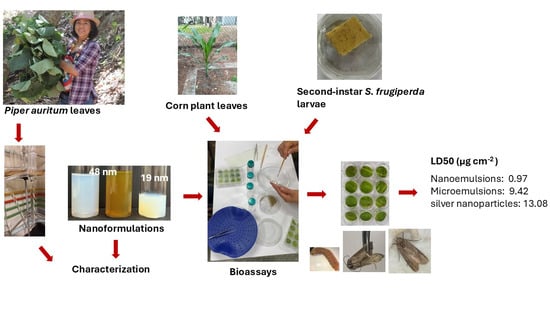
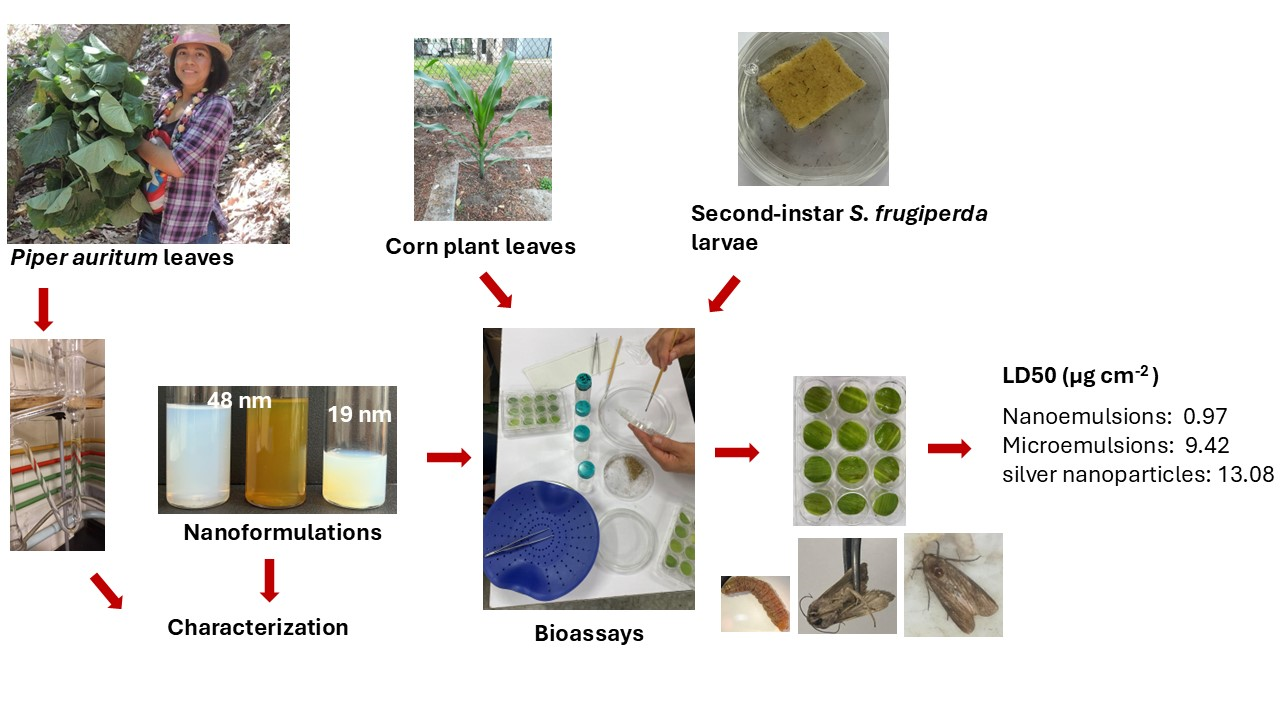
Spodoptera frugiperda (J.E. Smith) (Lepidoptera: Noctuidae) is an agricultural pest of global economic importance. Its ability to reproduce, adapt, and develop resistance necessitates the creation of effective and environmentally friendly alternative control strategies. This study aimed to evaluate the larvicidal activity of three nanoformulations (NFs) based on the essential oil (70% safrole) of Piper auritum Kunth (Piperales: Piperaceae), nanoemulsion (NE), microemulsion (ME), and silver nanoparticles (AgNPs), against second-instar larvae of S. frugiperda. The NFs were prepared using a combination of low- and high-energy methods, using Tween 80 and Span 80 as stabilizing agents. The droplet sizes of the NFs ranged from 19 to 48 nm. Stability analysis of the formulations maintained for 60 days in open systems at room temperature allowed the identification of remaining oxidized sesquiterpenes and phenylpropanoids. In in vitro bioassays, the NE demonstrated the highest larvicidal activity, with an LD50 of 0.97 µg cm−2, outperforming the other formulations by a factor of ten. Observations of morphological damage to larval and pupal tissues, along with deformation of adult specimens, confirming the toxicity of the NFs. These findings highlight the potential of essential oil-based NFs derived from P. auritum as sustainable biopesticides for integrated pest management.

Graphical Abstract

1. Introduction

Spodoptera frugiperda (J.E. Smith) (Lepidoptera: Noctuidae) is a polyphagous pest that primarily affects economically significant crops, especially corn, which can suffer losses of up to 60% if not controlled [1]. Once considered native to tropical and subtropical regions of the Americas, its remarkable migratory abilities have allowed it to spread to Africa, Asia, Oceania, and Europe, thereby threatening food security [2,3].
The rapid reproduction and expansion of S. frugiperda, along with its capacity to develop resistance to pesticides and other control measures [4,5,6,7], have led to the development of numerous control products and strategies over the past two decades [8,9,10,11,12,13]. Pesticides and Bt plants (genetically modified plants) are among the most notable products for their high effectiveness [11,14,15]; however, their high costs often limit accessibility for low-income farmers. As alternatives to conventional pesticides, phytochemical extracts and essential oils are gaining traction due to the wide range of potential applications [16,17].
Essential oils are composed of various groups of compounds, including terpenes, phenylpropanoids, and other plant-specific phytochemicals. These compounds enable essential oils to affect multiple physiological and behavioral mechanisms in insects, thereby reducing the risk of resistance development [18,19,20]. Although numerous studies have reported the effectiveness of essential oils in controlling insect pests, only a few products, such as neem oil and garlic oil, are currently marketed for field applications [16,17,21,22,23]. The limited commercial availability can be attributed to regulatory hurdles, variable oil composition influenced by origin and environmental conditions, availability of plant materials, and insufficient studies on formulations that ensure the stability of the oils [17,24,25].
Because of the lipophilic properties of essential oils, emulsification and encapsulation are the most suitable methods for their formulation [17,26,27,28]. Emulsification involves using surfactants to disperse the oils, while encapsulation requires an inert, and ideally biodegradable matrix to immobilize them. Emulsions with droplet sizes in the nanometer range have been shown to enhance the oil dispersion process, increasing both yield and efficiency [26,28]. Noteworthy benefits of nanoemulsions include improved chemical stability, enhanced dispersion in water, improved adhesion, increased permeability, and controlled release. They also help reduce the evaporation of volatile compounds, extending the oil permanence in the environment and minimizing leaching [28,29].
The Piperaceae family, specifically the genus Piper, is well known for its variety of phytochemical compounds that exhibit insecticidal, fungicidal, and repellent properties [30,31,32,33]. Species such as Piper nigrum L., Piper aduncum L., Piper guineense Schumach and Thonn, and Piper tuberculatum Jacq. have been extensively researched for their secondary metabolites, including isobutylamides, which function as neurotoxins in insects while remaining non-lethal to mammals [33,34,35]. These compounds exhibit various mechanisms of action, including contact toxicity, synergism, and antifeedant effects. Additionally, the essential oil derived from Piper plants contains components such as β-caryophyllene, limonene, and sabinene (phytochemicals reported to be larvicides), with concentrations that can vary depending on the extraction method [32,36].
The objective of this study is to develop and evaluate micro- and nanostructured formulations of the essential oil of Piper auritum Kunth (Piperales:Piperaceae) to determine their efficacy as sustainable biological pesticides for controlling second-instar larvae of Spodoptera frugiperda, a key pest in maize production. P. auritum belongs to the family Piperaceae and is abundant in agricultural systems, suggesting that its use in the development of bioinsecticides could be both feasible and promising. The formulation of nanoemulsions and silver nanoparticles is proposed to enhance the utilization and bioavailability of the phytochemical components. Although regulatory frameworks may present challenges for the commercialization of insecticides derived from phytochemical extracts, the high volatility of essential oils and their relatively short persistence in the environment may offer advantages that support the safe and effective application of such products [17,30].

2. Materials and Methods

2.1. Plants

Piper auritum Kunth (Piperales: Piperaceae) leaves were collected in September 2024 and May 2025 from the municipality of San Pedro Atoyac, Oaxaca (16°29′17″ N, 97°59′14″ W). This plant genus and species were previously reported by Jiménez-Durán et al. (2021) [37]. The leaves were washed with detergent and rinsed twice: first with plenty of tap water and then with sterilized distilled water. After being dehydrated at room temperature, the leaves were ground in a blender Oster Model BPST02-B00-013 (Newell Brands Inc., Atlanta, GA, USA) to a mesh size of 34 (0.45 mm). The ground leaves were stored in black plastic bags for ultra-freezing at −78 °C using a Ultra-Freezer model 9131 TSE320A (Thermo Fischer Scientific Inc., Waltham, MA, USA) until needed for use.

2.2. Essential Oil Extraction

The essential oil (EO) from the dehydrated leaves of P. auritum was extracted through hydrodistillation using a Clevenger apparatus. Extraction was performed in batches of 50 g of leaf powder immersed in 1 L of deionized water. The distillation lasted for 3 h at the boiling point of water. The recovered EO was dehydrated by passing it through a thick layer of anhydrous Na2SO4 (1 g) placed on a medium-pore filter paper. The EO adsorbed onto the Na2SO4 was subsequently recovered with HPLC-grade CH2Cl2, and the solvent was evaporated in a desiccator. From every 50 g of leaf powder, between 0.5 and 1 mL of EO was obtained.
The composition of th e EO was analyzed using a PERKIN ELMER SQ8S gas mass chromatograph model Clarus 580/SQ8S (PerkinElmer, Inc., Waltham, MA, USA) equipped with an Elite-5MS column (30 m × 0.25 mm × 0.25 μm) (1,4-bis(dimethylsiloxy)phenylenedimethylpolysiloxane). The injector temperature was set at 250 °C, with a helium flow rate of 0.5 mL min−1 and an ionization energy of 70 eV. The temperature program included two ramps: the first ramp started at 80 °C for 3 min, followed by a temperature increase to 180 °C at a rate of 5 °C min−1; the second ramp involved increasing the temperature to 280 °C at a rate of 10 °C min−1, maintaining the maximum temperature for 10 min. The analysis was performed using 3 μL of the oil samples. The mass spectrometer operated under the following conditions: transfer line temperature at 230 °C; source temperature of 250 °C, mass range of 30–500 m/z, and a solvent delay of 3 min. The NIST library version 6.0.0 was utilized as a reference for the tentative identification of the main compounds in the EO of P. auritum.

2.3. Piper auritum Essential Oil Nanoformulations

2.3.1. Nanoemulsion

An oil-in-water (O/W) nanoemulsion (NE) was prepared using the methodology described by Lemus de la Cruz et al. (2022) [38]. The NE (15 g) was prepared in a 40 mL glass vial, containing the following components in a ratio of 5:2.5:92.5: a surfactant mixture, P. auritum EO, and deionized water (DW), respectively. The surfactants used were ethoxylated sorbitan monooleate (TW80) (Tween® 80: P1754, HLB = 15) (Sigma Aldrich, Burlington, MA, USA) and sorbitan monooleate (SP80) (Span® 80: 85,548, HLB = 4.3) (Supelco/Sigma-Aldrich, Bellefonte, PA, USA), mixed in a ratio of 0.575:0.425 (analytical balance. OHAUS Explorer Pro EP214C) (Ohaus, Parsippany, NJ, USA). This mixture was homogenized with a magnetic stirrer at 1000 rpm and heated at 40–45 °C for 10 min (Heidolph, Schwabach, Baviera, Germany). Subsequently, the EO was added to the surfactant mixture under the same stirring conditions of temperature and duration. The temperature of the mixture was then increased to 73–75 °C, and the DW was added dropwise for 30 min while stirring at 1400 rpm.
The resulting emulsion was ultrasonicated using a Hielscher model UP200Ht ultrasound device (Teltow, Germany) with a 7 mm sonotrode, applying 40 W and 80% amplitude in 2 min cycles until a clear bluish emulsion was achieved. The droplet size of the NE was measured using dynamic light scattering (DLS) on a Malvern Zetasizer Nano ZS90 (Malvern Instruments Ltd., Worcestershire, UK). Measurements were conducted at room temperature, with each reading taken in triplicate.

2.3.2. Microemulsion and Silver Nanoparticles

A total of 1000 µL of a 0.1 M silver nitrate solution (0.1 M AgNO3) was added to 25 mL of an EO microemulsion (ME) at pH 10.3, which was adjusted using 1 N NaOH (pH meter: Eutech, Oakton) (Eutech Instruments Pte. Ltd., Singapore). The mixture underwent silver reduction under controlled stirring at 1400 rpm and a temperature of 80 °C (Heidolph, Schwabach, Baviera, Germany) for approximately one hour. The ME was prepared by dispersing 100 µL of EO in 25 mL of DW, along with 5 drops of TW80 as a surfactant. The oil-in-water dispersion was achieved using an IKA T18 DS1 Ultraturrax set to 20,000 rpm for 10 min (Digital Laboratory Equipment, Staufen, Germany). Greater dispersion was attained by applying ultrasound in 2–3 cycles of 2 min each at 40 Watts and 80% amplitude. The composition of the ME was developed based on a previous study aimed at increasing the concentration of silver nanoparticles (AgNPs). This was achieved by recording the absorbance of AgNP solutions prepared with varying volumes of EO (50–100 µL), 0.1 M AgNO3 solution (800–1000 µL), and increasing the number of TW80 drops (0–5). The selection criterion was the maximum peak height of the nanoparticle solution recorded at wavelengths between 420 and 440 nm (see Supplementary Figure S1). Nanoparticle size and concentration were indirectly measured by assessing absorbance at 460 nm using a UV-visible spectrophotometer GENESYS 10UV (Thermo Spectronic, Rochester, NY, USA). Nanoparticle shapes were observed using transmission electron microscopy (TEM). Samples (10 µL) were deposited onto copper grids for 2 min, negatively stained with phosphotungstic acid (pH 7.0), dried, and subsequently observed directly in a JEM-1400 TEM (JEOL, Peabody, MA, USA) [38].

2.3.3. Stability of Piper auritum Essential Oil in Formulations

This study was conducted using EO extracted from P. auritum leaves collected in May 2025. The EO composition in the different formulations was determined in duplicate using 2 mL samples poured into 6 cm Petri dishes left uncovered and maintained at room temperature for 7, 15, 30, and 60 days. At the end of each period, the samples were resuspended in sterile deionized water and transferred to 4 mL amber glass vials. The vials were sealed with septa secured by metal rings and stored at −4 °C until further analysis. The EO composition in the different nanoformulations was determined by solid-phase microextraction (SPME) using a 50/30 μm DVB/CAR/PDMS (24 Ga) microfibril [39]. The sample was heated for 15 min at 85 °C, followed by a 15 min adsorption step with the microfibril and a 10 min desorption step in the GC/MS at 250 °C. The samples were analyzed by gas chromatography–mass spectrometry as described in Section 2.2.

2.4. Bioassays

Bioassays were conducted in vitro using second-instar larvae of Spodoptera frugiperda (J.E. Smith) (Lepidoptera: Noctuidae), which were raised by Professor Laura Patricia Lina-García, a researcher at the Biotechnology Research Center of the Autonomous University of the State of Morelos (CEIB-UAEM), Mexico. The bioassays were performed in quadruplicate on sterilized 12-well polystyrene plates, each prepared with 2 mL of agar-agar (16%). The setup included circles of medium-pore filter paper (2 cm in diameter) and circles of corn leaves (also 2 cm in diameter) impregnated with the different nanoformulations. These formulations were tested at concentrations based on the EO of P. auritum, ranging from 0.055 to 54.743 µg cm−2 (26 to 26,000 ppm) for the NE, and from 9 to 35 µg cm−2 (4160 to 7280 ppm) for both the ME and NP treatments. The corn leaves, approximately 0.5–1.0 m in length, were collected from the crop field of the Faculty of Agricultural Sciences of the UAEM. The leaves were washed with detergent, then rinsed thoroughly first with tap water and then with sterilized distilled water. After draining, 2 cm diameter circles were punched from the leaves using a hole punch. These circles were immersed in the different nanoformulations for 1 min according to the treatment (NE, ME, or NP) and the concentration. Excess emulsion was removed before placing a leaf circle into each well of the polystyrene plates. A second-instar S. frugiperda larva was then placed on top of each corn leaf circle. The plates were covered with transparent plastic wrap, and a small perforation was made in each well to allow air circulation. A paper towel was placed over the plastic wrap, along with the plate lid, which was secured with rubber bands to prevent the larvae from escaping. The larvae were reared at 25 ± 2 °C, 80 ± 5% relative humidity, and 18/6 photoperiod. Larvae were observed every 24 h until they metamorphosed into pupae, and later into adults; during this time, the number of live and dead larvae was registered. Control experiments included deionized water, a surfactant mixture (TW80-SP80), and, as a positive control, the essential oil solubilized in 70% ethanol. These control bioassays were also performed in quadruplicate. Bioassay results were analyzed to construct mortality curves of S. frugiperda for the different formulations and to determine the LD50 values by the probit method.

2.5. Contact Toxicity and Repellent Effects

The contact toxicity and repellent effects of P. auritum essential oil formulations were assessed in vitro using glass Petri dishes (6 cm diameter). In both studies, carried out in duplicate, ten second-instar S. frugiperda larvae from each treatment were placed in separate containers. To evaluate the contact toxicity effect, 1 µL of each formulation, at a concentration near their LD50, was applied to the back of each larva. The larvae’s reactions to the formulations were observed using a Leica MZ6 stereomicroscope (Leica Microsystems, Wetzlar, Germany). For the evaluation of the repellent effect, two half-corn leaf circles were placed in a Petri dish: one treated with the respective formulation and the other untreated. A second-instar S. frugiperda larva was placed between the two half-circles, and its direction of movement was observed, indicating whether it moved toward the leaf with or without the nanoformulation; it was recorded whether the larvae ingested either or both leaves to feed themselves, or whether they died of starvation. In both studies, deionized water served as the negative control, while dehydrated EO acted as the positive control.

2.6. Statistical Analysis

The analysis of EO samples and their formulations was conducted in triplicate using independent samples. The bioassays were performed in quadruplicate, with a total of 48 larvae per treatment. The lethal dose (LD50) was determined using the probit method. In the study examining the effects of contact toxicity, repellency, and antifeedant, a total of 10 larvae were used for each formulation and per repetition (duplicate treatments): nanoemulsion (NE), microemulsion (ME), and nanoparticles (NP), as well as for the control groups (deionized water and essential oil solubilized in 70% ethanol). Statistical analysis, including one-way or two-way ANOVA, as well as mean comparisons with the Tukey test (α < 0.05), was performed using PASW Statistics 18 (version 18.0.0).

3. Results

3.1. Piper auritum Essential Oil

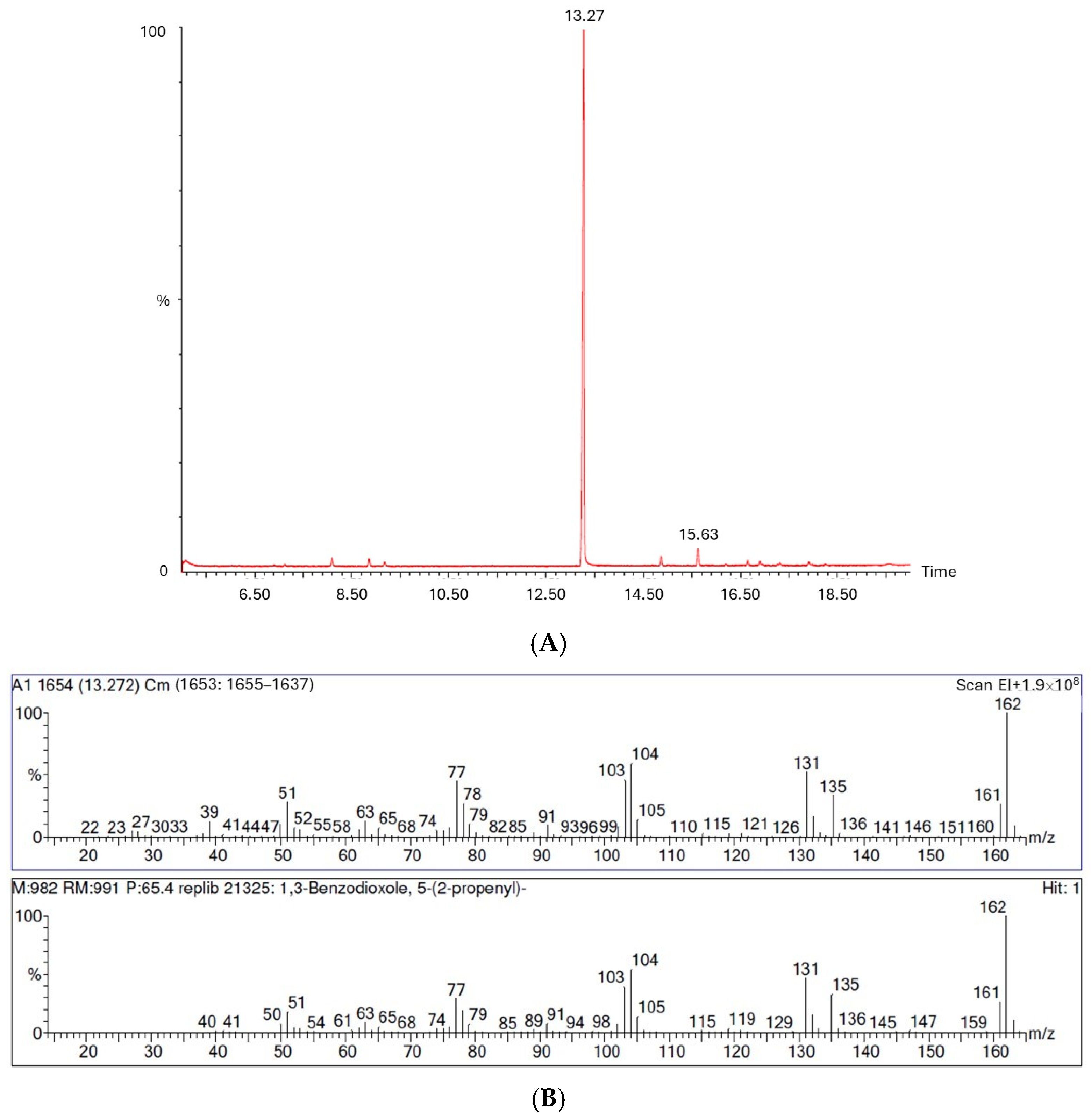
Table 1 presents the compounds identified in the EO extracted from P. auritum leaves collected in September 2024 and May 2025, with concentrations exceeding 1%. In both oils, safrole was the predominant component, accounting for 70% and 54%, respectively. The GC-MS spectrum of safrole is shown in Figure 1. The identified compounds mainly belong to the monoterpene, oxidized monoterpenes, sesquiterpene, oxidized sesquiterpenes, and phenylpropanoid families. During the first hour of the extraction process, the oil appeared colorless, but it subsequently changed to a light-yellow color. The notable difference in the diversity of compounds detected at concentrations greater than 1% may be attributed to the season in which the leaves were collected.

3.2. Silver Nanoparticles

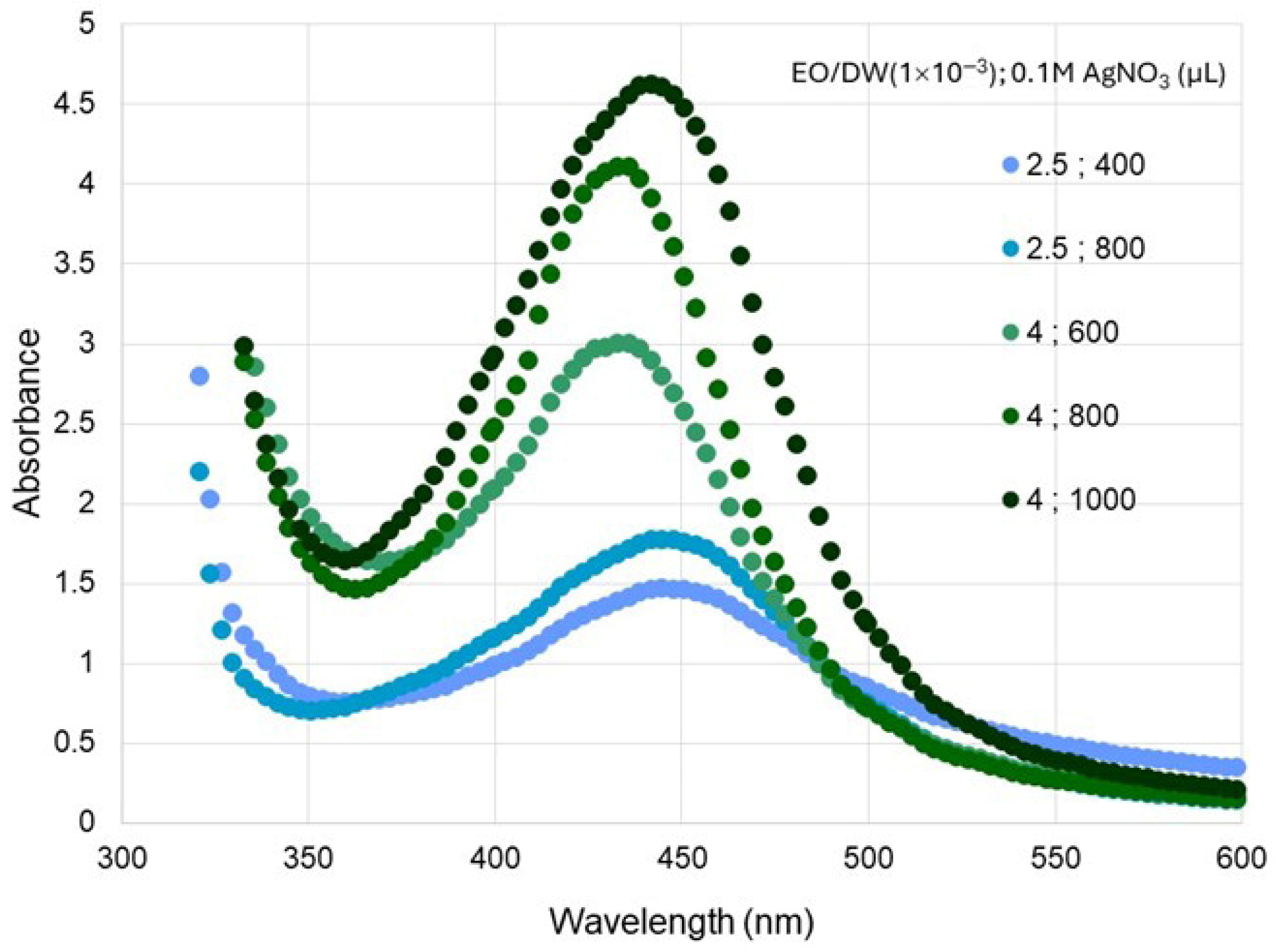
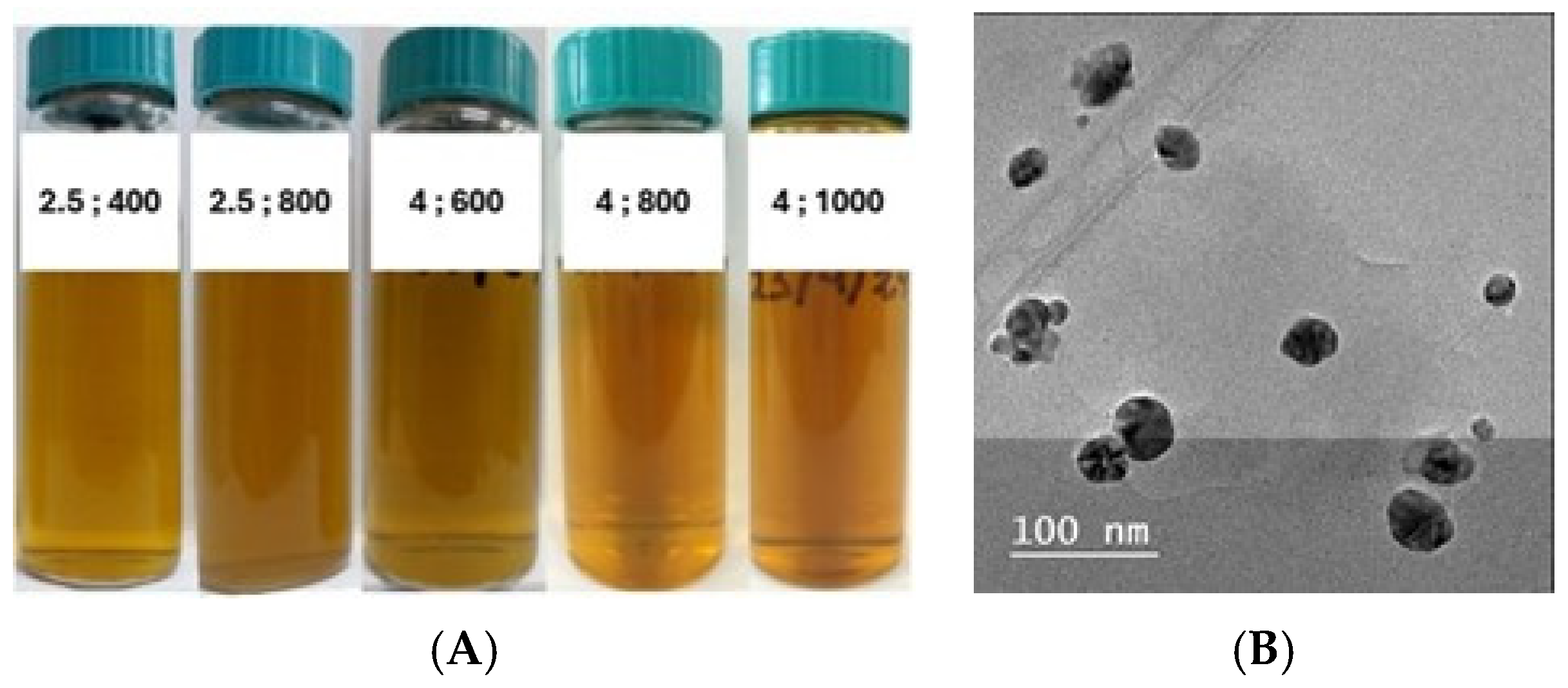
The absorbance curves of the AgNP solution, produced by the effect of the variation in the essential oil/deionized water (EO/DW) ratio and the volume of a 0.1 M AgNO3 solution, are presented in Figure 2 and Figure 3, with the appearance of these solutions, as well as the shape of the silver nanoparticles produced. For an EO/DW ratio of 2.5 × 10⁻³, increasing the volume of the 0.1 M AgNO3 solution from 400 to 800 µL resulted in a 21% increase in absorbance. When the EO/DW ratio was set to 4 × 10⁻³, increasing the AgNO3 solution volume from 400 to 600 µL resulted in a 37% increase in absorbance. A further 12% increase in absorbance was achieved by raising the volume of the AgNO3 solution from 600 to 800 µL; however, this change also produced a slight positive shift in the wavelength, indicating an increase in the diameter of the AgNPs.
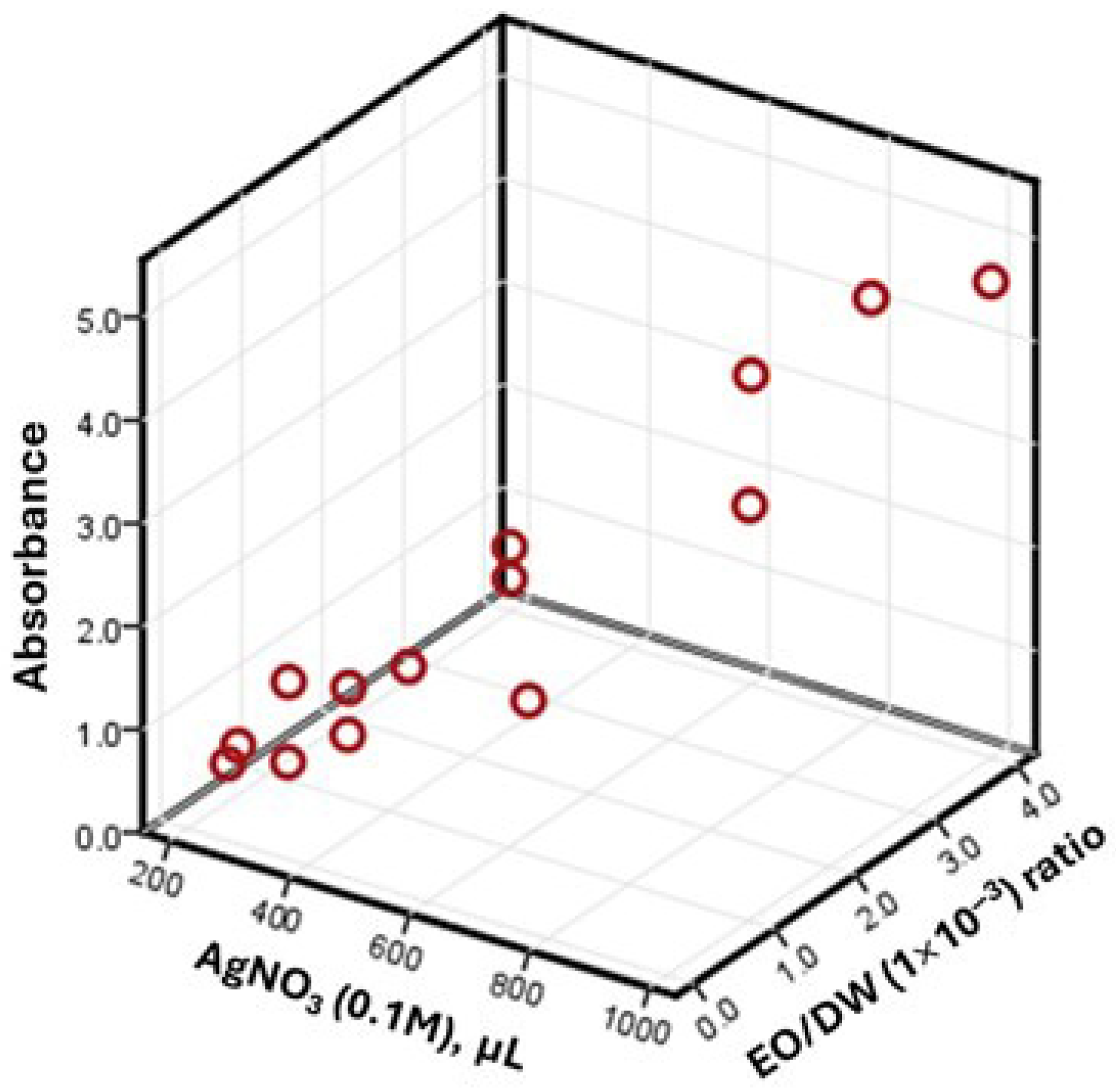
The relationship between the absorbance of the AgNP suspension, the EO/DW ratio, and the volume of the 0.1 M AgNO3 solution is illustrated in Figure 4. The correlation between absorbance and these two variables showed a linear trend, with R2 values of 0.86 and 0.88, respectively (Supplementary Figure S2).

3.3. Characteristics of the Piper auritum Essential Oil Formulations

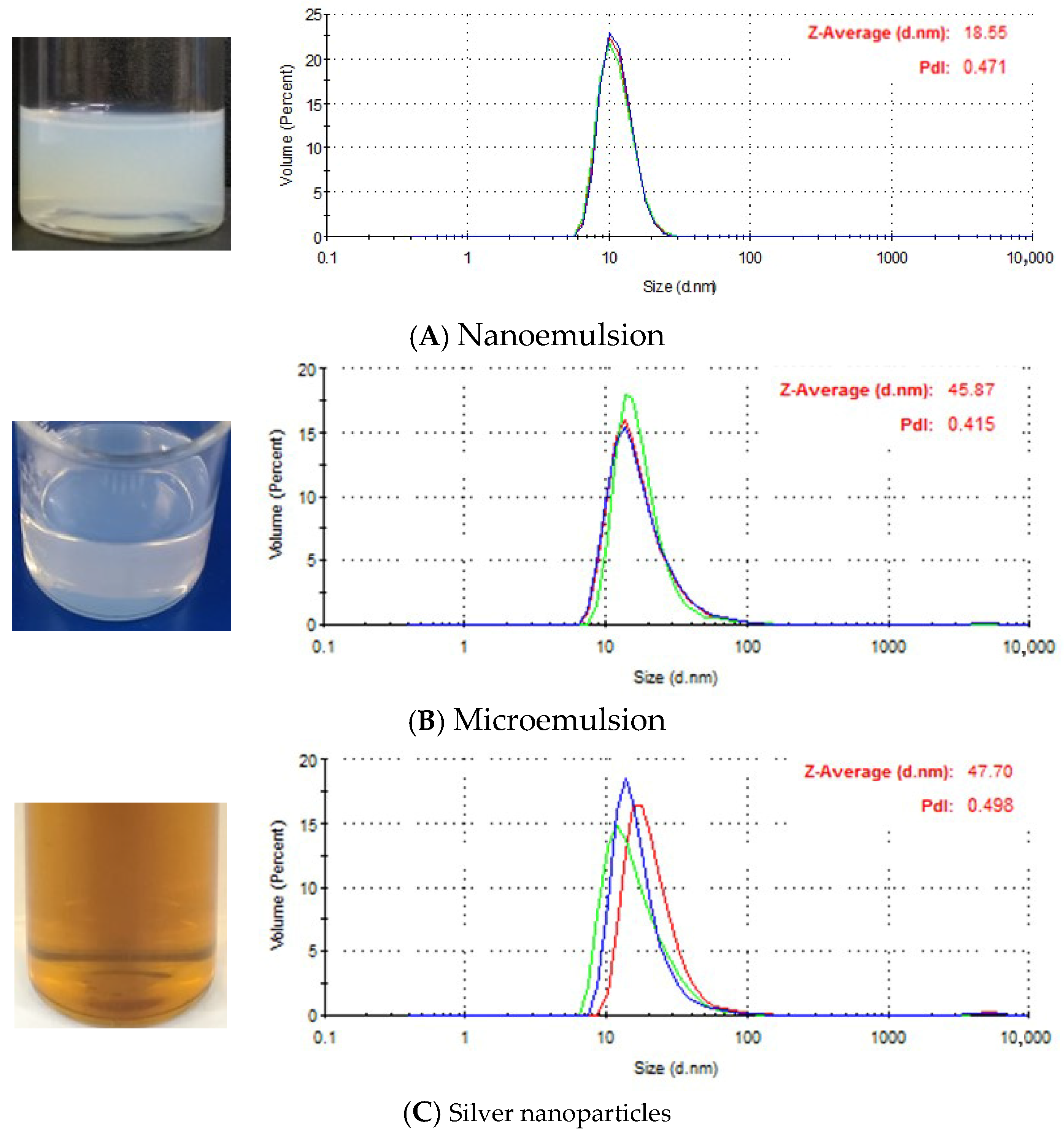
The characteristics of the NE, ME, and AgNP formulations are illustrated in Figure 5, which includes the corresponding Dynamic Light Scattering (DLS) diagrams. These diagrams help visualize the mean droplet (or AgNP) diameter and its polydispersity index. The mean droplet diameter for the nanoemulsion was recorded at 18.6 nm, while the microemulsion measured 45.6 nm; their polydispersity indices were 0.471 and 0.415, respectively. For the AgNPs, the average diameter was 47.7 nm, with a polydispersity index of 0.498. Regarding zeta potential, values were recorded close to zero, at approximately ±0.05 mV. Importantly, there were no visible changes in the appearance of the different formulations after 12 months of storage at room temperature. The observed appearance and texture were consistent with the expected fluid types: the NE displayed a translucent appearance with a bluish opalescence, the ME was transparent, and the AgNPs appeared ochre. The viscosity measurements were approximately that of water, at around 0.9 cp.

3.4. FTIR Spectra

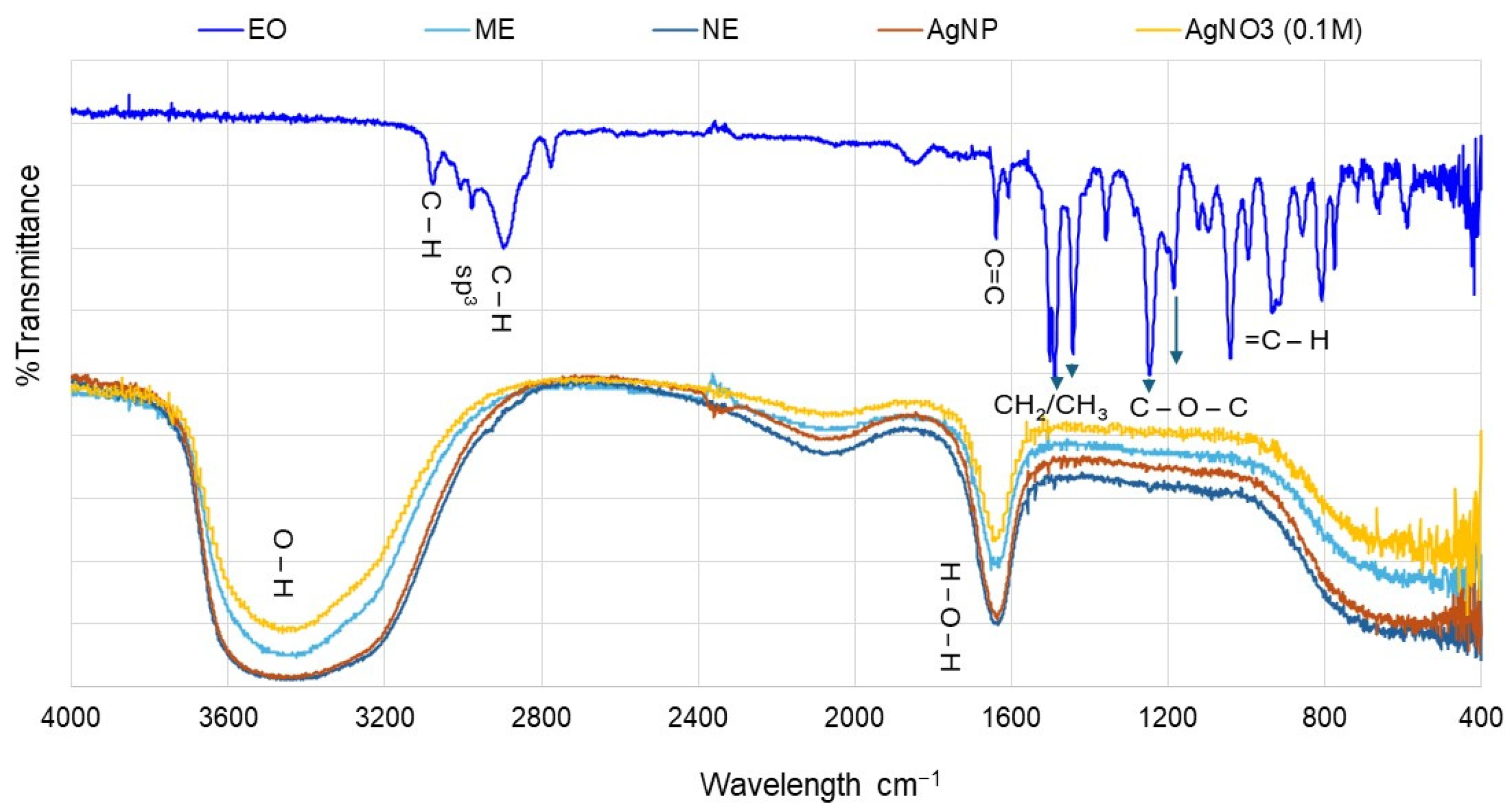
The FTIR spectrum of P. auritum Kunth EO, both in its pure form and in formulations, is presented in Figure 6. The signals observed between 1030–1250 cm−1 correspond to C–O–C/C–O stretching of the methylenedioxy group, while the range of 2980–2840 cm−1 is associated with C–H stretching in aliphatic compounds. A peak at 1639 cm−1 indicates olefinic C=C stretching, and the band at 996 cm−1 represents an out-of-plane vibration typical of terminal alkenes. The range of 929–915 cm−1 corresponds to =C–H bonds in olefinic molecules, and the signals between 856–715 cm−1 reflect C–H bonds in aromatic rings. These types of bonds confirm the presence of monoterpenes and sesquiterpenes. FTIR analysis of the EO formulations primarily revealed characteristic signals related to the surfactant-water bond, as well as signals from water itself, which is the dominant substance in all formulations. Specifically, the peaks between 3100–3700 cm−1, corresponding to O–H stretching (both asymmetric and symmetric), and the peak at 1640 cm−1 represent H–O–H bending. A shoulder observed in the 1900–2300 cm−1 range could indicate a combined band (ν2 + libration), which is typical of liquid water [40]. Supplementary Figure S3 shows the FTIR spectra of solid and 0.1 M silver nitrate solution. In the spectrum of silver nitrate in solution, as well as in the suspension of AgNPs, the characteristic signal of the nitrate ion at 1370 cm−1 was absent (Supplementary Figure S3) [41]. The absence of this signal supports the predominance of water in the spectra of the formulations.

3.5. Composition of the Piper auritum Essential Oil in Formulations and Stability

The composition of the EO in the different formulations is presented in Table 2, together with that of the EO used for their preparation. When comparing the initial EO composition across formulations, the fraction of monoterpenes decreased markedly, and some were completely lost in the ME and AgNP formulations. Only the NE retained a broad range of compounds, but at lower concentrations, averaging 80 ± 30% of the initial content. The greater loss of phytochemicals observed in the ME compared with the NE may be related to the use of a single surfactant, Tween 80 (TW80), at a low concentration (1%), which could have resulted in less effective oil protection. In addition, the increased proportion of safrole in two of the three formulations may be explained by its low volatility, as evidenced by its vapor pressure of 0.06 mmHg at 25 °C (Safrole. Report on Carcinogens, Fifteenth Edition; https://ntp.niehs.nih.gov/research/assessments/cancer/roc, accessed on 3 January 2026).
The periodic analysis of the EO composition in the different formulations is summarized in Table 3. The data indicate that the monoterpene fraction was not detected in any formulation by day 7. By day 15, three phytochemicals were identified in the AgNP formulation, four in the ME, and six in the NE, predominantly from the sesquiterpene and phenylpropanoid groups. In the NE, four of the six phytochemicals remained detectable by day 60, whereas in the ME, only safrole was still present. It is possible that other phytochemicals persisted in the formulations but at concentrations below the detection limits of the chromatographic methods used in this study. Overall, these results suggest that the NE is the most suitable formulation for maintaining EO stability during the period of biological activity of the formulation, as discussed below.

3.6. Larvicidal Activity of the Piper auritum Essential Oil Formulations

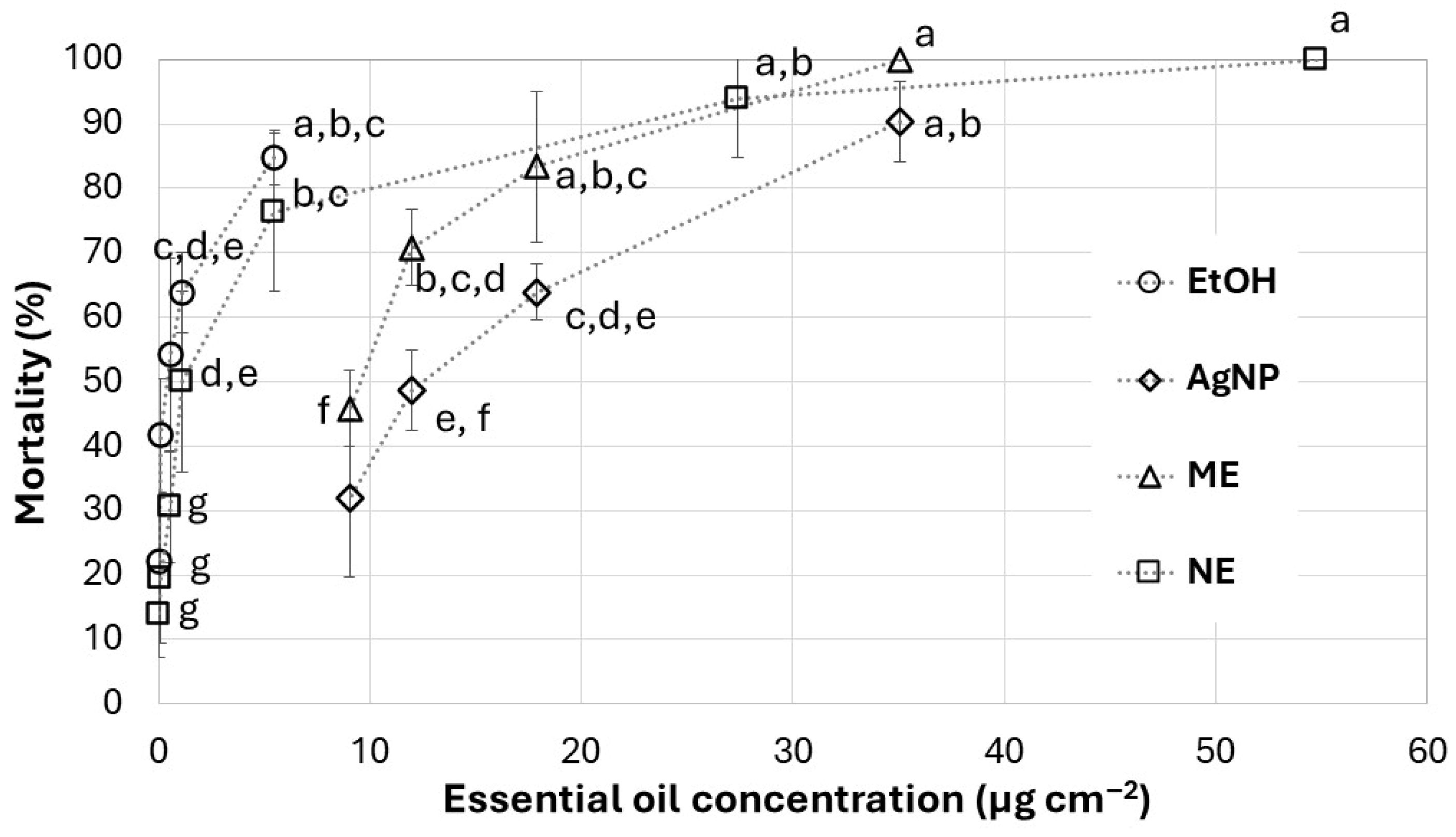
Figure 7 shows the larvicidal activity of the different P. auritum EO formulations against second-instar S. frugiperda larvae, with the EO solubilized in 70% ethanol used as the control. ANOVA was conducted to evaluate the effects of EO concentration within each formulation and the formulation type on larval mortality, revealing significant differences at p < 0.05 (EO concentration: F = 64.613; df = 11; p = 0.0001; χ2 = 0.895; formulation type: F = 138.789; df = 1; p = 0.0001; χ2 = 0.626). The interaction between EO concentration and formulation type was also significant (F = 3.864; df = 4; p = 0.006; χ2 = 0.157).
Probit analyses indicated good model fit for all formulations (p > 0.84), supporting the reliability of the estimated LD50 values as shown in Table 4. The highest larvicidal activity was observed in the NE formulation of the EO, with an LD50 of 0.97 µg cm−2, a moderate slope (0.9422), and an adequate chi-square value (χ2 = 26.724; df = 35; p = 0.841). This LD50 was approximately ten times lower than that calculated for the AgNP formulation (13.08 µg cm−2; slope = 2.8251; χ2 = 11.215; df = 30; p = 0.999) and lower than that of the ME (9.42 µg cm−2; slope = 3.54; χ2 = 2.708; df = 6; p = 0.844). Although the ME and AgNP formulations exhibited lower lethality than the NE, their comparatively steeper slopes indicate more homogeneous mortality responses at increasing concentrations, as shown in the probit analyses. Overall, these results confirm that the NE is the most potent formulation; however, the ME and AgNPs remain effective, as evidenced by the steeper concentration–response transitions reflected in their probit curves.
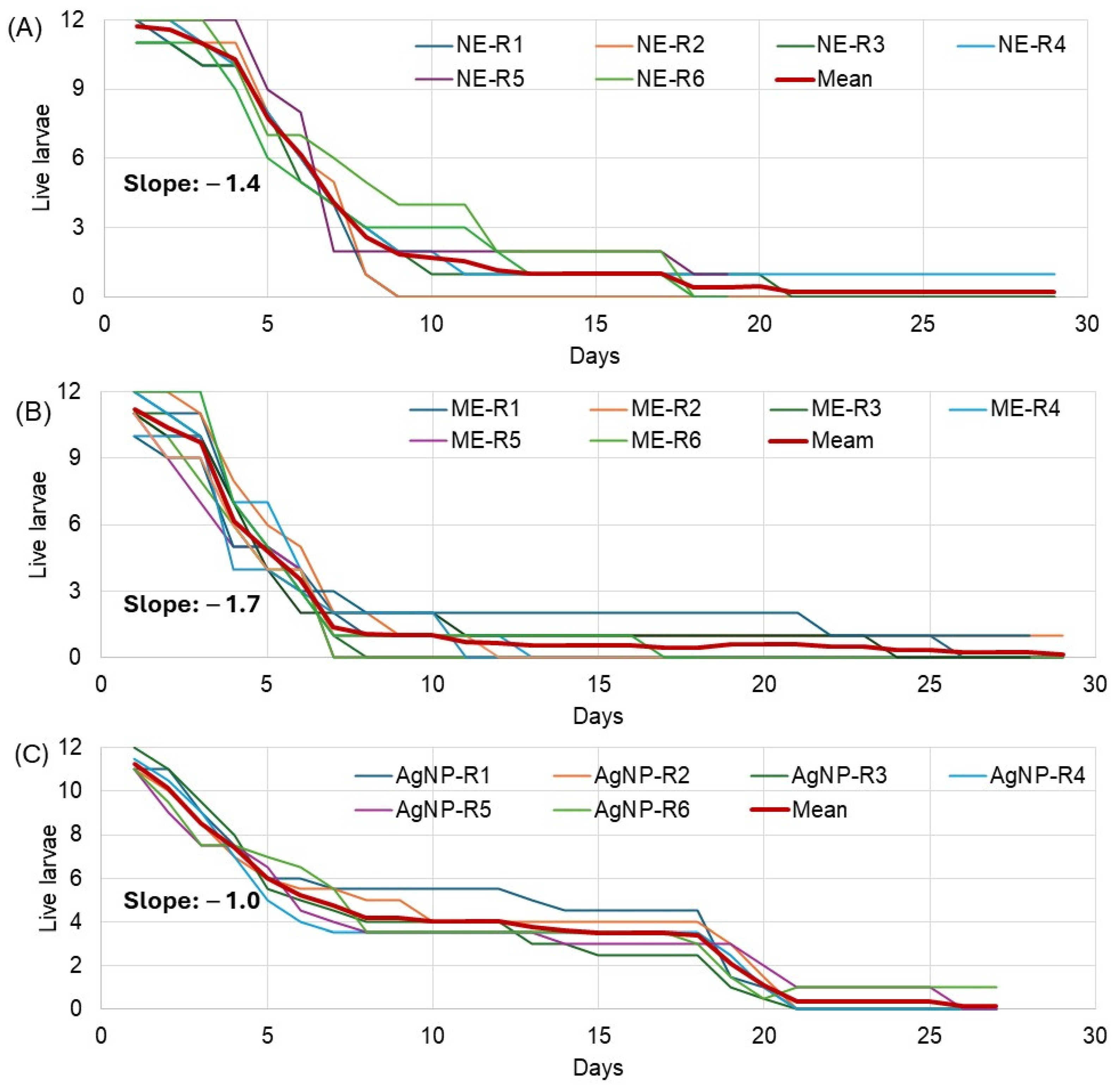
The survival curves of second-instar Spodoptera frugiperda larvae exposed to different formulations of Piper auritum essential oil at concentrations close to their LD50 are shown in Figure 8. The calculated slopes of the curves indicate the following order of response time during the first 7 days of larval exposure: ME < NE < AgNPs. At the LD50 level, NE and AgNPs achieved 100% control of S. frugiperda larvae within 20 days, whereas ME required approximately one additional week. The longer time required by ME may be associated with its lower relative content of the phytochemical groups identified (Table 2 and Table 3).

3.7. Biological Activity of Piper auritum Essential Oil in a Nanoemulsion Formulation

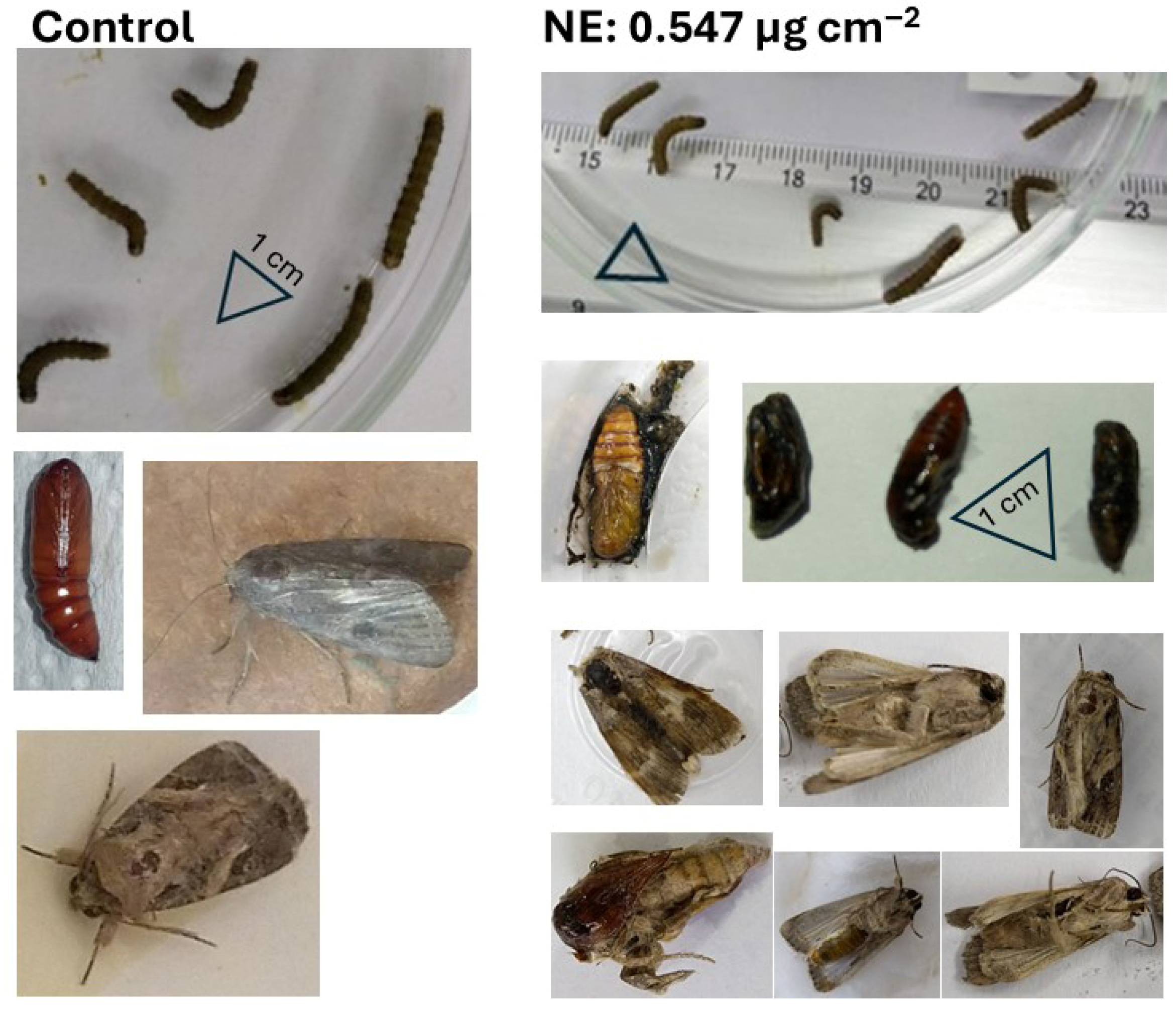
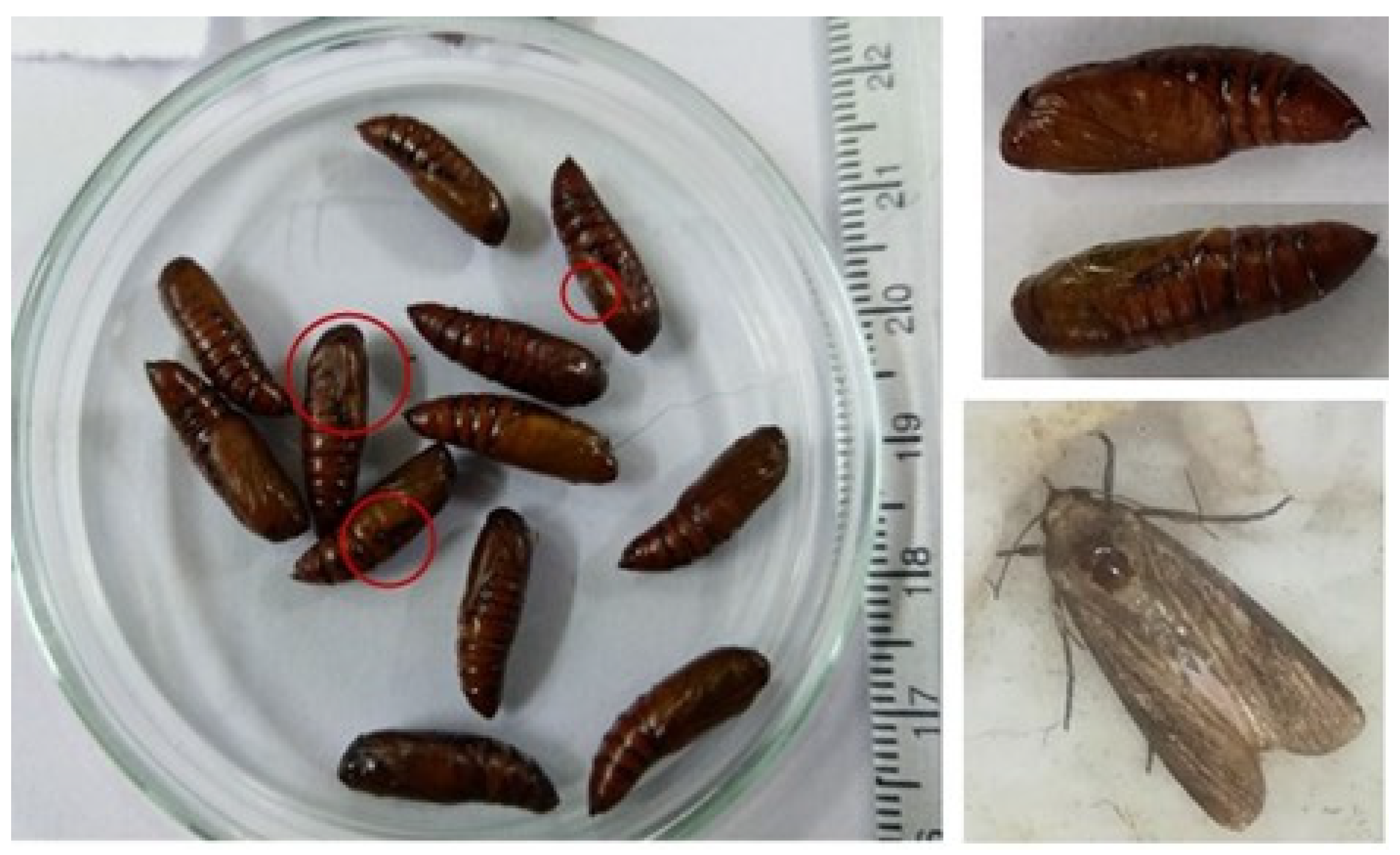
Exposure of second-instar S. frugiperda larvae to an NE concentration of 0.547 µg cm−2—below the LD50 value of 0.97 µg cm−2—resulted in a noticeable reduction in larval thickness and length (Figure 9). Mortality and malformation occurred in 35% of the pupae. Surviving pupae produced adults that exhibited various deformities, and even those that appeared externally normal developed a distinct red dorsal protuberance (Figure 10), which was observed in both male and female specimens. The duration of the developmental stages was recorded as follows: larval stage, 18–22 days; pupal stage, 12–13 days; and adult stage, 6–11 days. The longest duration recorded in larvae and adults corresponds to the control group; no variations in pupal stage duration were observed between treated and untreated specimens. For each oviposition event, females in the control group laid between 60 and 200 eggs, whereas females in the treatment group laid approximately 100 to 120 eggs per event. This latter estimate is approximate because the eggs produced by adults previously exposed to the NE were covered with a thick layer of scales (Supplementary Figure S4).

3.8. Contact Toxicity and Repellent Effects

The formulations applied to the larvae’s backs triggered a flight response as they sought to escape the toxic liquid. Subsequently, the larvae’s mobility decreased, and they exhibited spasmodic movements and mouth-opening (Figure 11). Finally, the larvae remained in one place and died. The intensity of the convulsions induced by the formulations, from highest to lowest, was as follows, EO > ME > NE > NP, with the following times of death: 2.2 ± 2.8, 6.2 ± 3.1, 8.6 ± 3.6, and 4.4 ± 1.1 min, respectively. The faster rate of the toxic effect of EO and the slower rate in NE suggest that the formulation activity could be determined by the release time of EO from the EO droplets enveloped by the surfactants.
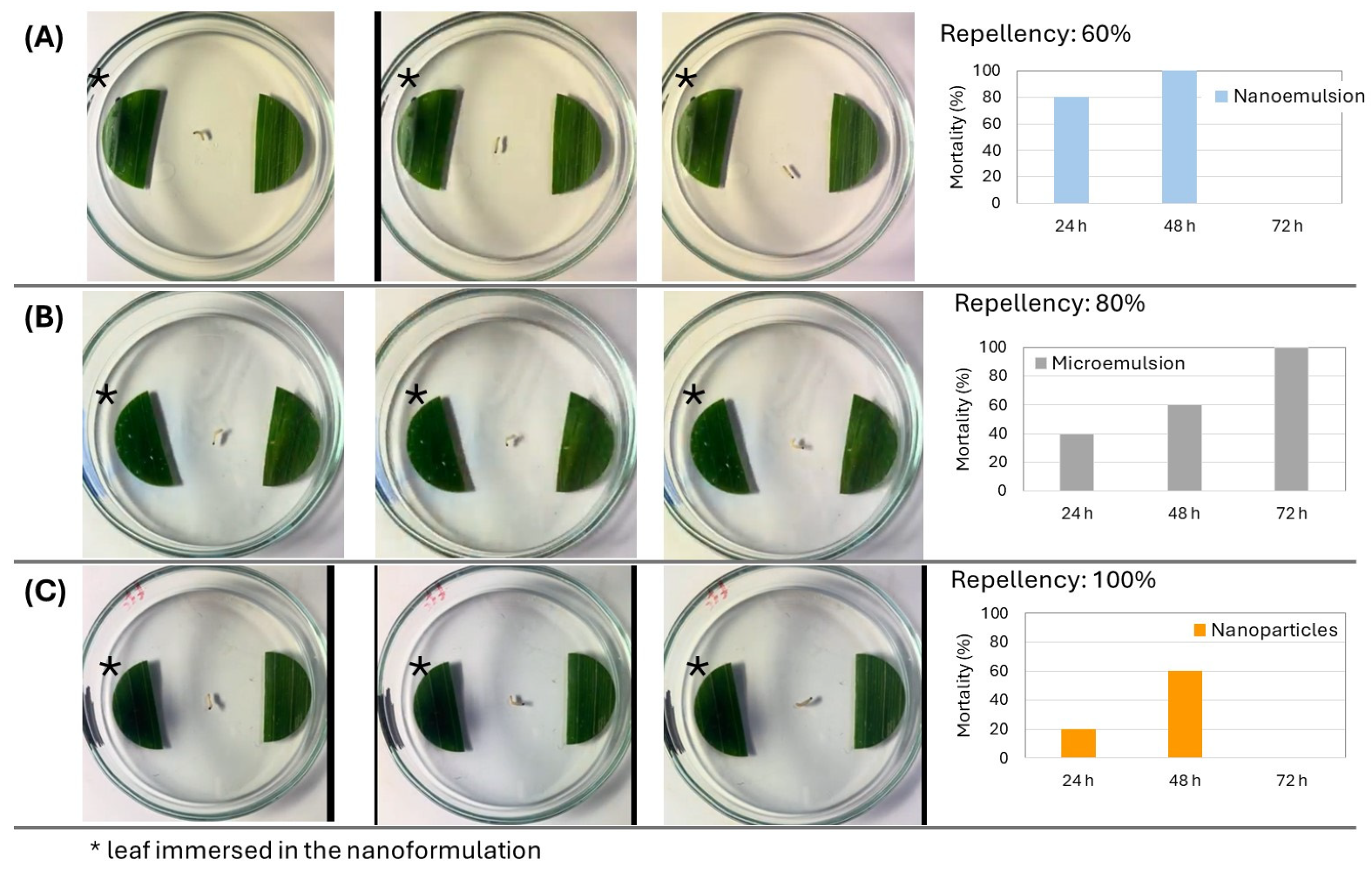
The repellent effect of the formulations followed the following order, AgNPs > ME > NE, with percentages of 100%, 80%, and 60%, respectively (Figure 12). These results suggest that the surfactant mixture encapsulating the EO in the NE decreases the rate of EO release and, consequently, its low perception by the larvae. Although the AgNPs are synthesized with microemulsified EO, the greater repellent activity of the AgNPs could be explained by a change in the TW80-EO-Water bonds during the incubation process of the formulation at 80 °C for Ag reduction.
In the experiment with the ME formulation, 20% of the larvae did not consume any leaves, while 40% fed exclusively on corn leaves without the formulation. The remaining larvae ingested both leaves: the one treated with the ME formulation and the one without it. In the experiment with the NE formulation, 40% of the larvae nibbled a little bit of corn leaves without formulation, and the remaining 60% both types of leaves. In the experiment using leaves impregnated with AgNPs, all larvae (100%) ingested both leaves treated and leaves not treated with AgNPs. Of all these larvae, 60% died within 48 h, while the survivors remained smaller by day 20. The percentage of larvae that died during the first 72 h in these experiments is shown in Figure 12.

4. Discussion

Safrole was the predominant compound found in the essential oil of P. auritum, aligning with findings from other researchers who reported concentrations ranging from 64% to 93% [31,32]. The remaining components of the essential oil, including the number and concentration of monoterpenes and sesquiterpenes, are generally consistent with the existing literature. Specifically, the production of monoterpenes tends to be higher during warmer months (spring and summer), while the production of sesquiterpenes is favored during the rainy and cooler months (autumn and winter). In contrast, the production of phenylpropanoids is reported to remain stable throughout the year. These variations in the production of different phytochemical groups across seasons are linked to their respective functions, which include acting as repellents (monoterpenes), insecticides (sesquiterpenes), and exhibiting antimicrobial properties or serving as sunscreens, structural agents, and stress relief agents (phenylpropanoids, sesquiterpenes, and monoterpenes) [42,43]. The repellent and larvicidal properties of the identified monoterpenes and sesquiterpenes have been documented in various studies, including Haselton et al. (2015) [44] with Musca domestica, Chaudhary et al. (2011) [45] with Plutella xylostella, and Benelli et al. (2017) [46] and Huong et al. (2019) [47] focusing on larvae of different mosquito species.
Nanoemulsification of EOs using surfactants has proven effective for dispersing oily substances in pest management of crops [48]. The choice of surfactant is crucial in nanoemulsion preparation as it influences both droplet size and emulsion stability; smaller droplet sizes lead to better oil dispersion. In this study, a mixture of TW80 and SP80 surfactants at a ratio of 0.575:0.425 was used to nanoemulsify P. auritum essential oil, resulting in a droplet size of 19 nm. The results were comparable to those reported by Lemus de la Cruz et al. (2022) [38], who studied the emulsification of the essential oil of Cedrela odorata L. The TW80–SP80 mixture has also been utilized by Eid and Hawash (2021) [49] in the emulsification of pure safrole, although they used different proportions: 51.2% TW80, 12.8% SP80, and 36% safrole oil, yielding a droplet size of 116.17 nm. The emulsification of essential oil using the TW80-SP80 surfactant mixture is noteworthy because it allows for the creation of stable emulsions with various lipophilic substances, including petroleum [50,51]. Zeta potential values of −30 mV are an indicator of nanoemulsion stability when ionic surfactants are employed. However, in cases where nonionic surfactants are used, as in this study, the zeta potential approaches zero [52]. In this scenario, stability is attributed to the dominance of steric effects over electrostatic effects, as noted by Debraj et al. (2023) [50].
In the green synthesis of AgNPs, using essential oils, emulsifying the oils with both synthetic and natural surfactants has proven to be an effective strategy for reducing silver ions [53,54,55,56]. In this study, we successfully emulsified the EO in DW at a ratio of 2 × 10⁻³ and 4 × 10⁻³, using five drops of TW80 (approximately 1%). Previous studies by Hongfang et al. (2017) [57] and Wang et al. (2021) [58] have reported higher concentrations of TW80, ranging from 2% to 8%, for the emulsification of clove oil and Litsea cubeba oil, respectively. It has been noted that silver ions can oxidize TW80 during the reduction process, leading to the production of metallic silver. However, even though this method is environmentally friendly, it requires a high energy input and may produce an unstable colloidal system [59]. In our research, we observed that increasing the EO to DW ratio amplified the absorbance of the AgNP solution. We hypothesize that the EO from P. auritum acts as the reducing agent for the silver ions. Our aim in increasing both the EO and AgNP concentrations was to achieve a lethal concentration that would affect at least 50% of the S. frugiperda larvae. The concentration of AgNPs was assessed indirectly through absorbance measurements, as attempts to separate AgNPs by centrifugation and lyophilization resulted in agglomeration and low recovery rates [60].
The effectiveness of essential oils in controlling insect pests is often questioned due to their volatility and the presence of high levels of toxic compounds, such as safrole [25]. In a study assessing safrole concentrations in corn kernels stored for 90 days, Siqueira-Ferraz et al. (2021) [39] reported a 90% reduction in safrole within the first 5 days, leaving only 1% of the initial amount (0.052 µg kg−1 for contact application and 0.12 µg kg−1 for fumigation) after 90 days. These authors concluded that essential oils with high safrole content can still be used effectively because of the substantial evaporation losses and the low concentrations that remain over time. In the present study, the reduced detection of phytochemicals in formulations exposed to open environments at ambient temperature further supports these findings. Specifically, after 7 days of exposure, concentrations of various phytochemical groups decreased by more than 90% compared to their initial levels. After 15 days, only oxygenated sesquiterpenes (such as geranylinalool) and phenylpropanoids (safrole and myristicin) remained, but at a maximum concentration of less than 15% of the remaining compounds. Overall, the percentage of residual phytochemicals dropped below 1.5% after this period. The residence time of P. auritum EO in the formulations appears to be adequate, given that 50% of the pest population can be effectively controlled in less than 7 days, as shown by the longevity curves presented in the Results Section 3.6.
Studies on plants of the genus Piper have highlighted their potential for insect pest control due to the fungicidal, larvicidal, insecticidal, repellent, and antifeedant activities observed in both their phytochemical extracts and essential oils [18,32,33,61,62,63]. In the present study, the essential oil extracted from dehydrated leaves of P. auritum exhibited larvicidal activity, with LD50 values ranging from 0.97 µg cm−2 (460 ppm) to 13 µg cm−2 (5247 ppm), depending on the formulation. The highest larvicidal activity was observed in the NEs. These results are consistent with those reported by Luneja and Mkindi (2025) [64], who demonstrated that nanoemulsification enhances the solubility and dispersion of essential oils while promoting the penetration of nano-sized droplets through the insect cuticle. Control of S. frugiperda using safrole-rich essential oils was previously reported by Lima et al. (2008) [65]. In their study, Piper hispidinervum essential oil (82% safrole) was solubilized in acetone and applied to first- and third-instar larvae of S. frugiperda, resulting in LD50 values of 16.2 mg mL−1 (16,200 ppm) and 9.4 mg mL−1 (9400 ppm), respectively. The higher activity of P. auritum EO observed in the present study may be attributed to the improved dispersion of the oil within the nanoemulsion. However, it is important to note that the diversity and interaction of phytochemical constituents also play a critical role in determining the biological activity of essential oils [66,67].
Usseglio et al. (2023) [18], who evaluated the use of EOs as natural alternatives for the control of S. frugiperda, identified the genus Piper as the most extensively studied for managing this pest. Their analysis showed that EOs obtained from the same genus or even the same plant species may exhibit markedly different levels of toxicity, depending on the application method and the chemical composition of the oil (Supplementary Table S1; references [68,69,70,71,72,73,74,75,76,77,78,79,80,81] are cited in the Supplementary Materials). Soil characteristics and environmental conditions during plant growth largely determine this variability. The authors further emphasized that such compositional differences are directly reflected in the biological activity of EOs. Neurotoxic, antifeedant, and repellent effects, as well as hormonal disruption and inhibition of larval growth, have been reported as common modes of action of EOs [61]. In the present study, contact application of different formulations of P. auritum EO induced larval convulsions followed by mortality. When larvae were exposed to corn leaves dipped in the formulations, a temporary repellent effect was observed. However, subsequent ingestion of treated leaves resulted in larval death, and surviving larvae and emerging adults exhibited morphological alterations. These effects were attributed to the exposure of second-instar larvae to EO formulations. The greatest larvicidal activity was expected in the AgNP formulation; however, although effective, the biological activity was of the same order observed in the ME, or even lower. To elucidate the mechanisms of action of the microemulsified EO, as well as the potential contribution of AgNPs in the emulsified formulations, further studies employing metabolomic and proteomic approaches could be required [20].

5. Conclusions

The larvicidal activity of three nanoformulations based on the essential oil extracted from dehydrated leaves of Piper auritum was evaluated: nanoemulsion, microemulsion, and silver nanoparticles. Among the three formulations tested, the nanoemulsion exhibited the highest larvicidal activity, with a potency ten times greater than that of the microemulsion and the silver nanoparticles. However, the steeper slopes observed in the mortality–concentration curves of the microemulsion and silver nanoparticles suggest that these two formulations could be more effective for controlling Spodoptera frugiperda, as small increases in concentration lead to significant improvements in their larvicidal activity. Additionally, the microemulsion requires less surfactant, offering an economic advantage in terms of production costs.
The variable composition of essential oils—resulting from factors such as plant origin, climatic conditions, and their inherent low stability—has limited their regulation for large-scale use in insect pest control. However, the development of nanomaterial technologies has enabled the creation of micro- and nanoemulsified formulations. These formulations not only extend the stability of essential oils in the environment but also enhance the dispersion and penetration of their toxic components into the insect cuticle. It is important to note that Spodoptera frugiperda is a highly adaptable and migratory pest, with a strong capacity to develop resistance to conventional insecticides. In this regard, botanical insecticides, particularly when incorporated into integrated pest management programs, are emerging as a promising alternative.

Supplementary Materials

The following supporting information can be downloaded at: https://www.mdpi.com/article/10.3390/agriculture16030308/s1, Figure S1: Absorbance of a solution of silver nanoparticles produced by green synthesis, influenced by the ratio of the components deionized water, essential oil, and silver nitrate (0.1 M). Results obtained from a survey of the effect of the variables focused on increasing the concentration of silver particles in solution; Figure S2: Absorbance of silver nanoparticle suspensions synthesized via green methods using Piper auritum essential oil. (A) Effect of the essential oil/deionized water ratio (EO/DW). (B) Effect of the volume of 0.1 M silver nitrate solution (AgNO3); Figure S3: FTIR spectrum of silver nitrate, solid and in 0.1 M solution. The signals at 1375 cm−1 (asymmetrical stretching of NO3), 803 cm−1 (out-of-plane deformation), and 731 cm−1 (plane deformation) are characteristic of the nitrate ion spectrum. Signals in the range 3400–3200 cm−1 (O–H) and at approximately 1640 cm−1 (H–O–H) are characteristic of water; Figure S4: Eggs laid by adult Spodoptera frugiperda specimens. (A) Control, (B) treatment with the nanoemulsion at a concentration of 0.547 µg cm−2; Table S1: Essential oils applied to the control of Spodoptera frugiperda larvae.

Author Contributions

Conceptualization, J.B.-C. and M.E.M.-L.; methodology, J.B.-C., J.S.-T., L.P.L.-G., M.E.M.-L. and I.M.S.-B.; software, J.B.-C.; validation, J.B.-C. and J.S.-T.; formal analysis, J.B.-C. and J.S.-T.; investigation, J.B.-C., J.S.-T. and F.D.L.N.; resources, J.B.-C.; data curation, J.B.-C. and J.S.-T.; writing—original draft preparation, J.B.-C.; writing—review and editing, J.B.-C., J.S.-T., I.M.S.-B., L.P.L.-G. and M.E.M.-L.; visualization, J.B.-C., J.S.-T. and I.M.S.-B.; supervision, J.B.-C.; project administration, J.B.-C.; funding acquisition, J.B.-C. All authors have read and agreed to the published version of the manuscript.

Funding

This research received no external funding.

Institutional Review Board Statement

Not applicable.

Data Availability Statement

Experimental results are included in the article. Additional information can be provided on request.

Acknowledgments

The authors would like to thank Héctor Suárez Gómez, Gustavo Gerardo Medina Mendoza (Analytical center), Marcela Guerrero Cruz (Department of Physics at Cinvestav), and Iris Ramos-García (Department of Chemistry at Cinvestav) for their technical and steadfast help.

Conflicts of Interest

The authors declare no conflicts of interest.

Abbreviations

The following abbreviations are used in this manuscript:
AgNPsSilver nanoparticles
EOEssential oil
DWDeionized water
MEMicroemulsion
NENanoemulsion
NPsNanoparticles
SP80Span 80
TW80Tween 80

References

  1. Montezano, D.G.; Specht, A.; Sosa-Gómez, D.R.; Roque-Specht, V.F.; Sousa-Silva, J.C.; Paula-Moraes, S.V.; Peterson, J.A.; Hunt, T.E. Host Plants of Spodoptera frugiperda (Lepidoptera: Noctuidae) in the Americas. Afr. Entomol. 2018, 26, 286–300. [Google Scholar] [CrossRef]
  2. Mendesil, E.; Tefera, T.; Blanco, C.A.; Paula-Moraes, S.V.; Huang, F.; Viteri, D.M.; Hutchison, W.D. The invasive fall armyworm, Spodoptera frugiperda, in Africa and Asia: Responding to the food security challenge, with priorities for integrated pest management research. J. Plant Dis. Prot. 2023, 130, 1175–1206. [Google Scholar] [CrossRef]
  3. Kartakis, S.; Horrocks, K.J.; Cingiz, K.; Darren, J.; Kriticos, D.J.; Justus Wesseler, J. Migration extent and potential economic impact of the fall armyworm in Europe. Sci. Rep. 2025, 15, 17405. [Google Scholar] [CrossRef] [PubMed]
  4. Zhao, Y.; Huang, J.; Ni, H.; Guo, D.; Yang, F.; Wang, X.; Wu, S.; Gao, C. Susceptibility of fall armyworm, Spodoptera frugiperda (J.E. Smith), to eight insecticides in China, with special reference to lambda-cyhalothrin. Pestic. Biochem. Physiol. 2020, 168, 104623. [Google Scholar] [CrossRef] [PubMed]
  5. Amaral, F.S.A.; Guidolin, A.S.; Salmeron, E.; Kanno, R.H.; Padovez, F.E.O.; Fatoretto, J.C.; Omoto, C. Geographical distribution of Vip3Aa20 resistance allele frequencies in Spodoptera frugiperda (Lepidoptera: Noctuidae) populations in Brazil. Pest Manag. Sci. 2020, 76, 169–178. [Google Scholar] [CrossRef]
  6. Boaventura, D.; Bolzan, A.; Padovez, F.E.O.; Okuma, D.M.; Omoto, C.; Nauen, R. Detection of a ryanodine receptor target-site mutation in diamide insecticide resistant fall armyworm, Spodoptera frugiperda. Pest Manag. Sci. 2020, 76, 47–54. [Google Scholar]
  7. Diab, M.; Abu-Elsaoud, A.; Ghareeb, E.; El-Azeem, E.A.; Elkelish, A.; Salama, M. Biocontrol potential of Saccharomyces as a sustainable approach targeting Spodoptera frugiperda. Sci. Rep. 2025, 15, 32429. [Google Scholar] [CrossRef] [PubMed]
  8. Sagar, G.C.; Aastha, B.; Laxman, K. An introduction of fall armyworm (Spodoptera frugiperda) with management strategies: A review paper. Nippon. J. Environ. Sci. 2020, 1, 1010. [Google Scholar] [CrossRef]
  9. Paredes-Sánchez, F.A.; Rivera, G.; Bocanegra-García, V.; Martínez-Padrón, H.Y.; Berrones-Morales, M.; Niño-García, N.; Herrera-Mayorga, V. Advances in Control Strategies against Spodoptera frugiperda. A Review. Molecules 2021, 26, 5587. [Google Scholar] [CrossRef]
  10. Abbas, A.; Ullah, F.; Hafeez, M.; Han, X.; Dara, M.Z.N.; Gul, H.; Zhao, C.R. Biological Control of Fall Armyworm, Spodoptera frugiperda. Agronomy 2022, 12, 2704. [Google Scholar] [CrossRef]
  11. Van den Berg, J.; du Plessis, H. Chemical Control and Insecticide Resistance in Spodoptera frugiperda (Lepidoptera: Noctuidae). J. Econ. Entomol. 2022, 115, 1761–1771. [Google Scholar] [CrossRef]
  12. Prasanna, B.M.; Bruce, A.; Beyene, Y.; Makumbi, D.; Gowda, M.; Asim, M.; Martinelli, S.; Head, G.P.; Parimi, S. Host plant resistance for fall armyworm management in maize: Relevance, status and prospects in Africa and Asia. Theor. Appl. Genet. 2022, 135, 3897–3916. [Google Scholar] [CrossRef] [PubMed]
  13. Samal, I.; Bhoi, T.K.; Mahanta, D.K.; Komal, J. Bibliometric analysis of invasive fall armyworm, Spodoptera frugiperda (Lepidoptera: Noctuidae). Biologia 2025, 80, 355–368. [Google Scholar] [CrossRef]
  14. Sisay, B.; Tefera, T.; Wakgari, M.; Ayalew, G.; Mendesil, E. The Efficacy of Selected Synthetic Insecticides and Botanicals against Fall Armyworm, Spodoptera frugiperda, in Maize. Insects 2019, 10, 45. [Google Scholar] [CrossRef] [PubMed]
  15. Mumtaz, H.; Majeed, M.Z.; Afzal, M.; Arshad, M.; Mehmood, A.; Qasim, M. The Efficacy of Selected Synthetic Insecticide Formulations against Fall Armyworm Spodoptera frugiperda (J.E. Smith) Under Laboratory, Semi-Field and Field Conditions. Pakistan J. Zool. 2024, 56, 147–155. [Google Scholar] [CrossRef]
  16. Isman, M.B. Botanical Insecticides in the Twenty-First Century-Fulfilling Their Promise? Annu. Rev. Entomol. 2020, 65, 233–249. [Google Scholar] [CrossRef]
  17. Sarmah, K.; Anbalagan, T.; Marimuthu, M.; Mariappan, P.; Angappan, S.; Vaithiyanathan, S. Innovative formulation strategies for botanical- and essential oil-based insecticides. J. Pest Sci. 2024, 98, 1–30. [Google Scholar] [CrossRef]
  18. Usseglio, V.L.; Dambolena, J.S.; Zunino, M.P. Can Essential Oils Be a Natural Alternative for the Control of Spodoptera frugiperda? A Review of Toxicity Methods and Their Modes of Action. Plants 2023, 12, 3. [Google Scholar] [CrossRef]
  19. Amchi Bordoloi, P.; Rajkumari, P.; Borah, N.; Kumar Borah, B. Essential oil: A biopesticide in insect-pest management. Int. J. Adv. Biochem. Res. 2024, 8, 1284–1289. [Google Scholar] [CrossRef]
  20. Oliveira, J.A.C.; Fernandes, L.A.; Figueiredo, K.G.; Corrêa, E.J.A.; Lima, L.H.F.; Alves, D.S.; Bertolucci, S.K.V.; Carvalho, G.A. Effects of Essential Oils on Biological Characteristics and Potential Molecular Targets in Spodoptera frugiperda. Plants 2024, 13, 1801. [Google Scholar] [CrossRef]
  21. Secretaría de Agricultura y Desarrollo Rural. Modificación a la Norma Oficial Mexicana NOM-032-SAG/FITO-2014; Diario Oficial de la Federación (DOF): Mexico City, Mexico, 2023. Available online: https://platiica.economia.gob.mx/normalizacion/nom-032-sag-fito-2014/ (accessed on 20 January 2026).
  22. Environmental Protection Agency (EPA). Active Ingredients Allowed in Minimum Risk Pesticide Products; U.S. Environmental Protection Agency: Washington, DC, USA, 2024. Available online: https://www.epa.gov/minimum-risk-pesticides/active-ingredients-allowed-minimum-risk-pesticide-products (accessed on 20 January 2026).
  23. European Parliament and Council of the European Union (EU). Regulation (EC) No 1107/2009 concerning the placing of plant protection products on the market. Off. J. Eur. Union 2009, 1–50. Available online: https://www.legislation.gov.uk/eur/2009/1107 (accessed on 20 January 2026).
  24. Pavela, R.; Benelli, G. Essential Oils as Ecofriendly Biopesticides? Challenges and Constraints. Trends Plant Sci. 2016, 21, 1000–1007. [Google Scholar] [CrossRef]
  25. Ayllón-Gutiérrez, R.; Díaz-Rubio, L.; Montano-Soto, M.; Haro-Vázquez, M.d.P.; Córdova-Guerrero, I. Applications of Plant Essential Oils in Pest Control and Their Encapsulation for Controlled Release: A Review. Agriculture 2024, 14, 1766. [Google Scholar] [CrossRef]
  26. Elsharkawy, E.E. Nanotechnology Applications of Pesticide Formulations. J. Nanomed. 2020, 3, 1029. [Google Scholar]
  27. Jyotsna, B.; Patil, S.; Prakash, Y.S.; Rathnagiri, P.; Kishor, P.K.; Jalaja, N. Essential oils from plant resources as potent insecticides and repellents: Current status and future perspectives. Biocatal. Agric. Biotechnol. 2024, 61, 103395. [Google Scholar] [CrossRef]
  28. Gupta, R.; Malik, P.; Rani, R.; Solanki, R.; Ameta, R.K.; Malik, V.; Mukherjee, T.K. Recent progress on nanoemulsions mediated pesticides delivery: Insights for agricultural sustainability. Plant Nano Biol. 2024, 8, 100073. [Google Scholar] [CrossRef]
  29. Zhao, X.; Cui, H.; Wang, Y.; Sun, C.; Cui, B.; Zeng, Z. Development Strategies and Prospects of Nano-based Smart Pesticide Formulation. J. Agric. Food Chem. 2018, 66, 6504–6512. [Google Scholar] [CrossRef]
  30. Scott, I.M.; Jensen, H.R.; Philogene, B.; Arnason, J.T. A review of Piper spp. (Piperaceae) phytochemistry, insecticidal activity and mode of action. Phytochem. Rev. 2008, 7, 65–75. [Google Scholar] [CrossRef]
  31. Da Silva, J.K.; Da Trindade, R.; Alves, N.S.; Figueiredo, P.L.; Maia, J.G.S.; Setzer, W.N. Essential Oils from Neotropical Piper Species and Their Biological Activities. Int. J. Mol. Sci. 2017, 18, 2571. [Google Scholar] [CrossRef]
  32. Salehi, B.; Zakaria, Z.A.; Gyawali, R.; Ibrahim, S.A.; Rajkovic, J.; Shinwari, Z.K.; Khan, T.; Sharifi-Rad, J.; Ozleyen, A.; Turkdonmez, E.; et al. Piper Species: A Comprehensive Review on Their Phytochemistry, Biological Activities and Applications. Molecules 2019, 24, 1364. [Google Scholar] [CrossRef]
  33. Ripoll-Aristizábal, D.C.; Patiño-Ladino, O.J.; Prieto-Rodríguez, J.A. Essential oils and phenylpropanoids from Piper: Bioactivity and enzyme inhibition in Sitophilus zeamais and Tribolium castaneum. J. Stored Prod. Res. 2025, 114, 102714. [Google Scholar] [CrossRef]
  34. Fan, L.S.; Muhamad, R.; Omar, D.; Rahmani, M. Insecticidal properties of Piper nigrum fruit extracts and essential oils against Spodoptera litura. Int. J. Agric. Biol. 2011, 13, 517–522. [Google Scholar]
  35. Ávila Murillo, M.C.; Cuca Suareza, L.E.; Cerón Salamanca, J.A. Actividad insecticida sobre Spodoptera frugiperda (Lepidóptera: Noctuidae) de los compuestos aislados de la parte aérea de Piper septuplinervium (Miq.) C. DC. y las inflorescencias de Piper subtomentosum Trel. & Yunck. (Piperaceae). Quim. Nova 2014, 37, 442–446. [Google Scholar] [CrossRef]
  36. Mgbeahuruike, E.E.; Yrjönen, T.; Vuorela, H.; Holm, Y. Bioactive compounds from medicinal plants: Focus on Piper species. S. Afr. J. Bot. 2017, 112, 54–69. [Google Scholar]
  37. Jiménez-Durán, A.; Barrera-Cortés, J.; Lina-García, L.P.; Santillan, R.; Soto-Hernández, R.M.; Ramos-Valdivia, A.C.; Ponce-Noyola, T.; Ríos-Leal, E. Biological Activity of Phytochemicals from Agricultural Wastes and Weeds on Spodoptera frugiperda (J.E. Smith) (Lepidoptera: Noctuidae). Sustainability 2021, 13, 13896. [Google Scholar] [CrossRef]
  38. Lemus de la Cruz, A.S.; Barrera-Cortés, J.; Lina-García, L.P.; Ramos-Valdivia, A.C.; Santillán, R. Nanoemulsified Formulation of Cedrela odorata Essential Oil and its Larvicidal Effect against Spodoptera frugiperda (J.E. Smith). Molecules 2022, 27, 2975. [Google Scholar] [CrossRef]
  39. Siqueira-Ferraz, M.S.S.; Faroni, L.R.D.; Heleno, F.F.; de Sousa, A.H.; Prates, L.H.F.; Rodrigues, A.A.Z. Method Validation and Evaluation of Safrole Persistence in Cowpea Beans Using Headspace Solid-Phase Microextraction and Gas Chromatography. Molecules 2021, 26, 6914. [Google Scholar] [CrossRef]
  40. Mojet, B.L.; Ebbesenz, S.D.; Lefferts, L. Light at the interface: The potential of attenuated total reflection infrared spectroscopy for understanding heterogeneous catalysis in water. Chem. Soc. Rev. 2010, 39, 4643–4655. [Google Scholar] [CrossRef]
  41. Mihaylov, M.Y.; Zdravkova, V.R.; Ivanova, E.Z.; Aleksandrov, H.A.; Petkov, P.S.; Vayssilov, G.N.; Hadjiivanov, K.I. Infrared spectra of surface nitrates: Revision of the current opinions based on the case study of ceria. J. Catal. 2021, 394, 245–258. [Google Scholar] [CrossRef]
  42. Feitosa, B.d.S.; Ferreira, O.O.; Franco, C.d.J.P.; Karakoti, H.; Kumar, R.; Cascaes, M.M.; Jawarkar, R.D.; Mali, S.N.; Cruz, J.N.; de Menezes, I.C.; et al. Chemical Composition of Piper nigrum L. Cultivar Guajarina Essential Oils and Their Biological Activity. Molecules 2024, 29, 947. [Google Scholar] [CrossRef]
  43. Assunção, J.A.S.; Machado, D.B.; Felisberto, J.S.; Chaves, D.S.A.; Campos, D.R.; Cid, Y.P.; Sadgrove, N.J.; Ramos, Y.J.; Moreira, D.d.L. Insecticidal activity of essential oils from Piper aduncum against Ctenocephalides felis felis: A promising approach for flea control. Braz. J. Vet. Parasitol. 2024, 33, e007624. [Google Scholar] [CrossRef]
  44. Haselton, A.T.; Acevedo, A.; Kuruvilla, J.; Werner, E.; Kiernan, J.; Dhar, P. Repellency of a-pinene against the house fly, Musca domestica. Phytochemistry 2015, 117, 469–475. [Google Scholar] [CrossRef]
  45. Chaudhary, A.; Sharma, P.; Nadda, G.; Tewary, D.K.; Singh, B. Chemical composition and larvicidal activities of the Himalayan cedar, Cedrus deodara essential oil and its fractions against the diamondback moth, Plutella xylostella. J. Insect Sci. 2011, 11, 157. [Google Scholar] [CrossRef] [PubMed]
  46. Benelli, G.; Govindarajan, M.; Rajeswary, M.; Senthilmurugan, S.; Vijayan, P.; Alharbi, N.S.; Kadaikunnan, S.; Khaled, J.M. Larvicidal activity of Blumea eriantha essential oil and its components against six mosquito species, including Zika virus vectors: The promising potential of (4E,6Z)-allo-ocimene, carvotanacetone and dodecyl acetate. Parasitol. Res. 2017, 116, 1175–1188. [Google Scholar] [CrossRef] [PubMed]
  47. Huong, L.T.; Hung, N.H.; Dai, D.N.; Tai, T.A.; Hien, V.T.; Satyal, P.; Setzer, W.N. Chemical Compositions and Mosquito Larvicidal Activities of Essential Oils from Piper Species Growing Wild in Central Vietnam. Molecules 2019, 24, 3871. [Google Scholar] [CrossRef]
  48. Karthik-Raja, R.; Prabu Kumar, S.; Balasubramani, G.; Sankaranarayanan, C.; Liu, B.; Hazir, S.; Narayanan, M. An updated review on green synthesized nanoparticles to control insect pests. J. Pest Sci. 2025, 98, 31–50. [Google Scholar] [CrossRef]
  49. Eid, A.M.; Hawash, M. Evaluación biológica del aceite de safrol y del nanoemulgel de aceite de safrol como antioxidante, antidiabético, antibacteriano, antifúngico y anticancerígeno. BMC Complement. Med. Ther. 2021, 21, 159. [Google Scholar] [CrossRef] [PubMed]
  50. Debraj, D.; Carpenter, J.; Vatti, A.K. Understanding the Effect of the Oil-to-Surfactant Ratio on Eugenol Oil-in-Water Nanoemulsions Using Experimental and Molecular Dynamics Investigations. Ind. Eng. Chem. Res. 2023, 62, 16766−16776. [Google Scholar] [CrossRef]
  51. Kopanichuk, I.V.; Vedenchuk, E.A.; Koneva, A.S.; Vanin, A.A. Structural properties of span 80/tween 80 reverse micelles by molecular dynamics simulations. J. Phys. Chem. B 2018, 122, 8047−8055. [Google Scholar] [CrossRef]
  52. Skoglund, S.; Lowe, T.A.; Hedberg, J.; Blomberg, E.; Wallinder, I.O.; Wold, S.; Lundin, M. Effect of laundry surfactants on surface charge and colloidal stability of silver nanoparticles. Langmuir ACS J. Surf. Colloids 2013, 29, 8882–8891. [Google Scholar] [CrossRef]
  53. Sethuram, L.; Thomas, J.; Mukherjee, A.; Chandrasekaran, N. Eugenol micro-emulsion reinforced with silver nanocomposite electrospun mats for wound dressing strategies. Mater. Adv. 2021, 2, 2971–2988. [Google Scholar] [CrossRef]
  54. Wang, Y.; Li, Q.; Peng, X.; Li, Z.; Xiang, J.; Chen, Y.; Hao, K.; Wang, S.; Nie, D.; Cui, Y.; et al. Green synthesis of silver nanoparticles through oil: Promoting full-thickness cutaneous wound healing in methicillin-resistant Staphylococcus aureus infections. Front. Bioeng. Biotechnol. 2022, 10, 856651. [Google Scholar] [CrossRef]
  55. Ma, C.; Liu, B.; Du, L.; Liu, W.; Zhu, Y.; Chen, T.; Wang, Z.; Chen, H.; Pang, Y. Green Preparation and Antibacterial Activity Evaluation of AgNPs-Blumea balsamifera Oil Nanoemulsion. Molecules 2024, 29, 2009. [Google Scholar] [CrossRef]
  56. Sarangi, A.; Das, B.S.; Panigrahi, L.L.; Arakha, M.; Bhattacharya, D. Formulation of Garlic Essential Oil-assisted Silver Nanoparticles and Mechanistic Evaluation of their Antimicrobial Activity against a Spectrum of Pathogenic Microorganisms. Curr. Top. Med. Chem. 2024, 24, 2000–2012. [Google Scholar] [CrossRef]
  57. Hongfang, G.; Hui, Y.; Chuang, W. Controllable preparation and mechanism of nano-silver mediated by the microemulsion system of the clove oil. Results Phys. 2017, 7, 3130–3136. [Google Scholar] [CrossRef]
  58. Wang, Y.; Cen, C.; Chen, J.; Zhou, C.; Fu, L. Nano-emulsification improves physical properties and bioactivities of Litsea cubeba essential oil. LWT—Food Sci. Technol. 2021, 137, 110361. [Google Scholar] [CrossRef]
  59. Li, H.-J.; Zhang, A.-Q.; Hu, Y.; Sui, L.; Qian, D.-J.; Chen, M. Large-scale synthesis and self-organization of silver nanoparticles with Tween 80 as a reductant and stabilizer. Nanoscale Res. Lett. 2012, 7, 612. [Google Scholar] [CrossRef] [PubMed]
  60. Ghaly, H.S.A.; Seyedasli, N.; Varamini, P. Enhanced nanoprecipitation method for the production of PLGA nanoparticles for oncology applications. AAPS J. 2025, 27, 113. [Google Scholar] [CrossRef] [PubMed]
  61. Dutra, K.; Wanderley-Teixeira, N.; Guedes, C.; Cruz, G.; Navarro, D.; Monteiro, A.; Agra, A.; Lapa Neto, C.; Teixeira, A. Toxicity of Essential Oils of Leaves of Plants from the Genus Piper with Influence on the Nutritional Parameters of Spodoptera frugiperda (J.E. Smith) (Lepidoptera: Noctuidae). J. Essent. Oil Bear. Plants 2020, 23, 213–229. [Google Scholar] [CrossRef]
  62. Abdullah, N.; Zain, W.; Hamid, H.; Ramli, N. Essential oil from Piperaceae as a potential for biopesticide agents: A review. Food Res. 2020, 4, 1–10. [Google Scholar] [CrossRef]
  63. Costa-Reverte, C.H.; Arantes da Silva, J.M.; Krinski, D.; Butnariu, A.R. Avaliação da eficiência de óleos essenciais de Piper arboreum e Piper fuligineum com mecanismo de contato para o controle de lepidópterpos-praga da cultura da soja. Rev. Científica Multidiscip. Núcleo Conhecimento 2025, 2, 53–83. [Google Scholar] [CrossRef]
  64. Luneja, R.L.; Mkindi, A.G. Advances in botanical-based nanoformulations for sustainable cotton insect pest management in developing countries. Front. Agron. 2025, 7, 1558395. [Google Scholar] [CrossRef]
  65. Lima, R.K.; Cardoso, M.G.; Campos de Moraes, J.; Melo, B.A.; Rodrigues, V.G.; Guimarães, P.L. Insecticidal Activity of Long-pepper essential oil (Piper hispidinervum C. DC.) on fall armyworm Spodoptera frugiperda (J. E. Smith, 1797) (Lepidoptera: Noctuidae). Acta Amazon. 2008, 39, 377–382. [Google Scholar] [CrossRef]
  66. Fazolin, M.; Bizzo, H.R.; Monteiro, A.F.M.; Lima, M.E.C.; Maisforte, N.S.; Gama, P.E. Synergism in Two-Component Insecticides with Dillapiole against Fall Armyworm. Plants 2023, 12, 3042. [Google Scholar] [CrossRef] [PubMed]
  67. de Paula Rosetti, M.K.; Alves, D.S.; Luft, I.C.; Pompermayer, K.; Scolari, A.S.; de Souza e Silva, G.T.; de Oliveira, M.S.; Vanegas, J.A.G.; Pacule, H.B.; Silva, G.H.; et al. Duguetia lanceolata A. St.-Hil. (Annonaceae) Essential Oil: Toxicity against Spodoptera frugiperda (J. E. Smith) (Lepidoptera: Noctuidae) and Selectivity for the Parasitoid Trichogramma pretiosum Riley (Hymenoptera: Trichogrammatidae). Agriculture 2023, 13, 488. [Google Scholar] [CrossRef]
  68. Keerthi, M.C.; Suroshe, S.S.; Doddachowdappa, S.; Shivakumara, K.T.; Mahesha, H.S.; Rana, V.S.; Gupta, A.; Murukesan, A.; Casini, R.; Elansary, H.O.; et al. Bio-Intensive Tactics for the Management of Invasive Fall Armyworm for Organic Maize Production. Plants 2023, 12, 685. [Google Scholar] [CrossRef]
  69. Wangrawa, D.W.; Waongo, A.; Traore, F.; Ilboudo, Z.; Upshur, F.; Borovsky, D.; Lahondère, C.; Badolo, A.; Sanon, A. Insecticidal and Anti-Feeding Activities of Cymbopogon schoenanthus, Lippia multiflora, and Ocimum americanum Essential Oils Against Larvae and Pupae of Spodoptera frugiperda (Lepidoptera:Noctuidae). Acta Sci. Agric. 2023, 7, 50–62. [Google Scholar] [CrossRef]
  70. Gomez Da Camara, C.a.G.; Nascimento, A.F.D.; Monteiro, V.B.; De Moraes, M.M. Larvicidal, ovicidal and antifeedant activities of essential oils and constituents against Spodoptera frugiperda. Arch. Phytopathol. Plant Prot. 2022, 55, 851–873. [Google Scholar] [CrossRef]
  71. Reis, D.M.D.; De França, S.M.; Marques, I.S.; Cruz, G.D.S.; Filho, A.J.C.; De Araújo Gomes, B.; Filho, E.R.; Zuffo, A.M.; Barbosa, D.R.E. Essential oils of Alpinia zerumbet, Syzygium cumini, and Aniba rosaeodora: Toxicity, effects on nutritional components, and biological parameters of Spodoptera frugiperda (Lepidoptera: Noctuidae). J. Plant Dis. Prot. 2025, 132, 158. [Google Scholar] [CrossRef]
  72. Giraldi, G.T.; Amaral, W.D.; Zimmermann, R.C.; Mazarotto, E.J.; Schafaschek, A.M.; Gerber, A.E.; Maia, B.H.L.N.S.; Santos, E.F.D.; Da Silva, M.a.N.; Foester, L.A. Insecticidal activity, toxicity and biochemical alterations of Drimys brasiliensis essential oil against Spodoptera frugiperda. J. Pest Sci. 2024, 98, 693–703. [Google Scholar] [CrossRef]
  73. Giraldi, G.T.; Zimmermann, R.C.; Amaral, W.D.; Martins, C.E.N.; Schafaschek, A.M.; Maia, B.H.L.N.S.; Santos, E.F.D.; Mazarotto, E.J.; Da Silva, M.a.N.; Foester, L.A. Toxicity of essential oils from Baccharis species on Spodoptera frugiperda and their selectivity to the parasitoid Telenomus remus. J. Pest Sci. 2025, 98, 2247–2263. [Google Scholar] [CrossRef]
  74. Sadek, H.E.; Elbehery, H.H.; Mohamed, S.A.; El-Wahab, T.E.A. Genetic expressions and evaluation of insecticidal activity of some essential oil and methomyl lannate 90% against Spodoptera frugiperda. Bull. Natl. Res. Cent. 2024, 48, 15. [Google Scholar] [CrossRef]
  75. Monteiro, I.N.; dos Santos, M.O.; de Oliveira, A.K.M.; Favero, S.; Garcia, N.Z.T.; Fernandes, Y.M.L.; Matias, R. Chemical analysis and insecticidal activity of Ocimum gratissimum essential oil and its major constituent against Spodoptera frugiperda (Smith, 1797) (Lepidoptera: Noctuidae). Res. Soc. Dev. 2020, 9, e4999119787. [Google Scholar] [CrossRef]
  76. Sombra, K.E.; De Aguiar, C.V.; De Oliveira, S.J.; Barbosa, M.G.; Zocolo, G.J.; Pastori, P.L. Potential pesticide of three essential oils against Spodoptera frugiperda (J.E. Smith) (Lepidoptera: Noctuidae). Chil. J. Agric. Res. 2020, 80, 617–628. [Google Scholar] [CrossRef]
  77. Knaak, N.; Wiest, S.L.F.; Andreis, T.F.; Fiuza, L.M. Toxicity of essential oils to the larvae of Spodoptera frugiperda (Lepidoptera: Noctuidae). J. Biopestic. 2013, 6, 49–53. [Google Scholar] [CrossRef]
  78. Mohammad, A.M.; Shaker, A.M.; Salem, O.M.A.; Elmashay, A.; Hassani, R. Screening the larvicidal activity of ZnO, CuO nanoparticles, and neem seed oil extract against the full armyworm Spodoptera frugiperda (J. E. Smith) (Lepidoptera, Noctuidae). Emir. J. Food Agric. 2024, 36, 1–9. [Google Scholar] [CrossRef]
  79. Fakeer, M.; Hammam, G.H.; Joo, J.H.; Hussein, K.A. Applicability of entomopathogenic fungi and essential oils against the fall armyworm Spodoptera frugiperda (Lepidoptera: Noctuidae). Int. J. Trop. Insect Sci. 2023, 44, 53–61. [Google Scholar] [CrossRef]
  80. Altaf, N.; Ullah, M.I.; Arshad, M.; Afzal, M.; Al-Shuraym, L.A.; Mehmood, N.; Hayat, Z.; Sayed, S.M. The chemical composition and biological activities of plant essential oils against Spodoptera frugiperda (J.E. Smith) (Lepidoptera: Noctuidae). J. Plant Dis. Prot. 2024, 131, 705–717. [Google Scholar] [CrossRef]
  81. Wangrawa, D.W.; Waongo, A.; Traore, F.; Sanou, D.; Lahondere, C.; Sané, A.R.; Borovsky, D.; Ouédraogo, S.N.; Sanon, A. The Essential Oils Compounds of Lippia multiflora Moldenke and Cymbopogon schoenanthus (L.) Spreng Repel and Affect the Survival of the Maize Pest Spodoptera frugiperda (Lepidoptera: Noctuidae) Larvae. Psyche J. Entomol. 2024, 2024, 1202962. [Google Scholar] [CrossRef]
Figure 1. (A) Chromatographic profile of the essential oil of Piper auritum Kunth obtained by hydrodistillation with a Clevenyer apparatus. (B) Gas mass spectrum of the major compound, identified as safrole (1,3-Benzodioxole, 5-(2-propenyl)-; Match 982, R. Match 991).
Agriculture 16 00308 g001
Figure 2. Absorbance curves of silver nanoparticle solutions as a function of the essential oil/deionized water ratio (Piper auritum Kunth essential oil, EO/DW) and the volume of 0.1 M AgNO3 solution (µL).
Agriculture 16 00308 g002
Figure 3. (A) Silver nanoparticle solutions obtained by green synthesis using Piper auritum Kunth essential oil. Vial labels indicate the essential oil/deionized water ratio (EO/DW × 10−3) and the volume (µL) of a 0.1 M AgNO3 solution. (B) TEM image of silver nanoparticles recovered by centrifugation at 15,000 rpm.
Agriculture 16 00308 g003
Figure 4. Absorbance of silver nanoparticle suspensions synthesized with Piper auritum Kunth essential oil, as a function of the essential oil/deionized water ratio ((EO/DW) × 10−3) and the volume (µL) of a 0.1 M AgNO3 solution.
Agriculture 16 00308 g004
Figure 5. Appearance of formulations prepared from Piper auritum Kunth essential oil and their corresponding DLS profiles: (A) nanoemulsion, (B) microemulsion, and (C) silver nanoparticles.
Agriculture 16 00308 g005
Figure 6. FTIR spectra of Piper auritum Kunth essential oil (EO), alone and integrated into nanoemulsion (NE), microemulsion (ME), and silver nanoparticle (AgNP) formulations. Characteristic functional groups: C–H, aromatic C–H stretching; C=C, olefinic stretching; CH2/CH3, bending vibrations; C–O–C, vibrations of the methylenedioxide group; C–O–C, vibrations of the aromatic ether; =C–H, bonds in olefinic molecules. In the spectra of aqueous substances: H–O–H deformation; O–H stretching.
Agriculture 16 00308 g006
Figure 7. Mortality (mean (%) ± SD) of second-instar larvae of Spodoptera frugiperda as a function of Piper auritum essential oil concentration (µg cm−2) in the EO formulations. Mortality was assessed on day 7. Positive control: EO solubilized in 70% ethanol; negative control: distilled water. Statistical analysis: two-way ANOVA. Symbols sharing the same letter (a–g) are not significantly different (Tukey’s test for α = 0.05).
Agriculture 16 00308 g007
Figure 8. Life curves of second-stage Spodoptera frugiperda larvae exposed to different formulations of the Piper auritum essential oil at a concentration near its LD50. (A) nanoemulsion (NE), (B) microemulsion (ME), and (C) silver nanoparticles (AgNPs). The different lines in the graphs indicate repetitions.
Agriculture 16 00308 g008
Figure 9. Morphological malformations in pupae and adults of Spodoptera frugiperda after exposure of second-instar larvae to Piper auritum essential oil nanoemulsions at 0.547 µg cm−2. Images on the left correspond to the control.
Agriculture 16 00308 g009
Figure 10. Pupal stage of Spodoptera frugiperda after exposure of second-instar larvae to a nanoemulsion (NE) at 0.547 µg cm−2. Adult Spodoptera frugiperda emerging from these pupae exhibited a red protuberance. The red circles show tissue damage in pupae.
Agriculture 16 00308 g010
Figure 11. Reactions of Spodoptera frugiperda larvae exposed to the Piper auritum essential oil formulations via cuticular contact.
Agriculture 16 00308 g011
Figure 12. Repellent effect of different formulations of Piper auritum essential oil on Spodoptera frugiperda larvae. (A) Nanoemulsion (NE), (B) microemulsion (ME), and (C) silver nanoparticles (AgNPs). The asterisk in the images indicates the position of the corn leaves moistened with the essential oil formulations. The graphs show the percentage of larval mortality during the first 72 h; semicircles of corn leaves, impregnated or not with the formulations, were their only food source.
Agriculture 16 00308 g012
Table 1. Phytochemical compounds found in the essential oil of Piper auritum Kunth leaves collected in September 2024 and May 2025, at concentrations greater than 1%.
Phytochemical CompoundFamilySeptember 2024May 2025
Area%Area%
1R-α-PineneMonoterpenes1.175
β-PineneMonoterpenes 1.07
o-CymeneMonoterpenes 1.42
ç-TerpineneMonoterpenes 2.76
TerpinoleneMonoterpenes 2.41
Linalooloxidized monoterpenes 3.78
Allo-OcimeneMonoterpenes1.059
Safrolephenylpropanoids70.61254.47
Copaenesesquiterpenes 3.72
Caryophyllenesesquiterpenes 8.35
cis-β-Copaenesesquiterpenes 2.98
β-Germacrenesesquiterpenes 2.01
Nerolidoloxidized sesquiterpenes 1.71
α-Amorphenesesquiterpenes1.134
α-Himachalenesesquiterpenes2.266
Caryophyllene oxideoxidized sesquiterpenes 0.89
Table 2. Phytochemical compounds found in the essential oil (EO) of Piper auritum Kunth leaves collected in May 2025 and identified in the following formulations: nanoemulsion (NE), microemulsion (ME), and silver nanoparticles (AgNPs).
Phytochemical CompoundEONEAgNPME
Area%Area%Area%Area%
β-Pinene1.071.17--
o-Cymene1.421.28--
ç-Terpinene2.761.72--
Terpinolene2.411.49--
Linalool3.781.780.616-
Safrole54.4760.9376.5040.77
Copaene3.723.361.1950.40
Caryophyllene8.356.573.201.35
Humulene0.930.830.460.29
cis-β-Copaene2.981.970.580.28
β-Germacrene2.011.20.910.29
MyristicinNI1.391.593.39
Nerolidol1.711.091.697.98
Caryophyllene oxide0.891.231.660.95
Table 3. Variation over time in the EO composition across the different formulations. Percentages represent the relative concentrations of the compounds remaining in each formulation.
Days7153060
EOSpatulenol
Caryophyllene oxide
alfa-himachalene (1.129%)
cis-β-Copaene (0.806%)
Phytol (3.421%)
AgNPSafrole (1.619%)
Myristicin (0.599%)
cis-Sesquisabinene hydrate
Spatulenol (0.592%)
Epicubebol (1.45%)
β-Copaene (0.607%)
Caryophyllene oxide
cis-Sesquisabinene hydrate
Epicubebol
Phytol (3.235%)
MESafrole (0.673%)
cis-Sesquisabinenhydrate
Epicubebol
Safrole (2.95%)
cis-Sesquisabinenhydrate
Epicubebol (1.123%)
Caryophyllene oxide (0.468%)
Safrole (1.8%)Safrole (1.8%)
NESafrole
Myristicin (1.053%)
Geranyllinalool (5.473%)
β-Copaene (1.067%)
Safrole (1.47%)
Isoeugenol methyl ether (0.468%)
β-Copaene (1.12%)
Myristicin (8.292%)
Geranyllinalool (15.356%)
α-himachalene (0.638%)
Safrole (1.236%)
β-Copaene (0.541%)
Myristicin
Geranyllinalool
Safrole (0.938%)
Myristicin (0.702%)
Geranyllinalool
Epicubebol (0.935%)
Table 4. Lethal doses (LD50 and LD95) of Piper auritum Kunth essential oil-based formulations against second-instar Spodoptera frugiperda larvae. Probit analyses indicated good model fit for all formulations (p > 0.84).
LD50
(µg cm−2)
Limit
Minimum
Limit
Maximum
LD95
(µg cm−2)
Limit
Minimum
Limit
Maximum
χ2SlopR2
EO-Eth0.130.090.197.463.6922.5619.250.820.77
NE0.970.711.3437.6819.8390.3026.720.940.79
ME9.426.4711.2723.7218.2149.692.713.540.78
NP13.0811.5714.5848.6538.0071.6111.222.830.89
SM2605.6398.3120,080.1*********17.14−0.270.62
***: The 3 asterisks indicate out-of-range figures.
Disclaimer/Publisher’s Note: The statements, opinions and data contained in all publications are solely those of the individual author(s) and contributor(s) and not of MDPI and/or the editor(s). MDPI and/or the editor(s) disclaim responsibility for any injury to people or property resulting from any ideas, methods, instructions or products referred to in the content.