Article

Research on Diverse Pathways for Coordinated Development of Agroforestry Economy and Ecological Environment: The Case of China, 2012–2023

Research Institute of Forestry Policy and Information, Chinese Academy of Forestry, Beijing 100091, China
*
Author to whom correspondence should be addressed.
Agriculture 2026, 16(1), 97; https://doi.org/10.3390/agriculture16010097 (registering DOI)
Submission received: 20 November 2025 / Revised: 25 December 2025 / Accepted: 29 December 2025 / Published: 31 December 2025
(This article belongs to the Section Agricultural Economics, Policies and Rural Management)

Abstract

The coordinated development of the agroforestry economy and the ecological environment is crucial for promoting the sustainable development and high-quality transformation of the agroforestry economy. Based on TOE theory and utilizing provincial-level panel data from China covering 2012–2023, this study comprehensively employs dynamic QCA and NCA methods to explore the multi-faceted driving pathways and supporting factors for the coordinated development of the agroforestry economy and ecological environment across temporal and spatial dimensions. Key findings include: (1) Coordinated development requires synergistic contributions from multiple factors—technological, organizational, and environmental—rather than isolated effects of any single element. While no single factor alone constitutes a necessary condition for coordination, the importance of technological innovation, market demand, and industrial support is progressively increasing; (2) The coordinated development of the agroforestry economy and ecological environment involves multiple pathways and complex mechanisms. Specifically, it encompasses four distinct approaches: enterprise-driven and industry-supported model, technology-innovation-led model, market-driven factor integration model, and government-led multi-stakeholder collaboration model; (3) No significant temporal effects emerged across all pathways, but pronounced spatial heterogeneity was evident. The enterprise-driven and industry-supported model suits Northeast and Central China; the technology-innovation-led model is suitable for South China and Northeast China; the market-driven factor integration model is suitable for East China, Central China, and Southwest China; the government-led multi-stakeholder collaboration model is suitable for Southwest China and Central China. Therefore, to enhance the coordinated development of the agroforestry economy and ecological environment, each region should adopt a holistic perspective, leverage its unique resource and factor endowments, strengthen the integrated matching of technological, organizational, and environmental factors, and explore development pathways tailored to local conditions.

1. Introduction

Global warming, ecosystem imbalance, and declining biodiversity pose potential threats to human survival and development [1]. Against this backdrop, accelerating the transition to a green economy has become a shared choice for the international community [1,2,3]. As an eco-economic industry aligned with China’s strategic development direction and societal needs, the agroforestry economy resonates with global sustainable development trends [3,4]. In March 2025, the agroforestry economy was first incorporated into China’s Government Work Report. This signifies an elevation in its developmental positioning—from pilot explorations at the local level to a strategic national-level initiative. According to statistics from the National Forestry and Grassland Administration, by 2024, China’s agroforestry economy had achieved large-scale management and utilization of 40 million hectares of forest land, involving 950,000 operational entities, with an annual output value exceeding 1 trillion yuan [5]. The sector employs over 34 million people, becoming a distinctive industry boosting income for mountainous forest farmers. However, as economically rational actors, farmers prioritize profit maximization in their operations, often diminishing attention to ecological conservation [2]. This has triggered a series of negative ecological impacts, including excessive land reclamation, accelerated soil erosion, and damaged surface vegetation. An agroforestry economy can both maintain the stability and health of forest ecosystems and generate economic value by leveraging forest resources. Guided by relevant forest conservation policies, its development has created a positive substitution effect for traditional timber harvesting and processing industries [6]. Simultaneously, agroforestry management models improve micro-ecological environments, mitigate soil erosion, enhance water retention and soil conservation capabilities, and promote forest resource growth alongside ecological restoration [7,8]. Empirical research by Zomer et al. confirms that when agroforestry practices reach an 80% coverage rate, global tree coverage could increase by nearly 8%, significantly enhancing the carbon sequestration capacity of forest ecosystems [9]. Consequently, conducting an in-depth analysis of the multifaceted drivers and core influencing factors for the coordinated development of the agroforestry economy and the ecological environment holds significant practical value for achieving sustainable industrial development.
Agroforestry economy possesses both ecological and economic benefits, driving its growing global prominence. Scholars have conducted in-depth research on this field through diverse perspectives, methodologies, and scales. Regarding the conceptual evolution of the agroforestry economy: Following its establishment in 1978, the International Center for Research in Agroforestry (ICRAF) elevated agroforestry economy from a practical production approach to a systematic theoretical research domain [8]. ICRAF defined it as: Within a single land management unit, the deliberate integration of perennial woody plants with other cultivated plants and livestock through spatial arrangement or temporal sequencing, forming a composite ecosystem where agriculture and forestry interact ecologically and economically in various combination patterns [10]. The 1982 launch of the international journal Agroforestry Systems marked the maturation of global agroforestry research [2]. In 2011, the U.S. Department of Agriculture explicitly stated that agroforestry systems hold significant importance for the nation’s agricultural and forestry economic development and ecological conservation [8]. In contrast, Chinese scholars began researching the agroforestry economy relatively late. In 1994, Li Wenhua and Lai Shideng published Agroforestry in China, defining it as a systematic management model integrating agriculture and forestry [10]. Some domestic scholars translate “agroforestry economy” as “under-forest economy,” arguing this term better highlights the multifunctional value of forest resources [10,11,12]. It places greater emphasis on optimizing forest resource allocation, encompassing development models such as agroforestry cultivation, agroforestry animal husbandry, agroforestry gathering, and forest landscape utilization [5]. Although different countries define agroforestry economy differently at various developmental stages, its core characteristics remain consistent. This study posits that the agroforestry economy is an ecologically friendly economic system grounded in ecology, economics, and systems engineering. It relies on forests, woodlands, and their ecosystems, characterized primarily by integrated management practices. This artificial ecosystem exhibits multiple attributes: polyphyllic symbiosis, multi-product output, synergistic multi-benefits, and sustainable development [5,8].
Regarding the environmental impacts of the agroforestry economy. As the agroforestry economy continues to advance and expand in scale, the effects of its development and management activities on ecosystems have gradually become a research hotspot in academia. International scholars have focused their research on the environmental effects of different agroforestry economy development models. Surrounding key ecological dimensions such as soil erosion [13,14], soil nutrient cycling [15,16,17], biodiversity maintenance [18,19,20], and atmospheric regulation with carbon sequestration functions [21,22,23,24]. However, existing studies predominantly employ experimental research methods. Such approaches require strict control over confounding variables beyond independent and dependent variables to ensure the accuracy of research conclusions. The development of an agroforestry economy is fundamentally a market-driven activity encompassing management, production, and consumption. Decision-making behaviors of various stakeholders significantly influence their environmental impacts [10]. Consequently, some scholars have shifted their focus to exploring the driving pathways and influencing factors for the coordinated development of the agroforestry economy and ecological environment [25]. For instance, Wu Weiguang et al. constructed an analytical framework based on the Leontief production function and optimal production decision theory, revealing the economic effects, environmental effects, and their synergistic mechanisms of the agroforestry economy [4]. Hao Lili et al. utilized a coordinated development degree model to measure the coupling level and variation patterns of Heilongjiang’s agroforestry economy with its ecological environment at the micro-scale [6]. Although relevant research has made some progress, existing findings mostly focus on typical regions such as Jilin [26], Hunan [27], and Yunnan [28]. But research has primarily focused on descriptive analysis, exploring the current characteristics, existing problems, and response strategies for the coordinated development of the agroforestry economy and ecological environment within regions, yet lacking analysis and validation based on empirical data. A few studies have measured and evaluated the level of coordinated development, but there remain significant gaps in exploring the driving pathways of coordinated development and elucidating the theoretical mechanisms.
Regarding advances and applications in research methodologies, current academic studies predominantly rely on micro-level survey data from specific regions. Utilizing quantitative tools such as structural equation modeling [29], factor analysis [13,27], and multiple linear regression [30,31], these studies explore the differential driving effects of factors like operational scale, market demand, and policy regulations on the coordinated development of the agroforestry economy and ecological environment. Concurrently, some studies employ case analysis methods, examining drivers and underlying mechanisms from perspectives such as forest farmers’ management philosophies, educational attainment, and behavioral characteristics [32,33,34,35]. However, it is crucial to note that the coordinated development of the agroforestry economy and ecological environment constitutes a multidimensional, multi-stakeholder complex system process [36,37]. A single-factor analytical perspective struggles to comprehensively deconstruct the intrinsic driving mechanisms of this complex system and fails to effectively elucidate the intricate nonlinear interactions among various elements [8]. Furthermore, traditional regression analysis methods primarily examine the marginal “net effect” of independent variables on dependent variables, exhibiting significant limitations in exploring multiple concurrent causal relationships. Against this backdrop, systematically investigating the diverse driving pathways for the coordinated development of the agroforestry economy and ecological environment under the combined effects of different factors represents a critical gap in the field that urgently requires filling. This research imperative aligns highly with configurational theory grounded in abductive logic. Adopting a holistic analytical perspective, this theory emphasizes that outcomes arise from the synergistic and interdependent interactions of multiple factors, with different combinations of elements potentially yielding equivalent results [38,39,40]. It thus offers a novel research approach to overcome existing research challenges.
In summary, existing research on the coordinated development of the agroforestry economy and ecological environment has accumulated practical reference value, but may still exhibit the following shortcomings: First, the theoretical analysis framework remains immature. Previous studies have largely focused on summarizing experiences from specific cases, failing to establish a theoretical analytical framework that integrates the synergistic effects of multiple factors. This hinders a comprehensive explanation of the interwoven nonlinear mechanisms among various elements. Second, research methodologies exhibit significant limitations. The synergistic development of the agroforestry economy and ecological environment possesses pronounced systemic and dynamic characteristics. Existing studies predominantly focus on single-factor-driven linear analysis perspectives, lacking depth in deciphering the concurrent causal relationships among multiple factors. Simultaneously, constrained by specific hypothetical conditions, the issue of endogeneity in research remains difficult to resolve thoroughly. Third, the scope of research requires further expansion. Existing findings show limited exploration of the combined effects of multiple factors and their impact on synergistic development. Few studies have systematically deconstructed the driving mechanisms of the agroforestry economy and ecological environment synergistic development from a multi-case perspective, incorporating configurational analysis concepts.
Given this, this study aims to address these research gaps. It provides theoretical foundations and methodological references for analyzing the diverse driving pathways and supporting factors of the agroforestry economy and ecological environment synergistic development. First, this study systematically identifies key factors influencing synergistic development using the TOE theoretical framework. Then, extending the research scope to the provincial level, it employs panel data from China’s 31 provinces covering 2012–2023. By integrating a coordinated development degree model with a hybrid research methodology combining dynamic QCA and NCA, it reveals diverse driving pathways for the coordinated development of the agroforestry economy and ecological environment under multi-factor combination scenarios. Finally, targeted policy recommendations are proposed based on the findings. These aim to provide decision-making references for formulating differentiated coordinated development strategies across regions and promoting the sustainable development of the agroforestry economy.
The potential contributions of this study are as follows: First, at the theoretical level. This research integrates TOE theory with China’s national context, incorporating multiple factors such as technology, organization, and environmental dimensions into the theoretical analytical framework. It not only expands the application scenarios of TOE theory but also focuses on analyzing the nonlinear interactions among various factors in coordinated development, filling the theoretical gap in existing research that has insufficiently addressed the synergistic effects of multiple factors. Second, at the practical level. This study employs a mixed-methods approach, including dynamic QCA and NCA, to conduct integrated qualitative and quantitative analysis based on abductive logic. This methodology not only effectively addresses the endogeneity challenges of traditional regression analysis but also uncovers the diverse driving pathways and complex causal relationships underpinning the coordinated development of the agroforestry economy and ecological environment, thereby compensating for the limitations of current research methods.

2. Theoretical Analysis

2.1. Theoretical Foundation

The TOE theory was first proposed by Tornatizky and Fleischer in 1990, initially focusing on the factors influencing and pathways for achieving technological innovation activities at the micro-organizational level [41,42,43]. Through subsequent practical applications and theoretical expansions by numerous scholars, this theory has gradually extended from the micro-organizational domain to the macro-economic system level. Currently, the theory has been widely applied across diverse research contexts, including industrial green transformation [42], cross-industry convergence development [43], and coupled co-evolution between systems [44,45,46], demonstrating strong theoretical adaptability and practical value. Structurally, the theory comprises three core dimensions. The technological dimension focuses on the intrinsic characteristics of technology itself and conducts a systematic analysis of the adaptive relationship between technology and organization. The organizational dimension centers on internal organizational features, encompassing elements such as organizational scale, resource endowment, and management models. The environmental dimension emphasizes the analysis of the external environment surrounding the organization, specifically covering external influencing factors like market competition, industry development structures, and policy and institutional orientations. The framework integrates multiple variables across technology, organization, and environment dimensions, overcoming the limitations of previous single-perspective research. It provides a robust theoretical foundation for studying the interactive mechanisms of multidimensional factors [41].
Aligning with China’s practical context of harmonizing agroforestry economy development with ecological conservation, this study employs the theory as its theoretical foundation to precisely identify influencing factors for this coordinated development. The three dimensions of TOE theory do not exist in isolation but exhibit mutually permeating, synergistically reinforcing interactions, collectively forming a dynamic system that propels the coordinated development of the agroforestry economy and ecological environment [43]. First, at the technological level, the core focus lies on the compatibility between the inherent attributes of technology and the relevant organizations within the agroforestry economy. This involves examining the alignment between technological characteristics and organizational structures, as well as the coordination between technology application and organizational capabilities [45]. As the core engine driving the qualitative transformation and upgrading of the agroforestry economy, technological innovation can overcome technical bottlenecks in ecological conservation and efficient resource utilization, providing foundational support for new product development and technological application within the sector. By promoting deep alignment between technology and agroforestry economy organizations, it shapes scientifically sound technology adoption pathways, thereby optimizing the allocation efficiency of forestry resources and achieving synergistic enhancement of ecological and economic benefits. Second, at the organizational level. The coordinated development of the agroforestry economy and the ecological environment relies on efficient and smooth organizational operating models, as well as scientific and comprehensive internal management mechanisms [44]. The spillover effects generated by technology introduction and the effectiveness of translating technological innovations into practical applications largely depend on the capacity of the agroforestry economy organizations to absorb and integrate diverse technical resources. This process requires not only government departments to play a leading role in top-level design planning and securing funding, but also the full mobilization of enterprises to leverage their crucial roles in organizational leadership, practical demonstration, and industrial promotion. Finally, at the environmental level. The macro-external environment in which agroforestry economy organizations operate exerts a direct and significant influence on the effectiveness of new technology adoption [46]. This environment encompasses external factors such as market consumption demand, industrial support systems, and competitive industry structures. Collectively, these elements provide the essential material foundation and market basis for technology implementation [47]. Indeed, the quality of the macro-environment plays a decisive role in governing the operational mechanisms and functional realization of the entire agroforestry economy and ecological environment coordination system.
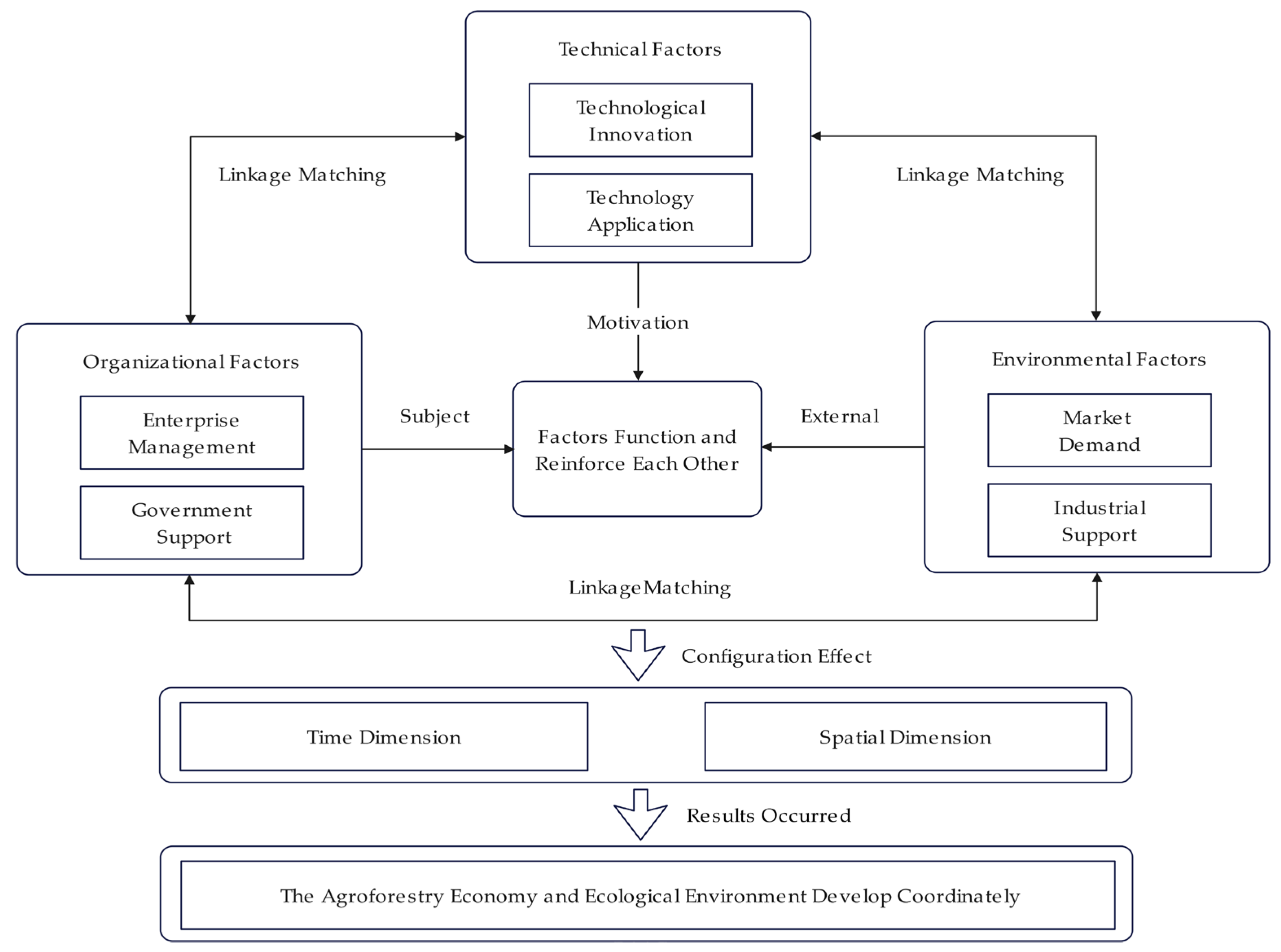
Therefore, this study is grounded in the TOE theoretical framework, optimized and adapted to the actual development context of China’s agroforestry economy. This framework is integrated and restructured around three core dimensions—technology, organization, and environment—and further refined into six key influencing factors: technological innovation, scientific application, enterprise management, government support, market demand, and industrial support. These factors interact through interlinked, organically matched synergistic pathways, collectively driving the coordinated development of the agroforestry economy and the ecological environment (Figure 1). This system systematically characterizes complex influence mechanisms while providing a reliable theoretical basis for quantitative verification and pathway optimization. The following sections analyze the interactive mechanisms of these factors within the TOE framework, focusing on their specific roles in promoting the coordinated development of the agroforestry economy and the ecological environment.

2.2. Factor Analysis

2.2.1. Technological Innovation

Through technological innovation breakthroughs and the industrialization of research outcomes, we can not only significantly enhance the comprehensive utilization efficiency of forest land resources but also reduce the disturbance caused by industrial development to forest ecosystems. This approach effectively strengthens the competitive edge of the agroforestry economy, thereby fostering a virtuous cycle of mutual advancement between the agroforestry economy and the ecological environment. This manifests across four dimensions: First, innovating high-quality seed selection techniques. Advanced methods like molecular breeding and hybrid selection substantially improve survival rates and stress resistance in agroforestry crops and livestock. This enables steady economic growth while strictly adhering to the upper limits of forest ecological carrying capacity [45]. Second, innovating wild-simulating cultivation techniques. Leveraging modern environmental monitoring and control technologies, precisely replicating natural conditions required for wild species growth—such as light intensity, soil composition, temperature, and humidity [48]. This technology enables large-scale production without felling trees or damaging surface vegetation, relying solely on diffused light resources beneath the forest canopy and natural humus soil, thereby minimizing intervention in forest ecosystems [5,47]. Third, innovate circular farming techniques. Fermented livestock waste, such as chicken manure, serves as a substrate for cultivating edible fungi. Post-harvest fungal residue is then processed into organic fertilizer. This approach creates a closed-loop system that absorbs farming waste, supplies plant nutrients, and replenishes forest soil, significantly reducing soil structure damage caused by chemical fertilizer application [27].

2.2.2. Technology Application

Technology application occupies the terminal position in the technological innovation chain, serving as the core hub for driving the commercialization of innovation outcomes [43]. This manifests primarily in two aspects: First, within production and processing stages, the practical value of technological innovation can only be fully realized through implementation [49]. Modern information technology, through widespread adoption and integrated applications, is continuously revolutionizing the implementation pathways for the coordinated development of the agroforestry economy and ecological conservation. Take the practical deployment of ecological monitoring technology as an example. This technology establishes a baseline for ecological protection within forest ecosystems, ensuring that agroforestry economy activities remain within the reasonable limits of the environment’s carrying capacity [8]. Specifically, by deploying IoT devices such as soil environment sensors in forest areas and combining them with drone remote sensing technology, real-time data on soil nutrients, vegetation density, and ecological conditions are captured. This data provides scientific references for optimizing production plans, helping operators avoid potential ecological risks at the source. Secondly, in the market consumption phase, blockchain technology enables the recording of product lifecycle data—from seedling cultivation and processing to warehousing, logistics, and final delivery—onto the blockchain. By establishing a product quality traceability system, it effectively addresses longstanding industry challenges such as inconsistent product quality and trust deficits in market transactions [50]. This technology not only precisely addresses consumers’ core demands for traceable agricultural product safety and verifiable quality. Simultaneously, through the feedback effect of consumer-side demand, it creates a reverse incentive mechanism, driving relevant enterprises to continuously strengthen R&D investment and thereby promoting the coordinated development of the agroforestry economy and the ecological environment.

2.2.3. Enterprise Management

As the core entities driving the coordinated development of the agroforestry economy and ecological environment, enterprises play a vital role in integrating diverse resources and connecting multiple stakeholders. Their impact manifests in three key areas: First, fostering enterprise-led cultivation. Currently, China’s agroforestry economy remains predominantly smallholder-based. Compared to the limitations of smallholder operations, enterprises possess more robust production systems, standardized process control mechanisms, and mature technological R&D capabilities. By establishing unified ecological cultivation standards and centralized market access channels, enterprises overcome the challenges of information asymmetry and weak bargaining power inherent in smallholder fragmentation. Simultaneously, enterprises demonstrate stronger ecological responsibility and sustainable development principles, strictly adhering to ecological protection boundaries during production. Through precision management and green technology applications, they minimize disturbance and damage to ecosystems. Second, optimized corporate collaboration models. As exemplary benchmarks for industry development, enterprises have established diverse collaborative systems through innovative benefit-sharing mechanisms. Common forms include shareholding partnerships, production trusteeship, entrusted management, and contract farming [32]. This mechanism directly links forest farmers’ economic returns to ecological conservation outcomes, creating a virtuous cycle of protection, income growth, and further conservation. Third, distinctive brand development. In a market environment where product homogenization intensifies competition, branding has become a crucial vehicle for core competitiveness [51]. By cultivating highly recognizable and market-influential product brands, enterprises leverage brand premium effects to break the vicious cycle of low-price competition. As brand influence expands, companies elevate ecological control standards in production processes, continuously increasing resources and technologies dedicated to ecological conservation. This ultimately achieves mutual empowerment of economic and ecological benefits.

2.2.4. Government Support

As the core entity for policy formulation and industrial planning, the government bears the responsibility for guiding and coordinating the protection and utilization of ecological resources [51]. In the process of harmonizing the development of the agroforestry economy with ecological conservation, the government’s macro-regulation and targeted policies determine the quality of project implementation and its effectiveness [43]. This is manifested in the following three aspects: First, tiered policy guidance and institutional safeguards. At the national level, guiding documents such as the “Opinions on Accelerating the Development of Agroforestry Economy” and the “National Agroforestry Economy Development Guide (2021–2030)” have been issued. These documents define development boundaries, establish ecological red lines, and regulate industrial order, thereby preventing issues like excessive ecological exploitation or imbalanced industrial development [8]. Local governments build institutional frameworks tailored to local conditions, covering aspects like access standards, development model, and benefit distribution. Second, fiscal subsidies and risk mitigation. Local governments provide targeted support for the agroforestry economy through dedicated funds, tax incentives, and policy-based financial tools [52]. Fiscal injections effectively reduce initial investments in equipment procurement and technology adoption during the early R&D phase. Concurrently, technological innovations in this sector provide essential support for ecological conservation during agroforestry development. Third, vocational skills training and capacity building. To achieve the goal of enhancing technological empowerment across the entire agroforestry economy value chain, Governments enhance producers’ ecological stewardship awareness and industrial management capabilities through diverse approaches like specialized training programs, on-site guidance, and technical consultations [8]. Concurrently, by strengthening professional training for grassroots forestry extension workers and industry managers—focusing on improving their proficiency in interpreting national policies, overseeing forest resources, protecting the ecological environment, and handling emergency incidents—the government further optimizes its service efficiency.

2.2.5. Market Demand

Market demand serves as an external driver for the synergistic development of the agroforestry economy and ecological environment, providing continuous guidance for technological innovation and organizational model optimization [8]. The dual evolution of its scale and quality level jointly constitutes the key factor influencing the selection of industrial development paths. This is primarily reflected in the following two aspects: First, the sustained expansion of market demand scale. With the deepening penetration of green development concepts and the growing awareness of eco-friendly consumption, consumer demand for eco-friendly and health-oriented products has steadily increased. Taking core agroforestry economy outputs as an example, forest-grown ecological foods—such as mushrooms, medicinal herbs, and fruits—have leveraged their natural, green quality advantages to become the third-largest category in China’s agricultural product consumption market [53]. This scaled demand growth generates significant economic incentives. It not only fully mobilizes the investment enthusiasm of enterprises, governments, and new business entities but also drives the concentrated allocation of production factors toward the agroforestry economy sector, injecting momentum into scaled development [54]. Second, the iterative upgrading of market demand quality. With steady growth in per capita disposable income, consumer demand structures for agroforestry products have undergone a significant transformation. This shift manifests primarily in consumers transitioning from basic utility value to consuming distinctive, diverse, and premium green products. Simultaneously, traditional single-dimensional material consumption patterns are gradually extending into diversified service consumption models centered on ecological experiences and health preservation [8]. To precisely align with evolving market preferences, operators will inevitably accelerate technological innovation. They develop market-compatible product lines through enhanced variety improvement, optimized production standards, and advanced processing techniques. To better meet consumer demands, operators will also prioritize ecological conservation, producing premium goods that align with high-end, health-conscious consumption trends. This ultimately achieves synergistic benefits for both ecological and economic outcomes.

2.2.6. Industrial Support

Industrial support capacity refers to the enabling effects generated by external industries associated with the agroforestry economy, falling under the extended scope of the market environment dimension [46]. The agroforestry economy is characterized by its long industrial chains and extensive industrial support [8], and a robust and well-developed associated industrial system is crucial for promoting the integration of primary, secondary, and tertiary industries and facilitating structural transformation. This manifests in three specific ways: First, within the primary sector, associated industries of the agroforestry economy create a more favorable competitive environment through multidimensional synergistic collaboration. For instance, agriculture provides critical technical support—such as variety selection and pest control—for core activities like agroforestry cultivation and farming. Related planting activities not only enrich forest vegetation structure but also effectively enhance the stability of forest ecosystems [34]. Second, in the secondary sector, processing and manufacturing industries employ clean production technologies to recycle and utilize waste materials like straw and fruit shells generated during processing. This circular economy model effectively reduces industrial pollution loads on the surrounding environment while promoting material cycling within ecosystems. Simultaneously, deep processing transforms primary products into end products such as health foods and Chinese herbal medicine extracts, significantly increasing the added value of the agroforestry economy products. This not only expands market profit margins but also attracts social capital toward green processing technology R&D and environmental equipment upgrades, fostering a mutually empowering development dynamic between industrial ecologization and ecological industrialization [55]. Third, within the tertiary sector, tourism development consistently prioritizes preserving the integrity and authenticity of forest ecosystems. To ensure sustainable tourism experiences, operators proactively undertake forest tending, ecological corridor restoration, and native landscape conservation [34]. Through immersive encounters with forest ecosystems, visitors gain direct appreciation for ecological conservation, strengthening their personal environmental stewardship. Furthermore, creating immersive experiential consumption scenarios activates market demand, effectively translating forest ecological value into economic returns [8].

3. Research Methods and Data Sources

3.1. Research Methods

This study employs a comprehensive approach integrating Necessity Condition Analysis to identify essential prerequisites, Dynamic Qualitative Comparative Analysis to explore diverse combination pathways of sufficient conditions, and a coordinated development degree model to measure outcome variables. Through the organic integration and complementary application of these methodologies, this study aims to deeply deconstruct the intrinsic mechanisms underpinning the coordinated development of the agroforestry economy and ecological environment, clearly delineating the configuration logic and pathways of core driving factors. This not only provides methodological references for studying driving mechanisms but also offers decision-making insights for government policy optimization. The specific methodology is as follows:
First, employing Necessity Condition Analysis to analyze the necessary conditions for coordinated development, precisely identifying indispensable key influencing factors. Prior to conducting configuration analysis, testing the necessity of individual factors serves as a prerequisite step, with its results laying the foundation for subsequent configuration analysis. Notably, while Dynamic Qualitative Comparative Analysis methods can preliminarily assess the necessity of antecedent conditions, their analytical dimensions lean toward qualitative descriptions. This approach struggles to precisely quantify the strength of associations between antecedent and consequent conditions, failing to fully reveal the impact of individual factors on outcomes [35]. In contrast, the Necessity Condition Analysis method, as a specialized analytical tool designed specifically for single-factor necessity testing, possesses unique technical advantages. Through effect size calculations and Monte Carlo simulation replacement tests, it can quantitatively determine whether a particular antecedent factor is a necessary condition for the occurrence of the outcome variable [8]. Furthermore, the method can also leverage bottleneck analysis to quantitatively assess the constraint strength of antecedent conditions on outcomes, thereby providing robust support for identifying key limiting factors. Therefore, introducing the method into the single-factor necessity testing phase prior to configurational analysis effectively addresses the inherent limitations of Dynamic Qualitative Comparative Analysis in quantitative single-factor necessity analysis. The cross-validation and complementary strengths of these two methods further enhance the robustness and credibility of research conclusions.
Second, Dynamic Qualitative Comparative Analysis identifies diverse pathways for coordinating the agroforestry economy and ecological environment development across different factor combinations by accounting for interactions among antecedent conditions. The core limitation of traditional regression analysis paradigms lies in their focus on estimating marginal net effects of independent variables on dependent variables, remaining confined to single-factor driven linear research. This approach significantly underperforms in exploring multiple concurrent causal relationships and struggles to effectively resolve endogeneity issues. However, it draws on Boolean algebra and set theory as its theoretical foundation. By comparing multiple causal conditions across cases, it seeks to uncover concurrent causal relationships and diverse configuration outcomes linking outcome variables to condition variables [40,43]. The rationale for adopting this methodology in the present study manifests in two key aspects. First, the coordinated development of the agroforestry economy and ecological environment is influenced by multiple factors, potentially involving several equivalent causal chains leading to outcomes [56]. This approach fully accounts for the interactive relationships among antecedent conditions, emphasizes multiple concurrent causal mechanisms, and identifies configuration paths yielding different outcomes—all of which possess complete equivalence [57]. Simultaneously, it integrates case-oriented qualitative attributes with variable-oriented quantitative characteristics, overcoming the limitations of single-case analysis. On the other hand, the coordinated development of the agroforestry economy and ecological environment is inherently a dynamic evolutionary process with time-lag effects. Ecological conservation measures, industrial restructuring, and policy dividend realization all require specific time cycles. Relying solely on cross-sectional data makes it difficult to clearly elucidate the interactive mechanisms between causal relationships and temporal dimensions. This methodology enables systematic analysis of associative characteristics and evolutionary patterns across different cases and within the same case’s condition configurations and outcomes. It operates across three dimensions—overall, intra-group, and inter-group—using core metrics such as consistency and coverage [58]. Simultaneously, it precisely captures subtle spatiotemporal variations in configurations by observing consistency-adjusted distances, providing a scientific basis for formulating differentiated development strategies across regions.
Third, the coordinated development index model was employed to measure the harmonious development level between the agroforestry economy and the ecological environment, serving as the outcome variable in this study. Methodologically, this model effectively characterizes the coordinated development of two or more systems. Its core advantage lies in comprehensively accounting for the interrelationships among indicators, overcoming the inherent limitations of traditional weighted averaging and analytic hierarchy process (AHP) in handling indicator correlations [43]. In the specific calculation process, this study employs the model to measure the coordinated development level between the agroforestry economy and the ecological environment. The coordinated development degree is then categorized into five levels: moderately imbalanced (0.2–0.4), basically coordinated (0.4–0.6), moderately coordinated (0.6–0.8), and highly coordinated (0.8–1.0) [44]. This classification provides a basis for interpreting subsequent results.

3.2. Research Samples and Data Sources

Considering case heterogeneity and data availability, this study selected 31 provinces in China from 2012 to 2023 as the research sample, focusing on practical cases of coordinated development between the agroforestry economy and the ecological environment. The required data encompass multiple core indicators, sourced as follows: Data on agroforestry economy output value, forest coverage rate, afforested area, forest stock volume, forest fire-affected area, pest/disease/rodent-affected area, economic forest product cultivation/collection output value, non-wood forest product processing output value, forest tourism/recreation service output value, agroforestry economy management training, completed investment, demonstration base area, and technology extension area primarily originate from the China Forestry Statistical Yearbook, China Forestry and Grassland Statistical Yearbook, China Environmental Statistical Yearbook, China Rural Statistical Yearbook, and provincial statistical yearbooks. Regional GDP, per capita disposable income, and per capita consumption expenditure data are sourced from the Statistical Yearbook of China’s Population and Employment and the China Statistical Yearbook. Total patent applications and granted invention patents for the agroforestry economy are sourced from the Patent Retrieval and Analysis Database of the China National Intellectual Property Administration; the number of normally operating agroforestry economy enterprises and those holding trademarks are sourced from the Tianyancha corporate information query website (www.tianyancha.com) and the Peking University Law Database. Among these indicators, two metrics—agroforestry economy management training and total patent applications—exhibited isolated instances of data gaps during the statistical analysis of sample data from Xinjiang and Tibet. These missing data points were not systematic in nature, appearing only as sporadic omissions in specific years. They did not substantially impact the overall validity of the data series. Therefore, this study employs linear interpolation to supplement and refine the data, ensuring both data integrity and analytical reliability.

3.3. Variable Measurement

3.3.1. Outcome Variables

This study employs the level of coordinated development between the agroforestry economy and the ecological environment as the outcome variable. The entropy method was used to calculate indicator weights. The specific evaluation indicator system and calculation results are detailed in Table 1. For the agroforestry economy development evaluation dimension, this study constructs evaluation indicators from two aspects: industrial scale and industrial competitiveness. Specifically, first, for the industrial scale, the total industrial output value of the agroforestry economy and the annual growth rate of output value were selected as characterizing indicators [26,37]. The total output value of the agroforestry economy encompasses economic activities across the entire industrial chain, serving as a comprehensive indicator that directly reflects the overall development scale of the industry. The annual growth rate of output value directly reflects the expansion pace and growth momentum of the industry. Second, for industrial competitiveness, three indicators, market share, industrial location entropy, and growth elasticity, are used to reflect the competitiveness level of the agroforestry economy industry [26,27,28,29]. Market share is calculated as the proportion of regional agroforestry economy output relative to national total output, serving as a key parameter for measuring market penetration capability and scale-based competitive advantage. Industrial location entropy reveals regional agglomeration characteristics and comparative advantages within the agroforestry economy. Growth elasticity focuses on assessing the risk resilience of the regional agroforestry economy, where higher values indicate greater stability in industrial structure.
In the ecological environment protection evaluation dimension, this study constructs an evaluation indicator system based on the PSR model across three levels: ecological state, ecological pressure, and ecological response [59,60]. First, the ecological state: Forest coverage and forest stock volume are selected to characterize the current status and quality of ecosystems under specific pressures [33]. Forest coverage reflects the dynamic changes in regional forest resource stocks, directly determining the resource foundation and potential space for agroforestry economy development. Forest stock volume intuitively demonstrates the concentration level of forest resources and serves as the core basis for assessing forest ecological environment quality. Second, ecological pressure: The area affected by forest fires and the area affected by pests, diseases, and rodents are used to quantify the burden of human activities on the ecological environment. Both indicators are key parameters reflecting the extent of damage to forest resource health and the level of disturbance to ecological function stability [6]. Third, ecological response: We selected the area of artificial afforestation and the pest control rate to characterize management measures and social actions taken in response to ecological and environmental issues [2,3,4]. The area of artificial afforestation directly reflects the intensity of forest ecosystem restoration and improvement efforts; the pest control rate reflects the effectiveness of prevention and control measures against such biological disasters.

3.3.2. Antecedent Conditions

Based on the systematic analysis of TOE theory and existing research findings in related fields, this study identifies six key antecedent conditions (Table 2) by focusing on technology, organization, and environment as core analytical dimensions. The rationale and measurement methods for specific indicators are as follows: First, technological innovation. A dual-dimensional measurement system was constructed, incorporating both quantity and quality. The total number of patent applications and the number of granted invention patents related to the agroforestry economy were selected to comprehensively reflect the technological innovation capabilities in this sector across regions [28,47]. Second, technology application. Two indicators were adopted to directly illustrate the development levels of technological dissemination and practical demonstration in the agroforestry economy across regions [31,32,33]. Third, enterprise management. Given that brand trademarks externally manifest corporate operational capabilities and value accumulation while serving as key indicators of consumer recognition of production organization standards, this study selects the number of normally operating agroforestry economy enterprises and the number of such enterprises holding registered trademarks to characterize the overall operational capacity of enterprises within the industry [8]. Fourth, government support. Government backing is measured by completed investments in agroforestry economy projects and technical training programs for agroforestry industry operations [29,31]. The former directly reflects fiscal subsidies and dedicated investments for coordinating agroforestry economy development with ecological conservation, while the latter provides indirect human resource support by enhancing foresters’ specialized production skills and comprehensive competencies. Fifth, market demand. Per capita disposable income and per capita consumption expenditure serve as proxy variables to quantify regional market demand intensity for agroforestry products [8], a methodology validated in relevant studies. Sixth, industrial support. Integrating the development of primary, secondary, and tertiary industries within the agroforestry economy, three core indicators were selected: the output value of economic forest product cultivation and collection, the output value of non-wood forest product processing and manufacturing, and the output value of forestry tourism and leisure services [27,28,29]. These comprehensively reflect the supportive role of diversified industrial synergy in the coordinated development of the agroforestry economy and the ecological environment.

3.4. Data Calibration

In conducting dynamic qualitative comparative analysis, data calibration serves as an indispensable preliminary operation [57]. Essentially, calibration involves assigning membership to selected cases within a set of attributes. Its purpose is to uniformly standardize raw case data—which may possess different measurement scales and value ranges—into the 0–1 interval, thereby determining each case’s membership orientation within its corresponding set [41]. Based on the actual case circumstances and variable value distributions, this study employs direct calibration for structured calibration. Specifically, the 75th, 50th, and 25th percentiles are defined as benchmark anchor points for full membership, crossover points, and full non-membership, respectively. Additionally, to avoid ambiguity in configuration membership arising from cases with a membership degree of 0.5 in either the condition or result sets, this study adjusted the 0.5 membership degree to 0.501 to clarify case membership [40,41,42]. The calibrated results and descriptive statistics for each variable are detailed in Table 3.

4. Result Analysis

4.1. Necessary Condition Analysis

4.1.1. NCA Single Condition Necessity Analysis

First, this study employs the Necessity Condition Analysis method to examine the necessity of a single antecedent condition for the coordinated development of the undergrowth economy and the ecological environment [8]. This method assesses necessity through two indicators: effect size and bottleneck level. Effect size is measured using two approaches: upper-bound regression (CE) and upper-bound envelopment (CR). For a precondition to meet the necessity criterion, it must simultaneously satisfy two conditions: the effect size (d) must be no less than 0.1, and the Monte Carlo simulation permutation test must indicate that the effect size is significant [44,45,46]. According to the analysis results presented in Table 4, none of the six preconditions included in this study met the necessity determination criteria for the coordinated development of the agroforestry economy and ecological environment.
Furthermore, this study further employs the CR estimation method to conduct an in-depth analysis of the constraint bottleneck levels across six preconditions. The bottleneck level here refers to the minimum threshold standard that each precondition must meet throughout the entire sample observation period to achieve the predetermined proportion of target outcomes [57]. As shown in Table 5, when the target is set at 100% coordinated development between the agroforestry economy and the ecological environment, the six key prerequisite conditions—technological innovation, technology application, enterprise operational capacity, government policy support, market demand scale, and industrial foundation support—must achieve minimum fulfillment rates of 33.5%, 3.4%, 3.8%, 44.2%, 69.3%, and 82.8%, respectively. This finding confirms that the coordinated development of the agroforestry economy and ecological environment does not rely on the independent driving force of a single factor, but rather requires the synergistic interaction and joint support of multiple prerequisite conditions, including technology, organization, and environment.

4.1.2. Dynamic QCA Necessity Test

The purpose of the necessary condition test is to quantify the explanatory power of various antecedent conditions on the outcome variable. This study employs the R programming language analysis environment to conduct a secondary necessity test on six antecedent conditions, thereby enhancing the reliability of the test results. Academic research generally holds that a consistency level exceeding 0.9 and a coverage rate above 0.5 can define a condition as a necessary prerequisite for the occurrence of the outcome variable [8]. It is noteworthy that if the adjusted inter-group consistency distance of a precondition exceeds the critical value of 0.2, the panel data must be disaggregated by year to eliminate the influence of potential factors [42]. Based on the individual necessity test results (Table 6), the aggregated consistency of all antecedent conditions failed to reach the 0.9 threshold. This suggests that no single antecedent condition in this study can independently cause the outcome variable. Further examination of the intergroup consistency adjustment distance reveals that some antecedent conditions exhibit distances exceeding 0.2. Consequently, a deeper analysis of the cross-sectional data for each causal combination is required.
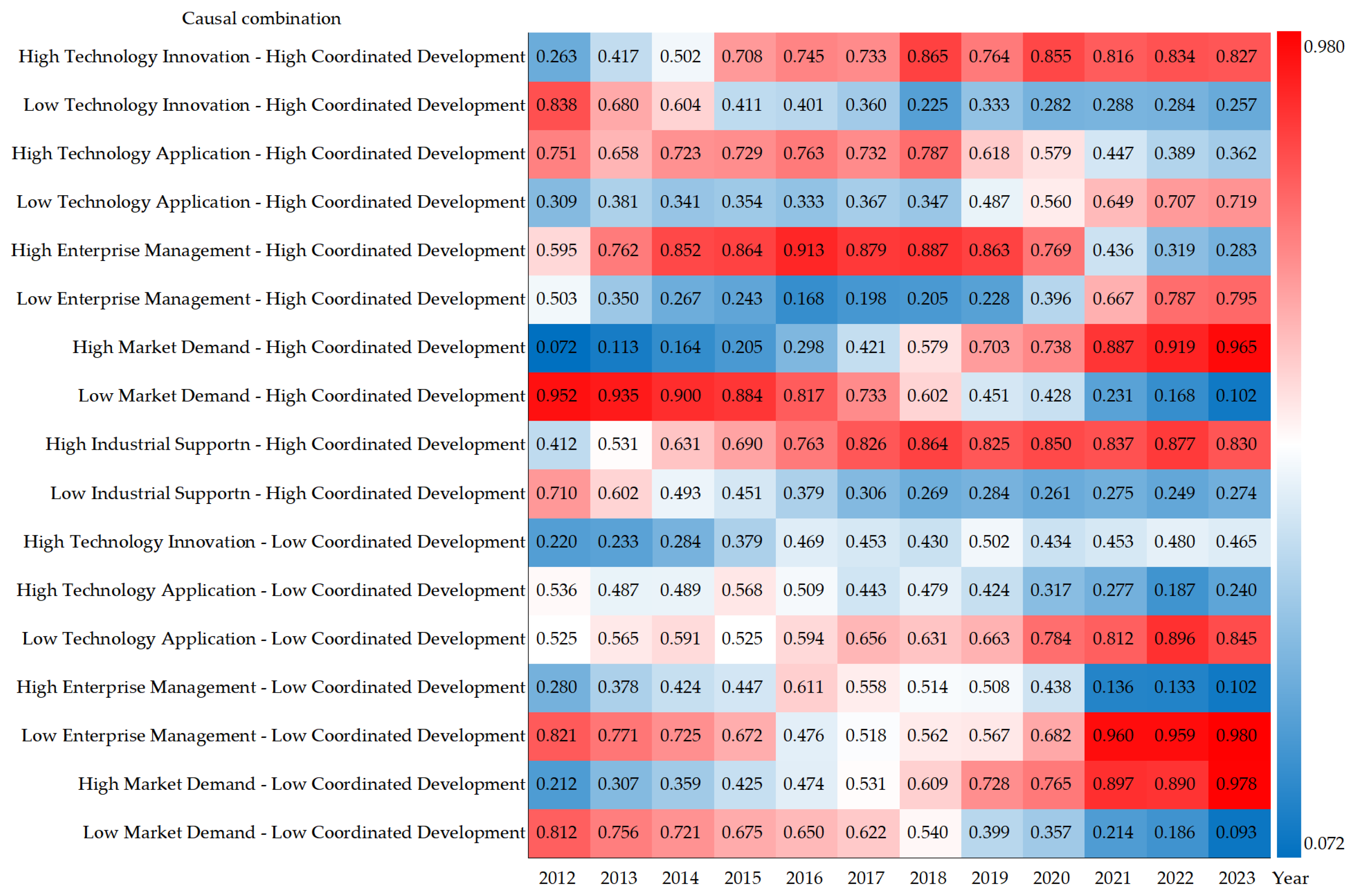
Second, this study focuses on causal combinations where the intergroup consistency adjustment distance exceeds the 0.2 threshold. Further observations using cross-sectional data (Figure 2) reveal: The intergroup consistency for “High Enterprise Management-High Coordinated Development” in 2016 was 0.913; The intergroup consistency for “High Market Demand-High Coordinated Development” in 2023 was 0.965; the intergroup consistency for “Low Market Demand-High Coordinated Development” in 2012, 2013, and 2014 was 0.952, 0.935, and 0.900, respectively; the intergroup consistency for “Low Enterprise Management-Low Coordinated Development” in 2021, 2022, and 2023 was 0.960, 0.959, and 0.980, respectively. The intergroup consistency for the “High Market Demand-Low Coordinated Development” combination in 2023 was 0.978; all other combinations fell below the 0.9 threshold. Furthermore, analyzing intergroup consistency changes across time revealed distinct patterns for each causal combination [45]. The results reveal a distinct upward trend in intergroup consistency for the “High Technological Innovation–High Coordinated Development,” “High Market Demand–High Coordinated Development,” and “High Industrial Support–High Coordinated Development” combinations. This indicates that technological innovation, market demand, and industrial support progressively gain greater necessity in the coordinated development of the agroforestry economy and ecological environment, exhibiting significant temporal correlation.
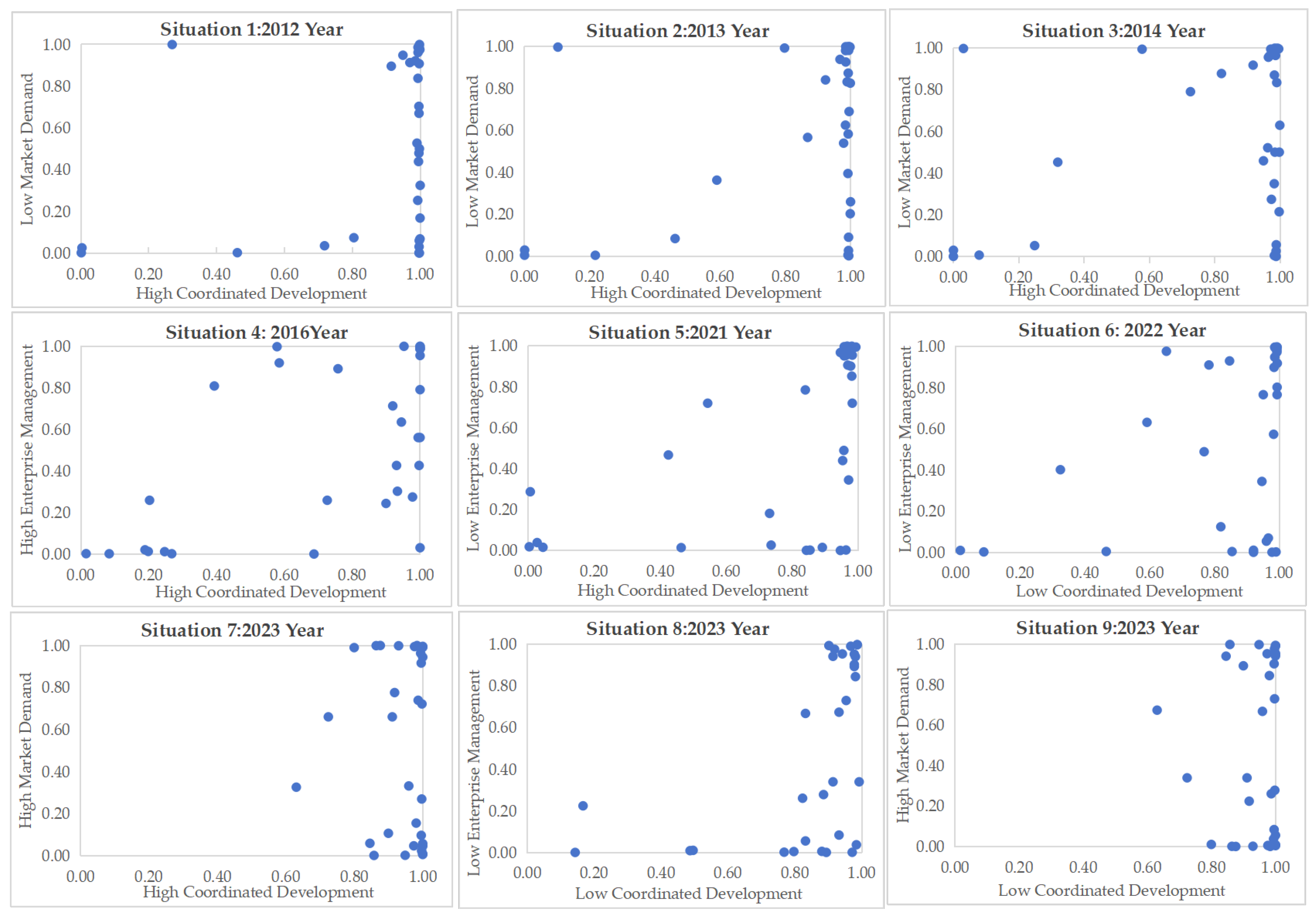
Third, to ensure the reliability of the necessity analysis, this study selected cross-sectional data with intergroup consistency exceeding 0.9 and coverage levels surpassing 0.5. Subsequently, the sample data were validated using X-Y scatter plot analysis. As shown in Figure 3, the distribution of all sample cases exhibits two typical characteristics [43,44,45,46]: The majority of sample cases cluster near the right side of the y-axis in the scatter plot, while more than one-third of the cases concentrate in the upper-left region. This distribution pattern indicates that none of the six antecedent conditions selected for this study constitute a necessary condition for generating the observed outcomes. This conclusion aligns with the findings derived from the prior NCA analysis.

4.2. Configuration Analysis

4.2.1. Summary Results Analysis

Sufficiency analysis serves as the core function of dynamic qualitative comparative analysis, aiming to deeply deconstruct the combined effects of multiple antecedent conditions and reveal their underlying mechanisms influencing outcome variables [44,46]. To ensure the integrity of the research sample and enable all included cases to participate in truth table construction, this study sets the sample frequency threshold to 1 based on actual conditions. The original consistency threshold and PRI consistency threshold are defined as 0.80 and 0.70, respectively, guaranteeing the comprehensiveness of configurational analysis data. Second, based on prior analysis, no single antecedent condition independently constitutes a necessary condition for the outcome variable. Therefore, no directional specification was applied to conditional variables during counterfactual analysis. Finally, for complex, intermediate, and simplified solutions derived from sufficiency analysis, core conditions were identified through the nested relationship between intermediate and simplified solutions. Furthermore, consistency and coverage serve as two core metrics for evaluating the validity and explanatory power of configurational pathways [56,57,58]. According to existing academic consensus, a configuration can be deemed a high-quality solution—providing robust and credible support for research conclusions—when its overall consistency exceeds 0.75 and its coverage surpasses 50%. As shown in the configuration results (Table 7), the overall solution achieving coordinated development between the agroforestry economy and the ecological environment exhibits a consistency of 0.87 and an overall coverage of 0.519. This outcome indicates that the configuration results obtained in this study possess strong explanatory power and reliability. Therefore, following the theoretical process of configuration analysis, this study proceeds to name and analyze the four obtained configuration paths.
First, the enterprise-driven and industry-supported model: Analysis of configuration H1 indicates that in regions with weak market demand, the combination of high-level enterprise operational capabilities and a comprehensive industrial support system constitutes the core driving condition for promoting the coordinated development of the agroforestry economy and ecological environment. This configuration covers 38.00% of all sample cases. After excluding cases overlapping with other configurations, its independent coverage rate stands at 7.20%. This development pathway clearly demonstrates that fully leveraging enterprises’ organizational leadership and resource integration roles in industrial development [49], while establishing efficient coordination mechanisms between upstream and downstream industries, can provide robust momentum for advancing both agroforestry economy growth and forest ecological conservation [48]. Take Jilin province as an example. With the continuous and in-depth advancement of key forestry ecological restoration projects, the total amount of forest resources in the province has steadily increased, and its ecological endowment advantages have become increasingly prominent. As a major forestry province, Jilin hosts 18 large state-owned forestry enterprises, ranking among the highest nationwide. These enterprises provide robust organizational guarantees and technical support for regional agroforestry economy development [26]. Simultaneously, Jilin has built a solid foundation in supporting industries such as agroforestry product processing and deep manufacturing of non-wood forest products. By strengthening integration across the industrial chain, it has successfully cultivated nationally recognized specialty industrial zones like Tonghua blueberries and Changbai Mountain mulberry mushrooms.
Second, the technology-innovation-led model: Configuration H2 defines high technological innovation levels, deep technology application, and low market demand intensity as core conditions, supplemented by high enterprise operational efficiency as peripheral conditions. The synergy of these elements constitutes the key pathway for achieving coordinated development between the agroforestry economy and the ecological environment. This configuration covers 15.60% of all sample cases, fully validating the core driving role of technological innovation in industrial upgrading and highlighting the irreplaceable position of enterprises as the main entities for innovation, R&D, and application [6]. Specifically, enterprises achieve dual-pronged breakthroughs through transformative technological innovation and large-scale application. This approach not only enables leapfrog improvements in agroforestry economy productivity but also facilitates precise cost control and optimization, injecting sustained momentum into high-quality industrial development [17]. Taking Guangxi province as an example, the region has deepened an integrated development model combining industry, academia, research, and application. Through active cooperation with universities, research institutions and companies, an innovative cooperation network characterized by resource sharing, complementary advantages and efficient collaboration has been established. This collaboration focuses on critical aspects of the agroforestry Chinese medicinal materials industry, concentrating joint research efforts on core areas such as establishing standardized cultivation systems, refining processing techniques, innovating high-value-added product development, and optimizing large-scale production models [15,37]. To accelerate the deep integration of technological innovation and industrial application, specialized research studios, experimental verification platforms, and pilot-scale conversion bases have been strategically deployed in key demonstration sites.
Third, the market-driven factor integration model: Configuration H3 indicates that by aggregating the four core conditions of technological innovation, technological application, enterprise operation and industrial support, the coordinated development of the agroforestry economy and ecological environment can ultimately be achieved. This configuration clearly highlights the pivotal role of market demand as an external driver, accounting for 36.00% of the explanatory power for the sample cases. When the market level generates excess demand gaps and refined, high-quality consumption preferences, the market-driven effect permeates the entire TOE analytical framework through demand-oriented factor integration and synergistic linkage [8]. Take Fujian province as an example: this region boasts superior forest resource endowments, with a forest coverage rate of 66.80%, consistently ranking first nationally. As early as 2001, Fujian Province took the lead in launching the collective forest tenure system reform, activating the vitality of market entities through institutional innovation with clear property rights and well-defined rights and responsibilities [25,37]. From a market demand perspective, influenced by Fujian’s unique geographical environment and traditional dietary culture, local residents have consistently maintained strong consumption demand for natural, green, and healthy wellness products. Driven by this demand orientation, Fujian’s agroforestry economy operators have fully leveraged the province’s abundant forest resources and high-quality ecological environment to precisely address market pain points. Starting with the protective development of forest landscape resources, they have built a distinctive health and wellness industrial chain extending into health product processing and forest wellness services [33].
Fourth, the government-led multi-stakeholder collaboration model: Configuration H4 establishes coordinated development between the agroforestry economy and the ecological environment through four core conditions: high technological innovation, high enterprise management, high government support, and high industrial backing. This pathway’s defining feature is the prominent role of government leadership, which explains 37.30% of the sample cases. As the core hub of the collaborative system, the government can empower agroforestry economy projects through diversified support measures and lay a solid foundation for industrial development [31]. Taking Yunnan province as an example, as a core biodiversity region in China, its unique resource endowment provides natural advantages for agroforestry economy development. Data indicates that the province hosts 63% of China’s higher plant species and 59% of its species resources, with this rich biological foundation establishing the material basis for agroforestry economy development [28]. To promote the rapid development of the agroforestry economy, the local government has established a multi-dimensional collaborative support system. It covers key areas such as resource development and utilization, variety breeding and technology promotion, and the establishment of scientific and technological innovation platforms. In terms of technological innovation and promotion, Yunnan focuses on addressing industry pain points and needs by selecting and promoting advanced forestry and grassland technologies that are highly practical and adaptable. Furthermore, the local area has taken the integrated development of the agroforestry economy as the starting point to build a diversified service supply model that integrates leisure and sightseeing, product experience, and health and wellness vacations. This model promotes the efficient transformation of ecological resources into economic value [53].
4.2.2. Inter-Group Results Analysis
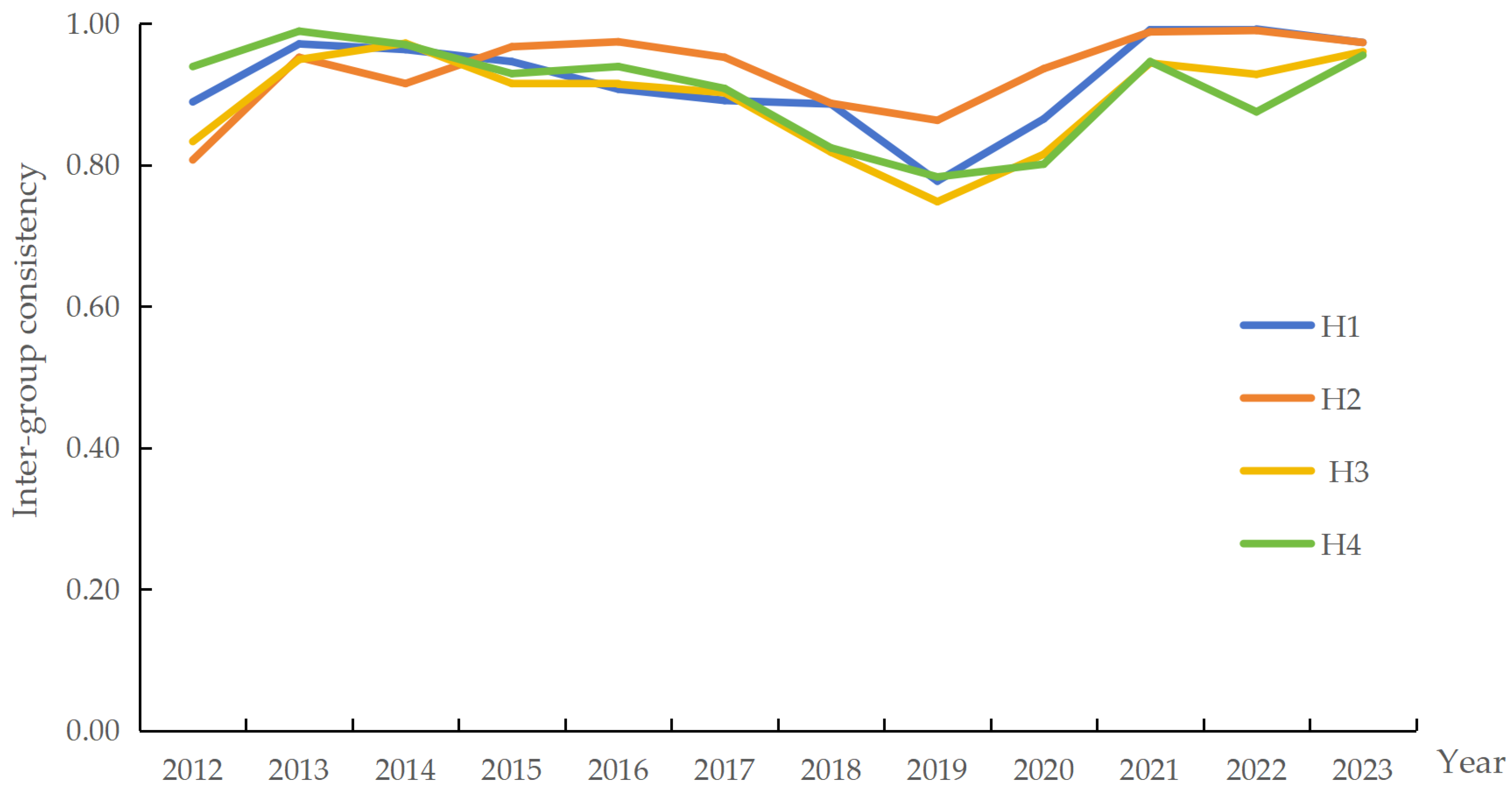
To circumvent the temporal blind spots inherent in traditional directional comparison analysis, this study introduces the intergroup consistency metric to examine the temporal effects of configuration. Intergroup consistency measures whether the configuration of conditions constitutes a sufficient condition for the outcome in each year of the sample period [57]. Essentially, it quantifies the consistency level across cross-sectional data spanning multiple years. As shown in Table 6, the intergroup consistency adjustment distances for all four configurations are below 0.2. This indicates no significant temporal effects across configurations, confirming that the conditional configurations consistently and sufficiently drive outcomes throughout the study period. Consequently, the research findings maintain strong applicability and stability. Furthermore, analysis of the intergroup consistency trend chart (see Figure 4) reveals that throughout the entire sample period, the consistency levels of all configurations exceeded the 0.75 threshold criterion. This indicates that these configurations possess strong explanatory power regarding the coordinated development of the agroforestry economies and ecological environments. Notably, while inter-group consistency across configurations exhibited stable characteristics without significant temporal fluctuations, all configurations still followed a pattern of concentrated variation, displaying a “V”-shaped fluctuation between 2019 and 2021. This fluctuation can be explained by two dimensions: structural transformation in market demand and the shift in development philosophies among business entities [8,44]. On one hand, the COVID-19 pandemic significantly heightened public health-conscious consumption, directly boosting demand for products like traditional Chinese medicinal herbs that combine medicinal efficacy with ecological attributes, leading to a fundamental shift in market demand structure. On the other hand, this clear market signal prompted operators in the agroforestry economy to re-examine the logic of synergistic development between ecological and economic value. This has deepened their understanding and emphasis on the virtuous cycle development model: “ecological conservation → enhanced product quality → increased economic benefits → reinvestment in ecological conservation.” Against this backdrop, the development goals of operators have shifted from a single-minded pursuit of short-term economic gains to a comprehensive orientation that balances ecological conservation and sustainable development [3,34]. This transformation in development philosophy and objectives ultimately fosters a more closely coordinated relationship between the agroforestry economy and the ecological environment.
4.2.3. Intra-Group Results Analysis
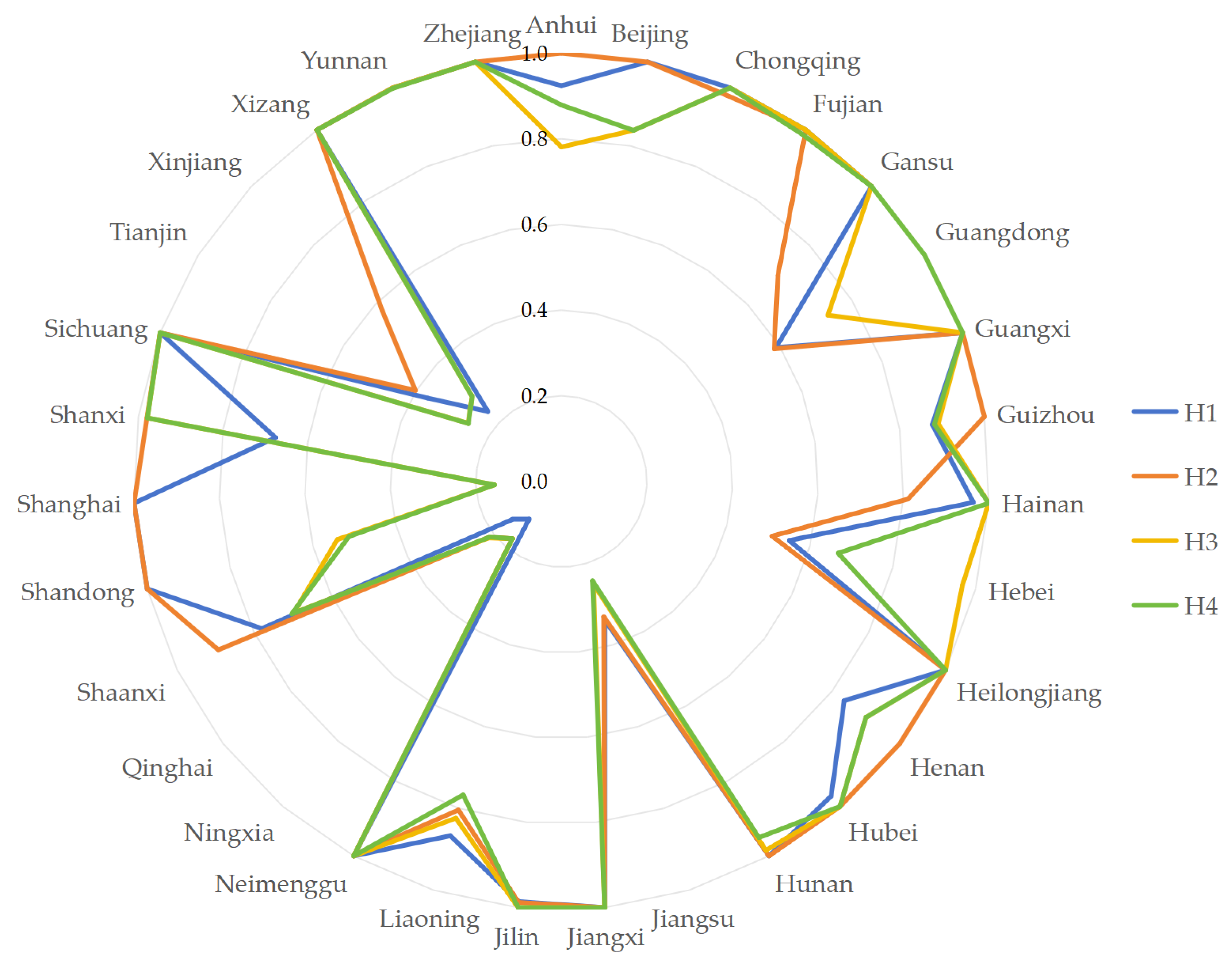
First, the intra-group consistency analysis uses provinces as the unit of analysis, examining from a spatial perspective the sufficiency of different configurations in each province for generating outcomes during the sample observation period [42]. Based on the data analysis results presented in Figure 5, the intraclass correlation coefficients for the vast majority of provinces exceed the 0.75 threshold. This phenomenon indicates that most provincial cases exhibit strong stability in the association between specific condition combinations and outcomes. Simultaneously, multiple equivalent pathways exist for the coordinated development of the agroforestry economy and ecological environment in some provinces. Specifically, in configuration H1, Guangdong, Hebei, Jiangsu, Ningxia, Qinghai, Shanxi, Tianjin, and Xinjiang exhibit relatively low consistency levels, though Guangdong achieves a consistency level of 1.0 in configuration H4. Hebei achieved a consistency level of 0.968 in configuration H3; Shanxi demonstrated higher consistency levels in configurations H2, H3, and H4; while Ningxia, Qinghai, Tianjin, and Xinjiang exhibited poor consistency performance across all configurations. Furthermore, the consistency adjustment distance within all configurations exceeded 0.2 (Table 6), indicating significant spatial heterogeneity among cases corresponding to different configurations. Consequently, the distribution of the four identified configuration paths at the provincial level exhibits pronounced regional disparities, reflecting the unique developmental conditions of each province.
Secondly, based on the geographical division standards of China, this study divided the research samples into seven major regions: Northeast China, North China, East China, South China, Central China, Northwest China, and Southwest China [8]. Based on the average regional coverage data of each configuration in Table 8, the spatial adaptation scenarios of different configurations are analyzed. The cases of configuration H1 are mainly distributed in Northeast China and Central China. The provinces that configuration H2 can explain are mainly distributed in South China and Northeast China, with typical representatives including Guangxi, Heilongjiang, Jilin, etc. These regions have outstanding capabilities in technological innovation and the promotion of achievements. The innovative development of deep-processed products will further create new market demands. Configuration H3 is more suitable for implementation in East China, Central China and Southwest China. Typical provinces include Fujian, Zhejiang, Anhui, Henan, etc. The configuration H4 cases are mainly distributed in the southwest and central China regions, including provinces such as Yunnan, Sichuan and Guizhou. Among them, Guizhou Province in the southwest region was the first at the provincial level to issue the “Opinions on Accelerating the High-Quality Development of Agroforestry Economy”, becoming the first province in the country to incorporate the achievements of the agroforestry economy development into the government performance assessment system [5]. The assessment mechanism has forced local governments to increase their efforts in ecological protection and industrial support, fully demonstrating the role of government guidance in coordinating the dual goals of ecology and economy.

4.3. Robustness Test

This study adheres to the core principles of dynamic QCA robustness testing [40,41,42,43]: results are deemed robust if core findings remain substantially unchanged after adjusting operational conditions. Robustness testing was conducted as follows (Table 9): First, adjusting the case frequency threshold. While maintaining all other testing parameters and operational steps, the initial case frequency threshold was raised from 1 to 2. The results showed that the number of identified configurations and all key evaluation parameters remained unchanged. Second, the PRI consistency threshold was adjusted. The original PRI value was raised from 0.70 to 0.75, while the rest of the testing process remained unchanged. Results indicate that although overall consistency and coverage metrics exhibited slight fluctuations, the original configuration paths and types remained valid. Collectively, these validation results demonstrate the robust nature of this study’s conclusions, further validating their reliability and persuasiveness.

5. Discussion

5.1. Influencing Factors for the Coordinated Development of Agroforestry Economy and Ecological Environment

This study reveals that the coordinated development of the agroforestry economy and ecological environment is not driven by a single independent factor, but rather depends on the synergistic effects of multiple influencing factors. This conclusion not only highlights the complex interrelationships within the agroforestry economy sector but also confirms the potential substitution effects and interactions among influencing factors [8]. Although existing research indicates that technological innovation capacity [5,47], market demand characteristics [45], infrastructure conditions [1,17], and policy support intensity [31,32,33] exert significant positive impacts on the coordinated development of the agroforestry economy and ecological environment, most prior studies have focused on case summarization and empirical analysis within specific regions. They have failed to adequately account for regional differences in resource endowments, developmental foundations, and industrial conditions. The generalizability of relevant research conclusions is limited, and the explanatory power of theoretical foundations requires further enhancement. Unlike previous studies, this research employs the TOE theoretical analytical framework to systematically identify and empirically validate the factors influencing the coordinated development of the agroforestry economy and ecological environment. These factors specifically include technological innovation, technology application, enterprise management, government support, market demand, and industrial support, thereby addressing the deficiency of theoretical frameworks in prior research. Furthermore, necessity tests for individual conditions reveal a progressively increasing trend in the necessity of technological innovation, market demand, and industrial support, demonstrating significant temporal correlation. First, technological advancement serves as a core driver, not only enhancing the production and operational efficiency of the agroforestry economy but also acting as a key enabler for the industry’s transition toward green and low-carbon development [47]. Second, industrial support primarily functions through two pathways. On one hand, it extends the agroforestry economy’s industrial chain through establishing deep-processing systems and enhancing brand management capabilities, thereby increasing product value-added [15,37]. On the other hand, it fosters cross-sectoral development by integrating diverse industries such as cultural tourism and wellness, cultivating sustainable coordinated development models. Third, with steady growth in residents’ income levels, consumption structures are undergoing noticeable upgrades. Public environmental awareness has generally strengthened, and consumer demand for green, organic, and health-oriented products continues to expand [8,25]. Against this backdrop, the guiding role of market demand in promoting the coordinated development of the agroforestry economy and the ecological environment is increasingly evident. Therefore, continuously strengthening technological innovation capabilities, further unlocking market demand potential, and improving the industrial support system hold broader practical significance for advancing the coordinated development of the agroforestry economy and the ecological environment in the future.

5.2. Driving Pathways for the Coordinated Development of Agroforestry Economy and Ecological Environment

This empirical study confirms that the driving pathways for coordinated development of the agroforestry economy and ecological environment exhibit diverse characteristics, with no single optimal equilibrium model applicable to all scenarios. In existing relevant research, scholars have predominantly employed traditional regression methods such as Logistic regression [37], factor analysis [13,27], structural equation modeling [29], and multiple linear regression analysis [30,31] to analyze their driving mechanisms. The value of these methods lies in their ability to analyze the intensity of individual factors’ impact on the level of coordinated development. However, the various driving elements of coordinated development between the agroforestry economy and the ecological environment do not exist in isolation; they are interconnected through complex interactions. Traditional regression methods cannot effectively reveal the interactive relationships, intensity of influence, and synergistic composite driving mechanisms among these elements. They also fail to fully resolve endogeneity issues, resulting in somewhat limited explanatory power [8]. To address this research gap, this study adopts a configurational analysis theoretical framework, combining dynamic qualitative comparative analysis with necessary condition analysis to deeply explore the multi-driver pathways of coordinated development between the agroforestry economy and the ecological environment. It aims to provide a novel theoretical perspective and empirical support for deciphering the complex driving mechanisms of coordinated development models across different regions [46]. Sufficiency analysis reveals four configuration pathways for the coordinated development of the agroforestry economy and ecological environment, each exhibiting significant regional heterogeneity. Specifically, configuration H1 emphasizes the operational and industrial support functions of enterprises, proving more applicable to Northeast China and Central China. This pathway leverages enterprises’ leading role to effectively integrate production factors such as land, labor, and technology, thereby generating economies of scale [17]. Configuration H2 highlights the enabling role of technological innovation capacity and application, demonstrating stronger adaptability in South China and Northeast China. Local market entities achieve leapfrog improvements in production efficiency through the synergistic efforts of breakthrough technological innovation and scaled-up technology application [14]. Simultaneously, by relying on refined control of raw material consumption and optimization of production processes, it achieves reasonable regulation of production costs and simultaneous enhancement of ecological benefits. This finding resonates with the conclusions of Chen et al.’s research [20]. Configuration H3 highlights the driving role of market demand in coordinated development, making it more suitable for East China, Central China, and Southwest China. This pathway takes market demand dynamics as its core orientation, effectively integrating elements such as technological innovation, enterprise operations, and industrial support. In response to market supply–demand fluctuations, business entities strengthen the linkage between market demand and industrial development through measures such as optimizing production structures and innovating product forms [8]. This study suggests this pathway holds broad application potential and is poised to become a core approach for promoting the coordinated development of the agroforestry economy and ecological environment in the future. Pathway H4 emphasizes the leading role of government support, making it more suitable for the Southwest and Central China regions. By establishing a diversified support system encompassing fiscal incentives, institutional frameworks, and regulatory services, it builds a robust institutional foundation and safeguard for the coordinated development of the agroforestry economy and ecological environment [28,31]. This pathway fully demonstrates the government’s pivotal regulatory role in balancing the dual objectives of ecological conservation and economic growth.
However, this study has certain limitations. First, the data selection is based on the provincial level, making it difficult to accurately capture the localized development characteristics and differentiated practices of the agroforestry economy at smaller spatial scales such as counties and townships; Second, this study focuses on the macro-level analysis of the overall development level of the agroforestry economy, but has not yet conducted in-depth discussions on the differentiated characteristics and suitability conditions of specific development models such as agroforestry planting and agroforestry breeding. Third, the longitudinal case analysis of each driving pathway is limited in depth. Future research could select representative regions for case studies to systematically deconstruct the underlying mechanisms of different driving pathways. Despite these limitations, they do not undermine the stability of the core conclusions of this study but rather point to directions for future research.

6. Conclusions and Implications

6.1. Conclusions

This study, grounded in the TOE theoretical framework and utilizing panel data from China’s 31 provinces spanning 2012–2023, employs a comprehensive approach integrating the coupled coordination model, dynamic qualitative comparative analysis, and necessary condition analysis. It systematically explores the multi-faceted driving mechanisms and implementation pathways for the coordinated development of the agroforestry economy and ecological environment. Key findings are as follows:
First, the analysis of necessary conditions reveals that the coordinated development of the agroforestry economy and ecological environment cannot be sustained by a single factor but rather results from the synergistic interaction of multiple elements, including technology, organization, and environment. Specifically, individual influencing factors such as technological innovation, technology application, enterprise management, government support, market demand, and industrial support are insufficient to constitute the necessary conditions for achieving the outcome. However, the necessity of technological innovation, market demand, and industrial support progressively increases over time, exhibiting a certain time effect. Future efforts focused on enhancing the core competitiveness and supply efficiency of these three factors will have broader universal applicability in elevating the level of coordinated development between the agroforestry economy and the ecological environment.
Second, through configurational analysis of conditions, it was found that the coordinated development of the agroforestry economy and ecological environment follows multiple driving pathways, exhibiting a typical “different causes, same effect” phenomenon. Specifically, the study identified four core driving pathways: enterprise operation and industrial support-driven, technology innovation-led, market-pulled factor integration, and government-guided multi-stakeholder collaboration. This finding indicates that no universally optimal model exists for harmonizing agroforestry economy and ecological environment development, as different factors may exhibit substitutability and interactive effects. Therefore, the key to promoting coordinated development lies in flexibly configuring core and peripheral conditions to form an optimal combination of adaptive conditions.
Third, inter-group and intra-group consistency analyses revealed that none of the configuration pathways exhibited significant temporal effects, yet all demonstrated pronounced spatial heterogeneity. This indicates that the explanatory power of the four core pathways maintains strong stability and applicability over time, while their suitability varies significantly across different regions. Specifically, the enterprise-driven and industry-supported model suits Northeast and Central China; the technology-innovation-led model suits South China and Northeast China; the market-driven factor integration model suits East China, Central China, and Southwest China; the government-led multi-stakeholder collaboration model suits Southwest and Central China. These findings provide robust theoretical foundations and practical guidance for regions to develop tailored strategies—based on local conditions—for coordinating agroforestry economy growth with ecological conservation.

6.2. Implications

Based on the findings of this study, the following insights are proposed to promote the coordinated development of the agroforestry economy and ecological environment:
First, for regions where the enterprise-driven and industry-supported model is viable, the focus should be on nurturing local enterprises and strengthening industrial support capabilities. On one hand, select local enterprises with scale and potential for targeted support, leveraging policy tools such as fiscal interest subsidies and tax breaks to help leading enterprises expand production capacity. Promote joint operations between local enterprises and small-scale operators like family forest farms and specialized cooperatives to enhance the overall operational efficiency of the regional agroforestry economy. On the other hand, deepen the integration of the three industrial sectors within the agroforestry economy, promoting deep synergy with related industries such as eco-tourism, forest wellness, and nature education. Improve the supporting industrial infrastructure by introducing ancillary enterprises for sorting, preservation, packaging, and warehousing. Create integrated industrial parks to enhance the sector’s risk resilience and overall competitiveness.
Second, for regions where the technology-innovation-led model is applicable, it is recommended to increase investment in scientific research and development within the agroforestry economy. On one hand, establish a diversified R&D funding mechanism by setting up specialized research funds to prioritize key technological developments in ecological cultivation, green pest control, deep processing, and waste recycling. Guide enterprises to become the primary R&D investors, offering policy incentives such as additional tax deductions for R&D expenses and subsidies for purchasing research equipment to companies engaged in relevant technological development. On the other hand, support business entities in collaborating with universities and research institutes to establish joint R&D centers and laboratories, focusing on targeted breakthroughs for regionally distinctive agroforestry products. By establishing technology transfer platforms and enhancing technical training for forest farmers, we will facilitate the application of technological achievements in the agroforestry economy to large-scale industrial use.
Third, for regions where the market-driven factor integration model is applicable, we recommend continuously expanding market demand for agroforestry economy products. On the one hand, we will strengthen the promotion of green consumption concepts. Through community outreach, public lectures, and media campaigns, we will highlight the ecological value, nutritional benefits, and health advantages of the agroforestry economy products, guiding consumers toward green consumption practices. Implement green consumption incentive policies, such as distributing product vouchers and offering logistics subsidies, to stimulate consumer enthusiasm. Simultaneously, develop differentiated products targeting diverse needs—including health and wellness, premium dining, and cultural tourism experiences—to expand market reach across multiple dimensions. Improve production, sales, and distribution systems by leveraging offline product trading centers, online community group buying, and livestream sales to broaden market channels and enhance product circulation efficiency. Establish a comprehensive traceability system for product quality to address consumer trust concerns.
Fourth, for regions where the government-led multi-stakeholder collaboration model is feasible, strengthen governmental leadership and coordination capabilities; develop specialized plans for agroforestry economy development, defining clear objectives, priority sectors, and implementation pathways to avoid haphazard development and homogenized competition; and construct a comprehensive policy support system, prioritizing improvements in infrastructure such as storage and preservation facilities, processing equipment, and transportation logistics to enhance the foundational conditions for high-quality industrial development. On the other hand, strengthen quality assurance and ecological environmental protection oversight; establish a robust product quality and safety supervision system, formulate unified product standards and testing protocols, and reinforce quality control across the entire production, processing, and distribution chain; and enhance ecological environmental protection supervision by developing ecological access standards and green production norms to promote the synergistic development of the agroforestry economy and the ecological environment.


Author Contributions

Conceptualization, G.H., S.C. and R.Z.; methodology, G.H. and X.G. software, G.H. and X.G.; validation, G.H. and X.G.; formal analysis, S.C. and R.Z.; investigation, G.H., S.C. and R.Z.; data curation, G.H., S.C., X.G. and R.Z.; writing—original draft preparation, G.H., X.G. and R.Z.; writing—review and editing, G.H. and S.C.; funding acquisition, S.C. and R.Z. All authors have read and agreed to the published version of the manuscript.

Funding

The National Social Science Foundation of China (No. 22BGL313), the Fundamental Research Funds for the Project of Central Public Research Institutes of the Chinese Academy of Forestry (No. CAFYBB2021QC002), the Jiangsu Province Forestry Science and Technology Innovation and Promotion Project (No. LYKJ[2024]02), the Fourth Batch of Youth Leading Talent Project for Forest and Grassland Science and Technology Innovation (No. 2024132029), the Forest and Grassland Soft Science Research Project (No. 2025131016).

Institutional Review Board Statement

Not applicable.

Data Availability Statement

All raw data contained in this study can be provided on demand based on editorial needs. If in doubt, please consult the corresponding author.

Conflicts of Interest

The authors declare no conflicts of interest.

Abbreviations

The following abbreviations are used in this manuscript:
TOETechnology-Organization-Environment
NCANecessary Condition Analysis
Dynamic QCADynamic Qualitative Comparative Analysis

References

  1. Hong, C.C.; Liu, M.C.; Li, W.H. Agroforestry Compound Management: An Effective Model for Ecological Agriculture Development in China. Rural Econ. 2015, 3, 37–41. [Google Scholar]
  2. Pan, K.L.; Guo, L.; Chen, X.; Xu, L.G.; Tang, J.J. Research Progress on the Service Functions of Agroforestry Compound Ecosystems. J. Ecol. Rural Environ. 2022, 38, 1535–1544. [Google Scholar] [CrossRef]
  3. Manioudis, M.; Meramveliotakis, G. Broad Strokes Towards a Grand Theory in the Analysis of Sustainable Development: A Return to the Classical Political Economy. J. New Political Econ. 2022, 27, 866–878. [Google Scholar] [CrossRef]
  4. Wu, W.G.; Xu, H.; Wang, F.T.; Xiong, L.C. Effective Carrier and Practice of the “Two Mountains” Concept: Economic Effects, Environmental Effects, and Synergy Logic of Under-Forest Economy. Chin. Rural Econ. 2023, 10, 158–174. [Google Scholar] [CrossRef]
  5. Chen, X.L.; Dou, Y.Q. High-Quality Development of Under-Forest Economy: Strategic Essentials, Technological Breakthroughs, and Key Measures. For. Sci. 2025, 61, 59–71. [Google Scholar]
  6. Hao, L.L.; Li, L.H.; Zhang, B.; Chen, Y.B. Research on the Coupling and Coordinated Development of Under-Forest Economy and Ecological Environment System in Heilongjiang Province. Issues For. Econ. 2021, 41, 128–135. [Google Scholar] [CrossRef]
  7. Dou, Y.Q.; Li, Y. Research on the Development Model of Under-Forest Economy in Ethnic Minority Areas of Yunnan Province. Issues For. Econ. 2017, 37, 86–91+111. [Google Scholar] [CrossRef]
  8. Huang, G.X.; Chen, S.Z.; Huang, J.X.; Zhao, R. Multiple Driving Paths for Development of Agroforestry Economy: Configuration Analysis Based on fsQCA. Land 2025, 14, 2121. [Google Scholar] [CrossRef]
  9. Zomer, R.J.; Bossio, D.A.; Trabucco, A.; Noordwijk, M.; Xu, J. Global Carbon Sequestration Potential of Agroforestry and Increased Tree Cover on Agricultural Land. Circ. Agric. Syst. 2022, 85, 14367. [Google Scholar] [CrossRef]
  10. Dou, Y.Q.; Zhao, L.X.; Wang, Y.; Wang, J.; Chen, X.L. Under-Forest Economy: Conceptual Discrimination and Connotation Evolution. W. For. Res. 2024, 37, 1–7. [Google Scholar] [CrossRef]
  11. Wu, J.; Chen, J.C. Under-Forest Economy and High-Quality Agricultural Development: Coupling Logic and Implementation Path. J. Northwest AF Univ. (Soc. Sci. Ed.) 2022, 22, 153–160. [Google Scholar] [CrossRef]
  12. Zhao, L.X.; Dou, Y.Q.; Lin, K.L.; Wang, F.; Chen, X.L. Under-Forest Economy Development and Practicing the Big Food Perspective: Coupling Relationship and Synergistic Path. W. For. Res. 2024, 37, 15–21. [Google Scholar] [CrossRef]
  13. Chen, L.; Xiong, K.N.; Hang, H.T.; Lu, N.N.; Guo, T.; Min, X.Y. Under-Forest Economy Planting Modes and Problem Analysis in Karst Rocky Desertification Areas of China. W. For. Res. 2019, 32, 85–90. [Google Scholar] [CrossRef]
  14. Nunes, L.J.R.; Meireles, C.I.R.; Pinto Gomes, C.J.; Ribeiro, N.A. Historical Development of the Portuguese Forest: The Introduction of Invasive Species. Forests 2019, 10, 974. [Google Scholar] [CrossRef]
  15. Chen, H.; Zhu, D.Y.; Chen, H.; Wen, Y.Q. Effects of Agroforestry on Soil Environment in Rocky Desertification Areas and Its Application. W. For. Res. 2019, 32, 13–18. [Google Scholar] [CrossRef]
  16. Guo, Y.; Nie, C.J.; Xiang, Y.Z.; Xu, H.; Liu, X.; Zeng, H.; Li, C. Effects of Different Walnut Agroforestry Modes on Soil Fertility. Chin. J. Soil Sci. 2016, 47, 391–397. [Google Scholar] [CrossRef]
  17. Tang, F.K.; Qi, D.H.; Lu, Q.; Yang, W.B.; Zhou, J.X. Protection and Development of Agroforestry in Northwest China. J. Nat. Resour. 2016, 31, 1429–1439. [Google Scholar] [CrossRef]
  18. Das, B.R.; Bhuyan, M.J.; Deka, N.; Bhattacharya, P. Unveiling the Richness and Socio-Cultural Importance of Homestead Agroforestry in Sivasagar District of Assam, India. Small-Scale For. 2024, 23, 613–643. [Google Scholar] [CrossRef]
  19. Torralba, M.; Fagerholm, N.; Burgess, P.J.; Moreno, G.; Plieninger, T. Do European Agroforestry Systems Enhance Biodiversity and Ecosystem Services? A Meta-Analysis. Agric. Ecosyst. Environ. 2016, 230, 150–161. [Google Scholar] [CrossRef]
  20. Chen, C.; Yan, G.; Schmid, B.; Li, Y.; Bongers, F.J.; Bruelheide, H.; Huang, Y.Y. Understory Shrub Diversity: Equally Vital as Overstory Tree Diversity to Promote Forest Productivity. Natl. Sci. Rev. 2025, 12, nwaf093. [Google Scholar] [CrossRef]
  21. Enríquez-de-Salamanca, Á. Carbon versus Timber Economy in Mediterranean Forests. Atmosphere 2021, 12, 746. [Google Scholar] [CrossRef]
  22. Wang, X.; Yin, J.; Yang, Y.; Muda, I.; Abduvaxitovna, S.Z.; AlWadi, B.M.; Castillo-Picon, J.; Abdul-Samad, Z. Relationship between the Resource Curse, Forest Management and Sustainable Development and the Importance of R&D Projects. Resour. Policy 2023, 85, 103997. [Google Scholar] [CrossRef]
  23. Daigneault, A.; Favero, A. Global Forest Management, Carbon Sequestration and Bioenergy Supply under Alternative Shared Socioeconomic Pathways. Land Use Policy 2021, 103, 105302. [Google Scholar] [CrossRef]
  24. Deng, B.; Shi, Y.; Zhang, L.; Fang, H.F.; Gao, Y. Effects of Spent Mushroom Substrate-Derived Biochar on Soil CO2 and N2O Emissions Depend on Pyrolysis Temperature. Chemosphere 2020, 246, 125608. [Google Scholar] [CrossRef]
  25. Zhu, L.; Zhou, Y.X.; Tang, L.Z.; Tong, T.T. Agroforestry Management Modes and Their Comprehensive Evaluation Methods in China. J. Nanjing For. Univ. (Nat. Sci. Ed.) 2015, 39, 149–156. [Google Scholar] [CrossRef]
  26. Dong, S.N.; Yu, Y.F.; Fu, Y.C. Spatiotemporal Differentiation and Influencing Factors of Under-Forest Economy Growth Quality in Changbai Mountain Area of Jilin Province. J. Northeast Norm. Univ. (Philos. Soc. Sci. Ed.) 2023, 1, 147–158+202. [Google Scholar] [CrossRef]
  27. Fang, W.; Cai, X.W.; Fu, D. Influencing Factors and Development Countermeasures of Under-Forest Economy in Hunan Province. Econ. Geogr. 2020, 40, 184–189. [Google Scholar] [CrossRef]
  28. Wang, B.X.; Dou, Y.Q.; Chen, X.L.; Li, Y. High-Quality Development Path of Under-Forest Economy in Yunnan Province Based on Efficiency Measurement. J. West. For. Sci. 2025, 54, 135–142. [Google Scholar] [CrossRef]
  29. Wang, K. Dynamic Changes of Under-Forest Economy Development Level and Its Influencing Factors in State-Owned Forest Industry Areas of Heilongjiang Province. J. Northeast For. Univ. 2022, 50, 113–118. [Google Scholar] [CrossRef]
  30. Musa, F.I.; Sahoo, U.K.; Eltahir, M.E.S.; Magid, T.D.A.; Adlan, O.E.; Abdelrhman, H.A.; Abdelkarim, A.A. Contribution of Non-Wood Forest Products for Household Income in Rural Areas of Sudan—A Review. J. Agric. Food Res. 2023, 14, 100801. [Google Scholar] [CrossRef]
  31. Zhi, L.; Gao, J.; Zhi, M.; Liu, Y. Government Actions for Under-Forest Economy Development and Farmers’ Responses in the Natural Forest Protection Areas. For. Econ. 2019, 41, 108–118. [Google Scholar] [CrossRef]
  32. Hu, X.J.; Xu, J.Q.; He, D.H.; Zhang, N.R.; Zheng, Y.F. Farmers’ Willingness to Engage in Under-Forest Economy and Its Influencing Factors in Collective Forest Areas of Zhejiang Province. J. Zhejiang AF Univ. 2018, 35, 537–542. [Google Scholar] [CrossRef]
  33. Wu, H.; Zhu, L.Y.; Wang, H.L.; Guo, X.Y.; Zhang, F.; Sun, C.P. Thoughts on the Connotation and Development Model of Under-Forest Economy in the New Era. For. Econ. 2019, 41, 78–81. [Google Scholar] [CrossRef]
  34. Klarin, T. The Concept of Sustainable Development: From its Beginning to the Contemporary Issues. Zagreb Int. Rev. Econ. Bus. J. 2018, 21, 67–94. [Google Scholar] [CrossRef]
  35. Das, B.R.; Bhuyan, M.J.; Deka, N.; Bhattacharya, P. Assessing Homestead Agroforestry-Based Livelihoods in Sivasagar District of Assam, India, Using Livelihood Significance Index (LSI). For. Policy Econ. 2025, 170, 103388. [Google Scholar] [CrossRef]
  36. Jose, S. Agroforestry for Ecosystem Services and Environmental Benefits: An Overview. Agroforest. Syst. 2009, 76, 1–10. [Google Scholar] [CrossRef]
  37. Gao, S.Y.; Hou, F.M.; Cheng, S.Y.; Zhou, S. Mechanism of Digital Empowerment for Under-Forest Economy Development. Issues For. Econ. 2023, 43, 615–625. [Google Scholar] [CrossRef]
  38. Beynon, M.J.; Jones, P.; Pickernell, D. Country-Level Entrepreneurial Attitudes and Activity Through the Years: A Panel Data Analysis Using fsQCA. J. Bus. Res. 2020, 115, 443–455. [Google Scholar] [CrossRef]
  39. Dul, J.; Van der Laan, E.; Kuik, R. A Statistical Significance Test for Necessary Condition Analysis. Organ. Res. Methods 2020, 23, 385–395. [Google Scholar] [CrossRef]
  40. Du, Y.Z.; Jia, L.D. Configuration Perspective and Qualitative Comparative Analysis (QCA): A New Path for Management Research. Manag. World 2017, 6, 155–167. [Google Scholar] [CrossRef]
  41. Tan, H.B.; Fan, Z.T.; Du, Y.Z. Technological Management Capability, Attention Allocation and Local Government Website Construction—A Configuration Analysis Based on the TOE Framework. Manag. World 2019, 35, 81–94. [Google Scholar] [CrossRef]
  42. Wang, Y.Z.; Yan, H.; Dong, F.Q. Multiple Pathways of Agricultural Digitalization Driving the Cultivation of New Agricultural Quality Productivity—A Configuration Analysis Based on Dynamic QCA. Res. Agric. Moderniz. 2025, 46, 623–636. [Google Scholar] [CrossRef]
  43. Cao, Z.; Tao, D. Multiple Pathways of Coupling Coordination between Industrial Chain and Innovation Chain from a Configuration Perspective. J. Chongqing Univ. Sci. Technol. (Soc. Sci. Ed.) 2024, 3, 12–25. [Google Scholar] [CrossRef]
  44. Li, M.; Cui, X.Y.; Pang, G.F.; Ji, H. Coupling Coordination and Interactive Impact between Ecological Environment and High-Quality Economic Development in the Yangtze River Economic Belt. Res. Environ. Yangtze Basin 2025, 34, 1399–1412. [Google Scholar]
  45. Sun, Y.F.; Zhang, S.H. Configuration Pathways of Coupling Coordinated Development of Regional “Innovation-Ecology-Economy”—Based on Dynamic Qualitative Comparative Analysis. Resour. Sci. 2024, 46, 549–564. [Google Scholar] [CrossRef]
  46. Wu, Y.C.; Wang, L. Pathways to Improve China’s Food Security Governance Efficiency under the TOE Framework. Resour. Sci. 2025, 47, 2304–2315. [Google Scholar] [CrossRef]
  47. Ding, X.L.; Xue, C.X.; Gao, J.Z. Impact of Forestry Science and Technology Services on Farmers’ Behavior of Operating Under-Forest Economy. Issues For. Econ. 2018, 38, 52–58+106. [Google Scholar] [CrossRef]
  48. Wei, J.; Cao, Z.H.; Huang, C.Y. Current Status, Problems and Countermeasures of the Forest Edible Fungus Industry Based on the Big Food Perspective. Acta Microbiol. Sin. 2025, 65, 1714–1725. [Google Scholar] [CrossRef]
  49. Liu, G.Y.; Xu, W.; Bao, Q.F. Research on the Dynamic Capability Construction and Internal Mechanism of Forest Industry Enterprises Developing Under-Forest Economy—An Empirical Analysis Based on Inner Mongolia Forest Industry Enterprises. For. Econ. 2022, 44, 38–50. [Google Scholar] [CrossRef]
  50. Huang, G.X.; Chen, S.Z.; Zhao, R. Logical Relationship and Practice Path between the Value Realization of Forest Ecological Products and the Reform of Collective Forest Tenure System. World For. Res. 2024, 37, 117–123. [Google Scholar] [CrossRef]
  51. Gao, D.; Zhang, B.; Li, S. Spatial Effect Analysis of Total Factor Productivity and Forestry Economic Growth. Forests 2021, 12, 702. [Google Scholar] [CrossRef]
  52. Hyde, W.F. The Experience of China’s Forest Reforms: What They Mean for China and What They Suggest for the World. For. Policy Econ. 2019, 98, 1–7. [Google Scholar] [CrossRef]
  53. Huang, G.X.; Chen, S.Z.; Zhao, R. Theoretical Discussion on New Quality Productive Forces Empowering Forestry Industry Development from the Perspective of Diamond Model. W. For. Res. 2025, 38, 114–120. [Google Scholar] [CrossRef]
  54. Costanza, R.; Daly, H.E. Natural Capital and Sustainable Development. Conserv. Biol. 1992, 6, 37–46. [Google Scholar] [CrossRef]
  55. Maitah, M.; Toth, D.; Smutka, L.; Maitah, K.; Jarolínová, V. Income Differentiation as a Factor of Unsustainability in Forestry. Sustainability 2020, 12, 4749. [Google Scholar] [CrossRef]
  56. Fiss, P.C. Building Better Causal Theories: A Fuzzy Set Approach to Typologies in Organization Research. Acad. Manag. J. 2011, 54, 393–420. [Google Scholar] [CrossRef]
  57. Cheng, L.J.; Lin, Y.H. Measurement and Improvement Strategies of Sustainability of Employee Medical Insurance Funds in Resource-Based Cities Based on Dynamic QCA-NCA. Chongqing Soc. Sci. 2025, 4, 112–132. [Google Scholar] [CrossRef]
  58. Garcia-Castro, R.; Ariño, M.A. A General Approach to Panel Data Set-Theoretic Research. J. Adv. Manag. Sci. Inf. Syst. 2016, 2, 526. [Google Scholar] [CrossRef]
  59. Ben, M.; Shuo, L.; Zheng, Z.; Yali, W. Forest Ecosystem Sustainable Development Evaluation and Prediction Based on PSR Model. Adv. J. Food Sci. Technol. 2016, 11, 158–163. [Google Scholar] [CrossRef]
  60. Li, Q.; Chen, S.; Zhao, R. Study on Evaluation of Timber Security in China Based on the PSR Conceptual Model. Forests 2020, 11, 517. [Google Scholar] [CrossRef]
Figure 1. Theoretical Analytical.
Agriculture 16 00097 g001
Figure 2. Heatmap of Intergroup Consistency for Causal Combinations.
Agriculture 16 00097 g002
Figure 3. X-Y Scatter Plot for Necessity Condition Test.
Agriculture 16 00097 g003
Figure 4. Variations in Intergroup Consistency Levels Across Different Configurations.
Agriculture 16 00097 g004
Figure 5. Level of Intra-Group Consistency for Each Configuration.
Agriculture 16 00097 g005
Table 1. The index evaluation system for outcome variables.
First IndexSecondary IndexIndicator DescriptionIndicator DirectionWeight
Agroforestry Economy DevelopmentDevelopment SituationTotal Industrial Output Value (RMB)+0.349
Annual Growth Rate of Output Value (%)+0.031
Development potentialMarket Share (%)+0.315
Industrial Location Entropy+0.299
Growth Elasticity+0.006
Ecological environment protectionEcological StateForest Coverage (%)+0.156
Forest Stock Volume (m3)+0.315
Ecological PressureForest Fire Area (hm2)0.110
Forest Harmful Occurrence Area (hm2)0.018
Ecological ResponseArea of Artificial Afforestation (hm2)+0.349
Forest Pest Control Rate (%)+0.052
Table 2. The index evaluation system of antecedent variables.
First IndexSecondary IndexIndicator DescriptionIndicator DirectionWeight
Technical FactorsTechnological InnovationTotal Number of Patent Applications for Agroforestry Economy (items)+0.525
Number of Authorized Invention Patents for Agroforestry Economy (items)+0.475
Technology ApplicationThe Area of Technological Promotion (hm2)+0.462
The Area of Demonstration Base Administered by the Station (hm2)+0.538
Organizational FactorsEnterprise ManagementNumber of Normally Operating Agroforestry Economy enterprises (units)+0.547
Number of Trademark-holding Agroforestry Economy Enterprises (units)+0.453
Government SupportInvestment Completion Status of Agroforestry Economy (RMB)+0.679
Training on Agroforestry Industry Management Techniques (person-times)+0.321
Environmental FactorsMarket
Demand
Disposable Income of Residents (RMB)+0.571
Per Capita Consumption Expenditure of Residents (RMB)+0.429
Industrial SupportOutput Value of Economic Forest Product Planting and Collection (RMB)+0.197
Output Value of Non-wood Forest Product Processing and Manufacturing (RMB)+0.337
Output Value of Forestry Tourism and Leisure Services (RMB)+0.466
Table 3. Rules for Variable Calibration.
Variable TypeCalibration AnchorDescriptive Statistics
CompletelyIntersectionUnaffiliatedMeanStandardMinMax
Coupling coordination degree0.5210.3880.2790.1010.1180.0000.794
Technological innovation0.1390.0570.0210.0730.1050.0000.996
Technology application0.1070.0280.0090.1040.1400.0001.000
Enterprise management0.1200.0470.0200.0680.1170.0000.716
Government support0.0740.0240.0070.2680.1740.0001.000
Market demand0.3260.2340.1510.1920.1920.0000.739
Industrial support0.3080.1290.0370.4070.1690.1010.860
Table 4. NCA Method Necessary Condition Analysis Results.
ConditionMethodsAccuracyCeiling AreaRangeEffect Size (d)p-Value
Technological innovationCR100%0.0000.9890.0000.032 *
CE96.5%0.0090.9890.0100.045 *
Technology applicationCR100%0.0000.9860.0000.000 *
CE96.0%0.0030.9860.0030.365
Enterprise managementCR100%0.0020.9940.0020.000 *
CE97.6%0.0090.9940.0090.009 *
Government supportCR100%0.0030.9830.0030.000 *
CE89.5%0.0420.9830.0430.127
Market demandCR100%0.0000.9990.0000.059
CE82.3%0.0460.9990.0460.126
Industrial supportCR100%0.0060.9830.0060.000 *
CE89.5%0.0900.9830.0910.039 *
Note: (1) d < 0.1 indicates a low effect size; (2) p denotes the statistical significance of the effect size; (3) * indicates a threshold of less than 0.05.
Table 5. NCA Method Bottleneck Level (%) Analysis Results.
Highly Coordinated DevelopmentTechnology
Innovation
Technology ApplicationEnterprise ManagementGovernment Support Market DemandIndustrial Support
0NNNNNNNNNNNN
10NNNNNNNNNNNN
20NNNNNNNNNNNN
30NNNNNNNNNNNN
40NNNNNNNNNNNN
50NNNNNNNNNNNN
60NNNN0.7NNNNNN
70NNNN1.5NNNNNN
80NNNN2.2NNNN7.9
90NN1.53.021.417.545.3
10033.53.43.844.269.382.8
Note: (1) Bottleneck analysis was performed using the Critical Path (CP) method; (2) NN denotes unnecessary.
Table 6. Results of Necessity Tests for Individual Conditions.
Condition VariableHighly Coordinated DevelopmentLow Coordinated Development
Summary ConsistencySummary CoverageAdjust Consistency Adjustment RangeGroup Consistency Adjustment RangeSummary ConsistencySummary CoverageAdjust Consistency Adjustment RangeGroup Consistency Adjustment Range
High technology innovation0.6840.6930.3000.4200.4050.4160.2650.269
Low technology innovation0.4240.4130.4980.6070.7010.6910.1670.130
High Technology application0.6310.6600.2610.4610.4080.4320.3270.243
Low Technology application0.4580.4330.3620.6360.6790.6510.2060.124
High Enterprise management0.7040.7150.3580.2740.3780.3880.4980.372
Low Enterprise management0.3980.3870.6270.6070.7230.7120.2650.129
High Government support0.6570.6770.0780.5140.4150.4330.1170.230
Low government support0.4490.4320.1250.6830.6900.6700.0740.145
High market demand0.4870.4860.7130.4900.6100.6160.4560.165
Low market demand0.6150.6090.5650.4670.4910.4920.5260.199
High industrial support0.7370.7570.2140.4090.3570.3710.1870.306
Low industrial support0.3880.3740.4320.6830.7660.7460.1130.108
Table 7. Configuration Results for Achieving Coordinated Development of Agroforestry Economy and Ecological Environment.
Causal ConditionsConfiguration H1Configuration H2Configuration H3Configuration H4
Technological innovation
Technology Application
Enterprise Management
Government Support
Market demand
Industrial Support
Consistency0.9110.9300.8760.885
PRI0.8700.8820.8290.845
Coverage0.3800.1560.3600.373
Unique Coverage0.0720.0270.0100.014
Adjusted consistency adjustment range0.0740.0660.0860.082
Intra-group consistency adjustment range0.3620.3210.3970.403
Overall consistency0.874
Overall PRI0.828
Overall Coverage0.519
Note: ◉ and ◎ indicate the presence and absence of core conditions, respectively; ● and ◯ indicate the presence and absence of peripheral conditions, respectively; blank spaces indicate optional conditions.
Table 8. Average Regional Configuration Coverage.
Configuration Northeast ChinaNorth China Central ChinaSouth ChinaEast
China
Northwest ChinaSouthwest China
H10.4980.2870.4680.2750.3210.1270.383
H20.2890.1390.0820.2800.0940.0870.157
H30.1540.3180.4780.1650.3950.1320.425
H40.1030.3180.4860.2380.3860.1350.459
Table 9. Robustness Test Results.
Condition SettingsOverall ConsistencyOverall Coverage
Original results (case frequency = 1, original consistency threshold = 0.80, PRI = 0.70)0.8740.519
Results of adjusting the case frequency threshold (changing the case frequency from 1 to 2 while keeping other parameters unchanged)0.8740.519
Results of adjusting the PRI threshold (increasing PRI from 0.70 to 0.75 while keeping other parameters unchanged)0.8760.517
Disclaimer/Publisher’s Note: The statements, opinions and data contained in all publications are solely those of the individual author(s) and contributor(s) and not of MDPI and/or the editor(s). MDPI and/or the editor(s) disclaim responsibility for any injury to people or property resulting from any ideas, methods, instructions or products referred to in the content.