
Article

The Impact of Digital Inclusive Finance on the Resilience of Green Grain Production: The Case of 30 Chinese Provinces, 2011–2023

1
College of Economics & Management, Northeast Forestry University, Harbin 150040, China
2
College of Economics & Management, Heilongjiang Bayi Agricultural University, Daqing 163000, China
3
China State Farm Economic Development Center, Beijing 100021, China
*
Author to whom correspondence should be addressed.
Agriculture 2025, 15(23), 2460; https://doi.org/10.3390/agriculture15232460
Submission received: 17 October 2025 / Revised: 15 November 2025 / Accepted: 24 November 2025 / Published: 27 November 2025
(This article belongs to the Section Agricultural Economics, Policies and Rural Management)

Abstract

This study selected 30 provinces in China from 2011 to 2023 as research samples; constructed an evaluation index system of green grain production resilience; and empirically tested the direct impact of digital inclusive finance on green grain production resilience, the transmission effect, with farmers’ risk taking and agricultural socialized services as mediating variables, and the moderating effect, with traditional financial competition as a moderating variable. The results show that digital inclusive finance can significantly enhance green grain production resilience; this effect is more evident in major grain-producing areas and eastern regions. Farmers’ risk taking and agricultural socialized services have a positive mediating effect on the influence of digital inclusive finance on green grain production resilience. Traditional financial competition exerts a negative moderating effect on the relationship between digital inclusive finance and green grain production resilience.

1. Introduction

Grain production lays an important foundation for ensuring people’s livelihood and well-being [1] and national security and stability, but its sustainable development faces multiple severe challenges. This is mainly reflected in the deterioration of water bodies and the decline in soil quality caused by high chemical input [2], which have increased the risks of grain yield reduction and quality degradation; intensified geopolitical conflicts and the complex and changeable international trade environment, which have increased the uncertainty of grain production; and frequent extreme meteorological disasters and market price fluctuations [3], which have aggravated the vulnerability of grain production. Impacted by multiple risks, enhancing the resilience of green grain production and ensuring a green and stable grain supply is urgent. As an inclusive financial tool [4], digital inclusive finance has promoted mechanized farming [5] and largescale operation [6], reduced the cost of risk response in green grain production, help improved the application level of intelligent green technologies [7], provided effective risk management tools for grain production entities [8], enhanced the risk resistance capacity of green grain production, and opened up a new path for improving the resilience of green grain production.
Green grain production is a farming approach rooted in the theory of sustainable development [9]. Scholars have studied the efficiency of green grain production, focusing on analyzing its influencing factors. The role of agricultural labor force aging is a hotspot of concern among scholars. Studies that found a negative impact argue that labor force aging exerts an adverse influence on farmers’ green grain production behaviors [10], thereby negatively affecting the efficiency of green grain production [11]. However, Wang Shuhong and Yang Zhihai (2020) proposed that labor force aging has a promoting effect on the efficiency of green grain production [12]. From the perspective of the specific mechanism of action, labor force aging has promoted the application of agricultural socialized services in green grain production, improving the efficiency of green grain production [13]. In addition, the study by Qin et al. (2024) shows that general temperature changes have a positive impact on green grain production, while extreme temperature changes have the opposite effect [14]. Despite extensive research on the efficiency of green grain production, little attention has been paid to its resilience, i.e., the capacity to adapt to shocks from resource constraints, ecological degradation, and market fluctuations. Addressing this gap is critical, as enhancing such resilience is fundamental to ensuring food security in an era of increasing resource scarcity, environmental pressures, and climate volatility.
Scholars have not conducted relevant research on the resilience of green food production; nevertheless, numerous studies have been conducted on grain production resilience. Scholars have adopted the comprehensive evaluation method, the core variable method, and the counterfactual simulation method to measure grain production resilience. The comprehensive evaluation method is the most commonly used method, constructing an evaluation index system based on two [15], three [16,17,18], and four dimensions [19]. However, this method ignores the resilience characteristics of the changes in resistance and recovery during external environmental changes, such as economic fluctuations [20]. Grain yield is usually adopted as the core variable in studies using the core variable method [21,22], but systematically and comprehensively reflecting the situation of grain production resilience using this method is difficult due to the relatively singular indicator. Li and Ma (2025) measured grain production resilience based on grain yield using the counterfactual simulation method [23], which is greatly affected by the prediction performance of the econometric model. In addition, scholars have further analyzed the impacts of the digital economy [7], large-scale agricultural operation [24], policy-based agricultural insurance [25], and agricultural mechanization [26] on grain production resilience.
The role of digital inclusive finance in grain production has gradually attracted attention. Focusing on the aspect of resilience, most scholars currently pay attention to digital inclusive finance and grain industry resilience. Scholars’ research has found that digital inclusive finance, by utilizing digital technologies, provides new opportunities for comprehensively enhancing the resilience of the grain industry [27]. For example, Li et al. (2024) [28] pointed out that digital inclusive finance directly strengthens the resilience of local grain systems and produces a significant spatial spillover effect. This effect is particularly prominent in major grain-producing areas [28]. Zhang and Yu (2024), taking grain supply chain resilience as the research object, found that agricultural socialized services have improved the impact of digital inclusive finance on the resilience of the food supply chain [29]. Regarding grain production resilience, Prasad and Sud (2019) indicated that digital finance can help farmers adjust resource allocation and thereby effectively reduce losses [30] and significantly improve grain production resilience via agricultural industrial agglomeration and agricultural socialized services [31]. While extant research has demonstrated that digital inclusive finance strengthens general grain production resilience, its specific effect on green grain production resilience remains unexamined.
In summary, although research has been conducted on green grain production efficiency, grain production resilience, and the relationship between digital inclusive finance and grain industry resilience in the existing literature, the association between digital inclusive finance and green grain production resilience remains unexamined. Moreover, as the largest agricultural country in the world, China has significantly contributed to ensuring global food security. Taking China as an example to research green grain production resilience will help formulate strategies for improving the resilience of green grain production and provide a reference for other developing countries to strengthen their own food security. Therefore, taking China as an example, this study aimed to analyze the mechanism by which digital inclusive finance affects the resilience of green grain production, providing a theoretical analytical basis and policy suggestions for digital inclusive finance to support green grain production resilience. The innovation of this study is reflected in the following: First, from the perspective of sustainable development, this study constructs an evaluation index system for green grain production resilience, which is a useful supplement to the research on grain production resilience. Second, this study reveals the mechanism by which digital inclusive finance affects green grain production resilience via agricultural socialized services, farmers’ risk taking, and traditional financial competition, and analyzes the heterogeneous effects across different regions and different grain functional areas.

2. Research Hypotheses

2.1. Definition of Green Grain Production Resilience

The concept of resilience was first proposed in the field of ecology [32] and is now widely applied in the field of social sciences [33]. Combined with the discipline under study, resilience has different definitions. Based on the research of Tendall et al. (2015) [34], this study defines green grain production resilience as the ability of green grain production to effectively resist, repair, and adjust, as well as reform and innovate, when facing various risk crises under the conditions of tightening resource and environmental constraints.

2.2. Digital Inclusive Finance and Green Grain Production Resilience

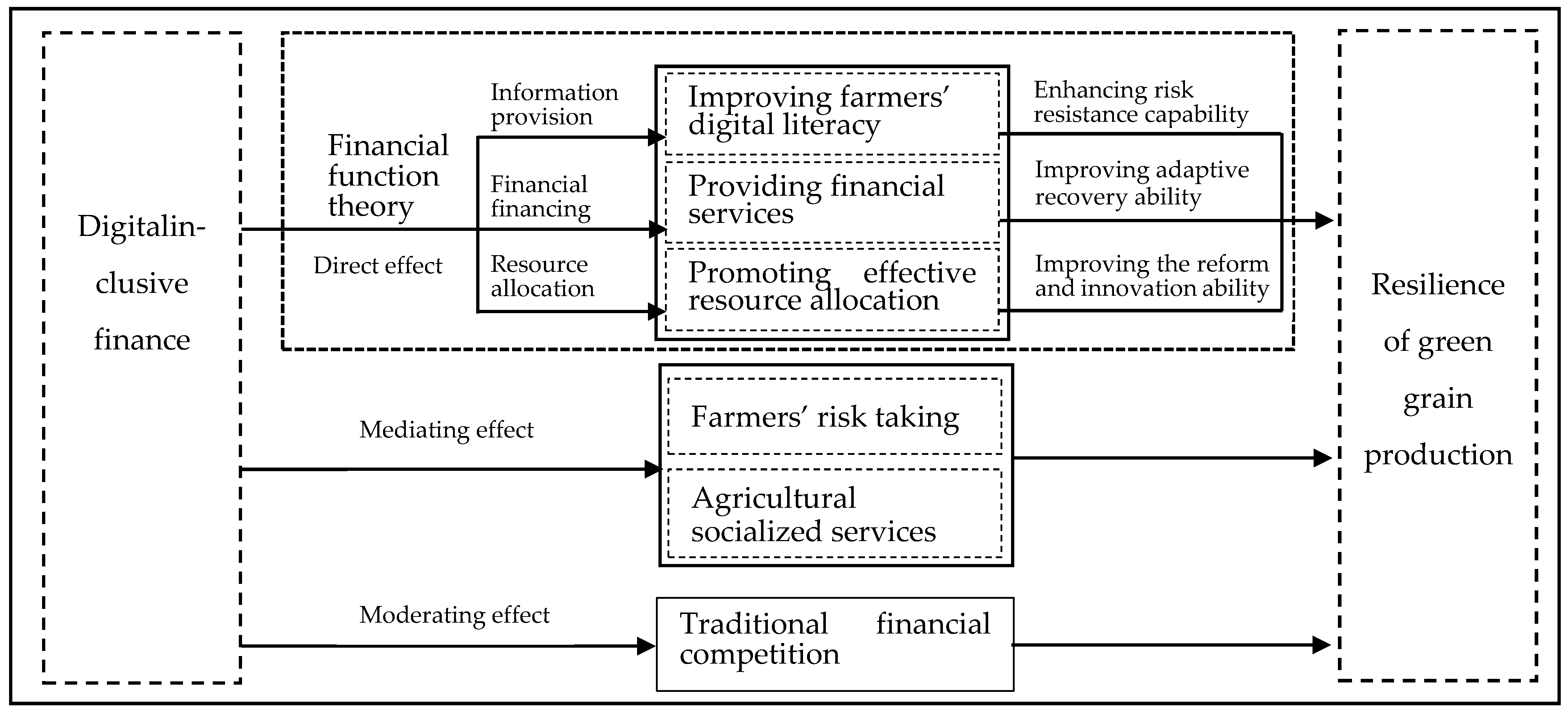
Green grain production resilience represents the ability of green grain production to effectively resist environmental risks, adapt and recover, and reform and innovate in the production process. According to the theory of financial functions, digital inclusive finance enhances the risk resistance, adaptive recovery, and reform and innovation capabilities of green food production by facilitating information acquisition, promoting capital circulation, and improving resource allocation.
First, digital inclusive finance can improve farmers’ digital literacy, thereby enhancing the risk resistance ability of green grain production. Digital technology provides new opportunities for green grain production [35] by improving its climate adaptability and reducing the negative environmental impact of the production process. For example, the Internet of Things technology can collect various types of meteorological data and propose optimal irrigation and fertilization schemes using AI algorithms, thereby saving resources and reducing pollution. However, according to the digital divide theory, the adoption of digital technology displays usage differences, which are mainly caused by farmers’ digital literacy [36]. Digital inclusive finance indirectly improves farmers’ digital participation by embedding digital services into farmers’ social platforms, mobile apps, and other aspects of daily life, allowing them to enhance their digital literacy via the “learning by using” process in daily activities. Simultaneously, digital inclusive finance satisfies farmers’ financial and business needs via online loans and online sales of agricultural products, prompting farmers to actively learn about digital applications and, thus, improving their digital literacy. Improving farmers’ digital literacy contributes to their use of digital technologies and, thus, enhances the risk resistance ability of green grain production.
Second, digital inclusive finance can provide farmers with financial services, thereby improving the adaptive recovery ability of green grain production. Green grain production requires a large amount of capital investment, but farmers’ own funds are usually insufficient to meet the production and operation needs. The problem of insufficient funds for green grain production is prominent [37]. Digital inclusive finance effectively improves farmers’ accessibility and convenience in obtaining financial services and can provide financial support for farmers quickly and at low interest [38]. This can enable farmers to have sufficient funds to adopt intelligent green production technologies [39], purchase green production materials, and enhance the adaptive recovery ability of green grain production.
Third, digital inclusive finance enhances the effective allocation of resources, thereby improving the reform and innovation ability of green grain production. At present, digital inclusive finance pays great attention to the concept of green finance. This trend helps to fully leverage the resource-guiding function of finance [40], guiding the flow of funds, talents, and technologies into green agricultural development [41]. The flow of resources provides funding and personnel support for agricultural innovation, which in turn helps to enhance the reform and innovation ability of green grain production. Therefore, this study proposes Hypothesis 1:
H1. 
Digital inclusive finance helps to enhance the resilience of green grain production.

2.3. Mediating Mechanism of Farmers’ Risk Taking

The short-term risk of farmers engaging in green grain production is relatively high [42]. This is mainly because the production materials and green technologies required for green grain production are costly, and the risks of grain yield reduction caused by climate, pests, and diseases in green production are higher. Therefore, farmers’ risk-taking ability is the key factor in determining their engagement in green grain production. A high level of farmers’ risk-taking ability means that farmers possess strong “risk-resistant capital,” which can increase the likelihood of farmers investing in green grain production—such as purchasing high-quality seeds, promptly replacing intelligent production equipment, and adopting advanced green agricultural technologies [43]—and strengthen farmers’ adaptability to various risks and enable them to take more flexible response measures when facing risks, thereby improving the resilience of green grain production.
According to the risk aversion theory, farmers can transfer the risks of green grain production and avoid the potential losses caused by such risks via risk control, thereby enhancing their risk-taking ability. Digital inclusive finance improves farmers’ risk-taking ability by increasing their ability to purchase agricultural insurance, providing precise agricultural insurance products, and broadening their access channels to information on green grain production. Digital inclusive finance enables farmers to obtain convenient financial services at lower service costs. Sufficient funds enhance farmers’ ability to purchase agricultural insurance, helping them achieve risk transfer. Digital inclusive finance effectively avoids information asymmetry, allowing farmers to better understand green technologies, green agricultural products, and market conditions, thus improving their risk management ability. Therefore, this study proposes Hypothesis 2:
H2. 
Farmers’ risk taking plays a mediating role in the process of enhancing the resilience of green grain production via digital inclusive finance.

2.4. Mediating Mechanism of Agricultural Socialized Services

Agricultural socialized services primarily impact the resilience of green grain production by promoting the specialization and intelligence of grain production [44]. Agricultural socialized services can provide professional scientific planting services, which can effectively avoid the environmental pollution problem caused by excessive use of chemical inputs and reduce the problem of grain yield reduction caused by improper fertilizer application. In addition, agricultural socialized services improve farmers’ large-scale operations by providing intelligent mechanization services [45]. This can alleviate the problem of small-scale management areas and land fragmentation that hinders small farmers from adopting green production behaviors [46]. Furthermore, it decreases carbon emission intensity by improving the level of mechanization.
Digital inclusive finance provides conditions for agricultural socialized services. With its wide coverage, digital inclusive finance can provide funding for agricultural socialized service organizations, greatly improving their service radius and capacity in rural areas. Moreover, digital inclusive finance enhances the intelligence level of agricultural socialized services via digital technologies. Therefore, this study proposes Hypothesis 3:
H3. 
Agricultural socialized services play a mediating role in the process of enhancing the resilience of green grain production via digital inclusive finance.

2.5. Moderating Effect of Traditional Financial Competition

Since traditional financial institutions have served agricultural production for a long time, they are the main driving force behind agricultural production and business investment. Moreover, as Chinese farmers are generally older and have relatively lower education levels, coupled with their limited understanding of digital inclusive finance, their dependence and trust in local traditional financial institutions are higher. They tend to prefer offline loans when facing credit demands. The more intense the traditional financial competition is, the more major financial institutions will extend their services to remote rural areas [47], relax credit standards, simplify business procedures, reduce service costs, and adopt the method of “instant borrowing and instant lending” to provide farmers with higher-quality and more convenient financial services. Therefore, in the short term, it is difficult for the advantages of digital inclusive finance in agricultural production investment to immediately emerge when traditional financial competition intensifies. Based on the above analysis, this study proposes Hypothesis 4:
H4. 
Traditional financial competition suppresses the effectiveness of digital inclusive finance in enhancing the resilience of green grain production.
Based on the preceding analysis, we developed a conceptual model illustrating the relationships between digital inclusive finance, green grain production resilience, farmers’ risk-taking capacity, agricultural socialized services, and traditional financial competition, as depicted in Figure 1.

3. Models, Variables, and Data

3.1. Modeling

3.1.1. Baseline Regression Model

The following baseline regression model was constructed to test the impact of digital inclusive finance on the resilience of green grain production:
G G S i t = α 0 + α 1 D I F i t + α 2 C o n t r o l s i t + μ i + μ t + ε i t
In Equation (1), GGSit represents the resilience of green grain production, DIFit represents digital inclusive finance, Controlsit represents the control variables, α1 and α2 are coefficients, and α0 is the intercept term.

3.1.2. Mediating Effect Model

Digital inclusive finance may improve the resilience of green grain production by improving farmers’ risk taking and agricultural socialized services. This study used the following model to test the mediating effect:
M i t = β 0   +   β 1 D I F i t   +   β 2 C o n t r o l s i t + μ i + μ t + ε i t
G G S i t = γ 0 + γ 1 D I F i t + γ 2 M i t + γ 3 C o n t r o l s i t + μ i + μ t + ε i t
where Mit is the mediating variable, and the other variables are consistent with those in Equation (1).

3.1.3. Moderating Effect Model

To examine the moderating role of traditional financial competition in the impact of digital inclusive finance on the resilience of green grain production, the following model is constructed:
G G S i t = δ 0   +   δ 1 D I F i t + δ 2 T F i t   +   δ 3 T F i t × D I F i t + δ 4 C o n t r o l s i t + μ i + μ t + ε i t
In Equation (4), TFit represents the intensity of traditional financial competition in region i in year t, and the other variables are consistent with those in Equation (1).

3.2. Variable Selection

3.2.1. Explained Variable: Green Grain Production Resilience (GGS)

Based on the definition of green grain production resilience, this study adopted the pressure–state–response (PSR) theoretical framework to develop a comprehensive evaluation index system. The system includes 19 element indicators based on three aspects, risk resistance ability, adaptive recovery ability, and reform and innovation ability, as shown in Table 1. Risk resistance capacity is measured via both input and output dimensions. From the input perspective, high-quality farmland enhances yield stability and resource use efficiency via soil improvement and disaster-resilient infrastructure. Dense agrometeorological observation networks facilitate precise climate risk forecasting, enabling proactive risk mitigation measures. Governmental agricultural support serves as a critical funding source for green grain production in underdeveloped rural financial markets, promoting the adoption and application of smart green technologies.
Adaptive recovery capacity is evaluated via two dimensions: ecological adaptation and production resilience. Given that pesticides, fertilizers, agricultural film, and carbon emissions are primary sources of environmental degradation in grain production, their application intensity per unit sown area—including pesticide use, fertilizer consumption, agricultural film usage, and carbon emission intensity—serves as an indicator of pollution control effectiveness. Strengthened control in these areas reflects enhanced ecological adaptive recovery capacity. Concurrently, the multiple-cropping index captures the speed of production recovery post disaster via optimized planting structures. The total mechanical power per unit sown area represents the core capacity for restoring agricultural operations following disruptive events.
A stronger transformative innovation capacity enhances the ability to withstand, adapt to, and prevent shocks. Agricultural R&D expenditure and personnel investment reflect the scale of research and development inputs in agricultural innovation, with greater investment indicating higher innovation potential. The number of agricultural green innovation patents and the level of germplasm innovation are direct outputs of agricultural innovation, demonstrating the effectiveness of innovative activities. The proportion of certified organic grain cultivation areas and the number of certified green food grain products represent outcomes of green grain production, reflecting the intergenerational accumulation of green agricultural products.
This study used a weighting coefficient method to isolate some indicators to separate the grain production input from the generalized agricultural production input. Referring to Volkov et al.’s study (2022) [48], this study employed the entropy method to evaluate the resilience of green grain production, which enabled the objective determination of the weights for each evaluation indicator and was applied for comprehensive multi-criteria evaluation.

3.2.2. Core Explanatory Variable: Digital Inclusive Finance (DIF)

This study adopted the Digital Inclusive Finance Index published by the Digital Finance Research Center of Peking University as the measurement indicator [49]. The original data were divided by 100 for the convenience of empirical testing and analysis.

3.2.3. Mediating Variables

First, farmers’ risk taking (AR) refers to their ability to withstand and absorb financial and production-related shocks under conditions of uncertainty. This study measured farmers’ risk-taking ability using the depth of agricultural insurance utilization, which was measured by the ratio of agricultural insurance premium income to the added value of the agricultural industry. Second, agricultural socialized services (ASSs) denote specialized and supplementary activities that support agricultural production via market-based, specialized provision. This study measured agricultural socialized services by the ratio of the total output value of the agricultural service industry to the number of agricultural employees.

3.2.4. Moderating Variable

The moderating variable was traditional financial competition (TF), which refers to the intensity of market competition among conventional banking institutions, reflected in their rivalry for customer segments, credit allocation, and regional market share. It is measured by the degree of banking market competition within each region. Following Jiang et al. (2019) [50], the Herfindahl–Hirschman Index (HHI) was used for this measurement.

3.2.5. Control Variable

The control variables were as follows: digitalization level (SZ), measured by the number of digital technology innovation patents, taking the logarithm of the patent count; urbanization rate (UR), measured by the ratio of the urban population to the total regional population; industrial structure level (IS), measured by the proportion of the added value of the primary industry to the regional GDP; grain production conditions (GPC), measured by the agricultural product producer price index; and regional infrastructure (RI), measured by the road mileage per unit area.

3.3. Data Sources

This study selected panel data from 30 provinces in China (excluding Tibet, Hong Kong, Macao, and Taiwan) from 2011 to 2023 for analysis. The data on digital inclusive finance were obtained from the Digital Finance Research Center of Peking University. The other data were obtained from the China Statistical Yearbook, China Rural Statistical Yearbook, China Agricultural Statistical Yearbook, China Insurance Yearbook, China Fiscal Statistical Yearbook, China Leisure Agriculture Yearbook, China Tertiary Industry Statistical Yearbook, public information from provincial government websites, the public data of the China Green Food Development Center, the Tailong Finance School–Qiyan China Financial Inclusion Database (TFID) of Zhejiang Gongshang University, the Agricultural and Forestry Patent Database (AFPD) of the China National Research Data Services Platform (CNRDS), and the EPS Data Platform. Missing data were supplemented using the interpolation method. The descriptive statistics of each variable are shown in Table 2.

4. Empirical Analysis

4.1. Baseline Test

The test results of the impact of digital inclusive finance on the resilience of green grain production are shown in Table 3, where Column (1) presents the preliminary regression results without control variables, while Columns (2) to (6) show the regression results after sequentially adding control variables. The coefficient for the impact of digital inclusive finance on green grain production resilience increased from 0.0372 to 0.0956 after adding the control variables one by one. All coefficients were significant at the 1% level. The model’s goodness of fit gradually increased from 0.644 to 0.687. This result shows that digital inclusive finance has significantly improved the resilience of green grain production, thus supporting Hypothesis 1.

4.2. Robustness Test and Endogeneity Analysis

4.2.1. Robustness Test

We used the equal weight method to re-evaluate the resilience of green food production to ensure the robustness of the resilience evaluation indicators for green food production. The research results showed that the regression coefficient of the impact of digital inclusive finance on the resilience of green food production was 0.0464, with a p-value of 0, which was consistent with the original results. Moreover, this study validated the results by changing the sample period, reducing the sample size, and applying winsorization to the variables. The results are shown in Columns (1) to (3) of Table 4.
(1)
Changing the sample period: The sample period was shortened to 2013–2021, and the regression results are shown in Column (1) of Table 4. According to the results, the regression coefficient of digital inclusive finance was 0.0791 and significant at the 1% level, consistent with the baseline regression results.
(2)
Winsorization: Winsorization of 5% was applied to the variables. The regression results obtained after performing a series of tests are shown in Column (2) of Table 4. The coefficient of digital inclusive finance was 0.0945 and significant at the 1% level, consistent with the baseline regression results.
(3)
Changing the sample size: As Beijing, Shanghai, Tianjin, and Chongqing are municipalities directly under the central government, significantly differing from other provinces in terms of agricultural policies and green agricultural development environments, these cities were deleted from the sample. The regression results are shown in Column (3) of Table 4. The coefficient of digital inclusive finance was 0.1238, consistent with the baseline regression results.

4.2.2. Endogeneity Test

Referring to Peng (2025) [8] and Lin (2025) [51], this study selected the internet penetration rate (IL) and one-period lagged digital inclusive finance as instrumental variables to conduct the endogeneity test. The results are shown in Columns (4) and (5) of Table 4. In the regression results, the F-test values were all greater than 10, indicating that the selected instrumental variables were valid. The results show that the coefficients of digital inclusive finance on green grain production resilience were 0.085 and 0.095 after instrumental variable processing, respectively, both significant at the 1% level. This verifies the validity of the research results; that is, digital inclusive finance has a significant positive impact on the resilience of green grain production. This study examined the impact of digital inclusive finance on the resilience of green grain production by gradually adding control variables. The test results are shown in Table 3, where Column (1) presents the preliminary regression results without control variables, while Columns (2) to (6) show the regression results after sequentially adding control variables. According to the regression results, the coefficient of digital inclusive finance on green grain production resilience increased from 0.0372 to 0.0956 after adding the control variables one by one, and all coefficients were significant at the 1% level. The model’s goodness of fit gradually increased from 0.644 to 0.687, indicating that the explanatory power of the model was continuously strengthened. This result shows that digital inclusive finance enhances the resilience of green grain production, thus supporting Hypothesis 1.

4.3. Heterogeneity Analysis

The location conditions, ecological environments, and grain planting situations differ among regions; therefore, it was necessary to further explore whether the impact of digital inclusive finance on the resilience of green grain production varies across different regions and grain functional areas.

4.3.1. Regional Heterogeneity Test

The development level of digital inclusive finance is closely related to the level of regional economic development. This study divided the 30 provinces into eastern, central, and western regions to further explore the impact of digital inclusive finance on green grain production resilience under different levels of economic development. The eastern region included Beijing, Tianjin, Hebei, Liaoning, Shanghai, Jiangsu, Zhejiang, Fujian, Shandong, Guangdong, and Hainan; the central region included Shanxi, Jilin, Heilongjiang, Anhui, Jiangxi, Henan, Hubei, and Hunan; and the western region included Inner Mongolia, Guangxi, Chongqing, Sichuan, Guizhou, Yunnan, Shaanxi, Gansu, Qinghai, Ningxia, and Xinjiang. The regression results are shown in Columns (1) to (3) of Table 5. The results indicate that digital inclusive finance had a significant positive impact on the resilience of green grain production in the eastern region, but its impact on the central and western regions was not significant. This may be because the relatively high level of economic development in the eastern region promotes the development of digital inclusive finance and the construction of digital infrastructure. In addition, its advantageous geographical location and favorable climatic conditions provide a solid foundation for the development of green agriculture. The combined effect of these factors makes the influence of digital inclusive finance on green grain production resilience most significant in the eastern region.

4.3.2. Heterogeneity Test by Grain Functional Area

This study divided the 30 provinces into major grain-producing areas and non-major grain-producing areas to examine the differences in the impact of digital inclusive finance on green grain production resilience across different grain functional areas. The regression results are shown in Columns (4) and (5) of Table 5. According to the results, digital inclusive finance had a significant positive impact on the resilience of green grain production in major grain-producing areas, whereas this impact was not significant in non-major grain-producing areas. This may be because it is difficult to overcome certain objective constraints, such as land fragmentation and underdeveloped infrastructure, when digital inclusive finance functions. In contrast, major grain-producing areas are the core zones of grain cultivation, bearing the crucial responsibility of ensuring food security. The government’s policy support for green grain production is relatively stronger in these areas, which are characterized by higher levels of scale and specialization in production. Most importantly, grain cultivation is the main source of farmers’ income in major grain-producing areas, making farmers more willing to invest in green grain production. Leveraging these inherent advantages, digital inclusive finance acts as a catalyst and significantly enhances the resilience of green grain production in major grain-producing areas.

4.4. Mediating Effect

4.4.1. Mediating Effect of Farmers’ Risk Taking

Digital inclusive finance enhances the resilience of green grain production via improving farmers’ risk-taking ability. The mediating effect was tested using Equations (2) and (3), and the results are shown in Table 6. According to Column (2) of Table 6, the regression coefficient of the impact of digital inclusive finance on farmers’ risk-taking was 0.0122. After including farmers’ risk taking into the model, as shown in Column (3), the coefficient of digital inclusive finance remained significant at the 1% level, indicating that farmers’ risk taking plays a mediating role in the effect of digital inclusive finance on green grain production resilience. The results of the Sobel and bootstrap tests also passed the significance level test.

4.4.2. Mediating Effect of Agricultural Socialized Services

Digital inclusive finance can indirectly enhance the resilience of green grain production by improving the level of agricultural socialized services. Column (4) of Table 6 shows that digital inclusive finance had a significant positive effect on agricultural socialized services. The estimation results in Column (5), alongside the results of the Sobel and bootstrap tests, indicate that agricultural socialized services play a mediating role in the impact of digital inclusive finance on green grain production resilience.

4.5. Moderating Effect

The interaction term between traditional financial competition and digital inclusive finance was included in the regression model, according to Equation (4), to further test the moderating effect of traditional financial competition intensity. The results are shown in Column (6) of Table 6, showing that digital inclusive finance, traditional financial competition, and their interaction term were all significantly positive. Since the traditional financial competition intensity is a negative indicator—where higher values indicate weaker competition—the results demonstrate a negative moderating effect of traditional financial competition on the relationship between digital inclusive finance and green grain production resilience.

5. Discussion

Sustainable food production is an urgent problem under current ecological deterioration and resource shortages [52]. Digital inclusive finance improves the green allocation of resources and improves environmental risk management, thereby increasing the resilience of green grain production. Previous studies have only analyzed the impact of digital inclusive finance on the resilience of grain production [31]. Based on this, this study quantified, for the first time, the resilience of green grain production and found that digital inclusive finance can significantly enhance the resilience of green grain production. However, this relationship could not be directly explained as an absolute causal relationship, mainly because we could not completely exclude factors that simultaneously affect both. Future research can attempt to identify more exogenous policy shocks or instrumental variables to provide more rigorous causal evidence for the relationship between the two.
Further heterogeneity analysis showed that the promoting effect of digital inclusive finance on green grain production resilience was mainly observed in major grain-producing areas, where the proportion of grain cultivation was high, while the effect was not significant in non-major grain-producing areas. Existing studies have found that the effect of digital inclusive finance on agricultural green development exhibits clear regional heterogeneity. For example, Guo et al. (2024) found that the effect of digital inclusive finance on agricultural green development is more significant in major grain-producing areas [53], which indirectly supports this study’s findings.
The mechanism analysis suggested that digital inclusive finance improves the resilience of green grain production via farmers’ risk taking and agricultural socialized services. This result is similar to those of Peng et al. (2025) [8] and Han and Liu (2025) [54]. Han and Liu (2025), for instance, demonstrated that agricultural productive services can effectively decrease the intensity of pesticide and fertilizer use in grain production [54]. However, Peng et al. (2025) found that the mediating effect of farmers’ risk taking is nonlinear [8]. This study used agricultural insurance to measure farmers’ risk preferences in depth. This indicator can only directly reflect one result of farmers’ risk preferences, but it cannot fully reflect the reasons why farmers are willing to take risks. Future research can refer to Yin et al.’s (2024) use of discrete choice experiments to measure farmers’ preferences [55]. Farmers’ risk preferences can be accurately quantified by designing a selection set that includes multiple attributes, such as digital inclusive finance and green food production, providing further useful supplements to this study. Moreover, this study found that the greater the intensity of traditional financial competition, the weaker the role of digital inclusive finance in enhancing the resilience of green grain production, which is basically consistent with Gao et al.’s findings (2024) [56].
Although the results of this study are of certain value, several limitations remain. One limitation relates to the evaluation index system of green grain production resilience. The soil organic matter content was not included in the evaluation indicators due to data constraints. Future studies may adopt scientific methods to measure soil organic matter content and incorporate it into the evaluation framework. Furthermore, this study did not analyze the spatial effects of digital inclusive finance on green grain production resilience. Future research should construct spatial effect models to explore this aspect. Additionally, this study only conducted linear analysis and did not examine nonlinear relationships. Future research should explore whether the impact mechanism of digital inclusive finance on green grain production resilience exhibits nonlinear effects.

6. Conclusions and Policy Recommendations

This study analyzed the impact of digital inclusive finance on the resilience of green grain production and conducted empirical tests of mediating and moderating effects based on panel data from 30 provinces in China from 2011 to 2023. The results show that digital inclusive finance significantly promotes the improvement of green grain production resilience, with notable differences across regions and grain functional areas. The mechanism analysis revealed that digital inclusive finance enhances the resilience of green grain production through farmers’ risk taking and agricultural socialized services. In addition, the stronger the traditional financial competition intensity, the weaker the promoting effect of digital inclusive finance on green grain production resilience. Traditional financial competition plays a negative moderating role between digital inclusive finance and the resilience of green food production.
The following policy recommendations are proposed to strengthen the promoting effect of digital inclusive finance on the resilience of green grain production:
First, the level of socialized agricultural services must be improved. On the one hand, we need to strengthen policy support for agricultural socialized service organizations, encourage them to cover more rural areas, and improve the coverage of agricultural socialized services. On the other hand, we need to strengthen the financial support of digital inclusive finance for agricultural socialized service organizations so that they have sufficient funds to purchase smart devices and improve their service levels.
Second, the application of digital inclusive finance in different grain functional areas in a differentiated manner must be promoted. The service capacity of digital inclusive finance should be continuously enhanced in major grain-producing areas. Farmers should be provided with convenient and flexible credit services tailored to the characteristics of green grain production. In non-major grain-producing areas, more policy and financial support should be provided to increase local attention to green grain production and strengthen the application of digital inclusive finance in this field.
Third, farmers’ risk-taking ability must be enhanced. Agricultural insurance is an effective means to improve farmers’ risk-taking capacity. Training should be strengthened to raise farmers’ awareness of risk prevention and their understanding of the importance of agricultural insurance to increase their enthusiasm for purchasing agricultural insurance. In addition, the government should increase premium subsidies to reduce the cost of insurance for farmers and enhance their willingness to purchase it.

Author Contributions

C.H. proposed the research idea and designed this study. H.C. wrote the draft, was involved in data processing (including collection, refinement, visualization, and analysis), and revised this work. C.Z. was involved in writing and analysis and provided guidance for this article. All authors have read and agreed to the published version of the manuscript.

Funding

This study was supported by the National Social Science Fund of China (grant no. 22BJY089) and the Daqing Philosophy and Social Sciences Planning Research Project (DSGB2025192).

Institutional Review Board Statement

Not applicable.

Data Availability Statement

The data supporting the findings of this study are publicly available and referenced and can be provided by the corresponding author upon reasonable request.

Conflicts of Interest

The authors declare no conflicts of interest.

References

  1. Ashraf, J.; Javed, A. Food Security and Environmental Degradation: Do Institutional Quality and Human Capital Make a Difference? J. Environ. Manag. 2023, 331, 117330. [Google Scholar] [CrossRef]
  2. Manioudis, M.; Meramveliotakis, G. Broad strokes towards a grand theory in the analysis of sustainable development: A return to the classical political economy. New Political Econ. 2022, 27, 866–878. [Google Scholar] [CrossRef]
  3. Zhang, H.; Bai, X.; Zhao, M. How Socialized Services Affect Agricultural Economic Resilience-Empirical Evidence from China. Agriculture 2024, 14, 1773. [Google Scholar] [CrossRef]
  4. Ozili Peterson, K. Digital Finance Research and Developments around the World: A Literature Review. Int. J. Bus. Forecast. Mark. Intell. 2023, 8, 35. [Google Scholar] [CrossRef]
  5. Sun, X.T.; Yu, T.; Yu, F.W. The Impact of Digital Finance on Agricultural Mechanization: Evidencefrom 1869 Counties in China. Chin. Rural Econ. 2022, 6, 76–93. (In Chinese) [Google Scholar]
  6. Fei, R.; Lin, Z.; Chunga, J. How Land Transfer Affects Agricultural Land Use Efficiency: Evidence from China’s Agricultural Sector. Land Use Policy 2021, 103, 105300. [Google Scholar] [CrossRef]
  7. Xie, Y.; Yao, R.; Wu, H.; Li, M. Digital Economy, Factor Allocation, and Resilience of Food Production. Land 2025, 14, 139. [Google Scholar] [CrossRef]
  8. Peng, D.; Su, Y.; Feng, Y. Nonlinear Mechanisms of the Impact of Digital Financial Inclusion on Agricultural Resilience: Threshold Effect of Agricultural Production Risk. China Popul. Resour. Environ. 2025, 35, 205–219. (In Chinese) [Google Scholar]
  9. Labeyrie, V.; Ouadah, S.; Raimond, C. Social Network Analysis: Which Contributions to The Analysis of Agricultural Systems Resilience? Agric. Syst. 2024, 215, 103832. [Google Scholar] [CrossRef]
  10. Yang, Z.; Wang, J. How Can the Aging of Agricultural Labor Affect Green Grain Production:Based on the Survey of Farmers in Six Provinces Along the Yangtze River. Resour. Environ. Yangtze Basin 2020, 29, 725–737. [Google Scholar]
  11. Zhao, W.; Luo, X.; Tang, L.; Sun, B. Impact of Digital Agricultural Extension Services on Farmers’ Green Grain Production Efficiency: An Analysis from the Dual Perspective of Aging and Digital Divide. J. Arid. Land Resour. Environ. 2024, 38, 55–68. [Google Scholar] [CrossRef]
  12. Wang, S.; Yang, Z. The Effect of the Aging of Agricultural Labor Force on the Change of Grain Green Total Factor Productivity. Res. Agric. Mod. 2020, 41, 396–406. [Google Scholar] [CrossRef]
  13. Zhang, R.; Ma, L.; Zhao, K.; Zhang, Z. The Role of Agricultural Production Trusteeship in Improving Green Production Efficiency of Grain. Resour. Sci. 2023, 45, 2248–2263. [Google Scholar] [CrossRef]
  14. Qin, Z.; Fan, Z.; Yu, S. The Impact and Transmission Mechanism of Temperature Changes on Green Production Efficiency of Grain. J. China Agric. Resour. Reg. Plan. 2024, 45, 81–94. [Google Scholar]
  15. Eeswaran, R.; Nejadhashemi, A.P.; Miller, S.R. Evaluating the Climate Resilience in Terms of Profitability and Risk for a Long-Term Corn-Soybean-Wheat Rotation under Different Treatment Systems. Clim. Risk Manag. 2021, 32, 100284. [Google Scholar] [CrossRef]
  16. Fan, Z.; Qin, Z.; Yu, S. Impact of Extreme Temperature on the Resilience of Grain Production: Perspectives on Green Finance. Chin. J. Eco-Agric. 2024, 32, 896–910. [Google Scholar] [CrossRef]
  17. Martin, R.; Sunley, P. On the Notion of Regional Economic Resilience: Conceptualization and Explanation. J. Econ. Geogr. 2015, 15, 1–42. [Google Scholar] [CrossRef]
  18. Wei, Z.; Peng, J.; Zhao, Y.; Li, X.; Wang, C. Reform of Agricultural Land Property Rights System and Grain Production Resilience: Empirical Evidence Based on China’s “Three Rights Separation” Reform. PLoS ONE 2025, 20, e0319387. [Google Scholar] [CrossRef]
  19. Tao, C.; Zhou, H.; Deng, R.; Zhang, Z. The Multi-Dimensional Spatial Network Effect on Grain Production Resilience: Evidence from China’s Provinces. Appl. Econ. 2025, 57, 5015–5031. [Google Scholar] [CrossRef]
  20. Sui, J.L.; Li, Y.X.; Liu, J.Q. The Spatiotemporal Convergence and Divergence, Heterogeneous Differentiation Characteristics of Economic Resilience in China: Identification Based on a Markov Switching Mixed-frequency Dynamic Factor Model. J. Manag. World 2024, 40, 16–36+73+37. [Google Scholar] [CrossRef]
  21. Chen, Y.; Zeng, M.; Chen, B. Impact of Climate Change on the Resilience of Food Production: Research of the Moderating Effect Based on Crop Diversification. Acta Ecol. Sin. 2024, 44, 6937–6951. [Google Scholar] [CrossRef]
  22. Kahiluoto, H.; Kaseva, J.; Balek, J.; Olesen, J.E.; Ruiz-Ramos, M.; Gobin, A.; Kersebaum, K.C.; Takac, J.; Ruget, F.; Ferrise, R.; et al. Decline in Climate Resilience of European Wheat. Proc. Natl. Acad. Sci. USA 2019, 116, 123–128. [Google Scholar] [CrossRef] [PubMed]
  23. Li, S.L.; Ma, L. The Mechanism and Policy Effects of National Modern Agricultural Demonstration Zone Construction on Grain Production Resilience. J. Shenzhen Univ. (Humanit. Soc. Sci.) 2025, 42, 5–15. (In Chinese) [Google Scholar]
  24. Cui, D. The Impact of Large-Scale Agricultural Operations on the Grain Production Resilience: A Quasi-Natural Experiment Based on Land Transfer Policy. Front. Sustain. Food Syst. 2025, 9, 1596449. [Google Scholar] [CrossRef]
  25. Zheng, T.; Zhao, G. The Impact of Policy-Oriented Agricultural Insurance on China’s Grain Production Resilience. Front. Sustain. Food Syst. 2025, 8, 1510953. [Google Scholar] [CrossRef]
  26. Fang, D.; Chen, J.; Wang, S.; Chen, B. Can Agricultural Mechanization Enhance the Climate Resilience of Food Production? Evidence from China. Appl. Energy 2024, 373, 123928. [Google Scholar] [CrossRef]
  27. Fang, G.F.; Cai, L. How Digital Financial Inclusion Affects Agricultural Output: Facts, Mechanism and Policy Implications. Issues Agric. Econ. 2022, 10, 97–112. (In Chinese) [Google Scholar]
  28. Li, M.; Chen, D.; Yu, G. Digital Inclusive Finance Empowers Food System Resilience based on the Perspective of Spatial Spillover Effect. J. China Agric. Resour. Reg. Plan. 2024, 45, 74–84. [Google Scholar]
  29. Zhang, X.; Yu, Y. The Impact of Digital Inclusive Finance on Food Supply Chain Resilience: A Perspective of Production Factor Development. Res. Agric. Mod. 2025, 46, 270–281. [Google Scholar] [CrossRef]
  30. Prasad, R.S.; Sud, R. Implementing climate change adaptation: Lessons from India’s national adaptation fund on climate change (NAFCC). Clim. Policy 2019, 19, 354–366. [Google Scholar] [CrossRef]
  31. Liu, L.; Li, X. How Does Digital Inclusive Finance Improve the Climate Resilience of Food Production? Front. Sustain. Food Syst. 2025, 9, 1612111. [Google Scholar] [CrossRef]
  32. Heller, M.C.; Keoleian, G.A. Assessing the Sustainability of the Us Food System: A Life Cycle Perspective. Agric. Syst. 2003, 76, 1007–1041. [Google Scholar] [CrossRef]
  33. Folke, C.; Carpenter, S.R.; Walker, B.; Scheffer, M.; Chapin, T.; Rockstrom, J. Resilience Thinking: Integrating Resilience, Adaptability and Transformability. Ecol. Soc. 2010, 15, 20. [Google Scholar] [CrossRef]
  34. Tendall, D.M.; Joerin, J.; Kopainsky, B.; Edwards, P.; Shreck, A.; Le, Q.B.; Kruetli, P.; Grant, M.; Six, J. Food System Resilience: Defining the Concept. Glob. Food Secur.-Agric. Policy Econ. Environ. 2015, 6, 17–23. [Google Scholar] [CrossRef]
  35. Xiong, F.; Rao, P.; Zhang, L.; Zhu, S. Influence of Digital Technology Application on Grain Growers’ Green Production Behavior. J. China Agric. Univ. 2025, 30, 257–268. [Google Scholar]
  36. Gong, S.; Sun, Z.; Wang, B.; Yu, Z. Could Digital Literacy Contribute to the Improvement of Green Production Efficiency in Agriculture? Sage Open 2024, 14, 1–18. [Google Scholar] [CrossRef]
  37. Zhou, Y.S.; Miao, Z.Y. The Impact of Digital Inclusive Finance on Farmers’ Investment in Production and Operation. China Rural Surv. 2023, 01, 40–58. [Google Scholar] [CrossRef]
  38. Zhang, X.L.; Li, Z. “De-grainization” or “grainization”:the impacts of digital financial inclusion on cropping structure. Res. Agric. Mod. 2025, 46, 680–690. [Google Scholar] [CrossRef]
  39. Liu, Q.; Yan, T. How Do Digital Media Strengthen the Role of Social Networks in Promoting Farmers’ Adoption of Climate Change Mitigation Measures? China Agric. Econ. Rev. 2024, 16, 445–467. [Google Scholar] [CrossRef]
  40. Wang, L.; Ma, J.M. Mechanism and Effect of Digital Financial Inclusion Affecting Green Development of Agriculture. J. S. China Agric. Univ. (Soc. Sci. Ed.) 2023, 22, 14–27. [Google Scholar]
  41. van Veelen, B. Cash Cows? Assembling Low-Carbon Agriculture through Green Finance. Geoforum 2021, 118, 130–139. [Google Scholar] [CrossRef]
  42. Zheng, J.; Zhao, W. Impact of Agricultural Insurance on Green Agricultural Production in China: Based on the Mediation Effect of Agricultural Technology Progress. Resour. Sci. 2023, 45, 2414–2432. [Google Scholar] [CrossRef]
  43. Gunnsteinsson, S. Experimental Identification of Asymmetric Information: Evidence on Crop Insurance in the Philippines. J. Dev. Econ. 2020, 144, 102414. [Google Scholar] [CrossRef]
  44. Elahi, E.; Abid, M.; Zhang, L.; ul Haq, S.; Sahito, J.G.M. Agricultural Advisory and Financial Services; Farm Level Access, Outreach and Impact in a Mixed Cropping District of Punjab, Pakistan. Land Use Policy 2018, 71, 249–260. [Google Scholar] [CrossRef]
  45. Yan, H.; Qi, Y.; Zhang, M. Research on the Effect and Mechanism of Agricultural Producer Services Promoting Green Grain Production. J. China Agric. Resour. Reg. Plan. 2023, 44, 54–67. [Google Scholar]
  46. Wang, S.R.; Lin, X.Y.; Geng, N. Research on Social Networks, Services Embedding and Farmers’ Green Production Behaviors: Based on the Mediated Effect Model Test. Chin. J. Agric. Resour. Reg. Plan. 2025, 1–11. (In Chinese) [Google Scholar]
  47. Song, K.; Liu, J.; Li, Z. Does the Development of Digital Financial Inclusion Narrows the Urban-rural Income Gap?—Concurrently Discuss the Synergistic Effect between Digital Financial Inclusion and Traditional Finance in Rural Area. China Soft Sci. 2022, 133–145. [Google Scholar]
  48. Volkov, A.; Morkunas, M.; Balezentis, T.; Streimikiene, D. Are Agricultural Sustainability and Resilience Complementary Notions? Evidence from the North European Agriculture. Land Use Policy 2022, 112, 105791. [Google Scholar] [CrossRef]
  49. Guo, F.; Wang, J.; Wang, F.; Cheng, Z.; Kong, T.; Zhang, X. Measuring China’s Digital Financial Inclusion: Index Compilation and Spatial Characteristics. China Econ. Q. 2020, 19, 1401–1418. (In Chinese) [Google Scholar] [CrossRef]
  50. Jiang, F.X.; Cai, W.J.; Cai, X.N.; Li, X.T. Microeconomic Effects of Bank Competition: Evidence from Corporate Financial Constraints. Econ. Res. J. 2019, 54, 72–88. [Google Scholar]
  51. Lin, L.; Tang, R.L. Digital New Quality Productivity Boosting Farmers’ Income: Theoretical Mechanism and Empirical Test. Econ. Probl. 2025, 104–112. [Google Scholar] [CrossRef]
  52. Tomislav, K. The Concept of Sustainable Development: From its Beginning to the Contemporary Issues. Zagreb Int. Rev. Econ. Bus. 2018, 21, 67–94. [Google Scholar] [CrossRef]
  53. Guo, J.; Chen, L.; Kang, X. Digital Inclusive Finance and Agricultural Green Development in China: A Panel Analysis (2013–2022). Financ. Res. Lett. 2024, 69, 106173. [Google Scholar] [CrossRef]
  54. Han, G.; Liu, T. Exploring Green Grain Production Pathways: Evidence from Farmland and Agricultural Service Scale Operations in China. Front. Sustain. Food Syst. 2025, 9, 1557321. [Google Scholar] [CrossRef]
  55. Yin, Y.; Zhang, Y.; Duan, W.; Xu, K.; Yang, Z.; Shi, B.; Yao, Z.; Yin, C.; Dogot, T. Farmers’ Preferences for Sustainable Farmland Construction—Insights From a Discrete Choice Experiment in China. Sustain. Prod. Consum. 2024, 48, 235–247. [Google Scholar] [CrossRef]
  56. Gao, Q.; Sun, M.; Chen, L. The Impact of Digital Inclusive Finance on Agricultural Economic Resilience. Financ. Res. Lett. 2024, 66, 105679. [Google Scholar] [CrossRef]
Figure 1. Theoretical framework of the impact of digital inclusive finance on the resilience of green grain production.
Agriculture 15 02460 g001
Table 1. Evaluation index system of green grain production resilience.
Primary
Indicators
Tertiary IndicatorsIndicator Calculation MethodIndicator
Attribute
Weight
Risk
resistance ability
Proportion of high-quality arable land (A1) %Area of high-standard farmland/total arable land area+0.0962
Effective irrigation rate (A2) %Effective irrigated area/grain sown area+0.1227
Soil and water conservation rate (A3) %Area of soil and water loss control/total land area under jurisdiction+0.1585
Agricultural natural disaster formation rate (A4) %Area affected by agricultural natural disasters/total disaster-affected area0.0274
Fiscal support for agriculture (A5) %Expenditure on agriculture, forestry, and water affairs/general public budget expenditure+0.1265
Density of agricultural Meteorological observation stations (A6) %Number of agricultural meteorological observation Stations/total land area+0.1579
Grain yield per unit sown area (A7) t/hm2Total grain output/grain sown area+0.0483
Adaptive
recovery
ability
Pesticide use per unit grain sown area (B1) kg/hm2Agricultural pesticide use/grain sown area0.0144
Fertilizer use per unit grain sown area (B2) kg/hm2Converted pure amount of agricultural fertilizer use/grain sown area0.0306
Agricultural film use per unit Grain sown area (B3) kg/hm2Agricultural film use/grain sown area0.0184
Carbon emission intensity (B4) t/10,000 yuanAgricultural carbon emissions/total output Value of agriculture, forestry, animal husbandry, and fishery0.0279
Grain multiple-cropping index (B5) %Grain sown area/total arable land area+0.0797
Total mechanical power per unit grain sown area (B6) kW/hm2Total agricultural mechanical power/grain sown area+0.0334
Reform and
innovation ability
Agricultural R&D expenditure (C1) CNY 100 millionInternal expenditure on R&D × (agricultural output value/total output value of agriculture, forestry, animal husbandry, and fishery)+0.0018
Agricultural R&D personnel input (C2) 10,000 personsR&D personnel × (agricultural output value/total output value of agriculture, forestry, animal husbandry, and fishery)+0.0158
Number of agricultural green innovation patent (C3) itemsNumber of authorized agricultural green innovation patents+0.0071
and germplasm innovation level (C4) itemsNumber of applications for new agricultural plant variety rights+0.0169
Proportion of certified area of organic grain products (C5) %Certified area of organic agricultural products/grain sown area+0.0047
Number of certified green food grain products (C6) %Number of certified green food label products in the year × proportion of green grain products+0.0117
Note: Coefficient a = grain sown area/total crop sown area; coefficient b = agricultural output value/total output value of agriculture, forestry, animal husbandry, and fishery. Indicators A1, A2, A3, A4, B1, B2, B3, B6, C1, and C2 are multiplied by coefficient a; A5 and B4 are multiplied by coefficients a and b, respectively.
Table 2. Results of descriptive statistical analysis of variables.
Variable NameSample SizeMeanStd. Dev.Min.Max.
GGS3900.1550.0600.0730.428
DIF3902.5551.1130.1834.738
AR3900.0130.0180.0010.126
ASS3907.9640.7286.1009.826
TF3900.0910.0320.0420.250
SZ3909.4881.5294.26312.749
UR3900.6010.1200.3710.893
IS3900.0960.0510.0020.240
GPC390103.6126.26890.410122.600
RI3909.6845.0580.97121.941
IL3907.86913.8740.08492.97
Table 3. Baseline test results.
VariableGreen Grain Production Resilience
(1)(2)(3)(4)(5)(6)
DIF0.0372 **
(2.08)
0.0554 ***
(3.07)
0.0948 ***
(4.91)
0.0945 ***
(4.52)
0.0966 ***
(4.65)
0.0956 ***
(4.56)
SZ 0.0226 ***
(4.11)
0.0295 ***
(5.33)
0.0296 ***
(5.25)
0.0303 ***
(5.41)
0.0303 ***
(5.41)
IS 0.589 ***
(4.80)
0.587 ***
(4.53)
0.509 ***
(3.82)
0.510 ***
(3.82)
UR −0.00319
(−0.04)
0.0336
(0.39)
0.0306
(0.36)
RI −0.00409 **
(−2.33)
−0.0041 **
(−2.34)
GPC −0.0001
(−0.47)
cons0.0968 ***
(11.23)
−0.0967 **
(−2.02)
−0.231 ***
(−4.27)
−0.230 ***
(−3.27)
−0.213 ***
(−3.03)
−0.194 **
(−2.37)
Region-fixed effectsYesYesYesYesYesYes
Time-fixed effectsYesYesYesYesYesYes
N390390390390390390
R20.6440.6600.6820.6820.6870.687
** p < 0.05, and *** p < 0.01.
Table 4. Robustness and endogeneity tests.
VariableChanging Sample
Period (1)
Winsorization (2)Changing Sample Size (3)Internet Penetration Rate (5)Lagged One
Period (4)
DIF0.0791 ***
(3.80)
0.0945 ***
(4.37)
0.1238 ***
(5.15)
0.0846 ***
(3.94)
0.0945 ***
(4.37)
Cons−0.352 ***
(−3.44)
−0.214 **
(−2.47)
−0.095
(−1)
0.0844
(1.14)
−0.214 **
(−2.47)
Control variablesYesYesYesYesYes
Region-fixed effectsYesYesYesYesYes
Time-fixed effectsYesYesYesYesYes
N390390390390390
F30.2641.8335.9440.1941.83
** p < 0.05, and *** p < 0.01.
Table 5. Heterogeneity test.
VariableEastern Region (1)Central Region (2)Western Region (3)Major Grain-Producing Areas (4)Non-Major Grain-Producing Areas (5)
DIF0.105 ***
(4.03)
0.0455
(0.79)
0.0816
(1.39)
0.151 ***
(5.22)
0.0433
(1.52)
Cons−0.337 **
(−2.23)
−0.0807
(−0.42)
−0.311
(−1.60)
0.00160
(0.01)
−0.142
(−1.34)
Control variablesYesYesYesYesYes
Region-fixed effectsYesYesYesYesYes
Time-fixed effectsYesYesYesYesYes
N390390390390390
** p < 0.05, and *** p < 0.01.
Table 6. Tests of mediating and moderating effects.
VariableGGS (1)AR (2)GGS (3)ASS (4)GGS (5)GGS (6)
DIF0.0956 ***
(4.56)
0.0122 ***
(9.49)
0.0924 ***
(4.42)
0.060 **
(2.27)
0.054 ***
(3.69)
0.123 ***
(4.88)
AR 0.354 **
(2.10)
ASS 0.062 **
(1.97)
TF 0.033 ***
(3.88)
DIFI × TF DIFI × TF
Cons−0.194 **
(−2.37)
0.0589 ***
(3.59)
−0.237 ***
(−2.82)
0.285
(1.52)
−0.120
(−1.18)
Cons
Sobel test 0.005 *** (4.121) 0.005 *** (2.709)Sobel test
Bootstrap test (ind_eff) 0.005 *** (5.05) 0.006 *** (2.57)Bootstrap test (ind_eff)
Bootstrap test (dir_eff) 0.011 *** (3.68) 0.010 ** (2.38)Bootstrap test (dir_eff)
Region-fixed effectsYesYesYesYesYesRegion-fixed effects
Time-fixed effectsYesYesYesYesYesTime-fixed effects
N390390390390390N
R20.6870.4070.6910.7790.681R2
** p < 0.05, and *** p < 0.01.
Disclaimer/Publisher’s Note: The statements, opinions and data contained in all publications are solely those of the individual author(s) and contributor(s) and not of MDPI and/or the editor(s). MDPI and/or the editor(s) disclaim responsibility for any injury to people or property resulting from any ideas, methods, instructions or products referred to in the content.