


Apple Quality during Shelf-Life after Long-Term Storage and Simulated Transport



Abstract
1. Introduction
2. Materials and Methods
2.1. Research Plan
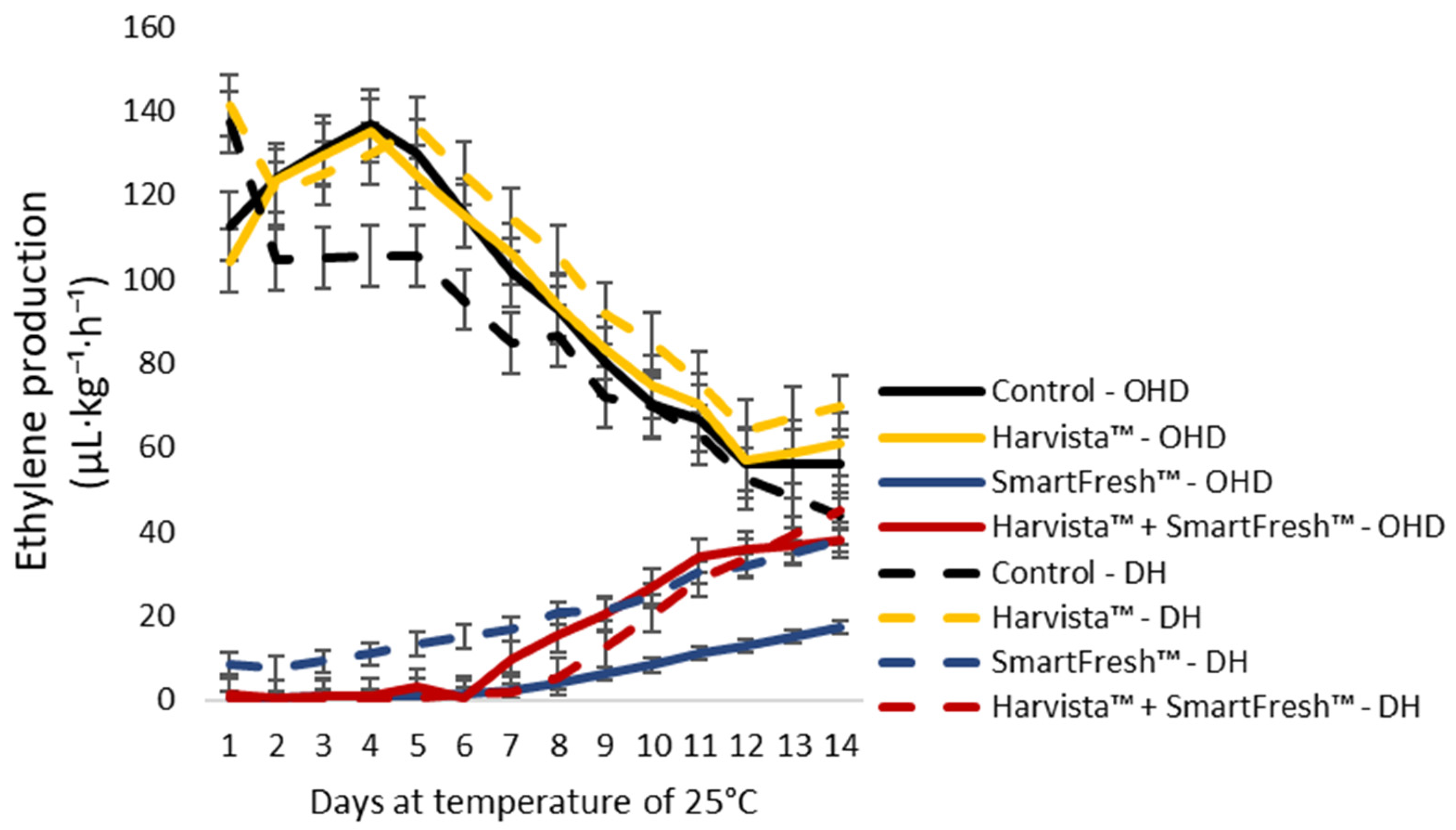
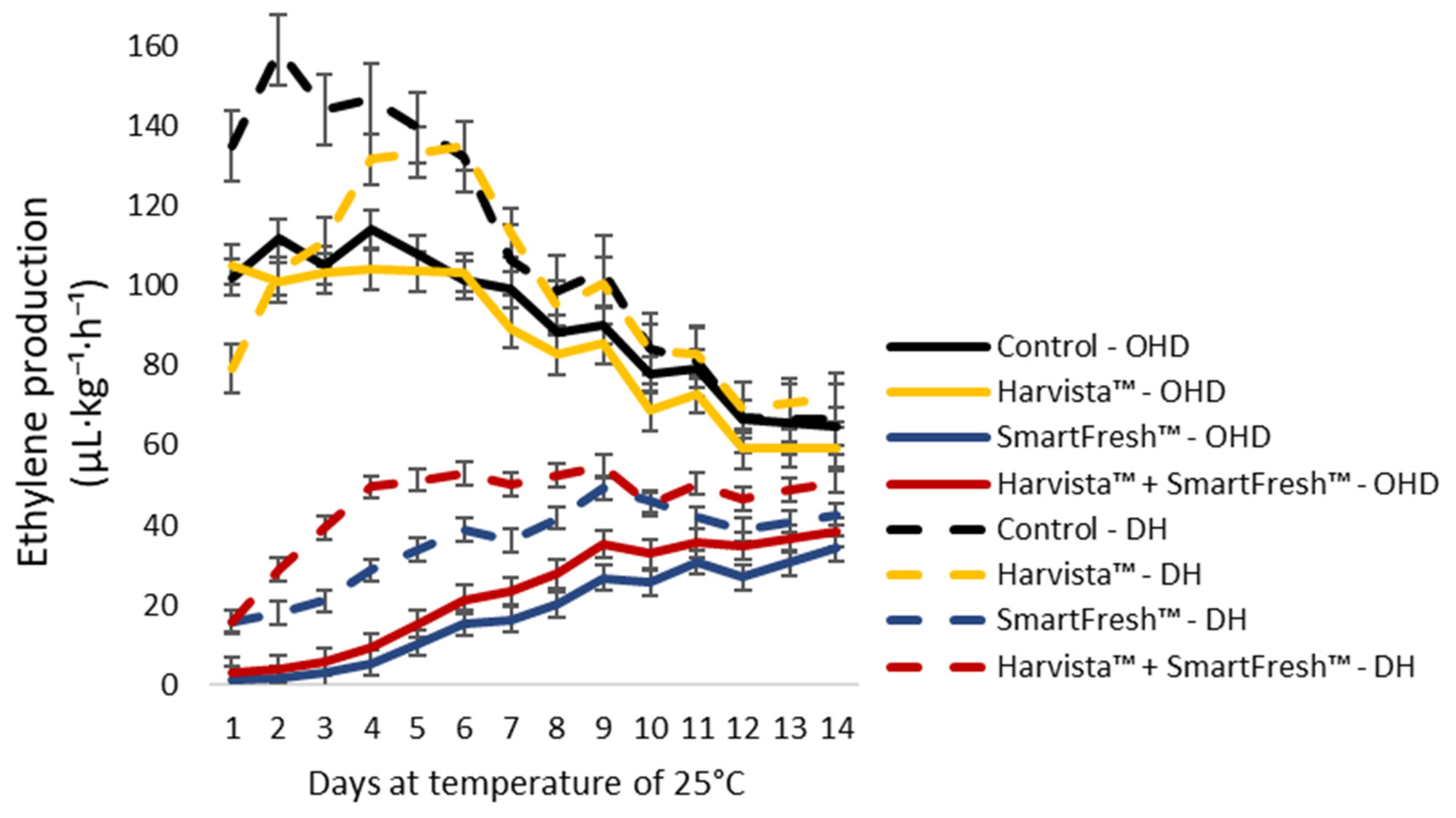
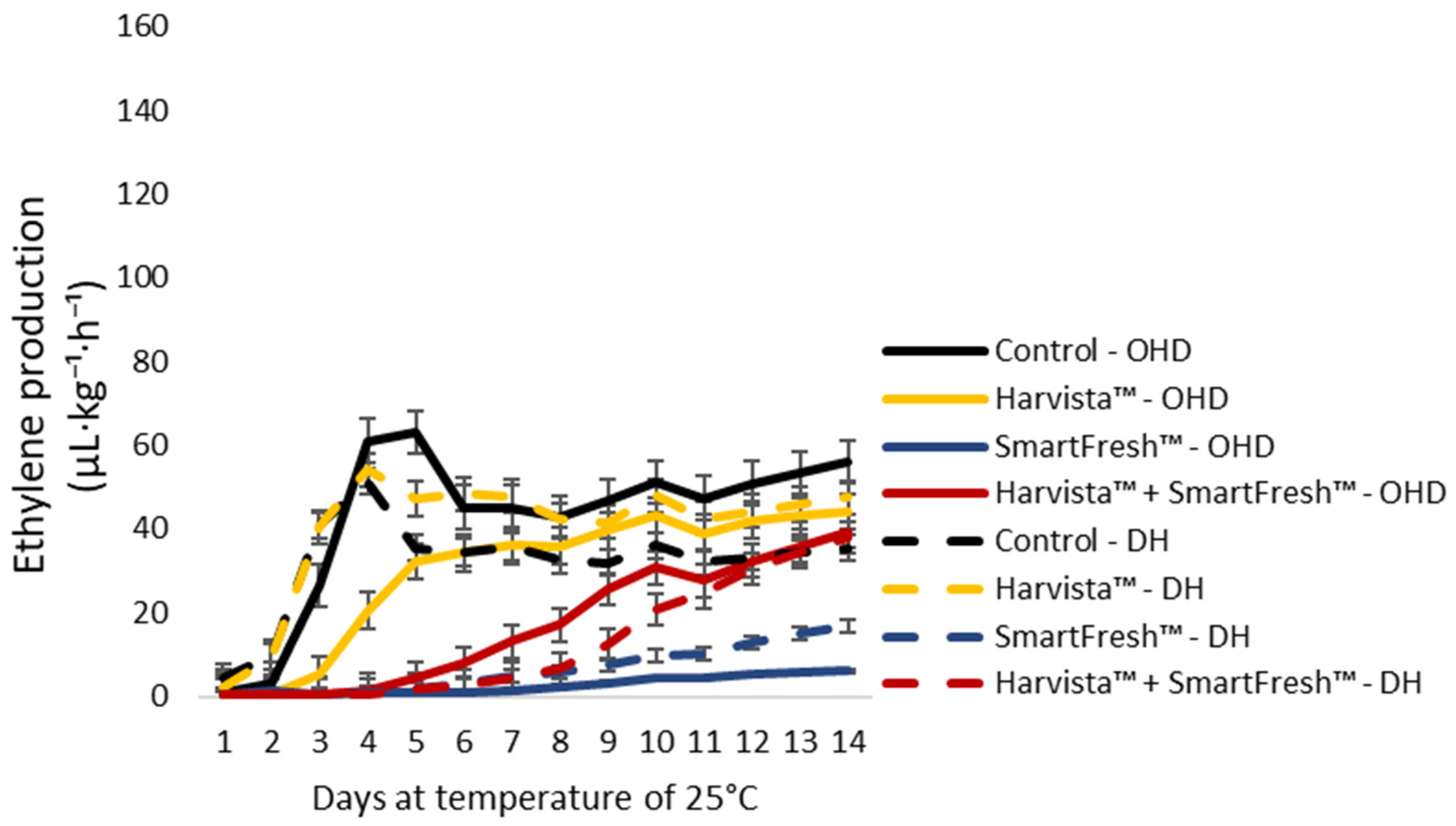
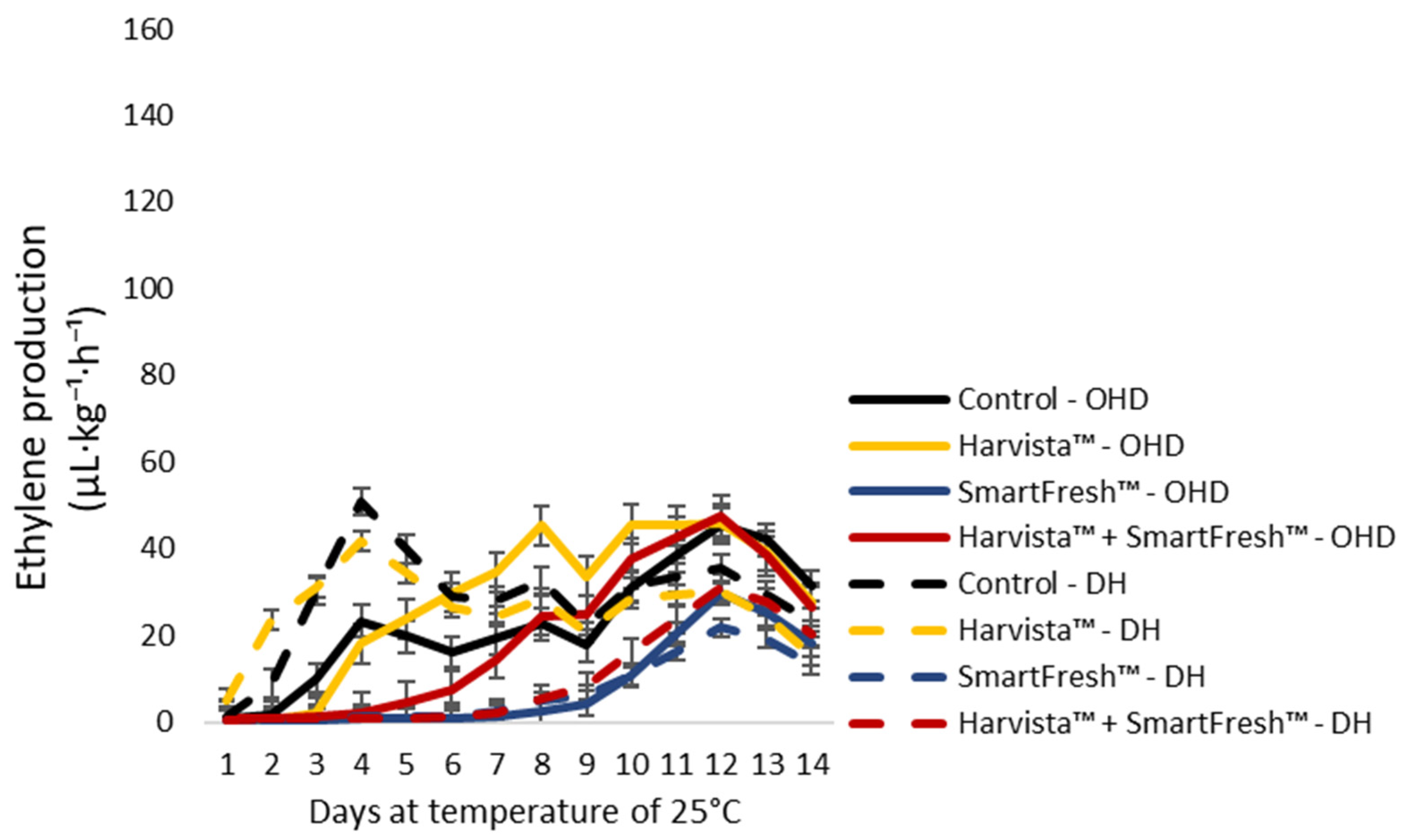
- Control—OHD (fruit harvested at the optimal harvest date, not treated with 1-MCP either before or after harvest);
- Harvista™—OHD (fruit harvested from Harvista™-sprayed trees at the optimal harvest date);
- SmartFresh™—OHD (fruit harvested from Harvista™-non-sprayed trees at the optimal harvest date, and treated with SmartFresh™ 7 days after harvest);
- Harvista™ + SmartFresh™—OHD (fruit harvested from Harvista™-sprayed trees at the optimal harvest date, and treated with SmartFresh™ 7 days after harvest);
- Control—DH (fruit harvested at the delayed harvest date, not treated with 1-MCP either before or after harvest);
- Harvista™—DH (fruit harvested from Harvista™-sprayed trees at the delayed harvest date);
- SmartFresh™—DH (fruit harvested from Harvista™-non-sprayed trees at the delayed harvest date, and treated with SmartFresh™ 7 days after harvest);
- Harvista™ + SmartFresh™—DH (fruit harvested from Harvista™-sprayed trees at the delayed harvest date, and treated with SmartFresh ™ 7 days after harvest).
2.2. Measurements
2.3. Statistical Analysis
3. Results
3.1. Ethylene Production
3.2. Firmness
3.3. Soluble Solids Content (SSC)
3.4. Titratable Acidity (TA)
4. Discussion
5. Conclusions
Supplementary Materials
Author Contributions
Funding
Institutional Review Board Statement
Data Availability Statement
Conflicts of Interest
References
- The Apple Market in the EU: Vol. 1: Production, Areas and Yields. Available online: https://agriculture.ec.europa.eu/system/files/2022-10/apples-production_en.pdf (accessed on 4 August 2023).
- Trajer, M.; Dyngus, M. Krajowa Produkcja, Spożycie Oraz Promocja Owoców i Warzyw, Agencja Rynku Rolnego, Biuletyn Informacyjny, nr 3. 2013, pp. 6–27. Available online: www.faostat.fao.org (accessed on 4 August 2023).
- O’Neil, C.E.; Nicklas, T.A.; Fulgoni, V.L. Consumption of apples is associated with a better diet quality and reduced risk of obesity in children: National Health and Nutrition Examination Survey (NHANES) 2003–2010. Nutr. J. 2015, 14, 48. [Google Scholar] [CrossRef] [Scilit]
- Hoehn, E.; Gasser, F.; Guggenbuehl, B.; Casutt, M. Consumer demands on eating quality of apples: Minimum requirements on firmness, soluble solids and acidity. Acta Hortic. 2003, 600, 693–696. [Google Scholar] [CrossRef] [Scilit]
- Wang, Y.; Lu, Q.; Li, B.; Si, Y.; Wang, Y.; Sun, J.; Yuan, H.; Wang, A. LED white light-activated transcription factor MdHY5 inhibits ethylene biosynthesis during apple fruit ripening. Postharvest Biol. Technol. 2023, 202, 112372. [Google Scholar] [CrossRef] [Scilit]
- Feder, A.; Jensen, S.; Wang, A.; Courtney, L.; Middleton, L.; Van Eck, J.; Liu, Y.; Giovannoni, J.J. Tomato fruit as a model for tissue-specific gene silencing in crop plants. J. Hort. Res. 2020, 7, 42. [Google Scholar] [CrossRef] [Scilit] [PubMed]
- Fu, L.; Liu, S.Y.; Xu, F.X. Effect of treatment with MeJA on physiology and biochemistry in blueberry fruit. J. Southeast Univ. Nat. Sci. Ed. 2017, 35, 473–475. [Google Scholar]
- Xu, F.X.; Liu, S.Y. Control of ethylene activity in blueberry fruit by combined 1-methylcyclopropene (1-MCP) and UV-C irradiation. Food Bioproc Technol. 2017, 10, 1695–1703. [Google Scholar] [CrossRef] [Scilit]
- Chen, T.; Qin, G.; Tian, S. Regulatory network of fruit ripening: Current understanding and future challenges. New Phytol. 2020, 228, 1219–1226. [Google Scholar] [CrossRef] [Scilit]
- Barry, C.S.; Giovannoni, J.J. Ethylene and fruit ripening. J. Plant Growth Regul. 2007, 26, 143. [Google Scholar] [CrossRef] [Scilit]
- Mattheis, J.P. How 1-methylcyclopropene has altered the Washington State apple industry. HortScience 2008, 43, 99–101. [Google Scholar] [CrossRef] [Scilit]
- Kvikliene, N. Effect of harvest date on apple fruit quality and storage ability. Folia Hort. 2001, 13, 97–102. [Google Scholar]
- Łysiak, G. Measurement of ethylene production as a method for determining the optimum harvest date of ‘Jonagored’ apples. Folia Hort. 2014, 26, 117–124. [Google Scholar] [CrossRef] [Scilit]
- Łysiak, G.; Kurlus, R.; Zydlik, Z.; Walkowiak-Tomczak, D. Apple skin colour changes during harvest as an indicator of maturity. Acta Sci. Pol. Hortorum Cultus 2014, 13, 71–83. [Google Scholar]
- Sugar, D.; Einhorn, T.C. Conditioning temperature and harvest maturity influence induction of ripening capacity in ‘d’Anjou’ pear fruit. Postharvest Biol. Technol. 2011, 60, 121–124. [Google Scholar] [CrossRef] [Scilit]
- Jan, I.; Rab, A.; Sajid, M. Storage performance of apple cultivars harvested at different stages of maturity. J. Anim. Plant Sci. 2012, 22, 438–447. [Google Scholar]
- Łysiak, G. The influence of harvest maturity and basic macroelement content in fruit on the incidence of diseases and disorders after storage of the ‘Ligol’ apple cultivar. Folia Hort. 2013, 25, 31–39. [Google Scholar] [CrossRef] [Scilit]
- Małachowska, M.; Tomala, K. Effect of preharvest and postharvest application of 1-mcp on the quality of Gala Schniga® Schnico Red(s) apples during long-term storage. Agriculture 2022, 12, 2073. [Google Scholar] [CrossRef] [Scilit]
- Blankenship, S.M.; Dol, J.M. 1-Methylcyclopropene: A review. Postharvest Biol. Technol. 2003, 28, 1–25. [Google Scholar] [CrossRef] [Scilit]
- Tomala, K.; Małachowska, M.; Guzek, D.; Głąbska, D.; Gutkowska, K. The effects of 1-methylcyclopropene treatment on the fruit quality of ‘Idared’ apples during storage and transportation. Agriculture 2020, 10, 490. [Google Scholar] [CrossRef] [Scilit]
- Tomala, K.; Guzek, D.; Głąbska, D.; Małachowska, M.; Krupa, T.; Gutkowska, K. The influence of 1-methylcyclopropene on the quality parameters of Idared apples after 8 weeks of storage simulating long-distance transportation. Agronomy 2021, 11, 528. [Google Scholar] [CrossRef] [Scilit]
- Tomala, K.; Guzek, D.; Głąbska, D.; Małachowska, M.; Widłak, Ł.; Krupa, T.; Gutkowska, K. Assessment of the quality of ‘Red Jonaprince’ apples during storage after delayed harvesting and 1-methylcyclopropene (1-mcp) preharvest and postharvest treatment. Agronomy 2023, 13, 1730. [Google Scholar] [CrossRef] [Scilit]
- Bühlmann, A.; Rebeaud, S.G. Empfehlungen für die Obstlagerun. Obstlagerung 2017, 17, 11–14. [Google Scholar]
- Łysiak, G. The determination of harvest index of Šampion apples intended for long storage. Acta Sci. Pol. Hortorum Cultus 2011, 10, 273–282. [Google Scholar]
- Chen, B.; Mao, J.; Huang, B.; Mi, B.; Liu, Y.; Hu, Z. Effect of bagging and time of harvest on fruit quality of ‘Red Fuji’ apple in high altitude area in China. Fruits 2017, 72, 36–46. [Google Scholar] [CrossRef] [Scilit]
- Hoehn, E.; Gasser, F.; Guggenbühl, B.; Künsch, U. Efficacy of instrumental measurements for determination of minimum requirements of firmness, soluble solids, and acidity of several apple varieties in comparison to consumer expectations. Postharvest Biol. Technol. 2003, 27, 27–37. [Google Scholar] [CrossRef] [Scilit]
- Barreiro, P.; Ruiz-Altisent, M.; Valerio, C.; García-Ramos, J. Fruit postharvest technology: Instrumental measurement of ripeness and quality. In Production Practices and Quality Assessment of Food Crops; Dris, R., Jain, S.M., Eds.; Springer: Dordrecht, The Netherlands, 2006; pp. 321–340. [Google Scholar] [CrossRef] [Scilit]
- Dong, X.; Huber, D.J.; Ramírez-Sánchez, M.; Rao, J.; Lee, J.; Watkins, C.B. Cultivar differences in gaseous 1-methylcyclopropene accumulation in whole and fresh-cut apple fruit. Postharvest Biol. Technol. 2014, 93, 130–134. [Google Scholar] [CrossRef] [Scilit]
- Wang, Y.; Sugar, D. 1-MCP efficacy in extending storage life of ‘Bartlett’ pears is affected by harvest maturity, production elevation, and holding temperature during treatment delay. Postharvest Biol. Technol. 2015, 103, 1–8. [Google Scholar] [CrossRef] [Scilit]
- Chiriboga, M.A.; Schotsmans, W.C.; Larrigaudière, C.; Dupille, E.; Recasens, I. How to prevent ripening blockage in 1-MCP-treated ‘Conference’ pears. J. Sci. Food Agric. 2011, 91, 1781–1788. [Google Scholar] [CrossRef] [Scilit]
- Watkins, C.B. The use of 1-methylcyclopropene (1-MCP) on fruits and vegetables. Biotech. Adv. 2006, 24, 389–409. [Google Scholar] [CrossRef] [Scilit]
- McArtney, S.J.; Obemiller, J.D.; Schopp, J.R.; Parkeer, M.L.; Edgington, T.B. Preharvest 1-methylcyclopropene delays fruit maturity and reduces softening and superficial scald of apples during long-term storage. HortScience 2008, 43, 366–371. [Google Scholar] [CrossRef] [Scilit]
- Villalobos-Acuña, M.G.; Biasi, W.V.; Flores, S.; Mitcham, E.J.; Elkins, R.B.; Willits, N.H. Preharvest application of 1-methylcyclopropene influences fruit drop and storage potential of ‘Bartlett’ pears. HortScience 2010, 45, 610–616. [Google Scholar] [CrossRef] [Scilit]
- Deell, J.R.; Lum, G.B.; Ehsani-Moghaddam, B. Effects of multiple 1-methylcyclopropene treatments on apple fruit quality and disorders in controlled atmosphere storage. Postharvest Biol. Technol. 2016, 111, 93–98. [Google Scholar] [CrossRef] [Scilit]
- Thongkum, M.; McAtee, P.M.; Schaffer, R.J.; Allan, A.C.; Ketsa, S. Characterization and differential expression of ethylene receptor genes during fruit development and dehiscence of durian (Durio zibethinus). Sci. Hortic. 2018, 240, 623–630. [Google Scholar] [CrossRef] [Scilit]
- Péneau, S.; Hoehn, E.; Roth, H.-R.; Escher, F.; Nuessli, J. Importance and consumer perception of freshness of apples. Food Qual. Prefer. 2006, 17, 9–19. [Google Scholar] [CrossRef] [Scilit]
- Jha, S.N.; Rai, D.R.; Shrama, R. Physico-chemical quality parameters and overall quality index of apple during storage. J. Food Sci. Technol. 2011, 49, 594–600. [Google Scholar] [CrossRef] [Scilit] [PubMed]
- Błaszczyk, J.; Gasparski, K. Influence of 1-methylcyclopropene (1-MCP) on the quality and storability of ‘Red Jonaprince’ apples stored in different conditions. Acta Sci. Pol. Hortorum Cultus. 2019, 18, 7–15. [Google Scholar] [CrossRef] [Scilit]
- Cheng, Z.; Zhou, W.; Gong, X.; Wei, X.; Li, J.; Peng, Z. Physicochemical changes of custard apple at different storage temperatures. IOP Conf. Ser. Mater. Sci. Eng. 2018, 392, 052013. [Google Scholar] [CrossRef] [Scilit]
- Rupasinghe, H.P.V.; Murr, D.P.; Paliyath, G.; Skog, L. Inhibitory effect of 1-MCP on ripening and superficial scald development in ‘McIntosh’ and ‘Delicious’ apples. J. Hortic. Sci. Biotechnol. 2000, 75, 271–276. [Google Scholar] [CrossRef] [Scilit]
- DeEll, J.R.; Lum, G.B. Effects of low oxygen storage and 1-methylcyclopropene on storage disorders of ‘Empire’ apples. HortScience 2017, 52, 1265–1270. [Google Scholar] [CrossRef] [Scilit]
- Yoo, J.; Kim, S.H.; Kwon, J.G.; Cho, Y.J.; Kang, I.K. Effects of 1-methylcyclopropene treatments on fruit quality attributes and cell wall metabolism in cold stored ‘Summer Prince’ and ‘Summer King’ apples. Hortic. Sci. Technol. 2020, 38, 660–674. [Google Scholar] [CrossRef] [Scilit]
- Yoo, J.; Jung, H.; Win, N.M.; Kwon, J.G.; Cho, Y.J.; Jung, H.Y.; Lee, D.H.; Kang, I.K. Changes in fruit quality attributes, cell wall materials, and related hydrolases activities in 1-methylcyclopropene (1-MCP)-treated ‘Honggeum’ apples during cold storage. Hortic. Sci. Technol. 2020, 38, 870–879. [Google Scholar] [CrossRef] [Scilit]
- Moran, R.E.; McManus, P. Firmness retention, and prevention of coreline browning and senescence in ‘Macoun’ apples with 1-methylcyclopropene. HortScience 2005, 40, 161–163. [Google Scholar] [CrossRef] [Scilit]
- Steffens, C.A.; Soardi, K.; Heinzen, A.S.; Amaral Vignali Alves, J.; Silva, J.C.; Talamini do Amarante, C.V.; Brackmann, A. Quality of “Cripps Pink” apples following the application of 1-MCP, ethanol vapor and nitric oxide as pretreatments for controlled atmosphere storage. J. Food Process. Preserv. 2021, 46, e16121. [Google Scholar] [CrossRef] [Scilit]
- Pre-Aymard, C.; Fallik, E.; Weksler, A.; Lurie, S. Sensory analysis and instrumental measurements of ‘Anna’ apples treated with 1-methylcyclopropene. Postharvest Biol Technol. 2005, 36, 135–142. [Google Scholar] [CrossRef] [Scilit]
- Toivonen, P.M.A.; Lu, C.W. Studies on elevated temperature, short-term storage of ‘Sunrise’ summer apples using 1-MCP to maintain quality. J. Hortic. Sci. Biotechnol. 2005, 80, 439–446. [Google Scholar] [CrossRef] [Scilit]
- Łysiak, G.P.; Rutkowski, K.; Walkowiak-Tomczak, D. Effect of Storage Conditions on Storability and Antioxidant Potential of Pears cv. ‘Conference’. Agriculture 2021, 11, 545. [Google Scholar] [CrossRef] [Scilit]

| Maturity Indices | Optimal Harvest Date (Harvest I) | Delayed Harvest (Harvest II) | ||
|---|---|---|---|---|
| Control | Harvista™ | Control | Harvista™ | |
| Mean ± SD | ||||
| Internal ethylene content (µL·L−1) | 1.18 ± 0.17 | 0.48 ± 0.19 | 1.23 ± 0.64 | 0.42 ± 0.12 |
| Starch index (-) | 3.3 ± 0.3 | 4.1 ± 1.0 1 | 9.0 ± 0.4 | 6.8 ± 1.2 |
| Soluble solids content (°Bx) | 11.8 ± 0.2 | 10.8 ± 0.2 | 13.1 ± 0.3 | 11.5 ± 0.4 |
| Firmness (N) | 85.1 ± 1.8 | 85.3 ± 1.0 | 70.6 ± 3.7 | 75.9 ± 2.2 |
| Titratable acidity (%) | 0.409 ± 0.029 | 0.375 ± 0.032 | 0.333 ± 0.018 | 0.350 ± 0.015 |
| Streif Index (IS) (-) | 0.22 ± 0.02 | 0.20 ± 0.04 | 0.06 ± 0.01 | 0.10 ± 0.02 |
| Harvest Date | Treatment Applied/p-Value | Days of Shelf-Life | p-Value for Shelf-Life | ||
|---|---|---|---|---|---|
| 0 | 7 | 14 | |||
| 6 Weeks of Transport | |||||
| Harvest I (optimal harvest date) | Control | Ab 60.2 c | Ab 52.9 b | Ab 42.9 a | 0.0002 |
| Harvista™ | Bb 76.8 c | Bb 65.2 b | Bb 55.3 a | <0.0001 | |
| SmartFresh™ | Bb 79.7 c | Cb 74.3 b | Cb 66.9 a | <0.0001 | |
| Harvista™ + SmartFresh™ | Bb 80.0 c | Ca 73.6 b | Ca 63.2 a | 0.0003 | |
| p-Value for the combinations with 1-MCP | <0.0001 | <0.0001 | <0.0001 | ||
| Harvest II (delayed harvest) | Control | Aa 48.9 b | Aa 40.5 a | Aa 37.8 a | 0.0005 |
| Harvista™ | Ba 55.7 c | Ba 48.9 b | Ba 43.0 a | <0.0001 | |
| SmartFresh™ | Ca 64.1 b | Ca 59.7 a | Ca 61.7 a | <0.0001 | |
| Harvista™ + SmartFresh™ | Da 75.8 c | Da 71.3 b | Ca 63.7 a | 0.0011 | |
| p-Value for the combinations with 1-MCP | <0.0001 | <0.0001 | <0.0001 | ||
| Control Harvista™ SmartFresh™ Harvista™ + SmartFresh™ | p-Value for the harvest date | 0.0396 0.0006 0.0007 0.0002 | 0.0037 0.0004 0.0004 0.0066 | 0.0064 0.0008 0.0088 0.1436 | |
| 8 Weeks of Transport | |||||
| Harvest I (optimal harvest date) | Control | Ab 56.0 b | Ab 55.5 b | Ab 47.9 a | 0.0306 |
| Harvista™ | Bb 76.6 b | Bb 71.2 b | Bb 55.2 a | 0.0050 | |
| SmartFresh™ | Bb 77.7 b | Bb 75.6 b | Cb 62.9 a | <0.0001 | |
| Harvista™ + SmartFresh™ | Bb 79.9 b | Bb 75.4 b | Cb 64.9 a | 0.0007 | |
| p-Value for the combinations with 1-MCP | <0.0001 | <0.0001 | <0.0001 | ||
| Harvest II (delayed harvest) | Control | Aa 46.5 b | Aa 43.6 ab | Aa 39.9 a | <0.0001 |
| Harvista™ | Aa 51.7 b | ABa 48.5 ab | ABa 44.5 a | 0.0529 | |
| SmartFresh™ | Ba 59.9 b | BCa 56.6 ab | BCa 49.7 a | 0.0283 | |
| Harvista™ + SmartFresh™ | Ca 74.0 b | Ca 68.6 b | Ca 59.0 a | 0.0015 | |
| p-Value for the combinations with 1-MCP | <0.0001 | <0.0001 | <0.0001 | ||
| Control Harvista™ SmartFresh™ Harvista™ + SmartFresh™ | p-Value for the harvest date | <0.0001 0.0004 0.0049 <0.0001 | 0.0380 0.0299 0.0032 0.0228 | 0.0262 0.0203 0.0010 0.0241 | |
| Harvest Date | Treatment Applied/p-Value | Days of Shelf-Life | p-Value for Shelf-Life | ||
|---|---|---|---|---|---|
| 0 | 7 | 14 | |||
| 6 Weeks of Transport | |||||
| Harvest I (optimal harvest date) | Control | Ab 54.8 b | Aa 41.4 a | Aa 37.5 a | 0.0005 |
| Harvista™ | Ab 59.3 c | Bb 51.0 b | Bb 45.1 a | <0.0001 | |
| SmartFresh™ | Bb 73.1 a | Cb 73.7 a | Db 70.5 a | 0.7185 | |
| Harvista™ + SmartFresh™ | Bb 78.8 b | Ca 76.1 b | Ca 62.4 a | 0.0001 | |
| p-Value for the combinations with 1-MCP | <0.0001 | <0.0001 | <0.0001 | ||
| Harvest II (delayed harvest) | Control | Aa 44.9 b | Aa 40.7 ab | Aa 37.1 a | <0.0001 |
| Harvista™ | Aa 49.5 c | Aa 42.6 b | Aa 38.9 a | <0.0001 | |
| SmartFresh™ | Ba 61.2 b | Ba 56.2 b | Ba 44.9 a | 0.0054 | |
| Harvista™ + SmartFresh™ | Ca 74.4 b | Ca 70.5 b | Ca 59.5 a | <0.0001 | |
| p-Value for the combinations with 1-MCP | <0.0001 | <0.0001 | <0.0001 | ||
| Control Harvista™ SmartFresh™ Harvista™ + SmartFresh™ | p-Value for the harvest date | 0.0004 <0.0001 0.0812 0.0331 | 0.0025 0.0007 0.0057 0.2063 | <0.0001 0.0096 0.0002 0.1055 | |
| 8 Weeks of Transport | |||||
| Harvest I (optimal harvest date) | Control | Aa 45.9 b | Aa 42.4 b | Aa 36.5 a | <0.0001 |
| Harvista™ | Bb 51.7 c | Ab 44.9 b | Ab 41.6 a | 0.0002 | |
| SmartFresh™ | Cb 71.4 b | Bb 67.6 b | Bb 53.0 a | <0.0001 | |
| Harvista™ + SmartFresh™ | Db 76.3 c | Ba 65.7 b | Ba 53.2 a | <0.0001 | |
| p-Value for the combinations with 1-MCP | <0.0001 | <0.0001 | <0.0001 | ||
| Harvest II (delayed harvest) | Control | Aa 44.5 b | Aa 40.4 a | Aa 37.8 a | 0.0110 |
| Harvista™ | Aa 46.7 c | Aa 42.3 b | Aa 37.4 a | <0.0001 | |
| SmartFresh™ | Ba 56.7 b | Ba 55.4 b | Ba 45.9 a | 0.0083 | |
| Harvista™ + SmartFresh™ | Ca 66.8 b | Ca 63.2 b | Ca 52.5 a | 0.0014 | |
| p-Value for the combinations with 1-MCP | <0.0001 | <0.0001 | <0.0001 | ||
| Control Harvista™ SmartFresh™ Harvista™ + SmartFresh™ | p-Value for the harvest date | 0.1664 0.0017 0.0143 0.0027 | 0.0199 0.0172 0.0300 <0.0001 | 0.7489 0.0052 0.0676 0.0297 | |
| Harvest Date | Treatment Applied/p-Value | Days of Shelf-Life | p-Value for Shelf-Life | ||
|---|---|---|---|---|---|
| 0 | 7 | 14 | |||
| 6 Weeks of Transport | |||||
| Harvest I (optimal harvest date) | Control | Ba 12.4 a | Ba 12.5 a | Aa 12.0 a | 0.0002 |
| Harvista™ | Ba 12.4 a | Bb 12.6 a | ABb 12.7 a | <0.0001 | |
| SmartFresh™ | Cb 14.6 b | Cb 15.0 b | Ba 13.4 a | <0.0001 | |
| Harvista™ + SmartFresh™ | Aa 11.4 a | Aa 11.4 a | Ba 13.3 b | 0.0003 | |
| p-Value for the combinations with 1-MCP | <0.0001 | <0.0001 | <0.0001 | ||
| Harvest II (delayed harvest) | Control | Aa 12.7 a | Ba 12.7 a | ABb 12.7 a | 0.0005 |
| Harvista™ | Aa 12.5 b | Aa 11.4 a | Aa 11.6 a | <0.0001 | |
| SmartFresh™ | Aa 13.1 a | Ba 13.1 a | Ba 13.7 a | <0.0001 | |
| Harvista™ + SmartFresh™ | Ab 12.4 a | Bb 12.6 ab | Ba 13.4 b | 0.0011 | |
| p-Value for the combinations with 1-MCP | <0.0001 | <0.0001 | <0.0001 | ||
| Control Harvista™ SmartFresh™ Harvista™ + SmartFresh™ | p-Value for the harvest date | 0.0396 0.0006 0.0007 0.0002 | 0.0037 0.0004 0.0004 0.0066 | 0.0064 0.0008 0.0088 0.1436 | |
| 8 Weeks of Transport | |||||
| Harvest I (optimal harvest date) | Control | Aa 12.4 a | Ab 12.7 a | Ba 12.4 a | 0.0306 |
| Harvista™ | Aa 12.2 a | Ba 13.0 a | Ba 12.8 a | 0.0050 | |
| SmartFresh™ | Aa 12.2 a | Bb 13.2 b | Cb 13.9 c | <0.0001 | |
| Harvista™ + SmartFresh™ | Aa 11.7 a | Aa 11.9 a | Aa 11.8 a | 0.0007 | |
| p-Value for the combinations with 1-MCP | <0.0001 | <0.0001 | <0.0001 | ||
| Harvest II (delayed harvest) | Control | Aa 12.4 a | Aa 11.8 a | Aa 12.5 a | <0.0001 |
| Harvista™ | Aa 13.0 a | Ba 13.1 a | Aa 12.7 a | 0.0529 | |
| SmartFresh™ | Aa 12.4 a | ABa 12.4 a | Aa 12.3 a | 0.0283 | |
| Harvista™ + SmartFresh™ | Ab 12.8 a | ABb 12.8 a | Aa 12.3 a | 0.0015 | |
| p-Value for the combinations with 1-MCP | <0.0001 | <0.0001 | <0.0001 | ||
| Control Harvista™ SmartFresh™ Harvista™ + SmartFresh™ | p-Value for the harvest date | <0.0001 0.0004 0.0049 <0.0001 | 0.0380 0.0299 0.0032 0.0228 | 0.0262 0.0203 0.0010 0.0241 | |
| Harvest Date | Treatment Applied/p-Value | Days of Shelf-Life | p-Value for Shelf-Life | ||
|---|---|---|---|---|---|
| 0 | 7 | 14 | |||
| 6 Weeks of Transport | |||||
| Harvest I (optimal harvest date) | Control | BCb 13.2 a | Bb 13.5 a | Bb 13.1 a | 0.0005 |
| Harvista™ | ABa 12.4 b | Aa 12.1 ab | Ab 11.9 a | <0.0001 | |
| SmartFresh™ | Ca 13.5 a | Ba 13.1 a | Ba 13.6 a | 0.7185 | |
| Harvista™ + SmartFresh™ | Aa 11.9 a | Aa 11.8 a | Aa 11.7 a | 0.0001 | |
| p-Value for the combinations with 1-MCP | <0.0001 | <0.0001 | <0.0001 | ||
| Harvest II (delayed harvest) | Control | Aa 11.8 ab | ABa 12.3 b | Aa 11.5 a | <0.0001 |
| Harvista™ | ABa 12.5 b | Aa 12.2 b | Aa 11.1 a | <0.0001 | |
| SmartFresh™ | Ba 13.2 a | Ba 13.1 a | Ba 13.2 a | 0.0054 | |
| Harvista™ + SmartFresh™ | Bb 12.7 a | ABa 12.4 a | Bb 12.6 a | <0.0001 | |
| p-Value for the combinations with 1-MCP | <0.0001 | <0.0001 | <0.0001 | ||
| Control Harvista™ SmartFresh™ Harvista™ + SmartFresh™ | p-Value for the harvest date | 0.0004 <0.0001 0.0812 0.0331 | 0.0025 0.0007 0.0057 0.2063 | <0.0001 0.0096 0.0002 0.1055 | |
| 8 Weeks of Transport | |||||
| Harvest I (optimal harvest date) | Control | BCa 12.9 a | ABa 12.1 a | Ba 12.3 a | <0.0001 |
| Harvista™ | Aa 11.8 a | Aa 11.8 a | Aa 11.5 a | 0.0002 | |
| SmartFresh™ | Ca 13.3 a | Ca 13.3 a | Da 14.0 b | <0.0001 | |
| Harvista™ + SmartFresh™ | ABa 12.2 a | BCb 13.0 b | Ca 13.2 b | <0.0001 | |
| p-Value for the combinations with 1-MCP | <0.0001 | <0.0001 | <0.0001 | ||
| Harvest II (delayed harvest) | Control | ABa 12.1 a | Aa 12.1 a | ABa 12.5 a | 0.0110 |
| Harvista™ | Aa 11.8 a | Aa 12.0 a | Aa 11.7 a | <0.0001 | |
| SmartFresh™ | Ba 12.8 a | Ba 13.6 ab | Ca 14.0 b | 0.0083 | |
| Harvista™ + SmartFresh™ | ABa 12.1 a | Aa 12.1 a | Ba 12.8 b | 0.0014 | |
| p-Value for the combinations with 1-MCP | <0.0001 | <0.0001 | <0.0001 | ||
| Control Harvista™ SmartFresh™ Harvista™ + SmartFresh™ | p-Value for the harvest date | 0.1664 0.0017 0.0143 0.0027 | 0.0199 0.0172 0.0300 <0.0001 | 0.7489 0.0052 0.0676 0.0297 | |
| Harvest Date | Treatment Applied/p-Value | Days of Shelf-Life | p-Value for Shelf-Life | ||
|---|---|---|---|---|---|
| 0 | 7 | 14 | |||
| 6 Weeks of Transport | |||||
| Harvest I (optimal harvest date) | Control | Ba 0.366 b | Ab 0.332 a | Ab 0.309 a | 0.0013 |
| Harvista™ | ABb 0.364 b | Ab 0.350 b | Aa 0.306 a | 0.0001 | |
| SmartFresh™ | Cb 0.427 b | Bb 0.397 b | Ab 0.322 a | 0.0004 | |
| Harvista™ + SmartFresh™ | Ab 0.341 ab | ABb 0.356 b | Ab 0.330 a | 0.0073 | |
| p-Value for the combinations with 1-MCP | <0.0001 | 0.0085 | 0.0516 | ||
| Harvest II (delayed harvest) | Control | Ca 0.356 c | Ba 0.297 b | Aa 0.263 a | 0.0008 |
| Harvista™ | Aa 0.286 a | Aa 0.254 a | Aa 0.286 a | 0.0401 | |
| SmartFresh™ | Ca 0.360 c | Ba 0.305 b | Aa 0.273 a | <0.0001 | |
| Harvista™ + SmartFresh™ | Ba 0.310 a | Ba 0.293 a | Aa 0.281 a | 0.2406 | |
| p-Value for the combinations with 1-MCP | <0.0001 | 0.0024 | 0.3626 | ||
| Control Harvista™ SmartFresh™ Harvista™ + SmartFresh™ | p-Value for the harvest date | 0.2917 0.0002 <0.0001 0.0331 | 0.0298 <0.0001 0.0019 0.0021 | 0.0037 0.1134 0.0025 0.0093 | |
| 8 Weeks of Transport | |||||
| Harvest I (optimal harvest date) | Control | ABb 0.333 b | ABb 0.321 b | Aa 0.218 a | <0.0001 |
| Harvista™ | Ab 0.321 b | Ab 0.300 ab | Bb 0.287 a | 0.0043 | |
| SmartFresh™ | Cb 0.387 b | Bb 0.334 a | Bb 0.319 a | 0.0004 | |
| Harvista™ + SmartFresh™ | Bb 0.367 b | Cb 0.374 b | Bb 0.286 a | 0.0008 | |
| p-Value for the combinations with 1-MCP | 0.0015 | <0.0001 | <0.0001 | ||
| Harvest II (delayed harvest) | Control | Aa 0.233 a | ABa 0.273 b | Aa 0.232 a | <0.0001 |
| Harvista™ | Aa 0.229 ab | Aa 0.256 b | Aa 0.215 a | 0.0169 | |
| SmartFresh™ | Ba 0.304 ab | Ca 0.314 b | Ba 0.282 a | 0.0224 | |
| Harvista™ + SmartFresh™ | Ba 0.311 b | Ba 0.297 b | Aa 0.234 a | 0.0007 | |
| p-Value for the combinations with 1-MCP | <0.0001 | 0.0006 | 0.0015 | ||
| Control Harvista™ SmartFresh™ Harvista™ + SmartFresh™ | p-Value for the harvest date | <0.0001 0.0001 0.0007 0.0128 | 0.0019 0.0003 0.0157 0.0010 | 0.2440 0.0008 0.0135 0.0214 | |
| Harvest Date | Treatment Applied/p-Value | Days Of Shelf-Life | p-Value for Shelf-Life | ||
|---|---|---|---|---|---|
| 0 | 7 | 14 | |||
| 6 Weeks of Transport | |||||
| Harvest I (optimal harvest date) | Control | Aa 0.228 c | Aa 0.196 b | Aa 0.165 a | <0.0001 |
| Harvista™ | Ba 0.252 b | ABb 0.237 b | Ba 0.189 a | 0.0003 | |
| SmartFresh™ | Bb 0.260 a | Ba 0.252 a | Ca 0.217 a | 0.1271 | |
| Harvista™ + SmartFresh™ | Bb 0.260 b | Ba 0.257 b | Ca 0.213 a | 0.0007 | |
| p-Value for the combinations with 1-MCP | 0.0036 | 0.0251 | <0.0001 | ||
| Harvest II (delayed harvest) | Control | Aa 0.206 b | Aa 0.184 ab | Aa 0.156 a | 0.0066 |
| Harvista™ | Ba 0.245 c | ABa 0.199 b | Aa 0.173 a | <0.0001 | |
| SmartFresh™ | ABa 0.230 a | Ba 0.236 a | Ba 0.220 a | 0.6805 | |
| Harvista™ + SmartFresh™ | Ba 0.242 b | Ba 0.245 b | Ba 0.210 a | 0.0004 | |
| p-Value for the combinations with 1-MCP | 0.0028 | 0.0055 | <0.0001 | ||
| Control Harvista™ SmartFresh™ Harvista™ + SmartFresh™ | p-Value for the harvest date | 0.0790 0.1805 0.0251 0.0238 | 0.2410 0.0109 0.4389 0.2417 | 0.1477 0.1029 0.7299 0.6781 | |
| 8 Weeks of Transport | |||||
| Harvest I (optimal harvest date) | Control | Aa 0.194 b | Aa 0.191 b | Aa 0.157 a | 0.0128 |
| Harvista™ | Ba 0.246 b | Bb 0.230 ab | Bb 0.200 a | 0.0164 | |
| SmartFresh™ | Ba 0.265 b | ABa 0.225 a | Ca 0.226 a | 0.0085 | |
| Harvista™ + SmartFresh™ | Bb 0.278 c | Ba 0.254 b | Ca 0.220 a | 0.0001 | |
| p-Value for the combinations with 1-MCP | <0.0001 | 0.0037 | <0.0001 | ||
| Harvest II (delayed harvest) | Control | Aa 0.193 a | Aa 0.190 a | Bb 0.205 a | 0.4354 |
| Harvista™ | Ba 0.271 b | Aa 0.199 a | Aa 0.175 a | <0.0001 | |
| SmartFresh™ | Ba 0.264 b | Ba 0.234 a | Ca 0.227 a | 0.0051 | |
| Harvista™ + SmartFresh™ | Ba 0.256 b | Ba 0.245 b | BCa 0.213 a | 0.0006 | |
| p-Value for the combinations with 1-MCP | 0.0352 | 0.0005 | <0.0001 | ||
| Control Harvista™ SmartFresh™ Harvista™ + SmartFresh™ | p-Value for the harvest date | 0.8475 0.1456 0.9296 0.0130 | 0.9093 0.0178 0.5402 0.2127 | <0.0001 0.0094 0.8414 0.4140 | |
Disclaimer/Publisher’s Note: The statements, opinions and data contained in all publications are solely those of the individual author(s) and contributor(s) and not of MDPI and/or the editor(s). MDPI and/or the editor(s) disclaim responsibility for any injury to people or property resulting from any ideas, methods, instructions or products referred to in the content. |
© 2023 by the authors. Licensee MDPI, Basel, Switzerland. This article is an open access article distributed under the terms and conditions of the Creative Commons Attribution (CC BY) license (https://creativecommons.org/licenses/by/4.0/).
Share and Cite
Małachowska, M.; Tomala, K. Apple Quality during Shelf-Life after Long-Term Storage and Simulated Transport. Agriculture 2023, 13, 2045. https://doi.org/10.3390/agriculture13112045
Małachowska M, Tomala K. Apple Quality during Shelf-Life after Long-Term Storage and Simulated Transport. Agriculture. 2023; 13(11):2045. https://doi.org/10.3390/agriculture13112045
Chicago/Turabian StyleMałachowska, Maria, and Kazimierz Tomala. 2023. "Apple Quality during Shelf-Life after Long-Term Storage and Simulated Transport" Agriculture 13, no. 11: 2045. https://doi.org/10.3390/agriculture13112045
APA StyleMałachowska, M., & Tomala, K. (2023). Apple Quality during Shelf-Life after Long-Term Storage and Simulated Transport. Agriculture, 13(11), 2045. https://doi.org/10.3390/agriculture13112045

