Incidental Carcinoma after Cholecystectomy for Benign Disease of the Gallbladder: A Meta-Analysis



Abstract
1. Introduction
2. Materials and Methods
2.1. Published Study Search and Selection Criteria
2.2. Data Extraction
2.3. Statistical Analyses
3. Results
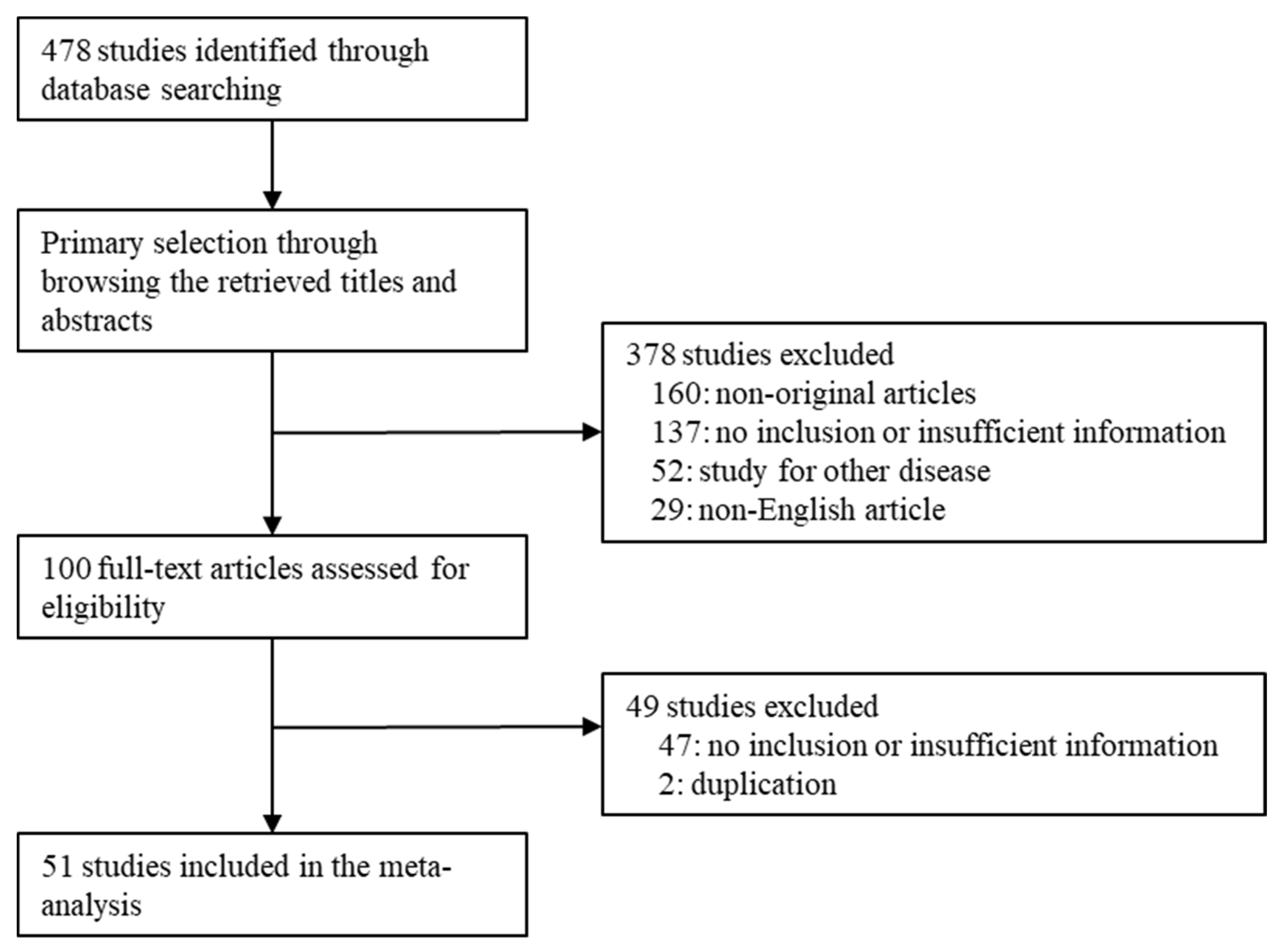
3.1. Selection and Characteristics of Studies
3.2. The Incidence Rate of IGBC after Cholecystectomy
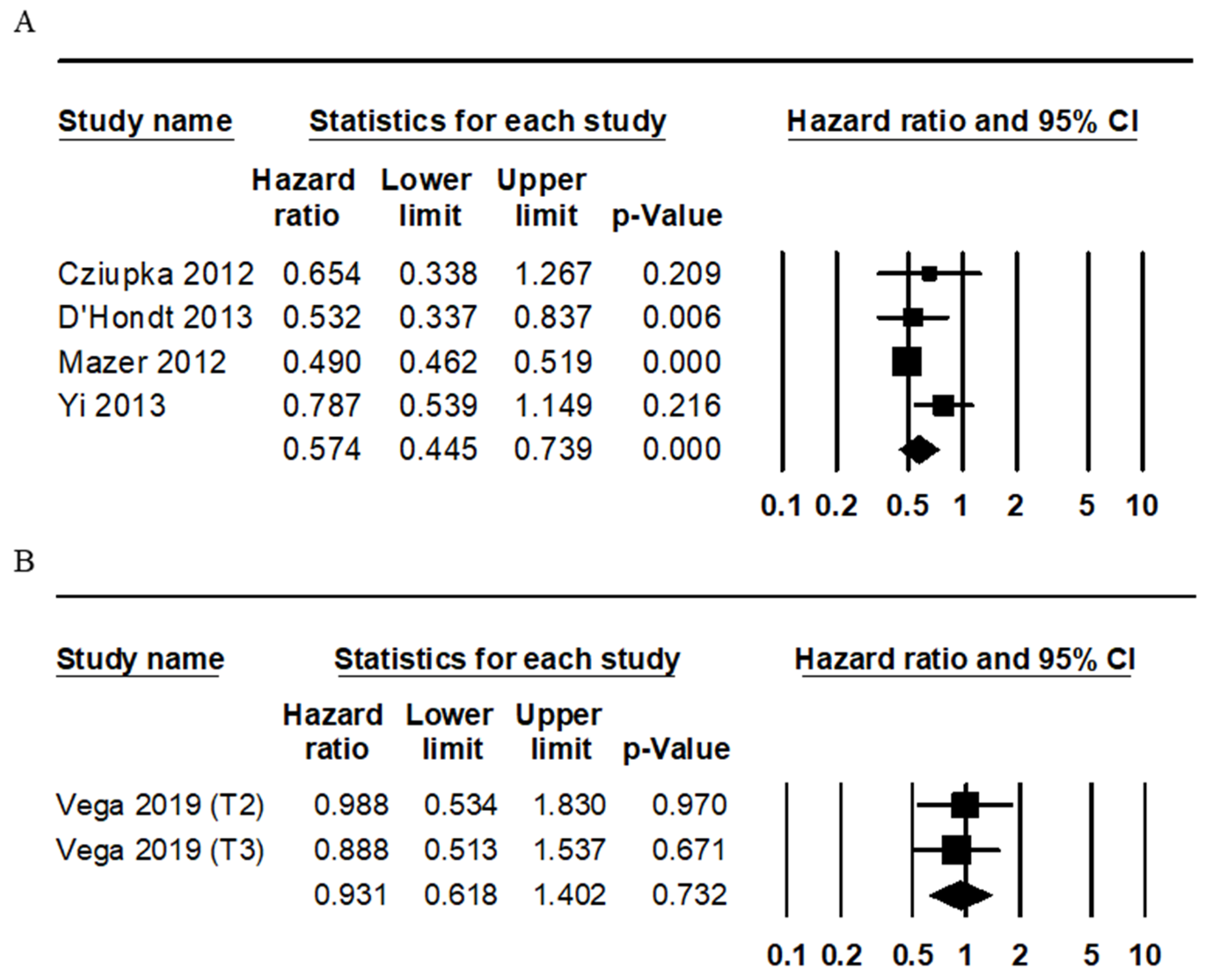
3.3. Comparison of Prognosis between IGBC and Non-IGBC
4. Discussion
5. Conclusions
Author Contributions
Conflicts of Interest
References
- WHO Classification of Tumors Editorial Board. WHO Classification of Tumours of the Digestive System, 5th ed.; International Agency for Research on Cancer: Lyon, France, 2019. [Google Scholar]
- Levy, A.D.; Murakata, L.A.; Abbott, R.M.; Rohrmann, C.A., Jr. From the archives of the AFIP. Benign tumors and tumorlike lesions of the gallbladder and extrahepatic bile ducts: Radiologic-pathologic correlation. Armed Forces Institute of Pathology. Radiographics 2002, 22, 387–413. [Google Scholar] [CrossRef] [PubMed]
- Ahn, Y.; Park, C.-S.; Hwang, S.; Jang, H.-J.; Choi, K.-M.; Lee, S.-G. Incidental gallbladder cancer after routine cholecystectomy: When should we suspect it preoperatively and what are predictors of patient survival? Ann. Surg. Treat. Res. 2016, 90, 131–138. [Google Scholar] [CrossRef] [PubMed]
- Aoki, T.; Tsuchida, A.; Kasuya, K.; Inoue, K.; Saito, H.; Koyanagi, Y. Is frozen section effective for diagnosis of unsuspected gallbladder cancer during laparoscopic cholecystectomy? Surg. Endosc. 2001, 16, 197–200. [Google Scholar] [CrossRef] [PubMed]
- Apodaca-Rueda, M.; Cazzo, E.; De-Carvalho, R.B.; Chaim, E.A. Prevalência do câncer de vesícula biliar em pacientes submetidos à colecistectomia: Experiência do Hospital de Clínicas da Faculdade de Ciências Médicas da Universidade Estadual de Campinas–UNICAMP. Revista Colégio Bras. Cir. 2017, 44, 252–256. [Google Scholar] [CrossRef]
- Basak, F.; Hasbahceci, M.; Canbak, T.; Sisik, A.; Acar, A.; Yucel, M.; Bas, G.; Alimoĝlu, O. Incidental findings during routine pathological evaluation of gallbladder specimens: Review of 1747 elective laparoscopic cholecystectomy cases. Ann. R. Coll. Surg. Engl. 2016, 98, 280–283. [Google Scholar] [CrossRef]
- Braghetto, I.; Bastias, J.; Csendes, A.; Chiong, H.; Compan, A.; Valladares, H.; Rojas, J. Gallbladder carcinoma during laparoscopic cholecystectomy: Is it associated with bad prognosis? Int. Surg. 1999, 84, 344–349. [Google Scholar]
- Cavallaro, A.S.; Piccolo, G.; Panebianco, V.; Menzo, E.L.; Berretta, M.; Zanghì, A.; Di Vita, M.; Cappellani, A. Incidental gallbladder cancer during laparoscopic cholecystectomy: Managing an unexpected finding. World J. Gastroenterol. 2012, 18, 4019–4027. [Google Scholar] [CrossRef]
- Chan, C.-P.; Chang, H.-C.; Chen, Y.-L.; Yang, L.; Chen, S.-T.; Kuo, S.-J.; Tsai, P.-C. A 10-year experience of unsuspected gallbladder cancer after laparoscopic cholecystectomy. Int. Surg. 2003, 88, 175–179. [Google Scholar]
- Charfi, S.; Gouiaa, N.; Mnif, H.; Chtourou, L.; Tahri, N.; Abid, B.; Mzali, R.; Boudawara, T.S. Histopathological findings in cholecystectomies specimens: A single institution study of 20 584 cases. Hepatobiliary Pancreat. Dis. Int. 2018, 17, 345–348. [Google Scholar] [CrossRef]
- Choi, S.B.; Han, H.J.; Kim, C.Y.; Kim, W.B.; Song, T.-J.; Suh, S.O.; Kim, Y.C.; Choi, S.Y. Incidental Gallbladder Cancer Diagnosed Following Laparoscopic Cholecystectomy. World J. Surg. 2009, 33, 2657–2663. [Google Scholar] [CrossRef]
- Cziupka, K.; Partecke, L.I.; Mirow, L.; Heidecke, C.-D.; Emde, C.; Hoffmann, W.; Siewert, U.; Berg, N.V.D.; Von Bernstorff, W.; Stier, A. Outcomes and prognostic factors in gallbladder cancer: A single-centre experience. Langenbeck’s Arch. Surg. 2012, 397, 899–907. [Google Scholar] [CrossRef] [PubMed]
- D’Hondt, M.; Lapointe, R.; Benamira, Z.; Pottel, H.; Plasse, M.; Letourneau, R.; Roy, A.; Dagenais, M.; Vandenbroucke-Menu, F. Carcinoma of the gallbladder: Patterns of presentation, prognostic factors and survival rate. An 11-year single centre experience. Eur. J. Surg. Oncol. (EJSO) 2013, 39, 548–553. [Google Scholar] [CrossRef] [PubMed]
- Chabowski, M.; Dorobisz, T.; Dorobisz, K.; Pawlowski, W.; Janczak, D.; Patrzalek, D.; Janczak, D. Incidental gallbladder cancer after cholecystectomy: 1990 to 2014. OncoTargets Ther. 2016, 9, 4913–4916. [Google Scholar] [CrossRef] [PubMed]
- Duzkoylu, Y.; Bektas, H.; Kozluklu, Z.D. Incidental gallbladder cancers: Our clinical experience and review of the literature. Turk. J. Surg. 2015, 32, 107–110. [Google Scholar] [CrossRef] [PubMed]
- Ferrarese, A.; Solej, M.; Enrico, S.; Falcone, A.; Catalano, S.; Pozzi, G.; Marola, S.; Martino, V. Diagnosis of incidental gallbladder cancer after laparoscopic cholecystectomy: Our experience. BMC Surg. 2013, 13, S20. [Google Scholar] [CrossRef] [PubMed]
- Firat, Y.D.; Idiz, U.O.; Cakir, C.; Yardimci, E.; Yazici, P.; Bektasoglu, H.; Bozkurt, E.; Ucak, R.; Gucin, Z.; Uresin, T.; et al. Prospective multi-center study of surgeon’s assessment of the gallbladder compared to histopathological examination to detect incidental malignancy. Langenbeck’s Arch. Surg. 2019, 404, 573–579. [Google Scholar] [CrossRef]
- Volkan, G.; Kirimker, E.O.; Akyol, C.; Kocaay, A.F.; Karabörk, A.; Tüzüner, A.; Erden, E.; Karayalçin, K. Incidental gallbladder cancer diagnosed during or after laparoscopic cholecystectomy in members of the Turkish population with gallstone disease. Turk J. Gastroenterol. 2011, 22, 513–516. [Google Scholar]
- Geramizadeh, B.; Kashkooe, A. Incidental Gall Bladder Adenocarcinoma in Cholecystectomy Specimens; A Single Center Experience and Review of the Literature. Middle East J. Dig. Dis. 2018, 10, 249–253. [Google Scholar] [CrossRef][Green Version]
- Glauser, P.M.; Strub, D.; Käser, S.A.; Mattiello, D.; Rieben, F.; Maurer, C.A. Incidence, management, and outcome of incidental gallbladder carcinoma: Analysis of the database of the Swiss association of laparoscopic and thoracoscopic surgery. Surg. Endosc. 2010, 24, 2281–2286. [Google Scholar] [CrossRef]
- Goussous, N.; Maqsood, H.; Patel, K.; Ferdosi, H.; Muhammad, N.; Sill, A.M.; Kowdley, G.C.; Cunningham, S.C. Clues to predict incidental gallbladder cancer. Hepatobiliary Pancreat. Dis. Int. 2018, 17, 149–154. [Google Scholar] [CrossRef]
- Gulwani, H.V.; Gupta, S.; Kaur, S. Incidental Detection of Carcinoma Gall Bladder in Laparoscopic Cholecystectomy Specimens: A Thirteen Year Study of 23 Cases and Literature Review. Indian J. Surg. Oncol. 2015, 6, 30–35. [Google Scholar] [CrossRef] [PubMed][Green Version]
- Horkoff, M.J.; Ahmed, Z.; Xu, Y.; Sutherland, F.R.; Dixon, E.; Ball, C.G.; Bathe, O.F. Adverse Outcomes After Bile Spillage in Incidental Gallbladder Cancers. Ann. Surg. 2019. [Google Scholar] [CrossRef] [PubMed]
- Ioannidis, O.; Paraskevas, G.; Varnalidis, I.; Ntoumpara, M.; Tsigkriki, L.; Gatzos, S.; Malakozis, S.G.; Papapostolou, D.; Papadopoulou, A.; Makrantonakis, A.; et al. Primary gallbladder cancer discovered postoperatively after elective and emergency cholecystectomy. Klin. Onkol. 2013, 26, 31–34. [Google Scholar] [CrossRef] [PubMed]
- Jha, V.; Sharma, P.; Mandal, K.A. Incidental gallbladder carcinoma: Utility of histopathological evaluation of routine cholecystectomy specimens. South Asian J. Cancer 2018, 7, 21–23. [Google Scholar] [CrossRef]
- Kalita, D.; Pant, L.; Singh, S.; Jain, G.; Kudesia, M.; Gupta, K.; Kaur, C. Impact of routine histopathological examination of gall bladder specimens on early detection of malignancy-a study of 4115 cholecystectomy specimens. Asian Pac. J. Cancer Prev. 2013, 14, 3315–3318. [Google Scholar] [CrossRef]
- Kim, J.H.; Kim, W.H.; Kim, J.H.; Yoo, B.M.; Kim, M.W. Unsuspected gallbladder cancer diagnosed after laparoscopic cholecystectomy: Focus on acute cholecystitis. World J. Surg. 2010, 34, 114–120. [Google Scholar] [CrossRef]
- Koppatz, H.; Nordin, A.; Scheinin, T.; Sallinen, V. The risk of incidental gallbladder cancer is negligible in macroscopically normal cholecystectomy specimens. HPB 2018, 20, 456–461. [Google Scholar] [CrossRef]
- Kwon, S.Y.; Chang, H.J. A clinicopathological study of unsuspected carcinoma of the gallbladder. J. Korean Med. Sci. 1997, 12, 519–522. [Google Scholar] [CrossRef]
- Kwon, A.H.; Imamura, A.; Kitade, H.; Kamiyama, Y. Unsuspected gallbladder cancer diagnosed during or after laparoscopic cholecystectomy. J. Surg. Oncol. 2008, 97, 241–245. [Google Scholar] [CrossRef]
- Lundgren, L.; Muszynska, C.; Ros, A.; Persson, G.; Gimm, O.; Valter, L.; Andersson, B.; Sandström, P. Are Incidental Gallbladder Cancers Missed with a Selective Approach of Gallbladder Histology at Cholecystectomy? World J. Surg. 2018, 42, 1092–1099. [Google Scholar] [CrossRef]
- Martins-Filho, E.D.; Batista, T.; Kreimer, F.; Iwanaga, T.C.; Leão, C.D.S.; Martins, A.C.D.A. Prevalence of incidental gallbladder cancer in a tertiary-care hospital from Pernambuco, Brazil. Arq. Gastroenterol. 2015, 52, 247–249. [Google Scholar] [CrossRef] [PubMed]
- Mazer, L.M.; Losada, H.F.; Chaudhry, R.M.; Velazquez-Ramirez, G.A.; Donohue, J.H.; Kooby, D.A.; Nagorney, D.M.; Adsay, N.V.; Sarmiento, J.M. Tumor characteristics and survival analysis of incidental versus suspected gallbladder carcinoma. J. Gastrointest. Surg. 2012, 16, 1311–1317. [Google Scholar] [CrossRef] [PubMed]
- Mitrovic, F.; Krdzalic, G.; Musanovic, N.; Osmic, H. Incidental gallbladder carcinoma in regional clinical centre. Acta Chir. Iugosl. 2010, 57, 95–97. [Google Scholar] [CrossRef] [PubMed][Green Version]
- Mori, T.; Souda, S.; Hashimoto, J.; Yoshikawa, Y.; Ohshima, M. Unsuspected gallbladder cancer diagnosed by laparoscopic cholecystectomy: A clinicopathological study. Surg. Today 1997, 27, 710–713. [Google Scholar] [CrossRef]
- Nitta, T.; Kataoka, J.; Ohta, M.; Fujii, K.; Takashima, Y.; Inoue, Y.; Ishibashi, T. Surgical strategy for suspected early gallbladder carcinoma including incidental gallbladder carcinoma diagnosed during or after cholecystectomy. Ann. Med. Surg. 2018, 33, 56–59. [Google Scholar] [CrossRef]
- Panebianco, A.; Volpi, A.; Lozito, C.; Prestera, A.; Ialongo, P.; Palasciano, N.A.M. Incidental gallbladder carcinoma: Our experience. G. Chir. J. Surg. 2013, 34, 167–169. [Google Scholar] [CrossRef]
- Patel, K.; Dajani, K.; Iype, S.; Chatzizacharias, N.A.; Vickramarajah, S.; Singh, P.; Davies, S.; Brais, R.; Liau, S.S.; Harper, S.; et al. Incidental non-benign gallbladder histopathology after cholecystectomy in an United Kingdom population: Need for routine histological analysis? World J. Gastrointest. Surg. 2016, 8, 685–692. [Google Scholar] [CrossRef]
- Pitt, S.C.; Jin, L.X.; Hall, B.L.; Strasberg, S.M.; Pitt, H.A. Incidental Gallbladder Cancer at Cholecystectomy. Ann. Surg. 2014, 260, 128–133. [Google Scholar] [CrossRef]
- Sarli, L.; Contini, S.; Sansebastiano, G.; Gobbi, S.; Costi, R.; Roncoroni, L. Does laparoscopic cholecystectomy worsen the prognosis of unsuspected gallbladder cancer? Arch. Surg. 2000, 135, 1340–1344. [Google Scholar] [CrossRef]
- Shimizu, T.; Arima, Y.; Yokomuro, S.; Yoshida, H.; Mamada, Y.; Nomura, T.; Taniai, N.; Aimoto, T.; Nakamura, Y.; Mizuguchi, Y.; et al. Incidental gallbladder cancer diagnosed during and after laparoscopic cholecystectomy. J. Nippon. Med. Sch. 2006, 73, 136–140. [Google Scholar] [CrossRef]
- Solaini, L.; Sharma, A.; Watt, J.; Iosifidou, S.; Aleong, J.-A.C.; Kocher, H. Predictive factors for incidental gallbladder dysplasia and carcinoma. J. Surg. Res. 2014, 189, 17–21. [Google Scholar] [CrossRef]
- Talreja, V.; Ali, A.; Khawaja, R.; Rani, K.; Samnani, S.S.; Farid, F.N. Surgically Resected Gall Bladder: Is Histopathology Needed for All? Surg. Res. Pract. 2016, 2016, 9319147. [Google Scholar] [CrossRef] [PubMed]
- Tantia, O.; Jain, M.; Khanna, S.; Sen, B. Incidental carcinoma gall bladder during laparoscopic cholecystectomy for symptomatic gall stone disease. Surg. Endosc. 2008, 23, 2041–2046. [Google Scholar] [CrossRef] [PubMed]
- Tatli, F.; Ozgönül, O.; Yucel, Y.; Yalcin, H.C.; Ciftci, R.; Gümer, M.; Erkmen, F.; Altuntas, R.; Uzunkoy, C. Incidental gallbladder cancer at cholecystectomy. Ann. Ital. Chir. 2017, 6, 399–402. [Google Scholar]
- Tian, Y.-H.; Ji, X.; Liu, B.; Yang, G.-Y.; Meng, X.-F.; Xia, H.-T.; Wang, J.; Huang, Z.; Dong, J.-H. Surgical Treatment of Incidental Gallbladder Cancer Discovered During or Following Laparoscopic Cholecystectomy. World J. Surg. 2014, 39, 746–752. [Google Scholar] [CrossRef] [PubMed]
- Utsumi, M.; Aoki, H.; Kunitomo, T.; Mushiake, Y.; Yasuhara, I.; Arata, T.; Katsuda, K.; Tanakaya, K.; Takeuchi, H. Evaluation of surgical treatment for incidental gallbladder carcinoma diagnosed during or after laparoscopic cholecystectomy: Single center results. BMC Res. Notes 2017, 10, 56. [Google Scholar] [CrossRef]
- Vega, E.A.; Vinuela, E.; Sanhueza, M.; Mege, R.; Caracci, M.; Diaz, C.; Diaz, A.; Okuno, M.; Joechle, K.; Goumard, C.; et al. Positive cystic duct margin at index cholecystectomy in incidental gallbladder cancer is an important negative prognosticator. Eur. J. Surg. Oncol. (EJSO) 2019, 45, 1061–1068. [Google Scholar] [CrossRef]
- Xu, X.; Liu, W.; Li, B.; Hong, T.; Zheng, C.-J.; Wang, C.; Zhao, Y. Unsuspected Gallbladder Cancer During or After Laparoscopic Cholecystectomy. Chin. Med. Sci. J. 2013, 28, 102–106. [Google Scholar] [CrossRef]
- Yamamoto, H.; Hayakawa, N.; Kitagawa, Y.; Katohno, Y.; Sasaya, T.; Takara, D.; Nagino, M.; Nimura, Y. Unsuspected gallbladder carcinoma after laparoscopic cholecystectomy. J. Hepato Biliary Pancreat. Surg. 2005, 12, 391–398. [Google Scholar] [CrossRef]
- Yi, X.; Long, X.; Zai, H.; Xiao, D.; Li, W.; Li, Y. Unsuspected gallbladder carcinoma discovered during or after cholecystectomy: Focus on appropriate radical re-resection according to the T-stage. Clin. Transl. Oncol. 2013, 15, 652–658. [Google Scholar] [CrossRef]
- Zhang, W.; Xu, G.-F.; Tian, Z.-Q.; Wu, G.-Z.; Wang, H.; Guan, W.-X. Surgical approach does not influence the outcome of incidental gallbladder carcinoma. Int. J. Clin. Exp. Med. 2015, 8, 869–875. [Google Scholar] [PubMed]
- Zhu, J.-Q.; Han, D.-D.; Li, X.-L.; Kou, J.-T.; Fan, H.; He, Q. Predictors of incidental gallbladder cancer in elderly patients. Hepatobiliary Pancreat. Dis. Int. 2015, 14, 96–100. [Google Scholar] [CrossRef]
- Shih, S.P.; Schulick, R.D.; Cameron, J.L.; Lillemoe, K.D.; Pitt, H.A.; Choti, M.A.; Campbell, K.A.; Yeo, C.J.; Talamini, M.A. Gallbladder Cancer: The Role of Laparoscopy and Radical Resection. Ann. Surg. 2007, 245, 893–901. [Google Scholar] [CrossRef] [PubMed]
- Jemal, A.; Siegel, R.; Ward, E.; Murray, T.; Xu, J.; Smigal, C.; Thun, M.J. Cancer statistics, 2006. CA. Cancer J. Clin. 2006, 56, 106–130. [Google Scholar] [CrossRef] [PubMed]
- Alves, K.R.; Goulart, A.C.; Ladeira, R.M.; de Oliveira, I.R.S.; Benseñor, I.M. Frequency of Cholecystectomy and Associated Sociodemographic and Clinical Risk Factors in the ELSA-Brasil Study. Sao Paulo Med. J. 2016, 134, 240–250. [Google Scholar] [CrossRef] [PubMed]
- Stinton, L.M.; Shaffer, E.A. Epidemiology of Gallbladder Disease: Cholelithiasis and Cancer. Gut Liver. 2012, 6, 172–187. [Google Scholar] [CrossRef]
- Yusuf, S.; Peto, R.; Lewis, J.; Collins, R.; Sleight, P. Beta blockade during and after myocardial infarction: An overview of the randomized trials. Prog. Cardiovasc. Dis. 1985, 27, 335–371. [Google Scholar] [CrossRef]
- Choi, K.S.; Choi, S.B.; Park, P.; Kim, W.B.; Choi, S.Y. Clinical characteristics of incidental or unsuspected gallbladder cancers diagnosed during or after cholecystectomy: A systematic review and meta-analysis. World J. Gastroenterol. 2015, 21, 1315–1323. [Google Scholar] [CrossRef]
- Goetze, T.; Paolucci, V. Does laparoscopy worsen the prognosis for incidental gallbladder cancer? Surg. Endosc. 2005, 20, 286–293. [Google Scholar] [CrossRef]


| First Author, Year | Location | Study Year | Using Registry | Initial Surgery | No of Patients | Tumor Stage | ||||||
|---|---|---|---|---|---|---|---|---|---|---|---|---|
| Total | IGBC | Tx | Tis | T1 | T2 | T3 | T4 | |||||
| Ahn 2016 | Korea | 1998−2014 | ND | 4629 | 73 | |||||||
| Aoki 2002 | Japan | 1990−1999 | LC | 990 | 11 | 5 | 6 | |||||
| Apodaca-Rueda 2017 | Brazil | 2010−2015 | ND | 893 | 13 | |||||||
| Basak 2016 | Turkey | 2009−2013 | LC/Open | 1747 | 4 | 3 | 1 | |||||
| Braghetto 1999 | Chile | 1992−1998 | LC | 6500 | 15 | 4 | 5 | 6 | ||||
| Cavallaro 2012 | Italy | 1998−2008 | LC | 1480 | 9 | 1 | 4 | 4 | ||||
| Chan 2003 | Taiwan | 1992−2000 | LC | 1825 | 11 | 3 | 4 | 3 | 1 | |||
| Charfi 2018 | Tunisia | 2003−2016 | LC/Open | 20,584 | 155 | 18 | 68 | 36 | 33 | |||
| Choi 2009 | Korea | 2002−2007 | LC | 3145 | 33 | 12 | 17 | 4 | ||||
| Cziupka 2012 | Germany | 2001−2009 | ND | ND | 12 | 3 | 5 | 3 | 1 | |||
| D’Hondt 2013 | Belgium | 1998−2008 | LC/Open | ND | 45 | |||||||
| Dorobisz 2016 | Poland | 1990−2014 | LC/Open | 7314 | 64 | |||||||
| Duzkoylu 2015 | Turkey | 2005−2013 | LC | 8698 | 15 | 3 | 2 | 5 | 3 | |||
| Ferrarese 2013 | Italy | 2008−2012 | LC | 508 | 7 | 5 | 2 | |||||
| Firat 2019 | Turkey | 2015−2017 | LC/Open | 1112 | 7 | 1 | 3 | 3 | ||||
| Genc 2011 | Turkey | 1999−2010 | LC | 5164 | 5 | 1 | 1 | 1 | 2 | |||
| Geramizadeh 2018 | Iran | 2010−2016 | LC/Open | 4872 | 18 | 10 | 8 | |||||
| Glauser 2011 | Switzerland | ND | Yes | LC/Open | 30,960 | 69 | 2 | 14 | 34 | 14 | 5 | |
| Goussous 2018 | USA | 2000−2013 | LC/Open | 5796 | 26 | |||||||
| Gulwani 2015 | India | 2001−2013 | LC | 2926 | 23 | 5 | 14 | 4 | ||||
| Horkoff 2019 | Canada | 2001−2015 | Yes | LC/Open | 11,4951 | 129 | ||||||
| Ioannidis 2013 | Greece | 1992−2001 | LC/Open | 1536 | 14 | 5 | 6 | 3 | ||||
| Jha2018 | India | 2014−2016 | LC/Open | 4800 | 20 | 18 | 2 | |||||
| Kalita 2013 | India | 2009−2012 | LC/Open | 4107 | 18 | 1 | 7 | 10 | ||||
| Kim 2010 | Korea | 1997−2008 | LC/Open | 2607 | 26 | 1 | 6 | 17 | 2 | |||
| Koppatz 2018 | Finland | 2010−2012 | LC/Open | 2034 | 10 | |||||||
| Kwon 1997 | Korea | 1990−1996 | ND | 527 | 10 | 5 | 3 | 2 | ||||
| Kwon 2008 | Japan | 1992−2004 | LC | 1793 | 38 | 20 | 17 | 1 | ||||
| Lundgren 2018 | Sweden | 2007−2014 | Yes | LC/Open | 36,010 | 213 | 23 | 14 | 41 | 72 | 51 | 12 |
| Martins-Filho 2015 | Brazil | 2007−2010 | LC/Open | 2018 | 10 | |||||||
| Mazer 2012 | USA | 1984−2008 | ND | ND | 443 | |||||||
| Mitrovic 2010 | Bosnia et al. | ND | LC/Open | 3007 | 21 | |||||||
| Mori 1997 | Japan | 1991−1995 | LC | 456 | 13 | 9 | 3 | 1 | ||||
| Nitta 2018 | Japan | 2009−2017 | LC/Open | 529 | 8 | 2 | 1 | 3 | 2 | |||
| Panebianco 2013 | Italy | 2003−2011 | LC | 1188 | 6 | 1 | 2 | 3 | ||||
| Patel 2016 | UK | 2008−2013 | LC/Open | 4027 | 7 | 1 | 2 | 2 | 2 | |||
| Pitt 2014 | USA | 2005−2009 | Yes | LC/Open | 91,260 | 170 | ||||||
| Sarli 2000 | Italy | 1992−1999 | LC/Open | 2300 | 20 | 1 | 6 | 4 | 9 | |||
| Shimizu 2006 | Japan | 1991−2004 | LC | 1195 | 10 | 4 | 5 | 1 | ||||
| Solaini 2014 | UK | 2005−2012 | LC/Open | 864 | 7 | |||||||
| Talreja 2016 | Pakistan | 2005−2015 | LC | 964 | 11 | 1 | 4 | 6 | ||||
| Tantia 2009 | India | 2004−2007 | LC | 3205 | 19 | 8 | 8 | 3 | ||||
| Tatli 2017 | Italy | 2013−2016 | LC/Open | 341 | 7 | 3 | 4 | |||||
| Tian 2015 | China | 2002−2012 | LC | 7582 | 69 | 22 | 16 | 13 | 18 | |||
| Utsumi 2017 | Japan | 2008−2015 | LC | 352 | 8 | 3 | 4 | 1 | ||||
| Vega 2019 | USA | 1999−2016 | ND | ND | 11 | |||||||
| Xu 2013 | China | 1993−2011 | LC | 8005 | 36 | 16 | 11 | 9 | ||||
| Yamamoto 2005 | Japan | 1991−2003 | LC | 1663 | 9 | 1 | 3 | 5 | ||||
| Yi 2013 | China | 1992−2009 | LC/Open | 14073 | 38 | 14 | 4 | 13 | 7 | |||
| Zhang 2015 | China | 1999−2007 | LC | 11574 | 28 | 4 | 9 | 8 | 5 | 2 | ||
| Zhu 2015 | China | 2000−2010 | LC | 4014 | 29 | 11 | 14 | 4 | ||||
| Subgroup | Number of Subsets | Fixed Effect [95% CI] | Heterogeneity Test (p-Value) | Random Effect [95% CI] | Egger’s Test (p-Value) |
|---|---|---|---|---|---|
| Overall | 47 | 0.005 [0.005, 0.005] | <0.001 | 0.006 [0.005, 0.008] | 0.070 |
| Laparoscopic | 21 | 0.007 [0.007, 0.008] | <0.001 | 0.007 [0.005, 0.009] | 0.517 |
| Using registry | 4 | 0.003 [0.002, 0.003] | <0.001 | 0.002 [0.001, 0.005] | 0.499 |
| Individual | 43 | 0.007 [0.007, 0.008] | <0.001 | 0.007 [0.006, 0.008] | 0.294 |
| Included 1990’s | 19 | 0.007 [0.006, 0.007] | <0.001 | 0.007 [0.004, 0.010] | 0.972 |
| Included 2000’s | 21 | 0.004 [0.004, 0.004] | <0.001 | 0.006 [0.004, 0.008] | 0.253 |
| after 2010 year | 6 | 0.006 [0.005, 0.008] | <0.001 | 0.007 [0.004, 0.012] | 0.198 |
| Subgroup | Number of Subsets | Fixed Effect [95% CI] | Heterogeneity Test (p-Value) | Random Effect [95% CI] | Egger’s Test (p-Value) |
|---|---|---|---|---|---|
| Age | |||||
| IGBC | 41 | 70.239 [69.945, 70.534] | <0.001 | 65.291 [63.867, 66.715] | <0.001 |
| Laparoscopic | 19 | 69.234 [68.703, 69.765] | <0.001 | 64.179 [61.280, 67.077] | <0.001 |
| Using registry | 3 | 71.613 [71.208, 72.017] | 0.083 | 71.149 [69.890, 72.408] | 0.524 |
| Individual | 38 | 68.695 [68.265, 69.124] | <0.001 | 64.629 [62.801, 66.458] | <0.001 |
| Overall | 17 | 49.797 [49.770, 49.824] | <0.001 | 52.023 [49.208, 54.839] | 0.199 |
| Laparoscopic | 4 | 48.289 [48.048, 48.529] | <0.001 | 49.014 [43.925, 54.103] | 0.938 |
| Individual | 17 | 49.797 [49.770, 49.824] | <0.001 | 52.023 [49.208, 54.839] | 0.199 |
| Female ratio | |||||
| IGBC | 41 | 0.695 [0.668, 0.721] | 0.113 | 0.694 [0.660, 0.727] | 0.980 |
| Laparoscopic | 19 | 0.658 [0.607, 0.705] | 0.671 | 0.658 [0.607, 0.705] | 0.333 |
| Using registry | 3 | 0.735 [0.691, 0.775] | 0.001 | 0.761 [0.628, 0.857] | 0.588 |
| Individual | 38 | 0.673 [0.638, 0.706] | 0.744 | 0.673 [0.638, 0.706] | 0.147 |
| Overall | 23 | 0.683 [0.681, 0.685] | <0.001 | 0.689 [0.659, 0.717] | 0.891 |
| Laparoscopic | 6 | 0.661 [0.652, 0.669] | <0.001 | 0.635 [0.584, 0.683] | 0.187 |
| Individual | 23 | 0.683 [0.681, 0.685] | <0.001 | 0.689 [0.659, 0.717] | 0.891 |
| Subgroup | Number of Subsets | Fixed Effect [95% CI] | Heterogeneity Test (p-Value) | Random Effect [95% CI] | Egger’s Test (p-Value) |
|---|---|---|---|---|---|
| Tumor stage | |||||
| pTis | 17 | 0.125 [0.094, 0.163] | 0.002 | 0.130 [0.079, 0.206] | 0.853 |
| pT1 | 34 | 0.300 [0.270, 0.331] | <0.001 | 0.341 [0.283, 0.403] | 0.022 |
| pT2 | 37 | 0.395 [0.364, 0.426] | 0.001 | 0.397 [0.348, 0.448] | 0.957 |
| pT3 | 27 | 0.230 [0.203, 0.260] | 0.253 | 0.227 [0.195, 0.264] | 0.311 |
| pT4 | 8 | 0.156 [0.126, 0.191] | <0.001 | 0.125 [0.073, 0.206] | 0.255 |
© 2020 by the authors. Licensee MDPI, Basel, Switzerland. This article is an open access article distributed under the terms and conditions of the Creative Commons Attribution (CC BY) license (http://creativecommons.org/licenses/by/4.0/).
Share and Cite
Pyo, J.-S.; Son, B.K.; Lee, H.Y.; Oh, I.W.; Chung, K.H. Incidental Carcinoma after Cholecystectomy for Benign Disease of the Gallbladder: A Meta-Analysis. J. Clin. Med. 2020, 9, 1484. https://doi.org/10.3390/jcm9051484
Pyo J-S, Son BK, Lee HY, Oh IW, Chung KH. Incidental Carcinoma after Cholecystectomy for Benign Disease of the Gallbladder: A Meta-Analysis. Journal of Clinical Medicine. 2020; 9(5):1484. https://doi.org/10.3390/jcm9051484
Chicago/Turabian StylePyo, Jung-Soo, Byoung Kwan Son, Hyo Young Lee, Il Whan Oh, and Kwang Hyun Chung. 2020. "Incidental Carcinoma after Cholecystectomy for Benign Disease of the Gallbladder: A Meta-Analysis" Journal of Clinical Medicine 9, no. 5: 1484. https://doi.org/10.3390/jcm9051484
APA StylePyo, J.-S., Son, B. K., Lee, H. Y., Oh, I. W., & Chung, K. H. (2020). Incidental Carcinoma after Cholecystectomy for Benign Disease of the Gallbladder: A Meta-Analysis. Journal of Clinical Medicine, 9(5), 1484. https://doi.org/10.3390/jcm9051484