General Practitioners Records Are Epidemiological Predictors of Comorbidities: An Analytical Cross-Sectional 10-Year Retrospective Study




Abstract
1. Introduction
2. Experimental Section
- (1)
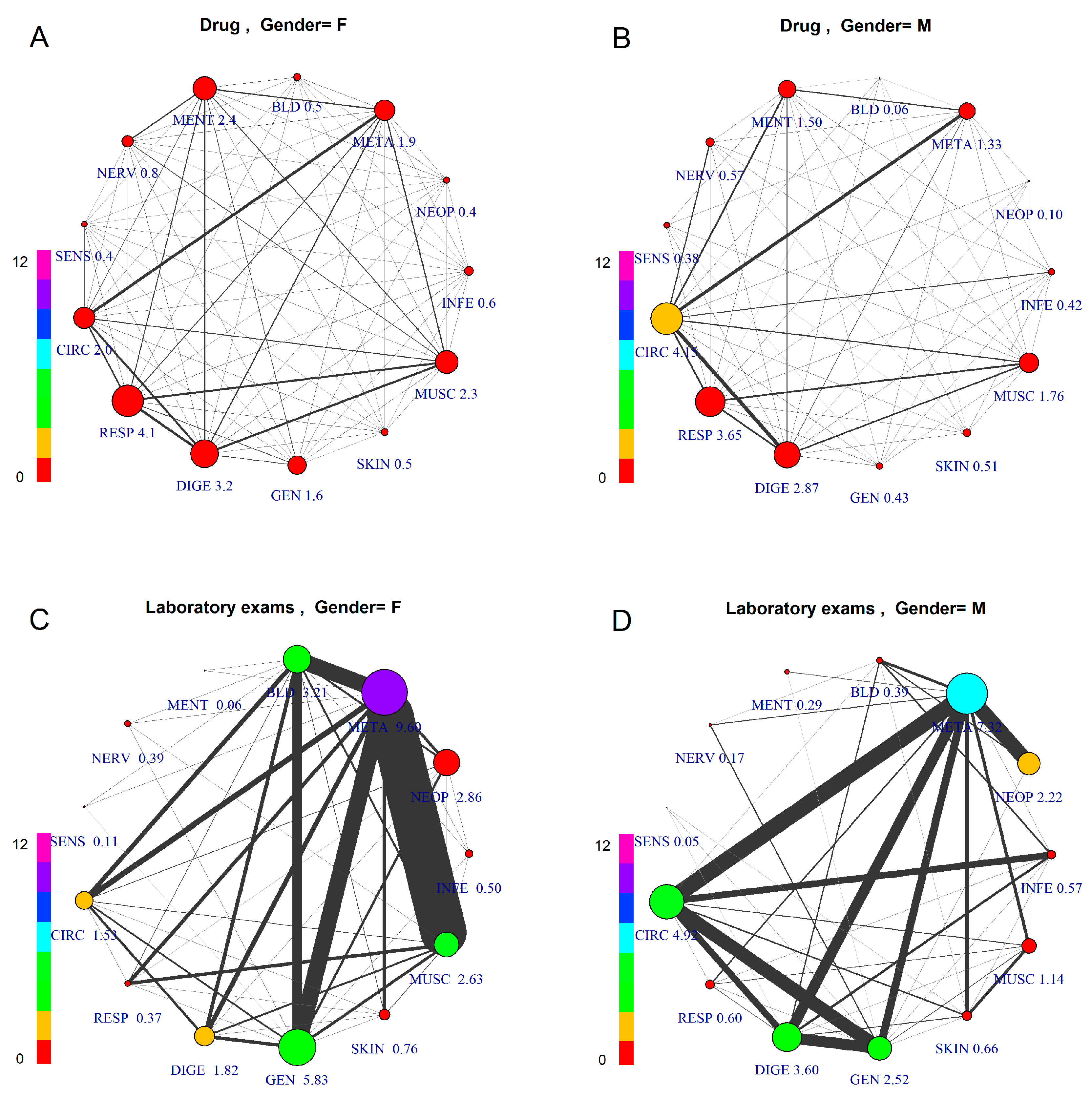
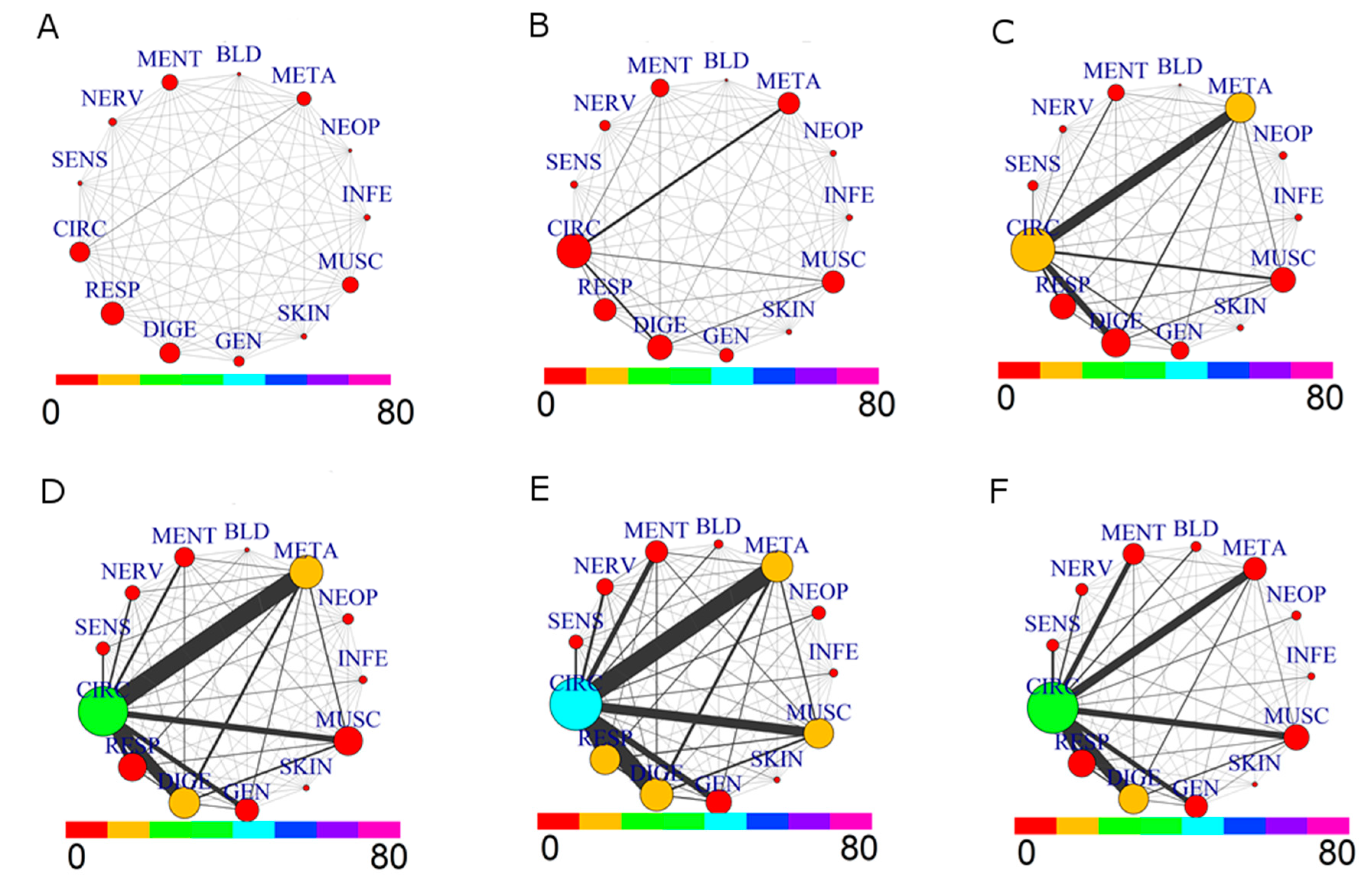
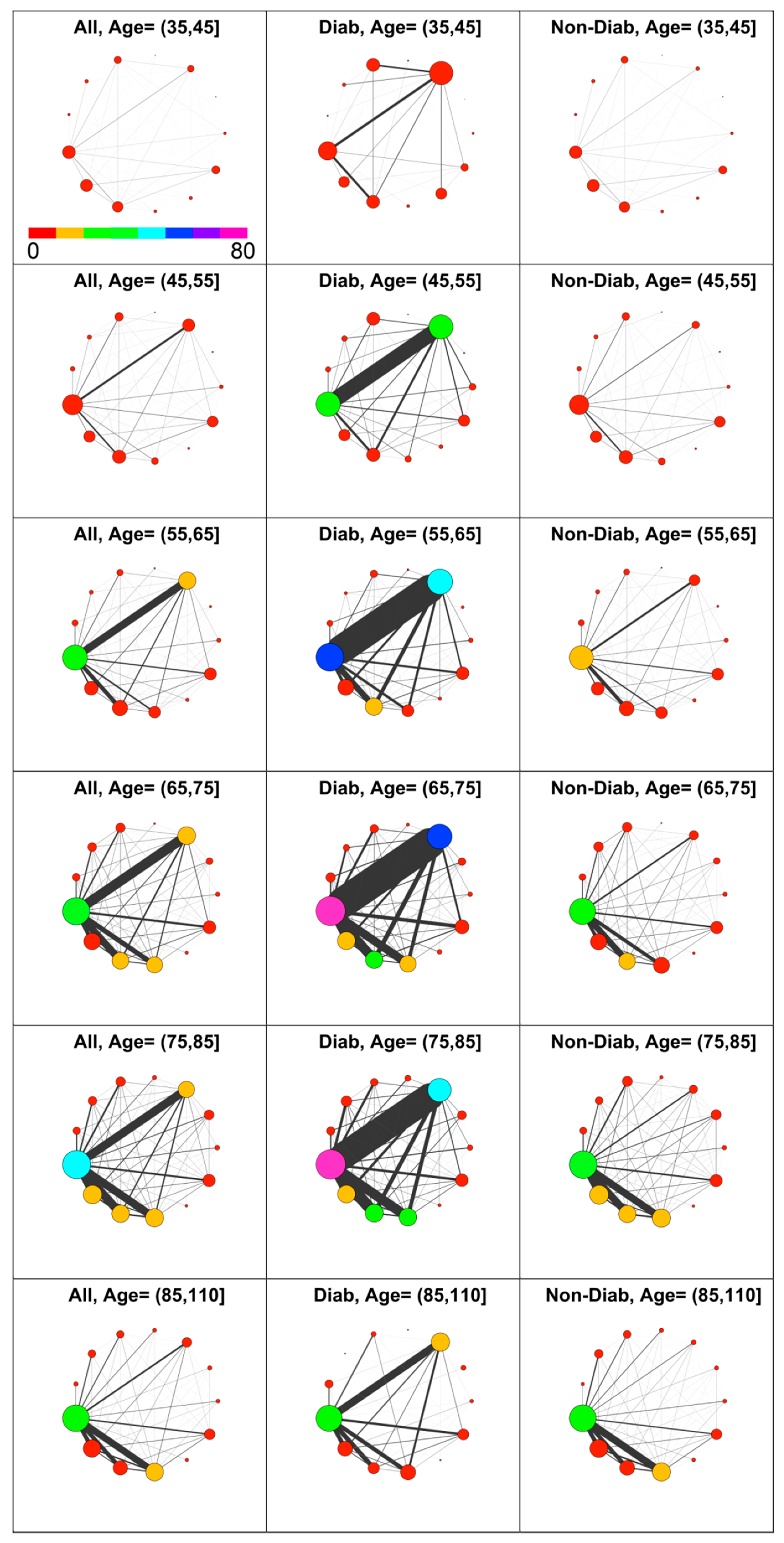
- The node label represents the ICD9CM group, and the associated number, if present, is the mean number of GPP per patient;
- (2)
- The node color represents the node strength, that is the sum of the weights from all links, and scale is shown in the picture;
- (3)
- The node size is proportional to the number of GPP per patient referred to the specific ICD9CM group. That is, the average number of prescriptions of a specific ICD9CM group made to a patient, belonging to the considered subset, and in the studied time interval. In some figures, the exact number is given beside the node symbol (e.g., see Figure 2);
- (4)
- The links indicate the presence of comorbidity and have a width proportional to the average number of times the corresponding ICD9CM groups have been co-prescribed per patient (link weight).
3. Results
3.1. General Population Data
3.2. Comorbidity Networks by Age, Gender and Prescription Type
3.3. Comorbidity Networks Evolution by Age
3.4. Diabetes Impact on Comorbidity
3.5. Diabetes Impact on Comorbidity by Age Group
3.6. Comorbidity Pattern in Diabetic Patients
4. Discussion
- (1)
- GPR represent a comprehensive source of information on population health to study comorbidities associated with non-acute pathological conditions observed in non-hospitalized general populations;
- (2)
- Network analysis is an instrument to measure associations between morbidities and their dependence on health determinants;
- (3)
- Extracting information on general population comorbidities from GPR may impact both clinical practice and health system policy making;
- (4)
- The proposed methodology is scalable to even larger datasets and generalizable to diversified contexts influencing health through factors such as geo-localization, lifestyle, nutrition and their temporal evolution.
Supplementary Materials
Author Contributions
Funding
Acknowledgments
Conflicts of Interest
References
- Loscalzo, J.; Kohane, I.; Barabasi, A.L. Human disease classification in the postgenomic era: A complex systems approach to human pathobiology. Mol. Syst. Biol. 2007, 3, 124. [Google Scholar] [CrossRef] [Scilit] [PubMed]
- Sturmberg, J.P.; Martin, C.M. Diagnosis—The limiting focus of taxonomy. J. Eval. Clin. Pract. 2016, 22, 103–111. [Google Scholar] [CrossRef] [Scilit] [PubMed]
- Feinstein, A.R. The pre-therapeutic classification of co-morbidity in chronic disease. J. Chronic Dis. 1970, 23, 455–468. [Google Scholar] [CrossRef] [Scilit]
- Le Reste, J.Y.; Nabbe, P.; Manceau, B.; Lygidakis, C.; Doerr, C.; Lingner, H.; Czachowski, S.; Munoz, M.; Argyriadou, S.; Claveria, A.; et al. The European General Practice Research Network presents a comprehensive definition of multimorbidity in family medicine and long term care, following a systematic review of relevant literature. J. Am. Med. Dir. Assoc. 2013, 14, 319–325. [Google Scholar] [CrossRef] [Scilit] [PubMed]
- Le Reste, J.Y.; Nabbe, P.; Lygidakis, C.; Doerr, C.; Lingner, H.; Czachowski, S.; Munoz, M.; Argyriadou, S.; Claveria, A.; Calvez, A.; et al. A research group from the European General Practice Research Network (EGPRN) explores the concept of multimorbidity for further research into long term care. J. Am. Med. Dir. Assoc. 2013, 14, 132–133. [Google Scholar] [CrossRef] [Scilit] [PubMed]
- World Health Organization (WHO). The Global Burden of Disease 2004 Update; WHO: Geneva, Switzerland, 2008. [Google Scholar]
- Mercer, S.W.; Smith, S.M.; Wyke, S.; O’Dowd, T.; Watt, G.C. Multimorbidity in primary care: Developing the research agenda. Fam. Pract. 2009, 26, 79–80. [Google Scholar] [CrossRef] [Scilit] [PubMed]
- Häyrinen, K.; Saranto, K.; Nykänen, P. Definition, structure, content, use and impacts of electronic health records: A review of the research literature. Int. J. Med. Inform. 2008, 77, 291–304. [Google Scholar] [CrossRef] [Scilit] [PubMed]
- Van Oostrom, S.H.; Picavet, H.S.; de Bruin, S.R.; Stirbu, I.; Korevaar, J.C.; Schellevis, F.G.; Baan, C.A. Multimorbidity of chronic diseases and health care utilization in general practice. BMC Fam. Pract. 2014, 15, 61. [Google Scholar] [CrossRef] [Scilit] [PubMed]
- Van Oostrom, S.H.; Picavet, H.S.; van Gelder, B.M.; Lemmens, L.C.; Hoeymans, N.; van Dijk, C.E.; Verheij, R.A.; Schellevis, F.G.; Baan, C.A. Multimorbidity and comorbidity in the Dutch population—Data from general practices. BMC Public Health 2012, 12, 715. [Google Scholar] [CrossRef] [Scilit] [PubMed]
- Newman, M.E.J. The Structure and Function of Complex Networks. SIAM Rev. 2003, 45, 167–256. [Google Scholar] [CrossRef] [Scilit]
- Menche, J.; Sharma, A.; Kitsak, M.; Ghiassian, S.D.; Vidal, M.; Loscalzo, J.; Barabási, A.L. Uncovering disease-disease relationships through the incomplete interactome. Science 2015, 347, 1257601. [Google Scholar] [CrossRef] [Scilit] [PubMed]
- Capobianco, E.; Lio, P. Comorbidity: A multidimensional approach. Trends Mol. Med. 2013, 19, 515–521. [Google Scholar] [CrossRef] [Scilit] [PubMed]
- Capobianco, E. Dynamic Networks in Systems Medicine. Front. Genet. 2012, 3, 185. [Google Scholar] [CrossRef] [Scilit] [PubMed]
- Sturmberg, J.P.; Bennett, J.M.; Martin, C.M.; Picard, M. ‘Multimorbidity’ as the manifestation of network disturbances. J. Eval. Clin. Pract. 2017, 23, 199–208. [Google Scholar] [CrossRef] [Scilit] [PubMed]
- Goh, K.-I.; Cusick, M.E.; Valle, D.; Childs, B.; Vidal, M.; Barabási, A.L. The human disease network. Proc. Natl. Acad. Sci. USA 2007, 104, 8685–8690. [Google Scholar] [CrossRef] [Scilit] [PubMed]
- Zhou, X.; Menche, J.; Barabási, A.-L.; Sharma, A. Human symptoms–disease network. Nat Commun. 2014, 5, 4212. [Google Scholar] [CrossRef] [Scilit] [PubMed]
- Luke, D.A.; Stamatakis, K.A. Systems science methods in public health. Annu. Rev. Public Health 2012, 33, 357–376. [Google Scholar] [CrossRef] [Scilit] [PubMed]
- Yurkovich, M.; Avina-Zubieta, J.A.; Thomas, J.; Gorenchtein, M.; Lacaille, D. A systematic review identifies valid comorbidity indices derived from administrative health data. J. Clin. Epidemiol. 2015, 68, 3–14. [Google Scholar] [CrossRef] [Scilit] [PubMed]
- Cavallo, P.; Pagano, S.; Carpinelli, L. The Drug Prescription Process: A Network Medicine Approach. In Handbook of Systems and Complexity in Health; Sturmberg, J., Martin, C.M., Eds.; Springer: New York, NY, USA, 2013; pp. 537–562. [Google Scholar]
- Chrischilles, E.; Schneider, K.; Wilwert, J.; Lessman, G.; O’Donnell, B.; Gryzlak, B.; Wright, K.; Wallace, R. Beyond comorbidity: Expanding the definition and measurement of complexity among older adults using administrative claims data. Med. Care 2014, 52 (Suppl. 3), S75–S84. [Google Scholar] [CrossRef] [Scilit] [PubMed]
- International Classification of Diseases (ICD). Available online: http://www.who.int/classifications/icd/en/ (accessed on 10 October 2017).
- R: A Language and Environment for Statistical Computing. Available online: http://www.R-project.org/ (accessed on 10 October 2017).
- Csardi, G.; Nepusz, T. The igraph software package for complex network research. Complex Syst. 2006, 1695, 1–9. [Google Scholar]
- Istituto Nazionale di Statistica (ISTAT). I.Stat—Datawarehouse Statistico Italiano; ISTAT: Roma, Italy, 2017. [Google Scholar]
- Serna, E.; Gambini, J.; Borras, C.; Abdelaziz, K.M.; Belenguer, A.; Sanchis, P.; Avellana, J.A.; Rodriguez-Manas, L.; Vina, J. Centenarians, but not octogenarians, up-regulate the expression of microRNAs. Sci. Rep. 2012, 2, 961. [Google Scholar] [CrossRef] [Scilit] [PubMed]
- Bazzoni, G.; Marengoni, A.; Tettamanti, M.; Franchi, C.; Pasina, L.; Djade, C.D.; Fortino, I.; Bortolotti, A.; Merlino, L.; Nobili, A. The drug prescription network: A system-level view of drug co-prescription in community-dwelling elderly people. Rejuvenation Res. 2015, 18, 153–161. [Google Scholar] [CrossRef] [Scilit] [PubMed]
- Chmiel, A.; Klimek, P.; Thurner, S. Spreading of diseases through comorbidity networks across life and gender. New J. Phys. 2014, 16, 115013. [Google Scholar] [CrossRef] [Scilit]
- Saczynski, J.S.; Go, A.S.; Magid, D.J.; Smith, D.H.; McManus, D.D.; Allen, L.; Ogarek, J.; Goldberg, R.J.; Gurwitz, J.H. Patterns of comorbidity in older adults with heart failure: The Cardiovascular Research Network PRESERVE study. J. Am. Geriatr. Soc. 2013, 61, 26–33. [Google Scholar] [CrossRef] [Scilit] [PubMed]
- Laux, G.; Kuehlein, T.; Rosemann, T.; Szecsenyi, J. Co- and multimorbidity patterns in primary care based on episodes of care: Results from the German CONTENT project. BMC Health Serv. Res. 2008, 8, 14. [Google Scholar] [CrossRef] [Scilit] [PubMed]
- Connor, M.; Day, G.E.; Meston, D. Successful linking of patient records between hospital services and general practice to facilitate integrated care in a hospital and health service in south-east Queensland. Aust. Health Rev. 2016, 40, 78–81. [Google Scholar] [CrossRef] [Scilit] [PubMed]
- Pourbohloul, B.; Kieny, M.P. Complex systems analysis: Towards holistic approaches to health systems planning and policy. Bull. World Health Organ. 2011, 89, 242. [Google Scholar] [CrossRef] [Scilit] [PubMed]
- Cavallo, P.; Pagano, S.; Boccia, G.; De Caro, F.; De Santis, M.; Capunzo, M. Network analysis of drug prescriptions. Pharmacoepidemiol. Drug Saf. 2013, 22, 130–137. [Google Scholar] [CrossRef] [Scilit] [PubMed]
- Lee, D.S.; Park, J.; Kay, K.A.; Christakis, N.A.; Oltvai, Z.N.; Barabási, A.L. The implications of human metabolic network topology for disease comorbidity. Proc. Natl. Acad. Sci. USA 2008, 105, 9880–9885. [Google Scholar] [CrossRef] [Scilit] [PubMed]
- Kivelä, M.; Arenas, A.; Barthelemy, M.; Gleeson, J.P.; Moreno, Y. Multilayer networks. J. Complex Netw. 2014, 2, 203–271. [Google Scholar] [CrossRef] [Scilit]



| GPP Type | All | Drug | Laboratory Test | Procedures | Rehab | Referral | Hospital |
| Prescriptions | 1,728,736 | 897,329 | 647,023 | 105,126 | 8388 | 65,734 | 5136 |
| % of total | 100.0% | 51.9% | 37.4% | 6.1% | 0.5% | 3.8% | 0.3% |
| Prescriptions per patient per year | 10.51 | 5.45 | 3.93 | 0.64 | 0.05 | 0.40 | 0.03 |
| GPP Type (row) | All | Drug % | Laboratory Test % | Procedures % | Rehab % | Referral % | Hospital % |
| ICD9 Group (column) | |||||||
| CIRC—circulatory | 451,765 | 69.2% | 25.4% | 3.5% | 0.0% | 1.8% | 0.2% |
| META—metabolic | 231,541 | 37.6% | 56.6% | 2.5% | 0.0% | 3.3% | 0.1% |
| ILL—ill defined | 219,664 | 26.7% | 56.4% | 10.7% | 1.0% | 4.8% | 0.5% |
| DIGE—digestive | 133,736 | 72.6% | 20.4% | 4.8% | 0.0% | 1.9% | 0.3% |
| MUSC—muscular | 122,718 | 57.4% | 22.2% | 11.8% | 3.7% | 4.6% | 0.3% |
| GEN—genitourinary | 112,029 | 37.6% | 51.6% | 6.7% | 0.0% | 3.8% | 0.3% |
| RESP—respiratory | 110,587 | 87.1% | 6.9% | 3.2% | 0.1% | 2.5% | 0.2% |
| SUPP—supplementary | 75,458 | 13.0% | 76.9% | 6.5% | 0.1% | 3.3% | 0.3% |
| NEOP—neoplastic | 72,708 | 15.2% | 67.7% | 12.2% | 0.0% | 4.0% | 0.9% |
| MENT—mental | 45,328 | 89.5% | 4.9% | 0.7% | 0.0% | 4.8% | 0.1% |
| NERV—nervous | 28,969 | 69.0% | 16.9% | 7.3% | 0.4% | 5.8% | 0.6% |
| BLD—blood | 28,406 | 20.5% | 75.6% | 1.3% | 0.0% | 2.4% | 0.2% |
| SENS—sensory | 26,879 | 57.1% | 5.3% | 14.0% | 0.0% | 22.0% | 1.5% |
| SKIN | 22,250 | 44.3% | 36.2% | 3.7% | 0.1% | 15.4% | 0.4% |
| INFE—infectious | 21,803 | 49.5% | 33.1% | 11.5% | 0.1% | 5.6% | 0.2% |
| INJ—injuries | 20,342 | 40.1% | 14.7% | 21.7% | 5.3% | 17.5% | 0.7% |
| PREG—pregnancy | 2748 | 41.9% | 48.2% | 4.4% | 0.0% | 3.2% | 2.2% |
| CONG—congenital | 1401 | 24.1% | 42.1% | 18.6% | 1.1% | 10.5% | 3.5% |
| NEWB—newborn | 404 | 66.6% | 21.0% | 2.0% | 0.0% | 8.9% | 1.5% |
© 2018 by the authors. Licensee MDPI, Basel, Switzerland. This article is an open access article distributed under the terms and conditions of the Creative Commons Attribution (CC BY) license (http://creativecommons.org/licenses/by/4.0/).
Share and Cite
Cavallo, P.; Pagano, S.; De Santis, M.; Capobianco, E. General Practitioners Records Are Epidemiological Predictors of Comorbidities: An Analytical Cross-Sectional 10-Year Retrospective Study. J. Clin. Med. 2018, 7, 184. https://doi.org/10.3390/jcm7080184
Cavallo P, Pagano S, De Santis M, Capobianco E. General Practitioners Records Are Epidemiological Predictors of Comorbidities: An Analytical Cross-Sectional 10-Year Retrospective Study. Journal of Clinical Medicine. 2018; 7(8):184. https://doi.org/10.3390/jcm7080184
Chicago/Turabian StyleCavallo, Pierpaolo, Sergio Pagano, Mario De Santis, and Enrico Capobianco. 2018. "General Practitioners Records Are Epidemiological Predictors of Comorbidities: An Analytical Cross-Sectional 10-Year Retrospective Study" Journal of Clinical Medicine 7, no. 8: 184. https://doi.org/10.3390/jcm7080184
APA StyleCavallo, P., Pagano, S., De Santis, M., & Capobianco, E. (2018). General Practitioners Records Are Epidemiological Predictors of Comorbidities: An Analytical Cross-Sectional 10-Year Retrospective Study. Journal of Clinical Medicine, 7(8), 184. https://doi.org/10.3390/jcm7080184