Platelet Recovery and Mortality in Septic Patients with Thrombocytopenia: A Propensity Score-Matched Analysis of the MIMIC-IV Database
Abstract
1. Introduction
2. Methods
2.1. Study Design and Data Source
2.2. Study Population
3. Variables and Definitions
3.1. Exposure
3.2. Outcomes
3.3. Covariates
3.4. Statistical Analysis
3.5. Propensity Score Methods
3.6. Regression Models
3.7. Additional Analyses
3.8. Software
4. Results
5. Discussion
6. Conclusions
Supplementary Materials
Author Contributions
Funding
Institutional Review Board Statement
Informed Consent Statement
Data Availability Statement
Acknowledgments
Conflicts of Interest
References
- Fleischmann-Struzek, C.; Mellhammar, L.; Rose, N.; Cassini, A.; Rudd, K.E.; Schlattmann, P.; Allegranzi, B.; Reinhart, K. Incidence and mortality of hospital- and ICU-treated sepsis: Results from an updated and expanded systematic review and meta-analysis. Intensive Care Med. 2020, 46, 1552–1562. [Google Scholar] [CrossRef]
- Rudd, K.E.; Johnson, S.C.; Agesa, K.M.; Shackelford, K.A.; Tsoi, D.; Kievlan, D.R.; Colombara, D.V.; Ikuta, K.S.; Kissoon, N.; Finfer, S.; et al. Global, regional, and national sepsis incidence and mortality, 1990–2017: Analysis for the Global Burden of Disease Study. Lancet 2020, 395, 200–211. [Google Scholar] [CrossRef]
- Ostadi, Z.; Shadvar, K.; Sanaie, S.; Mahmoodpoor, A.; Montazer, M. Thrombocytopenia in the intensive care unit. Pak. J. Med. Sci. 2019, 35, 282–287. [Google Scholar] [CrossRef]
- Schupp, T.; Weidner, K.; Rusnak, J.; Jawhar, S.; Forner, J.; Dulatahu, F.; Brück, L.M.; Hoffmann, U.; Kittel, M.; Bertsch, T.; et al. Diagnostic and prognostic role of platelets in patients with sepsis and septic shock. Platelets 2023, 34, 2131753. [Google Scholar] [CrossRef] [PubMed]
- Alqeeq, A.; Ayyad, T. The clinical significance of thrombocytopenia in sepsis and septic shock: A systematic review and meta-analysis. BMC Anesthesiol. 2025, 25, 36. [Google Scholar] [CrossRef] [PubMed]
- Wang, J.; Zhou, P.; Li, X.; Zhou, L.; Deng, Z. Association between platelet count and 30-day in-hospital mortality among ICU patients with sepsis: A multicenter retrospective cohort study. Front. Med. 2024, 11, 1444481. [Google Scholar] [CrossRef]
- Li, J.; Li, R.; Jin, X.; Ren, J.; Zhang, J.; Gao, Y.; Hou, Y.; Zhang, X.; Wang, G. Platelet count trajectory patterns and prognosis in critically ill patients with thrombocytopenia: Based on latent growth mixture model analysis. Thromb. Res. 2025, 249, 109314. [Google Scholar] [CrossRef]
- Assinger, A. Platelets and infection—an emerging role of platelets in viral infection. Front. Immunol. 2014, 5, 649. [Google Scholar] [CrossRef]
- Setarehaseman, A.; Mohammadi, A.; Maitta, R. Thrombocytopenia in sepsis. Life 2025, 15, 274. [Google Scholar] [CrossRef]
- Kasugai, D.; Ozaki, M.; Nishida, K.; Goto, Y.; Takahashi, K.; Matsui, S.; Matsuda, N. Relative platelet reductions provide better pathophysiologic signatures of coagulopathies in sepsis. Sci. Rep. 2021, 11, 12768. [Google Scholar] [CrossRef]
- Fan, S.H.; Pang, M.M.; Si, M.; Cao, C.F.; Yan, M.C.; Xu, Y.; Meng, T.Y.; Yin, M.; Wang, H. Quantitative changes in platelet count in response to different pathogens: An analysis of patients with sepsis. Ann. Med. 2024, 56, 2405073. [Google Scholar] [CrossRef] [PubMed]
- Giordano, P.; Lassandro, G.; Barone, A.; Cesaro, S.; Fotzi, I.; Giona, F.; Gorio, C.; Maggio, A.; Miano, M.; Marzollo, A.; et al. Long term use of eltrombopag in children with chronic immune thrombocytopenia: Extended real life retrospective multicenter experience of the Italian Association of Pediatric Hematology and Oncology. Front. Med. 2023, 10, 1214308. [Google Scholar] [CrossRef] [PubMed]
- Lassandro, G.; Palladino, V.; Faleschini, M.; Barone, A.; Boscarol, G.; Cesaro, S.; Chiocca, E.; Farruggia, P.; Giona, F.; Gorio, C.; et al. CHildren with Inherited Platelet disorders Surveillance (CHIPS) retrospective and prospective observational cohort study by Italian Association of Pediatric Hematology and Oncology (AIEOP). Front. Pediatr. 2022, 10, 967417. [Google Scholar] [CrossRef] [PubMed]
- Al Saleh, K.; AlQahtani, R.M. Platelet count patterns and patient outcomes in sepsis at a tertiary care center: Beyond the APACHE score. Medicine 2021, 100, e25013. [Google Scholar] [CrossRef]
- Han, Y.; Liu, J.; Huang, Z.; Hu, H.; Yin, H. Early dynamic changes in platelet counts and 28-day mortality in sepsis patients. Front. Med. 2025, 12, 1596134. [Google Scholar] [CrossRef]
- Zhou, H.; Li, Z.; Liang, H.; Yan, Z. Thrombocytopenia and platelet count recovery in patients with sepsis-3: A retrospective observational study. Platelets 2022, 33, 612–620. [Google Scholar] [CrossRef]
- Wang, K.; Lu, D.; Wang, F. Subphenotypes of platelet count trajectories in sepsis from multi-center ICU data. Sci. Rep. 2024, 14, 15790. [Google Scholar] [CrossRef]
- Johnson, A.E.W.; Bulgarelli, L.; Shen, L.; Gayles, A.; Shammout, A.; Horng, S.; Pollard, T.J.; Hao, S.; Moody, B.; Gow, B.; et al. MIMIC-IV, a freely accessible electronic health record dataset. Sci. Data 2023, 10, 1. [Google Scholar] [CrossRef]
- Singer, M.; Deutschman, C.S.; Seymour, C.W.; Shankar-Hari, M.; Annane, D.; Bauer, M.; Bellomo, R.; Bernard, G.R.; Chiche, J.-D.; Coopersmith, C.M.; et al. The Third International Consensus Definitions for Sepsis and Septic Shock (Sepsis-3). JAMA 2016, 315, 801–810. [Google Scholar] [CrossRef]
- Ye, Q.; Wang, X.C.; Xu, X.; Chen, J.; Christiani, D.C.; Chen, F.; Zhang, R.; Wei, Y. Serial platelet count as a dynamic prediction marker of hospital mortality among septic patients. Burns Trauma 2024, 12, tkae016. [Google Scholar] [CrossRef]
- Claushuis, T.A.M.; van Vught, L.A.; Scicluna, B.P.; Wiewel, M.A.; Klouwenberg, P.M.C.K.; Hoogendijk, A.J.; Ong, D.S.Y.; Cremer, O.L.; Horn, J.; Franitza, M.; et al. Thrombocytopenia is associated with a dysregulated host response in critically ill sepsis patients. Blood 2016, 127, 3062–3072. [Google Scholar] [CrossRef] [PubMed]
- Zhou, D.; Li, Z.; Wu, L.; Shi, G.; Zhou, J. Thrombocytopenia and platelet course on hospital mortality in neurological intensive care unit: A retrospective observational study from a large database. BMC Neurol. 2020, 20, 441. [Google Scholar] [CrossRef]
- Chen, J.; Gao, X.; Shen, S.; Xu, J.; Sun, Z.; Lin, R.; Dai, Z.; Su, L.; Christiani, D.C.; Chen, F.; et al. Association of longitudinal platelet count trajectory with ICU mortality: A multi-cohort study. Front. Immunol. 2022, 13, 936662. [Google Scholar] [CrossRef]
- Hu, Y.; Dai, S.; Qiao, C.; Ye, Y.; Ren, J.; Wang, K.; Li, L.; Liu, Z. Platelets in infection: Intrinsic roles and functional outcomes. Front. Immunol. 2025, 16, 1616783. [Google Scholar] [CrossRef]
- Li, M.; Li, X.; Fan, K.; Yu, Y.-Y.; Gong, J.; Geng, S.-Y.; Liang, Y.-F.; Huang, L.; Qiu, J.-H.; Tian, X.-H.; et al. Platelet desialylation is a novel mechanism and therapeutic target in thrombocytopenia during sepsis: An open-label, multicenter, randomized controlled trial. J. Hematol. Oncol. 2017, 10, 104. [Google Scholar] [CrossRef]
- Leung, G.; Morassutti, A.; Hornsby, T.; Gill, S.E. The role of platelets and megakaryocytes in sepsis and ARDS. J. Physiol. 2024, 602, 1203–1218. [Google Scholar] [CrossRef]
- Zhu, J.; Zhang, C.; Deng, Z.; Ouyang, L. Association between neutrophil-platelet ratio and 28-day mortality in patients with sepsis: A retrospective analysis based on MIMIC-IV. BMC Infect. Dis. 2025, 25, 73. [Google Scholar] [CrossRef]



| Characteristics | Unmatched Cohort | Propensity-Matched Cohort | ||||||
|---|---|---|---|---|---|---|---|---|
| All | TP | All | TP | All | TP | |||
| N | 50,916 | 4674 | 46,242 | 8782 | 4391 | 4391 | ||
| Age, years (%) | ||||||||
| 18–39 | 4937 (9.7) | 374 (8.0) | 4563 (9.9) | <0.001 | 720 (8.2) | 355 (8.1) | 365 (8.3) | 0.726 |
| 40–64 | 17,967 (35.3) | 1999 (42.8) | 15,968 (34.5) | <0.001 | 3429 (39.0) | 1810 (41.2) | 1619 (36.9) | <0.001 |
| >65 | 28,012 (55.0) | 2301 (49.2) | 25,711 (55.6) | <0.001 | 4633 (52.8) | 2226 (50.7) | 2407 (54.8) | <0.001 |
| Male (%) | 28,439 (55.9) | 2870 (61.4) | 25,569 (55.3) | <0.001 | 5408 (61.6) | 2693 (61.3) | 2715 (61.8) | 0.645 |
| Race (%) | ||||||||
| AMERICAN | 133 (0.3) | 22 (0.5) | 111 (0.2) | 0.005 | 34 (0.4) | 17 (0.4) | 17 (0.4) | 1.000 |
| ASIAN | 1496 (2.9) | 169 (3.6) | 1327 (2.9) | 0.005 | 330 (3.8) | 161 (3.7) | 169 (3.8) | 0.694 |
| BLACK | 4640 (9.1) | 398 (8.5) | 4242 (9.2) | 0.143 | 743 (8.5) | 372 (8.5) | 371 (8.4) | 1.000 |
| HISPANIC | 1735 (3.4) | 187 (4.0) | 1548 (3.3) | 0.021 | 332 (3.8) | 168 (3.8) | 164 (3.7) | 0.867 |
| OTHER | 2407 (4.7) | 237 (5.1) | 2170 (4.7) | 0.261 | 410 (4.7) | 217 (4.9) | 193 (4.4) | 0.245 |
| UNKNOWN | 6305 (12.4) | 614 (13.1) | 5691 (12.3) | 0.106 | 1116 (12.7) | 567 (12.9) | 549 (12.5) | 0.586 |
| WHITE | 34,200 (67.2) | 3047 (65.2) | 31,153 (67.4) | 0.003 | 5817 (66.2) | 2889 (65.8) | 2928 (66.7) | 0.391 |
| BMI (median [IQR]) | 27.99 [27.99–27.99] | 27.99 [27.20–27.99] | 27.99 [27.99–27.99] | <0.001 | 27.99 [26.57–27.99] | 27.99 [27.23–7.99] | 27.99 [26.06–28.36] | 0.030 |
| Neutrophil count (median [IQR]) | 9.25 [6.20–13.14] | 6.46 [3.37–10.43] | 9.59 [6.62–13.39] | <0.001 | 8.43 [5.00–13.28] | 6.43 [3.33–10.38] | 10.83 [7.22–15.69] | <0.001 |
| Comorbidities | ||||||||
| Type 2 Diabetes (%) | 37,976 (74.6) | 3569 (76.4) | 34,407 (74.4) | 0.004 | 6695 (76.2) | 3339 (76.0) | 3356 (76.4) | 0.688 |
| Hyperlipidemia (%) | 32,619 (64.1) | 3417 (73.1) | 29,202 (63.2) | <0.001 | 6300 (71.7) | 3157 (71.9) | 3143 (71.6) | 0.758 |
| Chronic renal disease (%) | 43,243 (84.9) | 3890 (83.2) | 39,353 (85.1) | <0.001 | 7266 (82.7) | 3639 (82.9) | 3627 (82.6) | 0.756 |
| Cirrhosis (%) | 48,057 (94.4) | 3309 (70.8) | 44,748 (96.8) | <0.001 | 6735 (76.7) | 3261 (74.3) | 3474 (79.1) | <0.001 |
| Immunosuppression (%) | 49,649 (97.5) | 4317 (92.4) | 45,332 (98.0) | <0.001 | 8285 (94.3) | 4079 (92.9) | 4206 (95.8) | <0.001 |
| SOFA (median [IQR]) | 3.0 [2–6] | 7.0 [5–10] | 3.0 [2–5] | <0.001 | 7.0 [5–10] | 7.0 [5–10] | 7.0 [5–10] | 0.003 |
| Charlson (median [IQR]) | 4.0 [2–7] | 5.0 [3–7] | 4.0 [2–7] | <0.001 | 5.0 [3–7] | 5.0 [3–7] | 5.0 [3–7] | 0.132 |
| Interventions | ||||||||
| Antibiotic (%) | 36,724 (72.13) | 32,691 (70.70) | 4033 (86.29) | <0.001 | 878 (78.69) | 396 (70.97) | 482 (86.38) | <0.001 |
| Glucocorticoids (%) | 7078 (13.90) | 6056 (13.10) | 1022 (21.87) | <0.001 | 180 (16.13) | 60 (10.75) | 120 (21.51) | <0.001 |
| Immunosuppressant drugs (%) | 1267 (2.49) | 910 (1.97) | 357 (7.64) | <0.001 | 57 (5.11) | 11 (1.97) | 46 (8.24) | <0.001 |
| Antihypertensive drugs (%) | 31,277 (61.43) | 28,233 (61.05) | 3044 (65.13) | <0.001 | 698 (62.54) | 341 (61.11) | 357 (63.98) | 0.322 |
| Nephrotoxic drugs (%) | 36,871 (72.42) | 33,502 (72.45) | 3369 (72.08) | 0.590 | 790 (70.79) | 411 (73.66) | 379 (67.92) | 0.035 |
| Heparin (%) | 40,136 (78.83) | 36,931 (79.86) | 3205 (68.57) | <0.001 | 834 (74.73) | 443 (79.39) | 391 (70.07) | <0.001 |
| Anticoagulant drugs (%) | 40,145 (78.85) | 36,937 (79.88) | 3208 (68.64) | <0.001 | 835 (74.82) | 443 (79.39) | 392 (70.25) | <0.001 |
| Platelet aggregation drugs (%) | 23,723 (46.59) | 22,285 (48.19) | 1438 (30.77) | <0.001 | 420 (37.64) | 265 (47.49) | 155 (27.78) | <0.001 |
| Invasive ventilation (%) | 17,652 (34.67) | 15,801 (34.17) | 1851 (39.60) | <0.001 | 419 (37.56) | 205 (36.74) | 214 (38.35) | 0.578 |
| Variables | Unmatched Cohort | Propensity-Matched Cohort (Weighted) | ||||||
|---|---|---|---|---|---|---|---|---|
| All | TP | No TP | p | All | TP | No TP | p | |
| N | 22,513 | 3041 | 19,270 | 1044 | 522 | 522 | ||
| N (ESS) | 22,513 | 3041 | 19,270 | 484.7 | 522 | 157.8 | ||
| Age (%) | <0.001 | 0.635 | ||||||
| 18–39 | 1645 (7.31) | 244 (8.02) | 1374 (7.13) | 63.4 (6.08) | 35.0 (6.70) | 28.4 (5.45) | ||
| 40–64 | 7696 (34.18) | 1350 (44.39) | 6290 (32.64) | 469.6 (44.98) | 227.0 (43.49) | 242.6 (46.47) | ||
| >65 | 13,172 (58.51) | 1447 (47.58) | 11,606 (60.23) | 511.0 (48.94) | 260.0 (49.81) | 251.0 (48.08) | ||
| Male (%) | 13,019 (57.83) | 1844 (60.64) | 11,073 (57.46) | <0.001 | 644.8 (61.76) | 307.0 (58.81) | 337.8 (64.72) | 0.127 |
| Race (%) | <0.001 | 0.641 | ||||||
| AMERICAN | 59 (0.26) | 14 (0.46) | 43 (0.22) | 2.8 (0.27) | 2.0 (0.38) | 0.8 (0.15) | ||
| ASIAN | 647 (2.87) | 114 (3.75) | 526 (2.73) | 36.8 (3.52) | 17.0 (3.26) | 19.8 (3.79) | ||
| BLACK | 1813 (8.05) | 235 (7.73) | 1562 (8.11) | 85.5 (8.19) | 44.0 (8.43) | 41.5 (7.96) | ||
| HISPANIC | 729 (3.24) | 119 (3.91) | 600 (3.11) | 29.0 (2.78) | 15.0 (2.87) | 14.0 (2.68) | ||
| OTHER | 1056 (4.69) | 157 (5.16) | 887 (4.60) | 48.6 (4.66) | 28.0 (5.36) | 20.6 (3.95) | ||
| UNKNOWN | 3121 (13.86) | 434 (14.27) | 2664 (13.82) | 192.8 (18.47) | 105.0 (20.11) | 87.8 (16.82) | ||
| WHITE | 15,088 (67.02) | 1968 (64.72) | 12,988 (67.40) | 648.5 (62.12) | 311.0 (59.58) | 337.5 (64.66) | ||
| BMI (median [IQR]) | 28.12 [24.46–2.86] | 27.56 [24.10–31.92] | 28.24 [24.53–32.99] | <0.001 | 27.50 [23.73–32.55] | 27.75 [24.34–32.63] | 27.30 [23.17–32.3] | 0.350 |
| Neutrophil count (median [IQR]) | 10.06 [6.58–14.72] | 6.67 [3.29–11.08] | 10.72 [7.37–15.23] | <0.001 | 8.22 [4.85–11.79] | 7.27 [3.63–11.33] | 8.95 [6.07–12.18] | <0.001 |
| Comorbidities | ||||||||
| Hypertension (%) | 9681 (43.00) | 1067 (35.09) | 8540 (44.32) | <0.001 | 358.5 (34.34) | 192.0 (36.78) | 166.5 (31.90) | 0.187 |
| Type 2 Diabetes (%) | 6318 (28.06) | 723 (23.78) | 5550 (28.80) | <0.001 | 231.1 (22.13) | 119.0 (22.80) | 112.1 (21.47) | 0.668 |
| Hyperlipidemia (%) | 7982 (35.46) | 781 (25.68) | 7142 (37.06) | <0.001 | 300.8 (28.81) | 155.0 (29.69) | 145.8 (27.93) | 0.589 |
| Chronic renal disease (%) | 4064 (18.05) | 520 (17.10) | 3508 (18.20) | 0.141 | 203.0 (19.44) | 104.0 (19.92) | 99.0 (18.96) | 0.722 |
| Cirrhosis (%) | 1948 (8.65) | 986 (32.42) | 952 (4.94) | <0.001 | 308.4 (29.54) | 152.0 (29.12) | 156.4 (29.96) | 0.877 |
| Immunosuppression (%) | 5015 (22.28) | 971 (31.93) | 4003 (20.77) | <0.001 | 294.0 (28.16) | 147.0 (28.16) | 147.0 (28.15) | 0.998 |
| SOFA (median [IQR]) | 5.0 [3–8] | 8.0 [6–11] | 5.0 [3–7] | <0.001 | 10.0 [7–13] | 10.0 [7–13] | 10.0 [7–14] | 0.433 |
| Charlson (median [IQR]) | 5.0 [3–7] | 5.0 [3–7] | 5.0 [3–7] | <0.001 | 5.0 [3–7] | 5.0 [3–7] | 5.0 [3–7] | 0.771 |
| Intervention | ||||||||
| Antibiotic (%) | 22,513 (100.00) | 3041 (100.00) | 19,270 (100.00) | 1044 (100.00) | 522 (100.00) | 522 (100.00) | ||
| Glucocorticoids (%) | 3513 (15.60) | 745 (24.50) | 2756 (14.30) | <0.001 | 280.3 (26.85) | 155.0 (29.69) | 125.3 (24.01) | 0.335 |
| Immunosuppressant drugs (%) | 758 (3.37) | 255 (8.39) | 502 (2.61) | <0.001 | 73.1 (7.01) | 40.0 (7.66) | 33.1 (6.35) | 0.561 |
| Antihypertensive drugs (%) | 16,151 (71.74) | 2039 (67.05) | 14,027 (72.79) | <0.001 | 759.4 (72.74) | 390.0 (74.71) | 369.4 (70.77) | 0.449 |
| Heparin (%) | 18,291 (81.25) | 2153 (70.80) | 15,979 (82.92) | <0.001 | 865.5 (82.90) | 406.0 (77.78) | 459.5 (88.03) | <0.001 |
| Anticoagulant drugs (%) | 18,926 (81.3) | 2156 (70.90) | 16,140 (82.90) | <0.001 | 867.5 (83.85) | 405.0 (77.90) | 460.5 (88.15) | <0.001 |
| Platelet aggregation drugs (%) | 11,195 (49.73) | 885 (29.10) | 10,248 (53.18) | <0.001 | 439.9 (42.14) | 196.0 (37.55) | 243.9 (46.72) | 0.033 |
| CRRT (%) | 1196 (5.31) | 347 (11.41) | 848 (4.40) | <0.001 | 236.1 (22.62) | 119.0 (22.80) | 117.1 (22.43) | 0.948 |
| Invasive ventilation (%) | 11,915 (52.92) | 1450 (47.68) | 10,406 (54.00) | <0.001 | 751.9 (72.02) | 357.0 (68.39) | 394.9 (75.64) | 0.034 |
| Outcomes | Unadjusted RR/Ratio (95% CI, p) | Adjusted RR/Ratio (Full) (95% CI, p) | Adjusted RR/Ratio (OW-Weighted) (95% CI, p) |
|---|---|---|---|
| Death | 1.37 (1.32–1.43, p ≤ 0.001) | 1.02 (0.98–1.07, p = 0.244) | 1.05 (1.01–1.10, p = 0.027) |
| 28-day death (%) | 1.31 (1.25–1.36, p = 0.001) | 0.98 (0.93–1.02, p = 0.276) | 1.02 (0.97–1.07, p = 0.481) |
| Hospital days (median [IQR]) | 1.06 (1.03–1.09, p ≤ 0.001) | 1.10 (1.06–1.13, p ≤ 0.001) | 0.98 (0.95–1.01, p = 0.232) |
| ICU days (median [IQR]) | 0.98 (0.96–1.01, p = 0.281) | 0.98 (0.95–1.00, p = 0.081) | 0.86 (0.83–0.88, p ≤ 0.001) |
| Hospital survival days (median [IQR]) | 0.62 (0.55–0.69, p ≤ 0.001) | 1.32 (1.18–1.47, p ≤ 0.001) | 1.23 (1.08–1.39, p = 0.001) |
| ICU survival days (media [IQR]) | 0.58 (0.52–0.66, p ≤ 0.001) | 1.30 (1.16–1.46, p ≤ 0.001) | 1.22 (1.07–1.39, p = 0.002) |
| Characteristic | Unmatched Cohort | Propensity-Weighted Cohort | ||||||
|---|---|---|---|---|---|---|---|---|
| All | No Recovery | Recovery | p | All | No Recovery | Recovery | p | |
| N | 2272 | 1632 | 640 | 1043.3 | 403.3 | 640.0 | ||
| Age (%) | ||||||||
| 18–39 | 188 (8.27) | 100 (6.13) | 88 (13.75) | <0.001 | 113.60 (10.89) | 25.12 (6.23) | 88.48 (13.83) | <0.001 |
| 40–64 | 1003 (44.15) | 786 (48.16) | 217 (33.91) | <0.001 | 411.22 (39.41) | 192.76 (47.79) | 218.47 (34.14) | <0.001 |
| >65 | 1081 (47.58) | 746 (45.71) | 335 (52.34) | 0.004 | 518.50 (49.70) | 185.47 (45.98) | 333.02 (52.04) | 0.035 |
| Male (%) | 1402 (61.71) | 1012 (62.01) | 390 (60.94) | 0.636 | 637.58 (61.11) | 250.00 (61.98) | 387.58 (60.56) | 0.611 |
| Race (%) | 0.252 | |||||||
| BMI (median [IQR]) | 27.82 [24.45–32.46] | 28.08 [24.62–32.67] | 27.23 [24.09–32.04] | 0.042 | 27.65 [24.34–32.63] | 28.43 [24.91–33.30] | 27.15 [24.09–32.02] | 0.012 |
| Neutrophil count (median [IQR]) | 5.85 [1.57–10.26] | 5.70 [1.49–10.07] | 6.26 [3.39–11.51] | 0.146 | 5.92 [1.85–10.51] | 3.69 [1.09–8.39] | 6.33 [3.49–11.53] | 0.042 |
| Platelet count (median [IQR]) | 72.3 [51.5–86.0] | 65.50 [46.5–82.0] | 82.0 [70.5–91.0] | <0.001 | 77.0 [60.0–89.0] | 63.9 [44.7–81.0] | 82.0 [70.6–91.0] | <0.001 |
| Comorbidities | ||||||||
| Hypertension (%) | 809 (35.61) | 536 (32.84) | 273 (42.66) | <0.001 | 405.69 (38.88) | 139.15 (34.50) | 266.54 (41.65) | 0.010 |
| Type 2 Diabetes (%) | 575 (25.31) | 434 (26.59) | 141 (22.03) | 0.025 | 234.26 (22.45) | 98.22 (24.35) | 136.05 (21.26) | 0.192 |
| Hyperlipidemia (%) | 612 (26.94) | 393 (24.08) | 219 (34.22) | <0.001 | 316.90 (30.37) | 98.95 (24.53) | 217.95 (34.06) | <0.001 |
| Chronic Renal disease (%) | 424 (18.66) | 332 (20.34) | 92 (14.38) | 0.001 | 171.59 (16.45) | 78.78 (19.53) | 92.81 (14.50) | 0.019 |
| Cirrhosis (%) | 678 (29.84) | 643 (39.40) | 35 (5.47) | <0.001 | 192.53 (18.45) | 158.33 (39.25) | 34.19 (5.34) | <0.001 |
| Immunosuppression (%) | 706 (31.07) | 579 (35.48) | 127 (19.84) | <0.001 | 276.28 (26.48) | 147.59 (36.59) | 128.70 (20.11) | <0.001 |
| SOFA (median [IQR]) | 9.0 [6–11] | 9.0 [7–12] | 7.0 [5–10] | <0.001 | 8.0 [6–11] | 9.0 [6–12] | 7.0 [5–10] | <0.001 |
| Charlson (median [IQR]) | 5.0 [4–7] | 6.0 [4–8] | 4.0 [2–6] | <0.001 | 5.0 [3–7] | 6.0 [4–8] | 4.0 [2–6] | <0.001 |
| Intervention | ||||||||
| Antibiotic (%) | 2272 (100.00) | 1632 (100.00) | 640 (100.00) | 1043.32 (100.0) | 403.34 (100.00) | 639.97 (100.00) | ||
| Glucocorticoids (%) | 626 (27.55) | 553 (33.88) | 73 (11.41) | <0.001 | 206.94 (19.83) | 132.64 (32.89) | 74.29 (11.61) | <0.001 |
| Immunosuppressant drugs (%) | 240 (10.56) | 220 (13.48) | 20 (3.12) | <0.001 | 67.41 (6.46) | 48.12 (11.93) | 19.29 (3.01) | <0.001 |
| Antihypertensive drugs (%) | 1836 (80.81) | 1315 (80.58) | 521 (81.41) | 0.651 | 837.15 (80.24) | 319.32 (79.17) | 517.83 (80.91) | 0.449 |
| Heparin (%) | 1908 (83.98) | 1347 (82.54) | 561 (87.66) | 0.003 | 884.92 (84.82) | 324.76 (80.52) | 560.16 (87.53) | <0.001 |
| Anticoagulant drugs (%) | 1908 (83.98) | 1347 (82.54) | 561 (87.66) | 0.003 | 884.92 (84.82) | 324.76 (80.52) | 560.16 (87.53) | <0.001 |
| Platelet aggregation drugs (%) | 837 (36.84) | 505 (30.94) | 332 (51.88) | <0.001 | 449.86 (43.12) | 121.36 (30.09) | 328.50 (51.33) | <0.001 |
| CRRT (%) | 331 (14.57) | 296 (18.14) | 35 (5.47) | <0.001 | 114.91 (11.01) | 77.21 (19.14) | 37.70 (5.89) | <0.001 |
| Invasive ventilation (%) | 1334 (58.71) | 898 (55.02) | 436 (68.12) | <0.001 | 652.88 (62.58) | 217.38 (53.90) | 435.50 (68.05) | <0.001 |
| Outcomes | ||||||||
| Septic shock (%) | 311 (13.69) | 248 (15.20) | 63 (9.84) | <0.001 | 133.79 (12.82) | 68.95 (17.10) | 64.83 (10.13) | <0.001 |
| ARDS (%) | 23 (1.01) | 17 (1.04) | 6 (0.94) | 0.823 | 11.86 (1.14) | 4.77 (1.18) | 7.08 (1.11) | 0.902 |
| AKI (%) | 1967 (86.58) | 1430 (87.62) | 537 (83.91) | 0.019 | 887.19 (85.04) | 352.27 (87.34) | 534.92 (83.58) | 0.062 |
| Hospital days (median [IQR]) | 14.64 [9.77–23.89] | 16.01 [10.22–26.81] | 12.20 [8.86–17.89] | <0.001 | 13.07 [9.16–20.99] | 15.79 [10.26–25.35] | 12.17 [8.79–18.13] | <0.001 |
| ICU days (median [IQR]) | 5.14 [2.68–10.21] | 5.27 [2.71–10.87] | 4.94 [2.58–8.77] | 0.014 | 5.04 [2.72–9.64] | 5.23 [2.78–11.30] | 4.98 [2.57–8.66] | 0.015 |
| Death (%) | 363 (15.98) | 332 (20.34) | 31 (4.84) | <0.001 | 114.72 (11.00) | 83.13 (20.61) | 31.59 (4.94) | <0.001 |
| 28-day death (%) | 847 (37.28) | 710 (43.50) | 137 (21.41) | <0.001 | 320.09 (30.68) | 184.21 (45.67) | 135.88 (21.23) | <0.001 |
| Hospital survival days(median [IQR]) | 51.72 [17.52–236.24] | 46.35 [16.38–214.91] | 110.31 [34.08–371.92] | <0.001 | 70.15 [18.99–262.64] | 47.94 [15.95–210.36] | 111.51 [34.00–364.93] | <0.001 |
| ICU survival days (median [IQR]) | 47.60 [15.55–229.22] | 41.93 [14.75–211.95] | 106.33 [34.01–371.92] | <0.001 | 66.19 [16.92–262.58] | 41.42 [14.35–199.81] | 110.71 [33.92–364.93] | <0.001 |
| Outcomes | Unadjusted (95% CI, p) | Adjusted (95% CI, p) | OW-Weighted (95%CI, p) |
|---|---|---|---|
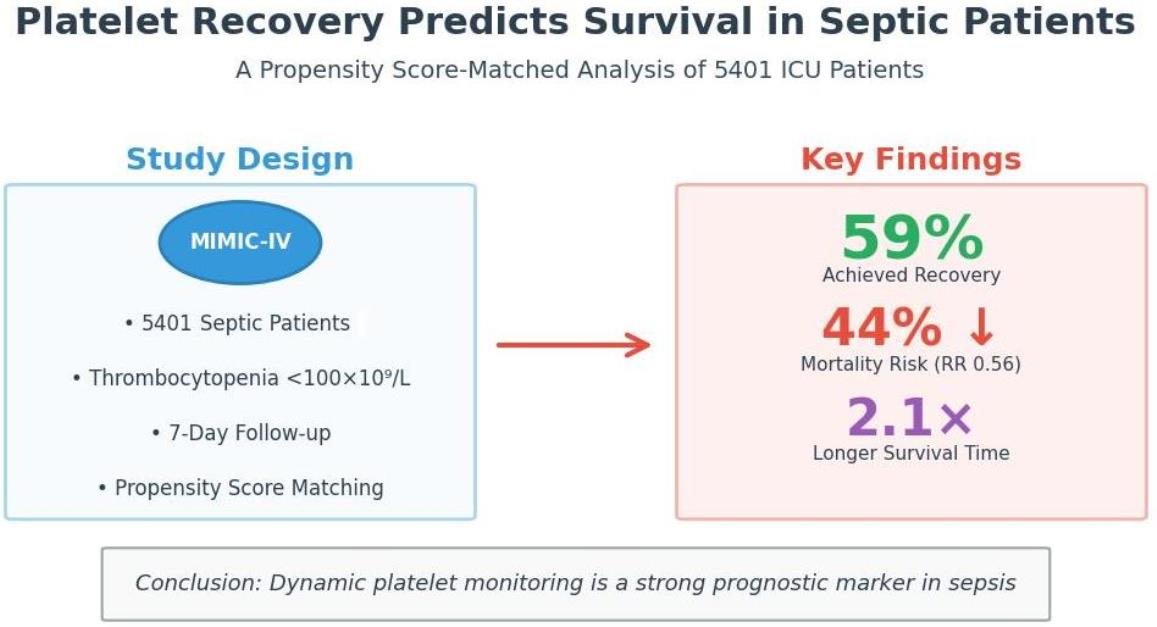
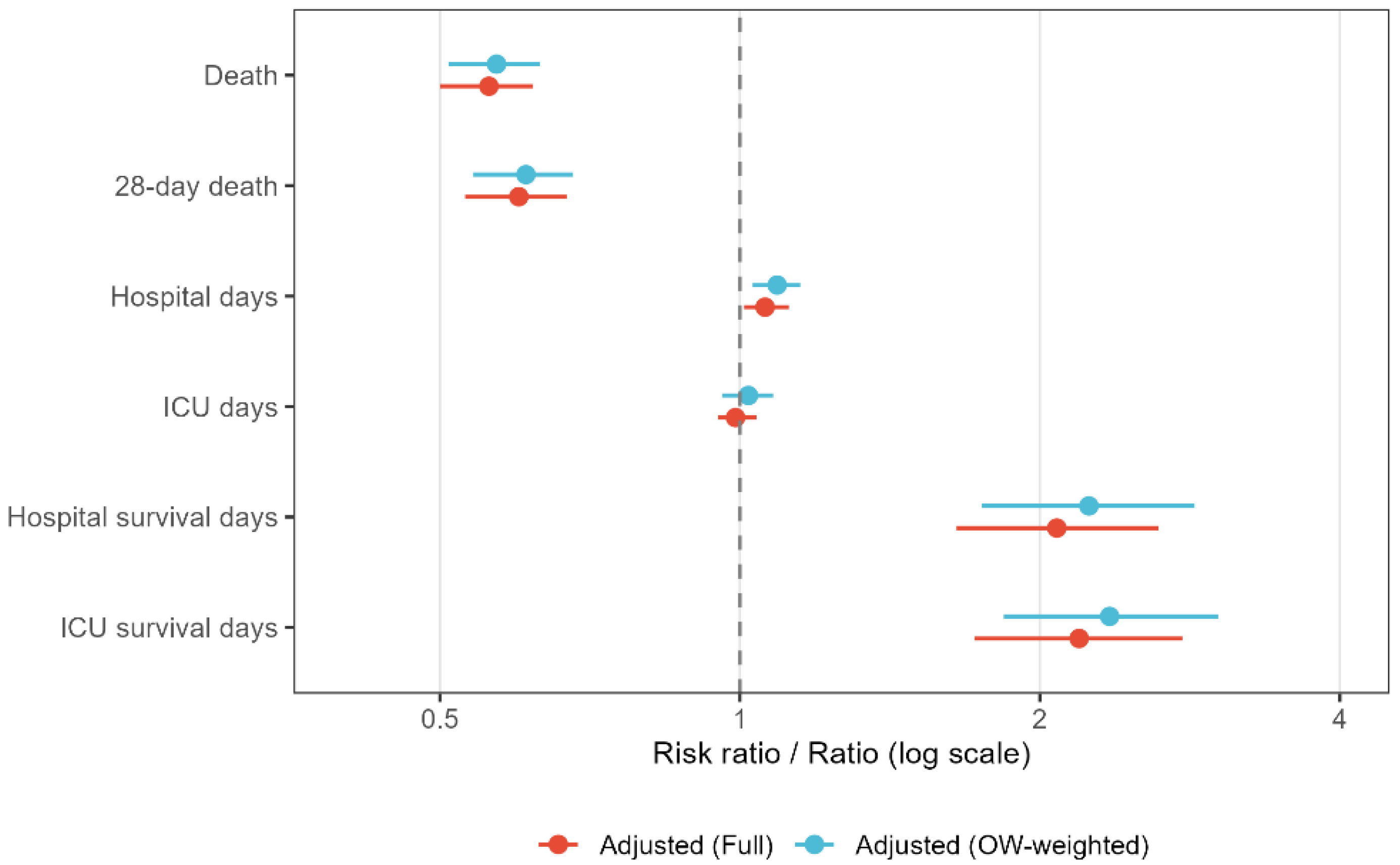
| Death | 0.44 (0.40–0.49, p < 0.001) | 0.56 (0.50–0.62, p < 0.001) | 0.57 (0.51–0.63, p < 0.001) |
| 28-day death (%) | 0.49 (0.44–0.54, p < 0.001) | 0.60 (0.53–0.67, p < 0.001) | 0.61 (0.54–0.68, p < 0.001) |
| Hospital days (median [IQR]) | 0.94 (0.89–0.99, p = 0.030) | 1.06 (1.01–1.12, p = 0.030) | 1.09 (1.03–1.15, p = 0.004) |
| ICU days (median [IQR]) | 0.92 (0.87–0.97, p = 0.002) | 0.99 (0.95–1.04, p = 0.759) | 1.02 (0.96–1.08, p = 0.501) |
| Hospital survival days (median [IQR]) | 2.80 (2.22–3.53, p < 0.001) | 2.08 (1.65–2.63, p < 0.001) | 2.24 (1.75–2.86, p < 0.001) |
| ICU survival days (media [IQR]) | 3.05 (2.41–3.87, p < 0.001) | 2.19 (1.72–2.78, p < 0.001) | 2.35 (1.84–3.02, p < 0.001) |
| Outcome | Time to Recovery | Event Rate/Median [IQR] | Unadjusted RR (95% CI) | p | Adjusted RR/Ratio (95% CI) | p |
|---|---|---|---|---|---|---|
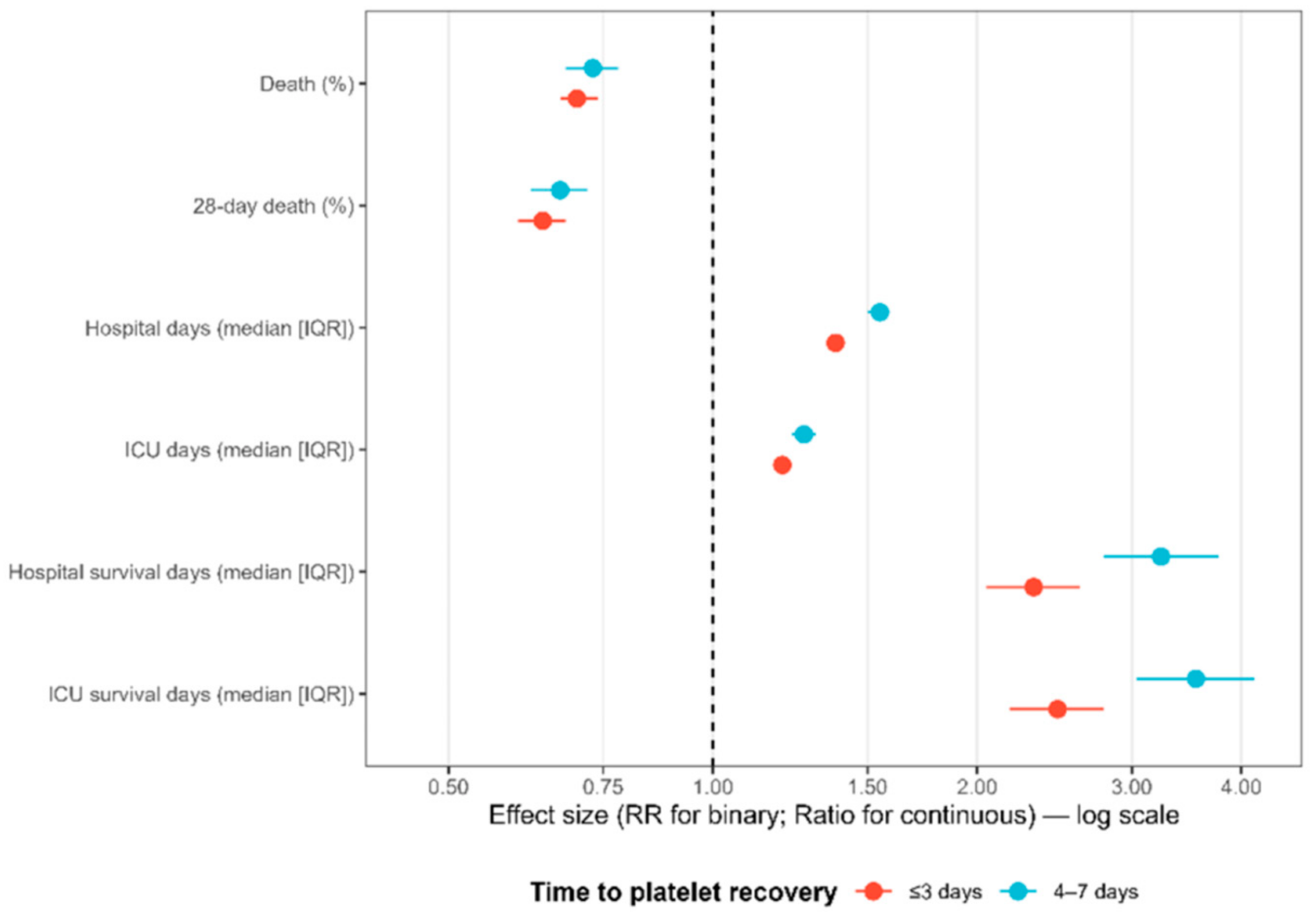
| Death (%) | ≤3 days | 28.8% (916/3184) | 0.88 (0.83–0.93) | <0.001 | 0.70 (0.67–0.74) | <0.001 |
| 4–7 days | 33.2% (534/1608) | 1.02 (0.95–1.09) | 0.592 | 0.73 (0.68–0.78) | <0.001 | |
| 28-day death (%) | ≤3 days | 24.6% (782/3184) | 0.80 (0.75–0.85) | <0.001 | 0.64 (0.60–0.68) | <0.001 |
| 4–7 days | 28.2% (453/1608) | 0.92 (0.85–0.99) | 0.029 | 0.67 (0.62–0.72) | <0.001 | |
| Hospital days (median [IQR]) | ≤3 days | 8.9 [6.1–15.2] | — | — | 1.38 (1.35–1.41) | <0.001 |
| 4–7 days | 11.3 [7.2–18.8] | — | — | 1.55 (1.50–1.59) | <0.001 | |
| ICU days (median [IQR]) | ≤3 days | 2.8 [1.5–5.3] | — | — | 1.20 (1.18–1.23) | <0.001 |
| 4–7 days | 3.2 [1.7–7.3] | — | — | 1.27 (1.23–1.31) | <0.001 | |
| Hospital survival days (median [IQR]) | ≤3 days | 88.5 [21.8–371.0] | — | — | 2.32 (2.05–2.62) | <0.001 |
| 4–7 days | 110.3 [26.3–369.2] | — | — | 3.24 (2.79–3.77) | <0.001 | |
| ICU survival days (media [IQR]) | ≤3 days | 87.6 [19.2–370.9] | — | — | 2.47 (2.18–2.79) | <0.001 |
| 4–7 days | 108.5 [24.3–368.6] | — | — | 3.55 (3.04–4.14) | <0.001 |
| Risk Factor | Category/Unit | Unadjusted OR (95% CI, p) | Adjusted OR (95% CI, p) |
|---|---|---|---|
| Age | 18–39 (ref) | 1.00 | 1.00 |
| 40–64 | — | 0.94 (0.45–1.93, p = 0.864) | |
| ≥65 | — | 0.85 (0.38–1.87, p = 0.690) | |
| Hypertension | No (ref) | 1.00 | 1.00 |
| Yes | 1.40 (1.25–1.57, p < 0.001) | 1.08 (0.76–1.54, p = 0.674) | |
| Hyperlipidemia | No (ref) | 1.00 | 1.00 |
| Yes | 1.83 (1.61–2.07, p < 0.001) | 1.04 (0.72–1.49, p = 0.833) | |
| Chronic renal disease | No (ref) | 1.00 | 1.00 |
| Yes | 1.02 (0.88–1.18, p = 0.796) | 2.44 (1.50–4.02, p < 0.001) | |
| Cirrhosis | No (ref) | 1.00 | 1.00 |
| 1 | 0.25 (0.22–0.28, p < 0.001) | 0.47 (0.31–0.71, p < 0.001) | |
| Immunosuppression | No (ref) | 1.00 | 1.00 |
| 1 | 0.58 (0.51–0.65, p < 0.001) | 1.19 (0.79–1.82, p = 0.412) | |
| BMI (per IQR) | per IQR | 0.98 (0.91–1.06, p = 0.575) | 1.15 (0.98–1.36, p = 0.092) |
| Neutrophils (per IQR) | per IQR | 1.17 (1.05–1.31, p = 0.007) | 0.99 (0.85–1.17, p = 0.916) |
| Baseline platelets (per IQR) | per IQR | 2.12 (1.96–2.29, p < 0.001) | 1.63 (1.34–2.00, p < 0.001) |
| SOFA (per IQR) | per IQR | 0.58 (0.54–0.63, p < 0.001) | 0.63 (0.49–0.81, p < 0.001) |
| Charlson (per IQR) | per IQR | 0.61 (0.57–0.66, p < 0.001) | 0.48 (0.35–0.65, p < 0.001) |
| Glucocorticoids drugs | No (ref) | 1.00 | 1.00 |
| 1 | 0.45 (0.40–0.52, p < 0.001) | 0.62 (0.42–0.91, p = 0.015) | |
| Immunosuppressant drugs | No (ref) | 1.00 | 1.00 |
| 1 | 0.51 (0.41–0.62, p < 0.001) | 0.73 (0.36–1.51, p = 0.399) | |
| Antihypertensive drugs | No (ref) | 1.00 | 1.00 |
| 1 | 1.94 (1.71–2.21, p < 0.001) | 1.51 (1.00–2.28, p = 0.050) | |
| Heparin | No (ref) | 1.00 | 1.00 |
| 1 | 1.73 (1.53–1.97, p < 0.001) | 1.81 (1.17–2.81, p = 0.008) | |
| Platelet aggregation drugs | No (ref) | 1.00 | 1.00 |
| 1 | 3.42 (3.04–3.85, p < 0.001) | 2.69 (1.89–3.83, p < 0.001) | |
| CRRT | No (ref) | 1.00 | 1.00 |
| 1 | 0.50 (0.42–0.59, p < 0.001) | 0.38 (0.25–0.59, p < 0.001) | |
| Invasive ventilation | No (ref) | 1.00 | 1.00 |
| 1 | 1.88 (1.68–2.10, p < 0.001) | 1.41 (0.98–2.03, p = 0.065) |
Disclaimer/Publisher’s Note: The statements, opinions and data contained in all publications are solely those of the individual author(s) and contributor(s) and not of MDPI and/or the editor(s). MDPI and/or the editor(s) disclaim responsibility for any injury to people or property resulting from any ideas, methods, instructions or products referred to in the content. |
© 2026 by the authors. Licensee MDPI, Basel, Switzerland. This article is an open access article distributed under the terms and conditions of the Creative Commons Attribution (CC BY) license.
Share and Cite
Zhou, Y.; Zheng, X.; Zheng, Y.; Yang, Z. Platelet Recovery and Mortality in Septic Patients with Thrombocytopenia: A Propensity Score-Matched Analysis of the MIMIC-IV Database. J. Clin. Med. 2026, 15, 884. https://doi.org/10.3390/jcm15020884
Zhou Y, Zheng X, Zheng Y, Yang Z. Platelet Recovery and Mortality in Septic Patients with Thrombocytopenia: A Propensity Score-Matched Analysis of the MIMIC-IV Database. Journal of Clinical Medicine. 2026; 15(2):884. https://doi.org/10.3390/jcm15020884
Chicago/Turabian StyleZhou, Yi, Xiangtao Zheng, Yanjun Zheng, and Zhitao Yang. 2026. "Platelet Recovery and Mortality in Septic Patients with Thrombocytopenia: A Propensity Score-Matched Analysis of the MIMIC-IV Database" Journal of Clinical Medicine 15, no. 2: 884. https://doi.org/10.3390/jcm15020884
APA StyleZhou, Y., Zheng, X., Zheng, Y., & Yang, Z. (2026). Platelet Recovery and Mortality in Septic Patients with Thrombocytopenia: A Propensity Score-Matched Analysis of the MIMIC-IV Database. Journal of Clinical Medicine, 15(2), 884. https://doi.org/10.3390/jcm15020884