



Evaluation of Muscle Oxygenation Responses to Eccentric Exercise and Recovery Enhancement Using Capacitive–Resistive Electric Transfer and Vibration Therapy

 ,
,  , ,
, ,  , , ,
, , ,  , and
, and
Abstract
1. Introduction
2. Materials and Methods
2.1. Study Participants

| Group 1 | Group 2 | |
|---|---|---|
| Number of subjects (n) | 20 | 21 |
| Male/Female | 3/17 | 4/17 |
| Height (cm) | 168 ± 10 | 167 ± 7 |
| Weight (kg) | 63 ± 14 | 64 ± 12 |
| Age | 19 ± 2 | 19 ± 2 |
2.2. Study Design
2.3. Procedures
2.3.1. Muscle Oxygenation Measurement
Measurement Setup
Arterial Occlusion Protocol
Variables
2.3.2. Fatiguing Eccentric Protocol
2.3.3. VT Intervention
2.3.4. TECAR Intervention
2.3.5. Data Analysis
- -
- Change in hemoglobin level during occlusion (ΔtHb): defined as the difference between the average tHb value in the last five seconds and the first five seconds of the occlusion phase:
- -
- Change in saturation level (ΔSmO2): defined as the difference between the average SmO2 value in the last five seconds and the first five seconds of the occlusion phase:
- -
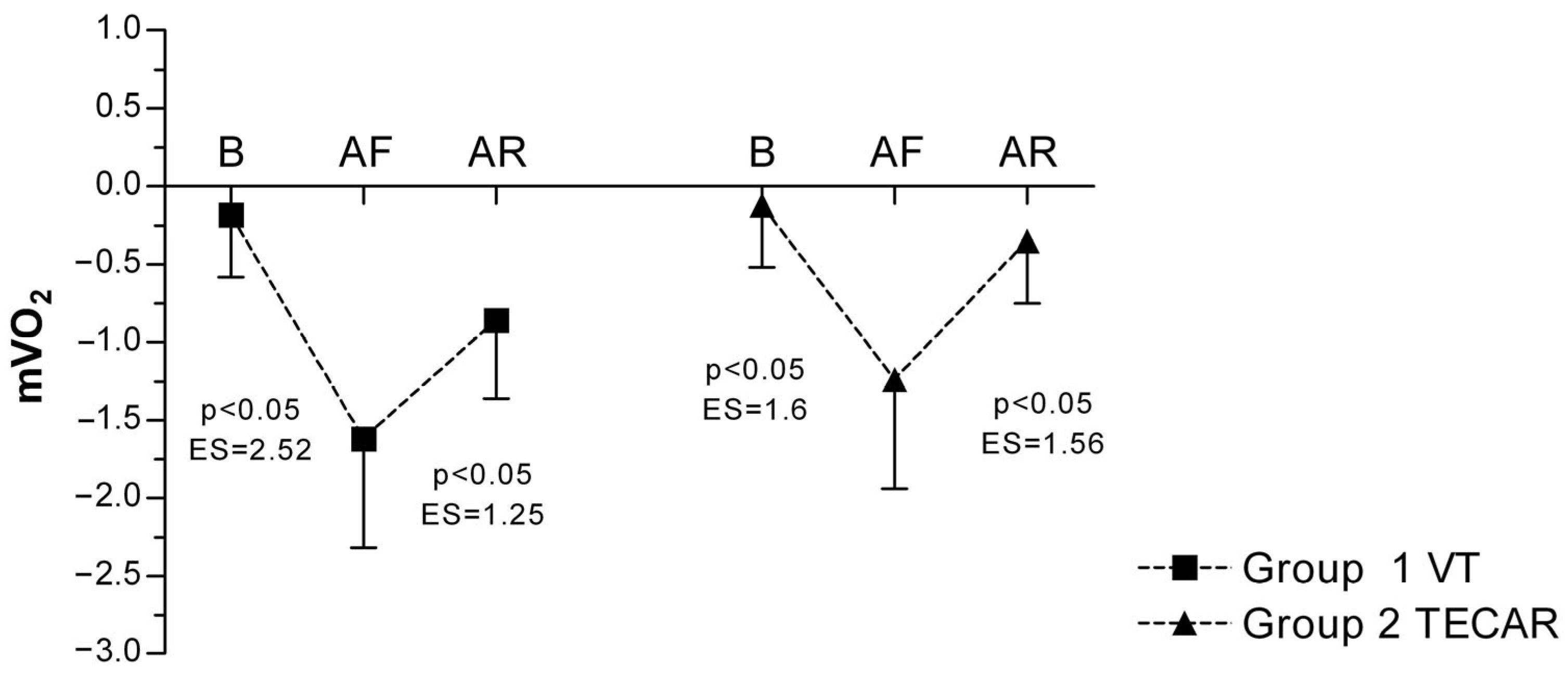
- Muscle oxygen consumption rate (mVO2): calculated based on changes in tHb and SmO2 values during the test, using the following relationship:
2.4. Statistical Analysis
3. Results
3.1. Changes in ΔSmO2 (Change in Oxygen Saturation During Occlusion)
3.2. Changes in ΔtHb (Change in Hemoglobin Level During Occlusion)
3.3. Changes in mVO2 (Muscle Oxygen Consumption)
4. Discussion
5. Conclusions
Author Contributions
Funding
Institutional Review Board Statement
Informed Consent Statement
Data Availability Statement
Conflicts of Interest
References
- Iodice, P.; Ripari, P.; Pezzulo, G. Local high-frequency vibration therapy following eccentric exercises reduces muscle soreness perception and posture alterations in elite athletes. Eur. J. Appl. Physiol. 2019, 119, 539–549. [Google Scholar] [CrossRef]
- Percival, S.; Sims, D.T.; Stebbings, G.K. Local Vibration Therapy, Oxygen Resaturation Rate, and Muscle Strength After Exercise-Induced Muscle Damage. J. Athl. Train. 2022, 57, 502–509. [Google Scholar] [CrossRef]
- Caldwell, J.T.; Wardlow, G.C.; Branch, P.A.; Ramos, M.; Black, C.D.; Ade, C.J. Effect of exercise-induced muscle damage on vascular function and skeletal muscle microvascular deoxygenation. Physiol. Rep. 2016, 4, e13032. [Google Scholar] [CrossRef]
- Minuzzi, L.G.; Ferrauti, A.; Chupel, M.U.; Hacker, S.; Weyh, C.; Valenzuela, P.L.; Lucia, A.; Krüger, K.; Reichel, T. Acute Inflammatory Response to Eccentric Exercise in Young and Master Resistance-trained Athletes. Int. J. Sports Med. 2024, 45, 897–907. [Google Scholar] [CrossRef]
- Marklund, P.; Mattsson, C.M.; Wåhlin-Larsson, B.; Ponsot, E.; Lindvall, B.; Lindvall, L.; Ekblom, B.; Kadi, F. Extensive inflammatory cell infiltration in human skeletal muscle in response to an ultraendurance exercise bout in experienced athletes. J. Appl. Physiol. 2013, 114, 66–72. [Google Scholar] [CrossRef]
- Cullen, M.L.; Casazza, G.A.; Davis, B.A. Passive Recovery Strategies after Exercise: A Narrative Literature Review of the Current Evidence. Curr. Sports Med. Rep. 2021, 20, 351–358. [Google Scholar] [CrossRef]
- Wilcock, I.M.; Cronin, J.B.; Hing, W.A. Physiological response to water immersion: A method for sport recovery? Sports Med. 2006, 36, 747–765. [Google Scholar] [CrossRef] [PubMed]
- Chen, J.; Cogburn, J.; Marcussen, B.; Slayman, T. Optimizing Athletes’ Recovery and Performance: A Review of Vibration Therapy, Compression Garments, and Massage. Curr. Sports Med. Rep. 2025, 24, 177–185. [Google Scholar] [CrossRef] [PubMed]
- Tiidus, P.M. Alternative treatments for muscle injury: Massage, cryotherapy, and hyperbaric oxygen. Curr. Rev. Musculoskelet. Med. 2015, 8, 162–167. [Google Scholar] [CrossRef] [PubMed]
- Duñabeitia, I.; Arrieta, H.; Torres-Unda, J.; Gil, J.; Santos-Concejero, J.; Gil, S.M.; Irazusta, J.; Bidaurrazaga-Letona, I. Effects of a capacitive-resistive electric transfer therapy on physiological and biomechanical parameters in recreational runners: A randomized controlled crossover trial. Phys. Ther. Sport 2018, 32, 227–234. [Google Scholar] [CrossRef]
- Tashiro, Y.; Hasegawa, S.; Yokota, Y.; Nishiguchi, S.; Fukutani, N.; Shirooka, H.; Tasaka, S.; Matsushita, T.; Matsubara, K.; Nakayama, Y.; et al. Effect of Capacitive and Resistive electric transfer on haemoglobin saturation and tissue temperature. Int. J. Hyperth. 2017, 33, 696–702. [Google Scholar] [CrossRef]
- Clijsen, R.; Leoni, D.; Schneebeli, A.; Cescon, C.; Soldini, E.; Li, L.; Barbero, M. Does the Application of Tecar Therapy Affect Temperature and Perfusion of Skin and Muscle Microcirculation? A Pilot Feasibility Study on Healthy Subjects. J. Altern. Complement. Med. 2020, 26, 147–153. [Google Scholar] [CrossRef]
- Szabo, D.A.; Neagu, N.; Teodorescu, S.; Predescu, C.; Sopa, I.S.; Panait, L. TECAR Therapy Associated with High-Intensity Laser Therapy and Manual Therapy in the Treatment of Muscle Disorders: A Literature Review. J. Clin. Med. 2022, 11, 6149. [Google Scholar] [CrossRef]
- Lu, X.; Wang, Y.; Lu, J.; You, Y.; Zhang, L.; Zhu, D.; Yao, F. Does vibration benefit delayed-onset muscle soreness? A meta-analysis and systematic review. J. Int. Med. Res. 2019, 47, 3–18. [Google Scholar] [CrossRef]
- Cochrane, D.J. Effectiveness of using wearable vibration therapy to alleviate muscle soreness. Eur. J. Appl. Physiol. 2017, 117, 501–509. [Google Scholar] [CrossRef] [PubMed]
- Games, K.E.; Sefton, J.M.; Wilson, A.E. Whole-body vibration and blood flow and muscle oxygenation: A meta-analysis. J. Athl. Train. 2015, 50, 542–549. [Google Scholar] [CrossRef] [PubMed]
- Manimmanakorn, N.; Ross, J.J.; Manimmanakorn, A.; Lucas, S.J.; Hamlin, M.J. Effect of whole-body vibration therapy on performance recovery. Int. J. Sports Physiol. Perform. 2015, 10, 388–395. [Google Scholar] [CrossRef] [PubMed]
- Bakhtiary, A.H.; Safavi-Farokhi, Z.; Aminian-Far, A. Influence of vibration on delayed onset of muscle soreness following eccentric exercise. Br. J. Sports Med. 2007, 41, 145–148. [Google Scholar] [CrossRef]
- Jones, S.; D’Silva, A.; Bhuva, A.; Lloyd, G.; Manisty, C.; Moon, J.C.; Sharma, S.; Hughes, A.D. Improved Exercise-Related Skeletal Muscle Oxygen Consumption Following Uptake of Endurance Training Measured Using Near-Infrared Spectroscopy. Front. Physiol. 2017, 8, 1018. [Google Scholar] [CrossRef]
- Grassi, B.; Quaresima, V. Near-infrared spectroscopy and skeletal muscle oxidative function: A review. J. Biomed. Opt. 2016, 21, 091313. [Google Scholar] [CrossRef]
- Ryan, T.E.; Erickson, M.L.; Brizendine, J.T.; Young, H.J.; McCully, K.K. Noninvasive evaluation of skeletal muscle mitochondrial capacity with near-infrared spectroscopy. J. Appl. Physiol. 2012, 113, 175–183. [Google Scholar] [CrossRef]
- Southern, W.M.; Ryan, T.E.; Reynolds, M.A.; McCully, K. Reproducibility of near-infrared spectroscopy measurements of oxidative function. Appl. Physiol. Nutr. Metab. 2014, 39, 521–529. [Google Scholar] [CrossRef] [PubMed]
- Feldmann, A.; Schmitz, R.; Erlacher, D. Reliability and validity of the Moxy Monitor. J. Biomed. Opt. 2019, 24, 115001. [Google Scholar] [CrossRef] [PubMed]
- Crum, E.M.; O’Connor, W.J.; Van Loo, L.; Valckx, M.; Stannard, S.R. Validity and reliability of the Moxy oxygen monitor during incremental cycling exercise. Eur. J. Sport Sci. 2017, 17, 1037–1043. [Google Scholar] [CrossRef]
- Corral-Pérez, J.; Marín-Galindo, A.; Costilla, M.; Casals, C.; Muñoz-López, A.; Sánchez-Sixto, A.; Sañudo, B.; Ponce-González, J.G. Reliability of near-infrared spectroscopy in measuring muscle oxygenation during squat exercise. J. Sci. Med. Sport 2024, 27, 805–813. [Google Scholar] [CrossRef] [PubMed]
- Tan, Q.; Wang, Y.; Li, Z.; Wang, D.; Lam, W.K.; Wong, D.W.; Peng, Y.; Zhang, G.; Zhang, M. Spectral Analysis of Muscle Hemodynamic Responses. Sensors 2021, 21, 3072. [Google Scholar] [CrossRef]
- Gorianovas, G.; Skurvydas, A.; Streckis, V.; Brazaitis, M.; Kamandulis, S.; McHugh, M.P. Repeated bout effect in males of different ages. BioMed Res. Int. 2013, 2013, 218970. [Google Scholar]
- Bonilla, A.A.V.; Timon, R.; Camacho-Cardeñosa, A.; Camacho-Cardeñosa, M.; Guerrero, S.; Olcina, G. Fatigue Increases in Resting Muscle Oxygen Consumption after a Womens Soccer Match. Int. J. Sports Med. 2020, 41, e2–e8. [Google Scholar] [CrossRef]
- Van Beekvelt, M.C.; Colier, W.N.; Wevers, R.A.; Van Engelen, B.G. Performance of near-infrared spectroscopy in skeletal muscle. J. Appl. Physiol. 2001, 90, 511–519. [Google Scholar] [CrossRef]
- Paternoster, F.K.; Seiberl, W. Comparison of Different Approaches Estimating Skeletal Muscle Oxygen Consumption. Appl. Sci. 2022, 12, 2272. [Google Scholar] [CrossRef]
- Lakens, D. Calculating and reporting effect sizes: A practical primer. Front. Psychol. 2013, 4, 863. [Google Scholar] [CrossRef]
- Kerschan-Schindl, K.; Grampp, S.; Henk, C.; Resch, H.; Preisinger, E.; Fialka-Moser, V.; Imhof, H. Whole-body vibration exercise and muscle blood volume. Clin. Physiol. 2001, 21, 377–382. [Google Scholar] [CrossRef]
- Saxena, H.; Ward, K.R.; Krishnan, C.; Epureanu, B.I. Multi-Frequency Whole-Body Vibration and Tissue Oxygenation. IEEE Access 2020, 8, 140445–140455. [Google Scholar] [CrossRef]
- Ohya, T.; Aramaki, Y.; Kitagawa, K. Active vs. Passive Recovery during Intermittent Sprint Cycling. Int. J. Sports Med. 2013, 34, 616–622. [Google Scholar]
- Kriel, Y.; Kerhervé, H.A.; Askew, C.D.; Solomon, C. Active vs. Passive Recovery and Local Tissue Oxygenation. PLoS ONE 2016, 11, e0163733. [Google Scholar]
- Buchheit, M.; Cormie, P.; Abbiss, C.R.; Ahmaidi, S.; Nosaka, K.K.; Laursen, P.B. Muscle Deoxygenation during Repeated Sprint Running. Int. J. Sports Med. 2009, 30, 418–425. [Google Scholar] [CrossRef]
- Soares, R.N.; McLay, K.M.; George, M.A.; Murias, J.M. Differences in oxidative metabolism modulation. Physiol. Rep. 2017, 5, e13384. [Google Scholar] [CrossRef]
- Zorgati, H.; Collomp, K.; Boone, J.; Guimard, A.; Buttelli, O.; Mucci, P. Effect of pedaling cadence on muscle oxygenation. Eur. J. Appl. Physiol. 2015, 115, 2681–2689. [Google Scholar] [CrossRef] [PubMed]
- Nemoto, S.; Nakabo, T.; Tashiro, N.; Kishino, A.; Yoshikawa, A.; Nakamura, D.; Geshi, N. Muscle strength and oxygenation dynamics. Sci. Rep. 2024, 14, 11676. [Google Scholar]
- Yamashita, T.; Fujino, T.; Kosuge, Y.; Miyazawa, S.; Ochi, E. Muscle Oxygenation during Concentric and Eccentric Exercise. J. Physiol. Investig. 2025, 68, 249–255. [Google Scholar] [CrossRef] [PubMed]
- Yamada, E.; Kusaka, T.; Arima, N.; Isobe, K.; Yamamoto, T.; Itoh, S. Muscle oxygenation and EMG during sustained contraction. Clin. Physiol. Funct. Imaging 2008, 28, 216–221. [Google Scholar] [CrossRef] [PubMed]
- Oleksy, Ł.; Mika, A.; Daszkiewicz, M.; Sopa, M.; Szczudło, M.; Kuchciak, M.; Stolarczyk, A.; Adamska, O.; Reichert, P.; Dzięcioł-Anikiej, Z.; et al. Evaluation of TECAR and Vibration Therapy for Muscle Recovery. J. Clin. Med. 2025, 14, 6648. [Google Scholar] [CrossRef] [PubMed]
Disclaimer/Publisher’s Note: The statements, opinions and data contained in all publications are solely those of the individual author(s) and contributor(s) and not of MDPI and/or the editor(s). MDPI and/or the editor(s) disclaim responsibility for any injury to people or property resulting from any ideas, methods, instructions or products referred to in the content. |
© 2026 by the authors. Licensee MDPI, Basel, Switzerland. This article is an open access article distributed under the terms and conditions of the Creative Commons Attribution (CC BY) license.
Share and Cite
Oleksy, Ł.; Mika, A.; Daszkiewicz, M.; Sopa, M.; Szczudło, M.; Kuchciak, M.; Stolarczyk, A.; Adamska, O.; Reichert, P.; Dzięcioł-Anikiej, Z.; et al. Evaluation of Muscle Oxygenation Responses to Eccentric Exercise and Recovery Enhancement Using Capacitive–Resistive Electric Transfer and Vibration Therapy. J. Clin. Med. 2026, 15, 794. https://doi.org/10.3390/jcm15020794
Oleksy Ł, Mika A, Daszkiewicz M, Sopa M, Szczudło M, Kuchciak M, Stolarczyk A, Adamska O, Reichert P, Dzięcioł-Anikiej Z, et al. Evaluation of Muscle Oxygenation Responses to Eccentric Exercise and Recovery Enhancement Using Capacitive–Resistive Electric Transfer and Vibration Therapy. Journal of Clinical Medicine. 2026; 15(2):794. https://doi.org/10.3390/jcm15020794
Chicago/Turabian StyleOleksy, Łukasz, Anna Mika, Maciej Daszkiewicz, Martyna Sopa, Miłosz Szczudło, Maciej Kuchciak, Artur Stolarczyk, Olga Adamska, Paweł Reichert, Zofia Dzięcioł-Anikiej, and et al. 2026. "Evaluation of Muscle Oxygenation Responses to Eccentric Exercise and Recovery Enhancement Using Capacitive–Resistive Electric Transfer and Vibration Therapy" Journal of Clinical Medicine 15, no. 2: 794. https://doi.org/10.3390/jcm15020794
APA StyleOleksy, Ł., Mika, A., Daszkiewicz, M., Sopa, M., Szczudło, M., Kuchciak, M., Stolarczyk, A., Adamska, O., Reichert, P., Dzięcioł-Anikiej, Z., & Kielnar, R. (2026). Evaluation of Muscle Oxygenation Responses to Eccentric Exercise and Recovery Enhancement Using Capacitive–Resistive Electric Transfer and Vibration Therapy. Journal of Clinical Medicine, 15(2), 794. https://doi.org/10.3390/jcm15020794

