Author Contributions
Conceptualization, A.S. and E.F.; methodology, A.S., E.F., N.T. and G.L.N.; software, A.S.; validation, G.L.N. and P.F.F.; formal analysis, A.S. and N.T.; investigation, A.S., E.F. and N.T.; resources, A.S.; data curation, A.S., E.F. and N.T.; writing—original draft preparation, A.S.; writing—review and editing, G.L.N.; visualization, M.L., M.B. and P.F.F.; supervision, M.L., M.B., P.F.F. and P.M.; project administration, A.S.; funding acquisition, P.M. All authors have read and agreed to the published version of the manuscript.
Figure 1.
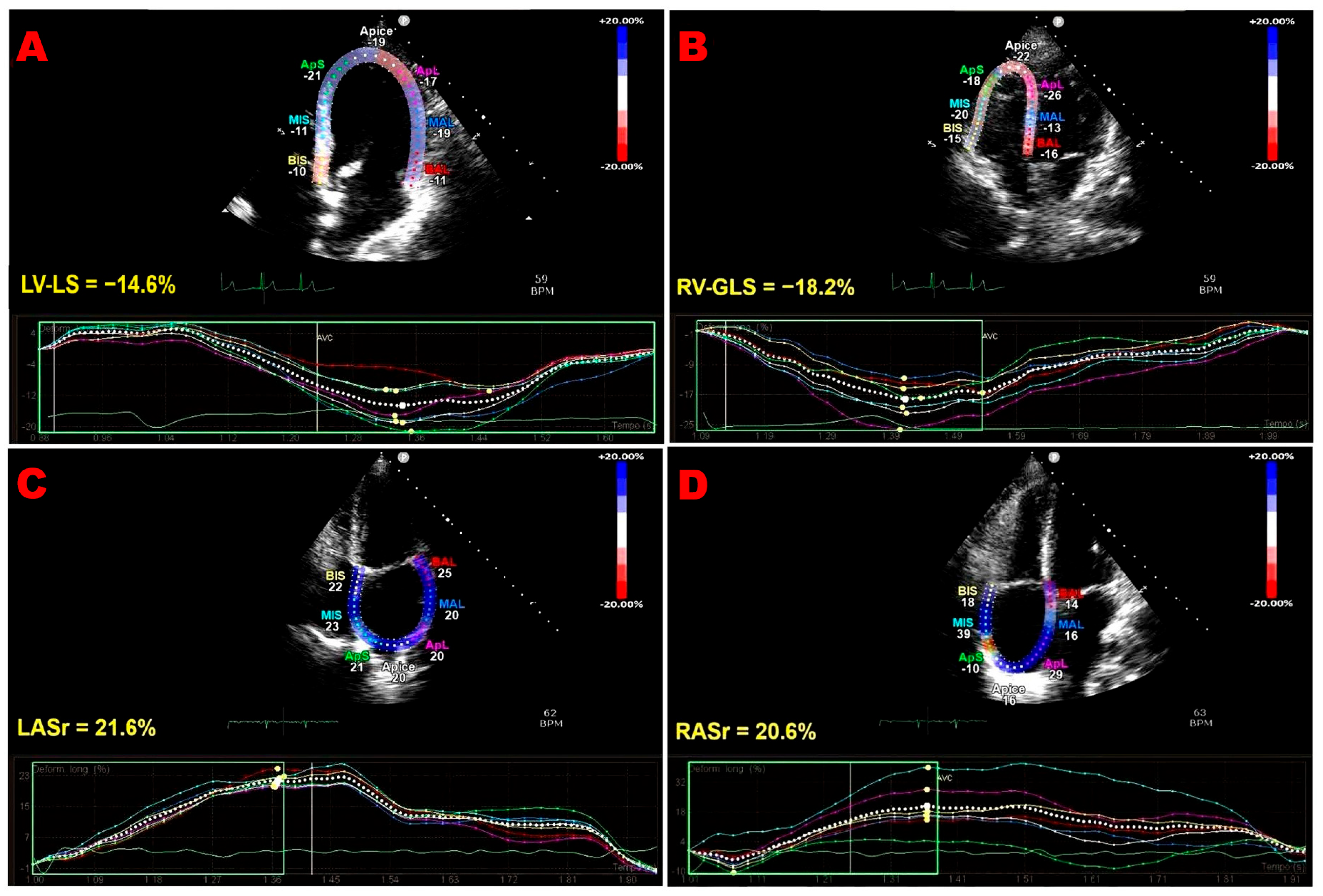
Representative examples of biventricular and biatrial myocardial strain parameters assessed by speckle-tracking echocardiography from the apical four-chamber (4C) view in an ICI-treated patient enrolled in the present study who developed ICI-related cardiac dysfunction. (A) LV-LS, left ventricular longitudinal strain. (B) RV-GLS, right ventricular global longitudinal strain. (C) LASr, left atrial reservoir strain. (D) RASr, right atrial reservoir strain. For each cardiac chamber, color-coded segmental strain maps are provided together with the corresponding strain curves. ICI, immune checkpoint inhibitors.
Figure 1.
Representative examples of biventricular and biatrial myocardial strain parameters assessed by speckle-tracking echocardiography from the apical four-chamber (4C) view in an ICI-treated patient enrolled in the present study who developed ICI-related cardiac dysfunction. (A) LV-LS, left ventricular longitudinal strain. (B) RV-GLS, right ventricular global longitudinal strain. (C) LASr, left atrial reservoir strain. (D) RASr, right atrial reservoir strain. For each cardiac chamber, color-coded segmental strain maps are provided together with the corresponding strain curves. ICI, immune checkpoint inhibitors.
Figure 2.
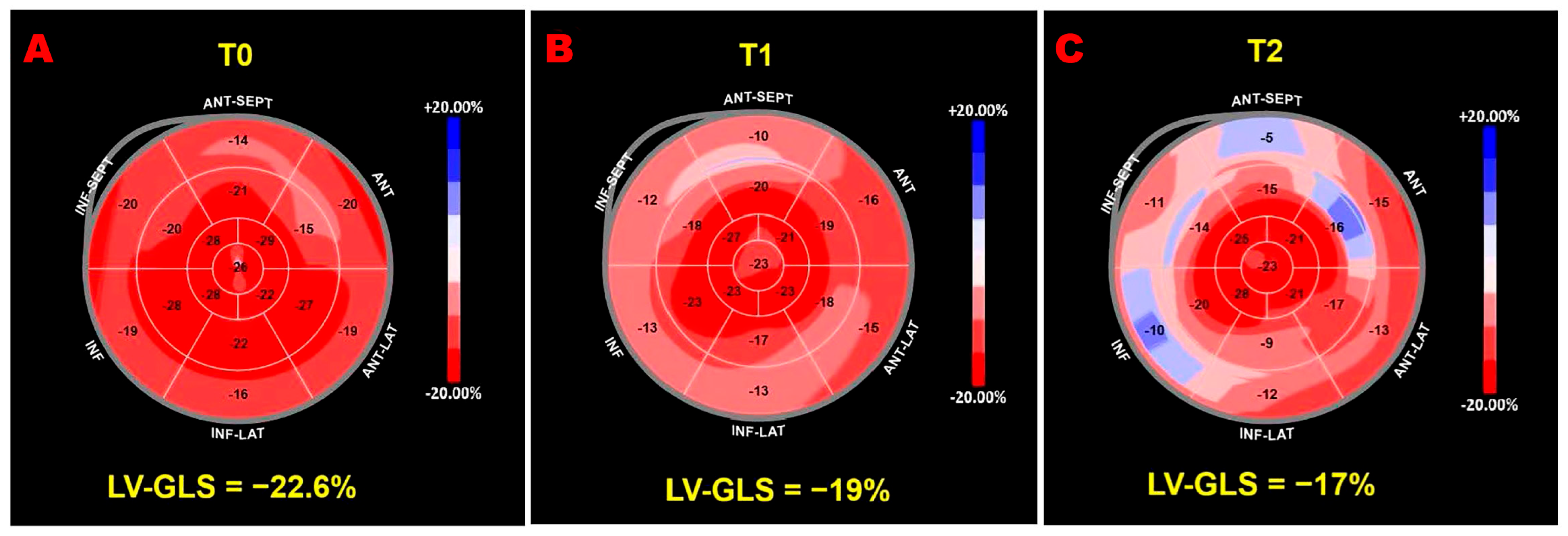
Speckle-tracking echocardiography–derived LV-GLS bull’s-eye plots obtained in a patient enrolled in the present study who developed ICI-related cardiotoxicity. (A) Normal LV-GLS bull’s-eye plot at baseline (T0). (B) Mild impairment of the LV-GLS bull’s-eye plot at the 1-month follow-up (T1). (C) Moderate impairment of the LV-GLS bull’s-eye plot at the 3-month follow-up (T2). ICI, immune checkpoint inhibitors; LV-GLS, left ventricular global longitudinal strain.
Figure 2.
Speckle-tracking echocardiography–derived LV-GLS bull’s-eye plots obtained in a patient enrolled in the present study who developed ICI-related cardiotoxicity. (A) Normal LV-GLS bull’s-eye plot at baseline (T0). (B) Mild impairment of the LV-GLS bull’s-eye plot at the 1-month follow-up (T1). (C) Moderate impairment of the LV-GLS bull’s-eye plot at the 3-month follow-up (T2). ICI, immune checkpoint inhibitors; LV-GLS, left ventricular global longitudinal strain.
Table 1.
Baseline clinical characteristics of ICI-treated patients included in the present study. Continuous variables are expressed as mean ± standard deviation, whereas categorical variables are expressed as number (percentage). ACEi-ARBs, angiotensin-converting enzyme inhibitors/angiotensin receptor blockers; BMI, body mass index; BSA, body surface area; CAD, coronary artery disease; CCB, calcium channel blockers; ICI, immune checkpoint inhibitors.
Table 1.
Baseline clinical characteristics of ICI-treated patients included in the present study. Continuous variables are expressed as mean ± standard deviation, whereas categorical variables are expressed as number (percentage). ACEi-ARBs, angiotensin-converting enzyme inhibitors/angiotensin receptor blockers; BMI, body mass index; BSA, body surface area; CAD, coronary artery disease; CCB, calcium channel blockers; ICI, immune checkpoint inhibitors.
| | ICI-Treated Patients (n = 28) |
|---|
| Demographics and anthropometrics | |
| Age (yrs) | 62.1 ± 16.0 |
| Male sex (%) | 12 (42.8) |
| BSA (m2) | 1.73 ± 0.19 |
| BMI (kg/m2) | 23.0 ± 3.5 |
| Cardiovascular risk factors and cardiovascular comorbidities | |
| Smoking (%) | 9 (32.1) |
| Hypertension (%) | 13 (46.4) |
| Type 2 diabetes (%) | 3 (10.7) |
| Dyslipidemia (%) | 2 (7.1) |
| History of CAD (%) | 2 (7.1) |
| Cancer type | |
| Melanoma (%) | 6 (21.4) |
| Breast (%) | 10 (35.7) |
| Lung (%) | 4 (14.3) |
| Colorectal (%) | 2 (7.1) |
| Kidney (%) | 3 (10.7) |
| Esophagus (%) | 3 (10.7) |
| Metastatic cancer (%) | 14 (50.0) |
| ICI therapy | |
| Pembrolizumab (%) | 18 (64.3) |
| Nivolumab (%) | 9 (32.1) |
| Pembrolizumab plus Relatlimab (%) | 3 (10.7) |
| Durvalumab (%) | 1 (3.6) |
| Co-treatment with antracyclines (%) | 7 (25.0) |
| Neoadjuvant ICI (%) | 7 (25.0) |
| Adjuvant ICI (%) | 7 (25.0) |
| ICI for metastatic cancer (%) | 14 (50.0) |
| Current cardiac treatment | |
| Anticoagulants (%) | 1 (3.6) |
| Antiplatelets (%) | 7 (25.0) |
| ACEi-ARBs (%) | 12 (42.8) |
| Beta blockers (%) | 10 (35.7) |
| Antiarrhythmics (%) | 1 (3.6) |
| CCB (%) | 7 (25.0) |
| Diuretics (%) | 7 (25.0) |
| Statins (%) | 1 (3.6) |
Table 2.
Hemodynamic parameters and laboratory findings at baseline and during follow-up in ICI-treated patients. All variables are expressed as continuous values and were compared across time points using repeated-measures ANOVA; statistically significant p values are shown in bold. DBP, diastolic blood pressure; eGFR, estimated glomerular filtration rate; Hb, hemoglobin; Hs-TnT, high-sensitivity troponin T; ICI, immune checkpoint inhibitors; NLR, neutrophil-to-lymphocyte ratio; NT pro-BNP, N-terminal pro–B-type natriuretic peptide; PCR, C-reactive protein; RDW, red cell distribution width; SBP, systolic blood pressure.
Table 2.
Hemodynamic parameters and laboratory findings at baseline and during follow-up in ICI-treated patients. All variables are expressed as continuous values and were compared across time points using repeated-measures ANOVA; statistically significant p values are shown in bold. DBP, diastolic blood pressure; eGFR, estimated glomerular filtration rate; Hb, hemoglobin; Hs-TnT, high-sensitivity troponin T; ICI, immune checkpoint inhibitors; NLR, neutrophil-to-lymphocyte ratio; NT pro-BNP, N-terminal pro–B-type natriuretic peptide; PCR, C-reactive protein; RDW, red cell distribution width; SBP, systolic blood pressure.
| | T0 | T1 | T2 | p-Value |
|---|
| Hemodynamics | | | | |
| Heart rate (bpm) | 75.1 ± 11.6 | 75.9 ± 11.6 | 76.4 ± 14.7 | 0.96 |
| SBP (mmHg) | 132.4 ± 24.5 | 126.1 ± 20.1 | 125.4 ± 25.1 | 0.74 |
| DBP (mmHg) | 72.7 ± 13.1 | 69.5 ± 6.3 | 68.5 ± 10.9 | 0.61 |
| Blood tests | | | | |
| Hb (g/dL) | 12.7 ± 2.0 | 12.3 ± 1.7 | 12.0 ± 1.8 | 0.76 |
| RDW (%) | 13.8 ± 1.8 | 15.2 ± 2.6 | 16.8 ± 2.9 | 0.002 |
| NLR | 1.8 ± 0.9 | 2.9 ± 1.5 | 4.2 ± 2.4 | <0.001 |
| Creatinine (mg/dL) | 0.75 ± 0.21 | 0.74 ± 0.22 | 0.81 ± 0.25 | 0.65 |
| eGFR (mL/min/m2) | 104.5 ± 13.6 | 103.4 ± 10.5 | 98.4 ± 16.6 | 0.55 |
| PCR (mg/dL) | 4.4 ± 3.5 | 13.9 ± 20.0 | 33.4 ± 44.3 | 0.03 |
| Hs-TnT (ng/L) | 4.2 ± 3.3 | 5.0 ± 3.9 | 5.5 ± 4.0 | 0.68 |
| NT pro-BNP (pg/mL) | 300.6 ± 319.7 | 575.8 ± 1305.8 | 416.3 ± 436.0 | 0.69 |
Table 3.
Conventional echoDoppler parameters at baseline and during follow-up in ICI-treated patients. Continuous variables are expressed as mean ± standard deviation and were compared across time points using repeated-measures ANOVA; categorical variables are expressed as number (percentage). AR, aortic regurgitation; E/A, early-to-late diastolic transmitral flow velocity ratio; e′, early diastolic mitral annular velocity; ICI, immune checkpoint inhibitors; IVS, interventricular septal thickness; LAVi, left atrial volume index; LV, left ventricular; LVEDD, left ventricular end-diastolic diameter; LVEDV, left ventricular end-diastolic volume; LVEF, left ventricular ejection fraction; LVESV, left ventricular end-systolic volume; LVMi, left ventricular mass index; MR, mitral regurgitation; PW, posterior wall thickness; RVIT, right ventricular inflow tract diameter; RWT, relative wall thickness; sPAP, systolic pulmonary artery pressure; TAPSE, tricuspid annular plane systolic excursion; TR, tricuspid regurgitation.
Table 3.
Conventional echoDoppler parameters at baseline and during follow-up in ICI-treated patients. Continuous variables are expressed as mean ± standard deviation and were compared across time points using repeated-measures ANOVA; categorical variables are expressed as number (percentage). AR, aortic regurgitation; E/A, early-to-late diastolic transmitral flow velocity ratio; e′, early diastolic mitral annular velocity; ICI, immune checkpoint inhibitors; IVS, interventricular septal thickness; LAVi, left atrial volume index; LV, left ventricular; LVEDD, left ventricular end-diastolic diameter; LVEDV, left ventricular end-diastolic volume; LVEF, left ventricular ejection fraction; LVESV, left ventricular end-systolic volume; LVMi, left ventricular mass index; MR, mitral regurgitation; PW, posterior wall thickness; RVIT, right ventricular inflow tract diameter; RWT, relative wall thickness; sPAP, systolic pulmonary artery pressure; TAPSE, tricuspid annular plane systolic excursion; TR, tricuspid regurgitation.
| Conventional EchoDoppler Indices | T0 | T1 | T2 | p-Value |
|---|
| IVS (mm) | 11.1 ± 3.0 | 11.3 ± 3.3 | 11.3 ± 3.2 | 0.97 |
| PW (mm) | 8.1 ± 1.5 | 8.1 ± 1.4 | 8.3 ± 1.6 | 0.90 |
| LVEDD (mm) | 45.3 ± 4.8 | 45.2 ± 4.4 | 45.3 ± 4.9 | 0.99 |
| RWT | 0.37 ± 0.07 | 0.36 ± 0.07 | 0.37 ± 0.08 | 0.96 |
| LVMi (g/m2) | 87.3 ± 26.5 | 87.9 ± 31.4 | 91.0 ± 39.4 | 0.93 |
| Normal LV geometric model (%) | 21 (75.0) | 21 (75.0) | 19 (67.8) | 0.13 |
| LV Concentric remodeling (%) | 1 (3.6) | 1 (3.6) | 3 (3.6) | 0.13 |
| LV concentric hypertrophy (%) | 3 (10.7) | 3 (10.7) | 1 (3.6) | 0.13 |
| LV eccentric hypertrophy (%) | 3 (10.7) | 3 (10.7) | 5 (17.8) | 0.13 |
| LVESV (mL) | 67.0 ± 16.7 | 63.6 ± 13.3 | 67.8 ± 16.1 | 0.67 |
| LVEDV (mL) | 23.7 ± 6.6 | 23.7 ± 5.4 | 25.5 ± 8.5 | 0.65 |
| LVEF (%) | 64.5 ± 4.7 | 62.5 ± 4.1 | 62.6 ± 6.6 | 0.42 |
| E/A ratio | 1.0 ± 0.3 | 0.8 ± 0.2 | 0.9 ± 0.3 | 0.23 |
| E/average e’ ratio | 8.5 ± 4.5 | 9.2 ± 3.9 | 10.5 ± 5.0 | 0.38 |
| LAVi (mL/m2) | 32.0 ± 9.5 | 31.2 ± 8.1 | 34.0 ± 9.2 | 0.60 |
| More than mild MR (%) | 6 (21.4) | 6 (21.4) | 8 (28.6) | 0.13 |
| More than mild AR (%) | 0 (0.0) | 0 (0.0) | 1 (3.6) | 0.37 |
| More than mild TR (%) | 0 (0.0) | 1 (3.6) | 1 (3.6) | 0.37 |
| RVIT (mm) | 29.0 ± 3.4 | 28.7 ± 2.9 | 29.7 ± 2.6 | 0.57 |
| TAPSE (mm) | 24.0 ± 3.5 | 22.3 ± 3.5 | 21.8 ± 4.4 | 0.17 |
| sPAP (mmHg) | 26.9 ± 3.4 | 27.6 ± 3.7 | 28.9 ± 3.3 | 0.22 |
Table 4.
Longitudinal changes in myocardial strain and strain rate parameters at baseline and during follow-up in ICI-treated patients. Continuous variables are expressed as mean ± standard deviation and evaluated longitudinally using repeated-measures ANOVA; statistically significant p values are denoted in bold. 2C, two-chamber view; 3C, three-chamber view; 4C, four-chamber view; CS, circumferential strain; CSR, circumferential strain rate; FWLS, free wall longitudinal strain; GLS, global longitudinal strain; GLSR, global longitudinal strain rate; GCS, global circumferential strain; GCSR, global circumferential strain rate; ICI, immune checkpoint inhibitors; LA, left atrial; LAcd, left atrial conduit strain; LAct, left atrial contractile strain; LASr, left atrial reservoir strain; LS, longitudinal strain; LSR, longitudinal strain rate; LV, left ventricular; RA, right atrial; RAcd, right atrial conduit strain; RAct, right atrial contractile strain; RASr, right atrial reservoir strain; RV, right ventricular; STE, speckle-tracking echocardiography.
Table 4.
Longitudinal changes in myocardial strain and strain rate parameters at baseline and during follow-up in ICI-treated patients. Continuous variables are expressed as mean ± standard deviation and evaluated longitudinally using repeated-measures ANOVA; statistically significant p values are denoted in bold. 2C, two-chamber view; 3C, three-chamber view; 4C, four-chamber view; CS, circumferential strain; CSR, circumferential strain rate; FWLS, free wall longitudinal strain; GLS, global longitudinal strain; GLSR, global longitudinal strain rate; GCS, global circumferential strain; GCSR, global circumferential strain rate; ICI, immune checkpoint inhibitors; LA, left atrial; LAcd, left atrial conduit strain; LAct, left atrial contractile strain; LASr, left atrial reservoir strain; LS, longitudinal strain; LSR, longitudinal strain rate; LV, left ventricular; RA, right atrial; RAcd, right atrial conduit strain; RAct, right atrial contractile strain; RASr, right atrial reservoir strain; RV, right ventricular; STE, speckle-tracking echocardiography.
| Myocardial Strain Parameters | T0 | T1 | T2 | p-Value |
|---|
| LS-4C (%) | 20.9 ± 2.3 | 19.4 ± 3.4 | 17.9 ± 3.1 | 0.01 |
| LSR-4C (s−1) | 1.05 ± 0.17 | 1.04 ± 0.21 | 0.89 ± 0.23 | 0.02 |
| LS-2C (%) | 21.2 ± 2.7 | 19.1 ± 3.4 | 17.9 ± 3.0 | 0.01 |
| LSR-2C (s−1) | 1.08 ± 0.17 | 1.05 ± 0.18 | 0.87 ± 0.21 | 0.004 |
| LS-3C (%) | 20.1 ± 3.7 | 17.4 ± 3.1 | 16.5 ± 2.8 | 0.005 |
| LSR-3C (s−1) | 1.13 ± 0.17 | 1.04 ± 0.14 | 0.95 ± 0.14 | 0.004 |
| LV-GLS (%) | 20.7 ± 2.1 | 18.9 ± 3.0 | 17.6 ± 2.7 | 0.002 |
| LV-GLSR (s−1) | 1.08 ± 0.14 | 1.06 ± 0.15 | 0.88 ± 0.20 | 0.001 |
| Basal LV-CS (%) | 18.7 ± 3.5 | 17.6 ± 5.0 | 17.0 ± 4.6 | 0.56 |
| Basal LV-CSR (s−1) | 1.24 ± 0.15 | 1.18 ± 0.27 | 1.11 ± 0.22 | 0.23 |
| Mid LV-CS (%) | 22.7 ± 3.6 | 20.3 ± 5.1 | 20.7 ± 4.9 | 0.31 |
| Mid LV-CSR (s−1) | 1.39 ± 0.17 | 1.35 ± 0.20 | 1.32 ± 0.22 | 0.64 |
| Apical LV-CS (%) | 27.8 ± 5.4 | 25.7 ± 5.6 | 25.2 ± 7.8 | 0.47 |
| Apical LV-CSR (s−1) | 1.82 ± 0.31 | 1.80 ± 0.47 | 1.62 ± 0.49 | 0.31 |
| LV-GCS (%) | 22.8 ± 3.3 | 20.7 ± 4.5 | 20.5 ± 5.3 | 0.29 |
| LV-GCSR (s−1) | 1.46 ± 0.14 | 1.45 ± 0.27 | 1.32 ± 0.21 | 0.13 |
| LAcd strain (%) | 26.1 ± 5.2 | 24.0 ± 5.8 | 20.1 ± 4.2 | 0.005 |
| LAct strain (%) | 9.5 ± 5.5 | 7.3 ± 4.7 | 4.2 ±3.0 | 0.006 |
| LASr (%) | 35.7 ±6.5 | 30.8 ±6.0 | 26.7 ± 5.5 | <0.001 |
| LASr/E/e’ ratio | 5.1 ± 2.7 | 3.7 ± 1.6 | 3.1 ± 1.8 | 0.02 |
| LA-SRs (s−1) | 1.72 ± 0.35 | 1.54 ± 0.37 | 1.22 ± 0.32 | <0.001 |
| LA-SRe (s−1) | 1.94 ± 0.66 | 1.66 ± 0.77 | 1.26 ± 0.61 | 0.02 |
| LA-SRl (s−1) | 2.73 ± 0.62 | 2.51 ± 0.49 | 1.87 ± 0.41 | <0.001 |
| RAcd strain (%) | 31.6 ± 7.7 | 26.7 ± 4.9 | 21.6 ± 6.2 | <0.001 |
| RAct strain (%) | 10.2 ± 5.8 | 8.3 ± 5.8 | 4.3 ± 2.9 | 0.009 |
| RASr (%) | 41.5 ± 9.0 | 34.3 ± 4.9 | 26.4 ± 4.3 | <0.001 |
| RA-SRs (s−1) | 2.01 ± 0.54 | 1.88 ± 0.36 | 1.63 ± 0.35 | 0.04 |
| RA-SRe (s−1) | 1.76 ± 0.34 | 1.60 ± 0.26 | 1.40 ± 0.43 | 0.04 |
| RA-SRl (s−1) | 2.19 ± 0.66 | 2.08 ± 0.47 | 1.68 ± 0.40 | 0.04 |
| RV-GLS (%) | 20.1 ± 3.7 | 19.2 ± 3.3 | 16.6 ± 4.1 | 0.03 |
| RV-GLSR (s−1) | 1.27 ± 0.26 | 1.08 ± 0.14 | 1.01 ± 0.21 | 0.005 |
| RV-FWLS (%) | 21.2 ± 3.7 | 19.2 ± 3.3 | 17.6 ± 4.3 | 0.03 |
| Timing STE (min) | 8.9 ± 1.4 | 8.4 ± 1.4 | 8.1 ± 1.5 | 0.29 |
Table 5.
Logistic regression analysis (Model 1) evaluating baseline demographic and anthropometric predictors of LV-GLS impairment. Statistically significant p values are highlighted in bold. OR, odds ratio; CI, confidence interval; BMI, body mass index; LV-GLS, left ventricular global longitudinal strain.
Table 5.
Logistic regression analysis (Model 1) evaluating baseline demographic and anthropometric predictors of LV-GLS impairment. Statistically significant p values are highlighted in bold. OR, odds ratio; CI, confidence interval; BMI, body mass index; LV-GLS, left ventricular global longitudinal strain.
| Model 1 | Logistic Regression Analysis |
|---|
| OR (95% CI) | p-Value |
|---|
| Age (yrs) | 1.72 (1.00–2.93) | 0.04 |
| Male sex | 2.54 (0.23–28.0) | 0.45 |
| Basal BMI (Kg/m2) | 1.13 (0.83–1.56) | 0.43 |
Table 6.
Logistic regression analysis (Model 2) evaluating 3-month follow-up variables associated with LV-GLS impairment. Statistically significant p values are reported in bold type. OR, odds ratio; CI, confidence interval; LV-GLS, left ventricular global longitudinal strain; NLR, neutrophil-to-lymphocyte ratio; SBP, systolic blood pressure; T2, 3-month follow-up.
Table 6.
Logistic regression analysis (Model 2) evaluating 3-month follow-up variables associated with LV-GLS impairment. Statistically significant p values are reported in bold type. OR, odds ratio; CI, confidence interval; LV-GLS, left ventricular global longitudinal strain; NLR, neutrophil-to-lymphocyte ratio; SBP, systolic blood pressure; T2, 3-month follow-up.
| Model 2 | Logistic Regression Analysis |
|---|
| OR (95% CI) | p-Value |
|---|
| T2-SBP (mmHg) | 1.05 (0.98–1.12) | 0.17 |
| T2-NLR | 1.94 (1.25–3.01) | 0.003 |
| Pembrolizumab therapy | 3.00 (0.34–26.2) | 0.32 |
Table 7.
Cox proportional hazards regression analysis (Model 1) evaluating baseline demographic variables and baseline left ventricular myocardial deformation as predictors of adverse clinical outcomes. Significant p values are shown in bold. HR, hazard ratio; CI, confidence interval; LV-GLS, left ventricular global longitudinal strain; T0, baseline.
Table 7.
Cox proportional hazards regression analysis (Model 1) evaluating baseline demographic variables and baseline left ventricular myocardial deformation as predictors of adverse clinical outcomes. Significant p values are shown in bold. HR, hazard ratio; CI, confidence interval; LV-GLS, left ventricular global longitudinal strain; T0, baseline.
| Model 1 | Univariate Cox Regression Analysis | Multivariate Cox Regression Analysis |
|---|
| HR (95% CI) | p-Value | HR (95% CI) | p-Value |
|---|
| Age (yrs) | 1.11 (1.04–1.18) | <0.001 | 1.08 (1.01–1.16) | 0.03 |
| T0-LV-GLS | 0.41 (0.27–0.62) | <0.001 | 0.43 (0.26–0.71) | <0.001 |
Table 8.
Cox proportional hazards regression analysis (Model 2) evaluating baseline systemic inflammatory status as a predictor of adverse clinical outcomes. p values in bold denote statistical significance. HR, hazard ratio; CI, confidence interval; NLR, neutrophil-to-lymphocyte ratio; T0, baseline.
Table 8.
Cox proportional hazards regression analysis (Model 2) evaluating baseline systemic inflammatory status as a predictor of adverse clinical outcomes. p values in bold denote statistical significance. HR, hazard ratio; CI, confidence interval; NLR, neutrophil-to-lymphocyte ratio; T0, baseline.
| Model 2 | Univariate Cox Regression Analysis | Multivariate Cox Regression Analysis |
|---|
| HR (95% CI) | p-Value | HR (95% CI) | p-Value |
|---|
| Age (yrs) | 1.11 (1.04–1.18) | <0.001 | 1.09 (1.01–1.17) | 0.02 |
| T0-NLR | 1.54 (1.21–1.96) | <0.001 | 1.15 (0.84–1.58) | 0.37 |
Table 9.
Univariate Cox proportional hazards regression analysis (Model 3) evaluating age and metastatic cancer status as predictors of adverse clinical outcomes in patients undergoing immune checkpoint inhibitor therapy. Hazard ratios (HRs) are reported with corresponding 95% confidence intervals (CIs). Statistically significant p values are shown in bold.
Table 9.
Univariate Cox proportional hazards regression analysis (Model 3) evaluating age and metastatic cancer status as predictors of adverse clinical outcomes in patients undergoing immune checkpoint inhibitor therapy. Hazard ratios (HRs) are reported with corresponding 95% confidence intervals (CIs). Statistically significant p values are shown in bold.
| Model 3 | Univariate Cox Regression Analysis |
|---|
| HR (95% CI) | p-Value |
|---|
| Age (yrs) | 1.11 (1.04–1.18) | <0.001 |
| Metastatic cancer | 1.31 (0.47–3.60) | 0.61 |





 ,
,