


The Validation and Cross-Cultural Adaptation of the Arabic Version of the Polycystic Ovary Syndrome Quality of Life Scale (PCOSQOL)



Abstract
1. Introduction
2. Materials and Methods
2.1. Study Design
2.2. Target Population
2.3. Sample Size with Sample Size Calculation/Sampling Technique
2.4. Subject Recruitment Procedures
2.5. Study Subject Selection
2.6. Study Setting
2.7. Data Collection Tool
2.8. Study Variables
2.9. Study Procedure
- Forward translation: Two independent bilingual translators translated the original English PCOSQOL into Arabic, ensuring that medical and cultural contexts are considered.
- Expert panel and back-translation: Two other bilingual experts back-translated the Arabic version into English to ensure accuracy and cultural appropriateness. After forward translation, a panel of five experts (two family physicians, two gynecologists and obstetricians, and a medical researcher with experience in questionnaire translation) revised it and compared it to the original English version. All are bilingual. Discrepancies between the original English version and the back-translated versions were discussed and resolved in a consensus meeting involving all translators.
- Pre-testing and cognitive interviewing: The Arabic PCOSQOL was administered to a small group (20–30 participants) of women with PCOS, and feedback on clarity, cultural relevance, and any difficulties encountered was collected. Based on feedback, all necessary questionnaire modifications were made. These responses were not included in further analyses.
- Final version: The Arabic version was subjected to validity and reliability testing. The tool was distributed to the target participants, where they completed the Arabic PCOSQOL, along with demographics and the required clinical information.
2.10. Confidentiality and Ethical Consideration
2.11. Statistical Analysis
3. Results
3.1. Overall Sample Characteristics
3.2. PCOSQOL Score Overview
3.3. Psychometric Properties
3.3.1. Internal Consistency Reliability
3.3.2. Construct Validity
3.3.3. Test–Retest Reliability
3.4. Group Comparisons
3.4.1. Hirsutism
3.4.2. Infertility
3.4.3. Mood
3.4.4. Impact of PCOS
4. Discussion
4.1. Psychometrics
4.2. Cultural and Psychosocial Interpretation
4.3. Limitations
4.4. Implications and Future Directions
5. Conclusions
Author Contributions
Funding
Institutional Review Board Statement
Informed Consent Statement
Data Availability Statement
Conflicts of Interest
Abbreviations
| PCOS | Polycystic Ovary Syndrome |
| PCOSQOL | Polycystic Ovary Syndrome Quality of Life |
| QoL | Quality of Life |
| EFA | Exploratory factor analysis |
| ICC | Intraclass correlation coefficient |
| NIH | National Institute of Health |
| SPSS | Statistical package for the social science |
| KMO | Kaiser–Meyer–Olkin |
| HRQoL | Health-related quality of life |
| WHO | World Health Organization |
| IRB | Institutional Review Board |
| PROMs | Patient-reported outcome measures |
References
- Rotterdam ESHRE/ASRM-Sponsored PCOS Consensus Workshop Group. Revised 2003 consensus on diagnostic criteria and long-term health risks related to polycystic ovary syndrome (PCOS). In Proceedings of the ESHRE/ASRM-Sponsored PCOS Consensus Workshop Group Meeting, Rotterdam, The Netherlands, 1–3 May 2003. [Google Scholar] [CrossRef]
- Aldossary, K.; Alotaibi, A.; Alkhaldi, K.; Alharbi, R. Prevalence of polycystic ovary syndrome, and relationship with obesity/overweight: Cross-sectional study in Saudi Arabia. J. Adv. Pharm. Educ. Res. 2020, 10, 186–190. [Google Scholar]
- Himelein, M.J.; Thatcher, S.S. Depression and body image among women with polycystic ovary syndrome. J. Health Psychol. 2006, 11, 613–625. [Google Scholar] [CrossRef]
- Teede, H.J.; Tay, C.T.; Laven, J.J.E.; Dokras, A.; Moran, L.J.; Piltonen, T.T.; Costello, M.F.; Boivin, J.; Redman, L.M.; Boyle, J.A.; et al. Recommendations from the 2023 International Evidence-based Guideline for the Assessment and Management of Polycystic Ovary Syndrome. J. Clin. Endocrinol. Metab. 2023, 108, 2447–2469. [Google Scholar] [CrossRef]
- Cronin, L.; Guyatt, G.; Griffith, L.; Wong, E.; Azziz, R.; Futterweit, W.; Cook, D.; Dunaif, A. Development of a health-related quality-of-life questionnaire (PCOSQ) for women with polycystic ovary syndrome (PCOS). J. Clin. Endocrinol. Metab. 1998, 83, 1976–1987. [Google Scholar] [CrossRef] [PubMed]
- Barnard, L.; Ferriday, D.; Guenther, N.; Strauss, B.; Balen, A.H.; Dye, L. Quality of life and psychological well being in polycystic ovary syndrome. Hum. Reprod. 2007, 22, 2279–2286. [Google Scholar] [CrossRef]
- AlAhmari, L.S.M.; Alzahrani, H.S.; Alzahrani, N.; AlDhafyan, S.O.; Al-Qahtani, R.H.; Al-Zaid, J.A.; AlShahrani, M.S.; Al-Ghamdi, L.A. Measures of health-related quality of life in PCOS women: A cross sectional study from Saudi Arabia. Eur. Rev. Med. Pharmacol. Sci. 2024, 28, 1913–1919. [Google Scholar] [CrossRef]
- Alghadeer, S.; Algarawi, A.; Abu-Rkybah, F.; Alshebly, M.M.; Alruthia, Y. The translation and validation of the Arabic Version of the Polycystic Ovary Syndrome Health-Related Quality of Life Questionnaire (AR-PCOSQ). BMC Womens Health 2020, 20, 244. [Google Scholar] [CrossRef]
- Williams, S.; Sheffield, D.; Knibb, R.C. The Polycystic Ovary Syndrome Quality of Life scale (PCOSQOL): Development and preliminary validation. Health Psychol. Open 2018, 5, 2055102918788195. [Google Scholar] [CrossRef] [PubMed]
- Younan, L.; Clinton, M.; Fares, S.; Samaha, H. The translation and cultural adaptation validity of the actual scope of practice questionnaire. East. Mediterr. Health 2019, 25, 181–188. [Google Scholar] [CrossRef] [PubMed]
- Koo, T.K.; Li, M.Y. A Guideline of Selecting and Reporting Intraclass Correlation Coefficients for Reliability Research. J. Chiropr. Med. 2016, 15, 155–163. [Google Scholar] [CrossRef]
- Odhaib, S.A.; Amiri, F.N.; Altemimi, M.T.; Imran, H.J.; Alidrisi, H.A.; Mohammed, M.J.; Mansour, A.A. Development of the First Health-Related Quality of Life Questionnaires in Arabic for Women with Polycystic Ovary Syndrome (Part I): The Creation and Reliability Analysis of PCOSQoL-47 and PCOSQoL-42 Questionnaires. Cureus 2021, 13, e14735. [Google Scholar] [CrossRef]
- Odhaib, S.A.; Amiri, F.N.; Altemimi, M.T.; Imran, H.J.; Alidrisi, H.A.; Mohammed, M.J.; Mansour, A.A. Development of the First Health-Related Quality of Life Questionnaires in Arabic for Women with Polycystic Ovary Syndrome (Part II): Dual-Center Validation of PCOSQoL-47 and PCOSQoL-42 Questionnaires. Cureus 2021, 13, e18060. [Google Scholar] [CrossRef] [PubMed]
- Odhaib, S.A.; Altemimi, M.T.; Imran, H.J. Development of the First Health-Related Quality of Life Questionnaires in Arabic for Women with Polycystic Ovary Syndrome (Part III): Scoring System Interpretation. Cureus 2022, 14, e32166. [Google Scholar] [CrossRef]
- Lin, C.Y.; Ou, H.T.; Wu, M.H.; Chen, P.C. Validation of Chinese Version of Polycystic Ovary Syndrome Health-Related Quality of Life Questionnaire (Chi-PCOSQ). PLoS ONE 2016, 11, e0154343. [Google Scholar] [CrossRef]
- Oh, J.; Kim, J.H. Validity and Reliability of a Korean version of Polycystic Ovary Syndrome Questionnaire. Korean J. Women Health Nurs. 2014, 20, 255–265. [Google Scholar] [CrossRef] [PubMed]
- Jedel, E.; Kowalski, J.; Stener-Victorin, E. Assessment of health-related quality of life: Swedish version of polycystic ovary syndrome questionnaire. Acta Obstet. Gynecol. Scand. 2008, 87, 1329–1335. [Google Scholar] [CrossRef] [PubMed]
- Ncube, N. Validation of the Polycystic Ovary Syndrome Health-Related Quality of Life Questionnaire (PCOSQ) in the Clinical Community in Our Gynaecological Endocrine Clinic. Master’s Thesis, University of Cape Town, Cape Town, South Africa, 2016. [Google Scholar]
- Jones, G.L.; Benes, K.; Clark, T.L.; Denham, R.; Holder, M.G.; Haynes, T.J.; Mulgrew, N.C.; Shepherd, K.E.; Wilkinson, V.H.; Singh, M.; et al. The Polycystic Ovary Syndrome Health-Related Quality of Life Questionnaire (PCOSQ): A validation. Hum. Reprod. 2004, 19, 371–377. [Google Scholar] [CrossRef]
- Luo, Y.Y.; Xu, X.L.; Li, X.B. Psychometric properties of the Chinese version of the modified polycystic ovary syndrome health-related quality-of-life questionnaire. Health Qual. Life Outcomes 2020, 18, 131. [Google Scholar] [CrossRef]
- Zaman, R.; Ehsan, S.; Fatima, A.; Obaid, S.; Shahzadi, J. Translation and psychometric analysis of urdu version of modified polycystic ovary syndrome health related quality of life questionnaire (MPCOSQ-U). BMC Womens Health 2024, 24, 413. [Google Scholar] [CrossRef]
- Jiskoot, G.; Somers, S.; De Roo, C.; Stoop, D.; Laven, J. Translation of the Modified Polycystic Ovary Syndrome Questionnaire (mPCOSQ) and the Polycystic Ovary Syndrome Quality of Life Tool (PCOSQOL) in Dutch and Flemish Women with PCOS. J. Clin. Med. 2023, 12, 3927. [Google Scholar] [CrossRef]
- Fauser, B.C.; Tarlatzis, B.C.; Rebar, R.W.; Legro, R.S.; Balen, A.H.; Lobo, R.; Carmina, E.; Chang, J.; Yildiz, B.O.; Laven, J.S.; et al. Consensus on women’s health aspects of polycystic ovary syndrome (PCOS): The Amsterdam ESHRE/ASRM-Sponsored 3rd PCOS Consensus Workshop Group. Fertil. Steril. 2012, 97, 28–38.e25. [Google Scholar] [CrossRef] [PubMed]
- Ghayur, M.S.; Kareem, R.; Wahab, S.; Inayat, S.; Karim, R.; Sethi, M.R.; Malik, N.N.; Irfan, M. Translation, Cross-Cultural Adaptation and Validation of Polycystic Ovarian Syndrome Quality of Life Scale in Pashto. J. Ayub Med. Coll. Abbottabad 2022, 34, 823–829. [Google Scholar] [CrossRef] [PubMed]
- Mahey, R.; Satapathy, S.; Haldar, P.; Kumari, S.; Gupta, M.; Jayraj, A.K.; Kumari, A.; Cheluvaraju, R.; Ramappa, R.; Negi, A. Translation, Cross-cultural Adaptation and Validation of Hindi Version of Polycystic Ovary Syndrome-quality of Life Scale (PCOSQOL-I)—A Cross-sectional study. J. Hum. Reprod. Sci. 2025, 18, 96–104. [Google Scholar] [CrossRef] [PubMed]
- ALSumri, H.; Szatkowski, L.; Gibson, J.; Fiaschi, L.; Bains, M. Psychosocial Impacts of Infertility among Omani Women with Polycystic Ovarian Syndrome: A Qualitative Study. Int. J. Fertil. Steril. 2023, 17, 107–114. [Google Scholar] [CrossRef]
- Alkheyr, Z.; Murad, M.; Das, P.; Aljenaee, K.; Kamel, C.; Hajji, S.A.; Flood, J.; Atkin, S.L.; Ali, K.F. Self-esteem and body image satisfaction in women with PCOS in the Middle East: Cross-sectional social media study. PLoS ONE 2024, 19, e0301707. [Google Scholar] [CrossRef]

| Item | Total Participants (n = 207) |
|---|---|
| Age (years) | 27.32 ± 6.86 |
| Educational level | |
| High school or less | 43 (20.8%) |
| Bachelor’s degree | 138 (66.7%) |
| Master’s degree or above | 9 (4.3%) |
| Vocational/Technical Institute/Diploma | 17 (8.2%) |
| Marital status | |
| Single | 134 (64.7%) |
| Married | 65 (31.4%) |
| Divorced/widowed | 8 (3.9%) |
| Residence | |
| Eastern region | 9 (4.3%) |
| Western region | 9 (4.3%) |
| Northern region | 4 (1.9%) |
| Southern region | 5 (2.4%) |
| Central region | 180 (87%) |
| Income (SAR) | |
| <5000 | 92 (44.4%) |
| 5000–9999 | 52 (25.1%) |
| 10,000–19,999 | 45 (21.7%) |
| ≥20,000 | 18 (8.7%) |
| Employment status | |
| Student | 71 (34.3%) |
| Unemployed | 54 (26.1%) |
| Employed | 80 (38.6%) |
| Retired | 2 (1%) |
| Having children | 53 (25.6%) |
| Item | Usually (1) | Often (2) | Sometimes (3) | Occasionally (4) | Rarely (5) | Not at All (6) | Does Not Apply (7) |
|---|---|---|---|---|---|---|---|
| During the last four weeks, how often have you: | |||||||
| Hirsutism | |||||||
| Been worried about other people seeing your facial hair | 69 (33.3%) | 25 (12.1%) | 25 (12.1%) | 19 (9.2%) | 15 (7.2%) | 33 (15.9%) | 21 (10.1%) |
| Felt moody because of your excess hair | 53 (25.6%) | 19 (9.2%) | 27 (13%) | 16 (7.7%) | 27 (13%) | 41 (19.8%) | 24 (11.6%) |
| Felt depressed because of your hirsutism | 37 (17.9%) | 15 (7.2%) | 21 (10.1%) | 13 (6.3%) | 36 (17.4%) | 53 (25.6%) | 32 (15.5%) |
| Spent a lot of time and energy removing excess hair | 57 (27.5%) | 31 (15%) | 16 (7.7%) | 19 (9.2%) | 17 (8.2%) | 45 (21.7%) | 22 (10.6%) |
| Felt depressed because of your facial hair | 36 (17.4%) | 18 (8.7%) | 16 (7.7%) | 10 (4.8%) | 24 (11.6%) | 68 (32.9%) | 35 (16.9%) |
| Felt embarrassed by your facial hair | 62 (30%) | 20 (9.7%) | 19 (9.2%) | 10 (4.8%) | 17 (8.2%) | 51 (24.6%) | 28 (13.5%) |
| Score | 23.43 ± 11.65 | ||||||
| Infertility | |||||||
| Felt under pressure to have a child | 21 (10.1%) | 6 (2.9%) | 12 (5.8%) | 11 (5.3%) | 10 (4.8%) | 36 (17.4%) | 111 (53.6%) |
| Felt anxious about conceiving a child | 41 (19.8%) | 12 (5.8%) | 29 (14%) | 20 (9.7%) | 18 (8.7%) | 35 (16.9%) | 52 (25.1%) |
| Felt depressed over difficulties conceiving a child | 19 (9.2%) | 6 (2.9%) | 13 (6.3%) | 9 (4.3%) | 13 (6.3%) | 43 (20.8%) | 104 (50.2%) |
| Felt depressed because of your infertility | 15 (7.2%) | 5 (2.4%) | 9 (4.3%) | 3 (1.4%) | 16 (7.7%) | 36 (17.4%) | 123 (59.4%) |
| Felt depressed over your struggle to have children | 21 (10.1%) | 5 (2.4%) | 9 (4.3%) | 3 (1.4%) | 13 (6.3%) | 40 (19.3%) | 116 (56%) |
| Felt like a failure because of your trouble conceiving | 16 (7.7%) | 5 (2.4%) | 9 (4.3%) | 4 (1.9%) | 15 (7.2%) | 37 (17.9%) | 121 (58.5%) |
| Been scared that you may not have children | 38 (18.4%) | 15 (7.2%) | 25 (12.1%) | 22 (10.6%) | 20 (9.7%) | 40 (19.3%) | 47 (22.7%) |
| Score | 37.34 ± 12 | ||||||
| Mood | |||||||
| Felt guilty for being overly aggressive towards a friend or family member | 40 (19.3%) | 17 (8.2%) | 32 (15.5%) | 26 (12.6%) | 21 (10.1%) | 50 (24.2%) | 21 (10.1%) |
| Overreacted to a day-to-day occurrence because of PCOS | 44 (21.3%) | 31 (15%) | 46 (22.2%) | 22 (10.6%) | 21 (10.1%) | 30 (14.5%) | 13 (6.3%) |
| Felt overwhelmed by your PCOS and depression | 56 (27.1%) | 27 (13%) | 38 (18.4%) | 20 (9.7%) | 19 (9.2%) | 31 (15%) | 16 (7.7%) |
| Had a short temper with your close friends and/or family | 57 (27.5%) | 25 (12.1%) | 40 (19.3%) | 28 (13.5%) | 18 (8.7%) | 29 (14%) | 10 (4.8%) |
| Felt like crying for no reason | 88 (42.5%) | 27 (13%) | 36 (17.4%) | 23 (11.1%) | 12 (5.8%) | 16 (7.7%) | 5 (2.4%) |
| Felt depressed | 52 (25.1%) | 22 (10.6%) | 36 (17.4%) | 26 (12.6%) | 26 (12.6%) | 31 (15%) | 14 (6.8%) |
| Score | 20.09 ± 9.06 | ||||||
| Impact of PCOS | |||||||
| Felt like you weren’t a real woman because of your PCOS | 14 (6.8%) | 15 (7.2%) | 24 (11.6%) | 8 (3.9%) | 26 (12.6%) | 87 (42%) | 33 (15.9%) |
| Felt depressed about how PCOS has impacted your life | 33 (15.9%) | 11 (5.3%) | 29 (14%) | 30 (14.5%) | 23 (11.1%) | 58 (28%) | 23 (11.1%) |
| Felt like less of a woman because of having PCOS | 15 (7.2%) | 12 (5.8%) | 25 (12.1%) | 16 (7.7%) | 25 (12.1%) | 86 (41.5%) | 28 (13.5%) |
| Wanted to do something but haven’t because of your PCOS | 25 (12.1%) | 12 (5.8%) | 20 (9.7%) | 19 (9.2%) | 21 (10.1%) | 79 (38.2%) | 31 (15%) |
| Felt abnormal because of your PCOS | 22 (10.6%) | 8 (3.9%) | 34 (16.4%) | 19 (9.2%) | 20 (9.7%) | 75 (36.2%) | 29 (14%) |
| Felt like you don’t know what to do to help yourself | 47 (22.7%) | 19 (9.2%) | 32 (15.5%) | 15 (7.2%) | 16 (7.7%) | 59 (28.5%) | 19 (9.2%) |
| Felt like you don’t know what to do to control your PCOS | 62 (30%) | 23 (11.1%) | 29 (14%) | 21 (10.1%) | 24 (11.6%) | 31 (15%) | 17 (8.2%) |
| Felt like you hated yourself | 27 (13%) | 13 (6.3%) | 26 (12.6%) | 23 (11.1%) | 25 (12.1%) | 70 (33.8%) | 23 (11.1%) |
| Felt like your PCOS is in control of your life | 37 (17.9%) | 17 (8.2%) | 33 (15.9%) | 20 (9.7%) | 23 (11.1%) | 59 (28.5%) | 18 (8.7%) |
| Felt embarrassed about the way you look | 38 (18.4%) | 19 (9.2%) | 15 (7.2%) | 16 (7.7%) | 31 (15%) | 64 (30.9%) | 24 (11.6%) |
| Felt angry that you have PCOS | 33 (15.9%) | 15 (7.2%) | 30 (14.5%) | 25 (12.1%) | 24 (11.6%) | 59 (28.5%) | 21 (10.1%) |
| Been envious of women without PCOS | 19 (9.2%) | 10 (4.8%) | 13 (6.3%) | 14 (6.8%) | 21 (10.1%) | 91 (44%) | 39 (18.8%) |
| Felt embarrassed about having PCOS | 17 (8.2%) | 10 (4.8%) | 17 (8.2%) | 18 (8.7%) | 20 (9.7%) | 91 (44%) | 34 (16.4%) |
| Felt that it is unfair that you have PCOS | 14 (6.8%) | 7 (3.4%) | 9 (4.3%) | 16 (7.7%) | 21 (10.1%) | 98 (47.3%) | 42 (20.3%) |
| Struggled to cope with your PCOS and your other condition(s) | 45 (21.7%) | 17 (8.2%) | 39 (18.8%) | 17 (8.2%) | 17 (8.2%) | 46 (22.2%) | 26 (12.6%) |
| Wanted to take part in a social activity but haven’t because of your PCOS | 14 (6.8%) | 6 (2.9%) | 9 (4.3%) | 8 (3.9%) | 18 (8.7%) | 108 (52.2%) | 44 (21.3%) |
| Score | 72.85 ± 23.52 | ||||||
| Total score | 153.71 ± 43.09 | ||||||
| Domain | Cronbach’s Alpha | Level of Reliability |
|---|---|---|
| Hirsutism | 0.943 | Excellent |
| Infertility | 0.933 | Excellent |
| Mood | 0.867 | Good |
| Impact of PCOS | 0.951 | Excellent |
| Total | 0.951 | Excellent |
| Factors | |||||
|---|---|---|---|---|---|
| Factor 1 | Factor 2 | Factor 3 | Factor 4 | ||
| Impact of PCOS | Infertility | Hirsutism | Mood | ||
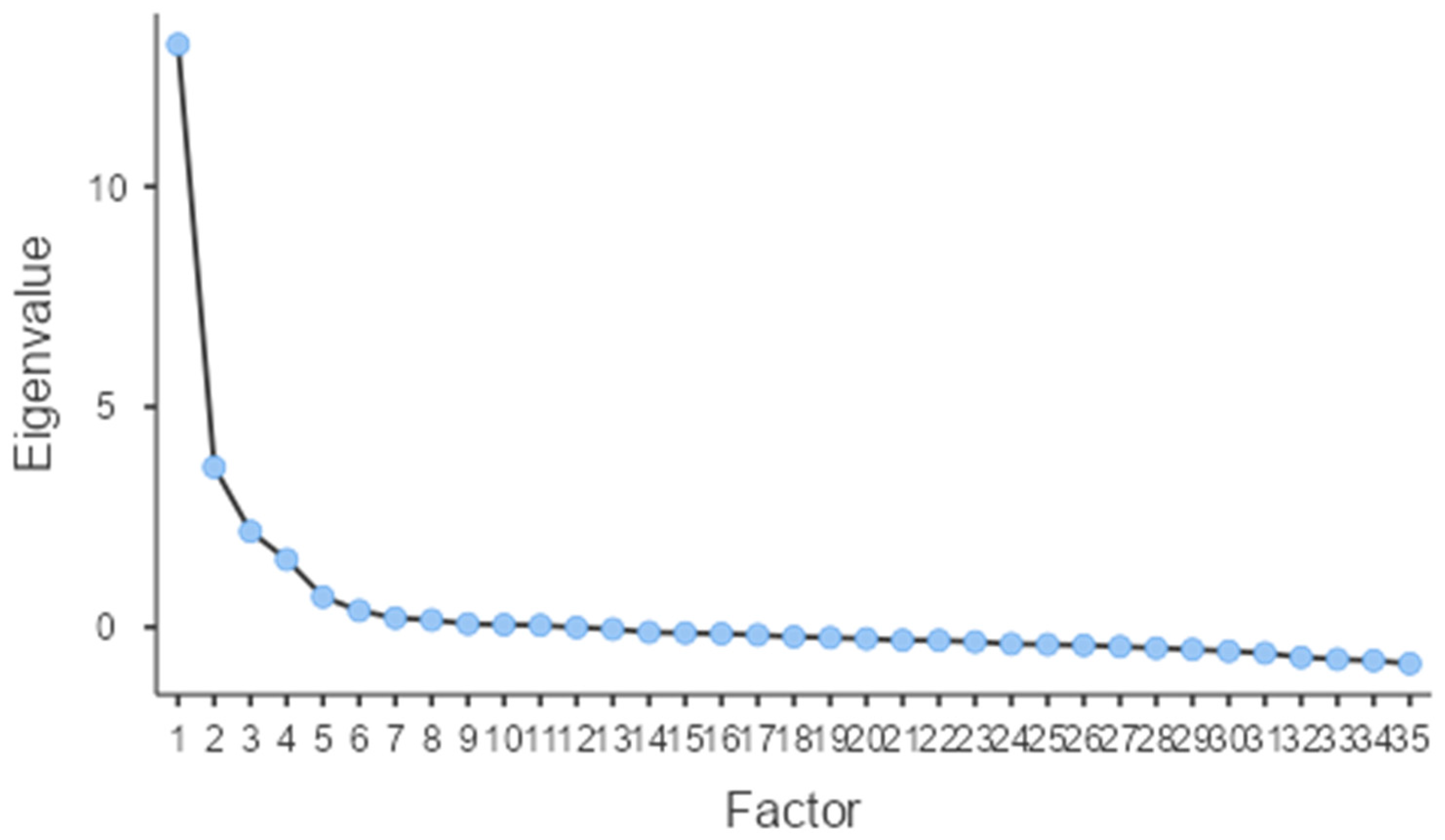
| Eigenvalue | 13.23 | 3.63 | 2.17 | 1.54 | |
| % of Variance | 25.11 | 13.99 | 13.82 | 9.51 | |
| Cumulative % | 25.11 | 39.11 | 52.93 | 62.45 | |
| Q | Factor Loadings | ||||
| 7 | Been worried about other people seeing your facial hair | 0.84 | |||
| 21 | Felt moody because of your excess hair | 0.87 | |||
| 22 | Felt depressed because of your hirsutism | 0.78 | |||
| 24 | Spent a lot of time and energy removing excess hair | 0.81 | |||
| 26 | Felt depressed because of your facial hair | 0.82 | |||
| 30 | Felt embarrassed by your facial hair | 0.9 | |||
| 1 | Felt under pressure to have a child | 0.86 | |||
| 8 | Felt anxious about conceiving a child | 0.55 | |||
| 9 | Felt depressed over difficulties conceiving a child | 0.9 | |||
| 23 | Felt depressed because of your infertility | 0.89 | |||
| 25 | Felt depressed over your struggle to have children | 0.97 | |||
| 31 | Felt like a failure because of your trouble conceiving | 0.94 | |||
| 34 | Been scared that you may not have children | 0.49 | |||
| 2 | Felt guilty for being overly aggressive towards a friend or family member | 0.68 | |||
| 30 | Overreacted to a day-to-day occurrence because of PCOS | 0.79 | |||
| 5 | Felt overwhelmed by your PCOS and depression | 0.68 | |||
| 11 | Had a short temper with your close friends and/or family | 0.77 | |||
| 12 | Felt like crying for no reason | 0.59 | |||
| 14 | Felt depressed | 0.5 | |||
| 4 | Felt like you weren’t a real woman because of your PCOS | 0.69 | |||
| 6 | Felt depressed about how PCOS has impacted your life | 0.62 | |||
| 10 | Felt like less of a woman because of having PCOS | 0.62 | |||
| 13 | Wanted to do something but haven’t because of your PCOS | 0.8 | |||
| 15 | Felt abnormal because of your PCOS | 0.83 | |||
| 16 | Felt like you don’t know what to do to help yourself | 0.69 | |||
| 17 | Felt like you don’t know what to do to control your PCOS | 0.64 | |||
| 18 | Felt like you hated yourself | 0.69 | |||
| 19 | Felt like your PCOS is in control of your life | 0.74 | |||
| 20 | Felt embarrassed about the way you look | 0.8 | |||
| 27 | Felt angry that you have PCOS | 0.71 | |||
| 28 | Been envious of women without PCOS | 0.64 | |||
| 29 | Felt embarrassed about having PCOS | 0.76 | |||
| 32 | Felt that it is unfair that you have PCOS | 0.62 | |||
| 33 | Struggled to cope with your PCOS and your other condition(s) | 0.75 | |||
| 35 | Wanted to take part in a social activity but haven’t because of your PCOS | 0.63 | |||
| Domain | ICC (95% CI) | p-Value | Level of Agreement | Mean Test ± SD | Mean Retest ± SD |
|---|---|---|---|---|---|
| Hirsutism | 0.885 (0.798 to 0.934) | <0.001 | Almost perfect | 23.54 ± 12.35 | 22.44 ± 12.35 |
| Infertility | 0.830 (0.702 to 0.903) | <0.001 | Almost perfect | 35.4 ± 11.63 | 33.86 ± 12.49 |
| Mood | 0.760 (0.579 to 0.863) | <0.001 | Substantial | 17.96 ± 8.21 | 19.76 ± 9.98 |
| Impact of PCOS | 0.849 (0.734 to 0.914) | <0.001 | Almost perfect | 69.66 ± 24.73 | 70.76 ± 25.1 |
| Total | 0.861 (0.755 to 0.921) | <0.001 | Almost perfect | 146.56 ± 41.85 | 146.82 ± 48.73 |
| Item | Hirsutism Score | p-Value | Infertility Score | p-Value | Mood Score | p-Value | Impact of PCOS Score | p-Value |
|---|---|---|---|---|---|---|---|---|
| Age (years) | ||||||||
| ≤25 | 21.28 ± 11.25 | 0.007 | 40.6 ± 9.32 | <0.001 | 19.9 ± 9.11 | 0.765 | 69.28 ± 23.82 | 0.028 |
| >25 | 25.6 ± 11.7 | 34.06 ± 13.46 | 20.28 ± 9.05 | 76.46 ± 22.77 | ||||
| Educational level | ||||||||
| High school or less | 21.98 ± 11.8 | 0.767 | 39.58 ± 8.46 | 0.070 | 18.65 ± 8.98 | 0.455 | 67.14 ± 22.98 | 0.243 |
| Bachelor’s degree | 23.64 ± 11.49 | 37.02 ± 12.25 | 20.14 ± 9.27 | 73.86 ± 23.11 | ||||
| Master’s degree or above | 23.67 ± 12.31 | 28.33 ± 18.81 | 23.11 ± 7.18 | 81.89 ± 22.64 | ||||
| Vocational/Technical Institute/Diploma | 25.29 ± 12.92 | 39.06 ± 11.8 | 21.71 ± 8.44 | 74.29 ± 27.63 | ||||
| Marital status | ||||||||
| Single | 21.6 ± 11.56 a | 0.005 | 41.63 ± 7.94 a | <0.001 | 19.16 ± 8.85 a | 0.005 | 71.54 ± 23.46 | 0.413 |
| Married | 26.31 ± 11.37 b | 28.48 ± 13.92 b | 22.75 ± 8.95 b | 74.49 ± 24.47 | ||||
| Divorced/widowed | 30.75 ± 8.55 ab | 37.63 ± 13.52 ab | 14 ± 8.55 a | 81.38 ± 14.42 | ||||
| Residence | ||||||||
| Eastern region | 23.89 ± 14.73 | 0.826 | 30.56 ± 14.84 | 0.081 | 18.22 ± 10.1 | 0.347 | 59.78 ± 31.42 ab | 0.014 |
| Western region | 25.44 ± 12.2 | 43.11 ± 6.09 | 23.22 ± 10.08 | 81.11 ± 19.9 a | ||||
| Northern region | 26 ± 12.3 | 40.75 ± 7.5 | 25.75 ± 11.27 | 82 ± 26.7 ab | ||||
| Southern region | 28.4 ± 9.02 | 28.2 ± 14.11 | 15.2 ± 8.56 | 44 ± 27.45 b | ||||
| Central region | 23.11 ± 11.59 | 37.57 ± 11.92 | 20.04 ± 8.92 | 73.69 ± 22.55 a | ||||
| Income (SAR) | ||||||||
| <5000 | 21.92 ± 11.57 | 0.172 | 39.05 ± 10.4 | 0.152 | 18.95 ± 9.56 | 0.152 | 69.29 ± 25.64 | 0.156 |
| 5000–9999 | 23.13 ± 12.53 | 35.12 ± 13.22 | 19.5 ± 8.09 | 73.1 ± 20.62 | ||||
| 10,000–19,999 | 26.62 ± 10.59 | 37.82 ± 12.13 | 22.2 ± 8.61 | 76.87 ± 22.21 | ||||
| ≥20,000 | 24 ± 11.28 | 33.83 ± 14.65 | 22.39 ± 9.6 | 80.28 ± 21.53 | ||||
| Employment status | ||||||||
| Student | 19.8 ± 10.68 a | 0.014 | 41.41 ± 7.45 a | 0.002 | 19.52 ± 8.65 | 0.840 | 69.28 ± 24.11 | 0.234 |
| Unemployed | 25.56 ± 11.75 b | 35.72 ± 12.3 b | 20.37 ± 9.63 | 71.89 ± 24.55 | ||||
| Employed | 25.15 ± 11.91 b | 35.16 ± 13.98 b | 20.3 ± 9.17 | 76.86 ± 22.08 | ||||
| Retired | 26 ± 5.66 ab | 24 ± 15.56 ab | 24.5 ± 7.78 | 65 ± 21.21 | ||||
| Having children | ||||||||
| No | 22.06 ± 11.47 | 0.004 | 39.79 ± 10.14 | <0.001 | 19.75 ± 9.15 | 0.352 | 72.49 ± 23.41 | 0.706 |
| Yes | 27.4 ± 11.37 | 30.25 ± 14.09 | 21.09 ± 8.82 | 73.91 ± 24.03 |
Disclaimer/Publisher’s Note: The statements, opinions and data contained in all publications are solely those of the individual author(s) and contributor(s) and not of MDPI and/or the editor(s). MDPI and/or the editor(s) disclaim responsibility for any injury to people or property resulting from any ideas, methods, instructions or products referred to in the content. |
© 2026 by the authors. Licensee MDPI, Basel, Switzerland. This article is an open access article distributed under the terms and conditions of the Creative Commons Attribution (CC BY) license.
Share and Cite
Alwatban, L.; Sayed, A.; Alwatban, R.; Alwatban, M.; Alyousefi, N. The Validation and Cross-Cultural Adaptation of the Arabic Version of the Polycystic Ovary Syndrome Quality of Life Scale (PCOSQOL). J. Clin. Med. 2026, 15, 607. https://doi.org/10.3390/jcm15020607
Alwatban L, Sayed A, Alwatban R, Alwatban M, Alyousefi N. The Validation and Cross-Cultural Adaptation of the Arabic Version of the Polycystic Ovary Syndrome Quality of Life Scale (PCOSQOL). Journal of Clinical Medicine. 2026; 15(2):607. https://doi.org/10.3390/jcm15020607
Chicago/Turabian StyleAlwatban, Layan, Ayah Sayed, Raneem Alwatban, Mais Alwatban, and Nada Alyousefi. 2026. "The Validation and Cross-Cultural Adaptation of the Arabic Version of the Polycystic Ovary Syndrome Quality of Life Scale (PCOSQOL)" Journal of Clinical Medicine 15, no. 2: 607. https://doi.org/10.3390/jcm15020607
APA StyleAlwatban, L., Sayed, A., Alwatban, R., Alwatban, M., & Alyousefi, N. (2026). The Validation and Cross-Cultural Adaptation of the Arabic Version of the Polycystic Ovary Syndrome Quality of Life Scale (PCOSQOL). Journal of Clinical Medicine, 15(2), 607. https://doi.org/10.3390/jcm15020607

