A Comprehensive Review of Acute Coronary Syndrome and Bypass Surgery: Recent Advances, Timing, and Indicative Considerations



Abstract
1. Introduction
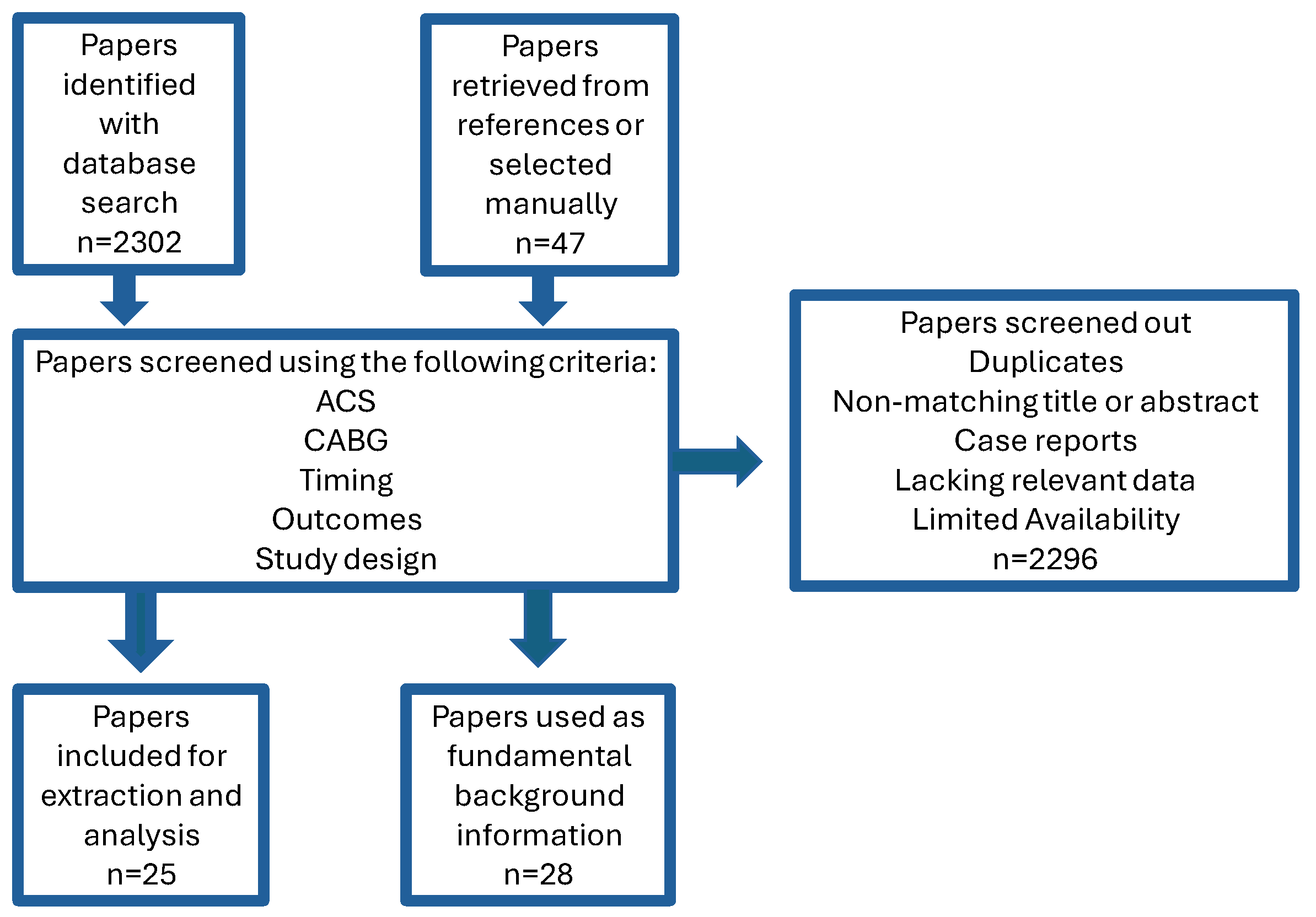
2. Methods
2.1. Objectives
2.2. Search Strategy
2.3. Study Selection Criteria
2.4. Limitations in Selection
3. Results
3.1. Contemporary Role of CABG in the Management of ACS
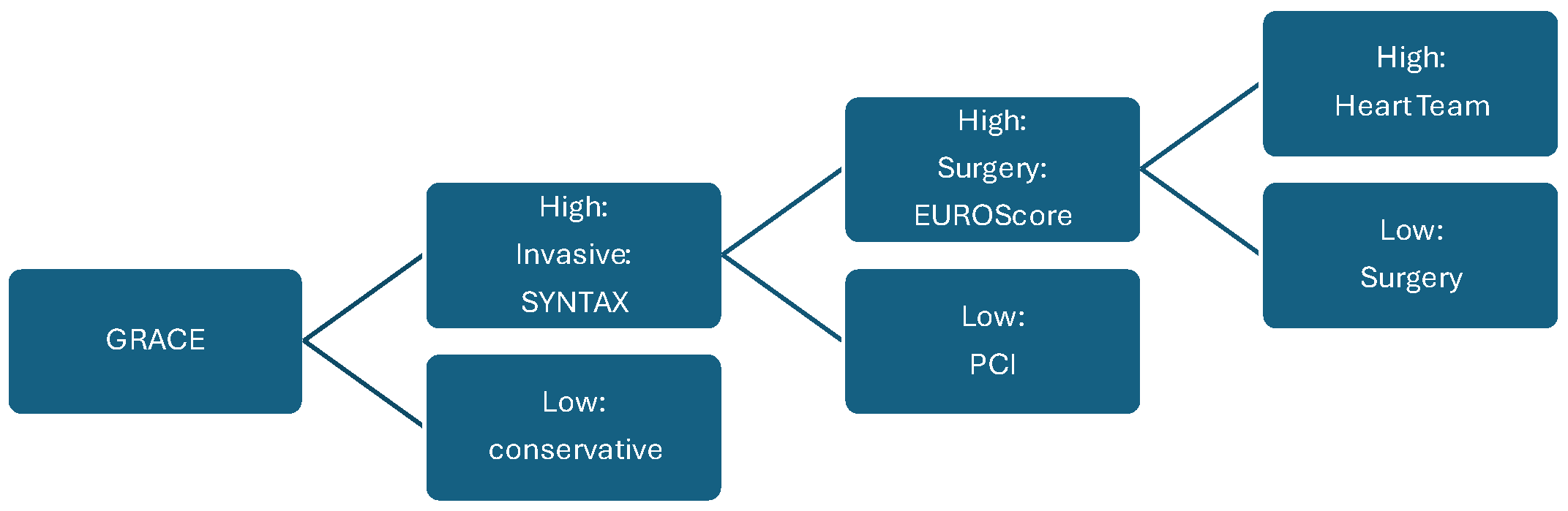
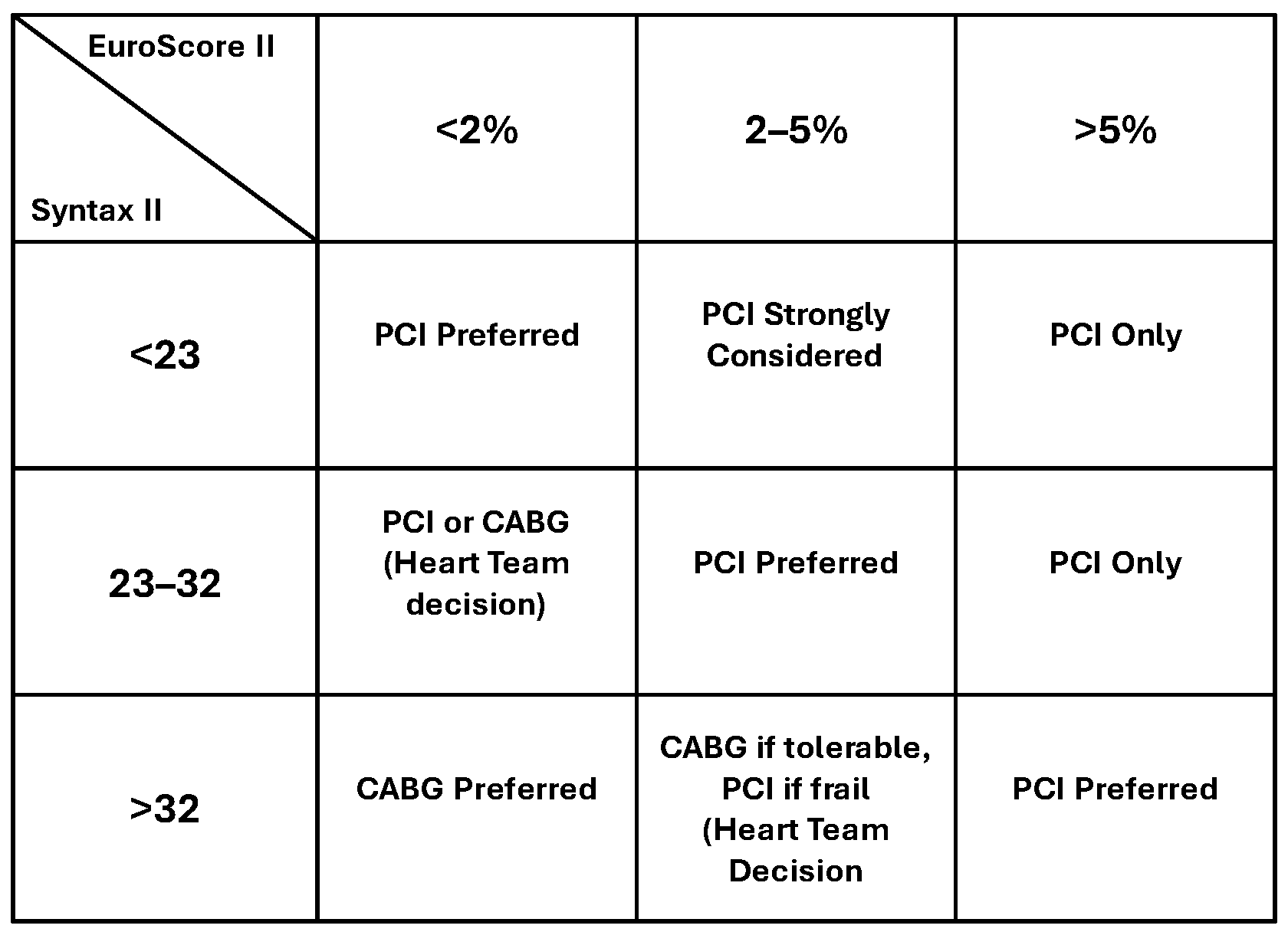
3.2. Risk Stratification and Decision-Making Frameworks
3.3. Combined Scoring Approaches
3.4. High-Risk Subgroups and Special Clinical Scenarios

| Study | Study Design | Population | Timing Considerations | Endpoints | Key Findings | Limitations |
|---|---|---|---|---|---|---|
| Acharya et al., 2016 [9] | registry | CABG < 7 days after ACS | salvage/emergent/urgent | MACCE | earlier cases—worse risk profile—worse outcomes | CABG indication based on clinical routine duration of shock not available MCS use influenced by local and individual practice |
| Benedetto et al., 2022 [16] | multi-centre retrospective cohort | CABG after NSTE-ACS | days from Tn peak to surgery | 30 d/LT mortality | if peak Tn is <100× normal, no delay needed; if >100× normal, then 5–10 days seems beneficial | retrospective lacking data on: anatomical complexity, surgical technique, completeness of revascularisation, medication, cause of death |
| da Fonseca et al., 2018 [40] | single-centre retrospective | awaiting elective CABG | duration of waiting status | MACCE | waiting over 16 weeks yields a risk in itself—significant additional risk factor is reduced LVEF (<45%) | lacking data on: drug adherence, timing of surgery, patients with end points treated at another provider |
| Hadaya et al., 2022 [41] | registry | CABG after ACS | 0, 1–3, 4–7, >7 d | MACCE | worst results recorded on day 0 and in >7 groups; day 1–3 and 4–7 were better, with day 1–3 presenting lower costs | retrospective time measured in days lacking data on: laboratory values, risk scores, antiplatelet drug use, LVEF |
| Huenges et al., 2024 [27] | single-centre retrospective | CABG < 48 h ACS among TIDM and TIIDM | <48 h | MACCE, LT survival | TIIDM showed worst risk profile, short- and long-term mortality followed by TIDM and non-diabetic | ongoing registry with changing clinical protocols selection bias |
| Kim et al., 2024 [14] | database review | CABG after <1 y ACS | <1, 1–2, 3–7, 7–21, >21 d | MACCE, survival | worst results 24–48 h | selection bias no STE-ACS vs NSTE-ACS distinction no randomisation of surgical methods |
| Lee et al., 2001 [12] | multi-centre retrospective cohort | CABG in NSTE.ACS and STE-ACS | <6 h, 6 h–1 d, 1–7 d, >7 d | ST survival | earlier surgery yields inferior outcomes; difference is lesser among NSTE-ACS | retrospective no data on timing protocol |
| Lee et al., 2003 [13] | multi-centre retrospective cohort | CABG in STE-ACS | <6 h, 6 h–1 d, 1–3 d, 4–7 d, 7–14 d, >14 d | ST survival | surgery < 3 d yields inferior outcomes | retrospective varying local protocols |
| Lemaire et al., 2020 [15] | database review | CABG in STE-ACS | 1 d, 2–3 d, 4–7 d | ST survival, perioperative complications | 1 d group had significantly inferior results | retrospective lacking data on: type of surgery, cause of timing |
| Liakopoulos et al., 2019 [42] | database review | NSTE-ACS and STE ACS with CS and CABG | <24 h, >24 h | MACCE, ST mortality | STE-ACS worse than NSTE-ACS; effect of timing is ns | lacking data on: presurgical treatment, completeness of revascularisation, long-term clinical data institutional bias |
| Parikh et al., 2010 [20] | database review | CABG in NSTE-ACS | <48 h, >48 h | ST MACCE, mortality | more risk factors in the late group, ns results | retrospective bias: survival and selection locally variable protocols low overall GRACE scores |
| Patlolla et al., 2024 [43] | single-centre retrospective | CABG in NSTE.ACS and STE-ACS | <24 h, 1–7 d, >7 d | ST mortality, MACCE | inferior outcomes > 7 d, especially in elderly people, NSTE-ACS, DM | retrospective lacking data on: pre-center treatment, cause of death, MACCE selection bias |
| Rojas et al., 2019 [18] | single-centre prospective observational | CABG in NSTE-ACS | <72 h, >72 h | 6 mo mortality, MACCE | more risk factors in the early group, ns results | retrospective selection bias favoring late surgeries only short-term follow-up |
| Thielmann et al., 2021 [19] | database review | CABG after PCI (culprit with further indications, failed or abandoned) | <24 h, >24 h | ST mortality, MACCE | high-risk subpopulation among CABG due to baseline characteristics | norandomized incompleteness of patient and pre-surgical treatment data possible treatment bias |
| Thielmann et al., 2006 [17] | single-centre prospective | CABG in STE-ACS and NSTE-ACS | <24 h | ST mortality, MACCE | preoperative cTnI was a strong predictor of survival in both groups | only short-term follow-up single center |
| Voisine et al., 2005 [10] | single-centre retrospective | CABG after ACS | <6 h, 6–24 h, 1–7 d, 8–30 d, >30 d | ST mortality | inferior outcomes < 7 d—especially among historically earlier surgeries | retrospective no NSTE-ACS and STE-ACS distinction cause of urgency is partly missing |
| Weiss et al., 2008 [11] | database review | CABG after ACS | <24 h, 24–48 h, 48–72 h, >3 d | ST mortality | inferior outcomes < 3 d | retrospective possible selection bias favoring late surgeries missing clinical data includeing LVEF, NYHA |
| Study | Study Design | Population | Timing Considerations | Endpoints | Key Findings | Limitations |
|---|---|---|---|---|---|---|
| Elbadawi et al., 2019 [44] | multi-centre retrospective cohort | mechanical complication after ACS | n. a. | in-hospital mortality | rate does not decrease, outcomes do not improve vastly, surgery still yields benefits | retrospective lack of data on: laboratory findings, LVEF, pre-treatment delay |
| Ezad et al., 2018 [45] | single-centre retrospective | urgent CABG after PCI | n. a. | in-hospital mortality | PCI complications are rare but present and urgency is mandatory despite the high surgical risk | retrospective single center low caseload no statistical end points reviewed |
| Fukui et al., 2014 [33] | single-centre retrospective | undergoing isolated CABG | n. a. | MACCE | both Euroscore II and SYNTAX II judge early risk appropriately; for long-term prognosis, Euroscore II fits | retrospective single center limited number of patients |
| Huckaby et al., 2020 [46] | single-centre retrospective | NSTE-ACS multivessel PCI or CAB | unknown | MACCE, LT survival | lower mortality and MACCEs among CABG group | retrospective outpatients not included lack of data on: anatomical complexity, LVEF |
| Mehaffey et al., 2023 [47] | database review | age > 65 y ACS CABG or multivessel PCI | unknown | MACCE, LT survival | higher stroke and rate, cost, longer hospitalization but lower mortality in the shorter term, lower mortality and MACCEs in the longer term among CABG group | retrospective lack of data on: anatomical complexity, heart team involved, patient preference |
| Mehta et al., 2008 [37] | database review | ACS CABG | n. a. | ST mortality | mortality not prohibitive | retrospective selection bias (referral) |
| Omerovic et al., 2024 [24] | database review | multivessel NSTE-ACS | n. a. | mortality ST, LT, MACCE | stroke ns, other MACCEs and mortality prefer CABG | retrospective evolving treatment during data collection period lack of data on: MCS use, graft and stent type, presence of PAD, CTO, completeness of revascularisation, adherence to medication |
| Paparella et al., 2010 [48] | single-centre retrospective | CABG < 21 d after ACS | n. a. | ST, LT mortality, MACCE | praeop. tropI > 0.15 worse outcomes | retrospective lack of consistent postoperative imaging data lack of initial troponin values |
4. Discussion
5. Timing of CABG in STE-ACS and NSTE-ACS
5.1. Timing of CABG in STE-ACS
5.2. Timing of CABG in NSTE-ACS
5.3. Interpretation and Clinical Implications
6. Knowledge Gaps and Future Directions
7. Conclusions
8. Limitations
Author Contributions
Funding
Institutional Review Board Statement
Informed Consent Statement
Data Availability Statement
Conflicts of Interest
Abbreviations
| ACS | Acute Coronary Syndrome |
| AI | Artificial Intelligence |
| CABG | Coronary Artery Bypass Grafting |
| DAPT | Dual Antiplatelet Therapy |
| DM | Diabetes Mellitus |
| ECMO | Extracorporeal Membrane Oxygenator |
| GRACE | Global Registry of Acute Coronary Events |
| IABP | Intra-Aortic Balloon Pump |
| LT | Long-term |
| MACCE | Major Adverse Cardiac and Cerebrovascular Events |
| MCS | Mechanical Circulatory Support |
| NSTE-ACS | Non-ST-elevation Acute Coronary Syndrome |
| PAI | Platelet Aggregation Inhibitor |
| PCI | Percutaneous Coronary Intervention |
| RCT | Randomized Controlled Trial |
| ST | Short-term |
| STE-ACS | ST-elevation Acute-Coronary Syndrome |
| SYNTAX | Synergy Between PCI with Taxus and Cardiac Surgery |
| TIDM | Diabetes Mellitus Type I |
| TIIDM | Diabetes Mellitus Type II |
| VSR | Ventricular Septal Rupture |
References
- Thygesen, K.; Alpert, J.S.; Jaffe, A.S.; Chaitman, B.R.; Bax, J.J.; Morrow, D.A.; White, H.D.; Mickley, H.; Crea, F.; Van de Werf, F.; et al. Fourth universal definition of myocardial infarction. Circulation 2018, 138, e618–e651. [Google Scholar] [CrossRef]
- Amsterdam, E.A.; Wenger, N.K.; Brindis, R.G.; Casey, D.E.; Ganiats, T.G.; Holmes, D.R.; Jaffe, A.S.; Jneid, H.; Kelly, R.F.; Kontos, M.C.; et al. 2014 AHA/ACC Guideline for the Management of Patients with Non-ST-Elevation Acute Coronary Syndromes: A report of the American College of Cardiology/American Heart Association Task Force on Practice Guidelines. J. Am. Coll. Cardiol. 2014, 64, e139–e228. [Google Scholar] [CrossRef] [Scilit] [PubMed]
- Fox, K.A.; Anderson, F.A., Jr.; Dabbous, O.H.; Steg, P.G.; López-Sendón, J.; Van de Werf, F.; Budaj, A.; Gurfinkel, E.P.; Goodman, S.G.; Brieger, D. Intervention in acute coronary syndromes: Do patients undergo intervention on the basis of their risk characteristics? The Global Registry of Acute Coronary Events (GRACE). Heart 2007, 93, 177–182. [Google Scholar] [CrossRef] [Scilit] [PubMed]
- Jobs, A.; Mehta, S.R.; Montalescot, G.; Vicaut, E.; van’t Hof, A.W.J.; Badings, E.A.; Neumann, F.-J.; Kastrati, A.; Sciahbasi, A.; Reuter, P.-G.; et al. Optimal timing of an invasive strategy in patients with non-ST-elevation acute coronary syndrome: A meta-analysis of randomised trials. Lancet 2017, 390, 737–746. [Google Scholar] [CrossRef] [Scilit] [PubMed]
- Lawton, J.S.; Tamis-Holland, J.E.; Bangalore, S.; Bates, E.R.; Beckie, T.M.; Bischoff, J.M.; Bittl, J.A.; Cohen, M.G.; DiMaio, J.M.; Don, C.W.; et al. 2021 ACC/AHA/SCAI Guideline for Coronary Artery Revascularization: A Report of the American College of Cardiology/American Heart Association Joint Committee on Clinical Practice Guidelines. J. Am. Coll. Cardiol. 2022, 79, e21–e129. [Google Scholar] [CrossRef] [Scilit] [PubMed]
- Hillis, G.S.; Zehr, K.J.; Williams, A.W.; Schaff, H.V.; Orzulak, T.A.; Daly, R.C.; Mullany, C.J.; Rodeheffer, R.J.; Oh, J.K. Outcome of patients with low ejection fraction undergoing coronary artery bypass grafting: Renal function and mortality after 3.8 years. Circulation 2006, 114, I414–I419. [Google Scholar] [CrossRef] [Scilit]
- Shepshelovich, D.; Yahav, D.; Rome, D.R.; Goldvaser, H.; Richter, I.; Hermann, E.A.; Barr, R.G. Heterogeneity of Primary Outcomes in Large Atherosclerotic Cardiovascular Disease Trials Published in Prominent Medical Journals. JAMA Intern. Med. 2025, 185, 464–466. [Google Scholar] [CrossRef] [Scilit]
- Lang, Q.; Qin, C.; Meng, W. Appropriate Timing of Coronary Artery Bypass Graft Surgery for Acute Myocardial Infarction Patients: A Meta-Analysis. Front. Cardiovasc. Med. 2022, 9, 794925. [Google Scholar] [CrossRef] [Scilit] [PubMed]
- Acharya, D.; Gulack, B.C.; Loyaga-Rendon, R.Y.; Davies, J.E.; He, X.; Brennan, J.M.; Thourani, V.H.; Williams, M.L. Clinical Characteristics and Outcomes of Patients With Myocardial Infarction and Cardiogenic Shock Undergoing Coronary Artery Bypass Surgery: Data from the Society of Thoracic Surgeons National Database. Ann. Thorac. Surg. 2016, 101, 558–566. [Google Scholar] [CrossRef] [Scilit] [PubMed]
- Voisine, P.; Mathieu, P.; Doyle, D.; Perron, J.; Baillot, R.; Raymond, G.; Métras, J.; Dagenais, F. Influence of time elapsed between myocardial infarction and coronary artery bypass grafting surgery on operative mortality. Eur. J. Cardiothorac. Surg. 2006, 29, 319–323. [Google Scholar] [CrossRef] [Scilit]
- Weiss, E.S.; Chang, D.D.; Joyce, D.L.; Nwakanma, L.U.; Yuh, D.D. Optimal timing of coronary artery bypass after acute myocardial infarction: A review of California discharge data. J. Thorac. Cardiovasc. Surg. 2008, 135, 503–511. [Google Scholar] [CrossRef] [Scilit] [PubMed]
- Lee, D.C.; Oz, M.C.; Weinberg, A.D.; Lin, S.X.; Ting, W. Optimal Timing of Revascularization: Transmural Versus Nontransmural Acute Myocardial Infarction. Ann. Thorac. Surg. 2001, 71, 1198–1204. [Google Scholar] [CrossRef] [Scilit]
- Lee, D.C.; Oz, M.C.; Weinberg, A.D.; Ting, W. Appropriate timing of surgical intervention after transmural acute myocardial infarction. J. Thorac. Cardiovasc. Surg. 2003, 125, 115–119. [Google Scholar] [CrossRef] [Scilit] [PubMed]
- Kim, H.H.; Lee, M.; Yoo, K.J. Optimal Revascularization Timing of Coronary Artery Bypass Grafting in Acute Myocardial Infarction. Clin. Cardiol. 2024, 47, e24325. [Google Scholar] [CrossRef] [Scilit]
- Lemaire, A.; Vagaonescu, T.; Ikegami, H.; Volk, L.; Verghis, N.; Lee, L.Y. Delay in coronary artery bypass grafting for STEMI patients improves hospital morbidity and mortality. J. Cardiothorac. Surg. 2020, 15, 86. [Google Scholar] [CrossRef] [Scilit] [PubMed]
- Benedetto, U.; Sinha, S.; Mulla, A.; Glampson, B.; Davies, J.; Panoulas, V.; Gautama, S.; Papadimitriou, D.; Woods, K.; Elliott, P.; et al. Implications of elevated troponin on time-to-surgery in non-ST elevation myocardial infarction (NIHR Health Informatics Collaborative: TROP-CABG study). Int. J. Cardiol. 2022, 1, 14–19. [Google Scholar] [CrossRef] [Scilit] [PubMed]
- Thielmann, M.; Massoudy, P.; Neuhäuser, M.; Tsagakis, K.; Marggraf, G.; Kamler, M.; Mann, K.; Erbel, R.; Jakob, H. Prognostic value of preoperative cardiac troponin I in patients undergoing emergency coronary artery bypass surgery with non-ST-elevation or ST-elevation acute coronary syndromes. Circulation 2006, 114, I448–I453. [Google Scholar] [CrossRef] [Scilit]
- Rojas, S.V.; Trinh-Adams, M.L.; Uribarri, A.; Fleissner, F.; Iablonskii, P.; Rojas-Hernandez, S.; Ricklefs, M.; Martens, A.; Rümke, S.; Warnecke, G.; et al. Early surgical myocardial revascularization in non-ST-segment elevation acute coronary syndrome. J. Thorac. Dis. 2019, 11, 4444–4452. [Google Scholar] [CrossRef] [Scilit]
- Thielmann, M.; Wendt, D.; Slottosch, I.; Welp, H.; Thielmann, M.; Schiller, W.; Tsagakis, K.; Schmack, B.; Weymann, A.; Martens, S.; et al. Coronary Artery Bypass Graft Surgery in Patients With Acute Coronary Syndromes After Primary Percutaneous Coronary Intervention: A Current Report from the North-Rhine Westphalia Surgical Myocardial Infarction Registry. J. Am. Heart Assoc. 2021, 10, e021182. [Google Scholar] [CrossRef] [Scilit]
- Parikh, S.V.; de Lemos, J.A.; Jessen, M.E.; Brilakis, E.S.; Ohman, E.M.; Chen, A.Y.; Wang, T.Y.; Peterson, E.D.; Roe, M.T.; Holper, E.M. Timing of in-hospital coronary artery bypass graft surgery for non-ST-segment elevation myocardial infarction patients results from the National Cardiovascular Data Registry ACTION Registry-GWTG (Acute Coronary Treatment and Intervention Outcomes Network Registry-Get with the Guidelines). JACC Cardiovasc. Interv. 2010, 3, 419–427. [Google Scholar] [PubMed]
- DeFilippis, A.P.; Chapman, A.R.; Mills, N.L.; de Lemos, J.A.; Arbab-Zadeh, A.; Newby, L.K.; Morrow, D.A. Assessment and Treatment of Patients with Type 2 Myocardial Infarction and Acute Non-Ischemic Myocardial Injury. Circulation 2019, 140, 1661–1678. [Google Scholar] [CrossRef] [Scilit] [PubMed]
- Farmer, D.; Jimenez, E. Re-evaluating the Role of CABG in Acute Coronary Syndromes. Curr. Cardiol. Rep. 2020, 22, 148. [Google Scholar] [CrossRef] [Scilit]
- Head, S.J.; Milojevic, M.; Daemen, J.; Ahn, J.-M.; Boersma, E.; Christiansen, E.H.; Domanski, M.J.; Farkouh, M.E.; Flather, M.; Fuster, V.; et al. Mortality after coronary artery bypass grafting versus percutaneous coronary intervention with stenting for coronary artery disease: A pooled analysis of individual patient data. Lancet 2018, 391, 939–948. [Google Scholar] [CrossRef] [Scilit] [PubMed]
- Omerovic, E.; Råmunddal, T.; Petursson, P.; Angerås, O.; Rawshani, A.; Jha, S.; Skoglund, K.; Mohammad, M.A.; Persson, J.; Alfredsson, J.; et al. Percutaneous vs. surgical revascularization of non-ST-segment elevation myocardial infarction with multivessel disease: The SWEDEHEART registry. Eur. Heart J. 2025, 46, 518–531. [Google Scholar] [CrossRef] [Scilit]
- Shiyovich, A.; Shlomo, N.; Cohen, T.; Iakobishvili, Z.; Kornowski, R.; Eisen, A. Temporal trends of patients with acute coronary syndrome and multi-vessel coronary artery disease-from the ACSIS registry. Int. J. Cardiol. 2020, 304, 8–13. [Google Scholar] [CrossRef] [Scilit] [PubMed]
- Farkouh, M.E.; Domanski, M.; Sleeper, L.A.; Siami, F.S.; Dangas, G.; Mack, M.; Yang, M.; Cohen, D.J.; Rosenberg, Y.; Solomon, S.D.; et al. Strategies for multivessel revascularization in patients with diabetes. N. Engl. J. Med. 2012, 367, 2375–2384. [Google Scholar] [CrossRef] [Scilit] [PubMed]
- Huenges, K.; Rainer-Schmidt, N.; Panholzer, B.; Caliebe, A.; Hüttmann, L.; Kolat, P.; Thiem, A.; Attmann, T.; Fraund-Cremer, S.; Haneya, A.; et al. Impact of Diabetes in Patients With Acute Myocardial Infarction Undergoing Coronary Artery Bypass Surgery Within 48 Hours. Heart Lung Circ. 2024, 33, 1272–1279. [Google Scholar] [CrossRef] [Scilit] [PubMed]
- Neumann, F.-J.; Sousa-Uva, M.; Ahlsson, A.; Alfonso, F.; Banning, A.P.; Benedetto, U.; Byrne, R.A.; Collet, J.P.; Falk, V.; Head, S.J.; et al. 2018 ESC/EACTS Guidelines on myocardial revascularization. Eur. Heart J. 2018, 40, 87–165. [Google Scholar] [CrossRef] [Scilit] [PubMed]
- Peker, T.; Boyraz, B. Short-Term Prognostic Value of the Culprit-SYNTAX Score in Patients with Acute Myocardial Infarction. J. Cardiovasc. Dev. Dis. 2023, 10, 270. [Google Scholar] [CrossRef] [Scilit]
- Nashef, S.A.; Roques, F.; Sharples, L.D.; Nilsson, J.; Smith, C.; Goldstone, A.R.; Lockowandt, U. EuroSCORE II. Eur. J. Cardiothorac. Surg. 2012, 41, 734–744. [Google Scholar] [CrossRef] [Scilit]
- Sullivan, P.G.; Wallach, J.D.; Ioannidis, J.P. Meta-Analysis Comparing Established Risk Prediction Models (EuroSCORE II, STS Score, and ACEF Score) for Perioperative Mortality During Cardiac Surgery. Am. J. Cardiol. 2016, 118, 1574–1582. [Google Scholar] [CrossRef] [Scilit]
- Ad, N.; Holmes, S.D.; Patel, J.; Pritchard, G.; Shuman, D.J.; Halpin, L. Comparison of EuroSCORE II, Original EuroSCORE, and The Society of Thoracic Surgeons Risk Score in Cardiac Surgery Patients. Ann. Thorac. Surg. 2016, 102, 573–579. [Google Scholar] [CrossRef] [Scilit] [PubMed]
- Fukui, T.; Uchimuro, T.; Takanashi, S. EuroSCORE II with SYNTAX score to assess risks of coronary artery bypass grafting outcomes. Eur. J. Cardiothorac. Surg. 2015, 47, 66–71. [Google Scholar] [CrossRef] [Scilit] [PubMed]
- Sianos, G.; Morel, M.-A.; Kappetein, P.; Morice, M.-C.; Colombo, A.; Dawkins, K.; van den Brand, M.; Van Dyck, N.; Russell, M.E.; Mohr, F.W.; et al. The SYNTAX Score: An angiographic tool grading the complexity of coronary artery disease. EuroIntervention 2005, 1, 219–227. [Google Scholar] [PubMed]
- Serruys, P.W.; Morice, M.-C.; Kappetein, A.P.; Colombo, A.; Holmes, D.R.; Mack, M.J.; Ståhle, E.; Feldman, T.E.; van den Brand, M.; Bass, E.J.; et al. Percutaneous Coronary Intervention versus Coronary-Artery Bypass Grafting for Severe Coronary Artery Disease. N. Engl. J. Med. 2009, 360, 961–972. [Google Scholar] [CrossRef] [Scilit] [PubMed]
- Wiviott, S.D.; Steg, P.G. Clinical evidence for oral antiplatelet therapy in acute coronary syndromes. Lancet 2015, 386, 292–302. [Google Scholar] [CrossRef] [Scilit] [PubMed]
- Mehta, R.H.; Grab, J.D.; O’Brien, S.M.; Glower, D.D.; Haan, C.K.; Gammie, J.S.; Peterson, E.D. Clinical characteristics and in-hospital outcomes of patients with cardiogenic shock undergoing coronary artery bypass surgery: Insights from the Society of Thoracic Surgeons National Cardiac Database. Circulation 2008, 117, 876–885. [Google Scholar] [CrossRef] [Scilit] [PubMed]
- Ronco, D.; Corazzari, C.; Matteucci, M.; Massimi, G.; Di Mauro, M.; Ravaux, J.M.; Beghi, C.; Lorusso, R. Effects of concomitant coronary artery bypass grafting on early and late mortality in the treatment of post-infarction mechanical complications: A systematic review and meta-analysis. Ann. Cardiothorac. Surg. 2022, 11, 210–225. [Google Scholar] [CrossRef] [Scilit]
- Gaudino, M.; Rahouma, M.; Habib, R.H.; Hameed, I.; Robinson, N.B.; Farrington, W.J.; Fremes, S.; Schwann, T.A.; Girardi, L.N. Surgeons’ Coronary Bypass Practice Patterns in the United States. J. Am. Coll. Cardiol. 2020, 76, 1714–1715. [Google Scholar] [CrossRef] [Scilit]
- da Fonseca, V.B.P.; De Lorenzo, A.; Tura, B.R.; Pittella, F.J.M.; da Rocha, A.S.C. Mortality and morbidity of patients on the waiting list for coronary artery bypass graft surgery. Interact. Cardiovasc. Thorac. Surg. 2018, 26, 34–40. [Google Scholar] [CrossRef] [Scilit]
- Hadaya, J.; Sanaiha, Y.; Tran, Z.; Downey, P.; Shemin, R.J.; Benharash, P. Timing of Coronary Artery Bypass Grafting in Acute Coronary Syndrome: A National Analysis. Ann Thorac Surg. 2022, 113, 1482–1490. [Google Scholar] [CrossRef] [Scilit] [PubMed]
- Liakopoulos, O.J.; Schlachtenberger, G.; Wendt, D.; Choi, Y.-H.; Slottosch, I.; Welp, H.; Schiller, W.; Martens, S.; Welz, A.; Neuhauser, M.; et al. Early Clinical Outcomes of Surgical Myocardial Revascularization for Acute Coronary Syndromes Complicated by Cardiogenic Shock: A Report From the North-Rhine-Westphalia Surgical Myocardial Infarction Registry. JAHA 2019, 119, 012049. [Google Scholar] [CrossRef] [Scilit] [PubMed]
- Patlolla, S.H.; Crestanello, J.A.; Schaff, H.V.; Pochettino, A.; Stulak, J.M.; Daly, R.C.; Greason, K.L.; Dearani, J.A.; Saran, N. Timing of coronary artery bypass grafting after myocardial infarction influences late survival. JTCVS Open 2024, 20, 40–48. [Google Scholar] [CrossRef] [Scilit]
- Elbadawi, A.; Elgendy, I.Y.; Mahmoud, K.; Barakat, A.F.; Mentias, A.; Mohamed, A.H.; Ogunbayo, G.O.; Megaly, M.; Saad, M.; Omer, M.A.; et al. Temporal Trends and Outcomes of Mechanical Complications in Patients with Acute Myocardial Infarction. JACC Cardiovasc. Interv. 2019, 12, 1825–1836. [Google Scholar] [CrossRef] [Scilit] [PubMed]
- Ezad, S.; Williams, T.D.; Condon, J.; Boyle, A.J.; Collins, N.J. Common themes in patients requiring urgent cardiothoracic surgery after percutaneous coronary interventions: Case series and review of the literature. Cardiovasc. Revasc. Med. 2018, 19, 976–979. [Google Scholar] [CrossRef] [Scilit]
- Huckaby, L.V.; Sultan, I.; Mulukutla, S.; Kliner, D.; Gleason, T.G.; Wang, Y.; Thoma, F.; Kilic, A. Revascularization following non-ST elevation myocardial infarction in multivessel coronary disease. J. Card. Surg. 2020, 35, 1195–1201. [Google Scholar] [CrossRef] [Scilit]
- Mehaffey, J.H.; Hayanga, J.W.A.; Kawsara, M.; Sakhuja, A.; Mascio, C.; Rankin, J.S.; Badhwar, V. Contemporary Coronary Artery Bypass Grafting versus Multivessel Percutaneous Coronary Intervention. Ann. Thorac. Surg. 2023, 116, 1213–1220. [Google Scholar] [CrossRef] [Scilit] [PubMed]
- 48; Paparella, D.; Scrascia, G.; Paramythiotis, A.; Guida, P.; Magari, V.; Malvindi, P.G.; Favale, S.; Tupputi Schinosa, L.L. Preoperative Cardiac Troponin I to Assess Midterm Risks of Coronary Bypass Grafting Operations in Patients With Recent Myocardial Infarction. Ann. Thorac. Surg. 2010, 89, 696–703. [Google Scholar] [CrossRef] [Scilit] [PubMed]
- Knuuti, J.; Wijns, W.; Saraste, A.; Capodanno, D.; Barbato, E.; Funck-Brentano, C.; Prescott, E.; Storey, R.F.; Deaton, C.; Cuisset, T.; et al. 2019 ESC Guidelines for the diagnosis and management of chronic coronary syndromes: The Task Force for the diagnosis and management of chronic coronary syndromes of the European Society of Cardiology (ESC). Eur. Heart J. 2019, 41, 407–477. [Google Scholar] [CrossRef] [Scilit] [PubMed]
- Mehta, S.R. Refining Antithrombotic Therapy for Atrial Fibrillation and Acute Coronary Syndromes or PCI. N. Engl. J. Med. 2019, 380, 1580–1581. [Google Scholar] [CrossRef] [Scilit]
- Rexius, H.; Brandrup-Wognsen, G.; Odén, A.; Jeppsson, A. Mortality on the waiting list for coronary artery bypass grafting: Incidence and risk factors. Ann. Thorac. Surg. 2004, 77, 769–774. [Google Scholar] [CrossRef] [Scilit] [PubMed]
- Dayan, V.; Soca, G.; Parma, G.; Mila, R. Does early coronary artery bypass surgery improve survival in non-ST acute myocardial infarction? Interact. Cardiovasc. Thorac. Surg. 2013, 17, 140–142. [Google Scholar] [CrossRef] [Scilit]
- Polito, M.V.; Asparago, S.; Galasso, G.; Farina, R.; Panza, A.; Iesu, S.; Piscione, F. Early myocardial surgical revascularization after ST-segment elevation myocardial infarction in multivessel coronary disease: Bridge therapy is the solution? J. Cardiovasc. Med. 2018, 19, 120–125. [Google Scholar] [CrossRef] [Scilit] [PubMed]
- So, D.Y.F.; Wells, G.A.; Lordkipanidzé, M.; Chong, A.Y.; Ruel, M.; Perrault, L.P.; Le May, M.R.; Sun, L.; Tran, D.; Labinaz, M.; et al. Early vs delayed bypass surgery in patients with acute coronary syndrome receiving ticagrelor: The RAPID CABG randomized open-label noninferiority trial. JAMA Surg. 2025, 160, 387–394. [Google Scholar] [CrossRef] [Scilit]
- Shrestha, B.; Katz, D.; Kelley, J.; Menzies, D.; Hong, M.K. Cangrelor in STEMI as a bridge to CABG-a mini-case series. Am. Heart J. Plus 2022, 13, 100122. [Google Scholar] [CrossRef] [Scilit] [PubMed]
- Unverzagt, S.; Buerke, M.; de Waha, A.; Haerting, J.; Pietzner, D.; Seyfarth, M.; Thiele, H.; Werdan, K.; Zeymer, U.; Prondzinsky, R. Intra-aortic balloon pump counterpulsation (IABP) for myocardial infarction complicated by cardiogenic shock. Cochrane Database Syst. Rev. 2015, 2015, CD007398. [Google Scholar]
- Rab, T.; Ratanapo, S.; Kern, K.; Basir, M.B.; McDaniel, M.; Meraj, P.; Kin, S.B., 3rd; O’Neill, W. Cardiac Shock Care Centers: JACC Review Topic of the Week. JACC 2018, 72, 1972–1980. [Google Scholar] [CrossRef] [Scilit] [PubMed]
- Jeppsson, A.; Rocca, B.; Hansson, E.C.; Gudbjartsson, T.; James, S.; Kaskig, J.C.; Landmesser, U.; Pan, E.; Landonil, G.; Magron, P.; et al. 2024 EACTS Guidelines on perioperative medication in adult cardiac surgery. Eur. J. Cardiothorac. Surg. 2024, 67, ezae355. [Google Scholar] [CrossRef] [Scilit]
- Urban, P.; Gregson, J.; Owen, R.; Mehran, R.; Windecker, S.; Valgimigli, M.; Varenne, O.; Krucoff, M.; Saito, S.; Baber, U.; et al. Assessing the Risks of Bleeding vs Thrombotic Events in Patients at High Bleeding Risk After Coronary Stent Implantation: The ARC-High Bleeding Risk Trade-off Model. JAMA Cardiol. 2021, 6, 410–419. [Google Scholar] [CrossRef] [Scilit] [PubMed]
- Shafiq, A.; Jang, J.S.; Kureshi, F.; Fendler, T.J.; Gosch, K.; Jones, P.G.; Cohen, D.J.; Bach, R.; Spertus, J.A. Predicting Likelihood for Coronary Artery Bypass Grafting After Non-ST-Elevation Myocardial Infarction: Finding the Best Prediction Model. Ann. Thorac. Surg. 2016, 102, 1304–1311. [Google Scholar] [CrossRef] [Scilit] [PubMed]
- Dimitriadis, K.; Pyrpyris, N.; Iliakis, P.; Kanatas, P.; Theofilis, P.; Sakalidis, A.; Apostolos, A.; Tsioufis, P.; Papanikolaou, A.; Aznaouridis, K.; et al. Optimal management of high bleeding risk patients undergoing percutaneous coronary interventions: Where do we stand? J. Cardiol. 2025, 85, 79–87. [Google Scholar] [CrossRef] [Scilit] [PubMed]
- Weigel, F.; Krakowski, G.; Nudy, M.; Foy, A. Systematic review of bias in non-randomized studies on the optimal timing of coronary artery bypass grafting following acute coronary syndrome. J. Am. Coll. Cardiol. 2021, 77, 145. [Google Scholar] [CrossRef] [Scilit]


Disclaimer/Publisher’s Note: The statements, opinions and data contained in all publications are solely those of the individual author(s) and contributor(s) and not of MDPI and/or the editor(s). MDPI and/or the editor(s) disclaim responsibility for any injury to people or property resulting from any ideas, methods, instructions or products referred to in the content. |
© 2026 by the authors. Licensee MDPI, Basel, Switzerland. This article is an open access article distributed under the terms and conditions of the Creative Commons Attribution (CC BY) license.
Share and Cite
Holczer, L.; Hejjel, L.; Szokodi, I.; Kónyi, A. A Comprehensive Review of Acute Coronary Syndrome and Bypass Surgery: Recent Advances, Timing, and Indicative Considerations. J. Clin. Med. 2026, 15, 560. https://doi.org/10.3390/jcm15020560
Holczer L, Hejjel L, Szokodi I, Kónyi A. A Comprehensive Review of Acute Coronary Syndrome and Bypass Surgery: Recent Advances, Timing, and Indicative Considerations. Journal of Clinical Medicine. 2026; 15(2):560. https://doi.org/10.3390/jcm15020560
Chicago/Turabian StyleHolczer, Lőrinc, László Hejjel, István Szokodi, and Attila Kónyi. 2026. "A Comprehensive Review of Acute Coronary Syndrome and Bypass Surgery: Recent Advances, Timing, and Indicative Considerations" Journal of Clinical Medicine 15, no. 2: 560. https://doi.org/10.3390/jcm15020560
APA StyleHolczer, L., Hejjel, L., Szokodi, I., & Kónyi, A. (2026). A Comprehensive Review of Acute Coronary Syndrome and Bypass Surgery: Recent Advances, Timing, and Indicative Considerations. Journal of Clinical Medicine, 15(2), 560. https://doi.org/10.3390/jcm15020560