
The Impact of Probiotics on Clinical Outcomes in Diverticular Disease: A Systematic Review and Meta-Analysis

 , , , ,
  , , and
Abstract
1. Introduction
2. Materials and Methods
2.1. Study Protocol and Reporting Guidelines
2.2. Literature Search Strategy
2.3. Eligibility Criteria and Study Selection
2.4. Data Extraction and Management
2.5. Outcome Assessment Framework
2.6. Risk of Bias Assessment
2.7. Statistical Analysis and Meta-Analysis Methods
2.8. Subgroup Analysis and Meta-Regression Modeling
2.9. Sensitivity Analysis and Influence Analysis
2.10. Publication Bias Assessment
2.11. Quality of Evidence Assessment
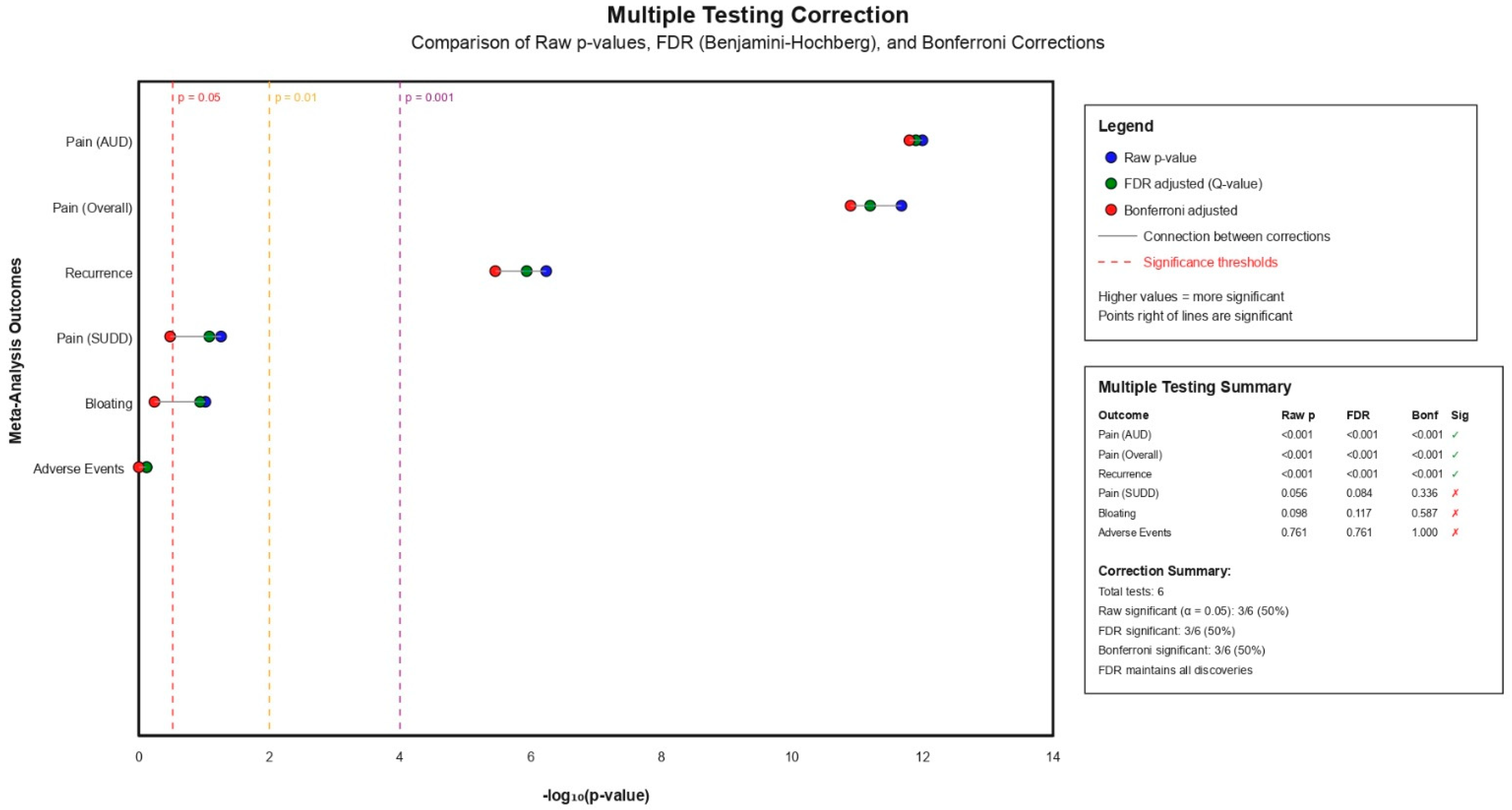
2.12. Multiple Testing Corrections
3. Results
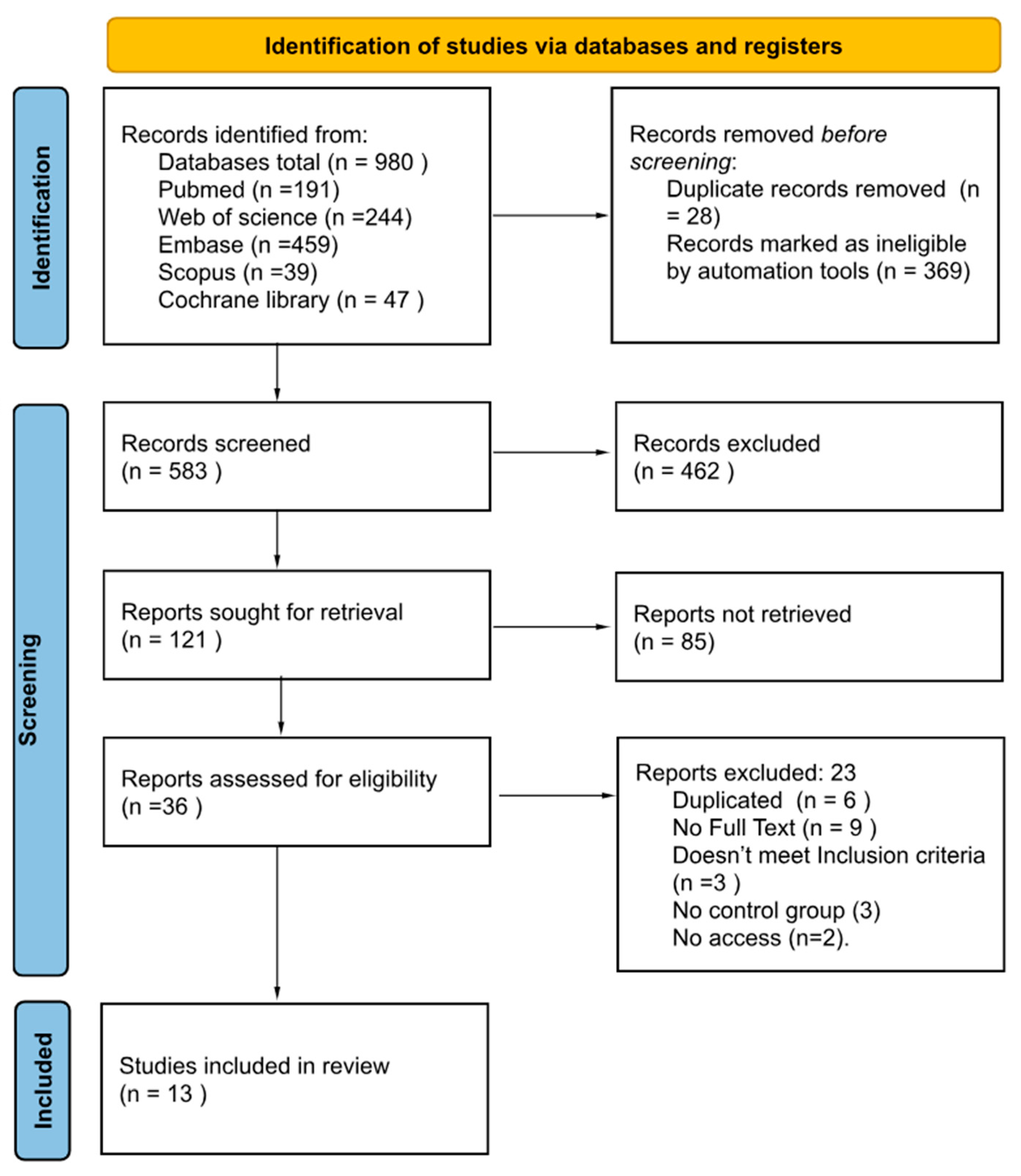
3.1. Study Selection and Characteristics
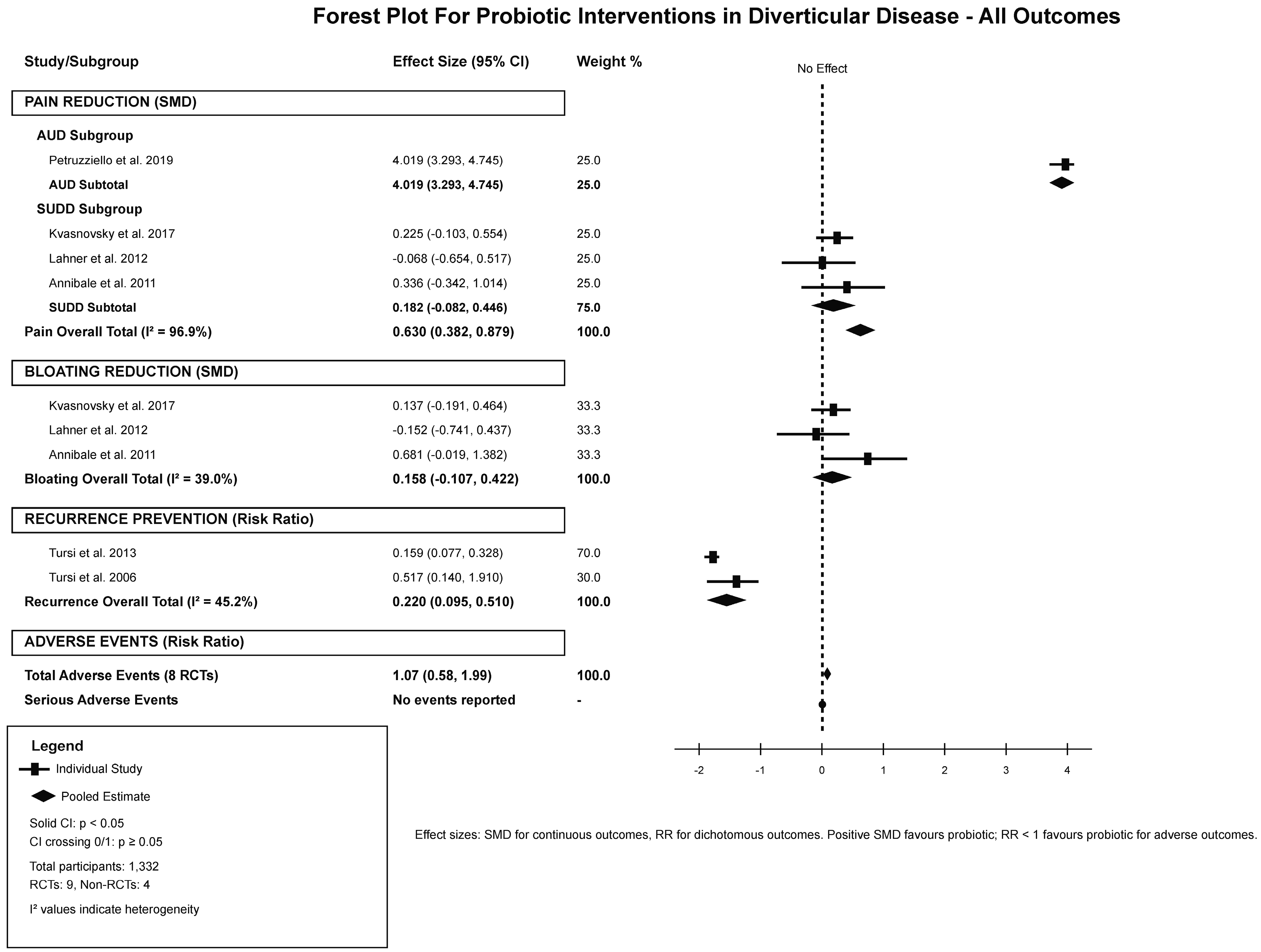
3.2. Primary and Secondary Outcomes Analysis
3.3. Inflammatory Biomarkers and Long-Term Outcomes
3.4. Safety and Adverse Events Profile
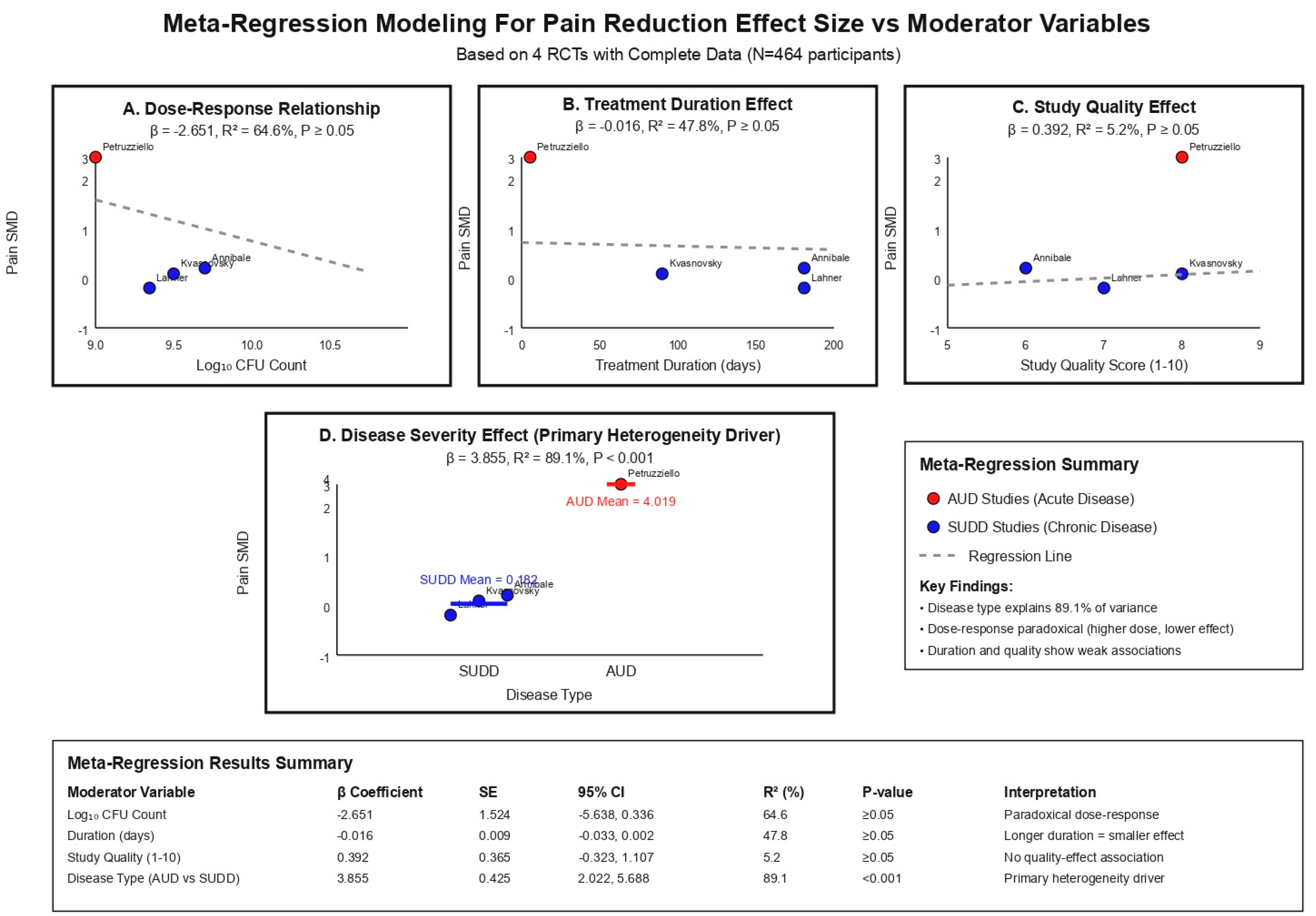
3.5. Meta-Regression and Sensitivity Analysis
3.6. Risk of Bias Assessment
3.7. Quality of Evidence Assessment
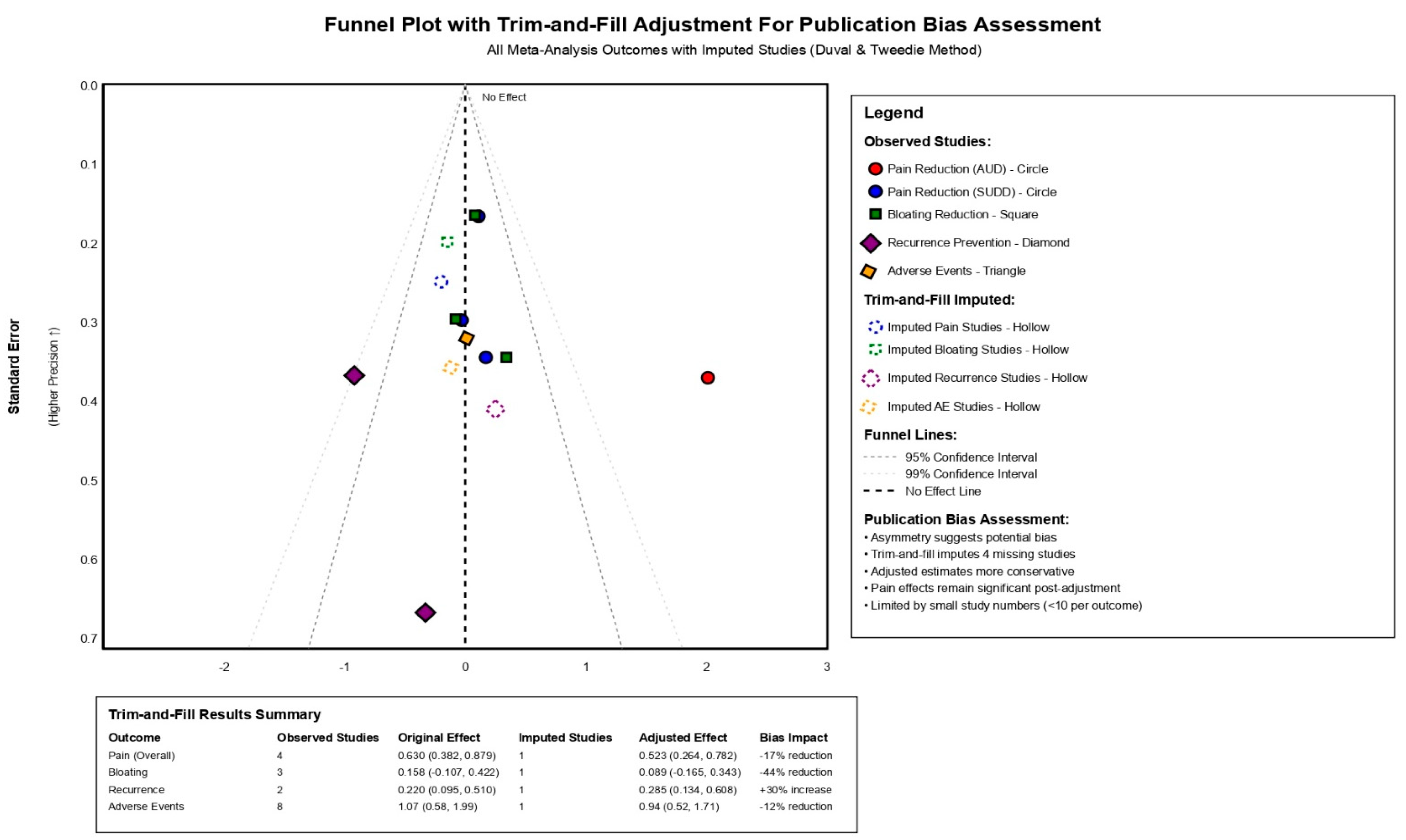
3.8. Publication Bias and Multiple Testing Corrections
4. Discussion
4.1. Abdominal Pain Improvement with Probiotics
4.2. Abdominal Bloating Improvement
4.3. C-Reactive Protein
4.4. Probiotics & Prevention of Diverticular Disease Recurrence
4.5. Limitations
4.6. Recommendations
5. Conclusions
Supplementary Materials
Author Contributions
Funding
Institutional Review Board Statement
Informed Consent Statement
Data Availability Statement
Acknowledgments
Conflicts of Interest
Abbreviations
| PRISMA | Preferred Reporting Items for Systematic reviews and Meta-Analyses |
| MeSH | Medical Subject Headings |
| DD | Diverticular Disease |
| RCTs | Randomized Controlled Trials |
| SMD | Standardized Mean Difference |
| CI | Confidence Interval |
| CRP | C-reactive Protein |
| RR | Relative Risk |
| SCAD | Segmental Colitis associated with Diverticulosis |
| SUDD | Symptomatic Uncomplicated Diverticular Disease |
| CT | Computed Tomography |
| CTC | Computed Tomography Colonography |
| CDD | Classification of Diverticular Disease |
| CENTRAL | Cochrane Central Register of Controlled Trials |
| AUD | Acute Uncomplicated Diverticulitis |
| RoB 2.0 | Risk of Bias |
| ROBINS-I | Risk of Bias in Non-Randomized Studies of Interventions |
| GRADE | The Grading of Recommendations Assessment, Development, and Evaluation |
| FDR | False Discovery Rate |
| IBS | Irritable Bowel Syndrome |
| IBD | Inflammatory Bowel Disease |
| AGA | American Gastroenterological Association |
| ASCRS | American Society of Colon and Rectal Surgeons |
| NICE | National Institute for Health and Core Excellence |
References
- Tursi, A. Diverticulosis Today: Unfashionable and Still under-Researched. Ther. Adv. Gastroenterol. 2016, 9, 213–228. [Google Scholar] [CrossRef]
- Yang, F.; Sun, X.; Jiang, K. Distribution and Characteristics of Colonic Diverticula in Northern China. J. Clin. Gastroenterol. 2025, 59, 1–5. [Google Scholar] [CrossRef]
- Azzam, N. Prevalence and Clinical Features of Colonic Diverticulosis in a Middle Eastern Population. World J. Gastrointest. Endosc. 2013, 5, 391. [Google Scholar] [CrossRef]
- Carabotti, M.; Sgamato, C.; Amato, A.; Beltrame, B.; Binda, G.A.; Germanà, B.; Leandro, G.; Pasquale, L.; Peralta, S.; Viggiani, M.T.; et al. Italian Guidelines for the Diagnosis and Management of Colonic Diverticulosis and Diverticular Disease. Dig. Liver Dis. 2024, 56, 1989–2003. [Google Scholar] [CrossRef] [PubMed]
- Cuomo, R.; Barbara, G.; Pace, F.; Annese, V.; Bassotti, G.; Binda, G.A.; Casetti, T.; Colecchia, A.; Festi, D.; Fiocca, R.; et al. Italian Consensus Conference for Colonic Diverticulosis and Diverticular Disease. United Eur. Gastroenterol. J. 2014, 2, 413–442. [Google Scholar] [CrossRef]
- Calini, G.; Abd El Aziz, M.A.; Paolini, L.; Abdalla, S.; Rottoli, M.; Mari, G.; Larson, D.W. Symptomatic Uncomplicated Diverticular Disease (SUDD): Practical Guidance and Challenges for Clinical Management. Clin. Exp. Gastroenterol. 2023, 16, 29–43. [Google Scholar] [CrossRef] [PubMed]
- Buldukoğlu, O.Ç.; Öcal, S.; Atar, G.E.; Harmandar, F.A.; Çekin, A.H. Sit or Squat? Toilet Type Is a Determinant of Diverticulosis Development. Turk. J. Gastroenterol. 2024, 35, 475–480. [Google Scholar] [CrossRef]
- Imaeda, H.; Hibi, T. The Burden of Diverticular Disease and Its Complications: West versus East. Inflamm. Intest. Dis. 2018, 3, 61–68. [Google Scholar] [CrossRef] [PubMed]
- Trifan, A.; Gheorghe, C.; Sabo, C.M.; Diculescu, M.; Nedelcu, L.; Singeap, A.M.; Sfarti, C.; Gheorghe, L.; Sporea, I.; Tanțău, M.; et al. Diagnosis and Treatment of Colonic Diverticular Disease: Position Paper of the Romanian Society of Gastroenterology and Hepatology. J. Gastrointest. Liver Dis. 2018, 27, 449–457. [Google Scholar] [CrossRef]
- Bhatia, M.; Mattoo, A. Diverticulosis and Diverticulitis: Epidemiology, Pathophysiology, and Current Treatment Trends. Cureus 2023, 15, e43158. [Google Scholar] [CrossRef]
- Kruis, W.; Germer, C.; Böhm, S.; Dumoulin, F.L.; Frieling, T.; Hampe, J.; Keller, J.; Kreis, M.E.; Meining, A.; Labenz, J.; et al. German Guideline Diverticular Disease/Diverticulitis: Part II: Conservative, Interventional and Surgical Management. United Eur. Gastroenterol. J. 2022, 10, 940–957. [Google Scholar] [CrossRef]
- Lock, J.F.; Galata, C.; Reißfelder, C.; Ritz, J.-P.; Schiedeck, T.; Germer, C.-T. The Indications for and Timing of Surgery for Diverticular Disease. Dtsch. Ärzteblatt Int. 2020, 117, 591. [Google Scholar] [CrossRef]
- Gross, M.; Beckenbauer, U.E.; Bruder, L.; Zehrer, A. Divertikelkrankheit: Patientenmanagement in hausärztlichen Praxen in Deutschland: Hoher Stellenwert von Probiotika in der hausärztlichen Versorgung. MMW—Fortschritte Der Med. 2022, 164, 16–26. [Google Scholar] [CrossRef]
- Page, M.J.; McKenzie, J.E.; Bossuyt, P.M.; Boutron, I.; Hoffmann, T.C.; Mulrow, C.D.; Shamseer, L.; Tetzlaff, J.M.; Akl, E.A.; Brennan, S.E.; et al. The PRISMA 2020 Statement: An Updated Guideline for Reporting Systematic Reviews. BMJ 2021, 372, n71. [Google Scholar] [CrossRef]
- Alnajjar, J.; Alabdullatif, N.; Almutairi, A.; ALBohassan, M.; Almarzooq, M.; Alshafei, A. Protocol for the Impact of Probiotics on Clinical Outcomes in Diverticular Disease: A Systematic Review and Meta-Analysis; PROSPERO: London, UK, 2024. [Google Scholar]
- Sterne, J.A.C.; Savović, J.; Page, M.J.; Elbers, R.G.; Blencowe, N.S.; Boutron, I.; Cates, C.J.; Cheng, H.-Y.; Corbett, M.S.; Eldridge, S.M.; et al. RoB 2: A Revised Tool for Assessing Risk of Bias in Randomised Trials. BMJ 2019, 366, l4898. [Google Scholar] [CrossRef]
- Sterne, J.A.; Hernán, M.A.; Reeves, B.C.; Savović, J.; Berkman, N.D.; Viswanathan, M.; Henry, D.; Altman, D.G.; Ansari, M.T.; Boutron, I.; et al. ROBINS-I: A Tool for Assessing Risk of Bias in Non-Randomised Studies of Interventions. BMJ 2016, 355, i4919. [Google Scholar] [CrossRef]
- GRADE|Cochrane. Available online: https://www.cochrane.org/learn/courses-and-resources/cochrane-methodology/grade (accessed on 7 October 2025).
- Ojetti, V.; Saviano, A.; Brigida, M.; Petruzziello, C.; Caronna, M.; Gayani, G.; Franceschi, F. Randomized Control Trial on the Efficacy of Limosilactobacillus reuteri ATCC PTA 4659 in Reducing Inflammatory Markers in Acute Uncomplicated Diverticulitis. Eur. J. Gastroenterol. Hepatol. 2022, 34, 496–502. [Google Scholar] [CrossRef] [PubMed]
- Aragona, S.E.; Pasquale, L.; Fedeli, P.; Galloro, G.; Carrara, P.; Massa, D.; Iannuzziello, D.; Paiano, P.; Savarino, E.; Vinti, M.; et al. Diverticular Disease: A New Therapeutic Opportunity. J. Biol. Regul. Homeost. Agents 2022, 36, 59–64. [Google Scholar] [CrossRef]
- Petruzziello, C.; Migneco, A.; Cardone, S.; Covino, M.; Saviano, A.; Franceschi, F.; Ojetti, V. Supplementation with Lactobacillus reuteri ATCC PTA 4659 in Patients Affected by Acute Uncomplicated Diverticulitis: A Randomized Double-Blind Placebo Controlled Trial. Int. J. Color. Dis. 2019, 34, 1087–1094. [Google Scholar] [CrossRef]
- Petruzziello, C.; Marannino, M.; Migneco, A.; Brigida, M.; Saviano, A.; Piccioni, A.; Franceschi, F.; Ojetti, V. The Efficacy of a Mix of Three Probiotic Strains in Reducing Abdominal Pain and Inflammatory Biomarkers in Acute Uncomplicated Diverticulitis. Eur. Rev. Med. Pharmacol. Sci. 2019, 23, 9126–9133. [Google Scholar] [CrossRef] [PubMed]
- Kvasnovsky, C.L.; Bjarnason, I.; Donaldson, A.N.; Sherwood, R.A.; Papagrigoriadis, S. A Randomized Double-Blind Placebo-Controlled Trial of a Multi-Strain Probiotic in Treatment of Symptomatic Uncomplicated Diverticular Disease. Inflammopharmacol 2017, 25, 499–509. [Google Scholar] [CrossRef]
- Campanini, A.; De Conto, U.; Cavasin, F.; Bastiani, F.; Camarotto, A.; Gardini, L.; Geremia, A.; Marastoni, C.; Missorini, C.; Quarantelli, E.; et al. A Primary-Care Interventional Model on the Diverticular Disease: Searching for the Optimal Therapeutic Schedule. J. Clin. Gastroenterol. 2016, 50, S93–S96. [Google Scholar] [CrossRef]
- Tursi, A.; Brandimarte, G.; Elisei, W.; Picchio, M.; Forti, G.; Pianese, G.; Rodino, S.; D’Amico, T.; Sacca, N.; Portincasa, P.; et al. Randomised Clinical Trial: Mesalazine and/or Probiotics in Maintaining Remission of Symptomatic Uncomplicated Diverticular Disease—A Double-Blind, Randomised, Placebo-Controlled Study. Aliment. Pharmacol. Ther. 2013, 38, 741–751. [Google Scholar] [CrossRef]
- Lahner, E. High-Fibre Diet and Lactobacillus paracasei B21060 in Symptomatic Uncomplicated Diverticular Disease. World J. Gastroenterol. WJG 2012, 18, 5918. [Google Scholar] [CrossRef]
- Annibale, B.; Maconi, G.; Lahner, E.; De Giorgi, F.; Cuomo, R. Efficacy of Lactobacillus paracasei Sub. Paracasei F19 on Abdominal Symptoms in Patients with Symptomatic Uncomplicated Diverticular Disease: A Pilot Study. Minerva Gastroenterol. Dietol. 2011, 57, 13–22. [Google Scholar]
- Lamiki, P.; Tsuchiya, J.; Pathak, S.; Okura, R.; Solimene, U.; Jain, S.; Kawakita, S.; Marotta, F. Probiotics in Diverticular Disease of the Colon: An Open Label Study. J. Gastrointest. Liver Dis. 2010, 19, 31–36. [Google Scholar]
- Tursi, A.; Brandimarte, G.; Giorgetti, G.M.; Elisei, W.; Aiello, F. Balsalazide and/or High-Potency Probiotic Mixture (VSL#3) in Maintaining Remission after Attack of Acute, Uncomplicated Diverticulitis of the Colon. Int. J. Color. Dis. 2007, 22, 1103–1108. [Google Scholar] [CrossRef]
- Tursi, A.; Brandimarte, G.; Giorgetti, G.M.; Elisei, W. Mesalazine and/or Lactobacillus casei in Preventing Recurrence of Symptomatic Uncomplicated Diverticular Disease of the Colon: A Prospective, Randomized, Open-Label Study. J. Clin. Gastroenterol. 2006, 40, 312–316. [Google Scholar] [CrossRef] [PubMed]
- Fric, P.; Zavoral, M. The Effect of Non-Pathogenic Escherichia Coli in Symptomatic Uncomplicated Diverticular Disease of the Colon. Eur. J. Gastroenterol. Hepatol. 2003, 15, 313–315. [Google Scholar] [CrossRef] [PubMed]
- Marasco, G.; Buttitta, F.; Cremon, C.; Barbaro, M.R.; Stanghellini, V.; Barbara, G. The Role of Microbiota and Its Modulation in Colonic Diverticular Disease. Neurogastroenterol. Motil. 2023, 35, e14615. [Google Scholar] [CrossRef]
- Bretto, E.; D’Amico, F.; Fiore, W.; Tursi, A.; Danese, S. Lactobacillus paracasei CNCM I 1572: A Promising Candidate for Management of Colonic Diverticular Disease. J. Clin. Med. 2022, 11, 1916. [Google Scholar] [CrossRef] [PubMed]
- Tursi, A.; Papa, V.; Lopetuso, L.R.; Settanni, C.R.; Gasbarrini, A.; Papa, A. Microbiota Composition in Diverticular Disease: Implications for Therapy. Int. J. Mol. Sci. 2022, 23, 14799. [Google Scholar] [CrossRef] [PubMed]
- Lahner, E.; Bellisario, C.; Hassan, C.; Zullo, A.; Esposito, G.; Annibale, B. Probiotics in the Treatment of Diverticular Disease. A systematic review. J. Gastrointest. Liver Dis. 2016, 25, 79–86. [Google Scholar] [CrossRef]
- Aghamohammad, S.; Sepehr, A.; Miri, S.T.; Najafi, S.; Rohani, M.; Pourshafiea, M.R. The effects of the probiotic cocktail on modulation of the NF-kB and JAK/STAT signaling pathways involved in the inflammatory response in bowel disease model. BMC Immunol. 2022, 23, 8. [Google Scholar] [CrossRef] [PubMed]
- Barbara, G.; Stanghellini, V.; Brandi, G.; Cremon, C.; Di Nardo, G.; De Giorgio, R.; Corinaldesi, R. Interactions between commensal bacteria and gut sensorimotor function in health and disease. Am. J. Gastroenterol. 2005, 100, 2560–2568. [Google Scholar] [CrossRef]
- Gao, C.; Major, A.; Rendon, D.; Lugo, M.; Jackson, V.; Shi, Z.; Mori-Akiyama, Y.; Versalovic, J. Histamine H2 Receptor-Mediated Suppression of Intestinal Inflammation by Probiotic Lactobacillus reuteri. mBio 2015, 6, e01358-15. [Google Scholar] [CrossRef]
- Piccioni, A.; Franza, L.; Vaccaro, V.; Saviano, A.; Zanza, C.; Candelli, M.; Covino, M.; Franceschi, F.; Ojetti, V. Microbiota and Probiotics: The Role of Limosilactobacillus reuteri in Diverticulitis. Medicina 2021, 57, 802. [Google Scholar] [CrossRef]
- Zhang, T.; Zhang, C.; Zhang, J.; Sun, F.; Duan, L. Efficacy of Probiotics for Irritable Bowel Syndrome: A Systematic Review and Network Meta-Analysis. Front. Cell. Infect. Microbiol. 2022, 12, 859967. [Google Scholar] [CrossRef]
- Goodoory, V.C.; Khasawneh, M.; Black, C.J.; Quigley, E.M.M.; Moayyedi, P.; Ford, A.C. Efficacy of Probiotics in Irritable Bowel Syndrome: Systematic Review and Meta-analysis. Gastroenterology 2023, 165, 1206–1218, Corrigendum in Gastroenterology 2024, 167, 1248. https://doi.org/10.1053/j.gastro.2024.08.017. [Google Scholar] [CrossRef]
- Hun, L. Original Research: Bacillus coagulans Significantly Improved Abdominal Pain and Bloating in Patients with IBS. Postgrad. Med. 2009, 121, 119–124. [Google Scholar] [CrossRef]
- Kim, H.J.; Vazquez Roque, M.I.; Camilleri, M.; Stephens, D.; Burton, D.D.; Baxter, K.; Thomforde, G.; Zinsmeister, A.R. A Randomized Controlled Trial of a Probiotic Combination VSL# 3 and Placebo in Irritable Bowel Syndrome with Bloating. Neurogastroenterol. Motil. 2005, 17, 687–696. [Google Scholar] [CrossRef]
- Moshiree, B.; Drossman, D.; Shaukat, A. AGA Clinical Practice Update on Evaluation and Management of Belching, Abdominal Bloating, and Distention: Expert Review. Gastroenterology 2023, 165, 791–800.e3. [Google Scholar] [CrossRef]
- Mazidi, M.; Rezaie, P.; Ferns, G.; Vatanparast, H. Impact of Probiotic Administration on Serum C-Reactive Protein Concentrations: Systematic Review and Meta-Analysis of Randomized Control Trials. Nutrients 2017, 9, 20. [Google Scholar] [CrossRef]
- Vermeire, S. Laboratory Markers in IBD: Useful, Magic, or Unnecessary Toys? Gut 2006, 55, 426–431. [Google Scholar] [CrossRef] [PubMed]
- McMillan, D.C. The Systemic Inflammation-Based Glasgow Prognostic Score: A Decade of Experience in Patients with Cancer. Cancer Treat. Rev. 2013, 39, 534–540. [Google Scholar] [CrossRef] [PubMed]
- Van De Wall, B.J.M.; Draaisma, W.A.; Van Der Kaaij, R.T.; Consten, E.C.J.; Wiezer, M.J.; Broeders, I.A.M.J. The Value of Inflammation Markers and Body Temperature in Acute Diverticulitis. Color. Dis. 2013, 15, 621–626. [Google Scholar] [CrossRef] [PubMed]
- Kumarasinghe, D.; Zahid, A.; O’Grady, G.; Leow, T.Y.; Sheriff, T.; Ctercteko, G.; Gosselink, M.; Adusumilli, S. The Use of Biochemical Markers in Complicated and Uncomplicated Acute Diverticulitis. Int. Surg. 2021, 105, 380–388. [Google Scholar] [CrossRef]
- Morreale, C.; Bresesti, I.; Bosi, A.; Baj, A.; Giaroni, C.; Agosti, M.; Salvatore, S. Microbiota and Pain: Save Your Gut Feeling. Cells 2022, 11, 971. [Google Scholar] [CrossRef]
- Barbara, G.; Scaioli, E.; Barbaro, M.R.; Biagi, E.; Laghi, L.; Cremon, C.; Marasco, G.; Colecchia, A.; Picone, G.; Salfi, N.; et al. Gut Microbiota, Metabolome and Immune Signatures in Patients with Uncomplicated Diverticular Disease. Gut 2017, 66, 1252–1261. [Google Scholar] [CrossRef]
- Hegazy, S.K. Effect of Probiotics on Pro-Inflammatory Cytokines and NF-κB Activation in Ulcerative Colitis. World J. Gastroenterol. WJG 2010, 16, 4145. [Google Scholar] [CrossRef]
- Cabré, E.; Gassull, M.A. Probiotics for Preventing Relapse or Recurrence in Crohn’s Disease Involving the Ileum: Are There Reasons for Failure? J. Crohn’s Colitis 2007, 1, 47–52. [Google Scholar] [CrossRef] [PubMed]
- Sang, L.-X.; Chang, B.; Zhang, W.-L.; Wu, X.-M.; Li, X.-H.; Jiang, M. Remission Induction and Maintenance Effect of Probiotics on Ulcerative Colitis: A Meta-Analysis. World J. Gastroenterol. 2010, 16, 1908–1915. [Google Scholar] [CrossRef] [PubMed]
- Rahimi, R.; Nikfar, S.; Rahimi, F.; Elahi, B.; Derakhshani, S.; Vafaie, M.; Abdollahi, M. A Meta-Analysis on the Efficacy of Probiotics for Maintenance of Remission and Prevention of Clinical and Endoscopic Relapse in Crohn’s Disease. Dig. Dis. Sci. 2008, 53, 2524–2531. [Google Scholar] [CrossRef]
- Prantera, C.; Scribano, M.L.; Falasco, G.; Andreoli, A.; Luzi, C. Ineffectiveness of Probiotics in Preventing Recurrence after Curative Resection for Crohn’s Disease: A Randomised Controlled Trial with Lactobacillus GG. Gut 2002, 51, 405–409. [Google Scholar] [CrossRef]
- Peery, A.F.; Shaukat, A.; Strate, L.L. AGA Clinical Practice Update on Medical Management of Colonic Diverticulitis: Expert Review. Gastroenterology 2021, 160, 906–911. [Google Scholar] [CrossRef]
- Feingold, J.L.; Steele, S.R.; Lee, S.; Kaiser, A.; Boushey, R.; Buie, W.D.; Rafferty, J.F. Practice Parameters for the Treatment of Sigmoid Diverticulitis. Dis. Colon. Rectum 2020, 63, 384–407. [Google Scholar] [CrossRef] [PubMed]
- National Institute for Health and Care Excellence (NICE). Diverticular Disease: Diagnosis and Management (NG147). 2019. Available online: https://www.nice.org.uk/guidance/ng147 (accessed on 21 November 2025).



| Study | Design | Country | Setting | Total N | Int/Ctrl N | Mean Age (Years) | Male (%) | Disease Type | Probiotic Strain (s) | Daily CFU | Duration | Schedule | Control Type |
|---|---|---|---|---|---|---|---|---|---|---|---|---|---|
| Ojetti et al. 2022 [19] | Double-blind RCT | Italy | Hospital ED | 119 | 61/58 | 65.1 ± 20.0 | 41.2 | AUD | Limosilactobacillus reuteri ATCC PTA 4659 | 5 × 10⁸ | 10 days | Twice daily | Placebo |
| Aragona et al. 2022 [20] | Clinical Experience | Italy | Multicenter | 388 | 388 (pre-post) | 62.9 | 53.1 | SUDD/Symptomatic DD | Divercol® (L. rhamnosus, L. reuteri, L. acidophilus—tyndallized) | 3 × 10⁹ | 2 weeks | Daily | Pre-post design |
| Petruzziello et al. 2019 [21] | Double-blind RCT | Italy | Hospital ED | 88 | 44/44 | 61.9 ± 13.9 | 38.6 | AUD | L. reuteri ATCC PTA 4659 | 109 | 10 days | Twice daily | Placebo |
| Petruzziello et al. 2019 [22] | Open-label controlled trial | Italy | Hospital ED | 84 | 42/42 | 61.5 ± 11.5 | 29.8 | AUD | Lactibiane Iki (B. lactis LA 304, L. salivarius LA 302, L. acidophilus LA 201) | 8 × 10¹⁰ | 10 days | Twice daily | Antibiotics alone |
| Kvasnovsky et al. 2017 [23] | Double-blind RCT | UK | Tertiary hospital clinic | 143 | 71/72 | 61.8 (median) | 44.4 | SUDD | Symprove (L. rhamnosus NCIMB 30174, L. plantarum NCIMB 30173, L. acidophilus NCIMB 30175, E. faecium NCIMB 30176) | 1010 | 3 months | Daily | Placebo |
| Campanini et al. 2016 [24] | Prospective interventional | Italy | Primary Care | 178 | 43/63 | 71.7 ± 11.5 | 32.2 | SUDD | Lactobacillus/Bifidobacterium consortium | 2.4 × 10¹⁰ | 3 months | 20 days/month | Rifaximine alone |
| Tursi et al. 2013 [25] | Double-blind RCT | Italy | Multicenter | 210 | 109/50 | 62.5 (median) | 43.3 | SUDD | L. casei DG | 2.4 × 10¹⁰ | 12 months | 10 days/month | Placebo |
| Lahner et al. 2012 [26] | Multicenter RCT | Italy | Multicenter | 52 | 30/22 | 66.3 ± 9.5 | 32.7 | SUDD | L. paracasei B21060 | 5 × 10⁹ | 6 months | Daily | High-fiber diet |
| Annibale et al. 2011 [27] | Pilot RCT | Italy | Multicenter Academic | 50 | 34/16 | 65.2 ± 8.1 | 36.0 | SUDD | L. paracasei F19 | 1.2–4.8 × 10¹⁰ | 6 months | 14 days/month | High-fiber diet |
| Lamiki et al. 2010 [28] | Prospective open-label | Japan/Italy | Multicenter | 46 | 46/0 | 62.5 | 21.7 | SUDD (constipation) | SCM-III (L. acidophilus 145, L. helveticus ATC 15009, Bifidobacterium spp. 420) | ~1011 | 6 months | Three times daily | Single-arm |
| Tursi et al. 2007 [29] | Pilot controlled trial | Italy | Multicenter | 30 | 15/15 | 60.1 | 63.3 | Uncomplicated diverticulitis | VSL#3 (8 strains: 4 Lactobacillus, 3 Bifidobacterium, 1 Streptococcus) | 4.5 × 10¹¹ | 12 months | 15 days/month | Probiotic alone |
| Tursi et al. 2006 [30] | Prospective RCT | Italy | Multicenter | 90 | 58/30 | 67.5 | 40.0 | SUDD | L. casei DG | 1.6 × 10¹⁰ | 12 months | 15 days/month | Mesalazine |
| Fric et al. 2003 [31] | Prospective open trial | Czech Republic | Outpatient | 15 | 15/0 | 74.8 | 33.3 | SUDD | E. coli Nissle 1917 | 2.5–5.0 × 10¹⁰ | 5.2 weeks (avg) | Daily | Historical control |
| Study/Analysis | Design | Disease | Probiotic | N (Int/Ctrl) | Pain Baseline (Int/Ctrl) | Pain Post-Treatment | Pain Reduction | Pain SMD (95% CI) | Bloating SMD (95% CI) | Notes |
|---|---|---|---|---|---|---|---|---|---|---|
| Ojetti et al. 2022 [19] | RCT | AUD | Single strain | 61/58 | 7.0 ± NR/7.0 ± NR | 0.0 ± NR/0.0 ± NR | 7.0/7.0 | NR (no SDs) | NR | Complete resolution both groups |
| Petruzziello et al. 2019 [21] | RCT | AUD | Single strain | 44/44 | 8.2 ± 0.2/7.9 ± 0.3 | 0.13 ± 0.06/1.1 ± 0.25 | 8.07/6.80 | 4.019 (3.293, 4.745) | NR | Very large effect size |
| Petruzziello et al. 2019 [22] (second study) | RCT | AUD | Multi-strain | 42/42 | 7.9 ± NR/8.0 ± NR | 0.1 ± NR/0.8 ± NR | 7.8/7.2 | NR (no SDs) | NR | Substantial reduction both groups |
| AUD RCT SUBGROUP | Meta-analysis | 1 study with complete data | - | - | - | - | - | 4.019 (3.293, 4.745) | N/A | Very large effect for AUD |
| Kvasnovsky et al. 2017 [23] | RCT | SUDD | Multi-strain | 71/72 | 3.4 ± 2.8/2.7 ± 2.5 | 2.1 ± 2.4/2.2 ± 2.3 | 1.3/0.5 | 0.225 (−0.103, 0.554) | 0.137 (−0.191, 0.464) | Non-significant improvements |
| Tursi et al. 2013 [25] | RCT | SUDD | Single strain | 109/50 | 0 (asymptomatic at baseline) | NR | NR | NR | NR | Prevention study, recurrence focus |
| Lahner et al. 2012 [26] | RCT | SUDD | Single strain | 24/21 | 4.6 ± 2.2/4.6 ± 2.8 | 2.2 ± 0.8/2.0 ± 1.9 | 2.4/2.6 | −0.068 (−0.654, 0.517) | −0.152 (−0.741, 0.437) | Control group improved more |
| Annibale et al. 2011 [27] | RCT | SUDD | Single strain | 18/16 | 3.7 ± 3.5/2.8 ± 2.4 | 1.9 ± 2.2/2.3 ± 2.3 | 1.8/0.5 | 0.336 (−0.342, 1.014) | 0.681 (−0.019, 1.382) | Moderate effects, wide CIs |
| Tursi et al. 2006 [30] | RCT | SUDD | Single strain | 58/30 | 0 (asymptomatic at baseline) | NR | NR | NR | NR | Prevention study, recurrence focus |
| Fric et al. 2003 [31] | RCT | SUDD | Single strain | 15 (historical control) | 9.1 (historical) | 1.2 | 7.9 | NR (historical control) | NR (historical control) | Single-arm design |
| SUDD RCT SUBGROUP | Meta-analysis | 3 studies with complete data | - | - | - | - | - | 0.182 (−0.082, 0.446) | 0.158 (−0.107, 0.422) | Small non-significant effects |
| I2 = 10.3% (pain), 39.0% (bloating) | - | - | - | - | - | - | - | Heterogeneity assessment | ||
| ALL RCTs OVERALL | Meta-analysis | 4 studies with complete pain data, 3 with bloating data | - | - | - | - | - | 0.630 (0.382, 0.879) | 0.158 (−0.107, 0.422) | Medium effect for pain, high heterogeneity |
| I2 = 96.9% (pain), 39.0% (bloating) | - | - | - | - | - | - | - | Heterogeneity assessment | ||
| Non-Randomized Studies: | ||||||||||
| Aragona et al. 2022 [20] | Non-RCT | SUDD | Multi-strain (tyndallized) | 388 (single-arm) | 3.7 ± NR | 1.5 ± NR | 2.2 | NR (no control) | NR (no control) | Pre-post design, large sample |
| Campanini et al. 2016 [24] | Non-RCT | SUDD | Multi-strain | 43/63 | 1.5 ± 1.0/NR | 0.9 ± 0.8/NR | 0.6/NR | NR (active comparator) | NR (active comparator) | Compared to rifaximine alone |
| Lamiki et al. 2010 [28] | Non-RCT | SUDD | Multi-strain | 46 (single-arm) | NR | NR | NR | NR | NR | Outcomes not clearly reported |
| Tursi et al. 2007 [29] | Non-RCT | Uncomplicated diverticulitis | Multi-strain | 15/15 | NR | NR | NR | NR | NR | Pilot controlled trial, pain scores NR |
| Study/Analysis | Design | Disease | Follow-Up | N (Int/Ctrl) | CRP Baseline (Int/Ctrl) mg/L | CRP Post-Treatment mg/L | CRP Reduction (Int/Ctrl) | CRP WMD (95% CI) | Recurrence Events (Int/Ctrl) | Recurrence Rate % | Risk Ratio (95% CI) | Notes |
|---|---|---|---|---|---|---|---|---|---|---|---|---|
| Inflammatory Biomarkers (AUD Studies): | ||||||||||||
| Ojetti et al. 2022 [19] | RCT | AUD | 10 days | 61/58 | 570.0 ± 225.0/377.1 ± 112.0 | 235.1 ± 100.5/226.0 ± 84.0 | 334.9/151.1 | +183.8 (95.2, 272.4) | NR | NR | NR | Greater CRP reduction in intervention |
| Petruzziello et al. 2019 [21] | RCT | AUD | 10 days | 44/44 | 68.0 ± 8.8/71.3 ± 8.9 | 22.6 ± 4.0/43.8 ± 5.2 | 45.4/27.5 | +17.9 (14.1, 21.7) | NR | NR | NR | Significant anti-inflammatory effect |
| Petruzziello et al. 2019 (1) [22] | RCT | AUD | 10 days | 42/42 | 764.4/679.0 | 274.6/461.6 | 489.8/217.4 | +272.4 (no CI) | NR | NR | NR | Large reduction, SDs not reported |
| AUD CRP META-ANALYSIS | Meta-analysis | 3 studies | 10 days | 147/144 | - | - | - | Not pooled (range: +17.9 to +272.4) | - | - | - | Significant anti-inflammatory effect |
| High heterogeneity due to baseline differences | Descriptive pooling only | |||||||||||
| Long-Term Outcomes (≥6 months): | ||||||||||||
| Tursi et al. 2013 [25] | RCT | SUDD | 12 months | 109/50 | NR | NR | NR | NR | 8/23 | 7.3/46.0 | 0.159 (0.077, 0.328) | 84% reduction in recurrence |
| Tursi et al. 2006 [30] | RCT | SUDD | 12 months | 58/30 | NR | NR | NR | NR | 4/4 | 6.9/13.3 | 0.517 (0.140, 1.910) | Non-significant reduction |
| Lahner et al. 2012 [26] | RCT | SUDD | 6 months | 30/22 | 4.6 ± 2.2/4.6 ± 2.8 | 2.2 ± 0.8/2.0 ± 1.9 | 2.4/2.6 | −0.2 (−1.1, 0.7) | 0/0 | 0.0/0.0 | NE (no events) | No recurrences in either group |
| SUDD RECURRENCE META-ANALYSIS | Meta-analysis | 2 studies with events | 12 months | 167/80 | - | - | - | - | 12/27 | 7.2/33.8 | 0.220 (0.095, 0.510) | 78% reduction in recurrence risk |
| I2 = 45.2% (moderate heterogeneity) | p = 0.0005 (statistically significant) | |||||||||||
| Fric et al. 2003 [31] | RCT | SUDD | 8–40 months | 15 (historical) | 9.1 (historical) | 1.2 | 7.9 | NR (historical control) | 4/NR | 26.7/NR | NR | Single-arm with historical comparison |
| Non-Randomized Studies: | ||||||||||||
| Lamiki et al. 2010 [28] | Non-RCT | SUDD | 6 months | 46 (single-arm) | NR | NR | NR | NR | 14/NA | 31.1/NA | NR | Constipation-predominant SUDD |
| Tursi et al. 2007 [29] | Non-RCT | Uncomplicated diverticulitis | 12 months | 15/15 | NR | NR | NR | NR | 1/2 | 6.7/13.3 | 0.500 (0.050, 5.030) | Pilot controlled trial |
| Campanini et al. 2016 [24] | Non-RCT | SUDD | 3 months | 43/63 | NR | NR | NR | NR | NR | NR | NR | Active comparator design |
| Aragona et al. 2022 [20] | Non-RCT | SUDD | 21 days | 388 (single-arm) | NR | NR | NR | NR | NR | NR | NR | Pre-post design, short follow-up |
| Study/Analysis | Design | Disease | Duration | N (Int/Ctrl) | Total AEs (Int/Ctrl) | AE Rate % (Int/Ctrl) | Serious AEs (Int/Ctrl) | Withdrawals due to AEs (Int/Ctrl) | Total Withdrawals (Int/Ctrl) | Risk Ratio (95% CI) | AE Details | Notes |
|---|---|---|---|---|---|---|---|---|---|---|---|---|
| Acute Studies (≤2 weeks): | ||||||||||||
| Ojetti et al. 2022 [19] | RCT | AUD | 10 days | 61/58 | 0/0 | 0.0/0.0 | 0/0 | 0/0 | 0/0 | NE | None reported | Complete safety profile |
| Petruzziello et al. 2019 [21] | RCT | AUD | 10 days | 44/44 | 0/0 | 0.0/0.0 | 0/0 | 0/0 | 0/0 | NE | None reported | >95% compliance |
| Petruzziello et al. 2019 (1) [22] | RCT | AUD | 10 days | 42/42 | 0/0 | 0.0/0.0 | 0/0 | 0/0 | 0/0 | NE | None reported | >95% compliance |
| Aragona et al. 2022 [20] | Non-RCT | SUDD | 2 weeks | 388 | 0 | 0.0 | 0 | 0 | 0 | NE | None reported | “Safely tolerated” |
| ACUTE STUDIES META-ANALYSIS | Meta-analysis | AUD/SUDD | ≤2 weeks | 535/144 | 0/0 | 0.0/0.0 | 0/0 | 0/0 | 0/0 | NE | - | Excellent short-term safety |
| Intermediate Studies (1–6 months): | ||||||||||||
| Kvasnovsky et al. 2017 [23] | RCT | SUDD | 3 months | 71/72 | 15/13 | 21.1/18.1 | 0/0 | 8/2 | 15/8 | 1.17 (0.64, 2.13) | Int: nausea, reflux, constipation; Ctrl: cramps, bleeding, bloating | Most AEs mild, GI-related |
| Campanini et al. 2016 [24] | Non-RCT | SUDD | 3 months | 43/63 | NR/NR | NR/NR | NR/NR | NR/NR | 4/7 | NR | Not systematically reported | Active comparator design |
| Lahner et al. 2012 [26] | RCT | SUDD | 6 months | 30/22 | 3/0 | 10.0/0.0 | 0/0 | 3/0 | 10/1 | 5.13 (0.28, 93.02) | Int: 1 constipation, 2 worse pain | Higher AE rate in probiotic group |
| Lamiki et al. 2010 [28] | Non-RCT | SUDD | 6 months | 46 | 4 | 8.7 | 0 | 0 | 1 | NE | 4 poor palatability (9%) | >98% compliance despite taste |
| Annibale et al. 2011 [27] | RCT | SUDD | 6 months | 34/16 | 1/0 | 2.9/0.0 | 0/0 | 1/0 | 4/1 | 1.41 (0.06, 33.27) | Int: 1 diarrhea | Mild GI symptoms only |
| INTERMEDIATE STUDIES META-ANALYSIS | Meta-analysis | SUDD | 3–6 months | 135/110 | 19/13 | 14.1/11.8 | 0/0 | 12/2 | 29/9 | 1.32 (0.73, 2.39) | - | Mild GI AEs, no serious events |
| Long-Term Studies (≥12 months): | ||||||||||||
| Tursi et al. 2013 [25] | RCT | SUDD | 12 months | 109/50 | 0/0 | 0.0/0.0 | 0/0 | 0/0 | 0/0 | NE | None related to study drugs | Excellent long-term tolerance |
| Tursi et al. 2006 [30] | RCT | SUDD | 12 months | 58/30 | 2/1 | 3.4/3.3 | 0/0 | 0/0 | 1/1 | 1.03 (0.10, 10.98) | Int: epigastric pain, nausea; Ctrl: epigastric pain | Mild GI symptoms |
| Tursi et al. 2007 [29] | Non-RCT | Uncomplicated diverticulitis | 12 months | 15/15 | 0/0 | 0.0/0.0 | 0/0 | 0/0 | 1/1 | NE | None reported | Withdrawals due to compliance issues |
| Fric et al. 2003 [31] | RCT | SUDD | 5.2 weeks | 15 | 0 | 0.0 | 0 | 0 | 0 | NE | No undesired side effects | Historical control design |
| LONG-TERM STUDIES META-ANALYSIS | Meta-analysis | SUDD | ≥12 months | 167/80 | 2/1 | 1.2/1.3 | 0/0 | 0/0 | 1/1 | 0.87 (0.08, 9.32) | - | Excellent long-term safety |
| Overall Safety Profile: | ||||||||||||
| ALL RCTs POOLED | Meta-analysis | All diseases | Variable | 464/334 | 21/14 | 4.5/4.2 | 0/0 | 12/2 | 30/11 | 1.07 (0.58, 1.99) | - | Similar safety to controls |
| Analysis Type | Specific Analysis | Studies/Criteria | Sample Size | Statistical Measure | Effect Size/Coefficient | 95% CI | R2/I2 (%) | p-Value | Change From Baseline |
|---|---|---|---|---|---|---|---|---|---|
| Meta-Regression: | |||||||||
| Dose–Response | Pain reduction | Log10 CFU count | 4 studies | β coefficient | −2.651 | −5.638, 0.336 | R2 = 64.6 | ≥0.05 | N/A |
| Treatment Duration | Pain reduction | Duration (days) | 4 studies | β coefficient | −0.016 | −0.033, 0.002 | R2 = 47.8 | ≥0.05 | N/A |
| Study Quality | Pain reduction | Quality score (1–10) | 4 studies | β coefficient | 0.392 | −0.323, 1.107 | R2 = 5.2 | ≥0.05 | N/A |
| Disease Severity | Pain reduction | AUD vs. SUDD | 4 studies | β coefficient | 3.855 | 2.022, 5.688 | R2 = 89.1 | <0.001 | N/A |
| Recurrence Prevention | Recurrence rate | Log10 CFU count | 2 studies | β coefficient | NE | NE | NE | NE | N/A |
| Sensitivity Analysis: | |||||||||
| Baseline Analysis | All eligible RCTs | None excluded | 4 studies | SMD | 0.630 | 0.382, 0.879 | I2 = 96.9 | <0.05 | Reference |
| Study Quality | Exclude low quality | Quality score < 7 | 3 studies | SMD | 0.669 | 0.394, 0.944 | I2 = 97.2 | <0.05 | +6.2% |
| Sample Size | Exclude small studies | Studies n < 50 | 4 studies | SMD | 0.624 | 0.375, 0.873 | I2 = 96.8 | <0.05 | −0.9% |
| Treatment Duration | Exclude short duration | Duration < 30 days | 3 studies | SMD | 0.182 | −0.082, 0.446 | I2 = 10.3 | ≥0.05 | −71.1% |
| Combined Exclusions | Quality < 7 + n < 50 | Both criteria | 3 studies | SMD | 0.669 | 0.394, 0.944 | I2 = 97.2 | <0.05 | +6.2% |
| Model Comparison: | |||||||||
| Fixed Effects | All studies | Standard model | 4 studies | SMD | 3.515 | 3.370, 3.660 | I2 = 96.9 | <0.001 | +457.8% |
| Random Effects | All studies | Preferred model | 4 studies | SMD | 0.630 | 0.382, 0.879 | I2 = 96.9 | <0.05 | Reference |
| Influence Analysis: | |||||||||
| Remove Petruzziello 2019 [21] | Largest effect study | AUD study excluded | 3 studies | SMD | 0.182 | −0.082, 0.446 | I2 = 10.3 | ≥0.05 | −71.1% |
| Remove Kvasnovsky 2017 [23] | Largest sample study | Multi-strain excluded | 3 studies | SMD | 0.741 | 0.421, 1.061 | I2 = 96.8 | <0.001 | +17.6% |
| Remove Lahner 2012 [26] | Negative effect study | Smallest effect excluded | 3 studies | SMD | 0.856 | 0.512, 1.200 | I2 = 97.1 | <0.001 | +35.9% |
| Remove Annibale 2011 [27] | Smallest sample study | Pilot study excluded | 3 studies | SMD | 0.615 | 0.358, 0.872 | I2 = 97.0 | <0.05 | −2.4% |
| Heterogeneity Exploration: | |||||||||
| AUD Subgroup | Disease-specific | Acute studies only | 1 study | SMD | 4.019 | 3.293, 4.745 | I2 = N/A | <0.001 | +537.9% |
| SUDD Subgroup | Disease-specific | Chronic studies only | 3 studies | SMD | 0.182 | −0.082, 0.446 | I2 = 10.3 | ≥0.05 | −71.1% |
| Between-Group Test | AUD vs. SUDD | Disease comparison | 4 studies | Difference | 3.837 | 2.945, 4.729 | Q = 89.1 | <0.001 | N/A |
| Single Strain | Probiotic type | Mono-bacterial | 3 studies | SMD | 0.420 | 0.141, 0.699 | I2 = 52.1 | <0.05 | −33.3% |
| Multi-strain | Probiotic type | Poly-bacterial | 1 study | SMD | 0.225 | −0.103, 0.554 | I2 = N/A | ≥0.05 | −64.3% |
| Strain Comparison | Single vs. Multi | Probiotic comparison | 4 studies | Difference | 0.195 | −0.432, 0.822 | Q = 8.7 | 0.56 | N/A |
Disclaimer/Publisher’s Note: The statements, opinions and data contained in all publications are solely those of the individual author(s) and contributor(s) and not of MDPI and/or the editor(s). MDPI and/or the editor(s) disclaim responsibility for any injury to people or property resulting from any ideas, methods, instructions or products referred to in the content. |
© 2025 by the authors. Licensee MDPI, Basel, Switzerland. This article is an open access article distributed under the terms and conditions of the Creative Commons Attribution (CC BY) license.
Share and Cite
Alnajjar, J.S.; Alabdullatif, N.I.; AlBohassan, M.; Almarzooq, M.A.; Almutairi, A.A.; Alshafei, A.B.; Almaqhawi, A.; AlAli, M.N.; Alessa, M.Y.; Alquaimi, M. The Impact of Probiotics on Clinical Outcomes in Diverticular Disease: A Systematic Review and Meta-Analysis. J. Clin. Med. 2026, 15, 88. https://doi.org/10.3390/jcm15010088
Alnajjar JS, Alabdullatif NI, AlBohassan M, Almarzooq MA, Almutairi AA, Alshafei AB, Almaqhawi A, AlAli MN, Alessa MY, Alquaimi M. The Impact of Probiotics on Clinical Outcomes in Diverticular Disease: A Systematic Review and Meta-Analysis. Journal of Clinical Medicine. 2026; 15(1):88. https://doi.org/10.3390/jcm15010088
Chicago/Turabian StyleAlnajjar, Jawad S., Norah I. Alabdullatif, Mohemed AlBohassan, Mohammed A. Almarzooq, Amani A. Almutairi, Abdulelah B. Alshafei, Abdullah Almaqhawi, Mohammed N. AlAli, Mohammed Y. Alessa, and Manal Alquaimi. 2026. "The Impact of Probiotics on Clinical Outcomes in Diverticular Disease: A Systematic Review and Meta-Analysis" Journal of Clinical Medicine 15, no. 1: 88. https://doi.org/10.3390/jcm15010088
APA StyleAlnajjar, J. S., Alabdullatif, N. I., AlBohassan, M., Almarzooq, M. A., Almutairi, A. A., Alshafei, A. B., Almaqhawi, A., AlAli, M. N., Alessa, M. Y., & Alquaimi, M. (2026). The Impact of Probiotics on Clinical Outcomes in Diverticular Disease: A Systematic Review and Meta-Analysis. Journal of Clinical Medicine, 15(1), 88. https://doi.org/10.3390/jcm15010088