Effectiveness of Cardiopulmonary Exercise Testing as an Incentive to Enhance Outpatient Cardiac Rehabilitation Participation in Acute Coronary Syndrome Survivors: A Study Protocol for a Randomized Controlled Trial with Determinant Analysis


Abstract
1. Introduction
1.1. The Crucial Role of Cardiac Rehabilitation and the Implementation Gap
1.2. The Implementation Gap of Cardiac Rehabilitation
1.3. The Role and Clinical Importance of CPET
1.4. Behavioral Potential of CPET: Opportunities from a Health Psychology Perspective
1.5. Integrating Clinical and Behavioral Perspectives: Study Hypothesis
2. Materials and Methods
2.1. Study Design and Setting
2.2. Participants
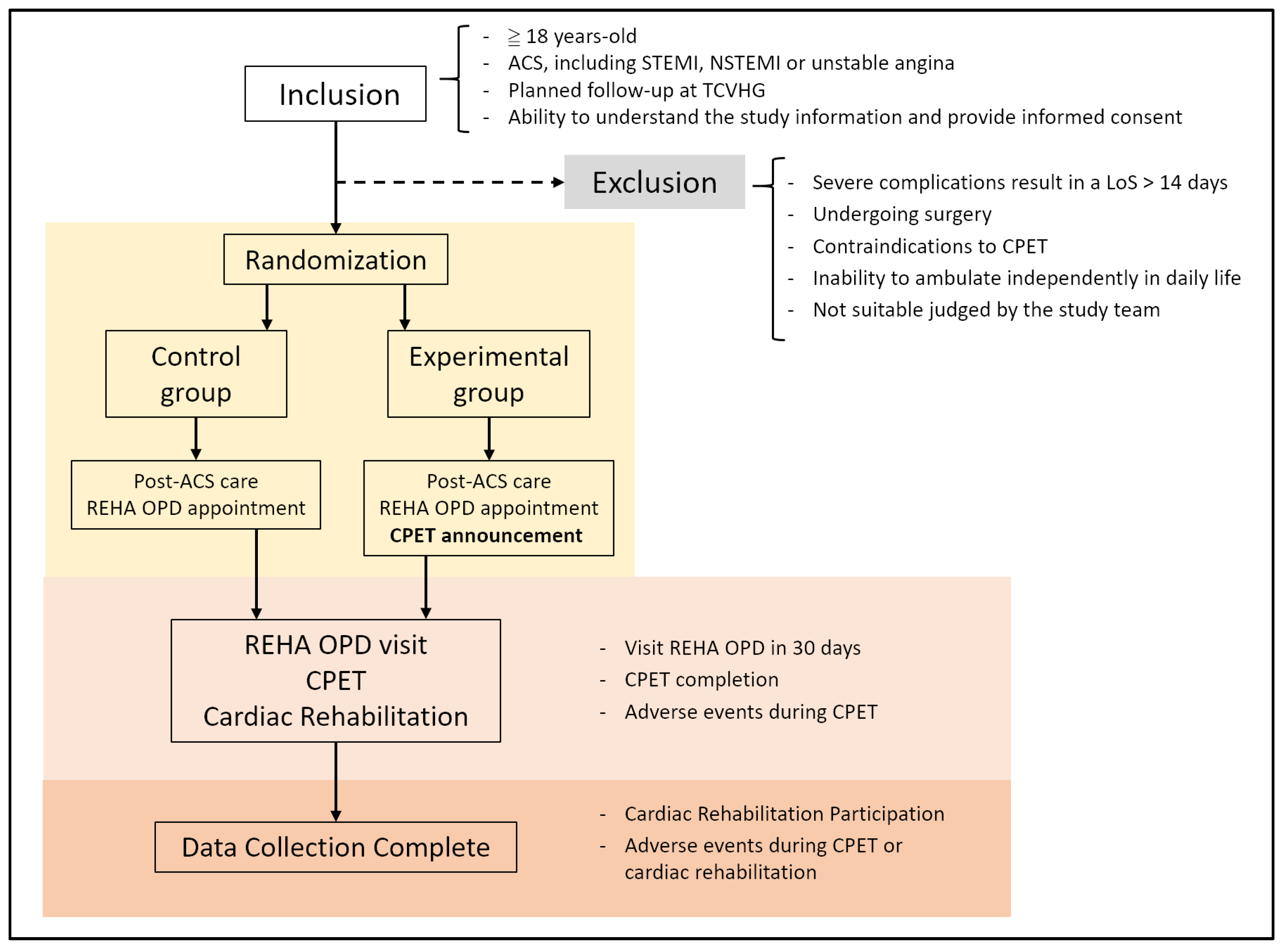
- Aged at least 18 years.
- Hospitalization with a primary diagnosis of ACS, including S-T elevated myocardial infarction (STEMI), non-ST elevated myocardial infarction (NSTEMI), or unstable angina, managed with standard evidence-based therapy.
- Planned post-discharge follow-up at the cardiology outpatient department (OPD) of TCVGH.
- Able to understand the study information and provide written informed consent.
- Severe medical complications during hospitalization resulting in a length of stay (LoS) longer than 14 days, such as respiratory failure or acute kidney injury requiring intensive treatment.
- Undergoing open-heart surgery during the index hospitalization.
- Contraindications to CPET according to contemporary standards [31].
- Severe functional dependence with inability to ambulate independently in daily life due to neurological or musculoskeletal conditions.
- Any other condition judged by the clinical team to make participation unsafe or infeasible.
2.3. Interventions
2.4. Randomization, Allocation Concealment and Blinding
2.5. Outcome and Covariates
- Cardiac rehabilitation program participation: completion of a predefined early rehabilitation course within 12 weeks after discharge, defined as attending at least six supervised rehabilitation sessions.
- CPET completion: whether a CPET is ultimately performed during follow-up, irrespective of group.
- Safety: occurrence of adverse events potentially related to exercise or rehabilitation during the observation period, such as syncope during exercise sessions, sustained arrhythmias requiring urgent management, or emergency department visits or rehospitalization that related to therapeutic exercise
- Demographic factors—age, sex, body mass index (BMI).
- Socioeconomic and lifestyle factors—education level, employment and physical workload, physical activity level prior to ACS, and current smoking status.
- Social context—residential distance from the hospital and whether a family member accompanied the patient during hospitalization.
- Comorbidities—hypertension, diabetes mellitus, dyslipidemia, and renal impairment.
- ACS characteristics—ACS type based on electrocardiographic (ECG) findings (STEMI or NSTEMI), peak creatine kinase (CK) level, left ventricular ejection fraction (LVEF) by ECG, and hospitalization LoS.
2.6. Sample Size Calculation
2.7. Statistical Analysis
2.8. Oversight and Monitoring
2.9. Confidentiality
3. Discussion
3.1. Rationale and Innovation
3.2. Strength and Limitation
3.3. Clinical Implication
4. Conclusions
Author Contributions
Funding
Institutional Review Board Statement
Informed Consent Statement
Data Availability Statement
Acknowledgments
Conflicts of Interest
References
- World Health Organization. Cardiovascular Diseases (CVDs); World Health Organization: Geneva, Switzerland, 2023. [Google Scholar]
- Fuster, V.; Kovacic, J.C. Acute coronary syndromes: Pathology, diagnosis, genetics, prevention, and treatment. Circ. Res. 2014, 114, 1847–1851. [Google Scholar] [CrossRef]
- Bavry, A.A.; Kumbhani, D.J.; Rassi, A.N.; Bhatt, D.L.; Askari, A.T. Benefit of early invasive therapy in acute coronary syndromes: A meta-analysis of contemporary randomized clinical trials. J. Am. Coll. Cardiol. 2006, 48, 1319–1325. [Google Scholar] [CrossRef] [PubMed]
- Kaambwa, B.; Gesesew, H.A.; Horsfall, M.; Chew, D. Quality of life changes in acute coronary syndromes patients: A systematic review and meta-analysis. Int. J. Environ. Res. Public Health 2020, 17, 6889. [Google Scholar] [CrossRef]
- Dibben, G.O.; Faulkner, J.; Oldridge, N.; Rees, K.; Thompson, D.R.; Zwisler, A.D.; Taylor, R.S. Exercise-based cardiac rehabilitation for coronary heart disease: A me-ta-analysis. Eur. Heart J. 2023, 44, 452–469. [Google Scholar] [CrossRef]
- Anderson, L.; Thompson, D.R.; Oldridge, N.; Zwisler, A.D.; Rees, K.; Martin, N.; Taylor, R.S. Exercise-based cardiac rehabilitation for coronary heart disease. Cochrane Database Syst. Rev. 2016, 1, CD001800. [Google Scholar] [CrossRef]
- Virani, S.S.; Newby, L.K.; Arnold, S.V.; Bittner, V.; Brewer, L.C.; Demeter, S.H.; Dixon, D.L.; Fearon, W.F.; Hess, B.; Johnson, H.M.; et al. 2023 AHA/ACC/ACCP/ASPC/NLA/PCNA guideline for the management of patients with chronic coronary disease. Circulation 2023, 148, e9–e119. [Google Scholar] [CrossRef] [PubMed]
- Rao, S.V.; O’Donoghue, M.L.; Ruel, M.; Rab, T.; Tamis-Holland, J.E.; Alexander, J.H.; Baber, U.; Baker, H.; Cohen, M.G.; Cruz-Ruiz, M.; et al. 2025 ACC/AHA/ACEP/NAEMSP/SCAI guideline for the management of patients with acute coronary syndromes. Circulation 2025, 151, e771–e862. [Google Scholar] [CrossRef]
- Choi, H.E.; Kim, C.; Lee, D.J.; Joo, J.E.; Kim, H.S. Participation and prognostic impact of cardiac rehabilitation after acute coronary syndrome: Big-data study of the Korean National Health Insurance Service. J. Korean Med. Sci. 2023, 38, e119. [Google Scholar] [CrossRef]
- Ohtera, S.; Kato, G.; Ueshima, H.; Mori, Y.; Nakatani, Y.; Ozasa, N.; Nakayama, T.; Kuroda, T. A nationwide survey on participation in cardiac rehabilitation among patients with coronary heart disease using health claims data in Japan. Sci. Rep. 2021, 11, 20096. [Google Scholar] [CrossRef]
- Chen, S.; Wang, T.; Yang, H.; Lin, Y.; Lin, C.; Yeh, J. Promoting phase II cardiac rehabilitation for patients with acute myocardial infarction—Post-COVID-19 pandemic experience from one medical center. J. Taiwan Cardiovasc. Interv. 2025, 16, 1–10. [Google Scholar]
- Lin, Y.; Lee, C.; Lan, C.; Chen, S.; Hsiao, S.; Lu, P.; Suen, P.; Chen, M.; Wang, Y.; Lai, J. Phase I cardiac rehabilitation among patients with acute ST-elevation myocardial infarction. Rehabil. Pract. Sci. 2012, 40, 25–33. [Google Scholar] [CrossRef]
- Chen, T.; Li, Y. Contemporary management of ST-segment elevation myocardial infarction in Taiwan: A highlight of 2020 Taiwan STEMI guideline. J. Taiwan Cardiovasc. Interv. 2021, 11, 1–6. [Google Scholar]
- Sugiharto, F.; Nuraeni, A.; Trisyani, Y.; Melati Putri, A.; Aghnia Armansyah, N. Barriers to participation in cardiac rehabilitation among patients with coronary heart disease after reperfusion therapy: A scoping review. Vasc. Health Risk Manag. 2023, 19, 557–570. [Google Scholar] [CrossRef] [PubMed]
- Goodwin, A.M.; Duran, A.T.; Kronish, I.M.; Moise, N.; Sanchez, G.J.; Garber, C.E.; Schwartz, J.E.; Diaz, K.M. Factors associated with objectively measured exercise participation after hospitalization for acute coronary syndrome. Int. J. Cardiol. 2019, 275, 1–5. [Google Scholar] [CrossRef]
- Grace, S.L.; Russell, K.L.; Reid, R.D.; Oh, P.; Anand, S.; Rush, J.; Williamson, K.; Gupta, M.; Alter, D.A.; Stewart, D.E.; et al. Effect of cardiac rehabilitation referral strategies on utilization rates: A prospective, controlled study. Arch. Intern. Med. 2011, 171, 235–241. [Google Scholar] [CrossRef]
- Ades, P.A.; Keteyian, S.J.; Wright, J.S.; Hamm, L.F.; Lui, K.; Newlin, K.; Shepard, D.S.; Thomas, R.J. Increasing cardiac rehabilitation participation from 20% to 70%: A road map from the Million Hearts cardiac rehabilitation collaborative. Mayo Clin. Proc. 2017, 92, 234–242. [Google Scholar] [CrossRef]
- Supervía, M.; Medina-Inojosa, J.R.; Yeung, C.; Lopez-Jimenez, F.; Squires, R.W.; Pérez-Terzic, C.M.; Brewer, L.C.; Leth, S.E.; Thomas, R.J. Cardiac rehabilitation for women: A systematic review of barriers and solutions. Mayo Clin. Proc. 2017, 92, 565–575. [Google Scholar] [CrossRef]
- Colella, T.J.F.; Hardy, M.; Hart, D.; Price, J.A.D.; Sarfi, H.; Mullen, K.A.; Mulvagh, S.; Norris, C.M. The Canadian Women’s Heart Health Alliance Atlas—Chapter 3: Patient perspectives. CJC Open 2021, 3, 229–235. [Google Scholar] [CrossRef]
- Pepera, G.; Antoniou, V.; Su, J.J.; Lin, R.; Batalik, L. Comprehensive and Personalized Approach Is a Critical Area for Developing Remote Cardiac Rehabilitation Programs. World J. Clin. Cases 2024, 12, 2009–2015. [Google Scholar] [CrossRef]
- Antoniou, V.; Kapreli, E.; Davos, C.H.; Batalik, L.; Pepera, G. Safety and Long-Term Outcomes of Remote Cardiac Rehabilitation in Coronary Heart Disease Patients: A Systematic Review. Digit. Health 2024, 10, 20552076241237661. [Google Scholar] [CrossRef]
- Cersosimo, A.; Longo Elia, R.; Condello, F.; Colombo, F.; Pierucci, N.; Arabia, G.; Matteucci, A.; Metra, M.; Adamo, M.; Vizzardi, E.; et al. Cardiac Rehabilitation in Patients with Atrial Fibrillation. Minerva Cardiol. Angiol. 2025, 73, 1–13. [Google Scholar] [CrossRef]
- Santiago de Araújo Pio, C.; Chaves, G.S.; Davies, P.; Taylor, R.S.; Grace, S.L. Interventions to promote patient utilisation of cardiac rehabilitation. Cochrane Database Syst. Rev. 2019, 2, CD007131. [Google Scholar] [CrossRef]
- Gaalema, D.E.; Elliott, R.J.; Savage, P.D.; Rengo, J.L.; Cutler, A.Y.; Pericot-Valverde, I.; Priest, J.S.; Shepard, D.S.; Higgins, S.T.; Ades, P.A. Financial incentives to increase cardiac rehabilitation participation among low-socioeconomic status patients: A randomized clinical trial. JACC Heart Fail. 2019, 7, 537–546. [Google Scholar] [CrossRef]
- Redfern, J.; Singleton, A.C.; Raeside, R.; Santo, K.; Hafiz, N.; Spencer, L.; Leung, R.W.; Roberts, M.; King, M.; Cho, J.G.; et al. Integrated text messaging for people attending cardiac and pulmonary rehabilitation: A multicentre randomised controlled trial. Ann. Phys. Rehabil. Med. 2024, 67, 101800. [Google Scholar] [CrossRef]
- Cruz-Cobo, C.; Bernal-Jiménez, M.Á.; Calle, G.; Gheorghe, L.L.; Gutiérrez-Barrios, A.; Cañadas, D.; Tur, J.A.; Vázquez-García, R.; Santi-Cano, M.J. Efficacy of a mobile health app (eMOTIVA) regarding compliance with cardiac rehabilitation guide-lines in patients with coronary artery disease: Randomized controlled clinical trial. JMIR Mhealth Uhealth 2024, 12, e55421. [Google Scholar] [CrossRef] [PubMed]
- Imran, T.F.; Wang, N.; Zombeck, S.; Balady, G.J. Mobile technology improves adherence to cardiac rehabilitation: A propensity score-matched study. J. Am. Heart Assoc. 2021, 10, e020482. [Google Scholar] [CrossRef] [PubMed]
- Neubeck, L.; Cartledge, S.; Dawkes, S.; Gallagher, R. Is there an app for that? Mobile phones and secondary prevention of cardiovascular disease. Curr. Opin. Cardiol. 2017, 32, 567–571. [Google Scholar] [CrossRef] [PubMed]
- Gallegos-Rejas, V.M.; Rawstorn, J.C.; Gallagher, R.; Mahoney, R.; Thomas, E.E. Key features in telehealth-delivered cardiac rehabilitation required to optimize cardiovascular health in coronary heart disease: A systematic review and realist synthesis. Eur. Heart J. Digit. Health 2024, 5, 208–218. [Google Scholar] [CrossRef]
- Ambrosetti, M.; Abreu, A.; Corrà, U.; Davos, C.H.; Hansen, D.; Frederix, I.; Iliou, M.C.; Pedretti, R.F.E.; Schmid, J.P.; Vigorito, C.; et al. Secondary prevention through comprehensive cardiovascular rehabilitation: From knowledge to implementation—2020 update. Eur. J. Prev. Cardiol. 2021, 28, 460–495. [Google Scholar] [CrossRef]
- Albouaini, K.; Egred, M.; Alahmar, A.; Wright, D.J. Cardiopulmonary exercise testing and its application. Postgrad. Med. J. 2007, 83, 675–682. [Google Scholar] [CrossRef]
- Pedretti, R.F.E.; Hansen, D.; Ambrosetti, M.; Back, M.; Berger, T.; Ferreira, M.C.; Cornelissen, V.; Davos, C.H.; Doehner, W.; de Pablo, Y.; et al. How to optimize adherence to guideline-directed medical therapy in the secondary prevention of cardiovascular diseases: A clinical consensus statement from the European Association of Preventive Cardiology. Eur. J. Prev. Cardiol. 2023, 30, 149–166. [Google Scholar] [CrossRef] [PubMed]
- Lambert, S.D.; Loiselle, C.G. Health information seeking behavior. Qual. Health Res. 2007, 17, 1006–1019. [Google Scholar] [CrossRef]
- Wang, L.Y.T.; Lua, J.Y.H.; Chan, C.X.C.; Ong, R.L.L.; Wee, C.F.; Woo, B.F.Y. Health information needs and dissemination methods for individuals living with ischemic heart disease: A systematic review. Patient Educ. Couns. 2023, 108, 107594. [Google Scholar] [CrossRef]
- Lawson, P.J.; Flocke, S.A. Teachable moments for health behavior change: A concept analysis. Patient Educ. Couns. 2009, 76, 25–30. [Google Scholar] [CrossRef]
- Brust, M.; Gebhardt, W.A.; Ter Hoeve, N.; Numans, M.E.; Kiefte-de Jong, J.C. Exploring timing and delivery of lifestyle advice following an acute cardiac event hospitalization: The cardiac patient’s perspective. Patient Educ. Couns. 2024, 124, 108279. [Google Scholar] [CrossRef]
- Janz, N.K.; Becker, M.H. The health belief model: A decade later. Health Educ. Q. 1984, 11, 1–47. [Google Scholar] [CrossRef] [PubMed]
- Carpenter, C.J. A meta-analysis of the effectiveness of health belief model variables in predicting behavior. Health Commun. 2010, 25, 661–669. [Google Scholar] [CrossRef]
- Chan, A.-W.; Boutron, I.; Hopewell, S.; Moher, D.; Schulz, K.F.; Collins, G.S.; Tunn, R.; Aggarwal, R.; Berkwits, M.; Berlin, J.A.; et al. SPIRIT 2025 statement: Updated guide-line for protocols of randomised trials. BMJ 2025, 389, e081477. [Google Scholar] [CrossRef]
- Pack, Q.R.; Mansour, M.; Barboza, J.S.; Hibner, B.A.; Mahan, M.G.; Ehrman, J.K.; Vanzant, M.A.; Schairer, J.R.; Keteyian, S.J. An Early Appointment to Outpatient Cardiac Rehabilitation at Hospital Discharge Improves Attendance at Orientation: A Randomized, Single-Blind, Controlled Trial. Circulation 2013, 127, 349–355. [Google Scholar] [CrossRef]
- Soldati, S.; Di Martino, M.; Rosa, A.C.; Fusco, D.; Davoli, M.; Mureddu, G. The Impact of In-Hospital Cardiac Rehabilitation Program on Medication Adherence and Clinical Outcomes in Patients with Acute Myocardial Infarction in the Lazio Region of Italy. BMC Cardiovasc. Disord. 2021, 21, 466. [Google Scholar] [CrossRef] [PubMed]
- Fors, A.; Ulin, K.; Cliffordson, C.; Ekman, I.; Brink, E. The Cardiac Self-Efficacy Scale, a Useful Tool with Potential to Evaluate Person-Centred Care. Eur. J. Cardiovasc. Nurs. 2015, 14, 536–543. [Google Scholar] [CrossRef] [PubMed]
- Dankner, R.; Drory, Y.; Geulayov, G.; Ziv, A.; Novikov, I.; Zlotnick, A.Y.; Moshkovitz, Y.; Elami, A.; Schwammenthal, E.; Goldbourt, U.A. Controlled Intervention to Increase Participation in Cardiac Rehabilitation. Eur. J. Prev. Cardiol. 2015, 22, 1121–1128. [Google Scholar] [CrossRef] [PubMed]
- Grace, S.L.; Scholey, P.; Suskin, N.; Arthur, H.M.; Brooks, D.; Jaglal, S.; Abramson, B.L.; Stewart, D.E. A Prospective Comparison of Cardiac Rehabilitation Enrollment Following Automatic Versus Usual Referral. J. Rehabil. Med. 2007, 39, 239–245. [Google Scholar] [CrossRef]
- Brouwers, R.W.M.; Houben, V.J.G.; Kraal, J.J.; Spee, R.F.; Kemps, H.M.C. Predictors of Cardiac Rehabilitation Referral, Enrolment and Completion after Acute Myocardial Infarction: An Exploratory Study. Neth. Heart J. 2021, 29, 151–157. [Google Scholar] [CrossRef] [PubMed]
- Parashar, S.; Spertus, J.A.; Tang, F.; Bishop, K.L.; Vaccarino, V.; Jackson, C.F.; Boyden, T.F.; Sperling, L. Predictors of Early and Late Enrollment in Cardiac Rehabilitation among Those Referred after Acute Myocardial Infarction. Circulation 2012, 126, 1587–1595. [Google Scholar] [CrossRef]

Disclaimer/Publisher’s Note: The statements, opinions and data contained in all publications are solely those of the individual author(s) and contributor(s) and not of MDPI and/or the editor(s). MDPI and/or the editor(s) disclaim responsibility for any injury to people or property resulting from any ideas, methods, instructions or products referred to in the content. |
© 2026 by the authors. Licensee MDPI, Basel, Switzerland. This article is an open access article distributed under the terms and conditions of the Creative Commons Attribution (CC BY) license.
Share and Cite
Lee, Y.; Huang, C.-Y.; Ho, H.; Cheng, Y.-Y. Effectiveness of Cardiopulmonary Exercise Testing as an Incentive to Enhance Outpatient Cardiac Rehabilitation Participation in Acute Coronary Syndrome Survivors: A Study Protocol for a Randomized Controlled Trial with Determinant Analysis. J. Clin. Med. 2026, 15, 319. https://doi.org/10.3390/jcm15010319
Lee Y, Huang C-Y, Ho H, Cheng Y-Y. Effectiveness of Cardiopulmonary Exercise Testing as an Incentive to Enhance Outpatient Cardiac Rehabilitation Participation in Acute Coronary Syndrome Survivors: A Study Protocol for a Randomized Controlled Trial with Determinant Analysis. Journal of Clinical Medicine. 2026; 15(1):319. https://doi.org/10.3390/jcm15010319
Chicago/Turabian StyleLee, Yuchun, Chin-Yin Huang, Hungchin Ho, and Yuan-Yang Cheng. 2026. "Effectiveness of Cardiopulmonary Exercise Testing as an Incentive to Enhance Outpatient Cardiac Rehabilitation Participation in Acute Coronary Syndrome Survivors: A Study Protocol for a Randomized Controlled Trial with Determinant Analysis" Journal of Clinical Medicine 15, no. 1: 319. https://doi.org/10.3390/jcm15010319
APA StyleLee, Y., Huang, C.-Y., Ho, H., & Cheng, Y.-Y. (2026). Effectiveness of Cardiopulmonary Exercise Testing as an Incentive to Enhance Outpatient Cardiac Rehabilitation Participation in Acute Coronary Syndrome Survivors: A Study Protocol for a Randomized Controlled Trial with Determinant Analysis. Journal of Clinical Medicine, 15(1), 319. https://doi.org/10.3390/jcm15010319