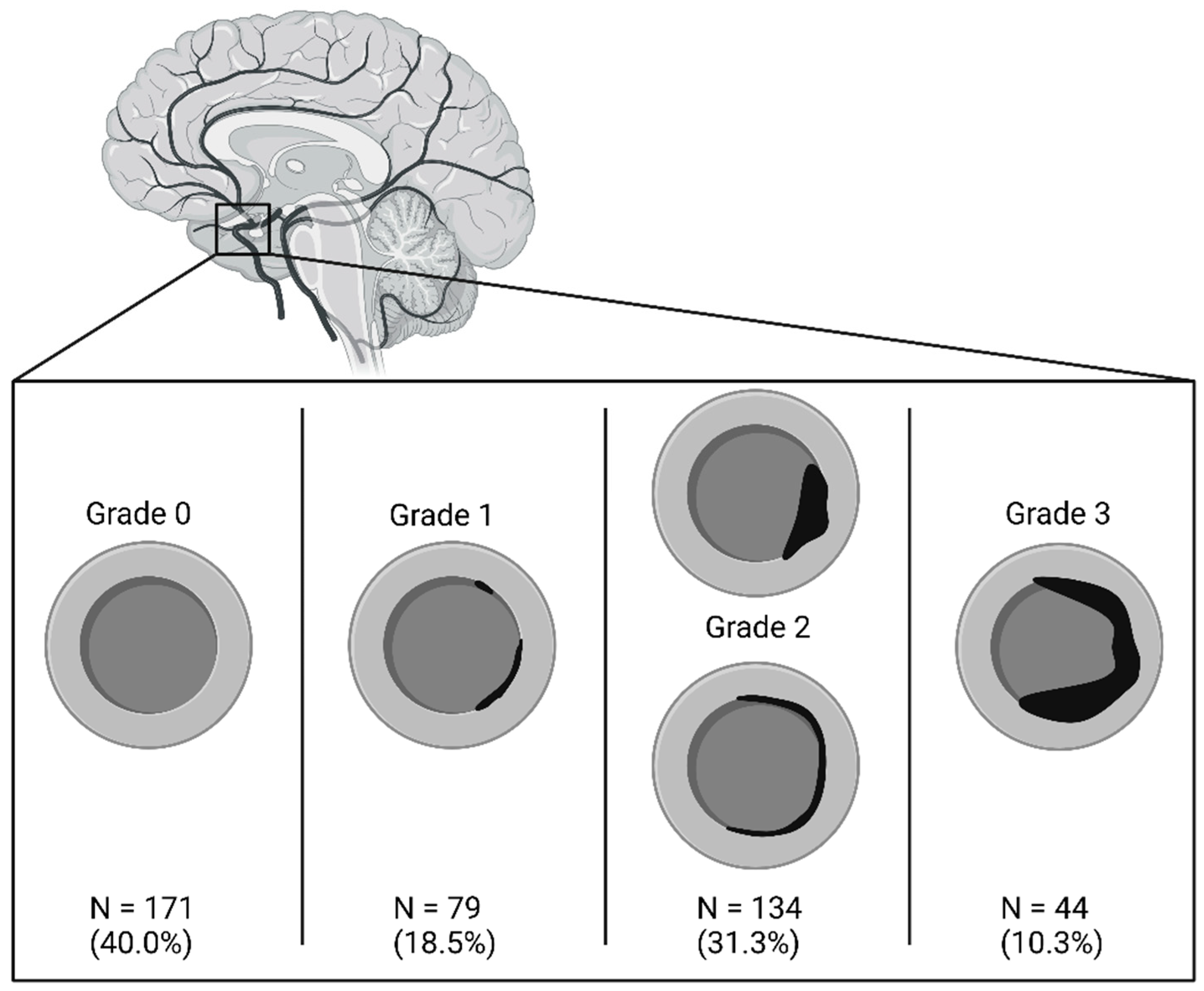
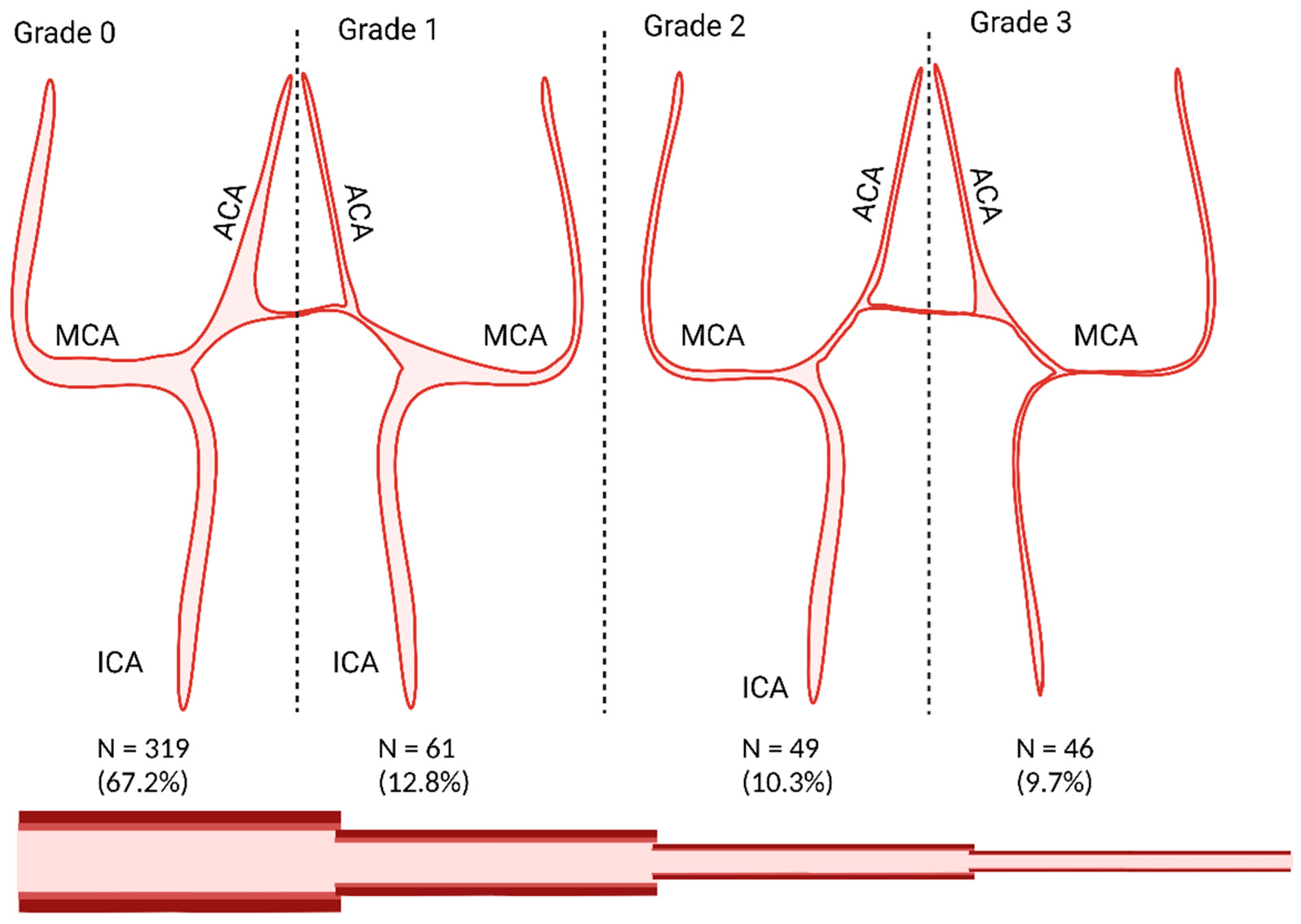
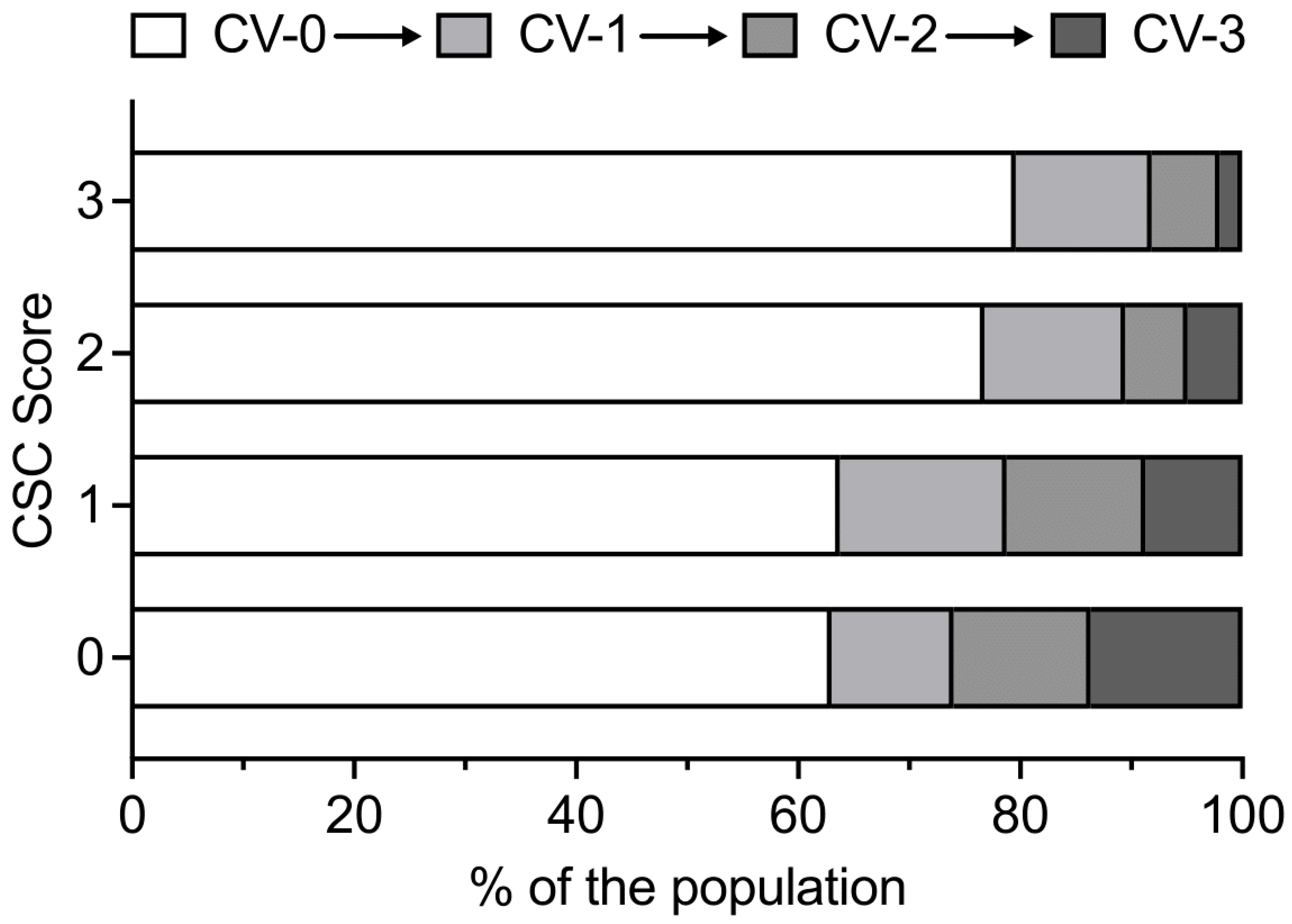
Calcification of the Internal Carotid Artery and Its Influence on the Severity of Cerebral Vasospasm in Aneurysmal Subarachnoid Hemorrhage
 , , , , ,
  and
and
Abstract
1. Introduction
2. Materials and Methods
2.1. Treatment Process
2.2. Data Management and Statistics
3. Results
4. Discussion
5. Conclusions
Author Contributions
Funding
Institutional Review Board Statement
Informed Consent Statement
Data Availability Statement
Acknowledgments
Conflicts of Interest
Abbreviations
| CV | Cerebral vasospasm |
| aSAH | Aneurysmal subarachnoid hemorrhage |
| CSC | Carotid siphon calcification |
| TCD | Transcranial Doppler |
| DIND | Delayed ischemic neurological deficit |
| aOR | Adjusted odds ratio |
| CI | Confidence interval |
| RC | Regression coefficient |
| DCI | Delayed cerebral ischemia |
| CT | Computer tomography |
| DSA | Digital subtraction angiography |
| ICP | Intracranial pressure |
| CBFV | Cerebral blood flow velocity |
| WFNS | World Federation of Neurosurgical Societies |
| mRS | Modified ranking scale |
| SD | Standard deviation |
| ICA | Internal carotid artery |
| MCA | Middel cerebral artery |
| ACA | Anterior cerebral artery |
References
- Romenskaya, T.; Longhitano, Y.; Piccolella, F.; Berger, J.M.; Artico, M.; Taurone, S.; Maconi, A.; Saviano, A.; Caramuta, M.; Savioli, G.; et al. Cerebral Vasospasm: Practical Review of Diagnosis and Management. Rev. Recent. Clin. Trials 2023, 18, 12–18. [Google Scholar] [CrossRef]
- Jabbarli, R.; Pierscianek, D.; Rölz, R.; Oppong, M.D.; Kaier, K.; Shah, M.; Taschner, C.; Mönninghoff, C.; Urbach, H.; Beck, J.; et al. Endovascular treatment of cerebral vasospasm after subarachnoid hemorrhage: More is more. Neurology 2019, 93, e458–e466. [Google Scholar] [CrossRef]
- Rumalla, K.; Lin, M.; Ding, L.; Gaddis, M.; Giannotta, S.L.; Attenello, F.J.; Mack, W.J. Risk Factors for Cerebral Vasospasm in Aneurysmal Subarachnoid Hemorrhage: A Population-Based Study of 8346 Patients. World Neurosurg. 2021, 145, e233–e241. [Google Scholar] [CrossRef]
- Fisher, C.M.; Kistler, J.P.; Davis, J.M. Relation of cerebral vasospasm to subarachnoid hemorrhage visualized by computerized tomographic scanning. Neurosurgery 1980, 6, 1–9. [Google Scholar] [CrossRef] [PubMed]
- Colip, C.G.; Wo, S.; Hippe, D.S.; Watase, H.; Urdaneta-Moncada, A.R.; Zhu, C.; Wu, L.; Vranic, J.E.; Kelly, C.M.; Levitt, M.R.; et al. Computed tomography angiography findings predictive of post-intervention vasospasm in patients with aneurysmal subarachnoid hemorrhage. Br. J. Radiol. 2021, 94, 20200893. [Google Scholar] [CrossRef] [PubMed]
- Hussein, H.M.; Zacharatos, H.; Cordina, S.; Lakshminarayan, K.; Ezzeddine, M.A. Intracranial vascular calcification is protective from vasospasm after aneurysmal subarachnoid hemorrhage. J. Stroke Cerebrovasc. Dis. 2014, 23, 2687–2693. [Google Scholar] [CrossRef]
- Jayaweera, M.; Hernandez, A.; Haripottawekul, A.; Stretz, C.; Furie, K.L.; Yaghi, S.; Mahta, A. Impact of intracranial atherosclerosis burden on vasospasm risk and outcomes in aneurysmal subarachnoid hemorrhage. J. Stroke Cerebrovasc. Dis. 2024, 33, 108077. [Google Scholar] [CrossRef] [PubMed]
- Engel, A.; Song, L.; Rauschenbach, L.; Gümüs, M.; Santos, A.N.; Dinger, T.F.; Oppong, M.D.; Li, Y.; Gembruch, O.; Ahmadipour, Y.; et al. Impact of Carotid Siphon Calcification on the Course and Outcome of Patients with Aneurysmal Subarachnoid Hemorrhage. Stroke 2024, 55, 2305–2314. [Google Scholar] [CrossRef]
- Gotovac, N.; Išgum, I.; Viergever, M.A.; Biessels, G.J.; Fajdić, J.; Velthuis, B.K.; Prokop, M. Calcium at the carotid siphon as an indicator of internal carotid artery stenosis. Eur. Radiol. 2013, 23, 1478–1486. [Google Scholar] [CrossRef]
- Kohn, J.C.; Lampi, M.C.; Reinhart-King, C.A. Age-related vascular stiffening: Causes and consequences. Front. Genet. 2015, 6, 112. [Google Scholar] [CrossRef]
- Muhire, G.; Iulita, M.F.; Vallerand, D.; Youwakim, J.; Gratuze, M.; Petry, F.R.; Planel, E.; Ferland, G.; Girouard, H. Arterial Stiffness Due to Carotid Calcification Disrupts Cerebral Blood Flow Regulation and Leads to Cognitive Deficits. J. Am. Heart Assoc. 2019, 8, e011630. [Google Scholar] [CrossRef]
- Yamaki, V.; Cavalcanti, D.; Figueiredo, E. Delayed Ischemic Neurologic Deficit after Aneurysmal Subarachnoid Hemorrhage. Asian J. Neurosurg. 2019, 14, 641–647. [Google Scholar] [CrossRef]
- Woodcock, R.J., Jr.; Goldstein, J.H.; Kallmes, D.F.; Cloft, H.J.; Phillips, C.D. Angiographic correlation of CT calcification in the carotid siphon. AJNR Am. J. Neuroradiol. 1999, 20, 495–499. [Google Scholar] [PubMed]
- Merkel, H.; Lindner, D.; Gaber, K.; Ziganshyna, S.; Jentzsch, J.; Mucha, S.; Gerhards, T.; Sari, S.; Stock, A.; Vothel, F.; et al. Standardized Classification of Cerebral Vasospasm after Subarachnoid Hemorrhage by Digital Subtraction Angiography. J. Clin. Med. 2022, 11, 2011. [Google Scholar] [CrossRef] [PubMed]
- Drake, C.G. Report of World Federation of Neurological Surgeons Committee on a Universal Subarachnoid Hemorrhage Grading Scale. J. Neurosurg. 1988, 68, 985–986. [Google Scholar] [CrossRef]
- van Swieten, J.C.; Koudstaal, P.J.; Visser, M.C.; Schouten, H.J.; van Gijn, J. Interobserver agreement for the assessment of handicap in stroke patients. Stroke 1988, 19, 604–607. [Google Scholar] [CrossRef] [PubMed]
- Vos, A.; Kockelkoren, R.; de Vis, J.B.; van der Schouw, Y.T.; van der Schaaf, I.C.; Velthuis, B.K.; Mali, W.P.; de Jong, P.A.; Majoie, C.; Roos, Y.; et al. Risk factors for atherosclerotic and medial arterial calcification of the intracranial internal carotid artery. Atherosclerosis 2018, 276, 44–49. [Google Scholar] [CrossRef]
- Li, M.; Hu, Y.-H.; Chen, G. Relationship between cerebral vasospasm and delayed ischemic neurological deficit. Zhejiang Da Xue Xue Bao Yi Xue Ban 2006, 35, 215–218. [Google Scholar]
- Seule, M.; Muroi, C.; Sikorski, C.; Keller, E. Monitoring of cerebral hemodynamics and oxygenation to detect delayed ischemic neurological deficit after aneurysmal subarachnoid hemorrhage. Acta Neurochir. Suppl. 2013, 115, 57–61. [Google Scholar]
- Li, J.; Fan, Y.; Zhang, J.; Xing, S.; Tang, S.; Li, X.; Dang, C.; Zeng, J. Silent brain infarction is associated with carotid siphon calcification in ischemic stroke patients. Neuroimage Clin. 2022, 35, 103050. [Google Scholar] [CrossRef]
- Bos, D.; Portegies, M.L.; van der Lugt, A.; Bos, M.J.; Koudstaal, P.J.; Hofman, A.; Krestin, G.P.; Franco, O.H.; Vernooij, M.W.; Ikram, M.A. Intracranial carotid artery atherosclerosis and the risk of stroke in whites: The Rotterdam Study. J. Am. Med. Assoc. Neurol. 2014, 71, 405–411. [Google Scholar] [CrossRef] [PubMed]
- Vinke, E.J.; Yilmaz, P.; van der Toorn, J.E.; Fakhry, R.; Frenzen, K.; Dubost, F.; Licher, S.; de Bruijne, M.; Kavousi, M.; Ikram, M.A.; et al. Intracranial arteriosclerosis is related to cerebral small vessel disease: A prospective cohort study. Neurobiol. Aging 2021, 105, 16–24. [Google Scholar] [CrossRef] [PubMed]
- Wu, X.-H.; Chen, X.-Y.; Fan, Y.-H.; Leung, T.W.-H.; Wong, K.-S. High Extent of Intracranial Carotid Artery Calcification Is Associated with Downstream Microemboli in Stroke Patients. J. Stroke Cerebrovasc. Dis. 2017, 26, 442–447. [Google Scholar] [CrossRef] [PubMed]



| Mean (±SD), Median (IQR) or Total Amount (Relative Amount) | |
|---|---|
| Maximum CSC value | 1 (0–2) |
| Patient age | 55.83 (±14.04) |
| Patient sex (female) | 320 (67.4%) |
| Smoking status (yes) | 155 (32.6%) |
| Fisher grade (3 or 4) | 391 (86.1%) |
| WFNS grade (4 or 5) | 195 (41.1%) |
| Aneurysm occlusion (microsurgical) | 267 (56.2%) |
| ICP crisis (>20 mmHg) | 152 (32.3%) |
| Maximum angiographic CV per patient | 0 (0–1) |
| Increased CBFV (>120 cm/s) | 216 (48.4%) |
| Days of increased CBFV (>120 cm/s) | 2.33 (±3.39) |
| Maximum CBFV by TCD | 158.53 (±50.68) |
| Angiographic CV Present | Increased TCD Values (>120 cm/s) | DIND | ||||
|---|---|---|---|---|---|---|
| aOR (95% CI) | p-Value | aOR (95% CI) | p-Value | aOR (95% CI) | p-Value | |
| CSC, per-point increase | 0.76 (0.60–0.97) | 0.025 | 0.87 (0.68–1.11) | 0.265 | 0.76 (0.59–0.98) | 0.034 |
| Patient age, per-year increase | 0.98 (0.96–1.00) | 0.030 | 0.95 (0.94–0.97) | <0.001 | 1.01 (0.99–1.02) | 0.615 |
| Patient sex (female) | 1.16 (0.75–1.81) | 0.503 | 1.07 (0.68–1.69) | 0.768 | 1.06 (0.67–1.68) | 0.816 |
| Smoking status (yes) | 0.56 (0.35–0.88) | 0.012 | 0.54 (0.34–0.86) | 0.009 | 0.70 (0.43–1.15) | 0.157 |
| Fisher grade (3 or 4) | 1.96 (0.98–3.91) | 0.057 | 2.03 (1.07–3.87) | 0.031 | 1.22 (0.59–2.56) | 0.587 |
| WFNS grade (4 or 5) | 0.73 (0.45–1.16) | 0.183 | 0.88 (0.54–1.44) | 0.612 | 0.84 (0.51–1.37) | 0.477 |
| Aneurysm occlusion (microsurgical) | 1.61 (1.04–2.49) | 0.035 | 1.66 (1.06–2.61) | 0.028 | 0.92 (0.57–1.47) | 0.719 |
| ICP crisis (>20 mmHg) | 1.92 (1.19–3.11) | 0.008 | 2.85 (1.72–4.72) | <0.001 | 1.94 (1.16–3.23) | 0.010 |
| Severity of Angiographic CV | Severity of TCD CV (Measured by the Maximum CBFV) * | Days of Increased TCD Values (>120 cm/s) | ||||
|---|---|---|---|---|---|---|
| Prediction of CV Severity | Regression Coefficients (95% CI) | p-Value | Regression Coefficients (95% CI) | p-Value | Regression Coefficients (95% CI) | p-Value |
| CSC, per-point increase | −0.14 (−0.24 to −0.04) | 0.006 | +1.57 (−7.45 to +10.58) | 0.731 | −0.43 (−0.77 to −0.10) | 0.010 |
| Patient age, per-year increase | −0.01 (−0.02 to +0.00) | 0.038 | −0.97 (−1.82 to −0.12) | 0.026 | −0.07 (−0.09 to −0.05) | <0.001 |
| Patient sex (female) | +0.13 (−0.06 to +0.31) | 0.184 | +2.45 (−16.17 to +21.06) | 0.795 | +0.44 (−0.18 to +1.06) | 0.167 |
| Smoking status (yes) | −0.23 (−0.42 to −0.04) | 0.019 | −11.79 (−30.26 to +6.68) | 0.208 | −0.57 (−1.20 to +0.07) | 0.079 |
| Fisher grade (3 or 4) | +0.23 (−0.04 to +0.50) | 0.088 | +66.126 (+23.36 to 108.89) | 0.003 | +1.17 (+0.31 to +2.03) | 0.008 |
| WFNS grade (4 or 5) | −0.11 (−0.31 to +0.09) | 0.301 | −4.73 (−26.73 to +17.28) | 0.671 | +0.19 (−0.48 to +0.85) | 0.583 |
| Aneurysm occlusion (microsurgical) | +0.15 (−0.04 to +0.34) | 0.132 | −6.29 (−25.21 to +12.64) | 0.511 | +1.158 (+0.53 to +1.78) | <0.001 |
| ICP crisis (>20 mmHg) | +0.33 (+0.11 to +0.55) | 0.003 | +34.99 (+13.07 to +56.91) | 0.002 | +0.93 (+0.23 to 1.63) | 0.009 |
| Prediction of mRS 6 Months After Discharge | Regression Coefficients (95% CI) | p-Value |
|---|---|---|
| CSC, per-point increase | +0.17 (+0.11 to +0.24) | <0.001 |
| Severity of radiologic CV | +0.12 (+0.05 to +0.18) | <0.001 |
| Patient age, per-year increase | +0.04 (+0.03 to +0.04) | <0.001 |
| Patient sex (female) | −0.16 (−0.28 to −0.03) | 0.014 |
| Smoking status (yes) | −0.58 (−0.71 to −0.46) | <0.001 |
| Fisher grade (3 or 4) | +0.34 (+0.16 to +0.52) | <0.001 |
| WFNS grade (4 or 5) | +1.23 (+1.09 to +1.37) | <0.001 |
| Aneurysm occlusion (microsurgical) | −0.08 (−0.20 to +0.05) | 0.214 |
| ICP crisis (>20 mmHg) | +1.37 (+1.22 to +1.5) | <0.001 |
Disclaimer/Publisher’s Note: The statements, opinions and data contained in all publications are solely those of the individual author(s) and contributor(s) and not of MDPI and/or the editor(s). MDPI and/or the editor(s) disclaim responsibility for any injury to people or property resulting from any ideas, methods, instructions or products referred to in the content. |
© 2025 by the authors. Licensee MDPI, Basel, Switzerland. This article is an open access article distributed under the terms and conditions of the Creative Commons Attribution (CC BY) license.
Share and Cite
Engel, A.; Rauschenbach, L.; Rexhepi, A.; Gümüs, M.; Rieß, C.; Rodemerk, J.; Song, L.; Li, Y.; Schmidt, B.; Ahmadipour, Y.; et al. Calcification of the Internal Carotid Artery and Its Influence on the Severity of Cerebral Vasospasm in Aneurysmal Subarachnoid Hemorrhage. J. Clin. Med. 2026, 15, 168. https://doi.org/10.3390/jcm15010168
Engel A, Rauschenbach L, Rexhepi A, Gümüs M, Rieß C, Rodemerk J, Song L, Li Y, Schmidt B, Ahmadipour Y, et al. Calcification of the Internal Carotid Artery and Its Influence on the Severity of Cerebral Vasospasm in Aneurysmal Subarachnoid Hemorrhage. Journal of Clinical Medicine. 2026; 15(1):168. https://doi.org/10.3390/jcm15010168
Chicago/Turabian StyleEngel, Adrian, Laurèl Rauschenbach, Argtim Rexhepi, Meltem Gümüs, Christoph Rieß, Jan Rodemerk, Li Song, Yan Li, Börge Schmidt, Yahya Ahmadipour, and et al. 2026. "Calcification of the Internal Carotid Artery and Its Influence on the Severity of Cerebral Vasospasm in Aneurysmal Subarachnoid Hemorrhage" Journal of Clinical Medicine 15, no. 1: 168. https://doi.org/10.3390/jcm15010168
APA StyleEngel, A., Rauschenbach, L., Rexhepi, A., Gümüs, M., Rieß, C., Rodemerk, J., Song, L., Li, Y., Schmidt, B., Ahmadipour, Y., Dammann, P., Darkwah Oppong, M., Sure, U., & Jabbarli, R. (2026). Calcification of the Internal Carotid Artery and Its Influence on the Severity of Cerebral Vasospasm in Aneurysmal Subarachnoid Hemorrhage. Journal of Clinical Medicine, 15(1), 168. https://doi.org/10.3390/jcm15010168