Prospective Analysis of Perioperative Stress Response in Living Donor Liver Transplantation for Hepatitis B-Related Liver Disease

 ,
,  , , , , and
Abstract
1. Introduction
2. Materials and Methods
2.1. Study Design, Setting, Ethical Approval, and Funding
2.2. Study Population and Sample Size Calculation
2.3. Inclusion and Exclusion Criteria
2.4. Study Parameters
2.4.1. Demographic, Clinical and Surgical Characteristics of the Patients
2.4.2. Basic Biochemical and Hematological Parameters
2.4.3. Specific Biochemical Parameters
2.5. Basic Immunosuppressive Protocol
2.6. Statistical Analyses
3. Results
3.1. Comparison of LDLT Recipients and LLDs Groups
3.2. Intragroup Comparisons
3.2.1. Intragroup Comparison in the LDLT Recipients Group
3.2.2. Intragroup Comparison in LLDs Group
3.3. Comparison of Temporal Cytokine and Biochemical Marker Profiles Between LLDs and LDLT Recipients
4. Discussion
Limitations
5. Conclusions
Supplementary Materials
Author Contributions
Funding
Institutional Review Board Statement
Informed Consent Statement
Data Availability Statement
Acknowledgments
Conflicts of Interest
References
- Starzl, T.E.; Groth, C.G.; Brettschneider, L.; Moon, J.B.; Fulginiti, V.A.; Cotton, E.K.; Porter, K.A. Extended survival in 3 cases of orthotopic homotransplantation of the human liver. Surgery 1968, 63, 549–563. [Google Scholar] [CrossRef] [PubMed][Green Version]
- Akbulut, S.; Ozer, A.; Saritas, H.; Yilmaz, S. Factors affecting anxiety, depression, and self-care ability in patients who have undergone liver transplantation. World J. Gastroenterol. 2021, 27, 6967–6984. [Google Scholar] [CrossRef] [PubMed]
- Akbulut, S.; Yilmaz, S. Liver transplantation in Turkey: Historical review and future perspectives. Transplant. Rev. 2015, 29, 161–167. [Google Scholar] [CrossRef] [PubMed]
- Raia, S.; Nery, J.R.; Mies, S. Liver transplantation from live donors. Lancet 1989, 2, 497. [Google Scholar] [CrossRef]
- Trefts, E.; Gannon, M.; Wasserman, D.H. The liver. Curr. Biol. 2017, 27, R1147–R1151. [Google Scholar] [CrossRef]
- Hann, A.; Osei-Bordom, D.C.; Neil, D.A.H.; Ronca, V.; Warner, S.; Perera, M. The Human Immune Response to Cadaveric and Living Donor Liver Allografts. Front. Immunol. 2020, 11, 1227. [Google Scholar] [CrossRef]
- Lan, A.K.; Luk, H.N.; Goto, S.; Chen, S.M.; Eng, H.L.; Chen, Y.S.; de Villa, V.H.; Wang, C.C.; Cheng, Y.F.; Chen, C.L.; et al. Stress response to hepatectomy in patients with a healthy or a diseased liver. World J. Surg. 2003, 27, 761–764. [Google Scholar] [CrossRef]
- Wang, R.; Peng, X.; Yuan, Y.; Shi, B.; Liu, Y.; Ni, H.; Guo, W.; Yang, Q.; Liu, P.; Wang, J.; et al. Dynamic immune recovery process after liver transplantation revealed by single-cell multi-omics analysis. Innovation 2024, 5, 100599. [Google Scholar] [CrossRef]
- Watt, D.G.; Horgan, P.G.; McMillan, D.C. Routine clinical markers of the magnitude of the systemic inflammatory response after elective operation: A systematic review. Surgery 2015, 157, 362–380. [Google Scholar] [CrossRef]
- Chen, G.; Hu, X.; Huang, Y.; Xiang, X.; Pan, S.; Chen, R.; Xu, X. Role of the immune system in liver transplantation and its implications for therapeutic interventions. MedComm 2023, 4, e444. [Google Scholar] [CrossRef]
- Jin, S.; Fu, Q.; Wuyun, G.; Wuyun, T. Management of post-hepatectomy complications. World J. Gastroenterol. 2013, 19, 7983–7991. [Google Scholar] [CrossRef]
- Van der Kloott, W. William Maddock Bayliss’s therapy for wound shock. Notes Rec. R. Soc. Lond. 2010, 64, 271–286. [Google Scholar] [CrossRef] [PubMed]
- Burk, A.M.; Martin, M.; Flierl, M.A.; Rittirsch, D.; Helm, M.; Lampl, L.; Bruckner, U.; Stahl, G.L.; Blom, A.M.; Perl, M.; et al. Early complementopathy after multiple injuries in humans. Shock 2012, 37, 348–354. [Google Scholar] [CrossRef]
- Cannon, J.G.; Friedberg, J.S.; Gelfand, J.A.; Tompkins, R.G.; Burke, J.F.; Dinarello, C.A. Circulating interleukin-1 beta and tumor necrosis factor-alpha concentrations after burn injury in humans. Crit. Care Med. 1992, 20, 1414–1419. [Google Scholar] [CrossRef]
- Baigrie, R.J.; Lamont, P.M.; Kwiatkowski, D.; Dallman, M.J.; Morris, P.J. Systemic cytokine response after major surgery. Br. J. Surg. 1992, 79, 757–760. [Google Scholar] [CrossRef] [PubMed]
- Simsek, T.; Simsek, H.U.; Canturk, N.Z. Response to trauma and metabolic changes: Posttraumatic metabolism. Ulus. Cerrahi Derg. 2014, 30, 153–159. [Google Scholar] [CrossRef]
- Kovtun, A.; Messerer, D.A.C.; Scharffetter-Kochanek, K.; Huber-Lang, M.; Ignatius, A. Neutrophils in Tissue Trauma of the Skin, Bone, and Lung: Two Sides of the Same Coin. J. Immunol. Res. 2018, 2018, 8173983. [Google Scholar] [CrossRef]
- Chadda, K.R.; Puthucheary, Z. Persistent inflammation, immunosuppression, and catabolism syndrome (PICS): A review of definitions, potential therapies, and research priorities. Br. J. Anaesth. 2024, 132, 507–518. [Google Scholar] [CrossRef] [PubMed]
- Saat, T.C.; Susa, D.; Kok, N.F.; van den Engel, S.; Roest, H.P.; van der Laan, L.J.; JN, I.J.; de Bruin, R.W. Inflammatory genes in rat livers from cardiac- and brain death donors. J. Surg. Res. 2015, 198, 217–227. [Google Scholar] [CrossRef]
- Zeytunlu, M.; Uguz, A.; Unalp, O.; Ergun, O.; Karasu, Z.; Gunsar, F.; Akarca, U.; Yilmaz, F.; Turan, I.; Nart, D.; et al. Results of 1001 liver transplantations in 23 years: Ege University experience. Turk. J. Gastroenterol. 2018, 29, 664–668. [Google Scholar] [CrossRef]
- Akarsu, M.; Dolu, S.; Harputluoglu, M.; Yilmaz, S.; Akyildiz, M.; Gencdal, G.; Polat, K.Y.; Dincer, D.; Adanir, H.; Turan, I.; et al. Changing trends in the etiology of liver transplantation in Turkiye: A multicenter study. Hepatol. Forum 2024, 5, 3–6. [Google Scholar] [CrossRef]
- Dalda, Y.; Akbulut, S.; Sahin, T.T.; Tuncer, A.; Ogut, Z.; Satilmis, B.; Dalda, O.; Gul, M.; Yilmaz, S. The Effect of Pringle Maneuver Applied during Living Donor Hepatectomy on the Ischemia-Reperfusion Injury Observed in the Donors and Recipients. Medicina 2024, 60, 649. [Google Scholar] [CrossRef]
- Usta, S.; Akbulut, S.; Sarici, K.B.; Garzali, I.U.; Ozdemir, F.; Gonultas, F.; Baskiran, A.; Isik, B.; Yilmaz, S. An Elbow Patch Reconstruction Technique for Narrowed Remnant Portal Veins during Right Lobe Living Donor Hepatectomy: A Rescue Surgery. J. Clin. Med. 2024, 13, 2924. [Google Scholar] [CrossRef] [PubMed]
- Yilmaz, S.; Akbulut, S.; Usta, S.; Ozsay, O.; Sahin, T.T.; Sarici, K.B.; Karabulut, E.; Baskiran, A.; Gonultas, F.; Ozdemir, F.; et al. Diagnostic and therapeutic management algorithm for biliary complications in living liver donors. Transpl. Int. 2021, 34, 2226–2237. [Google Scholar] [CrossRef] [PubMed]
- Yilmaz, S.; Kayaalp, C.; Isik, B.; Ersan, V.; Otan, E.; Akbulut, S.; Dirican, A.; Kutlu, R.; Kahraman, A.S.; Ara, C.; et al. Reconstruction of Anomalous Portal Venous Branching in Right Lobe Living Donor Liver Transplantation: Malatya Approach. Liver Transpl. 2017, 23, 751–761. [Google Scholar] [CrossRef]
- Ozgul, U.; Ucar, M.; Erdogan, M.A.; Aydogan, M.S.; Toprak, H.I.; Colak, C.; Durmus, M.; Ersoy, M.O. Effects of isoflurane and propofol on hepatic and renal functions and coagulation profile after right hepatectomy in living donors. Transplant. Proc. 2013, 45, 966–970. [Google Scholar] [CrossRef]
- Sayan, H.; Aydogan, M.S.; Bicakcioglu, M.; Toprak, H.I.; Isik, B.; Yilmaz, S. Effects of Thoracic Epidural Anesthesia on Liver Blood Flow and Indocyanine Green Clearance Test in Living-Donor Liver Transplantation: A Prospective, Randomized, Double-Blind Study. Transplant. Proc. 2015, 47, 1462–1465. [Google Scholar] [CrossRef] [PubMed]
- Aktas, A.; Kayaalp, C.; Gunes, O.; Gokler, C.; Uylas, U.; Cicek, E.; Ersoy, Y.; Kose, A.; Bayindir, Y.; Aydin, C.; et al. Surgical site infection and risk factors following right lobe living donor liver transplantation in adults: A single-center prospective cohort study. Transpl. Infect. Dis. 2019, 21, e13176. [Google Scholar] [CrossRef]
- Kose, A.; Altunisik Toplu, S.; Akbulut, S.; Yasar, S.; Sarici, K.B.; Duman, Y.; Kutlu, R.; Isik, B.; Colak, Y.Z.; Yilmaz, S.; et al. Evaluation of clinical characteristics and outcomes of postoperative infections in living liver donors. Int. J. Clin. Pract. 2021, 75, e14324. [Google Scholar] [CrossRef]
- Clavien, P.A.; Camargo, C.A., Jr.; Gorczynski, R.; Washington, M.K.; Levy, G.A.; Langer, B.; Greig, P.D. Acute reactant cytokines and neutrophil adhesion after warm ischemia in cirrhotic and noncirrhotic human livers. Hepatology 1996, 23, 1456–1463. [Google Scholar] [CrossRef]
- Murtha-Lemekhova, A.; Fuchs, J.; Ghamarnejad, O.; Nikdad, M.; Probst, P.; Hoffmann, K. Influence of cytokines, circulating markers and growth factors on liver regeneration and post-hepatectomy liver failure: A systematic review and meta-analysis. Sci. Rep. 2021, 11, 13739. [Google Scholar] [CrossRef]
- Aubrecht, J.; Potter, D.; Sauer, J.M.; Warner, R.; Johnson, K.J.; McGill, M.R.; Peron, K.; King, N.M.P. Serum glutamate dehydrogenase activity enables sensitive and specific diagnosis of hepatocellular injury in humans. Toxicol. Sci. 2025, 203, 171–180. [Google Scholar] [CrossRef] [PubMed]
- Church, R.J.; Schomaker, S.J.; Eaddy, J.S.; Boucher, G.G.; Kreeger, J.M.; Aubrecht, J.; Watkins, P.B. Glutamate dehydrogenase as a biomarker for mitotoxicity; insights from furosemide hepatotoxicity in the mouse. PLoS ONE 2020, 15, e0240562. [Google Scholar] [CrossRef]
- Huong, N.T.C.; Hai, N.P.; Van Khanh, C.; Kamel, M.G.; Vinh Chau, N.V.; Truong, N.T.; Vinh, N.T.; Elsheikh, R.; Makram, A.M.; Elsheikh, A.; et al. New biomarkers for liver involvement by dengue infection in adult Vietnamese patients: A case-control study. BMC Infect. Dis. 2024, 24, 800. [Google Scholar] [CrossRef]
- Munteanu, A.; Samasca, G.; Lupan, I.; Iancu, C. Immunological Evaluation of Surgical Stress in Liver Resections. Maedica 2017, 12, 289–292. [Google Scholar] [PubMed]
- Siu, J.; McCall, J.; Connor, S. Systematic review of pathophysiological changes following hepatic resection. HPB 2014, 16, 407–421. [Google Scholar] [CrossRef]
- St Peter, S.D.; Imber, C.J.; De Cenarruzabeitia, I.L.; McGuire, J.; James, T.; Taylor, R.; Friend, P.J. Beta-galactosidase as a marker of ischemic injury and a mechanism for viability assessment in porcine liver transplantation. Liver Transpl. 2002, 8, 21–26. [Google Scholar] [CrossRef]
- Hasa, E.; Hartmann, P.; Schnabl, B. Liver cirrhosis and immune dysfunction. Int. Immunol. 2022, 34, 455–466. [Google Scholar] [CrossRef]
- Berres, M.L.; Schnyder, B.; Yagmur, E.; Inglis, B.; Stanzel, S.; Tischendorf, J.J.; Koch, A.; Winograd, R.; Trautwein, C.; Wasmuth, H.E. Longitudinal monocyte human leukocyte antigen-DR expression is a prognostic marker in critically ill patients with decompensated liver cirrhosis. Liver Int. 2009, 29, 536–543. [Google Scholar] [CrossRef] [PubMed]
- Berry, P.A.; Antoniades, C.G.; Carey, I.; McPhail, M.J.; Hussain, M.J.; Davies, E.T.; Wendon, J.A.; Vergani, D. Severity of the compensatory anti-inflammatory response determined by monocyte HLA-DR expression may assist outcome prediction in cirrhosis. Intensive Care Med. 2011, 37, 453–460. [Google Scholar] [CrossRef] [PubMed]
- Wasmuth, H.E.; Kunz, D.; Yagmur, E.; Timmer-Stranghöner, A.; Vidacek, D.; Siewert, E.; Bach, J.; Geier, A.; Purucker, E.A.; Gressner, A.M.; et al. Patients with acute on chronic liver failure display “sepsis-like” immune paralysis. J. Hepatol. 2005, 42, 195–201. [Google Scholar] [CrossRef]
- Yang, G.; Wan, P.; Zhang, Y.; Tan, Q.; Qudus, M.S.; Yue, Z.; Luo, W.; Zhang, W.; Ouyang, J.; Li, Y.; et al. Innate Immunity, Inflammation, and Intervention in HBV Infection. Viruses 2022, 14, 2275. [Google Scholar] [CrossRef]
- Robinson, M.W.; Harmon, C.; O’Farrelly, C. Liver immunology and its role in inflammation and homeostasis. Cell. Mol. Immunol. 2016, 13, 267–276. [Google Scholar] [CrossRef]
- Klein, C.; Wustefeld, T.; Assmus, U.; Roskams, T.; Rose-John, S.; Muller, M.; Manns, M.P.; Ernst, M.; Trautwein, C. The IL-6-gp130-STAT3 pathway in hepatocytes triggers liver protection in T cell-mediated liver injury. J. Clin. Investig. 2005, 115, 860–869. [Google Scholar] [CrossRef] [PubMed]
- Tao, Y.; Wang, M.; Chen, E.; Tang, H. Liver Regeneration: Analysis of the Main Relevant Signaling Molecules. Mediat. Inflamm. 2017, 2017, 4256352. [Google Scholar] [CrossRef] [PubMed]
- Wynn, T.A.; Chawla, A.; Pollard, J.W. Macrophage biology in development, homeostasis and disease. Nature 2013, 496, 445–455. [Google Scholar] [CrossRef] [PubMed]
- Marsland, A.L.; Walsh, C.; Lockwood, K.; John-Henderson, N.A. The effects of acute psychological stress on circulating and stimulated inflammatory markers: A systematic review and meta-analysis. Brain Behav. Immun. 2017, 64, 208–219. [Google Scholar] [CrossRef]
- Frangogiannis, N. Transforming growth factor-beta in tissue fibrosis. J. Exp. Med. 2020, 217, e20190103. [Google Scholar] [CrossRef]
- Kubiczkova, L.; Sedlarikova, L.; Hajek, R.; Sevcikova, S. TGF-beta—An excellent servant but a bad master. J. Transl. Med. 2012, 10, 183. [Google Scholar] [CrossRef]
- Castoldi, L.; De Rai, P.; Zerbi, A.; Frulloni, L.; Uomo, G.; Gabbrielli, A.; Bassi, C.; Pezzilli, R.; ProInf, A.S.G. Long term outcome of acute pancreatitis in Italy: Results of a multicentre study. Dig. Liver Dis. 2013, 45, 827–832. [Google Scholar] [CrossRef]
- Ilangumaran, S.; Moriggl, R.; Kalvakolanu, D.V. Editorial: Cytokines in liver diseases. Cytokine 2019, 124, 154608. [Google Scholar] [CrossRef]
- Mohlenberg, M.; Terczynska-Dyla, E.; Thomsen, K.L.; George, J.; Eslam, M.; Gronbaek, H.; Hartmann, R. The role of IFN in the development of NAFLD and NASH. Cytokine 2019, 124, 154519. [Google Scholar] [CrossRef]
- Wu, Y.; Min, J.; Ge, C.; Shu, J.; Tian, D.; Yuan, Y.; Zhou, D. Interleukin 22 in Liver Injury, Inflammation and Cancer. Int. J. Biol. Sci. 2020, 16, 2405–2413. [Google Scholar] [CrossRef]
- Bouzeineddine, N.Z.; Philippi, A.; Gee, K.; Basta, S. Granulocyte macrophage colony stimulating factor in virus-host interactions and its implication for immunotherapy. Cytokine Growth Factor Rev. 2025, 81, 54–63. [Google Scholar] [CrossRef] [PubMed]
- Easton, R.; Balogh, Z.J. Peri-operative changes in serum immune markers after trauma: A systematic review. Injury 2014, 45, 934–941. [Google Scholar] [CrossRef]
- Tan-Garcia, A.; Lai, F.; Sheng Yeong, J.P.; Irac, S.E.; Ng, P.Y.; Msallam, R.; Tatt Lim, J.C.; Wai, L.E.; Tham, C.Y.L.; Choo, S.P.; et al. Liver fibrosis and CD206(+) macrophage accumulation are suppressed by anti-GM-CSF therapy. JHEP Rep. 2020, 2, 100062. [Google Scholar] [CrossRef]
- Hammerich, L.; Tacke, F. Interleukins in chronic liver disease: Lessons learned from experimental mouse models. Clin. Exp. Gastroenterol. 2014, 7, 297–306. [Google Scholar] [CrossRef]
- Friedman, S.L. Mechanisms of hepatic fibrogenesis. Gastroenterology 2008, 134, 1655–1669. [Google Scholar] [CrossRef]
- Traeger, T.; Mikulcak, M.; Eipel, C.; Abshagen, K.; Diedrich, S.; Heidecke, C.D.; Maier, S.; Vollmar, B. Kupffer cell depletion reduces hepatic inflammation and apoptosis but decreases survival in abdominal sepsis. Eur. J. Gastroenterol. Hepatol. 2010, 22, 1039–1049. [Google Scholar] [CrossRef] [PubMed]
- Chen, M.; Chen, X.; Ling, H.; Bai, C.; Chen, L.; Zhong, L.; Gong, P.; Shi, F. Prognostic significance of fibrinogen levels in sepsis-associated acute kidney injury: Unveiling a nonlinear relationship and clinical implications. Front. Nephrol. 2024, 4, 1398386. [Google Scholar] [CrossRef] [PubMed]
- Jin, W.Y.Y.; Jeong, J.H.; Kim, D.H.; Kim, T.Y.; Kang, C.; Lee, S.H.; Lee, S.B.; Kim, S.C.; Park, Y.J.; Lim, D. Factors predicting the early mortality of trauma patients. Ulus. Travma Acil Cerrahi Derg. 2018, 24, 532–538. [Google Scholar] [CrossRef]
- Verma, A.; Kole, T. International normalized ratio as a predictor of mortality in trauma patients in India. World J. Emerg. Med. 2014, 5, 192–195. [Google Scholar] [CrossRef] [PubMed]
- Zhong, F.; Yang, H.; Peng, X.; Zeng, K. Effects of perioperative steroid use on surgical stress and prognosis in patients undergoing hepatectomy: A systematic review and meta-analysis of randomized controlled trials. Front. Pharmacol. 2024, 15, 1415011. [Google Scholar] [CrossRef]
- Joseph, B.; Scalea, T. The Consequences of Aging on the Response to Injury and Critical Illness. Shock 2020, 54, 144–153. [Google Scholar] [CrossRef]
- Palmer, J.; Pandit, V.; Zeeshan, M.; Kulvatunyou, N.; Hamidi, M.; Hanna, K.; Fain, M.; Nikolich-Zugich, J.; Zakaria, E.R.; Joseph, B. The acute inflammatory response after trauma is heightened by frailty: A prospective evaluation of inflammatory and endocrine system alterations in frailty. J. Trauma Acute Care Surg. 2019, 87, 54–60. [Google Scholar] [CrossRef] [PubMed]
- Balaban, R.S.; Nemoto, S.; Finkel, T. Mitochondria, oxidants, and aging. Cell 2005, 120, 483–495. [Google Scholar] [CrossRef] [PubMed]
- Walston, J.; McBurnie, M.A.; Newman, A.; Tracy, R.P.; Kop, W.J.; Hirsch, C.H.; Gottdiener, J.; Fried, L.P. Frailty and activation of the inflammation and coagulation systems with and without clinical comorbidities: Results from the Cardiovascular Health Study. Arch. Intern. Med. 2002, 162, 2333–2341. [Google Scholar] [CrossRef]
- Kraus, R.F.; Rastorfer, I.; Sixt, S.; Hundhammer, T.; Dejaco, A.; Rimboeck, J.; Gruber, M.; Petermichl, W. Age affects the immune system more than a moderate surgical trauma and anesthesia. Sci. Rep. 2025, 15, 38993. [Google Scholar] [CrossRef]
- Szabo, G.; Romics, L., Jr.; Frendl, G. Liver in sepsis and systemic inflammatory response syndrome. Clin. Liver Dis. 2002, 6, 1045–1066. [Google Scholar] [CrossRef]



| Variables [Median (IQR)] | LLDs (n = 20) | LDLT Recipients (n = 20) | p |
|---|---|---|---|
| Age (yıl) | 28.0 (9.2) | 53.5 (11.7) | <0.001 |
| Gender (Male) | 13 (65) | 18 (90) | 0.058 |
| BMI (kg/m2) | 23.8 (5.9) | 25.7 (6.7) | 0.253 |
| IL-1 | |||
| Preop | 53.9 (117.9) | 0 (0) | <0.001 |
| Incision | 48.6 (49.6) | 0 (0) | <0.001 |
| Hepatectomy | 54.7 (122) | 0 (9.3) | <0.001 |
| POD0 | 49.6 (112) | 10.3 (27.8) | <0.001 |
| POD1 | 51.7 (48.2) | 11.0 (45.1) | <0.001 |
| POD3 | 71.8 (53.2) | 21.5 (97.5) | 0.006 |
| IL-6 | |||
| Preop | 24.0 (20.4) | 0 (0) | <0.001 |
| Incision | 26.9 (18.1) | 0 (0) | <0.001 |
| Hepatectomy | 24.8 (15.4) | 0 (0) | <0.001 |
| POD0 | 25.4 (20.5) | 0 (11.7) | 0.001 |
| POD1 | 30.6 (21.5) | 0 (18.4) | 0.001 |
| POD3 | 26.1 (21.3) | 0 (28.3) | 0.056 |
| TNF-α | |||
| Preop | 81.0 (81.0) | 0 (0) | <0.001 |
| Incision | 92.2 (93.5) | 0 (0.4) | <0.001 |
| Hepatectomy | 91.7 (99.8) | 0 (11) | <0.001 |
| POD0 | 123 (120) | 7.1 (77.0) | 0.004 |
| POD1 | 110 (124) | 10.5 (95.2) | 0.001 |
| POD3 | 109 (89) | 29.0 (153) | 0.049 |
| INF-γ | |||
| Preop | 61.1 (70.1) | 0 (0) | <0.001 |
| Incision | 66.2 (63.1) | 0 (0) | <0.001 |
| Hepatectomy | 63.9 (65.4) | 0 (23.2) | <0.001 |
| POD0 | 74.8 (71.1) | 14.6 (54) | <0.001 |
| POD1 | 63.5 (71.9) | 14.0 (65.7) | <0.001 |
| POD3 | 62.1 (26.8) | 36.8 (106) | 0.012 |
| GM-CSF | |||
| Preop | 56.6 (86.4) | 0 (0) | <0.001 |
| Incision | 51.3 (66.0) | 0 (0) | <0.001 |
| Hepatectomy | 46.9 (119) | 0 (14.6) | <0.001 |
| POD0 | 50.9 (128.6) | 2.3 (76.4) | 0.003 |
| POD1 | 55.8 (52.5) | 9.8 (59.5) | 0.001 |
| POD3 | 55.1 (60.4) | 24.0 (106) | 0.020 |
| IL-22 | |||
| Preop | 53.2 (32.7) | 0 (0) | <0.001 |
| Incision | 59.9 (29.3) | 0 (0) | <0.001 |
| Hepatectomy | 56.6 (35.0) | 0 (19.9) | <0.001 |
| POD0 | 60.5 (46.6) | 6.9 (39.4) | 0.004 |
| POD1 | 53.7 (34.8) | 7.1 (44.7) | 0.004 |
| POD3 | 54.1 (35.3) | 27.7 (68.3) | 0.024 |
| IL-4 | |||
| Preop | 118 (111) | 0 (0) | <0.001 |
| Incision | 124 (86.0) | 0 (0) | <0.001 |
| Hepatectomy | 133 (76.5) | 0 (39.5) | <0.001 |
| POD0 | 127 (90.5) | 37.5 (71.2) | <0.001 |
| POD1 | 133 (115) | 29.4 (90.3) | <0.001 |
| POD3 | 125 (110) | 73.7 (132) | 0.011 |
| TGF-β | |||
| Preop | 1418 (1566) | 0 (26.5) | <0.001 |
| Incision | 1509 (992) | 0 (90.0) | <0.001 |
| Hepatectomy | 1474 (1076) | 2.0 (327) | <0.001 |
| POD0 | 1454 (1182) | 388 (1228) | 0.009 |
| POD1 | 1326 (939) | 344 (1404) | 0.006 |
| POD3 | 1338 (1374) | 928 (1977) | 0.157 |
| GLDH | |||
| Preop | 3.5 (2.1) | 0 (0) | <0.001 |
| Incision | 3.4 (2.8) | 0 (0) | <0.001 |
| Hepatectomy | 3.8 (1.9) | 0 (1.4) | <0.001 |
| POD0 | 4.1 (3.4) | 0.6 (2.4) | <0.001 |
| POD1 | 3.8 (2.9) | 0.1 (3.6) | 0.001 |
| POD3 | 4.0 (2.4) | 1.2 (4.7) | 0.008 |
| GalactB | |||
| Preop | 89.6 (78.0) | 0 (5.4) | <0.001 |
| Incision | 86.8 (39.7) | 0 (7.2) | <0.001 |
| Hepatectomy | 86.8 (39.3) | 0 (32.9) | <0.001 |
| POD0 | 93.3 (44.6) | 34.9 (57.7) | 0.002 |
| POD1 | 89.9 (48.6) | 41.6 (76.5) | 0.010 |
| POD3 | 85.4 (37.9) | 55.2 (118) | 0.043 |
| Variables [Median (IQR)] | LLDs (n = 20) | LT Recipients (n = 20) | p |
|---|---|---|---|
| WBC | |||
| Preop | 7.3 (2.1) | 6.0 (3.0) | 0.003 |
| POD0 | 22.5 (6.9) | 18.1 (7.2) | 0.006 |
| POD1 | 15.9 (6.6) | 10.4 (5.3) | 0.004 |
| POD2 | 12.9 (4.2) | 11.8 (11.2) | 0.201 |
| POD3 | 8.3 (2.9) | 8.1 (8.0) | 0.277 |
| HGB | |||
| Preop | 15.4 (3.9) | 13.5 (2.1) | 0.011 |
| POD0 | 14.0 (3.1) | 11.6 (3.7) | <0.001 |
| POD1 | 14.2 (3.3) | 10.2 (2.7) | <0.001 |
| POD2 | 13.8 (3.3) | 9.0 (2.6) | <0.001 |
| POD3 | 13.0 (3.6) | 9.0 (3.2) | <0.001 |
| PLT | |||
| Preop | 242 (40.7) | 79 (59.2) | <0.001 |
| POD0 | 266 (91.5) | 93 (62.0) | <0.001 |
| POD1 | 192 (81.5) | 70 (49.2) | <0.001 |
| POD2 | 183 (65) | 50 (41.7) | <0.001 |
| POD3 | 180 (52.2) | 49 (39.0) | <0.001 |
| RDW | |||
| Preop | 12.8 (1.2) | 14.3 (1.6) | <0.001 |
| POD0 | 12.7 (1.4) | 14.7 (3.8) | <0.001 |
| POD1 | 12.7 (1.5) | 14.9 (3.3) | <0.001 |
| POD2 | 12.7 (1.8) | 15.7 (3.1) | <0.001 |
| POD3 | 12.6 (1.5) | 16.0 (3.9) | <0.001 |
| MPV | |||
| Preop | 10.3 (1.3) | 11.5 (1.3) | 0.002 |
| POD0 | 10.2 (1.2) | 11.3 (1.3) | 0.007 |
| POD1 | 10.2 (1.2) | 11.5 (1.1) | 0.006 |
| POD2 | 10.5 (1.8) | 11.2 (1.0) | 0.058 |
| POD3 | 10.4 (1.0) | 11.2 (1.0) | 0.007 |
| PDW | |||
| Preop | 11.9 (2.5) | 14.3 (3.3) | 0.003 |
| POD0 | 11.5 (2.8) | 12.3 (2.8) | 0.033 |
| POD1 | 11.5 (2.3) | 12.6 (2.9) | 0.116 |
| POD2 | 11.9 (3.3) | 13.3 (2.1) | 0.178 |
| POD3 | 11.9 (2.1) | 12.2 (2.5) | 0.180 |
| AST | |||
| Preop | 19.0 (9.5) | 60.5 (52.7) | <0.001 |
| POD0 | 125 (95.0) | 478 (326.2) | <0.001 |
| POD1 | 161 (127.7) | 356 (241.5) | <0.001 |
| POD2 | 123 (88.0) | 171 (84.7) | 0.114 |
| POD3 | 82 (36.2) | 99 (41.7) | 0.242 |
| ALT | |||
| Preop | 21 (9.2) | 39.5 (30.5) | <0.001 |
| POD0 | 146 (57.0) | 546 (256.2) | <0.001 |
| POD1 | 179 (115.2) | 477 (288.5) | <0.001 |
| POD2 | 166 (168.2) | 317 (120.5) | 0.002 |
| POD3 | 125 (109.7) | 223 (83.0) | 0.002 |
| ALP | |||
| Preop | 66.5 (27.7) | 112 (77.7) | <0.001 |
| POD0 | 64.5 (25.0) | 62.0 (41.2) | 0.799 |
| POD1 | 62.5 (26.2) | 52.0 (24.0) | 0.030 |
| POD2 | 70.5 (38.7) | 45.0 (19.0) | <0.001 |
| POD3 | 78.0 (47.0) | 45.0 (19.0) | <0.001 |
| Albumin | |||
| Preop | 4.3 (0.52) | 2.6 (0.90) | <0.001 |
| POD0 | 3.5 (0.48) | 2.25 (0.80) | <0.001 |
| POD1 | 3.3 (0.40) | 2.7 (0.68) | <0.001 |
| POD2 | 3.3 (0.40) | 3.0 (0.7) | 0.108 |
| POD3 | 3.3 (0.30) | 3.2 (0.7) | 0.841 |
| GGT | |||
| Preop | 18.0 (13.0) | 62.0 (65.7) | <0.001 |
| POD0 | 21.5 (17.7) | 42.0 (50.7) | 0.003 |
| POD1 | 26.5 (37.5) | 40.0 (38.5) | 0.021 |
| POD2 | 26.5 (39.7) | 33.0 (28.2) | 0.211 |
| POD3 | 51.0 (59.5) | 40.5 (32.0) | 0.547 |
| Phosphorus | |||
| Preop | 3.4 (0.98) | 3.2 (0.7) | 0.369 |
| POD0 | 3.6 (1.2) | 4.1 (1.2) | 0.013 |
| POD1 | 2.9 (0.7) | 3.3 (1.6) | 0.277 |
| POD2 | 2.3 (1.0) | 2.6 (1.4) | 0.006 |
| POD3 | 2.6 (0.9) | 3.1 (0.9) | 0.003 |
| Total Bilirubin | |||
| Preop | 0.6 (0.2) | 1.6 (2.5) | <0.001 |
| POD0 | 1.6 (0.6) | 5.7 (3.4) | <0.001 |
| POD1 | 2.1 (1.3) | 4.8 (4.4) | <0.001 |
| POD2 | 2.6 (2.0) | 2.2 (4.0) | 0.947 |
| POD3 | 2.45 (1.6) | 1.9 (2.2) | 0.678 |
| Plateletcrit | |||
| Preop | 0.2 (0.1) | 0.1 (0.10) | <0.001 |
| POD0 | 0.3 (0.1) | 0.1 (0.02) | <0.001 |
| POD1 | 0.2 (0.0) | 0.1 (0.02) | <0.001 |
| POD2 | 0.2 (0.0) | 0.1 (0.10) | <0.001 |
| POD3 | 0.2 (0.0) | 0.1 (0.10) | <0.001 |
| Fibrinogen | |||
| POD0 | 196 (105) | 100 (49) | <0.001 |
| POD1 | 288 (205) | 102 (47) | <0.001 |
| POD2 | 347 (129) | 132 (48) | <0.001 |
| POD3 | 371 (109) | 133 (53) | <0.001 |
| INR | |||
| Preop | 1.0 (0.1) | 1.40 (0.3) | <0.001 |
| POD0 | 1.2 (0.2) | 2.85 (1.2) | <0.001 |
| POD1 | 1.5 (0.2) | 2.45 (0.8) | <0.001 |
| POD2 | 1.4 (0.2) | 2.10 (0.6) | <0.001 |
| POD3 | 1.3 (0.2) | 1.55 (0.5) | 0.002 |
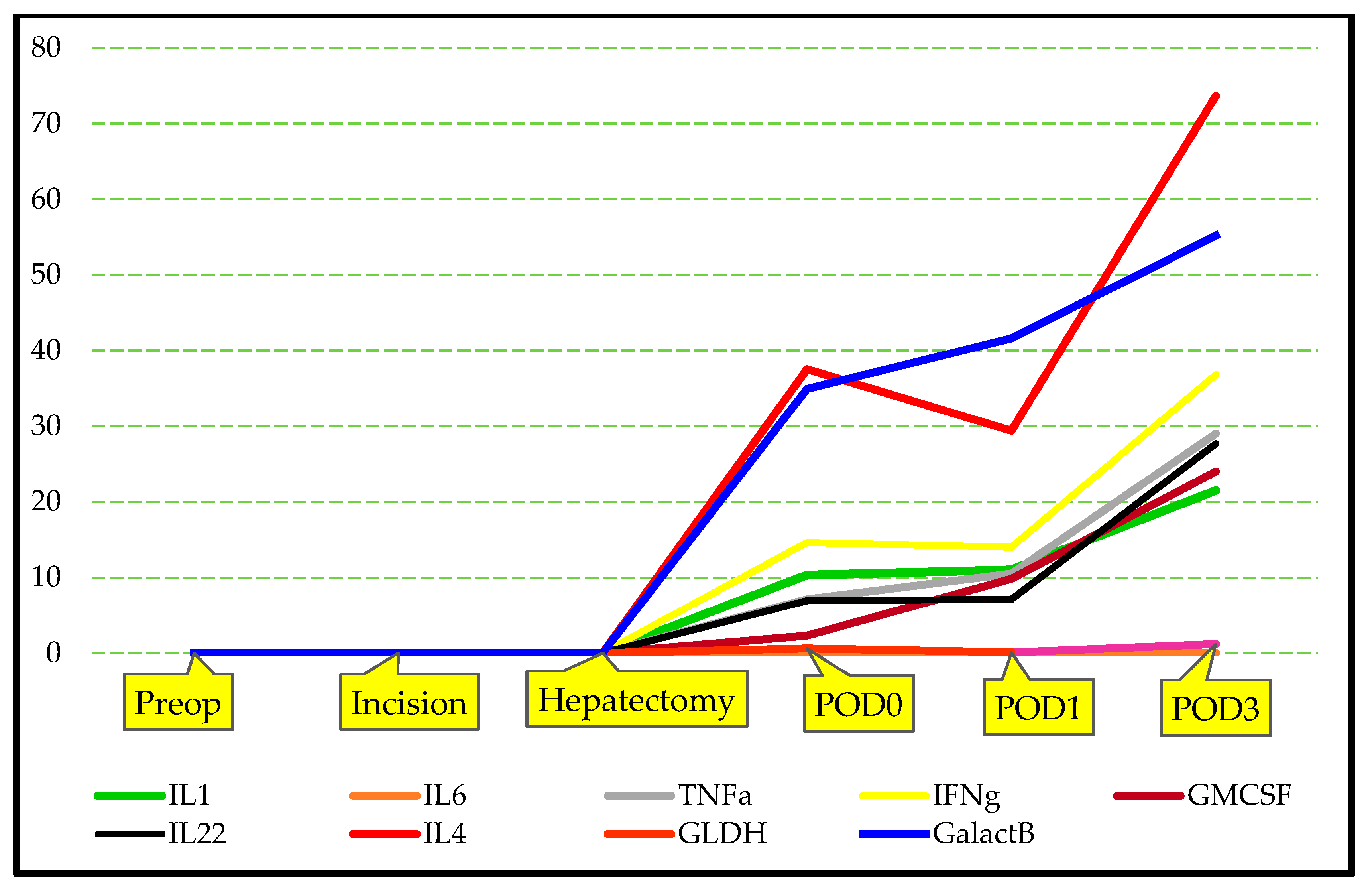
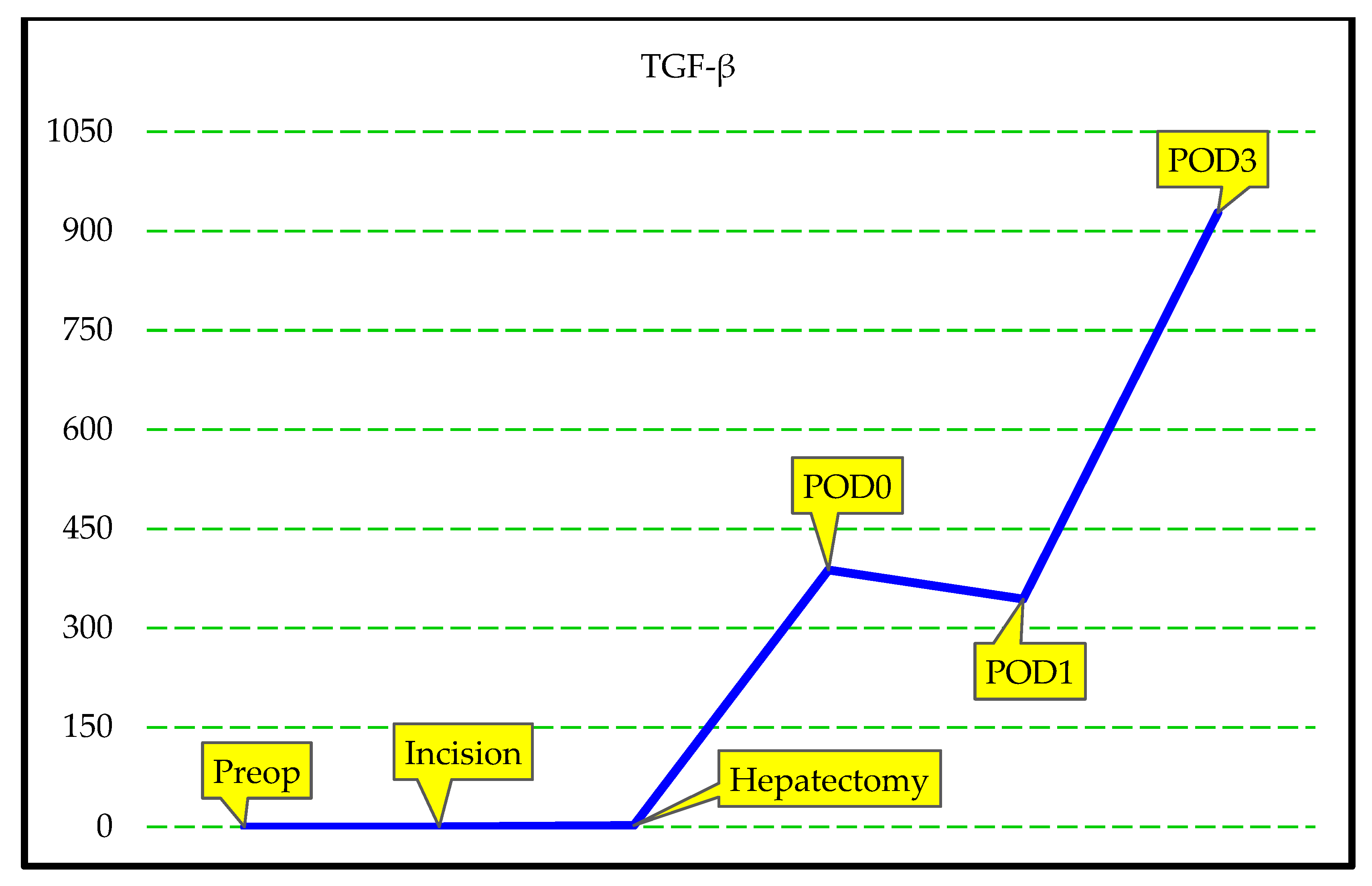
| Preop | Incision | Hepatectomy | POD0 | POD1 | POD3 | |
|---|---|---|---|---|---|---|
| IL-1 | 0 (0) a.b.c | 0 (0) d.e.f | 0 (9.3) g.h.i | 10.3 (27.8) a.d.g.j | 11.0 (45.1) b.e.h.k | 21.5 (97.5) c.f.i.j.k |
| IL-6 | 0 (0) a.b.c | 0 (0) | 0 (0) d.e.f | 0 (11.7) a.d.g | 0 (18.4) b.e | 0 (28.3) c.f.g |
| TNF-α | 0 (0) a.b.c.d.e | 0 (0.4) a.f.g.h.i | 0 (11.0) b.f.j.k.l | 7.1 (77.0) c.g.j.m | 10.5 (95.2) d.h.k.n | 29.0 (152.7) e.i.l.m.n |
| IFN-γ | 0 (0) a.b.c.d | 0 (0) e.f.g | 0 (23.2) a.h.i.j | 14.6 (54.0) b.e.h.k | 14.0 (65.7) c.f.l | 36.8 (105.7) d.g.j.k.l |
| GMCSF | 0 (0) a.b.c.d | 0 (0) e.f.g | 0 (14.6) a.h.i.j | 2.3 (76.4) b.e.h.k | 9.8 (59.5) c.f.i.l | 24.0 (105.6) d.g.j.k.l |
| IL-22 | 0 (0) a.b.c.d | 0 (0) e.f.g | 0 (19.9) a.h.i.j | 6.9 (39.4) b.e.h.k | 7.1 (44.7) c.f.i.l | 27.7 (68.3) d.g.j.k.l |
| IL-4 | 0 (0) a.b.c.d | 0 (0) e.f.g | 0 (39.5) a.h.i.j | 37.5 (71.2) b.e.h.k | 29.4 (90.3) c.f.i.l | 73.7 (132.1) d.g.j.k.l |
| TGF-β | 0 (26.5) a.b.c | 0 (90.0) d.e.f | 2.0 (327.4) g.h.i | 388 (1228.3) a.d.g.j | 344 (1404.6) b.e.h.k | 928 (1977.7) c.f.i.j.k |
| GLDH | 0 (0) a.b.c | 0 (0) d.e.f.g | 0 (1.4) d.h.i.j | 0.6 (2.4) a.e.h.k | 0.1 (3.6) b.f.i | 1.2 (4.7) c.g.j.k |
| GalactB | 0 (5.4) a.b.c | 0 (7.2) d.e.f | 0 (32.9) g.h.i | 34.9 (57.7) a.d.g.j | 41.6 (76.5) b.e.h | 55.2 (118) c.f.i.j |
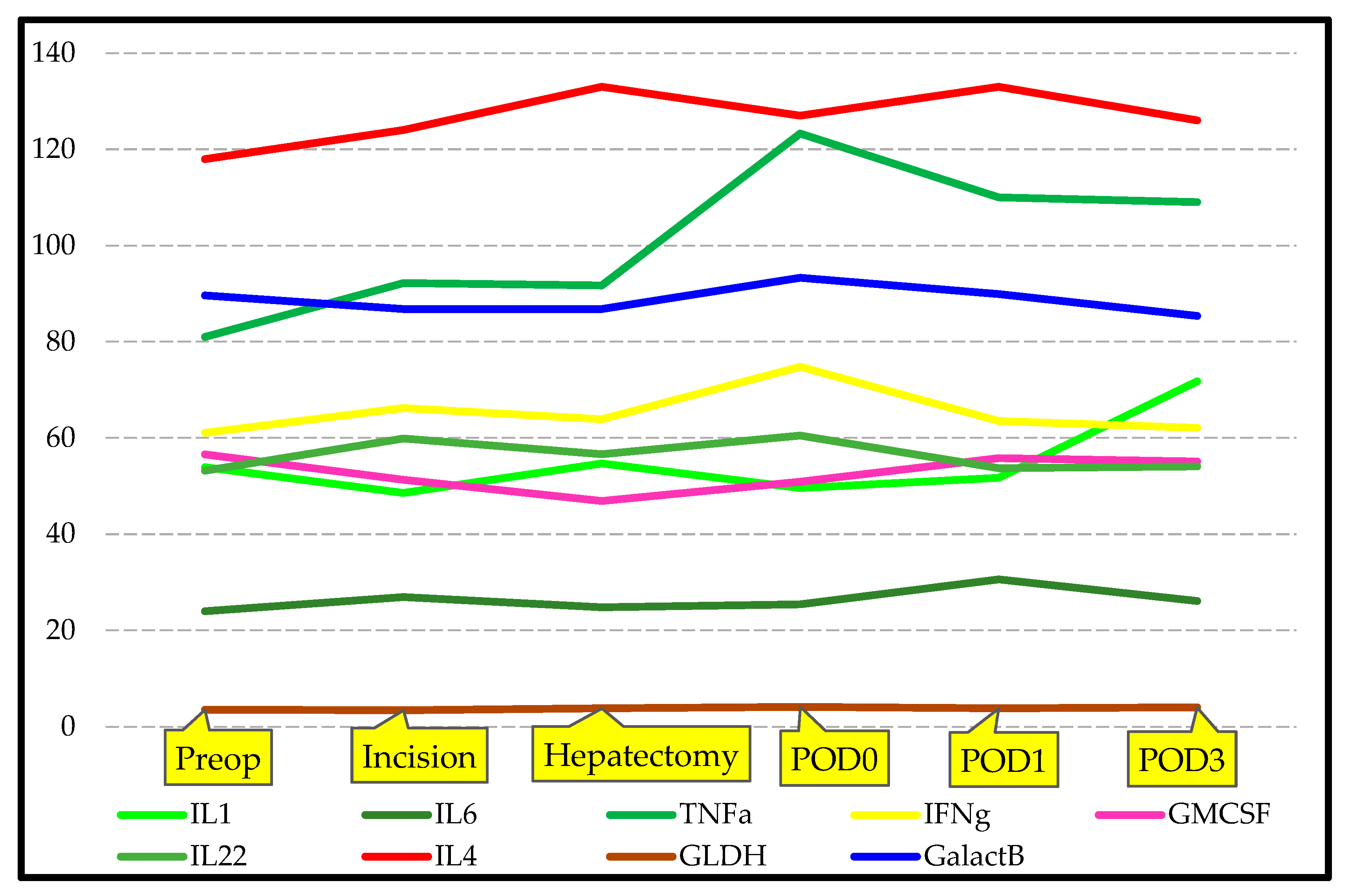
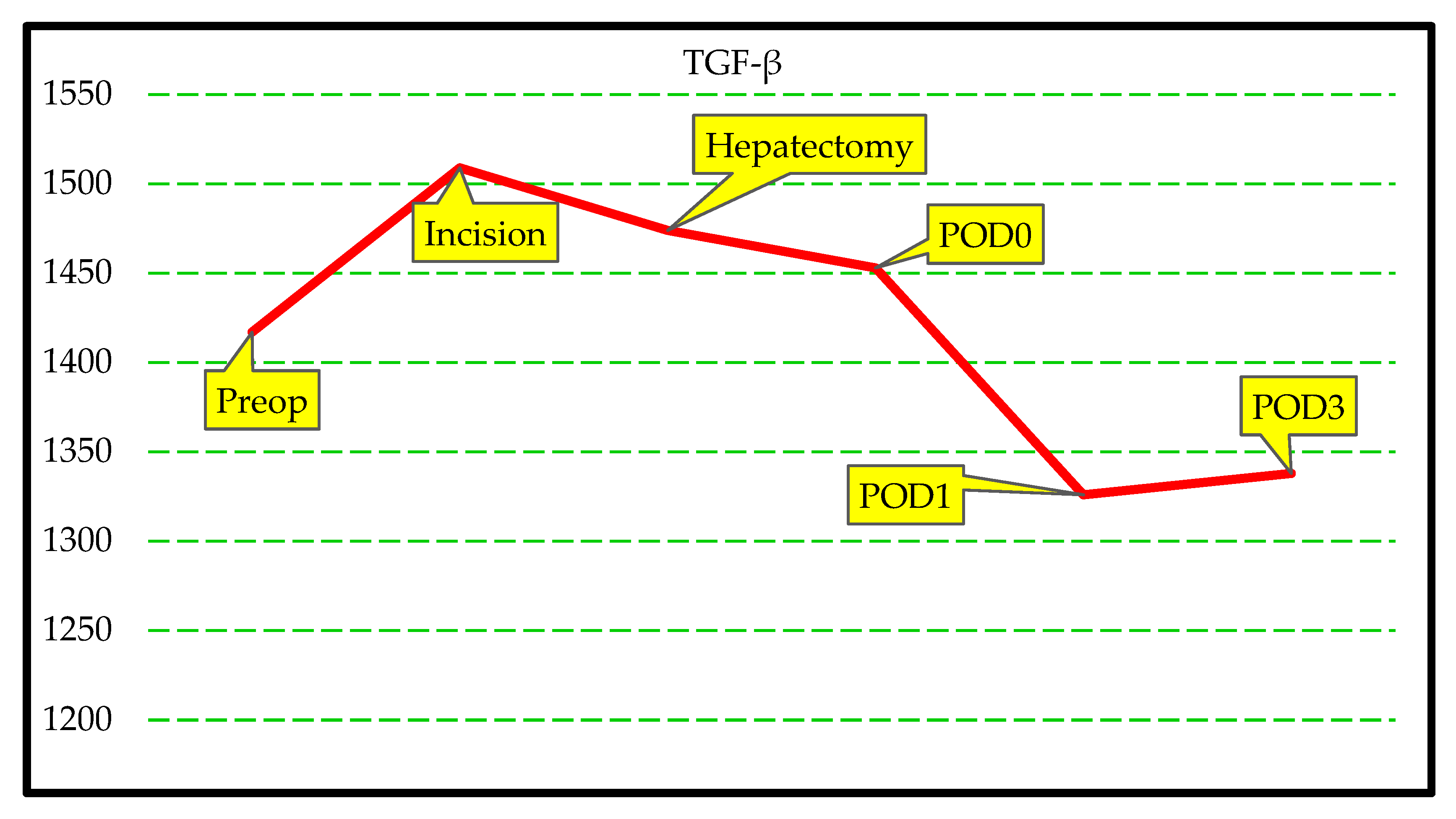
| Preop | Incision | Hepatectomy | POD0 | POD1 | POD3 | p | |
|---|---|---|---|---|---|---|---|
| IL-1 | 53.9 (117.9) | 48.6 (49.6) | 54.7 (122.0) | 49.6 (111.9) | 51.7 (48.2) | 71.8 (53.2) | 0.983 |
| IL-6 | 24.0 (20.4) | 26.9 (18.1) | 24.8 (15.4) | 25.4 (20.5) | 30.6 (21.5) | 26.1 (21.3) | 0.414 |
| TNF-α | 81.0 (81.0) | 92.2 (93.5) | 91.7 (99.8) | 123.3 (120) | 110 (125) | 109 (89) | 0.668 |
| IFN-γ | 61.1 (70.1) | 66.2 (63.1) | 63.9 (65.4) | 74.8 (71.1) | 63.5 (71.9) | 62.1 (26.8) | 0.91 |
| GMCSF | 56.6 (86.4) | 51.3 (66.0) | 46.9 (119.2) | 50.9 (128.6) | 55.8 (52.5) | 55.1 (60.4) | 0.995 |
| IL-22 | 53.2 (32.7) | 59.9 (29.3) | 56.6 (35.0) | 60.5 (46.6) | 53.7 (34.8) | 54.1 (35.3) | 0.395 |
| IL-4 | 118 (110) | 124 (86) | 133 (76.5) | 127 (90.5) | 133 (114) | 126 (110) | 0.324 |
| TGF-β | 1417 (1566) | 1509 (992) | 1474 (1075) | 1453 (1182) | 1326 (939) | 1338 (1374.4) | 0.916 |
| GLDH | 3.5 (2.1) | 3.4 (2.8) | 3.8 (1.9) | 4.1 (3.4) | 3.8 (2.9) | 4.0 (2.4) | 0.055 |
| GalactB | 89.6 (78.0) | 86.8 (39.7) | 86.8 (39.3) | 93.3 (44.6) | 89.9 (48.6) | 85.4 (37.9) | 0.216 |
Disclaimer/Publisher’s Note: The statements, opinions and data contained in all publications are solely those of the individual author(s) and contributor(s) and not of MDPI and/or the editor(s). MDPI and/or the editor(s) disclaim responsibility for any injury to people or property resulting from any ideas, methods, instructions or products referred to in the content. |
© 2025 by the authors. Licensee MDPI, Basel, Switzerland. This article is an open access article distributed under the terms and conditions of the Creative Commons Attribution (CC BY) license (https://creativecommons.org/licenses/by/4.0/).
Share and Cite
Tuncer, A.; Akbulut, S.; Sahin, T.T.; Satilmis, B.; Ogut, Z.; Dalda, Y.; Yilmaz, S. Prospective Analysis of Perioperative Stress Response in Living Donor Liver Transplantation for Hepatitis B-Related Liver Disease. J. Clin. Med. 2025, 14, 8970. https://doi.org/10.3390/jcm14248970
Tuncer A, Akbulut S, Sahin TT, Satilmis B, Ogut Z, Dalda Y, Yilmaz S. Prospective Analysis of Perioperative Stress Response in Living Donor Liver Transplantation for Hepatitis B-Related Liver Disease. Journal of Clinical Medicine. 2025; 14(24):8970. https://doi.org/10.3390/jcm14248970
Chicago/Turabian StyleTuncer, Adem, Sami Akbulut, Tevfik Tolga Sahin, Basri Satilmis, Zeki Ogut, Yasin Dalda, and Sezai Yilmaz. 2025. "Prospective Analysis of Perioperative Stress Response in Living Donor Liver Transplantation for Hepatitis B-Related Liver Disease" Journal of Clinical Medicine 14, no. 24: 8970. https://doi.org/10.3390/jcm14248970
APA StyleTuncer, A., Akbulut, S., Sahin, T. T., Satilmis, B., Ogut, Z., Dalda, Y., & Yilmaz, S. (2025). Prospective Analysis of Perioperative Stress Response in Living Donor Liver Transplantation for Hepatitis B-Related Liver Disease. Journal of Clinical Medicine, 14(24), 8970. https://doi.org/10.3390/jcm14248970