Article

Sodium-Glucose Cotransporter 2 Inhibitor Use in Adults Undergoing Peritoneal Dialysis: A Propensity-Matched Real-World Data Analysis


by
Eric Amelunxen
,
Hauke S. Wülfrath
,
Friedrich A. von Samson-Himmelstjerna
,
Christoph B. Niehus
,
Benedikt Kolbrink
,
Kevin Schulte
,
Roland Schmitt
and
Laura Katharina Sievers
*
Department of Nephrology and Hypertension, University Hospital Schleswig-Holstein, Campus Kiel, 24105 Kiel, Germany
*
Author to whom correspondence should be addressed.
These authors contributed equally to this work.
J. Clin. Med. 2025, 14(24), 8815; https://doi.org/10.3390/jcm14248815 (registering DOI)
Submission received: 21 November 2025 / Revised: 9 December 2025 / Accepted: 11 December 2025 / Published: 12 December 2025

Abstract

Background: Sodium-glucose cotransporter 2 inhibitors (SGLT2is) have become key therapeutic agents based on their protective cardiovascular and renal effects. However, their safety and efficacy in patients with kidney failure, especially undergoing peritoneal dialysis (PD), who are a population at very high cardiovascular risk, remain largely unexplored. Methods: We conducted a retrospective global cohort study using the electronic health records of 19,871 adult peritoneal dialysis patients from the Global Collaborative Network TriNetX database. Of these, n = 412 patients used SGLT2is within 3 months after PD initiation. After propensity score matching, n = 367 patients per cohort were evaluated for cardiovascular risk, mortality and adverse events related to SGLT2is-treatment. Results: The mean age of PD patients with SGLT2is use was 58.7 years and common comorbidities were heart failure (74.0%) and type 2 diabetes (62.1%). Comedication included beta blocking agents (75.5%), diuretics (74.0%), statins (64.6%), insulins (60.2%) and renin- angiotensin blockade (56.3%) in the majority of patients. After propensity score matching, SGLT2is use showed a trend towards reduced all-cause mortality or major adverse cardiovascular events but no significant risk reduction. Further, incidence of hemodialysis was not lowered by SGLT2is use. Known adverse events of SGLT2is use such as ketoacidosis, genitourinary infections, dehydration or peritonitis were not increased among users. Conclusions: In this cohort of PD patients with high cardiovascular and metabolic risk factors, SGLT2is use was safe with regard to unchanged adverse events, while effects on mortality, cardiovascular outcomes, and technique failure were neutral.

1. Introduction

Sodium-glucose cotransporter 2 inhibitors (SGLT2is) have evolved from glucose-lowering agents to a cornerstone of cardiovascular and chronic kidney disease (CKD) care [1]. Beyond their initial use in patients with type 2 diabetes (T2DM), SGLT2is have demonstrated significant benefits including lower risk of hospitalizations for heart failure (HF), preservation of kidney function, and improved mortality outcomes in individuals without T2DM [2,3,4]. These effects are believed to arise from hemodynamic, anti-inflammatory, and metabolic mechanisms independent of glycemic control [5,6], positioning SGLT2is as disease-modifying agents across a wide range of patient populations.
One population notably absent from this growing body of evidence are patients with kidney failure (KF). Patients with KF require kidney replacement therapy (KRT) to maintain solute clearance and fluid balance. To compensate for lack of kidney function, patients receive hemodialysis (HD) using extracorporeal dialyzers or peritoneal dialysis (PD) utilizing the peritoneal membrane and regular fluid exchanges. Once PD is established, long-term technique survival is challenging due to infectious complications, ultrafiltration failure and dialysis inadequacy, leading to transition to hemodialysis. This change is associated with increased mortality [7]. At the same time, this population typically carries a very high risk for cardiovascular disease and overall mortality and, thus, might particularly benefit from SGLT2i therapy [8,9]. However, the role of SGLT2is in KF has been questioned. Safety concerns including urinary tract infections and ketoacidosis further limit SGLT2i adoption in vulnerable populations like dialysis patients [10,11]. Emerging evidence, although observational, supports the potential use of SGLT2is in patients on KRT, while data on PD is limited and mostly derived from small case series or animal models [12,13]. To address these circumstances, we aimed to characterize real-world use of SGLT2is in PD patients and explore potential signals of benefit or harm. Therefore, we conducted a retrospective propensity score-matched (PSM) analysis using the global TriNetX research network. This study addresses the following key questions:
(1)
Are SGLT2is associated with changes in all-cause mortality or major adverse cardiac events (MACE) in patients undergoing PD?
(2)
Is SGLT2i therapy safe in patients undergoing PD?

2. Materials and Methods

2.1. Study Design

This retrospective cohort study utilized the TriNetX Global Collaborative Network to assess the use of SGLT2is in patients initiating PD [14]. Data were retrieved between 22 September and 10 October 2025 from approximately 184 million patients across 157 healthcare organizations. The study followed the STROBE reporting guidelines. Data used in this study is de-identified prior to researcher access; therefore, no individual patient consent or separate IRB approval was required.

2.2. Study Population

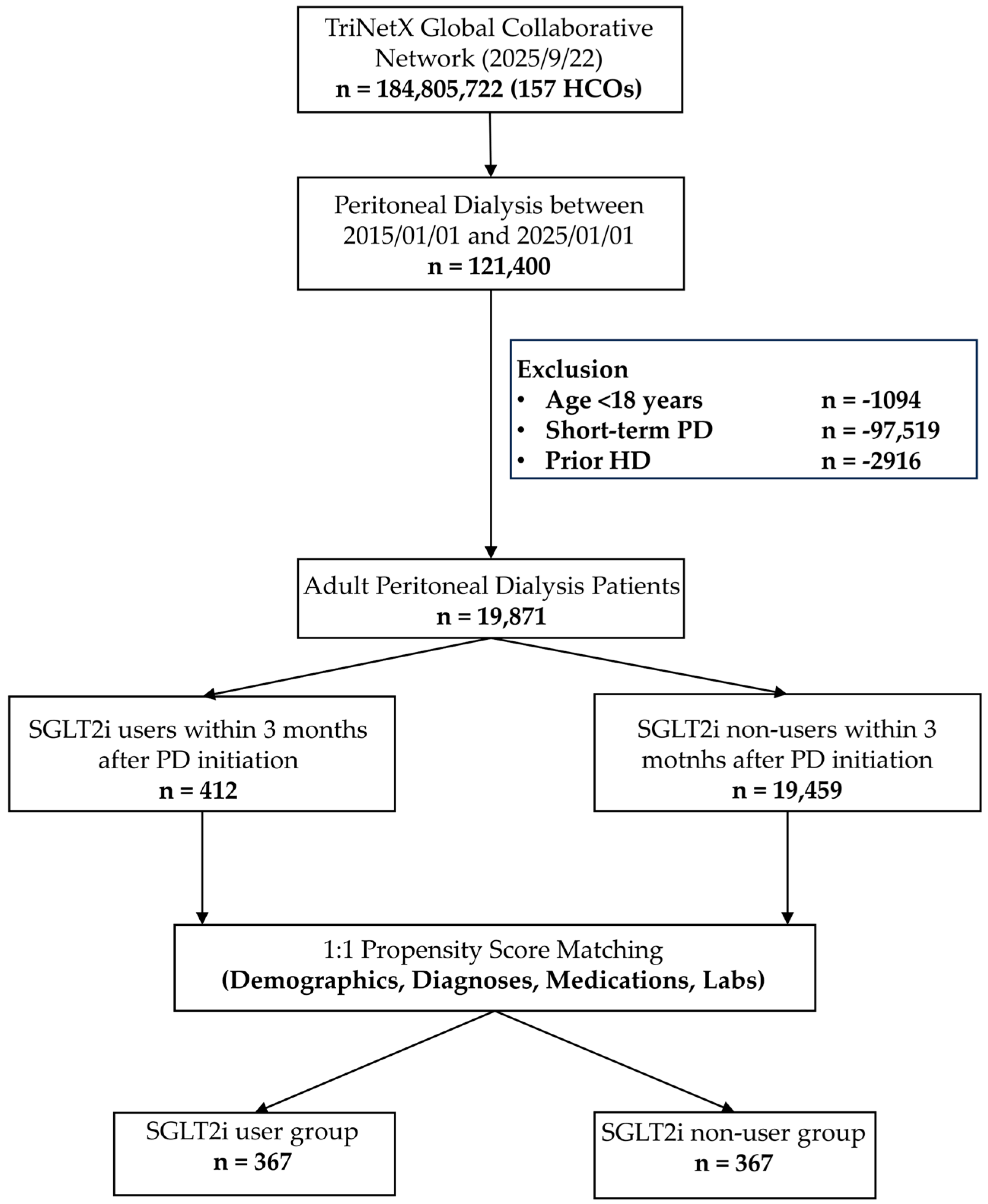
This study included adults aged 18 to 90 years between 1 January 2015 and 1 January 2025, if their electronic health records (EHR) contained at least two PD instances, identified through systematized nomenclature of medicine (SNOMED) procedure codes, PD-catheter insertion, or PD fluid prescription, separated by a minimum of three months. Patients with prior hemodialysis were excluded. The index date was defined as the first PD documentation. Cohorts were defined by SGLT2is initiation within three months after PD onset (users vs. non-users). The full query code is provided in Table S1, and the cohort selection algorithm in Figure 1.

2.3. Outcomes

The primary outcome of this study was all-cause mortality. The secondary outcome was MACE, defined as a composite of myocardial infarction, stroke, and cardiovascular death. Additional endpoints included ketoacidosis, osteoporotic fracture, thrombosis, amputation below the knee, urinary tract infection, dehydration, hypoglycemia, hypervolemia, peritonitis, and PD-catheter complications. Furthermore, we analyzed as a surrogate for PD technique failure the transition to HD defined as a first instance of HD procedure. Follow-up ranged from one day to five years after the index date. Detailed ICD-10 and procedural codes for outcomes are listed in Table S2. Patients with outcome event prior to the index date were excluded.
For sensitivity analyses, outcomes were evaluated at 1-, 3-, and 5-year follow-up intervals and for long-term SGLT2i users (2 prescriptions ≥ 3 months apart after PD initiation). Additionally, we performed landmark analysis involving different follow-up initiation times of 14, 30, 60, 90 and 180 days [15,16]. To further evaluate the clinical relevance of SGLT2i continuation at the initiation of PD, we conducted an additional analysis defining a cohort of patients with documented SGLT2i use prior to PD initiation, identified by SGLT2i medication code preceding the first PD record. To assess the ability of our study to detect clinically relevant differences in all-cause mortality, we performed a sensitivity analysis based on the number of observed events using the Schoenfeld approximation. The detailed numerical results of this analysis are presented in the Section 3.

2.4. Covariates and Statistical Analysis

Statistical analysis was conducted using the analytical tools of the TriNetX platform [14]. Cohort baseline characteristics before and after PSM were summarized as means with standard deviations (SD) and as counts with corresponding percentages [17,18]. Baseline characteristics were derived from the 6-month period before the index event. For PSM, 40 covariates including cardiovascular and metabolic diagnoses, medications and laboratory parameters were used for the built-in TriNetX PSM tool. In detail, propensity scores are calculated for each patient by logistic regression, following a greedy nearest neighbor matching algorithm with a caliper of 0.1 pooled standard deviation. Therefore, patients with standard deviations > 0.1 are not matched. For survival analyses, the Kaplan–Meier method was used to estimate time-to-event probabilities. For all outcomes, hazard ratios (HRs) with corresponding 95% confidence intervals (CIs) and p-values and log-rank tests were calculated using Cox proportional hazards model [19]. The proportional hazards assumption was assessed using the generalized Schoenfeld residuals method. More details are provided on the official TriNetX Website. Graphs were created using R (R version 4.5.1, R Foundation for Statistical Computing, Vienna, Austria) and forestplot and ggplot2 packages. The codes for covariates are provided in Table S3.

2.5. Use of Artificial Intelligence

ChatGPT-5.1-Modell (OpenAI, San Francisco, CA, USA) was used to assist in formatting data into tables and for language refinement of the manuscript. All data analyses, interpretations, and the final manuscript content were reviewed and validated by the authors. The authors take full responsibility for the integrity and accuracy of the content presented in this publication.

3. Results

3.1. Identification of PD Patients Treated with SGLT2is

The study identified a total of 19,871 adult PD patients, of which 2.1% (n = 412) initiated SGLT2i therapy within three months after starting PD. The remaining 19,459 patients served as the non-users control group (Figure 1). The median follow-up time (±IQR) was 1.84 (±1.9) years for SGLT2i users and 2.65 (±3.10) years for non-users, respectively. Before PSM, users of SGLT2is were older, compared to non-users (58.7 ± 12.7 years vs. 46.7 ± 19.3 years) and more often male. Furthermore, SGLT2i users exhibited a higher burden of cardiovascular and metabolic risk factors. In parallel to the comorbidities, the medication differed between the groups with higher use of insulin, beta blockers, diuretics and lipid-lowering drugs in the SGLT2i user group (Table 1). Peritonitis rate for users was 2.43% and 1.64% for non-users. We analyzed cohorts before PSM, observing survival rates of 46.39% and 75.15% and MACE rates of 71.5% and 23.6% for SGLT2i users and SGLT2i non-users, respectively. For main analysis, PSM was performed and led to a cohort of 367 patients in each study arm (Table 1, Figure S1). Patients with events prior to the follow-up initiation time were excluded from outcome analyses; therefore, the number of patients for analysis varied between outcomes.

3.2. SGLT2is Showed No Significant Association with Mortality and Cardiovascular Events

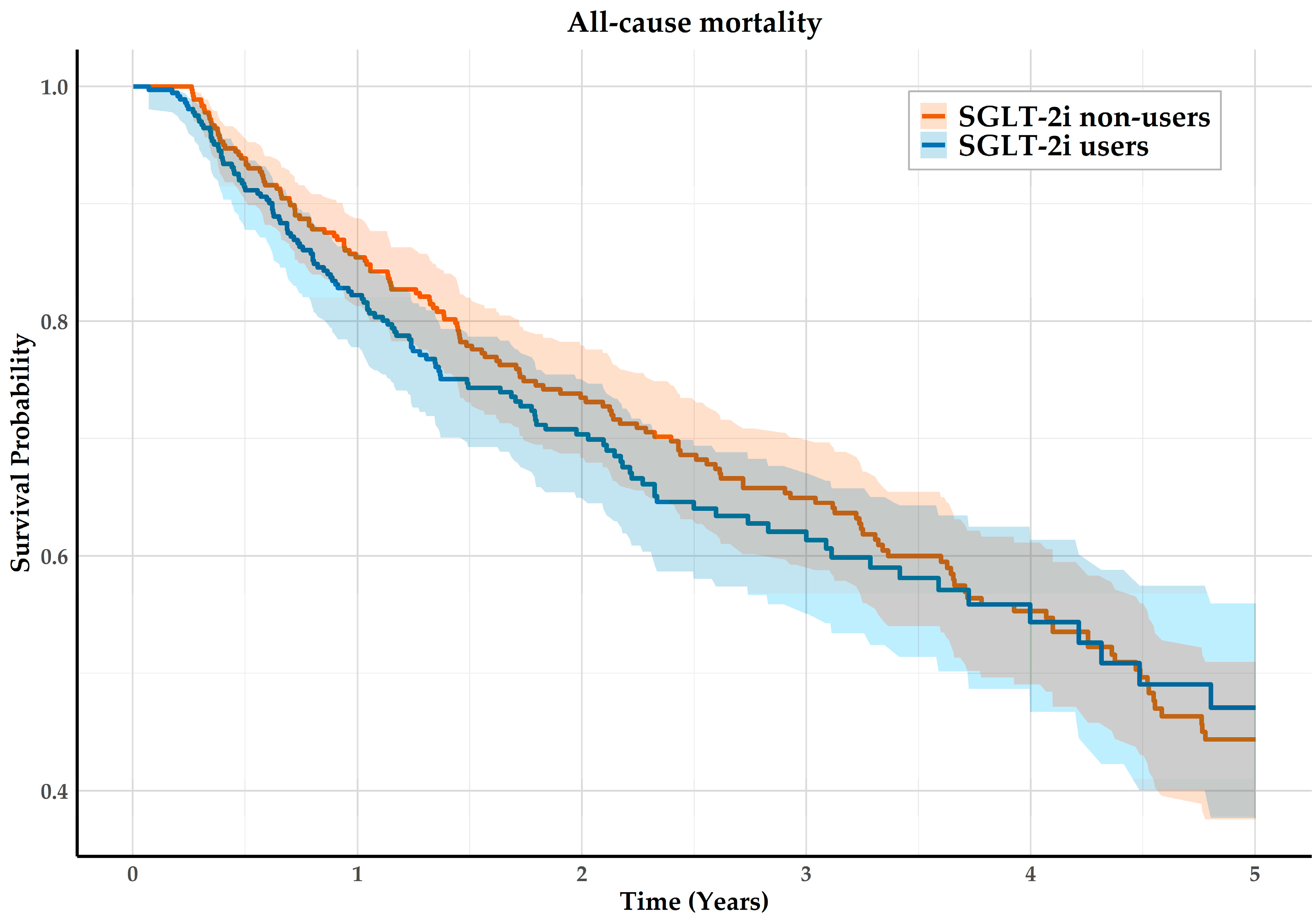
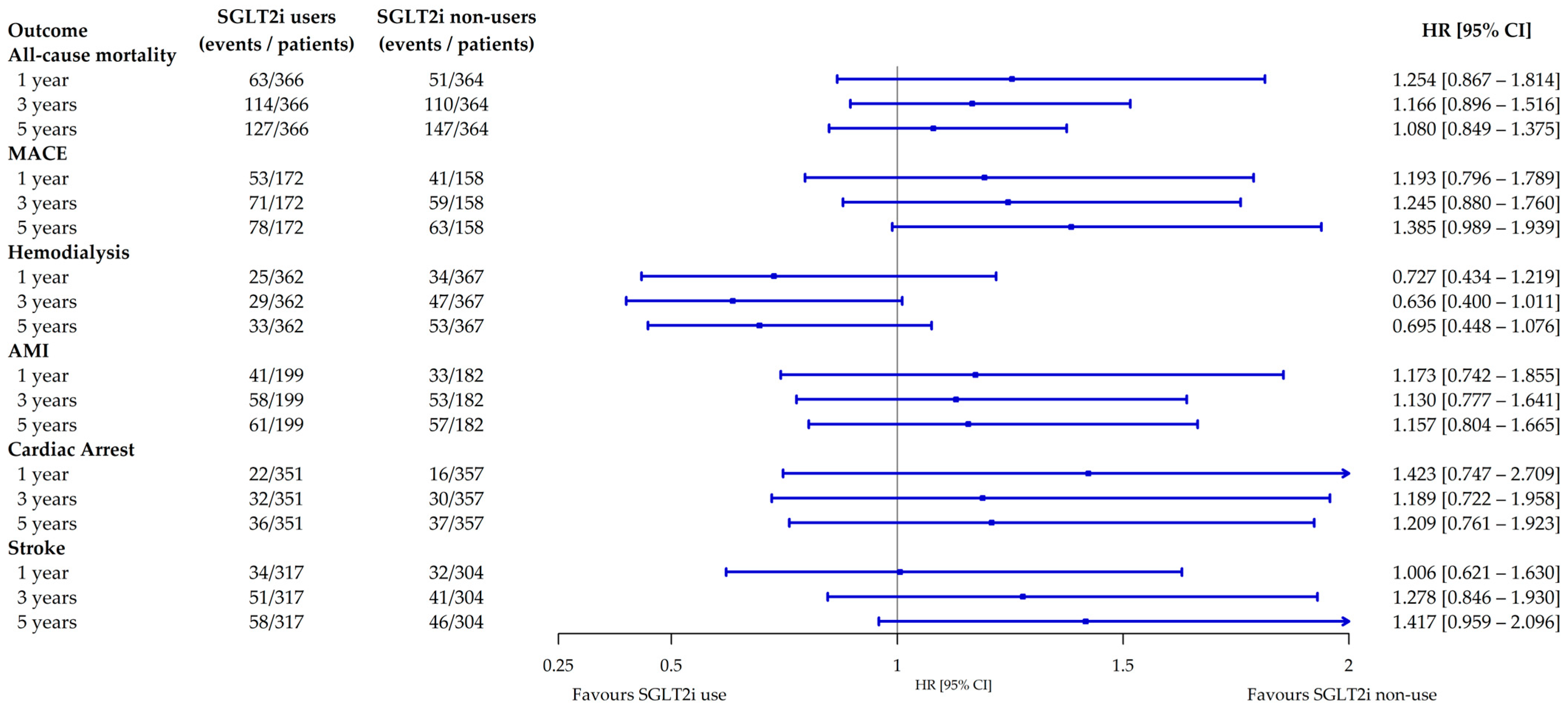
A total of 274 all-cause mortality events occurred in the matched cohorts, corresponding to a confidence interval width of 0.53. Based on the Schoenfeld approximation, this number of events provides approximately 80% power to detect hazard ratios ≤ 0.71 or ≥1.40. During the follow up, 127 of 366 users (34.7%) and 147 of 364 non-users (40.4%) reached the primary outcome all-cause mortality. In Kaplan–Meier analyses, the estimated 5-year survival probability was 47.1% for SGLT2i users and 44.4% for non-users. SGLT2i use had no significant effect on all-cause mortality (HR 1.08, 95% CI 0.85–1.38; p = 0.53; Figure 2 and Figure 3). Similarly, 5-year MACE did not differ significantly (HR 1.39, 95% CI 0.99–1.94; p = 0.06). A total of 45.3% for SGLT2i users and 39.9% for non-users reached the secondary outcome. There was no significant effect for individual MACE components (Figure 3). Furthermore, subgroup analyses for 3- and 5-year follow-up showed no significant survival or cardiovascular differences for subgroups with comorbid HF, CKD, or T2DM (Tables S4–S6, Figures S4–S6).

3.3. SGLT2is Showed No Increase in Complications in PD Patients

We further assessed renal, metabolic or infectious complications of SGLT2is. Dehydration, metabolic disturbances like ketoacidosis or hypoglycemia and thrombosis showed no significant difference between cohorts. Rates of urinary tract infections were significantly less frequent in the SGLT2i group (Figure S2). Specific PD complications such as peritonitis or catheter problems were not increased with <10 events per group within the follow-up period (exact number censored due to low outcome number).
For transition to HD, we analyzed first instances of HD with 33 of 362 (9.1%) SGLT2i users compared with 52 of 367 (14.4%) patients in the non-user group (Figure S3). This difference did not reach statistical significance (HR 0.70, 95% CI 0.45–1.08; p = 0.10).

3.4. Sensitivity Analysis Confirmed the Robustness of Findings

To reevaluate our findings, we performed analyses with different follow-up durations of 1, 3 and 5 years after the index event. All-cause mortality and MACE remained consistent across cohorts (Figure 3). To address potential immortal time bias, landmark analyses were conducted and showed consistent results for 5-year all-cause mortality and MACE (Table S7). Additionally, we recalculated our analysis for long-term SGLT2i users: The HRs were 0.814 (95% CI: 0.594–1.115, p = 0.1983) for 5-year all-cause mortality and 1.184 (95% CI: 0.778–1.802, p = 0.4289) for MACE. For transition to HD, SGLT2i use showed significant reduction with an HR of 0.328 (95% CI: 0.161–0.668, p = 0.0013). Exact event numbers for the transition to HD analyses were not publicly available due to censoring (n ≤ 10) (Table S8). When initiating follow-up after 30 days of the index event, we no longer observed significant association with an HR of 0.629 (95% CI: 0.288–1.375, p = 0.2413). Regarding continuation of SGLT2is during PD initiation, we did not observe significant association for 5-year mortality, MACE or HD (Table S9).

4. Discussion

SGLT2is have shown a broad range of beneficial effects including a reduction in all-cause mortality and MACE in vulnerable patient cohorts including T2DM, CKD and HF patients [1]. Our study provides evidence that these effects are not conserved in PD patients.

4.1. No Difference in All-Cause Mortality and MACE

Our analysis did not reveal a significant association of SGLT2i use with all-cause mortality or MACE for patients undergoing PD. This finding contrasts the cardioprotective and survival advantages demonstrated in large randomized controlled trials among patients with earlier stages of CKD and retrospective analyses—similarly to ours—demonstrating benefits in mortality and MACE reduction in diabetic patients with KF initiating dialysis [2,4,20]. The latter, however, included very few PD patients. Regarding continuation of SGLT2i therapy at the initiation of PD, no significant benefit was observed. However, interpretation is limited by small sample size.
It is plausible that the mechanisms mediating these cardiovascular benefits—such as osmotic diuresis, blood pressure reduction, improved ventricular loading conditions, and favorable metabolic effects—are attenuated in PD patients due to severely reduced glomerular filtration and altered volume homeostasis [5,6]. In contrast, a growing body of evidence suggests that SGLT2is benefits are mediated through pleiotropic events. Recent data from a meta-analysis show a reduced relative risk for sudden cardiac death. In addition, direct SGLT2is have positive cellular effects in endothelial cells, cardiomyocytes, and immune cells, although these mechanisms alone may not be sufficient to translate into reductions in mortality or MACE in this high-risk population [21,22].
Notably, our PD cohort was heterogeneous, with SGLT2i users being older and more comorbid. Analysis before PSM showed relevant differences in survival and MACE rate. Similar selection patterns have been reported in real-world data, where SGLT2is are often initiated in patients with greater cardiovascular and metabolic burden despite older age occasionally limiting their use [23]. In summary, our results suggest that once patients progress to KF and receive PD, SGLT2i-mediated cardioprotection may no longer exert clinically relevant effects.

4.2. SGLT2is Are Safe in Peritoneal Dialysis Patients

In our cohort, SGLT2i therapy appeared to be safe among patients treated with PD. We observed no increased incidence of adverse events such as urinary tract infections, hypovolemia, or metabolic complications that have typically been associated with this drug class. This is in line with more recent evidence suggesting that infections primarily involve the external genital tract rather than the urinary tract itself [24,25]. With respect to ketoacidosis, the main concern relates to euglycemic ketoacidosis, which differs from classical diabetic ketoacidosis, but is less relevant to the population studied here [26,27].
These results are clinically important because safety concerns have historically limited the use of SGLT2is in advanced CKD [28]. Our data add to the growing body of evidence supporting the overall safety of these agents in KF and specifically in PD patients. This finding is particularly relevant given the paucity of real-world data in this population and the ongoing need for prospective confirmation. Several randomized controlled trials are currently investigating SGLT2i use in PD, including their safety, effects on ultrafiltration, and mechanistic pathways, with results still awaited [13]. Nevertheless, our study contributes valuable preliminary evidence suggesting that SGLT2is can be safely prescribed in PD, while emphasizing the need for larger, prospective studies to validate these observations and define their clinical role in this fragile population.

4.3. No Evident Impact on Transition to Hemodialysis

Experimental studies have demonstrated that SGLT2is reduce peritoneal glucose absorption, attenuate peritoneal fibrosis, and enhance ultrafiltration capacity [13]. These findings suggest that SGLT2i therapy may preserve peritoneal membrane integrity and, consequently, improve long-term PD technique survival. Based on this rationale, we investigated whether SGLT2i use was associated with a reduced risk of transition to hemodialysis. However, our analysis did not reveal a significant difference in transition rates between patients receiving SGLT2is and those who were not.
The absence of a detectable signal for PD dropout supports the assumption that SGLT2is do not negatively influence peritoneal membrane function, ultrafiltration capacity, or dialysis adequacy [29,30]. These results are reassuring from a clinical standpoint, indicating that SGLT2i therapy can be safely continued in PD patients without compromising treatment continuity. However, our data also do not suggest a measurable benefit in terms of preserving PD modality or delaying the need for HD. Although SGLT2is have been shown to slow the decline of kidney function in earlier CKD stages, this effect may be negligible once patients are established on PD [4].
Taken together, our findings imply that SGLT2i therapy neither harms nor substantially alters the course of PD treatment. As recruiting patients for prospective studies in PD remains challenging due to the limited number of eligible individuals, our findings provide valuable real-world evidence on clinically meaningful outcomes. Future studies should aim to confirm these results in prospective designs focusing on hard endpoints such as technique failure and mortality. Currently, the Renal Lifecycle trial is investigating the effect of the SGLT2i dapagliflozin in severe CKD, HD and PD patients, for a composite endpoint including all-cause mortality. The results will provide randomized controlled evidence for the questions addressed by our study [31].

4.4. Limitations

This study has several limitations related to the retrospective, EHR-based nature: a potential limitation is misclassification bias due to identification of patients through diagnostic, medication and procedural codes. To mitigate this, patients were required to have at least two PD records spaced ≥3 months apart, as used in previous retrospective studies to ensure consistent PD treatment [32]. Still, in a global study, variation in practice of coding must be assumed. Due to the observational design, selection bias might therefore limit the generalizability of our findings. A potential limitation of the study is insufficient power. An effect size comparable to that reported in the DAPA-CKD trial (HR = 0.69) would have been detectable in our dataset, whereas smaller effect sizes would likely not have been identified.
Additionally, the relatively low number of patients on SGLT2is (resulting from lack of approval of SGLT2is in KF) in the dataset did not allow differentiation between modalities of PD, e.g., continuous or intermittent PD. This prevented evaluation of potential differences in outcomes by PD modality. Prescription of SGLT2is is based on documented prescription, administration or dispensing; therefore, discontinuation or intermittent use cannot be ruled out. Furthermore, the TriNetX database does not provide granular clinical data, for example, on ultrafiltration parameters or urine volume, which may represent a clinically relevant benefit for PD patients but remained beyond the scope of this analysis. This further accounts for SGLT2i indications as well as comorbidity subtypes, such as different forms of heart failure.
While the observational and retrospective design of this study entails inherent limitations, the data provide meaningful real-world evidence that complements existing trial results and warrants confirmation in prospective settings.

5. Conclusions

In summary, our study provides the first data demonstrating that the benefits of SGLT2is regarding all-cause mortality and MACE do not transfer to PD patients, while safety concerns appear unfounded. Further research should aim to define effective and evidence-based cardio-renal protection for this underserved population.

Supplementary Materials

The following supporting information can be downloaded at https://www.mdpi.com/article/10.3390/jcm14248815/s1, Table S1. Codes and cohort query definitions. Table S2. Definitions of study outcomes. Table S3. Propensity score matching (PSM) codes. Table S4. Main outcomes in chronic kidney disease (CKD). Table S5. Main outcomes in type 2 diabetes (T2DM). Table S6. Main outcomes in heart failure (HF). Table S7. Landmark analysis. Table S8. Main outcomes in long-term SGLT2is. Table S9. SGLT2is continuation outcome analysis. Figure S1. Balance plot for PSM. Figure S2. Forest plot of safety outcomes. Figure S3 Kaplan–Meier curves for hemodialysis. Figure S4. Forest plot of outcomes for CKD. Figure S5. Forest plot of outcomes for HF. Figure S6. Forest plot of safety type 2 diabetes. STROBE Checklist.

Author Contributions

Conceptualization, E.A., H.S.W. and L.K.S.; methodology, E.A. and F.A.v.S.-H.; software, E.A.; validation, E.A., H.S.W. and L.K.S.; formal analysis, E.A.; investigation, E.A. and H.S.W.; data curation, E.A.; writing—original draft preparation, E.A., H.S.W. and L.K.S.; writing—review and editing, E.A., H.S.W., L.K.S., F.A.v.S.-H., C.B.N., B.K., K.S. and R.S.; visualization, E.A.; supervision, L.K.S. All authors have read and agreed to the published version of the manuscript.

Funding

This research received no external funding.

Institutional Review Board Statement

Ethical review and approval were waived for this study, as it used de-identified data and did not involve data collection or transmission of data identifiable on individual level.

Informed Consent Statement

This study was exempt from informed consent, as it used retrospective de-identified data and did not involve data collection or transmission of data identifiable on individual level.

Data Availability Statement

The original contributions presented in this study are included in the article/Supplementary Material. Further inquiries can be directed to the corresponding author(s).

Acknowledgments

We express our gratitude for the support provided by Friederike Uebing (Legal Department and Networking and Strategic Cooperation Unit, UKSH, Kiel Campus) in facilitating access to the TriNetX platform at UKSH. We gratefully acknowledge Ralf Ludwig (Lübeck Institute of Experimental Dermatology, University of Lübeck, Lübeck, Germany) for his valuable support, input, and guidance during the conceptualization and development of this study. During the preparation of this manuscript/study, the author(s) used ChatGPT (OpenAI, San Francisco, CA, USA) Version GPT-5 for the purposes of formatting data into tables and for language refinement of the manuscript. The authors have reviewed and edited the output and take full responsibility for the content of this publication.

Conflicts of Interest

F.A.v.S.-H. reports receiving lecturing fees and travel support from Chiesi GmbH, Lilly GmbH and Astra Zeneca GmbH. B.K. received lecturing fees from Astra Zeneca, Fresenius Medical Care and Vantive, as well as research grants from Fresenius Medical Care and Vantive. L.K.S. received lecturing fees and travel support from Novartis, Boehringer Ingelheim Lilly and Astra Zeneca GmbH. F.A.v.S.-H. and B.K. are supported by the Medical Faculty of the Christian-Albrechts-University Kiel. The other authors declare no conflicts of interest.

Abbreviations

The following abbreviations are used in this manuscript:
SGLT2iSodium-glucose cotransporter 2 inhibitor
PDPeritoneal dialysis
HDHemodialysis
KFKidney failure
KRTKidney replacement therapy
HFHeart failure
CKDChronic kidney disease
T2DMType 2 diabetes mellitus
EHRElectronic health records
PSMPropensity score matching
MACEMajor adverse cardiovascular events
SNOMEDSystematized Nomenclature of Medicine
ICD-10International Classification of Diseases, 10th Revision
HCOHealth care organization
IQRInterquartile range
SDStandard deviation
CIConfidence interval
HRHazard ratio
CIHDChronic ischemic heart disease
CLRDChronic lower respiratory disease
BMIBody mass index
GFRGlomerular filtration rate
SBPSystolic blood pressure
DBPDiastolic blood pressure
BNPB-type natriuretic peptide
TGTriglycerides
HDLHigh-density lipoprotein
LDLLow-density lipoprotein
ASTAspartate aminotransferase
ALTAlanine aminotransferase
RASiRenin–angiotensin system inhibition
HbA1cHemoglobin A1c
STROBEStrengthening the Reporting of Observational Studies in Epidemiology

References

  1. Mavrakanas, T.A.; Tsoukas, M.A.; Brophy, J.M.; Sharma, A.; Gariani, K. SGLT-2 inhibitors improve cardiovascular and renal outcomes in patients with CKD: A systematic review and meta-analysis. Sci. Rep. 2023, 13, 15922. [Google Scholar] [CrossRef] [PubMed]
  2. Heerspink, H.J.L.; Stefánsson, B.V.; Correa-Rotter, R.; Chertow, G.M.; Greene, T.; Hou, F.-F.; Mann, J.F.E.; McMurray, J.J.V.; Lindberg, M.; Rossing, P.; et al. Dapagliflozin in Patients with Chronic Kidney Disease. N. Engl. J. Med. 2020, 383, 1436–1446. [Google Scholar] [CrossRef]
  3. McMurray, J.J.V.; Solomon, S.D.; Inzucchi, S.E.; Køber, L.; Kosiborod, M.N.; Martinez, F.A.; Ponikowski, P.; Sabatine, M.S.; Anand, I.S.; Bělohlávek, J.; et al. Dapagliflozin in Patients with Heart Failure and Reduced Ejection Fraction. N. Engl. J. Med. 2019, 381, 1995–2008. [Google Scholar] [CrossRef]
  4. The EMPA-KIDNEY Collaborative Group; Herrington, W.G.; Staplin, N.; Wanner, C.; Green, J.B.; Hauske, S.J.; Emberson, J.R.; Preiss, D.; Judge, P.; Mayne, K.J.; et al. Empagliflozin in Patients with Chronic Kidney Disease. N. Engl. J. Med. 2023, 388, 117–127. [Google Scholar]
  5. Thomas, M.C.; Cherney, D.Z.I. The actions of SGLT2 inhibitors on metabolism, renal function and blood pressure. Diabetologia 2018, 61, 2098–2107. [Google Scholar] [CrossRef]
  6. Dyck, J.R.; Sossalla, S.; Hamdani, N.; Coronel, R.; Weber, N.C.; Light, P.E.; Zuurbier, C.J. Cardiac mechanisms of the beneficial effects of SGLT2 inhibitors in heart failure: Evidence for potential off-target effects. J. Mol. Cell Cardiol. 2022, 167, 17–31. [Google Scholar] [CrossRef] [PubMed]
  7. Nadeau-Fredette, A.-C.; Sukul, N.; Lambie, M.; Perl, J.; Davies, S.; Johnson, D.W.; Robinson, B.; Van Biesen, W.; Kramer, A.; Jager, K.J. Mortality Trends After Transfer From Peritoneal Dialysis to Hemodialysis. Kidney Int. Rep. Mai 2022, 7, 1062–1073. [Google Scholar] [CrossRef] [PubMed]
  8. Jaar, B.G.; Plantinga, L.C.; Crews, D.C.; Fink, N.E.; Hebah, N.; Coresh, J.; Kliger, A.S. Timing, causes, predictors and prognosis of switching from peritoneal dialysis to hemodialysis: A prospective study. BMC Nephrol. 2009, 10, 3. [Google Scholar] [CrossRef]
  9. de Jager, D.J.; Grootendorst, D.C.; Jager, K.J.; van Dijk, P.C.; Tomas, L.M.J.; Ansell, D.; Collart, F.; Finne, P.; Heaf, J.G.; De Meester, J.; et al. Cardiovascular and Noncardiovascular Mortality Among Patients Starting Dialysis. JAMA 2009, 302, 1782–1789. [Google Scholar] [CrossRef]
  10. McLean, P.; Bennett, J.; Woods, E.T.; Chandrasekhar, S.; Newman, N.; Mohammad, Y.; Khawaja, M.; Rizwan, A.; Siddiqui, R.; Birnbaum, Y.; et al. SGLT2 inhibitors across various patient populations in the era of precision medicine: The multidisciplinary team approach. npj Metab. Health Dis. 2025, 3, 29. [Google Scholar] [CrossRef]
  11. Jeong, S.J.; Lee, S.E.; Shin, D.H.; Park, I.B.; Lee, H.S.; Kim, K.A. Barriers to initiating SGLT2 inhibitors in diabetic kidney disease: A real-world study. BMC Nephrol. 2021, 22, 177. [Google Scholar] [CrossRef]
  12. Siddiqui, R.; Obi, Y.; Dossabhoy, N.R.; Shafi, T. Is There a Role for SGLT2 Inhibitors in Patients with End-Stage Kidney Disease? Curr. Hypertens Rep. 2024, 26, 463–474. [Google Scholar] [CrossRef] [PubMed]
  13. Stepanova, N. SGLT2 inhibitors in peritoneal dialysis: A promising frontier toward improved patient outcomes. Ren. Replace Ther. 2024, 10, 5. [Google Scholar] [CrossRef]
  14. Ludwig, R.J.; Anson, M.; Zirpel, H.; Thaci, D.; Olbrich, H.; Bieber, K.; Kridin, K.; Dempfle, A.; Curman, P.; Zhao, S.S.; et al. A comprehensive review of methodologies and application to use the real-world data and analytics platform TriNetX. Front. Pharmacol. 2025, 16, 1516126. [Google Scholar] [CrossRef] [PubMed]
  15. Morgan, C.J. Landmark analysis: A primer. J. Nucl. Cardiol. 2019, 26, 391–393. [Google Scholar] [CrossRef]
  16. Mi, X.; Hammill, B.G.; Curtis, L.H.; Lai, E.C.C.; Setoguchi, S. Use of the landmark method to address immortal person-time bias in comparative effectiveness research: A simulation study. Stat. Med. 2016, 35, 4824–4836. [Google Scholar] [CrossRef]
  17. Austin, P.C. An Introduction to Propensity Score Methods for Reducing the Effects of Confounding in Observational Studies. Multivar Behav. Res. Mai 2011, 46, 399–424. [Google Scholar] [CrossRef]
  18. Andrade, C. Mean Difference, Standardized Mean Difference (SMD), and Their Use in Meta-Analysis: As Simple as It Gets. J. Clin. Psychiatry 2020, 81, 20f13681. [Google Scholar] [CrossRef]
  19. Andersen, P.K.; Gill, R.D. Cox’s Regression Model for Counting Processes: A Large Sample Study. Ann. Stat. 1982, 10, 1100–1120. [Google Scholar] [CrossRef]
  20. Wang, C.A.; Lin, L.C.; Chen, J.Y.; Wang, W.J.; Wu, V.C. Exploring the mortality and cardiovascular outcomes with SGLT-2 inhibitors in patients with T2DM at dialysis commencement: A health global federated network analysis. Cardiovasc. Diabetol. 2024, 23, 327. [Google Scholar] [CrossRef] [PubMed]
  21. Schönberger, E.; Mihaljević, V.; Steiner, K.; Šarić, S.; Kurevija, T.; Majnarić, L.T.; Ćurčić, I.B.; Canecki-Varžić, S. Immunomodulatory Effects of SGLT2 Inhibitors—Targeting Inflammation and Oxidative Stress in Aging. Int. J. Environ. Res. Public Health 2023, 20, 6671. [Google Scholar] [CrossRef] [PubMed]
  22. Scisciola, L.; Cataldo, V.; Taktaz, F.; Fontanella, R.A.; Pesapane, A.; Ghosh, P.; Franzese, M.; Puocci, A.; De Angelis, A.; Sportiello, L.; et al. Anti-inflammatory role of SGLT2 inhibitors as part of their anti-atherosclerotic activity: Data from basic science and clinical trials. Front. Cardiovasc. Med. 2022, 9, 1008922. [Google Scholar] [CrossRef] [PubMed]
  23. Malik, M.E.; Butt, J.H.; Strange, J.E.; Falkentoft, A.C.; Jensen, J.; Andersson, C.; Zahir, D.; Fosbøl, E.; McMurray, P.J.J.V. Initiation of SGLT2 inhibitors and GLP-1 receptor agonists according to level of frailty in people with type 2 diabetes and cardiovascular disease in Denmark: A cross-sectional, nationwide study. Lancet Healthy Longev. 2023, 4, e552–e560. [Google Scholar] [CrossRef]
  24. Mascolo, A.; Di Napoli, R.; Balzano, N.; Cappetta, D.; Urbanek, K.; De Angelis, A.; Scisciola, L.; Di Meo, I.; Sullo, M.G.; Rafaniello, C.; et al. Safety profile of sodium glucose co-transporter 2 (SGLT2) inhibitors: A brief summary. Front. Cardiovasc. Med. 2022, 9, 1010693. [Google Scholar] [CrossRef]
  25. Puckrin, R.; Saltiel, M.P.; Reynier, P.; Azoulay, L.; Yu, O.H.Y.; Filion, K.B. SGLT-2 inhibitors and the risk of infections: A systematic review and meta-analysis of randomized controlled trials. Acta Diabetol. 2018, 55, 503–514. [Google Scholar] [CrossRef]
  26. Barski, L.; Eshkoli, T.; Brandstaetter, E.; Jotkowitz, A. Euglycemic diabetic ketoacidosis. Eur. J. Intern. Med. 2019, 63, 9–14. [Google Scholar] [CrossRef]
  27. Ogawa, W.; Sakaguchi, K. Euglycemic diabetic ketoacidosis induced by SGLT2 inhibitors: Possible mechanism and contributing factors. J. Diabetes Investig. März 2016, 7, 135–138. [Google Scholar] [CrossRef]
  28. Scheen, A.J. Real-life underuse of SGLT2 inhibitors for patients with type 2 diabetes at high cardiorenal risk. Diabetes Epidemiol. Manag. 2024, 13, 100184. [Google Scholar] [CrossRef]
  29. Lai, J.W.; Wang, C.C.N.; Chou, C.Y. SGLT-2 inhibitors in chronic peritoneal dialysis patients: A follow-up study. BMC Nephrol. 2024, 25, 238. [Google Scholar] [CrossRef]
  30. Martus, G.; Bergling, K.; de Arteaga, J.; Öberg, C.M. SGLT2 inhibition does not reduce glucose absorption during experimental peritoneal dialysis. Perit. Dial. Int. 2021, 41, 373–380. [Google Scholar] [CrossRef] [PubMed]
  31. Bakker, W.M.; Heerspink, H.J.L.; Berger, S.P.; Wanner, C.; Badve, S.V.; Arnott, C.; Abrahams, A.C.; van den Born, J.C.; Gaillard, C.A.J.M.; Gelens, M.A.C.J.; et al. Rationale and design of the Renal Lifecycle trial assessing the effect of dapagliflozin on cardiorenal outcomes in severe chronic kidney disease. Nephrol. Dial. Transplant. 2025, 40, 1746–1755. [Google Scholar] [CrossRef]
  32. Shukri, A.; Mettang, T.; Scheckel, B.; Schellartz, I.; Simic, D.; Scholten, N.; Mülleru, M.; Stock, S. Hemodialysis and Peritoneal Dialysis in Germany from a Health Economic View—A Propensity Score Matched Analysis. Int. J. Environ. Res. Public Health 2022, 19, 14007. [Google Scholar] [CrossRef] [PubMed]
Figure 1. Flow chart of cohort selection process. HCO, Health care organization, PD, peritoneal dialysis, HD, hemodialysis, SGLT2is, Sodium-glucose cotransporter 2 inhibitor.
Jcm 14 08815 g001
Figure 2. Kaplan–Meier curves for all-cause mortality of SGLT2i users and non-users.
Jcm 14 08815 g002
Figure 3. Forest plot of primary and secondary outcomes. 95% CIs represented as error bars. HR hazard ratio; AMI acute myocardial infarction; CI confidence interval; MACE major adverse cardiovascular event; SGLT2i sodium-glucose cotransporter 2 inhibitor.
Jcm 14 08815 g003
Table 1. Baseline characteristics of cohorts before and after propensity score matching.
CharacteristicSGLT2is Users
Before PSM
(n = 412)
SGLT2is Non-Users Before PSM
(n = 19,459)
SMD Before PSMSGLT2is Users
After PSM
(n = 367)
SGLT2is Non-Users After PSM
(n = 367)
SMD After PSM
Age at Index58.7 ± 12.746.7 ± 19.30.72858.8 ± 13.159.4 ± 14.40.04
Not Hispanic or Latino380 (92.23%)15,893 (81.67%)0.317338 (92.10%)339 (92.37%)0.01
Male264 (64.08%)7604 (39.08%)0.517232 (63.22%)232 (63.22%)<0.0001
White208 (50.49%)8341 (42.86%)0.153189 (51.50%)194 (52.86%)0.027
Heart failure305 (74.03%)3129 (16.08%)14,327261 (71.12%)260 (70.85%)0.006
Type 2 diabetes mellitus256 (62.14%)3743 (19.24%)0.971219 (59.67%)223 (60.76%)0.022
Dyslipidemia231 (56.07%)3833 (19.70%)0.809205 (55.86%)205 (55.86%)<0.0001
Hypertension221 (53.64%)5737 (29.48%)0.506199 (54.22%)191 (52.04%)0.044
CIHD230 (55.83%)3123 (16.05%)0.911195 (53.13%)193 (52.59%)0.011
Overweight and obesity181 (43.93%)3663 (18.82%)0.562161 (43.87%)162 (44.14%)0.005
Acute myocardial infarction169 (41.02%)1271 (6.53%)0.886137 (37.33%)131 (35.70%)0.034
Hypertensive heart disease173 (41.99%)1029 (5.29%)0.958136 (37.06%)146 (39.78%)0.056
Cardiomyopathy126 (30.58%)905 (4.65%)0.724102 (27.79%)109 (29.70%)0.042
CLRD88 (21.36%)2673 (13.74%)0.20182 (22.34%)74 (20.16%)0.053
Diseases of liver70 (16.99%)1482 (7.62%)0.28858 (15.80%)54 (14.71%)0.03
Neoplasms55 (13.35%)2111 (10.85%)0.07753 (14.44%)10 (2.73%)0.008
Peritonitis10 (2.43%)320 (1.64%)0.05510 (2.73%)257 (70.03%)<0.0001
Beta blocking agents311 (75.49%)5391 (27.70%)10,886268 (73.03%)241 (65.67%)0.066
Diuretics305 (74.03%)4451 (22.87%)11,915263 (71.66%)202 (55.04%)0.13
Statins266 (64.56%)3744 (19.24%)10,341229 (62.40%)185 (50.41%)0.034
Insulins248 (60.19%)3324 (17.08%)0.987215 (58.58%)117 (31.88%)0.072
RASi232 (56.31%)3460 (17.78%)0.87196 (53.41%)36 (9.81%)0.06
Calcium channel blockers156 (37.86%)3289 (16.90%)0.484137 (37.33%)14 (3.82%)0.115
Biguanides55 (13.35%)764 (3.93%)0.3446 (12.53%)15 (4.09%)0.087
Sulfonylureas22 (5.34%)463 (2.38%)0.15422 (6.00%)11 (3.00%)0.101
DPP-4 inhibitors22 (5.34%)254 (1.31%)0.22720 (5.45%)132 (35.97%)0.064
GLP-1 analogues17 (4.13%)183 (0.94%)0.20415 (4.09%)75 (20.44%)0.059
GFR mL/min/1.73 m265.4 ± 33.571.2 ± 52.50.13364.6 ± 33.961 ± 360.097
GFR 0–15 mL/min/1.73 m2141 (34.22%)7503 (38.56%)0.09138 (37.60%)142 (38.69%)0.034
GFR 15–30 mL/min/1.73 m285 (20.63%)1461 (7.51%)0.38474 (20.16%)157 (42.78%)0.007
GFR 30–45 mL/min/1.73 m2161 (39.08%)1958 (10.06%)0.716140 (38.15%)213 (58.04%)0.011
GFR 45–60 mL/min/1.73 m2190 (46.12%)2547 (13.09%)0.776160 (43.60%)157 (42.78%)0.017
Potassium, mmol/L4.04 ± 0.54.0 ± 0.60.0724.05 ± 0.54.04 ± 0.50.019
SBP, mmHg105 ± 25.4121 ± 22.50.653106 ± 24.9113.6 ± 28.10.258
DBP, mmHg62 ± 16.171 ± 14.10.57663 ± 15.765 ± 15.30.139
BMI30.2 ± 7.830.7 ± 7.70.07630.5 ± 7.731.3 ± 8.10.098
Albumin, g/dL3.4 ± 0.53.5 ± 0.60.1573.5 ± 0.53.5 ± 0.50.151
AST, U/L34.9 ± 44.335.5 ± 20.00.00434.7 ± 4.531 ± 360.089
ALT, U/L31.0 ± 3.831 ± 15.20.00930.0 ± 35.325.6 ± 28.40.136
Hemoglobin A1c, %7.4 ± 2.26.7 ± 1.90.3397.4 ± 2.27.3 ± 20.062
BNP, pg/mL808 ± 852584 ± 12740.207766 ± 829792 ± 9150.03
TG, mg/dL143 ± 183160 ± 2460.079147 ± 198157 ± 1620.054
HDL, mg/dL38.3 ± 15.143.3 ± 18.10.29938.3 ± 15.339.2 ± 15.70.056
LDL, mg/dL81.8 ± 38.190.4 ± 41.30.21780.4 ± 36.788.4 ± 41.20.207
SGLT2i, sodium-glucose cotransporter 2 inhibitor; PSM, propensity score matching; SMD, standardized mean difference; CIHD, chronic ischemic heart disease; CLRD, chronic lower respiratory disease; BMI, body mass index; GFR, glomerular filtration rate; SBP, systolic blood pressure; DBP, diastolic blood pressure; AST, aspartate aminotransferase; ALT, alanine aminotransferase; BNP, B-type natriuretic peptide; TG, triglycerides; HDL, high-density lipoprotein; LDL, low-density lipoprotein; RASi, renin–angiotensin system inhibition; DPP-4, dipeptidyl peptidase-4; GLP-1, glucagon-like peptide-1.
Disclaimer/Publisher’s Note: The statements, opinions and data contained in all publications are solely those of the individual author(s) and contributor(s) and not of MDPI and/or the editor(s). MDPI and/or the editor(s) disclaim responsibility for any injury to people or property resulting from any ideas, methods, instructions or products referred to in the content.