


Integration of a Bimanual Training Program Using Joystick-Operated Ride-On Toys into an Intensive, Task-Oriented Hybrid Intervention for Children with Unilateral Cerebral Palsy: A Feasibility Study


Abstract
1. Introduction
2. Materials and Methods
2.1. Participants
2.2. Setting and Camp Structure
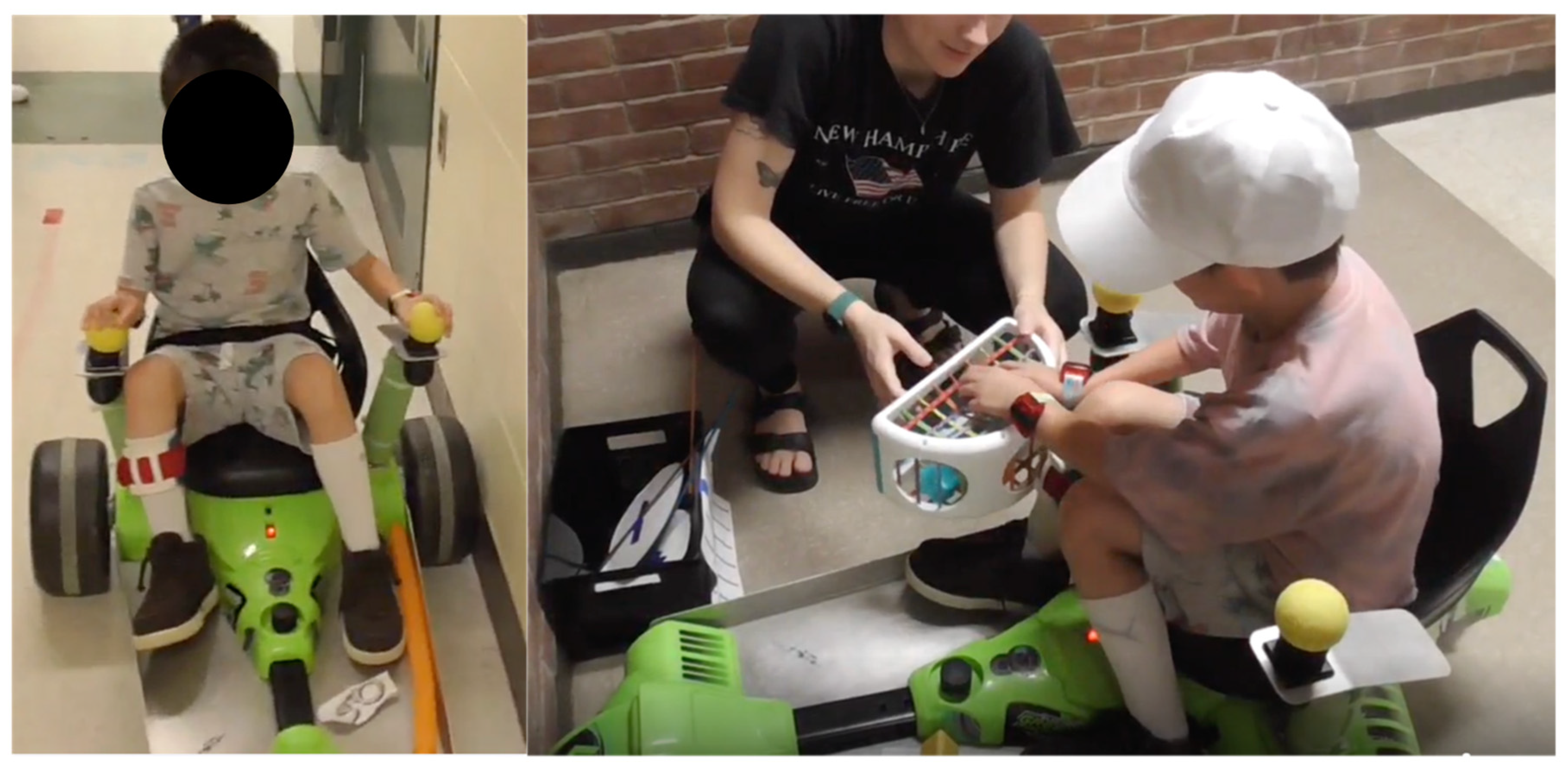
2.3. Ride-on-Toy Navigation Training (RNT) Program
2.4. Outcomes and Measures
2.4.1. Adherence and Clinician Impressions on Delivery of RNT
2.4.2. Testing Measures Conducted at Pretest and Posttest
Shriner’s Hospital Upper Extremity Evaluation (SHUEE)
Quality of Upper Extremity Skills Test (QUEST)
Box and Blocks (BBT)
2.4.3. Training-Specific Measures Analyzed from Early to Late Sessions
Affected Arm Use During Training Session
2.5. Statistical Analysis
3. Results
3.1. Adherence
3.2. Testing Measures Conducted at Pretest and Posttest
3.2.1. Shriner’s Hospital Upper Extremity Evaluation (SHUEE)
3.2.2. Quality of Upper Extremity Skills Test (QUEST)
3.2.3. Box and Blocks (BBT)
3.2.4. Path Navigation Test
3.3. Training-Specific Measures Analyzed from Early to Late Sessions
3.3.1. Affected Arm Use During Training Sessions
3.3.2. Level of Independence During Ride-On Toy Navigation
4. Discussion
Limitations
5. Conclusions
Author Contributions
Funding
Institutional Review Board Statement
Informed Consent Statement
Data Availability Statement
Acknowledgments
Conflicts of Interest
Abbreviations
| UCP | Unilateral Cerebral Palsy |
| RNT | Ride-on-toy Navigation Training |
| mCIMT | Modified Constraint-Induced Movement Therapy |
| BT | Bimanual Training |
| UE | Upper Extremity |
| IRB | Institutional Review Board |
| QUEST | Quality of Upper Extremity Skills Test |
| SHUEE | Shriner’s Hospital Upper Extremity Evaluation |
| DPA | Dynamic Positional Analysis |
| SFA | Spontaneous Functional Analysis |
| ES | Effect Size |
| SE | Standard Error |
| M | Mean |
| OT | Occupational Therapists |
References
- Dan, B.; Rosenbaum, P.; Carr, L.; Gough, M.; Coughlan, J.; Nweke, N. Proposed updated description of cerebral palsy. Dev. Med. Child Neurol. 2025, 67, 700–709. [Google Scholar] [CrossRef] [PubMed]
- Chiu, H.; Ada, L. Constraint-induced movement therapy improves upper limb activity and participation in hemiplegic cerebral palsy: A systematic review. J. Physiother. 2016, 62, 130–137. [Google Scholar] [CrossRef] [PubMed]
- Christensen, D.; Van Naarden Braun, K.; Doernberg, N.S.; Maenner, M.J.; Arneson, C.L.; Durkin, M.S.; Benedict, R.E.; Kirby, R.S.; Wingate, M.S.; Fitzgerald, R.; et al. Prevalence of cerebral palsy, cooccurring autism spectrum disorders, and motor functioning–Autism and Developmental Disabilities Monitoring Network, USA, 2008. Dev. Med. Child Neurol. 2014, 56, 59–65. [Google Scholar] [CrossRef] [PubMed]
- Beaman, J.; Kalisperis, F.; Miller-Skomorucha, K. The infant and child with cerebral palsy. In Pediatric Physical Therapy, 5th ed.; Lippincott Williams and Wilkins: Sydney, Australia, 2014; pp. 187–246. [Google Scholar]
- Sakzewski, L.; Ziviani, J.; Boyd, R. Systematic review and meta-analysis of therapeutic management of upper-limb dysfunction in children with congenital hemiplegia. Pediatrics 2009, 123, e1111–e1122. [Google Scholar] [CrossRef]
- Jackman, M.; Lannin, N.; Galea, C.; Sakzewski, L.; Miller, L.; Novak, I. What is the threshold dose of upper limb training for children with cerebral palsy to improve function? A systematic review. Aust. Occup. Ther. J. 2020, 67, 269–280. [Google Scholar] [CrossRef]
- Gilmore, R.; Ziviani, J.; Sakzewski, L.; Shields, N.; Boyd, R. A balancing act: Children’s experience of modified constraint-induced movement therapy. Dev. Neurorehabilit. 2010, 13, 88–94. [Google Scholar] [CrossRef]
- Hines, A.; Bundy, A.C.; Black, D.; Haertsch, M.; Wallen, M. Upper limb function of children with unilateral cerebral palsy after a magic-themed HABIT: A pre-post-study with 3-and 6-month follow-up. Phys. Occup. Ther. Pediatr. 2019, 39, 404–419. [Google Scholar] [CrossRef]
- Dong, V.A.; Tung, I.H.; Siu, H.W.; Fong, K.N. Studies comparing the efficacy of constraint-induced movement therapy and bimanual training in children with unilateral cerebral palsy: A systematic review. Dev. Neurorehabilit. 2013, 16, 133–143. [Google Scholar] [CrossRef]
- Oliveira, A.; Pereira, A.; Núñez, J.C.; Vallejo, G.; Lopes, S.; Guimarães, A.; Abreu, R.; Rosário, P. Children with Cerebral Palsy Rehabilitation In-Session Engagement: Lessons Learnt from a Story Tool Training Program. Int. J. Disabil. Dev. Educ. 2024, 71, 1–19. [Google Scholar] [CrossRef]
- Miller, L.; Ziviani, J.; Ware, R.S.; Boyd, R.N. Does context matter? Mastery motivation and therapy engagement of children with cerebral palsy. Phys. Occup. Ther. Pediatr. 2016, 36, 155–170. [Google Scholar] [CrossRef]
- Green, D.; Schertz, M.; Gordon, A.M.; Moore, A.; Margalit, T.S.; Farquharson, Y.; Ben Bashat, D.; Weinstein, M.; Lin, J.; Fattal-Valevski, A. A multi-site study of functional outcomes following a themed approach to hand–arm bimanual intensive therapy for children with hemiplegia. Dev. Med. Child Neurol. 2013, 55, 527–533. [Google Scholar] [CrossRef] [PubMed]
- Bono, G.L.; Achermann, P.; Rückriem, B.; Lieber, J.; van Hedel, H.J. Goal-directed personalized upper limb intensive therapy (PULIT) for children with hemiparesis: A retrospective analysis. Am. J. Occup. Ther. 2022, 76, 7606205050. [Google Scholar] [CrossRef]
- Gilliaux, M.; Renders, A.; Dispa, D.; Holvoet, D.; Sapin, J.; Dehez, B.; Detrembleur, C.; Lejeune, T.M.; Stoquart, G. Upper limb robot-assisted therapy in cerebral palsy: A single-blind randomized controlled trial. Neurorehabilit. Neural Repair 2015, 29, 183–192. [Google Scholar] [CrossRef]
- Phelan, I.; Carrion-Plaza, A.; Furness, P.J.; Dimitri, P. Home-based immersive virtual reality physical rehabilitation in paediatric patients for upper limb motor impairment: A feasibility study. Virtual Real. 2023, 27, 3505–3520. [Google Scholar] [CrossRef]
- Acar, G.; Altun, G.P.; Yurdalan, S.; Polat, M.G. Efficacy of neurodevelopmental treatment combined with the Nintendo® Wii in patients with cerebral palsy. J. Phys. Ther. Sci. 2016, 28, 774–780. [Google Scholar] [CrossRef]
- Peramalaiah, M.K.; Parmar, S.T.; Sepehri, N.; Muthukumarana, S.; Kanitkar, A.; Hin, C.K.; Szturm, T.J. Evaluation of a Game-Based Mechatronic Device for Rehabilitation of Hand-Arm Function in Children with Cerebral Palsy: Feasibility Randomized Controlled Trial. JMIR Rehabil. Assist. Technol. 2025, 12, e65358. [Google Scholar] [CrossRef]
- Büyüktaş, N.; Tarsuslu, T. The Effects of Upper Extremity Robotic Rehabilitation in Children with Spastic Hemiparetic Cerebral Palsy: A Randomized Controlled Trial. Balıkesir Sağlık Bilim. Derg. 2025, 14, 781–788. [Google Scholar]
- Roberts, H.; Shierk, A.; Clegg, N.J.; Baldwin, D.; Smith, L.; Yeatts, P.; Delgado, M.R. Constraint induced movement therapy camp for children with hemiplegic cerebral palsy augmented by use of an exoskeleton to play games in virtual reality. Phys. Occup. Ther. Pediatr. 2020, 41, 150–165. [Google Scholar] [CrossRef]
- Bayón, C.; Raya, R.; Lerma Lara, S.; Ramirez, O.; Serrano, J.I.; Rocon, E. Robotic therapies for children with cerebral palsy: A systematic review. Transl. Biomed. 2016, 7, 1–10. [Google Scholar] [CrossRef]
- Aderinto, N.; Olatunji, G.; Kokori, E.; Abraham, I.C.; Ogieuhi, I.J.; Egbunu, E.; Moradeyo, A.; Obasanjo, O.M.; Ukoaka, B.M.; Babalola, A.E.; et al. The Effectiveness of Virtual Reality Therapy in Improving Motor Function and Quality of Life among Children with Cerebral Palsy. Curr. Treat. Options Pediatr. 2024, 11, 1. [Google Scholar] [CrossRef]
- Amonkar, N.; Kumavor, P.; Morgan, K.; Bubela, D.; Srinivasan, S. Feasibility of Using Joystick-Operated Ride-on-Toys to Promote Upper Extremity Function in Children with Cerebral Palsy: A Pilot Study. Pediatr. Phys. Ther. 2022, 34, 508–517. [Google Scholar] [CrossRef] [PubMed]
- Srinivasan, S.; Amonkar, N.; Kumavor, P.; Morgan, K.; Bubela, D. Outcomes associated with a single joystick-operated ride-on-toy navigation training incorporated into a constraint-induced movement therapy program: A pilot feasibility study. Behav. Sci. 2023, 13, 413. [Google Scholar] [CrossRef]
- Srinivasan, S.; Kumavor, P.; Morgan, K. A training program using modified joystick-operated ride-on toys to complement conventional upper extremity rehabilitation in children with cerebral palsy: Results from a pilot study. Bioengineering 2024, 11, 304. [Google Scholar] [CrossRef]
- Srinivasan, S.; Kumavor, P.D.; Morgan, K. A pilot feasibility study on the use of dual-joystick-operated ride-on toys in upper extremity rehabilitation for children with unilateral cerebral palsy. Children 2024, 11, 408. [Google Scholar] [CrossRef]
- Shahane, V.; Kumavor, P.D.; Morgan, K.; Srinivasan, S. Fast and Fun: A Pilot Feasibility Study Using Dual Joystick-Operated Ride-on Toys for Upper Extremity Rehabilitation in Children with Hemiplegia. Phys. Occup. Ther. Pediatr. 2024, 44, 844–864. [Google Scholar] [CrossRef]
- Ryan, R.M.; Deci, E.L. Self-determination theory and the facilitation of intrinsic motivation, social development, and well-being. Am. Psychol. 2000, 55, 68. [Google Scholar] [CrossRef]
- Shumway-Cook, A.; Woollacott, M.H.; Rachwani, J.; Santamaria, V. Motor Control: Translating Research into Clinical Practice; Lippincott Williams and Wilkins: Philadelphia, PA, USA, 2023. [Google Scholar]
- Kataria, K.; Kumavor, P.; Srinivasan, S. Feasibility and perceived impact of a clinician-led bimanual training pro-gram using joystick-operated ride-on toys incorporated into an intensive task-oriented hybrid summer camp for children with Unilateral Cerebral Palsy. Department of Kinesiology, University of Connecticut, Storrs, CT, USA. 2025; Manuscript under review. [Google Scholar]
- Eliasson, A.; Krumlinde-Sundholm, L.; Rösblad, B.; Beckung, E.; Arner, M.; Öhrvall, A.; Rosenbaum, P. The Manual Ability Classification System (MACS) for children with cerebral palsy: Scale development and evidence of validity and reliability. Dev. Med. Child. Neurol. 2006, 48, 549–554. [Google Scholar] [CrossRef]
- De Brito Brandão, M.; Mancini, M.C.; Vaz, D.V.; Pereira de Melo, A.P.; Fonseca, S.T. Adapted version of constraint-induced movement therapy promotes functioning in children with cerebral palsy: A randomized controlled trial. Clin. Rehabil. 2010, 24, 639–647. [Google Scholar] [CrossRef]
- Boyd, R.N.; Ziviani, J.; Sakzewski, L.; Miller, L.; Bowden, J.; Cunnington, R.; Ware, R.; Guzzetta, A.; Al Macdonell, R.; Jackson, G.D.; et al. COMBIT: Protocol of a randomised comparison trial of COMbined modified constraint induced movement therapy and bimanual intensive training with distributed model of standard upper limb rehabilitation in children with congenital hemiplegia. BMC Neurol. 2013, 13, 68. [Google Scholar] [CrossRef] [PubMed]
- Aarts, P.B.; van Hartingsveldt, M.; Anderson, P.G.; van den Tillaar, I.; van der Burg, J.; Geurts, A.C. The pirate group intervention protocol: Description and a case report of a modified constraint-induced movement therapy combined with bimanual training for young children with unilateral spastic cerebral palsy. Occup. Ther. Int. 2012, 19, 76–87. [Google Scholar] [CrossRef] [PubMed]
- Lee, G.K.; Pascual, M.; Rethlefsen, S.A. A hybrid model of modified constraint induced movement therapy to improve upper extremity performance in children with unilateral upper extremity paresis: Retrospective case series. Br. J. Occup. Ther. 2021, 84, 271–277. [Google Scholar] [CrossRef]
- Kataria, K.; Jakubowski, M.; Jarvis, Z.; Jakimczyk, I.; Srinivasan, S. “It’s really fun!”: Child perceptions on the use of ride-on toys for rehabilitation in childhood hemiplegia. In Proceedings of the 79th Annual Meeting of the American Academy of Cerebral Palsy and Developmental Medicine, New Orleans, LA, USA, 15–18 October 2025. [Google Scholar]
- Davids, J.R.; Peace, L.C.; Wagner, L.V.; Gidewall, M.A.; Blackhurst, D.W.; Roberson, W.M. Validation of the Shriners Hospital for Children Upper Extremity Evaluation (SHUEE) for children with hemiplegic cerebral palsy. J. Bone Jt. Surg. 2006, 88, 326–333. [Google Scholar] [CrossRef]
- Thorley, M.; Lannin, N.; Cusick, A.; Novak, I.; Boyd, R. Construct validity of the Quality of Upper Extremity Skills Test for children with cerebral palsy. Dev. Med. Child Neurol. 2012, 54, 1037–1043. [Google Scholar] [CrossRef]
- Thorley, M.; Lannin, N.; Cusick, A.; Novak, I.; Boyd, R. Reliability of the quality of upper extremity skills test for children with cerebral palsy aged 2 to 12 years. Phys. Occup. Ther. Pediatr. 2012, 32, 4–21. [Google Scholar] [CrossRef]
- Chen, H.; Chen, C.C.; Hsueh, I.; Huang, S.; Hsieh, C. Test-retest reproducibility and smallest real difference of 5 hand function tests in patients with stroke. Neurorehabilit. Neural Repair 2009, 23, 435–440. [Google Scholar] [CrossRef]
- Liang, K.; Chen, H.; Shieh, J.; Wang, T. Measurement properties of the box and block test in children with unilateral cerebral palsy. Sci. Rep. 2021, 11, 20955. [Google Scholar] [CrossRef]
- Srinivasan, S.; Amonkar, N.; Kumavor, P.D.; Bubela, D.; Morgan, K. Joystick-operated ride-on toy navigation training for children with hemiplegic cerebral palsy: A pilot study. Am. J. Occup. Ther. 2024, 78, 7804185070. [Google Scholar] [CrossRef] [PubMed]
- Arnould, C.; Penta, M.; Renders, A.; Thonnard, J. ABILHAND-Kids: A measure of manual ability in children with cerebral palsy. Neurology 2004, 63, 1045–1052. [Google Scholar] [CrossRef]
- Preston, N.; Weightman, A.; Gallagher, J.; Holt, R.; Clarke, M.; Mon-Williams, M.; Levesley, M.; Bhakta, B. Feasibility of school-based computer-assisted robotic gaming technology for upper limb rehabilitation of children with cerebral palsy. Disabil. Rehabil. Assist. Technol. 2016, 11, 281–288. [Google Scholar] [CrossRef] [PubMed]
- Li, W.; Lam-Damji, S.; Chau, T.; Fehlings, D. The development of a home-based virtual reality therapy system to promote upper extremity movement for children with hemiplegic cerebral palsy. Technol. Disabil. 2009, 21, 107–113. [Google Scholar] [CrossRef]
- Choi, J.Y.; Yi, S.; Shim, D.; Yoo, B.; Park, E.S.; Rha, D. Home-based virtual reality-enhanced upper limb training system in children with brain injury: A randomized controlled trial. Front. Pediatr. 2023, 11, 1131573. [Google Scholar] [CrossRef] [PubMed]
- Bartlett, D.J.; Palisano, R.J. Physical therapists’ perceptions of factors influencing the acquisition of motor abilities of children with cerebral palsy: Implications for clinical reasoning. Phys. Ther. 2002, 82, 237–248. [Google Scholar] [CrossRef] [PubMed]
- Majnemer, A.; Shevell, M.; Law, M.; Poulin, C.; Rosenbaum, P. Level of motivation in mastering challenging tasks in children with cerebral palsy. Dev. Med. Child Neurol. 2010, 52, 1120–1126. [Google Scholar] [CrossRef] [PubMed]
- Diamond, A. Close interrelation of motor development and cognitive development and of the cerebellum and prefrontal cortex. Child Dev. 2000, 71, 44–56. [Google Scholar] [CrossRef] [PubMed]
- Thelen, E.; Schöner, G.; Scheier, C.; Smith, L.B. The dynamics of embodiment: A field theory of infant perseverative reaching. Behav. Brain Sci. 2001, 24, 1–34. [Google Scholar] [CrossRef]

| Child Number | % Spontaneous Functional Analysis (SFA) Scores | % Dynamic Positional Analysis (DPA) Scores | |
|---|---|---|---|
| 1 | Pretest | 57.78 | 66.67 |
| Posttest | 60.00 | 72.22 | |
| 2 | Pretest | 55.56 | 68.06 |
| Posttest | 66.67 | 73.61 | |
| 3 | Pretest | 48.89 | 59.72 |
| Posttest | 55.56 | 70.83 | |
| 4 | Pretest | 0.00 | 55.56 |
| Posttest | 6.67 | 50.00 | |
| 5 | Pretest | 0.00 | 26.39 |
| Posttest | 4.44 | 34.72 | |
| 6 | Pretest | 57.78 | 76.39 |
| Posttest | 53.33 | 68.06 | |
| 7 | Pretest | 55.56 | 84.72 |
| Posttest | 64.44 | 84.72 | |
| 8 | Pretest | 26.67 | 41.67 |
| Posttest | 51.11 | 69.44 | |
| 9 | Pretest | 55.56 | 79.17 |
| Posttest | 80.00 | 88.89 | |
| 10 | Pretest | 55.56 | 88.89 |
| Posttest | 60.00 | 88.89 |
| Child Number | Total Score | Dissociated Movements | Grasps | Protective Extension | Weight Bearing | |
|---|---|---|---|---|---|---|
| 1 | Pretest | 73.87 | 70.31 | 40.74 | 94.44 | 90.00 |
| Posttest | 81.28 | 84.38 | 40.74 | 100.00 | 100.00 | |
| 2 | Pretest | 88.32 | 87.50 | 77.78 | 100.00 | 88.00 |
| Posttest | 92.06 | 89.06 | 85.19 | 100.00 | 94.00 | |
| 3 | Pretest | 69.37 | 59.38 | 77.78 | 58.33 | 82.00 |
| Posttest | 71.05 | 64.06 | 81.48 | 66.67 | 72.00 | |
| 4 | Pretest | 52.95 | 56.25 | 55.56 | 50.00 | 50.00 |
| Posttest | 54.90 | 64.06 | 55.56 | 50.00 | 50.00 | |
| 5 | Pretest | 56.40 | 62.50 | 55.56 | 55.56 | 52.00 |
| Posttest | 59.57 | 64.06 | 55.56 | 66.67 | 52.00 | |
| 6 | Pretest | 93.17 | 87.50 | 85.19 | 100.00 | 100.00 |
| Posttest | 94.63 | 85.94 | 92.59 | 100.00 | 100.00 | |
| 7 | Pretest | 95.91 | 98.44 | 85.19 | 100.00 | 100.00 |
| Posttest | 97.22 | 100.00 | 88.89 | 100.00 | 100.00 | |
| 8 | Pretest | 64.61 | 64.06 | 70.37 | 50.00 | 74.00 |
| Posttest | 69.73 | 73.44 | 81.48 | 50.00 | 74.00 | |
| 9 | Pretest | 87.33 | 93.75 | 88.89 | 66.67 | 100.00 |
| Posttest | 96.98 | 95.31 | 92.59 | 100.00 | 100.00 | |
| 10 | Pretest | 93.49 | 90.63 | 88.89 | 94.44 | 100.00 |
| Posttest | 97.12 | 92.19 | 96.30 | 100.00 | 100.00 |
| Child Number | % Task-Appropriate UE Use: Navigation | % Task-Appropriate UE Use: Object Interactions | % Independent Navigation | |
|---|---|---|---|---|
| 1 | Early | 88.86 | 64.88 | 90.41 |
| Late | 94.39 | 73.53 | 99.78 | |
| 2 | Early | 89.95 | 65.22 | 97.22 |
| Late | 87.07 | 75.96 | 99.88 | |
| 3 | Early | 92.29 | 38.64 | 97.11 |
| Late | 90.04 | 68.78 | 100.00 | |
| 4 | Early | 70.08 | 6.78 | 88.90 |
| Late | 68.09 | 24.14 | 99.04 | |
| 5 | Early | 68.47 | 6.24 | 48.60 |
| Late | 64.39 | 46.48 | 92.17 | |
| 6 | Early | 93.34 | 72.26 | 96.89 |
| Late | 96.74 | 83.93 | 100.00 | |
| 7 | Early | 87.24 | 86.45 | 97.76 |
| Late | 97.98 | 87.47 | 100.00 | |
| 8 | Early | 78.17 | 53.86 | 88.72 |
| Late | 75.68 | 82.14 | 93.68 | |
| 9 | Early | 94.52 | 80.84 | 56.45 |
| Late | 98.44 | 87.81 | 100.00 | |
| 10 | Early | 91.28 | 73.99 | 91.55 |
| Late | 90.67 | 73.74 | 99.16 |
Disclaimer/Publisher’s Note: The statements, opinions and data contained in all publications are solely those of the individual author(s) and contributor(s) and not of MDPI and/or the editor(s). MDPI and/or the editor(s) disclaim responsibility for any injury to people or property resulting from any ideas, methods, instructions or products referred to in the content. |
© 2025 by the authors. Licensee MDPI, Basel, Switzerland. This article is an open access article distributed under the terms and conditions of the Creative Commons Attribution (CC BY) license (https://creativecommons.org/licenses/by/4.0/).
Share and Cite
Kataria, K.; Kumavor, P.D.; Srinivasan, S. Integration of a Bimanual Training Program Using Joystick-Operated Ride-On Toys into an Intensive, Task-Oriented Hybrid Intervention for Children with Unilateral Cerebral Palsy: A Feasibility Study. J. Clin. Med. 2025, 14, 8672. https://doi.org/10.3390/jcm14248672
Kataria K, Kumavor PD, Srinivasan S. Integration of a Bimanual Training Program Using Joystick-Operated Ride-On Toys into an Intensive, Task-Oriented Hybrid Intervention for Children with Unilateral Cerebral Palsy: A Feasibility Study. Journal of Clinical Medicine. 2025; 14(24):8672. https://doi.org/10.3390/jcm14248672
Chicago/Turabian StyleKataria, Kush, Patrick D. Kumavor, and Sudha Srinivasan. 2025. "Integration of a Bimanual Training Program Using Joystick-Operated Ride-On Toys into an Intensive, Task-Oriented Hybrid Intervention for Children with Unilateral Cerebral Palsy: A Feasibility Study" Journal of Clinical Medicine 14, no. 24: 8672. https://doi.org/10.3390/jcm14248672
APA StyleKataria, K., Kumavor, P. D., & Srinivasan, S. (2025). Integration of a Bimanual Training Program Using Joystick-Operated Ride-On Toys into an Intensive, Task-Oriented Hybrid Intervention for Children with Unilateral Cerebral Palsy: A Feasibility Study. Journal of Clinical Medicine, 14(24), 8672. https://doi.org/10.3390/jcm14248672

