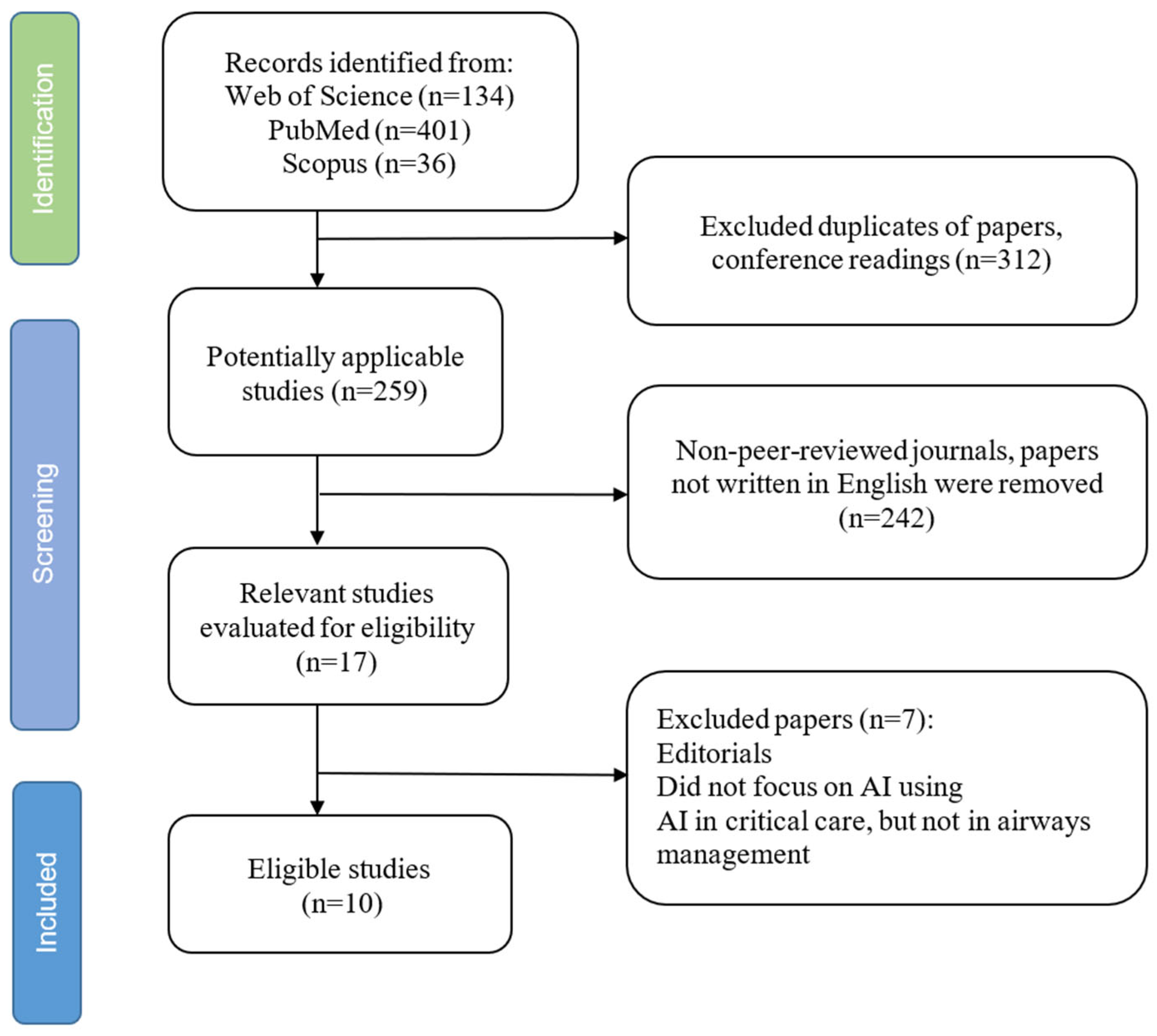

Artificial Intelligence for Predicting Difficult Airways: A Review

Abstract
1. Introduction
2. Materials and Methods
3. Results
3.1. Review Article Analysis
3.2. Original Research Articles Analysis
4. Discussion
4.1. Comparative Performance of AI and Traditional Models
4.2. Limitations in Methodology and Comparability
4.3. Clinical Applicability and Interpretability
4.4. Ethical and Regulatory Considerations
4.5. Clinical Utility and Cost-Effectiveness
4.6. Toward Standardization and Benchmarking
4.7. Future Directions
4.8. Limitations
5. Conclusions
Supplementary Materials
Author Contributions
Funding
Institutional Review Board Statement
Informed Consent Statement
Data Availability Statement
Conflicts of Interest
Abbreviations
| AI | Artificial Intelligence |
| ML | Machine Learning |
| DL | Deep Learning |
| CNN | Convolutional Neural Network |
| RNN | Recurrent Neural Network |
| MIL | Multiple Instance Learning |
| FRFE | Face Region Feature Extractor |
| SSL | Semi-Supervised Learning |
| GAN | Generative Adversarial Network |
| XAI | Explainable Artificial Intelligence |
| CDSS | Clinical Decision Support System |
| AUC | Area Under the Curve |
| AUROC | Area Under the Receiver Operating Characteristic Curve |
| AUPRC | Area Under the Precision–Recall Curve |
| ROC | Receiver Operating Characteristic |
| PPV | Positive Predictive Value |
| NPV | Negative Predictive Value |
| PLR | Positive Likelihood Ratio |
| NLR | Negative Likelihood Ratio |
| TMD | Thyromental Distance |
| ULBT | Upper Lip Bite Test |
| LEMON | Look, Evaluate, Mallampati, Obstruction, Neck mobility (airway assessment system) |
| ASA PS | American Society of Anesthesiologists Physical Status |
| CL | Cormack–Lehane (classification) |
| ECG | Electrocardiogram |
| NBP | Non-invasive Blood Pressure |
| SpO2 | Peripheral Oxygen Saturation |
| EtCO2 | End-tidal Carbon Dioxide Concentration |
| BRF | Balanced Random Forest |
| LGBM | Light Gradient Boosting Machine |
| XGB | Extreme Gradient Boosting |
| LR | Logistic Regression |
| MLP | Multi-Layer Perceptron |
| ResNet18 | Residual Neural Network with 18 layers |
| VGG16 | Visual Geometry Group 16-layer Network |
| Grad-CAM | Gradient-Weighted Class Activation Mapping |
| BMI | Body Mass Index |
| MRI | Magnetic Resonance Imaging |
| CT | Computed Tomography |
| AU | Arbitrary Unit |
| IQR | Interquartile Range |
| NDDL | Non-Difficult Direct Laryngoscopy |
| DDL | Difficult Direct Laryngoscopy |
| NDL | Non-Difficult Laryngoscopy |
| DL (clinical) | Difficult Laryngoscopy |
| NC | Neck Circumference |
| TMHT | Thyromental Height |
| QUADAS-2 | Quality Assessment of Diagnostic Accuracy Studies-2 |
| FDA | U.S. Food and Drug Administration |
| EMA | European Medicines Agency |
| MIMIC-III | Medical Information Mart for Intensive Care III |
| GANs | Generative Adversarial Networks |
References
- Valero, R.; Orrego, C.; Mayoral, V.; Masso, E.; Lopez, A.; Sabate, S.; Villalonga, R.; Bermejo, S.; Borras, R.; Vila, P.; et al. Collaborative intervention to improve airway assessment and safety in management for anaesthesia: The Qualitat & Via Aeria (QUAVA) study. Eur. J. Anaesthesiol. 2014, 31, 143–152. [Google Scholar] [CrossRef] [PubMed]
- Joffe, A.M.; Aziz, M.F.; Posner, K.L.; Duggan, L.V.; Mincer, S.L.; Domino, K.B. Management of Difficult Tracheal Intubation: A Closed Claims Analysis. Anesthesiology 2019, 131, 818–829. [Google Scholar] [CrossRef]
- Apfelbaum, J.L.; Hagberg, C.A.; Caplan, R.A.; Blitt, C.D.; Connis, R.T.; Nickinovich, D.G.; Hagberg, C.A.; Caplan, R.A.; Benumof, J.L.; Berry, F.A.; et al. Practice guidelines for management of the difficult airway: An updated report by the American Society of Anesthesiologists Task Force on Management of the Difficult Airway. Anesthesiology 2013, 118, 251–270. [Google Scholar] [CrossRef] [PubMed]
- Kheterpal, S.; Healy, D.; Aziz, M.F.; Shanks, A.M.; Freundlich, R.E.; Linton, F.; Martin, L.D.; Linton, J.; Epps, J.L.; Fernandez-Bustamante, A.; et al. Incidence, predictors, and outcome of difficult mask ventilation combined with difficult laryngoscopy: A report from the multicenter perioperative outcomes group. Anesthesiology 2013, 119, 1360–1369. [Google Scholar] [CrossRef]
- Detsky, M.E.; Jivraj, N.; Adhikari, N.K.; Friedrich, J.O.; Pinto, R.; Simel, D.L.; Wijeysundera, D.N.; Scales, D.C. Will This Patient Be Difficult to Intubate? The Rational Clinical Examination Systematic Review. JAMA 2019, 321, 493–503. [Google Scholar] [CrossRef]
- Heinrich, S.; Birkholz, T.; Irouschek, A.; Ackermann, A.; Schmidt, J. Incidences and predictors of difficult laryngoscopy in adult patients undergoing general anesthesia: A single-center analysis of 102,305 cases. J. Anesth. 2013, 27, 815–821. [Google Scholar] [CrossRef]
- Hayasaka, T.; Kawano, K.; Kurihara, K.; Suzuki, H.; Nakane, M.; Kawamae, K. Creation of an artificial intelligence model for intubation difficulty classification by deep learning (convolutional neural network) using face images: An observational study. J. Intensive Care 2021, 9, 38. [Google Scholar] [CrossRef]
- Amaniti, A.; Papakonstantinou, P.; Gkinas, D.; Dalakakis, I.; Papapostolou, E.; Nikopoulou, A.; Tsatali, M.; Zarogoulidis, P.; Sapalidis, K.; Kosmidis, C.; et al. Comparison of Laryngoscopic Views betweenC-MAC and Conventional Laryngoscopy in Patients with Multiple Preoperative Prognostic Criteria of Difficult Intubation. An Observational Cross-Sectional Study. Medicina 2019, 55, 760. [Google Scholar] [CrossRef]
- Faramarzi, E.; Soleimanpour, H.; Khan, Z.H.; Mahmoodpoor, A.; Sanaie, S. Upper lip bite test for prediction of difficult airway: A systematic review. Pak. J. Med. Sci. 2018, 34, 1019–1023. [Google Scholar] [CrossRef] [PubMed]
- Chen, H.; Zheng, Y.; Fu, Q.; Li, P. A review of the current status and progress in difficult airway assessment research. Eur. J. Med. Res. 2024, 29, 172. [Google Scholar] [CrossRef]
- Connor, C.W.; Segal, S. The importance of subjective facial appearance on the ability of anesthesiologists to predict difficult intubation. Anesth. Analg. 2014, 118, 419–427. [Google Scholar] [CrossRef]
- Norskov, A.K.; Rosenstock, C.V.; Lundstrom, L.H. Lack of national consensus in preoperative airway assessment. Dan. Med. J. 2016, 63, A5278. [Google Scholar]
- Hagiwara, Y.; Watase, H.; Okamoto, H.; Goto, T.; Hasegawa, K.; Japanese Emergency Medicine Network Investigators. Prospective validation of the modified LEMON criteria to predict difficult intubation in the ED. Am. J. Emerg. Med. 2015, 33, 1492–1496. [Google Scholar] [CrossRef]
- Bellini, V.; Rafano Carna, E.; Russo, M.; Di Vincenzo, F.; Berghenti, M.; Baciarello, M.; Bignami, E. Artificial intelligence and anesthesia: A narrative review. Ann. Transl. Med. 2022, 10, 528. [Google Scholar] [CrossRef]
- Matava, C.; Pankiv, E.; Ahumada, L.; Weingarten, B.; Simpao, A. Artificial intelligence, machine learning and the pediatric airway. Paediatr. Anaesth. 2020, 30, 264–268. [Google Scholar] [CrossRef]
- Esteva, A.; Kuprel, B.; Novoa, R.A.; Ko, J.; Swetter, S.M.; Blau, H.M.; Thrun, S. Dermatologist-level classification of skin cancer with deep neural networks. Nature 2017, 542, 115–118. [Google Scholar] [CrossRef]
- De Rosa, S.; Bignami, E.; Bellini, V.; Battaglini, D. The Future of Artificial Intelligence Using Images and Clinical Assessment for Difficult Airway Management. Anesth. Analg. 2025, 140, 317–325. [Google Scholar] [CrossRef]
- Salimparsa, M.; Sedig, K.; Lizotte, D.J.; Abdullah, S.S.; Chalabianloo, N.; Muanda, F.T. Explainable AI for Clinical Decision Support Systems: Literature Review, Key Gaps, and Research Synthesis. Informatics 2025, 12, 119. [Google Scholar] [CrossRef]
- Hassija, V.; Chamola, V.; Mahapatra, A.; Singal, A.; Goel, D.; Huang, K.; Scardapane, S.; Spinelli, I.; Mahmud, M.; Hussain, A. Interpreting Black-Box Models: A Review on Explainable Artificial Intelligence. Cogn. Comput. 2023, 16, 45–74. [Google Scholar] [CrossRef]
- Abbas, Q.; Jeong, W.; Lee, S.W. Explainable AI in Clinical Decision Support Systems: A Meta-Analysis of Methods, Applications, and Usability Challenges. Healthcare 2025, 13, 2154. [Google Scholar] [CrossRef]
- Raz, T.; Pahud De Mortanges, A.; Reyes, M. Explainable AI in medicine: Challenges of integrating XAI into the future clinical routine. Front. Radiol. 2025, 5, 1627169. [Google Scholar] [CrossRef]
- Kim, J.H.; Jung, H.S.; Lee, S.E.; Hou, J.U.; Kwon, Y.S. Improving difficult direct laryngoscopy prediction using deep learning and minimal image analysis: A single-center prospective study. Sci. Rep. 2024, 14, 14209. [Google Scholar] [CrossRef]
- Kim, J.H.; Kim, H.; Jang, J.S.; Hwang, S.M.; Lim, S.Y.; Lee, J.J.; Kwon, Y.S. Development and validation of a difficult laryngoscopy prediction model using machine learning of neck circumference and thyromental height. BMC Anesthesiol. 2021, 21, 125. [Google Scholar] [CrossRef]
- Tavolara, T.E.; Gurcan, M.N.; Segal, S.; Niazi, M.K.K. Identification of difficult to intubate patients from frontal face images using an ensemble of deep learning models. Comput. Biol. Med. 2021, 136, 104737. [Google Scholar] [CrossRef]
- Wang, G.; Li, C.; Tang, F.; Wang, Y.; Wu, S.; Zhi, H.; Zhang, F.; Wang, M.; Zhang, J. A fully-automatic semi-supervised deep learning model for difficult airway assessment. Heliyon 2023, 9, e15629. [Google Scholar] [CrossRef]
- Xia, M.; Jin, C.; Zheng, Y.; Wang, J.; Zhao, M.; Cao, S.; Xu, T.; Pei, B.; Irwin, M.G.; Lin, Z.; et al. Deep learning-based facial analysis for predicting difficult videolaryngoscopy: A feasibility study. Anaesthesia 2024, 79, 399–409. [Google Scholar] [CrossRef]
- Yamanaka, S.; Goto, T.; Morikawa, K.; Watase, H.; Okamoto, H.; Hagiwara, Y.; Hasegawa, K. Machine Learning Approaches for Predicting Difficult Airway and First-Pass Success in the Emergency Department: Multicenter Prospective Observational Study. Interact. J. Med. Res. 2022, 11, e28366. [Google Scholar] [CrossRef]
- Wang, Z.; Jin, Y.; Zheng, Y.; Chen, H.; Feng, J.; Sun, J. Evaluation of preoperative difficult airway prediction methods for adult patients without obvious airway abnormalities: A systematic review and meta-analysis. BMC Anesthesiol. 2024, 24, 242. [Google Scholar] [CrossRef]
- Roth, D.; Pace, N.L.; Lee, A.; Hovhannisyan, K.; Warenits, A.M.; Arrich, J.; Herkner, H. Airway physical examination tests for detection of difficult airway management in apparently normal adult patients. Cochrane Database Syst. Rev. 2018, 5, CD008874. [Google Scholar] [CrossRef]
- Darzi, F.; Bocklitz, T. A Review of Medical Image Registration for Different Modalities. Bioengineering 2024, 11, 786. [Google Scholar] [CrossRef]
- Semmelrock, H.; Ross-Hellauer, T.; Kopeinik, S.; Theiler, D.; Haberl, A.; Thalmann, S.; Kowald, D. Reproducibility in machine-learning-based research: Overview, barriers, and drivers. AI Mag. 2025, 46, e70002. [Google Scholar] [CrossRef]
- Silvey, S.; Liu, J. Sample Size Requirements for Popular Classification Algorithms in Tabular Clinical Data: Empirical Study. J. Med. Internet Res. 2024, 26, e60231. [Google Scholar] [CrossRef]
- Giri, R.; Firdhos, S.H.; Vida, T.A. Artificial Intelligence in Anesthesia: Enhancing Precision, Safety, and Global Access Through Data-Driven Systems. J. Clin. Med. 2025, 14, 6900. [Google Scholar] [CrossRef]
- Cao, Y.; Wang, Y.; Liu, H.; Wu, L. Artificial intelligence revolutionizing anesthesia management: Advances and prospects in intelligent anesthesia technology. Front. Med. 2025, 12, 1571725. [Google Scholar] [CrossRef]
- El-Hadi, H.; Chan, B.L.; Siu, B.W.; Ko, I.C.; Leung, D.K.; Teoh, J.Y.; Chiu, P.K.; Ng, C.F.; Liu, A.Q. A Systematic Review of Smartphone Applications That Address Patient Care in the Peri-Operative Period. Healthcare 2025, 13, 2775. [Google Scholar] [CrossRef]
- Zhang, S.; Yu, J.; Xu, X.; Yin, C.; Lu, Y.; Yao, B.; Tory, M.; Padilla, L.M.; Caterino, J.; Zhang, P.; et al. Rethinking Human-AI Collaboration in Complex Medical Decision Making: A Case Study in Sepsis Diagnosis. In Proceedings of the 2024 CHI Conference on Human Factors in Computing Systems, Honolulu, HI, USA, 11–16 May 2024; Volume 2024. [Google Scholar] [CrossRef]
- Jenko, S.; Papadopoulou, E.; Kumar, V.; Overman, S.; Krepelkova, K.; Wilson, J.; Dunbar, E.; Spice, C.; Exarchos, T. Artificial Intelligence in Healthcare: How to Develop and Implement Safe, Ethical and Trustworthy AI Systems. Ai 2025, 6, 116. [Google Scholar] [CrossRef]
- Mennella, C.; Maniscalco, U.; De Pietro, G.; Esposito, M. Ethical and regulatory challenges of AI technologies in healthcare: A narrative review. Heliyon 2024, 10, e26297. [Google Scholar] [CrossRef]
- Viderman, D.; Abdildin, Y.G.; Batkuldinova, K.; Badenes, R.; Bilotta, F. Artificial Intelligence in Resuscitation: A Scoping Review. J. Clin. Med. 2023, 12, 2254. [Google Scholar] [CrossRef]
- Wang, B.; Li, X.; Xu, J.; Wang, B.; Wang, M.; Lu, X.; Han, R.; Chen, Y.; Jiang, X.; Yao, W. Comparison of Machine Learning Models for Difficult Airway. J. Anesth. Transl. Med. 2023, 2, 21–28. [Google Scholar] [CrossRef]
- Muhammad, D.; Bendechache, M. Unveiling the black box: A systematic review of Explainable Artificial Intelligence in medical image analysis. Comput. Struct. Biotechnol. J. 2024, 24, 542–560. [Google Scholar] [CrossRef]
- Sadeghi, Z.; Alizadehsani, R.; Cifci, M.A.; Kausar, S.; Rehman, R.; Mahanta, P.; Bora, P.K.; Almasri, A.; Alkhawaldeh, R.S.; Hussain, S.; et al. A review of Explainable Artificial Intelligence in healthcare. Comput. Electr. Eng. 2024, 118, 109370. [Google Scholar] [CrossRef]
- Alkhanbouli, R.; Matar Abdulla Almadhaani, H.; Alhosani, F.; Simsekler, M.C.E. The role of explainable artificial intelligence in disease prediction: A systematic literature review and future research directions. BMC Med. Inform. Decis. Mak. 2025, 25, 110. [Google Scholar] [CrossRef]
- Pham, T. Ethical and legal considerations in healthcare AI: Innovation and policy for safe and fair use. R. Soc. Open Sci. 2025, 12, 241873. [Google Scholar] [CrossRef] [PubMed]
- Wang, M.; Li, S.; Zhang, X.; Feng, G. Facial privacy in the digital era: A comprehensive survey on methods, evaluation, and future directions. Comput. Sci. Rev. 2025, 58, 100785. [Google Scholar] [CrossRef]
- Elgin, C.Y.; Elgin, C. Ethical implications of AI-driven clinical decision support systems on healthcare resource allocation: A qualitative study of healthcare professionals’ perspectives. BMC Med. Ethics 2024, 25, 148. [Google Scholar] [CrossRef] [PubMed]
- MacIntyre, M.R.; Cockerill, R.G.; Mirza, O.F.; Appel, J.M. Ethical considerations for the use of artificial intelligence in medical decision-making capacity assessments. Psychiatry Res. 2023, 328, 115466. [Google Scholar] [CrossRef]
- Chen, R.J.; Wang, J.J.; Williamson, D.F.K.; Chen, T.Y.; Lipkova, J.; Lu, M.Y.; Sahai, S.; Mahmood, F. Algorithmic fairness in artificial intelligence for medicine and healthcare. Nat. Biomed. Eng. 2023, 7, 719–742. [Google Scholar] [CrossRef]
- Viderman, D.; Ayazbay, A.; Kalzhan, B.; Bayakhmetova, S.; Tungushpayev, M.; Abdildin, Y. Artificial Intelligence in the Management of Patients with Respiratory Failure Requiring Mechanical Ventilation: A Scoping Review. J. Clin. Med. 2024, 13, 7535. [Google Scholar] [CrossRef]
- Pagallo, U.; O’Sullivan, S.; Nevejans, N.; Holzinger, A.; Friebe, M.; Jeanquartier, F.; Jean-Quartier, C.; Miernik, A. The underuse of AI in the health sector: Opportunity costs, success stories, risks and recommendations. Health Technol. 2024, 14, 1–14. [Google Scholar] [CrossRef]
- Vittori, A.; Cascella, M. Could artificial intelligence accelerate progress in ambulatory anesthesia? J. Transl. Med. 2025, 23, 1151. [Google Scholar] [CrossRef]
- Abdelbaky, A.M.; Elmasry, W.G.; Awad, A.H.; Khan, S. Role of Artificial Intelligence in Critical Care Medicine: A Literature Review. Cureus 2025, 17, e90149. [Google Scholar] [CrossRef] [PubMed]
- El Arab, R.A.; Al Moosa, O.A. Systematic review of cost effectiveness and budget impact of artificial intelligence in healthcare. NPJ Digit. Med. 2025, 8, 548. [Google Scholar] [CrossRef] [PubMed]
- Zhang, W.; Du, L.; Huang, Y.; Liu, D.; Li, T.; Zheng, J. Artificial intelligence for difficult airway assessment: A protocol for a systematic review with meta-analysis. BMJ Open 2025, 15, e096744. [Google Scholar] [CrossRef]
- Bodini, M. A Review of Facial Landmark Extraction in 2D Images and Videos Using Deep Learning. Big Data Cogn. Comput. 2019, 3, 14. [Google Scholar] [CrossRef]
- Nemani, S.; Goyal, S.; Sharma, A.; Kothari, N. Artificial intelligence in pediatric airway—A scoping review. Saudi J. Anaesth. 2024, 18, 410–416. [Google Scholar] [CrossRef] [PubMed]


| Authors | Article Type | Research Purpose | Evaluation Methods a | AI Models a |
|---|---|---|---|---|
| Chen et al. (2024) [10] | Review |
| No specific measurements indicated | Machine learning (algorithms: random forest, facial recognition); Deep learning (CNN b, RNN b) Computer vision. |
| De Rosa et al. (2025) [17] | Review |
| Fully automated model of predicting difficult endotracheal intubation with 900 patients’ face images:
| DL (deep learning) segmentation of MRI, CT, X-ray images:
Machine learning. |
| Hayasaka et al. (2021) [7] | Original |
| Supine-side-closed mouth-base position model:
| 16 positions AI models developed by mixing and combining the following options (see Figure S1, Supplemental Materials):
|
| Kim et al. (2024) [22] | Original |
| Deep learning model for predicting difficult direct laryngoscopy (DDL):
| EfficientNet-B5 deep learning model (pre-trained model derived from ImageNet database). |
| Kim et al. (2021) [23] | Original |
| Machine learning model using BRF algorithm (best):
| Machine learning:
|
| Matava et al. (2020) [15] | Review |
| Face analysis model:
| Machine learning (also random forest algorithm); Machine vision (real-time vocal cords classification and labeling). Machine learning algorithm for identifying glottis location from laryngeal images. |
| Tavolara et al. (2021) [24] | Original |
| First strategy—retrain the last layer of FRFE: Inner corner of eyes and bottom center of lip model’s ensemble performance:
Ensemble model’s performance:
For the FRFE model:
| 33 CNNs (3 face alignments, 11 face regions) training model built to make the base of Face Region Feature Extractor (FRFE) for patient face feature extraction. |
| Wang et al. (2023) [25] | Original |
| MixMatch with ResNet18 as backbone network (30% data labeled) results:
| Semi-supervised deep learning models (SSL):
|
| Xia et al. (2024) [26] | Original |
| Three image positions (upper lip bite, mouth open, tongue extension): AUROC > 0.7. Facial model:
Traditional model:
| Computer vision: facial analysis; Deep learning backbone network: ResNet18 (18-layer model); Combined model (logistic regression) includes eight variables:
|
| Yamanaka et al. (2022) [27] | Original |
| Ensemble model for difficult airway prediction:
| Machine learning models (for each outcome prediction):
|
| Criteria | Chen et al. (2024) [10] | De Rosa et al. (2025) [17] | Matava et al. (2020) [15] |
|---|---|---|---|
| Number of publications investigated, n | Not clearly indicated; References: 67. | 847 (titles and abstracts reviewed), 31 of them (used for full review). | Not clearly indicated; References: 27. |
| Data type | Facial images; Cervical spine lateral X-ray images. | Facial images (from different views, from 4–16); Medical images (X-ray, CT, MRI). | Face images and videos; pediatric bronchoscopies; laryngeal images. |
| Comparison with existing methods | Bedside assessment (Mallampati test, TMD a, ULBT a). Disadvantages: set cutoff values, subcategorized results, subjective. Comprehensive tests (LEMON): Disadvantages: complex, time-consuming. X-ray: Advantages: Clear visual of skeletal structures. CT, MRI: Advantages: Detailed view, visible anatomical structures. X-ray, CT, MRI: Disadvantages: radiation, time-consuming, expensive. Ultrasound: Advantages: Laryngoscopy-visible anatomical structures (tongue, epiglottis, glottis), and not (hyoid bone, cricoid cartilage, soft tissues of neck); low cost; availability. Computer-aided airway reconstruction and three-dimensional (3D) printing techniques: Advantages: Opportunity for forming the safest plan for operation, encouraging new intubation device production. Disadvantages: high cost, limited availability. | CT scan segmentation for airway diameter, wall thickness: Manual: >15 h for each scan; Semi-automated: >2.5 h for each scan; Automated: not indicated; Advantage: precision, no bias for the operator. Disadvantages of these methods: time-consuming, image feature dependence. | No existing traditional or conventional methods discussed. |
| Conclusions | AI algorithms involving face images are recommended because they can:
| Research about the application of AI in MRI is limited. Most developed models were created in limited conditions, such as using data of patients scheduled for surgery. This aspect lowers the predictability of results if applied to unexpected or emergency cases. There may be limitations of studies to certain ethnicities, decreasing the possibility of applying the model worldwide. | Machine learning models could be developed to serve as secondary and supplementary tools of a patient’s diagnosis, making the physician’s clinical decision and assessment the main judgment of the case. |
| Future perspectives | Difficult airway assessment apps: The development of apps using face images of patients has the potential to improve difficult airway management. Nowadays, the operation is still time-consuming and complex due to the selection of identification points by yourself, an issue that could be fixed and simplified in the future. | AI in MRI: An image recognition tool can help in identifying neck or airway obstructions (high-arched palate, narrow oropharynx, short neck) causing difficult airways from MRI scans. | GPS guide: Machine learning algorithms can be developed in the direction of GPS guides for the procedures of video laryngoscopy and bronchoscopy, which would greatly assist physicians and residents still new to managing difficult airways in children. |
| Authors | Accessibility of Methods (for Reproducing the Models) | Conclusions | Future Perspectives |
|---|---|---|---|
| Hayasaka et al. (2021) [7] | The authors used the already existing VGG16 model and its modified version for training and developing the CNN model. The learning rates, epochs, and data processing steps were also included. The procedure did not have complex algorithms. | The best predictive model was found to be the one using the supine-side-closed mouth-base position. Photos taken in a sitting position could not effectively be assessed for difficult intubation. But, there were limitations:
| The authors discussed the opportunity of developing an application. In addition, they believe it would be possible to create a model that can work with huge amounts of data, including a higher number of face images in a larger area of study coverage. |
| Kim et al. (2024) [22] | The details of data preprocessing are presented with equations and supporting schemes. Additionally, authors included the specifics for each fold for cross-validation. | The model showed good performance with a focus on practical application in clinical situations, using simple and limited data. Limitations of other studies were considered and resolved for this study:
| Further research should focus on improving the classification of laryngeal views to avoid issues of overreporting CL grades 3–4 cases or misclassifying cases. Furthermore, future studies have to rely on more anesthesiologists to objectively evaluate the incidence rate of DL compared to real-life statistics, which would still be enough for the model’s training. |
| Kim et al. (2021) [23] | Authors included details about each of the machine learning algorithm packages, a program to run the mentioned algorithms, and equations for the calculation of certain parameters. Thus, it can be considered an appropriate amount of data for model reproduction. | The overall performance of the models was good but needs the addition of new predictors and training based on this data. However, ensemble models presented close to or higher than other references’ results. There were limitations as follows:
| More data (predictors, variables) are needed for the improvement of the model’s performance as a predictive tool. The way to overcome the weaknesses of each model would be to apply an ensemble model with both high sensitivity and specificity. |
| Tavolara et al. (2021) [24] | The procedures, both of data preprocessing and processing, are described in detail. It includes the schematic illustrations, descriptions, learning rates, and epoch numbers for FRFE model recreation. | The model presents a huge improvement in the field of AI detection of difficult airways, focusing on the facial features of patients. This model showcases high sensitivity and specificity compared to bedside tests, significantly outperforming them. However, there were limitations:
| The model can be further developed using not only frontal face images, but also profile pictures. Profile angle would help with the analysis of jaw and neck features. Additionally, face ratios between landmarks could be useful in predicting difficult airways by comparing different ratios. |
| Wang et al. (2023) [25] | The authors provided a detailed description of algorithms (all four parts of MixMatch SSL) and comparison results for identifying the best backbone network to work with. They included information about programs they run experiments in, epochs, and learning rates. Also, data preprocessing and extraction steps are given. | SSL models with 30% labeled data show results of high precision and accuracy, close to those of anesthesiologists with more than 5 years of experience, proving that providing 100% labeled data is not necessary. This solution solves the issue of time-consuming manual labeling of images. Multi-channel fusion of numerous images from different angles and key difficult airway indicators increases the reliability of the method. | The SSL model based on MixMatch can be improved by using data from several hospitals across China, which would significantly decrease single-center and possible bias factors’ impact. The model also has the potential to be developed as an app for easy access anywhere and anytime. |
| Xia et al. (2024) [26] | Authors included a description of algorithms for model development along with supplementary information on procedures for initial processing of data and application to the model. Name of the program, its settings, epochs, learning rates, and parameters were presented in the paper. | There was a significant difference in baseline characteristics between groups of difficult and non-difficult videolaryngoscopy patients. Combined model (images and clinical assessment) and facial model (only including image analysis) performed with no significant difference, proving no need for clinical examination in assessing for difficult videolaryngoscopy. The AI model showed better results compared to traditional and a no-image data-based model. Heatmaps helped in the identification of important facial features for difficult airway assessment, presenting them in red and yellow. | The methodology of this research using both ResNet18 and LASSO makes it possible to use general images, without the need for a large number of images for the assessment. Further development for a larger scale can allow application of this model in multi-center studies, including Caucasian populations, as well as Asian. |
| Yamanaka et al. (2022) [27] | Although authors do not include links or package details about each of the machine learning algorithms, since the said articles are common to find on the internet, and program names are included, the data should be enough to understand and reproduce the model. | The predictive model based on machine learning that uses predictors collected in routine observation performed better than conventional methods. The limitations highlighted by the authors include the following:
| The development and integration of machine learning for the prediction of intubation outcomes can help to improve the airway management practice and conditions of ill patients in emergency departments. |
Disclaimer/Publisher’s Note: The statements, opinions and data contained in all publications are solely those of the individual author(s) and contributor(s) and not of MDPI and/or the editor(s). MDPI and/or the editor(s) disclaim responsibility for any injury to people or property resulting from any ideas, methods, instructions or products referred to in the content. |
© 2025 by the authors. Licensee MDPI, Basel, Switzerland. This article is an open access article distributed under the terms and conditions of the Creative Commons Attribution (CC BY) license (https://creativecommons.org/licenses/by/4.0/).
Share and Cite
Alatau, M.; Bauer, J.; Sazonov, V. Artificial Intelligence for Predicting Difficult Airways: A Review. J. Clin. Med. 2025, 14, 8600. https://doi.org/10.3390/jcm14238600
Alatau M, Bauer J, Sazonov V. Artificial Intelligence for Predicting Difficult Airways: A Review. Journal of Clinical Medicine. 2025; 14(23):8600. https://doi.org/10.3390/jcm14238600
Chicago/Turabian StyleAlatau, Meruyert, Johann Bauer, and Vitaliy Sazonov. 2025. "Artificial Intelligence for Predicting Difficult Airways: A Review" Journal of Clinical Medicine 14, no. 23: 8600. https://doi.org/10.3390/jcm14238600
APA StyleAlatau, M., Bauer, J., & Sazonov, V. (2025). Artificial Intelligence for Predicting Difficult Airways: A Review. Journal of Clinical Medicine, 14(23), 8600. https://doi.org/10.3390/jcm14238600