
Review

Management of Calcified Coronary Lesions—A Review of Plaque Modification Methods

by
Piotr Kałmucki
1,*,†,‡,
Paulina Skonieczna
2,†,
Artur Baszko
3,‡ and
Tomasz Siminiak
1,‡
1
Department of Cardiovascular Diseases Prevention, Poznan University of Medical Sciences, 61-701 Poznan, Poland
2
HCP Medical Centre, 61-485 Poznan, Poland
3
2nd Department of Cardiology, Poznan University of Medical Sciences, 61-485 Poznan, Poland
*
Author to whom correspondence should be addressed.
These authors contributed equally to this work.
ROR identifier of the Poznan University of Medical Sciences: https://ror.org/02zbb2597.
J. Clin. Med. 2025, 14(23), 8566; https://doi.org/10.3390/jcm14238566 (registering DOI)
Submission received: 29 October 2025 / Revised: 24 November 2025 / Accepted: 29 November 2025 / Published: 3 December 2025
(This article belongs to the Section Cardiology)

Abstract

Coronary artery disease remains the leading cause of cardiovascular morbidity and mortality worldwide, affecting millions of individuals each year. Coronary artery calcification is a common finding in patients with advanced atherosclerosis and represents an important determinant of procedural success during percutaneous coronary intervention. Severe calcifications are associated with increased procedural complexity and elevated complication rates due to challenging lesion preparation, suboptimal stent expansion, and less favorable long-term clinical results. This review summarizes the present understanding of vascular calcification mechanisms, discusses relevant diagnostic imaging modalities, and describes current plaque modification techniques used to optimize procedural outcomes. Methods such as rotational, orbital, and laser atherectomy, as well as specialized balloon technologies and intravascular lithotripsy, are discussed with regard to their mechanisms of action, clinical effectiveness, and safety profiles. Particular emphasis is placed on the integration of advanced imaging for precise lesion assessment, improved patient selection, and the use of combination strategies in complex cases. Finally, emerging technologies and future directions are highlighted, with the goal of enhancing procedural safety, device deliverability, and treatment outcomes in the evolving field of interventional cardiology.

1. Introduction

Cardiovascular diseases, including coronary artery disease (CAD), continue to represent the main cause of mortality worldwide, accounting for nearly one-third of all global fatalities [1]. The primary origin of coronary artery disease is atherosclerosis—a complex sequence of cellular mechanisms that drive plaque formation and gradual narrowing of the vascular lumen [2]. Coronary artery calcification represents an advanced manifestation of this process, reflecting both plaque burden and vascular degeneration, and acting as a robust predictor of adverse cardiovascular events [3]. Data from the large MESA cohort demonstrate that progression of coronary artery calcification is strongly associated with an increased risk of acute coronary syndromes and cardiac arrest [4]. At the cellular level, coronary artery calcification arises from a complex interaction among endothelial injury, lipid accumulation, and chronic inflammation. Activated macrophages and inflammatory cytokines such as IL-6, TNF- α , and IL-1 β stimulate vascular smooth muscle cells to shift toward osteogenic differentiation through pathways involving RUNX2 and Wnt/ β -catenin signaling. Simultaneously, various forms of programmed cell death, including apoptosis and autophagy, contribute to the release of matrix vesicles and dysmorphic calcium deposition within the arterial wall, ultimately promoting plaque mineralization and progression of atherosclerosis [5,6]. Intimal calcifications, most common in CAD, are considered to be particularly associated with age, diabetes mellitus, dyslipidemia, smoking, and systemic inflammation [3]. The assessment of plaque calcification severity severity may involve a non-invasive coronary artery calcification score (Agatston score) derived from computed tomography (CT), as well as fluoroscopic and intravascular imaging (IVI) performed during percutaneous coronary intervention (PCI). Precise quantification of coronary artery calcification prior to PCI enables tailored procedural planning, selection of the most suitable plaque-modification strategy, and optimization of clinical outcomes. IVI modalities such as intravascular ultrasound (IVUS) and optical coherence tomography (OCT) facilitate the assessment of calcium features and guide the choice of appropriate calcium debulking techniques [7]. Adequate lesion preparation reduces the risk of stent underexpansion, malapposition, and related complications such as thrombosis or target lesion failure, improving both procedural safety and long-term vessel patency [8,9,10].

2. Lesion Assessment

Coronary artery calcification (CAC) can serve as an initial diagnostic indicator of coronary atherosclerosis in patients with a low likelihood of obstructive coronary artery disease. According to the latest recommendations of the European Society of Cardiology, the absence of CAC carries a high negative predictive value, allowing clinicians to safely defer further investigation in patients with a calcium score of zero [11]. Non-invasive evaluation of the coronary artery calcium score (CACS) is commonly performed using ECG-gated cardiac computed tomography protocols without contrast enhancement, but it can also be achieved using a patient’s previous non-synchronized thoracic CT scans performed for non-cardiac indications; the results correlate reasonably well with those of dedicated cardiac CT imaging [12,13]. CAC quantification is based on calcium mass and volume or, more frequently, on the Agatston scoring system, which calculates the area of all pixels with a density above 130 Hounsfield units for each coronary artery and combines them into a cumulative index of the calcium burden. Calculation requires dedicated software but still depends on manual selection of coronary calcifications, a time-consuming process that necessitates operator training and experience [14]. Automated analysis using artificial intelligence and refined post-processing algorithms are expected to streamline this workflow. Subsequent contrast administration during ECG-gated cardiac CT angiography protocols enables further comprehensive evaluation of non-calcified plaques and luminal stenosis and is indicated in patients with a low or moderate probability of obstructive coronary artery disease [11]. However, a reliable CCTA assessment of luminal narrowing in severely calcified lesions can be challenging, especially in the presence of blooming artifacts, which distort the true lumen size and lead to an overestimation of the stenosis [15]. Functional lesion assessment with CT-derived fractional flow reserve (FFR-CT), which incorporates computational flow modeling, can improve diagnostic confidence. Although FFR-CT maintains excellent sensitivity in patients with a heavy coronary calcium burden, the considerable number of false-positive results still compromises the overall specificity in this group of patients [16]. Suboptimal image quality, patient-related motion, and variability in acquisition parameters may affect the diagnostic accuracy of CCTA and the reliability of FFR-CT calculations [15]. Modern technologies such as ultrahigh-resolution photon-counting CT, which transduces each detected photon into an electrical response and generates high-quality images, may increase the accuracy of both CAC scoring [17] and CCTA [18,19], but their poor availability significantly limits their use in everyday practice. Consequently, invasive coronary angiography combined with intravascular imaging and coronary physiologic assessment remains the gold-standard method for evaluation of the severity of artery stenosis in patients with calcified coronary lesions.
In fluoroscopy, calcified plaques appear as linear radiopaque or tramline-like densities that are clearly distinguishable even before contrast administration and without cardiac motion. When calcific deposits are observed bilaterally along the vessel wall and extend over a cumulative length of at least 15 mm, they indicate a high calcium burden [10]. This allows a rough classification of the severity of calcification (mild, moderate, or severe) [7,8]. Although highly specific, fluoroscopy lacks the sensitivity to precisely evaluate calcium depth, circumferential arc, and lesion length and therefore cannot effectively guide procedural decision making during PCI.
Accurate assessment of calcified coronary lesions requires the use of intravascular imaging. Intravascular ultrasound (IVUS) is a catheter-based modality that generates cross-sectional images of the vessel wall using ultrasound, allowing real-time evaluation of lumen, plaque, and calcium morphology. IVUS identifies calcifications as bright, hyperechoic regions with acoustic shadowing, enabling quick and appropriate measurement of calcific lesions: calcium arc, length, and location (superficial vs. deep). The extent of shadowing and the presence of reverberation artifacts on IVUS images make it possible to assess the estimated calcium thickness (reverberations suggest <0.5 mm, while complete shadowing suggests >1 mm calcium thickness). Moreover, IVUS provides an intraprocedural evaluation of the results of percutaneous coronary angioplasty, allowing confirmation of the proper modification of the plaque and correct stent apposition. The main limitations of IVUS are the relatively large catheter (approximately 3.2 F), which may not be able to cross highly calcified, narrow lesions, and poor spatial resolution, typically 100–150 μ m for classical probes [20]. Recently emerged high-definition intravascular ultrasound (HD-IVUS) probes (OptiCross, Boston Scientific, Marlborough, MA, USA and TrueVision, Insight Lifetech, Shenzhen, Guangdong, China) offer a higher image resolution that enables a more detailed evaluation of atherosclerotic plaques. However, due to the ultrasound-based nature of this technology, the acoustic shadow behind calcium deposits still partially limits the complete evaluation of calcified lesions [21].
Optical coherence tomography (OCT) is an intracoronary imaging technique that uses near-infrared light to produce high-resolution (10–15 μ m) cross-sectional images of the vessel microstructure. In OCT, calcium is identifiable as a heterogeneous low-signal region with well-defined margins, minimal backscatter, deep light penetration, and no associated shadowing. OCT excels in delineating superficial calcium, measuring its thickness, arc, and longitudinal extent [21]. Simple OCT scoring systems such as the “rule of 5” (which considers an arc >50% of vessel circumference, thickness >0.5 mm, and length >5 mm [22]) and, more recently, the “rule of 3” (which stands for 360° arc, thickness >0.3 mm, and length >3 mm) both correlate strongly with the likelihood of stent underexpansion [23]. Along with assessing plaque morphology, OCT enables real-time visualization of periprocedural plaque modification—such as fracture lines or tissue disruption—and allows post-PCI confirmation of optimal stent deployment (e.g., minimum stent area, stent apposition, and no edge dissections). Based on these features, Shlofmitz et al. developed the MLD MAX algorithm to streamline the workflow during OCT-guided PCI [24]. The properties of IVUS and OCT are compared in Table 1 below.
The initial stage of coronary artery calcification involves microscopic deposits, typically observed in areas of intimal thickening, with dimensions ranging between 0.5 and 15 μ m. As calcification progresses, plaques often develop extensive calcium layers spanning more than one quadrant of the vessel wall. Mechanical disruption of these calcified plates may result in the emergence of very difficult-to-treat calcified nodules [26]. Certain morphological features of calcified atherosclerotic plaques have been shown to significantly increase the risk of stent underexpansion and future in-stent restenosis. Consequently, dedicated scoring systems have been developed to evaluate such lesions and guide the need for plaque modification prior to stent implantation. Fujino et al. [27] proposed an OCT-based rating system, recently revised by Sato et al. [23], and similarly, Zhang et al. [28] established IVUS-derived criteria. Both scoring systems have been incorporated into the Expert Consensus Statement on the Management of Calcified Coronary Lesions [10] and are summarized in Table 2.
A final score of ≥2 points on the OCT scale [23] or ≥2 points on the IVUS scale indicates the need for appropriate plaque preparation with advanced calcium modification techniques to enable optimal stent deployment [28].
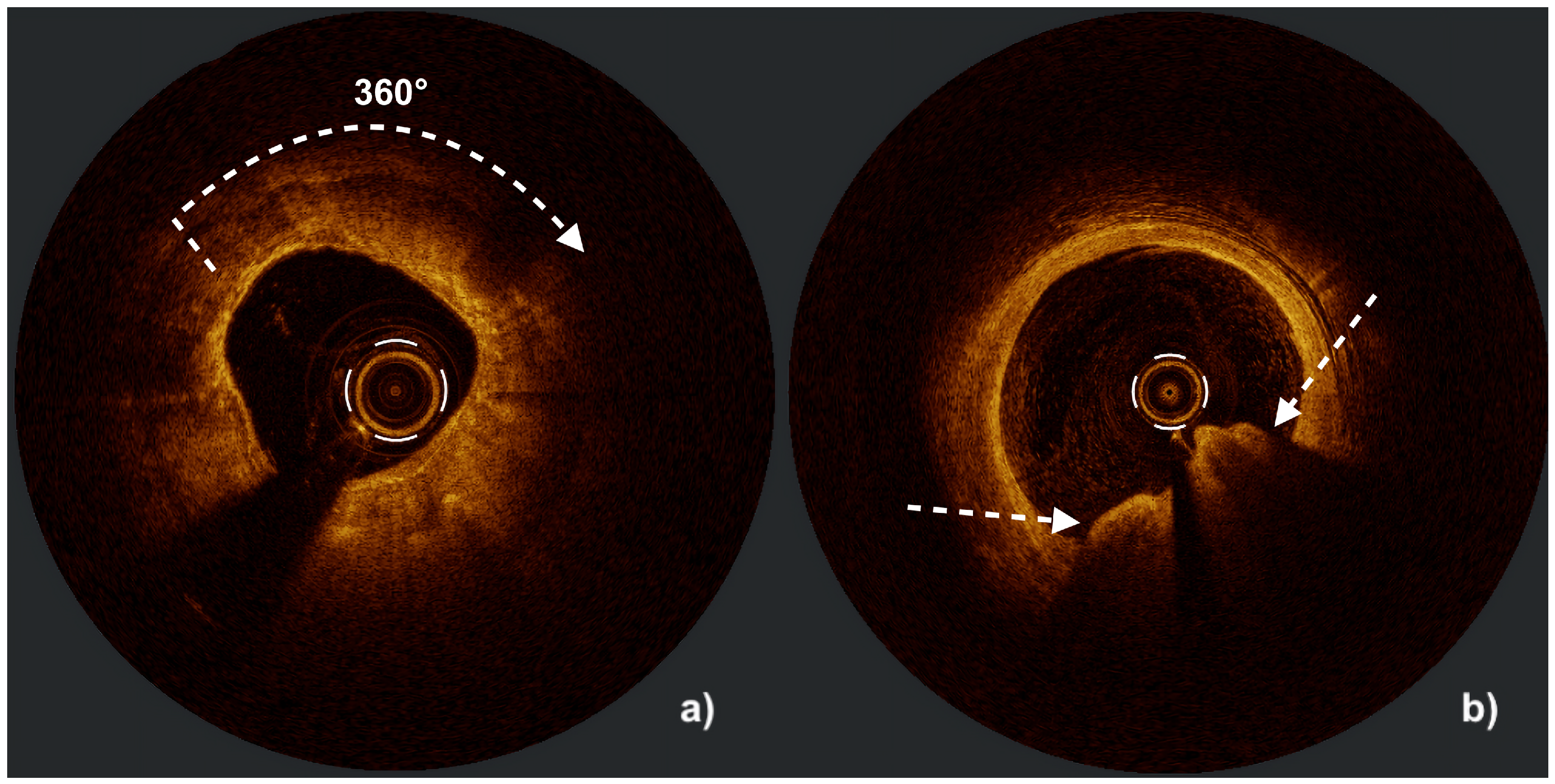
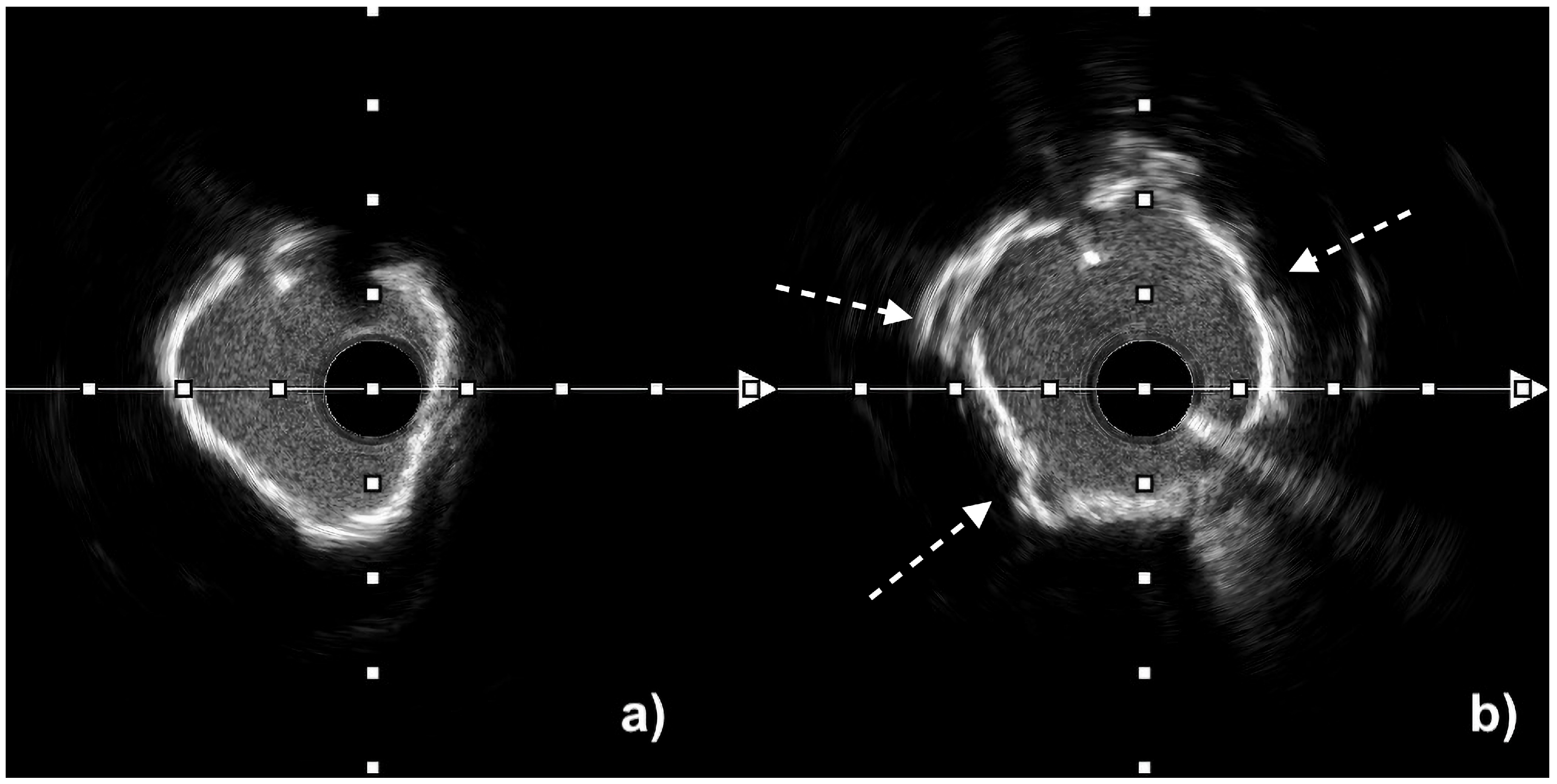
A calcified nodule (CN) is a protruding mass of calcium within the coronary lumen, typically overlying a heavily calcified plaque; such nodules are often present in the proximal and medial segments of the right coronary artery, which are exposed to high flexural stress, or in lipid-rich and necrotic-core-dominant areas, including the left main bifurcation and proximal parts of the epicardial arteries [29]. CNs tend to occur more frequently in older individuals, women, patients with comorbidities such as diabetes mellitus or history of previous coronary artery bypass grafting (CABG), and also in those receiving chronic hemodialysis [30]. CNs are histologically categorized as eruptive (with fibrous cap disruption, an irregular surface, and thrombus formation) or non-eruptive (with a smooth surface and an intact cap) [31]. CNs are associated with an elevated risk of long-term cardiovascular events and poor invasive treatment results due to suboptimal stent expansion and a high percentage of in-stent restenosis. Non-eruptive calcium nodules are less susceptible to balloon deformation and require accurate, often multi-stage lesion modification to avoid stent underexpansion. On the other hand, eruptive CNs may allow more symmetrical acute stent deployment, but they are linked to worse long-term outcomes due to early in-stent restenosis caused by the reprotrusion of nodular debris into the vessel lumen [10]. Intraprocedural differentiation of CN subtypes is achievable using IVI—particularly with HD-IVUS or more precisely with OCT because of its superior resolution. Examples of concentric calcifications and eruptive calcified nodules obtained in HD-IVUS and OCT imaging are presented below in Figure 1 and Figure 2.

3. Modification Methods for Calcified Plaques

Percutaneous treatment of heavily calcified coronary lesions remains challenging, with increased periprocedural risk, elevated incidence of early complications, and suboptimal success rates. The selection of appropriate calcium modification techniques seems to be crucial for effective lesion preparation, optimal stent deployment, and avoidance of adverse events.

3.1. SC and NC Balloons

Semi-compliant balloons are thin-wall angioplasty devices constructed from soft, flexible polymers. They are commonly used for lesion predilatation in non-calcified coronary stenoses; for plain old balloon angioplasty (POBA); or as carriers for antiproliferative agents in drug-coated balloons. Due to their trackability and flexibility, they are advantageous for crossing tight or tortuous lesions. However, when deployed against heavily calcified plaques under high inflation pressures, SC balloons may expand non-uniformly, widening at the proximal and distal edge while remaining constricted at the lesion site—often referred to as a “dog-bone” or “dumbbell” effect. This phenomenon not only indicates insufficient plaque modification but also has the potential to cause serious complications such as balloon rupture, vessel perforation, or dissection, especially at the edges of the balloon [32].
Non-compliant balloons are composed of thick, rigid walls of durable polymers. These balloons exhibit limited expansion in response to increasing inflation pressure, resulting in a more controlled and predictable diameter. This feature allows the application of high radial force against the lesion with minimal risk of overexpansion, making these balloons a first-line tool for predilatation of calcified lesions, especially when intravascular imaging or advanced plaque modification devices are not insertable through a tight coronary stenosis. However, in the presence of asymmetric, sharp, or deep calcifications, even NC balloons may display incomplete expansion, a “dog-bone” effect during inflation, or even rupture at very high pressures [32].
Clinical data suggest that even with relatively simple lesions, the use of non-compliant balloons for lesion preparation results in more uniform expansion and better procedural outcomes than the use of semi-compliant alternatives. These findings have contributed to a paradigm shift in predilatation strategies, favoring high-pressure, non-compliant balloon inflation for optimal stent bed preparation, regardless of the lesion complexity [33].

3.2. Super-High-Pressure Non-Compliant Balloons

Super-high-pressure non-compliant balloons, such as the OPN (SIS Medical, Frauenfeld, Switzerland), are designed with a dual-layer architecture to withstand inflation pressures up to 35 atmospheres [34] and apply significant forces to modify severely resistant lesions, including undilatable de novo calcifications and in-stent restenoses. Their reinforced structure distributes pressure between the inner and outer layers, reducing the risk of vessel perforation in the event of balloon rupture. Super-high-pressure NC balloons are relatively easy to use and do not require additional operator training. However, due to their bulky design and relatively large crossing profile, adjunctive methods such as a “buddy wire” technique or guide extension catheter may be necessary to advance the device to the target site in case of a narrow, complex lesions [32]. Compared with the use of standard non-compliant balloons, the use of OPN devices for complex, non-dilatable lesions was associated with a significantly reduced residual diameter stenosis [35].

3.3. Scoring and Cutting Balloons

Scoring balloons are modified balloon devices equipped with an external nitinol net designed to focus contact force without provoking vessel wall pressure injury. Force transmission through nitinol struts generates controlled microfractures within the plaque and results in efficient disruption of calcium at lower inflation pressures. The structural design also provides anchoring during inflation, which helps prevent slippage and ensure stable balloon expansion. Because most scoring balloons (AngioSculpt EVO, Philips, Amsterdam, The Netherlands or NSE Alpha, B. Braun, Melsungen, Germany or Naviscore, iVascular, Barcelona, Spain) are based on semi-compliant platforms, they maintain favorable crossability and trackability, offering advantages in anatomies where bulky devices are difficult to deliver [36]. Different technology is applied in the Scoreflex (OrbusNeich, Hong Kong, China)—a NC balloon family, where a single nitinol wire and a segment of standard workhorse guidewire are used as scoring components [32]. A combination of hydrophilic and hydrophobic coatings reduces friction to improve the deliverability of the NC-based device to the lesion site [22].
Cutting balloons are specialized non-compliant angioplasty devices equipped with three or four longitudinal microsurgical blades. Cutting edges focus contact force to create controlled shallow incisions in fibrotic or calcified plaques at relatively low pressures, improving balloon expansion and facilitating optimal stent delivery [37]. Reduction of applied pressures limits the risk of uncontrolled dissection or vessel injury. The main factor preventing the widespread application of cutting balloons is their bulky profile, which gives them a poor ability to cross narrow lesions. Newer designs—such as the Wolverine balloon (Boston Scientific, Marlborough, MA, USA) —have improved deliverability through lower-profile shafts and more flexible distal tips [38]. In the COPS trial, patients with calcified plaques randomized to cutting balloon predilatation achieved a greater final minimum stent area than those treated with standard NC balloons [39]. Other studies comparing scoring and cutting balloons suggest better stent deliverability after cutting balloon predilatation, even in challenging anatomies [40]. The features of balloon-based devices are summarized in Table 3 presented below.

3.4. Coronary Atherectomy

Atherectomy is a percutaneous intervention designed to partially remove atherosclerotic plaque responsible for vascular obstruction. In contrast to angioplasty, which compresses the plaque into the arterial wall, this approach physically eliminates part of the lesion. Coronary atherectomy is an important modality for the modification of calcified lesions, especially in tight, balloon-uncrossable stenoses. Available atherectomy methods include rotational, orbital, and laser atherectomy.

3.4.1. Rotational Atherectomy

Rotational atherectomy (RA), also known as rotablation, is one of the oldest and most established techniques to modify calcified coronary plaques. Despite its long history, it remains underused due to its procedural complexity and the relatively time-consuming operator training required.
The most popular ROTAPRO™ system (Boston Scientific, Marlborough, MA, USA) requires specialized 0.009″ guidewires, such as the ROTAWIRE™ or ROTAWIRE™ Drive, from a new family of guidewires with improved trackability. After the Rotawire is positioned distal to the lesion, the diamond-coated elliptical burr begins to spin over the wire at 140,000 to 180,000 rpm and, through a controlled “pecking motion”, progressively ablates the calcific plaque. A burr-to-artery ratio of approximately 0.6 is recommended [41,42], with smaller burrs (1.25–1.5 mm) favored for long or tortuous segments and larger ones reserved for proximal or aorto-ostial disease. Most procedures can be performed with burr sizes up to 1.75 mm via radial approach with a 6 Fr guiding catheter. Burrs of 2.0 mm diameter require a 7 Fr system or a sheathless radial approach, while the largest devices may need an 8 Fr guiding catheter and a subsequent femoral approach [43]. A continuous flush solution, typically composed of heparinized saline with vasodilators such as verapamil or nitrates, must be administered through the side port of the device to cool the turbine, prevent vasospasm, and reduce debris accumulation during the procedure [42].
Unlike balloon techniques, RA removes plaque by mechanical abrasion, reducing vessel wall barotrauma and the risk of deep dissections. The most frequent complication of RA (5–20%) is the coronary slow-flow phenomenon (CSFP), usually resulting from the accumulation of atherosclerotic debris in the distal coronary circulation. The incidence of this complication is related not only to anatomical features such as small vessel diameter, angulation, and atherosclerotic lesion length but also to procedural factors such as high burr to vessel ratio, long ablation runs [44], and excessive drops in rotational speed. Although current, less aggressive burr-to-vessel ratio recommendations have reduced the incidence of CSFP, operators should remain cautious about the possibility of this complication. The moment a flow drop is noticed, rotational atherectomy should be suspended until normal TIMI-3 flow is re-established [43]. ST-segment elevation on ECG monitoring often precedes the onset of CSFP and can be valuable for intraprocedural surveillance during rotational atherectomy. Ensuring pre-procedural hydration and maintaining systolic blood pressure above 100 mmHg are important maneuvers in the prevention of CSFP [45]. Although rare, coronary artery perforations (1–2% of cases) [46,47] remain a potentially fatal adverse event of RA. Increased vigilance for perforation is required, especially when procedures are performed on eccentric calcifications—such as calcified nodules—or within narrow, tortuous coronary vessels [45]. Another major complication is burr entrapment, reported in 0.4–0.8% of cases. It can arise from anatomical angulation or the so-called “Kokesi phenomenon”, where the burr slips behind the lesion and becomes stuck due to its fusiform silhouette [48]. In some cases, this complication requires surgical intervention and coronary artery bypass grafting. Experienced operators emphasize the importance of monitoring early signs of rising resistance, such as alterations in ablation sound pitch and fluctuations in rotational speed, as prompt recognition and response can prevent device lodging, vessel injury, or other serious complications [42].
The ROTAPRO™ rotablation system (Boston Scientific, Marlborough, MA, USA), being equipped with a diamond coating only on the front half of the spinning burr, is a typical “front cutting device”. Due to the mechanism of action, it is especially effective in treating very tight or even balloon-uncrossable calcified lesions. In moderate stenoses, eccentric lesions, and calcified nodules, the use of RA, although possible, is less effective. A spinning burr can “shave” the calcium surface and even cause cracking in calcific nodules, but techniques such as OA or IVL tend to be more effective in such cases [49].
A recent advancement in RA technology, the FireRaptor System (MicroPort Rota Pace, Shanghai, China), features an eccentric and fully diamond-coated burr. This property allows the FireRaptor System, unlike the classic rotablation systems, to perform bidirectional plaque modification. Forward and reverse device movement not only decreases the risk of burr entrapment but also enhances cutting efficiency. In addition, adjustable rotational speed allows operators to tailor the ablation diameter to the size of the vessel and the characteristics of the lesion, reducing the need for multiple device exchanges [50].

3.4.2. Orbital Atherectomy

Orbital atherectomy (OA) is another technique within the atherectomy family. The Diamondback 360® Coronary Orbital Atherectomy System (Abbott Cardiovascular, Chicago, IL, USA) features a diamond-coated, eccentrically mounted 1.25 mm crown that rotates over a specialized 0.012″ ViperWire with a 0.014″ tip. The mechanism of OA relies on centrifugal force generated by the spinning crown, which orbits as it advances through a coronary artery and preferentially ablates calcified tissue while displacing softer structures. This unique mechanism of action allows continuous blood flow during atheroablation and generates very small, submicron debris (~2 μ m), which passes safely through the microcirculation, resulting in a low risk of distal embolization and the slow-flow phenomenon [51]. The system incorporates single “one-size-fits-all” 1.25-mm crown, that can be delivered through a 6 Fr guide catheter. Changes in rotational speed (from 80,000 rpm to 120,000 rpm) translate into an increased sanding radius, thereby enabling treatment of different-sized vessels from 2.5 to 4 mm in diameter [52]. The procedure is aided by the infusion of the specific ViperSlide lubricant to reduce friction between the crown and vessel walls. Lesion preparation typically begins at the lower rotational speed, with careful advancement at 1 mm/s and no forward force applied. The operator is encouraged to monitor the acoustic feedback of the spinning crown to evaluate engagement with the lesion. Each run should be slow and limited to a maximum time of 30 s, while the total duration of atherectomy should not exceed 5 min due to expected device wear, as specified by the manufacturer [53]. The incidence of complications with orbital atherectomy is comparable to that observed with rotational atherectomy [54].

3.4.3. Laser Atherectomy

Excimer laser coronary atherectomy (ELCA) is an atherectomy modality that uses high-energy ultraviolet light to ablate atherosclerotic tissue. The most popular system, the CVX-300 Laser Excimer System (Philips, Amsterdam, The Netherlands), generates short pulses at a wavelength of 308 nm by passing an electrical discharge through a rare gas–halogen mixture, producing excimer molecules that emit photons. Lesion modification occurs through combined photochemical bond disruption, photomechanical shockwave generation, and localized photothermal effect. This triple-modality action enables precise plaque ablation with minimal thermal injury to surrounding tissue and decreased formation of particulate debris (predominantly microfragments < 10 μ m), thereby reducing the risk of distal embolization and no-reflow phenomenon [55].
A key advantage of ELCA over rotational or orbital atherectomy is its compatibility with any standard 0.014″ coronary guidewire, which is typically easier to advance across complex lesions than dedicated systems such as Rotawire or ViperWire. Catheters are available in various sizes ranging from 0.9 to 2.0 mm and should not exceed two-thirds of the vessel’s reference diameter. The most common 0.9 mm device is deliverable through a 6 Fr guide catheter, facilitating the ELCA procedure from radial access [56]. Device operation requires heparinized saline or contrast flushing to prevent bubble formation. Each 10-s activation is followed by a 5-s pause, repeated until the lesion is crossed or adequately modified for balloon passage or expansion [57]. For safety, the patient and all personnel must wear protective tinted eyewear to prevent retinal injury from exposure to UV light.
ELCA can be applied to native calcified lesions; balloon-uncrossable stenoses; chronic total occlusions; and in-stent restenoses (ISRs), especially with significant peri-stent calcifications [58]. Clinical outcome data from ELCA studies regarding ISR lesions showed no significant effect on stent structural integrity or polymer release [59]. Another advantage of ELCA is the ability to use side branch wire protection during treatment of resistant coronary bifurcation lesions [10]. In certain heavily calcified lesions, when ROTAWIRE™ advancement is not possible, ELCA may be applied first to create a channel that facilitates wire passage, allowing RA to be performed and the procedure to be completed successfully in what is known as the “RASER” technique [60]. This complex intervention offers a valuable bailout option for patients with lesions resistant to conventional PCI. However, due to the higher baseline and periprocedural risk, its introduction should be guided by multi-disciplinary Heart Team consultation and patient input [61].

3.5. Intravascular Lithotripsy

Intravascular lithotripsy (IVL) is one of the newer calcium modification techniques, which delivers pulsatile acoustic pressure waves from an external power source via spherical emitters integrated into a semi-compliant balloon. The monorail device is advanced to the lesion site over the standard coronary 0.014″ guidewire. The system applies low-pressure balloon inflation—typically around 4 atmospheres—ensuring vessel wall contact while minimizing barotrauma. Once the balloon is apposed to the vessel walls, a controlled electrical discharge within the fluid-filled balloon generates rapidly expanding vapor bubbles. Their collapse emits circumferential shockwaves that traverse soft tissue without damage but produce focal mechanical stress when encountering calcific deposits. The peak wave pressure is equivalent to approximately 50 atmospheres [62]. The targeted stress leads to multiplane microfractures in both the superficial and deep layers of calcium, improving vessel compliance. The shockwaves are generated at a consistent frequency of one pulse per second and delivered in sequences of ten, with a maximum of 120 pulses available in the new C2+ Generation Shockwave System (Shockwave Medical, Santa Clara, CA, USA). The integrated balloon serves multiple purposes: it stabilizes the system during energy delivery, facilitates coupling of acoustic energy through fluid–tissue impedance matching, and provides thermal protection to vascular structures and device components by dispersing generated heat [62]. Given the IVL balloon’s limited length of 12 mm and the minimum diameter of 2.5 mm, small vessels cannot be treated with this device, whereas long, calcified segments require sequential inflations. Another limitation of IVL is its relatively bulky profile, which can hinder delivery in tight or tortuous lesions. In such cases, auxiliary techniques or devices—such as guide extensions or prior atherectomy—may be required [63].
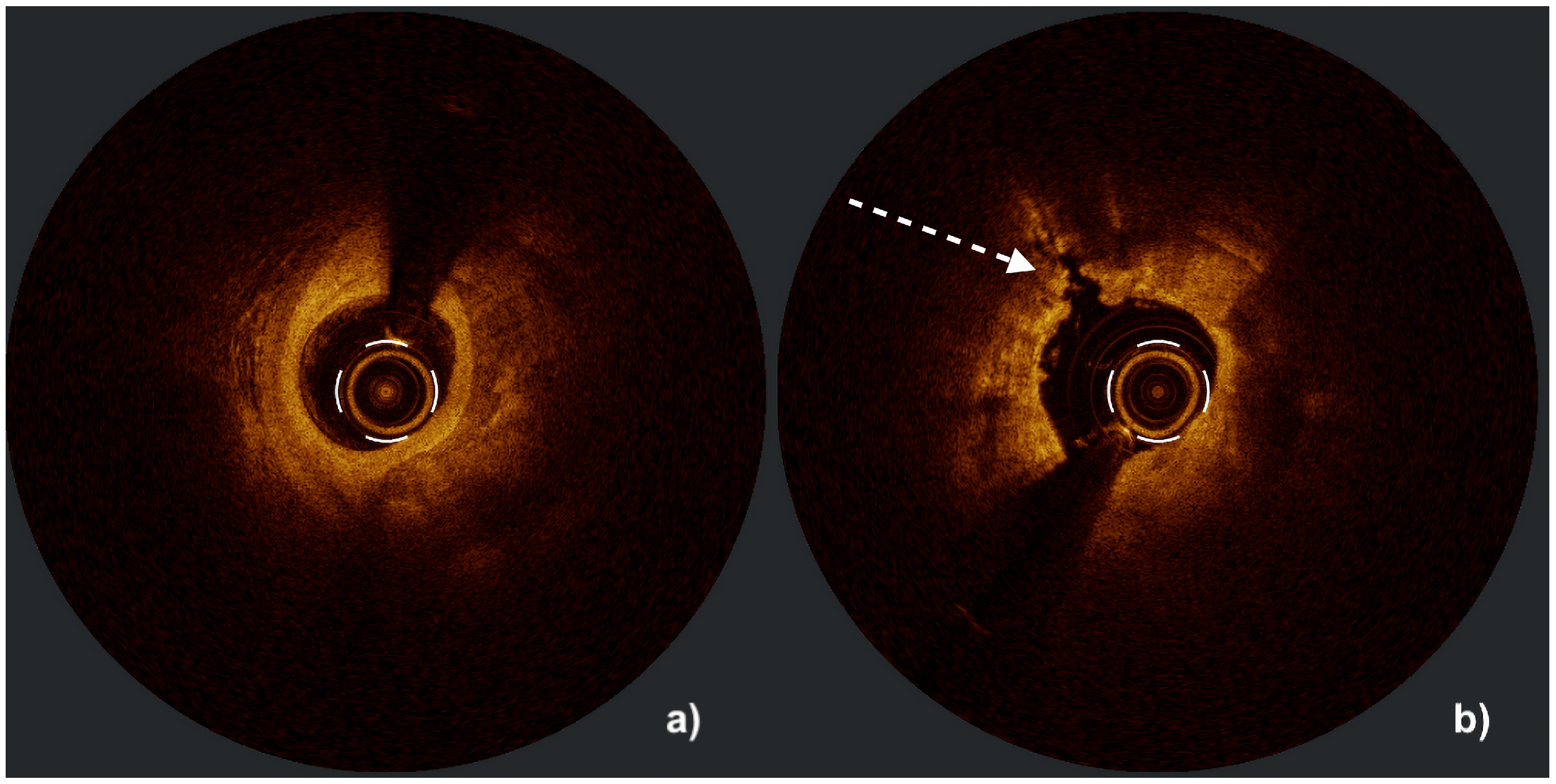
IVL is highly effective in circumferential calcium lesions, where acoustic pressure waves can disrupt concentric calcified rings and restore vessel compliance. Clinically, its key advantage is also observed in the treatment of eccentric calcifications and calcified nodules, where conventional techniques—such as high-pressure non-compliant, scoring, or cutting balloons—carry an elevated risk of arterial dissection. In these challenging morphologies, rotational atherectomy is further limited by wire bias, often resulting in superficial “shaving” or lesion guttering rather than sufficient calcium modification. In contrast, IVL catheters selectively deliver acoustic energy toward dense calcific deposits while sparing healthy soft vessel wall regions, enabling safer and more uniform lesion preparation [64]. Figure 3 and Figure 4 presented below illustrate the effect of IVL in circumferential calcium lesions visualized with IVUS and OCT. IVL has also been successfully used for managing underexpanded stents, with evidence from registries showing significant increases in stent area and luminal gain [65]. Unlike RA or OA, the IVL catheter allows the placement of a side-branch protection wire during pulse delivery, making it particularly suitable for the treatment of coronary bifurcation lesions [66]. Due to its safety profile and lower risk of complications, IVL is also preferred over atherectomy in balloon-crossable calcified aorto-ostial lesions [10].
DISRUPT CAD III, a large prospective study involving 384 patients with severe coronary calcification, assessed the procedural success of IVL at over 92%, with perforation and slow-flow rates of 0.3% and 0.5% respectively [67]. IVL’s safety profile, with a minimal incidence of adverse events, was later confirmed in other studies, also including patients with acute coronary syndromes [68,69].
Driven by increasing clinical demand, next-generation devices based on established mechanisms of action are being developed and introduced worldwide. Several new IVL platforms are currently undergoing clinical evaluation (Abbott Cardiovascular, Chicago, IL, USA; Lepumedical, Beijing, China; Shunmei, Shenzhen, China), including the Sola system (FastWave Medical, Minneapolis, MN, USA; IDE trial starts in mid-2026), the first laser-based IVL platform with a single movable optical transmitter, and the Javelin Coronary IVL system (Shockwave Medical, Santa Clara, CA, USA), a single distal emitter device that enables forward calcium modification beyond the catheter tip and facilitates treatment of tight, non-crossable lesions [70]. The features of the described methods for modification of calcified lesions are summarized in Table 4 below.
The latest approach is a slightly different procedure called Hertz contact intravascular lithotripsy (HC-IVL). The technique is based on the Hertzian contact stress principle, where the force concentrated at small contact points generates sufficient stress to fracture rigid structures while preserving the surrounding soft tissues. The system consists of a semi-compliant balloon catheter with multiple rows of metallic hemispheres. When the balloon is inflated, these hemispheres apply discrete, high-intensity contact forces to the calcified plaque, producing controlled fractures without the need for any external energy source, which significantly reduces procedural complexity. The semi-compliant platform of HC-IVL provides improved deliverability, especially compared to standard IVL devices. Moreover, this design enables treatment of various lesion morphologies, adjusting to the size of the vessel during inflation. Repeated HC-IVL inflations allow effective management of long segments, including eccentric and concentric calcification, while maintaining a favorable safety profile [74].
LithiX™ HC-IVL (Elixir Medical Corporation, Milpitas, CA, USA) was assessed in the PINNACLE I trial, a prospective, multicenter single-arm study that included 60 patients with moderately to severely calcified coronary lesions. A very high clinical success rate was observed for the combined primary safety and efficacy endpoint (98.3%), along with 100% angiographic success and residual diameter stenosis <30% in all lesions. The target lesion failure rate was 1.7%, with a single perioperative non-Q-wave myocardial infarction. No cases of severe dissection, perforation, or abrupt closure of the vessel were observed [75,76].

4. Conclusions

Coronary artery calcification remains a major determinant of procedural success and long-term clinical outcomes in percutaneous coronary intervention. The choice of a calcium modification technique should be guided by intravascular imaging findings, lesion morphology, and operator expertise and experience. Despite significant progress, evidence from randomized trials comparing different calcium modification strategies is still limited. Future studies are required to establish standardized algorithms that integrate multimodal imaging and combination therapies to optimize stent expansion and improve patient prognosis in complex coronary disease with advanced atherosclerosis.

Author Contributions

Conceptualization, P.K., P.S. and T.S.; writing—original draft preparation, P.S. and P.K.; writing—review and editing, T.S. and A.B.; visualization, P.S.; supervision, T.S. and A.B.; funding acquisition, T.S. All authors have read and agreed to the published version of the manuscript.

Funding

This research received no external funding.

Institutional Review Board Statement

Not applicable.

Informed Consent Statement

Not applicable.

Data Availability Statement

Not applicable.

Acknowledgments

During the preparation of this manuscript, the authors used ChatGPT-4 (OpenAI, https://openai.com/, accessed on 24 October 2025) for language and style editing, paraphrasing, and improving the clarity and structure of sentences. The authors have reviewed and edited the output and take full responsibility for the content of this publication.

Conflicts of Interest

The authors declare no conflicts of interest.

References

  1. Di Cesare, M.; Perel, P.; Taylor, S.; Kabudula, C.; Bixby, H.; Gaziano, T.A.; Vaca McGhie, D.; Mwangi, J.; Pervan, B.; Narula, J.; et al. The Heart of the World. Glob. Heart 2024, 19, 11. [Google Scholar] [CrossRef]
  2. Jebari-Benslaiman, S.; Galicia-García, U.; Larrea-Sebal, A.; Rekondo Olaetxea, J.; Alloza, I.; Vandenbroeck, K.; Benito-Vicente, A.; Martín, C. Pathophysiology of Atherosclerosis. Int. J. Mol. Sci. 2022, 23, 3346. [Google Scholar] [CrossRef]
  3. Onnis, C.; Virmani, R.; Kawai, K.; Nardi, V.; Lerman, A.; Cademartiri, F.; Scicolone, R.; Boi, A.; Congiu, T.; Faa, G.; et al. Coronary Artery Calcification: Current Concepts and Clinical Implications. Circulation 2024, 149, 251–266. [Google Scholar] [CrossRef]
  4. Budoff, M.J.; Young, R.; Lopez, V.A.; Kronmal, R.A.; Nasir, K.; Blumenthal, R.S.; Detrano, R.C.; Bild, D.E.; Guerci, A.D.; Liu, K.; et al. Progression of Coronary Calcium and Incident Coronary Heart Disease Events: MESA (Multi-Ethnic Study of Atherosclerosis). J. Am. Coll. Cardiol. 2013, 61, 1231–1239. [Google Scholar] [CrossRef]
  5. Pugliese, G.; Iacobini, C.; Blasetti Fantauzzi, C.; Menini, S. The Dark and Bright Side of Atherosclerotic Calcification. Atherosclerosis 2015, 238, 220–230. [Google Scholar] [CrossRef]
  6. Mitsis, A.; Khattab, E.; Christodoulou, E.; Myrianthopoulos, K.; Myrianthefs, M.; Tzikas, S.; Ziakas, A.; Fragakis, N.; Kassimis, G. From Cells to Plaques: The Molecular Pathways of Coronary Artery Calcification and Disease. J. Clin. Med. 2024, 13, 6352. [Google Scholar] [CrossRef]
  7. Petousis, S.; Skalidis, E.; Zacharis, E.; Kochiadakis, G.; Hamilos, M. The Role of Intracoronary Imaging for the Management of Calcified Lesions. J. Clin. Med. 2023, 12, 4622. [Google Scholar] [CrossRef]
  8. Caiazzo, G.; Di Mario, C.; Kedhi, E.; De Luca, G. Current Management of Highly Calcified Coronary Lesions: An Overview of the Current Status. J. Clin. Med. 2023, 12, 4844. [Google Scholar] [CrossRef] [PubMed]
  9. Ikari, Y.; Saito, S.; Nakamura, S.; Shibata, Y.; Yamazaki, S.; Tanaka, Y.; Ako, J.; Yokoi, H.; Kobayashi, Y.; Kozuma, K. Device Indication for Calcified Coronary Lesions Based on Coronary Imaging Findings. Cardiovasc. Interv. Ther. 2023, 38, 163–165. [Google Scholar] [CrossRef] [PubMed]
  10. Riley, R.F.; Patel, M.P.; Abbott, J.D.; Bangalore, S.; Brilakis, E.S.; Croce, K.J.; Doshi, D.; Kaul, P.; Kearney, K.E.; Kerrigan, J.L.; et al. SCAI Expert Consensus Statement on the Management of Calcified Coronary Lesions. J. Soc. Cardiovasc. Angiogr. Interv. 2024, 3, 101259. [Google Scholar] [CrossRef] [PubMed]
  11. Vrints, C.; Andreotti, F.; Koskinas, K.C.; Rossello, X.; Adamo, M.; Ainslie, J.; Banning, A.P.; Budaj, A.; Buechel, R.R.; Chiariello, G.A.; et al. 2024 ESC Guidelines for the Management of Chronic Coronary Syndromes: Developed by the Task Force for the Management of Chronic Coronary Syndromes of the European Society of Cardiology (ESC) Endorsed by the European Association for Cardio-Thoracic Surgery (EACTS). Eur. Heart J. 2024, 45, 3415–3537. [Google Scholar] [CrossRef] [PubMed]
  12. Osborne-Grinter, M.; Ali, A.; Williams, M.C. Prevalence and Clinical Implications of Coronary Artery Calcium Scoring on Non-Gated Thoracic Computed Tomography: A Systematic Review and Meta-Analysis. Eur. Radiol. 2024, 34, 4459–4474. [Google Scholar] [CrossRef] [PubMed]
  13. Dzaye, O.; Razavi, A.C.; Jelwan, Y.A.; Peng, A.W.; Grant, J.K.; Blaha, M.J. Coronary Artery Calcium Scoring on Dedicated Cardiac CT and Noncardiac CT Scans. Radiol. Cardiothorac. Imaging 2025, 7, e240548. [Google Scholar] [CrossRef] [PubMed]
  14. Lima, M.R.; Lopes, P.M.; Ferreira, A.M. Use of Coronary Artery Calcium Score and Coronary CT Angiography to Guide Cardiovascular Prevention and Treatment. Ther. Adv. Cardiovasc. Dis. 2024, 18, 17539447241249650. [Google Scholar] [CrossRef]
  15. Bienstock, S.; Lin, F.; Blankstein, R.; Leipsic, J.; Cardoso, R.; Ahmadi, A.; Gelijns, A.; Patel, K.; Baldassarre, L.A.; Hadley, M.; et al. Advances in Coronary Computed Tomographic Angiographic Imaging of Atherosclerosis for Risk Stratification and Preventive Care. JACC Cardiovasc. Imaging 2023, 16, 1099–1115. [Google Scholar] [CrossRef]
  16. Mickley, H.; Veien, K.T.; Gerke, O.; Lambrechtsen, J.; Rohold, A.; Steffensen, F.H.; Husic, M.; Akkan, D.; Busk, M.; Jessen, L.B.; et al. Diagnostic and Clinical Value of FFRCT in Stable Chest Pain Patients with Extensive Coronary Calcification. JACC Cardiovasc. Imaging 2022, 15, 1046–1058. [Google Scholar] [CrossRef]
  17. van der Werf, N.R.; Si-Mohamed, S.; Rodesch, P.A.; van Hamersvelt, R.W.; Greuter, M.J.W.; Boccalini, S.; Greffier, J.; Leiner, T.; Boussel, L.; Willemink, M.J.; et al. Coronary Calcium Scoring Potential of Large Field-of-View Spectral Photon-Counting CT: A Phantom Study. Eur. Radiol. 2022, 32, 152–162. [Google Scholar] [CrossRef]
  18. Hagar, M.T.; Soschynski, M.; Saffar, R.; Rau, A.; Taron, J.; Weiss, J.; Stein, T.; Faby, S.; von Zur Muehlen, C.; Ruile, P.; et al. Accuracy of Ultrahigh-Resolution Photon-Counting CT for Detecting Coronary Artery Disease in a High-Risk Population. Radiology 2023, 307, e223305. [Google Scholar] [CrossRef]
  19. Halfmann, M.C.; Bockius, S.; Emrich, T.; Hell, M.; Schoepf, U.J.; Laux, G.S.; Kavermann, L.; Graafen, D.; Gori, T.; Yang, Y.; et al. Ultrahigh-Spatial-Resolution Photon-Counting Detector CT Angiography of Coronary Artery Disease for Stenosis Assessment. Radiology 2024, 310, e231956. [Google Scholar] [CrossRef]
  20. Dawood, M.; Elwany, M.; Abdelgawad, H.; Sanhoury, M.; Zaki, M.; Elsharkawy, E.; Nawar, M. Coronary Calcifications, the Achilles Heel in Coronary Interventions. Adv. Interv. Cardiol. 2024, 20, 1–17. [Google Scholar] [CrossRef]
  21. Wu, W.; Zhao, S.; Banga, A.; Trivedi, Y.V.; Dasari, V.S.; Munjal, P.; Bhat, R.R.; Tapia-Orihuela, R.K.A.; Oguz, U.M.; Zafar, H.; et al. High-Definition Intravascular Ultrasound Versus Optical Coherence Tomography: Lumen Size and Plaque Morphology. J. Soc. Cardiovasc. Angiogr. Interv. 2025, 4, 102520. [Google Scholar] [CrossRef]
  22. Jurado-Román, A.; Gómez-Menchero, A.; Gonzalo, N.; Martín-Moreiras, J.; Ocaranza, R.; Ojeda, S.; Palazuelos, J.; Rodríguez-Leor, O.; Salinas, P.; Vaquerizo, B.; et al. Plaque Modification Techniques to Treat Calcified Coronary Lesions: Position Paper from the ACI-SEC. REC Interv. Cardiol. (Engl. Ed.) 2023, 5, 46–61. [Google Scholar] [CrossRef]
  23. Sato, T.; Matsumura, M.; Yamamoto, K.; Sugizaki, Y.; Shlofmitz, E.; Moses, J.W.; Khalique, O.K.; Thomas, S.V.; Malik, S.; Dakroub, A.; et al. A Revised Optical Coherence Tomography–Derived Calcium Score to Predict Stent Underexpansion in Severely Calcified Lesions. JACC Cardiovasc. Interv. 2025, 18, 622–633. [Google Scholar] [CrossRef]
  24. Shlofmitz, E.; Croce, K.; Bezerra, H.; Sheth, T.; Chehab, B.; West, N.E.J.; Shlofmitz, R.; Ali, Z.A. The MLD MAX OCT Algorithm: An Imaging-Based Workflow for Percutaneous Coronary Intervention. Catheter. Cardiovasc. Interv. 2022, 100, S7–S13. [Google Scholar] [CrossRef] [PubMed]
  25. Koganti, S.; Kotecha, T.; Rakhit, R.D. Choice of Intracoronary Imaging: When to Use Intravascular Ultrasound or Optical Coherence Tomography. Interv. Cardiol. 2016, 11, 11–16. [Google Scholar] [CrossRef]
  26. Mori, H.; Torii, S.; Kutyna, M.; Sakamoto, A.; Finn, A.V.; Virmani, R. Coronary Artery Calcification and Its Progression: What Does It Really Mean? JACC Cardiovasc. Imaging 2018, 11, 127–142. [Google Scholar] [CrossRef] [PubMed]
  27. Fujino, A.; Mintz, G.S.; Matsumura, M.; Lee, T.; Kim, S.-Y.; Hoshino, M.; Usui, E.; Yonetsu, T.; Haag, E.S.; Shlofmitz, R.A.; et al. A New Optical Coherence Tomography-Based Calcium Scoring System to Predict Stent Underexpansion. EuroIntervention 2018, 13, e2182–e2189. [Google Scholar] [CrossRef] [PubMed]
  28. Zhang, M.; Matsumura, M.; Usui, E.; Noguchi, M.; Fujimura, T.; Fall, K.N.; Zhang, Z.; Nazif, T.M.; Parikh, S.A.; Rabbani, L.E.; et al. Intravascular Ultrasound-Derived Calcium Score to Predict Stent Expansion in Severely Calcified Lesions. Circ. Cardiovasc. Interv. 2021, 14, e010296. [Google Scholar] [CrossRef]
  29. Shin, D.; Karimi Galougahi, K.; Spratt, J.C.; Maehara, A.; Collet, C.; Barbato, E.; Ribichini, F.L.; Gonzalo, N.; Sakai, K.; Mintz, G.S.; et al. Calcified Nodule in Percutaneous Coronary Intervention: Therapeutic Challenges. JACC Cardiovasc. Interv. 2024, 17, 1187–1199. [Google Scholar] [CrossRef]
  30. Lee, T.; Mintz, G.S.; Matsumura, M.; Zhang, W.; Cao, Y.; Usui, E.; Kanaji, Y.; Murai, T.; Yonetsu, T.; Kakuta, T.; et al. Prevalence, Predictors, and Clinical Presentation of a Calcified Nodule as Assessed by Optical Coherence Tomography. JACC Cardiovasc. Imaging 2017, 10, 883–891. [Google Scholar] [CrossRef]
  31. Sato, T.; Matsumura, M.; Yamamoto, K.; Shlofmitz, E.; Moses, J.W.; Khalique, O.K.; Thomas, S.V.; Tsoulios, A.; Cohen, D.J.; Mintz, G.S.; et al. Impact of Eruptive vs Noneruptive Calcified Nodule Morphology on Acute and Long-Term Outcomes After Stenting. JACC Cardiovasc. Interv. 2023, 16, 1024–1035. [Google Scholar] [CrossRef]
  32. Maffey, M.W.; Bagur, R. Dedicated Balloon Techniques for Coronary Calcium Modification. Interv. Cardiol. 2024, 19, e13. [Google Scholar] [CrossRef] [PubMed]
  33. Cuculi, F.; Bossard, M.; Zasada, W.; Moccetti, F.; Voskuil, M.; Wolfrum, M.; Malinowski, K.P.; Toggweiler, S.; Kobza, R. Performing Percutaneous Coronary Interventions with Predilatation Using Non-Compliant Balloons at High-Pressure versus Conventional Semi-Compliant Balloons: Insights from Two Randomised Studies Using Optical Coherence Tomography. Open Heart 2020, 7, e001204. [Google Scholar] [CrossRef] [PubMed]
  34. Bulluck, H.; McEntegart, M. Contemporary Tools and Devices for Coronary Calcium Modification. JRSM Cardiovasc. Dis. 2022, 11, 20480040221089760. [Google Scholar] [CrossRef]
  35. Secco, G.G.; Ghione, M.; Mattesini, A.; Dall’Ara, G.; Ghilencea, L.; Kilickesmez, K.; De Luca, G.; Fattori, R.; Parisi, R.; Marino, P.N.; et al. Very High-Pressure Dilatation for Undilatable Coronary Lesions: Indications and Results with a New Dedicated Balloon. EuroIntervention 2016, 12, 359–365. [Google Scholar] [CrossRef]
  36. Perfetti, M.; Fulgenzi, F.; Radico, F.; Toro, A.; Procopio, A.; Maddestra, N.; Zimarino, M. Calcific Lesion Preparation for Coronary Bifurcation Stenting. Cardiol. J. 2019, 26, 429–437. [Google Scholar] [CrossRef]
  37. Scalamogna, M.; Kuna, C.; Voll, F.; Aytekin, A.; Lahu, S.; Kessler, T.; Kufner, S.; Rheude, T.; Sager, H.B.; Xhepa, E.; et al. Modified Balloons to Prepare Severely Calcified Coronary Lesions before Stent Implantation: A Systematic Review and Meta-Analysis of Randomized Trials. Clin. Res. Cardiol. 2024, 113, 995–1005. [Google Scholar] [CrossRef] [PubMed]
  38. Shah, M.; Najam, O.; Bhindi, R.; De Silva, K. Calcium Modification Techniques in Complex Percutaneous Coronary Intervention. Circ. Cardiovasc. Interv. 2021, 14, e009870. [Google Scholar] [CrossRef]
  39. Mangieri, A.; Nerla, R.; Castriota, F.; Reimers, B.; Regazzoli, D.; Leone, P.P.; Gasparini, G.L.; Khokhar, A.A.; Laricchia, A.; Giannini, F.; et al. Cutting Balloon to Optimize Predilation for Stent Implantation: The COPS Randomized Trial. Catheter. Cardiovasc. Interv. 2023, 101, 798–805. [Google Scholar] [CrossRef]
  40. Ishihara, T.; Iida, O.; Takahara, M.; Tsujimura, T.; Okuno, S.; Kurata, N.; Asai, M.; Okamoto, S.; Nanto, K.; Mano, T. Improved Crossability with Novel Cutting Balloon versus Scoring Balloon in the Treatment of Calcified Lesion. Cardiovasc. Interv. Ther. 2021, 36, 198–207. [Google Scholar] [CrossRef]
  41. Nowak, A.; Ratajczak, J.; Kasprzak, M.; Sukiennik, A.; Fabiszak, T.; Wojakowski, W.; Ochała, A.; Wańha, W.; Kuczmik, W.; Navarese, E.P.; et al. Long-Term Outcome of Rotational Atherectomy According to Burr-to-Artery Ratio and Changes in Coronary Artery Blood Flow: Observational Analysis. Cardiol. J. 2023, 30, 361–368. [Google Scholar] [CrossRef]
  42. Barbato, E.; Carrié, D.; Dardas, P.; Fajadet, J.; Gaul, G.; Haude, M.; Khashaba, A.; Koch, K.; Meyer-Gessner, M.; Palazuelos, J.; et al. European Expert Consensus on Rotational Atherectomy. EuroIntervention 2015, 11, A6. [Google Scholar] [CrossRef]
  43. Sakakura, K.; Ito, Y.; Shibata, Y.; Okamura, A.; Kashima, Y.; Nakamura, S.; Hamazaki, Y.; Ako, J.; Yokoi, H.; Kobayashi, Y.; et al. Clinical Expert Consensus Document on Rotational Atherectomy from the Japanese Association of Cardiovascular Intervention and Therapeutics: Update 2023. Cardiovasc. Interv. Ther. 2023, 38, 141–162. [Google Scholar] [CrossRef] [PubMed]
  44. Sakakura, K.; Taniguchi, Y.; Yamamoto, K.; Tsukui, T.; Jinnouchi, H.; Seguchi, M.; Wada, H.; Fujita, H. Modifiable and Unmodifiable Factors Associated with Slow Flow Following Rotational Atherectomy. PLoS ONE 2021, 16, e0250757. [Google Scholar] [CrossRef] [PubMed]
  45. Mattaroccia, G.; Redivo, M.; Cianca, A.; Dell’Aquila, F.; Casenghi, M.; Giovannelli, F.; Rigattieri, S.; Berni, A.; Tommasino, A.; Barbato, E. The New Era of Coronary Angioplasty: How Cutting-Edge Technologies Are Redefining Complex Interventions. Heart Surg. Forum 2025, 28, E107–E119. [Google Scholar] [CrossRef]
  46. Kini, A.; Marmur, J.D.; Duvvuri, S.; Dangas, G.; Choudhary, S.; Sharma, S.K. Rotational Atherectomy: Improved Procedural Outcome with Evolution of Technique and Equipment. Single-Center Results of First 1,000 Patients. Catheter. Cardiovasc. Interv. 1999, 46, 305–311. [Google Scholar] [CrossRef]
  47. Januszek, R.; Siudak, Z.; Dziewierz, A.; Dudek, D.; Bartuś, S. Predictors of In-Hospital Effectiveness and Complications of Rotational Atherectomy (from the ORPKI Polish National Registry 2014–2016). Catheter. Cardiovasc. Interv. 2018, 92, E278–E287. [Google Scholar] [CrossRef]
  48. Mechery, A.; Jordan, P.J.; Doshi, S.N.; Khan, S.Q. Retrieval of a Stuck Rotablator Burr (“Kokeshi Phenomenon”) and Successful Percutaneous Coronary Intervention. J. Cardiol. Cases 2015, 13, 90–92. [Google Scholar] [CrossRef]
  49. Zhao, Y.; Wang, P.; Zheng, Z.; Shi, Y.; Liu, J. Comparison of Intravascular Lithotripsy versus Rotational Atherectomy for the Treatment of Severe Coronary Artery Calcification. BMC Cardiovasc. Disord. 2024, 24, 311. [Google Scholar] [CrossRef]
  50. MicroPort. MicroPort® RotaPace Receives Approval for FireRaptor® in China. MicroPort News. 2025. Available online: https://microport.com/news/microport-rotapace-receives-approval-for-fireraptor-in-china (accessed on 28 October 2025).
  51. Shlofmitz, E.; Jeremias, A.; Shlofmitz, R.; Ali, Z.A. Lesion Preparation with Orbital Atherectomy. Interv. Cardiol. Rev. 2019, 14, 169–173. [Google Scholar] [CrossRef]
  52. Khattak, S.; Sharma, H.; Khan, S.Q. Atherectomy Techniques: Rotablation, Orbital and Laser. Interv. Cardiol. 2024, 19, e21. [Google Scholar] [CrossRef]
  53. Shipman, J.N.; Agasthi, P. Orbital Atherectomy. In StatPearls [Internet]; StatPearls Publishing: Treasure Island, FL, USA, 2025. Available online: https://www.ncbi.nlm.nih.gov/books/NBK563144/ (accessed on 28 November 2025).
  54. Goel, S.; Pasam, R.T.; Chava, S.; Gotesman, J.; Sharma, A.; Malik, B.A.; Frankel, R.; Shani, J.; Gidwani, U.; Latib, A. Orbital Atherectomy versus Rotational Atherectomy: A Systematic Review and Meta-Analysis. Int. J. Cardiol. 2020, 303, 16–21. [Google Scholar] [CrossRef]
  55. Rawlins, J.; Din, J.N.; Talwar, S.; O’Kane, P. Coronary Intervention with the Excimer Laser: Review of the Technology and Outcome Data. Interv. Cardiol. Rev. 2016, 11, 27–32. [Google Scholar] [CrossRef] [PubMed]
  56. Jawad-Ul-Qamar, M.; Sharma, H.; Vetrugno, V.; Sandhu, K.; Ludman, P.F.; Doshi, S.N.; Townend, J.N.; Osheiba, M.; Zaphiriou, A.; Khan, S.Q. Contemporary Use of Excimer Laser in Percutaneous Coronary Intervention with Indications, Procedural Characteristics, Complications and Outcomes in a University Teaching Hospital. Open Heart 2021, 8, e001522. [Google Scholar] [CrossRef] [PubMed]
  57. Fernandez, J.P.; Hobson, A.R.; McKenzie, D.; Shah, N.; Sinha, M.K.; Wells, T.A.; Levy, T.M.; Swallow, R.A.; Talwar, S.; O’Kane, P.D. Beyond the Balloon: Excimer Coronary Laser Atherectomy Used Alone or in Combination with Rotational Atherectomy in the Treatment of Chronic Total Occlusions, Non-Crossable and Non-Expansible Coronary Lesions. EuroIntervention 2013, 9, 243–250. [Google Scholar] [CrossRef]
  58. Li, H.; Ai, H.; Li, L.; Zheng, N.; Tang, G.; Yang, G.; Zhao, Y.; Sun, F.; Zhang, H. The Therapeutic Effects of Excimer Laser Coronary Atherectomy Therapy for In-Stent Restenosis Chronic Total Occlusions. BMC Cardiovasc. Disord. 2021, 21, 399. [Google Scholar] [CrossRef]
  59. Giri, S.; Ito, S.; Lansky, A.J.; Mehran, R.; Margolis, J.; Gilmore, P.; Garratt, K.N.; Cummins, F.; Moses, J.; Rentrop, P.; et al. Clinical and Angiographic Outcome in the Laser Angioplasty for Restenotic Stents (LARS) Multicenter Registry. Catheter. Cardiovasc. Interv. 2001, 52, 24–34. [Google Scholar] [CrossRef]
  60. Protty, M.B.; Gallagher, S.; Farooq, V.; Sharp, A.S.P.; Egred, M.; O’Kane, P.; Kinnaird, T. Combined Use of Rotational and Excimer Laser Coronary Atherectomy (RASER) during Complex Coronary Angioplasty—An Analysis of Cases (2006–2016) from the British Cardiovascular Intervention Society Database. Catheter. Cardiovasc. Interv. 2021, 97, E911–E918. [Google Scholar] [CrossRef]
  61. Hesse, K.; Mehta, S.; Tam, C.; Ahmed, F.; Shahid, F.; Mintz, G.S.; Ahmed, J.M. Combined Rotational Excimer Laser Coronary Atherectomy (RASER) in Non-Crossable, Non-Dilatable Coronary Artery Disease: Observations from a Single Center. J. Invasive Cardiol. 2024, 36. [Google Scholar] [CrossRef] [PubMed]
  62. Kereiakes, D.J.; Virmani, R.; Hokama, J.Y.; Illindala, U.; Mena-Hurtado, C.; Holden, A.; Hill, J.M.; Lyden, S.P.; Ali, Z.A. Principles of Intravascular Lithotripsy for Calcific Plaque Modification. JACC Cardiovasc. Interv. 2021, 14, 1275–1292. [Google Scholar] [CrossRef]
  63. Oliveira, C.; Vilela, M.; Nobre Menezes, M.; Silva Marques, J.; Moreira Jorge, C.; Rodrigues, T.; Almeida Duarte, J.; Marques da Costa, J.; Carrilho Ferreira, P.; Francisco, A.R.; et al. Coronary Intravascular Lithotripsy Effectiveness and Safety in a Real-World Cohort. J. Pers. Med. 2024, 14, 438. [Google Scholar] [CrossRef]
  64. Honton, B.; Monsegu, J. Best Practice in Intravascular Lithotripsy. Interv. Cardiol. 2022, 17, e02. [Google Scholar] [CrossRef]
  65. Tovar Forero, M.N.; Sardella, G.; Salvi, N.; Cortese, B.; di Palma, G.; Werner, N.; Aksoy, A.; Escaned, J.; Salazar, C.H.; Gonzalo, N.; et al. Coronary Lithotripsy for the Treatment of Underexpanded Stents: The International Multicentre CRUNCH Registry. EuroIntervention 2022, 18, 574–581. [Google Scholar] [CrossRef] [PubMed]
  66. Kaul, A.; Dhalla, P.S.; Bapatla, A.; Khalid, R.; Garcia, J.; Armenta-Quiroga, A.S.; Khan, S. Current Treatment Modalities for Calcified Coronary Artery Disease: A Review Article Comparing Novel Intravascular Lithotripsy and Traditional Rotational Atherectomy. Cureus 2020, 12, e10922. [Google Scholar] [CrossRef] [PubMed]
  67. Hill, J.M.; Kereiakes, D.J.; Shlofmitz, R.A.; Klein, A.J.; Riley, R.F.; Price, M.J.; Herrmann, H.C.; Bachinsky, W.; Waksman, R.; Stone, G.W. Intravascular Lithotripsy for Treatment of Severely Calcified Coronary Artery Disease. J. Am. Coll. Cardiol. 2020, 76, 2635–2646. [Google Scholar] [CrossRef] [PubMed]
  68. Wu, T.; Yang, H.; Xu, G.; Li, Q.; Zhu, L.; Yang, Y.; Yang, T. The Safety and Efficacy of Intravascular Lithotripsy in the Treatment of Severe Coronary Artery Calcification in 261 Cases: A Retrospective Study. Health Sci. Rep. 2025, 8, e70474. [Google Scholar] [CrossRef]
  69. van Oort, M.J.H.; Al Amri, I.; Bingen, B.O.; Oliveri, F.; Claessen, B.E.P.M.; Dimitriu-Leen, A.C.; Vossenberg, T.N.; Kefer, J.; Girgis, H.; van der Kley, F.; et al. Evolving Use and Clinical Outcomes of Coronary Intravascular Lithotripsy: Insights from an International, Multicentre Registry. Heart 2024, 111, 62–68. [Google Scholar] [CrossRef]
  70. Shockwave Medical Website. Shockwave Medical Enrolls First Patient in FORWARD CAD Pivotal Study of Novel Forward Intravascular Lithotripsy Platform. Available online: https://shockwavemedical.com/de/news/shockwave-medical-enrolls-first-patient-in-forward-cad-pivotal-study-of-novel-forward-intravascular-lithotripsy-platform/ (accessed on 28 November 2025).
  71. Russo, D.; Massaro, G.; Benedetto, D.; Russo, G.; Canova, P.; Pescetelli, I.; Fiocca, L.; Romano, M.; Lettieri, C.; Chiricolo, G.; et al. Contemporary Approach to Heavily Calcified Lesions: Tools of the Trade, Challenges, and Pitfalls. Vessel Plus 2024, 8, 9. [Google Scholar] [CrossRef]
  72. Sasi, V.; Szántó, G.; Achim, A.; Ungi, I.; Varga, A.; Ruzsa, Z. Combination of Laser Atherectomy and Super High-Pressure Non-Compliant Balloon to Treat Stent Under-Expansion in Cases of Failed Interventional Options. Interv. Cardiol. 2023, 18, e23. [Google Scholar] [CrossRef]
  73. Yeung, J.Y.K.; Chiang, M. Current Role of Excimer Laser Coronary Angioplasty Atherectomy in Calcified Coronary Artery Disease Management. JACC Case Rep. 2025, 30, 103025. [Google Scholar] [CrossRef]
  74. Elixir Medical Website. Elixir Medical Announces Launch of LithiX™ Hertz Contact (HC) Intravascular Lithotripsy System (IVL) in Europe. Novel IVL Technology Designed to Deliver Calcium Fragmentation for Treatment of Moderate to Severely Calcified Coronary Artery Lesions Without Requiring an Energy Source. Available online: https://elixirmedical.com/elixir-medical-announces-launch-of-lithix-hertz-contact-hc-intravascular-lithotripsy-system-ivl-in-europe/ (accessed on 28 November 2025).
  75. PCR. EuroPCR 2024: Primary Outcomes from PINNACLE I Clinical Trial Establish Safety and Effectiveness of Elixir Medical’s Hertz Contact Intravascular Lithotripsy System for Calcium Fragmentation in Moderate to Severe Calcified Coronary Artery Lesions. 2024. Press Release, PCR Online. Available online: https://www.pcronline.com/News/Press-releases/2024/EuroPCR-2024-Primary-outcomes-from-PINNACLE-I-clinical-trial-establish-safety-and-effectiveness-of-Elixir-Medical-s-Hertz-Contact-Intravascular-Lithotripsy-System-for-calcium-fragmentation-in-moderate-to-severe-calcified-coronary-artery-lesions (accessed on 28 November 2025).
  76. Bennett, J.; Hamer, B.; Paradies, V.; Tonino, P.; Bataille, Y.; Verheye, S. TCT-381 Safety and Effectiveness of a Novel Intravascular Lithotripsy Device Using the Hertz Contact Stress Mechanism for Calcium Fragmentation: Six-Month Outcomes of the PINNACLE I Clinical Trial. J. Am. Coll. Cardiol. 2024, 84 (Suppl. 18), B104. [Google Scholar] [CrossRef]
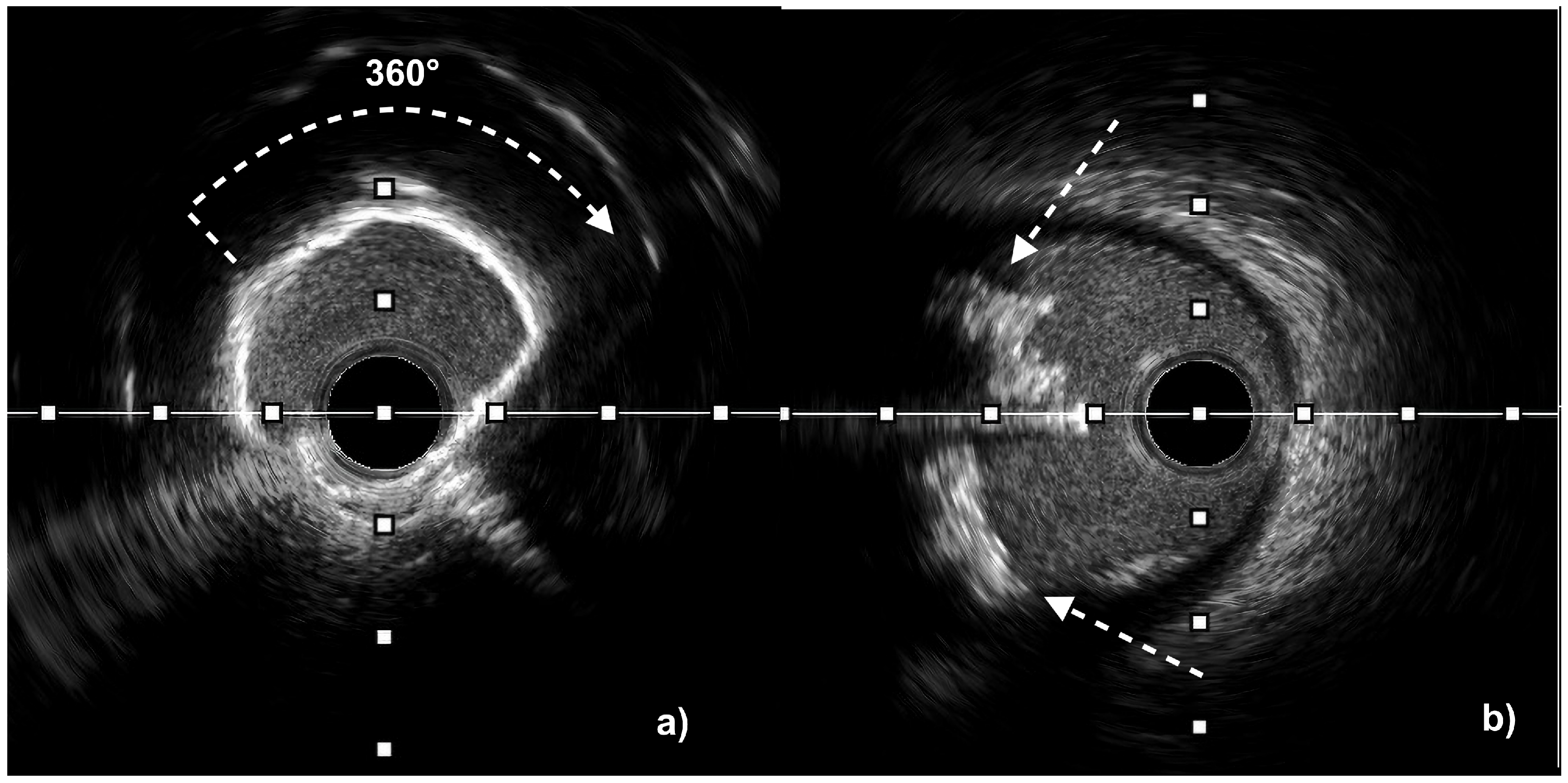
Figure 1. High-definition intravascular ultrasound (HD-IVUS) images illustrating severe coronary calcifications: (a) a circumferential (360°) calcified lesion appearing as a bright ring with an acoustic shadow behind it (white arrow); and (b) an eruptive calcified nodule appearing as an irregular, protruding calcified mass extending into the vessel lumen with an acoustic shadow (white arrows indicate the proximal and distal margins of the calcified nodule).
Jcm 14 08566 g001
Figure 2. Optical coherence tomography (OCT) images illustrating severe coronary calcifications: (a) a circumferential (360°) calcified lesion appearing as a heterogeneous, low-signal region with well-defined borders, minimal backscatter, deep light penetration, and no shadowing (white arrow); (b) an eruptive calcified nodule visualized as a heterogeneous, low-signal mass with similar optical characteristics, protruding into the vessel lumen (white arrows indicate the margins of the calcified nodule). Figure courtesy of Professor Maciej Lesiak and Sylwia Iwańczyk, Ph.D.
Jcm 14 08566 g002
Figure 3. Intravascular ultrasound (IVUS) images of a severely calcified coronary lesion with circumferential (360°) calcification before (a) and after (b) intravascular lithotripsy (IVL) using the Shockwave C2+ catheter (Shockwave Medical, USA), demonstrating an increase in minimal lumen area and multiple calcium fractures (indicated by white arrows).
Jcm 14 08566 g003
Figure 4. Optical coherence tomography (OCT) images of a severely calcified coronary lesion with circumferential (360°) calcification before (a) and after (b) plaque modification, demonstrating an increase in minimal lumen area and a calcium fracture (indicated by a white arrow). Figure courtesy of Professor Maciej Lesiak and Sylwia Iwańczyk, Ph.D.
Jcm 14 08566 g004
Table 1. Comparison between IVUS and OCT, adapted from Koganti et al. [25].
AspectIVUSOCT
Imaging modalityUltrasoundNear-infrared light
Axial resolution100–150 μ m
(20–40 MHz IVUS probes)
20–60 μ m
(60 MHz HD-IVUS probes)
10–20 μ m
Lateral resolution200 μ m20 μ m
Tissue penetration depth>5 mm1–2 mm
Need for blood clearanceNoYes
Need for contrast injectionNoYes (may be replaced by dextran)
Catheter sizeUp to 3.2 Fr2.7 Fr
Assessment of plaque morphologyModerate resolution for plaque assessmentSuperior fine detail (fibrous cap, lipid core, thrombus)
Calcium assessmentSemi-quantitative (measures calcium length and arc but only estimates thickness)
Microcalcifications not assessable
Difficulty in differentiating between eruptive and non-eruptive CNs
Quantitative (measures calcium length, arc, and thickness)
Microcalcifications assessable
Accurate differentiation between eruptive and non-eruptive CNs
Medial calcifications difficult to assess
Evaluation of vessel remodelingYesLimited
Utility in aorto-ostial lesionsPreferred (guideline-recommended)Difficult, less preferred
Stent expansion assessmentReliable, deeper wall visualizationHighly precise but limited by
EEM 1 visibility
Detection of malapposition/dissectionPossible, less sensitiveSuperior due to resolution
1 EEM—external elastic membrane.
Table 2. Calcified coronary lesion scoring systems for OCT and IVUS, reproduced from Sato et al. [23] and Jurado-Román et al. [22].
OCTIVUS
Calcium arc<360°0Calcium arc≤270°0
360°1>270° and
>5 mm length
1
Calcium thickness≤0.3 mm0Calcified noduleNo0
>0.3 mm1Yes1
Length of calcium > 270°≤3 mm0Coronary artery diameter≥3.5 mm0
>3 mm1<3.5 mm1
Table 3. Comparison of balloon-based devices used in Percutaneous Coronary Interventions (PCI).
AspectSemi-Compliant BalloonNon-Compliant BalloonSuper-High-Pressure NC BalloonScoring BalloonCutting Balloon
Device designThin, extensible single-layer balloonThick, non-extensible single-layer balloonDouble-layer, reinforced non-compliant balloonSC or NC balloon with nitinol scoring elementsNC balloon with longitudinal microblades
Primary mechanism of actionUniform plaque compression and vessel stretching at low pressuresFocal plaque compression, predictable expansionModification of fibro-calcific lesions with barostatic forceControlled scores created by nitinol elementsTissue microincisions from microblades
Typical pressure range (NP-RBP)∼6–14 atm∼12–22 atm∼10–35 atm∼8–20 atm∼6–12 atm
Main indicationsNarrow lesions, predilatation in mild diseasePredilatation, postdilatation, moderately calcified lesionsHeavily calcified lesions, resistant underexpanded stentsFibrotic/moderately calcified lesions, ISRFocal fibro-calcific lesions, ISR
AdvantagesFlexibility, deliverability, low crossing profilePredictable diameter; good stent expansionEffective for resistant lesions; strong radial forceReduced slippage, controlled plaque modificationPrecise plaque incision; low risk of arterial wall barotrauma
LimitationsIneffective in severe calcification, risk of over-dilatationLow efficiency in severe calcifications, risk of dissectionsBulky, higher perforation risk if oversizedBulky, difficult to deliver, costlyBulky, difficult to deliver, costly
Deliverability++- --- -
Calcified lesions-+++++++
Calcific nodules--- -++
Fibrotic lesions-+/--+++
Stent underexpansion-+++++
ISR-++++++
Symbol definitions: ++ excellent/very good performance; + good performance; +/- moderate performance; - poor performance; - - very poor performance. Abbreviations: SC—semi-compliant; NC—non-compliant, NP—nominal pressure; RBP—rated burst pressure; ISR—in-stent restenosis.
Table 4. Comparison of calcified lesion modification methods, adapted from Russo et al. [71], Sasi et al. [72], and Yeung et al. [73].
AspectIVLRAOAELCA
Mechanism of actionLithotripsy via acoustic pressure wavesAtheroablation via front abrasionAtheroablation via sandingPhotoablation (light, acoustic pressure waves, cavitation microbubbles)
GuidewireElective 0.014″ wireDedicated 0.009″/0.014″ tip wireDedicated 0.012″/0.014″ tip wireElective 0.014″ wire
Device size2.5–4.0 mm × 12 mm1.25–2.5 mm (5–8 Fr)One crown size 1.25 mm (6 Fr)0.9–2.0 mm with concentric and eccentric tip designs
Course of actionForward and backward
On the balloon’s adhesion surface
Forward only
Outside curve only
Forward and backward
Outside and inside curve
Forward only
Effect of wire biasIndependentDependentLess dependentLimited by vessel curvature (UV light does not deflect)
Side branch protectionYesNoNoYes
Distal embolizationNo or very low risk of no/slow reflowHigher risk of no/slow reflowMedium risk of no/slow reflowVery low risk of no/slow reflow
PerforationLow <1%Up to 1.5%Up to 1.8%1.5–2%
Effect on calciumAffects superficial and deep calciumAffects only superficial calciumAffects only superficial calciumDifferent effects on superficial and deep calcium
Disclaimer/Publisher’s Note: The statements, opinions and data contained in all publications are solely those of the individual author(s) and contributor(s) and not of MDPI and/or the editor(s). MDPI and/or the editor(s) disclaim responsibility for any injury to people or property resulting from any ideas, methods, instructions or products referred to in the content.