1. Introduction
The sacroiliac (SI) joint is a major synovial articulation that plays a critical role in transferring load between the spine and pelvis. Inflammation of this joint, or sacroiliitis, is recognized as a common cause of buttock and lower back pain, contributing to an estimated 10–25% of cases of chronic low back pain, with prevalence increasing with age and after lumbar fusion procedures [
1,
2,
3,
4]. Symptoms most frequently localize to the ipsilateral buttock (94%) and midline lumbar region (74%) [
5,
6], but may also radiate to the thigh or hip, complicating diagnosis and management [
7]. Emphasizing the diagnostic challenges due to overlapping symptom patterns with lumbar spine, hip, and gluteal pathologies. Differential diagnoses include hip osteoarthritis, muscular imbalance, and leg-length discrepancies [
8]. Other important differential diagnoses include greater trochanteric pain syndrome (GTPS), hip osteoarthritis, piriformis syndrome, and referred pain from lumbar facet arthropathy. The etiology of sacroiliitis includes both degenerative and inflammatory causes. Rheumatologic conditions such as axial spondyloarthritis, ankylosing spondylitis, and psoriatic arthritis are among the most frequent systemic contributors and should be considered in the diagnostic workup [
9,
10]. Pathological findings vary widely, ranging from synovial inflammation to subchondral bone changes, though some patients exhibit no histological abnormalities [
11,
12].
While sacroiliitis is clinically well recognized, the underlying neural mechanisms that generate pain remain incompletely understood. Pain may arise from both intra-articular structures and posterior ligamentous tissues [
13,
14]. The sensory innervation of the SI joint is complex, involving contributions from the dorsal rami of the L5, S1, S2, and S3 nerve roots. However, the relative importance of each branch in mediating nociception has not been clearly defined. Limited anatomical and clinical data suggest variability in how these nerve roots contribute to pain distribution, which may explain the heterogeneity of symptoms observed in patients with sacroiliitis.
Conservative management—such as physical therapy, nonsteroidal anti-inflammatory drugs, and image-guided injections—remains first-line, while radiofrequency ablation and, rarely, fusion surgery are considered for refractory cases [
15,
16,
17]. Minimally invasive interventions, such as radiofrequency (RF) and pulsed radiofrequency (PRF) ablation, have demonstrated clinical benefit in managing sacroiliac pain through selective denervation of the posterior sacral network [
15,
16,
17]. However, these approaches are limited by variability in lesion geometry, invasiveness, and post-procedure discomfort. In recent years, non-invasive neuromodulation technologies such as high-intensity focused ultrasound (HIFU) have emerged as potential therapeutic options. Unlike radiofrequency ablation, HIFU allows for noninvasive, image-guided targeting of neural structures [
18,
19,
20,
21,
22]. However, the relationship between specific sacral nerve branches and procedural pain responses during such treatments remains poorly characterized.
The sensory innervation of the sacroiliac joint is both complex and incompletely defined. Anatomical and cadaveric studies have shown that the joint receives contributions from the dorsal rami of L5 as well as the lateral branches of S1–S3, with variable overlap between individuals [
23]. Fortin and colleagues demonstrated that provocation of the sacroiliac joint commonly produces buttock and posterior thigh pain, implicating sacral dorsal rami in symptom generation [
24]. More recent cadaveric dissections confirmed that the posterior sacroiliac ligaments are richly innervated by the lateral branches of S1–S3, providing a plausible substrate for nociceptive signaling [
25].
Despite these observations, the relative importance of individual nerve roots in transmitting pain from the sacroiliac joint remains poorly understood. Clinical data directly comparing sensitivity across L5–S3 branches are scarce, leaving uncertainty regarding which divisions are most critical in sacroiliitis pathophysiology. Clarifying this distribution is essential, as it may explain the heterogeneous symptom patterns observed in patients and support the development of more precise interventional strategies.
The present study addresses this gap by prospectively evaluating pain-related interruptions during high-intensity focused ultrasound treatment of sacroiliitis. This was a uniquely feasible occurrence, as HIFU treatment of sacroiliitis is more painful compared to HIFU ablation of the lumbar medial branch which is usually uninterrupted. Also, as newer treatment protocols extend energy delivery time and thereby reduce intraprocedural pain, future procedures are unlikely to generate such data. By analyzing patterns across different lumbosacral branches, this work provides preliminary evidence of differential nerve root sensitivity and identifies potential therapeutic targets.
Therefore, the aim of this study was to identify which lumbosacral branches are most sensitive to pain during high-frequency focused ultrasound treatment for sacroiliitis, providing neurophysiological insight and guiding future interventional targeting.
2. Materials and Methods
2.1. Participants
Eight patients (five women, three men), 55 years old on average, with a mean BMI of 26, with chronic sacroiliac joint (SIJ) pain, were prospectively enrolled. Most patients were healthy with no Major Comorbidities except one patient who suffered from hypertension. All participants met the diagnostic criteria of the International Association for the Study of Pain (IASP) for SIJ-related low back pain [
26]. The average pain duration was 3.2 years
Inclusion criteria consisted of adults aged 18–75 years with a diagnosis of sacroiliac joint pain confirmed by ≥75% pain relief following diagnostic intra-articular injection, concordant clinical presentation, and radiographic or MRI evidence of SIJ pathology. Exclusion criteria included active systemic infection, prior sacral surgery, uncontrolled coagulopathy, pregnancy, or concurrent spinal/hip pathology capable of confounding pain origin. Local and national institutional review board (IRB) and regulatory approvals (by the Sheba Medical Center Institutional Review Board, 9283-22-SMC, 13 March 2022) were obtained before study initiation, and written informed consent was secured from all patients prior to treatment.
2.2. Procedure
All interventions were conducted in the Interventional Pain Department at Sheba Medical Center. Patients were positioned prone on a C-arm table (OakWorks Medical, New Freedom, PA, USA). Imaging guidance was provided using a PHILIPS ZENITION 70 GE 12-inch C-arm (Boston, MA, USA).
Targeting and ablation were performed with the Neurolyser XR system (FUSMobile Inc., Alpharetta, GA, USA), a fluoroscopy-guided high-frequency ultrasound (HIFU) platform. The device couples an ultrasonic transducer with X-ray guidance, enabling anatomical localization and precise energy delivery to neural targets adjacent to bony structures. Acoustic coupling was achieved using a disposable gel pad, which facilitated ultrasound energy transfer into the body while preventing energy loss. A lateral fluoroscopic image of the pelvis was first obtained to assess the skin-to-bone distance along the posterior sacral surface. This measurement was used to confirm that the region containing the targeted sacral nerve branches lay within the NeurolyserXR therapeutic envelope, which was digitally superimposed on the live X-ray image. Once proper alignment was verified, the procedure commenced. For each treatment site, an anteroposterior (AP) image was acquired, and the transducer was positioned under real-time software guidance to ensure precise spatial orientation. Target localization was further validated using a secondary image acquisition of the system’s integrated X-ray aim, superimposed on the patient’s anatomy, allowing fine adjustments to optimize targeting accuracy before energy delivery. Although the NeurolyserXR platform integrates an ultrasound-based therapeutic transducer [
27], targeting and confirmation were performed using real-time fluoroscopy (X-ray) overlay to ensure precise alignment of the focal zone with the posterior sacral surface. This dual-modality system minimizes targeting error and enhances safety compared to conventional free-hand ultrasound guidance.
For each target, an initial verification sonication (non-ablative, 300 J for 20 s) was delivered to ensure proper positioning and to exclude mistargeting. Once confirmed, therapeutic sonications were administered at ablative settings (1000 J for 50 s). No sedation was administered, allowing continuous patient feedback. During sonication, either the patient or clinical staff could terminate energy delivery if pain or motor/sensory responses suggestive of mistargeting occurred. In cases where energy delivery was interrupted due to pain alone, treatment was paused for <30 s and then resumed until ablation was complete. This sequence was repeated until all planned targets were addressed. Pain-related interruptions were defined as voluntary termination of sonication in response to acute pain rated ≥6/10 on a numerical scale. For reproducibility, interruption frequencies were normalized to the total acoustic energy delivered per branch (interruptions/Joule), allowing intersubject comparison independent of procedural duration or output.
2.3. Data Collection
For each patient, all sonications and interruptions were documented in an excel sheet, including the anatomical target (L5–S3, subdivided into inferior, middle, and superior branches where applicable), total number of energy deliveries, and number of interruptions due to pain.
2.4. Statistical Analysis
Comparisons of interruption frequencies across the main branches (L5, S1, S2, S3) were performed using chi-square goodness-of-fit tests. Pairwise comparisons (S3 vs. L5, S3 vs. S1, S3 vs. S2) and the aggregated analysis of S3 versus all other branches combined were conducted using chi-square tests of independence on 2 × 2 contingency tables. Effect sizes were calculated using Cohen’s w. Statistical significance was defined as p < 0.05. Given the exploratory nature of this first-in-human feasibility study, no formal power calculation was performed. The sample size of eight was determined pragmatically to establish procedural feasibility and gather initial neurophysiological data for future hypothesis generation.
2.5. Use of AI Tools
During the preparation of this study, the authors used OpenAI’s ChatGPT (GPT-5.1 model) and Microsoft Copilot (GPT-5 model integrated into the Microsoft Word application, November 2025 release) to support image generation and writing-related editing. All outputs produced by these tools were thoroughly reviewed and revised by the authors. The authors take full responsibility for the accuracy and integrity of the content presented in this publication.
3. Results
Eight patients (five women, three men) underwent bilateral sonications with 243 sonications targeting lumbosacral branches (L5–S3). Across all procedures, 162 interruptions (66.7%) were recorded due to patient-reported pain. Across patients, the mean number of sonications per session was 30.4 ± 8.7 (range 22–46). Mean delivery of energy per site was 870 ± 210 J. Interruption rates were consistent across patients (mean 66.7%, SD 11.4%).
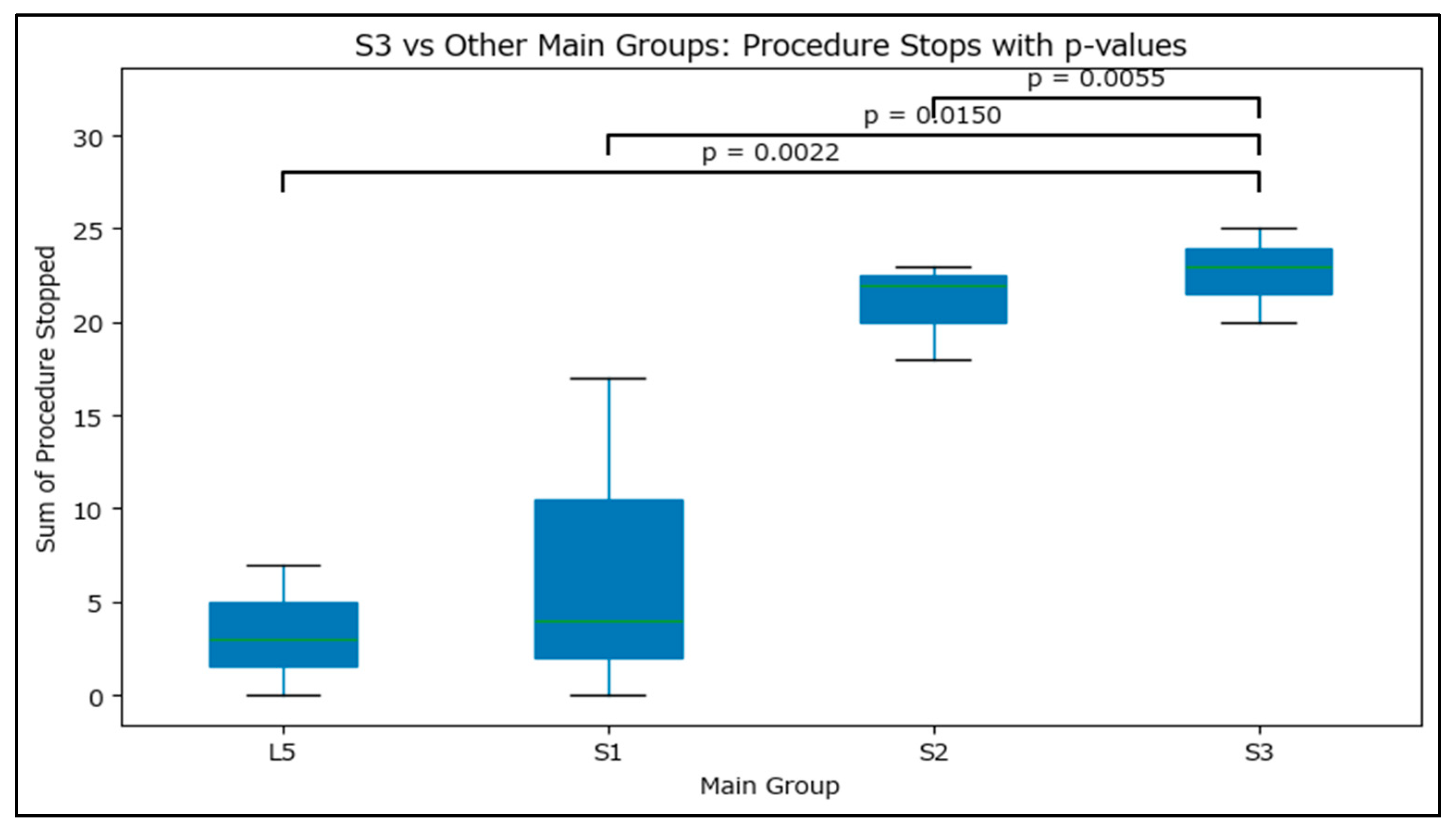
Interruptions were unevenly distributed across the main branches. S3 accounted for 68 interruptions (42.0%), S2 for 63 (38.9%), S1 for 21 (13.0%), and L5 for 10 (6.2%). The difference across main branches was highly significant (χ2(3) = 63.5, p < 0.001; Cohen’s w = 0.63, large effect).
Pairwise analyses confirmed that S3 produced significantly more interruptions than L5 (
p = 0.0022), S1 (
p = 0.0150), and S2 (
p = 0.0055) (
Figure 1). An aggregated comparison further demonstrated that S3 had significantly more interruptions than all other branches combined (
p < 0.001; Cohen’s
w = 0.58, large effect). Additional pairwise testing among the non-S3 branches revealed no difference between L5 and S1 (
p = 0.95), but significantly more interruptions at S2 compared with both L5 (
p = 0.003) and S1 (
p = 0.001).
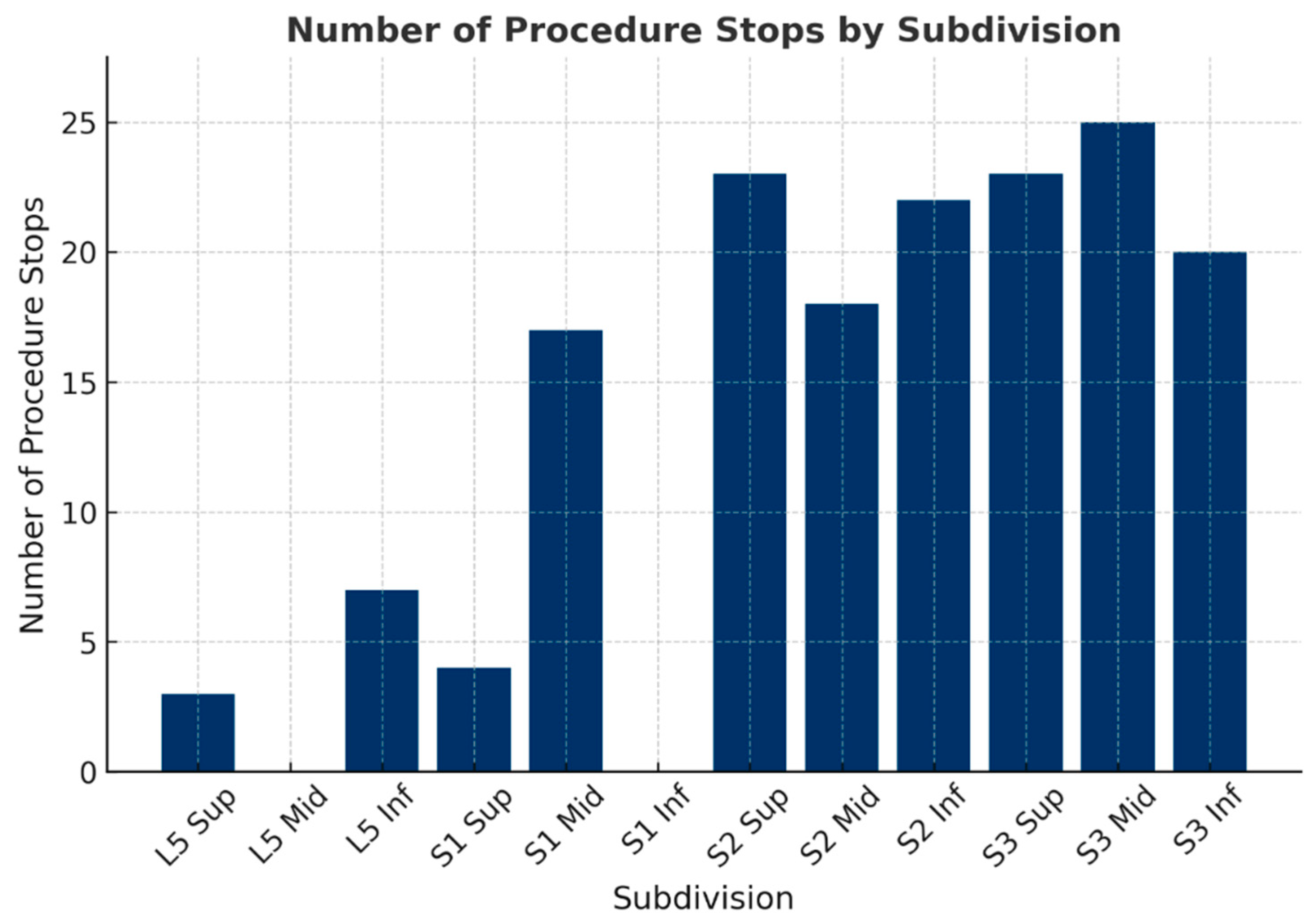
Subdivision-level analysis revealed distinct patterns across the sacral branches (
Figure 2). Within S3, interruption rates were uniformly high across all subdivisions—superior (82.1%), middle (86.2%), and inferior (71.4%)—with no significant differences among them (χ
2(2) = 0.56,
p = 0.76), indicating a consistent pain sensitivity profile throughout the nerve’s trajectory. In contrast, S1 and S2 demonstrated heterogeneous distributions. At S1, interruptions clustered prominently at the middle subdivision (χ
2(2) = 22.6,
p < 0.001), whereas S2 exhibited reduced sensitivity at its superior and high subdivisions compared with the mid and inferior levels (
p < 0.05). These findings suggest that while S3 functions as a uniformly sensitive pain mediator, the distribution of nociceptive responses in S1 and S2 may be anatomically localized to specific branches.
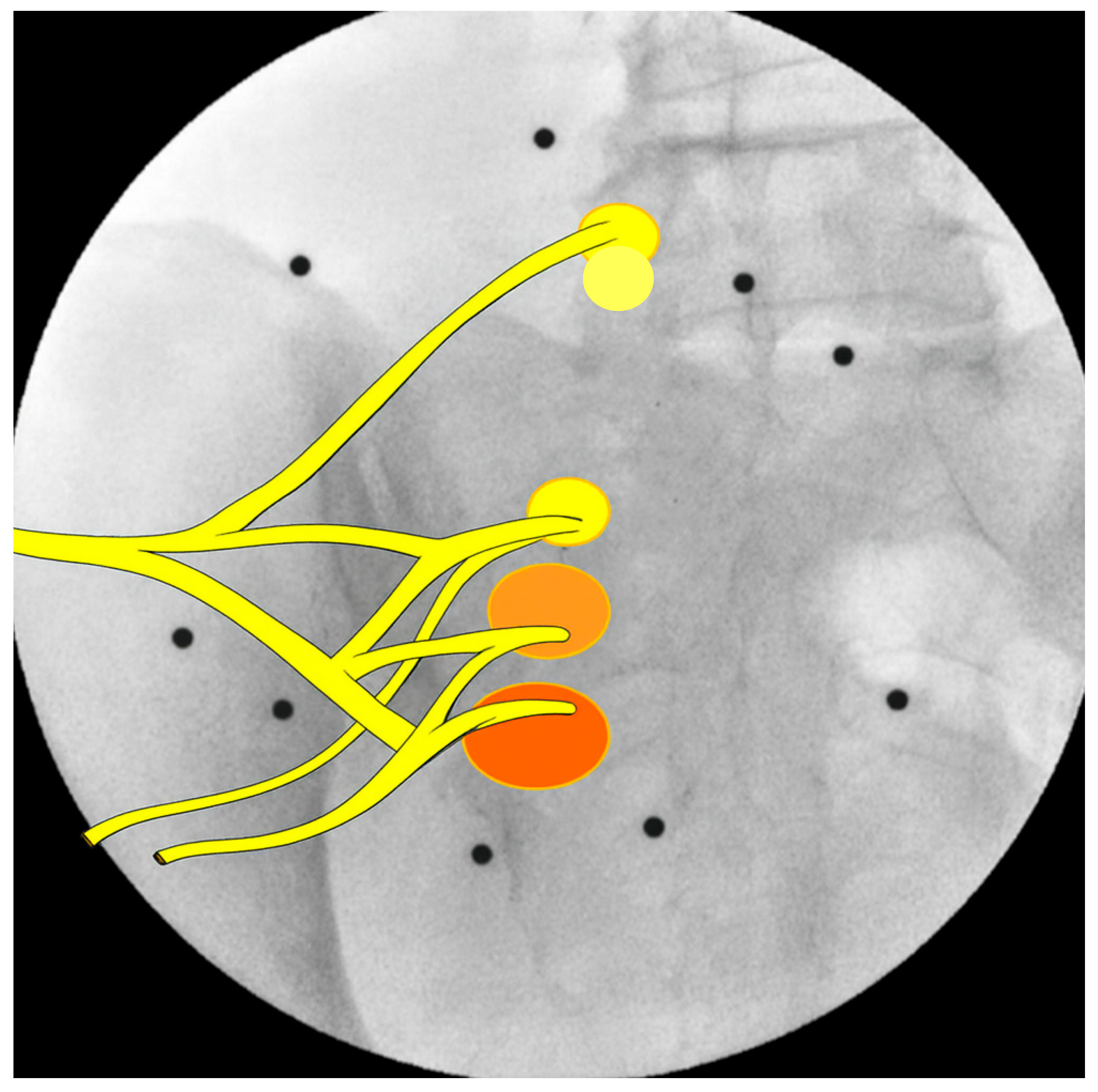
When interruption frequency was normalized to total delivered energy, a distinct gradient of nociceptive responsiveness emerged across the lumbosacral branches (
Table 1). The S3 branch exhibited the highest sensitivity index, followed by S2, whereas S1 and L5 demonstrated substantially lower ratios of interruptions per energy unit. This graded pattern highlights a progressive decline in pain sensitivity from the lower sacral to the upper lumbar levels, suggesting a functional hierarchy in nociceptive activation within the sacral plexus. (
Figure 3).
Together, these findings consistently identify S3 as the most pain-sensitive target during HIFU treatment of sacroiliitis, with S2 also demonstrating increased sensitivity relative to L5 and S1.
4. Discussion
This prospective evaluation of eight patients with sacroiliitis undergoing high-frequency ultrasound (HIFU) ablation demonstrated that treatment interruptions due to pain were strongly concentrated at the sacral nerve roots, particularly at S3. Among the 162 interruptions recorded, more than 80% occurred at S2 and S3, with S3 alone accounting for the highest proportion. Statistical analysis confirmed that interruptions were significantly more frequent at S3 compared to each of the other lumbosacral branches, and when analyzed against all branches combined.
Interestingly, pairwise comparisons among non-S3 branches revealed that S2 also exhibited greater sensitivity than both L5 and S1, while no difference was detected between L5 and S1. This suggests that both S2 and S3 play a substantial role in the nociceptive pathways of sacroiliac pain, though S3 remains the most consistently pain-sensitive root. These findings align with anatomical evidence indicating that sacral lateral branches, especially S2 and S3, provide major sensory innervation to the sacroiliac joint and its supporting ligaments [
23,
24,
25].
The identification of S3, and to a lesser extent S2, as key contributors to pain during HIFU treatment has important clinical implications. Neuroablative procedures such as radiofrequency denervation typically target multiple sacral branches; however, these results suggest that prioritizing S2 and S3, particularly S3, may enhance therapeutic precision and efficacy. Conversely, interventions directed at L5 and S1 may yield limited benefit, as these branches accounted for only a small proportion of pain-related interruptions.
At the subdivision level, S3 displayed a strikingly uniform pattern of pain sensitivity, with comparable interruption rates across superior, middle, and inferior branches. This suggests a diffuse nociceptive response throughout the S3 distribution, consistent with its broad sensory supply to the sacroiliac ligaments and posterior pelvic structures. In contrast, S1 and S2 showed more variable profiles, with interruptions clustering around the mid-level branches. These differences may reflect the variable course and depth of the lateral sacral branches, as well as the differential accessibility of terminal fibers to ultrasound energy. Together, these findings reinforce the functional prominence of S3 while revealing potentially distinct mechanosensory roles for the more cranial sacral branches.
In comparison with existing neuromodulation techniques, conventional interventions for sacroiliac pain, including sacral nerve stimulation (SNS) and radiofrequency ablation (RFA), commonly target the S3 nerve root due to its dominant sensory role. While SNS offers neuromodulatory benefits, it requires implanted hardware and carries procedural risks; RFA, though effective, may result in nonselective lesioning and inconsistent targeting [
28,
29]. In contrast, high-frequency focused ultrasound (HIFU) enables noninvasive, image-guided, and precise focal energy delivery to neural targets. The consistent pain sensitivity observed at S3 in this study supports its use as a potential HIFU target, and future comparative trials will be needed to determine whether this technique yields superior efficacy or durability compared with existing neuromodulation methods.
Strengths of this study include its prospective design, systematic recording of procedural events, and use of HIFU to provoke consistent nociceptive responses at anatomically defined sites. However, limitations must be acknowledged. The small cohort size may restrict generalizability, and interruptions during sonication were used as surrogate markers of sensitivity rather than direct measures of pain perception. In addition, the impact of the specific gel pad used, as well as skin-to-bone depth, was neglected due to the small sample size. Interindividual variability in sacral innervation may also influence results, and larger studies are required to validate these findings and assess their clinical utility. Nevertheless, the absence of a control group represents an additional limitation. Future large-scale, multicenter, randomized controlled trials will be essential to validate these findings and to further optimize treatment parameters.
The present study fills an important knowledge gap by prospectively characterizing pain-related interruptions during high-intensity focused ultrasound (HIFU) treatment for sacroiliitis. This unique observation window was possible because HIFU applied to the sacroiliac region is typically more painful and less tolerable than its use for lumbar medial branch ablation, which is generally uninterrupted. Moreover, as evolving treatment protocols increasingly emphasize prolonged, lower-intensity energy delivery to minimize intraprocedural discomfort, comparable data are unlikely to be reproduced in future clinical settings. By systematically analyzing interruption patterns across lumbosacral nerve branches, this study provides preliminary evidence of differential nerve root sensitivity to ultrasonic energy. When normalized for total energy delivered, S3 and, to a lesser extent, S2 exhibited markedly higher interruption rates per energy unit, suggesting greater nociceptive responsiveness. These findings offer novel insight into the functional topography of sacral nerve roots and highlight S3 as a potential therapeutic focus for refining targeted neuromodulation strategies in sacroiliitis. Future research could integrate real-time EMG or fMRI feedback to quantify central processing associated with peripheral nerve stimulation. Larger cohorts could validate whether the S3-dominant sensitivity observed here correlates with clinical pain localization patterns or therapeutic outcomes following targeted denervation.
5. Conclusions
This study highlights S3 as the most pain-sensitive target during HIFU treatment of sacroiliitis, with S2 also showing significant but less dominant involvement. Together, these findings underscore the importance of sacral nerve branches, particularly S3, in the pathophysiology of sacroiliac pain and provide a rationale for refining interventional strategies to focus on these targets. Future research should validate these findings in larger, multicenter cohorts and explore the integration of image-guided neuromodulation or real-time pain mapping to further optimize target selection and therapeutic precision in sacroiliac interventions.
Author Contributions
Conceptualization, L.U., I.G.-A., R.G., P.K. and T.H.; methodology, L.U., I.G.-A. and R.G.; software, I.G.-A. and P.K.; validation, L.U., I.G.-A. and P.K.; formal analysis, P.K. and I.G.-A.; investigation, T.H., I.G.-A., R.S., O.J. and P.K.; resources, L.U., R.G. and I.G.-A.; data curation, L.U. and R.G.; writing—original draft preparation, P.K.; writing—review and editing, L.U. and I.G.-A.; visualization, P.K. and I.G.-A.; supervision, L.U. and R.G.; project administration, L.U. and R.G. All authors have read and agreed to the published version of the manuscript.
Funding
This research received no external funding.
Institutional Review Board Statement
The study was conducted in accordance with the Declaration of Helsinki and approved by the Institutional Review Board of Sheba Medical Center (Protocol Code: 9283-22-SMC and Date of Approval: 13 March 2022).
Informed Consent Statement
Informed consent was obtained from all subjects involved in the study.
Data Availability Statement
Data is available by contacting the corresponding author upon reasonable request.
Acknowledgments
During the preparation of this manuscript/study, the authors used OpenAI [Chat GPT, GPT-5.1 model] and Copilot [Microsoft, GPT-5 model, Word app integration, November 2025 release] for the purposes of for assistance in image generation and writing editing. The authors have reviewed and edited the output and take full responsibility for the content of this publication.
Conflicts of Interest
The authors declare no conflicts of interest.
References
- Simopoulos, T.T.; Manchikanti, L.; Singh, V.; Gupta, S.; Hameed, H.; Diwan, S.; Cohen, S.P. A systematic evaluation of prevalence and diagnostic accuracy of sacroiliac joint interventions. Pain Physician 2012, 15, E305–E344. [Google Scholar] [CrossRef] [PubMed]
- Simopoulos, T.T.; Manchikanti, L.; Gupta, S.; Aydin, S.M.; Kim, C.H.; Solanki, D.; Nampiaparampil, D.E.; Singh, V.; Staats, P.S.; Hirsch, J.A. Systematic Review of the Diagnostic Accuracy and Therapeutic Effectiveness of Sacroiliac Joint Interventions. Pain Physician 2015, 18, E713–E756. [Google Scholar] [CrossRef] [PubMed]
- Thawrani, D.P.; Agabegi, S.S.; Asghar, F. Diagnosing Sacroiliac Joint Pain. J. Am. Acad. Orthop. Surg. 2019, 27, 85–93. [Google Scholar] [CrossRef]
- Wong, M.; Sinkler, M.A.; Kiel, J. Anatomy, Abdomen and Pelvis, Sacroiliac Joint. In StatPearls; StatPearls Publishing: Treasure Island, FL, USA, 2023. [Google Scholar]
- Protopopov, M.; Poddubnyy, D. Radiographic progression in non-radiographic axial spondyloarthritis. Expert Rev. Clin. Immunol. 2018, 14, 525–533. [Google Scholar] [CrossRef]
- Ziade, N.R. HLA B27 antigen in Middle Eastern and Arab countries: Systematic review of the strength of association with axial spondyloarthritis and methodological gaps. BMC Musculoskelet. Disord. 2017, 18, 280. [Google Scholar] [CrossRef]
- Slobodin, G.; Hussein, H.; Rosner, I.; Eshed, I. Sacroiliitis—Early diagnosis is key. J. Inflamm. Res. 2018, 11, 339–344. [Google Scholar] [CrossRef]
- Poddubnyy, D.; Listing, J.; Haibel, H.; Knüppel, S.; Rudwaleit, M.; Sieper, J. Functional relevance of radiographic spinal progression in axial spondyloarthritis: Results from the GErman SPondyloarthritis Inception Cohort. Rheumatology 2018, 57, 703–711. [Google Scholar] [CrossRef]
- Newman, D.P.; Soto, A.T. Sacroiliac Joint Dysfunction: Diagnosis and Treatment. Am. Fam. Physician 2022, 105, 239–245. [Google Scholar] [PubMed]
- Han, C.S.; Hancock, M.J.; Sharma, S.; Sharma, S.; Harris, I.A.; Cohen, S.P.; Magnussen, J.; Maher, C.G.; Traeger, A.C. Low back pain of disc, sacroiliac joint, or facet joint origin: A diagnostic accuracy systematic review. EClinicalMedicine 2023, 59, 101960. [Google Scholar] [CrossRef]
- Tan, S.; Ward, M.M. Computed tomography in axial spondyloarthritis. Curr. Opin. Rheumatol. 2018, 30, 334–339. [Google Scholar] [CrossRef]
- Žlnay, M. Využitie MRI vyšetrenia pri diagnostike axiálnej spondylartritídy [The role of magnetic resonance imaging in diagnostics of axial spondyloarthritis]. Vnitr. Lek. 2018, 64, 117–126. [Google Scholar] [CrossRef]
- Kocak, O.; Kocak, A.Y.; Sanal, B.; Kulan, G. Bilateral Sacroiliitis Confirmed with Magnetic Resonance Imaging during Isotretinoin Treatment: Assessment of 11 Patients and a Review of the Literature. Acta Dermatovenerol. Croat. 2017, 25, 228–233. [Google Scholar]
- Pandita, A.; Madhuripan, N.; Hurtado, R.M.; Dhamoon, A. Back pain and oedematous Schmorl node: A diagnostic dilemma. BMJ Case Rep. 2017, 2017, bcr2017219904. [Google Scholar] [CrossRef]
- Expert Panel on Musculoskeletal Imaging; Bernard, S.A.; Kransdorf, M.J.; Beaman, F.D.; Adler, R.S.; Amini, B.; Appel, M.; Arnold, E.; Cassidy, R.C.; Greenspan, B.S.; et al. ACR Appropriateness Criteria® Chronic Back Pain Suspected Sacroiliitis-Spondyloarthropathy. J. Am. Coll. Radiol. 2017, 14, S62–S70. [Google Scholar] [CrossRef]
- Nash, P.; Lubrano, E.; Cauli, A.; Taylor, W.J.; Olivieri, I.; Gladman, D.D. Updated guidelines for the management of axial disease in psoriatic arthritis. J. Rheumatol. 2014, 41, 2286–2289. [Google Scholar] [CrossRef]
- van der Heijde, D.; Ramiro, S.; Landewé, R.; Baraliakos, X.; van den Bosch, F.; Sepriano, A.; Regel, A.; Ciurea, A.; Dagfinrud, H.; Dougados, M.; et al. 2016 update of the ASAS-EULAR management recommendations for axial spondyloarthritis. Ann. Rheum. Dis. 2017, 76, 978–991. [Google Scholar] [CrossRef]
- Haar, G.T.; Coussios, C. High intensity focused ultrasound: Physical principles and devices. Int. J. Hyperth. 2007, 23, 89–104. [Google Scholar] [CrossRef]
- Dick, E.A.; Gedroyc, W.M. ExAblate magnetic resonance-guided focused ultrasound system in multiple body applications. Expert Rev. Med. Devices 2010, 7, 589–597. [Google Scholar] [CrossRef]
- Hananel, A.; Aubry, J.F. Image-Guided Focused Ultrasound: State of the Technology and the Challenges That Lie Ahead. Imaging Med. 2013, 5, 357–370. [Google Scholar] [CrossRef]
- Tyshlek, D.; Aubry, J.F.; Ter Haar, G.; Hananel, A.; Foley, J.; Eames, M.; Kassell, N.; Simonin, H.H. Focused ultrasound development and clinical adoption: 2013 update on the growth of the field. J. Ther. Ultrasound 2014, 2, 2. [Google Scholar] [CrossRef]
- Bradley, W.G., Jr. MR-guided focused ultrasound: A potentially disruptive technology. J. Am. Coll. Radiol. 2009, 6, 510–513. [Google Scholar] [CrossRef] [PubMed]
- Grob, K.R.; Neuhuber, W.L.; Kissling, R.O. Die Innervation des Sacroiliacalgelenkes beim Menschen [Innervation of the sacroiliac joint of the human]. Z. Rheumatol. 1995, 54, 117–122. [Google Scholar]
- Fortin, J.D.; Aprill, C.N.; Ponthieux, B.; Pier, J. Sacroiliac joint: Pain referral maps upon applying a new injection/arthrography technique. Part II: Clinical evaluation. Spine 1994, 19, 1483–1489. [Google Scholar] [CrossRef]
- Vanelderen, P.; Szadek, K.; Cohen, S.P.; De Witte, J.; Lataster, A.; Patijn, J.; Mekhail, N.; Van Kleef, M.; Van Zundert, J. 13. Sacroiliac joint pain. Pain Pract. 2010, 10, 470–478. [Google Scholar] [CrossRef]
- Raja, S.N.; Carr, D.B.; Cohen, M.; Finnerup, N.B.; Flor, H.; Gibson, S.; Keefe, F.J.; Mogil, J.S.; Ringkamp, M.; Sluka, K.A.; et al. The revised International Association for the Study of Pain definition of pain: Concepts, challenges, and compromises. Pain 2020, 161, 1976–1982. [Google Scholar] [CrossRef]
- Gofeld, M.; Smith, K.J.; Bhatia, A.; Djuric, V.; Leblang, S.; Rebhun, N.; Aginsky, R.; Miller, E.; Skoglind, B.; Hananel, A. Fluoroscopy-guided high-intensity focused ultrasound neurotomy of the lumbar zygapophyseal joints: A prospective, open-label study. Reg. Anesth. Pain Med. 2024, 50, 464–470. [Google Scholar] [CrossRef]
- Liu, Y.; Suvithayasiri, S.; Kim, J.S. Comparative Efficacy of Clinical Interventions for Sacroiliac Joint Pain: Systematic Review and Network Meta-analysis with Preliminary Design of Treatment Algorithm. Neurospine 2023, 20, 997–1010. [Google Scholar] [CrossRef] [PubMed]
- Choi, W.S.; Kim, J.S.; Ryu, K.S.; Hur, J.W.; Seong, J.H.; Cho, H.J. Endoscopic Radiofrequency Ablation of the Sacroiliac Joint Complex in the Treatment of Chronic Low Back Pain: A Preliminary Study of Feasibility and Efficacy of a Novel Technique. BioMed Res. Int. 2016, 2016, 2834259. [Google Scholar] [CrossRef] [PubMed]
| Disclaimer/Publisher’s Note: The statements, opinions and data contained in all publications are solely those of the individual author(s) and contributor(s) and not of MDPI and/or the editor(s). MDPI and/or the editor(s) disclaim responsibility for any injury to people or property resulting from any ideas, methods, instructions or products referred to in the content. |
© 2025 by the authors. Licensee MDPI, Basel, Switzerland. This article is an open access article distributed under the terms and conditions of the Creative Commons Attribution (CC BY) license (https://creativecommons.org/licenses/by/4.0/).




 ,
,