Article

Clinical and Molecular Spectrum of DDX41 Variants in Korean Patients with Hematologic Malignancies


1
Department of Laboratory Medicine and Genetics, Samsung Medical Center, Sungkyunkwan University School of Medicine, Seoul 06351, Republic of Korea
2
Department of Laboratory Medicine, Korea University Guro Hospital, Korea University College of Medicine, Seoul 08308, Republic of Korea
3
Division of Hematology-Oncology, Department of Medicine, Samsung Medical Center, Sungkyunkwan University School of Medicine, Seoul 06351, Republic of Korea
*
Author to whom correspondence should be addressed.
J. Clin. Med. 2025, 14(22), 7999; https://doi.org/10.3390/jcm14227999
Submission received: 9 September 2025 / Revised: 26 September 2025 / Accepted: 10 November 2025 / Published: 11 November 2025
(This article belongs to the Section Hematology)

Abstract

Background: DDX41 is one of the most frequent adult-onset myeloid neoplasm predisposition gene, yet its biology remains incompletely defined. This study investigated the frequency, spectrum, and clinical characteristics of DDX41 variants in Korean patients with hematologic malignancies, including the patterns of co-occurring somatic variants. Methods: We retrospectively reviewed 716 patients with hematologic malignancies who underwent targeted next-generation sequencing. In patients with germline DDX41 variants, clinicopathologic features, co-occurring variants, variant allele frequency (VAF) distributions, and survival were analyzed. Results: DDX41 variants were identified in 34/716 patients (4.7%), including 33 germline carriers (4.6%), occurring most frequently in AML (6.2%) and MDS (11.1%). Patients with germline DDX41 variants had a median age of 68 years, were predominantly male (69.7%), and commonly had normal karyotypes (72.7%), with similar features in AML and MDS except for lower platelet counts in AML (p = 0.025). The most common germline DDX41 variants were Y259C (20.6%), A500fs (14.7%), E7* (11.8%), V152G (11.8%), and D139G (8.8%), with null variants predominating in AML and missense variants in MDS (p = 0.002). Somatic DDX41 variants occurred in 63.6% of patients with germline DDX41 variants, with R525H being the most frequent (48%), while non-DDX41 somatic variants were detected in 78.8% of patients, most commonly involving ASXL1, DNMT3A, SRSF2, and TET2, which appeared at lower VAFs, suggesting late acquisition. Conclusions: This study demonstrates ethnic-specific DDX41 variant patterns in Korean myeloid neoplasm patients, with biallelic alterations potentially involved in early leukemogenesis. These findings provide further insight into the unique features of DDX41-associated myeloid neoplasms.

1. Introduction

Myeloid neoplasms with germline predisposition represent inherited genetic conditions that increase the risk of hematologic malignancies [1,2]. Identification of such predispositions is clinically important for accurate diagnosis, treatment decisions, donor selection for allogeneic hematopoietic stem cell transplantation, and genetic counseling for patients and their families.
DEAD-box RNA helicase 41 (DDX41) was first reported as a germline predisposition gene for myeloid neoplasms by Polprasert et al. in 2015 [3]. DDX41, located on chromosome 5q35.3, encodes a ubiquitously expressed 622-amino acid protein that plays essential roles in pre-mRNA splicing, RNA processing, innate immunity, and hematopoietic stem cell function [4]. Heterozygous germline variants in DDX41 are now recognized as the most frequent germline predisposition to adult-onset myeloid neoplasms, particularly myelodysplastic neoplasm (MDS) and acute myeloid leukemia (AML) [5,6].
Clinically, DDX41-related myeloid neoplasms are characterized by late onset, male predominance, hypocellular marrow, and relatively favorable outcomes [7,8]. Ethnic differences in variant distribution have been reported, and the penetrance of germline DDX41 variants has been estimated at around 62%, though it may vary by population and variant type [9]. Classifying germline DDX41 variants remains challenging due to their heterogeneity and variable pathogenicity, often resulting in a substantial proportion being designated as variants of uncertain significance (VUS). To address this, several studies have proposed DDX41-specific modifications to the American College of Medical Genetics and Genomics/Association for Molecular Pathology (ACMG/AMP) guidelines [9,10,11,12]. Moreover, recent studies have demonstrated that patients with DDX41 VUS exhibit clinical and molecular features comparable to those with pathogenic or likely pathogenic variants (PV/LPV), suggesting that many VUS may in fact be pathogenic and underscoring the need for refined classification frameworks [6,13].
Despite these advances, the biology and clinical impact of DDX41-mutated myeloid neoplasms are not yet fully understood. This study aims to investigate the frequency, spectrum, and clinical characteristics of DDX41 variants in Korean patients with hematologic malignancies, including the patterns of co-occurring somatic variants.

2. Materials and Methods

2.1. Patients

This study included patients with hematologic malignancies–including AML, MDS, mixed phenotype acute leukemia (MPAL), chronic myeloid leukemia (CML), Philadelphia–negative myeloproliferative neoplasms (Ph-negative MPN), myelodysplastic/myeloproliferative neoplasms (MDS/MPN), and acute lymphoblastic leukemia (ALL)–who underwent targeted next-generation sequencing (NGS) between August 2020 and September 2024. All patients were diagnosed according to the 2016 World Health Organization (WHO) classification of hematolymphoid tumors [14] and were reclassified in this study based on the 2022 WHO classification or the International Consensus Classification (ICC) [1,2,15,16]. Laboratory data, including complete blood counts (CBC), bone marrow (BM) examinations, cytogenetic analyses (i.e., karyotyping and fluorescence in situ hybridization [FISH]), and molecular testing (i.e., targeted NGS and multiplex reverse transcription [RT]-PCR), along with clinical information such as treatment, disease course, and survival, were obtained from electronic medical records. For survival analysis, patients with AML aged ≥18 years who were diagnosed between July 2018 and December 2022 were used as control groups, including patients with AML with a normal karyotype (AML-NK) (N = 26), AML, myelodysplasia-related (AML-MR) (N = 58), and AML with mutated TP53 (AML-TP53) (N = 33), with the latter two groups reclassified according to the ICC [2]. This study was approved by the Institutional Review Board of Samsung Medical Center (IRB No. 2025-03-023). The requirement for informed consent was waived due to the retrospective design of the study and the use of de-identified data.

2.2. Targeted NGS

Genomic DNA was extracted from BM aspirates or peripheral blood samples using the Promega DNA extraction kit (Promega, Madison, WI, USA) following the manufacturer’s instructions. Libraries were prepared using the IDT xGen predesigned/custom panel (Integrated DNA Technologies, Coralville, IA, USA) or the Twist custom somatic panel (Twist Bioscience, South San Francisco, CA, USA), targeting 49 hematologic malignancy-associated genes, including DDX41 (Supplementary Table S1). Sequencing was performed on a NextSeq 550Dx instrument (Illumina, San Diego, CA, USA), as previously described [17]. Reads were aligned to the human reference genome GRCh37/hg19 using BWA-MEM (version 0.7.17). Mutect2 in the GATK package (v4.1.2) and Pisces (5.2.11.163) were used to detect single nucleotide variants (SNVs) and small insertion/deletions (indels), and Pindel (version 0.2.5b9) was used to detect large indels.

2.3. Classification of Germline DDX41 Variants

DDX41 variants with variant allele frequency (VAF) ≥ 40% were considered to be germline origin, whereas those with VAF < 40% were presumed to be somatic in origin [11,12,18,19,20]. When available, germline origin was confirmed using cultured skin fibroblasts obtained from a skin punch biopsy. Germline DDX41 variants were classified based on the ACMG/AMP guidelines [21,22], with a modified interpretation framework for DDX41, as proposed in recent studies [11,12], additionally applied. A pathogenic moderate criterion (PM1) was assigned to variants located within known functional domains of DDX41, including amino acid positions 181–209 (Q-motif), 212–396 (DEAD-box domain), 407–567 (helicase domain), and 580–597 (zinc finger [ZnF] domain) [12]. PM2 was applied to variants with minor allele frequency (MAF) < 0.008% in Genome Aggregation Database (gnomAD) or Korean Reference Genome Database (KRGDB) [11]. A pathogenic supporting criterion (PP3) was applied to variants with a rare exome variant ensemble learner (REVEL) score > 0.7 [11,12] or a SpliceAI delta score > 0.8 [23]. Importantly, PP4 with a very strong level (PP4_very strong) was applied when a germline DDX41 variant was identified in conjunction with a presumed somatic DDX41 variant [12]. Variants with a MAF ≥ 0.1% in gnomAD or KRGDB were classified as benign. In this study, DDX41 variants classified as PV, LPV, and VUS were included for analysis.

2.4. Statistical Analysis

Categorical variables were compared using the chi-square or Fisher’s exact test, and continuous variables using the Mann–Whitney U, t-test, or Kruskal–Wallis test, as appropriate. The distribution of non-DDX41 somatic VAFs was assessed with empirical cumulative distribution functions and compared using the Wilcoxon rank-sum test. Overall survival was analyzed from diagnosis to death or last follow-up using Kaplan–Meier estimates and log-rank tests, with pairwise comparisons adjusted by Bonferroni correction. Statistical analyses and visualization were performed using SPSS version (v29.0.2.0; IBM, Armonk, NY, USA) and R software (v4.5.1; R Foundation for Statistical Computing, Vienna, Austria). A p-value < 0.05 was considered statistically significant.

3. Results

3.1. Overall Frequency of DDX41 Variants

DDX41 variants were identified in 34 of 716 patients (4.7%) with hematologic malignancies, including 33 patients (4.6%) with germline DDX41 variants and one with only a somatic DDX41 variant (Supplementary Tables S2 and S3). The prevalence of germline DDX41 variants varied by disease: 6.2% (13/210) in AML, 11.1% (15/135) in MDS, 2.4% (2/82) in CML, 0.5% (1/204) in Ph-negative MPN, 33.3% (1/3) in MPAL, and 2.0% (1/50) in ALL (Figure 1A). Co-occurring somatic DDX41 variants were found in 63.6% (21/33) of patients with germline DDX41 variants.

3.2. Clinical and Molecular Characteristics of Patients with Germline DDX41 Variants

Among 33 patients with germline DDX41 variants, the median age at diagnosis was 68 years (range, 48–86 years), 69.7% (23/33) were male, and 72.7% (24/33) had a normal karyotype. Given that AML and MDS accounted for the majority of cases (28/33, 84.8%), comparative analyses were limited to these two subtypes to allow meaningful statistical comparison. Baseline characteristics (age, sex, hemoglobin, white blood cell counts, bone marrow cellularity, and normal karyotype frequency) showed no significant differences between AML and MDS patients with germline DDX41 variants (all p > 0.05), except for lower platelet counts in AML (p = 0.025) (Table 1). The frequency of co-occurring somatic DDX41 variant was also similar (p = 1.000). Among AML patients, 69.2% had AML-MR, while among MDS patients, 60% had MDS with low blasts, and 40% had MDS with increased blasts.
A total of 34 germline DDX41 variants were identified, with eight confirmed as germline in cultured skin fibroblasts. One AML patient carried two germline variants (Glu7* and Cys595fs), both confirmed in fibroblasts. The median VAF of germline DDX41 variants was 49.7% (interquartile range [IQR], 48.9–50.4%). When stratified by confirmation status, the median VAFs were 49.8% (range, 47.0–51.5%) for confirmed germline variants and 49.7% (range, 45.8–52.2%) for presumed germline variants, with no significant difference between groups (p = 0.496).
Of 15 unique germline variants, 73.3% (11/15) were classified as PV/LPV according to the modified ACMG/AMP criteria, while the remaining were classified as VUS (Supplementary Table S2). Among 33 patients with germline DDX41 variants, six (18.2%) had VUS, all of which were missense variants without concomitant somatic DDX41 variants. Clinical characteristics were broadly similar between patients with PV/LPV and those with VUS. Although patients with VUS showed higher WBC counts (median, 15.94 vs. 1.96 × 10⁹/L; p = 0.004) and higher BM cellularity (median, 80% vs. 20%; p = 0.003), other baseline features, including age, hemoglobin level, and karyotype status, did not differ significantly between groups (Supplementary Table S4). However, as each pathogenicity group comprised a heterogeneous mix of hematologic malignancy subtypes, baseline characteristics may be partly confounded by disease distribution.
The most prevalent germline variant was Y259C (20.6%), followed by A500fs (14.7%), E7* (11.8%), V152G (11.8%), and D139G (8.8%) (Figure 1B and Supplementary Table S5). Variant types differed significantly by disease type: null variants predominated in AML (78.6%), while missense variants were more common in MDS (80.0%) (p = 0.002) (Figure 1C).

3.3. Co-Occurring Somatic Variants and Their Allele Frequency Patterns

Somatic DDX41 variants were identified in 22 patients (3.1%), with 25 variants comprising 11 unique ones. Two MDS patients had multiple somatic DDX41 variants (two and three variants, respectively). All but one were missense variants, with a median VAF of 6.8% (IQR, 3.9–12.1%). The most frequent somatic variant was R525H (48.0%), followed by T227M, P321L, and G530D (8.0% each). Somatic DDX41 variants were non-overlapping with germline DDX41 variants (Figure 1B). While germline DDX41 variants were distributed across the entire gene, somatic DDX41 variants clustered in the DEAD-box and helicase C domains.
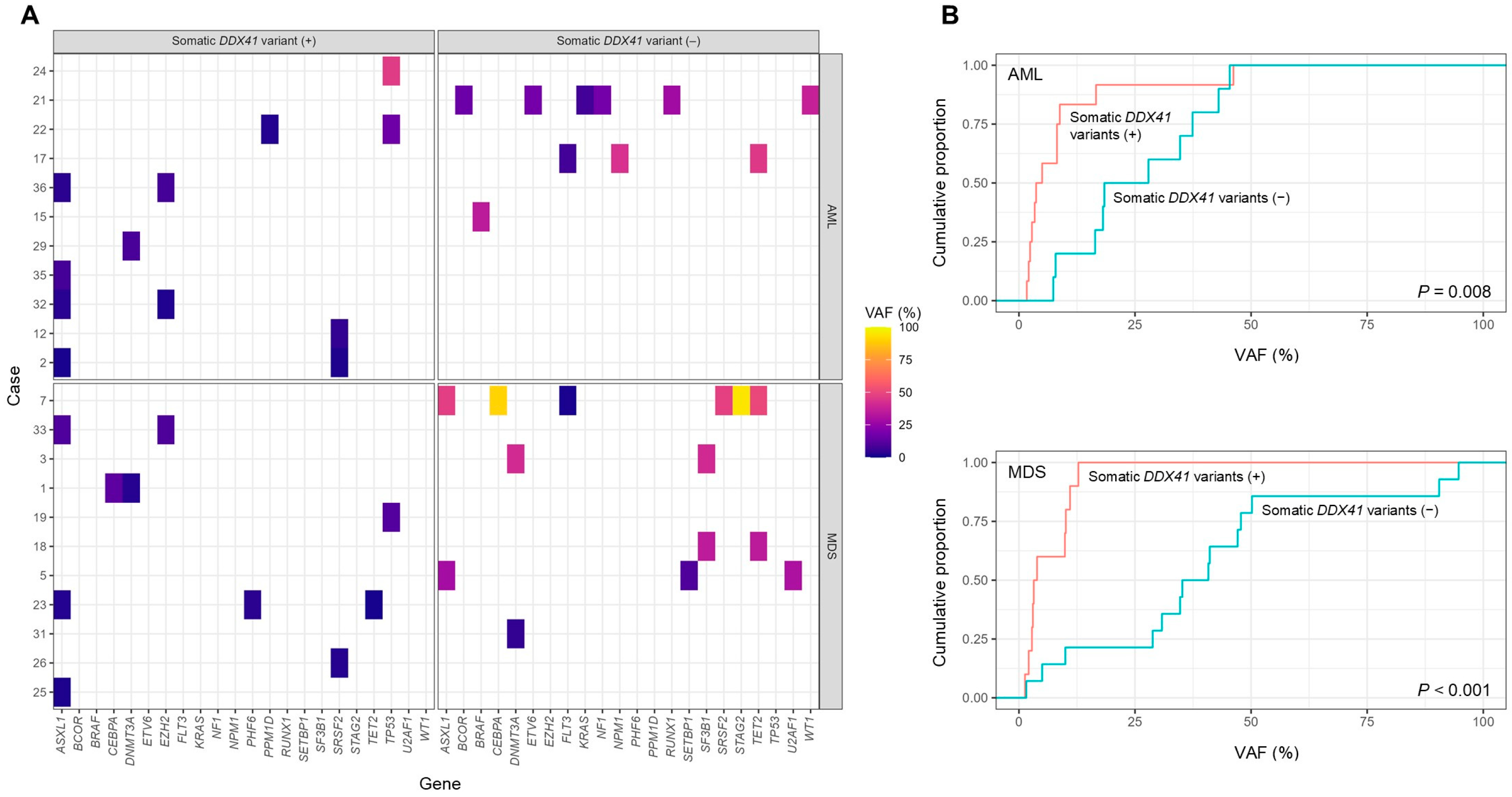
Non-DDX41 somatic variants were detected in 78.8% (26/33) of patients with germline DDX41 variants, including 84.6% of AML patients and 73.3% of MDS patients (p = 0.655). AML and MDS patients with somatic DDX41 variants tended to have fewer non-DDX41 somatic variants compared with those without (median 2, range 0–4 vs. median 3, range 0–8; p = 0.092). The most common co-occurring variants were ASXL1 (32.1%), followed by DNMT3A, SRSF2, and TET2 (14.3% each), and EZH2 and TP53 (10.7% each) (Figure 2A). To further evaluate VAF differences, we compared the distributions of non-DDX41 variant VAFs between patients with and without somatic DDX41 variants using empirical cumulative distribution function analysis. This demonstrated a significant leftward shift in both AML (p = 0.008) and MDS (p < 0.001) among patients without somatic DDX41 variants, suggesting that co-occurring variants in the presence of somatic DDX41 variants are more likely to occur at lower VAFs (Figure 2B).

3.4. Survival and Prognosis in AML and MDS with Germline DDX41 Variants

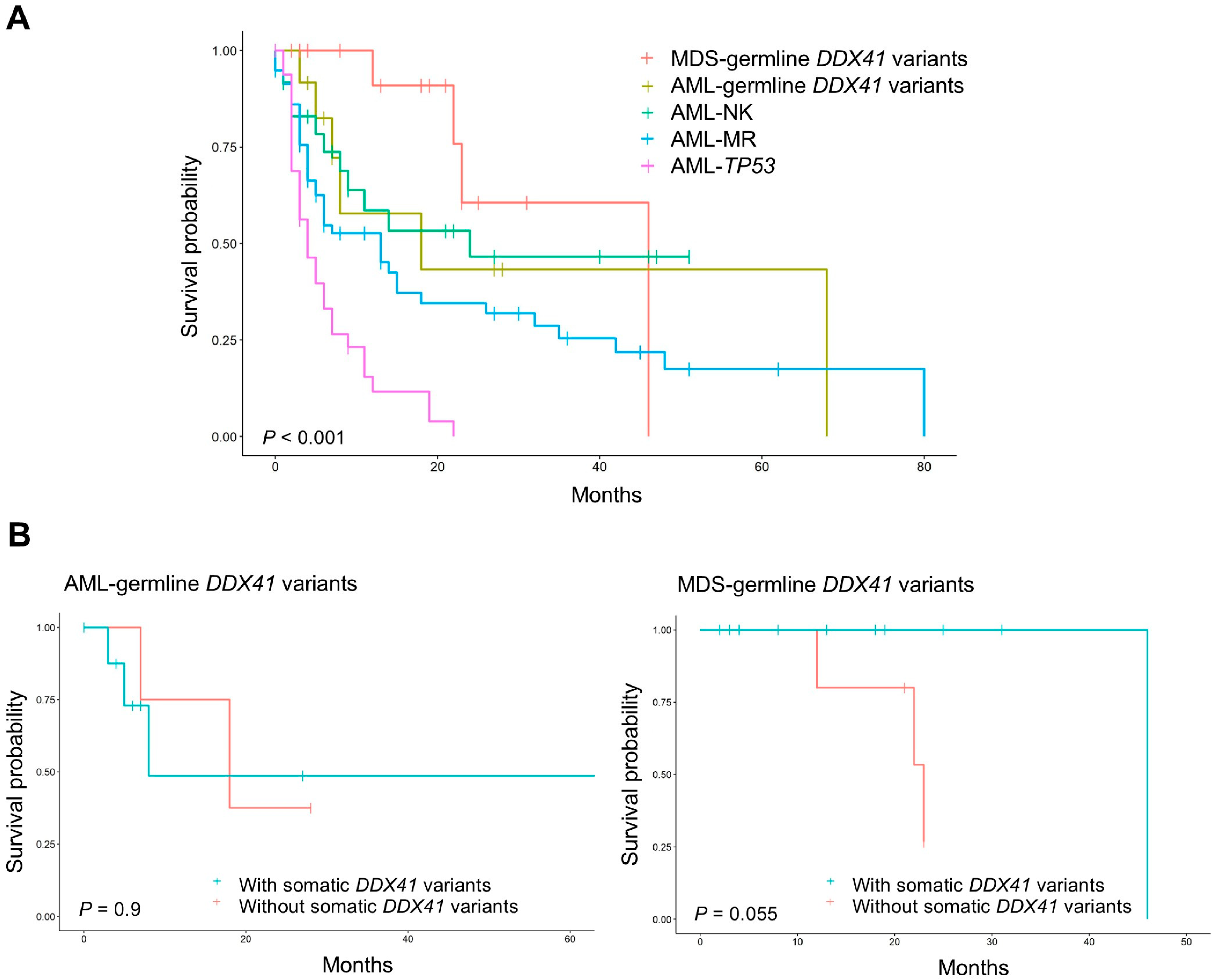
The median follow-up period of AML and MDS patients with germline DDX41 variants was 12.0 months (range, 0–68 months). Median survival was 18 months (95% CI, 7–not reached [NR]) for AML and 46 months (95% CI, 23–NR) for MDS. Survival was compared with AML subgroups: AML-NK, AML-MR, and AML-TP53 (Figure 3A). AML-TP53 had significantly worse survival than all other groups (p < 0.05), while differences among AML-NK, AML-MR, and AML/MDS with germline DDX41 variants were not significant, likely due to small sample size. Notably, AML patients with germline DDX41 variants, despite a high proportion of AML-MR (69.2%), showed survival patterns similar to AML-NK. In MDS, patients with concomitant somatic DDX41 variants exhibited a trend toward better survival compared to those without (p = 0.055) (Figure 3B).

4. Discussion

This study investigated the frequency and spectrum of DDX41 variants in Korean patients with hematologic malignancies, and evaluated the characteristics of somatic variants co-occurring with germline DDX41 variants.
The incidence of DDX41 variants in myeloid neoplasms has been reported to range from 2–5% across various studies [12,24], with a pooled incidence of 3.3% [25]. In the Korean population, a previous study identified germline DDX41 variants in 6.1% of patients with AML, MDS, or idiopathic cytopenia of undetermined significance, with disease-specific frequencies of 2.3% in AML and 9.0% in MDS [26]. Another study reported an incidence of 2% in various hematologic malignancies, including AML, MDS, MPN, B-cell lymphoma, and multiple myeloma [11]. In our study, germline DDX41 variants were detected in 4.6% of patients with hematologic malignancies, with higher prevalence in AML (6.2%) and MDS (11.1%). Among hematologic malignancies other than AML and MDS, DDX41 variants have been rarely reported [11,20,25,27], and our study identified one patient with B-ALL, one with MPAL, two with CML, and one with PV.
Patients with germline DDX41 variants in our study presented at a median age of 68 years, with male predominance (69.7%) and frequent normal karyotype (72.7%), demonstrating similar patterns in both AML and MDS. These characteristics represent hallmarks of DDX41-associated myeloid neoplasms [11,12,18,24,28]. The high normal karyotype rate suggests that disease progression may be driven by molecular rather than cytogenetic mechanisms. Moreover, the similarity in most baseline characteristics between AML and MDS patients with germline DDX41 variants may point to a potential continuum model in which MDS could evolve into AML, with the lower platelet counts observed in AML possibly reflecting more advanced disease.
In this study, we included both PV/LPV and VUS DDX41 variants. Similar to previous studies [6,13], patients with VUS exhibited clinical features that were largely comparable to those with PV/LPV variants, supporting the potential pathogenicity of these variants. However, because both groups encompassed heterogeneous hematologic malignancy subtypes, baseline differences may partly reflect disease distribution rather than inherent effects of variant classification. Further studies with larger and more homogeneous cohorts are needed to clarify these findings.
The spectrum of germline DDX41 variants exhibits ethnic variability. In Western populations, common germline variants include M1? and D140fs [11,12], whereas Asian populations show higher frequencies of A500fs, Y259C, and V152G [26,28]. In Japanese patients, A500fs is most prevalent, followed by S363del, Y259C, and E7* [28]. In a prior Korean study, V152G was most common, followed by Y259C, A500fs, and E7* [26]. In our study, Y259C was most prevalent, followed by A500fs and V152G. Notably, the most common variants in Western populations, M1? and D140fs, were rarely observed in Japanese and Korean populations, whereas A500fs appeared to be Asian-specific and V152G was identified exclusively in Korean patients. These ethnic differences likely reflect founder effects and population-specific genetic architecture, underscoring the importance of ethnicity-informed genetic screening strategies. Furthermore, variant types showed disease-specific patterns, with null variants predominating in AML (78.6%) and missense variants in MDS (80%), suggesting that null variants may drive more aggressive disease phenotypes. This observation is consistent with the findings by Makishima et al., who reported that MDS patients with DDX41 variants exhibited rapid progression to AML, with this aggressive transformation predominantly observed in those harboring null variants [28].
Concurrent somatic DDX41 variants occur in approximately 50–87% of patients with germline DDX41 variants in previous studies [3,11,12,18,26,28], and in 63.6% of patients with germline DDX41 variants in our study. Maierhofer et al. reported a highly specific germline–somatic association (odds ratios > 350) and suggested that somatic DDX41 variant presence can provide strong evidence for germline variant pathogenicity [12], thereby aiding VUS reclassification.
All somatic DDX41 variants except one were missense variants, clustering within the DEAD-box and helicase domains, with R525H being the most frequent, followed by other recurrent variants including G530D, T227M, and P321L, consistent with previous reports [12,26,28]. Somatic DDX41 variants alone are rare (0–0.6%) [11,18,26,28], and in our study, only one MDS patient (Case 9) harbored an isolated somatic DDX41 frameshift variant (Arg249fs) caused by a 113-base pair insertion.
In our study, non-DDX41 somatic variants were detected in 78.8% of patients with germline DDX41 variants, with similar rates in AML and MDS. The most common variant was ASXL1, followed by DNMT3A, SRSF2, TET2, EZH2, and TP53, which often exhibited lower VAFs, suggesting late acquisition [12,18]. Co-occurrence of a TP53 variant was relatively infrequent in our study, despite previous reports identifying it as the second most common co-occurring variant [24,25,29]. Patients with somatic DDX41 variants had fewer additional somatic variants, and these non-DDX41 variants occurred at significantly lower VAFs than in patients without somatic DDX41 variants. Collectively, these findings suggest that biallelic DDX41 alterations represent early leukemogenic events, thereby reducing the need for additional drivers [12,18], while non-DDX41 variants tend to emerge later as subclonal events. Conversely, in the absence of biallelic DDX41 alterations, leukemogenesis may require the acquisition of additional driver variants.
The prognostic impact of germline DDX41 variants remains inconsistent across studies [3,11,20,24,26,30]. A recent study by Makishima et al. showed that standard prognostic scoring systems, such as the revised/molecular International Prognostic Scoring System (IPSS-R/M), were not predictive in DDX41-related myeloid malignancies [28]. Importantly, DDX41 variants mitigated the poor prognosis typically associated with TP53 co-variants, indicating a unique survival benefit. In our study, AML outcomes were similar to those of AML-NK, despite 69.2% being classified as AML-MR, while in MDS, concomitant somatic DDX41 variants were associated with a trend toward better survival.
Our study has several limitations. Based on previous reports [11,12,18,19,20], we considered variants with a VAF ≥ 40% as germline in origin, and germline status was confirmed using cultured skin fibroblasts in only a subset of patients. Moreover, germline inference based solely on VAF carries inherent limitations, including the potential for confounding by copy number alterations or clonal hematopoiesis, although the latter is less likely at such high VAFs. We also included VUS, in addition to PV/LPV, to comprehensively evaluate their clinical relevance, although this may introduce some uncertainty in interpretation. In addition, our study lacked functional validation, such as protein expression or DNA damage marker analyses, which would help clarify the biological consequences of DDX41 variants. Finally, the relatively small sample size and short follow-up period may limit the generalizability of our findings.

5. Conclusions

In conclusion, we characterized the frequency, spectrum, and clinical features of DDX41 variants in Korean patients with hematologic malignancies. We found that concomitant somatic DDX41 variants were associated with fewer co-occurring non-DDX41 variants, which also tended to present at lower VAFs, supporting the role of biallelic DDX41 alterations as early leukemogenic events. Our study contributes to a better understanding of the unique features of DDX41-associated myeloid neoplasms.

Supplementary Materials

The following supporting information can be downloaded at: https://www.mdpi.com/article/10.3390/jcm14227999/s1, Table S1: List of genes included in the targeted next-generation sequencing panel; Table S2: Molecular and cytogenetic profiles of 34 patients with germline and/or somatic DDX41 variants; Table S3: Frequency of germline and somatic DDX41 variants in patients with hematologic malignancies; Table S4: Comparison of baseline characteristics of patients with germline DDX41 variants by pathogenicity classification; Table S5: Frequency of germline DDX41 variants by variant type.

Author Contributions

Conceptualization, B.K. and H.-Y.K.; methodology, B.K. and H.-Y.K.; software, B.K. and H.-Y.K.; formal analysis, B.K. and H.-Y.K.; investigation, D.-H.C., J.H.J., C.W.J. and H.-J.K.; resources, H.-Y.K. and H.-J.K.; data curation, B.K.; writing—original draft preparation, B.K. and H.-Y.K.; writing—review and editing, B.K., D.-H.C., J.H.J., C.W.J., H.-J.K. and H.-Y.K.; visualization, B.K. and H.-Y.K.; supervision, H.-Y.K.; funding acquisition, H.-Y.K. All authors have read and agreed to the published version of the manuscript.

Funding

This research was supported by a grant provided by the National Research Foundation of Korea (NRF), and funded by the Korean Government (MSIT) (RS-2025-00519514).

Institutional Review Board Statement

The study was conducted in accordance with the Declaration of Helsinki, and approved by the Institutional Review Board of Samsung Medical Center (IRB No. 2025-03-023, approval date 11 March 2025).

Informed Consent Statement

Patient consent was waived due to the retrospective design of the study and the use of de-identified data.

Data Availability Statement

All data relevant to the study have been included in the article or uploaded as Supplementary Information. The additional data presented in this study are available upon request from the corresponding author.

Conflicts of Interest

The authors declare no conflicts of interest.

Abbreviations

The following abbreviations are used in this manuscript:
ALLAcute lymphoblastic leukemia
AMLAcute myeloid leukemia
AML-MRAcute myeloid leukemia, myelodysplasia-related
AML-NKAcute myeloid leukemia with a normal karyotype
AML-TP53Acute myeloid leukemia with TP53 mutation
CBCComplete blood counts
CMLchronic myeloid leukemia
DDX41DEAD-box RNA helicase 41
FISHFluorescence in situ hybridization
LPVLikely pathogenic variant
MAFMinor allele frequency
MDSMyelodysplastic neoplasm
MDS/MPNMyelodysplastic/myeloproliferative neoplasm
MPALMixed phenotype acute leukemia
MPNMyeloproliferative neoplasm
NGSNext-generation sequencing
PVPathogenic variant
SNVSingle nucleotide variant
VAFVariant allele frequency
VUSVariant of uncertain significance

References

  1. Khoury, J.D.; Solary, E.; Abla, O.; Akkari, Y.; Alaggio, R.; Apperley, J.F.; Bejar, R.; Berti, E.; Busque, L.; Chan, J.K.C.; et al. The 5th edition of the World Health Organization Classification of Haematolymphoid Tumours: Myeloid and Histiocytic/Dendritic Neoplasms. Leukemia 2022, 36, 1703–1719. [Google Scholar] [CrossRef]
  2. Arber, D.A.; Orazi, A.; Hasserjian, R.P.; Borowitz, M.J.; Calvo, K.R.; Kvasnicka, H.M.; Wang, S.A.; Bagg, A.; Barbui, T.; Branford, S.; et al. International Consensus Classification of Myeloid Neoplasms and Acute Leukemias: Integrating morphologic, clinical, and genomic data. Blood 2022, 140, 1200–1228. [Google Scholar] [CrossRef] [PubMed]
  3. Polprasert, C.; Schulze, I.; Sekeres, M.A.; Makishima, H.; Przychodzen, B.; Hosono, N.; Singh, J.; Padgett, R.A.; Gu, X.; Phillips, J.G.; et al. Inherited and Somatic Defects in DDX41 in Myeloid Neoplasms. Cancer Cell 2015, 27, 658–670. [Google Scholar] [CrossRef] [PubMed]
  4. Andreou, A.Z. DDX41: A multifunctional DEAD-box protein involved in pre-mRNA splicing and innate immunity. Biol. Chem. 2021, 402, 645–651. [Google Scholar] [CrossRef]
  5. Kim, K.; Ong, F.; Sasaki, K. Current Understanding of DDX41 Mutations in Myeloid Neoplasms. Cancers 2023, 15, 344. [Google Scholar] [CrossRef]
  6. Badar, T.; Nanaa, A.; Foran, J.M.; Viswanatha, D.; Al-Kali, A.; Lasho, T.; Finke, C.; Alkhateeb, H.B.; He, R.; Gangat, N.; et al. Clinical and molecular correlates of somatic and germline DDX41 variants in patients and families with myeloid neoplasms. Haematologica 2023, 108, 3033–3043. [Google Scholar] [CrossRef] [PubMed]
  7. Li, P.; White, T.; Xie, W.; Cui, W.; Peker, D.; Zeng, G.; Wang, H.Y.; Vagher, J.; Brown, S.; Williams, M.; et al. AML with germline DDX41 variants is a clinicopathologically distinct entity with an indolent clinical course and favorable outcome. Leukemia 2022, 36, 664–674. [Google Scholar] [CrossRef]
  8. Kida, J.; Chlon, T.M. Germline DDX41 mutations in myeloid neoplasms: The current clinical and molecular understanding. Curr. Opin. Hematol. 2024, 32, 67–76. [Google Scholar] [CrossRef]
  9. Feurstein, S.; Hahn, C.N.; Mehta, N.; Godley, L.A. A practical guide to interpreting germline variants that drive hematopoietic malignancies, bone marrow failure, and chronic cytopenias. Genet. Med. 2022, 24, 931–954. [Google Scholar] [CrossRef]
  10. Matsui, H.; Hirata, M. Evaluation of the pathogenic potential of germline DDX41 variants in hematopoietic neoplasms using the ACMG/AMP guidelines. Int. J. Hematol. 2024, 119, 552–563. [Google Scholar] [CrossRef]
  11. Li, P.; Brown, S.; Williams, M.; White, T.; Xie, W.; Cui, W.; Peker, D.; Lei, L.; Kunder, C.A.; Wang, H.-Y.; et al. The genetic landscape of germline DDX41 variants predisposing to myeloid neoplasms. Blood 2022, 140, 716–755. [Google Scholar] [CrossRef] [PubMed]
  12. Maierhofer, A.; Mehta, N.; Chisholm, R.A.; Hutter, S.; Baer, C.; Nadarajah, N.; Pohlkamp, C.; Thompson, E.R.; James, P.A.; Kern, W.; et al. The clinical and genomic landscape of patients with DDX41 variants identified during diagnostic sequencing. Blood Adv. 2023, 7, 7346–7357. [Google Scholar] [CrossRef]
  13. Xie, Z.; Starczynowski, D.T. Are DDX41 variants of unknown significance and pathogenic variants created equal? Haematologica 2023, 108, 2883–2885. [Google Scholar] [CrossRef]
  14. Swerdlow, S.H.; Campo, E.; Harris, N.L.; Jaffe, E.S.; Pileri, S.A.; Stein, H.; Thiele, J. WHO Classification of Tumours of Haematopoietic and Lymphoid Tissues, Revised 4th ed.; IARC: Lyon, France, 2017. [Google Scholar]
  15. Alaggio, R.; Amador, C.; Anagnostopoulos, I.; Attygalle, A.D.; Araujo, I.B.O.; Berti, E.; Bhagat, G.; Borges, A.M.; Boyer, D.; Calaminici, M.; et al. The 5th edition of the World Health Organization Classification of Haematolymphoid Tumours: Lymphoid Neoplasms. Leukemia 2022, 36, 1720–1748. [Google Scholar] [CrossRef]
  16. Lee, C.; Kim, H.N.; Kwon, J.A.; Yoon, S.Y.; Jeon, M.J.; Yu, E.S.; Kim, D.S.; Choi, C.W.; Yoon, J. Implications of the 5(th) Edition of the World Health Organization Classification and International Consensus Classification of Myeloid Neoplasm in Myelodysplastic Syndrome With Excess Blasts and Acute Myeloid Leukemia. Ann. Lab. Med. 2023, 43, 503–507. [Google Scholar] [CrossRef]
  17. Park, M.S.; Kim, B.; Jang, J.H.; Jung, C.W.; Kim, H.J.; Kim, H.Y. Rare Non-Cryptic NUP98 Rearrangements Associated With Myeloid Neoplasms and Their Poor Prognostic Impact. Ann. Lab. Med. 2025, 45, 53–61. [Google Scholar] [CrossRef]
  18. Sébert, M.; Passet, M.; Raimbault, A.; Rahmé, R.; Raffoux, E.; Sicre de Fontbrune, F.; Cerrano, M.; Quentin, S.; Vasquez, N.; Da Costa, M.; et al. Germline DDX41 mutations define a significant entity within adult MDS/AML patients. Blood 2019, 134, 1441–1444. [Google Scholar] [CrossRef]
  19. Hendricks, R.M.; Kim, J.; Haley, J.S.; Ramos, M.L.; Mirshahi, U.L.; Carey, D.J.; Stewart, D.R.; McReynolds, L.J. Genome-first determination of the prevalence and penetrance of eight germline myeloid malignancy predisposition genes: A study of two population-based cohorts. Leukemia 2024, 39, 400–411. [Google Scholar] [CrossRef] [PubMed]
  20. Kusne, Y.; Badar, T.; Lasho, T.; Marando, L.; Mangaonkar, A.A.; Finke, C.; Foran, J.M.; Al-Kali, A.; Palmer, J.; Arana Yi, C.; et al. Prevalence of cytopenia(s) and somatic variants in patients with DDX41 mutant germline predisposition syndrome. Br. J. Haematol. 2025, 206, 1109–1120. [Google Scholar] [CrossRef] [PubMed]
  21. Richards, S.; Aziz, N.; Bale, S.; Bick, D.; Das, S.; Gastier-Foster, J.; Grody, W.W.; Hegde, M.; Lyon, E.; Spector, E.; et al. Standards and guidelines for the interpretation of sequence variants: A joint consensus recommendation of the American College of Medical Genetics and Genomics and the Association for Molecular Pathology. Genet. Med. 2015, 17, 405–424. [Google Scholar] [CrossRef]
  22. Abou Tayoun, A.N.; Pesaran, T.; DiStefano, M.T.; Oza, A.; Rehm, H.L.; Biesecker, L.G.; Harrison, S.M.; ClinGen Sequence Variant Interpretation Working, G. Recommendations for interpreting the loss of function PVS1 ACMG/AMP variant criterion. Hum. Mutat. 2018, 39, 1517–1524. [Google Scholar] [CrossRef]
  23. Ioannidis, N.M.; Rothstein, J.H.; Pejaver, V.; Middha, S.; McDonnell, S.K.; Baheti, S.; Musolf, A.; Li, Q.; Holzinger, E.; Karyadi, D.; et al. REVEL: An Ensemble Method for Predicting the Pathogenicity of Rare Missense Variants. Am. J. Hum. Genet. 2016, 99, 877–885. [Google Scholar] [CrossRef]
  24. Bataller, A.; Loghavi, S.; Gerstein, Y.; Bazinet, A.; Sasaki, K.; Chien, K.S.; Hammond, D.; Montalban-Bravo, G.; Borthakur, G.; Short, N.; et al. Characteristics and clinical outcomes of patients with myeloid malignancies and DDX41 variants. Am. J. Hematol. 2023, 98, 1780–1790. [Google Scholar] [CrossRef] [PubMed]
  25. Wan, Z.; Han, B. Clinical features of DDX41 mutation-related diseases: A systematic review with individual patient data. Ther. Adv. Hematol. 2021, 12, 20406207211032433. [Google Scholar] [CrossRef]
  26. Choi, E.J.; Cho, Y.U.; Hur, E.H.; Jang, S.; Kim, N.; Park, H.S.; Lee, J.H.; Lee, K.H.; Kim, S.H.; Hwang, S.H.; et al. Unique ethnic features of DDX41 mutations in patients with idiopathic cytopenia of undetermined significance, myelodysplastic syndrome, or acute myeloid leukemia. Haematologica 2022, 107, 510–518. [Google Scholar] [CrossRef] [PubMed]
  27. Lewinsohn, M.; Brown, A.L.; Weinel, L.M.; Phung, C.; Rafidi, G.; Lee, M.K.; Schreiber, A.W.; Feng, J.; Babic, M.; Chong, C.E.; et al. Novel germ line DDX41 mutations define families with a lower age of MDS/AML onset and lymphoid malignancies. Blood 2016, 127, 1017–1023. [Google Scholar] [CrossRef] [PubMed]
  28. Makishima, H.; Saiki, R.; Nannya, Y.; Korotev, S.; Gurnari, C.; Takeda, J.; Momozawa, Y.; Best, S.; Krishnamurthy, P.; Yoshizato, T.; et al. Germ line DDX41 mutations define a unique subtype of myeloid neoplasms. Blood 2023, 141, 534–549. [Google Scholar] [CrossRef]
  29. Quesada, A.E.; Routbort, M.J.; DiNardo, C.D.; Bueso-Ramos, C.E.; Kanagal-Shamanna, R.; Khoury, J.D.; Thakral, B.; Zuo, Z.; Yin, C.C.; Loghavi, S.; et al. DDX41 mutations in myeloid neoplasms are associated with male gender, TP53 mutations and high-risk disease. Am. J. Hematol. 2019, 94, 757–766. [Google Scholar] [CrossRef]
  30. Miao, L.; Wang, X.; Yao, M.; Tao, Y.; Han, Y. Clinicopathological and prognostic significance of DDX41 mutation in myeloid neoplasms: A systematic review and meta-analysis. Ann. Hematol. 2025, 104, 2581–2591. [Google Scholar] [CrossRef]
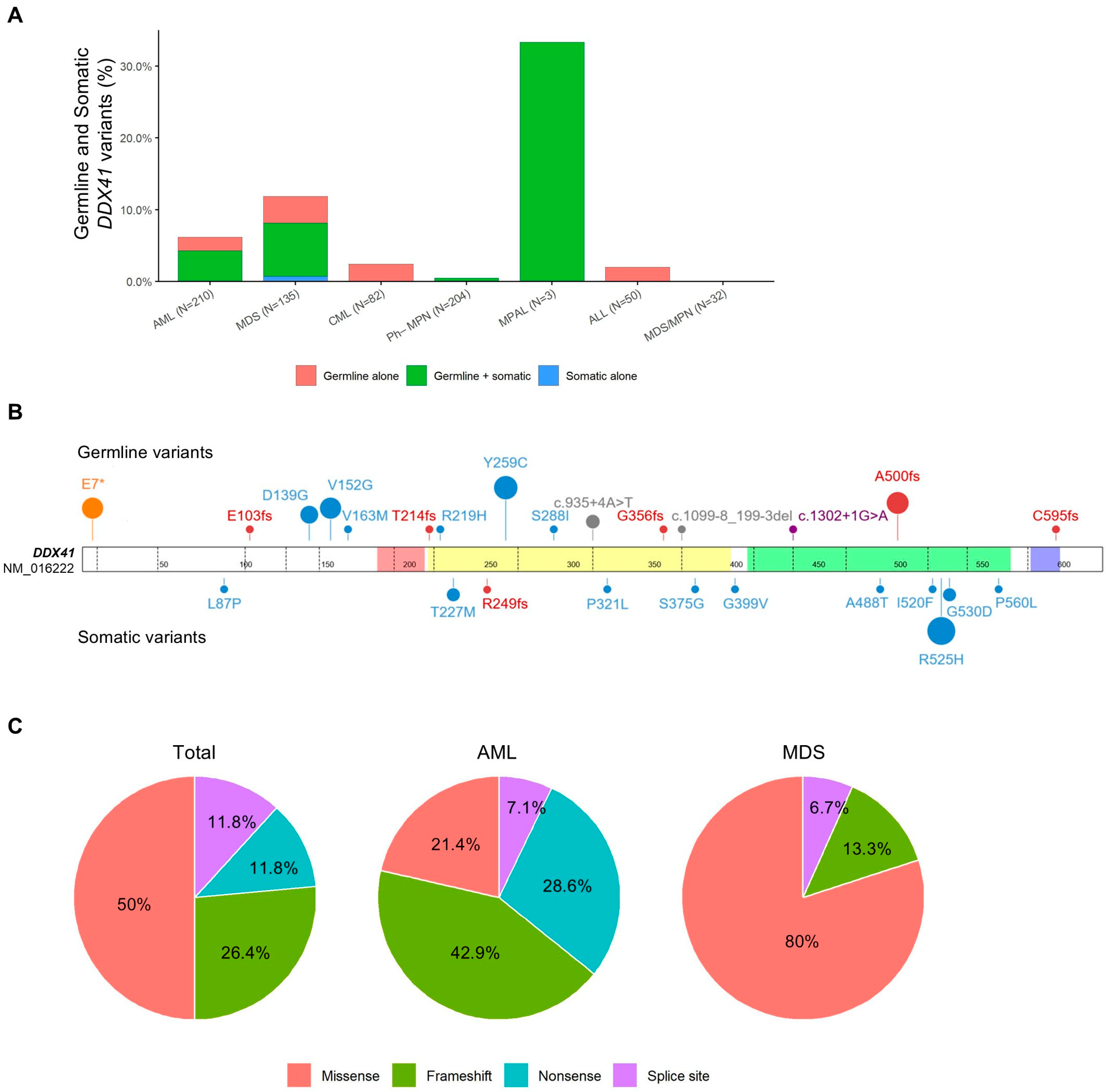
Figure 1. Frequency, distribution, and spectrum of DDX41 variants in hematologic malignancies. (A) Frequency of germline and somatic DDX41 variants by disease subtype. (B) Distribution of germline and somatic DDX41 variants identified in this study. Variants are color-coded according to their type: missense (blue), frameshift (red), nonsense (orange), and splice site variants (purple and gray). The relative size of the circles reflects the number of patients carrying each variant. Functional domains are color-coded as follows: Q-motif (pink), DEAD-BOX domain (light yellow), helicase domain (light green), and ZnF domain (light purple). (C) Proportion of germline DDX41 variant types in the total cohort, AML, and MDS patients.
Jcm 14 07999 g001
Figure 2. Spectrum and allele frequencies of non-DDX41 somatic variants according to somatic DDX41 variant status in AML and MDS patients with germline DDX41 variants. (A) Heatmap showing the distribution and variant allele frequencies (VAFs) of non-DDX41 somatic variants across individual cases, stratified by the presence or absence of somatic DDX41 variants and by disease category (AML vs. MDS). Each tile represents a detected variant, with color intensity indicating the corresponding VAF (%). (B) Empirical cumulative distribution function (ECDF) plots of non-DDX41 variant VAFs in AML (top) and MDS (bottom) patients, stratified by somatic DDX41 variant status.
Jcm 14 07999 g002
Figure 3. Survival analysis of patients with germline DDX41 variants. (A) Overall survival of patients with MDS with germline DDX41 variants (MDS-germline DDX41), AML with germline DDX41 variants (AML-germline DDX41), AML with normal karyotype (AML-NK), AML with myelodysplasia-related changes (AML-MR), and AML with TP53 mutations (AML-TP53). The overall survival differed significantly across groups (log-rank test, p < 0.001). Pairwise log-rank tests with Bonferroni correction showed significant differences between AML-TP53 and all other groups (p < 0.05), while other pairwise comparisons did not reach statistical significance. (B) Survival of patients with AML-germline DDX41 and MDS-germline DDX41 according to the presence or absence of concomitant somatic DDX41 variants.
Jcm 14 07999 g003
Table 1. Clinical and laboratory characteristics of AML and MDS patients with germline DDX41 variants.
CharacteristicsAML (N = 13)MDS (N = 15)p
Median age, yrs (range)68 (48–76)69 (50–86)0.406
Male, N (%)9 (69.2)11 (73.3)1.000
Median Hb, g/dL (range)8.3 (5.7–11.9)8.8 (5.6–11.5)0.747
Median WBC, ×109/L (range)1.72 (1.08–23.41)2.21 (0.97–31.2)0.213
Median PLT, ×109/L (range)47 (19–114)101.5 (34–404)0.025
Median BM blasts, % (range)30.0 (19.8–92.3)2.9 (0–18.0)<0.001
Median BM cellularity, % (range)20.0 (10–90)22.5 (15–100)0.950
Normal karyotype, N (%)10 (76.9)12 (80.0)1.000
Any somatic mutation, N (%)12 (92.3)15 (100.0)0.464
 Somatic DDX41 mutation9 (69.2)10 (66.7)1.000
 Other somatic mutation
 (excluding DDX41)
11 (84.6)11 (73.3)0.646
WHO classification, N (%)
 AML-MR9 (69.2)
 AML with KMT2A rearrangement1 (7.7)
 AML with NPM1 mutation1 (7.7)
 AML-NOS2 (15.4)
 MDS-LB 7 (46.7)
 MDS-LB-SF3B1 1 (6.7)
 MDS-del(5q) 1 (6.7)
 MDS-IB1 3 (20.0)
 MDS-IB2 3 (20.0)
Allogeneic HSCT, N (%)3 (23.1)3 (20.0)1.000
Death, N (%)6 (46.2)4 (26.7)0.433
Abbreviations: AML, acute myeloid leukemia; MDS, myelodysplastic neoplasm; yrs, years; Hb, hemoglobin; WBC, white blood cells; PLT, platelets; BM, bone marrow; WHO, world health organization; AML-MR, AML, myelodysplasia-related; AML-NOS, AML, not otherwise specified; MDS-LB, MDS with low blasts; MDS-LB-SF3B1, MDS with low blasts and SF3B1 mutation; MDS-del(5q), MDS with low blasts and isolated 5q deletion; MDS-IB, MDS with increased blasts; HSCT, hematopoietic stem cell transplantation.
Disclaimer/Publisher’s Note: The statements, opinions and data contained in all publications are solely those of the individual author(s) and contributor(s) and not of MDPI and/or the editor(s). MDPI and/or the editor(s) disclaim responsibility for any injury to people or property resulting from any ideas, methods, instructions or products referred to in the content.