Salivary Gland Sarcoidosis: Systematic Review of Case Reports and Case Series


Abstract
1. Introduction
2. Materials and Methods
2.1. Protocol and Registration
2.2. Search Strategy and Information Sources
2.3. Eligibility
2.4. Data Extraction
2.5. Study Quality Assessment
3. Results
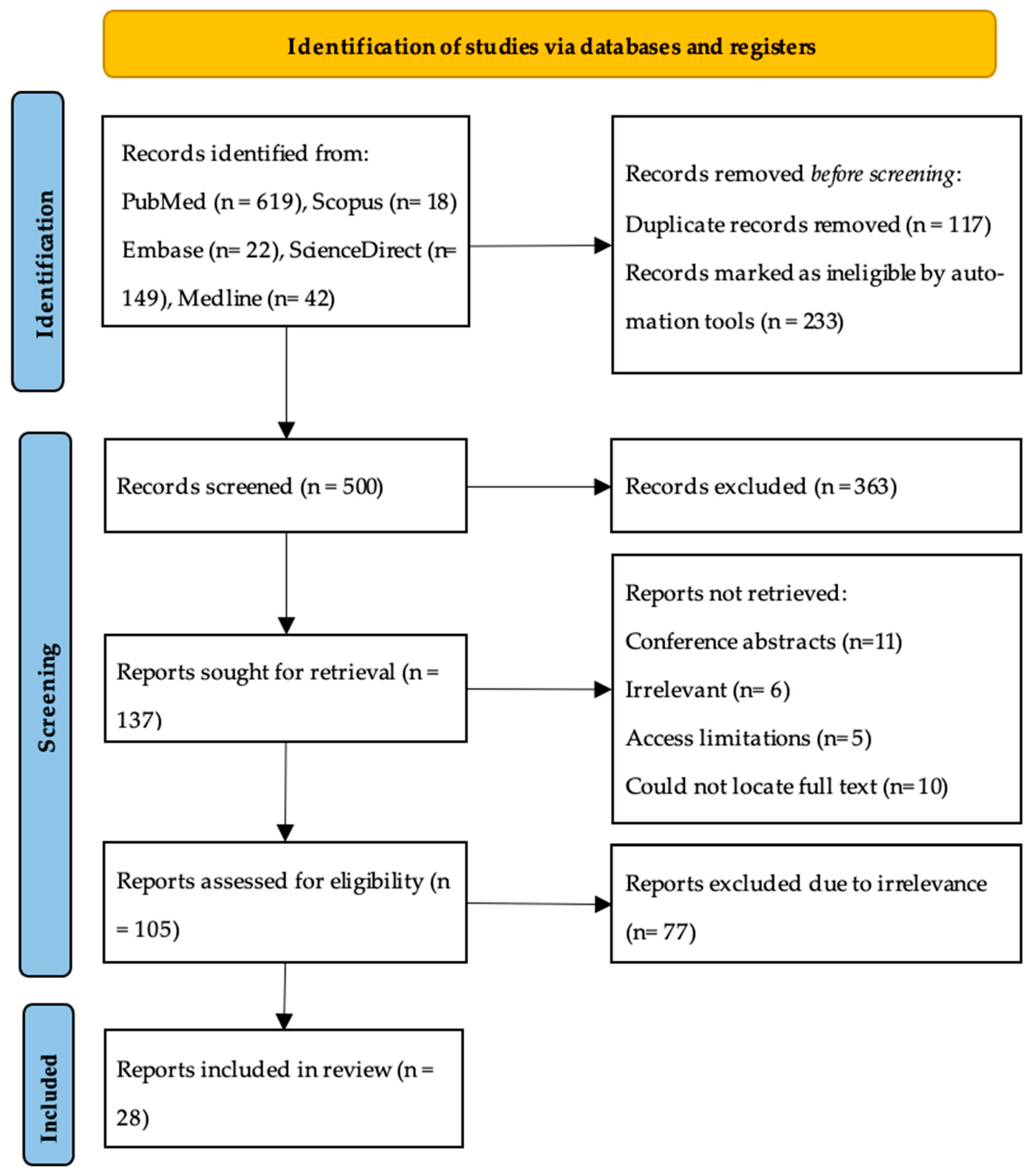
3.1. Literature Search
3.2. Study Characteristics
3.3. Study Quality Assessment
4. Discussion
5. Limitations
6. Conclusions
Author Contributions
Funding
Institutional Review Board Statement
Informed Consent Statement
Data Availability Statement
Acknowledgments
Conflicts of Interest
References
- Rossides, M.; Darlington, P.; Kullberg, S.; Arkema, E.V. Sarcoidosis: Epidemiology and Clinical Insights. J. Intern. Med. 2023, 293, 668–680. [Google Scholar] [CrossRef] [PubMed]
- Sikjær, M.G.; Hilberg, O.; Ibsen, R.; Løkke, A. Sarcoidosis: A Nationwide Registry-Based Study of Incidence, Prevalence and Diagnostic Work-Up. Respir. Med. 2021, 187, 106548. [Google Scholar] [CrossRef]
- Arkema, E.V.; Grunewald, J.; Kullberg, S.; Eklund, A.; Askling, J. Sarcoidosis Incidence and Prevalence: A Nationwide Register-Based Assessment in Sweden. Eur. Respir. J. 2016, 48, 1690–1699. [Google Scholar] [CrossRef]
- Salonen, J.; Kaarteenaho, R. National Retrospective Registry Survey on the Epidemiology of Sarcoidosis in Finland 2002–2022. BMJ Open Respir. Res. 2024, 11, e002461. [Google Scholar] [CrossRef]
- Yoon, H.Y.; Kim, H.M.; Kim, Y.J.; Song, J.W. Prevalence and Incidence of Sarcoidosis in Korea: A Nationwide Population-Based Study. Respir. Res. 2018, 19, 158. [Google Scholar] [CrossRef]
- Jeon, M.H.; Kang, T.; Yoo, S.H.; Swan, H.S.; Kim, H.J.; Ahn, H.S. The Incidence, Comorbidity and Mortality of Sarcoidosis in Korea, 2008–2015: A Nationwide Population-Based Study. Sarcoidosis Vasc. Diffus. Lung Dis. 2020, 37, 24–26. [Google Scholar] [CrossRef]
- Baughman, R.P.; Field, S.; Costabel, U.; Crystal, R.G.; Culver, D.A.; Drent, M.; Judson, M.A.; Wolff, G. Sarcoidosis in America: Analysis Based on Health Care Use. Ann. Am. Thorac. Soc. 2016, 13, 1244–1252. [Google Scholar] [CrossRef]
- Judson, M.A. The Clinical Features of Sarcoidosis: A Comprehensive Review. Clin. Rev. Allergy Immunol. 2015, 49, 63–78. [Google Scholar] [CrossRef]
- Sève, P.; Pacheco, Y.; Durupt, F.; Jamilloux, Y.; Gerfaud-Valentin, M.; Isaac, S.; Boussel, L.; Calender, A.; Androdias, G.; Valeyre, D.; et al. Sarcoidosis: A Clinical Overview from Symptoms to Diagnosis. Cells 2021, 10, 766. [Google Scholar] [CrossRef] [PubMed]
- Crouser, E.D.; Maier, L.A.; Wilson, K.C.; Bonham, C.A.; Morgenthau, A.S.; Patterson, K.C.; Abston, E.; Bernstein, R.C.; Blankstein, R.; Chen, E.S.; et al. Diagnosis and Detection of Sarcoidosis. An Official American Thoracic Society Clinical Practice Guideline. Am. J. Respir. Crit. Care Med. 2020, 201, e26–e51. [Google Scholar] [CrossRef] [PubMed]
- Chapman, M.N.; Fujita, A.; Sung, E.K.; Siegel, C.; Nadgir, R.N.; Saito, N.; Sakai, O. Sarcoidosis in the Head and Neck: An Illustrative Review of Clinical Presentations and Imaging Findings. AJR Am. J. Roentgenol. 2017, 208, 66–75. [Google Scholar] [CrossRef] [PubMed]
- Folwaczny, M.; Sommer, A.; Sander, C.A.; Kellner, H. Parotid Sarcoidosis Mimicking Sjögren’s Syndrome: Report of a Case. J. Oral Maxillofac. Surg. 2002, 60, 117–120. [Google Scholar] [CrossRef]
- Fatahzadeh, M.; Rinaggio, J. Diagnosis of Systemic Sarcoidosis Prompted by Orofacial Manifestations: A Review of the Literature. J. Am. Dent. Assoc. 2006, 137, 54–60. [Google Scholar] [CrossRef] [PubMed]
- Ahmad, Y.; Shahril, N.S.; Hussein, H.; Said, M.S. Case Review of Sarcoidosis Resembling Sjögren’s Syndrome. J. Clin. Med. Res. 2010, 2, 284–288. [Google Scholar] [CrossRef]
- Page, M.J.; McKenzie, J.E.; Bossuyt, P.M.; Boutron, I.; Hoffmann, T.C.; Mulrow, C.D.; Shamseer, L.; Tetzlaff, J.M.; Akl, E.A.; Brennan, S.E.; et al. The PRISMA 2020 Statement: An Updated Guideline for Reporting Systematic Reviews. BMJ 2021, 372, n71. [Google Scholar] [CrossRef] [PubMed]
- Hoggins, G.S.; Allan, D. Sarcoidosis of the Maxillary Region. Oral Surg. Oral Med. Oral Pathol. 1969, 28, 623–627. [Google Scholar] [CrossRef] [PubMed]
- Som, P.M.; Shugar, J.M.; Biller, H.F. Parotid Gland Sarcoidosis and the CT Sialogram. J. Comput. Assist. Tomogr. 1981, 5, 674–677. [Google Scholar] [CrossRef] [PubMed]
- Melsom, R.D.; Speight, P.M.; Ryan, J.; Perry, J.D. Sarcoidosis in a Patient Presenting with Clinical and Histological Features of Primary Sjögren’s Syndrome. Ann. Rheum. Dis. 1988, 47, 166–168. [Google Scholar] [CrossRef]
- Ohtsuka, S.; Yanadori, A.; Tabata, H.; Yamakage, A.; Yamazaki, S. Sarcoidosis with Giant Parotomegaly. Cutis 2001, 68, 199–200. [Google Scholar]
- Surattanont, F.; Mandel, L.; Wolinsky, B. Bilateral Parotid Swelling Caused by Sarcoidosis. J. Am. Dent. Assoc. 2002, 133, 738–741. [Google Scholar] [CrossRef] [PubMed]
- Sinha, R.; Gaur, S.N. Sarcoidosis Presenting as Acute Bilateral Parotid Swelling. Asian Pac. J. Allergy Immunol. 2004, 22, 171–174. [Google Scholar]
- Vairaktaris, E.; Vassiliou, S.; Yapijakis, C.; Papakosta, V.; Kavantzas, N.; Martis, C.; Patsouris, E. Salivary Gland Manifestations of Sarcoidosis: Report of Three Cases. J. Oral Maxillofac. Surg. 2005, 63, 1016–1021. [Google Scholar] [CrossRef]
- Yates, J.M.; Dickenson, A.J. Sarcoidosis Presenting as an Isolated Facial Swelling—An Unexpected Diagnosis? Dent. Update 2006, 33, 112–114. [Google Scholar] [CrossRef]
- McCormick, J.T.; Newton, E.D.; Geyer, S.; Caushaj, P.F. Sarcoidosis Presenting as a Solitary Parotid Mass. Ear Nose Throat J. 2006, 85, 664–665. [Google Scholar] [CrossRef]
- Rudralingam, M.; Nolan, A.; Macleod, I.; Greenwood, M.; Heath, N. A Case of Sarcoidosis Presenting with Diffuse, Bilateral Swelling of the Salivary Glands. Dent. Update 2007, 34, 439–442. [Google Scholar] [CrossRef]
- Poate, T.W.; Sharma, R.; Moutasim, K.A.; Escudier, M.P.; Warnakulasuriya, S. Orofacial Presentations of Sarcoidosis—A Case Series and Review of the Literature. Br. Dent. J. 2008, 205, 437–442. [Google Scholar] [CrossRef] [PubMed]
- Teymoortash, A.; Werner, J.A. Parotid Gland Involvement in Sarcoidosis: Sonographic Features. J. Clin. Ultrasound 2009, 37, 507–510. [Google Scholar] [CrossRef]
- Geraldes Filho, J.C.; Barbosa, H.S.; Souza, D.O.; Prates, A.A. Chronic Sialadenitis Caused by Sarcoidosis: A Case Report. Braz. J. Otorhinolaryngol. 2010, 76, 196. [Google Scholar] [CrossRef]
- Banks, G.C.; Kirse, D.J.; Anthony, E.; Bergman, S.; Shetty, A.K. Bilateral Parotitis as the Initial Presentation of Childhood Sarcoidosis. Am. J. Otolaryngol. 2013, 34, 142–144. [Google Scholar] [CrossRef] [PubMed]
- Lowe, J.; Whatley, B.; Kashani, S.; Howlett, D. A 22-Year-Old Woman with Bilateral Panuveitis and Parotid Swelling. BMJ 2015, 351, h4178. [Google Scholar] [CrossRef]
- Sharma, T.; Joshi, D.; Khurana, A.; Gupta, V.; Kapoor, N. Bilaterally Enlarged Parotids and Sicca Symptoms as a Presentation of Sarcoidosis: Pivotal Role of Aspiration Cytology in Diagnosis. J. Cytol. 2015, 32, 281–283. [Google Scholar] [CrossRef] [PubMed]
- Chappity, P.; Kumar, R.; Sahoo, A.K. Heerfordt’s Syndrome Presenting with Recurrent Facial Nerve Palsy: Case Report and 10-Year Literature Review. Sultan Qaboos Univ. Med. J. 2015, 15, e124–e128. [Google Scholar] [CrossRef]
- Lee, D.H.; Kim, J.H.; Lee, J.K. Isolated Parotid Gland Sarcoidosis Mimicking Parotid Tumor. J. Korean Med. Sci. 2016, 31, 644–645. [Google Scholar] [CrossRef]
- Broggi, G.; Reggio, E.; Giuliano, L.; Palmucci, S.; Caltabiano, R.; Lanzafame, S. Parotid Gland Involvement in Heerfordt Syndrome: A Case Report. Pathologica 2017, 109, 418–420. [Google Scholar]
- Assiri, K.; Al-Ahmari, M. Primary Parotid Gland Sarcoidosis—Case Report. Egypt. J. Hosp. Med. 2018, 72, 4593–4595. [Google Scholar] [CrossRef]
- Brown, J.R.; Thottam, P.J.; Poulik, J.; Haupert, M. Pediatric Sarcoidosis Presenting as Bilateral Parotid Swelling. Otolaryngol. Case Rep. 2017, 6, 19–21. [Google Scholar] [CrossRef]
- Diamantopoulos, P.T.; Charakopoulos, E.; Viniou, N.A.; Diamantopoulou, L.; Gaggadi, M. An Unusual Case Report of Unilateral Parotid Gland Sarcoidosis with Spontaneous Remission. Medicine 2019, 98, e18172. [Google Scholar] [CrossRef]
- Derbel, A.; Frikha, F.; Ghribi, M.; Salah, R.B.; Bahloul, Z. Bilateral Parotid Swelling: Don’t Forget Systemic Sarcoidosis! Ann. Clin. Cases 2021, 2, 1027. [Google Scholar]
- Abraham, S.M.; Faizal, B.; Mithun, C.B.; Smitha, N.V. Sarcoidosis Masquerading as Parotid Gland Disorder: A Unique Clinical Scenario. Kerala J. ENT Head Neck Surg. 2024, 2, 23–26. [Google Scholar]
- Vidović Juras, D.; Ivković, I.; Hećimović, A.; Gjadrov Kuveždić, K.; Andabak Rogulj, A.; Lončar Brzak, B.; Brailo, V.; Škrinjar, I.; Špiljak, B. Unusual Parotid Gland and Sublingual Mucosa Swelling in a 48-Year-Old Woman. Oral Surg. Oral Med. Oral Pathol. Oral Radiol. 2024, 138, 339–345. [Google Scholar] [CrossRef] [PubMed]
- Moola, S.; Munn, Z.; Tufanaru, C.; Aromataris, E.; Sears, K.; Sfetcu, R.; Currie, M.; Qureshi, R.; Mattis, P.; Lisy, K.; et al. Chapter 7: Systematic Reviews of Etiology and Risk. In JBI Manual for Evidence Synthesis; Aromataris, E., Munn, Z., Eds.; JBI: Adelaide, Australia, 2020. [Google Scholar] [CrossRef]
- Vourexakis, Z.; Dulguerov, P.; Bouayed, S.; Burkhardt, K.; Landis, B.N. Sarcoidosis of the Submandibular Gland: A Systematic Review. Am. J. Otolaryngol. 2010, 31, 424–428. [Google Scholar] [CrossRef]
- Ogle, O.E. Salivary Gland Diseases. Dent. Clin. N. Am. 2020, 64, 87–104. [Google Scholar] [CrossRef]
- Prasse, A. The Diagnosis, Differential Diagnosis, and Treatment of Sarcoidosis. Dtsch. Arztebl. Int. 2016, 113, 565–574. [Google Scholar] [CrossRef]
- Welter, S.M.; DeLuca-Johnson, J.; Thompson, K. Histologic Review of Sarcoidosis in a Neck Lymph Node. Head Neck Pathol. 2018, 12, 255–258. [Google Scholar] [CrossRef] [PubMed]
- Costabel, U.; Ohshimo, S.; Guzman, J. Diagnosis of Sarcoidosis. Curr. Opin. Pulm. Med. 2008, 14, 455–461. [Google Scholar] [CrossRef] [PubMed]
- Tana, C.; Donatiello, I.; Caputo, A.; Tana, M.; Naccarelli, T.; Mantini, C.; Ricci, F.; Ticinesi, A.; Meschi, T.; Cipollone, F.; et al. Clinical Features, Histopathology and Differential Diagnosis of Sarcoidosis. Cells 2022, 11, 59. [Google Scholar] [CrossRef]
- Dow, C.T.; Lin, N.W.; Chan, E.D. Sarcoidosis, Mycobacterium Paratuberculosis and Noncaseating Granulomas: Who Moved My Cheese. Microorganisms 2023, 11, 829. [Google Scholar] [CrossRef]
- van der Walt, J.D.; Leake, J. Granulomatous Sialadenitis of the Major Salivary Glands. A Clinicopathological Study of 57 Cases. Histopathology 1987, 11, 131–144. [Google Scholar] [CrossRef]
- Zheng, S.Y.; Du, X.; Dong, J.Z. Re-Evaluating Serum Angiotensin-Converting Enzyme in Sarcoidosis. Front. Immunol. 2023, 14, 950095. [Google Scholar] [CrossRef]
- Druyan, A.; Shuv, N.; Lidar, M. Put Down the ACE: Low Clinical Utility for Angiotensin-Converting Enzyme Levels in Sarcoidosis: A Single-Center Retrospective Cohort Study. J. Clin. Med. 2024, 13, 7657. [Google Scholar] [CrossRef] [PubMed]
- Shiboski, C.H.; Shiboski, S.C.; Seror, R.; Criswell, L.A.; Labetoulle, M.; Lietman, T.M.; Rasmussen, A.; Scofield, H.; Vitali, C.; Bowman, S.J.; et al. 2016 American College of Rheumatology/European League Against Rheumatism Classification Criteria for Primary Sjögren’s Syndrome: A Consensus and Data-Driven Methodology Involving Three International Patient Cohorts. Arthritis Rheumatol. 2017, 69, 35–45. [Google Scholar] [CrossRef] [PubMed]
- Umehara, H.; Okazaki, K.; Kawa, S.; Takahashi, H.; Goto, H.; Matsui, S.; Tsubouchi, H.; Tsuji, Y.; Kiyosawa, K.; Kawano, M.; et al. The 2020 revised comprehensive diagnostic (RCD) criteria for IgG4-RD. Mod. Rheumatol. 2021, 31, 529–533. [Google Scholar] [CrossRef] [PubMed]
- Brito-Zerón, P.; Pérez-Alvarez, R.; Pallarés, L.; Ramos-Casals, M. Sarcoidosis: An update on current pharmacotherapy options and future directions. Expert Opin. Pharmacother. 2016, 17, 2431–2448. [Google Scholar] [CrossRef] [PubMed]


| Parameter | Inclusion | Exclusion |
|---|---|---|
| Population | Patients diagnosed with sarcoidosis | Patients diagnosed with other salivary gland lesions |
| Exposure | Salivary gland sarcoidosis cases | Sarcoidosis in other parts of the body |
| Comparison | N/A | N/A |
| Outcome | Clinical features Diagnostic methods Treatment and outcome | Incomplete demographic, histopathological, and clinical details. |
| Study design | Case reports and case series Full-text availability English language only | Review articles, editorials, animal studies and conference abstracts Non-English language articles Duplicates that may introduce bias |
| Author/Year | Country | Age | Sex | Initial Symptoms | Duration (Months) | Location | ACE * Levels | Diagnosis | Treatment | Follow-Up and Outcome |
|---|---|---|---|---|---|---|---|---|---|---|
| Hoggins et al., 1969 [16] | UK | 45 | F | Firm and fleshy swelling involving left cheek and maxilla | 12 | Parotid | N/A | New | Surgical intervention + radiotherapy | 2 years Resolved |
| Som et al., 1981 [17] | US | 25 | F | Left parotid enlargement | N/A | Parotid | N/A | Pre-existing | Surgical intervention | N/A |
| 56 | M | Right parotid enlargement with facial palsy | N/A | Parotid | N/A | Pre-existing | Steroids | Resolved | ||
| 35 | F | Left parotid enlargement | N/A | Parotid | N/A | Pre-existing | Steroids | Resolved | ||
| 55 | F | Right parotid swelling | 144 | Parotid | N/A | New | Steroids | Resolved | ||
| Melsom et al., 1988 [18] | UK | 57 | F | Bilateral parotid swelling, dry mouth Difficulty chewing, swallowing, and speaking Malaise and tiredness, loss of weight | 9 | Parotid | Elevated | New | Steroids | Resolved |
| Ohtsuka et al., 2001 [19] | Japan | 63 | M | Painless and hard bilateral parotid and submaxillary node | 132 | Parotid | Decreased | New | Antibiotic | 3 months Resolved |
| Surattanont et al., 2002 [20] | US | 13 | F | Painless, firm symmetrical bilateral parotid swelling | 4 | Parotid Labial salivary glands | Elevated | New | Steroids | N/A |
| Folwaczny et al., 2002 [12] | Germany | 28 | F | Bilateral firm painless enlargement of parotid glands, dry mouth, and difficulty chewing | 0.5 (2 weeks) | Parotid | Elevated | New | None | N/A |
| Sinha and Gaur, 2004 [21] | India | 49 | F | Bilateral swelling at angles of the jaw, decreased salivation and loss of taste Low-grade fever, malaise and dry eyes | 0.3 (10 days) | Parotid | Elevated | New | Non-surgical intervention + steroids | 4 months Resolved |
| Vairaktaris et al., 2005 [22] | Greece | 72 | F | Xerostomia Painless parotid slow-growing enlargement unilateral | 2 | Parotid | N/A | New | Surgical intervention + steroids | 15 months Resolved |
| 68 | F | Enlarging lesion on left submandibular area, firm and immobile | 3 | Submandibular | N/A | New | Resection of mass + gland | 12 months Resolved | ||
| 66 | F | Painless submandibular swelling, gradual increase in size | 2 | Submandibular | N/A | New | Steroids | Reduction in swelling | ||
| Fatahzadeh and Rinaggio, 2006 [13] | USA | 47 | F | Severe xerostomia, burning tongue, and dysgeusia, dysphagia. Bilateral swelling. | 9 | Parotid Submandibular Minor salivary glands | Elevated | New | None | 7 months Spontaneous remission |
| Yates and Dickenson, 2006 [23] | UK | 39 | F | Palpable lesion in anterior lobe of right parotid gland | 1 | Parotid | Elevated | New | Steroids | Resolved |
| McCormick et al., 2006 [24] | USA | 51 | F | Right-sided neck mass posterior to the angle of the mandible, with discomfort Gradual increase in size | 1.5 | Parotid | N/A | New | Surgical intervention | Resolved |
| Rudralingam et al., 2007 [25] | UK | 50 | M | Dry mouth and dry eyes Bilateral parotid gland swelling | 12 | Parotid | Elevated | New | Steroids | 1 month Resolved |
| Poate et al., 2008 [26] | UK | 27 | M | Bilateral non-tender swelling of parotid glands, dryness of the mouth, fever, weight loss | 3 | Parotid | Elevated | New | Steroids | 3 months Resolved |
| 35 | F | Dry mouth and gritty eyes, fatigue | 24 | Labial minor salivary glands | Elevated | New | Steroids | 1 year Resolved | ||
| Teymoortash et al., 2009 [27] | Germany | Avg: 35 Rng: 30–46 | 5 M 1 F | 5 Bilateral enlargements 1 unilateral swelling 4 painful Firm, immobile mass | 0.7–1.4 (3–6 weeks) | Parotid | Elevated | 4 Pre-existing 2 New | Steroids | Resolved |
| Ahmad et al., 2010 [14] | Malaysia | 29 | M | Bilateral parotid enlargement, multiple cervical lymphadenopathies, pain while swallowing, malaise, low grade fever, night sweats and dry cough | 3 | Parotid | Normal | New | Steroids | 6 months Resolved |
| Geraldes Filho 2010 [28] | Brazil | 41 | M | Painless, firm bilateral enlargement of the parotid and submandibular gland | months | Submandibular and parotid | N/A | New | None | Spontaneous remission |
| Banks et al., 2013 [29] | USA | 13 | M | Painless bilateral parotid enlargement and mild bilateral, anterior cervical adenopathy | 1.2 (5 weeks) | Parotid | Normal | New | None | Spontaneous remission |
| Lowe et al., 2015 [30] | UK | 22 | F | Bilateral panuveitis and parotid enlargement Weight loss and fatigue | 3 | Parotid | N/A | New | Steroids | Resolved |
| Sharma et al., 2015 [31] | India | 54 | F | Swelling bilaterally, dryness of throat and eyes, and dry cough Decreased appetite and weight loss | 6 | Parotid | Elevated | New | Steroids | 6 months Resolved |
| Chappity et al., 2015 [32] | India | 52 | F | Bilateral facial palsy, swelling in left parotid region, fever | 24 | Parotid | Elevated | New | Steroids | 2 months Resolved |
| Lee et al., 2016 [33] | Korea | 49 | F | Right infra-auricular swelling | 0.7 (3 weeks) | Parotid | N/A | New | Surgical intervention | Resolved |
| Broggi et al., 2017 [34] | Italy | 60 | F | Fever, complete facial palsy, nonpainful enlargement of left parotid. Deviation of tongue and mouth to the left | 0.2 (1 week) | Parotid | Normal | New | Steroids | Resolved |
| Assiri and Al-Ahmari, 2018 [35] | Saudi Arabia | 44 | F | Painless right parotid swelling | 4 | Parotid | N/A | New | Surgical intervention | 1 year Resolved |
| Brown et al., 2018 [36] | USA | 5 | M | Firm, painful bilateral parotid swelling | 0.2 (7 days) | Parotid | Normal | New | Steroids | Resolved |
| Diamantopoulos et al., 2019 [37] | Greece | 28 | F | Painless hard parotid enlargement Facial palsy Malaise, low grade fever | 0.5 (15 days) | Parotid | Normal | New | None | 2 years Spontaneous remission |
| Derbel et al., 2021 [38] | Tunisia | 52 | F | Parotid enlargement, fever Dry mouth, dysphagia and dyspnea | 24 | Parotid | Elevated | New | Steroids | Recurred 7 years |
| Abraham et al., 2023 [39] | India | 40 | F | Bilateral parotid swelling, dry eyes and mouth | 24 | Parotid | Elevated | New | Steroids | 9 months Resolved |
| Juras et al., 2024 [40] | Croatia | 48 | F | Painless firm parotid swelling Right swelling sublingual and neck area xerostomia | 5 | Parotid Sublingual | Elevated | New | Steroids | 1 year Resolved |
| Total | 12 countries | Range: 5–72 Mean (SD): 42.7 (16.4) | 26 F 13 M | Swelling/enlargement: 32 Xerostomia: 13 Painless: 17 Fever: 7 Fatigue: 6 Pain: 6 Facial palsy: 4 | 0.2–144 | Parotid: 32 Multiple: 4 Submandibular: 2 Minor salivary glands: 1 | Elevated: 15 Normal: 5 Decrease: 1 | New: 32 Pre-existing: 7 | Non-surgical: 27 Surgical: 5 None: 5 Combination: 2 | Resolved: 31 Spontaneous remission: 4 Unclear: 3 Recurred: 1 |
| Author/Year | Demographic | History | Current Clinical Condition | Diagnostic Tests | Treatment Described | Post-Intervention Clinical Condition | Adverse Events | Takeaway Lessons | Overall Appraisal: |
|---|---|---|---|---|---|---|---|---|---|
| Hoggins et al., 1969 [16] | X | X | X | X | X | X | Moderate | ||
| Som et al., 1981 [17] | X | X | X | X | X | Moderate | |||
| Melsom et al., 1988 [18] | X | X | X | X | X | X | Moderate | ||
| Ohtsuka et al., 2001 [19] | X | X | X | X | X | X | X | High | |
| Surattanont et al., 2002 [20] | X | X | X | X | X | X | Moderate | ||
| Folwaczny et al., 2002 [12] | X | X | X | X | X | X | X | High | |
| Sinha and Gaur, 2004 [21] | X | X | X | X | X | X | X | High | |
| Vairaktaris et al., 2005 [22] | X | X | X | X | X | X | X | High | |
| Fatahzadeh and Rinaggio, 2006 [13] | X | X | X | X | X | Moderate | |||
| Yates and Dickenson, 2006 [23] | X | X | X | X | X | X | X | High | |
| McCormick et al., 2006 [24] | X | X | X | X | X | X | High | ||
| Rudralingam et al., 2007 [25] | X | X | X | X | X | X | X | High | |
| Poate et al., 2008 [26] | X | X | X | X | X | X | Moderate | ||
| Teymoortash et al., 2009 [27] | X | X | X | X | X | X | Moderate | ||
| Ahmad et al., 2010 [14] | X | X | X | X | X | X | Moderate | ||
| Geraldes Filho, 2010 [28] | X | X | X | X | X | X | Moderate | ||
| Banks et al., 2013 [29] | X | X | X | X | X | X | Moderate | ||
| Lowe et al., 2015 [30] | X | X | X | X | X | X | Moderate | ||
| Sharma et al., 2015 [31] | X | X | X | X | X | X | Moderate | ||
| Chappity et al., 2015 [32] | X | X | X | X | X | X | Moderate | ||
| Lee et al., 2016 [33] | X | X | X | X | X | X | X | High | |
| Broggi et al., 2017 [34] | X | X | X | X | X | X | Moderate | ||
| Assiri and Al-Ahmari, 2018 [35] | X | X | X | X | X | X | X | High | |
| Brown et al., 2018 [36] | X | X | X | X | X | X | X | High | |
| Diamantopoulos et al., 2019 [37] | X | X | X | X | X | X | Moderate | ||
| Derbel et al., 2021 [38] | X | X | X | X | X | X | X | High | |
| Abraham et al., 2023 [39] | X | X | X | X | X | X | Moderate | ||
| Juras et al., 2024 [40] | X | X | X | X | X | X | Moderate |
| Feature | Salivary Gland Sarcoidosis | Sjögren’s Syndrome (SS) | IgG4-Related Disease (IgG4-RD) |
|---|---|---|---|
| Key Histopathology | Non-caseating granulomas (epithelioid histiocytes, giant cells) [47,48,49]. | Focal lymphocytic sialadenitis (foci per 4 mm2) [54]. | Storiform fibrosis, obliterative phlebitis, dense lymphoplasmacytic infiltrate with >10 IgG4+ plasma cells/HPF and >40% IgG4+/IgG+ ratio [54]. |
| Serologic Markers | Serum ACE (elevated in ~41–78% of systemic cases; (limited sensitivity) [52,53]. | Anti-SSA/Ro and anti-SSB/La antibodies (highly specific) [54]. | Elevated serum IgG4 (in ~60–70% of cases) [54]. |
| Glandular Symptoms | Painless or painful swelling; xerostomia common. | Sicca symptoms (dry mouth, dry eyes); glandular swelling. | Firm, painless glandular enlargement (e.g., submandibular glands often affected) [54]. |
| Characteristic Extraglandular Manifestations | Heerfordt’s syndrome (uveitis, parotitis, fever, facial palsy) [34,36], pulmonary involvement, Löfgren’s syndrome [1,9]. | Arthralgia/arthritis, Raynaud’s phenomenon, fatigue, cutaneous vasculitis [54]. | Autoimmune pancreatitis, retroperitoneal fibrosis, sclerosing cholangitis, Riedel’s thyroiditis [54]. |
| Typical Course and Prognosis | Often self-limiting; excellent response to corticosteroids [1,8,11]. | Chronic, progressive autoimmune disorder [54]. | Chronic, fibro-inflammatory; good response to corticosteroids but relapses common [54]. |
| Diagnostic Approach | Biopsy is gold standard. Imaging (e.g., CXR/CT for systemic involvement) [11,46]. | ACR/EULAR classification criteria (serology, ocular/staining, histology) [54]. | Comprehensive diagnostic criteria (histology, serology, imaging of characteristic organ involvement) [54]. |
Disclaimer/Publisher’s Note: The statements, opinions and data contained in all publications are solely those of the individual author(s) and contributor(s) and not of MDPI and/or the editor(s). MDPI and/or the editor(s) disclaim responsibility for any injury to people or property resulting from any ideas, methods, instructions or products referred to in the content. |
© 2025 by the authors. Licensee MDPI, Basel, Switzerland. This article is an open access article distributed under the terms and conditions of the Creative Commons Attribution (CC BY) license (https://creativecommons.org/licenses/by/4.0/).
Share and Cite
Abouseif, N.; Jaber, M.; Abdelsayed, R.B. Salivary Gland Sarcoidosis: Systematic Review of Case Reports and Case Series. J. Clin. Med. 2025, 14, 7539. https://doi.org/10.3390/jcm14217539
Abouseif N, Jaber M, Abdelsayed RB. Salivary Gland Sarcoidosis: Systematic Review of Case Reports and Case Series. Journal of Clinical Medicine. 2025; 14(21):7539. https://doi.org/10.3390/jcm14217539
Chicago/Turabian StyleAbouseif, Nadin, Mohamed Jaber, and Reem B. Abdelsayed. 2025. "Salivary Gland Sarcoidosis: Systematic Review of Case Reports and Case Series" Journal of Clinical Medicine 14, no. 21: 7539. https://doi.org/10.3390/jcm14217539
APA StyleAbouseif, N., Jaber, M., & Abdelsayed, R. B. (2025). Salivary Gland Sarcoidosis: Systematic Review of Case Reports and Case Series. Journal of Clinical Medicine, 14(21), 7539. https://doi.org/10.3390/jcm14217539