Behavioural Interventions to Treat Oropharyngeal Dysphagia in Children with Cerebral Palsy: A Systematic Review of Randomised Controlled Trials

 , and
, and
Abstract
1. Introduction
2. Materials and Methods
2.1. Information Sources
2.2. Search Strategy
2.3. Inclusion and Exclusion Criteria
2.4. Data Collection Process
2.5. Data, Items, and Synthesis of Results
3. Results
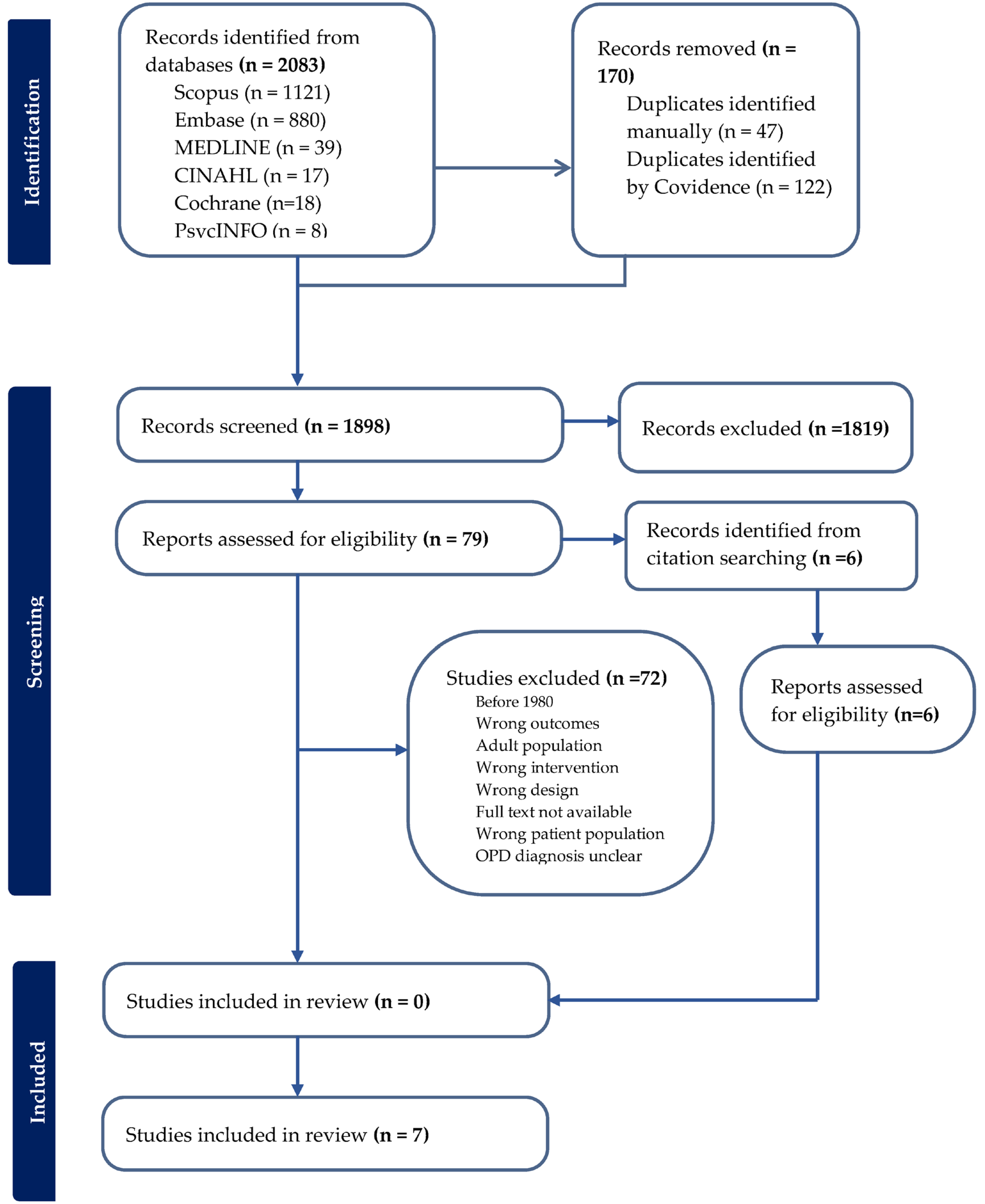
3.1. Study Selection
3.2. Description of Studies
3.2.1. Participants (See Table 1)
3.2.2. Outcomes and Outcome Measures (See Table 1 and Table 2)
3.2.3. Behavioural Intervention Groups (Table 1)
3.2.4. Interventions and Treatment Components (Table 2)
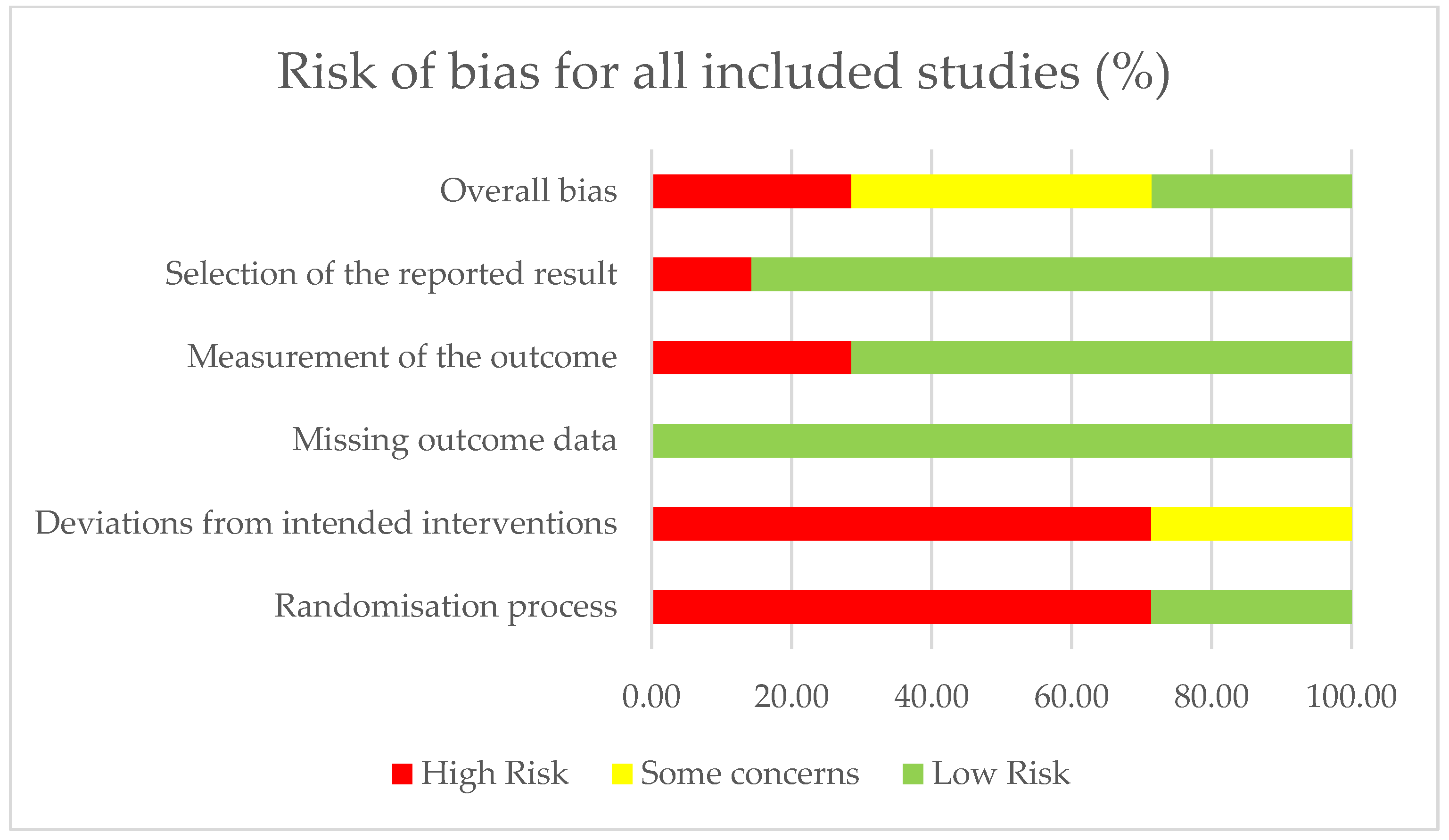
3.3. Methodological Quality
4. Discussion
4.1. Lack of Robust RCTs
4.2. Progress in the Research Field of OPD in CP
4.3. What Are the Important Elements of a Behavioural Intervention in the Treatment of OPD in CP?
4.4. Strengths and Limitations
5. Conclusions
Author Contributions
Funding
Institutional Review Board Statement
Informed Consent Statement
Data Availability Statement
Acknowledgments
Conflicts of Interest
Abbreviations
| AOT | Action Observation Training |
| babiEAT | baby intensive Early active Treatment |
| BPFAS | Behavioural Pediatrics Feeding Assessment Scale |
| CP | Cerebral Palsy |
| DSFS | Drooling Severity and Frequency Scale |
| FIPQ | Feeding Intervention Preferences Questionnaire |
| FOIS | Functional Oral Intake Scale |
| FOISi | Functional Oral Intake scale for Infants |
| FOMS | Feeding Oral Motor Scale |
| FS-IS | Feeding and Swallowing Impact Survey |
| FSIS | Feeding Swallowing Impact Scale |
| FuCT | Functional Chewing Training |
| GAS | Goal Attainment Scale |
| GMFM-88 | Gross Motor Function Measure-88 |
| IDDSI | International Dysphagia Diet Standardisation Initiative |
| ICF-CY | International Classification of Functioning-Children and Youth |
| KCPS | Karaduman Chewing Performance Scale |
| NCRT | Nutrition Related Caregiver Training |
| NDT-B | Neurodevelopmental Therapy Method-Bobath |
| OM | Oral Motor |
| OMAS | Oral Motor Assessment Scale |
| OMIS | Oral Motor Intervention Strategies |
| OMT | Oral Motor Therapy |
| OPD | Oropharyngeal Dysphagia |
| OSMS | Oral Sensorimotor Stimulation |
| Pedi-Eat | Pediatric Eating Assessment Tool, |
| PedsQL | Pediatric Quality of Life Inventory |
| PT | Physiotherapist |
| QoL | Quality of Life |
| SATCo | Segmental Assessment of Trunk Control |
| SLP | Speech-Language Pathologist |
| SLT | Speech and Language Therapist |
| SOMA | Schedule for Oral Motor Assessment |
| TIS | Trunk Impairment Scale |
References
- Dan, B.; Rosenbaum, P.; Carr, L.; Gough, M.; Coughlan, J.; Nweke, N. Proposed updated description of cerebral palsy. Dev. Med. Child Neurol. 2025, 67, 700–709. [Google Scholar] [CrossRef]
- McIntyre, S.; Goldsmith, S.; Webb, A.; Ehlinger, V.; Hollung, S.J.; McConnell, K.; Arnaud, C.; Smithers-Sheedy, H.; Oskoui, M.; Khandaker, G.; et al. Global CP Prevalence Group. Global prevalence of cerebral palsy: A systematic analysis. Dev. Med. Child Neurol. 2022, 64, 1494–1506. [Google Scholar] [CrossRef]
- Rosenbaum, P.; Paneth, N.; Leviton, A.; Goldstein, M.; Bax, M.; Damiano, D.; Dan, B.; Jacobsson, B. A report: The definition and classification of cerebral palsy. Dev. Med. Child Neurol. 2007, 109, 8–14. [Google Scholar] [CrossRef]
- Cans, C.; Dolk, H.; Platt, M.J.; Colver, A.; Prasauskiene, A.; Krageloh-Mann, I.; SCPE Collaborative Group. Recommendations from the SCPE collaborative group for defining and classifying cerebral palsy. Dev. Med. Child Neurol. 2007, 109, 35–38. [Google Scholar] [CrossRef]
- Surveillance of Cerebral Palsy in Europe. Surveillance of cerebral palsy in Europe: A collaboration of cerebral palsy surveys and registers. Dev. Med. Child Neurol. 2000, 42, 816–824. [Google Scholar] [CrossRef]
- Sadowska, M.; Sarecka-Hujar, B.; Kopyta, I. Cerebral Palsy: Current Opinions on Definition, Epidemiology, Risk Factors, Classification and Treatment Options. Neuropsychiatr. Dis. Treat. 2020, 16, 1505–1518. [Google Scholar] [CrossRef]
- Speyer, R.; Cordier, R.; Kim, J.H.; Cocks, N.; Michou, E.; Wilkes-Gillan, S. Prevalence of drooling, swallowing, and feeding problems in cerebral palsy across the lifespan: A systematic review and meta-analyses. Dev. Med. Child Neurol. 2019, 61, 1249–1258. [Google Scholar] [CrossRef] [PubMed]
- Reilly, S.; Skuse, D.; Poblete, X. Prevalence of feeding problems and oral motor dysfunction in children with cerebral palsy: A community survey. J. Pediatr. 1996, 129, 877–882. [Google Scholar] [CrossRef]
- Taylor, T.; Kozlowski, A.M.; Girolami, P.A. Comparing behavioral treatment of feeding difficulties and tube dependence in children with cerebral palsy and autism spectrum disorder. NeuroRehabilitation 2017, 41, 395–402. [Google Scholar] [CrossRef]
- Benfer, K.A.; Weir, K.A.; Bell, K.L.; Ware, R.S.; Davies, P.S.; Boyd, R.N. Oropharyngeal dysphagia in preschool children with cerebral palsy: Oral phase impairments. Res. Dev. Disabil. 2014, 35, 3469–3481. [Google Scholar] [CrossRef] [PubMed]
- Gisel, E.G.; Tessier, M.J.; Lapierre, G.; Seldman, E.; Drouin, E.; Filion, G. Feeding management of children with severe cerebral palsy and eating impairment: An exploratory study. J. Pediatr. Gastroenterol. Nutr. 2003, 37, 456–462. [Google Scholar]
- Panara, K.; Ramezanpour, A.E.; Padalia, D. Physiology, Swallowing. In StatPearls [Internet]; StatPearls Publishing: Treasure Island, FL, USA, 2023. [Google Scholar]
- Matsuo, K.; Palmer, J.B. Anatomy and physiology of feeding and swallowing: Normal and abnormal. Phys. Med. Rehabil. Clin. N. Am. 2008, 19, 691–707. [Google Scholar] [CrossRef]
- Gisel, E.G.; Applegate-Ferrante, T.; Benson, J.E.; Bosma, J.F. Oral-motor skills following sensorimotor therapy in two groups of moderately dysphagic children with cerebral palsy: Aspiration vs nonaspiration. J. Pediatr. Gastroenterol. Nutr. 1996, 23, 345–354. [Google Scholar] [CrossRef]
- Sullivan, P.B. Gastrointestinal disorders in children with neurodevelopmental disabilities. Hosp. Pediatr. 2015, 5, 357–364. [Google Scholar] [CrossRef]
- Arnaud, C.; Haak, P.; Himmelmann, K.; Krägeloh-Mann, I. Feeding-related challenges in children with cerebral palsy: Dysphagia, masticatory inefficiency, and malnutrition. J. Pediatr. Gastroenterol. Nutr. 2023, 76, 45–52. [Google Scholar]
- Arvedson, J.C.; Brodsky, L.; Lefton-Greif, M.A. (Eds.) Pediatric Swallowing and Feeding: Assessment and Management, 3rd ed.; Plural Publishing: San Diego, CA, USA, 2020. [Google Scholar]
- Arvedson, J.C. Feeding children with cerebral palsy and swallowing difficulties. Ital. J. Pediatr. 2013, 39, 1–7. [Google Scholar] [CrossRef] [PubMed]
- Groher, M.E.; Crary, M.A. (Eds.) Dysphagia: Clinical Management in Adults and Children, 2nd ed.; Elsevier: Amsterdam, The Netherlands, 2016. [Google Scholar]
- Arvedson, J.; Clark, H.; Lazarus, C.; Schooling, T.; Frymark, T. The effects of oral-motor exercises on swallowing in children: An evidence-based systematic review. Dev. Med. Child Neurol. 2010, 52, 1000–1013. [Google Scholar] [CrossRef] [PubMed]
- Snider, L.; Majnemer, A.; Darsaklis, V. Feeding Interventions for Children with Cerebral Palsy: A Review of the Evidence. Phys. Occup. Ther. Pediatr. 2011, 31, 58–77. [Google Scholar] [CrossRef]
- Miltenberger, R.G. Behavior Modification: Principles and Procedures, 6th ed.; Wadsworth Cengage Learning: Boston, MA, USA, 2012. [Google Scholar]
- Khamis, A.; Novak, I.; Morgan, C.; Tzannes, G.; Pettigrew, J.; Cowell, J.; Badawi, N. Motor Learning Feeding Interventions for Infants at Risk of Cerebral Palsy: A Systematic Review. Dysphagia 2020, 35, 1–17. [Google Scholar] [CrossRef]
- Khamis, A. Innovative Evidence-Based Assessment and Treatment of Oropharyngeal Dysphagia and Communication Disorders in Infants and Young Children at High Risk of Cerebral Palsy. Ph.D. Thesis, The University of Sydney, Camperdown, NSW, Australia, 2020. [Google Scholar]
- Fucile, S.; McFarland, D.H.; Gisel, E.G.; Lau, C. Oral and nonoral sensorimotor interventions facilitate suck-swallow-respiration functions and their coordination in preterm infants. Early Hum. Development. 2012, 88, 345–350. [Google Scholar] [CrossRef]
- Greene, Z.; O’Donnell, C.P.; Walshe, M. Oral stimulation for promoting oral feeding in preterm infants. Cochrane Database Syst. Rev. 2016, 9, CD009720. [Google Scholar] [CrossRef] [PubMed]
- Reche-Olmedo, L.; Torres-Collado, L.; Compañ-Gabucio, L.M.; Garcia-de-la-Hera, M. The Role of Occupational Therapy in Managing Food Selectivity of Children with Autism Spectrum Disorder: A Scoping Review. Children 2021, 8, 1024. [Google Scholar] [CrossRef]
- Arvedson, J.C.; Brodsky, L. (Eds.) Pediatric Swallowing and Feeding: Assessment and Management; Whurr: London, UK, 1993. [Google Scholar]
- Van den Engel-Hoek, L.; Harding, C.; van Gerven, M.; Cockerill, H. Pediatric feeding and swallowing rehabilitation: An overview. J. Pediatr. Rehabil. Med. 2017, 10, 95–105. [Google Scholar] [CrossRef] [PubMed]
- World Health Organization (WHO). ICF: International Classification of Functioning, Disability and Health; World Health Organization: Geneva, Switzerland, 2001. [Google Scholar]
- World Health Organization (WHO). International Classification of Functioning, Disability and Health: Children and Youth Version: ICF-CY; World Health Organization: Geneva, Switzerland, 2007. [Google Scholar]
- Page, M.; McKenzie, J.; Bossuyt, P.; Boutron, I.; Hoffmann, T.; Mulrow, C.; Shamseer, L.; Tetzlaff, J.; Akl, E.; Brennan, S.; et al. The PRISMA 2020 statement: An updated guideline for reporting systematic reviews. J. Clin. Epidemiol. 2021, 134, 178–189. [Google Scholar] [CrossRef] [PubMed]
- Frandsen, T.F.; Nielsen, M.F.B.; Lindhard, C.L.; Eriksen, M.B. Using the full PICO model as a search tool for systematic reviews resulted in lower recall for some PICO elements. J. Clin. Epidemiol. 2020, 127, 69–75. [Google Scholar] [CrossRef]
- Turkstra, L.S.; Norman, R.; Whyte, J.; Dijkers, M.P.; Hart, T. Knowing What We’re Doing: Why Specification of Treatment Methods Is Critical for Evidence-Based Practice in Speech-Language Pathology. Am. J. Speech Lang. Pathol. 2016, 25, 164–171. [Google Scholar] [CrossRef]
- Hart, T.; Tsaousides, T.; Zanca, J.M.; Whyte, J.; Packel, A.; Ferraro, M.; Dijkers, M.P. Toward a theory-driven classification of rehabilitation treatments. Arch. Phys. Med. Rehabil. 2014, 95 (Suppl. 1), S33–S44.e32. [Google Scholar] [CrossRef]
- Sterne, J.A.C.; Savović, J.; Page, M.J.; Elbers, R.G.; Blencowe, N.S.; Boutron, I.; Cates, C.J.; Cheng, H.Y.; Corbett, M.S.; Eldridge, S.M.; et al. RoB 2: A revised tool for assessing risk of bias in randomised trials. BMJ 2019, 366, l4898. [Google Scholar] [CrossRef]
- Abd-Elmonem, A.M.; Saad-Eldien, S.S.; Abd El-Nable, W.A. Effect of oral sensorimotor stimulation on oropharyngeal dysphagia in children with spastic cerebral palsy: A randomized controlled trial. Eur. J. Phys. Rehabil. Med. 2021, 57, 912–922. [Google Scholar] [CrossRef]
- Acar, G.; Ejraei, N.; Turkdoğan, D.; Enver, N.; Öztürk, G.; Aktaş, G. The Effects of Neurodevelopmental Therapy on Feeding and Swallowing Activities in Children with Cerebral Palsy. Dysphagia 2022, 37, 800–811. [Google Scholar] [CrossRef]
- Akaltun, M.S.; Umay, E.; Altindag, O.; Karaahmet, O.Z. Effectiveness of kinesiotape and sham kinesiotape application in children with cerebral palsy with dysphagia: A randomized controlled study. Turk. J. Phys. Med. Rehabil. 2023, 69, 434–443. [Google Scholar] [CrossRef]
- Khamis, A.; Badawi, N.; Morgan, C.; Novak, I. Baby Intensive Early Active Treatment (babiEAT): A Pilot Randomised Controlled Trial of Feeding Therapy for Infants with Cerebral Palsy and Oropharyngeal Dysphagia. J. Clin. Med. 2023, 12, 2677. [Google Scholar] [CrossRef]
- Manzoor, M.; Butt, G.A.; Nasir, M.; Hassan, F. Effects of oral motor therapy in children with cerebral palsy: A randomized controlled trial. J. Popul. Ther. Clin. Pharmacol. 2024, 31, 1273–1280. [Google Scholar]
- Mokhlesin, M.; Yadegari, F.; Noroozi, M.; Ravarian, A.; Ghoreishi, Z.S. Effect of action observation training on the oral phase of swallowing in children with cerebral palsy: A pilot randomized controlled trial. Logoped Phoniatr. Vocol. 2024, 49, 188–196. [Google Scholar] [CrossRef] [PubMed]
- Serel Aslan, S.; Demir, N.; Karaduman, A.A. Effect of a new treatment protocol called Functional Chewing Training on chewing function in children with cerebral palsy: A double-blind randomised controlled trial. J. Oral. Rehabil. 2017, 44, 43–50. [Google Scholar] [CrossRef] [PubMed]
- Allen, S.L.; Smith, I.M.; Duku, E.; Vaillancourt, T.; Szatmari, P.; Bryson, S.; Fombonne, E.; Volden, J.; Waddell, C.; Zwaigenbaum, L.; et al. Behavioral Pediatrics Feeding Assessment Scale in Young Children with Autism Spectrum Disorder: Psychometrics and Associations With Child and Parent Variables. J. Pediatr. Psychol. 2015, 40, 581–590. [Google Scholar] [CrossRef]
- Butler, P.; Saavedra, M.S.; Sofranac, M.M.; Jarvis, M.S.; Woollacott, M. Refinement, reliability and validity of the segmental assessment of trunk control (SATCo). Pediatr. Phys. Ther. 2010, 22, 246. [Google Scholar] [CrossRef]
- Cichero, J.A.Y. Evaluating chewing function: Expanding the dysphagia field using food oral processing and the IDDSI framework. J. Texture Stud. 2020, 51, 56–66. [Google Scholar] [CrossRef]
- Crary, M.A.; Mann, G.D.; Groher, M.E. Initial psychometric assessment of a functional oral intake scale for dysphagia in stroke patients. Arch. Phys. Med. Rehabil. 2005, 86, 1516–1520. [Google Scholar] [CrossRef]
- Cusick, A.; McIntyre, S.; Novak, I.; Lannin, N.; Lowe, K. A comparison of goal attainment scaling and the Canadian Occupational Performance Measure for paediatric rehabilitation research. Pediatr. Rehabil. 2006, 9, 149–157. [Google Scholar] [CrossRef]
- De Oliveira Lisa Ortega, A.; Ciamponi, A.L.; Mendes, F.M.; Santos, M.T. Assessment scale of the oral motor performance of children and adolescents with neurological damages. J. Oral Rehabil. 2009, 36, 653–659. [Google Scholar] [CrossRef]
- Lefton-Greif, M.A.; Okelo, S.O.; Wright, J.M.; Collaco, J.M.; McGrath-Morrow, S.A.; Eakin, M.N. Impact of children’s feeding/swallowing problems: Validation of a new caregiver instrument. Dysphagia 2014, 29, 671–677. [Google Scholar] [CrossRef]
- Russell, D.J.; Rosenbaum, P.L.; Avery, L.M.; Lane, M. Gross Motor Function Measure (GMFM-66 & GMFM-88) User’s Manual; Mac Keith Press: London, UK, 2002. [Google Scholar]
- Serel Arslan, S.; Aydın, G.; Alemdaroğlu, I.; Tunca Yılmaz, Ö.; Karaduman, A.A. Reliability and validity of the Karaduman Chewing Performance Scale in paediatric neuromuscular diseases: A system for classification of chewing disorders. J. Oral Rehabil. 2018, 45, 526–531. [Google Scholar] [CrossRef] [PubMed]
- Skuse, D.; Stevenson, J.; Reilly, S.; Mathisen, B. Schedule for Oral-Motor Assessment (SOMA): Methods of Validation. Dysphagia 1995, 10, 192–202. [Google Scholar] [CrossRef] [PubMed]
- Thomas-Stonell, N.; Greenberg, J. Three treatment approaches and clinical factors in the reduction of drooling. Dysphagia 1988, 3, 75. [Google Scholar] [CrossRef] [PubMed]
- Thoyre, S.; Pados, B.; Park, J.; Estrem, H.; Hodges, E.; McComish, C.; Van Riper, M.; Murdoch, K. Development and content validation of the Pediatric Eating Assessment Tool (Pedi-EAT). Am. J. Speech Lang. Pathol. 2014, 23, 46–59. [Google Scholar] [CrossRef]
- Varni, J.W.; Seid, M.; Kurtin, P.S. PedsQL 4.0: Reliability and validity of the Pediatric Quality of Life Inventory version 4.0 generic core scales in healthy and patient populations. Med. Care 2001, 39, 800–812. [Google Scholar] [CrossRef]
- Verheyden, G.; Nieuwboer, A.; Mertin, J.; Preger, R.; Kiekens, C.; De Weerdt, W. The Trunk Impairment Scale: A new tool to measure motor impairment of the trunk after stroke. Clin. Rehabil. 2004, 18, 326–334. [Google Scholar] [CrossRef]
- Sellers, D.; Mandy, A.; Pennington, L.; Hankins, M.; Morris, C. Development and reliability of a system to classify the eating and drinking ability of people with cerebral palsy. Dev. Med. Child Neurol. 2014, 56, 245–251. [Google Scholar] [CrossRef]
- Valentine, J.C.; Pigott, T.D.; Rothstein, H.R. How many studies do you need? A primer on statistical power for meta-analysis. J. Educ. Behav. Stat. 2010, 35, 215–247. [Google Scholar] [CrossRef]
- Tawfik, G.M.; Dila, K.A.S.; Mohamed, M.Y.F.; Tam, D.N.H.; Kien, N.D.; Ahmed, A.M.; Huy, N.T. A step by step guide for conducting a systematic review and meta-analysis with simulation data. Trop. Med. Health 2019, 47, 46. [Google Scholar] [CrossRef]
- Higgins, J.P.T.; Altman, D.G.; Gøtzsche, P.C.; Jüni, P.; Moher, D.; Oxman, A.D.; Savović, J.; Schulz, K.F.; Weeks, L.; Sterne, J.A.C. The Cochrane Collaboration’s tool for assessing risk of bias in randomised trials. BMJ 2011, 343, d5928. [Google Scholar] [CrossRef] [PubMed]
- Susukida, R.; Crum, R.M.; Ebnesajjad, C.; Stuart, E.A.; Mojtabai, R. Generalizability of findings from randomized controlled trials: Application to the National Institute of Drug Abuse Clinical Trials Network. Addiction 2017, 112, 1210–1219. [Google Scholar] [CrossRef] [PubMed]
- Chess, L.E.; Gagnier, J.J. Applicable or non-applicable: Investigations of clinical heterogeneity in systematic reviews. BMC Med. Res. Methodol. 2016, 16, 19. [Google Scholar] [CrossRef] [PubMed]
- Bhide, A.; Shah, P.S.; Acharya, G. A simplified guide to randomized controlled trials. Acta Obstet. Gynecol. Scand. 2018, 97, 380–387. [Google Scholar] [CrossRef]
- Moore, G.F.; Audrey, S.; Barker, M.; Bond, L.; Bonell, C.; Hardeman, W.; Moore, L.; O’Cathain, A.; Tinati, T.; Wight, D.; et al. Process evaluation of complex interventions: Medical Research Council guidance. BMJ 2015, 350, 1258. [Google Scholar] [CrossRef]
- Ellefson, M.R.; Oppenheimer, D.M. Is replication possible without fidelity? Psychol. Methods 2022, 28, 1446–1455. [Google Scholar] [CrossRef]
- Riddle, D.L.; Stratford, P.W.; Bowman, D.H. Findings of extensive variation in the types of outcome measures used in hip and knee replacement clinical trials: A systematic review. Arthritis Rheum. 2008, 59, 876–883. [Google Scholar] [CrossRef]
- Wood, L.; Egger, M.; Gluud, L.L.; Schulz, K.F.; Jüni, P.; Altman, D.G.; Gluud, C.; Martin, R.M.; Wood, A.J.; Sterne, J.A. Empirical evidence of bias in treatment effect estimates in controlled trials with different interventions and outcomes: Meta-epidemiological study. BMJ 2008, 336, 601–605. [Google Scholar] [CrossRef]
- Gitlin, L.N. Behavioral Intervention Research: Designing, Evaluating, and Implementing; Springer Publishing Company: New York, NY, USA, 2016. [Google Scholar]
- Tolin, D.F.; McKay, D.; Olatunji, B.O.; Abramowitz, J.S.; Otto, M.W. On the importance of identifying mechanisms and active ingredients of psychological treatments. Behav. Res. Ther. 2023, 170, 104425. [Google Scholar] [CrossRef]
- Tenny, S.; Abdelgawad, I. Statistical Significance. In StatPearls [Internet]; StatPearls Publishing: Treasure Island, FL, USA, 2023. [Google Scholar]
- Miltenberger, R.G.; Valbuena, D.; Sanchez, S. Functional Assessment of Challenging Behavior. Curr. Dev. Disord. Rep. 2019, 6, 202–208. [Google Scholar] [CrossRef]
- Roscoe, E.; Schlichenmeyer, K.; Dube, W. Functional analysis of problem behavior: A systematic approach for identifying idiosyncratic variables. Appl. Behav. Anal. 2015, 48, 289–314. [Google Scholar] [CrossRef] [PubMed]
- Corey, G. Theory and Practice of Counseling and Psychotherapy, 5th ed.; Brooks/Cole: Pacific Grove, CA, USA, 1996. [Google Scholar]
- McInerney, M.S.; Reddihough, D.S.; Carding, P.N.; Swanton, R.; Walton, C.M.; Imms, C. Behavioural interventions to treat drooling in children with neurodisability: A systematic review. Dev. Med. Child Neurol. 2019, 61, 39–48. [Google Scholar] [CrossRef] [PubMed]
- Koch, U.; Cratsley, K. Psychological mechanisms. In Encyclopedia of personality and individual differences; Zeigler-Hill, V., Shackelford, T.K., Eds.; Springer: Cham, Switzerland, 2020. [Google Scholar]
- Whyte, J.; Dijkers, M.P.; Hart, T.; Zanca, J.M.; Packel, A.; Ferraro, M.; Tsaousides, T. Development of a Theory-Driven Rehabilitation Treatment Taxonomy: Conceptual Issues. Arch. Phys. Med. Rehabil. 2014, 95, S24–S32.e2. [Google Scholar] [CrossRef]
- Hinckley, J.J.; Douglas, N.F. Treatment fidelity: Its importance and reported frequency in aphasia treatment studies. Am. J. Speech Lang. Pathol. 2013, 22, S279–S284. [Google Scholar] [CrossRef]
- Tate, R.L. The Risk-of-Bias in N-of-1 Trials (RoBiNT) Scale: An Expanded Manual for the Critical Appraisal of Single-Case Reports; John Walsh Centre for Rehabilitation Research: St Leonards, NSW, Australia, 2015. [Google Scholar]
- Keith, R.A.; Lipsey, M. The role of theory in rehabilitation assessment, treatment, and outcomes. In Improving Assessment in Rehabilitation and health; Glueckauf, R., Sechrest, L., Bond, G., McDonel, E., Eds.; Sage Publications, Inc.: Newbury Park, CA, USA, 1993; pp. 33–58. [Google Scholar]
- Malmivaara, A. Generalizability of findings from systematic reviews and meta-analyses in the Leading General Medical Journals. J. Rehabil. Med. 2020, 52, jrm00031. [Google Scholar] [CrossRef]
- Aarts, S.; van den Akker, M.; Winkens, B. The importance of effect sizes. Eur. J. Gen. Pract. 2013, 20, 61–64. [Google Scholar] [CrossRef]



| Study Country |
| Sample (N) Groups (n) a | Group Descriptive (Mean ± SD) (Age, Sex, CP Description) |
|---|---|---|---|
| Abd-Elmonem et al. 2021 [37] Egypt | OPD definition: ‘Having at least a problem of oral motor functions (sucking, drooling, swallowing) Tool for OPD/OPD-related behaviour: OMAS OPD severity: Not defined | n = 64 Intervention group = OSMS + 10 mins of rest + 90 min of NDT (n = 32) Control group = 90 min of NDT (n = 32) | Intervention group/control groups Age: 29.65 +/− 8.09 mths/29.18 +/− 7.97 mths M/F: M, n = 30, F, n = 34 CP description: Spastic quadriplegia (n = 64) GMFCS Level, median (IQR): EG = 4 (5.4) CG = 4 (5.4) |
| Acar et al. 2022 [38] Turkey | OPD definition: ‘Difficulty in feeding/swallowing’ Tool for OPD/OPD-related behaviour: SOMA OPD severity: Not defined; outlined ‘dysfunctions’ re. specific behaviours in SOMA | n = 40 Intervention group = OMIS + NRCT + NDT-B (neck + trunk stabilisation ex.) Visual, verbal, + proprioceptive feedback was given to the child (n = 20) Control group = OMIS + NRCT (n = 20) | Intervention group/control group Age: 3.30 +/− 0.76/2.97 +/− 0.91 M/F: M, n = 8, F, n = 12/M, n = 11, F, n = 9 CP description: Diplegia: 3 vs. 1; Hemiplegia: 2 vs. 2; Quadriplegia: 8 vs. 10; Dyskinesia: 1 vs. 2; Hypotonic: 6 vs. 5 GMFCS Level Level I: 4 vs. 2; Level III: 2 vs. 0; Level IV: 4 vs. 4; Level V: 10 vs. 14 Mini-Macs Level Level II: 4 vs. 3; Level III: 5 vs. 5; Level IV: 3 vs. 2; Level V: 7 vs. 9 EDACS Level (n = 16) (3.25 ± 1.12)/(n = 11) (3.27 ± 0.78) Level I: 1 vs. 0; Level II: 3 vs. 1; Level III: 5 vs. 7; Level IV: 5 vs. 2; Level V: 2 vs. 1 |
| Akalthun et al. 2023 [39] Turkey | OPD definition: ‘Who had oropharyngeal dysphagia symptoms or findings and was subsequently hospitalised and rehabilitated’ Tool for OPD/OPD-related behaviour: Observation/recording of mealtime; Mealtime length; FOIS; Pulse oximetry OPD severity: Not defined | n = 101 Intervention group = Kinesiotaping applied with stretching to suprahyoid region (n = 54) Sham group = Kinesio tape was applied without stretching to the suprahyoid region (n = 47) All pcpts had education on 4 items of care related to swallowing characteristics of the children | Intervention group/control group Age: 50.4 +/− 17.4 mths/47.9 +/− 18.6 mths M/F: M, n = 34, F, n = 20/M, n = 25, F, n = 22 CP description: GMFCS Level: 4.1 +/− 1.1 vs. 3.9 +/− 1.1 Hemiplegia: n = 7/n = 9 Diplegia: n = 13/n = 11 Triplegia: n = 24/n = 21 Tetraplegia: n = 10/n = 6 |
| Khamis et al. 2023 [40] Australia | OPD definition: OPD as determined by a CFE Tool for OPD/OPD-related behaviour: CFE, SOMA, IDSSI, FOISi OPD severity: Not defined; minimum of 20% of nutrition consumed orally; outlined dysfunctional behaviours on SOMA, IDSSI levels, and FOISi levels outlined | n = 14 Intervention group = babiEAT: twice-weekly for 4 weeks followed by once-weekly home visits for 8 wks (total = 12 wks) (n = 8) Standard care group = As per service protocol, which varies, typically weekly to monthly (12 wks) (n = 6) | Intervention group/standard care group Age: 9.63 (SD = 2.33 mths)/9.33 (SD = 1.75) M/F: M, n = 4, F, n = 4/M, n = 2, F, n = 4 CP description: Not described beyond CP diagnosis (babies originally identified as at high risk of CP) |
| Manzoor et al. 2024 [41] Pakistan | OPD definition: ‘Feeding and swallowing disorders’ Tool for OPD/OPD-related behaviour: FOMS and DSFS (for drooling) OPD severity: Not defined | n = 10 Intervention group = OMT (n = 5) Conventional SP group = (n = 5) | Intervention group/standard care group Age: 5.66 +/− 2.02 yrs/5.78 +/− 1.91 yrs M/F: M, n = 4, F, n = 1/M, n = 2, F, n = 3 CP description: Spastic, n = 4 vs. n = 3; Ataxic; n = 0 vs. n = 1; Athetoid, n = 1 vs/n = 1 |
| Mokhlesin et al. 2024 [42] Iran | OPD definition: ‘Impairment of oral phase of swallowing’; used DDS Tool for OPD/OPD-related behaviour: OMAS, SOMA, FS-IS, Pedi-EAT OPD severity: Not defined | n = 20 Intervention group = AOT, OSMT, and reinforcement (n = 10) Control group = Sham tx, OSMT, and reinforcement (n = 10) | Intervention group/control group Age: 8.6 +/− 2 yrs/7.6 +/− 1.2 yrs M/F: M, n = 7, F, n = 3/M, n = 8, F, n = 2 CP description: GMFCS Level: Level III: 5/6; Level IV: 5/4 EDACS Level: Level II: 4/3; Level III: 6/7 |
| Serel Arslan et al. 2017 [43] Turkey | OPD definition: ‘Children with CP who had complaints about chewing function and could not manage solid food intake over the age of 18 mths’ Tool for OPD/OPD-related behaviour: OMA; BPFAS, KCPS (chewing) OPD severity: Not defined. Parent reports of solid food refusal, holding food in mouth, trying to mash the food between tongue and palate, choking, gagging, and pushing food out of mouth | n = 80 Intervention group = FuCT (n = 50) Control group = Traditional OME (passive and active lip + tongue exercises (n = 30) | Intervention group/control group Age: 3.5 +/− 1.9 yrs/3.4 +/− 2.3 yrs M/F: M, n = 31, F, n = 19/M, n = 16, F, n = 14 CP description: Not described beyond CP diagnosis |
| Author and Purpose of Study | Intervention and Target Behaviour Outcomes ICF-CY Classification | Active Ingredients Agent of Intervention Setting Behavioural Intervention Sub-Type Content (Exercises and Content) Dosage (Trials, Regularity, Periodicity, Timeframe) | Mechanism of Action Hypothesised Theory | Mechanism of Action Sub-Type | Outcome Measures | Treatment Outcomes Primary Outcomes |
|---|---|---|---|---|---|---|
| Abd-Elmonem et al. 2021 [37] To explore the effect of Oral Sensorimotor Stimulation on oral motor skills and weight gain in children with spastic quadriplegia | Intervention: Oral Sensorimotor Stimulation (based on Fucile protocol). Target Behaviour: To decrease hypersensitivity of oral structures, increase jaw movement, and reinforce muscle strength, improve tongue movement and enhance Oral Motor (OM) organisation Outcomes Body Functions and Structures Level
| Intervention Group: Agent: Certified physical therapists (previously instructed regarding the aims and the protocol manoeuvres) Setting: Outpatient clinic Behavioural Intervention Sub-Type: skills training--indirect Content: Neurodevelopmental Therapy (NDT)-based sequenced trunk co-activation exercises + Oral Sensorimotor Stimulation (OSMS) Dosage: 20 min Oral Sensorimotor Stimulation, + 10 min rest + 90 min NDT, 5 days/week for 4 successive months Duration of each OSMS given Control Group Agent: Certified physical therapists (previously instructed regarding the aims and the protocol manoeuvres) Setting: Outpatient clinic Content: NDT-based sequenced trunk co-activation exercises Dosage: 90 min 5 days/week for 4 successive months | NDT: To regain typical movement by prohibiting abnormal tone, promoting postural reactions, and enhancing postural mechanisms OSMS: Decrease hypersensitivity of oral structures, increase jaw movement, reinforce muscle strength, improve tongue movement, and enhance oral motor organisation Overall, relationship to swallowing not explained | Changing output of organ systems (methods to +truncal control to support better posture during mealtime) | OMAS SATCo Body mass-weight GMFM-88 | Significant difference in post-treatment OMAS scores of the experimental group compared with the control group (p > 0.001) * and significant increase in OMAS scores of the experimental group compared with the pre-treatment scores (p > 0.001) *. Significant increase in static, active, and reactive scores of SATCo in the experimental and control groups (p > 0.001) *. However, post-treatment comparison between groups revealed no significant difference in SATCo scores (p > 0.05). Significant increase in weight (kg) (p > 0.001) * (MD (95% CI) = 2.42, −2.57; −2.26) and GMFM-88 in the experimental group post-treatment (MD (95% CI) = 38.17 +/− 3.6 (p = 0.001). No significant change in weight of the control group (p > 0.05), while there was a significant increase in GMFM-88 post-treatment mean values compared with the pre-treatment (p > 0.001) *. Post-treatment comparisons revealed a significant difference in weight (kg) in favour of the experimental group compared with that of the control group (p < 0.001), while there was no significant difference in GMFM-88 between groups’ post-treatment mean values (p > 0.05). * Significant difference reported in text; however, symbol error when reporting significance. |
| Acar et al. 2022 [38] To investigate the effects of the structured Neurodevelopmental Therapy Method—Bobath (NDT-B) on the feeding and swallowing activity of patients with CP and feeding difficulties | Intervention: NDT-B, Oral Motor Intervention Strategies (OSMS), Nutrition Related Caregiver Training (NRCT) Target Behaviour: not clear To maintain pelvic stability to support trunk control and finally influence head control, jaw stability and tongue/lip movement Outcomes: QOL Body Function and Structure Level- not clear Truncal control/power Activity-Level
| Intervention group: OMIS + NRCT + NDT-B Group Agent: PT Setting: University hospital Behavioural Intervention Sub-Type: Compensatory, skills training—indirect, skills training—direct Content: NDT-B-based neck and trunk stabilisation exercises, OMIS, NRCT feedback and modifications given, checklists for families to check they were performing exercises Dosage: NDT-B = 45 min session, 2 days/week for 6 weeks, NRCT home program for 6 weeks, standardised treatment protocol Control group: OMIS + NRCT Group: Agent: PT Setting: University hospital Content: OMIS + NCRT Dosage: NDT-B = 45 min session, 2 days/week for 6 weeks, NRCT home program for 6 weeks | Child’s head position influences swallowing during feeding and reduces risk of aspiration. NDT-B and OMIS hypothesised to have an effect on the feeding and swallowing activity. Exercises applied expected to increase the control of the trunk, reduce the duration of mealtime, reduce pain and discomfort after feeding, and increase the QOL | NDT-B- changing output of organ systems, increased trunk and postural control NRCT- Changing cognitive/affective representations and improving efficiency of skilled performance OMIS- changing output of organ systems and improving the quality, speed, efficiency, or automisation of skilled performance at function or activity level | TIS SOMA PedsQL | Greater improvement in static sitting balance and total TIS scores in the OMIS + NRCT + NDT-B group compared to the OMIS + NRCT group. Group effect was not significant on any scales. Increase in SOMA post-treatment results on items of trainer cup, bottle, and puree in both groups; however, improvement was greater in the OMIS + NRCT + NDT-B group. OMIS + NRCT + NDT-B group was superior in the trainer cup and puree subcategories (p = 0.05). Group effect was not significant on any scale. The QOL increased in both groups by affecting the physical functioning parameters (participating in active play and exercise, reducing aches and pains, etc.), but no superiority was found between the groups. |
| Akalthun et al. 2023 [39] To investigate the short- and long-term effects of kinesiotape on dysphagia in children with CP | Intervention: Application of Y-type kinesiotape Target Behaviour: Not clear Outcomes: Mealtime (length Oral Intake Body Function and Structure Level
| Intervention Group: Agent: Tape applied by specialist, profession not specified Setting: Hospital Behavioural Intervention Sub-Type: Unclear Content: Y-type kinesiotape, specifics of placement outlined on pg. 436 Dosage: Applied 2 times/week for 6 weeks; 3 days tape, 1 day rest, and 3 days tape Sham Group: Agent: Tape applied by specialist, profession not specified Setting: Hospital Content: Type of tape not specified, applied in different area without stretching Dosage: Applied 2 times/week for 6 weeks; 3 days tape, 1 day rest, and 3 days tape | Not clear | Not reported | FOIS Likert scale—family satisfaction Mealtime length in minutes Pulse oximetry Observation and video recording of mealtime | Drooling, weak tongue movement, chewing difficulty, coughing/choking, and retching/vomiting, as well as FOIS score and mealtime length, significantly improved in the kinesiotape group at 6 and 18 weeks compared to pre-treatment scores (p < 0.017). Although the 18-week values decreased slightly compared to the 6th week, there was no significant difference (p > 0.017). In the sham group, there was no significant difference in any parameter at 6 and 18 weeks compared to pre-treatment (p > 0.017). The kinesiotape group’s satisfaction level was significantly greater compared to the sham group (p = 0.008). Patients were more likely to answer “much better” or “slightly better” in the kinesiotape group at 6 weeks compared to the sham group (p = 0.003). |
| Khamis et al. 2023 [40] To assess the feasibility and acceptability of the baby intensive Early Active Treatment (babiEAT) and standard care feeding interventions and explore the preliminary efficacy of babiEAT versus standard care on OPD, health, and caregiver feeding-related QoL in infants at high risk of CP with OPD | Intervention: babiEAT Target Behaviour: Not clear Outcomes: Feasibility and accept- ability of both feeding therapy programs Feeding Related Quality of Life Body Functions and Structures Level
| Intervention group: babiEAT Agent: SLT Setting: Home/online Behavioural Intervention Sub-Type: Compensatory, skills training—indirect, skills training—direct Content: Caregivers practice these skills at snack time for 15 min, 3 times/daily, incorporating praise, comments on performance, singing, explorative play with hands, and preferred flavours. Caregivers asked to keep logbook Dosage: 60 min session 2 times/week for 4 weeks followed by 60 min session 1 time/week for 8 weeks. Total 12-week duration Standard Care: Agent: SLT Setting: Home/clinic/online Content: Variable dependent on clinician and service protocol. Caregivers asked to keep logbook Dosage: Average number of treatment hours and home program were significantly less than Ix group | Direct intervention following neuroplasticity and motor learning principles (which propose that early, intense practice that is challenging and as close to the task as possible produces the best outcomes) and incorporation of food or fluid stimuli | Changing output of organ systems and improving quality of skilled performance at either a function or activity level | FIPQ FRQoL FS-IS GAS SOMA IDDSI Level FOISi % of total volume consumed during first 5 min of mealtime Mealtime duration Number of compensatory strategies used Weight for age Number of chest infections and hospitalisation in 3 months pre- and during intervention | babiEAT intervention perceived by caregivers to be more “effective” than standard care (p = 0.048) and babiEAT caregivers more likely “to recommend this feeding therapy program to a friend”. Statistically significant difference in feeding efficiency with fluids in favour of the babiEAT group (p = 0.03). No significant difference in SOMA scores for fluids (bottle p = 0.31; trainer cup (straw) p = 0.19; cup p = 0.09); however, a statistically significant within-group reduction in compensations for cup drinking was noted for babiEAT participants compared to the standard care group (p = 0.02). No statically significant difference in the achievement of GAS goals for fluids (p = 0.053); mean for participants in the babiEAT group increased 2 SD from baseline and surpassed a T-score of 50, indicating goal achievement—a clinically significant outcome. Mean T-score for participants in the standard care group did not reach 50, indicating goals were not achieved. No significant differences in the % of solids consumed in the first 5 min (feeding efficiency) (p = 0.63) or GAS goals for solids (p = 0.30) between babiEAT and standard care participants. Mean solids T-score for babiEAT group improved over 2 SD from baseline and surpassed a T-score of 50 representing goal attainment, while the mean for those who received SC remained under 50, indicating goals were not reached; a clinically significant between-group difference. babiEAT participants made significantly more progress in both the SOMA Solids subtest (p = 0.047) and the recommended IDDSI level for solids (p = 0.02). FOISi ratings demonstrate a significant between-group difference in oral intake (p = 0.02). Mean duration of mealtimes for the babiEAT group reduced to less than 30 min, despite the babiEAT mean being higher prior to the intervention. No statistically significant between-group difference was found in Z-score weight measures (p = 0.51). babiEAT parents reported significantly higher QoL in all three FS-IS subtests than standard care parents. |
| Manzoor et al. 2024 [41] To assess the effects of oral motor therapy (OMT) in children with CP who have feeding and swallowing difficulties | Intervention: OMT; exercises designed to improve the strength, coordination, and function of the muscles involved in speech and swallowing. Target Behaviour: to enhance swallowing and chewing functions, with tactile and proprioceptive stimuli used to improve Oral Motor skills. Outcomes: Body Functions and Structures Level
| Intervention Group: Agent: Not reported Setting: University campus clinic Behavioural Intervention Sub-Type: Skills training—indirect, skills training—direct Content: Exercises focused on ‘enhancing swallowing and chewing functions, with tactile and proprioceptive stimuli used to improve oral motor skills’ Dosage: Intervention delivered over a 16-week period Control Group: Agent: Not reported Setting: University campus clinic Content: Traditional speech and language therapy; pre-language skill development, manual sign language, gestures, use of picture communication boards, and voice output communication devices, articulation exercises, cognitive therapy, receptive language development, vocabulary building Dosage: Intervention delivered over a 16-week period | Exercises designed to improve the strength, coordination, and function of the muscles involved in speech and swallowing | Not reported | FOMS DSFS | Treatment Group: mandible mobility (lateral) improved significantly, with 40% achieving regular mobility post-treatment (p = 0.038). Tongue retraction activity showed 100% improvement in the treatment group compared to 20% in the control group post-treatment (p = 0.010). Lip protrusion improved to 20% optimal in the treatment group, while the control group showed 60% improvement (p = 0.026). Drooling frequency decreased significantly in the treatment group, with 20% showing occasional drooling post-intervention compared to 80% in the control group (p = 0.038). |
| Mokhlesin et al. 2024 [42] To investigate the impact of Action Observation Training (AOT) on the oral phase of swallowing in children with spastic CP | Intervention: AOT Target Behaviour: Improve oral phase of swallowing; maintain lip seal around spoon, perform lateral tongue movements, chewing, biting after swallowing and chewing sequence Outcomes: Feeding-related QOL Body Functions and Structures Level
| Intervention Group: Agent: SLP Setting: Not reported Behavioural Intervention sub-type: Compensatory, skills training—indirect, skills training—direct Content: Protocol including action observation, oral sensorimotor therapy, positioning, and reinforcement Dosage: 20 min sessions, 1 per day, 5 days/week for 10 weeks Control Group: Agent: SLP Setting: Not reported Content: Protocol including sham treatment, oral sensorimotor therapy, positioning, and reinforcement Dosage: 20 min sessions, 1 per day, 5 days/week for 10 weeks | AOT would accelerate motor learning and improve the oral phase of swallowing. Protocol included some motor learning principles. No specific relation to paediatric CP populations | Changing output of organ systems (methods to increase truncal control to support better posture during mealtime) | SOMA OMAS Pedi-Eat FS-IS | Significant difference between the two groups in the oral phase of swallowing after the intervention (p = 0.03, Cohen’s d = 1.07). No significant difference found in the parent-reported scores of the FS-IS and symptoms of feeding problems between the two groups (p = 0.07). Significant difference in SOMA scores between both groups at post-treatment assessment (p = 0.03) but not significant in follow-up (T3) evaluation (p = 0.09) |
| Serel Arslan et al. 2017 [43] To investigate the effect of Functional Chewing Training (FuCT) on chewing function in children with CP | Intervention: FuCT Target Behaviour: Improve chewing function by providing postural alignment, sensory and motor training, and food and environmental adjustments. Outcomes: Activity-Level
| Intervention group: FuCT Agent: Physical therapist Setting: University clinic Behavioural Intervention Sub-Type: Compensatory, skills training—indirect, skills training—direct Content: Impairment-based (positioning, sensory stimulation, chewing exercise), adaptive (food consistency) components. Steps outlined Dosage: 5 sets of exercises per day, 5 days/week for 12 weeks as a home programme Control group: Traditional Oral Motor Intervention Agent: Physical therapist Setting: University clinic Content: ‘Traditional oral motor exercises including passive and active exercises of lips and tongue’ Dosage: 5 sets exercises per day, 5 days/week for 12 weeks as a home programme | The protocol aimed to ensure functional improvement in chewing function by stimulating and teaching the function | Changing output of organ systems (methods to increase truncal control to support better posture during mealtime) | BPFAS KCPS | Significant improvement observed in KCPS scores at 12 weeks after training in the FuCT group (p < 0.001), but no change found in the control group (p = 0.07). Significant improvement detected in all parameters of BPFAS at 12 weeks after training in the FuCT group (p < 0 001) and in four parameters of BPFAS in the control group (p = 0. 02). |
| RAND | DEV | MIS_OUT | MEAS_OUT | SEL_REP | OVERALL | |
|---|---|---|---|---|---|---|
| Abd-Elmonem et al. [37] | H | H | L | H | L | High |
| Acar et al. [38] | H | H | L | L | L | Some concerns |
| Akalthun et al. [39] | H | H | L | L | L | Some concerns |
| Khamis et al. [40] | L | Some concerns | L | L | L | Low |
| Manzoor et al. [41] | H | H | L | H | H | High |
| Mokhlesin et al. 42] | L | Some concerns | L | L | L | Low |
| Serel Arslan et al. [43] | H | H | L | L | L | Some concerns |
Disclaimer/Publisher’s Note: The statements, opinions and data contained in all publications are solely those of the individual author(s) and contributor(s) and not of MDPI and/or the editor(s). MDPI and/or the editor(s) disclaim responsibility for any injury to people or property resulting from any ideas, methods, instructions or products referred to in the content. |
© 2025 by the authors. Licensee MDPI, Basel, Switzerland. This article is an open access article distributed under the terms and conditions of the Creative Commons Attribution (CC BY) license (https://creativecommons.org/licenses/by/4.0/).
Share and Cite
McInerney, M.; Moran, S.; Molloy, S.; Murphy, C.-A.; McAndrew, B. Behavioural Interventions to Treat Oropharyngeal Dysphagia in Children with Cerebral Palsy: A Systematic Review of Randomised Controlled Trials. J. Clin. Med. 2025, 14, 6005. https://doi.org/10.3390/jcm14176005
McInerney M, Moran S, Molloy S, Murphy C-A, McAndrew B. Behavioural Interventions to Treat Oropharyngeal Dysphagia in Children with Cerebral Palsy: A Systematic Review of Randomised Controlled Trials. Journal of Clinical Medicine. 2025; 14(17):6005. https://doi.org/10.3390/jcm14176005
Chicago/Turabian StyleMcInerney, Michelle, Sarah Moran, Sophie Molloy, Carol-Anne Murphy, and Bríd McAndrew. 2025. "Behavioural Interventions to Treat Oropharyngeal Dysphagia in Children with Cerebral Palsy: A Systematic Review of Randomised Controlled Trials" Journal of Clinical Medicine 14, no. 17: 6005. https://doi.org/10.3390/jcm14176005
APA StyleMcInerney, M., Moran, S., Molloy, S., Murphy, C.-A., & McAndrew, B. (2025). Behavioural Interventions to Treat Oropharyngeal Dysphagia in Children with Cerebral Palsy: A Systematic Review of Randomised Controlled Trials. Journal of Clinical Medicine, 14(17), 6005. https://doi.org/10.3390/jcm14176005