
Abstract
Background: The optimal antithrombotic therapy after transcatheter aortic valve replacement (TAVR) remains uncertain. Limited data exist comparing novel oral anticoagulants (NOACs) with standard antiplatelet therapy in this population. Methods: We conducted a retrospective analysis of 171 patients who underwent TAVR between January 2018 and August 2024. Patients were categorized according to the discharge antithrombotic regimen as follows: NOACs (n = 27, 16%), vitamin K antagonists (VKAs; n = 8, 5%), and antiplatelet therapy only (APT-only; aspirin and/or clopidogrel without oral anticoagulation; n = 136, 79%). Due to the small VKA sample size, the primary analysis compared NOACs with APT-only. VKA outcomes were reported descriptively without statistical comparisons. Results: Compared with APT-only, NOAC users had significantly higher 30-day mortality (33% vs. 12%, p = 0.017) and 1-year mortality (41% vs. 20%, p = 0.048). NOACs were associated with higher rates of major adverse cardiovascular events (MACCE) at 30 days (22% vs. 8%, p = 0.051) and 1 year (34% vs. 17%, p < 0.001). After inverse probability treatment weighting, NOACs showed increased odds of 30-day MACCE (OR 5.59, 95% CI 2.56–12.18, p < 0.001) and increased hazard of 1-year mortality (HR 2.22, 95% CI 1.22–4.03, p = 0.009). Conclusions: NOAC use was associated with inferior outcomes compared to antiplatelet therapy in post-TAVR patients, although residual confounding cannot be excluded. Given the limited sample size and retrospective design, these hypothesis-generating findings require validation in larger prospective studies before they can influence clinical practice.
1. Introduction
Transcatheter aortic valve replacement (TAVR) is an expanding intervention for the treatment of aortic stenosis. TAVR has been shown to reduce mortality by 45% in early aortic stenosis compared with conservative treatments [1]. This approach is more frequently utilized than surgical aortic valve replacement (SAVR) because TAVR offers a non-inferior alternative to SAVR [2,3]. Prior to TAVR implementation, patients with advanced age, prior cardiac surgeries, or those considered higher risk may not have been considered candidates for SAVR; however, these patients may now be managed with TAVR.
The American College of Cardiology/American Heart Association (ACC/AHA) guidelines provide age-based recommendations for valve selection: for patients < 50 years without contraindication to anticoagulation, a mechanical prosthesis is reasonable (Class 2a); for patients 50–65 years, the choice should be individualized between mechanical and bioprosthetic valves with shared decision-making (Class 2a); and for patients > 65 years, a bioprosthesis is reasonable over a mechanical valve (Class 2a) [4]. However, antiplatelet and anticoagulation recommendations after these procedures are less well established.
Emerging trials, such as the GALILEO trial have indicated the use of the anticoagulant rivaroxaban and aspirin (ASA) [5]; however, these medications are associated with higher mortality rates and thromboembolic and major bleeding events. Recommendations that garner a level 2 recommendation by the 2020 ACC/AHA valvular disease guidelines include the use of ASA (between 75 mg and 100 mg daily), the use of Vitamin K antagonists (VKAs) in patients with low bleeding risk with a goal international normalized ratio (INR) of 2.5 for 3–6 months, or the use of dual antiplatelet therapy over VKA in patients who experience a thromboembolic event post bioprosthetic valve [4].
Current guidelines for anticoagulation and antiplatelet regimens are based on expert consensus supported by clinical trial data. Regarding antiplatelet regimens, most guidelines are based on extrapolated data from coronary stents [6], and research in this field is in its infancy or has yet to yield a definitive answer. In fact, the recent ATLANTIS trial, which compared apixaban with standard-of-care (warfarin or antiplatelet therapy), found that apixaban was not superior to the current standard-of-care [7]. There is also a need to establish data-driven guidelines for post-TAVR care, as each of these medications comes with its own added risk, and assessing their efficacy in this patient population is imperative. Therefore, further evaluation of existing data and clinical trials is needed.
The optimal antithrombotic therapy following TAVR remains a topic of ongoing debate. While the benefits of anticoagulation in preventing thromboembolic events are well established, the ideal agent and duration of therapy remain unclear. Recent studies have explored various antithrombotic strategies, including single antiplatelet therapy (SAPT), dual antiplatelet therapy (DAPT), and oral anticoagulation with either VKAs or novel oral anticoagulants (NOACs) [8].
The POPular TAVI trial provided evidence that aspirin alone may be preferable to DAPT in patients without an indication for oral anticoagulation, showing a reduction in bleeding events without an increase in thromboembolic complications [9]. However, the choice between VKAs and NOACs remains controversial for patients with indications for anticoagulation, such as atrial fibrillation. Conversely, the ENVISAGE-TAVI AF trial demonstrated the non-inferiority of edoxaban to that of VKAs for net adverse clinical events, albeit with an increased risk of major bleeding [10].
Recent meta-analyses have attempted to synthesize this evidence. A comprehensive review by Malik et al. (2023) concluded that, while NOACs appeared to have similar efficacy to VKAs in preventing thromboembolic events, they were associated with a higher risk of major bleeding in TAVR patients [11]. This finding underscores the complexity of balancing thrombotic and hemorrhagic risks in this unique patient cohort. Furthermore, emerging evidence suggests that leaflet thrombosis, a potential complication post-TAVR, may be influenced by the choice of antithrombotic therapy, adding another layer of complexity to treatment decisions [12].
The heterogeneity of TAVR patients, including variations in age, comorbidities, and indications for anticoagulation, further complicates the development of standardized antithrombotic protocols. Recent guidelines from the European Society of Cardiology (ESC) and the European Association for Cardio-Thoracic Surgery (EACTS) highlight the need for individualized approaches, taking into account patient-specific factors and procedural characteristics [13]. However, these recommendations are largely based on expert consensus, emphasizing the urgent need for more robust and long-term data to guide clinical decision-making.
The goal of this study was to determine whether NOACs provide a more favorable safety and efficacy profile than VKAs in post-TAVR patients, with the expectation that NOACs are associated with lower rates of major bleeding and overall mortality while maintaining or improving rates of major adverse cardiovascular events (MACCE) and non-major adverse cardiovascular events (NACE).
2. Methods
2.1. Study Design and Population
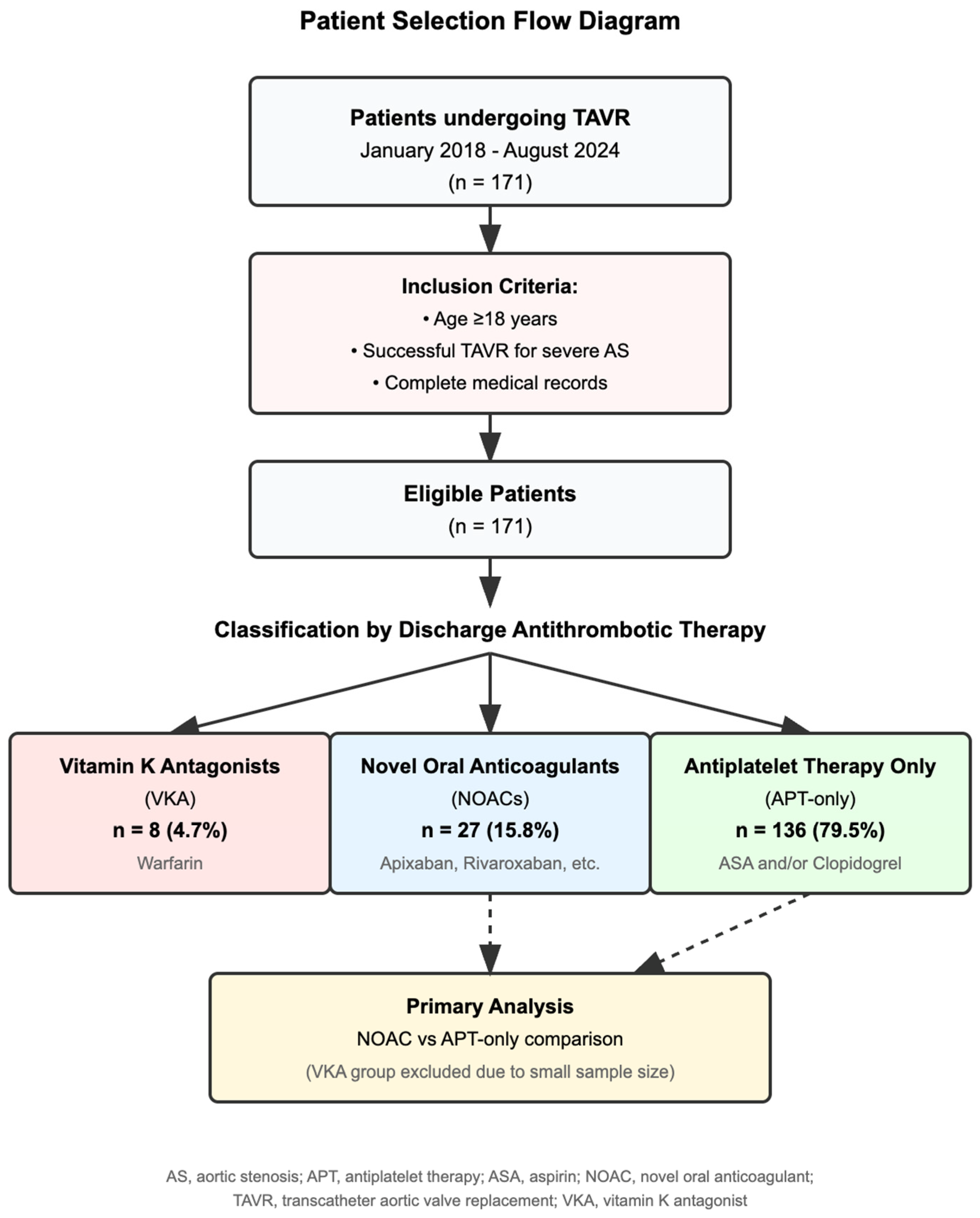
We conducted a retrospective cohort study of patients who underwent TAVR at Cape Fear Valley Medical Center between January 2018 and August 2024. The study was approved by the Institutional Review Board (IRB 1188-24), which waived the requirement for informed consent. We included adults (≥18 years) who underwent successful TAVR for severe aortic stenosis and excluded those with incomplete records, prior valve surgery, contraindications to anticoagulation, or life expectancy < 1 year from non-cardiac causes (Figure 1).
Figure 1.
Patient selection flow diagram and distribution of the anticoagulation groups. Legend: Flow diagram showing the selection process of patients who underwent TAVR between January 2018 and August 2024, including the inclusion/exclusion criteria and final distribution among the anticoagulation groups. NOAC, novel oral anticoagulant; TAVR, transcatheter aortic valve replacement; VKA: Vitamin K antagonist.
2.2. Antithrombotic Groups
Patients were classified according to the discharge antithrombotic regimen into three groups: (1) novel oral anticoagulants (NOACs)—apixaban, rivaroxaban, edoxaban, or dabigatran; (2) Vitamin K antagonists (VKAs)—warfarin with a target INR of 2.0–3.0; and (3) antiplatelet therapy only (APT-only)—aspirin (75–100 mg), clopidogrel (75 mg), or dual antiplatelet therapy (DAPT) without oral anticoagulation (Table 1 and Table 2). Both anticoagulated groups received concomitant antiplatelet therapy. The APT-only group received standard care for patients without anticoagulation indications. Detailed antithrombotic regimens and indications for anticoagulation were extracted from medical records and categorized as atrial fibrillation, venous thromboembolism, valve thrombosis concern, or other indications.
Table 1.
Variables tested using a set of random forest regression models to predict anticoagulant type.
Table 2.
Distribution of antithrombotic therapy groups.
2.3. Outcomes
The primary outcomes were 30-day and 1-year mortality and major adverse cardiovascular and cerebrovascular events (MACCE), defined as all-cause death, myocardial infarction, stroke, or transient ischemic attack. Secondary outcomes included bleeding events according to the Bleeding Academic Research Consortium (BARC) criteria and non-major adverse cardiovascular events (NACE). Data were collected through chart reviews and follow-up encounters. All outcomes are summarized in Table 3, Table 4, Table 5 and Table 6.
Table 3.
Primary analysis—NOAC vs. APT-only outcomes.
Table 4.
Descriptive statistics of the study variables.
Table 5.
Inverse probability of treatment weighting adjusted the values of the outcome variables.
Table 6.
Cox regression analysis predicting mortality based on study group binary variables.
2.4. Statistical Analysis
The markedly unequal group sizes (NOACs (n = 27); VKAs (n = 8); and APT-only (n = 136) necessitated the modification of our analysis plan. With only eight patients receiving VKA (<5% of the cohort), we had <20% power to detect meaningful differences in VKA. Therefore, we conducted a primary analysis comparing NOACs to APT-only using chi-square tests for categorical variables and Mann−Whitney U tests for continuous variables.
We applied inverse probability of treatment weighting (IPTW) using propensity scores from random forest models to adjust for confounding factors. The variables included in the propensity score model (Table 1) were selected based on clinical relevance and included demographics, comorbidities, procedural characteristics, and baseline risk scores. Binary outcomes were analyzed using logistic regression and time-to-event outcomes using Cox proportional hazards models (Table 6), reporting odds ratios and hazard ratios with 95% confidence intervals.
To assess the validity of our IPTW approach, we evaluated covariate balance using standardized mean differences (SMD) before and after weighting, with SMD < 0.1 indicating adequate balance (Supplementary Table S2). The performance of our propensity score model was assessed using the c-statistic, and the variable importance was extracted from the random forest model to identify the key predictors of treatment assignment. We conducted an overlap assessment by examining the distribution of propensity scores between the groups. The IPTW-adjusted outcomes are presented in Table 5.
2.5. Sensitivity and Subgroup Analyses
We performed several sensitivity analyses to assess the robustness of our findings: (1) restricting the analysis to patients with atrial fibrillation as the anticoagulation indication, (2) excluding patients who died within 7 days to account for early procedural complications, (3) stratifying by year of procedure to account for temporal trends (Table 3), and (4) using different IPTW trimming thresholds (1st–99th percentile vs. 5th–95th percentile). Prespecified subgroup analyses examined outcomes stratified by anticoagulation indication, age (≥80 vs. <80 years), CHA2DS2-VASc score (≥4 vs. <4), and baseline bleeding risk (Supplementary Table S5). “In the sensitivity analysis stratified by the 2020 valve guideline publication, the results remained consistent. For procedures performed during 2021–2024 (post-guideline era), NOACs remained associated with worse outcomes compared to APT-only (1-year mortality HR 2.17, 95% CI 1.13–4.17, p = 0.020).”
2.6. Multiple Testing Adjustment
Given the multiple outcomes assessed, we applied the Benjamini-Hochberg false discovery rate (FDR) correction with a 5% FDR threshold. Both uncorrected and FDR-adjusted p-values are reported to maintain transparency (Supplementary Table S4).
The VKA group is presented descriptively only, without statistical comparisons (Supplementary Table S1). All analyses were performed using SAS software (version 9.4) with a two-sided α of 0.05. Missing data were minimal (<5%) and were handled using complete case analysis.
3. Results
3.1. Study Population
Among the 171 patients who underwent TAVR during the study period, 136 (79.5%) received antiplatelet therapy only, 27 (15.8%) received NOACs, and 8 (4.7%) received VKAs (Table 2). The APT-only group consisted predominantly of patients on DAPT (n = 118, 86.8%), with fewer patients receiving aspirin monotherapy (n = 8, 5.9%) or clopidogrel monotherapy (n = 10, 7.4%). Given the small VKA sample size, statistical analyses were restricted to comparing the NOACs and APT-only groups, with VKA outcomes reported descriptively.
3.2. Baseline Characteristics
Patients receiving NOACs had higher baseline risk profiles than those in the APT-only group (Table 4), including higher mean CHA2DS2-VASc scores (4.7 ± 2.0 vs. 2.0 ± 2.5, p < 0.001) and more frequent indications for anticoagulation (93% vs. 13%, p < 0.001), predominantly atrial fibrillation. Patients receiving NOACs more often had prior cerebrovascular events (41% vs. 10%, p < 0.001) and higher STS-PROM scores (7.9 ± 8.8 vs. 6.0 ± 8.9, p = 0.056). The groups were similar in terms of age (76.4 ± 8.0 vs. 76.3 ± 8.8 years, p = 0.225), sex distribution, and prevalence of coronary artery disease.
3.3. Clinical Outcomes: NOAC Versus APT-Only
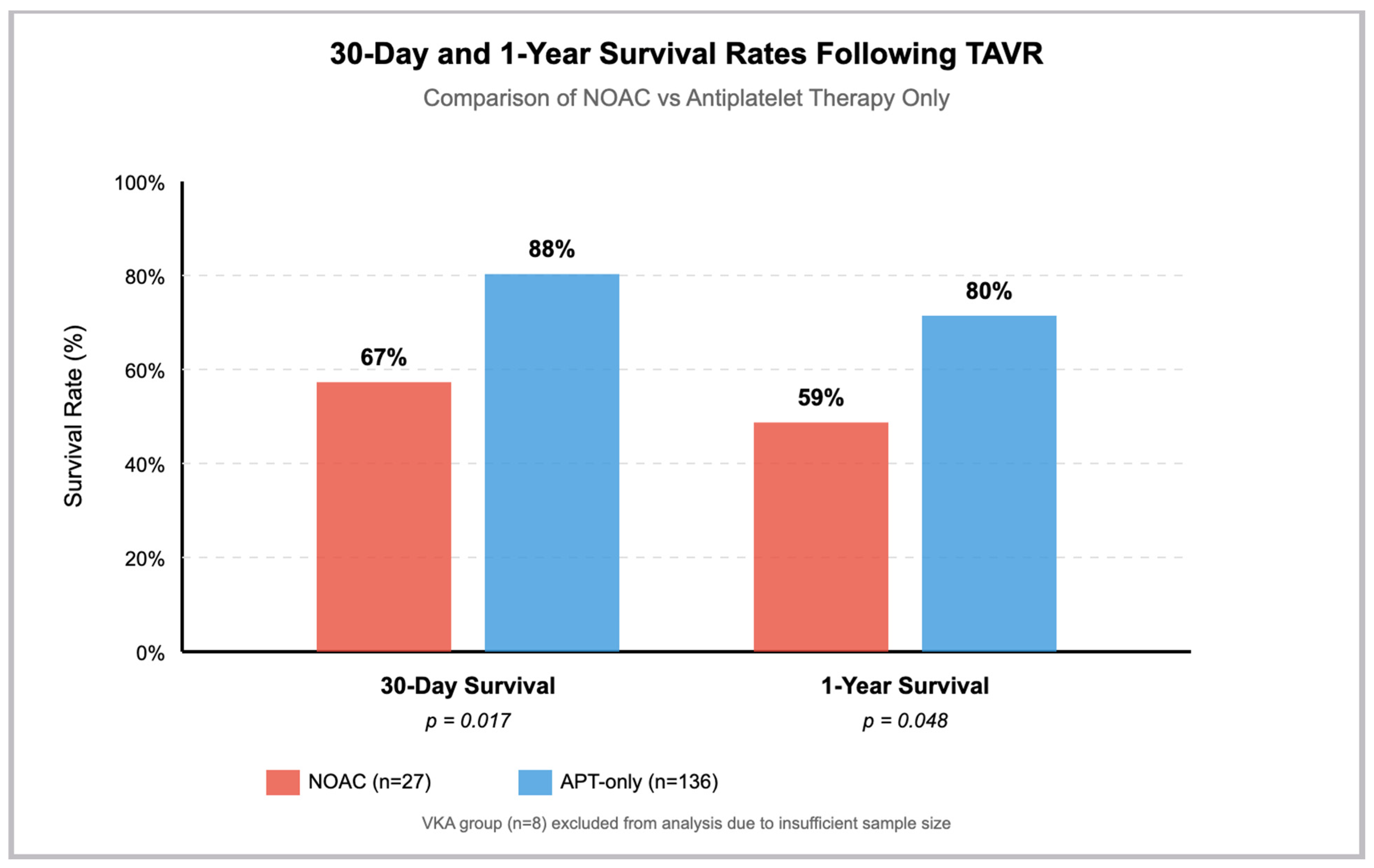
At 30 days, NOAC patients had significantly lower survival than APT-only (67% vs. 88%, p = 0.017), translating to an unadjusted odds ratio of 0.27 (95% CI 0.10–0.69, p = 0.007) (Table 4). The incidence of MACCE was higher in the NOAC group (22% vs. 8%, p = 0.051), with an odds ratio of 3.25 (95% CI 1.08–9.72, p = 0.035) (Table 6). Bleeding events were uncommon and similar between the groups (7% vs. 4%, p = 0.649).
These differences persisted at 1 year, with NOAC patients showing lower survival (59% vs. 80%, p = 0.048) and higher MACCE rates (34% vs. 17%, p < 0.001). After IPTW adjustment for baseline differences (Table 5), NOACs remained associated with worse outcomes: 30-day MACCE odds ratio 5.59 (95% CI 2.56–12.18, p < 0.001), 1-year mortality hazard ratio 2.22 (95% CI 1.22–4.03, p = 0.009), and 1-year MACCE odds ratio 2.40 (95% CI 1.23–4.68, p = 0.010) (Table 6) (Figure 2).
Figure 2.
Post-TAVR survival: NOAC versus antiplatelet therapy Survival rates at 30 days and 1 year post-TAVR for NOAC (n = 27, red) and APT-only (n = 136, blue) groups. Patients receiving NOAC showed significantly lower survival rates at both timepoints (p = 0.017 and p = 0.048, respectively). The VKA group (n = 8) was excluded due to insufficient sample size.
3.4. Temporal Trends
The proportion of patients receiving NOACs increased over the study period, from 4% in 2019 to 30% in 2023–2024 (rank-biserial correlation, p = 0.003), while APT-only use correspondingly decreased (Table 3). This trend likely reflects evolving practice patterns favoring NOACs over VKAs when anticoagulation is indicated.
3.5. Descriptive VKA Outcomes
The eight patients receiving VKAs had a mean age of 80.6 ± 7.9 years, 50% were female, and all had indications for anticoagulation (Supplementary Table S1). Seven of the eight patients (87.5%) survived at 30 days and 1 year. No patients treated with VKA experienced MACCE or bleeding events at either time point. While these outcomes appear favorable, no statistical comparisons were performed due to the small sample size.
4. Discussion
In this retrospective study of 171 post-TAVR patients, NOACs were associated with significantly worse outcomes than antiplatelet therapy alone, including higher mortality and MACCE rates at both 30 days and 1 year. These associations persisted after propensity score adjustments and sensitivity analyses. The severe underrepresentation of patients receiving VKA (n = 8, <5%) precluded any meaningful NOAC-VKA comparison, fundamentally limiting our ability to address the original research question of comparing NOACs with VKAs in post-TAVR patients.
4.1. Key Findings and Context
Patients prescribed NOACs exhibited shorter survival times at both the 30-day and 1-year follow-ups, as well as lower overall survival from baseline. Additionally, these patients experienced MACCE and NACE more frequently than those without. The use of inverse probability of treatment weighting enhanced some of the differences between groups or amplified those that were statistically significant.
Our results align with the GALILEO trial, which was terminated early due to excess death and bleeding with rivaroxaban [5], but contrast with ATLANTIS, which showed similar outcomes between apixaban and standard care [7]. This study is particularly relevant given recent research in other populations. Overtchouk et al. found that NOACs are associated with reduced major bleeding risk and lower mortality rates in patients with atrial fibrillation [8], while Brouwer et al. indicated that NOACs might provide comparable or even favorable outcomes regarding cardiovascular events in other high-risk procedures [9]. However, our findings suggest these benefits may not extend to the post-TAVR population.
Adverse NOAC outcomes are particularly concerning, given that 87% of our APT-only group received DAPT, an active antithrombotic strategy. The consistency of the findings across patients with and without atrial fibrillation suggests that the risk is not limited to specific subgroups.
Our findings should be interpreted in the context of evolving TAVR antithrombotic practices; most modern valve centers have moved away from VKAs post-TAVR unless there is another strong indication, with current practice favoring DAPT initially, followed by aspirin monotherapy after 6 months. The small VKA group in our study likely reflects this temporal shift in practice patterns, with VKAs primarily used in the early TAVR era.
4.2. Methodological Considerations
Our IPTW approach balanced the measured covariates (all SMDs < 0.1 post-weighting) with good model discrimination (c-statistic 0.842). Key findings remained significant after FDR correction, particularly for MACCE outcomes. However, residual confounding from unmeasured factors likely persists, as NOAC patients’ higher baseline risk despite adjustment suggests unmeasured characteristics influencing treatment selection.
Nearly 80% of patients belonged to the antiplatelet therapy-only group, while only eight patients (slightly less than 5%) were in the VKA group, which constrained many analyses involving this group. The use of NOACs demonstrated an increasing trend over the study period, with a higher proportion of patients being prescribed these medications in recent years (4% in 2019 to 30% in 2023–2024).
4.3. Limitations
The main limitations of this study include its retrospective nature, single-center design, and small sample size, particularly in the VKA group. These factors limit the generalizability of the results and highlight the need for larger prospective studies. We lacked data on specific NOAC agents, dosing, timing of initiation, and validated bleeding-risk scores. The safety-net hospital setting may not reflect the outcomes of high-volume TAVR centers.
5. Conclusions
In this single-center retrospective study, NOACs were associated with increased mortality and MACCE compared with antiplatelet therapy alone in post-TAVR patients. The extremely limited VKA representation (n = 8) precluded any meaningful NOAC-VKA comparison, fundamentally altering our ability to address the research question. These findings suggest that caution should be exercised when considering NOACs for post-TAVR patients without clear indications for anticoagulation. Prospective randomized trials with adequate sample sizes across all antithrombotic strategies are urgently needed to guide clinical decision-making.
Supplementary Materials
The following supporting information can be downloaded at: https://www.mdpi.com/article/10.3390/jcm14134690/s1, Table S1: Descriptive Characteristics and Outcomes of VKA Group (n = 8) *; Table S2: Standardized Mean Differences Pre- and Post-IPTW for NOAC vs APT-only Comparison; Table S3: Outcomes Stratified by Anticoagulation Indication; Table S4: False Discovery Rate Correction for Primary and Secondary Outcomes; Table S5: Sensitivity Analyses for Primary Outcomes.
Author Contributions
R.A.R.M.: Conceived and designed the study, supervised data collection, contributed to data analysis and interpretation, and drafted the manuscript. E.A.: Assisted with data collection and drafting of the manuscript. V.D.: Assisted with data collection and drafting of the manuscript. H.R.: Assisted with data collection and drafting of the manuscript. All authors have read and agreed to the published version of the manuscript.
Funding
This research did not receive any specific grants from funding agencies in the public, commercial, or not-for-profit sectors.
Institutional Review Board Statement
This study was approved by the Institutional Review Board of Cape Fear Valley Health System (approval number: IRB 1188-24, date 2 October 2024).
Informed Consent Statement
The requirement for individual patient consent was waived due to the retrospective nature of the study. All patient data were de-identified to ensure their confidentiality.
Data Availability Statement
The data that support the findings of this study are available from the corresponding author, Ricardo A. Rodriguez Mejia, upon reasonable request. The data are not publicly available because they contain information that could compromise the privacy of the research participants. Requests for access to the dataset used and analyzed in the current study will be reviewed by the Cape Fear Valley Health System Institutional Review Board and are subject to approval. Any data sharing will be restricted to non-identifiable data due to the nature of the study and to protect patient privacy. The statistical code used for the analysis is available from the corresponding author without undue reservation. Any shared data will be provided in accordance with the consent provided by participants on the use of confidential data and adherence to HIPAA regulations.
Acknowledgments
The authors would like to express their sincere gratitude to the Cardiovascular Department at Cape Fear Valley Medical Center for their invaluable support throughout this study. Their expertise and assistance were crucial for the successful completion of this study. We also thank the staff of Cape Fear Valley Medical Center for their cooperation and support during the data collection process.
Conflicts of Interest
The authors declare no conflicts of interest.
Permission to Reproduce Material from Other Sources
The following research includes citations and references to previously published works, which have been properly documented according to academic standards. All cited works are duly acknowledged through in-text citations and complete bibliographic references, in accordance with scholarly conventions. These citations serve to recognize the intellectual contributions of other researchers and support the arguments and findings presented in this study.
References
- Franke, K.B.; Bhatia, D.; Roberts-Thomson, R.L.; Psaltis, P.J. Aortic valve replacement reduces mortality in moderate aortic stenosis: A systematic review and meta-analysis. J. Geriatr. Cardiol. 2023, 20, 61–67. [Google Scholar] [CrossRef] [PubMed]
- Young, M.N.; Kearing, S.; Malenka, D.; Goodney, P.P.; Skinner, J.; Iribarne, A. Geographic and demographic variability in transcatheter aortic valve replacement dispersion in the United States. J. Am. Heart Assoc. 2021, 10, e019588. [Google Scholar] [CrossRef] [PubMed]
- Blankenberg, S.; Seiffert, M.; Vonthein, R.; Baumgartner, H.; Bleiziffer, S.; Borger, M.A.; Choi, Y.-H.; Clemmensen, P.; Cremer, J.; Czerny, M.; et al. Transcatheter or Surgical Treatment of Aortic-Valve Stenosis. N. Engl. J. Med. 2024, 390, 1572–1583. [Google Scholar] [CrossRef] [PubMed]
- Otto, C.M.; Nishimura, R.A.; Bonow, R.O.; Carabello, B.A.; Erwin, J.P., 3rd; Gentile, F.; Jneid, H.; Krieger, E.V.; Mack, M.; McLeod, C.; et al. 2020 ACC/AHA Guideline for the management of patients with valvular heart disease: A report of the American College of Cardiology/American Heart Association joint committee on clinical practice guidelines. Circulation 2021, 143, e72–e227. [Google Scholar] [PubMed]
- Dangas, G.D.; Tijssen, J.G.P.; Wöhrle, J.; Søndergaard, L.; Gilard, M.; Möllmann, H.; Makkar, R.R.; Herrmann, H.C.; Giustino, G.; Baldus, S.; et al. A Controlled trial of rivaroxaban after transcatheter aortic-valve replacement. N. Engl. J. Med. 2020, 382, 120–129. [Google Scholar] [CrossRef] [PubMed]
- Ahmad, Y.; Howard, J.P.; Madhavan, M.V.; Leon, M.B.; Makkar, R.R. single versus dual antiplatelet therapy after transcatheter aortic valve replacement: A meta-analysis of randomized clinical trials. Cardiovasc. Revasc Med. 2022, 34, 46–53. [Google Scholar] [CrossRef] [PubMed]
- Collet, J.P.; Van Belle, E.; Thiele, H.; Berti, S.; Lhermusier, T.; Manigold, T.; Neumann, F.J.; Gilard, M.; Attias, D.; Beygui, F.; et al. Apixaban vs. standard of care after transcatheter aortic valve implantation: The ATLANTIS trial. Eur. Heart J. 2022, 43, 2783–2797. [Google Scholar] [CrossRef] [PubMed]
- Overtchouk, P.; Guedeney, P.; Rouanet, S.; Verhoye, J.P.; Lefevre, T.; Van Belle, E.; Eltchaninoff, H.; Gilard, M.; Leprince, P.; Iung, B.; et al. Long-term mortality and early valve dysfunction according to anticoagulation use: The FRANCE-TAVI registry. J. Am. Coll. Cardiol. 2019, 73, 13–21. [Google Scholar] [CrossRef] [PubMed]
- Brouwer, J.; Nijenhuis, V.J.; Delewi, R.; Hermanides, R.S.; Holvoet, W.; Dubois, C.L.; Frambach, P.; De Bruyne, B.; van Houwelingen, G.K.; Van Der Heyden, J.A.; et al. Aspirin with or without clopidogrel after transcatheter aortic-valve implantation. N. Engl. J. Med. 2020, 383, 1447–1457. [Google Scholar] [CrossRef] [PubMed]
- Van Mieghem, N.M.; Unverdorben, M.; Hengstenberg, C.; Möllmann, H.; Mehran, R.; López-Otero, D.; Nombela-Franco, L.; Moreno, R.; Nordbeck, P.; Thiele, H.; et al. Edoxaban versus vitamin K antagonist for atrial fibrillation after TAVR. N. Engl. J. Med. 2021, 385, 2150–2160. [Google Scholar] [CrossRef] [PubMed]
- Malik, A.H.; Yandrapalli, S.; Aronow, W.S. Meta-analysis comparing the safety and efficacy of dual versus single antiplatelet therapy following transcatheter aortic valve replacement. Am. J. Cardiol. 2023, 188, 35–43. [Google Scholar]
- Chakravarty, T.; Søndergaard, L.; Friedman, J.; De Backer, O.; Berman, D.; Kofoed, K.F.; Jilaihawi, H.; Shiota, T.; Abramowitz, Y.; Jørgensen, T.H.; et al. Subclinical leaflet thrombosis in surgical and transcatheter bioprosthetic aortic valves: An observational study. Lancet 2017, 389, 2383–2392. [Google Scholar] [CrossRef] [PubMed]
- Vahanian, A.; Beyersdorf, F.; Praz, F.; Milojevic, M.; Baldus, S.; Bauersachs, J.; Capodanno, D.; Conradi, L.; De Bonis, M.; De Paulis, R.; et al. 2021 ESC/EACTS Guidelines for the management of valvular heart disease. Eur. Heart J. 2022, 43, 561–632. [Google Scholar] [CrossRef] [PubMed]
Disclaimer/Publisher’s Note: The statements, opinions and data contained in all publications are solely those of the individual author(s) and contributor(s) and not of MDPI and/or the editor(s). MDPI and/or the editor(s) disclaim responsibility for any injury to people or property resulting from any ideas, methods, instructions or products referred to in the content. |
© 2025 by the authors. Licensee MDPI, Basel, Switzerland. This article is an open access article distributed under the terms and conditions of the Creative Commons Attribution (CC BY) license (https://creativecommons.org/licenses/by/4.0/).