Areas of Interest and Attitudes towards the Pharmacological Treatment of Attention Deficit Hyperactivity Disorder: Thematic and Quantitative Analysis Using Twitter


 ,
,  ,
,  , and
, and 
Abstract
1. Introduction
2. Materials and Methods
2.1. Data Collection
2.2. Search Tool
2.3. Content Analysis Process
2.4. Measuring Influence and Interest on Twitter
2.5. Ethical Considerations
2.6. Statistical Analysis
3. Results
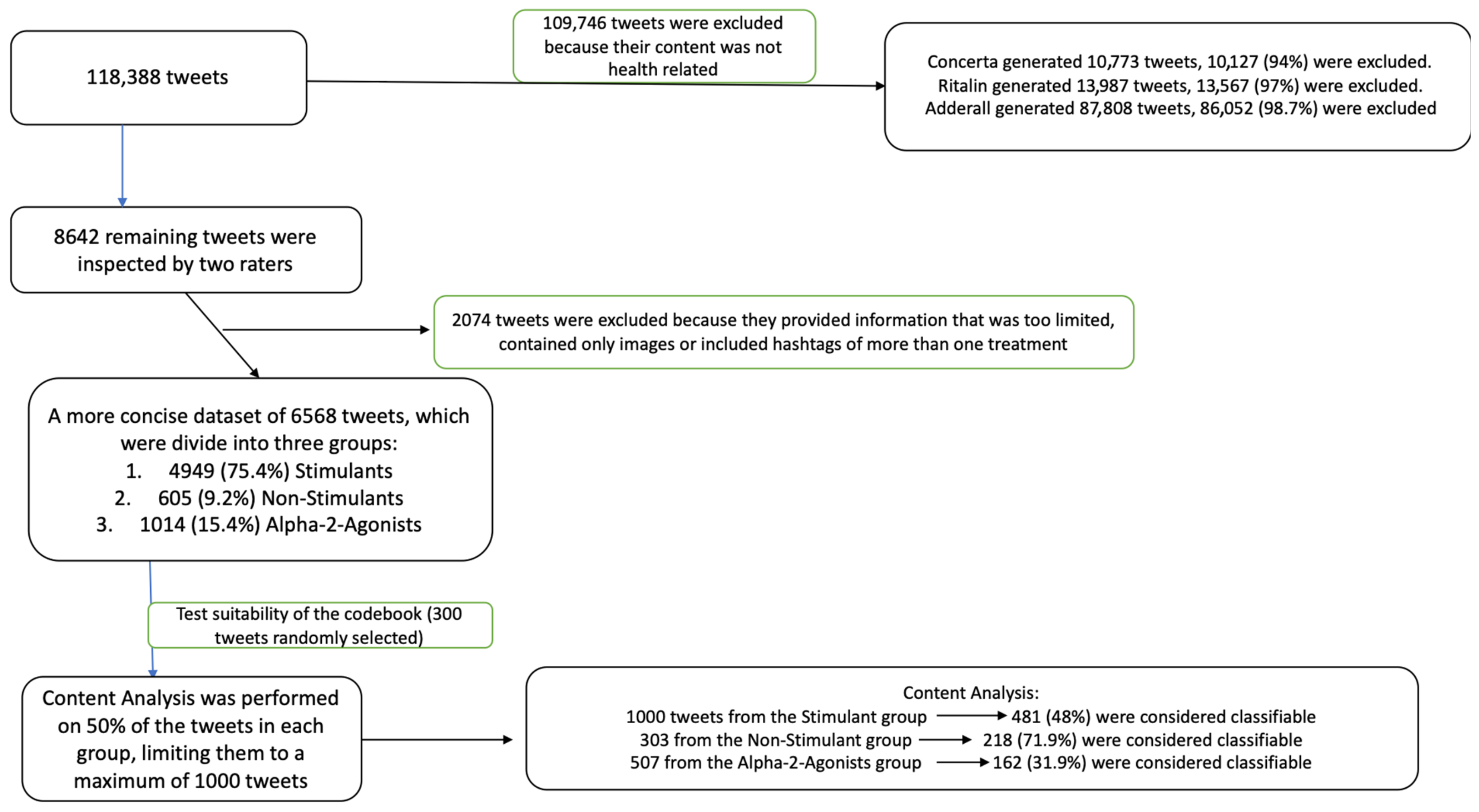
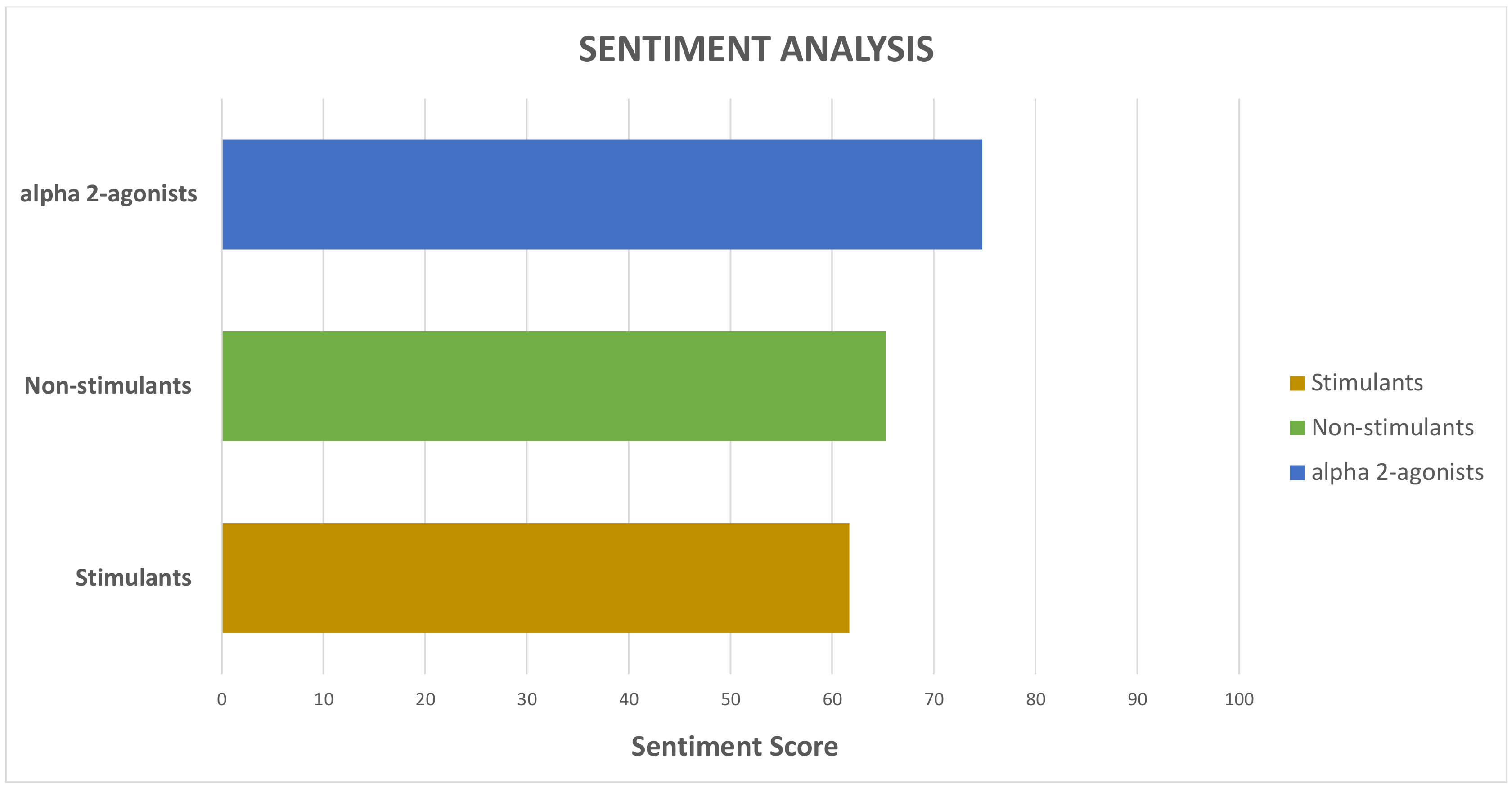
3.1. Stimulants Accumulated the Most Interest among Twitter Users
3.2. Scientific Links Were Mainly Found in Alpha-2 Agonist-Related Tweets
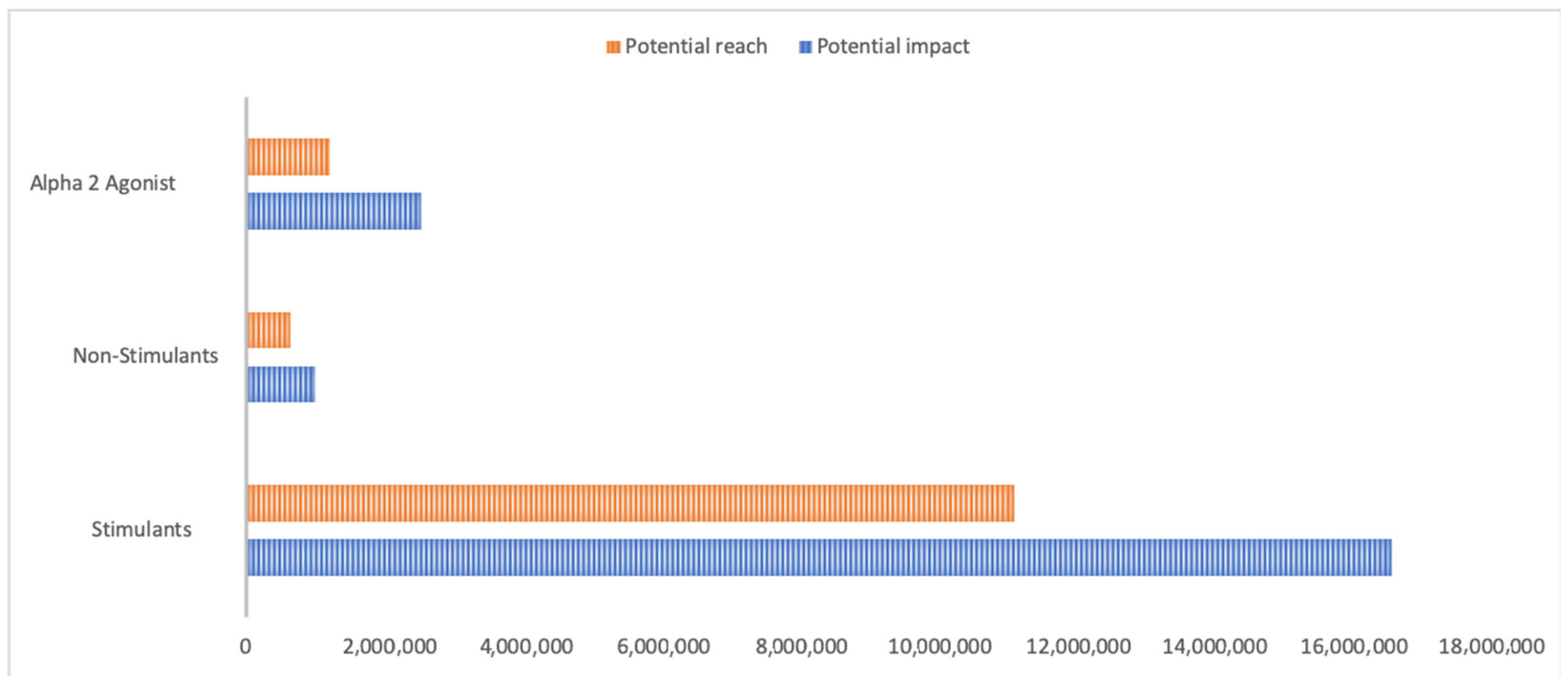
3.3. Stimulant Related Tweets Were the Most Disseminated within the Twitter Community
4. Discussion
4.1. Principal Findings
4.2. Limitations
5. Conclusions
Author Contributions
Funding
Institutional Review Board Statement
Informed Consent Statement
Data Availability Statement
Conflicts of Interest
References
- Fayyad, J.; De Graaf, R.; Kessler, R.; Alonso, J.; Angermeyer, M.; Demyttenaere, K.; De Girolamo, G.; Haro, J.M.; Karam, E.G.; Lara, C.; et al. Cross-national prevalence and correlates of adult attention-deficit hyperactivity disorder. Br. J. Psychiatry 2007, 190, 402–409. [Google Scholar] [CrossRef]
- Danielson, M.L.; Bitsko, R.H.; Ghandour, R.M.; Holbrook, J.R.; Kogan, M.D.; Blumberg, S.J. Prevalence of Parent-Reported ADHD Diagnosis and Associated Treatment Among U.S. Children and Adolescents, 2016. J. Clin. Child Adolesc. Psychol. 2018, 47, 199–212. [Google Scholar] [CrossRef]
- Merikangas, K.R.; He, J.-P.; Brody, D.; Fisher, P.W.; Bourdon, K.; Koretz, D.S. Prevalence and treatment of mental disorders among US children in the 2001–2004 NHANES. Pediatrics 2010, 125, 75–81. [Google Scholar] [CrossRef]
- Hechtman, L.; Swanson, J.M.; Sibley, M.H.; Stehli, A.; Owens, E.B.; Mitchell, J.T.; Arnold, L.E.; Molina, B.S.G.; Hinshaw, S.P.; Jensen, P.S.; et al. Functional Adult Outcomes 16 Years After Childhood Diagnosis of Attention-Deficit/Hyperactivity Disorder: MTA Results. J. Am. Acad. Child Adolesc. Psychiatry 2016, 55, 945–952.e2. [Google Scholar] [CrossRef]
- Roy, A.; Hechtman, L.; Arnold, L.E.; Swanson, J.M.; Molina, B.S.G.; Sibley, M.H.; Howard, A.L.; MTA Cooperative Group. Childhood Predictors of Adult Functional Outcomes in the Multimodal Treatment Study of Attention-Deficit/Hyperactivity Disorder (MTA). J. Am. Acad. Child Adolesc. Psychiatry 2017, 56, 687–695.e7. [Google Scholar] [CrossRef]
- Wolraich, M.L.; Hagan, J.F.; Allan, C.; Chan, E.; Davison, D.; Earls, M.; Evans, S.W.; Flinn, S.K.; Froehlich, T.; Frost, J.; et al. Clinical Practice Guideline for the Diagnosis, Evaluation, and Treatment of Attention-Deficit/Hyperactivity Disorder in Children and Adolescents. Pediatrics 2019, 144, e20192528. [Google Scholar] [CrossRef]
- Pappadopulos, E.; Jensen, P.S.; Chait, A.R.; Arnold, L.E.; Swanson, J.M.; Greenhill, L.L.; Hechtman, L.; Chuang, S.; Wells, K.C.; Pelham, W.; et al. Medication adherence in the MTA: Saliva methylphenidate samples versus parent report and mediating effect of concomitant behavioral treatment. J. Am. Acad. Child Adolesc. Psychiatry 2009, 48, 501–510. [Google Scholar] [CrossRef]
- Schaefer, M.R.; Wagoner, S.T.; Young, M.E.; Rawlinson, A.R.; Kavookjian, J.; Shapiro, S.K.; Gray, W.N. Subjective Versus Objective Measures of Medication Adherence in Adolescents/Young Adults with Attention-Deficit Hyperactivity Disorder. J. Dev. Behav. Pediatr. 2019, 40, 54–59. [Google Scholar] [CrossRef]
- Alvarez-Mon, M.A.; Asunsolo del Barco, A.; Lahera, G.; Quintero, J.; Ferre, F.; Pereira-Sanchez, V.; Ortuño, F.; Alvarez-Mon, M. Increasing Interest of Mass Communication Media and the General Public in the Distribution of Tweets About Mental Disorders: Observational Study. J. Med. Internet Res. 2018, 20, e205. [Google Scholar] [CrossRef] [PubMed]
- Saha, K.; Torous, J.; Kiciman, E.; De Choudhury, M. Understanding Side Effects of Antidepressants: Large-scale Longitudinal Study on Social Media Data. JMIR Ment. Health 2021, 8, e26589. [Google Scholar] [CrossRef]
- Colditz, J.B.; Chu, K.-H.; Emery, S.L.; Larkin, C.R.; James, A.E.; Welling, J.; Primack, B.A. Toward Real-Time Infoveillance of Twitter Health Messages. Am. J. Public Health 2018, 108, 1009–1014. [Google Scholar] [CrossRef]
- Teo, A.R.; Strange, W.; Bui, R.; Dobscha, S.K.; Ono, S.S. Responses to Concerning Posts on Social Media and Their Implications for Suicide Prevention Training for Military Veterans: Qualitative Study. J. Med. Internet Res. 2020, 22, e22076. [Google Scholar] [CrossRef]
- Sinnenberg, L.; Buttenheim, A.M.; Padrez, K.; Mancheno, C.; Ungar, L.; Merchant, R.M. Twitter as a Tool for Health Research: A Systematic Review. Am. J. Public Health 2017, 107, e1–e8. [Google Scholar] [CrossRef]
- Dol, J.; Tutelman, P.R.; Chambers, C.T.; Barwick, M.; Drake, E.K.; Parker, J.A.; Parker, R.; Benchimol, E.I.; George, R.B.; Witteman, H.O. Health Researchers’ Use of Social Media: Scoping Review. J. Med. Internet Res. 2019, 21, e13687. [Google Scholar] [CrossRef]
- Martinez, B.; Dailey, F.; Almario, C.V.; Keller, M.S.; Desai, M.; Dupuy, T.; Mosadeghi, S.; Whitman, C.; Lasch, K.; Ursos, L.; et al. Patient Understanding of the Risks and Benefits of Biologic Therapies in Inflammatory Bowel Disease. Inflamm. Bowel Dis. 2017, 23, 1057–1064. [Google Scholar] [CrossRef]
- Golder, S.; Bach, M.; O’Connor, K.; Gross, R.; Hennessy, S.; Gonzalez Hernandez, G. Public Perspectives on Anti-Diabetic Drugs: Exploratory Analysis of Twitter Posts. JMIR Diabetes 2021, 6, e24681. [Google Scholar] [CrossRef]
- Nanna, M.G.; Navar, A.M.; Zakroysky, P.; Xiang, Q.; Goldberg, A.C.; Robinson, J.; Roger, V.L.; Virani, S.S.; Wilson, P.W.F.; Elassal, J.; et al. Association of Patient Perceptions of Cardiovascular Risk and Beliefs on Statin Drugs With Racial Differences in Statin Use: Insights From the Patient and Provider Assessment of Lipid Management Registry. JAMA Cardiol. 2018, 3, 739–748. [Google Scholar] [CrossRef]
- Wei, M.Y.; Ito, M.K.; Cohen, J.D.; Brinton, E.A.; Jacobson, T.A. Predictors of statin adherence, switching, and discontinuation in the USAGE survey: Understanding the use of statins in America and gaps in patient education. J. Clin. Lipidol. 2013, 7, 472–483. [Google Scholar] [CrossRef] [PubMed]
- Golder, S.; O’Connor, K.; Hennessy, S.; Gross, R.; Gonzalez-Hernandez, G. Assessment of Beliefs and Attitudes About Statins Posted on Twitter. JAMA Netw. Open 2020, 3, e208953. [Google Scholar] [CrossRef]
- Lachmar, E.M.; Wittenborn, A.K.; Bogen, K.W.; McCauley, H.L. #MyDepressionLooksLike: Examining Public Discourse about Depression on Twitter. JMIR Ment. Health 2017, 4, e43. [Google Scholar]
- Berry, N.; Lobban, F.; Belousov, M.; Emsley, R.; Nenadic, G.; Bucci, S. #WhyWeTweetMH: Understanding Why People Use Twitter to Discuss Mental Health Problems. J. Med. Internet Res. 2017, 19, e107. [Google Scholar]
- Viguria, I.; Alvarez-Mon, M.A.; Llavero-Valero, M.; Asunsolo Del Barco, A.; Ortuño, F.; Alvarez-Mon, M. Eating Disorder Awareness Campaigns: Thematic and Quantitative Analysis Using Twitter. J. Med. Internet Res. 2020, 22, e17626. [Google Scholar] [CrossRef]
- Alvarez-Mon, M.A.; Llavero-Valero, M.; Sánchez-Bayona, R.; Pereira-Sanchez, V.; Vallejo-Valdivielso, M.; Monserrat, J.; Lahera, G.; Asunsolo del Barco, A.; Alvarez-Mon, M. Areas of Interest and Stigmatic Attitudes of the General Public in Five Relevant Medical Conditions: Thematic and Quantitative Analysis Using Twitter. J. Med. Internet Res. 2019, 21, e14110. [Google Scholar] [CrossRef]
- Pereira-Sanchez, V.; Alvarez-Mon, M.A.; Asunsolo del Barco, A.; Alvarez-Mon, M.; Teo, A. Exploring the Extent of the Hikikomori Phenomenon on Twitter: Mixed Methods Study of Western Language Tweets. J. Med. Internet Res. 2019, 21, e14167. [Google Scholar] [CrossRef]
- Mohammed, M.A.; Moles, R.J.; Chen, T.F. Medication-related burden and patients’ lived experience with medicine: A systematic review and metasynthesis of qualitative studies. BMJ Open 2016, 6, e010035. [Google Scholar] [CrossRef]
- Loewen, O.K.; Maximova, K.; Ekwaru, J.P.; Asbridge, M.; Ohinmaa, A.; Veugelers, P.J. Adherence to Life-Style Recommendations and Attention-Deficit/Hyperactivity Disorder. Psychosom. Med. 2020, 82, 305–315. [Google Scholar] [CrossRef]
- Pringsheim, T.; Stewart, D.G.; Chan, P.; Tehrani, A.; Patten, S.B. The Pharmacoepidemiology of Psychotropic Medication Use in Canadian Children from 2012 to 2016. J. Child Adolesc. Psychopharmacol. 2019, 29, 740–745. [Google Scholar] [CrossRef]
- Cortese, S.; Adamo, N.; Del Giovane, C.; Mohr-Jensen, C.; Hayes, A.J.; Carucci, S.; Atkinson, L.Z.; Tessari, L.; Banaschewski, T.; Coghill, D.; et al. Comparative efficacy and tolerability of medications for attention-deficit hyperactivity disorder in children, adolescents, and adults: A systematic review and network meta-analysis. Lancet Psychiatry 2018, 5, 727–738. [Google Scholar] [CrossRef]
- Gillespie-Lynch, K.; Kapp, S.K.; Shane-Simpson, C.; Smith, D.S.; Hutman, T. Intersections between the autism spectrum and the internet: Perceived benefits and preferred functions of computer-mediated communication. Intellect. Dev. Disabil. 2014, 52, 456–469. [Google Scholar] [CrossRef] [PubMed]
- Birnbaum, M.L.; Rizvi, A.F.; Correll, C.U.; Kane, J.M.; Confino, J. Role of social media and the Internet in pathways to care for adolescents and young adults with psychotic disorders and non-psychotic mood disorders. Early Interv. Psychiatry 2017, 11, 290–295. [Google Scholar] [CrossRef] [PubMed]
- Passerello, G.L.; Hazelwood, J.E.; Lawrie, S. Using Twitter to assess attitudes to schizophrenia and psychosis. BJPsych Bull. 2019, 43, 158–166. [Google Scholar] [CrossRef] [PubMed]
- Gray, W.N.; Kavookjian, J.; Shapiro, S.K.; Wagoner, S.T.; Schaefer, M.R.; Resmini Rawlinson, A.; Hinnant, J.B. Transition to College and Adherence to Prescribed Attention Deficit Hyperactivity Disorder Medication. J. Dev. Behav. Pediatr. 2017, 39, 1–9. [Google Scholar] [CrossRef] [PubMed]
- Guntuku, S.C.; Ramsay, J.R.; Merchant, R.M.; Ungar, L.H. Language of ADHD in Adults on Social Media. J. Atten. Disord. 2019, 23, 1475–1485. [Google Scholar] [CrossRef] [PubMed]
- Charach, A. Editorial: Time for a New Conversation on Stimulant Use. J. Am. Acad. Child Adolesc. Psychiatry 2020, 59, 929–930. [Google Scholar] [CrossRef]
- Eysenbach, G. Infodemiology and Infoveillance: Framework for an Emerging Set of Public Health Informatics Methods to Analyze Search, Communication and Publication Behavior on the Internet. J. Med. Internet Res. 2009, 11, e11. [Google Scholar] [CrossRef] [PubMed]
- Teter, C.J.; McCabe, S.E.; Cranford, J.A.; Boyd, C.J.; Guthrie, S.K. Prevalence and motives for illicit use of prescription stimulants in an undergraduate student sample. J Am. Coll. Health 2005, 53, 253–262. [Google Scholar] [CrossRef] [PubMed]
- Pliszka, S.R.; Crismon, M.L.; Hughes, C.W.; Corners, C.K.; Emslie, G.J.; Jensen, P.S.; McCRACKEN, J.T.; Swanson, J.M.; Lopez, M.; Texas Consensus Conference Panel on Pharmacotherapy of Childhood Attention Deficit Hyperactivity Disorder. The Texas Children’s Medication Algorithm Project: Revision of the algorithm for pharmacotherapy of attention-deficit/hyperactivity disorder. J. Am. Acad. Child Adolesc. Psychiatry 2006, 45, 642–657. [Google Scholar] [CrossRef]
- Emilsson, M.; Gustafsson, P.; Öhnström, G.; Marteinsdottir, I. Impact of personality on adherence to and beliefs about ADHD medication, and perceptions of ADHD in adolescents. BMC Psychiatry 2020, 20, 139. [Google Scholar] [CrossRef]
- Biederman, J.; Fried, R.; DiSalvo, M.; Woodworth, K.Y.; Biederman, I.; Driscoll, H.; Noyes, E.; Faraone, S.V.; Perlis, R.H. Further evidence of low adherence to stimulant treatment in adult ADHD: An electronic medical record study examining timely renewal of a stimulant prescription. Psychopharmacology 2020, 237, 2835–2843. [Google Scholar] [CrossRef]
- Felnhofer, A.; Bussek, T.; Goreis, A.; Kafka, J.X.; König, D.; Klier, C.; Zesch, H.; Kothgassner, O.D. Mothers’ and Fathers’ Perspectives on the Causes of Their Child’s Disorder. J. Pediatr. Psychol. 2020, 45, 803–811. [Google Scholar] [CrossRef]
- Oerbeck, B.; Furu, K.; Zeiner, P.; Aase, H.; Reichborn-Kjennerud, T.; Pripp, A.H.; Overgaard, K.R. Child and Parental Characteristics of Medication Use for Attention-Deficit/Hyperactivity Disorder. J. Child Adolesc. Psychopharmacol. 2020, 30, 456–464. [Google Scholar] [CrossRef]
- Turner-McGrievy, G.M.; Beets, M.W. Tweet for health: Using an online social network to examine temporal trends in weight loss-related posts. Transl. Behav. Med. 2015, 5, 160–166. [Google Scholar] [CrossRef] [PubMed]
- Booth, R.G.; Allen, B.N.; Bray Jenkyn, K.M.; Li, L.; Shariff, S.Z. Youth Mental Health Services Utilization Rates After a Large-Scale Social Media Campaign: Population-Based Interrupted Time-Series Analysis. JMIR Ment. Health 2018, 5, e27. [Google Scholar] [CrossRef] [PubMed]
- Robinson, P.; Turk, D.; Jilka, S.; Cella, M. Measuring attitudes towards mental health using social media: Investigating stigma and trivialisation. Soc. Psychiatry Psychiatr. Epidemiol. 2019, 54, 51–58. [Google Scholar] [CrossRef] [PubMed]
- Joseph, A.J.; Tandon, N.; Yang, L.H.; Duckworth, K.; Torous, J.; Seidman, L.J.; Keshavan, M.S. #Schizophrenia: Use and misuse on Twitter. Schizophr. Res. 2015, 165, 111–115. [Google Scholar]
- Hanson, C.L.; Burton, S.H.; Giraud-Carrier, C.; West, J.H.; Barnes, M.D.; Hansen, B. Tweaking and Tweeting: Exploring Twitter for Nonmedical Use of a Psychostimulant Drug (Adderall) Among College Students. J. Med. Internet Res. 2013, 15, e62. [Google Scholar] [CrossRef]
- Cassidy, T.A.; McNaughton, E.C.; Varughese, S.; Russo, L.; Zulueta, M.; Butler, S.F. Nonmedical Use of Prescription ADHD Stimulant Medications Among Adults in a Substance Abuse Treatment Population. J. Atten. Disord. 2015, 19, 275–283. [Google Scholar] [CrossRef] [PubMed]
- Saha, K.; Torous, J.; Ernala, S.K.; Rizuto, C.; Stafford, A.; De Choudhury, M. A computational study of mental health awareness campaigns on social media. Transl. Behav. Med. 2019, 9, 1197–1207. [Google Scholar] [CrossRef]



| Category | Examples of Tweets |
|---|---|
| EFFICACY (refers to the ability or inability of a treatment to provide a beneficial effect) |
|
| SIDE EFFECTS (refers to any effect that is secondary to the one intended either adverse or beneficial; we also included tweets discussing tolerability of the drug) |
|
| ADHERENCE (refers to the degree of conformity to the recommendations about the treatment with respect to the timing, dosage or frequency) |
|
| N | ALPHA-2 AGONIST | NON-STIMULANT | STIMULANT | p-Value | |
|---|---|---|---|---|---|
| 162 | 218 | 481 | |||
| EFFICACY | No Mention | 36 (22.2%) | 84 (38.5%) | 176 (36.6%) | |
| Positive | 120 (74.1%) | 118 (54.1%) | 270 (56.1%) | ||
| Negative | 6 (3.7%) | 16 (7.3%) | 35 (7.3%) | ||
| p < 0.001 | |||||
| SIDE EFFECTS | No Mention | 40 (24.7%) | 77 (35.3%) | 239 (49.7%) | |
| Positive | 4 (2.5%) | 3 (1.4%) | 6 (1.2%) | ||
| Negative | 118 (72.8%) | 138 (63.3%) | 236 (49.1%) | ||
| p < 0.001 | |||||
| ADHERENCE | No Mention | 148 (91.4%) | 196 (89.9%) | 451 (93.8%) | |
| Positive | 8 (4.9%) | 12 (5.5%) | 9 (1.9%) | ||
| Negative | 6 (3.7%) | 10 (4.6%) | 21 (4.4%) | ||
| p = 0.1 | |||||
| LINK | No Mention | 65 (40.1%) | 145 (66.5%) | 466 (96.9%) | |
| Scientific | 94 (58.0%) | 68 (31.2%) | 13 (2.7%) | ||
| Non-Scientific | 3 (1.9%) | 5 (2.3%) | 2 (0.4%) | ||
| p < 0.001 |
| Total | WITHOUT LINK | WITH LINK | p-Value | |
|---|---|---|---|---|
| 676 | 185 | |||
| EFFICACY | No Mention | 238 (35.4%) | 57 (30.8%) | |
| Positive | 382 (56.5%) | 126 (68.1%) | ||
| Negative | 55 (8.1%) | 2 (1.1%) | ||
| p < 0.001 | ||||
| SIDE EFFECTS | No Mention | 320 (47.3%) | 36 (19.5%) | |
| Positive | 10 (1.5%) | 3 (1.6%) | ||
| Negative | 346 (51.2%) | 146 (78.9%) | ||
| p < 0.001 | ||||
| ADHERENCE | No Mention | 611 (90.4%) | 184 (99.5%) | |
| Positive | 29 (4.3%) | 0 | ||
| Negative | 36 (5.3%) | 1 (0.5%) | ||
| p < 0.001 |
| ALPHA-2 AGONIST | NON-STIMULANTS | STIMULANTS | |||||
|---|---|---|---|---|---|---|---|
| WITHOUT LINK | WITH LINK | WITHOUT LINK | WITH LINK | WITHOUT LINK | WITH LINK | ||
| Total | 65 | 97 | 145 | 73 | 466 | 15 | |
| SIDE EFFECTS | NM | 26 (40%) | 14 (14%) | 66 (45.5%) | 11 (15.1%) | 288 (48.9%) | 11 (73.3%) |
| + | 1 (2%) | 3 (3%) | 3 (2.1%) | 0 | 6 (1.3%) | 0 | |
| − | 38 (58%) | 80 (82%) | 76 (52.4%) | 62 (84.9%) | 232 (49.8%) | 4 (26.7%) | |
| p = 0.001 | p < 0.001 | p = 0.17 | |||||
| EFFICACY | NM | 24 (37%) | 12 (12%) | 42 (29%) | 42 (57.5%) | 173 (37.1%) | 3 (20%) |
| + | 36 (55%) | 84 (87%) | 87 (60%) | 31 (42.5%) | 259 (55.6%) | 11 (73.3%) | |
| − | 5 (8%) | 1 (1%) | 16 (11%) | 0 | 34 (7.3%) | 1 (6.7%) | |
| p < 0.001 | p < 0.001 | p = 0.37 | |||||
| ADHERENCE | NM | 52 (80%) | 96 (99%) | 123 (84.8%) | 73 (100%) | 436 (93.6%) | 15 (100%) |
| + | 8 (12%) | 0 | 12 (8.3%) | 0 | 9 (1.9%) | 0 | |
| − | 5 (8%) | 1 (1%) | 10 (6.9%) | 0 | 21 (4.5%) | 0 | |
| p < 0.001 | p = 0.002 | p = 0.60 | |||||
Publisher’s Note: MDPI stays neutral with regard to jurisdictional claims in published maps and institutional affiliations. |
© 2021 by the authors. Licensee MDPI, Basel, Switzerland. This article is an open access article distributed under the terms and conditions of the Creative Commons Attribution (CC BY) license (https://creativecommons.org/licenses/by/4.0/).
Share and Cite
Alvarez-Mon, M.A.; de Anta, L.; Llavero-Valero, M.; Lahera, G.; Ortega, M.A.; Soutullo, C.; Quintero, J.; Asunsolo del Barco, A.; Alvarez-Mon, M. Areas of Interest and Attitudes towards the Pharmacological Treatment of Attention Deficit Hyperactivity Disorder: Thematic and Quantitative Analysis Using Twitter. J. Clin. Med. 2021, 10, 2668. https://doi.org/10.3390/jcm10122668
Alvarez-Mon MA, de Anta L, Llavero-Valero M, Lahera G, Ortega MA, Soutullo C, Quintero J, Asunsolo del Barco A, Alvarez-Mon M. Areas of Interest and Attitudes towards the Pharmacological Treatment of Attention Deficit Hyperactivity Disorder: Thematic and Quantitative Analysis Using Twitter. Journal of Clinical Medicine. 2021; 10(12):2668. https://doi.org/10.3390/jcm10122668
Chicago/Turabian StyleAlvarez-Mon, Miguel Angel, Laura de Anta, Maria Llavero-Valero, Guillermo Lahera, Miguel A. Ortega, Cesar Soutullo, Javier Quintero, Angel Asunsolo del Barco, and Melchor Alvarez-Mon. 2021. "Areas of Interest and Attitudes towards the Pharmacological Treatment of Attention Deficit Hyperactivity Disorder: Thematic and Quantitative Analysis Using Twitter" Journal of Clinical Medicine 10, no. 12: 2668. https://doi.org/10.3390/jcm10122668
APA StyleAlvarez-Mon, M. A., de Anta, L., Llavero-Valero, M., Lahera, G., Ortega, M. A., Soutullo, C., Quintero, J., Asunsolo del Barco, A., & Alvarez-Mon, M. (2021). Areas of Interest and Attitudes towards the Pharmacological Treatment of Attention Deficit Hyperactivity Disorder: Thematic and Quantitative Analysis Using Twitter. Journal of Clinical Medicine, 10(12), 2668. https://doi.org/10.3390/jcm10122668