
Optimal Operation for Electricity–Hydrogen Integrated Energy System Accounting for Dynamic Traits of Proton Exchange Membrane Electrolyzer


Abstract
1. Introduction
- (1)
- The majority of existing research either concentrates on PEM models at the component or simulation level or assumes constant hydrogen production efficiency and energy consumption ratios in system-level operation models. These simplifications overlook the dynamic electrochemical responses of PEM electrolyzers under variable operating conditions, resulting in inaccurate estimations of hydrogen production and renewable energy utilization.
- (2)
- The effects of frequent start–stop cycles, partial-load operations, and constrained operating ranges of PEM electrolyzers are frequently disregarded or merely represented through soft constraints. This approach tends to exaggerate operational flexibility and may lead to overly optimistic assessments of system-level economic and low-carbon performance.
- (3)
- In numerous studies on electricity–hydrogen IES, the hydrogen network is either excluded or oversimplified to a “point-to-point” transfer model, without explicitly accounting for steady-state gas flow, node continuity, and pipeline resistance. This undermines the physical coherence between the electrical and hydrogen subsystems and can inaccurately depict the spatio-temporal interactions between electricity and hydrogen.
- (1)
- We develop a physics-aware PEM electrolyzer model that explicitly accounts for electrochemical polarization features, variable hydrogen production efficiency, and start–stop dynamics. Binary variables capture start–stop impacts. This model establishes a direct relationship between operating current, power consumption, and hydrogen production rate, embedding the dynamic attributes of PEM electrolyzers into the day-ahead operation of an electricity–hydrogen IES.
- (2)
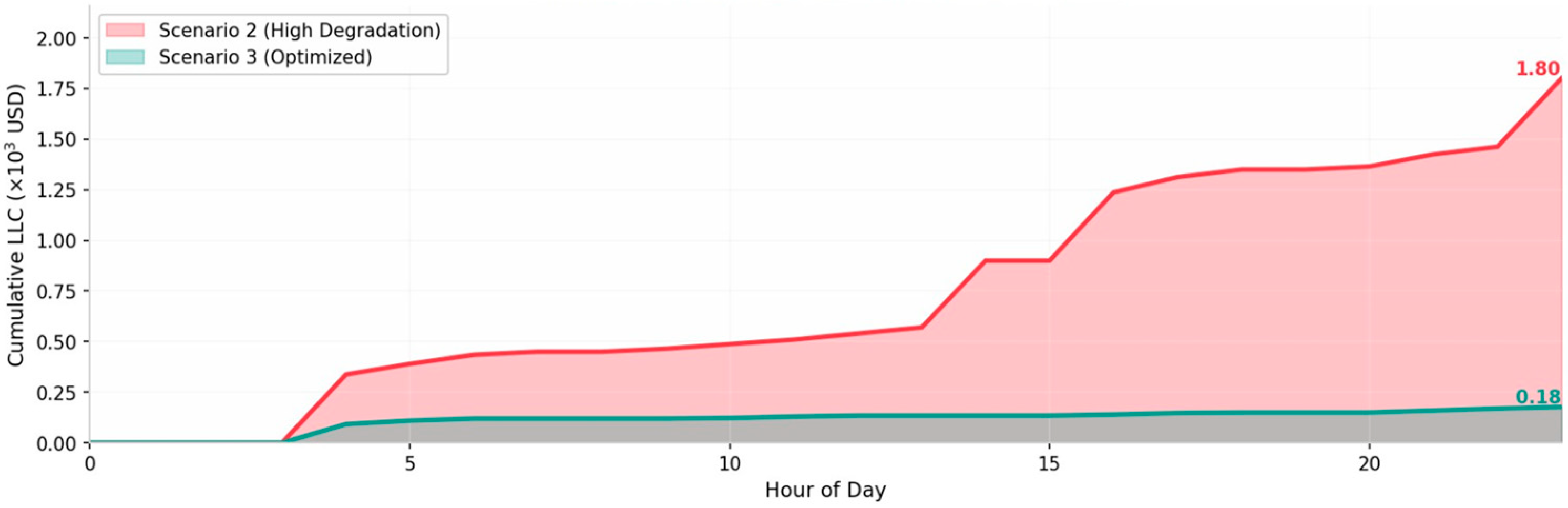
- Leveraging the dynamic PEM model, we construct an optimal operation model for an electricity–hydrogen IES aimed at minimizing daily operational costs, encompassing electricity procurement expenses, penalties for renewable energy curtailment, and carbon emission costs. We propose a novel Loss of Life Cost (LLC) model that quantifies the economic impact of operational cycles on PEM electrolyzer degradation. This model captures the degradation of proton exchange membranes and catalyst layers caused by frequent start–stop transitions and load variations, enabling total cost of ownership optimization.
- (3)
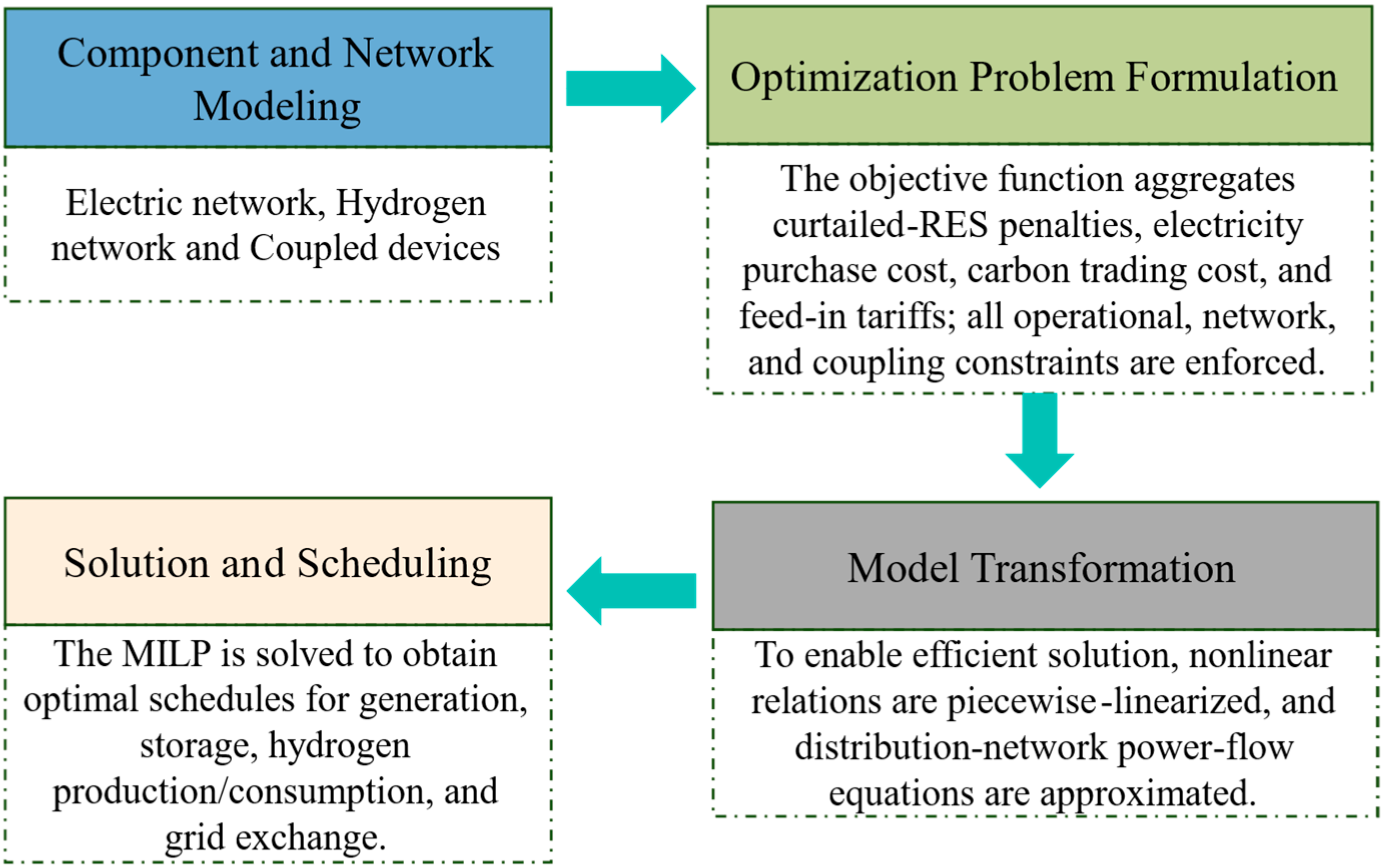
- To improve computational efficiency, we introduce a model transformation method that linearizes the nonlinear relationships in the PEM electrolyzer model and the hydrogen pipeline gas flow equations through piecewise linear approximation. Along with a suitable simplification of the power flow equations, the entire problem is reformulated as a mixed-integer linear programing (MILP) model, which can be effectively solved using commercial optimization software.
2. Dynamic Characteristics of PEM Electrolysis Cells
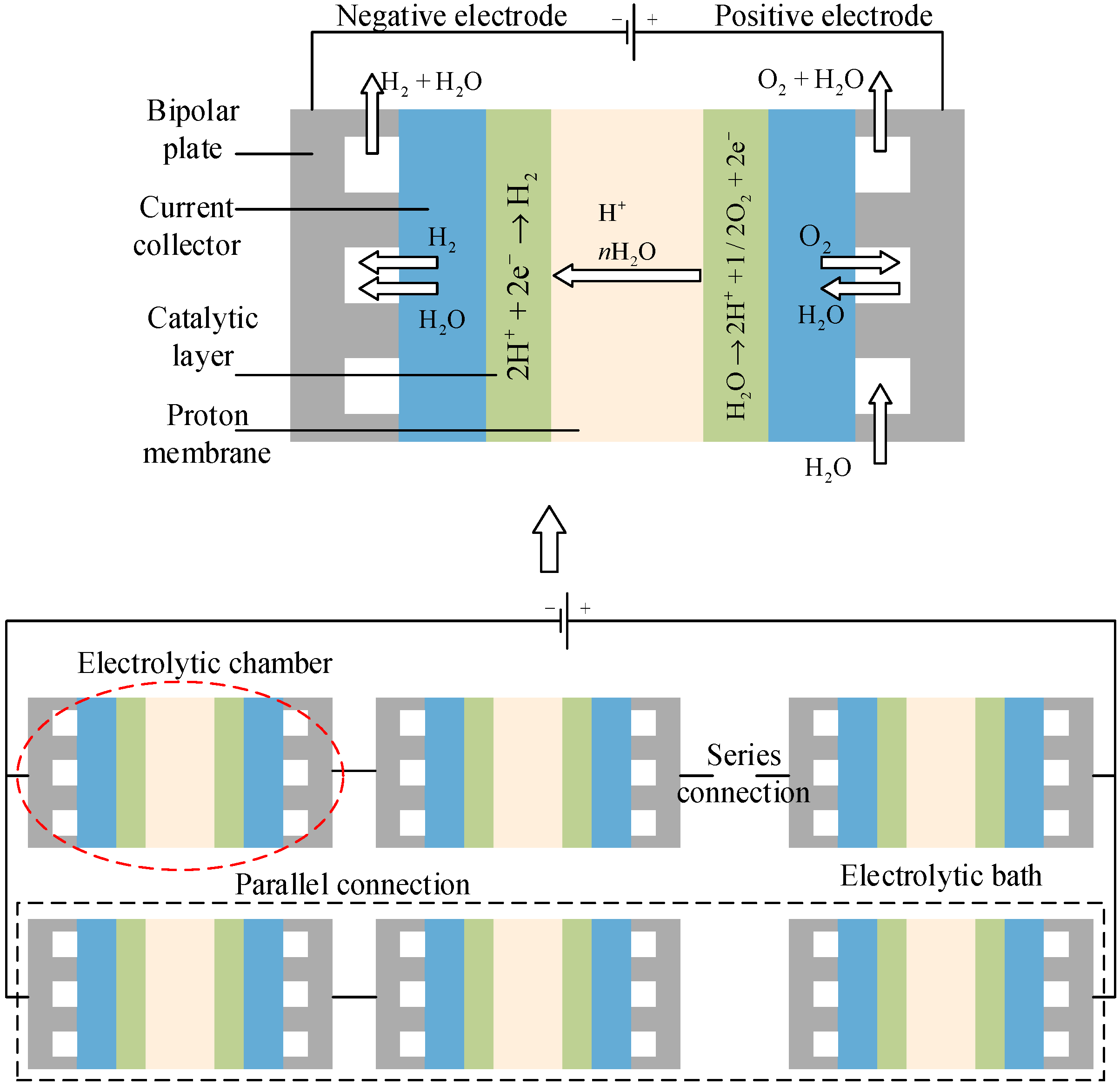
2.1. PEM-Based Water Electrolysis System for Hydrogen Production
2.2. Loss of Life Cost Modeling for PEM Electrolyzers
3. Optimization Operation Model for Electricity–Hydrogen IES
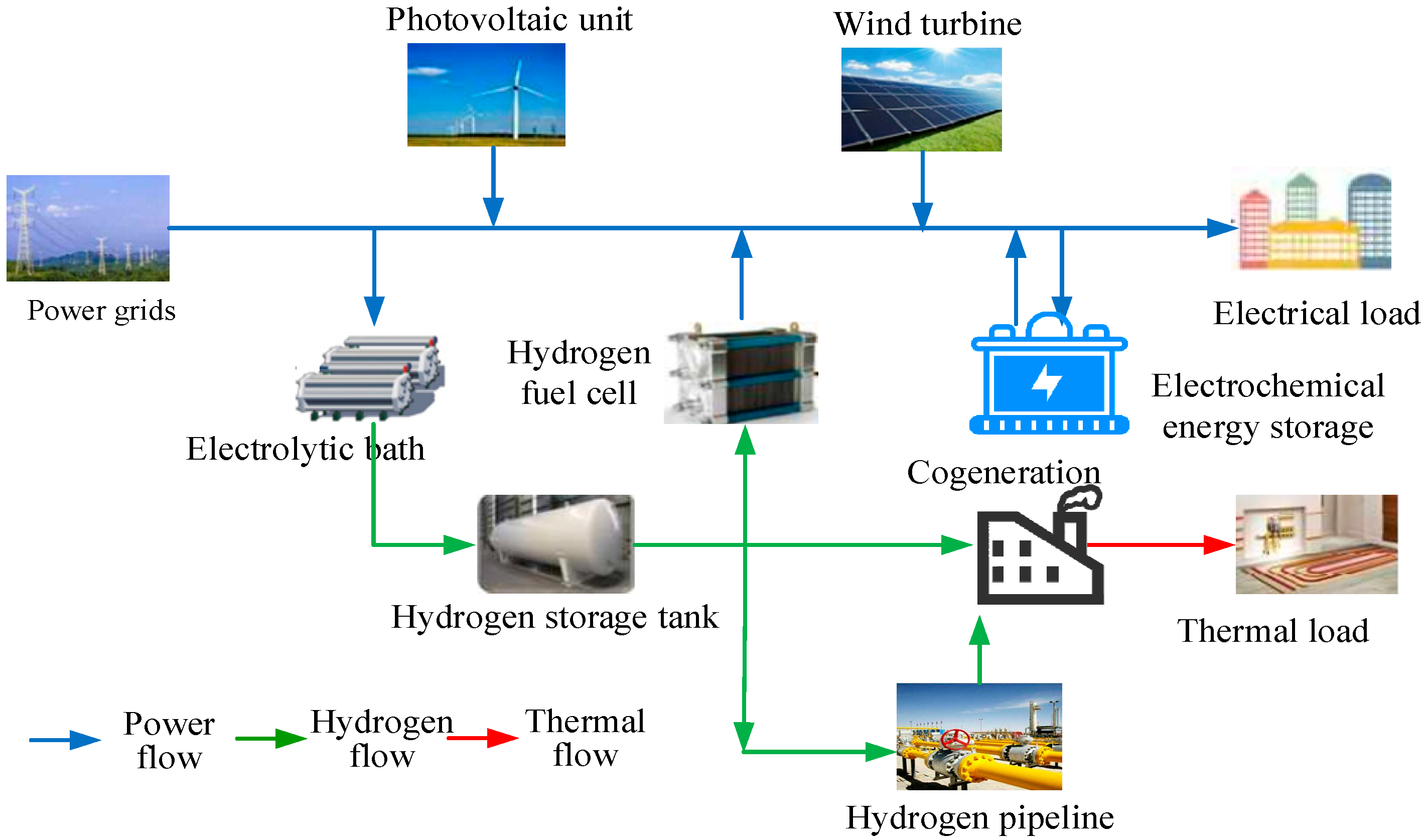
3.1. Basic Structure of the Electricity–Hydrogen IES
3.2. Objective Function
3.3. Constraints
- (1)
- Power Flow Equations
- (2)
- Hydrogen Storage Tank Operational Constraints
- (3)
- Hydrogen Fuel Cell Operational Constraints
- (4)
- Hydrogen Pipeline Gas Flow Equation
- (5)
- Equation for the Continuity of Hydrogen Flow in the Network
- (6)
- Electrical ES Operation Constraints
- (7)
- Operational Constraints for combined heat and power (CHP) Units
- (8)
- Power Balance Constraints for Integrated Electricity–Hydrogen Energy Systems
- (9)
- Node Voltage and Gas Pressure Constraints
- (10)
- Branch Transmission Capacity Constraints
4. Model Transformation and Solution
5. Case Study Analysis
5.1. Simulation Case Setup
5.2. Comparative Analysis of Simulation Results
- (1)
- Economic Performance Analysis
- (2)
- Hydrogen Production Analysis
5.3. Sensitivity Analysis
5.4. Robustness Analysis
5.5. Comparison of Various Models
6. Conclusions
Author Contributions
Funding
Data Availability Statement
Conflicts of Interest
References
- Karakurt, I.; Aydin, G. Development of regression models to forecast the CO2 emissions from fossil fuels in the BRICS and MINT countries. Energy 2023, 263, 125650. [Google Scholar] [CrossRef]
- Liu, S.; Li, H.; Zhang, K.; Lau, H.C. Techno-economic analysis of using carbon capture and storage (CCS) in decarbonizing China’s coal-fired power plants. J. Clean. Prod. 2022, 351, 131384. [Google Scholar] [CrossRef]
- He, Y.; Guo, S.; Dong, P.; Lv, D.; Zhou, J. Feasibility analysis of decarbonizing coal-fired power plants with 100% renewable energy and flexible green hydrogen production. Energy Convers. Manag. 2023, 290, 117232. [Google Scholar] [CrossRef]
- Kojima, H.; Nagasawa, K.; Todoroki, N.; Ito, Y.; Matsui, T.; Nakajima, R. Influence of renewable energy power fluctuations on water electrolysis for green hydrogen production. Int. J. Hydrogen Energy 2023, 48, 4572–4593. [Google Scholar] [CrossRef]
- Wang, J.; Kang, L.; Liu, Y. Optimal design of a renewable hydrogen production system by coordinating multiple PV arrays and multiple electrolyzers. Renew. Energy 2024, 225, 120304. [Google Scholar] [CrossRef]
- Buttler, A.; Spliethoff, H. Current status of water electrolysis for energy storage, grid balancing and sector coupling via power-to-gas and power-to-liquids: A review. Renew. Sustain. Energy Rev. 2018, 82, 2440–2454. [Google Scholar] [CrossRef]
- Mohammadi, A.; Mehrpooya, M. A comprehensive review on coupling different types of electrolyzer to renewable energy sources. Energy 2018, 158, 632–655. [Google Scholar] [CrossRef]
- Gul, E.; Baldinelli, G.; Farooqui, A.; Bartocci, P.; Shamim, T. AEM-electrolyzer based hydrogen integrated renewable energy system optimisation model for distributed communities. Energy Convers. Manag. 2023, 285, 117025. [Google Scholar] [CrossRef]
- El-Emam, R.S.; Özcan, H. Comprehensive review on the techno-economics of sustainable large-scale clean hydrogen production. J. Clean. Prod. 2019, 220, 593–609. [Google Scholar] [CrossRef]
- Stansberry, J.M.; Brouwer, J. Experimental dynamic dispatch of a 60 kW proton exchange membrane electrolyzer in power-to-gas application. Int. J. Hydrogen Energy 2020, 45, 9305–9316. [Google Scholar] [CrossRef]
- Hernández-Gómez, Á.; Ramirez, V.; Guilbert, D. Investigation of PEM electrolyzer modeling: Electrical domain, efficiency, and specific energy consumption. Int. J. Hydrogen Energy 2020, 45, 14625–14639. [Google Scholar] [CrossRef]
- Marangio, F.; Santarelli, M.; Cali, M. Theoretical Model and Experimental Analysis of A High Pressure PEM Water Eletrolyser for Hydrogen Production. Int. J. Hydrogen Energy 2009, 34, 1143–1158. [Google Scholar] [CrossRef]
- Zheng, Y.; You, S.; Bindner, H.W.; Münster, M. Optimal day-ahead dispatch of an alkaline electrolyser system concerning thermal–electric properties and state-transitional dynamics. Appl. Energy 2022, 307, 118091. [Google Scholar] [CrossRef]
- Yodwong, B.; Guilbert, D.; Phattanasak, M.; Kaewmanee, W.; Hinaje, M.; Vitale, G. AC-DC converters for electrolyzer applications: State of the art and future challenges. Electronics 2020, 9, 912. [Google Scholar] [CrossRef]
- Wang, Z.; Hu, J.; Liu, B. Stochastic optimal dispatching strategy of electricity-hydrogen-gas-heat integrated energy system based on improved spectral clustering method. Int. J. Electr. Power Energy Syst. 2021, 126, 106495. [Google Scholar] [CrossRef]
- Li, Z.; Xia, Y.; Bo, Y.; Wei, W. Optimal planning for electricity-hydrogen integrated energy system considering multiple timescale operations and representative time-period selection. Appl. Energy 2024, 362, 122965. [Google Scholar] [CrossRef]
- Yang, L.; Cao, X.; Zhou, Y.; Lin, Z.; Zhou, J.; Guan, X.; Wu, Q. Frequency-Constrained Coordinated Scheduling for Asynchronous AC Systems under Uncertainty via Distributional Robustness. IEEE Trans. Netw. Sci. Eng. 2025, 12, 4846–4862. [Google Scholar] [CrossRef]
- Lin, C.; Wu, W.; Wang, B.; Shahidehpour, M.; Zhang, B. Joint Commitment of Generation Units and Heat Exchange Stations for Combined Heat and Power Systems. IEEE Trans. Sustain. Energy 2020, 11, 1118–1127. [Google Scholar] [CrossRef]
- Wu, T.; Zhang, Y.-J.A.; Wang, S. Deep Learning to Optimize: Security-Constrained Unit Commitment With Uncertain Wind Power Generation and BESSs. IEEE Trans. Sustain. Energy 2022, 13, 231–240. [Google Scholar] [CrossRef]
- Awasthi, A.; Scott, K.; Basu, S. Dynamic Modeling and Simulation of a Proton Exchange Membrane Electrolyzer for Hydrogen Production. Int. J. Hydrogen Energy 2011, 36, 14779–14786. [Google Scholar] [CrossRef]
- Cai, P.; Mi, Y.; Ma, S.; Li, H.; Li, D.; Wang, P. Hierarchical game for integrated energy system and electricity-hydrogen hybrid charging station under distributionally robust optimization. Energy 2023, 283, 128471. [Google Scholar] [CrossRef]
- Zhou, D.; Yan, S.; Huang, D.; Shao, T.; Xiao, W.; Hao, J.; Wang, C.; Yu, T. Modeling and simulation of the hydrogen blended gas-electricity integrated energy system and influence analysis of hydrogen blending modes. Energy 2022, 239, 121629. [Google Scholar] [CrossRef]
- Cheng, Y.; Zhang, N.; Zhang, B.; Kang, C.; Xi, W.; Feng, M. Low-carbon operation of multiple energy systems based on energy-carbon integrated prices. IEEE Trans. Smart Grid 2020, 11, 1307–1318. [Google Scholar] [CrossRef]
- Santos, S.F.; Fitiwi, D.Z.; Shafie-Khah, M.; Bizuayehu, A.W.; Cabrita, C.M.P.; Catalao, J.P.S. New Multistage and Stochastic Mathematical Model for Maximizing RES Hosting Capacity—Part I: Problem Formulation. IEEE Trans. Sustain. Energy 2017, 8, 304–319. [Google Scholar] [CrossRef]
- Shi, Q.; Zhu, Y.; Fan, K.; Cheng, R.; Shen, J.; Liu, W. Two-Stage Linearization of Frequency Nadir Constraint for Unit Commitment. IEEE Trans. Power Syst. 2025, 40, 3584–3587. [Google Scholar] [CrossRef]
- Han, F.; Zeng, J.; Lin, J.; Gao, C.; Ma, Z. A novel two-layer nested optimization method for a zero-carbon island integrated energy system, incorporating tidal current power generation. Renew. Energy 2023, 218, 119381. [Google Scholar] [CrossRef]
- Lin, W.; Yang, Z.; Yu, J.; Li, W. Transmission Expansion Planning With Feasible Region of Hydrogen Production From Water Electrolysis. IEEE Trans. Ind. Appl. 2022, 58, 2863–2874. [Google Scholar] [CrossRef]
- Khalid, F.; Dincer, I.; Rosen, M.A. Analysis and assessment of an integrated hydrogen energy system. Int. J. Hydrogen Energy 2016, 41, 7960–7967. [Google Scholar] [CrossRef]



| Technology | Efficiency | Capital Cost | Carbon Emissions | Flexibility |
|---|---|---|---|---|
| PEM Electrolyzers | High (70–80%) | High | Low | High |
| Alkaline Electrolyzers | Moderate (55–65%) | Moderate | Moderate | Low |
| AEM Electrolyzers | Moderate (60–70%) | Low | Moderate | Moderate |
| Aspect | Existing Representative Work | the Main Contributions of this Paper |
|---|---|---|
| PEM model | Experiments or mechanism modeling are mostly conducted at the component or simulation level or employ constant efficiency at the system level. | Exploring the dynamic characteristics of PEM electrolysis cells, incorporating variable efficiency and start–stop impacts into system-level intraday operations. |
| Impact of Start–Stop and Load Range | This metric is often overlooked or approximated with soft constraints. | This paper employs explicit binary variables to characterize the impact of start–stop operation and power intervals, thereby avoiding the optimistic bias. |
| H2 network | Most references do not explicitly model or only calculate “point-to-point” traffic. | This paper investigates the characteristics of isothermal steady-state flow in relation to node continuity and pipe resistance, maintaining physical consistency between the electricity–hydrogen dual networks. |
| Node | Equipment | Total Capacity |
|---|---|---|
| 1,4,8,10 | Hydrogen Storage Tank | 3000 kg |
| 2,6,15,20 | PEM Electrolyzer | 200 MW |
| 16,23 | Hydrogen Fuel Cell | 200 MW |
| 11,17 | CHP Plant | 280 MW |
| 2,5,10 | Wind Farm | 500 MW |
| 18,23 | PV Power Plant | 640 MW |
| 7,9,16 | Electrical ES System | 500 MWh |
| Scenario | Ccurt | Cgrid | Ccarbon | CLLC |
|---|---|---|---|---|
| 1 (Constant Efficiency) | 10.98 | 12.79 | 3.45 | 0.00 |
| 2 (Unconstrained) | 4.23 | 9.45 | 2.56 | 6.85 |
| 3 (Proposed model) | 5.67 | 10.67 | 2.75 | 1.21 |
| Scenario | Power Consumption (p.u.) | Hydrogen Production (p.u.) | Daily LLC (%) |
|---|---|---|---|
| 1 | 780 | 650 | 0.00 |
| 2 | 650 | 715 | 2.43 |
| 3 | 679 | 685 | 0.42 |
| Electrolyzer Capacity | Scenario 1 | Scenario 2 | Scenario 3 |
|---|---|---|---|
| 200 MW | 36.67 | 35.67 | 30.92 |
| 260 MW | 25.47 | 20.15 | 21.02 |
| 300 MW | 21.03 | 14.34 | 19.79 |
| Strategy | Key PEM Modeling & Constraints | Best Features/Limitations |
|---|---|---|
| Constant-efficiency PEM baseline (Scenario 1) | PEM efficiency treated as constant; dynamics ignored | Feature: simple and fast to model. Limitation: overestimates H2 from variable conditions; inflates curtailment and cost; misjudges emissions. |
| Idealized unconstrained PEM (Scenario 2) | Ignores practical start–stop/power-range limits | Feature: lower nominal costs. Limitation: physically unrealistic; systematically underestimates purchases/emissions; not directly implementable; Accelerate equipment degradation speed. |
| Proposed strategy (Scenario 3) | Variable efficiency; explicit start–stop and power-range constraints via binary variables; piecewise linearization of PEM characteristics | Features: physically consistent dispatch; avoids optimistic bias; tractable day-ahead scheduling; Reasonably control the degradation speed of equipment. Limitations: slightly higher cost than idealized unconstrained variant because realism is enforced. |
| Electrolyzer Capacity | Scenario 1 | Scenario 2 | Scenario 3 |
|---|---|---|---|
| 200 MW | 37.95 | 41.56 | 31.38 |
| 260 MW | 26.23 | 24.18 | 21.44 |
| 300 MW | 21.56 | 18.36 | 20.09 |
Disclaimer/Publisher’s Note: The statements, opinions and data contained in all publications are solely those of the individual author(s) and contributor(s) and not of MDPI and/or the editor(s). MDPI and/or the editor(s) disclaim responsibility for any injury to people or property resulting from any ideas, methods, instructions or products referred to in the content. |
© 2026 by the authors. Licensee MDPI, Basel, Switzerland. This article is an open access article distributed under the terms and conditions of the Creative Commons Attribution (CC BY) license.
Share and Cite
Mao, C.; Rao, C.; Liang, J.; Wang, J.; Ji, P.; Zheng, Y. Optimal Operation for Electricity–Hydrogen Integrated Energy System Accounting for Dynamic Traits of Proton Exchange Membrane Electrolyzer. Membranes 2026, 16, 127. https://doi.org/10.3390/membranes16040127
Mao C, Rao C, Liang J, Wang J, Ji P, Zheng Y. Optimal Operation for Electricity–Hydrogen Integrated Energy System Accounting for Dynamic Traits of Proton Exchange Membrane Electrolyzer. Membranes. 2026; 16(4):127. https://doi.org/10.3390/membranes16040127
Chicago/Turabian StyleMao, Chengbo, Chaoping Rao, Jitao Liang, Jiahao Wang, Peirong Ji, and Yi Zheng. 2026. "Optimal Operation for Electricity–Hydrogen Integrated Energy System Accounting for Dynamic Traits of Proton Exchange Membrane Electrolyzer" Membranes 16, no. 4: 127. https://doi.org/10.3390/membranes16040127
APA StyleMao, C., Rao, C., Liang, J., Wang, J., Ji, P., & Zheng, Y. (2026). Optimal Operation for Electricity–Hydrogen Integrated Energy System Accounting for Dynamic Traits of Proton Exchange Membrane Electrolyzer. Membranes, 16(4), 127. https://doi.org/10.3390/membranes16040127