

Pilot Plant Test of Single-Pass Electrodialysis Reversal System



Abstract
1. Introduction
- (1)
- Can the novel EDR unit reach a demineralization level comparable or lower than commercial EDR units used in the energy industry?
- (2)
- Can the novel EDR unit offer a water recovery that is comparable or higher than commercial EDR units used in the energy industry?
- (3)
- Can the novel EDR unit achieve both those feats while still being cheaper than commercial EDR units?
- (1)
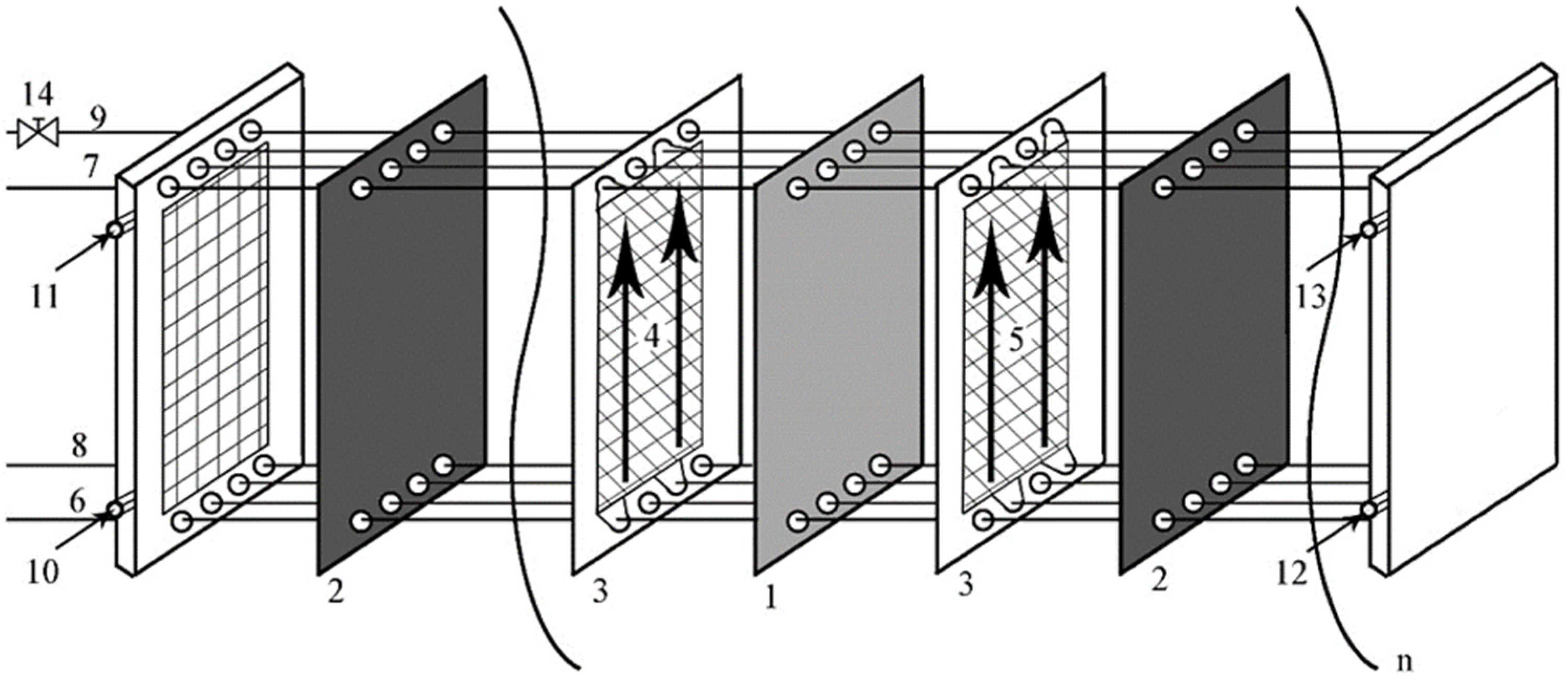
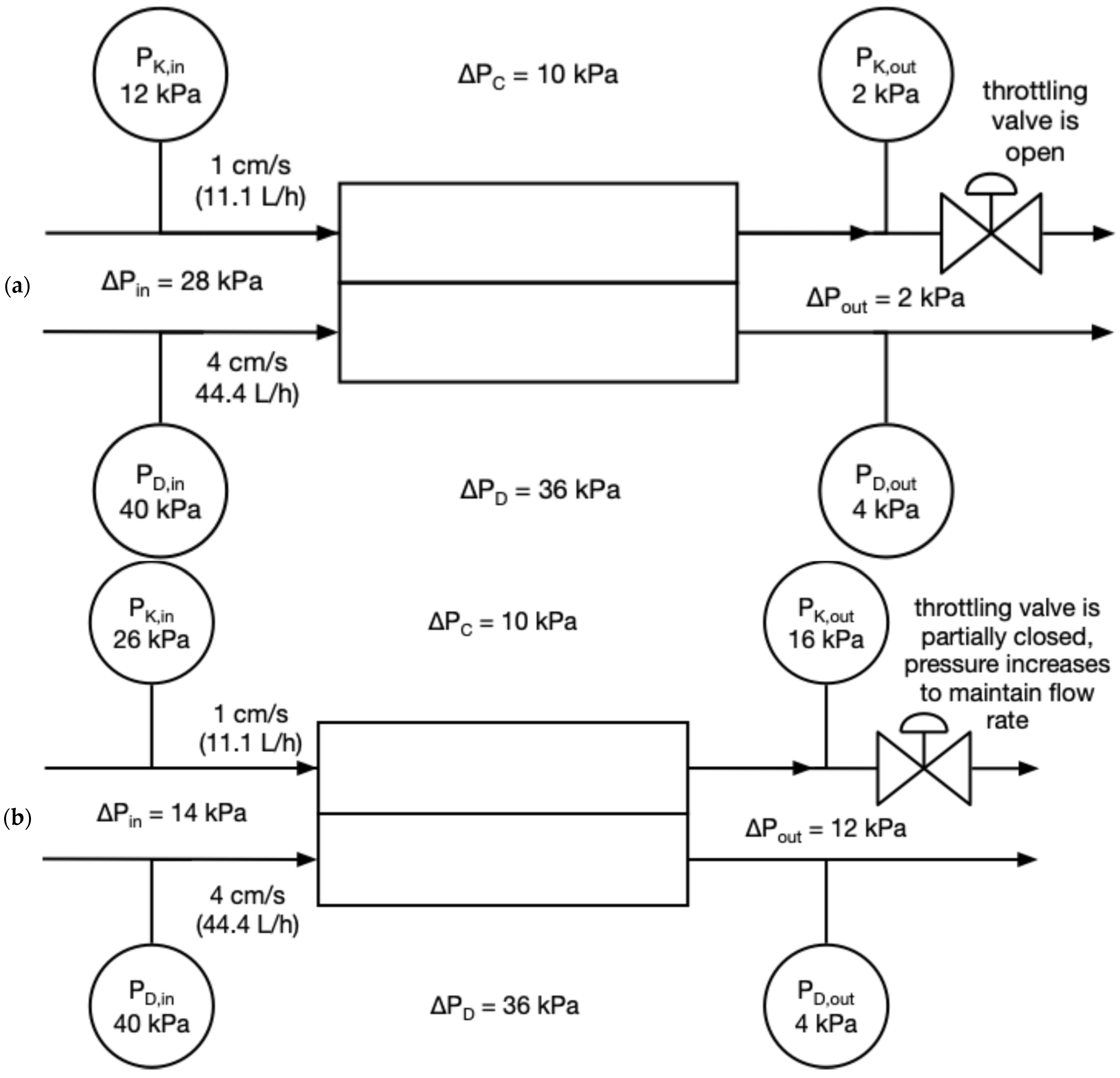
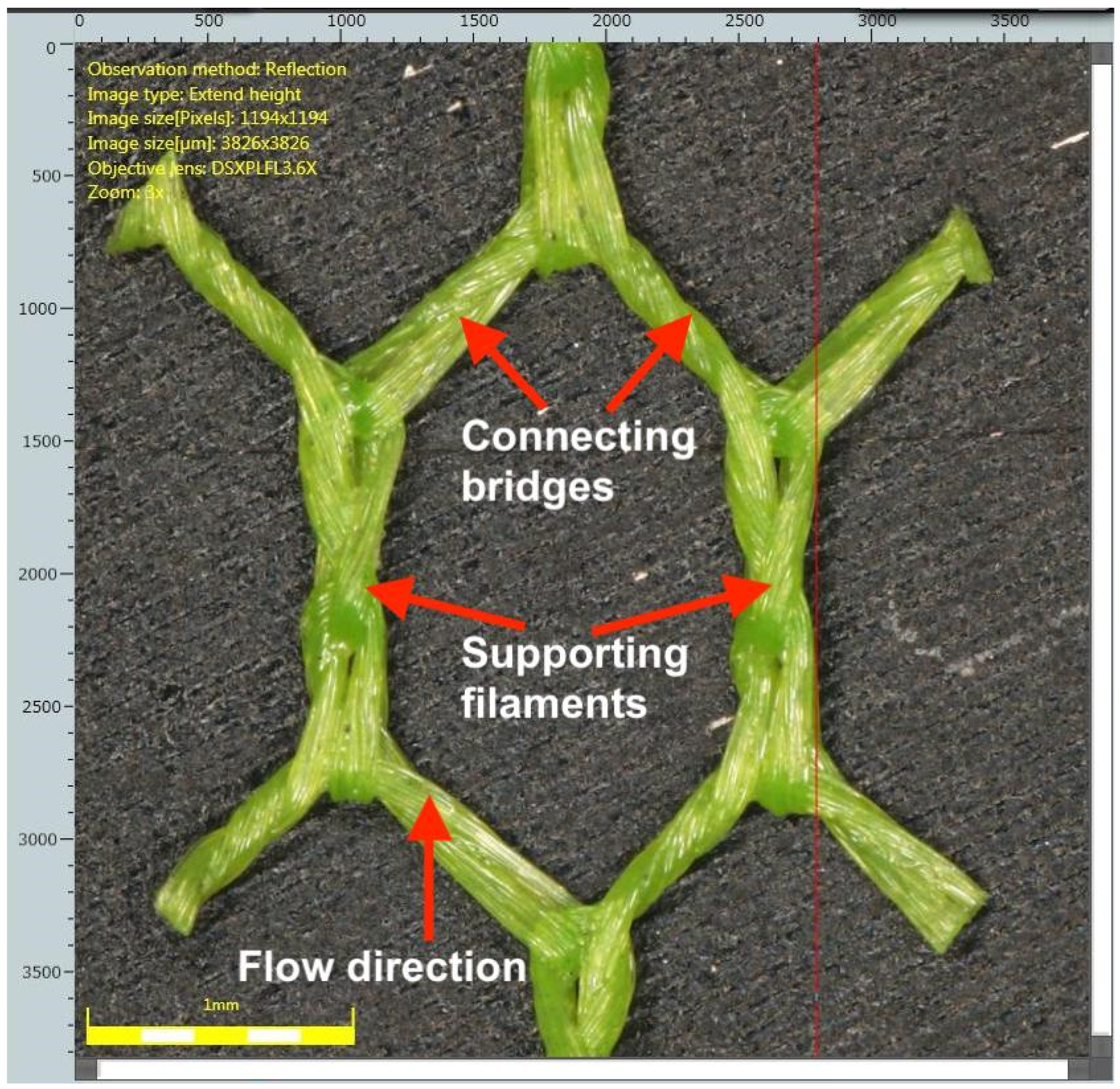
- Description of the novel elements of the EDR unit,
- (2)
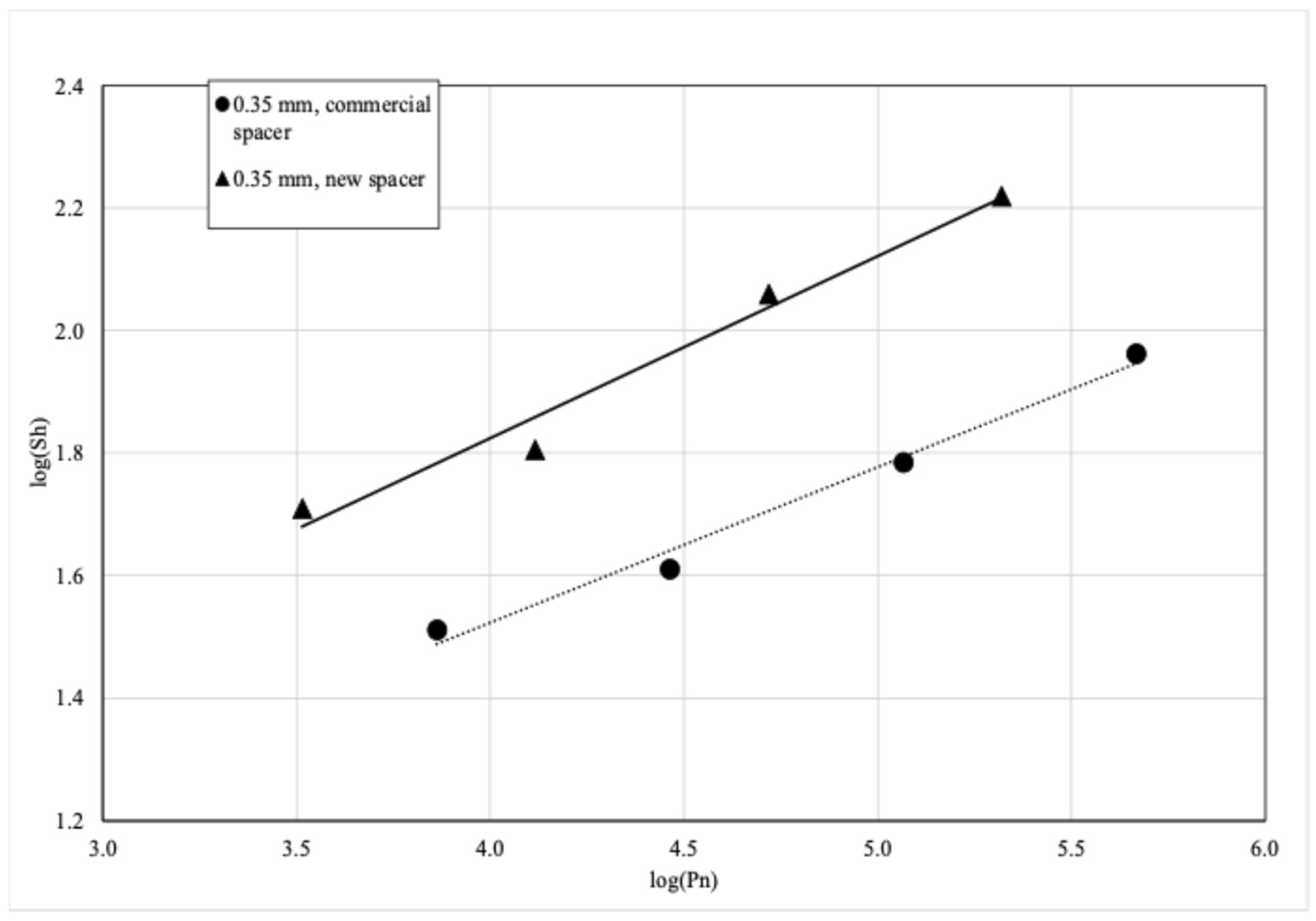
- Design process of the EDR unit with auxiliary bench-scale tests on smaller units,
- (3)
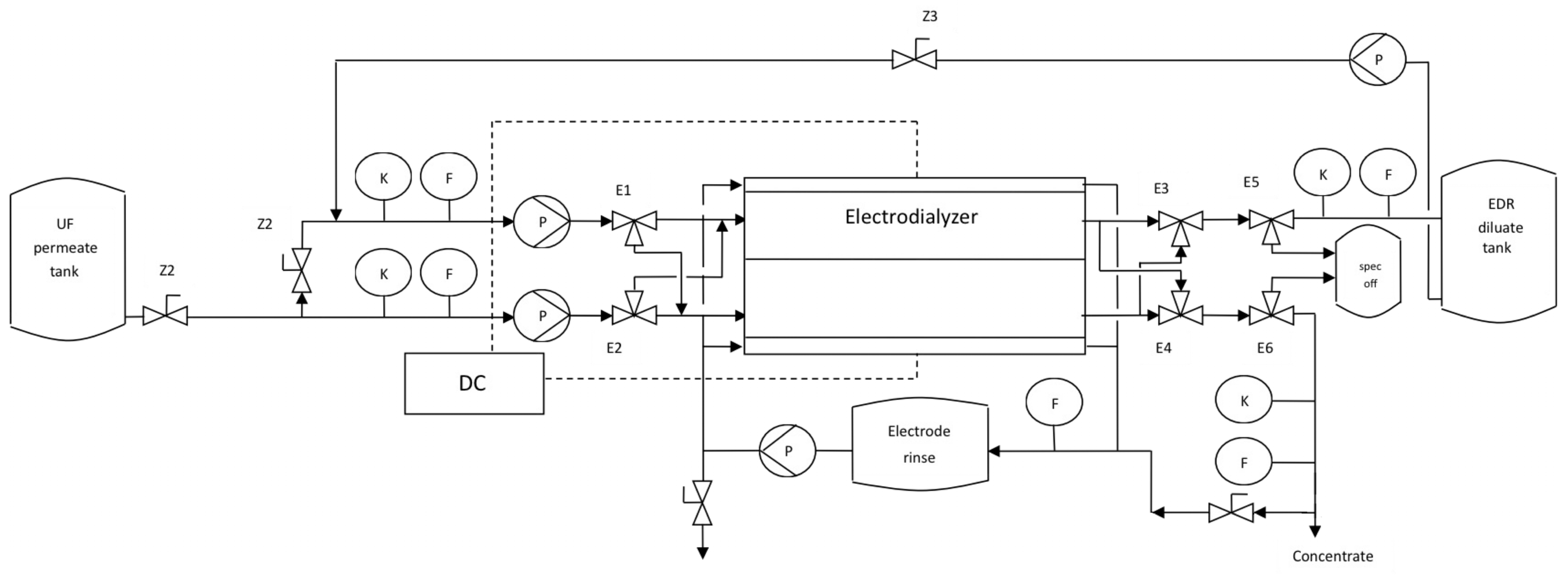
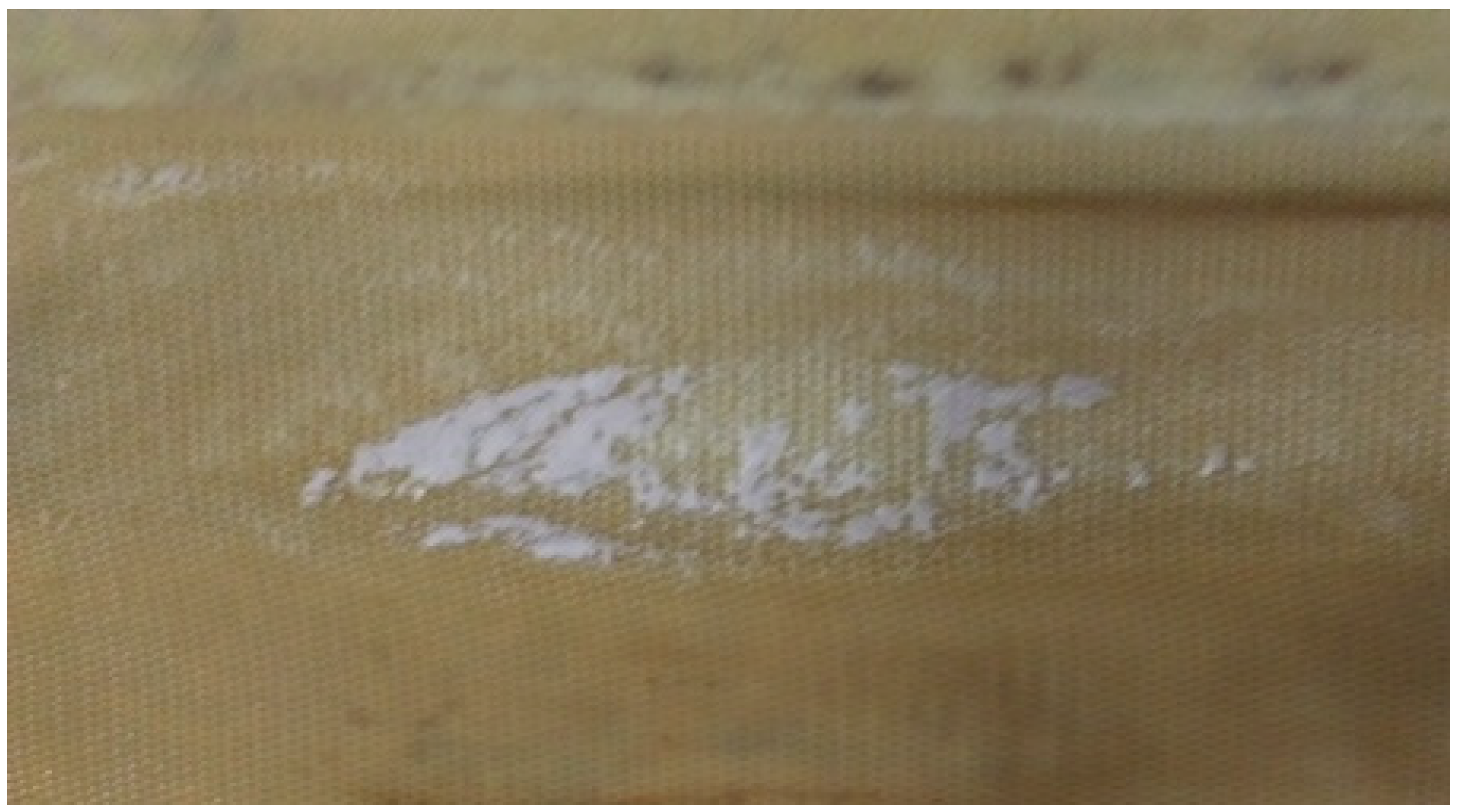
- Pilot tests of the EDR unit to determine the stability of the operation and to observe the achievable demineralization level, recovery, and occurrence of scaling,
- (4)
- Economic assessment of the EDR unit based on data collected during the pilot-scale test.
2. Materials and Methods
2.1. Description of Novel EDR Unit
2.1.1. Pressure Control Strategy
2.1.2. Novel Intermembrane Spacers
2.2. Auxiliary ED Experiments During the EDR Design Step
2.3. Pilot-Scale Test of the Constructed Novel EDR Unit
2.4. Economic Analysis
3. Results
3.1. Design of Single-Pass Electrodialyzer and the Auxiliary ED Experiments
- -
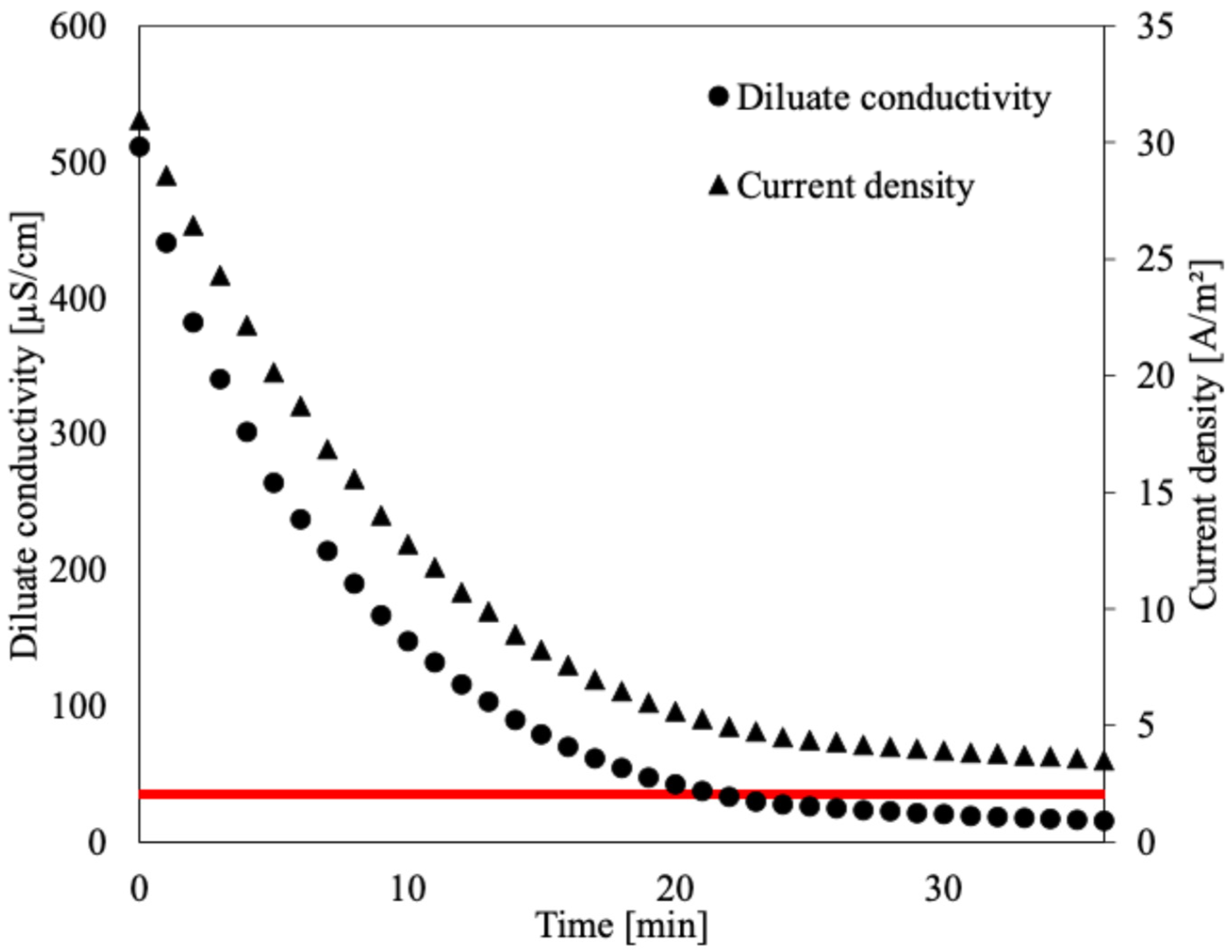
- Assume the design of a counter-current, single-pass electrodialyzer that works on a solution with a conductivity of 800 µS/cm. The feed is desalinated down to 35 µS/cm in the diluate compartment; simultaneously, the concentrate conductivity increases from 800 to 3000 µS/cm,
- -
- Consider two ends of said counter-current electrodialyzer. At one end, the 800 µS/cm solution enters the diluate compartment, while the 3000 µS/cm concentrate leaves the concentrate compartment. At the other end, the 35 µS/cm solution leaves the diluate compartment, while the 800 µS/cm feed enters the concentrate compartment,
- -
- Determine the limiting current density in a bench-scale electrodialyzer operating in a batch mode on a 35 µS/cm solution in the diluate compartment and 800 µS/cm in the concentrate compartment. This will simulate one end of the counter-current electrodialyzer,
- -
- Determine the limiting current density in a bench-scale electrodialyzer operating in a batch mode on an 800 µS/cm solution in the diluate compartment and a 3000 µS/cm solution in the concentrate compartment. This will simulate the second end of the counter-current electrodialyzer,
- -
- Assume working at 80% of the limiting current density and a first-order kinetic model for the distribution of the current density along the membrane; use Equation (1) to calculate the required membrane length.
3.2. Pilot-Scale Tests of Single-Pass EDR
3.3. Economic Analysis of the Proposed Solution
- -
- Membrane price: A value of 38 $/m2 was assumed for the base scenario, following real prices of cheap ion-exchange membranes [31], 10 $/m2 for the optimistic scenario, and 189 $/m2 for the pessimistic scenario. While the 10 $/m2 value is nowhere near commercial prices and we disputed this value in our previous work [32], a lot of techno-economic analyses claim that the membrane cost can be lowered down to this level. The pessimistic scenario was conducted to assume the price of high-end homogenous membranes following the 222 $/m2 data presented in [30] with an exchange rate of 1 $ = 0.85 €.
- -
- Alectricity price: A value of 0.11 €/kWh was assumed as the base scenario, following real prices of electricity for non-household consumers in Poland [33]. For the optimistic scenario, an electricity price of 0.05 €/kWh was assumed following the lowest electricity price for non-household consumers in the EU in 2024 (Norway) [33], and for the pessimistic scenario, a value of 0.26 €/kWh was assumed (highest price, Ireland),
- -
- EDR equipment: The base scenario was 321 €/m2, following Nayar et al.’s [30] assumption of an ED plant CAPEX of 600 $/m2, out of which 222 $/m2 is the membrane and 378 $/m2 is everything else, and assuming a currency exchange of 1 $ = 0.85 €. The optimistic scenario was assumed to be 20% lower than the base scenario, while the pessimistic scenario was assumed to be 20% higher.
- -
- Membrane lifetime: The base scenario was 80,000 h of work, which is an assumption based on our experiences with industrial EDR plants. For sensitivity analysis, +20% and −20% lifetime values were assumed as the optimistic and pessimistic scenarios, respectively.
4. Discussion
5. Conclusions
6. Patents
Author Contributions
Funding
Data Availability Statement
Conflicts of Interest
Abbreviations
| COD | Chemical oxygen demand |
| DC | Direct current |
| ED | Electrodialysis |
| EDR | Electrodialysis reversal |
| RO | Reverse osmosis |
| TOC | Total organic carbon |
Appendix A
- 1.
- Collect the following input data:
- Number of membrane pairs, n, dimensionless; in our case, n = 8.
- Operating current density, i [A/m2]; in our case, i = 8.57 A/m2 (average value of the 17/1.5 working/spec-off time ratio in Table 3) or i = 11.4 A/m2 (value that allowed for deep demineralization at a 17/1.5 working/spec-off time ratio).
- Operating voltage per membrane pair, U [V]; U = 2.51 V and U = 7 V for the average case and deep demineralization case, respectively.
- Electrode area, A [m2]. This value stems from the module geometry; in our case, A = 0.0836 m2.
- Feed flow rate, VF [m3/h], which is the sum of the diluate flow rate VD and concentrate flow rate VC. In the average case, VF = 58.15 L/h, VD = 43.17 L/h, VC = 14.98 L/h; in the deep demineralization case, VF = 65.5 L/h, VD = 45 L/h, VC = 20.5 L/h.
- Pressure drop along the diluate compartment; for the average case, ΔPD = 0.65 bar, and for the concentrate compartment, ΔPC = 0.153 bar; for the deep demineralization case, ΔPD = 0.7 bar, and for the concentrate compartment, ΔPC = 0.12 bar.
- 2.
- Calculate the energy required for electrodialysis as the DC current power per m3 of feed water treated, assuming a rectifier efficiency ηAC/DC of 90% (the rectifier transforms AC current into DC current required by the EDR, but part of the energy is lost; 90% is a typical value in the industry). By definition, the power is voltage x current, so taking into account the number of membrane pairs and electrode area, the equation for the average case and the deep demineralization case becomes, respectively:EDC = (n · U · A · i)/(ηAC/DC · VF) = (8 · 2.51 V · 0.0836 m2 · 8.57 A · m−2)/(0.9 · 58.15 dm3 · h−1) = 0.275 W · dm−3 · h = 0.275 kWh · m−3,EDC = (n · U · A · i)/(ηAC/DC · VF) = (8 · 7 V · 0.0836 m2 · 11.4 A · m−2)/(0.9 · 65.5 dm3 · h−1) = 0.905 W · dm−3 · h = 0.905 kWh · m−3,
- 3.
- Calculate the energy required for pumping per 1 m3 of feed water. The power requirement for the pump is pressure drop x flow rate/pump efficiency, so if we include different pressure drops in the diluate and concentrate compartments and assume a pump efficiency ηp of 80%, we get, for the average case and the deep demineralization case, respectively:EAC = (VD · ΔPD + VC · ΔPC)/(ηp · VF) = (43.17 dm3 · h−1 · 0.65 · 105 Pa + 14.98 dm3 · h−1 · 0.153 · 105 Pa)/(0.8 · 58.15 dm3 · h−1) = 0.018 kWh · m−3,EAC = (VD · ΔPD + VC · ΔPC)/(ηp · VF) = (40.5 dm3 · h−1 · 0.7 · 105 Pa + 20.5 dm3 · h−1 · 0.12 · 105 Pa)/(0.8 · 65.5 dm3 · h−1) = 0.015 kWh · m−3,
- 4.
- Next, calculate the operating costs by assuming that only the pumping costs and DC energy costs matter (chemicals costs are neglected) and assuming that the cost of electricity Cel is 0.11 €/kWh. For the average case and the deep demineralization case, respectively, the result is:OPEX = Cel · (EAC + EDC) = 0.11 · (0.018 + 0.275) = 0.032 € · m−3,OPEX = Cel · (EAC + EDC) = 0.11 · (0.015 + 0.905) = 0.101 € · m−3,
- 5.
- Next, calculate the investment costs using the following assumptions:
- Membrane cost of 38 €/m2 [31].
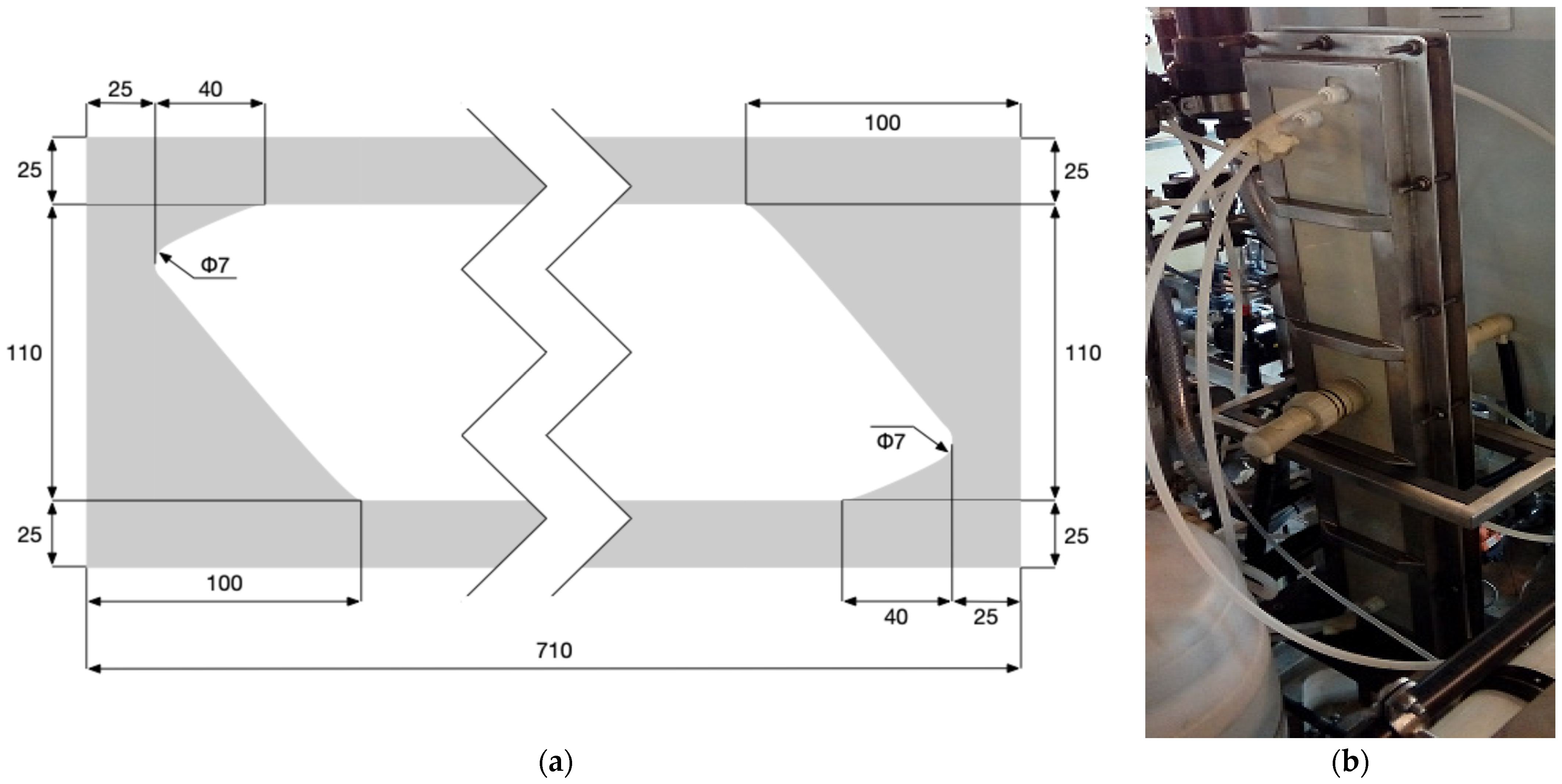
- Only 75% (ηm) of membrane area is the effective membrane area, and the remaining 25% is the sealing. Figure 4 presents the geometry of the spacer that can be used to explain the concept. Liquid can only flow along the white part in the middle, while the gray part is the sealing that prevents the liquid from spilling out. The membrane is in contact with the spacer and has the same area, but mass transfer can only occur when the membrane is in contact with the flowing liquid (i.e., only the area of the size of the white part in the middle would be effective). Additionally, because EDR requires both cation- and anion-exchange membranes, every cost relative to the membrane area should be multiplied by 2 × the number of membrane pairs.
- EDR equipment cost of 321 € per m2 of the effective membrane area installed. This is a common method for estimating the cost of ED/EDR plants, as the capital costs are mainly determined by the required membrane area for a given feed and product concentration [34]. For example, Chehayeb et al. [40] assumed that the fixed cost of ED is directly proportional to the membrane area. Nayar et al. [30] gave a capital cost value of a high-salinity ED plant of 600 $/m2, out of which 222 $/m2 was the membrane and 378 $/m2 was everything else. Taking into account a currency exchange of 1$ = 0.85€, we assumed a value of 321 €/m2 for the EDR equipment. In practice, that value could be lowered, because the low salinity of the feed does not necessitate as durable materials as those assumed in [30]. For the average case and for the deep demineralization case, the results are, respectively:
CAPEX = [2n · (Cm + Ceq) · A/ηm]/(tlife · VF) = [2 · 8 · (38 € · m−2 + 321 € · m−2) · 0.0836 m2/0.75]/(80000 h · 58.15 dm3 · h−1) = 0.138 € · m−3,CAPEX = [2n · (Cm + Ceq) · A/ηm]/(tlife · VF) = [2 · 8 · (38 € · m−2 + 321 € · m−2) · 0.0836 m2/0.75]/(80000 h · 65.5 dm3 · h−1) = 0.122 € · m−3,
References
- Wenten, I.G.; Bazant, M.Z.; Khoiruddin, K. Mitigating electrodialysis membrane fouling in seawater desalination. Sep. Purif. Technol. 2024, 345, 127228. [Google Scholar] [CrossRef]
- Reahl, E.R. Half a Century of Desalination with Electrodialysis; Ionics Technical Paper TP1038EN 0603; General Electric Company/GE Water & Process Technologies: Trevose, PA, USA, 2004. [Google Scholar]
- Severin, B.F.; Hayes, T.D. Electrodialysis of concentrated brines: Effects of multivalent cations. Sep. Purif. Technol. 2019, 218, 227–241. [Google Scholar] [CrossRef]
- Tanaka, Y. Ion Exchange Membranes: Fundamentals and Applications, 2nd ed.; Elsevier: Amsterdam, The Netherlands, 2015. [Google Scholar]
- Clímaco Patrocínio, D.; Neves Kunrath, C.C.; Siqueira Rodrigues, M.A.; Benvenuti, T.; Dani Rico Amado, F. Concentration effect and operational parameters on electrodialysis reversal efficiency applied for fluoride removal in groundwater. J. Environ. Chem. Eng. 2019, 7, 103491. [Google Scholar] [CrossRef]
- Walawege, D.D.; Wickramasingha, W.S.B.; Sandaruwan, R.D.C.; Udayanga, S.; Perera, I.J.J.U.N.; Nawalage, N.M.S.K.; Dassanayake, D.M.J.L.; Bellanthudawa, B.K.A. Electrodialysis reversal (EDR) technology: A viable solution for addressing water quality challenges in the dry zone, Sri Lanka. Water Pract. Technol. 2024, 19, 3972–3986. [Google Scholar] [CrossRef]
- Zhao, D.; Lee, L.Y.; Ong, S.L.; Chowdhury, P.; Siah, K.B.; Ng, H.Y. Electrodialysis reversal for industrial reverse osmosis brine treatment. Sep. Purif. Technol. 2019, 213, 339–347. [Google Scholar] [CrossRef]
- Lin, C.-W.; Tran, H.N.; Juang, R.-S. Reclamation and reuse of wastewater by membrane-based processes in a typical midstream petrochemical factory: A techno-economic analysis. Environ. Dev. Sustain. 2023, 26, 5419–5430. [Google Scholar] [CrossRef]
- Turek, M.; Was, J.; Dydo, P. Brackish water desalination in RO–single pass EDR system. Desalin. Water Treat. 2009, 7, 263–266. [Google Scholar] [CrossRef]
- Passanisi, J.; Persechino, J.; Reynolds, T.K. Project Compares Brackish Water Desalination Technologies—Part 2. Water Eng. Manag. 2002, 149, 4–6. [Google Scholar]
- Valero, F.; Barceló, A.; Arbós, R. Electrodialysis technology: Theory and applications. In Desalination, Trends and Technologies; Schorr, M., Ed.; InTech: Rijeka, Croatia, 2011; pp. 3–20. [Google Scholar]
- Hsu, Y.C.; Huang, H.H.; Huang, Y.D.; Chu, C.P.; Chung, Y.J.; Huang, Y.T. Survey on production quality of electrodialysis reversal and reverse osmosis on municipal wastewater desalination. Water Sci. Technol. 2012, 66, 2185–2193. [Google Scholar] [CrossRef]
- Mitko, K.; Rosiński, A.R.; Turek, M. Energy consumption in membrane capacitive deionization and electrodialysis of low salinity water. Desalin. Water Treat. 2021, 214, 294–301. [Google Scholar] [CrossRef]
- Kunrath, C.C.N.; Patrocínio, D.C.; Siqueira Rodrigues, M.A.; Benvenuti, T.; Amado, F.D.R. Electrodialysis reversal as an alternative treatment for producing drinking water from brackish river water: A case study in the dry season, northeastern Brazil. J. Environ. Chem. Eng. 2020, 8, 103719. [Google Scholar] [CrossRef]
- Xu, X.; He, Q.; Ma, G.; Wang, H.; Nirmalakhandan, N.; Xu, P. Pilot Demonstration of Reclaiming Municipal Wastewater for Irrigation Using Electrodialysis Reversal: Effect of Operational Parameters on Water Quality. Membranes 2021, 11, 333. [Google Scholar] [CrossRef]
- Balogun, H.A.; Ojelade, O.A.; Kareem, A.A.; Giwa, A.; Amusa, H.K.; Yusuf, A.O.; Amna, R.; Abid, H.A.; Okolie, J. Cost and energy requirement of electrochemical membrane systems: A critical review and data analysis. J. Environ. Chem. Eng. 2024, 12, 113733. [Google Scholar] [CrossRef]
- Tanaka, Y. Development of a computer simulation program of feed-and-bleed ion-exchange membrane electrodialysis for saline water desalination. Desalination 2014, 342, 126–138. [Google Scholar] [CrossRef]
- Matyja, A.; Zań, M. Połączenie różnych technik membranowych w procesie demineralizacji wody w TAURON Wytwarzanie S.A. Oddział Elektrownia Stalowa Wola. In Proceedings of the XII Forum Dyskusyjne Diagnostyka i Chemia dla Energetyki, Szczyrk, Poland, 22–24 May 2019. [Google Scholar]
- Turek, M.; Bernacka, E.; Mitko, K.; Kijański, M.; Chorążewska, M.; Miller-Turek, B. Spacer with Mixing Elements, Particularly for Membrane Modules. U.S. Patent US2021394120 (2025), 29 April 2025. [Google Scholar]
- Turek, M.; Laskowska, E.; Mitko, K. Electrodializer and Method of Conducting the Electrodialysis Process. Polish Patent PL241481, 10 October 2022. [Google Scholar]
- Turek, M.; Laskowska, E.; Mitko, K.; Sąkol-Sikora, D.; Stawiarz, T.; Krzyżak, W.; Zdeb, J.; Smółka, W. Method of Conducting the Electrodialysis Process. Polish Patent PL241092, 1 August 2022. [Google Scholar]
- Li, F.; Meindersma, W.; de Haan, A.B.; Reith, T. Novel spacers for mass transfer enhancement in mem-brane separations. J. Membr. Sci. 2005, 253, 1–12. [Google Scholar] [CrossRef]
- Lee, H.J.; Sarfert, F.; Strathmann, H.; Moon, S.H. Designing of an electrodialysis desalination plant. Desalination 2002, 142, 267–286. [Google Scholar] [CrossRef]
- Turek, M.; Gierzkiewicz, D.; Laskowska, E.; Słowik, M.; Mitko, K.; Dydo, P.; Sąkol-Sikora, D.; Stawiarz, T.; Krzyżak, W. The required membrane length in electrodialytic desalination of river water. Desalin. Water Treat. 2018, 128, 272–277. [Google Scholar] [CrossRef]
- Mitko, K.; Turek, M. Concentration distribution along the electrodialyzer. Desalination 2014, 341, 94–100. [Google Scholar] [CrossRef]
- Shaposhnik, V.A.; Kuzminykh, V.A.; Grigorchuk, O.V.; Vasileva, V.I. Analytical model of laminar flow electrodialysis with ion-exchange membranes. J. Membr. Sci. 1997, 133, 27–37. [Google Scholar] [CrossRef]
- Tanaka, Y. Current density distribution, limiting current density and saturation current density in an ion-exchange membrane electrodialyzer. J. Membr. Sci. 2002, 210, 65–75. [Google Scholar] [CrossRef]
- Tanaka, Y. A computer simulation of ion exchange membrane electrodialysis for concentration of seawater. Membr. Water Treat. 2010, 1, 13–37. [Google Scholar] [CrossRef]
- Tanaka, Y. Ion-exchange membrane electrodialysis program and its application to multi-stage continuous saline water desalination. Desalination 2012, 301, 10–25. [Google Scholar] [CrossRef]
- Nayar, K.G.; Fernandes, J.; McGovern, R.K.; Dominguez, K.P.; McCance, A.; Al-Anzi, B.S.; Lienhard V, J.H. Cost and energy requirements of hybrid RO and ED brine concentration systems for salt production. Desalination 2019, 456, 97–120. [Google Scholar] [CrossRef]
- Available online: https://www.alibaba.com/product-detail/Anion-exchange-membrane_60205080824.html (accessed on 30 June 2025).
- Turek, M.; Mitko, K. Challenges of Power Generation by Reverse Electrodialysis. Energies 2026, 19, 1061. [Google Scholar] [CrossRef]
- Available online: https://ec.europa.eu/eurostat/databrowser/view/nrg_pc_205_c/default/table?lang=en (accessed on 20 February 2026).
- Strathmann, H. Electrodialysis, a mature technology with a multitude of new applications. Desalination 2010, 264, 268–288. [Google Scholar] [CrossRef]
- Strnad, J.; Slouka, Z. Analysis of an underlimiting and overlimiting current regime in a single electrodialysis channel. Desalination 2024, 580, 117538. [Google Scholar] [CrossRef]
- Stockmeier, F.; Stüwe, L.; Kneppeck, C.; Musholt, S.; Albert, K.; Linkhorst, J.; Wessling, M. On the interaction of electroconvection at a membrane interface with the bulk flow in a spacer-filled feed channel. J. Membr. Sci. 2023, 678, 121589. [Google Scholar] [CrossRef]
- Vasil’eva, V.I.; Saud, A.M.; Akberova, E.M. Direct evidence for the electroconvective mechanism of neutral amino acid transport during electrodialysis. Mendeleev Commun. 2023, 33, 275–278. [Google Scholar] [CrossRef]
- Nikonenko, V.V.; Mareev, S.A.; Pis’menskaya, N.D.; Uzdenova, A.M.; Kovalenko, A.V.; Urtenov, M.K.H.; Pourcelly, G. Effect of Electroconvection and Its Use in Intensifying the Mass Transfer in Electrodialysis (Review). Russ. J. Electrochem. 2017, 53, 1122–1144. [Google Scholar] [CrossRef]
- Kim, J.; Kim, S.; Kwak, R. Controlling ion transport with pattern structures on ion exchange membranes in electrodialysis. Desalination 2023, 678, 121589. [Google Scholar] [CrossRef]
- Chehayeb, K.M.; Farhat, D.M.; Nayar, K.G.; Lienhard V, J.H. Optimal design and operation of electrodialysis for brackish-water desalination and for high-salinity brine concentration. Desalination 2017, 420, 167–182. [Google Scholar] [CrossRef]





| Linear Flow Velocity [cm/s] | i0 [A/m2] | U0 [V] | iL [A/m2] | UL [V] | L [m] | T [min] |
|---|---|---|---|---|---|---|
| 0.5 | 0.68 | 0.7 | 8.33 | 0.725 | 1.62 | 105 |
| 1 | 0.91 | 0.675 | 9.43 | 0.725 | 0.97 | 88 |
| 2 | 1.31 | 0.725 | 11.24 | 0.7 | 0.61 | 69 |
| 4 | 1.94 | 0.825 | 16.76 | 0.825 | 0.68 | 47 |
| Parameter | Average | Lowest | Highest |
|---|---|---|---|
| Conductivity [µS/cm] | 502 ± 15 | 479 | 522 |
| pH | 7.75 ± 0.18 | 7.40 | 7.97 |
| Turbidity [NTU] | 0.28 ± 0.19 | 0.11 | 0.68 |
| Total hardness [mmol/L] | 2.38 ± 0.35 | 2.01 | 3.02 |
| Ca2+ [mg/L] | 65.6 ± 11.2 | 52.0 | 86.0 |
| Mg2+ [mg/L] | 17.8 ± 3.1 | 13.9 | 24.0 |
| SiO2 [mg/L] | 4.75 ± 0.95 | 3.31 | 6.66 |
| SO42− [mg/L] | 48.1 ± 4.2 | 44.0 | 59.5 |
| Cl− [mg/L] | 30.8 ± 3.8 | 29.8 | 42.6 |
| CODKMnO4 [mg O/L] | 2.54 ± 0.49 | 2.13 | 3.50 |
| Flow Rate [L/h] | Conductivity [µS/cm] | i [A/m2] | U [V] | ΔP [bar] | Working/Spec-Off Time [min] | Recovery [%] | ||||
|---|---|---|---|---|---|---|---|---|---|---|
| D | C | F | D | C | D | C | ||||
| 5:1.33 working/spec-off ratio—scaling not observed | ||||||||||
| 23.1 | 11.4 | 522 | 57.7 | 1463 | 6.6 | 3.5 | 0.5 | 0.2 | 5/1.33 | 52.9% |
| 24.9 | 10.4 | 516 | 63.5 | 1599 | 6 | 3.25 | 0.73 | 0.3 | 5/1.33 | 55.7% |
| 21.6 | 6.4 | 498 | 89.2 | 1800 | 4.8 | 2.12 | 0.7 | 0.28 | 5/1.33 | 60.9% |
| 8:1–1.5 working/spec-off ratio—scaling not observed | ||||||||||
| 24 | 17.1 | 512 | 94.4 | 1026 | 6 | 2.5 | 0.8 | 0.6 | 8/1.5 | 49.2% |
| 37.2 | 21 | 520 | 88.7 | 1480 | 7.2 | 1.88 | 0.36 | 0.1 | 8/1.33 | 54.8% |
| 37.5 | 10.5 | 481 | 19.1 | 2176 | 11.4 | 7 | 0.36 | 0.06 | 8/1.33 | 67.0% |
| 37.5 | 10.5 | 481 | 39.2 | 2059 | 10.8 | 6 | 0.36 | 0.06 | 8/1.33 | 67.0% |
| 34.1 | 25.2 | 500 | 43.8 | 996 | 7.8 | 2.31 | 0.34 | 0.31 | 8/1.17 | 50.2% |
| 37.5 | 27 | 523 | 31 | 1206 | 10.2 | 5.5 | 0.4 | 0.16 | 8/1.17 | 50.7% |
| 37.2 | 22.6 | 500 | 56.7 | 1230 | 7.2 | 1.62 | 0.41 | 0.29 | 8/1 | 55.3% |
| 17:1.5 working/spec-off ratio—scaling not observed | ||||||||||
| 40.8 | 24 | 508 | 35 | 1312 | 9.6 | 3.62 | 0.6 | 0.3 | 17/1.5 | 57.9% |
| 45 | 20.5 | 511 | 17.9 | 1540 | 11.4 | 7 | 0.7 | 0.12 | 17/1.5 | 63.1% |
| 42.6 | 18.4 | 502 | 111.6 | 984 | 7.8 | 1.38 | 0.8 | 0.12 | 17/1.5 | 64.2% |
| 35.8 | 13.1 | 522 | 80 | 1730 | 7.2 | 1.12 | 0.7 | 0.16 | 17/1.5 | 67.3% |
| 25.8 | 8.4 | 511 | 92.6 | 1796 | 5.4 | 2.12 | 0.8 | 0.3 | 17/1.5 | 69.3% |
| 44.4 | 14.4 | 514 | 68 | 1889 | 8.6 | 2.31 | 0.6 | 0.17 | 17/1.5 | 69.4% |
| 43.4 | 13.8 | 508 | 72 | 1879 | 8.5 | 2.08 | 0.6 | 0.16 | 17/1.5 | 69.7% |
| 49.7 | 14.8 | 479 | 70.6 | 1768 | 9.6 | 2.25 | 0.7 | 0.14 | 17/1.5 | 70.8% |
| 37.5 | 10 | 514 | 84 | 2358 | 8 | 1.84 | 0.5 | 0.12 | 17/1.5 | 72.5% |
| 45 | 10.5 | 510 | 150 | 2053 | 6 | 0.62 | 0.6 | 0.12 | 17/1.5 | 74.5% |
| 47.5 | 10.3 | 511 | 63 | 2577 | 9 | 2.88 | 0.7 | 0.12 | 17/1.5 | 75.5% |
| 62:1.5 working/spec-off ratio—scaling not observed | ||||||||||
| 43.4 | 13.8 | 513 | 71 | N/A | 8.5 | 2.05 | 0.7 | 0.47 | 62/1.5 | 74.1% |
| 43.4 | 13.8 | 515 | 88 | N/A | 8 | 1.72 | 0.7 | 0.45 | 62/1.5 | 74.1% |
| 81:1.5 working/spec-off ratio—scaling observed | ||||||||||
| 44.2 | 14.1 | 518 | 85 | N/A | 8.4 | 2.12–2.48 | 0.7 | 0.14 | 81/1.5 | 74.4% |
| Additional tests—simulation of a second-stage EDR | ||||||||||
| 22.2 | 11.1 | 63.5 | 8.52 | 321 | 0.5 | 1.62 | 0.9 | 0.47 | 5/1.33 | 52.7% |
| 22.8 | 7.8 | 92.6 | 13.3 | 324 | 2.5 | 3.5 | 0.9 | 0.22 | 17/1.5 | 68.5% |
| Parameter | EDR Tested in Łagisza Power Plant | Commercial EDR in Stalowa Wola Power Plant | ||
|---|---|---|---|---|
| Average | Deep Demineralization | |||
| Flow rate [L/h] | Diluate | 43.2 | 45 | 74,900 |
| Concentrate | 15.0 | 20.5 | 74,900 (circulated through the EDR) | |
| 16,000 (removed from the system) | ||||
| Conductivity [µS/cm] | Feed | 509 | 511 | 450 |
| Diluate | 74.3 | 17.9 | 85 | |
| Concentrate | 1754 | 1540 | 1350 | |
| Working time/spec-off time [min] | 17/1.5 | 17/1.5 | 17/2.5 | |
| Recovery [%] | 69.4 | 63.1 | 71.9 | |
| Pressure drop [bar] | Diluate | 0.65 | 0.70 | 1.6 |
| Concentrate | 0.15 | 0.12 | ||
| Energy consumption [kWh/m3] | DC for EDR | 0.275 | 0.905 | 0.134 |
| Pumping | 0.018 | 0.015 | 0.092 | |
| Investment costs [€/m3] | 0.138 | 0.122 | 0.330 | |
| Overall desalination costs [€/m3] | 0.170 | 0.223 | 0.355 | |
| Analyzed Parameter | Łagisza [€/m3] | Stalowa Wola [€/m3] | Ratio of Łagisza to Stalowa Wola Total Costs | |||||
|---|---|---|---|---|---|---|---|---|
| Base | Optimistic | Pessimistic | Base | Optimistic | Pessimistic | |||
| Electricity costs | OPEX | 0.032 | 0.015 | 0.076 | 0.025 | - | - | - |
| CAPEX | 0.138 | 0.138 | 0.138 | 0.330 | - | - | - | |
| Total | 0.170 | 0.152 | 0.214 | 0.355 | 0.48 | 0.43 | 0.60 | |
| Membrane costs | OPEX | 0.032 | 0.032 | 0.032 | 0.025 | - | - | - |
| CAPEX | 0.138 | 0.127 | 0.196 | 0.330 | - | - | - | |
| Total | 0.170 | 0.159 | 0.228 | 0.355 | 0.48 | 0.45 | 0.64 | |
| Equipment costs | OPEX | 0.032 | 0.032 | 0.032 | 0.025 | - | - | - |
| CAPEX | 0.138 | 0.113 | 0.162 | 0.330 | - | - | - | |
| Total | 0.170 | 0.145 | 0.194 | 0.355 | 0.48 | 0.41 | 0.55 | |
| Membrane lifetime | OPEX | 0.032 | 0.032 | 0.032 | 0.025 | - | - | - |
| CAPEX | 0.138 | 0.115 | 0.172 | 0.330 | - | - | - | |
| Total | 0.170 | 0.147 | 0.204 | 0.355 | 0.48 | 0.41 | 0.58 | |
| All factors simultaneously | OPEX | 0.032 | 0.015 | 0.076 | 0.025 | - | - | - |
| CAPEX | 0.138 | 0.085 | 0.275 | 0.330 | - | - | - | |
| Total | 0.170 | 0.100 | 0.351 | 0.355 | 0.48 | 0.28 | 0.99 | |
| Analyzed Parameter | Łagisza [€/m3] | Stalowa Wola [€/m3] | Ratio of Łagisza to Stalowa Wola Total Costs | |||||
|---|---|---|---|---|---|---|---|---|
| Base | Optimistic | Pessimistic | Base | Optimistic | Pessimistic | |||
| Electricity costs | OPEX | 0.101 | 0.046 | 0.239 | 0.025 | - | - | - |
| CAPEX | 0.138 | 0.138 | 0.138 | 0.330 | - | - | - | |
| Total | 0.239 | 0.184 | 0.377 | 0.355 | 0.67 | 0.52 | 1.06 | |
| Membrane costs | OPEX | 0.101 | 0.101 | 0.101 | 0.025 | - | - | - |
| CAPEX | 0.138 | 0.127 | 0.196 | 0.330 | - | - | - | |
| Total | 0.239 | 0.228 | 0.297 | 0.355 | 0.67 | 0.64 | 0.84 | |
| Equipment costs | OPEX | 0.101 | 0.101 | 0.101 | 0.025 | - | - | - |
| CAPEX | 0.138 | 0.113 | 0.162 | 0.330 | - | - | - | |
| Total | 0.239 | 0.214 | 0.263 | 0.355 | 0.67 | 0.60 | 0.74 | |
| Membrane lifetime | OPEX | 0.101 | 0.101 | 0.101 | 0.025 | - | - | - |
| CAPEX | 0.138 | 0.115 | 0.172 | 0.330 | - | - | - | |
| Total | 0.239 | 0.216 | 0.273 | 0.355 | 0.67 | 0.61 | 0.77 | |
| All factors simultaneously | OPEX | 0.101 | 0.046 | 0.239 | 0.025 | - | - | - |
| CAPEX | 0.138 | 0.085 | 0.275 | 0.330 | - | - | - | |
| Total | 0.239 | 0.131 | 0.514 | 0.355 | 0.67 | 0.37 | 1.45 | |
Disclaimer/Publisher’s Note: The statements, opinions and data contained in all publications are solely those of the individual author(s) and contributor(s) and not of MDPI and/or the editor(s). MDPI and/or the editor(s) disclaim responsibility for any injury to people or property resulting from any ideas, methods, instructions or products referred to in the content. |
© 2026 by the authors. Licensee MDPI, Basel, Switzerland. This article is an open access article distributed under the terms and conditions of the Creative Commons Attribution (CC BY) license.
Share and Cite
Turek, M.; Bernacka, E.; Mitko, K. Pilot Plant Test of Single-Pass Electrodialysis Reversal System. Membranes 2026, 16, 114. https://doi.org/10.3390/membranes16040114
Turek M, Bernacka E, Mitko K. Pilot Plant Test of Single-Pass Electrodialysis Reversal System. Membranes. 2026; 16(4):114. https://doi.org/10.3390/membranes16040114
Chicago/Turabian StyleTurek, Marian, Ewa Bernacka, and Krzysztof Mitko. 2026. "Pilot Plant Test of Single-Pass Electrodialysis Reversal System" Membranes 16, no. 4: 114. https://doi.org/10.3390/membranes16040114
APA StyleTurek, M., Bernacka, E., & Mitko, K. (2026). Pilot Plant Test of Single-Pass Electrodialysis Reversal System. Membranes, 16(4), 114. https://doi.org/10.3390/membranes16040114